“Few episodes of cultural collision in Victoria’s reign were more extreme.” – Author Paul Thomas Murphy discusses Shooting Victoria

In June 1840, when Victoria was pregnant but had no living children, the succession would have passed to Ernest, her widely-loathed eldest uncle. I can’t help but wonder, then, whether, hearing of the news of the failed attempt, Ernest thanked God – or cursed.

At about 4 p.m. on 10 June 1840, a young man took up a position on a footpath at Constitution Hill, near Buckingham Palace. He had with him a pair of poor quality pistols. Two hours later a young couple drew alongside seated in an open carriage. It was the moment Edward Oxford had been waiting for. He discharged his firearms but missed both the young (and pregnant) Queen Victoria as well as her Consort Prince Albert.

What could have proved a national calamity instead became a public relations coup, helping Victoria and Albert reshape the monarchy and its role.

Oxford became the first of a surprisingly long line of assailants who took pot shots at Britain’s second-longest reigning monarch. Each was an eclectic mix of poverty, grandiosity, and mental disorder. For the first time, author Paul Thomas Murphy has drawn together the threads of each case – criminal, medical, and political – into a single narrative. The result is an ever-shifting landscape portrait of Victoria and the age to which she gave her name.

Paul Thomas Murphy is the author of Shooting Victoria, a 2012 New York Times notable book. He holds advanced degrees in Victorian Studies from Oxford and McGill Universities and the University of Colorado, where he taught both English and writing on interdisciplinary topics. He currently resides in Boulder, Colorado.

Shooting Victoria (published by Head of Zeus (January 2013) To find out more click here.


Why Victoria and her assailants?

I strongly believe that one of the most effective ways to gain insight into a culture is to focus upon its episodes of extreme cultural collision. And few episodes of cultural collision in Victoria’s reign were more extreme, in terms of social, political, legal, and gender conflict, than these eight attempts by the Queen’s seven assailants. More than this, these attempts occurred throughout Victoria’s reign—the first occurring when she was twenty-one, newly married and newly pregnant, and the last when she was sixty-one and a great-grandmother.

By focusing on all of the attempts, therefore, I am able present a portrait of the era from an entirely new perspective – a sweeping depiction portrayal both of the endlessly fascinating Victoria, Queen and Empress, and of some of the darker aspects of her age in the stories of the seven malcontents who bedeviled her.

Seven boys and men attempted attacks on Queen Victoria between 1840 and 1882. What, if anything, did they have in common?

Every single one of them was an outsider, removed from society for a variety of reasons: two identified themselves as Irish, one suffered a painful and discernible physical disability, and several clearly suffered from mental impairment. More than this, with one possible exception each of them had an aching desire to be somebody: a desire to force themselves upon the collective consciousness of Britain and of the world through one dramatic act that at least temporarily placed them on a level with Victoria, the ultimate insider of the time.

The one possible exception—the one who apparently had no desire to be somebody — was the fourth assailant, the Irishman William Hamilton, who in 1849 made his attempt in order to trade his free but impoverished life for the social security of a long stint in prison. He got exactly what he wanted.

The first assailant was Edward Oxford, who had a uniform, military rules of conduct and a manifesto for a revolutionary organisation called Young England – of which he was the only member. Did you ever find yourself wondering if there was more to Oxford’s assault, the autocratic hand of Victoria’s reactionary uncle Ernest Augustus I of Hanover for instance?

That is certainly what Edward Oxford wanted the world to think, and he succeeded—for a few days, at least. And even when it became abundantly clear to the police and to the government that Young England was entirely a figment of Oxford’s fertile imagination, some people—Irish nationalist and politician Daniel O’Connell, for instance—continued to believe that dark and reactionary forces were at work behind Oxford’s attempt. Clearly, Oxford was not a pawn in a right-wing conspiracy, vast or otherwise. But it is equally clear that in inventing his backstory he was influenced by extreme political currents of the time. And although Victoria’s uncle Ernest was certainly innocent of any direct involvement in Oxford’s crime, he certainly would have profited by it: had Oxford succeeded: in June 1840, when Victoria was pregnant but had no living children, the succession would have passed to Ernest, her widely-loathed eldest uncle. I can’t help but wonder, then, whether, hearing of the news of the failed attempt, Ernest thanked God – or cursed Oxford.

The key statesmen of Victoria’s reign appear through the course of the narrative, from Wellington via Peel to Gladstone and Disraeli. What light do the attempts throw on them and their policies?

All of these men were, in the fullest sense of the term, ministers to Queen Victoria, and after every attempt, each one was caught up not simply in protecting the Queen, but in protecting, in redefining, and in promoting the institution of monarchy. In the wake of Oxford’s attempt Lord Melbourne, Victoria’s first Prime Minister, successfully fought for an act to make Prince Albert regent in the case of Victoria’s death. After the two attempts of Victoria’s second assailant John Francis, her second Prime Minister Robert Peel devoted himself to strengthening her security and the security of the monarchy, and when a month later John William Bean made his attempt, Peel is said to have wept openly in Victoria’s presence.

Of all of Victoria’s Prime Ministers, however, the one who did the most not simply to protect Victoria, but to rehabilitate and promote the institution of the monarchy, was —surprisingly enough— William Gladstone. It’s worth remembering that Victoria’s fifth assailant, Arthur O’Connor, had originally planned to attack the Queen during a Thanksgiving service at Westminster Abbey to celebrate the recovery of the Prince of Wales from Typhoid Fever. Gladstone had planned that Thanksgiving service meticulously as a way to force the Queen back into public life after her ten years’ seclusion and abandonment of her responsibilities after the death of Prince Albert. And though Victoria fought him, Gladstone succeeded magnificently. Of Victoria’s Prime Ministers, Benjamin Disraeli is usually the one seen as the unabashed proponent of the modern monarchy. But I would argue that Gladstone more than Disraeli deserves credit for shaping a monarchy that has endured to this day.

You write about the assassination of US President James Garfield, but not that of Lincoln. How come?

Timing, for one thing. Lincoln’s assassination, as it happens, occurred fifteen years after the fifth assault upon Victoria, and six years before the sixth. Garfield’s, on the other hand, occurred just a year before the seventh assault. So did the assassination of Tsar Alexander II. Those two assassinations demonstrate the specific threats facing Victoria in 1882: an assault by a madman, or an attack by political terrorists. Garfield’s attempt is therefore more directly a part of the story.

Saying that, Victoria’s response to Lincoln’s death does provide true insight into Victoria’s state of mind in 1865. Last April 15th — the 150th anniversary of Lincoln’s assassination — I republished in my blog Victoria’s heartfelt letter to Mary Todd Lincoln. “I cannot remain silent when so terrible a calamity has fallen upon you & your Country,” she wrote Lincoln’s widow. But Victoria showed her greatest sympathy not for the great loss to the United States, but in Mary Todd Lincoln’s sudden and devastating loss of her husband, so similar to Victoria’s own loss of Albert four years before: “No one can better appreciate than I can, who am myself utterly broken-hearted by the loss of my own beloved Husband, who was the Light of my Life, — my Stay — my all, — what your sufferings must be.”

What’s the most interesting place you’ve been in your search for Victoria’s assailants? Is there anything left to see outside the Public Records Office?

There is much to see outside the PRO. There’s the neighbourhood in Southwark where Edward Oxford lived before his attempt, and nearby Bethlehem Hospital (now the Imperial War Museum) where he was sent afterwards; there’s the Round Tower at Windsor, where Victoria’s letters and journals are archived. There’s the Museum of London, which contains, deep in its archives, a chain mail parasol created for Victoria’s protection. And then there’s Constitution Hill itself, the site of three of the attempts. But of all the places I’ve been to in researching Shooting Victoria, the oddest and the most evocative has got to be the apartment of assailant #5, Robert Pate. Pate, Victoria’s only wealthy assailant, lived in luxury on Piccadilly, four floors above what was then, and is now, Fortnum and Mason’s world-renowned shop.

Since Pate’s day, Fortnum and Mason has expanded upwards, and today—oddly appropriately—what was in 1850 Pate’s apartment is now the men’s furnishings department of that store. I visited the store as I was completing my research. By ignoring the ties, the belts, the hairbrushes and shaving kits, and by focusing on the views out the window onto the neighborhood of St James — views that Pate surely would have recognized — I never felt more as if I was seeing the world through one of Victoria’s assailants’ eyes.

Did you interview or encounter any of the descendants of any of the assailants?

I have had the pleasure of speaking with a descendant of Edward Oxford’s family—specifically a descendant of his grandparents and one of his many uncles. Interestingly, that particular uncle emigrated to India after Oxford’s attempt, and generations of Oxfords have lived in India since then. I also engaged in a fascinating correspondence with the descendant of a participant in the 1842 attempt of assailant #2, John Francis — a descendant of PC William Trounce, the officer who seized Francis after he shot at Victoria on Constitution Hill. Trounce’s act—admittedly embellished by the family with time — has become a central episode in the Trounce family mythology.

Who was the most fortunate of Victoria’s assailants and who was the least?

The most fortunate has to have been Robert Pate, poster child for the great benefits of Victorian penal sentence of transportation. Pate, in spite of his father’s great wealth and his own privileged lifestyle, was a miserable man when he smacked Victoria with his cane in 1850: solitary and desolate, suffering from debilitating mental illness. He was tried and sentenced to seven years’ hard labour in Van Diemen’s Land, and that sentence, remarkably enough, seems to have prompted something like a miracle cure: before his sentence expired he married, and for years he lived the life of a proper Hobart gentleman. When his father died Pate inherited his estate and returned to England, living by all accounts a full, stable, and happy life.

The least fortunate? That’s more difficult to say. Is it #3, John William Bean? After his short but humiliating imprisonment Bean lived a long life of alienation, depression and disability, before finally killing himself with an overdose of opium in 1882. Or is it #6, Arthur O’Connor, or #7, Roderick Maclean? Both struggled with mental illness for most of their lives, and after their attempts both suffered decades of depressing confinement, O’Connor in a series of asylums in New South Wales, Australia, and Maclean in dreary Broadmoor. Both died in confinement in the 1920s.

Shooting Victoria was your first book. What’s next?

I’ve just completed another narrative of extreme cultural collision, but this time dealing with a more limited social sphere, and focusing upon a lesser-known heroine than Queen Victoria. Pretty Jane and the Viper of Kidbrooke Lane—the title taken from a penny dreadful written soon afterwards—concerns the murder in 1871 London of Jane Clouson, a seventeen-year-old maid-of-all-work. The narrative follows the police investigation of the crime and, with the arrest for murder of Jane’s young master, the remarkable legal odyssey that ensued. While Victoria’s fame will never die, and while Jane Clouson has (until now) been forgotten, I believe that the story of this young servant can reveal as much about the Victorian age as did that of the woman who gave it its name. Pretty Jane and the Viper of Kidbrooke Lane is slated for release next April.

What should be playing on the stereo when we’re reading Shooting Victoria?

I suppose the obvious answer to this would be—something by Elgar: anything by Elgar. But I would recommend something else. At the beginning of Shooting Victoria, I provided two epigraphs. The first was written by Victoria after the final attempt in 1882: “It is worth being shot at to see how much one is loved.” The second is more recent, from 1976: “Don’t know what I want, but I know how to get it.” Nothing I’ve read more succinctly and accurately captures the mindset of the seven who bedeviled the Queen: their angst, their undefined and undefinable longing to lash out for something—for anything—different than the world they discontentedly inhabited. What did they have in common? That’s what they had in common. The author of that quote is John Lydon; it’s a line, of course, from the Sex Pistols’ Anarchy in the UK. And to get into the spirit of Shooting Victoria, you could do far worse than accompany your reading with a good cranking out of Never Mind the Bollocks – perhaps balanced with the occasional Elgar track?


LIKE WHAT YOU JUST READ? FOLLOW US ON TWITTER! FIND US ON FACEBOOK! OR SIGN UP TO OUR MAILING LIST!

“It took 3 years before I found the right voice.” – Author Henry Bushkin discusses Johnny Carson

At water coolers in offices across this country, the first question was often “did you hear what Carson said about…”

What does it profit a man to gain the whole world and forfeit his soul? For thirty years (1962–1992) Johnny Carson hosted The Tonight Show, presiding over the pinnacle of American popular culture. He was a star among stars, loved by millions, respected by his peers, the big-break bestowing godfather to many of the biggest names in Hollywood. Yet he died alone.

Johnny Carson is a warts and all portrait of the man dubbed the King of Late Night. Focusing on Carson’s years at the height of his fame, wealth and power, it’s a memoir written by his lawyer and close confidant, Henry Bushkin. For eighteen years, prior to an unceremonious and acrimonious parting, Bushkin was Johnny Carson’s personal legal adviser, fixer, confidant, and close friend, frequently referred to on the on the Tonight Show as “Bombastic Bushkin”.

Johnny Carson (published by Eamon Dolan/Houghton Mifflin Harcourt, October 2013) To find out more click here.


Could anyone else have written this book? Would anybody else have dared to?

Not that I can imagine. After all Doc Severinson is still performing due to Carson and The Tonight Show. Doc was “appalled” at my book. Why? Because Johnny was shown to be a human being as opposed to simply being presented in a puff piece a la Ed McMahon’s book.

[Severinson was The Tonight Show‘s bandleader from 1967-92]

Jerry Seinfeld said he was never so nervous before a performance as when he was first about to go on with Johnny Carson. What made Carson so important?

The answer is simple. Carson made careers. If Johnny invited a young comedian to sit by the desk after a routine-it was nirvana for the unknown.

Carson was a star among stars, eminent in high society on both the East and West coasts, but how did his rural Iowa roots feed into his later public successes and private failures?

People of Johnny’s generation who grew up in Iowa and Nebraska had a difficult time sharing or expressing real emotional content. I call it the John Wayne tough guy approach to feelings and thoughts.

In a Presidential election cycle that features both Trump and Sanders as serious contenders, do you ever find yourself missing the cultural cohesion brought about (or exemplified) by figures such as Carson, Cronkite and Sinatra?

Yes. Johnny was the litmus test for the country. People tuned in to his monologue to hear him poke fun at the important issues of the day. At water coolers in offices across this country, the first question was often “did you hear what Carson said about…”

Carson’s died owning about half a billion dollars. He was very much not in the 99%. Yet he opposed the Vietnam War and capital punishment, as well as favoring racial equality at a time when many Americans did not. Where would his inclinations be taking him in 2016? Would he look with any favour on Jim Webb’s possible run as an independent candidate in 2016?

As you are probably aware, Carson never shared political leanings on his show. He poked fun at all comers. He was quite conservative fiscally and liberal on the important social issues. He always carried a .38 revolver and would be aligned with the NRA.

A dozen years before NBC ran The West Wing Carson Productions produced Mr. President, a sitcom starring George C. Scott as the President and Conrad Bain as his key advisor. Did you ever find yourself watching Martin Sheen, John Spencer et al and wondering what if?

I loved West Wing. Our Mr. President was far too costly to produce with Mr. Scott. There were no regrets as I lobbied Barry Diller to cancel that show. The ratings were strong enough for renewal but the cost did not justify another season.

Every year you traveled with Carson to watch Wimbledon. If you could visit the tournament together again which match would you and he rather watch, Isner–Mahut (2010) or Murray-Djokovic (2013)?

Murray/Djokovic for sure. Johnny would have rooted for Murray out of respect for the home town favorite.

The book is the memoir of a bromance shared between you and Carson. Given his lack of other friends and family it may well be the final word on him done in depth by a contemporary. It’s a portrait of light and dark. How did you determine to walk the line between tell-all sensationalism and paying tribute to a one-time friend and mentor?
It took 3 years before I found the right voice. If I had written the book in the late 80’s the tone and content would have been different. But as they say, tragedy plus 30 years equals comedy. Once I found the right tone, the writing became easier.

What did Carson have that later talk show hosts lack? Have you been on any of their shows to plug the book?

I was not invited to any of those shows. I believe all his successors felt the book exposed some warts that they did not want to discuss or acknowledge. Johnny began his career in radio and before that he taught himself to be a skilled magician. To be good at Magic, one has to develop the gift of gab in order to divert the audience. He continued honing his skill while in the Navy which added to the patter necessary to keep the audience entertained. Years of radio work helped develop the skill even further. His followers in late night mainly did stand up without the skills that Johnny developed.

For the guys behind the scenes is it true that there’s no business like show business, or is making money the same all over?

It’s not the same all over. Johnny to my upset passed on a $100 million dollar deal with Coca Cola because he did not fancy sitting in a board room with a bunch of civilians. Today that stock would be with in excess of $2.3 billion. People on Wall Street would be horrified to learn that he passed because of this.

What should be playing on the stereo when we’re reading Johnny Carson?

Anything from the American Songbook. Johnny was a superb drummer who often times sat in with a band or quartet and took over the drums. Gershwin, Cole Porter or Johnny Mercer were all favorites particularly Mercer.


LIKE WHAT YOU JUST READ? FOLLOW US ON TWITTER! FIND US ON FACEBOOK! OR SIGN UP TO OUR MAILING LIST!

“It really should go without saying that we ought to be commemorating the occasion and not being jubilant about such carnage.” – Author Fiona Watson discusses Pocket GIANTS: Robert The Bruce

Scotland is getting over Bannockburn in the emotional sense, probably because we have had to put our money where our mouth is and govern ourselves to a considerable extent.

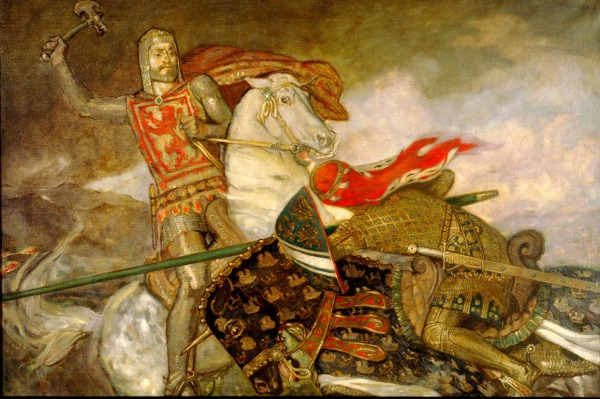
From disastrous beginnings after he took the throne of Scotland, having murdered a powerful rival, Robert I became a military leader of consummate genius. Throwing away the rulebook of medieval warfare, which favoured the mounted knight, he remodeled the Scottish army as a disciplined, audacious band of brothers capable of surprising castles, raiding and extracting blackmail as far south as Yorkshire and even defeating a mighty English army in pitched battle. Ruthless, charismatic, indomitable and lucky, the ‘Bruce’ is a towering example of an underdog capable of turning disadvantage into advantage and winning the day through talent and sheer determination.

Fiona Watson is a writer, historian and broadcaster living on the edge of the Scottish mountains rather too near the site of the battle of Bannockburn. Her most recent book was Macbeth. A True Story and she presents Scottish stories for Radio 4’s Making History. She was heavily involved in preparations for Bannockburn’s 700th anniversary and has written a graphic novel for the National Trust for Scotland about the battle. She is also writing a more traditional novel which has nothing whatsoever to do with Bannockburn set in the 1720s in the Highlands and the American colonies.

Pocket GIANTS: Robert The Bruce (published by The History Press, August 2014) To find out more click here. To find out more click here.


What makes Robert The Bruce different from any other land-hungry, sword-swinging, peasant-oppressing medieval ruler?

Well, you could say that he was your typical power-hungry, sword-swinging nobleman eager to make the most of a rather flimsy claim to the Scottish throne. The difference would be that he proved, somewhat unexpectedly given his rather mediocre record up until 1306, exceptionally good at being a king fighting for the freedom of his kingdom.

How did you go about setting the life in the times?

Well, I have been studying the Anglo-Scottish wars in general for far more years than I would like to admit, especially the period when Edward I was alive. It made sense to then go that bit further and look at the hero king, whom I knew pretty well while he was still Earl of Carrick. But, as with any great figure (especially one with such a dodgy start to his royal career), you have to be very careful not to just accept the hype that was written about him by his own propagandists and in the 700 years since. As with current politics, there is a lot more disagreement in reality than those trying to stage-manage things would like us to believe.

What is the best little known fact about Bruce?

ooooh, tricky, since we don’t have so very much personal stuff to go on. But I like the fact that, four years before he died, he gave his great friend, James Douglas, a charter with exceptional rights over his lands, accompanied by the gift, presented personally by the king, of an emerald. Sadly, the Douglases have managed to lose it (along with most of their lands). The Good Sir James had his own room in Bruce’s newly-built mansion at Cardross near Dumbarton and was with him pretty constantly before he died.

Which actor would you cast to play Bruce?

Yes, well, it’s about time there was a film about him, isn’t it? A bit late for Sir Sean. I would have had Peter O’Toole, who was just wonderful as Henry II in The Lion in Winter. And it’s a pity that Michael Fassbinder has got to Macbeth first. It has to be someone capable of complexity. I suppose Daniel Craig might be looking for a new job soon…

Who were the women in Bruce’s life, what impact did they have?

We don’t really know anything much about his mother, but his sisters were feisty characters. One of them, Mary, bad-mouthed Edward I and so was treated very harshly when she was captured, ending up suspended in a cage from the walls of Roxburgh castle. Then there was his wife, Elizabeth de Burgh, daughter of the earl of Ulster, who supposedly told Bruce off taking the throne, telling him they were no more than ‘the king and queen of summer’. And the Countess of Buchan, who left her husband to take part in Bruce’s inauguration as a member of the Fife family, who usually played a key role in that ceremony. She ended up in a cage as well.

And finally Marjorie Bruce, the king’s daughter by his first marriage, though her main contribution was in having a son (who probably killed her in childbirth, sadly). That son was Robert Stewart, who became king in 1371 and whose line lasted right up until 1714. Unfortunately, it’s really hard to say very much about any of them, because the documents aren’t there.

When is the best time of year to visit Bannockburn battlefield? What are the unmissable features?

When it’s quiet is a good start. I slipped away during a bash to mark the anniversary in 2014 to go up to the statue and was pretty much on my own, trying to imagine what it would have been like exactly 700 years previously.

Unfortunately, it isn’t actually the battlefield but probably the site of Bruce’s camp between the two days of the battle. Everything else is under housing now. But if you stand at the rotunda, you can see the castle, which the English army were intent on relieving, the direction in which the English were coming and the direction that the Scots would have taken to engage them on the next, proper day of the battle. It is worth standing there too and reading the wonderful poem that Kathleen Jamie wrote to commemorate last year’s anniversary.

Does Bannockburn have greater emotional than historical significance?

It certainly used to have a tremendous emotional pull but I didn’t think that was quite so obvious last year, perhaps because of the referendum. I actually think that Scotland is getting over Bannockburn in the emotional sense, probably because we have had to put our money where our mouth is and govern ourselves to a considerable extent. We are a lot more grown up now.

Not that Bannockburn isn’t important, but I think it may be its historical significance that grows in importance now.

Was Bannockburn’s 700th anniversary a focus for celebration or commemoration?

Actually, being a smart alec, I did tell a journalist off on the radio for saying we were celebrating the anniversary. Thousands and thousands of men died on that day and I think, after 700 years, it really should go without saying that we ought to be commemorating the occasion and not being jubilant about such carnage.

Was there a spider?

No. Isn’t that devastating? The spider story was actually first told about James Douglas, but was later transferred to Bruce since, let’s face it, there is no better way to sum up his trials and tribulations and how he overcame them in the first couple of years of his reign.

What should be playing on the stereo when we’re reading pocket GIANTS: Robert the Bruce?

How about ‘The Boys are back in Town’ by Thin Lizzy. I think that would get anyone in the mood. Followed by ‘We are the champions’ by Queen to mark Bannockburn, with a side order of ‘Another one bites the dust’ in memory of Edward II.


LIKE WHAT YOU JUST READ? FOLLOW US ON TWITTER! FIND US ON FACEBOOK! OR SIGN UP TO OUR MAILING LIST!

“He wasn’t the man that I – and my entire generation – had been led to believe.” – Author Warren Kozak discusses Curtis LeMay: Strategist and Tactician

I just sat back in my chair and had the realization: “My God, what if he had been on the other side?”

In November 1910 a four-year-old boy looked up into the sky above his home in a run-down section of Columbus, Ohio. To his amazement, and quite contrary to the laws of gravity, he saw there a flying machine, a Model B Wright Flyer. The boy set off in hot-footed pursuit, through lawns, streets and fields, chasing the airplane until eventually he lost sight of it. “It came from nowhere,” General Curtis LeMay wrote decades later, “…and I wanted to catch it.”

During WW2, LeMay oversaw incendiary bombing raids on 67 Japanese cities. In a three-hour period the firebombing of Tokyo killed an estimated 100,000 civilians, destroyed 250,000 buildings, and incinerated 16 square miles of the city. LeMay was unapologetic for the devastation. ”We’re at war with Japan. We were attacked by Japan. Do you want to kill Japanese, or would you rather have Americans killed?”

In a candid and challenging biography journalist and author Warren Kozak untangles many of the inconsistencies knotted together in the peculiar genius of Curtis LeMay (1906-90). Kozak unflinchingly sets his subject in context. LeMay’s times included the interwar depression years; the founding of American airpower; the European and Pacific theatres of WW2; the Berlin airlift; the reorganization of America’s Strategic Air Command and the brinksmanship of nuclear war; LeMay’s service as Chief of Staff of the US Air Force (1961-5); and (perhaps most controversially) his idiosyncratic run alongside former Alabama Governor George Wallace on an Independent ticket in the 1968 Presidential Election.

Curtis LeMay: Strategist and Tactician (published by Regnery History; Reissue edition September 9, 2014) To find out more click here.


Why Curtis LeMay?

Probably the best question because he isn’t an obvious war hero or glamorous in the slightest. But I discovered that he wasn’t the man that I – and my entire generation – had been led to believe. In the 1960s, Curtis LeMay became the caricature of the inhuman, brutal militarist. He was the George C. Scott character in Dr. Strangelove. Leftist journalist I.F. Stone called him “the caveman in the jet bomber.” He was completely dismissed by an entire generation and the country that he helped save.

I had the same attitude … based on nothing. And it was a throw-away line in a college lecture years before that always stayed with me. “You may not agree with his politics, but if you have a son serving in combat, you want him serving under someone like LeMay.” I thought that if you could entrust your child’s life to this man, there had to be more to him than the one-dimensional view I was given.

In pop culture LeMay became something of a ludicrous figure. He was the caveman in a jet bomber, a source of inspiration for Dr. Strangelove. What are the more important features to be observed once the satirical fog lifts?

When I started to research him and when I spoke to men who served under him, I found that depiction wasn’t true at all. He was brilliant, incredibly brave and cared deeply about the men who served under him. He also cared about the country he swore to protect and took his job very seriously.

The problem was that LeMay didn’t give a damn what anyone thought of him. In an era when political figures and celebrities spend vast sums of money on image makers – who coach them on what to say, how to say it and even what to wear – LeMay went in the opposite direction. He only cared about doing his job and in a strange way, he almost cultivated the sour image.

LeMay arrived in England with 35 B-17 bombers in 1942. His pilots were so inexperienced that he was afraid they wouldn’t even make it across the Atlantic. And he knew they were going to go up against the best air force in the world at that time – the Luftwaffe. So LeMay came up with one ingenious strategy after another – all of which were quickly adopted by the entire air force because they worked. The man worked 24 hours a day developing a whole new type of warfare.

Perhaps the most important skill came on his first mission. When he ordered his crews to fly straight into the target – right through the flak – they balked. They thought they would be slaughtered. But then he demonstrated the most important form of military leadership – he told the crews he believed they could take it and to prove it, he would fly the lead bomber. The lead bomber in the formation was the first bomber the enemy would target. LeMay insisted on flying the lead on every dangerous mission. He was the only general in World War II who fought in front of his troops. He thought his life was less important than accomplishing the mission.

Because of his command style, the men were willing to follow him. They came to believe in him. And although he terrified them, they revered him.

What was the LeMay Doctrine and does it have any relevance today?

The LeMay Doctrine was important then, throughout history and today. Basically, a nation should think long and hard before it makes the fateful decision to go to war. But if all diplomatic measures have failed and there is no choice, then that nation should use every weapon in its arsenal to end the war as quickly as possible. Prolonged wars help no one – not your country, not the enemy, no one. More people die and more damage is created.

But here is the kicker to the doctrine: if a country isn’t willing to do that, then it shouldn’t go to war in the first place. Think of all the wars that wouldn’t have been fought or would have been fought differently if that doctrine had been applied.

Could the LeMay Doctrine have been successfully applied to a regime such as North Korea’s in the early 1950s?

LeMay suggested it. So did MacArthur for that matter. Would the world be better off without the last six decades of the Kim crime syndicate, especially now with nuclear proliferation? Would the North Koreans be better off? Just look at the standard of living in South Korea and compare it to the millions of Koreans who have died of starvation in the North. And add their collusion with Syria and other rogue states selling nuclear technology.

Curtis LeMay won battles. He won battles as Grant and Sherman won battles, by beating the enemy overwhelmingly no matter the cost to the other side. Why did he fail in the battle of ideas against those advocating the incremental meeting of aggression with proportionate force?

You are referring to the strategy employed by Robert McNamara and Lyndon Johnson in the Vietnam War. That strategy worked in the Cuban Missile Crisis in 1962 – which was not a war but a tense negotiation – and McNamara thought it would work in Vietnam. It didn’t and the war went on for ten years and killed many more thousands of people.

If the LeMay doctrine had been put into place in Vietnam, it would have ended in either the country being free … or no war at all.

But remember, LeMay was just one member of the Joint Chiefs and the United States President is the Commander-In-Chief. Their job is to provide the President with military options. In the end the President decides. They take orders from him and they follow those orders, whether they like them or not. It was LBJ’s call and in my opinion, it was a bad one.

Hindsight is famously 20:20, but do events in Vietnam, Afghanistan, Iraq, Libya, Syria and Iran suggest to you that the time has come for a reassessment of the LeMay Doctrine as applied to war and peace?

Just look at the disaster that was Vietnam and the disaster in the Middle East today. The U.S. should have fought to win or not fought at all. However, winning in the Middle East today would have required an American troop commitment for perhaps decades. That would have taken a great deal of political will to get the American public on board and I’m not sure that was something any president could have accomplished. Don’t forget, the entire country was behind the effort in World War II but we still have troops in Germany 70 years after V-E Day. Japan too.

Wallace’s plan in ‘68 was to deadlock the Presidential election in the hope of securing victory when the tie was broken by the House of Representatives. You pull no punches in Curtis LeMay: Strategist and Tactician demonstrating why LeMay was a dire choice of running-mate for Wallace, one that made little sense for either man. Could LeMay have been unleashing a kamikaze strategy, one that would divert electoral college votes from Hubert Humphrey, denying LBJ’s Vice President victory over Richard Nixon, while also undermining Wallace (with whom he seemed to have little sympathy) as a credible candidate? If not, why on Earth did he run and run the way he did?

Very good question. Why on earth, indeed. No one I spoke to could answer that – not even his family. In the end, I could only speculate. But he was a disaster on the campaign stump. LeMay had zero political skills – actually less than zero. He didn’t even like Wallace and disagreed with Wallace’s views on race. In the end, I believe he thought he could push more votes to Nixon. The truth is that Wallace, who was a real threat in the beginning of the 1968 election, reached his high point two minutes before he announced LeMay as his running mate. Perhaps Wallace would have collapsed on his own, but there is no doubt that LeMay was a disaster on the campaign – saying everything a candidate should not say.

What sort of people did you meet, and what sort of places did you go, in your search for Curtis LeMay?

I met the most extraordinary people I’ve ever had the privilege to meet. Men in their 90s – many gone now – who served under LeMay in World War II. These men were extraordinary heroes – and I believe that word is over used today. But they went in those planes for 25, 35 some even flew 50 missions. Statistically they shouldn’t have survived. Over 60,000 U.S. airmen were shot down. But they kept going back. When I asked Judge Ralph Nutter, a Harvard trained lawyer and judge how he could do that, he looked at me and said: “It was just that kind of war.”

The reason I have lived a wonderful life in freedom is because of these men. It was just an honor to be next to them. I wanted to set the record straight about LeMay and I wanted people to know that he wasn’t what they were told he was … but meeting these men was such an added benefit. I will be grateful for this forever.

A few years ago I was invited to address the Air Force Academy. I flew into Denver and met Janie LeMay Lodge, his daughter, at the airport. We drove down to the Academy together and stopped along the way to have lunch. When we sat down, she put a box on the table. I asked “What’s this?” She said, “Just read the card.”

She wrote how grateful the family was to have the record set straight. She said she wanted me to have something of her father’s, but almost everything went to the Air Force Museum or the Smithsonian. Writing a biography of someone who is no longer living can be strange – I spent 4 years trying to get into this man’s head and understand him and I knew I would never meet him nor did I have anything that actually belonged to him. So I opened the box and there was his Zippo lighter … very well used. In the U.S. military, Zippo lighters are a very personal object. They are a very big deal. I was very moved.

What is the most common misconception you encountered from friends and family who heard about the project and what did you do to put them right?

I was walking down the street and ran into someone I knew right when the book came out. When she saw me, all said was: “I hated him.” Not “how are you?” or even “hello.” Just “I hated him.” I understood whom she was referring to. I must have been feeling some of LeMay’s belligerence and instead of just smiling, I asked her a counter question: “Did you like winning World War II?” … “Did that work for you?” She was silent.

Most people under a certain age never heard of LeMay. He’s been forgotten. That’s another reason I wrote the book.

I have to tell you one thing that I learned. Up until I wrote the book, I always thought of World War II as some gigantic mass that fell upon the earth and swayed this way and that way from 1939 to 1945. If you were lucky, you survived. If you weren’t, you died or someone close to you died.

I never thought one individual could make a difference in something that big. But one night … late … I just sat back in my chair and had the realization: “My God, what if he had been on the other side?” Just a simple question, but I realized just how much this one man had accomplished through sheer force of will. Of course one man didn’t make the difference between winning and losing, but there were a few who had a huge impact on the outcome and LeMay was certainly one of them.

What should be playing on the stereo when we’re reading LeMay?

Sorry, can’t help you with this one. I read in quiet.


LIKE WHAT YOU JUST READ? FOLLOW US ON TWITTER! FIND US ON FACEBOOK! OR SIGN UP TO OUR MAILING LIST!

“My aim is to write history like Bill Bryson writes travel books.” – Author Colin Brown discusses The Scum of the Earth

“We came closer to revolution post 1815 than at any time since the civil war of 1542.”

In 1938 the Scots Greys buried one of their own on Edinburgh’s Castle Esplanade. The hero they honoured, Ensign Charles Ewart, had distinguished himself at the Battle of Waterloo by capturing a regimental eagle from Napoleon’s 45e Régiment de Ligne.

Despite his fame and renown in the heady aftermath of victory, Ewart’s original grave in Greater Manchester was abandoned, all but forgotten, for the better part of a century. The neglect Ewart experience in death, was reflected in that of many of his comrades when they returned home to a regency Britain at war with itself.

Colin Brown was a lobby journalist for 30 years, first for The Guardian and then for The Independent, with a couple of years as the political editor of The Sunday Telegraph. Taking Wellington’s description of his own men – The Scum of the Earth – as his title, Brown tells the story of what happened to ordinary soldiers like Ewart after the initial flush of victory wore off.

The Scum of the Earth: What Happened to the Real British Heroes of Waterloo? (published by The History Press, May 2015) To find out more click here.


Was Britain on 19 June 1815 a land fit for heroes?

It was a country in turmoil – hundreds of thousands out of work from farms and factories, wages cut, the price of bread was increased by Act of Parliament, cottagers relying on subsistence farming were forced to leave the land by the Enclosure Acts, national debt increased to 230 per cent of GDP, and there was an economic slump. The Government reacted to the decisive defeat of Napoleon with austerity – the army was cut over five years from 233,000 in 1815 to 92,000, adding to the jobless seeking work. Eventually, the huge changes brought about the industrial revolution brought an economic boom to Britain, but that took another twenty years.

It’s the 200th anniversary of Waterloo. You’ve warned of the dangers of “an anniversary of misty-eyed backslapping”. Is that what has happened / is happening?

My book was criticised as “a left-wing whinge” on Amazon, which underlines the extent to which people want to read about the glory and the blood of the battle, not the uncomfortable truth.


Brits like to think of themselves as great at pomp and pageantry. Are they as good at commemoration vs. celebration?
The organisers of the national service of commemoration at St Paul’s warned guests it was “not triumphalist”. I think they got the balance right.

Which better defines the character and career of the Iron Duke, Waterloo or Peterloo?

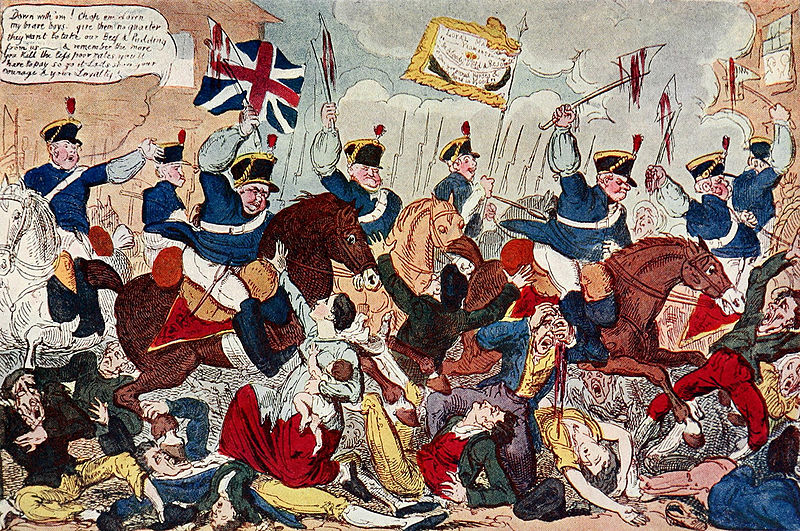
Waterloo; he was undoubtedly a great commander at the peak of his ability at Waterloo. Wellington’s political stand was certainly a contributory factor to Peterloo – his fear of revolution; and his failure to respond to reasonable demands for political reform led to his own political defeat by forces which were unstoppable. But there were others to blame for the massacre, including a lack of a proper civil authority that knew how to handle peaceful demonstrations.

Why didn’t Britain experience the political upheavals that beset continental Europe in the decades after 1815?

We came closer to revolution post 1815 than at any time since the civil war of 1542. But repression worked. The Six Acts, including the ban on the press, the ban on meetings, and the suspension of Habeas Corpus, with the gallows or deportation to Australia for minor offences was enough to keep the lid on the seething discontent for nearly twenty years. In the end, the Government had to concede reform with the vote, however limited.

But I also believe the repression worked because it was coupled with a lack of revolutionary zeal among the British public. As I say in the chapter on the Cato Street conspiracy, any would-be revolutionary should study the Cato Street files in the National Archives: they include many anonymous tip-offs from the general public warning the authorities that revolutionaries are plotting an attack on the Cabinet.

Of all the individual stories you’ve uncovered researching The Scum of the Earth, which most shaped your thinking and conclusions?

Francis Stiles and the battle with his commanding officer, Alexander Kennedy Clark, over who captured the Eagle of the 105th Regiment (now in the National Army Museum, Chelsea). The Eagle itself is a moving symbol of war: men shed blood and died for possession of that gilded bird, on top of a black wooden pole. It symbolises the gore and the ‘glory’ of war – it represented regimental pride; it was a reason why the ordinary men stayed and fought, and did not run away. It also represented the grandiose ambitions of the Emperor Napoleon, who wanted his soldiers to be like the Roman legions that ruled the world. The struggle by Alexander Kennedy Clark to gain the credit for capturing it represented a very real battle of class – the ordinary trooper against the landed gentry.

What happened to Stiles was an object lesson in how the army brushed an awkward problem under the regimental carpet: Stiles was paid for his silence, then dumped: he was promoted to sergeant; then in 1816 – the same year that he wrote to an officer asking him to confirm that he, Stiles, not Alexander Kennedy Clark, had captured the Eagle – he was made an Ensign, almost doubling his pay from 2s 11d a day to 5s 3d a day but it was in the West India Regiment which was unpopular because it could mean serving in the West Indies with the risk of malaria and other diseases. On 28th December 1817, he was put on half pay 2s 71/2d a day and effectively discharged from the army. This seems to me to be a plan to silence Stiles. By 1817, nobody was interested in who captured the Eagle. Stiles died in poverty; Alexander Kennedy Clark became Queen Victoria’s ADC.

This story still rankles with some of the NCOs of the Household Cavalry. After reading my book, some members of the Blues and Royals – his regiment – arranged to have a plaque put up to Stiles at St John’s church, Clerkenwell, where he was buried. I am glad I found the painting The Captive Eagle to use for the front cover of my book. But why was the painting in Great Yarmouth Town Hall, and not the National Army Museum? Could it be that the Army still won’t give Stiles the credit?

What sort of places have you visited for the sake of your research, or was it all dusty libraries and the Public Records Office?

I make a point of travelling to key sites to get a sense of place. My aim is to write history like Bill Bryson writes travel books. I therefore went twice to the battlefield at Waterloo, particularly Hougoumont; Salford central rail station to see the car park where Ewart was buried; the back of the Radisson hotel, Manchester, to walk the place where John Lees was battered in the Peterloo Massacre; to Oldham to pace out the route Lees would have taken when he started the march to Manchester; Oldham parish church, where he was buried; Edinburgh to see the Ewart memorial and the Castle where the Ewart Eagle and painting are kept; Walmer Castle, Kent, to see the dining room, where Wellington regaled his guests with stories of the battle and its political aftermath (noted by Earl Stanhope for Notes of Conversations with the Duke of Wellington).

The dusty places were also fascinating – the Hartley Library containing the archive of Wellington’s papers at Southampton University allowed me to hold the letter he wrote in 1813 attacking the ‘scum of the earth’; Apsley House, London, the Duke’s home; and Chethams library in Manchester, for its unrivaled collection about Peterloo.

I also visited the National Army Museum, the Guards Museum and the Woolwich artillery museum. I was surprised to discover that regimental museums are not publicly funded, and heavily rely on amateur volunteers, which accounts for their patchy performance. For example, the Coldstream Guards had none of the archive material I uncovered on James Graham, the “hero” of Hougoumont. I think the big new discoveries in history could come with ordinary people researching the lives of their ancestors.

Do you think of Regency England as an enlightened or a primitive society? Are there social policy lessons we can learn from the period? For example, could there be a place for the “King’s Hard Bargain” as a response to modern social problems?

Wellington favoured conscription. It is hard to see how it would work in peacetime. There are superficial attractions to national service, including discipline and self-awareness, but there are disadvantages – I have seen both in countries where it is still in use, Greece and Cyprus. Wellington is right in one respect – it has to apply to everyone, low or high; it could not be seen as a national service for the ‘working classes’. Middle class kids would have to serve too, and would complain if their careers were put on hold.

A national service for the unemployed, or those facing prison would bring as many problems as it seeks to solve. I think the most important policy lesson from Waterloo is to know our past. Were the defeats of Napoleon, the Kaiser and Hitler allied victories or the triumph of an island warrior race that has been called upon three times to rescue Europe from tyranny? (See my earlier book, Glory and Bollocks). With the EU in-out referendum approaching, it could become more important.

200 years on, do we treat our veterans any better?

The public do – the armed forces chiefs don’t seem to have changed in their attitude to the expendability of since Waterloo. They are imbued with the “can do” attitude, which can be lethal for their men and women. Two examples: before the Iraq war I asked Geoff Hoon, Defence Secretary, whether a) the troops had radios that worked (there was doubt) and b) the equipment they needed. He said he had been assured by the chiefs they had on both counts.

Five red caps died in an ambush because they did not have radios that worked. Men were sent on patrol in ‘snatch squad’ Land Rovers designed for Northern Ireland. As a result, men needlessly died from IEDs or were maimed and are now limbless ex-servicemen having to cope with life on charity and a pension. The chiefs are too inclined to say they “can do”, without saying, ‘actually, what you are asking the men to do is ridiculous. We could save lives by adopting a different strategy.’

For example, what was the point in defending Helmand Province in a hostile environment in the Taliban stronghold in Afghanistan? I sat through debates in the Commons when it was argued that going into Helmand was futile and likely to lead to more casualties. Bush and Blair disagreed, and the army chiefs said: ‘can do’. Now we have surrendered that land to the Taliban… for what?

What should be playing on the stereo when we’re reading The Scum of the Earth?

Never Mind the Bollocks, Sex Pistols (Anarchy in the UK).


LIKE WHAT YOU JUST READ? FOLLOW US ON TWITTER! FIND US ON FACEBOOK! OR SIGN UP TO OUR MAILING LIST!

Interview with indie author Tracey Morgan re. ‘Searching for Candy’

“One thing I can tell you is that everyone loved John, they all have so many stories and memories of him, he was generous and big hearted and almost magical.”

Tracey Morgan has a story to tell. It’s the story of a Canadian actor who became one of the most recognized, and best loved comedy stars ever to appear on the silver screen. In classics, ranging from The Blues Brothers to Cool Runnings, his performances are studies in subtly on an epic scale. John Candy (1950-1994) was a man liked and admired by everyone who knew him. And there’s the problem.

Was John Candy too nice a guy for modern publishing? Who on Earth would want to read a life entirely devoid of lurid scandals, debauched episodes, half-remembered highs and all-too-public lows? Here Tracey talks with Dan Lentell about the possibilities and pitfalls of self-publishing, as well as about the larger-than-life artist whose life she is rendering into print.

You can follow Tracey’s progress, and read fresh insights into the man and his legend, through her blog www.searchingforcandy.com & information on how to participate in crowd funding the book here.


What is your first memory of John Candy? Was it love at first sight?

My big brother was a huge influence on me and when we were younger, he was obsessed with various films, one of them being Brewster’s Millions, he used to watch that a lot and in turn so did I. Shortly after that I also saw Splash which I became obsessed with. Two very different characters in the films played by John, but both have that very human and funny element. I was always drawn to him, so yes I would say love at first sight.

What was Candy’s big break, the project or moment that made people sit up and take notice?

Well people started taking notice of him when the Second City Toronto troupe he was part of started their own TV show SCTV. Set up to rival Saturday Night Live (Second City were worried SNL would poach their talent) the show was huge in Canada and also started to get a US following.

However, I think the world took note when he played Dewey Oxberger (Ox) in Stripes, all of a sudden John was a movie star. His old agent Catherine McCartney told me John went incognito to a showing of Stripes in Toronto to see people’s reactions. He sat at the back of the cinema with Catherine and when Ox walked on screen for the first time the auditorium erupted! John was so touched he started to cry and had to leave. From then on in everyone knew who he was.

When did you decide to write his life, and was there a particular epiphany that determined you to do it?

About four years ago I was recovering from an awful bout of depression and I started revisiting things from my childhood that made me happy. One of those things were John Candy movies, there is something about Irv Blitzer, Uncle Buck, Gus Polinski, Del Griffith, Freddie Bauer, those characters that John played always made me feel like I could do anything and that it was OK to be yourself as long as you have a good heart.

So when I wanted to find out more about John I was shocked there wasn’t more about his life, the only real biography about him was written quite soon after his death and I think for some it was just too soon to talk about John, they were still grieving. The author had also decided to paint a darker side to John that I just couldn’t believe existed, so I thought I better do the research myself. They always say if you can’t find the book you want to read on the shelf, write it. Also if I am being honest, I felt like I had a calling from JC himself – just not the JC most people expect!

Have you had much contact with those who knew and worked with him? What has been their response to the project?

I have been very lucky to interview over sixty people that worked or were friends with John. Some have taken longer to trust me than others but the general response is that they are glad I am writing the book, after they have spoken to me they know that I am doing it for the right reasons. One thing I can tell you is that everyone loved John, they all have so many stories and memories of him, he was generous and big hearted and almost magical. Those that have contributed include Mel Brooks, Carl Reiner, Mariel Hemmingway, Kevin Pollak, Lonette McKee, Jay Underwood, Dave Thomas as well as many others.

There are a couple of other biographies out there, what’s going to be special about Searching for Candy?

Well for one Searching for Candy isn’t being written for money, just total love. The fact it is written from a fan’s perspective and that I have interviewed people who have not been in previous biographies will make it very different. But there is only one other biography written. Apart from that there is a fake Wikipedia article book that someone has fudged together, I don’t think anyone can class that as a work of passion.

Candy appeared in several classics, but he didn’t posses the midas touch. Did he do more than his fair share of dud flicks, or is it that he just didn’t live long enough to unassailably embellish his filmography?

John worked hard, very hard. He always thought he was going to die young so he wanted to bank role money to ensure his family were taken care of. He was also very bad at saying no and would always help people out if he could even if it wasn’t to his own advantage. In his career he was in over forty films, some that completely bombed, but every picture he did he always made the film better than it would have been without him and surely that is all any actor can hope for?

Could Candy have ever made a straight or serious role his own?

Yes, he was a brilliant dramatic actor. Just watch him playing Dean Andrews in JFK, John got to be the bad guy for a change and if you watch real life footage of Andrews you will see just what a brilliant job he did. There are also moments of true beauty in Planes, Trains and Automobiles where he will melt your heart.

How will your biography balance exploration of Candy’s professional and private lives?

Well I think his professional and private life were very intertwined. The interviews I have done dictate the balance and as many of his colleagues were also close friends it is hard to distinguish what falls into which category. He lived to work, and he lived for his family.

You’re crowd funding the project. What are the benefits and downsides?

Well the benefits so far are that I have been in contact with people like you, who have learnt about the project and have helped me promote it. I have had so many messages of support, people pledging and sharing the project and I would like to thank everyone who has contributed. If I raise the money I get to self-publish and make the book exactly as I want it to be.

The downside is that I am having sleepless nights worrying about not hitting the target! If I don’t hit the target I will find a plan B. Sometimes I think you just have to be brave, it doesn’t always work out but maybe that is because there is a better plan you have not come across yet.

What are the movies, made since 1994, that made you think, “Gosh! I wish he’d been available for that.”?

Good question! Very difficult to answer really, I think there are many roles he would have been fantastic at. I am not sure I want to say what they are, and I am not sure John would want me to, purely because he would hate me to disrespect any other actor. I think if John was still around he would have found more dramatic roles and taken on more projects as a Director. One thing for sure is his legacy still makes us laugh today.


You can follow Tracey’s progress, and read fresh insights into the man and his legend, through her blog www.searchingforcandy.com & information on how to participate in crowd funding the book here.

Ft. Encounter With The Karaoke Cabbie

You can hear Brian Mitchell, Edinburgh’s own Karaoke Cabbie, live on the Christmas ’14 edition of Edinburgh Nights. 15:00-16:00, Friday 19th December on Shore Radio. Alternatively you can subscribe to the podcast here.


I tumble into a taxi on Hanover Street, or is this Frederick? I’m never entirely certain, even at the best of times, and it’s been a good night. If I am no longer exactly on the level, here’s hoping the Great Architect of the Universe can keep me straight until I’ve staggered up the wooden hills to Bedfordshire. But this is Edinburgh and you can’t escape unanticipated spectacle so easily.

“Do you like music?” Is there someone else in the cab? Hazily, I remember the first episode of Sherlock, and that there is ALWAYS someone else in a hired hackney. “I don’t mind a tune mate,” I reply to the driver’s enquiry. A pause and then he asks, “You like Barry Manilow pal?” To this I’m …er… less committal. And that is how the conversation started. That’s how I encountered Brian Mitchell, Edinburgh’s very own Karaoke Cabbie.

It’s December. It’s cold and it’s going to get colder. August is a distant memory and yet the spirit of the Fringe moves among us. Turns out I’m the audience at a hopeful’s impromptu show. Brian’s been on Britain’s Got Talent, he’s been on The Voice, and yet he’s still waiting for his break together with the recognition his gigantically gentle stage style deserves.

The backing track comes on as we turn onto Waverley Bridge – not too quiet, not too loud – this is finely tuned improv. Brian’s warms up with classics from the song book of the artist formerly known as Barry Alan Pincus (Did I know Manilow started using his mother’s maiden name after his bar mitzvah?).

I had a guy in the back one time. Said he was a big pal of Manilow’s. Said I was the best tribute act he’d ever heard.

The best lounge crooners don’t just imitate, they resculpt the classics to their own range and unique aesthetic. Listening to Brian sing you come to realise this is a guy familiar with the engineering under the artistry. He appreciates it, respects it. Why does he suppose Louis Armstrong and Frank Sinatra never meshed on stage? “Very different styles, Dan pal, what you have to understand is…”

We’re bumping over the Royal Mile. People come from all over the world to see this view. I’d never imagined it could be improved until I saw it, long after the midnight hour, bathed in the magic Brian can conjures from In the Wee Small Hours. With the Current Mrs Dan away Christmas shopping in NYC, it brings a lump to my throat. “Give us something more cheerful can’t you Brian?” Of course he can!

If there’s one thing living in Edinburgh has taught me, it’s that great art (high and low) doesn’t just happen. Years of practise are required for each single hour of top quality entertainment, and that punters are just as responsible as producers for finding and celebrating artists. Why would you leave it to the corporate clever clogs behind the Saturday Night talent shows?

Consumption isn’t just consuming only what’s been put in front of us. I needs us to go out, explore, trying something new, take a risk and watch it pay off. Yes, you might have to listen to a bit of Manilow before you get to the Sinatra, but it’ll be so worth it in the end. You might even discover that… actually… you quite like Manilow after all.

By: Dan Lentell (Seen 5 December)

Visit our Features archive.

THIS POST HAS NOT BEEN SUBEDITED

An ANZAC Memorial In Edinburgh: Dan Lentell talks to Campaigner Mike Smith

Dan Lentell's avatarKen Lukowiak

“It was an idea that got me thinking, and the more I thought about it and mentioned it to others, the more convinced I was that it should happen.”

Mike Smith runs one of Edinburgh’s best loved watering-holes, the Bow Bar, located in the heart of the famous Old Town. There he manages an award-winning array of taps featuring all that’s best and brightest in the contemporary craft beer scene.

Mike is also leading the campaign to have a permanent ANZAC memorial located in his adopted home town.

Here Mike talks to Edinburgh-based writer, Dan Lentell (who helps Ken run Warrior to Worrier), about the campaign and how it will help commemorate and celebrate the heroes and heroism associated with the ANZAC banner.


What first brought you to Edinburgh and what made you stay?

Well my father is from Glasgow, so I hold a British passport. My initial plan was…

View original post 1,313 more words

Interview with indie flim-maker Jon Spira re. ‘Elstree 1976’

ELSTREE19760146

“The film industry is horrible, it’s cynical and doesn’t care for passion or real creativity. It’s a business and nobody in it is happy. But when you choose the crowdfunding model, it’s like throwing a party.”

Film-maker Jon Spira graduated from the Scottish Film School (a part of Napier) in 1999. He started his career as a screenwriter on cult sci-fi TV series Lexx, before moving on to several other ground-breaking projects.

Disillusion with the industry drove him into (seriously) early retirement. In his native Oxford he opened Videosyncratic, a chain of two indie VHS rental stores. Despite being a hub for creatives everywhere, Videosyncratic could not swim against the digital tide forever. His letter on its passing partly inspired the creation of Edinburgh49 as a support for emerging artists struggling for recognition amid pinstriped indifference. As Joni Mitchell famously sang, you don’t know what you’ve got till it’s gone.

In recent years Jon has emerged as a well-respected voice in the British film world. He is also an in-house film-maker at the British Film Institute on London’s Southbank, where he makes documentaries about film culture and interviews talent.

His first feature film was independent music documentary Anyone Can Play Guitar. It’s about the small-town scene which spawned Radiohead, Candyskins, Foals, Supergrass, Ride and Swervedriver and became an instant classic, rated as one of the top-20 must-see music films of all time by NME.

Jon is currently promoting Elstree 1976 via Kickstarter – check it out here. In this interview with Edinburgh49 Jon talks about his early start in Edinburgh, gives his views on the film industry, reflects on past success and looks forward to his latest challenge.


What made you pick Edinburgh as a place to study in?

Because there was a photo of a werewolf in the prospectus. Honestly. I just wanted to go to film school and it was really hard working out which one was going to be right for me and I saw the photo and thought ‘Wow, this place lets you make werewolf films!’ and that was enough for me. It was the right choice too.

You didn’t stay in the city long after graduating, was that a reflection on the state of Scottish filmmaking?

I stayed for 18 months or so. I was managing Box Office Video on Lothian Road (long gone now) I left because all the work I was getting was in London; it wasn’t a reflection on the Scottish film industry, it was just where life took me. To be honest, I don’t think I ever actually engaged with the industry in Scotland.

When you think of Edinburgh now, what’s the first thing that comes to mind?

Just, you know, joyous nostalgia. I just remember Edinburgh as being an intensely creative place. I was surrounded by actors, musicians, poets, artists, comedians, photographers. I don’t think I even appreciated how special it was at the time. I was living with Roddy Woomble at the time he started Idlewild. So, yeah, when I think of Edinburgh I just think of constant creativity.

When people think of Oxford they might be more likely to think of college lawns than Radiohead et al. How did you approach chronicling a contemporary arts movement in an antiquarian setting?

Oxford is two cities. The university is very much a closed world. I grew up in Oxford and I don’t think I ever got behind those walls more than a handful of times. The Oxford I grew up in was much more like every other town. I was a suburban kid and hung out in the skeezier parts of town as I got older. One of the things that I like about ACPG is that it doesn’t even address the university. That’s just not a part of that story, none of the bands had any real ties to that world. It was definitely gratifying to show audiences ‘our’ Oxford, though.

Did the success of Anyone Can Play Guitar surprise you, or are you an arrogant git?

A bit of both. I couldn’t have made ACPG without a certain arrogance. It was made for no money and in a completely different way to how documentaries are usually made – I had a lot of cameramen quit on me. My producer quit four separate times and he’d probably be the first to call me arrogant because I was absolutely obsessed with that film.

I knew my own mind at every step of the process and had no interest in what other people thought. I made that film for me and I still don’t really care what people think about it because it’s 100% the film I wanted it to be. The success it had has been a really odd one – it’s not well known at all, it completely circumnavigated the traditional industry. We chose not to go with distributors, so we organised the cinema release ourselves and we self-released the DVD, but it found its audience.

The BBC told us the film was too niche to screen, that it was too demanding on the viewer.

We looked at the formulaic pop-culture docs they churn out endlessly and decided that actually we’d rather be niche. It’s a positive and now I aim my films squarely at the niche, at people who want thoughtful, but not inaccessible films. I love that people connected with it so strongly and that it still sells steadily but, yeah, it’s my arrogance that allowed that to happen.

Elstree 1976 explores the relationship between commerce and art, focusing on the later lives of Star Wars extras. Are the featured extras right to cash in on their relatively minor role in other people’s creations?

That’s not my call to make and I’m presenting both sides of that issue equally in the film. I will say that I’ve met a lot of these guys over the past couple of years and I can say hand on heart that, although they’re all doing it for different reasons, I’ve yet to meet one who I feel is doing it cynically or pretending to have had a bigger involvement in the films than their role as an extra. Some of them do a lot of appearances to raise money for charity and even when they’re not, they earn the money they make.

“I’ve sat with them at conventions where they literally spend a whole weekend being ignored and that doesn’t seem like cashing-in to me. Equally, I can see how frustrating it is to the professional actors who trained and played an active role in Star Wars to find themselves sharing billing with extras, it can be seen to cheapen their contribution. It’s a really interesting issue from a really interesting community.

Is there something wrong with a company such as Polygon making SO much more money from a film like Four Weddings and a Funeral than the creators?

No. Not really. It’s capitalism and we all play our role in that. If someone pays you £100,000 to make a film and that film goes on to make £100,000,000, that’s not your business. You were paid to do a job. That’s part of the reason I work outside the system.

I make no money upfront on my films. I self-fund on a shoestring budget and use crowdfunding to pay for post-production and at the end of the process I own the films outright. That’s unheard of in the industry – a director owning his own film but it’s going to become the norm. I think you’ll see a lot less millionaire directors but you’ll see film-makers who own and build their own body of work, offering it online to download and making respectable living wages from that.

Is the fall of Blockbuster a sign that film distribution is changing, that the distance between producer and consumer is shrinking, or are we simply changing formats?

Yeah, film distribution is in a constant state of flux. Despite what I just said, I don’t like where it’s heading. I don’t like the Netflix model of paying a monthly fee and streaming unlimited movies. People will get screwed in that model. Just as musicians are getting shafted by Spotify. It devalues the creative industry. It devalues film. A few years ago, you understood that a film was generally worth a tenner to you – as a cinema ticket or a dvd – now a lot of people think it’s outrageous to pay that much, if at all. It’s a shame.

Films are no longer treats or something special, they are content to be consumed. I particularly worry about Netflix and Amazon and streaming as when you have just one or two companies controlling all film consumption, it means they can act as censors. They can make films completely unavailable to the public [and] they can control and influence the market and the kind of films that get made.

I don’t like it. I still buy DVDs. I think we’ll miss video shops a lot in the next few years. Like everything else, we’ve thrown beautiful organic things under the bus in favour of wretched convenience. That experience of walking to a video shop, walking around the aisles and really browsing, chatting to the staff and other customers while you’re waiting for your takeaway is now gone forever. Replaced by an M&S £10 meal deal and a depressing flick though whatever Netflix has. Ah well.

How have you found using Kickstarter or is it too early to tell? What other projects should folks support after mortgaging their houses to support yours?

I used Indiegogo on my last film and that was a great experience. So far Kickstarter has been incredible. It’s really a gorgeous process. You get to stand infront of a global audience of people like you and say ‘Hey, I want to make this thing, I think it’ll be really good and I’m making it for the love of it. If you give me a hand, you can have a copy’ – it’s almost like bartering before money – ‘You help me do this, I’ll give you some of it’ and the wave of passion and enthusiasm and support that you get – from complete strangers – just fills your fucking heart with joy.

The film industry is horrible, it’s cynical and doesn’t care for passion or real creativity. It’s a business and nobody in it is happy. But when you choose the crowdfunding model, it’s like throwing a party. Everyone’s motives are pure, it’s all done for the sheer joy of doing it and the audience totally get that.

What projects should others support? Whatever they want.

The point is that people need to go to Kickstarter and Indiegogo and browse the things that interest them. Crowdfunding is still a young concept but it’s not as left-field as people might think. There’s a lot of business and technology choosing to fund that route now too. Just go and check it out. The last campaign that truly excited me was the Mini Museum on Kickstarter – I can’t WAIT to receive my Mini Museum!

[NB. Mini Museum by Hans Fex raised $1,226,811 from 5,030 backers.]

And finally… which character are you from Star Wars and why?

Oh, I’ve always been Chewbacca. I’m shaggy, loyal, dependable, mouthy and I’ll rip your arms out of their sockets if you don’t let me win.


Check out Jon’s first feature film Anyone Can Play Guitar here.

Note: The Kickstarter video embedded in this post don’t show up in the email notification sent out to those of you following us through WordPress (but they are on the website, promise).