49 +3 Shows to See #EdFringe15

It’s been two weeks now since the official programme launch, and we’ve finally made it through all 439 pages, featuring over 3,330 shows. Needless to say we’re VERY excited for what this year’s Fringe has in store.

Being the arts geeks that we are, Alan Brown and I have managed to narrow down a list of 49+3 shows we’re really looking forward to seeing, shared below to help guide your choices.

We haven’t been bribed, cajoled, threatened or in any other way influenced in making our selection, we’re just being honest.

+ Many thanks to Loclan Mackenzie-Spencer and Andrew Strano of Nailed It! for their song in praise of our choices!

So, without further ado…

One from each of the 10 categories:
Cabaret – Nailed It!
Children’s – Dreamkeepers
Comedy – Matt Forde: Get the Political Party Started
Dance, Physical Theatre and Circus – Hitch!
Events – Edinburgh Gin’s Night of Literature and Liquor
Exhibitions – Unexpected Excesses
Music – Afropella Night
Musical Theatre – The Bakewell Bake Off: A New Musical
Spoken Word – TES
Theatre – Trans Scripts

My top 10
The Misfit Analysis
La Meute (The Wolf Pack)
Citydash
Brian Molley Quartet – Britunes
Ushers: The Front of House Musical
Poetry Can F*ck Off
Bloody East Europeans
Clickbait
Willy’s Bitches
Smother

Alan’s top 10
Ada
Down & Out in Paris & London
Light Boxes
Our Ladies of Perpetual Succour
Picasso stole the Mona Lisa
Scarfed for Life
The Sunset Five
The Titanic Orchestra
Wendy Hoose by Johnny McKnight
What Would Spock Do?

19 other recommendations (including returning favourites from former years)
Bromance
Every Brilliant Thing
Homme | Animal
Can’t Care, Won’t Care
Austentatious: An Improvised Jane Austen Novel
Doris, Dolly and the Dressing Room Divas
The Art of Reduction and the Distillation of Humanity: Whisky Theatre
Jess Robinson: The Rise of Mighty Voice
Chicken
The Jennifer Tremblay Trilogy. Parts 1, 2 & 3
We’re not dogs
The Oxford Gargoyles: Jazz a Capella
UKIP! The Musical
Going Viral
Dorian Gray
Lemons, Lemons, Lemons, Lemons, Lemons
Richard III
My Name is…
The Rape of Lucrece

+3 we both agree on!
Crash
E15
Free for All

Phew – bring on August! If there are any other shows you think should be brought to our attention please get in touch with us at plus3@edinburgh49.com

.
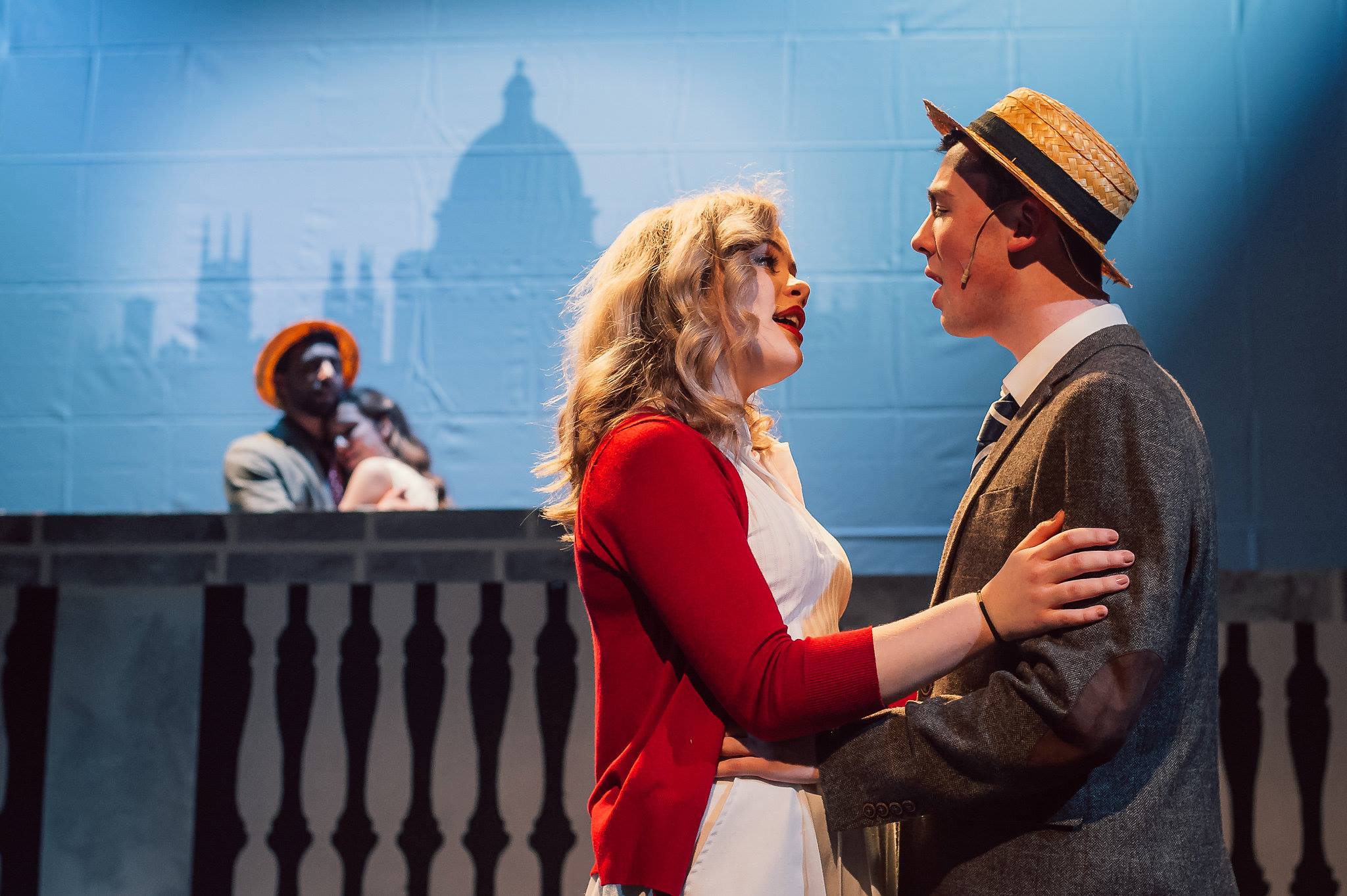
‘The Gondoliers’ (Pleasance: 17 – 21 March ’15)

fr. Eleanor Crowe as Gianetta with Harry McGregor as Marco; with Lydia Carrington as Tessa and Sean Marinelli as Giuseppe, behind.

fr. Eleanor Crowe as Gianetta with Harry McGregor as Marco; with Lydia Carrington as Tessa and Sean Marinelli as Giuseppe, behind.

 “The lovers glide through their united vocal performances”

Editorial Rating: 4 Stars:  Nae Bad

Director Thomas Ware and Assistant Director Lucy Evans set out with a vision to create a modernised version of Gilbert and Sullivan’s comic opera The Gondoliers and by the King of Barataria do they succeed! The costumes ooze Fifties glamour and glam their way through prestigious St Mark’s, ‘Oxbridge’; for St Mark is the patron saint of the original setting, Venice. Geddit? We have a show worth seeing.

His debut on the maestro’s podium saw Musical Director Steven Segaud coaxing a sound from the cast that can only be described as stunning. Conducting a 30-piece band and a cast of 33 takes great skill and his hard work paid off. The eleven-strong male chorus is perfectly matched by their female counterparts. The combined choral sound is magical and the principals more than hold their own when on their own.

Gilbert and Sullivan are notorious for weaving multiple devilishly intricate, wordy melodies that can trip up even the well-seasoned EUSOG trouper, but this cast were as quick lipped as they were quick witted. The overall sound and lasting impact more than made up for any bum notes from the band pit or stage.

Set Designer Isobel Williams and her team deserve mention for the unembellished stage design. It was most effective – using silhouettes is a clever way of determining location without having to build separate sets for the two cities and the bridge-turned-platform was also a great asset to the stage dressing; adding both height and opportunity for fun entertainment, should the need arise. What’s more, the gondoliers could then pass through ‘behind’; noticeable but unobtrusive – the audience catching no more than a glimpse of a hat, a head and an oar: a most effective direction.

Dominic James Lewis and Lucy Gibbons as the Duke and Duchess of Plaza Toro. Photos: EUSOG

Dominic James Lewis and Lucy Gibbons as the Duke and Duchess of Plaza Toro.
Photos: EUSOG

The added references of pop culture to the script did add to the hilarity of many a situation – most notably the larger-than-life Duke of Plaza Toro and his wife, the Duchess; portrayed by Dominic Lewis and Lucy Gibbons. The evident cracks in their marriage and need for lavish pomp and ceremony resulted in expectant chuckles from the audience as soon as they appeared on stage – such a reaction cannot be misconstrued. The pair’s comic timing and natural awareness and reaction to the other’s antics made for a great laugh.

Harry MacGregor and Sean Marinelli took to the roles of gondoliers Marco and Giuseppe, respectively, with an ease and camaraderie that was a joy to watch on stage. While the brothers’ vocals may not always have reflected their unity, their acting certainly did, especially when acting through technical glitches and finding love. The pair’s love interests, Eleanor Crowe and Lydia Carrington, made easy the chance to revel in G&S splendour – as Gianetta and Tessa; these sopranos worked their instruments well to produce a beautiful sound, and as a quartet, the lovers glide through their united vocal performances.

The most convincing love entanglement springs between Casilda, daughter of the Duchess – and newly made Queen of Barataria – and Luiz, a serving man. This tricky, class conflicted, love was fantastically conveyed by Ethan Baird and Ellie Millar; the pair’s pathetic battle against their feelings was poignantly funny – this poignancy only made more bitter sweet by the mellow melding of the pair’s vocals. Millar rose effortlessly through the high notes and was complemented perfectly by Baird’s rich tenor. And as with all Gilbert and Sullivan fairy tale-esque romances, the queen gets her king, strife is resolved within Barataria and Baird shows he suits both bowler hat and king’s garb.

All in all, farce and fancy that epitomizes what it means to be a Savoy Opera where life’s a pudding full of plums. Tra, la, la, ha, ha, ha, et cetera.

nae bad_blue

Star (blue)Star (blue)Star (blue)Star (blue)

Reviewer: Amy King  (Seen 16 March)

Visit Edinburgh University Savoy Opera Group here.

Visit the  Pleasance archive.

‘Chess’ (Church Hill Theatre: 10 – 14 March’15)

The Chess game between Anatoly Sergievsky (Kenneth Pinkerton) and Freddie Trumper (Ali Floyd). Photo: Alan Potter, StagePics.co.uk

The Chess game between Anatoly Sergievsky (Kenneth Pinkerton) and Freddie Trumper (Ali Floyd).
Photo: Alan Potter, StagePics.co.uk

“Gorgeous creativity”

Editorial Rating: 4 Stars Outstanding


Fifteen years ago, in what can only be classed as a folly of youth, I went all the way to Frankfurt to see a production of Chess. I tell that anecdote to highlight two key points: firstly, that performances of this musical aren’t that easy to find, and secondly that I’m a dyed-in-the-wool Chess nut. You can trust me, then, when I say it’s worth the bus trip to Morningside – because Edinburgh Music Theatre’s interpretation of the story is among the best I’ve seen.

Since its West End opening in 1986, Chess has had an appropriately chequered past. Written by Tim Rice and – of all people – Benny and Björn out of ABBA, it’s a 1970’s tale of Cold War intrigue set against the backdrop of a world-championship chess match. Being a musical, however, it’s also a schmaltzy love story; the juxtaposition doesn’t quite work, and the book’s been through a string of revisions in an attempt to find a winning endgame. Yet for all the plot’s faults, the soft-rock score ranks among my favourites, and there’s a sly humour to be found underpinning some of Rice’s more preposterous rhymes.

Without a doubt, the greatest strength of Edinburgh Music Theatre’s version is its engaging and hard-working ensemble. When they fill the stage, their voices truly fill the room, and I loved the little story vignettes that were often built into their tableaux. It’s a huge group of people, yet they’re made to seem even more numerous by a slew of rapid costume changes: far from the black-and-white styling you might be expecting, we’re treated to an unashamed riot of lumberjack shirts, sparkly pom-poms, leather hot-pants and flamboyant jeans.

There’s a gorgeous creativity to Mike Davies’ direction too – not just in the broad sweep, but in the minor detail, bringing out insights that are unexpected and new. A trivial example will show you what I mean: there’s a particular moment in a particular song when every director has the cast stamp their feet. It’s what the music seems to demand, and it captures the menace inherent in the East – vs – West storyline. But in this production, when the time comes, they look towards each other with cloying false smiles – turning the number on its head, to uncover a glorious comedy of manners.

Unfortunately though, the sheer size of the chorus occasionally overpowers the production. The iconic Anthem, for instance, is all about solitary defiance – and the impressive Kenneth Pinkerton was perfectly capable of holding the stage for it, without having twenty-odd singers troop into the foreground. More significantly, the chorus and the principals sometimes seemed to be in competition, with the leading actors’ lyrics often drowned out by a swelling accompaniment.

Among the other principals, it took me a while to warm to Ali Floyd as the American grandmaster Freddie Trumper; he lacked some of the boorish aggression his lyrics seem to imply. Still, he comprehensively won me over with his character-defining solo ‘Pity The Child’, which he performed with both vicious anger and electrifying restraint. Josephine Heinemeier also delivered some show-stopping moments as his partner Florence, while Lauren Gracie made an all-too-brief appearance as the Soviet grandmaster’s wife Svetlana. Gracie has a stunning voice, and it’s just a shame that the script (which, to be honest, isn’t all that big on women) makes us wait so long to hear it.

In the end though, the crowning achievement of Edinburgh Music Theatre’s production isn’t the solos or even the set-pieces, but the way it tells the story. The pace occasionally slips, but at their best they segue seamlessly from song to scene to song – building a sense of coherence and immediacy that even professional musical productions often lack. The climactic number ‘The Deal (No Deal)’ is genuinely exciting, presided over by a mischievous pair of god-like figures who delight in the havoc they’ve wrought. So if you’re tempted by this one, be sure not to miss it – that would be a folly at any age..


outstanding

StarStarStarStar

Reviewer:  Richard Stamp (Seen 12 March)

Go to Edinburgh Music Theatre here

Visit the Church Hill Theatre archive.

‘Rent’ (Churchill Theatre: 10 – 14 February ’15)

“Meenan is on interstellar form. His lightning fast, fluid movements suggest he’d be the one to back in a 2-on-1 prize fight against Jackie Chan and Dame Edna.”

Editorial Rating: 5 Stars: Nae Bad

“Dove sono le Puccini?” The gondolier looked up excitedly, “le puttane?!” “Err… no mate. Le Puccini? Opera a palazzo.” The Venetian working-man seemed disappointed. “Non è così buono,” he muttered sadly as we glided off towards an intimate encounter with La bohème.

Italian Giacomo Puccini adapted the narrative from Frenchman Henri Murger’s vignettes about Paris’ bohemian denizens. A century after La bohème’s 1896 premiere in Turin, American Jonathan Larson’s rock musical reimagining opened on New York’s Broadway. From there Rent emerged for one of the longest, most commercially successful, runs in musical history. Murger’s Scènes de la vie de bohème have thus been around the block so many times, the Gondolier’s puttane might have seemed positively virginal by comparison.

It’s Christmas Eve in the East Village. It’s a time before hipsters. A filmmaker and a rock musician – two noble artists, both alike in poverty – are told by their ex-roommate, now their current landlord, that they must pay the back rent owed. Solemnly they refuse. Joe Christie (as filmmaker Mark) and Nitai Levi (as rock musician Roger) establish strong leads, demonstrating possession of the several narrative arcs, the prism through which Larson’s sketchy urban landscape emerges. Jonathan Ip as landlord Benny demonstrates a determined gravity that centres the action.

Rent’s cast of bohemian characters provide fertile ground for a company well-suited to clever character studies. As Tom Collins – the maverik, homosexual college professor – Benjamin Aluwihare stands out as one of those student performers you hope will graduate into the major league. It’s all the more impressive because he is sharing the stage, romance and tragedy with Scott Meenan (as Angel, Collins’ cross-dressing significant other).

Meenan is on interstellar form. His lightning fast, fluid movements suggest he’d be the one to back in a 2-on-1 prize fight against Jackie Chan and Dame Edna. Meenan is camp, courageous, charming and – above all – courteous – daring to share the limelight so as to shine more brightly.

Not since Lily Cade met India Summers has a sapphic combo been as hot as the pairing of Caroline Elms (as lesbian lawyer Joanne) and Roz Ford (as bisexual performance artist Maureen). Both have superb presence, a mastery of pace and comic timing. Together they’re an alchemy reminiscent of Candice Bergen in Murphy Brown, Carla Gugino in Spin City, or Moira Kelly in The West Wing.

If Rent was truly bohemian (rather than theatrical hand sanitizer) we might have seen Rachael Anderson tumbled into their heady mix in a ménage-à-hell-yeah. Anderson’s jaw dropping portrayal of erotic dancer Mimi slips the surly bonds of physicality, lifting this production into a godlike orbit, circling the clumsy trendiness of Lawson’s checklist re-rendering of La Belle Époque original.

Eilidh Bruce Bass’ costumes establish the production’s look and feel as high 90s – existing somewhere between when Fraiser stopped looking like Cheers, but before Friends stopped looking like Seinfeld. Her clever attention to detail provides a palette of subtle retrospection on the period, touching up where Rent’s oh-so earnest themes have faded. The costumes achieve the remarkable feat of blending with the set without being lost in it.

And it really is a brilliant set. The band are incorporated without being outsourced to a balcony or platform. The back lighting comes through grimy green industrial window panes, each one an individual tale of neglect underscoring the dramatic meaning rising from below. The ensemble draw the various levels together passing props up and down with never a fumble. The stage right lighting rig is part of the set. That tubular grey lattice – which in most productions needs to be blanked out by the mind’s eye – it’s hanging there, at an angle, bold as brass. Who’d have thunk it? Well Andrew McDivitt did and it’s why his set designs are worth the ticket price alone (and then some).

As musical theatre Rent is what it is from when it was. The songs aren’t especially catchy, the narrative arcs are a muddled rainbow, the characters are embalmed in worthy sentiment. Jonathan Larson’s tragic death on the opening night of his work in progress denied audiences the chance to see the tweaks and changes he might have made.

Still, it’s hard not to get excited when Footlight’s production time comes around. High professional standards abound, not least from the ensemble who supercharge everything with which they come into contact. First-timer Campbell Keith is first among equals for his infectious enthusiasm, commitment and drive.

For me, as an essentially sedentary being, watching this cast might be what a flightless penguin feels looking up at a flock of starlings – isn’t it marvellous! How do they co-ordinate like that? And what kind of fish do they catch in the sky?

nae bad_blue

Star (blue)Star (blue)Star (blue)Star (blue)Star (blue)

Reviewer: Dan Lentell (Seen 10 February)

Visit Rent & the Edinburgh University Footlights here.

Visit the Assembly Roxy Bedlam Church Hill Theatre Festival Theatre King’s Theatre Other Pleasance, Potterrow & Teviot Summerhall The Lyceum The Stand Traverse archive.

THIS REVIEW HAS NOT BEEN SUBEDITED

♫ ‘A French Feast’, RSNO (Usher Hall, 6 Feb.’15)

A French Feast

“Müller-Schott’s cello lines sing”

Editorial Rating: 4 Stars Outstanding

A ‘French Feast’ of music with the Royal Scottish National Orchestra

Tall, dark-haired, handsome, talented, humble, charming – yet I still cannot begrudge him anything. Daniel Müller-Schott was the immensely capable German solo cellist taking part in tonight’s performance of a ‘French Feast’ of music with the Royal Scottish National Orchestra. In a talk in the bar of the Usher Hall with RSNO violinist Ursula Heidecker Allen prior to the concert, Müller-Schott described his musical ability as being “his mother’s fault”, she being an accomplished harpsichord player who always had the house full of music and musicians when he was growing up. He had many anecdotes, including the time his friend Philipp Lahm, former captain of the German football team, came to his house. Lahm had a go on Müller-Schott’s cello but professed that he might find it easier if he could play it with his feet!

This concert, of largely Romantic music, kicked off without the cellist. César Franck’s Les Éolides is a symphonic poem based on a poem of the same name and was composed during the latter part of his life when, as professor of organ music at the Paris Conservatoire, he was at his happiest and his work was more refined. The beginning of this piece has a lot of exposed entries by different orchestral groups and unfortunately one of the brass entries slightly misfired, but it was largely unnoticed by the audience. The silver-haired Gilbert Varga, conducting, has a very elegant baton style and strikes a debonair pose on the podium. He conducted without a score and, despite being a guest conductor, connected really well with the orchestra, conveying subtleties within the subdued dynamics which really evoked the ebb and flow of the wind subject of the original poem.

Müller-Schott  joined the orchestra for Camille Saint-Saëns’ Cello Concerto No.1 in A-minor. I liked the programme. French-born Saint-Saëns wrote the piece for Belgian cellist Tolbecque; Franck, whose music came before, became a citizen of France but was originally Belgian. Ok, maybe I’m just being a bit of a sad europhile, but it tickled me. What anybody could appreciate, however, was the quality of the performance. This is a gem of a piece of music anyway; regarded by Rachmaninoff, no less, as the best cello concerto ever written. But Müller-Schott’s cello lines sing, achieving a remarkably consistent tone from the lowest open strings through to the highest register, from dazzlingly quick triplets to whole phrases in harmonics. He achieves the hardest thing: to make the virtuosic look effortless. Müller-Schott’s own modesty showed through in the music as he let the music speak and it spoke magnificently.

The melancholic Elégie to follow was all emotion and so beautiful. Every time I hear Fauré’s music I always think “I must listen to more Fauré”. I suppose it’s akin to watching the Olympics and vowing to get fit, you know it’s good for you. The audience loved Müller-Schott’s performances and did not want to let him go. For his encore he played a movement from one of Benjamin Britten’s cello concertos. I feared at first that it would be a little too discordant for the ‘French Feast’ audience but they lapped it up. I think he could have played anything!

Some conductors are a bit too up themselves to even attempt to engage meaningfully with an audience, but Varga is not one of them and he made a deliberate, helpful, effort to introduce and explain each piece. After the intermission he quoted Einstein, “Imagination is stronger than knowledge”, and explained that “we musicians give you food for your imaginations, especially in Ravel’s Five Tales from Childhood”. Ma mère l’Oye (Mother Goose) is the collective title for them. It was a pleasant surprise to see a conductor who has the courage to get the strings to play so quietly for conductors are often “More string, please!” and it really allowed the woodwind soloists to be fully ‘cantabile’. Orchestral lead Maya Iwabuchi enjoyed some lovely, very expressive, solo lines in the 4th and 5th sections.

The finale was Ravel’s La Valse, a hugely fun, engaging piece of music which I think is difficult to get right but which the RSNO pulled-off with energy and precision. Varga’s conducting became purposefully jerky and robotic towards the end, hamming-up the idea of the music representing a petulant child breaking up his ‘waltz’ toy to make something more mechanical, supposedly better, but actually more ferocious and alarming.

Great entertainment and musical good times! We can be proud to have a national orchestra such as this and with upcoming programmes to suit a variety of tastes I would certainly recommend supporting them at a concert near you soon.

.outstanding

StarStarStarStar

Reviewer: David Jones (Seen 6 February)

Visit RSNO here.  Visit Usher Hall here.

THIS REVIEW HAS NOT BEEN SUBEDITED

♫ Kat Healy (Voodoo Rooms: 17 December ’14)

“I only seem to write songs about boys and the weather”

Editorial Rating: 3 Stars: Nae Bad

Kat Healy is an Edinburgh singer­-songwriter, based in Leith, with an acoustic, folk-influenced style. She kicked off her set with Weatherman (“I only seem to write songs about boys and the weather”), accompanying herself on guitar in a finger­picking style. There are quotations on Kat’s website comparing her to Joni Mitchell… yes… well… maybe. Certainly Kat’s voice is beautiful, expressive with a huge amount of control, able to sustain the final note in each phrase with excellent tone and apparent ease – all the more remarkable given that she is currently suffering with a heavy cold.

The patter between numbers is entertaining, chatty. Graham joins the stage on guitar for Frozen Smile, his playing style is understated, staccato notes with lots of muting, an excellent accompanist. The keys emphasise the scrunchy dissonance of the 9th and 11th chords. Kat did not play guitar for this and that allowed for fuller vocals and expression. Unfortunately the next song was spoiled by an annoying PA hum from the electric guitar that Graham had swapped to. Paul Gilbody, who had done his own very entertaining guitar and vocal slot in support earlier, joined on double bass and, for me, this didn’t add too much to the performance; mainly pizzicato root notes with octave leaps, notes that were already being played on keys.

Paul’s bass part for the next song, No Heros, did add a lot to the music, with a well­ crafted line with a nice hook which leaped effectively to a high register, overlapping with the guitar part. This was a great song, where Kat performed with a real emotional depth – though the bass notes on the keys in the chorus were a little ham­fisted.

Heart strings were tugged with a song about Kat’s late mother. However, this beautiful song was marred as the buzzing electric guitar returned and, with no other instruments playing to mask it, the fault was quite stark. Kim Edgar and Emily Kelly, who had both done support earlier, joined in for the final piece, I’ll Fly Away, from the American songbook. This was a fun, upbeat, three­ part close­harmony version. There were a few balance issues with Kim being quite a bit quieter than the other two, but they clearly enjoyed singing this song.  And that, along with a great little guitar solo from Graham, was a fitting end to the night.

As a gig it was good value at £9, especially with the three support acts. I found Kat’s professionalism of performing whilst feeling under the weather to be great, BUT starting the gig over half an hour late was not! I came to hear Kat’s amazing voice and I got that, but I do feel that she is at her best when she is not playing guitar herself. As a set then one or two more up­beat numbers would not have gone amiss, but that emotion, always on the edge of melancholy does have its place and maybe, quite possibly, the world needs a female equivalent of Ben Howard or Benjamin Francis ­Leftwich.

nae bad_blue

Star (blue)Star (blue)Star (blue)

Reviewer: David Jones (Seen 17 December)

Visit Kat Healy here

Visit our Assembly Roxy Bedlam Church Hill Theatre Festival Theatre King’s Theatre Other Pleasance, Potterrow & Teviot Summerhall The Lyceum The Stand Traverse archive.

THIS REVIEW HAS NOT BEEN SUBEDITED

Ft. Encounter With The Karaoke Cabbie

You can hear Brian Mitchell, Edinburgh’s own Karaoke Cabbie, live on the Christmas ’14 edition of Edinburgh Nights. 15:00-16:00, Friday 19th December on Shore Radio. Alternatively you can subscribe to the podcast here.


I tumble into a taxi on Hanover Street, or is this Frederick? I’m never entirely certain, even at the best of times, and it’s been a good night. If I am no longer exactly on the level, here’s hoping the Great Architect of the Universe can keep me straight until I’ve staggered up the wooden hills to Bedfordshire. But this is Edinburgh and you can’t escape unanticipated spectacle so easily.

“Do you like music?” Is there someone else in the cab? Hazily, I remember the first episode of Sherlock, and that there is ALWAYS someone else in a hired hackney. “I don’t mind a tune mate,” I reply to the driver’s enquiry. A pause and then he asks, “You like Barry Manilow pal?” To this I’m …er… less committal. And that is how the conversation started. That’s how I encountered Brian Mitchell, Edinburgh’s very own Karaoke Cabbie.

It’s December. It’s cold and it’s going to get colder. August is a distant memory and yet the spirit of the Fringe moves among us. Turns out I’m the audience at a hopeful’s impromptu show. Brian’s been on Britain’s Got Talent, he’s been on The Voice, and yet he’s still waiting for his break together with the recognition his gigantically gentle stage style deserves.

The backing track comes on as we turn onto Waverley Bridge – not too quiet, not too loud – this is finely tuned improv. Brian’s warms up with classics from the song book of the artist formerly known as Barry Alan Pincus (Did I know Manilow started using his mother’s maiden name after his bar mitzvah?).

I had a guy in the back one time. Said he was a big pal of Manilow’s. Said I was the best tribute act he’d ever heard.

The best lounge crooners don’t just imitate, they resculpt the classics to their own range and unique aesthetic. Listening to Brian sing you come to realise this is a guy familiar with the engineering under the artistry. He appreciates it, respects it. Why does he suppose Louis Armstrong and Frank Sinatra never meshed on stage? “Very different styles, Dan pal, what you have to understand is…”

We’re bumping over the Royal Mile. People come from all over the world to see this view. I’d never imagined it could be improved until I saw it, long after the midnight hour, bathed in the magic Brian can conjures from In the Wee Small Hours. With the Current Mrs Dan away Christmas shopping in NYC, it brings a lump to my throat. “Give us something more cheerful can’t you Brian?” Of course he can!

If there’s one thing living in Edinburgh has taught me, it’s that great art (high and low) doesn’t just happen. Years of practise are required for each single hour of top quality entertainment, and that punters are just as responsible as producers for finding and celebrating artists. Why would you leave it to the corporate clever clogs behind the Saturday Night talent shows?

Consumption isn’t just consuming only what’s been put in front of us. I needs us to go out, explore, trying something new, take a risk and watch it pay off. Yes, you might have to listen to a bit of Manilow before you get to the Sinatra, but it’ll be so worth it in the end. You might even discover that… actually… you quite like Manilow after all.

By: Dan Lentell (Seen 5 December)

Visit our Features archive.

THIS POST HAS NOT BEEN SUBEDITED

‘Home for Christmas’ (The Studio: 3 December 2014)

  carol-ann-duffy

little machine

“some shakin’ metaphysics to die for”

Editorial Rating:  3 Stars

As Homecoming Scotland 2014 approaches its close we enter The Home Straits, a programme of poetry and music on the theme of … home. This show, first of three, finished with the sweet tones and bitter air of Byron’s We’ll Go No More A-Roving that deserved louder applause (& participation) than our few and faint hearts allowed.

Home for Christmas is Poet Laureate Carol Ann Duffy’s idea. She is up front for the first half, reading her poems, alongside musician and Edinburgh friend John Sampson, but after the interval she sits out and Little Machine, is on stage. The band sing their settings of six of Duffy’s Christmas poems and then eight further poems, from the 16th Century ballad Western Wind to Liz Lochhead’s fervid My Way. Mood and style vary from piece to piece, from loose and cool J.J Cale to a Rocksteady lilt for Advent and there’s some shakin’ metaphysics to die for in Thomas Carew’s Mediocritie. The music making is very good – I like distinct guitar work – and the high regard for the poetry is evident in the diction.

However, it is sombre and plaintive to start with. “It’ll be over soon; home by Christmas” was the fond, forsaken hope. John Sampson’s trumpet opens with the Last Post, and then there’s Duffy’s own poem Last Post, where ‘If poetry could truly tell it backwards, then it would …. And all those thousands dead … Are queuing up for home … Freshly alive.’ Christmas Truce follows, when ‘beneath the yawn of history’ a miraculous peace broke out. The subsequent pairing of Wilfred Owen’s The Send-off with her response, An Unseen, is dreadfully poignant.

Just as sharp is the keen, deadpan, humour of three monologues from the celebrated The World’s Wife: Mrs Midas, Mrs Tiresias, and (Duffy’s favourite) Faust; and then four later poems of percipient, careful intent: Mrs Schofield’s GCSE, The Counties, The Human Bee, and Liverpool. They are all in the public domain – and not just on The Guardian’s pages – so go find them, realise their quality and why Duffy wrote them.

Little Machine had been on Radio Scotland’s ‘Culture Studio’ with Janice Forsyth that same afternoon. The trio anticipated an evening of banter and wit. Well, not really. I enjoyed their music, admired John Sampson’s playing the two halves of the recorder at the same time (do not try this at home, he cautioned) and heard really good poems, tellingly read by the poet herself, but it proved a subdued occasion, with little ‘give’ from our side of the stage. That’s what happens when the Last Post sounds. It all goes still and not in a stille nacht, glad tidings, kind of way.

Star (blue)Star (blue)Star (blue)

Reviewer: Alan Brown (Seen 3 December)

Visit ‘Little Machine’ here

Visit our Assembly Roxy Bedlam Church Hill Theatre Festival Theatre King’s Theatre Other Pleasance, Potterrow & Teviot Summerhall The Lyceum The Stand Traverse archive.

THIS REVIEW HAS NOT BEEN SUBEDITED

‘Chess: The Musical’ (Pleasance Theatre: 18 – 22 November ’14)

Photo: Oliver Buchanan

Photo: Oliver Buchanan

“Without Clark’s poise on which to pivot, the story might have given up and defected to the bar.”

Editorial Rating: 4 Stars: Outstanding

Priests, poets and psychiatrists all agree that the border between pure genius and melancholy madness is chequered with 64 black and white squares (with a white one always on the right). Next time you encounter that tramp in Potterrow Port, the one who’s convinced he’s Marcel Duchamp, ask him whether mad people gravitate to chess, or if chess makes them so. Chances are he’ll mutter darkly about the Lasker-Reichhelm position, but he might respond that the dedicated player lives “a monk-like existence and know[s] more rejection than any artist.”

The real Duchamp, the one who’d never been seen dead with a trolley from Aldi, directed those words to American prodigy Bobby Fischer, upon whose bizarre biography, Benny Andersson and Björn Ulvaeus (loosely) based a musical.

Inspired by the 1972 match between Fischer and Boris Spassky, the ABBA alumni spun a yarn interweaving two grandmasters’ competition in the arena, over a lady, and among the ideological roadblocks of Cold War politics. Truthfully, Gilbert and Sullivan Chess is not. The undeniable success of this production says more about EUSOG’s commitment to sampling work pas a la D’Oyly Carte than it does about Andersson & Ulvaeus’ capacity for profound historical commentary post-1815.

We enter to find the orchestra have escaped from their pit, and are lording it above the action. Production Manager Tom Turner has crammed more steeldeck into the set than went into South Park’s Ladder to Heaven. Visually the effect is elegant, the band’s movements in stylish harmony with Sam Burkett’s clever choreography. However x4 keys, drums, bass guitar, x3 violins, x2 cellos, flute, x2 clarinet, x3 trumpets, trombone, bassoon, oboe, french horn as well as percussion will tend to make a fair bit of noise and some dampening field needed to be generated for the sake of the singers down below.

Douglas Clark shone as Anatoly, making the script & song his own so as to cover the extensive narrative arc laid out for him. Without Clark’s poise on which to pivot, the story might have given up and defected to the bar. Tadgh Cullen (as Freddie) nailed Fischer’s astonishing angst. It was easy to see why Lydia Carrington (as Florence, the lady interest) would love him, and even easier to see why she left. I thought having Cullen sing his big number an octave higher than his vocal range was a brilliant piece of 4th wall smashing artistry, subtly underlining Freddie’s inner turmoil. My companion, smarter than your average bear, though it was a Boo-Boo. Cullen’s commitment held out. Our cheering was long, loud and genuine.

Giselle Yonace (as the tournament arbiter), Caroline Hickling (as Anatoly’s Russian wife), Peter Green (as the US manager), and Steven Segaud (as the mendacious USSR fixer) found the space to establish bold performances, spotlighting and supporting the main cast’s quirks and qualities. When Segaud tapped the vein of comic villainy in his character, I wasn’t the only one LMAO.

Ethan Baird’s direction emphasised the characters and the story they had to tell. But rather like flat pack furniture after the third house move, Chess is starting to show both its age and essential flimsiness. The producers are a bit young (and far too stylish) to embrace an ‘80s nostalgic short hand, but would one double-breasted suit have killed them? Would a visual of tactical nuclear warheads rolling through Red Square been so amiss? Several pieces were missing from this puzzling-out of a not so retro script.

If a musical about chess, written by the blokes from ABBA, set in the Evil Empire’s dreary dying days isn’t enough to float your Typhoon-Class, then here’s the only reason you’ll ever need to get out and kill, maim or mutilate whatever man or beast stands between you and the front row seats: Lydia Carrington.

She’s amazing. Her gorgeous voice battles down the band like Eva Green casually knocking down Greeks in the latest 300 movie. Carrington’s give and take with the male leads is as beguiling as Keira Knightley, as sexy as Elisha Cuthbert, and as anticipateringly exciting as when Elizabeth Warren made a cameo opposite John Goodman in Alpha House.

If you don’t see Carrington now, you’ll only have to pretend you did later. Unlike my VHS of Learn Chess with Nigel Short (ft. Carol Vorderman) this is one to watch.

outstanding

StarStarStarStar

Reviewer: Dan Lentell (Seen 19 November)

Visit EUSOG here

Visit our Pleasance, Potterrow & Teviot archive.

THIS REVIEW HAS NOT BEEN SUBEDITED

editor@edinburgh49.com

‘Top Hat’ (Festival Theatre: 7 – 18 October ’14)

“Hayward is Wodehousian perfection – the only actor who might do justice as Stanley Featherstonehaugh Ukridge.”

Editorial Rating: 5 Stars: Nae Bad

Michael Clarke Duncan, as death row inmate John Coffey in The Green Mile (1999), got it about right. The night before he becomes a dead man walking, Coffey is granted a clandestine glimpse of Ginger Rogers and Fred Astaire dancing cheek to cheek in Irving Berlin’s Hollywood classic Top Hat (1935). “They’s just like angels” he declares, utterly awestruck.

Expectations couldn’t be higher as we take our seats for the stage adaptation. “I wish Monty was here!” laments Companion A to Companion B, “he loves Strictly.” Monty-The-Dog’s inclusion in the lasses’ Saturday night ritual might suggest he’s more Withnail and I than WWII general. But like millions of contemporary Brits, Monty is a sucker for a sequin dress spinning at a bajillion miles an hour. If he were here, he’d be wanting dance, laughs, toe-tappin’, and above all, glamour… with a capital BLING! He would not be disappointed.

The plot is as subtle as a Shakespeare comedy, mistaken identity taking true love on a harebrained, helter-skelter ride. Boy annoys girl by dancing night and day in the hotel room above hers at an hour when even the coal porter is asleep. When she complains, he falls in love. She doesn’t and, much to the vexation of the theatrical producer of the West End show this boy is meant to be focused on, boy pursues girl from Hyde Park to Lido di Venezia.

Hildegard Bechtler’s set is a triumph, it’s how you want the 1930s to look. Art Deco, modernist, functional, and not a hint of a black shirt sneaking across il Ponte della Libertà. It’s not flawless – how come the parkscape scenery doesn’t move when the carriage does, and why is there a gap above the dressing table? But if you measure a set by how much you want to sit down in it- maybe sipping a Jack Rose while watching Katherine Hepburn mud wrestle Lucy Mercer – then Bechtler’s done alright.

The chemistry between Alan Burkitt (Jerry Travers) and Charlotte Gooch (Dale Tremont), never entirely ignites. Burkitt, former All England Tap Dancer of the Year and a Strictly Come Dancing favourite is superb, interstellar even. Gooch is both sultry and supercharged, staying cheek to cheek and toe to toe with Burkitt. They’re individually strong performances, worth the entry price alone, however they don’t seem to mesh. The double-edged lyrics of Wild About You fall disappointingly flat, while the inclusion of Rogers’ oft-quoted trusim, “I did everything he did, backwards … and in high heels,” is delivered more like a professional rebuke than a playful remark.

In contrast, the magnetic attraction of Clive Hayward (as producer Horace Hardwick) and Rebecca Thornhill (Madge, his socialite spouse) provides a true dose of human interest and drama. Hayward is Wodehousian perfection. He’s so good in fact that he may be the only actor who could do justice as Stanley Featherstonehaugh Ukridge.

Sebastien Torkia, as Tremont’s flamboyant BFF, and John Conroy, as Hardwick’s laconic gentleman’s personal gentleman, tap out Top Hat’s theatrical high notes. Torkia takes it to the edge and over, defying gravity to reach a level of lunacy that must be seen to be believed. Conroy is no less ambitious and equally brilliant, delivering each put down, as well as the story’s clever resolution, with a knowing confidence that never slips into arrogance.

Accompanying vignettes by the cast add to the seamless sparkle. I especially like the interplay between Lucy Ashenden and Edinburgh’s own John McManus in the hotel scenes which add depth and contrast. The great success of this great production is that amid all the careful choreography is a joyous piece of live theatre that will score with huffy hubby as assuredly as any bevy of sassy Strictly seekers.

Come for the dancing but stay for the theatricals. Bravo!

nae bad_blue

Star (blue)Star (blue)Star (blue)Star (blue)Star (blue)

Reviewer: Dan Lentell (Seen 9 October)

Visit our Festival Theatre archive.

THIS REVIEW HAS BEEN SUBEDITED