SCO. Mazzola, Frang. (Usher Hall: 27 Sept’18)

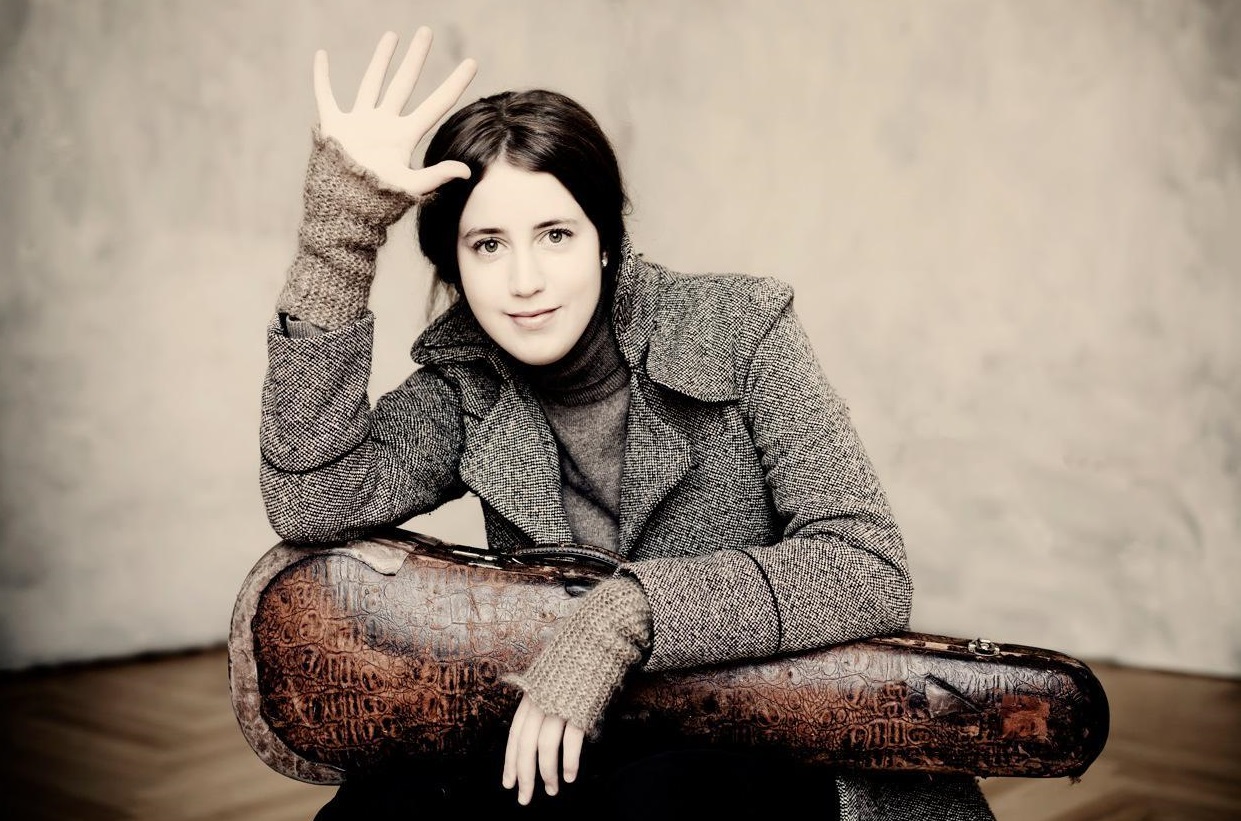
Vilde Frang
Photo: Marco Borggreve/Warner Classics


“It was a joyful, uplifting evening’s music.”

Editorial Rating: 4 Stars Nae Bad


A braw Autumnal evening met me as I walked across the Meadows to the Usher Hall for the Scottish Chamber Orchestra’s 2018/19 Season Opening Concert. The programme contained Nielsen and Sibelius and I braced myself for an evening of bleak Scandinavian forests, folklore and darkness.

I could not have been more wrong. It was a joyful, uplifting evening’s music.

Of course, Robin Ticciati was not on the podium. His replacement, Maxim Emilyanychev, was not either (he comes back next week), but instead Enrique Mazzola, Artistic and Music Director of the Orchestre National d’Isle de France and Principal Guest Conductor of Deutsche Oper in Berlin returned to take up the baton. Essentially a bel canto and opera conductor, how would he cope with this Romantic and late Romantic fare? He did fine.

The more I thought about the evening’s programming the cleverer I thought it was. How many of you have heard Sibelius’s third symphony? Two and Five, of course, but this was an interesting choice. Moreover, Nielsen is known principally for his symphonies and concerti, but an overture? Cleverer still was the positioning of the star attraction, Beethoven’s Violin Concerto, along with the soloist of the evening, Vilde Frang, in the second half. So often it’s a bit of a downer when the soloist goes home before the interval and the rest of the evening feels rather flat.

First off was Nielsen’s Helios Overture. Nielsen himself said that the work needed no introduction and indeed it was a predictable (none the worse for that) evocation of sunrise somewhat in the classical genre. After the pianissimo double basses, four horns braved the introduction and were just a tiny bit shaky on their damnably difficult to play instruments, so exposed. The orchestra very quickly found its feet with all sections playing confidently with some magnificent strings, wind and brass before it drew to a close as it had started, with pianissimo basses again. It was a pleasant relief to experience the audience sitting on their hands as Mazzola held up his hand to restrain applause rather longer than one might have expected. When it came, it was enthusiastic.

On to Sibelius’s 3rd Symphony in C. Who would dream of calling a Sibelius symphony “jolly”? But it was, and none the worse for that. In the first movement there was calling woodwind, responding strings, melodious horns, all at each other’s beck and call, ending with shades of the horn call of the 5th symphony. In the second we heard melodious flutes and unalloyed joy yet in the Sibelian mode. Come the third and a darker, sombre theme with nuances of Finlandia. A useful, unusual addition to one’s knowledge of this fabulous composer.

After the interval Beethoven’s Violin Concerto in D, written a hundred years earlier than the previous two works. Nielsen was of course a Dane, Sibelius a Finn and while Beethoven undoubtedly German his interpreter tonight was another Scandinavian, the Norwegian violinist Vilde Frang. Yet this was proving to be no Scandi Noir, Frang perhaps making the point by wearing a light coloured floaty dress rather than more conventional evening colours. The work has a long orchestral introduction and to be honest Frang looked a little spare as she awaited her entry, which she then executed extremely competently and was very much in charge for the rest of the performance as she drew a great deal of tone and volume out of her modern-ish 1864 Jean-Baptiste Vuillaume. The work is so well known there is little new for the music writer to contribute, save to say the performance was fresh, committed, with gusto, a thoroughly enjoyable 45 minute’s worth from start to finish.

Throughout the performance conductor Enrique Mazzola showed quiet authority and got everything he could and should have out of the works and the players, who responded only too happily. All done with the minimum of podium histrionics.

 

nae bad_blue

Star (blue)Star (blue)Star (blue)Star (blue)

Reviewer: Charles Stokes (Seen 27 September)

Go the SCO, the Scottish Chamber Orchestra

Visit Edinburgh49 at the Usher Hall archive.

Twelfth Night (Lyceum: 14 September – 6 October ’18)

Dawn Sievewright as Lady Tobi and Guy Hughes as Andrew Aguecheek.
Photos: Mihaela Bodlovi

“Truly festive and entertaining”

Editorial Rating: 4 Stars: Outstanding

Where to begin with this eye-catching season opener? Well, you should accept that music is indeed the food of love and that Frank Zappa is a legend, and then go to 1966 for Freak Out, the debut album of The Mothers of Invention. Side one, track six, is How Could I Be Such a Fool? (Answer: in Malvolio’s case, stupendously) and on side two you’ll find Any Way the Wind Blows, (not so freaky; more early Beatles) which nicely covers Twelfth Night’s alternative title, What You Will, with sax’, flute and clarinet.

The ‘mothers’ of this co-production from Edinburgh’s Lyceum and Bristol’s Old Vic are Wils Wilson and Ana Inés Jaberes-Pita, director and designer respectively, who brought Cockpit to the Lyceum last October. And, Wowie Zowie (.. track 7), do they pull out all the stops this time around! If mellow vibes come colour saturated and swaying with the dance moves of the early 70s, then this Twelfth Night is in the mix.

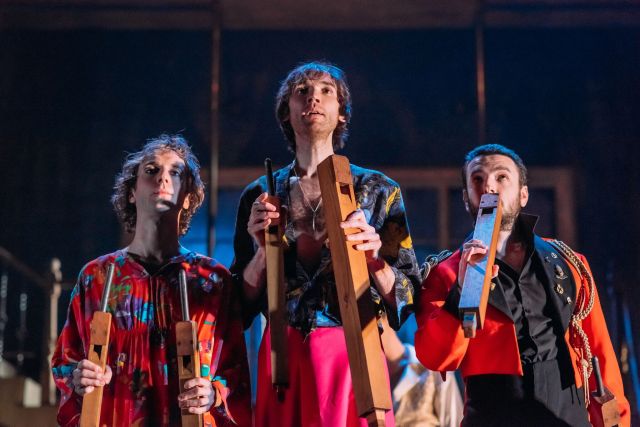
Suave Duke Orsino may have musicians ‘attending’ but these actor-musicians displace him, helped by a grand piano centre stage and blinding, wonderful costume. Were those magenta or crimson loon pants on an elongated Curio (Meilyr Jones)? Andrew Aguecheek (Guy Hughes) is a winged vision in white, gifted by ABBA, on platform shoes. Lovelorn he may be but his outing on piano to start the second half is awesome. Aly Macrea directs the band with customary, unassuming coolness, while any resemblance to Frank Zappa is accidental. It’s a delight to hear Dylan Read sing and move as Feste, once you’ve stopped admiring the blooming purple peonies on his dress.

TwelfthNight'18.2

l to r. Dylan Read, Meilyr Jones, & Brian James O’Sullivan.

Maria wears her furry mules to mischievous and joyful effect. You can forget quite how vital she is to the pace of the piece, and played well – as here by Joanna Holden – how easy it is to like her at the expense of Viola and Olivia, laden as they are with love and identity. Malvolio, the major-domo of rectitude, of proper clothes and estuary English, has no chance but, boy, does he have a go at embracing the ‘other’ side! Christopher Green has taken on (and created) many parts but this is probably his largest codpiece to date. He is also a fine singer and together with Messrs. Jones, Hughes, Macrae, and Read you do – for once – get a truly festive and entertaining Twelfth Night.

But what of love, with or without drink and desire? Frankly, they’re all subdued by fun and playacting, which the text proves it can support. Olivia (Lisa Dwyer Hogg) suffers the pangs the most, possibly because she has grey trousers. Sir Toby becomes Lady Tobi (Dawn Sievewright) who belches less but has all the gusto of the portly knight and even has room for a moment of pregnant melancholy. Viola (Jade Ogugua) and Sebastian (Joanne Thomson) are the identical twins that you’re happy to take on trust and see reunited whilst Orsino (Colette Dalal Tchantcho) has the hauteur not to care in the slightest that he has married the ‘wrong’ twin. Only Antonio (Brian James O’Sullivan) is really disappointed in love and he wins a sympathetic “Ah’s” from the audience as he exits, hurt.

When you can accept that a lava lamp and a squeeze box is a police car you know that you’re in expert hands. This is quite a rare Twelfth Night, suffused with theatre, and I enjoyed it.

outstanding

StarStarStarStar

Reviewer: Alan Brown  (Seen 19 October)

Go to Twelfth Night at the Lyceum

Visit Edinburgh49 at The Lyceum archive.

Freeman (Pleasance Courtyard: 1-27 Aug: 17:00: 60 mins)

“Brutal, fascinating, and extremely impressive.”

Editorial Rating: 5 Stars: Outstanding

Freeman is stuffed with brilliant ideas; it fires on all cylinders, incorporating hypnotic physical choreography with breathtaking performances and devastating portrayals of harrowing true stories. The performers of Strictly Arts Theatre Company produce deeply affecting characterisations and movements, breathing life into Camilla Whitehall’s tapestry of compelling episodes from history that truly deserve a closer look from today’s civilisation. The final result, as directed by Danièle Sanderson, is brutal, fascinating, and extremely impressive, though its most affecting methods are so raucously intense, the outcome is more chilling than perhaps was intended.

The narrative is principally anchored in the mid-nineteenth century story of William Freeman, a New York man treated in horrifically unjust way by the ‘justice’ system he moved in, and whose story intertwines with both the histories of institutional racial prejudice and the varied legal interpretations of mental conditions. Through this story and five similarly gripping tales, this production raises a profound and chilling question: How do we shape narratives when we bring up mental health? When has it helped? When has it made things worse?

Strictly Arts has adopted a fascinating approach to exploring these themes: after a lengthy yet graceful physical sequence set to trance-like music, the show opens in a setting recalling purgatory. Six souls regard each other in confusion, yet seem to understand they need to ‘tell their story’ so that they can all move on to whatever lies beyond. And so each illustrates their tale, as the other company members provide gorgeously crafted support to each respective retelling. They contort and combine their bodies in various shapes and figures to augment the narratives, which are both impressive and thrillingly creative each time they appear. Their recreations of a horse for William Freeman to ride, and a car during the dramatisation of Sandra Bland’s arrest are particularly riveting — and yes, Sandra Bland’s story is in this show. The stories stretch as far as 1840s Scotland, 2015 Texas, 1949 Leeds, and 2016 London, which combine for a bone-chillingly convincing assertion: when it comes to racial injustice and the horrific unfairness that non-white individuals have to face — particularly when it comes to appreciating their mental health — “nothing has changed.”

Perhaps the greatest aspect of Freeman’s 60 minutes, however, is the as-yet unparalleled talent of this acting ensemble. They are a genuinely captivating bunch, and credit must go to both Sanderson and Strictly Arts Artistic Director Corey Campbell for instilling this cast with a monumental cohesion onstage. Campbell himself brings William Freeman to life in an unforgettable performance, and he is not let down in the slightest by the surrounding cast members. In particular, Marcel White as Nigerian immigrant David Oluwale and Kimisha Lewis as Bland provide breathtaking characterisations. White delivers a compelling and heartbreaking turn as he charts Oluwale’s descent from optimism and ambition into desperation and bewilderment, made all the more tragic as the darkness of his story directly follows a sudden and joyous dance interlude set to Little Richard. Lewis’ portrayal of Bland’s doomed encounter with a fascist Texas police officer is played as a truly horrifying sequence where the remaining cast evoke the terror and pain of the thousands of Black individuals mistreated by law enforcement — this is without a doubt the most heart-wrenching moment I have experienced at the 2018 Fringe Festival. 

Yet the immense impact of this sequence and moments like it result in disorientation from scene to scene. While the show seems frenetic to the point of being intentionally jarring to experience, this becomes at times unfortunately inconclusive, and certain twists and wrenches of the narrative evoke hopelessness and confusion perhaps more than they ought to. The dance sequence that introduces Oluwale’s segment, for example, is so rich that the brutal physical violence that follows it feels garish, and somewhat cheaply vicious. Of course, these are true stories that evoke genuine anguish, so this is less a criticism of the narrative than a comment on the chilling effect on the viewer — Freeman includes lighter moments where we are given a moment to catch our breath, but in an odd and perhaps slightly misjudged order, such as early in the production, when the story of Daniel M’naghten is interrupted for some cacophonous silliness. 

Understanding those oddities of the production, this is nevertheless a fabulous piece of theatre, with unique points to make. M’naghten’s scene, in fact, contains a profoundly venerable commentary, delivered beautifully by Campbell as Freeman himself. M’naghten, played commendably by Pip Barclay, was a Scottish white man and the first person defended in court by the insanity defence; when it is his turn to tell his story, he refuses to take the exercise seriously, and decides to play around instead, until Freeman explains that while he can mess around and not care about these stories of racial disharmony, as they did not affect him, the rest of the characters, all black, are required to listen to white stories like his in order to be given a platform to tell theirs. It is a graceful, nuanced moment for which Sanderson, Campbell, and the entire company deserve immense credit for crafting so beautifully. 

Keiren Amos and Aimee Powell also deliver layered, compelling turns, as tragically-fated Michael Bailey and uncomfortably recently deceased Sarah Reed, respectively, both of whom were treated incompetently by the British justice system due to their mental health conditions. Their chapters are more factual than artistic, mostly, yet they are valuable additions to the narrative, and both Amos and Powell deserve credit for their resonantly realistic performances. 

This show is deeply important, strangely complex, and disorienting at times. But it is a vibrant and graceful hour, with a commendable amount of nuance, structure, and deep intelligence. This deserves its standout status at this year’s Fringe, and I would highly recommend it, possibly above all others, as the show not to miss, despite the thousand-yard-stare you will most likely be left with. Bravo to Strictly Arts.


outstanding

StarStarStarStarStar

Reviewer: Nathaniel Brimmer-Beller


Daliso Chaponda: What The African Said (Gilded Balloon at the Museum: 19-26 Aug: 19:30: 60 mins)

“This is must-see standup.”

Editorial Rating: 5 Stars: Outstanding

A hilarious, hilarious show. After rising to prominence on Britain’s Got Talent and touring various parts of the globe, Daliso Chaponda performs eight nights at Gilded Balloon’s Museum auditorium space, and take it from me, this is must-see standup. The comedy is clever and uproariously funny, the persona is both charming and caustic, and the hour is so packed with brilliant setups and payoffs that at only 60 minutes it feels altogether too short. 

Topics range from his road to standup, to his childhood, to his nationality, to newfound success, and other well-trodden ground for standup comedians — especially ones at the Fringe. Yet What The African Said never feels lazy or recycled; though these topics are not new subjects on the comedy stage, here they are spun with Chaponda’s unique charm and dexterity, so even an early-on Brexit joke provokes a much more appreciative giggle than 99% of the bone-tired political material bouncing around microphones all over the city.

Of course, he also ventures into fresh, intriguing territory, such as riveting takes on racism online and in person, European arrogance in education, and the hairpin tendencies of so many to take offence at so much. Some of his most delightful and arresting material takes aim at racial difference and touchiness, yet with exceeding grace and humility — it is telling that even as he acknowledged an upcoming one-liner caused (dubiously sensible) widespread offence and alarm, the audience felt prepared for a clever and commendable jab regardless of more sensitive reactions. Needless to say, the line in question is spectacularly funny and had me smiling hours after the performance; it boggles the mind that certain audiences did not feel the same. This is a man who knows how to write a joke.

Chaponda could be said to walk the fine line between probing race and racism and toying with it, yet he speaks and jokes with such confidence and wit that even his incisive commentaries are accompanied with a genuine laugh alongside them. On that topic, there is no shortage of incisive commentaries in this show; Chaponda’s comedy is matched with an impressive back catalogue of information and knowledge, which embeds his witticisms with a well-earned sense of genuine understanding, rather than flippant mockery. On top of that, the Malawi-born comedian includes some affectingly personal undercurrents to his material — not in the way so many other Fringe comedians work in an ‘emotional side’ to their standup, which has practically become clichéd by now — but again in a commendably honest and somehow quite fun aside to his more ribald suggestions.

Overall, this is a practically perfect hour of comedy, and one of the most enjoyable and rich standup performances I have experienced this year. Go and see it.


outstanding

StarStarStarStarStar

Reviewer: Nathaniel Brimmer-Beller (Seen 22 August)


Athena Kugblenu: Follow the Leader (Underbelly Bristo Square: 1-26 Aug: 17:30: 60 mins)

“A standout voice in the Edinburgh comedy lineup.”

Editorial Rating: 4 Stars: Nae Bad

In Athena Kugblenu’s new hour, entitled Follow the Leader, the term ‘pregnant pause’ gains new meaning. To explain, not only is the witty and clever comedian currently with child, but her slick and punchy new hour of standup is frequently based on letting extended, exasperated silences serve as the punchlines themselves. This approach loses no hilarity, mind you, and in fact proves quite a clever move for Kugblenu, a standup presence so engaging and poised onstage that you know whatever she says next will either be witty or a genuinely good point, and frequently both. 

Kugblenu loosely bases this show on the notion of trusting and following leaders, and how that does and does not help our ultimate goals. She incorporates funny and knowledgeable examples of leaders we probably should not admire so fervently, and contrasts them well with societal tendencies and cultural expectations that should similarly be reevaluated. Not every punchline is quite risible enough to create a consistently side-splitting hour, but ultimately, Follow the Leader is a good deal of fun and a thoroughly enjoyable walk through Kugblenu’s outlook on life and people. 

Her material ranges from political loyalties and questionable leanings to amusing anecdotes about herself and how she gets by. She touches on some hilarious ideas, such as more evidence-based alternatives to unfair government policies, and the relative pressures of ‘positive racism’ and similarly strange treatment from white to Black people. Her musings on international food and her unborn child also hit high notes, and though perhaps her material on being drunk and having sex could use a bit more workshopping, overall, this is a charming and well-spent hour of standup, and a standout voice in the Edinburgh comedy lineup.


nae bad_blue

Star (blue)Star (blue)Star (blue)Star (blue)

Reviewer: Nathaniel Brimmer-Beller (Seen 22 August)


I Love You Mum… I Promise I Won’t Die (theSpace @ Venue 45: 20-25th Aug: 15:40: 70 mins)

“The finest production I’ve seen this year”

Editorial Rating: 5 Stars: Outstanding

Death and grief are difficult topics to get right in the theatre – even more so for a young company who are not likely to have experienced much of either. Lloyd Theatre Arts (most of whom are aged 14-17), however, demonstrate maturity and sensitivity well beyond their years in this powerful life lesson.

In January 2014, 16-year-old- Daniel Spargo-Mabbs died as a result of a drug overdose at an illegal rave. I Love You Mum… I Promise I Won’t Die is a verbatim response to that tragedy, using only the words of his friends and family to tell the story of what happened. Mark Wheeller’s script, which interweaves responses from those close to Daniel, is a galling and frank account of his final few days and their immediate aftermath. Grab the tissues.

What’s most moving about this show is the painful honesty of it: the script contains all the teenage awkwardness you would expect from verbatim responses, and to their credit, the company capture this in the integrity of their performance. Some perspectives indicate a knowledge of what happened that night, some a blissful naivety, and not everyone is shown in a positive light, making it an insightful and thorough, unglossed story.

The action is also interspersed with choreographic sequences to reflect or highlight specific feelings that words alone can’t convey. Counter-balance and counter-tension are common motifs to demonstrate how much the individuals in the story relied on each other to get through the days, and these are intelligent and polished moments which show a fantastic creative engagement with the piece, as well as an emotional one. Indeed, the slickness, energy and connection throughout this performance from the whole company are indicative of hours of hard work and dedication to their craft, and the result is absolutely astonishing.

The second half of this production (which focuses more on the perspective of his family and girlfriend covering the same events) does drag somewhat, as there is little in the way of new narrative content, making it feel quite repetitive and static. Further editing to combine the two halves would help make this a more cohesive and gripping piece, but even in this state, it’s the finest production I’ve seen so far this year.

The performance quality of this production from both the young people, and the actors playing Daniel’s parents, really is first class – I genuinely thought I was watching Daniel’s friends and family tell this emotive and important story themselves. Take your children. Take your parents. And take care of yourselves.


outstanding

StarStarStarStarStar

Reviewer: Steve Griffin (Seen 21 August)

THIS REVIEW HAS NOT BEEN SUBEDITED

The Island (Just Festival at St. Johns: 3-25 Aug: 19:15/21:15: 60 mins)

“A masterful piece of literary theatre, brought to life commendably by perfectly cast performers.”

Editorial Rating: 4 Stars: Outstanding

There are plenty of captivating, harrowing setups and settings one can find at a theatre festival as dynamic and forward-thinking as the Fringe, yet perhaps the most compelling by measure for me thus far is the setting of this two-man tour de force, The Island. Though admittedly written in 1973, and staged in secret so the fascistic censorship laws of Apartheid South Africa overlooked its radical content, this play carries haunting and brilliant messages that carry weight and will move audience members even today. Onstage, the play’s performers, Siya Mayola and Luntu Masiza, are delightful leading men, and though the staging is not quite perfect, its quality and impact grows and grows on the viewer, so that by its climax, The Island proves itself a masterful piece of literary theatre, brought to life commendably by perfectly cast performers. 

Though the script itself, written by Athol Fugard, John Kani, and Winston Ntshona, does not specifically mention the name Robben Island, this production’s publicity makes very clear that this is a condemnation of the conditions and severity of South Africa’s most notorious prison compound. The script paints a painful picture of prison life with a lengthy opening sequence set in a mimed quarry, where the play’s two characters, John and Winston, lift and shovel useless piles of sand and rock back and forth; this creates a palpable sense of meaningless work and maddening repetition, yet is so drawn out it comes across as perhaps too grating a point. Next, the prisoners return to their cell, and though their performances are genuinely realistic, having been subjected to hours of backbreaking labour, their delivery is so breathless and strained for the first third of the show that it results in a peculiarly incomprehensible stretch of dialogue. As they regain their composure, John and Winston begin to discuss the thematic hook of the play: they have been granted a slot to perform the Greek tragedy Antigone for the other prisoners. 

As John, the more optimistic, theatrically-inclined of the two, Siya Mayola is a charming, mellifluous presence. He both teases and uplifts Winston with his words and suggestions, and to Mayola’s credit, and the play’s as well, his character is imbued with the sense of literary intelligence and cultural dexterity early on, without any needless exposition — economic storytelling at its best. As Winston, the more reluctant and grave, yet intermittently boisterous prisoner, Luntu Masiza presents a fascinating subject; he has been imprisoned for life for the sickeningly unworthy crime of simply burning his Apartheid-issued passbook in front of police, and though he has decided to treat his inhumane sentence with brusque humour rather than agony, Masiza incorporates moments of genuine, tragic ruminations on what his fate truly means, which are truly affecting, and brilliantly acted. 

Christopher Weare’s direction is clever, and the appropriately bare space in which this production is performed ultimately complements the starkness of the men’s prison cell, though there are some odd choices in terms of sightlines and characters intermittently turning their backs to the audience. Thankfully, the actors’ voices carry so well that these are easy to overlook. The most striking element of the show is its rising intensity and increasingly fascinating twists and turns. The story weaves itself in compelling new directions late on, and in fact one of the central elements of the dynamic between the prisoners — regarding their respective sentences — is only introduced well past the halfway point of the show. When it is brought up, however, it is discussed with devastating clarity and emotion, and credit must go to Masiza for his captivating, brilliantly-measured monologue as he explains his future in comparison to John’s. Towards the end, the prisoners get to perform their Antigone, which proves yet another fascinating turn of the narrative, and Mayola in particular shines in this play-within-a-play. Not to mention, the narrative and political implications of this particular staging within the Robben Island context is a truly inspired comparison, and left me both sickened with its implications and deeply impressed with the craftiness of its ultimate point. 

The acting is captivating, the play itself is brilliant, and the message is affecting. There are a few issues towards the beginning that admittedly force the production to take a long time to get to the heart of the matter, but when it does, The Island is deeply resonant and impeccably crafted theatre. An excellent fit for St. Johns’ Just Festival, and a worthy staging by these clever theatremakers.


outstanding

StarStarStarStar

Reviewer: Nathaniel Brimmer-Beller (Seen 20 August)


RENT (Gilded Balloon @ Rose Theatre: 16-26th Aug: 17:15: 2 hrs)

“A production bursting with raw talent, featuring some of the finest vocals on Edinburgh’s amateur stage”

Editorial Rating: 4 Stars: Nae Bad

RENT is a searing rock musical from the 1990s that was only recently knocked out of Broadway’s top 10 longest running musicals of all time by Wicked. It follows the story of a group of friends dealing with love and loss against a gritty New York backdrop, and is loosely based on Giacomo Puccini’s opera La Bohème.

Local company Captivate Theatre’s version is a slick and minimalist endeavour, editing out many of the smaller roles and songs to focus more on the main characters themselves, rather than the community of artists they move within. Yet what’s lost in pulsing power in some of the bigger moments is made up for in subtle sensitivity and slickness elsewhere, making this a clean and refreshing take on a musical that’s been doing the rounds for decades. This stripped back approach also spawns some interesting interpretations in the musical numbers, such as Today 4 U, which is almost unrecognisable as a nigh-on a capella song, though somehow works within Director Tom Mullins’ overall vision.

Yet while the minimalist ideology of this production creates many unexpected delights, the main downfall of this show is the staging and use of space, which is far too small to effectively mount a musical of RENT’s epic stature – even with the cuts and styling carried out. Unfortunately, this results in too much awkwardness on stage too often, given how important movement and isolation are to several scenes. At times Mullins makes the action work well within the constraints – in Santa Fe and La Vie Boheme in particular, the scale of the choreography matches the music, space and overall mood, but more often than not, the overwhelming feeling is one of potential – how great this show could be in a venue where it could breathe and run free.

Despite this, this is a production bursting with raw talent, featuring some of the finest vocals on Edinburgh’s amateur stage. Megan Grace in particular delivers a real powerhouse performance in every scene and song as Joanne – not to mention nailing that riff in Seasons of Love. Alex Peters as Roger and Anna Macleod as Mimi combine to create some spine-tingling harmonies in their duet moments, and it’s a shame Grace Cowley doesn’t get more time to sparkle as Maureen after her raw and gutsy Over the Moon.

RENT will always be a fantastic show, and this slick and super-streamlined version is packed with highlights and the heart needed to make it soar. But I’d love to see it return with more depth and detail in a bigger venue to really be blown away.


nae bad_blue

Star (blue)Star (blue)Star (blue)Star (blue)

Reviewer: Steve Griffin (Seen 19 August)

THIS REVIEW HAS NOT BEEN SUBEDITED

Signals (Pleasance Courtyard: 1-27 Aug: 13:10: 50 mins)

“A mature hour of philosophy and high-grade workplace dramedy.”

Editorial Rating: 3 Stars: Nae Bad

Until we know for sure, which might never be the case, the extraterrestrial is endlessly fascinating. One some level, the entirety of human existence is hinged on this question: is there anyone, anything else out there? Footprint Theatre’s engaging two-woman show Signals asks this question with an intelligent script, grounded performances, and an excellent climax, and while it is not exactly pulse-pounding, this production is a mature hour of philosophy and high-grade workplace dramedy.

Eve Cowley and Immie Davies play two data analysts on the night shift at a facility dedicated to scanning the cosmos for alien contact. For the majority of the play, they simply sit and swap comments about their co-workers, life in general, and whether their job is completely meaningless. The set is commendably simple yet effective; with only two desks and a rat king of wires and plugs, the feeling of a dingy office is created very well. Cowley and Davies’ performances are also well-suited to the piece; all their interactions, from casual chats to fiery arguments, are enjoyable to listen to and cleverly written. 

Overall, however, the show itself cannot quite muster any significant feeling other than ‘enjoyable’ for the first two thirds. While the stillness of the show is nicely reminiscent of naturalistic theatre trends, its interludes where nothing happens are overlong considering the theme of the show. Thankfully, the portion of the events when alien contact is actually realised is fabulously crafted, and genuinely thrilling — especially the two workers’ disparate reactions to the possibility that we might actually answer the ultimate existential question. This is, without a doubt, the best part of the show, and I can confidently say the final third is an excellent piece of theatre.

The rest, however, does not do the ending justice, and while the technical and performative aspects are solid, the runtime is not as well-measured as it could be. If the establishing segments of Signals took a few more notes from its ending, this still, gradual approach could have come across with a bit more verve than it currently does. This is a well-made production, but it could be much sharper, and with an injection of just a bit more energy it could be a seriously impressive two-hander. 


nae bad_blue

Star (blue)Star (blue)Star (blue)

Reviewer: Nathaniel Brimmer-Beller


Death is the New Porn (theSpace @ Venue 45: 13-18th Aug: 22:40: 60 mins)

“Another fine example of a gripping, character-driven play that Blazing Hyena really excel at”

Editorial Rating: 4 Stars: Outstanding

Death is the New Porn tells the story of a trio of vigilantes who get their kicks from following, luring and killing local criminals – all in the name of service to their society. They brag about how crime rates have fallen since they began their campaign – not just from physically stopping the perpetrators, but by spreading fear to prevent those would-be bad guys from meeting the same end. It’s a tough-talking and electrifying opening that sets up the potential for a thrilling noir-drama.

Yet rather than being an action-packed adventure about the number or profile of bodies they stack up, or police investigations they dodge, the narrative evolves to be more personal, and by the end, becomes a deeply emotional unveiling of three people trying to make sense of their own broken lives. What has driven each one to become a killer, and just how strong are bonds of blood?

The opening half of this performance has a very filmic quality, with director Catherine Exposito using the large thrust stage cleverly to create interesting angles and sightlines, with musical interludes and quick changes of pace adding to a Tarantino-esque feel. It’s a little confusing to begin with given the choppiness, but as the meat of the play unfolds, the compelling narrative and relationships between each character become more prominent, and ultimately, engaging.

Imogen Reiter, Jack Elliot and Jack Jarvis Gouther each turn in gutsy and gritty performances as the three anti-hero vigilantes, but Rosie Milne in particular impresses as supporting character Sheila – the recently released from prison recovering addict attempting to get her life back together. There’s a raw delicacy to her performance of a woman just about holding herself together that is utterly captivating to watch.

Jack Elliot’s script is on the whole very clever in its structure and development – the dialogue is natural and the sense of tension and anticipation are always high – though it would be good to get a bit more background and levelling early on. Some characters seem more well-developed than others causing a few too many gaps for the audience to fill in. There’s also quite a lot of faffing with props (especially drinks and glass) throughout, but these are minor criticisms for a work that is, on the whole, made to a very high quality.

In short, Death is the New Porn is another fine example of a gripping, character-driven play that Blazing Hyena really excel at. Highly recommended as a late-night comedy alternative.


outstanding

StarStarStarStar

Reviewer: Steve Griffin (Seen 16 August)

THIS REVIEW HAS NOT BEEN SUBEDITED