EIFF: “Puzzle” (Festival Theatre: 20 June’18)

“Genuinely affecting moments of liberation and subtle defiance.”

Editorial Rating: 3 Stars

Our first coverage of the film festival. Nathaniel Brimmer-Beller will keep them rolling.

As she addressed the gathered public at the opening screening of the 72nd Edinburgh International Film Festival on Wednesday, Kelly Macdonald expressed both gratitude — that her new film, Puzzle, directed by former producer Marc Turtletaub, was opening Scotland’s foremost film festival — and amusement that in it the Glasgow-born actress was playing an American. “I’m in nearly every frame of the film,” Macdonald continued, “so I’m sorry! But you’re in your seats and the doors are locked so you can’t leave now!”

From that introduction, one might expect Puzzle to be a point of embarrassment for the experienced actress. Macdonald has worked with talent as renowned as the Coen brothers (No Country for Old Men), Martin Scorsese (Boardwalk Empire), and Danny Boyle (Trainspotting, T2), yet Puzzle marks her first prominent, meaty leading role. Macdonald oughtn’t be embarrassed by her work in Turtletaub’s film, however, quite the opposite; yet by the time the credits roll, one is left wishing she was given more to do within all those frames. 

This, Turtletaub’s directorial debut, is a remake of Argentinian film Rompecabezas, directed by Natalia Smirnoff in 2009, and follows shrinking violet suburban housewife Agnes (Macdonald) as she gradually sheds the suffocating monotony of her daily life caring for her boorish husband (David Denman) and two insufferable teenage sons. In the film’s opening sequence, a stylistic high point in an otherwise unremarkable storytelling strategy, Agnes diligently weaves through a house party, existing in the background as her guests make a mess and ignore her. After a few minutes of watching her scrub and kowtow, Agnes reveals an impressive birthday cake, and the guests sing Happy Birthday to … her. Her servile existence at her own birthday celebration presents a perfect introduction to the character as a product of circumstance. As Agnes unwraps her presents, she finds a 1,000-piece puzzle, which, although average citizens remark it will take days to complete, she finishes within half an afternoon. Soon, she seeks out more puzzles, and through them, more control, more exploration, and more freedom, assisted along the way by her serendipitously-met “puzzle partner” Robert (Irrfan Khan). To its credit, though the initial setup of a film based entirely on one person’s self-discovery through 1,000-piece puzzles seems like an aggressively dull use of 103 minutes, the film manages to achieve some genuinely affecting moments of liberation and subtle defiance that avoid total insignificance. 

Unfortunately, I would not blame viewers for tuning out before these moments are reached, for despite that beginning, Puzzle begins to lose its grasp over its plot’s moving pieces quite quickly. Turtletaub, though partially responsible in his role as a producer on films such as Little Miss Sunshine and Loving for some of the more compelling family-based stories of the 21st century, can’t quite master the art of keeping the story fresh and maintaining depth. Too often, the dialogue between Agnes and her family lists into high-school-play levels of one-dimensionality, with displeasing references to veganism, Buddhism, and masculinity in “today’s youth” that come off as tone-deaf. Nearly every stereotypical “overdramatic indie film” line you can imagine is somewhere to be found in here, which becomes frustrating — not to mention its lamentably obvious central metaphor. In case you hadn’t guessed, the eponymous activity comes to represent the unsolvable puzzles in Agnes’s own life, and yes, there is a dramatic monologue about the cosmic connection between solving a particularly hard 1,000-piecer and solving yourself. (Though, to be fair, it is delivered by Mr. Khan, who continues to elevate uninteresting Hollywood ideas with his undeniable charm and masterful delivery — though the words he recites are unoriginal and formulaic, his performance of them is everything but.)

Overall, Puzzle does a lot more telling than it does showing. It is less a film than an overlong Hallmark ad, with a semi-profound lesson in there somewhere that is often overlooked in favor of ‘family drama’ beats that we have all seen before, repeatedly. If you are looking for bombast, style, or cutting-edge storytelling, all of which this year’s EIFF promises to offer by measure over the next two weeks, Turtletaub’s film is not for you. Yet, though such a clichéd film is a puzzling choice to open such a dynamic festival, as a calm, pensive look at a chronically overlooked type of person, this film fits well. 


Star (blue)Star (blue)Star (blue)

Reviewer: Nathaniel Brimmer-Beller (Seen 20 June)

Go to Edinburgh International Film Festival here
 

The Hour We Knew Nothing Of Each Other (Lyceum: 31 May-2 June ’18)

“A joy to watch”

Editorial Rating: 4 Stars: Outstanding

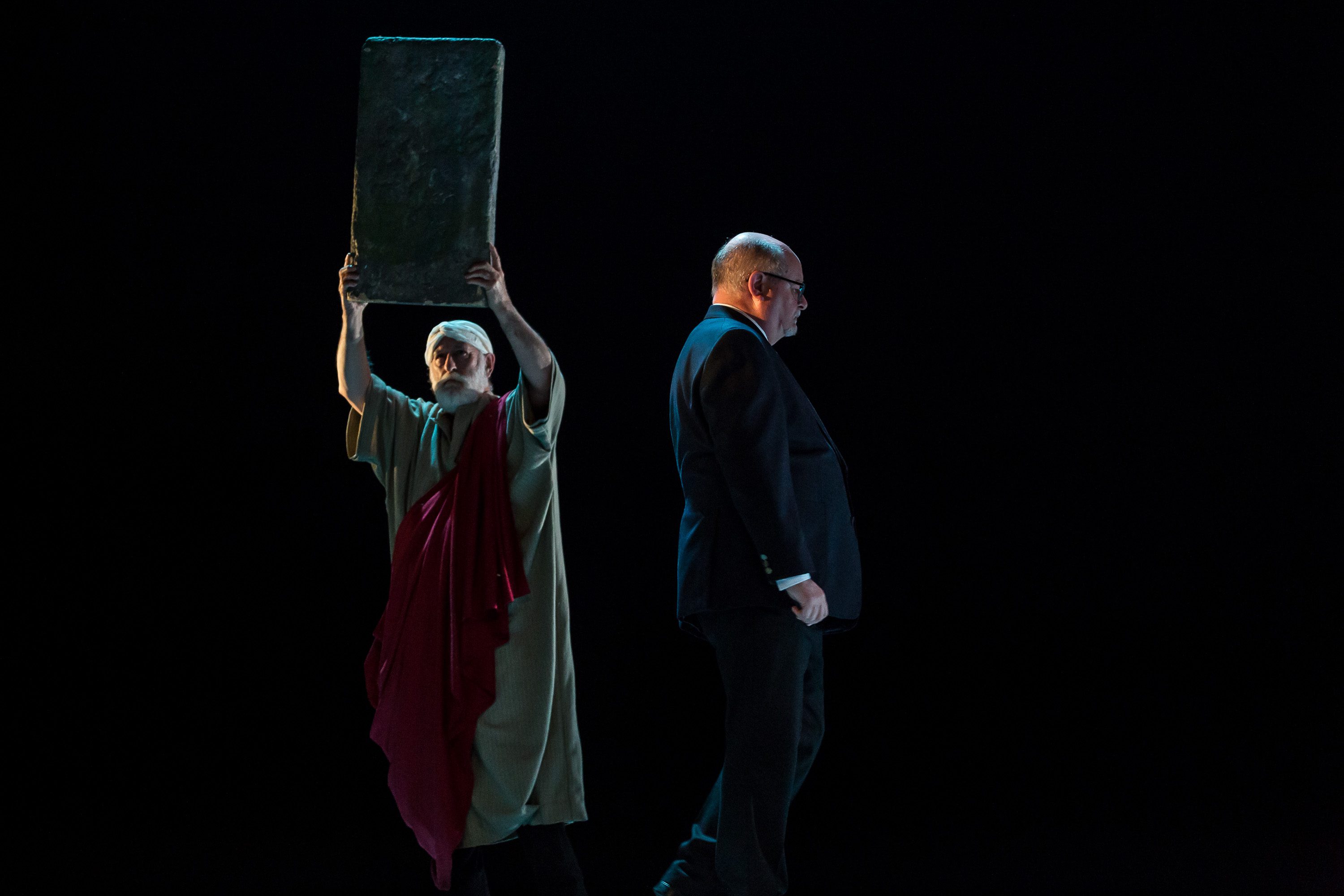
Peter Brook famously said he could take an empty space and call it a bare stage, continuing: “A man walks across this empty space, whilst someone else is watching him, and this is all that is needed for an act of theatre to be engaged.” In a masterclass of simplicity that Brook would be delighted with, The Hour We Knew Nothing Of Each Other is arguably very little more than several people walking across an empty space for the best part of 90 minutes, and the end result is nothing if not engaging throughout.

Inspired by an afternoon spent watching people come and go in a town square, playwright Peter Handke’s script transforms the actions of these normal people into a theatrical event, which is given new life here by directors Wils Wilson and Janice Parker, along with their community cast of over 90 (ninety!) Edinburgh residents.

The decision to use a large community cast works really well in bringing a sense of honesty and integrity to the action. These are people of all ages, backgrounds, shapes and sizes, with individual quirks that are celebrated on stage, but never embellished to make them ridiculous. Sure, there are some larger than life characters and a sprinkle of pizzazz to create some special moments, but the overall sense of realness conveyed by this piece makes it a joy to watch. Perhaps what’s most impressive though is how slick and deft everything is – one can only marvel at the intricacy that must go in to stage managing this huge cast and all their precise entrances and pathways on stage – it’s hard to spot a misstep anywhere.

Performed completely without words, this is a show that does ask quite a lot of an audience to keep with it, and Michael John McCarthy’s sound design and compositions are (excuse the pun) instrumental in creating a sense of wonderment throughout. His whimsical score facilitates a pleasing ebb and flow to the performance, as if you’re never sure if the music is leading the action or merely complementing it. There’s plenty of variety in the soundscape to punctuate different moods, yet enough consistency to keep it connected and grounded in some magical faraway place. Indeed, this is a production where all creative elements – from costume, design, sound, and direction (even the curtain!) – pull together towards a common goal, which manifests in a very high quality output.

In saying that, at almost an hour and a half in duration, this performance does verge on being too long and self-indulgent. In particular, the section where all performers cluster on stage feels like it should be the climax, but ends up being a surprisingly sloppy (in comparison to the rest of the show) and inconsequential few minutes, which peters out rather unceremoniously into more walking.

As a production that could easily be a rather bizarre lovechild of Samuel Becket and DV8, The Hour We Knew Nothing Of Each Other won’t appeal to everyone. But for me, there’s just such a vibrancy to this piece that leaves you 100% rooting for everyone involved. I’d happily go again.

outstanding

StarStarStarStar

Reviewer: Steve Griffin (Seen 1 June)

Visit the The Lyceum archive.

THIS REVIEW HAS NOT BEEN SUBEDITED

Gut (Traverse: 20 April – 12 May ’18)

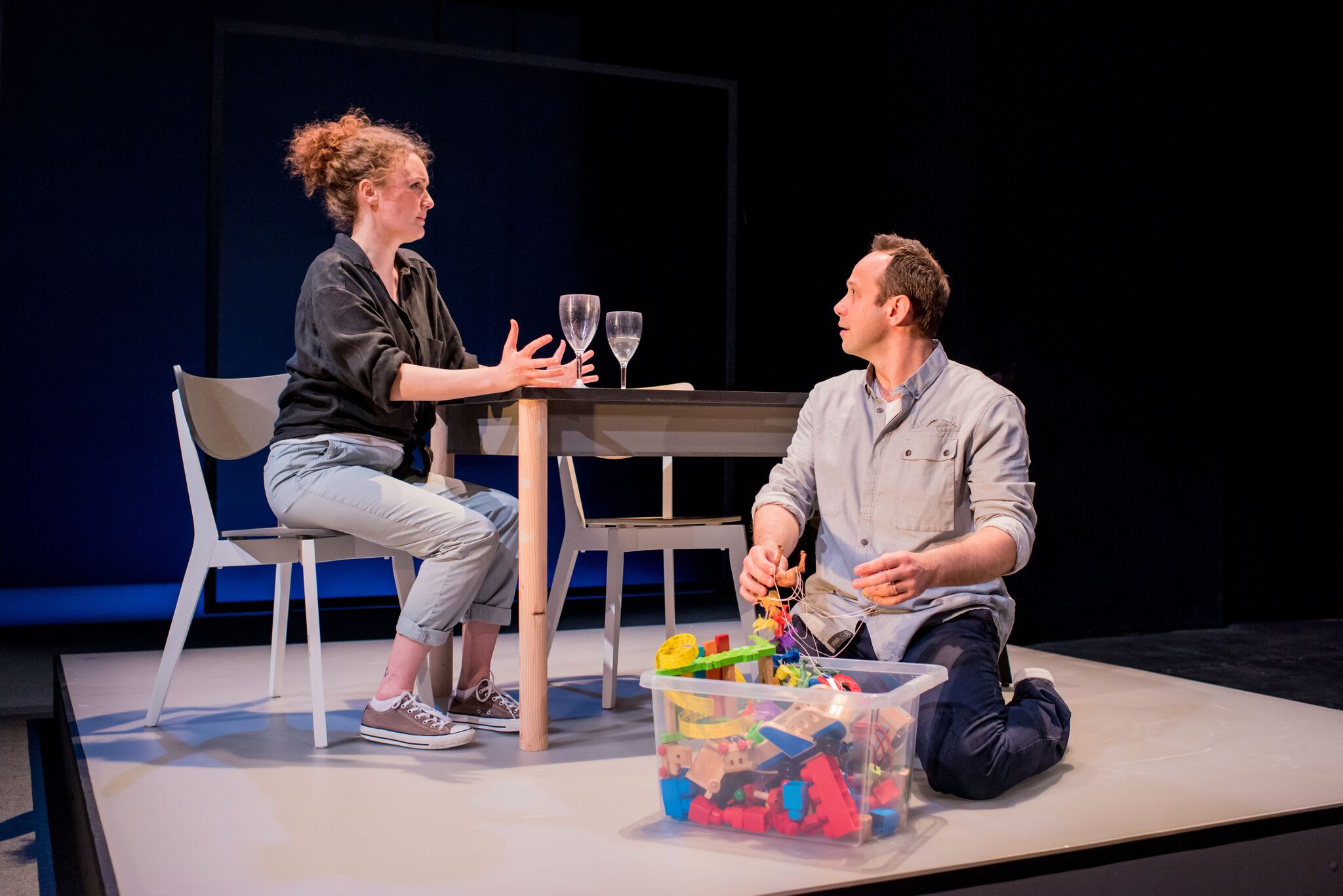
Kirsty Stuart and Peter Collins.
Photos. Mihaela Bodlovic.

‘Feel it!’

Editorial Rating: 4 Stars


Turning over a toy box can be messy but upending the presumption of innocence is in an altogether different ballpark. What happens when a nice kind man in the queue at a place to eat helps grandma out and takes your three old to the toilet? You’re allowed a gut feeling about this one and it’s probably the right one? But are you sure, really, really sure?

OK, it’s not The Place to Eat up in John Lewis’ – writer Frances Poet can only go so far – but it might just as well be. As it is, Fisher-Price’s Laugh and Learn puppy takes the biscuit for product placement. Dad, Rory, another nice bloke, hasn’t found puppy’s On-Off switch and its happy-happy tune is doing his head in. It is not so funny for Mum, Maddy; not funny at all, for where there’s an edge in this ninety minute drama she is well and truly over it. And there’s no soft play area on the other side. Is it The Stranger who pushed her or did she do it all by herself?

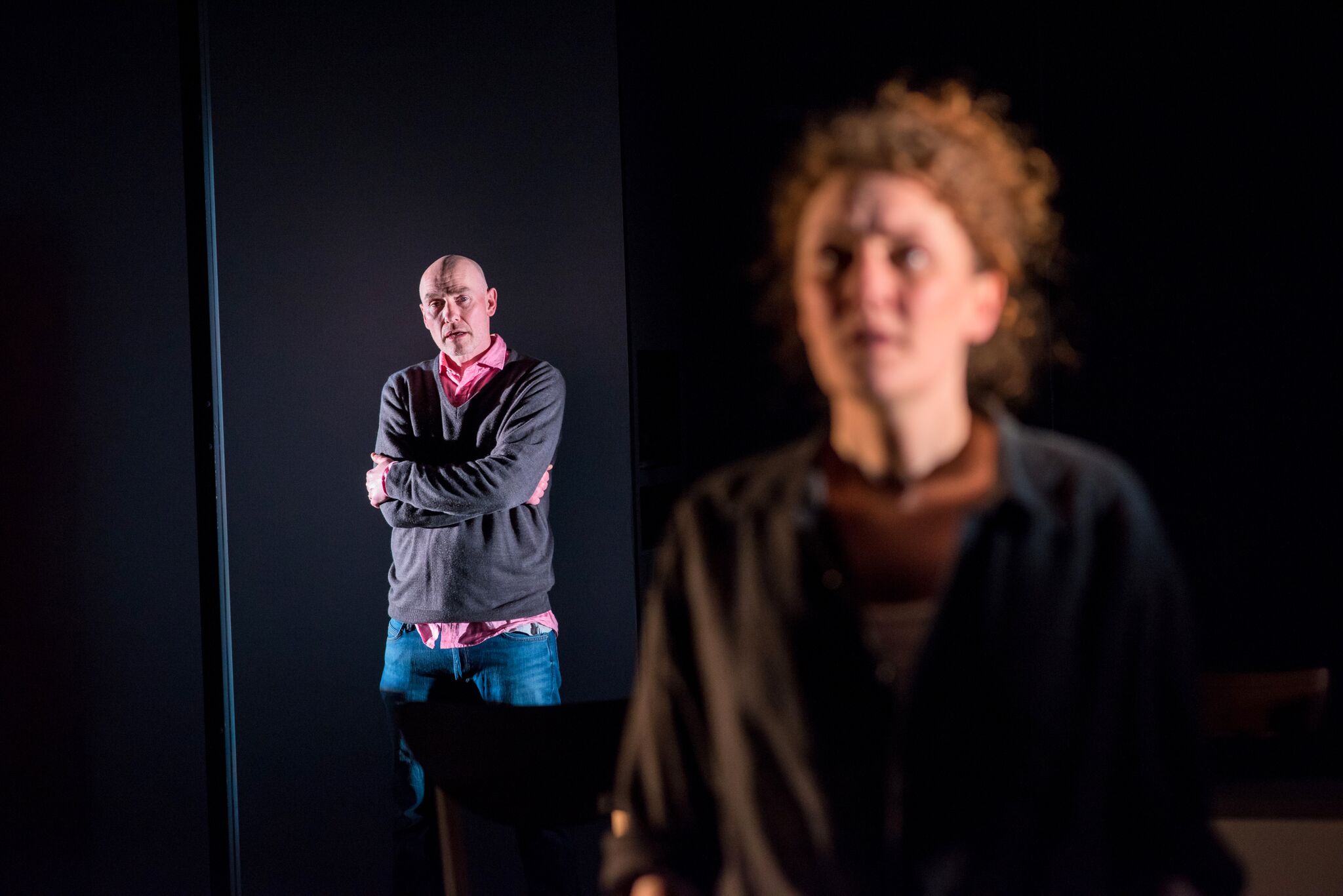
It could not happen to a more ordinary, youngish, couple, which is precisely the point. We even have a Glasgow address: 65 Kelvindale Road – and Joshua (3) goes to Nursery and Granny Morven (Rory’s mother) helps out a lot, to begin with. First it’s the baby monitor and then it all goes wrong, which is where is the creative team get it just right. There’s a broad set, minimally dressed: a table and three chairs stage left, and a garden swing stage right; large rectangular panels, one of gauze, at the back. Colours are muted, contemporary greys and creams. The exceptional lighting design by Kai Fischer marks off areas that quickly isolate and focus attention. Various Strangers cast shadows, open to frightening doubt, that contrast with the chilling white of Maddy’s psychiatric stay. Michael John McCarthy’s music is spare and quietly ominous while Zinnie Harris’ direction is one keen judgement call after another. The overall effect is a silent ‘House’ in the grip of a familiar, media churned nightmare that cannot be shaken off.

George Anton and Kirsty Stuart.

The script is conversational, inviting immediate and natural responses that seem at odds with the enveloping paranoia. Kirsty Stuart as Maddy is never more convincing as a loving mother than when she details her appalling behaviour. Rory (Peter Collins), who loves her to bits, can sort out toy trucks forever and still not get close to her. His mother, Morven (so believable by Lorraine McIntosh) can only be bewildered and hurt. George Anton is seven different Strangers, sympathetic in one light, scary in another. Presence is all and Anton delivers each time. The impassive concern of his police officer is especially alarming.

The initial setup is a little shaky, rather plastic. Can Maddy be that brittle? But if that’s a weakness the stage work carries it all the way. Gut succeeds in demonstrating that once parenting turns into child protection then it is a nervy, mind shredding issue. Feel it! Stand behind a swing and you risk getting your teeth knocked out but you can get thrown off a see-saw and bang your head just as easily. That, for me, is the audience’s experience. Up and down, up and down, see the Stranger, and then it’s touch-and-go (so to speak) whether it’s playtime or, ‘Wallop!’ “Mum’s out of it”.


Star (blue)Star (blue)Star (blue)Star (blue)

Reviewer: Alan Brown (Seen 24 April)

Go to Gut at the Traverse

Visit Edinburgh49 at the Traverse archive.

Dunedin Consort, Vivaldi’s ‘La Favorita’ (Queen’s Hall: 6 April ’18)

Dunedin Consort: Vivaldi’s La Favorita

“The very essence of live music making”

Editorial Rating:  5 Stars: Outstanding


Was this going to be, if not too much of a good thing, well, just too esoteric? It was a risk, and, while the stalls were a little over half full and just a few concertgoers in the balcony, such attendance levels are not unusual at the Queen’s Hall for chamber music. With Vivaldi, take away The Four Seasons and the Gloria and what have you got? A series of mostly string concertos that all sound very similar.


That is the perception. Friday’s concert by Edinburgh’s own Dunedin Consort proved it wrong. A cleverly chosen selection of seven string concertos from a cache of 27 manuscript volumes of composition discovered in Northern Italy in the 1920s provided a glorious treat of baroque music that whilst not having the gravitas or structure of his German contemporary Bach was a rewarding example of the Italian Baroque, and in many ways gentler on the ear. If Bach is the master of counterpoint, then surely Vivaldi is the master of ritornello? The tutti passages are more rounded.


The programme was titled La Favorita and this writer’s wicked sense of humour wondered if it was sponsored by a smart Edinburgh pizza group with its blinding, wood-fired, Cinquecentos. Not so, the title would have referred to one of the star female pupils under Vivaldi’s tutelage at the Ospedale della Pietá in Venice for whom a number of these works were written, possibly the mysterious “Anna” about whom we know very little. The boys learned a trade and had to leave the orphanage when they reached the age of fifteen. The girls received a musical education, and the most talented among them stayed and became members of the Ospedale’s renowned orchestra and choir.


La Favorita was reincarnated in a sense in the concert by Music Director and Soloist Cecilia Bernardini, leader of the Consort, who backed by two violins, cello, bass and harpsichord led us though an assortment of musical treats that entertained from start to finish.


The band kicked off with “Il Corneto da Posta” (RV 363), a joyful, simple work with a highly effective interplay between soloist and cello (honourable mention to Andrew Skidmore throughout the evening) in the first movement. Each work followed the classic three movement construct that was Vivaldi’s late Baroque hallmark. The Concerto for Strings and Basso Continuo (RV156) did everything it said on the tin and was an excellent, satisfying example of the continuo genre. There followed two Violin Concertos (RVs 387 and 224) where the players brought real verve and commitment to the music that otherwise might have seemed repetitive. We were being treated to some seriously good playing by the ensemble as a whole.


Following the interval came three more works, the first, very much in the Venetian tradition, being played up above us in the balcony, with the exception, for logistical reasons, of the harpsichordist. Stephen Farr wittily told us that the music he was reading from his iPad was an early 18th century Venetian model. Well, I guess we were only a few days past April Fool’s day. The Violin Concerto “Il Riposo” (RV270a) was tranquil, calming, and beautiful. A further Concerto for Strings and Basso Continuo (RV 128) and Violin Concerto (RV283) and a charming pizzicato encore brought the evening to a close.


In trying to summarise what made this evening so special, when to many a collection of unknown minor works from a late Baroque Italian composer famous only for a couple of numbers might seem at best, obscure, I have concluded that there were two drivers. Intelligent programme selection, and – here I am again extolling the joys of live music – truly excellent, committed playing on the night. The very essence of live music making. Bravo!


outstanding

StarStarStarStarStar

Reviewer: Charles Stokes (Seen 6 April)

Go to the Dunedin Consort

Visit Edinburgh49 at the  Queen’s Hall archive.

The Sorcerer, EUSOG (Pleasance: 27 – 31 March ’18)

Photos. Erica Belton

” A hoot from start to finish”

Editorial Rating:  4 Stars Nae Bad


As one who grew up when the D’Oyly Carte closed shop was in full swing this writer was perhaps somewhat of a trailblazer in being one of the first to take part in an independent production in 1962 while at prep school (the copyright on Gilbert’s words having expired in 1961). I was the Sergeant of Police in The Pirates of Penzance, probably the one and only time this Bass part has been sung by a Treble. It was thus with almost a sense of ownership that I went along to see the Edinburgh University Savoy Opera Group’s presentation of the relatively unknown Gilbert and Sullivan operetta, The Sorcerer, set  in 1969’s Summer of Love. (Well, that was ’67 if you went to San Francisco, Ed.)

There is a long history of The Savoy Opera Group introducing topical elements into the songs and dialogue. However a “modern dress” production (albeit from the 60s) is rarer, more common in Shakespeare or Grand Opera, perhaps like the new production of Cosi Fan Tutte premiering at the Met in New York this very Saturday that is set in Coney Island ten years earlier.

So. A relatively unknown work. A hippy production (I show my age).  A student company. In a word, a risk. Did it work?

The costumes paid only a passing reference to 60’s fashion: the occasional mini skirt, Aline’s dress, floral crowns for the female company and the occasional floral shirt and scarf for the men. Not a single hipster bellbottom or Zapata moustache in sight. But actually none of this really mattered and was presumably a way of keeping down wardrobe costs. After all, this was essentially pantomime. And it was a hoot from start to finish.

The Sorcerer made its debut in 1877 and was the first Gilbert and Sullivan collaboration in which the two had complete control of the production. It was highly successful for its time, which encouraged the author and composer to continue working together and expanding the possibilities of satiric operetta. The Sorcerer introduced the comic duet, the patter song, the contrapuntal double chorus, the tenor and soprano love duet and the soprano showpiece aria that became staples of all the G & S productions that followed.

The Sorcerer also introduced W. S. Gilbert’s passion for satirizing the excessive focus of the English on class differences with a plot that turns the entire social order upside down. As the operetta begins, the villagers of Ploverleigh are celebrating the betrothal of Alexis, son and heir of Sir Marmaduke Pointdextre, to the only maiden of suitable rank in the neighbourhood, Aline, daughter of Lady Sangazure. Alexis and Aline sign the marriage contract, but it appears that Alexis, despite the fact that he loves Aline, does not share his father’s outmoded notions that only men and women of equivalent rank should marry, without regard to such nonsense as romantic inclination.

Alexis has, in fact, hired a sorcerer, John Wellington Wells, to test his theories. Wells casts a spell and creates a love potion that is administered to all the villagers through tea poured from a large teapot during the banquet following the betrothal. All who drink it immediately fall asleep, just as Wells has predicted. When they awaken, he promises, each will fall madly in love with the first person he or she sees (shades, obvs, of A Midsummer Night’s Dream and why not of Sgt Pepper’s Lonely Hearts Club too?). Those who are already married are conveniently immune.

As we might anticipate, when the villagers awaken at midnight, chaos ensues. Sir Marmaduke himself, much to his son’s displeasure, falls in love with the lowly and elderly Mrs. Partlet, the pew opener. Lady Sangazure falls in love with the sorcerer himself, who spends most of the second act trying to elude her grasp. Even Alexis’ own betrothed, the lovely Aline, drinks the potion and falls out of love with Alexis and in love with the vicar of the village. Order can be restored only by the sacrifice of either Alexis or Mr. Wells …… But does it work out OK? Well, go and find out for yourself, but you can probably guess.

Did the players bring it off? Yes they did. Right from the start the opening ensemble inspired one in their confident, loud singing and homogeneity. I thought they were all miked up, such was the pleasing volume level, but, no, that was only the Principals. The chorus sang and acted enthusiastically, convincingly and were thoroughly entertaining from start to finish, particularly when the yummy potion took effect.

As for the Principals, I do question the choice of a female playing Alexis and dressed ambiguously with fitted shirt, trousers and cravat – again token costuming –  and Tilly Botsford handled the lower register singing only adequately, but acted convincingly. The finest singing came from Julia Weingartner’s Lady Sangazure with some hilariously over the top potion-induced amorous attention paid to the wickedly well played John Wellington-Wells (Angus Bhattaharya). The other Principals, Olivia Wollaston (a suitably pure Aline), Gordon Home (a well portrayed Pointdextre), Georgia Maria Rodgers (a frustrated adolescent Constance), Ewan Bruce (a suitably troubled and decent Dr Daly) and Niamh Higgins (a scream as Mrs Partlet) all drew us into the performance and had us rooting for them.

This was an evening of huge entertainment. Great singing, convincing acting, and tremendous fun. Everybody from Producer to orchestra member should take a bow.


nae bad_blue

Star (blue)Star (blue)Star (blue)Star (blue)


Reviewer: Charles Stokes (Seen 28 March)

Go to EUSOG, the Edinburgh University Savoy Opera Group

Visit Edinburgh49 at the Pleasance archive.

SCO: Ticciati, Martin (Usher Hall: 22 March ’18)

Image result

Robin Ticciati

“Edinburgh’s loss is Berlin’s gain”

Editorial Rating: 4 Stars Nae Bad

I started checking the website the previous evening. And every couple of hours on the day. Would the great man show up? He has been plagued by back problems, and has publicly announced he is “doing less, to give himself more space”. Tell that to Valery Gergiev. A number of recent concerts have been missed.


Well he did, and well he had to, didn’t he? For this was the official farewell concert of Robin Ticciati as Principal Conductor of the SCO having taken up the position of Music Director of the Deutches Symphionie-Orchester Berlin. Pleasing that as Rattle leaves the BPO another Brit takes over at the DSO. Lucky Berlin to have such talented Brits.


As expected, there was a full house. Everybody knew they were in for something special. Robin and the band did not disappoint. Whilst mainstream repertoire was chosen, it was played with insight, intuition and zest. This was not a case of bashing out a few lollipops to keep the punters happy.


That having been said, the choice of Bach’s Orchestral Suite No 4 in D did not in my opinion sit well with the post romantic nature of the rest of the programme. It was played enthusiastically and fluently, notwithstanding the somewhat stilted, staccato-esque scoring. The standing violins and violas reminded me of Christopher Warren-Green’s London Chamber Orchestra and like them played from memory. This gave an effective theatrical turn to the interplay between solo first violin and viola, creating an atmosphere of baroque’n’roll.


Unusually scored for strings, harp and piano the Copland Clarinet Concerto is a hybrid work in the classical/jazz idiom akin to some of the music of Leonard Bernstein.   In two movements and but 18 minutes long, it is a work of depth, intensity and contrasts. The first movement “Slowly and expressively” was exquisitely played by Maximiliano Martin and is a real tearjerker akin to Samuel Barber’s Adagio for Strings. Seldom has the harp and viola introduction been played so sensitively intoned, followed by the lyricism and restraint of the soloist. Following a demanding and striking cadenza the second movement, “Rather fast – trifle faster” was virtually jazz (it was written for Benny Goodman) and was delivered with aplomb by Martin, light on his feet as if he were the Pied Piper. With much applause Martin stood next to the game pianist and granted us an encore.


Following the interval it was time for the party piece, Dvorak’s Symphony No 9 ‘From the New World’. These accursed titles do one no good in trying to get in touch with the music. Like the Moonlight Sonata they are publishers’ whims to help with their marketing. The work is a wonderful example of post-romantic symphonic form (1893), well constructed in four movements, tuneful and melodic throughout. And while there may be influences of Native American music and American Folk Song, it is on record that Dvorak thought that there was nothing much to distinguish between Native American, African –American or even Scottish music. We take the music on its merits, which are considerable.


The piece is so well known it is difficult to avoid cliché, but the orchestra played with such convincing phrasing and freshness that there was nothing hammy or schmaltzy at all, it was almost as if listening with fresh ears, albeit to a superbly classic interpretation. A wonderful note for Robin Ticciati to go out on, save for the lyrical “Song without Words” encore.


Robin Ticciati will be back conducting the SCO in the Brahms symphonic cycle for the Edinburgh Festival. In the meantime, Edinburgh’s loss is Berlin’s gain.


nae bad_blue

Star (blue)Star (blue)Star (blue)Star (blue)

Reviewer: Charles Stokes (Seen 22 March)

Go to the Scottish Chamber Orchestra here

Visit the Usher Hall archive.

SCO: Emelyanychev, Spacek (Usher Hall: 15 March ’18)

Image result

Josef Spacek

“If it were a blind tasting you would be definitely getting a taste of premier cru”

Editorial Rating: 4 Stars: Nae Bad


The winter season has been cruel to the fans of the more well known soloists booked by the Scottish Chamber Orchestra. Thursday’s concert, the latest of three I had planned to attend, was, for the third time in a row for me, blighted by the non-appearance of not only the soloist but also the conductor. The SCO points out in its no-show apology that there are no refunds because they have the right to substitute artists. Other Scottish orchestras take a less severe line. I had wanted to see Schiff a few weeks ago, I had wanted to see Tetzlaff on Thursday. I wanted to see Ticciati. That’s why I put the concert in the diary. All pulled. Ticciati’s on-going back problems deserve sympathy and should be recorded here. One hopes he can make it for his farewell concert next week. For the others, one wonders.


I decided to stay, not least because I feared that opportunities to review the SCO were proving elusive. I am glad I did, because that fickle spirit, Live Music, triumphed, and I learnt a lesson.


The B Team were young, but what they lacked in experience they made up for in enthusiasm, technical competence, and considerable depth of interpretation beyond their years. The concert was a joy from start to finish, melodic, engaging, very well played, relaxed and entertaining. Maxim Emelyanychev stood in for Robin Ticciati. A student of Rozhdesvensky and the Moscow Conservatory he has, at the tender age of 29, yet to conduct a first rank orchestra, but is booked next season for the Royal Philharmonic, the St Petersburg Philharmonic and at Glyndebourne with the Orchestra of the Age of Enlightenment. So tonight we were shown a window into a promising future.


Perhaps Josef Spacek, standing in for Christian Tetzlaff, has a few more pips on his shoulder. He has appeared not only with his native Czech Philharmonic, but also, among others, the Philadelphia Orchestra, Bamberger Symphoniker, Rotterdam Philharmonic and Netherlands Philharmonic. This was his first gig with a British orchestra. The 32 year old did well.


And so to the music. Of the three concertos written by Dvorak, I would put the piano concerto in the second division, the violin concerto at the bottom end of the first, and the cello concerto as a masterpiece. I personally prefer the Romance for Violin and Orchestra to the concerto, but of course the latter is a more substantial work. Spacek took immediate control with confidence, smooth phrasing, great tone and sufficient volume even way up high on the E string, standing out from the orchestra notwithstanding the limitations of his instrument.   Emelyanychev kept the orchestra in balance but brought everything out of the piece in a conducting style that was confident and far from laid back. The orchestra was competent and supportive after just the slightest waver on the fiendishly difficult and exposed horn opening, and one was in no doubt as to the natural synergy between the triad of orchestra, soloist and conductor, completely forgetting that two of them were stand-ins.


I cannot write about Schubert’s 9th Symphony without a reference to my then eight year old daughter chatting to a violinist from the London Philharmonic Orchestra during the interval at a concert at the Royal Festival Hall, just before playing the work. He said that he and his colleagues called it “The Great Sea Monster” and that is what the Great C Major has been in our household ever since.


The symphony is not without its challenges to the listener. The key of C has its limitations, and for Schubert it is relatively long. There is plenty of melody, but also quite a bit of ‘fill’. The solution, as rightly executed by Emelyanychev, is to take it at a cracking pace.  The SCO was melodic, cohesive, disciplined and played it better than many. I should give a special mention to the timpanist who unusually was given an opportunity to demonstrate his considerable expertise. Overall it was a very accomplished performance by both orchestra and conductor.


The lesson for this writer is, once again, with live music you never know what you are gong to get. Stars can disappoint, relatively unknowns can surprise and impress. To mix my metaphors, while the names tonight were perhaps more Naxos than DG, if it were a blind tasting you would be definitely getting a taste of premier cru.


nae bad_blue

Star (blue)Star (blue)Star (blue)Star (blue)

Reviewer: Charles Stokes (Seen 15 March)

Go to  the SCO, Scotland’s national chamber orchestra

Visit Edinburgh49 at the the Usher Hall archive.

Footloose (King’s Theatre: 14-17 March ’18)

“Genuine wow-factor”

Editorial Rating: 4 Stars: Outstanding

When the stage musical of Footloose (based on the 1984 film) hit Broadway in 1998 its critical reception was mixed. But this week in Edinburgh the Bohemian’s Lyric Opera Company are cutting it loose with a near-perfect interpretation, with plenty of positives to shout about.

Following the story of a young man who moves to a new town that’s banned dancing for being a bad influence on children, it’s a fairly mediocre plot, but it’s a show packed with punch, heart and fun to get anyone’s weekend off to a good start.

What makes or breaks a show like Footloose – where dance is what the whole show is about – is being able to sell the choreography, and boy, do the Bohemians do just that: it’s hard to spot a foot or fingernail out of place in this full-on production. And what’s most impressive is that whether there are five or fifty dancers on stage, everything is slick, polished and performed with smiles. Dominic Lewis’s excellent choreography not only captures the overriding sense of freedom vs. containment throughout the show, but it really works to the strengths of this amateur company, creating complex patterns with simple moves that result in a genuine wow-factor.

Leading man Ren McCormack (Ross Davidson) brings all the charisma and light-footedness required for the out-of-towner who dares to be different, while Felicity Thomas as Ren’s love interest Ariel More is honest, likeable and very impressive vocally throughout the show. The main comedic moments are delivered by Willard Hewitt (Thomas MacFarlane), whose gawky brashness brings a lightness and joy to proceedings whenever he is on stage, while Christopher Cameron shows great authority and control as anti-hero Rev. Shaw More.

Musically, this show won’t be to everyone’s taste: there’s a real 80s vibe to the score, which to me makes the standout upbeat songs quite poppy and obvious, leaving the others feeling a little bland in comparison. In saying that, on the whole, everything is very capably sung with some stunning vocals on display – especially from the female leads. Cathy Geddie in particular brings tear-jerking emotion to Can You Find it in Your Heart, and Charlotte Jones pumps up the party diva-style with Let’s Hear it for the Boy. But it’s when Felicity Thomas, Cathy Geddie and Ciara McBrien combine in the spine-tingling Learning to be Silent that you know you’re watching something very special.

The only downfalls in this show are a few pitching and power issues with some of the male soloists, and a tendency for some of the duologue scenes to dip in energy following big production numbers, creating a sense of imbalance from scene to scene. On the whole though, this is a very polished production, so lose your blues and go and see Footloose!


outstanding

StarStarStarStar

Reviewer: Steve Griffin (Seen 15 March)

Visit the King’s Theatre archive.

THIS REVIEW HAS NOT BEEN SUBEDITED

Romeo and Juliet (Pleasance: 6 -10 March ’18)

Eliza Lawrence as Juliet and Douglas Clark as Romeo.
Photo: EUSC.

“A very appealing production “

Editorial Rating:  4 Stars: Outstanding


Can Romeo and Juliet be refreshing? Deffo.

For a start, as with Heineken, there’s the beer. Verona’s birra is Mastro Matto’s; in 1594 quite possibly a thriving business for either the house of Montague or of Capulet. Beer is liberally served in this production. The Prologue opens Act 2 truly blattered, heels in hand. The invitation to the Capulet party is ‘Pray come and crush a cup of wine’ [… or bottle of lager].

Downstage right and centre there’s a café. Mercutio and Benvolio are often in there, sitting down with a beer and talking lewd. You can forget how this high romantic tragedy starts way down low and mucky with the bawdy Sampson thrusting women –  ‘being the weaker vessels’ –  to the wall. However, no chance of that in this production: the Prince and the Friar are women, the Nurse is on man-topping form and Juliet is a very self-possessed #MeToo 16 year old.

Romeo sits ‘off’, to the side of the platform stage, appalled yet entertained, as Mercutio summons Rosaline’s ‘scarlet lip’ and ‘quivering thigh’. He’s then up on the platform, facing forward, for the balcony scene with Juliet behind him at the front of the main stage. It’s a terrific, captivating effect, each speaking to the other but straight at the audience as well. A window on wheels turns around to frame, alternatively, either the inside or the outside of Juliet’s room. This works well as an occasional framing device and is typical of Director Finlay McAfee’s ‘eye’ on his audience and how it will see and interpret the action.

What with body bags on a stark blue- grey set, Love looks ‘death-mark’d’ from the start, but this is not, I felt, a certainty. There is more immediacy and irresolution in the course of this production than in many, which is always appealing in a play whose awful end is common knowledge. The fighting –  tricky when Health & Safety shrinks rapier to titchy (plastic?) dagger – relies on fist, boot, and head bashing which looked sufficiently dangerous to make you realise how fatal accidents are so often juvenile and hot-headed. Mind you, Romeo’s dispatch of Tybalt is definitely murder.

Michael Black as Benvolio with Douglas Clark, Romeo.
Photo: EUSC.

Eliza Lawrence is Juliet and does indeed ‘teach the torches to burn bright’. (Probably not accidental then that Mercutio and Romeo play around with an LED lenser.) This Juliet may be sweet but you can believe that her suicide is the result of an extraordinary love and not momentary despair. Douglas Clark plays  Romeo with the same verve and assurance that he brought to Alan in Equus three years ago. That does make his wrecked helplessness with the Friar at the news of his banishment close to unbelievable but this is still (another) outstanding performance. Kirsten Millar’s programme profile says she is ‘immensely excited’ to add another old lady to her ‘eclectic portfolio’ and you can only admire her cracking truthfulness! Esmée Cook is a Friar whose diction over the whole piece is admirably steady, which helps in a play that can pitch and yaw from one scene to the next. Nathaniel Brimmer-Beller’s Capulet has attractive style – his jacket and shoes combo do half the talking – until he slaps his Juliet right across the face. Bam! And Will Peppercorn as Mercutio poses the usual problem: once he’s dead what’s to do without all that wit and energy? The draining effect of rainfall upon Romeo’s sleeping-bag in Mantua is actually genius!

As well as the yoof n’beer, it was Romeo sitting on the bed tying up his trainers after his few hours with Juliet that confirmed it. This is a very appealing production of Romeo and Juliet. Its effects may appear natural but are the result of new thinking and creative rehearsal. The musical score by Madison Willing – electro brooding Michael Nyman strings with grim rumbles – does ‘Tragedy’ proud, whilst the casual modern dress even gives it something of West Side Story. The Capulet ball, simply yet ingeniously staged, could have been in the Pear Tree. Does it serve Mastro Matto’s L’Ultima?

outstanding

StarStarStarStar

Reviewer: Alan Brown (Seen 7 March)

Go to Romeo and Juliet at the EUSC

Visit Edinburgh49 at the Pleasance archive.

Our Country’s Good (Bedlam: 26 February – 3 March)

BestPic2

“Bold and disciplined”

Editorial Rating: 4 Stars:  Outstanding

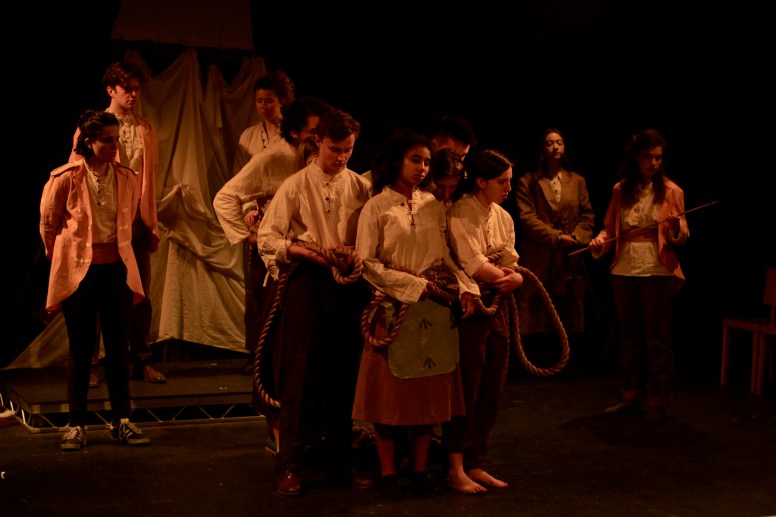
Lashings of intelligence here. That and the knowledge that ‘the shoulder blades are exposed at about 100 lashes’. There’s also sand on the stage floor, figuratively blood stained, but handy for gritty effect and for when you want to represent a play as ‘a diagram in the sand’, as proof of what could be and what might be changed for the better whatever the wretched circumstances.

And Lord knows that Australia has been there and done that. In literary terms it’s a swift line of descent: Robert Hughes’ ‘The Fatal Shore’ was published in 1986, Thomas Keneally’s ‘The Playmaker’ in 1987, and Timberlake Wertenbaker’s Our Country’s Good opened at the Royal Court, London, in September 1988. Historically it took eight months for the convict transports to get from Portsmouth to Botany Bay, arriving in January 1788. The action in Wertenbaker’s play – by now surely reckoned to be a modern ‘classic’ – is spread over five to six months. It is Edinburgh University’s official English Literature play of the year and this student production does it proud.

Of course, ‘Advance Australia Fair’ it ain’t. Major Robbie Ross (Amelia Watson) sees to that. He bitterly resents being in such an alien and depraved place, orders floggings for impertinence, and fears that any sign of weakness – ie. kindness – will result in revolt. Arguably it’s the toughest role because he is so singularly awful and Watson has the scowl and the whiplash voice to do it. He is opposed by Governor Arthur Phillip (Matthew Sedman) whose far-seeing humanity guides the play beyond the horror of its opening to its near jubilant close. Wertenbaker indicated that her play end with the ‘triumphant music of Beethoven’s 5th’ but perhaps that was felt to be too much for Bedlam on a freezing evening in February.

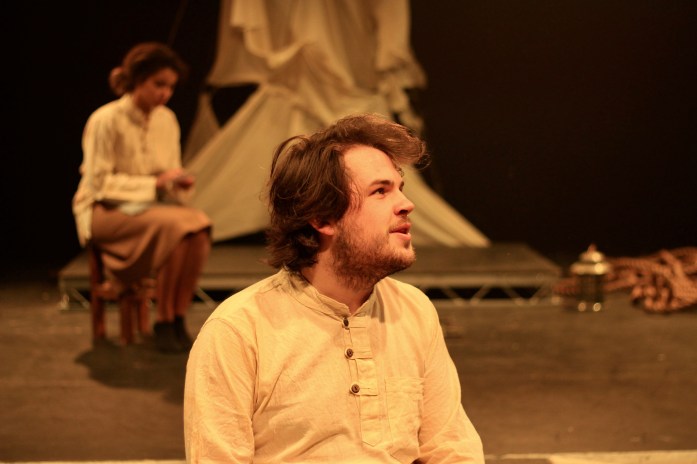
What Phillip does do is to require the production of George Farquhar’s Recruiting Officer (1706), directed by theatre loving 2nd Lieutenant Ralph Clark (Jacob Baird). The fact that Clark only has two copies of the play and that some of his cast cannot read and that Ross regards him as a sorry excuse for a Marine makes it a tall order to carry out. Baird is well cast as officer class decent but his character is frustrated almost to breaking point, emotionally and sexually. The relief provided by The Recruiting Officer is palpable and is far better for him than pining at his fly buttons for his beloved Betsey Alicia back home.

So, here’s the pre-text of late Restoration comedy within a docudrama, with its 22 strong cast list of gentlemen heroes (2), wise man (1) and villain (1), and the rest (several) as good-for-nothing, not! Robert Sideway (brilliant by Domi Ucar), pick-pocket to the gentry, and glorious ac-tor is a scuttling hoot, establishing her melancholy and rehearsing her bow. He is being flogged on deck when the play begins so it is a defining moment when during the second rehearsal scene he completely upstages a brutal Ross. No such joy for Midshipman Harry Brewer (Gordon Stackhouse) tormented by guilt and by his jealous love for his ‘Duckling’ girl (Anna Swinton). Their time together is raw and explicit and (for young actors) pretty impressive. Tiffany Garnham convinces that her Liz Morden, violent, in chains and born to be hanged, can still be redeemed. Jack McConnell is John Arnscott, transported for life, and so pleased that he can ‘be’ someone else. Erica Belton, speaks wonderfully as Ketch, apprentice hangman, who wants to be an actor because he remembers some players coming to his village in Ireland where they were loved ‘like the angels’. Anna Phillips’ shy Mary Brenham owns a precious and appealing dignity from the start. Anubhav Chowdhury’s Caesar is from Madagascar and you have to wonder at the bad luck that got him into a British penal colony but his French accent and daft woes do provide easy laughs. Hannah Robinson manages to be both upper class twit Campbell and illiterate Dabby, bless her, who never gives up on getting back to the soft rain of Devon.

IMG_4684

Matthew Sedman as Wisehammer and Anna Phillips as Mary, behind. Photo: Louis Caro.

Two characters remain: Wisehammer (Matthew Sedman again) and the Narrator, the Aboriginal Australian. Both command attention but Sedman is outstanding. In this production the Narrator (Sophie Boyle) plays a signature phrase on the violin and her few linked lines are a reminder of the tragic consequences for her people that followed this European ‘entertainment’. Wisehammer, as you can guess, is something else: almost a gentle philosopher, certainly a writer, and Sedman’s careful Northern delivery nail the words, especially his simple Prologue that gives the play its title and it is intoned twice for effect. The fact that Ralph Clark reckons it would give Major Ross apoplexy is a quality judgement.

Our Country’s Good is serious drama and directors Luke Morley and Jane Prinsley take it seriously. This production is bold and disciplined, barely cut – if at all – and its actors work a demanding script with real attention. Yes, there’s some yelling – you would too if you’re being whipped – and it drowned Wisehammer’s astonishing, ghastly opening description of men and women ‘spewed from their country’. Naval uniform is in short supply and despite its appeal the thrust stage doesn’t work, but the actors being constantly visible, on or ‘off, does; and the onstage set design by Natasha Wood and Bryn Jones of a short mast, sail cloth and crossed spars is all that is needed.

I’m with Governor Phillip’s: ‘We will laugh, we may be moved, we may even think a little’. There’s a conviction worth upholding.

outstanding

StarStarStarStar

Reviewer: Alan Brown (Seen 26 February)

Go to Our Country’s Good at EUTC, Bedlam

Visit Edinburgh49  at the Bedlam  archive.