+3 Review: Elf Lyons: Pelican (Voodoo Rooms, Aug 5-28 : 19.50 : 1hr)

https://i0.wp.com/static.wixstatic.com/media/d6333a_4e35550fa3104999ad420a1236578246.jpg

“A smörgåsbord of comic delights “

Editorial Rating: 4 Stars Nae Bad

Generally, I tend not to trust people whose names are actual words. So, phonetically speaking, Elf Lyons wasn’t starting from a point of strength. However, after a fantastically absurd hour of screaming, tortured analogies and jokes about the French, I realised that perhaps it’s worth a change in policy.

Returning to the Edinburgh Festival, “Pelican” is a show (as Lyons puts it) about wishing her mother was dead. As far as thematic linkages go, it’s a doozy, and links in neatly with a smörgåsbord of comic delights pulled from Lyons’ bohemian life.

Elf Lyons’ greatest strength is immediately visible from the moment she steps on stage. The Philip Gaulier school is lucky to have such a talented clown among them  – “cartoonish” does not do her justice: she has an almost fey energy to her, leaping and waving around on stage with strength unsuggested by her slim frame. Even when the occasional joke falls just short of the chortle line, her ostensibly boundless enthusiasm manages to nudge it across.

But, luckily, these scattershots are few. Far from allowing what is obviously a precocious wit to wither beneath her energy’s long shadow, it positively blooms. Much like her namesake, Lyons is far more of an opportunist than it may first appear, and an wonderfully unexpected sting after a few lighthearted puns definitely goes a long way. It’s not often that I’m surprised by a joke’s direction, but I’ll be damned if I wasn’t more than once during her short hour of comedy.

However, like many comedians, Lyons appears not to trust the quality of her own wit. Some jokes far outstay their welcome, when perhaps the beginning third would have been enough to coax a belly laugh from the audience. Her punchlines, though wonderfully clever, are delivered with more clarity than it appears she realises.

My usual recommendation for free Fringe shows is that you can’t go wrong: win or lose, nothing lost. But this is a show which deserves every penny it earns. The only reason against ticketing it is the possibility that someone will lose out on witnessing such a talented performer. Elf Lyons is certainly one to watch – though, don’t make the same mistake I did, and sit almost directly behind the pillar.

 

nae bad_blue

Star (blue)Star (blue)Star (blue)Star (blue)

Reviewer: Jacob Close (Seen 11 August)

Visit the Other archive.

THIS REVIEW HAS NOT BEEN SUBEDITED

+3 Review: 2044 (Greenside @ Infirmary Street, 5-20 Aug: 11.30: 50min)

“Twists, turns and tensions aplenty to keep the audience on their toes”

Editorial Rating: 3 Stars: Nae Bad

I’m normally wary of anything that describes itself as dystopian, as I have found that many such works (across all art forms) often struggle to create a world believable or compelling enough to hold my attention. 2044, however, is an intriguing and thoughtful piece, and while a little far-fetched, makes some very interesting conjectures on the future – made all the more timely given the current political landscape.

An independent Scotland, spurred on by a new right-leaning political wave, has developed extremely hostile relations with England, and when floods batter the English coastline, many “southerners” seek refuge north of the border. But, given the political situation, only one member of each family is allowed in – provided they meet the required standards of health, age and skills required for work.

It may seem reminiscent of various events in history, but the situation is presented with a very current and engaging interpretation. The script centres on two such refugees, and their struggle to follow the rules, lest they be seen as a burden on the country’s resources and be punished accordingly. The plot is structured in such a way as to slowly unfurl the background, giving hints at what’s to come, in quite a gripping story. Indeed, the craft and writing of this piece in terms of narrative development are spot-on, there are twists, turns and tensions aplenty to keep the audience on their toes.

Unfortunately though, at times it’s all a little bit melodramatic, and would benefit from a bit more development and depth to allow for greater variation in tone. Every scene feels like yet another “woe is me” announcement, and while intriguing plot developments, it is quite an intense 45 minutes and should really be a longer piece to give itself time to develop and unravel.

Because of the intensity of action, the acting also suffers somewhat. The constant chopping makes it quite frantic and one dimensional, and while some great subtlety is shown by Megan Matheson-Adams as Maria, the cast never feel like they fully hit their stride so the performance falls a little flat. I don’t think it helps that a couple of the monologues are quite forced and obvious, when a more creative way of communicating that information could be found.

Overall, a really commendable effort, particularly with the writing, but not quite the finished article yet.

nae bad_blue

Star (blue)Star (blue)Star (blue)

Reviewer: Steve Griffin (Seen 12 August)

THIS REVIEW HAS NOT BEEN SUBEDITED

+3 Review: Being Norwegian (Gilded Balloon, Aug 3-10 : 23.45 : 40 mins)

“A production wrought from the heart”

Editorial Rating: 3 Stars: Nae Bad

When I was first asked to review David Greig’s Being Norwegian, I expected something to do with hellish darkness and Kjøttboller. And whilst the former was surprisingly on the money, I certainly did not expect a neat, funny little vignette. Especially buried deep underneath the sports bar.

The setup is deceptively simple. Boy meets girl, boy is awkward, girl is Norwegian. Cue characteristic witticisms from Grieg, and a surprisingly dense plot for a play which takes about as much time as roasting a chicken. It’s the stage equivalent of tangled christmas lights.

Tom Hurley is a gem as the awkward and terribly British Sean, hopping between mental distress and crises of politeness with surprising ease. A high point of this production is the clear chemistry between Hurley and co-star Lisa Bennington, who brings a wonderfully sort of flighty etherealness to her part. As the show’s key components they work well together in a sort of chalk-and-cheese way, and it makes for a very easy watch. In terms of staging, it’s abashedly minimalist, but this in no way works against it. As a highly focused, emotional vignette, the staging and lights are just enough to accentuate the overall tone of the piece without feeling bare.

Despite its victories, however, there are a few defeats. At points the show seems to go beyond the pale of theatrical awkwardness, and simply lands in “static”. For some (admittedly smaller portions) it seems as if everyone in the room is waiting for something to happen. And, likewise, some of the more conversational segments seem a little on the stiff side.  However, who could blame them – it is positively criminal to place this show in the venue it has been given. The artful musings of European cultural philosophy are somewhat muddled when the upstairs room has been booked for what sounds like a bath salts eating competition followed by celebratory karaoke.

Despite its flaws, this is a production wrought from the heart. A two-person show, however short, is difficult to pull off – almost as hard as thinking up jokes about Norway.


nae bad_blue

Star (blue)Star (blue)Star (blue)

Reviewer: Jacob Close (Seen 10 August)

Visit the Pleasance, Potterrow & Teviot archive.

THIS REVIEW HAS NOT BEEN SUBEDITED

+3 Review: The Marked (Pleasance Dome: 3rd-29th Aug: 13.30: 1hr)

“Remarkable theatre worthy of standing ovation”

Editorial Rating: 4 Stars: Outstanding

With an intricate set and haunting musical score, it’s clear from the off that this is a show that pays close attention to detail and creativity. And while, on the whole, this focus creates some remarkable theatre worthy of the standing ovation it received in this performance, for me at times it does border on being a little too artistic for its own good.

The story is fairly simple: homeless Jack (Bradley Thompson) is unable to sleep, as dreams of his aggressive, alcoholic mother haunt him. But he is able to overcome his demons by helping Sophie (Dorie Kinnear) – another homeless person he meets on the streets – from winding up in the same situation thanks to boyfriend Pete (Tom Stacy).

Told in a very visual way, we get to see into the darkest depths of Jack’s mind: the buried secret he’s been living with for so long, and the struggle he has to go through just to be able to help someone else. In terrifying flashback sequences, Jack becomes a child puppet and his mother a domineering masked figure whose eyes bleed while she brandishes a wine bottle, and in the most gut-wrenching of these she actually smashes the bottle on his head. The music, lighting and other effects come together in these moments to create a gripping dramatic intensity, made all the more stark by the slick changes back to the “real” world and its emptiness.

Through clever use of a repeated street scene (demonstrating the relentlessness and drudgery of homelessness), we see Jack’s journey – from tripping over faceless individuals he’s too scared to look at to start with, to their smiles and humanity at the end when he finally wins through. It’s a really powerful story, and Thompson more than delivers with raw emotion in this physically demanding role. Credit also to Kinnear and Stacy for every other character they play between them, as well as their handling of masks, puppets and various props.

While the visual and technical aspects of this show are absolutely outstanding, one of my main niggles is the appearance of the life-size talking pigeons towards the end (no, I’m not making this up). At this point in the show a bit of light relief is exactly what is needed to break up the emotional intensity of the previous scene, but this device cheapens the production and wholly detracts from what otherwise is a complex and well-thought through piece. To me this is one example of where Theatre Temoin try a bit too hard to be too creative, and at times I would have preferred a little less focus on all the “stuff”, and more on the basics of the acting and narrative.

The Marked is a stunning and unique performance, but perhaps just a little overreached creatively.

outstanding

StarStarStarStar

Reviewer: Steve Griffin (Seen 12 August)

Visit the Pleasance, Potterrow & Teviot  archive.

THIS REVIEW HAS NOT BEEN SUBEDITED

+3 Review: The Six-Sided Man (Assembly Roxy: 3 – 29 Aug. 1150. 1hr10m)

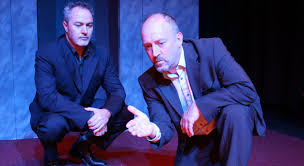
Gavin Robertson (l) & Nicholas Collett (r). Image: Assembly Roxy & Company Gavin Robertson

Gavin Robertson (l) & Nicholas Collett (r).
Image: Assembly Roxy & Company Gavin Robertson

“love its deadpan humour … the whole 4* performance of edge and ease”

Editorial Rating: 4 Stars:Nae Bad

You just know that you’re in expert hands when, to the exact beat of ABBA’s The Name of the Game, the dice are twice shaken and then thrown. Except they’re not, you just believe that you heard the rattle and saw the throw  …. and reckoned the fateful consequence. This is artful, practised, theatre.

The Dice Man appeared in 1971 and became a cult classic. The Six-Sided Man is its stage face, written and adapted by Gavin Robertson and first performed at the Edinburgh Festival in 1987. It’s back (by popular demand?) with Robertson himself playing The Patient and Nicholas Collett as The Psychiatrist. If they could, they’d be spokes on a roulette wheel; as it is they circle around each other, betting each other’s life on the throw of the dice, or die, which is an unfortunate pun.

The reason being, you see, is that the dice are liberating, freeing you of restraint and conformity by determining a single course of action that is irreversible. ‘Should I go out of the window four storeys up?’ becomes, on the throw of a 3, ‘I must go out of the window’. And where there is mortal risk there has to be sweet reward: roll a 6 and it’s the other guy who goes head first. The Winner Takes It All.

But that’s to jump the gun (with just the single bullet in the chamber, of course). The Patient comes to the Psychiatrist with his problems. The doctor is brisk. “Show me”, he says and the rest might be such weird stuff as dreams are made on but you’re not too sure. In fact – if that’s not too loaded an entity – there’s nothing quite so substantially awful as dog poo on your shoe on a first date.

The cure is that the predictable need not be endured or suffered  Yet the dialogue, alongside the high quality of the mime, voice and movement sequences, is unemotional and wary. No great shakes, you might say, but then you realise that there’s a face off here, with neither character prepared to raise the stakes until he’s as certain as he can be that he has the stronger hand. Knowing Me, Knowing You plays on.

The Dice Man was published under the name of Luke Rhinehart. In August 2012 ‘he’ announced his own death. Some believed it, some didn’t. It was a spoof but it allowed Luke to write his own valediction: ‘If you’re comfortable in the selves you’re rolling along with’, he wrote, ‘then roll on. Most people aren’t.’

You’ll roll with The Six-Sided Man and love its deadpan humour and admire the whole 4* performance of edge and ease but you’ll wonder where it’s going; at which point you’ll feel distinctly uncomfortable. Take A Chance on Me? You bet.

nae bad_blue

Star (blue)Star (blue)Star (blue)Star (blue)

Reviewer: Alan Brown  (Seen 8 August)

Go to The Six-Sided Man at Assembly Roxy.

Visit Edinburgh49’s  Assembly Roxy archive.

+3 Review: Tony Roberts – Card Magic (Assembly Roxy, Aug 5-28 : 21.30 : 1hr)

https://newimages.bwwstatic.com/columnpic7/iconsquaretonyroberts_0244_photobysteveullathorne.jpeg

“Absurdly clever card trickery”

Editorial Rating: 4 Stars Outstanding

I’ve never been very good at card tricks. As someone for whom maths lessons loomed like Banquo at the feast, knowing the number work at play in even the simplest sleight veered me sharply away. So when presented with someone who can do it with skill, I’m naturally impressed; and when presented with Tony Roberts, I was delighted.

Though the audience I saw him in was small, I feel this made no difference: Roberts is an expert at playing a crowd as if it was a one on one conversation, turning what could have been a small show in the Roxy downstairs into a warm, intimate and deeply interesting conclave. Hosted by the titular lauded businessman-cum-acclaimed street performer, ‘Card Magic’ (as Roberts so quickly and happily points out) is what it says on the tin – though perhaps without fully advertising the sheer quality of the product inside. And what that exactly is, much like the man himself, is hard to describe. Part comedy show, part biography and with a heaped helping of absurdly clever card trickery, this was a performance which never failed to intrigue and entertain.

This show’s greatest asset (quite fittingly) is Roberts himself. Deeply charismatic from the moment he opens his mouth, he fails to fall into the trap of braggadociousness which plagues so many contemporary street magicians. It’s like hanging out with an Australian uncle down the pub, if that very same uncle had spent a few years trapped in a Johnny Ace Palmer show. It’s clear from the get-go exactly how Roberts can draw crowds on a busy street – not only his wit, but his genuineness and warmth.

But, of course, being an ace with his suits doesn’t hurt either – and Roberts is clearly one of the best. Even with repeat viewings, his tricks would boggle the mind. Shaking his hand at the end of the show (as he humbly asks of every audience member), it’s almost surreal to recall the sheer dexterousness with which his fingers move. Although some of the tricks flowed a little too subtly on from his storytelling (though with shuffling skills like his, it’s difficult to tell when the real show’s starting), their denouement is always satisfying, whether you know you’re there at first or not.

This is the kind of show that makes children wish to grow up to be magicians, and adults wish they’d had the chance. But, as Roberts own story proves, it’s never too late to start seeing the magic – and I can think of no better show to pull back the curtain.

outstanding

StarStarStarStar

Reviewer: Jacob Close (Seen 7 August)

Visit the Assembly Roxy archive.

THIS REVIEW HAS NOT BEEN SUBEDITED

+3 Review: Nuclear Family (Assembly Roxy: 3 – 29 Aug. 1715. 1h)

Image. Sunday's Child & Fever Dream Theatre.

Image. Sunday’s Child & Fever Dream Theatre.

” .. a drama of a hopeless, unstable, situation”

Editorial Rating:  2 Stars

Torness nuclear power station is 30kms from Edinburgh, strikingly visible from the A1 and from the main line. The MailOnline did a photo feature on it in January last year. A close-up on one of the panels in the Control Room shows the operating switches to Boilers A to D. Understandably, there’s ‘Start Up’, ‘Drain and Warm-Up’, and – critically – ‘Dump’; which is what Ellen, who’s a technician at a nuclear site, has just done to Phil. He takes it very, very badly.

This then is your chance to get up-close and personal with nuclear safety. You play your part in an examination of how Phil, the jilted boyfriend, and a couple of his drunk mates got into the Central Control Room of a nuclear power station and caused a disaster. It’s your job to review the evidence of how it was allowed to happen and to play ‘What Would You Do / What Should They Have Done?’ The results are to be included in the final ‘Prescott’ report. (There is no connection BTW with the former Deputy Prime Minister or indeed, I trust, with any incident at a nuclear installation). As a core idea, it has a lot going for it; but what of its processes?

The audience of eight to ten – it might stretch to 14 or so – sits in a semi-circle. In front of us two actors act out the CCTV footage of the Security desk from that terrible evening. Ellen (Eva O’Connor) is on duty with her brother Joe (Adam Devereux), who is on a verbal warning for telling site managers what they don’t want to hear. This sequence is interrupted on five occasions for  audience participants to look at further evidence: personnel records, transcripts, and the like. A facilitator officiates and calls Time when a decision has to be reached: for example, sound the alarm now or wait? There is a show of hands to determine what happens next.

The acting was by far and away the best part, creating tension even when the plot approached meltdown. However, for me, the ‘interactive’ theatre was a nightmare. I had my senior doubts from the start when the bumbling distribution of iPods did not convince me that this was an official inquiry and then the request for a rapporteur helper was immediately taken up by a man to my right festooned with venue participant lanyards. He started whispering broken instructions on how to open the nano which I tried to follow but I had to give up on the looped audio files. My neighbour to the left seemed to be ‘on task’ and having an engaged conversation but all this activity seemed completely superfluous. It didn’t help, of course, that I was outside the discussions that were taking place. I just wanted to hear more from Joe and Ellen, whose acting was reaching critical levels, rather than wait for the next predictable outcome. Even then it was pretty obvious that whatever decision was reached, at whichever improbable juncture, it would make no difference. When the votes were taken there was no time to really examine the decisions reached. As an immersive simulation it wasn’t working; as a drama of a hopeless, unstable, situation, I liked its fallout.

Star (blue)Star (blue)

Reviewer: Alan Brown (Seen 7 August)

Visit the Assembly Roxy  archive.

+3 Review: Jane Eyre: An Autobiography (Assembly Roxy: 4 – 29 Aug. 1115. 1h30m)

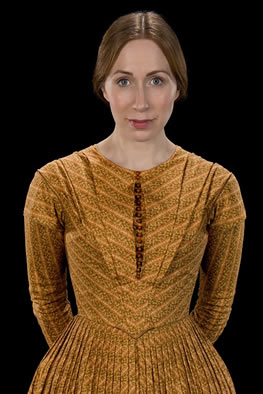
Image. Dyad Productions.

Image. Dyad Productions.

“Rebecca Vaughn’s solo work is outstanding.”

Editorial Rating: 3 Stars Outstanding

” ‘… and when I draw up the curtain this time, reader, you must fancy you see …’  me, plain and plain-spoken Jane Eyre, on stage for ninety minutes as I tell you the story of my life.”

We have an autobiographical telling, dramatic and full of character, with nothing of substance left out and everything of significance retained. From the window seat in the breakfast room, aged 10, to the parlour of Ferndean Manor, some nine years later where the blind Mr Rochester – he of the ‘brow of rock’ – reclaims his darling Jane. Writer Elton Townend Jones calls his work ‘an impressionistic adaptation’ of Charlotte Bronte’s book. Well, fair enough, along with the charged immediacy of the scene(s) comes the solid narrative, fused and monumental.

Performer Rebecca Vaughan is definitely impressive. She is Jane, of course, but she is also everyone else – except the source of crazed laughter from the attic. There is, inevitably, a cartoon Mr Brocklehurst, who might as well be the grim progenitor of today’s (English) free schools. Mr Rivers, impossible for the irreligious to figure, is left pallid and decent. Mr Rochester is gruff and always amused by Jane’s frank determinations. As Jane, Vaughan is upright and indomitable, which makes her excitement and frailty when it comes to the love story just a bit tricky. However, if romance is your thing, then Jane’s virtuous path to happiness is surely realised.

What makes the novel probably undoes its efficient telling. Jane ‘hadn’t intended to love [Rochester]’ but does and she certainly never expected riches but she gets them. That, to use Bronte’s unlikely word, is a ‘stunner’. The stage-succinct explanation of her 20K inheritance does advance a parallel narrative that gives Jane an easy living that is more assured than the trials and anxieties of any self-respecting literary heroine should be. I wondered, listening hard, whether her assessment of Position, Fortune, & Age in the marriage stakes – our century’s life-style choices – was beginning to count for more than love, which (I concede) is rather uncharitable.

Dyad Productions have worked the text of Jane Eyre to lucid and creditable effect and Rebecca Vaughn’s solo work is outstanding. I just found the whole piece satisfying and accomplished rather than remarkable or radical, which the novel is.

outstanding

StarStarStar

Reviewer: Alan Brown (Seen 7 August)

Go to Dyad Productions

Visit Edinburgh49’s Assembly Roxy archive.

+3 Review: Hot Brown Honey (Assembly Roxy, 5 Aug – 28 Aug : 20:20 : 1hr)

https://i0.wp.com/d2752rta4dscqv.cloudfront.net/ImageCache/1462324008_hot_brown_honey_h_0516.c935f3ad275ed95b1576ad8fb546a7d8.jpg

“Gleefully challenges stereotypes of sex and race with a full grin, bared chest and raised middle finger.”

Editorial Rating: 5 Stars Outstanding

I sat for some time before writing this review trying to think of an introduction which best captured what I thought of Hot Brown Honey. But the truth is, there’s not much else which can compare to the bombastic gut punch of a burlesque show Assembly Roxy has somehow managed to contain inside their theatre. From the second that the glass-panelled hive lights roar to life, this show is a nonstop ride that has the audience welded to their seats.

Hosted by unapologetically badass MC Kim “Busty Beatz” Bowers, Hot Brown Honey is a raucously funny and entertaining trip through acrobatics, beatboxing, song, dance and everything in between. But don’t be fooled – despite considerable comedy thrills, it never strays from what makes it so compelling: a show which not only celebrates the power and complex femininity of women of colour, but gleefully challenges stereotypes of sex and race with a full grin, bared chest and raised middle finger.

To talk too much about the acts would lessen their impact, but it cannot be said enough that each segment of performance was distinct, feverishly well executed and consistently jaw dropping. Every single honey from this hive is impressive enough to warrant their own review, let alone packing every single one into a single critique. Of course, for those who aren’t fans of audience participation, proceed with tentative caution: a show like this one demands to spill out into the aisles, to surprising and hilarious results.

The honeycomb that links up this show, however, is both more subtle and infinitely more loud than the performers themselves. There are West End shows that could learn things from the tech team behind the burlesque extravaganza. The sync between every technical element and the behaviour of the set is nothing short of breathtaking, for those who can bear to concentrate on anything but the inspired spectacle going on centre stage.

But what makes Hot Brown Honey such an outstanding show goes beyond its strength in immediacy. When the applause stops and the doors are open, that doesn’t mean the show is over: the messages, ethos and enthusiasm for equality, sexuality and sensuality stick around far after the day is done. As a piece of burlesque, Hot Brown Honey is outstanding simply by merit of its performance. But as a complete show, its greatest triumph is that it fully achieves the vision set out by creators Bowers, Lisa Fa’alafi and Candy B: not simply social activism masquerading as entertainment, but a genuinely thought provoking thrill which, at least personally, will open the eyes of many to any issue they never even know existed.

If you like your shows sexy, superbly skillful and socially conscious, you cannot miss Hot Brown Honey this Fringe. It’s a rare show indeed.


outstanding

StarStarStarStarStar

Reviewer: Jacob Close (Seen 6 August)

Visit the Assembly Roxy archive.

THIS REVIEW HAS NOT BEEN SUBEDITED

+3 Review: Tiff Stevenson: Seven (Assembly Roxy, Aug 8-14, 16-28 : 19.10: 1hr)

https://www.cityvarieties.co.uk/ArticleMedia/Images/CVTiffStevensonbig.jpg

“Stevenson has a presence you could smash a wine bottle on”

Editorial Rating:  4 Stars Nae Bad

When you see a comedian on TV, it’s almost a coin flip as to whether they’ll stand up to their digital performance when you’re maybe ten feet away. For some, it’s clear that they’re funnier as a bundle of pixels – but, as in the case of Tiff Stevenson, proximity makes joke grow funnier.

Even when loping around the stage, Stevenson has a presence you could smash a wine bottle on. Despite being wrapped up in a thick web of humour, it’s clear from the outset that there’s an iron core to every joke: it’s as if scientists managed to fuse Belva Lockwood and someone’s drunk aunt. Pushing their own distinct beliefs is something, consciously or otherwise, all comics do; and Stevenson is a masterclass in delivering it without sounding evangelical. Even if you don’t agree with what she’s saying (however you’ve managed to come to that outcome), you’ll be hard pressed not to laugh along with her.

From the get-go, it’s an unmistakably zeitgeist-y set. In a surprisingly speedy hour, Stevenson runs the full gamut from bus bombings to baby showers, joyously flicking up v’s behind her as she runs from topic to topic. We might be awash in a sea of Macintyres, but Stevenson is one of many happy islands where comedy’s rebellious, fringe roots are still dug deep. No subject is too taboo, as she very happily reminds the audience throughout – however, often the transitional link between these subjects can wave from tenuous to unneeded, but as it takes up perhaps a minute of time in total, it hardly spoils the bunch.

If there ever was a complaint, it was that sometimes Stevenson doesn’t seem to trust her own considerable wit enough. Several times throughout the show, a fantastic joke was extended far beyond its peak, simply for the sake of explaining it. Whilst none of these jokes fell into “unfunny”, it certainly blunted the otherwise fantastically sharp tongue which dominate the rest of the show.

To talk too much about Tiff Stevenson’s set at the Roxy is to do her a disservice: half of the enjoyment comes from the unexpected directions she swerves with every punchline. But if you’re looking to start your evening on a high note, you’ll have no tiff with her.


nae bad_blue

Star (blue)Star (blue)Star (blue)Star (blue)

Reviewer: Jacob Close (Seen 6 August)

Visit the Assembly Roxy  archive.

THIS REVIEW HAS NOT BEEN SUBEDITED