+3 Review: Queen Lear (Assembly Roxy: 4 – 29 Aug. 16.10. 1h)

Image. Assembly & Ronnie Dorsey productions

Image. Assembly & Ronnie Dorsey productions

“Exquisite”

Editorial Rating:  4 Stars:  Outstanding

Shakespeare’s Lear is a pathetic apologist : ‘I am a very foolish, fond old man’, who (by his frail reckoning) would have fathered Cordelia in his late sixties. And he didn’t stop there. Why should he? He’s a King of ‘wild, roaring, lecherous men’ who live for ‘war, wine, and whoring’. So, in Ronnie Dorsey’s new and exquisite piece we come to his second queen, heavily pregnant and in great pain. No Lear is to be seen but his expectation of a son, for once legitimate, is almost unbearable.

Remember Lear’s ‘Let copulation thrive’? Well, he ends that hateful, mad, speech longing for anything ‘to sweeten my imagination’. Enter Queen Lear.

Three characters: the young queen; her devoted companion Ursula; and her priest, Lawrence. Back story: the queen was married at 16 and leaves her home in the Borders for good. She is cruelly abused by a husband who, after beating her, kicks her small dog to death. Rooks caw about the castle walls (we assume that the queen’s chamber is in a castle) and in these harsh, loveless, circumstances it is doubly touching to hear Ursula call her queen ‘Sweeting’.

Dorsey writes words that hold and sustain. Queen Lear grasps sympathy where it can be found and does not let go. The queen, who knows that she will not be remembered, talks of the coming birth with dread. She would have the child but fears she will not survive the labour. In her time a caesarean section is all about cutting and not delivery. Alice Allemano plays a woman living the agony of the fact that ‘this child is killing me’, so if ever a role has to be in extremis, then this is it. Jane Goddard plays Ursula with a loving solicitude that is never familiar but always kind. Mary McCusker, as Lawrence, has ‘his’ own confession to make in a performance of great sensitivity and control.

Mark Leipacher directs. It is a tight work, physically and emotionally close, as you’d expect of a confinement and what lightness and lift there is comes from the lyrical quality of Dorsey’s lines. Three benches and an embroidered bolster are the only props required. The queen is in an elegant gown that denotes her high rank but which confers neither influence nor power. She can only hope against hope that Lear’s Fool will somehow protect Cordelia.

When resolution comes to such a forlorn situation it’s hard to take. You might not accept it, but that’s the point. For Lear’s queen there is no healing touch for her ‘female wounds’.


outstanding

StarStarStarStar

Reviewer: Alan Brown (Seen 6 August)

Visit Edinburgh49’s Assembly Roxy  archive.

+3 Review: Molly Whuppie (Assembly Roxy: 4-28 Aug. 1030. 1hr 15)

Image. Assembly & LicketySpit Theatre

Image. Assembly & LicketySpit Theatre

“Smiling, tuneful, and big-hearted”

Editorial Rating: 4 Stars: Nae Bad

Molly Whuppie is a pickle of a lassie. She’s bright, bonny and brave and saves her mother and sister from dying of hunger on a northern shore. She’s a fairy tale character from the Western Highlands , whom English cousin Jack – of beanstalk fame – would love to meet, for their stories are pretty close; although Molly (aka. Maol a Chliobain) steals it, as her baddie is no the giant, but one King Boris (!), who loves his meringues too, too much.

Smiling, tuneful, and big-hearted, Molly Whuppie has toured all over Scotland and has already, since 2001, delighted upwards of 30,000 people. Licketyspit Theatre Company is Edinburgh based but has decided, as the International Festival posters have it, to ‘Welcome [the]World’ so this is the company’s Fringe premier and it’s a treat.

If you’re still fortunate to be in your early years – and therefore very unlikely to be reading this! – Licketyspit is for you. If you’re alongside a young child, then you’ll appreciate the modesty of the fact that all actors do is ‘show the story’ in exciting and imaginative ways. First then, there’s fearless Molly (Amy McGregor) who keeps her pretty red beret on even when balancing for her life on the Bridge of the One Hair, and we sing “I’m Molly and you can’t scare me / I’m Molly, Hee Hee Hee!” Second, there’s Virginia Radcliffe as Ninian the Giant in tremendous sandals and as horrid King Boris with a wonderful polka dot jester’s cap. No crown of majesty for him, just fanfare by kazoo.

Radcliffe is also Artistic Director of LicketySpit and it is easy in Molly Whuppie to see hers years of experience in building drama-led work for children and their families. There’s a good strong narrative where the good and the kind – above all – prevail, constantly reinforced by repetitive elements of colour, music and song. Invention is everywhere, from the reveal of successive kind grannies to land clearance by tree hurling.

Yes, it was probably devised as a December, Christmassy show when Molly, her mum, and her sister are perishing of cold and, yes, there’s the question of how come only giants have a Never Empty Purse; but no matter really, this is a warm and generous show with stick puppets to colour in and cut out afterwards.


nae bad_blue

Star (blue)Star (blue)Star (blue)Star (blue)

Reviewer: Alan Brown (Seen 6 August)

Go to Assembly Children’s Shows

Visit Edinburgh49’s Assembly Roxy archive.

+3 Review: A Streetcar Named Desire (Assembly Roxy, 5 Aug – 29 Aug : 13.55 : 1hr 30mins)

https://files.list.co.uk/images/festivals/2016/fringe/2016STREETC-9D-300.jpg

“Consistently raw, emotional and human”

Editorial Rating: 2 Stars Nae Bad

For many years, Tennessee Williams’ immortal “A Streetcar Named Desire” conjured up two shared memories: the off-yellow, stained tooth colour of chipboard desks; and the strange, (and in hindsight, quite sad) familiarity with which my divorced, middle-aged English teacher spoke about the dangers of hiding in fantasies.Now, thanks to the Tumanishvilli Film Actor’s Company and director Keti Dolidze, it’s far easier to think of quiet intricacy, and the heartfelt ebb of Georgian on a smoke-filled stage.

From the get-go, it clear this is a production which has been undertaken with care. The monotone stamp of poverty is imprinted surprisingly well on the set. Had it not been lit up on the Assembly Roxy stage, I would have had no trouble believing it had all just been sitting in the French Quarter. But what was most admirable about the set was its clever use of shadow. Translucent material and a little light transformed what in any other production would have simply been a rearward wall into a very entertaining transition tool: whilst set is moved around, the audience is treated to dancing shadows, or the silhouette of a saxophonist. And whilst occasionally these transitory segments went on a little too long, they were nevertheless welcome. Combined with excellent, well-timed soundscaping, it was clear the overall audiovisual design had received the care it deserved.

However, the background paled in comparison to the string of strong performances. It would be difficult to place the strongest actor in what is obviously a very seasoned cast. Even sans translation, this was a show which was consistently raw, emotional and human. Nineli Chankvetadze’s Blanche in particular showed almost uncanny emotional range, bringing depth to every smile and frightened sob even when the emotions in between were few. Kudos also to Imeda Arabuli as Stanley Kowalski, who lent an almost frightening hypermasculine, bestial quality to a character who is so easily made trite by a lesser actor.

With the aforementioned strengths, then, you could be forgiven for wondering why I’ve given this show a surprisingly low rating. And whilst, clearly, many of its component parts merit celebration, it is unfortunate then that this production was completely and utterly failed by its translation. Whilst subtitling a foreign language work is a fine idea, its execution onstage was risible.

From half a line being completely cut off (which happened often), to the subtitles stalling or – even more frustratingly, skipping back and forth in an obvious effort to re-find the dialogue – and the surprisingly low quality of what should have been a simple transcription of Williams’ original transcript (Prize contenders include the immortal phrase: “I’ll never forget the colour of his yes!”), the translation of this show was consistently frustrating. Even worse, the form and punctuation of character dialogue was not so much confused as nonexistent, leaving much of the second half reading as if Blanche was having the most spectacular breakdown ever seen on stage.

But even worse was the fact that, as an audience member, I often found myself between Scylla and Charybdis: either losing myself in the wonderful performances on show and having no idea what was being said, or half-understanding the dialogue whilst being unable to see the show itself as I craned my vision to the extreme top left of the stage. Had the subtitling quality been better this may have been less of a problem, but given the internal problem-solving required to make the subtitles coherent, it was like I had simply stepped outside for half the play. I shudder at the prospect of having seen this work without first being familiar with the plot beyond cultural osmosis, as a surprising number of people are. Given that the importance that the language plays in Streetcar, I was legitimately shocked at the poor quality of its execution.

In terms of its actual materiality, Keti Dolidze has crafted a fine show indeed. And, if you’re fluent enough to understand Georgian on the stage, I’m sure it would make for an afternoon to remember. Had it been simply billed as a foreign language play, even an English speaker would be able to understand, at least, the raw emotional content from performance alone. But, as it stands, the almost fantastically poor quality of translation packaged with this show made engaging with it a chore by the final half hour. With some simple tweaks, A Streetcar Named Desire could have quite handily added two more stars. But, as it stands, perhaps the kindness of strangers is less important than the kindness of transcribers.


nae bad_blue

Star (blue)Star (blue)

Reviewer: Jacob Close (Seen 5 August)

Visit the Assembly Roxy  archive.

THIS REVIEW HAS NOT BEEN SUBEDITED

+3 Review: Early Doors (Pleasance pop-up @ The Jinglin’ Geordie: 5-29 Aug: 12.00: 1hr)

“A stunning piece of site-specific theatre”

Editorial Rating: 4 Stars: Outstanding

After the general bustle of buying drinks, finding seats and, of course, choosing your pub quiz team name, Early Doors opens with an introduction to each character, performed almost like an African tribal chant, which makes it feel like we (the bijou, but sell-out crowd) are being truly welcomed into their community. It’s rhythmic and theatrical but never over the top, and sets the tone for the lyrical, poetic styling of the piece as one long fable.

Our landlord and landlady are a young brother and sister who inherited the place when their mum died. They start by sharing memories of her, and set the scene for a potentially fractious relationship between them. We also meet various other characters in the community: the pub quiz master, who can’t help but share some details of his ongoing custody battle with his ex-wife; the bouncer, who recalls the end of his relationship with one of the local punters; and the “village idiot” who brings the comedy to proceedings. The characters are flawed but lovable, and the ensemble cast do a great job of sharing their world with us.

As the show progresses we get hints of the tensions and relationships between different characters, which help bring interest and drive the story. I did feel slightly robbed in some characters having comparatively little action, while others seemed quite unconnected to the main narrative, so for me, a little further development to see clearer links between each would really make this show spectacular – but this is only a small niggle considering the quality of action and overall performance value.

The piece is performed with wonderful energy, and the writing – in particular the language – of every aspect is exquisite, giving just enough detail to hook the audience without verging on rambling. Yet while some of the transitions between each section are smooth and logical, it is a shame that in other instances the show progresses by simply having one character leave and another mysteriously appear for no apparent reason.

There are so many wonderful aspects to this performance – the characterisation, storytelling, and sense of really being “in it” really are top notch and encapsulate everything I love about the Fringe. I would have just preferred some clearer links between sections and less disjointedness between some of the characters to give the piece a bit more cohesion.

Overall, I raise a glass to Not Too Tame and this stunning piece of site-specific theatre and urge you to go and join them at the Jinglin’ Geordie for a pint, a pub quiz and an engrossing performance.

outstanding

StarStarStarStar

Reviewer: Steve Griffin (Seen 6 August)

Visit the Pleasance, Potterrow & Teviot archive.

THIS REVIEW HAS NOT BEEN SUBEDITED

+3 Review: Teatro Delusio (Pleasance Courtyard: 5-29 Aug: 13.45: 1hr 15mins)

“Physical mask theatre at its finest”

Editorial Rating: 4 Stars: Outstanding

After last year’s sell-out smash Hotel Paradiso, I was excited to see what Familie Floz would come back with in 2016, and for the first 50 minutes at least, Teatro Delusio more than meets expectations. It’s physical mask theatre at its finest, with three actors playing well over 20 individual characters between them, each of whom are clearly defined, consistent and a joy to watch.

The setting is backstage at a theatre, where we see the stage crew attempt to set everything up (without killing themselves or each other in the process), and then assist various members of the orchestra, singers and ballet dancers onto stage, even though they may hate, love or just be plain bored with them.

There are tricks and treats aplenty, from simple slapstick moments of falling through ladders and playing with exploding lights, to sword fights and disappearing through trap doors. Familie Floz’s real strength, though, is their character work and dexterity of changes, from a grumpy stage manager to a diva singer, and my absolute favourite: a blind and deaf violinist who has no clue where he is. The changes are so slick you’d assume there were at least six performers constantly running around, while the physicality required to define each character was so perfect that simple gestures often had the audience howling with laughter.

Yet for all their great character work and ability to build a believable world on stage, I feel that Familie Floz perhaps tried to reach too far with this production, by introducing a few too many characters, and deliver a story that could easily have been at least 10 minutes shorter and not lost any of its power. About three quarters of the way through the performance, when ends could have been tied up and rounded off, still more new things happened, and the performance hit a new level of ridiculousness that I think lost me, and many of my fellow audience members. What began as a perfectly plausible, if a little stylised, day or two in the life of a Stage Manager seemed to turn into a dream sequence with stabbings, stage crew achieving their lifelong dream of filling in for wounded ballet dancers at the last minute and unexplained resurrections that pushed the suspension of disbelief a little too far.

A beautiful piece, but be prepared to get uncomfortable: those seats in the Pleasance Grand don’t give much wiggle room and by the end of this performance you’ll need it.

outstanding

StarStarStarStar

Reviewer: Steve Griffin (Seen 5 August)

Visit the Pleasance, Potterrow & Teviot archive.

THIS REVIEW HAS NOT BEEN SUBEDITED

+3 Review Moondogs (Edinburgh International Film Festival: 17 June ’16)

“Heartwarming and well written”

Editorial Rating: 3 Stars: Nae Bad

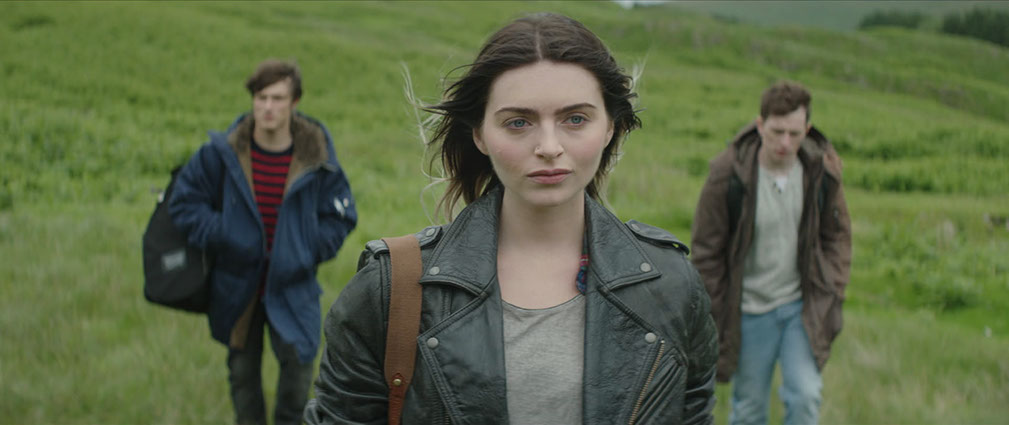
This year the 70th edition of the Edinburgh International Film Festival brought a wide range of films and documentaries home to Scotland. We took a look at the world premiere of Philip John’s Moon Dogs – a Scottish coming-of-age film – released on the 17th of June 2016.

Two step-brothers Michael (Jack Parry-Jones) and Thor (Christy O’Donnell) are thrown together through their parents’ marriage and the relationship between the two is far from perfect. Michael is a temperamental, slightly gullible young lad who having just finished high school is trying to figure out his future. Thor is the more quiet, reserved, artistic type who prefers to lock himself in his room to focus on his music and block out the rest of the world.

For their own individual reasons they decide to embark on a trip from their home on Shetland to Glasgow. With no money or any idea how they will get to there, they are lucky – or perhaps unlucky – to meet the wild, free-spirited yet slightly troubled young woman Caitlin (Tara Lee) who decides to accompany them on their journey.

The story focuses on the trio’s travels rather than their final destination. Throughout the film there are some beautiful shots of Scottish scenery and at times it almost feels like you are on a tour through Scotland’s landscapes and its society. With brutal honesty the film shows the best and the worst sides of Scotland. The three meet a variety of characters, from kind hearted locals to cruel criminals, whom anybody in their right mind would avoid.

The script, written by Derek Boyle and Raymond Friel, brings out a range of emotions with some charming and funny exchanges but also some darker, serious moments. Although this independent drama does at times appear a little awkward and staged this could be a reflection of how the characters themselves are feeling. At the beginning the boys, despite needing one another to make their journey to Glasgow possible, are both displeased at the idea of travelling together. As they begin to warm to each other the scenes and the interaction between the three appears to become more natural, resulting in some endearing moments for the audience and some sympathetic giggling.

The casting works. Michael and Thor are naive through their sheltered upbringing and young age and actors Parry-Jones and O’Donnell are very authentic in their roles. Tara Lee gives a captivating performance as Caitlin, although her questionable decision making and flirtatious nature make her a somewhat difficult character to comprehend. Personally I found this made her quite difficult to warm to, although perhaps the point of her role is more to provoke the boys and test their boundaries rather than to be a likeable character.

I would say Moon Dogs is a heartwarming, well written film that causes much amusement as the trio battle with the hardships of their journey and with growing up – as you do!


nae bad_blue

Star (blue)Star (blue)Star (blue)

Moondogs at the EIFF 2016 & at the British Films Directory

Reviewer: Iona Young (Seen 17 June)

Edinburgh Quartet: Mozart, MacMillan, Dvorak. (Queen’s Hall 25 May ’16)

Image result for edinburgh quartet pictures

“They played with zest, enthusiasm and perfect tonality”

Editorial Rating:  4 Stars:  Nae Bad

I think the overriding reason I enjoy the concerts of the Edinburgh Quartet over many others is their understanding of how to put together a performance, rather than just playing. A lot of thought clearly goes into this, from the overall theme, whether it be Storm and Stress or New Horizons to the programme mix on the night: this evening it was Mozart and MacMillan, followed by Dvorak, leaping boldly from the eighteenth to the twenty-first and then back to the nineteenth centuries – and then there’s considerate way they always do their final tuning before coming on stage so that they just smile at us and get on with it – it’s not about them, it’s about the music.

And smiling was very much in evidence on Wednesday; they were clearly enjoying themselves, and so were we. They put us at our ease.

We started with Mozart’s String Quartet No 19 in C, K465, the “Dissonance”. The first twenty bars or so really were the most incredible piece of creative genius of its time; we could easily have been listening to Schoenberg, but after that the piece reverts to classical, Haydnesque form, and a charming work it is, too. Assured, beautiful playing with the violins parrying the melody with the cello in contrapuntal support. An honourable mention must go to cellist Mark Bailey whose warm tone really brought it all out in the last movement.

Next up was James MacMIllan’s String Quartet No 3. The full gamut of techniques was used here, long silences, not so much sul ponticelli but playing on the other side of the bridge, tapping and knocking the bodies of the instruments, crazy pizzicatos, and the first violin playing right at the very top of the register on the E string. The work started eerily with unison octaves before breaking out into a thrilling full tilt series of prestissimo arpeggios thrown from instrument to instrument.  The players gave total commitment throughout to a highly unusual but engrossing work. I cannot pretend all the audience found it to their taste, but they were all remarking on it at the interval, and I for one was bowled over. It is clearly a demanding work extremely well played.

We were given an easier ride in part two, and gently led to the conclusion of the evening with Dvorak’s String Quartet No 12 in F Op 96, “The American”. From the confident and assured opening of Catherine Marwood’s viola to the many familiar melodies picked up individually and collectively by the band, they played with zest, enthusiasm and perfect tonality and were clearly enjoying themselves and we found their enthusiasm infective. Pure joy –  and a real treat to bring a thoroughly enjoyable evening to a close.

nae bad_blue

Star (blue)Star (blue)Star (blue)Star (blue)

Reviewer: Charles Stokes (Seen 25 May)

Go to the Edinburgh Quartet

Visit Edinburgh49‘s Queen’s Hall archive.

Thon Man Moliere (Lyceum: 20 May – 11 June ’16)

Jimmy Chisholm as Moliere & Siobhan Redmond as Madeleine. Photo: Mihaela Bdlovic.

Jimmy Chisholm as Moliere & Siobhan Redmond as Madeleine.
Photo: Mihaela Bdlovic.

“Siobhan Redmond as Madeleine and Jimmy Chisholm as Molière are perfectly, affectionately, matched.”

Editorial Rating: 4 Stars  Outstanding

In February 1662 Louis XIV sent flowers on the occasion of the marriage of Molière (40) to the seventeen year old Menou (Armande) Béjart. Perhaps the feted playwright was encouraged by the success in the previous year of his School for Husbands. And maybe those flowers were roses, for Menou draws firm, long stemmed roses in her sketch book. Wait up, they look like roses but maybe they’re …. Oh no! Surely not?

This is Liz Lochhead’s new play and she can have a garland too. Thon Man Molière is a comfortable winner. First off, it is a tribute piece to the man’s comedic genius; but second, it closely involves the women in his life, and third this play loves theatre and theatre-making.

Lochhead is an artist with the man’s biography. Born Jean-Baptiste Poquelin, her MacMolière is ‘Pokey’ indoors. Scaramouche is a pal but the fortunes of the ‘Illustrious Theatre’ company are dire to the point of collapse (and imprisonment for debt). There is rarely enough money and there are too few commissions until the king: “Vive le Roi!” – tires of the tragedies of Racine and Corneille. Tartuffe may well be a great play – and Pokey is inordinately proud of it – but it took nearly five years to get its revised version past the Archbishop of Paris. Molière’s first child is named after his royal godfather but Louis dies at eleven months.

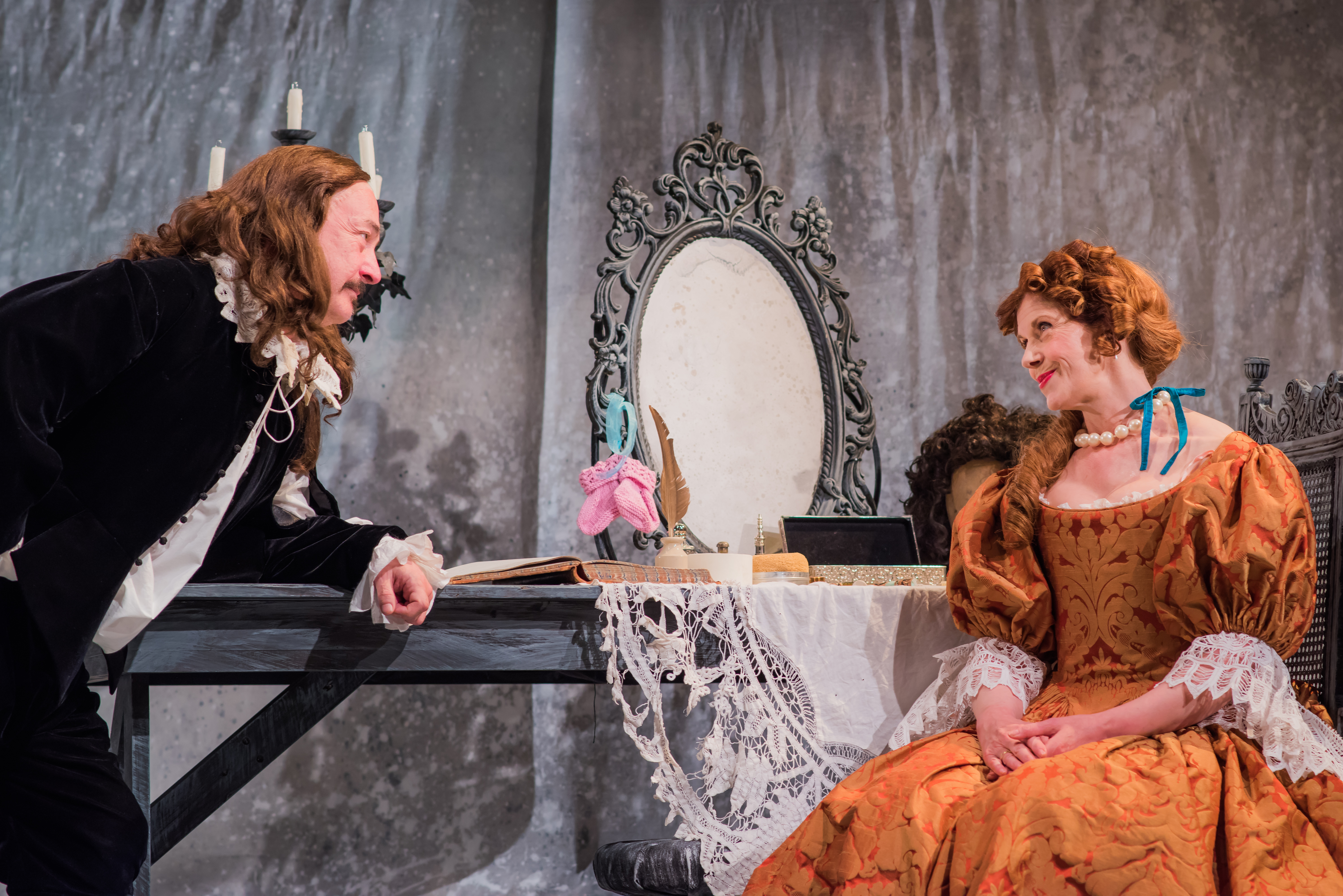
There is a sub-title to shape the facts: ‘Whit got [Pokey] intae aw that bother …’ – and it’s sex; not so much sex with his teenage wife but the naughty fact that Menou is the daughter of his former lover, business partner and bestie, Madeleine, and that Madame Béjart will not – under any circumstances – have her daughter tread the boards. Siobhan Redmond as Madeleine and Jimmy Chisholm as Molière are perfectly, affectionately, matched. She has the reserve, bearing, velvet voice and wide skirts of a grande dame. He has the effrontery, the wit and the audacity of his celebrated character.

Ever around and about the principals is the troupe, historically verifiable and altogether mischievous. Gros-René (Steven McNicoll), in streaked green wig, gives a command performance in lugubrious drinking and losing his breeks. Therese (Nicola Roy) is his bed-hopping wife, who would be so much more than the maid in yet another farce. James Anthony Pearson is Michel Baron, the huge star-to-be, lithe and cocksure, but who is still unable to seduce the naïve Armande, very engagingly played by Sarah Miele. At a guess, only the more than capable, laconic and kind Toinette (Molly Innes) is entirely the writer’s invention.

Tony Cownie directs with an assurance born of his previous productions at the Lyceum of Lochhead’s ‘Molières’: Tartuffe (1986!), Miseryguts (Le Misanthrope) in 2001, and Educating Agnes (L’Ecole des Femmes) in 2011. Musical entr’actes by Claire McKenzie, a la Lully, are accompanied by sweet mime and when the drapes lift the action resumes, ‘at home’ or backstage where outsize greyscale putti come second to the wooden stool, wicker baskets and some splendid costumes that were too much even for the Comédie – Francaise, aka. ‘La Maison de Molière’.

Dinnae think Thon Man Molière is daft. The script is too sharp for that and its composed effect is almost tender, which, with all those satiric impulses flying around, is some achievement.

The theatre programme contains an excellent ‘Who Was Molière?’ by Liz Lochhead herself and there’s a helpful preview article by Neil Cooper in the Herald.


outstanding

StarStarStarStar

Reviewer: Alan Brown  (Seen 24 May)

Go to Thon Man Moliere at the Lyceum

Visit Edinburgh49‘s Lyceum  archive.

RSNO: Leticia Moreno; Thomas Sondergard: Usher Hall: 6 May ’16

“They really went for it full on, you got everything you wanted and hoped to hear, but it was never over the top…..terrific playing…..quite something!”

Editorial Rating:  4 Stars:  Nae Bad

The RSNO’s Friday night Edinburgh concerts really set you up for the weekend, and last Friday’s cornucopia of delights was eagerly awaited: Bartok and Stravinsky, an orgy of brass, dissonance and full on orchestral razzmatazz. We were not disappointed.

There was much in the plots that drove the ballet suite parts of the programme that was descriptive writing of the louche – if not actually sordid – kind, not to mention the fecund. Robbers setting up a young girl as bait, consent to coition in order to effect the death of the punter, and Spring as the enduring symbol not just of birth, but of fertility, and finally the sacrifice of a virgin to appease, one suspects, not only the Gods but also senile and jealous Elders. No wonder the performances as ballets caused such a stir in the early part of the twentieth century.

First off was Bartok’s Suite from the ballet The Miraculous Mandarin. As for the story, Google it for all the gory details, but suffice it to say the premiere in Cologne in 1926 (conducted by none less than the composer Erno Dohnanyi) caused catcalls, whistles, boos, stamping and a walk out by the clergy present, with the work being banned in a number of cities. Nothing could do more to promote the piece. As for the music, well, exciting is not a strong enough word, and what impressed me is how the band got into the groove of this really quite demanding work straight away: dissonant, chaotic, resemblant of street life, some pointers to Walton’s Belshazzar’s Feast. The lilting, seductive melodies supplanted by raucous, glorious trombones and brass in general, with the strings coming in at the end and taking us away like furies. Wow! A great start to the evening, twenty minutes of exquisite bombast.

There followed Stravinsky’s Violin Concerto played by Spanish violinist Leticia Moreno on a 1762 Gagliano. The Concerto as a musical form is often compared as either a contest or a love affair between soloist and orchestra, with early examples (e.g. Vivaldi) featuring the soloist as first among equals, and later composers taking the soloist more out front. This latter approach is inherently more difficult with instruments such as the violin and guitar that find it difficult through volume limitations to stand out as a piano or trumpet would, and this limitation is the more obvious in later, more heavily orchestrated works, of which the Stravinsky is certainly one. Only in the second and final movements did the soloist really come to the fore, with a lightly supported melody in the second, and a lively toccata in the fourth enabling her to do so. Elsewhere conductor Thomas Sondergard was doing what he could to restrain the orchestra without rendering them inaudible. This also resulted in too soft playing from the clarinet so unfortunately the performance as a whole of this underestimated, supposedly austere work never quite satisfied. The audience nonetheless delighted in it and sent the players off to the interval with enthusiastic applause ringing in their ears.

The last work of the evening was Stravinsky’s  The Rite of Spring, a brilliant choice of programming given the glorious Spring day that was now drawing to a close. The playing here was absolutely first class with spectacularly clear and well articulated woodwind – not at all outdone by the “heavier” brass – playing with real clean attack and verve; but by the time the work was over you knew that everyone in the 105 piece band had had their moment in the sun, from the ten timpani, three huge Wagner tubas, seven trumpets, eight horns, washboard, rattle, tam-tam etc. – get it? The strings soared gloriously and one was reminded that, as is so often the case, although this sounded like it was chaotic, it is in fact a highly structured, cleverly orchestrated work that raised the roof and actually caused a riot when it premiered in Paris in 1913. One hundred years on its excitement and sheer jaw-dropping daring nature does not pale and the RSNO gave the sort of performance a seasoned concertgoer loves. They really went for it full-on and you got everything you wanted and hoped to hear, but it was never over the top. Terrific playing with the structure and discipline that strong composition enables. Quite something!


nae bad_blue

Star (blue)Star (blue)Star (blue)Star (blue)

Reviewer: Charles Stokes (Seen 6 May)

Go to the RSNO here

Visit Edinburgh49‘s Usher Hall archive.

Scottish Chamber Orchestra and Chorus (Queen’s Hall: 28 April ’16)

“A very appealing and appropriate choice of works”

Editorial Rating:  3 Stars:

Thursday’s SCO concert at The Queen’s Hall was to celebrate the 25th anniversary of the SCO Choir, and like at all the best gigs, the star attraction came on after the interval, following an impressive warm up by the band themselves.

Indeed, “warm up” is a particularly apposite description. The gallery was unusually crowded owing to the need for the ground floor to accommodate both the orchestra and 60 strong chorus, as half the centre stalls had been taken out. Heat rises, and for some reason the upper half of the house was uncomfortably warm, the lower a little too refreshingly cool.   Deliberate attempt to boost interval bar sales? Of course not; worried staff were toying with the radiators all evening.

Hot stuff? (Groan). Yes, it was an interesting programme, very much in the classical vein.

First up was Bach’s Overture from Suite No 3. Conductor Richard Eggar engaged with us immediately, explaining that this piece was “the one before Air on a G string” which I guess made us feel at home. My concerns about the Master’s orchestration including three trumpets playing very much in the high register, reminiscent of Handel and in truth slightly jarring (absolutely no reflection on the playing) was confirmed by the view taken by musicologist Joshua Rifkin that the piece may originally have been conceived for strings alone. Nonetheless it made for a lively opening to the evening’s entertainment.

Next came Mendelssohn’s Fifth Symphony. Yes, Fifth. Most people think he wrote only four, and in fact this work was composed probably somewhere between the first and second, much delayed in the performance. Nothing like the “Italian” or “Scottish” symphonies, it is a highly classical work, fitting in well with the Bach, and includes in the scoring a part for that intriguing instrument of yore, the Serpent, that I would imagine sounds rather like a cardboard tube made of brass.

A short while through the first movement I thought I was listening to Wagner. How could this be? Well, both Mendelssohn in this work, and Wagner in Parsifal, use the chorale-like orchestration of Martin Luther’s setting of Psalm 46, Ein’ feste Burg (“A safe stronghold’). Later on there were reminders of Haydn’s ‘London’ Symphony (no 104) with the use of the Dresden ‘Amen”. This ‘Reformation” symphony was an orchestral link between concert hall and church, a prelude of what was to come after the interval.

Mendelssohn featured again after the interval with the choir performing his hymn-like Verleih uns Frieden’, or “Peace in our time”, later to have such resonant connotations.   It was a pleasure to hear choral singing with such soothing melodic lines in this brief, dignified work.

Finally, the piece de resistance, Bach’s Magnificat in D. Confident choral singing with a strong, reassuring opening ably supported by brass and wind. The “Et exultavit…” that followed suffered from a slight lack of volume from the solo soprano, but the work as a whole provided a compleat combination of chorus, soloists and orchestra.

So Happy Birthday, SCO Chorus and Band, a very appealing and appropriate choice of works to celebrate this joyful occasion!


Star (blue)Star (blue)Star (blue)

Reviewer: Charles Stokes (Seen 28 April)

Go to the SCO and the Queen’s Hall

Visit Edinburgh49‘s Queen’s Hall archive.