SCO.Ticciati. Ortega Quero. (Usher Hall: 3 Nov.’16)

bruckner4

“This was a genuinely fresh approach to the Bruckner symphony”

Editorial Rating: 4 Stars: Nae Bad

The publicity for Thursday’s SCO gig at the Usher Hall intrigued me. I am a junkie for late Romantic music and for me the period 1850-1950 is the most exciting in classical music. Richard Strauss and Anton Bruckner are among my favourite composers and the SCO under conductor Robin Ticciati is approaching world class status. But a Chamber Orchestra playing a Bruckner symphony? This was something that had to be experienced.

I was pretty certain the SCO could bring off the Oboe Concerto by Richard Strauss. It is a beautiful work that sits comfortably within the Chamber genre, completely in contrast with his earlier works or subsequent dramatic Four Last Songs; so it is a bit of a one-off. The whole piece sat together well, the orchestra demonstrating real fluency of playing in support of the very demanding solo part. Ramon Ortega Quero handled the extraordinarily long passages (no less than 57 solo bars in the opening sequence) with sub aquatic breathing skill and faultless phrasing, and coaxed a beautiful tone out of his difficult instrument. Forgive me, but I could not help but remember my mother telling a story of a young oboist she went out with at university. His lips, as demonstrated in his kissing, were of a muscular versatility not since experienced. One of the benefits no doubt of a super competent embouchure.

We were treated to a thoroughly polished, relaxed performance of a rather intimate work that in particular demonstrated fine string playing and a conductor getting all that he wanted from his band with minimal apparent effort.

But the real test was to come.

What happens when a chamber orchestra tackles an orchestral behemoth? Ticciati has gone on record as saying “We need to scrape back the veneers” and “reveal the work in new colours”. This they did, although I do concede that the orchestra was beefed up to maximum strength. What they brought to Bruckner’s 4th Symphony was an astonishing clarity along with a seemingly relaxed approach that allowed the music to speak for itself, rather than  suffering the relentless drive of some other conductors. Ticciati’s body language and general demeanour suggested he could have been conducting Haydn or Mozart. So relaxed!

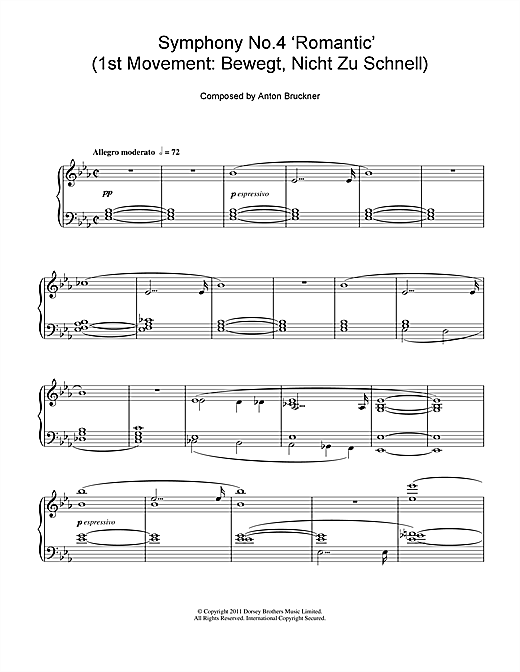
An eerie, breathtaking entry by the double basses in the Bewegt nicht zu schell followed by the winsome horn solo morphed into our first treat of full-on Bruckner brass. Ticciati, restrained, holding back, but not quite teasing, built the perfect climax. I have rarely heard such delicacy or clarity in orchestral Bruckner. Clever stuff!

The Andante, quasi allegretto gave us another very gentle pianissimo opening leading to the violas taking up the theme supported by pizzicato violins and cellos. We were being reminded of the SCO’s impeccable chamber orchestra credentials. There soon followed some of the best brass passages ever written and towards the end we were at last in “wild Bruckner” territory with the whole orchestra playing in apparent wilful abandon, but in fact right on the button, until we returned to a reflective pizzicato coda.

In the Sherzo; Bewegt haunting brass led us off with some very clean playing ending in a resounding conclusion.

Finally the Finale of the fourth movement: again, Bewegt, doch nicht zu schnell. After another plaintive horn call there was no shortage of brass and then the full orchestra gave us everything we wanted and took us home. I am delighted to report that the Usher Hall audience did not burst into applause immediately but waited until Ticciati had lowered his hand after some ten seconds, and gave him four curtain calls.

So the experiment worked. This was a genuinely fresh approach to the Bruckner symphony. I got clarity, freshness and an unstrained, natural and not too over intense approach that let the music speak for itself. Now, perhaps, for the same approach to the more difficult 6th or 8th.

nae bad_blue

Star (blue)Star (blue)Star (blue)Star (blue)

Reviewer: Charles Stokes (Seen 3 November)

Go the Scottish Chamber Orchestra

Visit Edinburgh49‘s Usher Hall archive.
Grain in the Blood (Traverse: 1 – 12 Nov.’16)

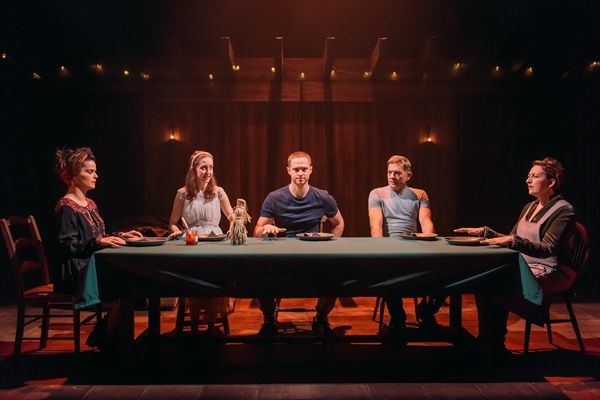
l to r: Frances Thorburn (Violet), Sarah Miele, Andrew Rothney, John Michie, Blythe Duff. Photos: Mihaela Bodlovic

l to r: Frances Thorburn (Violet), Sarah Miele, Andrew Rothney, John Michie, Blythe Duff.
Photos: Mihaela Bodlovic

“This hair-trigger of a play”

Editorial Rating: 5 Stars: Nae Bad

What is it about valleys? There’s the BBC’s Happy Valley and Edward Norton in Down in the Valley, also far from ‘happy’, and – seminally – there’s the Valley of the Shadow of Death, which is as good a place as any in which to locate Rob Drummond’s latest enthralling work. Once upon a time, ‘for hundreds of years in the valley everything was just so’, but then the thanksgiving poetry ran out, like blood. Time now, then, for a spell of compassionate release.

That’s the hope anyway, and it is hope that supports Sophia, whose grand-daughter Autumn, needs a kidney transplant if she is to live much beyond her twelfth birthday. Isaac, Sophia’s grown son, has it in him to help but naturally, dramatically, it is not as easy as that. In fact, after 85 minutes, it has all still to be decided, either by the words of a child terribly wise beyond her years or out of the barrels of a 12 bore shotgun. Orla O’Loughlin’s direction respects this hair-trigger of a play right to its showdown.

The action rises over 3½ days, counted as ‘three sleeps’ by Autumn, who is brat reporter and ancient Chorus combined. She knows the ‘Verses of the Harvest’ by heart and the rhythmic invocation of the Grain Mother as provider of health and happiness- sad joke –  sounds solemn and serious, ‘even though She doesn’t fucking exist’. That’s the thing about Autumn (Sarah Miele): she has that unnerving sacrilegious streak that adults can’t manage.

So, there is proper tension down on the farm. There’s even a game of ‘Truth or Dare?’ that contains the greatest reveal of them all, which is wickedly ironic as Isaac (Andrew Rothney) is described as ‘low risk’. Sophia (Blythe Duff) needs to believe that assessment whilst Burt (John Michie), is there as the phlegmatic companion to threatening circumstance. These two play out a nice challenge of ‘Would you kill scumbags to save your daughter?’, which just digs deeper into the disturbing, teasing, ethical dilemmas that Drummond delights in. Go to his Uncanny Valley for starters.

grain-in-the-blood-2

The remote rural location is part of the piece. Where better to unearth the unsettling and the rooted? The harvest moon can glint off Isaac’s blade and there’s the suffering of Auntie Violet’s horse to put alongside Sophia’s claim that ‘We’re all animals’, which might be what her veterinary practice has taught her. Her house is modern, of machined and polished wood, where you might expect low ceilings, wood smoke and warped timbers. The spare, snappy dialogue and careful movement suits the space, whose back wall slides away to show Autumn’s bed with its blood drip stand, or the barn, site of an earlier, bloodier horror. Introducing classical tragedy for our times, anyone?

Intrigued? You should be, because this is fascinating theatre, still and severe in its way, but emotionally resonant, well-focused and very well performed.

nae bad_blue

Star (blue)Star (blue)Star (blue)Star (blue)Star (blue)

Reviewer: Alan Brown  (Seen 1 November)

Go to Grain in the Blood at the Traverse

Visit Edinburgh49‘s Traverse archive

Frost / Nixon (Bedlam: 12 – 15 Oct.’16)

frost-nixon

David Frost (Callum Pope), left, interviews Richard Nixon (Paddy Echlin)

“The whole impression is one of a gathering and important moment.”

Editorial Rating:  4 Stars: Nae Bad

It’s a generational, media churned, thing. For Brits over 40 to call Peter Morgan’s Frost / Nixon (2006) the ‘real deal’, might be to ask ‘Collectable’ or ‘Antique’?; for Bedlam’s student audience this enthralling play on fact is simply ‘Legit’. Producer Patrick Beddow can be well pleased with its timeliness, coming as it does during the objectionable and tawdry business of the Hillary and Donald Show. Doubtless Frost / Nixon is relevant as U.S political history from 1977 but director Nathaniel Brimmer-Beller and cast make darned sure that it will still grab your attention as a piece of theatre.

David Frost died in 2013 and has the latest memorial stone in Poets’ Corner in Westminster Abbey, which says a lot about the influence of TV these days. Anyhow, he was 39 when he interviewed former President Richard Nixon, three years after Nixon was forced to resign following Watergate. Twenty-four hours plus of recorded material was edited into four ninety minute broadcasts. The first, on 5 May 1977, drew 45 million viewers, still the largest television audience for a political interview ever. Frost /Nixon is the story of how this big (and very real) deal happened, or kind of happened, and how it played out on all those screens. Frost was reckoned a lightweight, capable of only pitching softball questions, ‘puffballs’, that Nixon would just smash over the outfield fence and pocket $600,000. Well, he got his money – and a snazzy gift of Italian shoes – but not all the home runs.

Paddy Echlin is Nixon and Callum Pope is Frost and one on one, with a strong script, it’s a revealing double act. Frost, dapper and debonair, is still a shrewd operator. Nixon, is clever, practised, and self-assured almost to the last. Voice, gesture, timing are studied and effective. Off-camera – and there are cameras on stage – you get just enough of their personal lives to feel interested. Whether, you should sympathise with Richard Nixon is, of course, a contentious question but Echlin’s performance may well win you round. His chief of staff, Jack Brennan (Sasha Briggs), defends him against the liberal ‘side’, where Macleod Stephen as James Reston is particularly telling as player and commentator.

It’s 90 minutes straight through with no interval, which is a good call. Scenes proceed briskly and there are only a few chairs to move around and the whole impression is one of a gathering and important moment. The cameras provide some tight close-ups, and are a helpful reminder that this is a made-for-television ‘event’, but the flood lights do fade Nixon’s jowls to nothing. Otherwise, this is illuminating work.

nae bad_blue

Star (blue)Star (blue)Star (blue)Star (blue)

Reviewer: Alan Brown (Seen 12 October)

[Student? Want to review with us? Please email editor@edinburgh49.com]

Visit Bedlam Theatre

Visit Edinburgh49′s Bedlam archive.

Mischief (Traverse: 11-15 Oct ’16)

“Life-affirming and devastating in equal measure”

Editorial Rating: 3 Stars: Nae Bad

Ronnat and Brigid, mother and daughter, live alone on a small island, save for some cows that they tend to for a group of monks on a neighbouring island. But when the handsome young sailor Fari washes up on their beach, their little world is set to be changed forever. For his own good, Fari is sent off to live with the monks with the next dispatch of milk, but he soon becomes responsible for transporting the milk back and forward, meaning frequent visits to the women on the island, which have deeper effects on them all than any of them initially realise.

It’s a simple but intriguing set up, and Ellie Stewart’s writing creates a believable world and relationship web between the three characters that slowly unfurls as the play progresses. The plot is full of changes in direction and power between each one, keeping the tension alive throughout, and leading to a final scene and denouement that’s both life-affirming and devastating in equal measure.

While covering quite a “serious” overall topic, a fair amount of comedy is woven in, largely through quite overt sexualisation. Such moments are generally amusing, though do perhaps cheapen the play and divert attention away from the main drama, which is the piece’s real strength. Traditional singing and movement are also used throughout which in some ways add to the sense of history and ritual one would expect from such a setup, but in others seem a bit gratuitous in trying to cram in too many devices. Overall I think Mischief (a slightly misleading title) tries a bit too hard to do too much in such a short space of time.

What would make this play more effective would be a greater sense of stillness and time – there are quite a few scenes and scene changes as the story progresses at a pretty rollicking pace, but given the life-changing themes and choices presented, Gerda Stevenson’s slick direction never really gives enough opportunity for the situation or newly revealed facts to just hang and be absorbed. The young cast, in their earnestness, also seem very keen to over-emote and play up to stereotypical roles, when a subtler and more grounded approach would help make the play’s decisive moments stand out.

It’s a moving and captivating piece that’s cleverly written, but not realised to its full potential in this production.

nae bad_blue

Star (blue)Star (blue)Star (blue)

Reviewer: Steve Griffin (Seen 11 October)

Visit the Traverse archive.

THIS REVIEW HAS NOT BEEN SUBEDITED

Benedetti: Oundjian: RSNO (Usher Hall: 7 October ’16)

Image result for RSNO Benedetti

“Overall, an evening of first class playing and sheer joy.  The bar for the rest of the season has been set high”

Editorial Rating: 4 Stars:  Nae Bad

A steady swarm of eager concertgoers approached the Usher Hall and filled its bars, stairwells and ultimately seats on Friday night for the RSNO’s opening concert of their 2016/17 season. Effectively it was a full house, with almost all the choir stalls taken. Either way, the joint was heaving.

The star attraction was, of course, the superlative Nicola Benedetti with whom the city and Orchestra feel a strong affiliation, which she charmingly reciprocated in a short speech at the end of her bravura performance. This notwithstanding, the programme itself was a romantic blockbuster designed to pack them in, though the choice of starter was open to question.

Like a gourmet meal, there is a growing tendency in concerts to serve up an amuse bouche before the appetiser, and on this occasion the band put on Khachaturian’s Waltz from Masquerade as a four minute intro. Whilst undoubtedly Khachaturian stands comparison with Tchaikovsky and Rachmaninov as a Romantic composer and fellow Russian (albeit Georgian) this was by no means a romantic work, and frankly served the rest of the programme ill, getting us in the wrong frame of mind altogether. Charmingly rather galumphing and of the fairground genre, it needed more power from the strings and less from the brass and did little for us.

Then came Nicola in a performance of Tchaikovsky’s Violin Concerto , supported by the discipline and control of Peter Oundjian, and the excellent, well-balanced and complementary playing of the orchestra, that forced me to reappraise my entire attitude to this work several notches upwards. Never a grande oeuvre such as the Beethoven or Brahms, or as lush as the Bruch, the Tchaikovsky has always sat in my mind along the lighter end of the scale, like the Mendelssohn. Played as well as it was on the night, this concerto can take its place among the greats. Why? The limitations of the work remain -“a little showy” being a common criticism – but it was the playing that effected the transition. Benedetti’s long melodic lines, crystal clarity even playing in the highest of positions, and sheer ability to bring out the all the detail and nuances brought greater insight of the work than I have heard before. The orchestra gave a perfect, accurate and empathetic accompaniment, with excellent woodwind and brass in particular.

It was in Rachmaninov’s Symphony No2 that the strings really came into their own in a performance that was never self indulgent nor schmaltzy, but considered, well executed and disciplined so that unlike the Tchaikovsky the music spoke for itself. And what music! The first two movements are in fact quite complex as various themes develop, all of which were well handled, as the tension builds and is eventually rewarded with the fabulous, soaring third movement Adagio. A skilfully disciplined slow build-up under the iron grip of Oundjian held it all together brilliantly until the grand theme was unleashed, and here again not over done, but deeply moving with quite exceptional playing, feeling and discipline working hand in hand. Too often the final Allegro Vivace is frankly a bit of an anti climactic chore that one has to endure to round off the symphony, but  even at the end of a demanding night the RSNO really got into it and gave the movement a vivacity and brio I have rarely heard: glorious brass, hectic strings, all heading towards a spendidly exotic conclusion in the full romantic vein. Overall, an evening of first class playing and sheer joy. The bar for the rest of the season has been set high. Bring it on!

nae bad_blue

Star (blue)Star (blue)Star (blue)Star (blue)

Reviewer: Charles Stokes (Seen 7 October)

Go to the RSNO, Scotland’s National Orchestra.

Visit Edinburgh49‘s Usher Hall archive.

+3 Review: The Glummer Twins (Paradise in The Vault: 22-28 Aug. 11.35am 1h.)

“The guys are genuinely funny”

Editorial Rating: 3 Stars: Nae Bad

On a small, well-lit stage, deep in subterranean Edinburgh, The Glummer Twins start their set with Just Turned Sixty and Taking it Badly: a really good bemoaning of being the owner of an ageing body.  Through the medium of beat poetry and music, the Glummer Twins (David Harmer and Ray Globe) take a look back to 60’s childhood, 70’s aftershave and 80’s yuppies.  They ask the important question of whatever happen to the mods?  Autobiography is included, such as after moving from south London, the warm welcome David received from his new Doncaster school chums.

The Twins look forward to the future with the poems  Old Bloke Blues and Fiery Jack: the latter a must-hear for any pharmacist or person taking a large range of medications.  Groans and laughs are generated in equally generous measure as we follow the puntastic adventures of poet-noir detective Percy Shelly – private dick.  The poems comes thick and fast, with fifteen being delivered over the hour.

The theme of the show is ageing and reminiscing because there comes a time in life, theirs in particular, that there is a lot to look back on but not so much to look forward too.  The Glummer Twins state they have been coming to the Fringe for thirty one years and obviously love what they do.  The audience are in the safe hands of veterans.  Both were members of the performance group Circus of Poets, which in the 1980s appeared on nation television and toured Europe.

The style of comedy is, fair to say, gentle.  That does not mean unfunny: far from it.  While Percy Shelly is undoubtedly the comedic highlight, the spirit and black humour of South Yorkshire is also evoked.  Whatever will happen to Derek the Trainspotter?  One also has to ask, in the wake of the recent Brexit vote, whether there is deeper meaning to the poems Mediterranean Homesick Blues and Speak Scandi?

Harmer and Globe are good, solid performers who deliver rhymes and laughter.  Globe handles the musical side with electric guitar, pedal beat boxes and shares vocals, while Harmer’s performance is spoken word and costume change.  The show is squarely aimed at older generations.  They know that their style and material are not going to rock the foundations of comedy but that does not matter.  The guys are genuinely funny.  Watching The Glummer Twins is a fine way to wind up a morning on the Fringe.

P.S. – if one wants to know the origins of the name, Google “The Glummer Twins” and see what comes up.

nae bad_blue

Star (blue)Star (blue)Star (blue)

Reviewer: Martin Veart  (Seen 26 August)

Visit the Assembly Roxy Bedlam Church Hill Theatre Festival Theatre King’s Theatre Other Pleasance, Potterrow & Teviot Summerhall The Lyceum The Stand Traverse archive.

THIS REVIEW HAS NOT BEEN SUBEDITED

+3 Review: Mungo Park (Summerhall: 3 – 27 Aug. 8.45pm 1h 20m.)

Images: Dogstar Theatre.

Images: Dogstar Theatre.

“… an invitation to taste the popcorn, then it’s serried lights and blinding action”

Editorial Rating: 5 Stars: Nae Bad

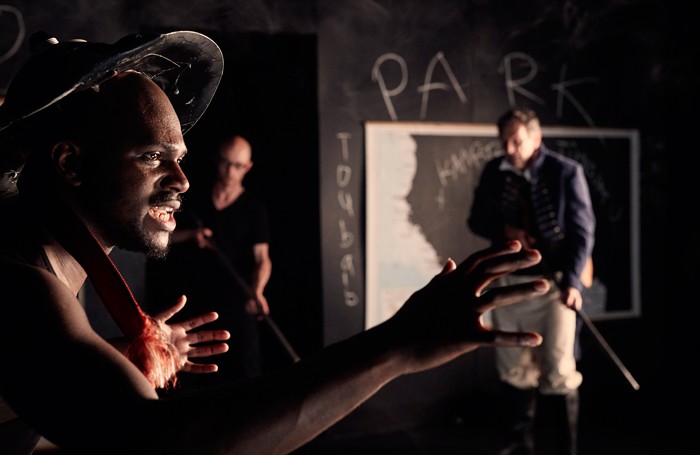
There is a Mungo Park Road in Gravesend, Kent, and sheltered housing at Mungo Park Court in Selkirk which seems all a bit sedentary when it comes to the tremendous life of Mungo P himself. Born in 1771, near Selkirk right enough, he ventured out down the Niger River and was the first European to reach Timbuktu. Of course, he did not have a passport so that nice phrasing, used in this show, about his Majesty ‘requests and requires [that] the bearer pass freely without let or hindrance’ did not apply. Instead his heroic travels are the stuff of bedtime stories, ‘To Selkirk … and beyond!’ if you will, which is where Mungo Park Theatre (Copenhagen) and Dogstar Theatre (Inverness) come flying in.

Writer and director Martin Lyngbo wants Hollywood-on-stage for the ‘inner eye of everyone in the audience’. So we get an invitation to taste the popcorn, then it’s serried lights and blinding action. We move swiftly from the Highlands, to London, and – via the two journeys of 1796 and 1805 – to central West Africa, on foot and in a canoe.

Travel at the wrong time and it’s very hot and wet and deadly out there. The African interior was a huge gap surrounded by a coastline, for its ‘heart lies in darkness’ and between August and October forty-one out of the forty-five or so Brits on the second expedition died of fever. How Parks survived for as long as he did is an open question but – to judge by this play – it was a combination of physical toughness, determination (to see home and family again), good sense and good luck. Africa for him is ‘a fragile network’ of peoples and customs and you got nowhere without respecting that.

Mungo Park goes back to 2006. That first Danish production was rehearsed during the crisis that surrounded publication in a newspaper of the Muhammad cartoons. This English language version, by Jonathan Sydenham, still looks as if it is significantly influenced by that controversy. Clever caricature asks questions of how individuals are represented and received by ‘others’, culturally akin or not. African kings Desse and Ali play ‘up’ their obvious differences in sing-song pidgin speech; their messengers play their crafty roles as would flunkies of a European court but with outlandish accents. Sir Joseph Banks, notable patron of the natural sciences, is as interested in gold as he is in plants. Lieutenant John Martyn, in command of Parks’ escort, is more blood thirsty racist than an officer and a gentleman. Desperate and dangerous confusion results from misunderstanding and prejudice.

Kingsley Amadi (l)

Kingsley Amadi (l)

Matthew Zajac is impressive as the courageous and virtuous Mungo, whose story we follow at every turn, literally so as he fights his good fight on a turntable. Anders Budde Christensen is all exaggerated gesture and of wily tongue as emissary and as the not-so-enlightened James Rennell, map-maker, who would be master of all he surveys. Kingsley Amadi is black African potentate and crazy (white) army officer. It is so confidently performed that the zany is never risible, the indomitable never preposterous.

The rapid screenplay, to go with the filmic idea, produces strong exposition – particularly when its opening is chalked-up on the blackboard rather like title cards to a silent movie of colonial history in the making – and a dynamic narrative. No visual ‘shots’ are projected so there’s a spontaneous, on-the-spot quality to the whole piece. For the most part it is tightly focused upon Parks himself and when it isn’t there is some loss in terms of its depth of field. Performers running up and down the central aisle in a bright light did not look right.

Sturdy Mungo always has a satchel for his notebook and his Travels were published in 1799 but if you want a stirring measure of the man and of his life you won’t do better than this motion picture of a play.


nae bad_blue

Star (blue)Star (blue)Star (blue)Star (blue)Star (blue)

Reviewer: Alan Brown (Seen 24 August)

Go to Summerhall and the Dogstar Theatre Company

Visit Edinburgh49‘s  Summerhall archive.

+3 Review: Penetrating Europe, or Migrants Have Talent (Paradise in Augustines: until 28th Aug: 21:35: 1hr)

“Sandalovych doesn’t simply engage the audience, she immerses us in the tumultuous narrative.”

Editorial Rating: 3 Stars:  Nae Bad 

Our host (Dave Strudelbar) for this evening’s episode of Migrants Have Talent bounds down the stairs before introducing the evening’s two judges: immigration officer, Nigel Nobson (Uilleam Blacker) as well as glamorous former illegal immigrant, Nigella Smith (Lesya Liskevych).  Nigella explains that she was talent-spotted after five years of cleaning the toilets at Television Centre. She cleaned toilets under her original name, she minor celebs with a new one, changed by deed poll. Together Nigel and Nigella decide who stays and who is deported, with the audience voting in the event of a tie.

There are five contestants. Actor Iaroslav Tsigan’s character is from Ukraine. He traveled to Britain on false Polish papers. A likeable character, his honesty fails to impress the stern judges. Interwoven with the talent show format are the stories of two young people, who relate how it is to travel and cross borders. One is going east to Ukraine for an adventure; the other west, by land and sea, to join family already in Britain.

These paired stories, delivered solo with other cast members playing the role of various officials, are the most effective part of the production.  The contrasting experiences and expectations of the two young people are increasingly moving. Actor Ira Sandalovych compellingly portrays a descent into fear. Sandalovych doesn’t simply engage the audience, she immerses us in the tumultuous narrative.

Most of the large cast are employed in the Migrants Have Talent sections.  Writers Blacker and Olesha Khromeychuk deploy a tongue in cheek style of satire that seeks to lighten what are, in reality, stories of genuine human suffering. At no point are we allowed to forget that not a million miles away from the Fringe, real people are really living through such uncomic tragedies. Still, this is above all a theatre piece. How effective (as opposed to affecting) is it?

The message is crystal clear. Humanity is common: borders and suffering man made.

If there is a problem it’s is one of counterpoint. Does the satire sparkle bright enough against the darkness of the immigrants’ tales? The lighting is handed well and sound, with the ensemble song describing cranes flying away to die in foreign lands (a poem from 19th century Ukraine) is truly beautiful in such a small venue.  However, with such a large cast, the staging does slip into awkward moment but, overall, this is a more than likeable production whose heart is definitely in the right place.
nae bad_blue

Star (blue)Star (blue)Star (blue)

Reviewer: Martin Veart   (Seen 23 August)

Visit the Assembly Roxy Bedlam Church Hill Theatre Festival Theatre King’s Theatre Other Pleasance, Potterrow & Teviot Summerhall The Lyceum The Stand Traverse archive.

THIS REVIEW HAS NOT BEEN SUBEDITED

+3 Review: The Other Guys – Well Sung (TheSpace@ Symposium Hall: Aug 16 – 20: 16.10 : 50 mins)

https://i0.wp.com/edinburgh.carpediem.cd/data/afisha/o/8c/a9/8ca969a213.jpg

 “Substantive, deep and intricate”

Editorial Rating: 4 Stars Nae Bad

I think the mark of a good group name is its capacity for inciting mild social chaos when you try and explain you’re going to see them. And whilst The Other Guys win points for being delightfully vague from the outset, their talent is nothing if not definite.

Formed in 2004, the St Andrews based acapella group has already received significant critical and celebrity accolade; and from the moment the voices start raising, it’s immediately clear why. Well Sung, despite the punderful name, is a set list with multifaceted focus: the quality of the vocals, tonal layers and overarching charmingness of the performance all come together to form what is certainly a spectacle worthy of spectation.

From the first note, what is immediately apparent is the sheer singing skill present throughout the group. The way in which many solo vocalists seemed to swoop and crest throughout their range was genuinely (and indeed, pleasantly) surprising, and it certainly makes for good acapella. It goes a long way to making the sentiments behind the songs seem genuine – for those of the patriotic persuasion, prepare for a performance of “Loch Lomond” that’ll make your knees shiver.

But even more than quality, what marks out The Other Guys is their rich tonality. Falling somewhere between glee club and old school barbershop, the harmonic layering of each vocalist during more group-orientated numbers is so rich and layered that it’s difficult to convey without hearing it. It’s the taste of red wine, or the smell of pine smoke – substantive, deep and intricate.

However, this interoperability is a fickle advantage: despite lending a definite veneer of quality to their songs, it comes at a cost: the more energetic numbers sometimes lacked the volumatic punch needed to fully capture the spirit of their original composition; and whilst tailor-made to show off that rich barber-shop-esque quality, the arrangements occasionally failed to show the same uniqueness which makes the vocals themselves so compelling.

Ultimately, though, it’s hard to deny the charm and talent of this group of young men. From acapella virgins to die-hard fans, this is a show that demands to be seen. Despite its shortcomings, Well Hung is a rare thing: a feast for the ears in which one can choose their portion. It’s very easy to get lost in the sheer vocal texture – but equally so to simply watch as the beauty unfolds.


nae bad_blue

Star (blue)Star (blue)Star (blue)Star (blue)

Reviewer: Jacob Close (Seen 20 August)

Visit the Other  archive.

THIS REVIEW HAS NOT BEEN SUBEDITED

+3 Review: The Free Association – Jacuzzi (Pleasance: 4-21 Aug: 23.00 : 1hr)

faimprov_cogarts_london_thebeauvoir_andrealops-113.jpg

 “Wild, witty and wickedly funny”

Editorial Rating: 4 Stars Nae Bad

I always approach live improv shows with a degree of trepidation: though a lot of the fun lies in its often wild unpredictability, it’s easy for a forced joke or sudden case of comedian’s block to sour an entire set. However, from the moment the Free Association players arrived on stage, I felt as if the audience was in very safe hands.

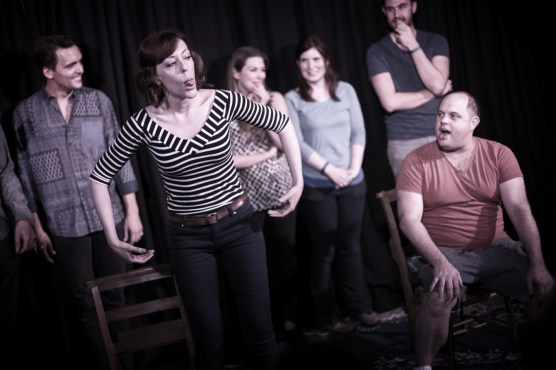
Basing scenes from improvised monologues by “special guests”, it’s a streamlined one-two punch of comedy flavours. The changeover from stand-up style presentation to off-the-wall improv is smooth, sharp and very crisp, handily overcoming the transitional inertia that would threaten less cohesive groups. From start to finish, it’s this veneer of professionalism that really brings the Free Association together; very seldom is improv so akin to a well-oiled machine.

But far from it to say the comedy is mechanical: I’d almost recommend a helmet to protect against the ideas bouncing off the walls. From Blue Peter themed suicide pacts to rad skateboarding private-school bait-and-switches (it somehow made sense at the time), you’d be hard pressed to try and follow the cognitive bead of sense for more than ten minutes – and this show is all the better for it. Despite a few jokes which fell flat or dampened the usually excellent energy, when the material’s good, it’s hysterical.

This unpredictability was aided by the novel way in which the Free Association goes about its work. They tout themselves as being “based on the American style of long-form improv but with [their] own unique spin”, and the latter is pointedly true. Jacuzzi often blurs the line between short form and long form improv, with overarching plots and characters weaving in and out of the utter chaos on stage at breakneck pace.

For a more amateur company, this may have been a tall order, but the talent driving this show can’t be denied. Despite the extreme difficulty in discerning a favourite from such a strong cast,  Comedy MVP inevitably must go to Alison Thea-Skot: I’ve never seen such a wide comedic range – it’s a hard job to make an audience really believe they’re watching a heavily-scottish football coach who’s forcibly making their players fat to win games  – again, plenty of sense at the time – but I’ll be damned if I didn’t expect a true-life biopic about it to be in the works by the time the set ended.

The Free Association is certainly deserving of its acclaim. Wild, witty and wickedly funny, “Jacuzzi” is a classic example of improv comedy done right.


nae bad_blue

Star (blue)Star (blue)Star (blue)Star (blue)

Reviewer: Jacob Close (Seen 17 August)

Visit the  Pleasance, Potterrow & Teviot archive.

THIS REVIEW HAS NOT BEEN SUBEDITED