Hay Fever (Lyceum: 10th March -1st April ’17)

Rosemary Boyle, Susan Wooldridge, Charlie Archer. Photo credit – Mihaela Bodlovic

“Susan Wooldridge is sensational as Judith Bliss”

Editorial Rating: 3 Stars: Nae Bad

The overarching theme in Noel Coward’s Hay Fever is one of contrast: theatre vs real life; keeping up appearances vs showing your true colours. And while capturing a lot of the inherent comedy in such situations, this latest production from the Lyceum Theatre Company and the Citizens Theatre, for me, goes one contrast too far in creating a production of paradox which ends up being somehow less great than the sum of its parts.

Without the traditional curtain opening at the start of the show, Tom Piper’s stark and stripped back set, which exposes a lot of the “backstage” area, is immediately visible. On first impression, it feels cheap and unfinished, leading me to worry I’ve walked into the theatre a week too soon. It does, however, create a rugged bohemian mood, which seems to make a lot more sense as the piece progresses.

When the action begins, much of it early on feels quite forced, with the first scene in particular a mass of very obvious stage directions with vases, cushions and sitting down. Thankfully, Rosemary Boyle as Sorrel allays many of my fears by capturing that much-needed sense of balance between theatricality and reality, with charming facial expressions, tone and timing all making her compelling to watch. In contrast her on-stage brother Simon (Charlie Archer) consistently leans towards being melodramatic, and it’s only in the final scene where his character starts to blend with the rest of his family that he feels like part of the same play as everyone else.

Indeed, this sense of mismatched acting styles also applies to the guests. Pauline Knowles brings a wonderful Jordan Baker coolness to Myra, with a clear journey in mood as she resists the madness around her, while Nathan Ives-Moiba (Sandy) seems quite content to bark his lines at anyone and everyone, with little subtlety or variation throughout.

Considering all of the above, perhaps what jars most about this production is how difficult it is to believe any chemistry or relationship between the family members and their guests. Susan Wooldridge, who is sensational as Judith Bliss in the second half of the piece, with commanding presence and vitality, is perhaps too old and withering to be believed as Sandy’s obsession, while Benny Baxter-Young’s frustrated and frumpy David seems the exact opposite of what Myra and Jackie would endure a trip to this house for. Individually the characters work, but together they don’t.

Hywell Simons and Katie Barnett. Photo credit – Mihaela Bodlovic

In saying that, there are some moments of brilliance. My personal highlights include the hilariously awkward arrival of Jackie and Richard – deftly played by Katie Barnett and Hywel Simons – which captures just how amusing British politeness can be to the outside eye, while Clara (Myra McFadyen) dazzles every time she sets foot on stage, particularly in the unexpected interlude. Even more unexpected (for everyone concerned) in this performance was the breakfast trolley’s stage direction to topple over, which though admirably covered by quick-fire improvisation, perhaps most deftly sums this production up: funny but off-balance.

nae bad_blue

Star (blue)Star (blue)Star (blue)

Reviewer: Steve Griffin (Seen 14 March)

Visit the The Lyceum archive.

THIS REVIEW HAS NOT BEEN SUBEDITED

A Step In Time (The Magnuson Centre, Edinburgh Academy: 10th & 11th March ’17)

“The group demonstrates all the qualities that make show choirs eminently lovable”

Editorial Rating: 3 Stars: Nae Bad

In large part thanks to a popular American TV series from the 00s, being in a show choir has become a lot more socially acceptable – even “cool” in some circles – in recent years, so it was great to see a packed house for Edinburgh University Footlights’ latest show, and a stage full of diverse young people who love being there.

In A Step In Time the group demonstrates all the qualities that make show choirs eminently lovable: fun renditions of upbeat popular tunes, killer vocals, show-stopping choreography and smiles big enough to fill the room. But behind all the glitter and grapevines, did the performance itself deliver a knock-out punch? In my opinion, not quite.

Opening number Step in Time set the scene well as a lively and energetic introduction to the night’s proceedings with some clever, subtle changes in lyrics and arrangement to make the song feel like the choir’s own. Accompanied by full-on intricate choreography, it says something about the fitness and dedication of the group that they were even able to breathe for the next ten minutes, let alone perform song after song, complete with dance routines.

For me, it was a shame there was significantly more focus on the “show” rather than the “choir” elements of the performance, with complex choreography and numerous costume changes detracting from the vocals throughout. Harmonies and power were often lost in the frantic flailing of arms and apparel, and what remained was at times imprecise and unnecessary. The flow of the performance was also quite stilted, with some uncomfortable lengthy pauses between songs, hindering the overall enjoyment of the night.

However, it was in the simpler and more stripped backed numbers where the group really excelled: the 90s medley, Seasons of Love and the 00s medley in the second half really showcased the strength and depth of the choir’s vocal talents, and it’s a shame we didn’t see more consistent top quality vocals and arrangements like these from the choir as a whole throughout the show. There were also some beautiful stand-out solo and small group performances (specifically Believe, She Used To Be Mine and I Know it’s Today) which highlighted some really gorgeous individual voices.

I would have preferred more quality over quantity in terms of the choreography, using it cleverly in specific numbers to give wow-factor, with greater focus on the basics of group singing as the overarching emphasis. Overall I think the group tried to do too much too often, which left the lily not just gilded, but smothered in cream and cherries too.

Still, it was an entertaining performance from a talented bunch of young people, that was, on the whole, very enjoyable. I look forward to the next one.

nae bad_blue

Star (blue)Star (blue)Star (blue)

Reviewer: Steve Griffin (Seen 10 March)

THIS REVIEW HAS NOT BEEN SUBEDITED

The Marriage of Figaro (Assembly Roxy: 1st, 3rd and 4th March ’17)

img_1893

I have seen grander productions of The Marriage of Figaro… but not better ones.”

Editorial Rating: : 4 Stars:  Nae Bad

It’s hard not to enjoy Figaro. The tunes are familiar, the plot is a delightful melange of innocent deceit and caprice, and all ends happily. It is true, however, that the subject matter of powerful men demanding sex from young women who are effectively in their thrall has deeply unpleasant contemporary undertones. However the sheer good nature of the plot, the cunning of the women involved in cleverly winding up and trapping the men (aided and abetted by the master of cunning himself, Figaro), allows us to dismiss any politically correct concerns. It’s a lot more female friendly than The Benny Hill Show, and overall is a happy opera that allows us to laugh at the foibles of human nature as we re-attach ourselves to the finer strands of love, forgiveness and commitment. Cosi Fan Tutte it is not.

This production is staged by Edinburgh Studio Opera: a well-established group of University music (and other disciplines) students who team up with musicians starting out on their professional careers, and on the whole is a very successful follow-up to last year’s triumph, Carmen.

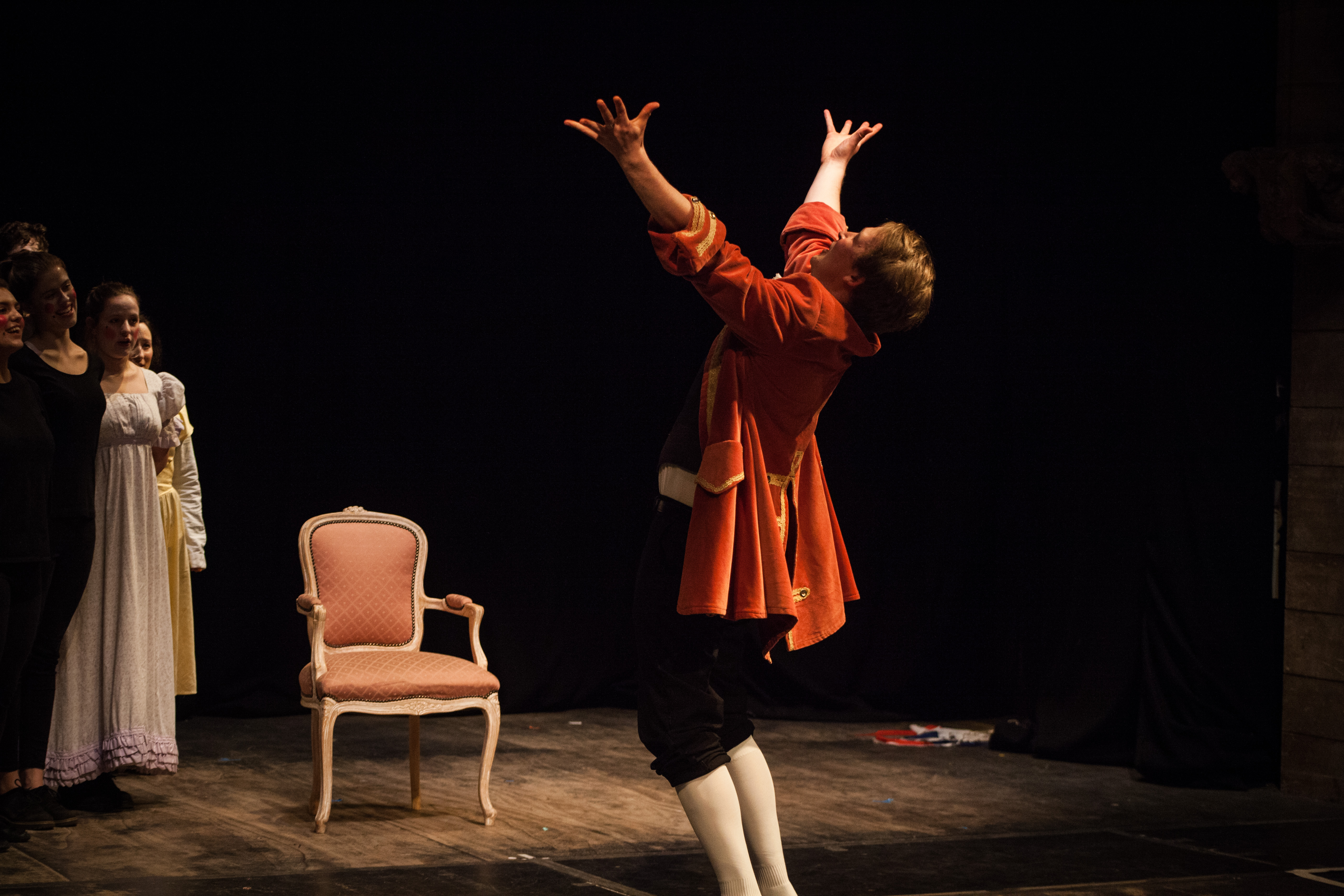
It uses a number of quite clever production devices in its storytelling in order to compensate for its stripped back set (a necessity of student productions!) – just clothes hampers and a door. We are led to believe we are watching an opera audition to start with, with cast getting into their costumes on stage. Quite why the chorus is dressed in black with grotesque make up in the manner of a Greek Chorus such as in Bacchae, is harder to understand, but arguably acts as a reminder that at this moment there are three entities in play; us, the audience; such actors as were robed; and the chorus being aspirant players hoping to get in on some of the action (which ultimately they did).

For me, this device works because the opera starts off with just two people on stage and the full company arrives only later on.  For the guise to return just as the interval and finish approach, as the chorus cast off their (over) garments on stage and wheel them off in laundry baskets is .entertaining but puzzling.  Again, perhaps a reminder that we were watching an audition, but could have been more thoroughly explored to make a clearer through-line. Other charming (if a little bizarre) moments are when the chorus also act as a very animated set of trees in the forest scene, a humorous foil to the shenanigans going on between the Count and Cherubino.

The libretto is sung in English with a commendable clarity that engages from the start. There is some fine solo as well as ensemble singing, with Jessica Conway (Rosina) delivering a couple of demanding arias very close together more than capably, while Jonathan Forbes Kennedy’s Count and Timothy Edmunson’s Figaro bring just the right balance of authority and vulnerability to their parts both vocally and with their acting. But for me, the star of the evening without doubt is Sarah Gilford’s Susanna, who not only sings beautifully, but acts with coquettish smiles, joyful humour and a streak of kind cunning. The Count never had a chance.

The production runs until the 4th March and I strongly recommend it for its inventive, professional approach. Ingenuity and creativity, allied to committed singing, acting and orchestral playing soon make one forget the necessarily stripped production. It is a joy from start to finish, and played for laughs which come aplenty. I have seen grander productions of The Marrage of Figaro, but not, in terms of sheer engagement with the work, better ones.  It feels as if the company really are giving it all they have, perhaps in the absence of more luxurious proscenium arch props, which sprinkles it with an extra layer of magic.


nae bad_blue

Star (blue)Star (blue)Star (blue)Star (blue)

Reviewer: Charles Stokes(Seen 28 February)

Visit the Assembly Roxy  archive.

THIS REVIEW HAS NOT BEEN SUBEDITED

The Winter’s Tale (Lyceum:10 February – 4 March ’17)

l-r: Maureen Beattie, Frances Grey and John Michie. Photography: Mihaela Bodlovic

l-r: Maureen Beattie, Frances Grey and John Michie.
Photography: Mihaela Bodlovic

“Go with an expressive meld of The Proclaimer’s evergreen ‘I’m Gonna Be’ and the absolute integrity of Paulina”

Editorial Rating: 5 Stars: Nae Bad

Accept that the Oracle at Delphi is a DNA lab – and why not? – and that no Bohemian sheep shearing feast is complete without See You Jimmy hats – ‘perhaps the most potent symbol of national self mockery in the world’ – and then you create a ‘Winter’s Tale’ to die for. And indeed little Mamillius does die, and the good lord Antigonus does get ripped apart by a bear, but that’s tragicomedy for you: part psychodrama, part romance, and now part ceilidh; all startlingly well realized in this Lyceum production, directed by Max Webster, designed by Fly Davis and with music by Alasdair Macrae.

Delphic maxim, admonition and genetic instruction, the aphorism ‘Know thyself’ would be a three-in-one cure all for Leontes, King of Sicilia. He might have found the motto in his Christmas cracker. Unfortunately, he doesn’t and goes insanely jealous instead: losing his wife, his son, his new born daughter and his best friend in the process. That’s roughly half the play, an hour or so, and then after the (16 year) interval there’s sixty minutes of making jolly good, when that lost daughter finds her Prince, the friends are reconciled and – miraculously – love between husband and wife is restored. Sweet? Nah, not when Jimmy Chisholm’s Autolycus is around, fleecing ordinary folk, pinching their gold, selling dodgy CDs and hawking his ‘delicate burdens of dildoes and fadings’ (that’s Shakespeare, not James Robertson’s proud and vernacular Scots). If it’s continuity you’re after, to oppose Leontes’ psychosis, then go with an expressive meld of The Proclaimer’s evergreen ‘I’m Gonna Be’ and the absolute integrity of Paulina (Maureen Beattie), as audacious in the face of power as you could wish woman to be.

The Winter’s Tale is late Shakespeare so it’s always interesting to see how a thoughtful production brings its mature ‘status’ into play. Rulers, Polixenes (Andy Clark) as well as Leontes, are petty tyrants in this telling. They act beyond reason, expecting loyalty and deserving none. Their women are their subjects. When Hermione (Frances Grey) pleads her innocence she knows that Leontes, husband, judge, and executioner, speaks a ‘language that I understand not; [that] My life stands in the level of your dreams’. In 1611 it was possible, and probably necessary, to admit that Leontes has regained his authority by the final scene; but not in 2017. The deluded male is busted and a near broken John Michie does it very well. It’s the same with position and rank, for who would be liege-men to lords such as these? Prince Florizel’s love for his common shepherdess (tho’ she’s not really!) cannot be doubted and Bohemia looks just the kind of subversive place where young people should grow up.

Jimmy Chisholm as Autolycus.

Jimmy Chisholm as Autolycus.

The binary nature of the piece – Sicilia vs. Bohemia – locks it together. One is urban and a touch swanky with its musicians in a recording booth, expensive and insulated; whilst over in Bohemia, or is it in a field near Auchtermuchty?, Autolycus is on the make and Annie Grace plays her Border pipes on a makeshift platform and it’s all in for a Canadian Barn Dance. Perdita (Fiona Wood), pranked up in her goddess claithes and pink Converses, is made-for-Fife. ‘Too noble for this place’ reckons Polixenes. Prat!

Yes, judgements come fast and sure in this tale. The opening signal is a beautiful arrangement of ‘In the Bleak Mid-Winter’, whose plaintive ‘What can I give him?’ is Hermione’s anguished, unanswerable question. Mamillius is the sacrificial lamb – and bear. Rustics, pre-eminently John Stahl as the Shepherd are as funny, honest and whole hearted as they are gullible and foolish. Autolycus, complete with paper crown around his neck, is the disgraceful Lord of Misrule, whom you shouldn’t care about, just delight in.

What is apparent throughout is clear-cut. Indeed there’s a thematic insistence upon narrative clarity and serious moral direction that other productions can lose sight of. No chance here: not only is the lighting plot instructive, there’s even an ultrasound to pay attention to and, remarkably, an apt reference to the human genome project:

‘Your mother was  most true to wedlock, prince;

For she did print your royal father off,

Conceiving you.’

Invention does not diminish Shakespeare.

nae bad_blue

Star (blue)Star (blue)Star (blue)Star (blue)Star (blue)

Reviewer: Alan Brown (Seen 14 February)

Go to The Winter’s Tale at the Lyceum

Visit Edinburgh49 at The Lyceum archive.

Picnic at Hanging Rock (Lyceum: 13 – 28 January ’17)

hanging-rock-1

“It’s cool, it’s chilling and it shocks”

Editorial Rating: 4 Stars: Nae Bad

Do you approach Hanging Rock expecting to see corsets hanging in mid-air? Well, in which case you will have noted that the excised last chapter of Joan Lindsay’s 1967 book provides this astonishing feature. Either that or you’re wandering in a Dreamtime of your own (adolescent) imagination, set about with eucalyptus trees and hot flushes from Peter Weir’s 1975 screenplay. Now here comes the wake-up call, a dramatic restorative, if you will.  It’s cool, it’s chilling and it shocks.

This Picnic at Hanging Rock is a stylish outing, to say the least, from Melbourne’s Malthouse Theatre and Perth’s Black Swan Theatre Company. That’s Perth, Western Australia, and that’s a collaboration over 2170 miles, but who’s counting? This is Tom Wright’s adaptation but as in Lindsay’s story distance is of no consequence and time is suspended, ‘running out and spooling in’, between grey black panelling topped with brushwood. No rock is visible and there is no interval.

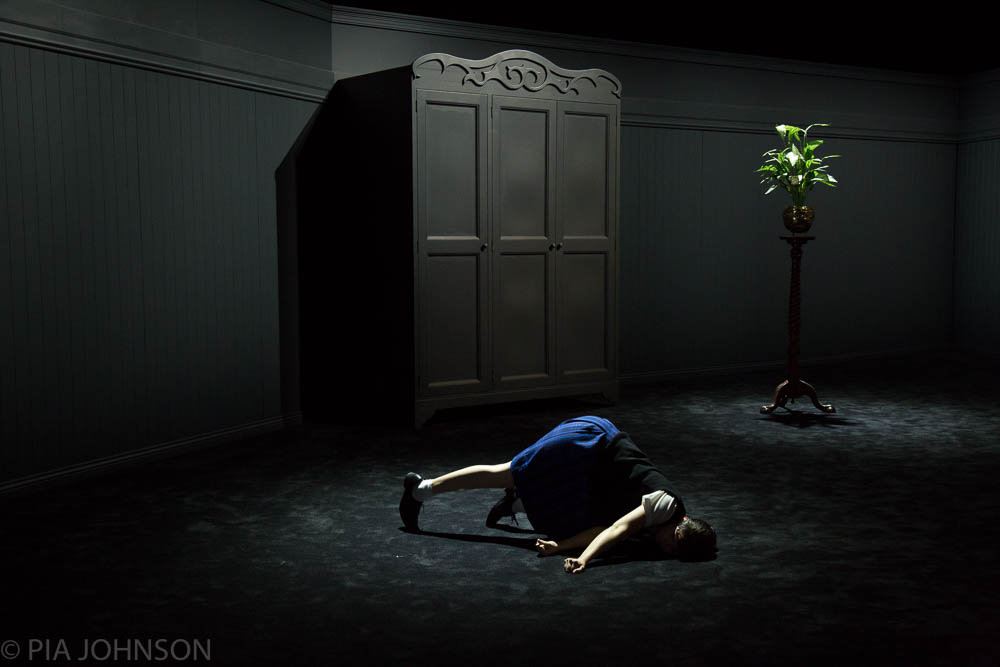
There is thunder and a blackout and five schoolgirls suddenly appear, side by side across the stage, in immaculate uniform ready for Speech Day 2017. They tell the story, their shared creepy story, of what happened on St Valentine’s Day, 1900, when a daytrip from Appleyard College went to Hanging Rock and four girls and one teacher disappear. One of them, Irma, is later found, close to death, and with absolutely no memory of what happened. It is, at its opening, a composed and perfectly disciplined account that you realise is the sure and safe way to rationalise the irrational, the unknown and the dangerous. It is a long introduction but necessary, for in this telling you understand that an ancient landmark is an abcess to be swabbed away for the sake of white Australians everywhere and young ladies from proper schools can never be too English. Whatever happened, dear, it’s really too, too bad that it happened in the state of Victoria.

hanging-rock-2

There are parasols to ward off the sun, a grand aspidistra to maintain respectability, and – figuratively – there must be ‘lino, asphalt, and axminster’ to hide the red earth. Mrs Appleyard, founder and Headmistress, remembers Bournemouth but dreams of the  intimate touch of her (?dead) husband. Irma, returns to the school before leaving for a stay in England and is viciously attacked by girls suffocating in their own propriety. Director Matthew Lutton works to challenge perceptions: angling the girls in contorted positions, immobilizing their movements in successive freeze-frame ‘shots’, subjecting the narrative to enigmatic surtitles over frequent blackouts. How else to refresh, even subvert, what has become an almost mythological text, complete with panpipes?

It is actually without humour – an unusual and tense achievement over eighty-five minutes – but the performances of the several characters are still appealingly unaffected and distinct. Amber McMahon cross-dresses as the young Englishman, Michael Fitzhubert, but there’s no caricature here. Elizabeth Nabben is Mrs Appleyard and builds a fragile role to its last despairing moment; Nikki Shiels suffers as Irma, whose fate it is to keep her nightmares under control, whilst Arielle Gray and Harriet Gordon-Anderson are in supporting roles that they make important.

Is an audience bushwhacked by theatrical device and intelligence? I think so, but it is performed with considerable respect for its source and the script is smart, spare and ingenious. Technically it works a treat with outstanding lighting and sound and this is probably one production where the ‘best’ seats, for the best effect, are probably at the front of the Upper Circle and you should definitely read the Director’s and Writer’s programme notes after the show because they’re too helpful. The play’s the thing.

[FYI. Bruce Springsteen and the E Street Band play at Hanging Rock on Saturday 11 February. You simply cannot keep a good place down!]

nae bad_blue

Star (blue)Star (blue)Star (blue)Star (blue)

Reviewer: Alan Brown  (Seen 14 January)

Picnic at Hanging Rock at the Lyceum

Visit Edinburgh49‘s The Lyceum  archive.

RSNO, Prieto and others (Usher Hall: 2 Dec’16)

Image result for verdi

“…this was a strong, conviction performance of a great work with some fine playing and singing”

Editorial Rating:  4 Stars: Nae Bad

“An opera in ecclesiastical robes” (Von Bulow”). “Bulow has blundered. It is a work of genius” (Brahms). But Von Bulow was not necessarily being pejorative. So what if the Verdi Requiem is an opera in ecclesiastical robes? This perennial argument does have some merit in criticism of the work. I see nothing wrong in celebrating a requiem in operatic style, but it is the structure and intervals within the requiem format that get in the way of the flow of the work. It is a series of seven moments, apart from the enjoyably more substantial Dies Irae and Libera Me. To me, its enjoyment is entirely secular. If I want a spiritual or religious high, I turn to Faure, or Mozart or, indeed, Brahms. If I want music to die for (le mot juste?), then it’s Verdi.

Friday night’s wonderful performance by the RSNO, RSNO Chorus and four soloists: soprano Evelina Dobraceva, mezzo-soprano Elizabeth DeShong, tenor Edgaras Montvidas and Bass-Baritone Hanno Muller-Brachmann – under the baton of Carlos Miguel Prieto was at times spoilt by the audience. On the whole I have a lot of time for the RSNO followers, who do not whoop or whistle, do not clap between movements, and allow a respectful interval at the end of a piece before applauding, but on Friday they coughed and they croaked as and when they pleased, spluttering just a few moments into the desperately fragile pianissimo Requiem. Surely they could have held back at least until the forte passages. I relished – in the fortissimo Dies Irae – the thought of drowning them out myself. This may be the price you pay for live music in winter, but perhaps the Usher Hall could print a few useful tips on muting the effect, as they do in the programme notes at the Royal Festival Hall.

Enough of the audience and on to the artists. The 120 strong chorus managed to keep precision and intensity in their pianissimo entrance, and sang throughout with discipline, force and feeling. Sopranos never harsh, well balanced between the four parts and every entry spot on; basses clear, and good mid range from the altos and tenors. They sang the Dies Irae and Libera Me as well as I have ever heard it sung. Bearing in mind the size of their catchment area this pays a real compliment to their talent and training.

The orchestra were also well up to the task and played with feeling and élan. The “stereo” effect of placing two trumpets up in the gods at the back of the hall in reply to the others on the stage in the Tuba Mirum worked very effectively – it doesn’t always – and it was a revelation to hear, again in the Dies Irae, a double fortissimo, that’s four fortes, without any blaring or coarseness.

The casting of the four soloists from America, Lithuania, Germany and Russia, coming together for a couple of gigs in Glasgow and Edinburgh shows what an international world classical music is, and how Scotland is right up there with the best of them in its ability to attract such talent. The work is not easy on the soloists, especially when singing with each other in duet format. Individual soloists sang well with the orchestra but the two sopranos struggled to sound homogenous in the Recodare, Jesu Pie in the Dies Irae but had got more used to each other in the kinder Agnus Dei. One felt bass-baritone Hanno Muller-Brachmman wasn’t entirely comfortable in the Mors Stupebit and Confutatis maledictus in the Dies Irae, but he entranced us later in the Lux Aeterna. Their quartet for the Offerterio worked well, and soprano Evelina Dobraceva thrilled us in the concluding Libera Me where she really nailed it.

Overall this was a strong, conviction performance of a great work with some fine playing and singing with just a few issues of coordination and integration between soloists, which is always a risk with a live performance of a work that really puts them on the spot. There was a respectable pause before enthsiastic applause broke out, showing that the audience’s heart was in the right place, even if their fitful larynxes were not.

nae bad_blue

Star (blue)Star (blue)Star (blue)Star (blue)

Reviewer: Charles Stokes (Seen 2 December)

Go to the Royal Scottish National Orchestra

Visit Edinburgh49‘s Usher Hall archive.

Blackbird (Bedlam: 16-17 Nov ’16)

“Powerful and moving”

Editorial Rating: 3 Stars: Nae Bad

I was quite apprehensive before taking my seat, as to how Edinburgh University Theatre Company would present the strong, emotive themes of trauma, abuse and love in David Harrower’s intense two-hander. With the entire play focusing on one conversation between the two central characters Ray and Una, how well would the actors sustain and communicate this challenging piece?

The plot sees Una (Sophia Dowson-Collins) seek out Ray (Benjamin Aluwihare) to confront him about the sexual relationship they had fifteen years prior – when she was only a 12 year old girl whilst he was a grown man of 40. She wants to face the past but he is at first unwilling to speak to her. As the play progresses they both go through a range of emotions, sometimes screaming at each other and at other times talking calmly about trivial things, creating a dramatic if at times, confusing dynamic.

The script is complex, taking a while to build and reel the audience in before taking a deeper and darker turn. We get to piece together more about the identities and personalities of both characters, and some surprising twists and turns reveal the truth of what happened fifteen years ago and how both characters have dealt with their experiences since. The silent captivation from my fellow audience members throughout told its own story: at times there was perceptible discomfort, and I personally found the whole thing quite awkward and difficult to watch, but only because the performance felt so real.

Although both performers did well I was particularly impressed by Dowson-Collins’s performance: at times there were long streaks where only she would speak – sometimes to Ray but often more like she was speaking to herself. She was captivating and consistent throughout, bringing a great sense or realness to her character. Aluwihare seemed nervous and awkward for the most part and although fitting with Ray’s character, it was difficult to tell how much “acting” came into play.

The set was perfectly suited to the action: it was very simple with just a couple of seats, a table and some office lockers, making the actors do the work to convey the story. In saying that, what didn’t work so well was the use of a plastic sheet hanging behind Una and Ray, from behind which a girl would appear to represent Una becoming a ghost of herself through everything she had experienced. Although I could see what the production was trying to do I felt like this distracted from the dialogue between Una and Ray, and a more creative way of expressing this idea could have been used to greater effect.

All in I was very impressed by the performance. The themes may not be to everyone’s taste, but it was still a fascinating watch.

nae bad_blue

Star (blue)Star (blue)Star (blue)

Reviewer: Iona Young (Seen 16 November)

Visit the Bedlam archive.

SCO.Ticciati. Ortega Quero. (Usher Hall: 3 Nov.’16)

bruckner4

“This was a genuinely fresh approach to the Bruckner symphony”

Editorial Rating: 4 Stars: Nae Bad

The publicity for Thursday’s SCO gig at the Usher Hall intrigued me. I am a junkie for late Romantic music and for me the period 1850-1950 is the most exciting in classical music. Richard Strauss and Anton Bruckner are among my favourite composers and the SCO under conductor Robin Ticciati is approaching world class status. But a Chamber Orchestra playing a Bruckner symphony? This was something that had to be experienced.

I was pretty certain the SCO could bring off the Oboe Concerto by Richard Strauss. It is a beautiful work that sits comfortably within the Chamber genre, completely in contrast with his earlier works or subsequent dramatic Four Last Songs; so it is a bit of a one-off. The whole piece sat together well, the orchestra demonstrating real fluency of playing in support of the very demanding solo part. Ramon Ortega Quero handled the extraordinarily long passages (no less than 57 solo bars in the opening sequence) with sub aquatic breathing skill and faultless phrasing, and coaxed a beautiful tone out of his difficult instrument. Forgive me, but I could not help but remember my mother telling a story of a young oboist she went out with at university. His lips, as demonstrated in his kissing, were of a muscular versatility not since experienced. One of the benefits no doubt of a super competent embouchure.

We were treated to a thoroughly polished, relaxed performance of a rather intimate work that in particular demonstrated fine string playing and a conductor getting all that he wanted from his band with minimal apparent effort.

But the real test was to come.

What happens when a chamber orchestra tackles an orchestral behemoth? Ticciati has gone on record as saying “We need to scrape back the veneers” and “reveal the work in new colours”. This they did, although I do concede that the orchestra was beefed up to maximum strength. What they brought to Bruckner’s 4th Symphony was an astonishing clarity along with a seemingly relaxed approach that allowed the music to speak for itself, rather than  suffering the relentless drive of some other conductors. Ticciati’s body language and general demeanour suggested he could have been conducting Haydn or Mozart. So relaxed!

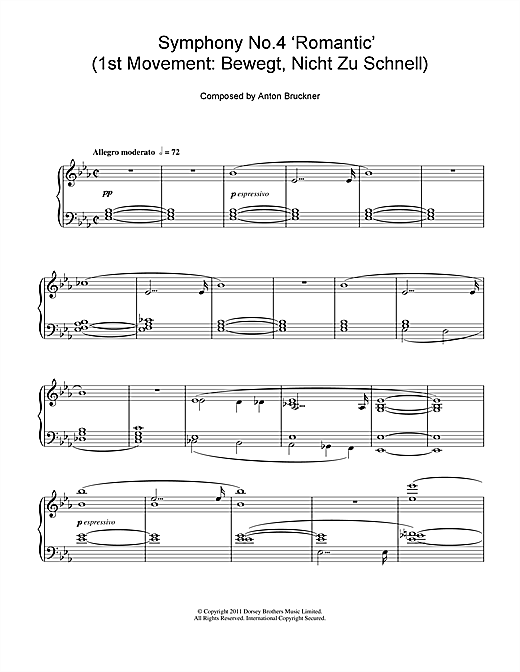
An eerie, breathtaking entry by the double basses in the Bewegt nicht zu schell followed by the winsome horn solo morphed into our first treat of full-on Bruckner brass. Ticciati, restrained, holding back, but not quite teasing, built the perfect climax. I have rarely heard such delicacy or clarity in orchestral Bruckner. Clever stuff!

The Andante, quasi allegretto gave us another very gentle pianissimo opening leading to the violas taking up the theme supported by pizzicato violins and cellos. We were being reminded of the SCO’s impeccable chamber orchestra credentials. There soon followed some of the best brass passages ever written and towards the end we were at last in “wild Bruckner” territory with the whole orchestra playing in apparent wilful abandon, but in fact right on the button, until we returned to a reflective pizzicato coda.

In the Sherzo; Bewegt haunting brass led us off with some very clean playing ending in a resounding conclusion.

Finally the Finale of the fourth movement: again, Bewegt, doch nicht zu schnell. After another plaintive horn call there was no shortage of brass and then the full orchestra gave us everything we wanted and took us home. I am delighted to report that the Usher Hall audience did not burst into applause immediately but waited until Ticciati had lowered his hand after some ten seconds, and gave him four curtain calls.

So the experiment worked. This was a genuinely fresh approach to the Bruckner symphony. I got clarity, freshness and an unstrained, natural and not too over intense approach that let the music speak for itself. Now, perhaps, for the same approach to the more difficult 6th or 8th.

nae bad_blue

Star (blue)Star (blue)Star (blue)Star (blue)

Reviewer: Charles Stokes (Seen 3 November)

Go the Scottish Chamber Orchestra

Visit Edinburgh49‘s Usher Hall archive.

Grain in the Blood (Traverse: 1 – 12 Nov.’16)

l to r: Frances Thorburn (Violet), Sarah Miele, Andrew Rothney, John Michie, Blythe Duff. Photos: Mihaela Bodlovic

l to r: Frances Thorburn (Violet), Sarah Miele, Andrew Rothney, John Michie, Blythe Duff.
Photos: Mihaela Bodlovic

“This hair-trigger of a play”

Editorial Rating: 5 Stars: Nae Bad

What is it about valleys? There’s the BBC’s Happy Valley and Edward Norton in Down in the Valley, also far from ‘happy’, and – seminally – there’s the Valley of the Shadow of Death, which is as good a place as any in which to locate Rob Drummond’s latest enthralling work. Once upon a time, ‘for hundreds of years in the valley everything was just so’, but then the thanksgiving poetry ran out, like blood. Time now, then, for a spell of compassionate release.

That’s the hope anyway, and it is hope that supports Sophia, whose grand-daughter Autumn, needs a kidney transplant if she is to live much beyond her twelfth birthday. Isaac, Sophia’s grown son, has it in him to help but naturally, dramatically, it is not as easy as that. In fact, after 85 minutes, it has all still to be decided, either by the words of a child terribly wise beyond her years or out of the barrels of a 12 bore shotgun. Orla O’Loughlin’s direction respects this hair-trigger of a play right to its showdown.

The action rises over 3½ days, counted as ‘three sleeps’ by Autumn, who is brat reporter and ancient Chorus combined. She knows the ‘Verses of the Harvest’ by heart and the rhythmic invocation of the Grain Mother as provider of health and happiness- sad joke –  sounds solemn and serious, ‘even though She doesn’t fucking exist’. That’s the thing about Autumn (Sarah Miele): she has that unnerving sacrilegious streak that adults can’t manage.

So, there is proper tension down on the farm. There’s even a game of ‘Truth or Dare?’ that contains the greatest reveal of them all, which is wickedly ironic as Isaac (Andrew Rothney) is described as ‘low risk’. Sophia (Blythe Duff) needs to believe that assessment whilst Burt (John Michie), is there as the phlegmatic companion to threatening circumstance. These two play out a nice challenge of ‘Would you kill scumbags to save your daughter?’, which just digs deeper into the disturbing, teasing, ethical dilemmas that Drummond delights in. Go to his Uncanny Valley for starters.

grain-in-the-blood-2

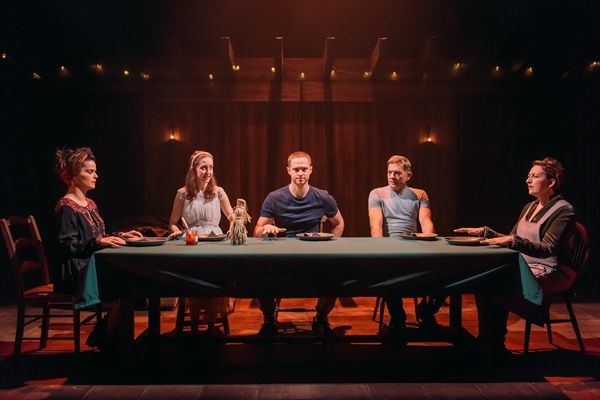
The remote rural location is part of the piece. Where better to unearth the unsettling and the rooted? The harvest moon can glint off Isaac’s blade and there’s the suffering of Auntie Violet’s horse to put alongside Sophia’s claim that ‘We’re all animals’, which might be what her veterinary practice has taught her. Her house is modern, of machined and polished wood, where you might expect low ceilings, wood smoke and warped timbers. The spare, snappy dialogue and careful movement suits the space, whose back wall slides away to show Autumn’s bed with its blood drip stand, or the barn, site of an earlier, bloodier horror. Introducing classical tragedy for our times, anyone?

Intrigued? You should be, because this is fascinating theatre, still and severe in its way, but emotionally resonant, well-focused and very well performed.

nae bad_blue

Star (blue)Star (blue)Star (blue)Star (blue)Star (blue)

Reviewer: Alan Brown  (Seen 1 November)

Go to Grain in the Blood at the Traverse

Visit Edinburgh49‘s Traverse archive

Frost / Nixon (Bedlam: 12 – 15 Oct.’16)

frost-nixon

David Frost (Callum Pope), left, interviews Richard Nixon (Paddy Echlin)

“The whole impression is one of a gathering and important moment.”

Editorial Rating:  4 Stars: Nae Bad

It’s a generational, media churned, thing. For Brits over 40 to call Peter Morgan’s Frost / Nixon (2006) the ‘real deal’, might be to ask ‘Collectable’ or ‘Antique’?; for Bedlam’s student audience this enthralling play on fact is simply ‘Legit’. Producer Patrick Beddow can be well pleased with its timeliness, coming as it does during the objectionable and tawdry business of the Hillary and Donald Show. Doubtless Frost / Nixon is relevant as U.S political history from 1977 but director Nathaniel Brimmer-Beller and cast make darned sure that it will still grab your attention as a piece of theatre.

David Frost died in 2013 and has the latest memorial stone in Poets’ Corner in Westminster Abbey, which says a lot about the influence of TV these days. Anyhow, he was 39 when he interviewed former President Richard Nixon, three years after Nixon was forced to resign following Watergate. Twenty-four hours plus of recorded material was edited into four ninety minute broadcasts. The first, on 5 May 1977, drew 45 million viewers, still the largest television audience for a political interview ever. Frost /Nixon is the story of how this big (and very real) deal happened, or kind of happened, and how it played out on all those screens. Frost was reckoned a lightweight, capable of only pitching softball questions, ‘puffballs’, that Nixon would just smash over the outfield fence and pocket $600,000. Well, he got his money – and a snazzy gift of Italian shoes – but not all the home runs.

Paddy Echlin is Nixon and Callum Pope is Frost and one on one, with a strong script, it’s a revealing double act. Frost, dapper and debonair, is still a shrewd operator. Nixon, is clever, practised, and self-assured almost to the last. Voice, gesture, timing are studied and effective. Off-camera – and there are cameras on stage – you get just enough of their personal lives to feel interested. Whether, you should sympathise with Richard Nixon is, of course, a contentious question but Echlin’s performance may well win you round. His chief of staff, Jack Brennan (Sasha Briggs), defends him against the liberal ‘side’, where Macleod Stephen as James Reston is particularly telling as player and commentator.

It’s 90 minutes straight through with no interval, which is a good call. Scenes proceed briskly and there are only a few chairs to move around and the whole impression is one of a gathering and important moment. The cameras provide some tight close-ups, and are a helpful reminder that this is a made-for-television ‘event’, but the flood lights do fade Nixon’s jowls to nothing. Otherwise, this is illuminating work.

nae bad_blue

Star (blue)Star (blue)Star (blue)Star (blue)

Reviewer: Alan Brown (Seen 12 October)

[Student? Want to review with us? Please email editor@edinburgh49.com]

Visit Bedlam Theatre

Visit Edinburgh49′s Bedlam archive.