Thingummy Bob (Traverse: 29 – 31 October ’15)

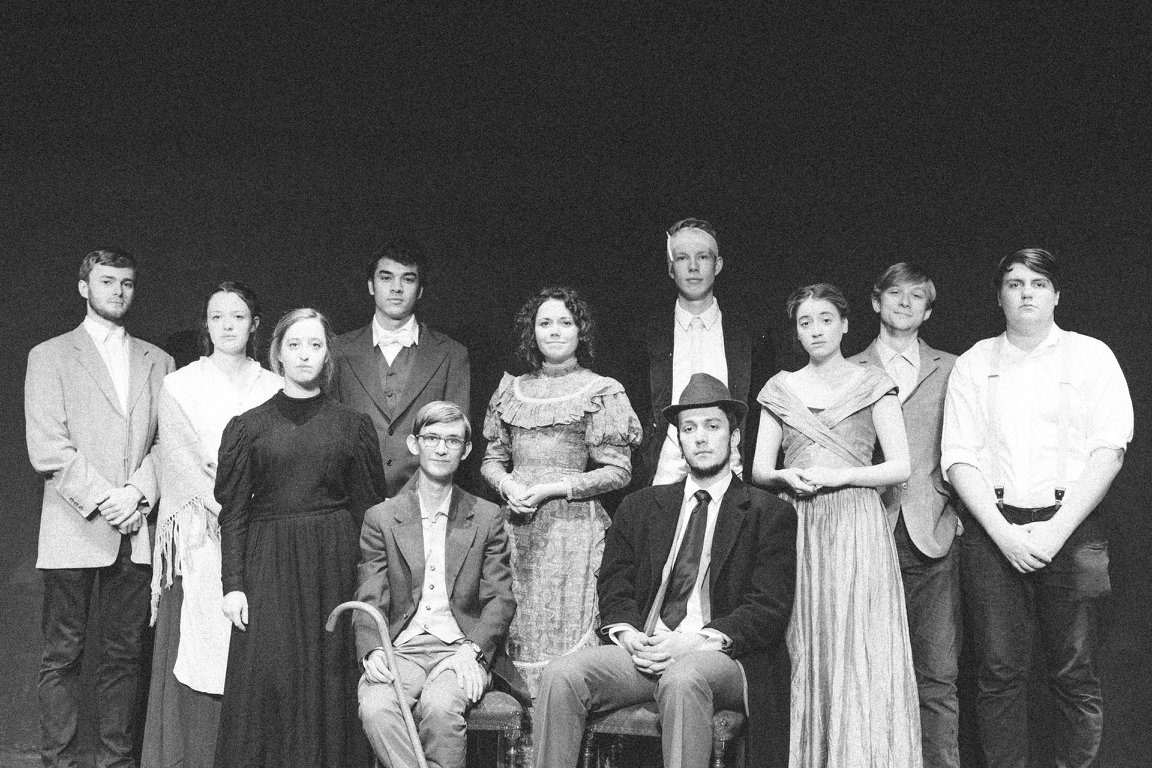
Karen Sutherland and John Edgar. Photo: Douglas Jones & Emma Quinn.

Karen Sutherland and John Edgar.
Photo: Douglas Jones & Emma Quinn.

“Go Bob, go!”

Editorial Rating: 4 Stars: Nae Bad

A Lung Ha Theatre Company production in association with Luminate, Scotland’s creative ageing festival.

Go looking for ‘Thingummy’ in a dictionary and you’ll find ‘Thing + a meaningless suffix, colloquial [since] 1751′. Well, there is nothing sketchy, meaningless or dated about this prize piece from writer Linda McLean and Lung Ha Theatre. It is plain, touching, and enjoyable; which is totally unsurprising when you learn that its title song is The Young Ones by Cliff Richard and The Shadows, 1962 (and counting). It is a bit mean of me to draw your attention to line 6, ‘For we won’t be the young ones very long’, but that’s the inescapable bit.

Bob (John Edgar) is in a wheelchair in a care home and is on a mission to rescue his LP records and what he can of his memory. He knows that he likes caramel wafers and is none too keen on pill popping. He loves his wife Audrey very much and wants to get back to their house but he cannot find his keys. He is determined, resourceful and witty and when he says “I do so mean it”, he does.

Binox (Karen Sutherland) has the job of keeping her eyes on Bob. She is the speaking voice of the care home’s security system and – binoculars trained – she would follow him wherever he goes. Charge Nurse (Kenneth Ainslie) and auxiliary Cap (Mark Howie) do their caring best and his niece Gemma (Emma McCaffrey) is always reassuring and kind but Bob can be hard to keep track of. The police get in on the act too. Bob’s other niece, Lesley (Karen Sutherland again), sends warm letters and postcards but she’s in Sydney, Aus. so really it’s down to his neighbour, Mrs Johnson (Kenneth Ainslie once more), to put the kettle on for when Bob makes it home.

It’s a fun pursuit that is made all the more engaging by the breadth and space of the set design by Karen Tennent. M C Escher squares and a revolving centre piece might suggest a board game – with rapping moves –  but the projection of photographs from Bob’s family album adds a whole new dimension. Personal really. Music by Philip Pinsky provides a catchy accompaniment, complete with scratches from those treasured 33s.

At one point, when Bob is trying to reach Audrey, Gemma says ‘”This is too sad”. It is and it isn’t, which is the appeal of ‘Thingummy Bob’. McLean’s script is clever, switching from the short and conversational – especially Cap’s serial “Aye’s” – to the longer, more considered and reflective sequencing of Binox and Lesley. Certainly the issues of aging and dementia are well in place but it is Bob’s story and Edgar’s performance that hold the stage as he wheels around it.

Artistic director Maria Oller and Movement Director Janis Claxton find great, sympathetic, cheer from this closing couplet of ‘The Young Ones’, ‘And some day when the years have flown / Darling, this will teach the young ones of our own’. Go Bob, go!

nae bad_blue

Star (blue)Star (blue)Star (blue)Star (blue)

Reviewer: Alan Brown (Seen 30 October)

Go to Lung Ha Theatre Company and Luminate

Visit the Traverse archive.
Hidden (The Lyceum: 20-24 October ’15)

“Gives chills and thrills aplenty”

Editorial Rating: 3 Stars: Nae Bad

Hidden really is a treat for anyone who’s ever wanted to explore what goes on everywhere else in a theatre that audiences don’t normally get to see. Marry that with tales from the history of the building and a Victorian horror story and you have quite an intriguing evening’s entertainment. However, while the idea and overall style and feel of the piece were terrific, there was no clear narrative or sense of progression between each section, leaving me feeling a bit cheated as to specific details and stories.

Individual sections were generally great at creating an overall mood, setting a scene (the dressing rooms in particular stood out), or presenting a static idea, and the piece was littered with numerous magical moments  – terrified faces and screams, isolated “scenelets” and monologues. Yet we learned very little about who these characters were, why there were there, and how they related to anything else that was going on.

While for most of the performance, the audience is directed where to go next by theatre ushers, in one section in the scenery dock, three of the young performers (Xanthe Mitchell, Ellis Imrie and Anna Millar) more than capably moved us around to follow the action. Staying true to their characters and without speaking, they created a compelling and haunting theatrical moment, demonstrating commanding professionalism and presence beyond their years. Moving into the area beneath the stage, Gregor Weir delivered a very charismatic and spooky monologue about being trapped, making clever use of the space by hiding in between and rattling racks of stored stage lights.

Indeed this whole section (directed by Lyceum Artistic Director Mark Thompson), which allowed the audience to fill the space as they wanted and explore the action from the perspective they chose, gave the piece a very immersive and personal feel. It’s a shame that this sense of individual discovery was not carried through more parts of the performance, particularly the section on the stage, where instead we were asked to simply stand in a line to one side and observe.

In saying that, the section in the stairwell leading up to “the Gods” (very emotively delivered by Emma Simpson and Tegan Wright) was a great way to follow the action, and break-up the sense of travelling from one part to the next by making the travelling itself part of the performance. Similarly, walking behind the bar in the stalls, past three caged performers shrieking to be let out, also helped make the “journey” more interesting to experience.

While it wouldn’t have been right to have delivered this piece in tour guide style, I feel that making more effort to communicate some of the background to each section would have been really beneficial. I felt it also lacked a little bit of diversity in terms of mood – it was almost all a chilling ghost story, when some happier or funnier moments of the theatre’s history would have added another layer of depth to the performance.

Given that this performance was devised and delivered by young people, in collaboration with four different directors, one must give them due credit for their achievement – this is a very ambitious project that gives chills and thrills aplenty, and is a worthy education and exploration into just how exciting theatre can be. For me it just lacked that bit of cohesion to make it really special.

nae bad_blue

Star (blue)Star (blue)Star (blue)

Reviewer: Steve Griffin (Seen 20 October)

Visit the The Lyceum archive.

THIS REVIEW HAS NOT BEEN SUBEDITED

Descent (Traverse: 20 – 24 October ’15)

Photo: Leslie Black

Photo: Leslie Black

” … doolally moments get longer and longer”

Editorial Rating: 4 Stars: Nae Bad

The fourth in this autumn’s ‘A Play, a Pie, and a Pint’; presented in association with Luminate, Scotland’s creative ageing festival.

Do you play ‘Trivial Pursuit’? Remember the rules? Where do those wee scoring wedges go, the ones that make up the ‘pie’? When did England win the World Cup? Rob is certain he knows the answers but he doesn’t, not at all.

You might go down with a bad cold, but Rob is going down with dementia and he’s probably only in his mid-fifties. That’s ‘Younger Onset Dementia’ then.

Linda Duncan McLaughlin’s play is not comfortable and it is definitely not trivial. It takes 60 minutes of stage time for Rob to go from running his own architectural practice to forgetting how to sit in a chair. His wife, Cathy, does more than her best to care for him but their daughter, Nicola, can see that there comes a point when Dad is too far gone and that Mum cannot continue the struggle to keep him at home, not least for the sake of her own health.

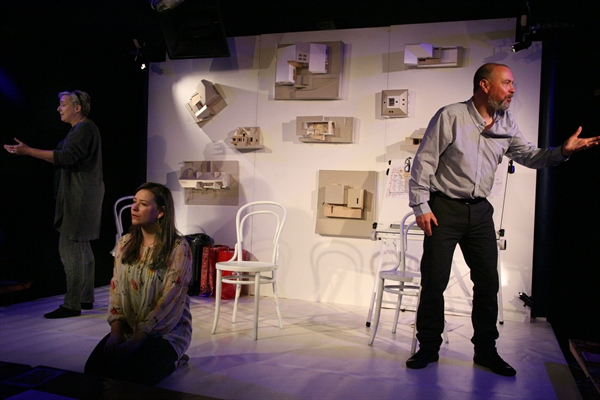
That Rob is an architect is a cruel touch. He has always found pleasure, even beauty, in design and function but here is laid low, kaboshed, by a condition that reduces his brain to formless mush. While he grows frantic because he cannot find his pen we see display models carefully arranged on the wall and neat plans on his drawing board. Rob knuckles his forehead in frustration as his doolally moments get longer and longer but there’s nothing feeble-minded about Barrie Hunter’s performance.

“Everything’s slipping”, says Cathy, and a clock tick-tocks away in the dark scene intervals. Wendy Seager’s calm presence is all the more disquieting in this exacting role. Cathy holds on to Rob as long as she can, which puts her at considerable risk, but their home grows silent, then empty, and finally there is nothing left, just an absence. Nicola (Fiona MacNeil) has, as she puts it, ‘to kick the walls down’.

It is a steep descent, narrowing all the while. McLaughlin and director Allie Butler steady it with a retrospective structure, instances of shared speech and some explicit commentary. The audience, selfishly, is  especially alert when the signs-to-look-out-for are tested at home. Rob, bless him, is appalled – and scared.

NHS Lothian is ‘Making Edinburgh dementia friendly’ at the moment. Look out for a leaflet in the libraries asking whether you are ‘Worried about your memory or someone else’s?’ If you’re not, Descent will make you think again.

nae bad_blue

Star (blue)Star (blue)Star (blue)Star (blue)

Reviewer: Alan Brown(Seen 20 October)

Go to Descent at the Traverse here

Visit the Traverse archive.

Lord of the Flies (Festival Theatre: 13 – 17 October ’15)

Set design: Jon Bausor Photo: Regent's Park Theatre.

Set design: Jon Bausor
Photo: Regent’s Park Theatre.

“Big, bold and gutsy”

Editorial Rating: 3 Stars: Nae Bad

For me, with the May general election in mind, this is a timely production of Lord of the Flies: a charismatic, commanding and fear-mongering leader on one side; a righteous and idealistic leader who is unable to win mass support on the other; and one guy in the middle who doesn’t fit into either camp and who is killed off. I wonder if William Golding knew back then how important and relevant his book would still be 61 years after its publication. And that’s without postulating that Michael Gove might make a ‘good’ Beast. This Regent’s Park Theatre production certainly doesn’t shy away from the issues – it’s big, bold and gutsy, but in my opinion, tries too hard to make its point.

I must start with Jon Bausor’s design – the first thing you see on entering the auditorium. It’s visually spectacular, with the focal point being a very believable carcass of a crashed aeroplane to one side, strewn with suitcases. On the other a sizable ramp leads up and off, and everything is surrounded by trees and hanging branches in Naturalistic style. Yet while stunning, I felt the set ended up being too much of a dominating presence, causing unnecessary overlaps with different scenes occurring concurrently (and confusingly) in the same part of the stage. I would have preferred a more mapped-out use of the space to clearly define the different locations in the story and help distinguish the separateness inherent in the characters.

One of this production’s strengths was the energy and dynamism with which the warrior-like sections were portrayed. With frantic movement, chanting, and a commanding performance from Freddie Watkins as ringleader Jack, these moments were terrifying and powerful, and an effective glimpse into what a group of boys might turn into without effective parenting. Indeed, this interpretation puts Jack’s character front and centre (rather than Ralph’s), giving more focus to the brutality of the boys’ behaviour throughout.

However, some of the effectiveness of the “savagery” was lost given a distinct lack of contrasting moments of quietness and subtlety. I found the whole thing too unnecessarily shouty: Piggy and Ralph would communicate in raised and pained voices when alone. Commands were all aggressive, and fright seemed to always be expressed very loudly. Even the Officer shouted all of his lines, reducing his status to that of the children, when his presence could have been communicated far more effectively through physicality and control.

Anthony Roberts as Piggy.

Anthony Roberts as Piggy.

In saying that, there were occasions where the dynamic changed to great effect: early in the second act when Ralph and Piggy discuss how to get Piggy’s glasses back is a rare glimpse of depth and subtlety in performance style, allowing the audience to connect with these two as different from the others. It’s a shame this technique wasn’t used more in the first half of the production. Anthony Roberts gave a valiant performance as Piggy, and I would have liked to have seen more of him.

The sound and lighting were both excellent in supporting the action and setting the scene, and the occasional music added to the ambience without being overpowering. The evolution, down the way, in costume and makeup to underline each character’s descent into savagery was clever and effective. That all went to show that clearly a lot of thought and creative energy has been put into this production, but for me a couple of big flaws hold it back from being remarkable.

nae bad_blue

Star (blue)Star (blue)Star (blue)

Reviewer: Steve Griffin (Seen 13 October)

Go to ‘Lord of the Flies’ at the Festival Theatre

Visit the Festival Theatre archive.

The Seagull (Bedlam: 7 – 8 October ’15)

The cast. Photo: EUTC Facebook page.

The cast.
Photo: EUTC Facebook page.

“Enlivening”

Editorial Rating: 4 Stars Nae Bad

At a guess, the Scottish Seabird Centre in North Berwick is not a must-go destination for students. Well, maybe directors Holly Marsden and Kathryn Salmond are the happy exception for their production of The Seagull gets as up close and personal as the centre’s webcams. And, critically, it does so unencumbered by tradition. No sentimental guano here.

Don’t get me wrong. This Seagull does the business: it’s intelligent, funny and sad – but it is also grounded and plain. Nina’s lofty ‘I am a seagull … No, that’s not it’ is lost on the wind (or cut) and her fraught state at the end of the play is all the more effective for being low-key.

Leave the real emoting to Konstantin (Douglas Clark), who does a fine, anguished job of it – just as he did as Alan Strang in Equus in March. It is not so much an uptight, stressy, performance as an upright one: earnest, principled, and lonely. Kostia stands apart as young and intense, a little weird, which goes down well with an EUTC audience. Chekhov is suitably amended. Where, back then, Kostia left university in his 3rd year ‘owing to circumstances’; now he did politics at uni. and got nowhere.

A seagull is still the emblem of the Moscow Arts Theatre and it is appealing to see how the play is up to date. There’s embattled youth with dreams and no prospects; parent(s) brittle with glee and anxiety and a professional class whose diplomas are looking tired and whose pensions are meagre. Town and country are miles apart and there is the constant engagement with what pays and what doesn’t. There’s even bingo and the fortunate winner who takes all, including the girl.

For Kostia, theatre just exists as nice vistas in abstracted space, which is a cheerless and absent place to be. It is more enlivening, by far, to stay in the company of others. There’s uncle Sorin, played with bleak glee by William Hughes; doctor Dorn, a gently sardonic Finlay McAfee; and the famous literary cad Trigorin, whom a soulful Jonathan Ip rescues from the censure that he probably deserves. However, it’s the women who really people the stage: Arkadina, Kostia’s impossible, self-absorbed mother, is strongly played by Elske Waite; Nina, lovely and brave, is a beautifully articulate Katya Morrison; and an unerring Sally Pendleton is the trapped but resolute Masha. I thought all three performers offered a junior master class in diction.

Of especial note in a solid, more than pleasing production was the spare quality of the costume and stage set. For once the doors opened and shut without shaking the ‘walls’ and a single fireplace, a table and a few chairs proved just enough.

We’re told that this is the first time that The Seagull has been put on at Bedlam. I’d be happy to see it or its relations fly back soon. Three Sisters, anyone?

nae bad_blue

Star (blue)Star (blue)Star (blue)Star (blue)

Reviewer: Alan Brown  (Seen 8 October)

Go to Bedlam Theatre and the Edinburgh University Theatre Company here.

Visit the Bedlam archive.

Cleansed in Blood (Thistle King James Hotel: 20-25, 27-31Aug : 14:00 : 45mins)

“Minimalist in it’s set design but wonderfully baroque in it’s storytelling”

Editorial Rating: 4 Stars  Nae Bad

In the grand scheme of generally unpleasant tales, the hierarchy usually runs thus: tales of moral downfall a-lá Citizen Kane, ones about the dangers of religious overzealousness, and stories about cancer. Put ‘em together and what have you got? Bippity-Boppity-Cleansed in Blood.

The brainchild of talented writer and actor Thom Jordan, “Cleansed in Blood” tells the story of cancer-survivor-turned-preacher Paul, and his trials and tribulations in his feverish pursuit of glory upon the sanctified stage. Pulling together Jordan’s own experience as the son of a minister and the real-life events surrounding the now infamous Michael Guglielmucci, Cleansed in Blood is a story of ambition, deception and redemption all packed into a dense 45-minute performance.

Presenting the show decked out in a nasal feed, Jordan’s stage gravitas is palpable. With minimal set and near non-existent tech, the show lived or died by his performance – and I was very glad to say it was very much kicking. There’s a very raw, unpleasant realism to Jordan’s performance which had me squirming in my seat for a large majority of the performance – a testament to his skill at inhabiting a character. As he strode around the small stage, you’d be forgiven for thinking Thom Jordan a simple pseudonym for charismatic and fervent Paul.

And that’s helped in large part by Jordan’s skill as a writer. His accolades are well-won: even without the considerable skill with which it’s executed, this is just a good story, with a twist which will leave you reeling in your chair. However, the structure of the play is less vertigo-inducing. Some plot points feel as if they come too late, and there are moments where certain story strands feel oddly wasted as Jordan rattles through to a nevertheless very satisfying ending.

Minimalist in it’s set design but wonderfully baroque in it’s storytelling, Cleansed in Blood makes for an oddly grim yet entertaining way to spend your afternoon. Forceful, provocative and thoughtful, it’s a compelling window into oddly rockstar world of high-profile preachers – and the dangers that lie with fame.


nae bad_blue

Star (blue)Star (blue)Star (blue)Star (blue)

Reviewer: Jacob Close (Seen 26 August)

Visit the Other  archive.

THIS REVIEW HAS NOT BEEN SUBEDITED

Melody (Clerk’s Bar, 8 Aug – 29 Aug : 16:45 : 50mins)

https://www.thestage.co.uk/wp-content/uploads/2015/08/Melody-Jemima-Foxtrot.jpg

“Foxtrot embodies the sensations of the everyday”

Editorial Rating: 4 Stars Nae Bad

One of my favourite things about poetry is the great dissonance you often get between the initial appearance of the poets, and the sheer power of their voices and minds. Watching Jemima Foxtrot perform is like watching a pistol shoot anti-tank bullets – there’s a very sincere and powerful energy to her work.

Taking the audience on an evocative journey through city streets “Melody” explores the memories they summon as Foxtrot wends her way between heartbreak to joy, with a warmth and oddly dreamy sort of lyricism that fits her imagery’s day-to-day beauty to a tee.

The biggest boon to this performance is how easily Foxtrot embodies the sensations of the everyday, and presents familiar emotions and thoughts in a way that makes them rough yet compelling. It’s not very often that a performer’s vocal skill and physicality mirror each-other so well, but as she bounces from piece to piece, she embodies each new feeling with vigour.

However, Foxtrot’s lack of pretense and startling sincerity in her work also forms a needed cover to the inevitable inertia when solo, unbacked vocal work pauses to become spoken word – but her energetic yet laid back style still suffered slightly in the sometimes jarring empty space. However, this hardly detracted, thanks in turn for the sheer power of her lyrics and honesty of her imagery.

This is definitely a free fringe find. Foxtrot’s presence onstage utterly transforms the familiar atmosphere of the Clerks Bar basement – no mean feat. As the 2015 Fringe starts to roll to a close, make sure you make your way to Jemima Foxtrot – “Melody” definitely impresses.


nae bad_blue

Star (blue)Star (blue)Star (blue)Star (blue)

Reviewer: Jacob Close (Seen 25 August)

Visit the Other archive.

THIS REVIEW HAS NOT BEEN SUBEDITED

Calypso Nights: Juan, Two? (Assembly Roxy: 5 – 30 Aug : 21:30 : 1hr)

https://i0.wp.com/tourism.atdw.com.au/Multimedia/Original__9674861_WATC_CN_Press1.jpg

As entertaining as he is inventive”

Editorial Rating: 4 Stars Nae Bad

It’s very hard to tell the flavours in a good condiment apart. It’s that phenomenon when two different kinds of thing come together to form something completely new, and often indescribable. Somewhat ironically to the themes of Barnie Duncan’s riotous show, “Calypso Nights: Juan, Two?” very much contributes to that phenomenon. It’s dance, music, laughter and ridiculousness all rolled up into something which resembles a surprisingly entertaining, cuba-libre flavoured fever dream.

Presented by high-powered DJ Juan Vesuvius (Duncan), Calypso Nights is a spicy blend of music, comedy and Caribbean-tinged factoids, tied together by his considerable powers as a mix DJ and seemingly never-ending cultural knowledge.

And the Caribbean couldn’t ask for a better ambassador, fictional or otherwise: with a pair of turntables and expertly used dry ice, Duncan dominated the small stage with such confidence that he managed to pull off the bizarro-world Elvis look.  And it was that very bravado that served to underscore the blurring between audience member and participant; it requires a special type of performer to turn an at first reticent audience into a flag-waving dance party – but DJ Juan Vesuvius has the knack.

The message of the benefit of mixtures was wholeheartedly present throughout the act: his DJ’ing skills had a surprising substance and quality quite unheralded by his pidgin english-spouting exterior. Mixing between seemingly dissonant bands and musical styles, Duncan creates something new and interesting nearly every time – although, his high energy weirdness threatens to send the unstable show into meltdown towards the end, where the comedy content is eaten up somewhat by a fusion cascade of sheer strangeness.

If you’re looking for a night of nigh-indescribable fun, Juan Vesuvius is your man. As entertaining as he is inventive, it’s hard to top this dose of musical chutney.

nae bad_blue

Star (blue)Star (blue)Star (blue)Star (blue)

Reviewer: Jacob Close (Seen 26 August)

Visit the Assembly Roxy archive.

THIS REVIEW HAS NOT BEEN SUBEDITED

Floe­-Joe’s Faces (Just The Tonic @ The Mash House, 24 -30 Aug : 21.00 : 1hr)

“A very entertaining show, with plenty of giggles”

Editorial Rating: 3 Stars: Nae Bad

The premise of this character comedy show is very interesting – having three different characters discuss their contribution to the mysterious “Floe-Joe’s” new album, track by track, at its first “listening party”, hosted by the main man. The whole show is underpinned by a selection of what I can only describe as incidental hip-hop – the kind that might play in the lift of a trendy club, which sets out a very clear vibe for the show overall, and its use and styling works very well to cover the transitions between each character, as well as giving each one its own soundtrack.

First up is the drunken and ballsy Irishman Fergyl Walsh, whose brother is Louis Walsh. He rants about being misunderstood and the angst involved in creating the album. It’s a gutsy performance, even if the accent slipped a little from time to time.

Next up is recently graduated RnB singer U (yes, that’s his name), who is desperate to move on from being a hooker (the singer that just sings the “hook” of a song, while the rapper hogs most of the limelight). Compared to the brash Fergyl, U is shy and assuming, and because of that is very likeable. Through various snippets in this section, Fairey also boasts a surprisingly impressive singing voice, and it was a shame not to hear more of it.

The final character of the show is the multi-faceted and over-confident street dancer, Lydia Left, who longs to break away from her dance troupe and achieve the stardom she dreams of. While something of a stereotype that doesn’t bring much uniqueness to the stage, she still manages to get the party started and the whole audience on their feet.

As can be expected of a slightly quirky character comedy, there are various moments when Fairey interacts with the audience -asking us to recount something good that’s happened today, or to predict what song might be playing in our heads. There’s also a great moment at the end where we get the chance to try out a few dance moves on stage, which was actually very refreshing and nowhere near as awkward as one might think.

A couple of the jokes fell a little flat, and there were a few moments that Fairey seemed a little apologetic for the performance, rather than oozing with confidence that a show like this really needs. However, on the whole it was a solid and very entertaining show, with plenty of giggles, and different to anything I’ve seen before.


nae bad_blue

Star (blue)Star (blue)Star (blue)

Reviewer: Steve Griffin (Seen 27 August)

Visit the Other archive.

THIS REVIEW HAS NOT BEEN SUBEDITED

Hannah and Hanna (Assembly George Square, 6 – 30 Aug : 13.20 : 1hr)

“A very heartfelt performance from two fine young actresses”

Editorial Rating: 3 Stars: Nae Bad

Hannah and Hanna is a story examining two sides of the immigration debate, which, given UKIP’s performance in this year’s general election, and the more recent events involving migrants in Calais, couldn’t be more perfectly timed.

Hannah (played by Cassandra Hercules), lives in Margate, Kent, where she’s been her whole life. Like her boyfriend and peers, she’s fiercely anti-immigration, believing that local resources should be kept for the locals. Hanna (Serin Ibrahim) is a refugee from Kosovo and sees Margate as a dreamland, and all she wants is to fit in and be accepted. Their worlds collide and a special bond is formed between them, transcending the prejudices of their families.

The play is very simply staged, with character and location indicated by token props and subtle changes in lighting. Between the two of them, Hercules and Ibrahim play a multitude of characters, ages and nationalities, but are at their best when playing Hannah and Hanna. Ibrahim brings beautiful sensitivity and naivety, while Hercules is vibrant with energy and passion. Both actresses, in their twenties in real life, capture and portray their 16 year old characters effortlessly, and through their physicality and delivery of the script it is uncannily believable that they are indeed that young. The bond they form is genuine, and the chemistry between the two is strong enough to make you feel warm and fuzzy inside.

However, despite being a very commendable effort from the performers, this play does fall down in certain areas, with parts of the script requiring a lorry-sized suspension of disbelief. While all the necessary ingredients are there (characters representing different points of view, a decent story arc and plenty of dramatic tension), it does all feel very rushed, and at times hard to follow.

Hannah is won around by Hanna’s charm very early on, and the pair seem to form an unbreakable friendship after only five minutes. The final 10 minutes of this play are quite confusing, with lots of ups and downs and jumps in time and location making it quite difficult to follow, and the ending isn’t as resounding or emphatic as it could have been considering the topic. What’s really missing is that, apart from the two central characters, there isn’t really a sense of anyone having learnt anything or viewpoints changing, so at worst it feels a bit pointless, and at best just a nice story.

I believe that if the company had longer to work on the piece (it was developed in just two weeks), and were prepared to make some changes to the initial script to extend and clarify it, this could be something very special. At the moment it’s a very heartfelt performance from two fine young actresses, but little more.

nae bad_blue

Star (blue)Star (blue)Star (blue)

Reviewer: Steve Griffin (Seen 23 August)

Visit the Other  archive.

THIS REVIEW HAS NOT BEEN SUBEDITED