‘Aladdin’ (King’s: 29 Nov’ 14 – 18 Jan.’15)

Aladdin 1

I’m a Believer

Editorial Rating: 4 Stars: Nae Bad

Actually, literally, which is tricky during a panto, I prefer ‘Al – la – din’. That has distance and colourful resonance. Losing that second ‘d’ does away with the Highland laddie and puts our local hero Southside, somewhere between and above the Mosque Kitchen and the Nile Valley Café . Only momentarily though, for the gong gongs and we’re away to Peking of old. ‘Somewhere in Egypt’ is scene 12 of 16.

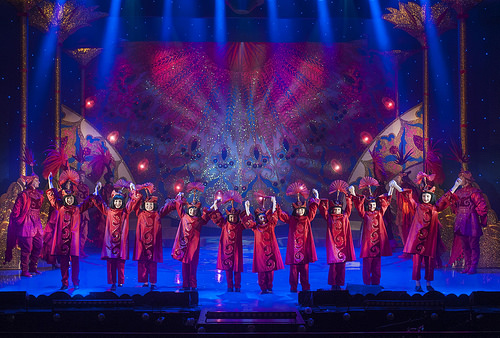
The King’s 2014  ‘Al – la – din’ is no call to prayer, although it does co-opt I’m a Believer as its signature belter. No, this is a serious magical treat, remarkably served after only ten days of full rehearsal. The reach and back-up power of producers Qdos Entertainment beggars the imagination, which is also what young Aladdin is about. He is poor but bold, his Mum runs the steamie off the street of 1,000 chopsticks, and he’s going to marry the most beautiful and loaded girl in the land, sorry, Empire. Yes he is and you should not doubt it. For a start Greg Barrowman as Aladdin has One Direction quality and the spangled charms of the Slave of the Ring to help him, in an appealing and graceful performance by Lisa Lynch. Kohl eyed Princess Jasmine (Miriam Elwell-Sutton), all brocade and style, just clocks him the once and she immediately wants “to talk to that boy – alone”. Lucky lad.

So dump the suspense and bring on the dancers, young and old, and give in to the moment, to the scene painting, to the costumes and to the out and out marvellous: the Vanishing Princess, Escape from the Table of Death, and an absolutely wicked, jaw dropping, example of Defying Gravity. Then enter, upstage and tall, the Mighty Nasty Cobra and the Giant Genie (a very droll, almost child-friendly Malcom Tucker). Take hold, my son, of the The Lamp of Amazing Power. Capital!Aladdin 2

Actually, again, there are three presiding comic genies of panto at the King’s. Three denizens of this Christmas cave of wonders: Allan Stewart as Widow Twankey, Andy Gray as Wishee Washee, and Grant Stott as Abanazar the bad, bad, Wizard. Rub that lamp for all it’s worth and you could not wish for more fun than these three familiars provide. “Oh, the acting!”, despairs Washee, as in “Our acting’s pants”, but what’s not to enjoy in amongst the topical gags (listen out for the 45/55 result), shuttling tongue-twisters, celebrity laundry, and hilarious routines? Their final skit of ‘If I Were Not Upon the Stage’, when they are joined by James Paterson (prev. the Emperor of China), is pure wallaping music hall.

This ‘Aladdin’ is an extravaganza, up there with flying carpets, and is tip-top admirable. My one queasy, senior, misgiving – because I’m not good off the ground – is that if there is a command message, it’s not ‘Open Sesame’ but ‘Get rich, and the girl’s yours’.

nae bad_blue

Star (blue)Star (blue)Star (blue)Star (blue)

Reviewer: Alan Brown (Seen 4 December)

Visit ‘Aladdin’ at the King’s here

Visit our Assembly Roxy Bedlam Church Hill Theatre Festival Theatre King’s Theatre Other Pleasance, Potterrow & Teviot Summerhall The Lyceum The Stand Traverse archive.
THIS REVIEW HAS NOT BEEN SUBEDITED

Crash (Traverse: 28 Oct – 1 Nov ’14)

Photo. Leslie Black

Photo. Leslie Black

“More slo-mo skid and shunt than full-on collision, more  crunch than splat”

Editorial Rating:  4 Stars: Nae Bad

In the Autumn line-up of A Play, A Pie and a A Pint.

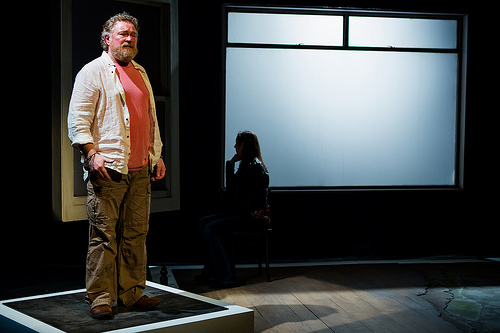
A whacked City trader speaks. He’s Scottish but it’s a quids in, pound sterling monologue, unassuming and on the level; a penny plain real deal, in fact, provided you accept that asset management is an emotional as well as a financial business. Finally, even naturally, the ‘game’ wastes you. There’s a wreck at the end of the tunnel.

Writer Andy Duffy’s single character has no name. He is a man alone in a sober suit and tie on a shiny office chair in a smooth glossy space. He could be in Aberdeen or across the way in Standard Life House, but still I incline to the Square Mile. His story begins on the night of 23 August 2007. (For the record Lehman Brothers declared bankruptcy on 15 November 2008.) He is precise like that; where he can he will enumerate, when he can’t he’ll simply point out that you don’t make money by being careful. And, instinctively, he has made and is still making lots of it.

Man (Jamie Michie) reads a piece in the ‘Financial Times’. His new girlfriend, Kate, prefers novels, which he considers to be self-indulgent pap. Man had a wife once but Alison died, which he’s sorry about, but shit happens when you lose control at the wheel, or when your investments go south. That’s ‘unprecedented volatility’ for you, which is where I’d bring in Russell Brand, who had lunch with the FT just last week. Brand finds the pink pages ‘hard to understand’ and opposes his ardent belief in spiritual ideologies to the FT’s economic one(s). So too even our trader, bruised and shaken by his wife’s death, attends meditation classes where in mid-mantra he finds consolation in … Kate’s long blond hair and tight figure. Nothing too revolutionary there to upset the capital markets .

Crash is more slo-mo skid and shunt than full-on collision, more crunch than splat, and so more revealing. There is the head-rest proposition that ‘money equals power and freedom’ but how is that supportable? Every now and again something is going to pile in from behind and the result will be bloody. You can hear it happening. There is a thrum of white noise – not Traverse 2’s air con – and the lighting gets colder. I was reminded of a Tube train coming into Bank. Man rises from his chair and/or collapses on a park bench and you wonder, not for the first time since the last financial horror show, if getting minted is worth it.

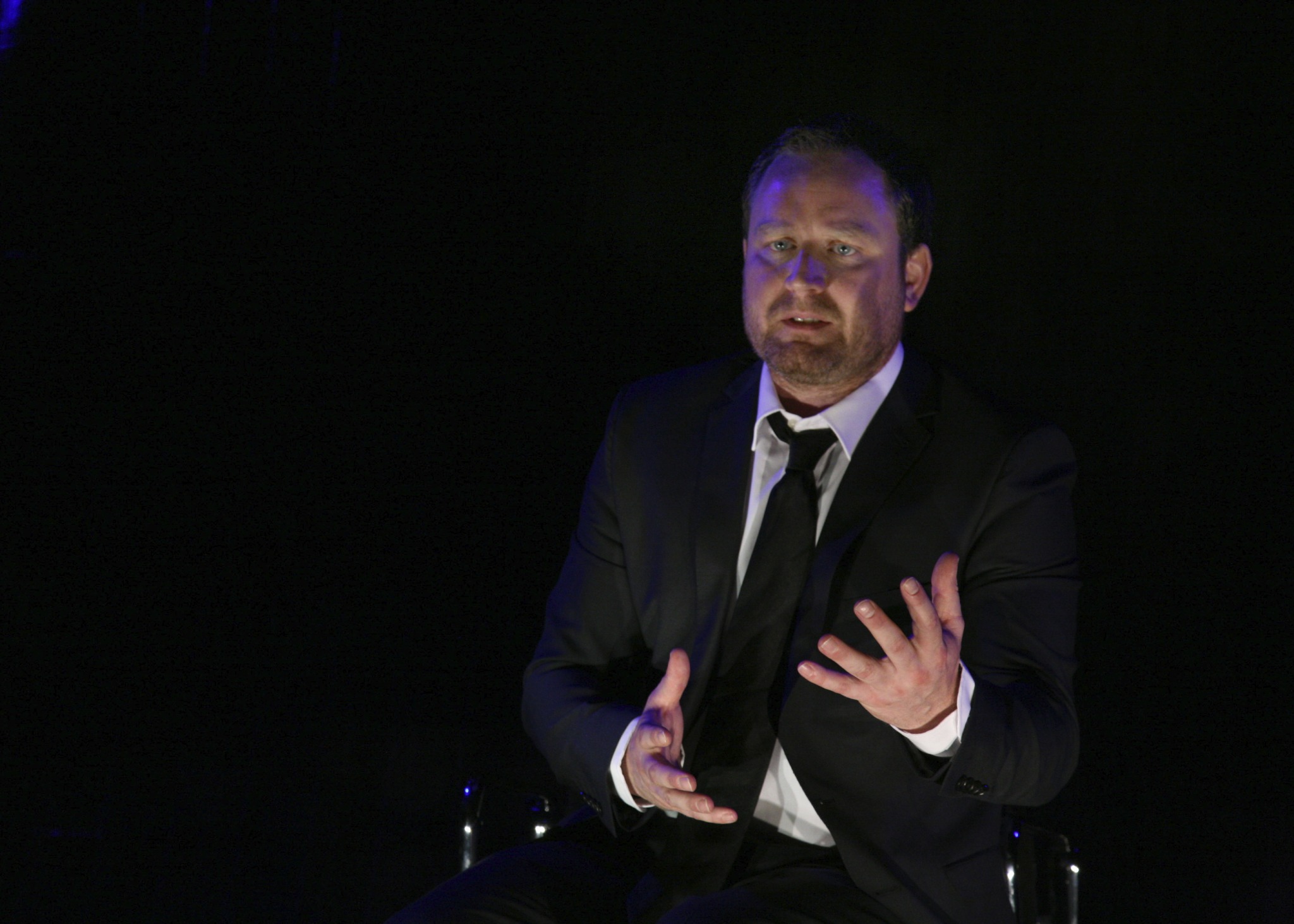
A driven, strong play that is expertly directed by Emma Callander and impressively performed by Jamie Michie.

nae bad_blue

Star (blue)Star (blue)Star (blue)Star (blue)

Reviewer: Alan Brown (Seen 28 October)

Visit Traverse Homepage here

Visit our Assembly Roxy Bedlam Church Hill Theatre Festival Theatre King’s Theatre Other Pleasance, Potterrow & Teviot Summerhall The Lyceum The Stand Traverse archive.

THIS REVIEW HAS NOT BEEN SUBEDITED

The Edinburgh49 Prize: for distinctive and memorable theatre (2014). Winners!

outstanding

“CONGRATULATIONS!”

Editorial Rating: Outstanding

The winners of the first ever Edinburgh49 Prize: for distinctive & memorable theatre (sponsored by Alechemy Brewing) were announced on 10 July at our ‘End of Normality’ party held at Assembly Roxy.

The event marked the city’s transition into full-on Festivals mode and was a chance to celebrate all that’s weird and wonderful about the other 49 weeks in the arts calendar.

Not only did our sponsor, Alechemy Brewing of Livingstone, ensure that everyone was well watered throughout the night, they also provided the star prize for our winning pub quiz team, a powerful combination of Royal Lyceum’s marketing team and NTS producers, who received a chance to sample 11 bottles from across Alechemy’s range.

Despite on-going tours and pre-Fringe commitments, we were delighted to welcome so many friends old and new to join us for the official announcement of the 6 winning productions, chosen from the more than 75 shows reviewed by us since last September.

In date order, the winning shows are:

With special mention of The #1 Loch Ness Monster Experience performed by Bruce Morton and Karen Fraser Docherty at Edinburgh College, 24 June, 2014 as part of the National Theatre of Scotland’s The Great, Yes, No, 5 Minute Theatre Show.

Charlotte Productions celebrate the sucess of Goblin's Story in style.

Charlotte Productions celebrate the sucess of Goblin’s Story in style.

Many congratulations again to all the winners and many, many thanks again to all the companies, participants and venues who have made 2013-14 such a wonderful year with which to begin Edinburgh49. Our job for 2013-14 was to establish the title and prove it could endure from one Fringe to another. We’ve done that. Next year we’d like to expand our coverage into new genres – can you help us?

There are some incredibly talented individuals operating across the genres in this city. If you think you can help amplify word-of-mouth with passionate, peer-review style reviews which help producers and punters alike – please get in touch!

No more reviews for now, as we circle around the Fringe and live up to our name, but we will be back in September.

See you on the far side!

Alan, Richard & Dan

‘Tales of Correction’ (Vault: 31 May & 1 June ’14)

Tales of Correction

‘Quite how to distinguish the proper from the improper is all to do.’

Editorial Rating: Nae Bad

“We are now returning to Edinburgh to get some preferment in the Acting way.”  From Love and Friendship (1790) by Jane Austen.

The Vault in Merchant Street is a good venue for Tales of Correction. It is hard by the garage of the Edinburgh Sheriff Court where prison vans deliver and collect. As it happens, and an awful lot does happen in these two short plays, the feckless, unfortunate Augustus in Love and Friendship does time in Newgate before being thrown out of an overturned carriage – and dying.

This Charlotte Productions double bill is a preview of the ‘project’ that this strong student born company is taking to the Jane Austen Festival in Bath in September where it is bound to be well received as both literary exercise and imaginative response.

Mansfield Presents is first on. We are in a cosy ‘back-stage’, back parlour space during on-off rehearsals of Lovers’ Vows, the actual society theatrical within-the-novel. As in Austen’s story, Fanny Price has a lot of needle-work to do and exactly as on-the-page(s) she has the admirable intelligence to stay quiet as all around her sound off. The red velveteen curtain is hung and the characters that matter are in place, costumes are just so, Rushworth’s sword has gone missing, and Maria is swooning over Henry Crawford. Edmund will, for sure, love Fanny and she him, but not yet. For the time being all the talk is of sexy subterfuge and Lovers’ Vows and of those related, tantalising questions: is it suitable for a private party (when ladies are present) and how does true delicacy show itself? Quite how to distinguish the proper from the improper is all to do.

Florence Bedell-Brill as Fanny is a study in self-possession; James Stewart, in wonderful voice as Mr Crawford, is the perfect gentleman for 1800, at least in her presence. Grace Knight as Mary Crawford provides the ringlets, wit and the fun whilst James Beagon and Jess Flood, as Edmund and Maria Bertram, embody good sense and trembling sensibility respectively. Leaving George Selwyn Sharpe – there’s a Regency name for you – as the loud buffoon in a cloak, which he inhabits handsomely.

The second play, Love and Friendship, with the same six actors, is writer Laura Witz’s adaptation of the 14 year old Austen’s parody of the sentimental novel. It is a glad, ludicrous and enjoyable piece where the broad comedy is still clever and effective. A melancholy cello plays on (ironically) while costumes change with bewildering speed from out of a suitcase and James Stewart, as an elm tree, sways in the wind that is George Selwyn Sharpe. Jess Flood narrates throughout and conveys just the right touch of wonder, incredulity and hand over breast excitement. Now it is Florence Bedell-Brill’s turn to swoon, which she does splendidly, taking Grace Knight down with her. James Beagon manages the rare double-act of coachman and pawing horse.

The two Tales of Correction are in order (i) heady, as in Think About This, because you should; and (ii) headlong, as in “Whoa!”, the wheels could come off. Well, they don’t because the direction, also by Laura Witz, is secure and the performances stay together.

Perhaps a young woman could review the plays in Bath. Laurie Penny would be my choice, echoing Edmund’s question in Chapter 15 of Mansfield Park, “But what do you do for women?”


nae bad_blue

Reviewer: Alan Brown  (Seen 1 June)

Visit about Charlotte Productions here.

‘A Slow Air’ (King’s: 22 – 24 May ’14)

A Slow Air

‘Plainsong for our secular times’

Editorial Rating: Nae Bad

Written and directed by David Harrower.

As you listen to A Slow Air you applaud the art of storytelling. The Scottish Storytelling Centre on the Royal Mile is now contained within ‘Traditional Arts and Culture Scotland’. One day, sometime, David Harrower’s 2011 play will be in there and part of Scotland’s ‘rich story heritage’. Unaffected, moving, A Slow Air is that good.

For the time being Ayr based Borderline Theatre has brought this play to the King’s after touring it through 17 Scottish venues – and 1 Welsh. It is easily portable: two bentwood chairs on a slightly raised platform stage and three-fold back flats with opaque windows that admit white, blue, or amber light. Daniel Padden’s quiet sound design is pitch perfect – Celtic strings, viola (?) and piano. It all creates a spare, open, space for two actors and an exceptional script.

Morna and Athol are brother and sister who have not seen or spoken to one another for 14 years. She, a single mother, stays in Edinburgh, off the Dalry Road; he, with wife Evelyn, is out in Houston, Renfrewshire, fifteen minutes’ drive from Glasgow airport, which is significant because it is 2007, and a short while after a green Cherokee Jeep loaded with propane gas canisters was driven straight at the glass doors of the terminal building.

Joshua, Morna’s 20 year old son is fascinated by that attack, probably because it has already acquired the vivid colours of the graphic novels that he loves to read, the comic strip immediacy of his sketches and drawings. They may have been crap terrorists and anyway “fanatics are hard to draw” but unwitting uncle Athol had been inside their house to give an estimate for a floor tiling job. Joshua, never seen, always reported, has all the qualities of the eejit young artist: maddening, unpredictable, lovable. It is Joshua who, in wacky fashion, would bring Morna and Athol back together.

Brother and sister come forward and talk and explain in turn. Pauline Knowles is ballsy, defiant, Morna, who is just about holding it together, despite seriously hard breaks. Morna cleans for alliterated Rosie and Randolph in their massive house in the Grange and in their empty flat in the New Town. She hits on the idea of using the flat for Joshua’s 21st. Pure brilliant! Lewis Howden’s performance as Athol is more reflective, more crumpled than wired, but nonetheless absorbing. Athol hates golf but has to try and play it to get business. We are treated to one botched round. In sum, mellow ‘Let There Be Love’ by ‘Simple Minds’ for him; & ‘U2s’ provocative ‘Pride (In the Name of Love’) for Morna. Hence Joshua, of course.

It is the innate sense of grounded, familial, story that you get – and gets you. Athol narrates. Morna responds in kind. Parents rest on sofa suites and live safe behind their double-glazing. Place and locality are everywhere: on the bus over the Bridges, Dick Place, Craigiehall, the Black Bitch pub in Linlithgow. SupaSnaps stores are on the High Street and Atholl marvels that Joshua could sleep well on a budget IKEA mattress.

David Harrower is the writer of Blackbird (2005), a recent production of which was reviewed on this site as ‘Outstanding’. Plainsong for our secular times, A Slow Air, is gentler, but no less compelling.


nae bad_blue

Reviewer: Alan Brown (Seen 22 May)

Visit A Slow Air homepage here.

‘Takin’ Over The Asylum’ (Studio at the Festival: 15 – 17 May ’14)

Takin' over the Asylum

‘Mike Paton, as the schizophrenic computer wizard, provides a deeply moving performance, rather lost in all that excess material like a thong in a duvet.’

Editorial Rating: Nae Bad

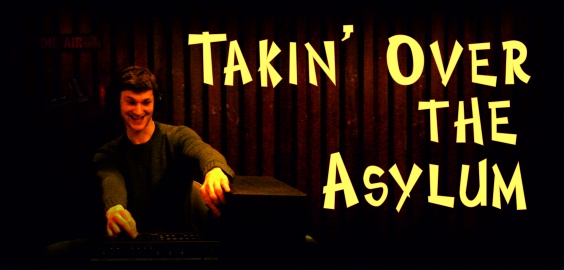
Eddie’s dreams of becoming a celebrated DJ have not exactly worked out. He’s not on Radio 1. Nor is he headlining at Radio Clyde. Instead he’s eking out a living as a double-glazing salesmen. When the opportunity to run St. Jude’s hospital radio comes about, Eddie seizes the chance to share his love of Soul music with a captive audience.

His in-patient listeners are an assortment of characters, each struggling with mental health issues serious enough for them to require round-the-clock supervision. With no other agenda than playing his records, the tables are turned. In Eddie the patients, especially the frenergetic young radio enthusiast Campbell, find a sympathetic ear into which they can pour their frustrations and confidences.

Donna Francechild’s script is partly the product of her own battle with the effects of bi-polar. Softly spoken Eddie (Alan Richardson) is its focus. He’s an ideal sounding board, reflecting the inner and outer turmoils of the patients. Richardson’s reactions in each of his onstage relationships help to reveal something far more intricate than the traditional stereotype of those with mental health problems.

Richardson is fortunate to be playing along with a highly capable cast who set their individual portraits into a greater whole. The effect is not unlike John Trumbull’s Declaration of Independence. As with the painting there is a sense of inclusion, a painstaking accuracy and attention detail but also a starchiness. It doesn’t help that Francechild’s canvas is too big; untrimmed material unstretched.

Takin’ Over The Asylum is a reimagining of a 20 year old BBC TV script (originally starring Ken Stott and David Tennant). But 1994 is not 2014. If you don’t agree then compare John Simm in the all but forgotten sitcom Men of the World with what he’s got up to more recently in Prey. Already something of a hybrid, One Flew Over the Cuckoo’s Nest spliced with Good Morning Vietnam, the uping-to-dating of Takin’ (references to podcasting and internet radio) fails to address how private an act listening to music is in the age of MP3. Why the reimaging? What was wrong with 1994 as a time and place?

What has been preserved is the episodic feel of the TV series. The sense of a single overarching narrative, one focused on a particular set of key events, is dimmed to the point of obscurity. Relationships progress suddenly out of no where. Confidences are exchanged when the scene before the characters were strangers to one another.

None of this detracts from the essential point that the onstage work in this production is of a very high order. For all that there is a lack of theatrical devices and the scene changes are painfully slow, there is some fantastic character work on offer. Calum Barbour as Campbell never flags or falters. He’s so good I even find myself warming to the twerpish Campbell. Pacy and racy, Lynsey Crawford as Francine is superb, revealing her scars with a tender emotion that presents a person as well as a victim – and I’m not just saying that because she lists kickboxing as a hobby.

Mike Paton, as the schizophrenic computer wizard, Fergus (who was an electrical engineer in the TV series), provides a deeply moving performance, rather lost in all that excess material like a thong in a duvet. Jane Black as the OCD Rosalie was truly sensational. I feel in love with her. Cared about her. And can’t bear to think about what she will have to face on the outside when she leaves St Jude’s.

Derek Blackwood’s set design is spot on and elegantly lit. This was my first venture into the Studio at the Festival (entrance via Potterrow) and it was great to see the space being used so well.

I’m not sure why they decided on assigned seating. Octopussing over the back rows, enjoying all the space that I was not sharing with the tightly packed rows below. I couldn’t help but feel that we might all have relaxed into Francechild’s razor sharp comedy if everyone else had been less constrained. But then as Matthew Thomson, as Stuart the nurse shows, asylums do tend to be more fun if you aren’t the one in the straitjacket.

nae bad_blue

Reviewer: Dan Lentell (Seen 15 May)

Visit Takin’ Over the Asylum‘s homepage here.

‘The Queen of Lucky People’ (Traverse: 29 April – 3 May ’14)

Eileen Nicholas as Patrice French Photo: Lesley Black

Eileen Nicholas as Patrice French
Photo: Lesley Black

‘Patrice’s impish tittle-tattle lands her in some embarrassing shite.’

Editorial Rating: Nae Bad

The last in the Traverse’s very welcome A Play, a Pie and a Pint season.

A venetian blind is prone to twitch not tweet. Anyhow, it provides the tell-tale keeking backdrop to The Queen of Lucky People, without doubt set in a tenement flat near you.

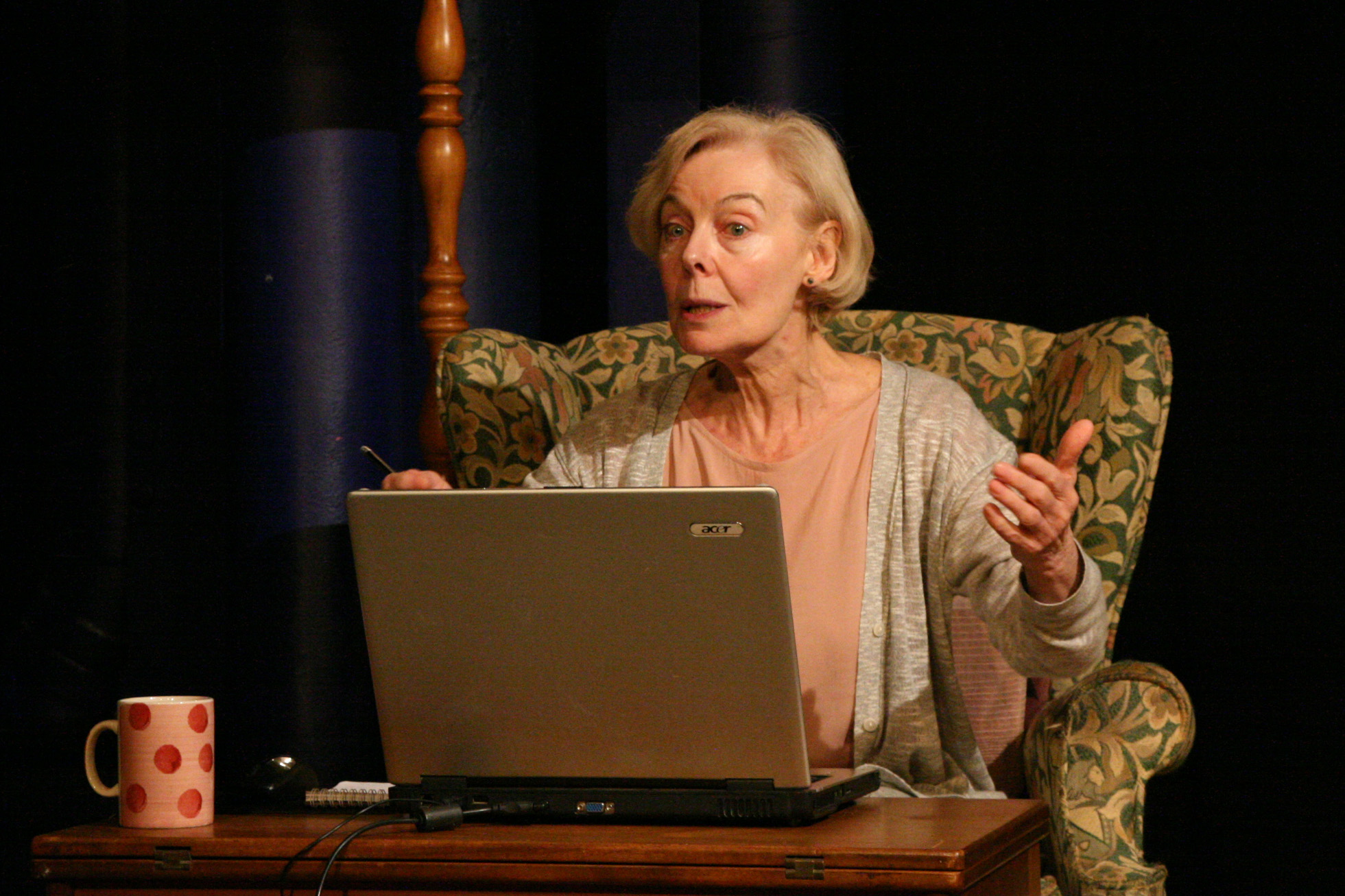
Patrice French, clerical officer, retired, lives there, which might just be the cheap end of Kelvin Drive, G20, or off the Warriston Road, EH7; either way, close enough to really notice the neighbours and to go out once in a while for a walk by the river. Not that Patrice gets out much as she prefers to be in the immediate vicinity of her laptop, spending cushioned hours within her social network of choice, ‘Lucky People’.

She has the site’s language at her fingertips. She tallies ‘Awesomes’, ‘LOLs’, and ‘Friends’ –  they’re ‘Buddies’ on ‘Lucky People’ –  with mounting glee and notes her “Record!” stats with pride. A euphoric Third-Age experience or late onset OCD? Regardless, out of sight and careless, Patrice pushes out her gossipy posts. She does not answer the phone and the blind is kept down.

Writer Iain Heggie gives Eileen Nicholas as Patrice many a winning line of solo banter. Laughs are frequent (and a little easy?) when you give an elderly character the energy and the assurance of the hip and snappy catchphrase. The script is at its best when, through the piece, Patrice’s impish tittle-tattle lands her in some embarrassing shite. You will be pleased to see how Marigold Extra-Life kitchen gloves and doggie bags, off, do the business.

It is a redemptive tale. You might argue that Patrice is a better person for having discovered – and thrown out – the troll within. Certainly Nicholas’ sure and appealing performance is of a lonely woman who is happier and kinder at the end. Sympathetic direction by Emma Callander and focused design by Patrick McGurn combine to lift a bright but brittle character into a companionable place. And so the blind goes up.

My only problem, and quite possibly mine alone, was that I could not get Alan Bennett’s A Woman of No Importance and the other Talking Heads out of my head. It is actually to compliment Iain Heggie that the thought of Bennett’s Miss Schofield (Patricia Routledge) with a lap-top is so alarming. Patrice, though, is the more forgiving creation. More of a quiche person, than a pie eater.


nae bad_blue

Reviewer: Alan Brown (Seen 1 May)

Visit The Queen of Lucky People homepage here.

‘Dear Scotland’ (Scottish National Portrait Gallery: 24 April to 3 May)

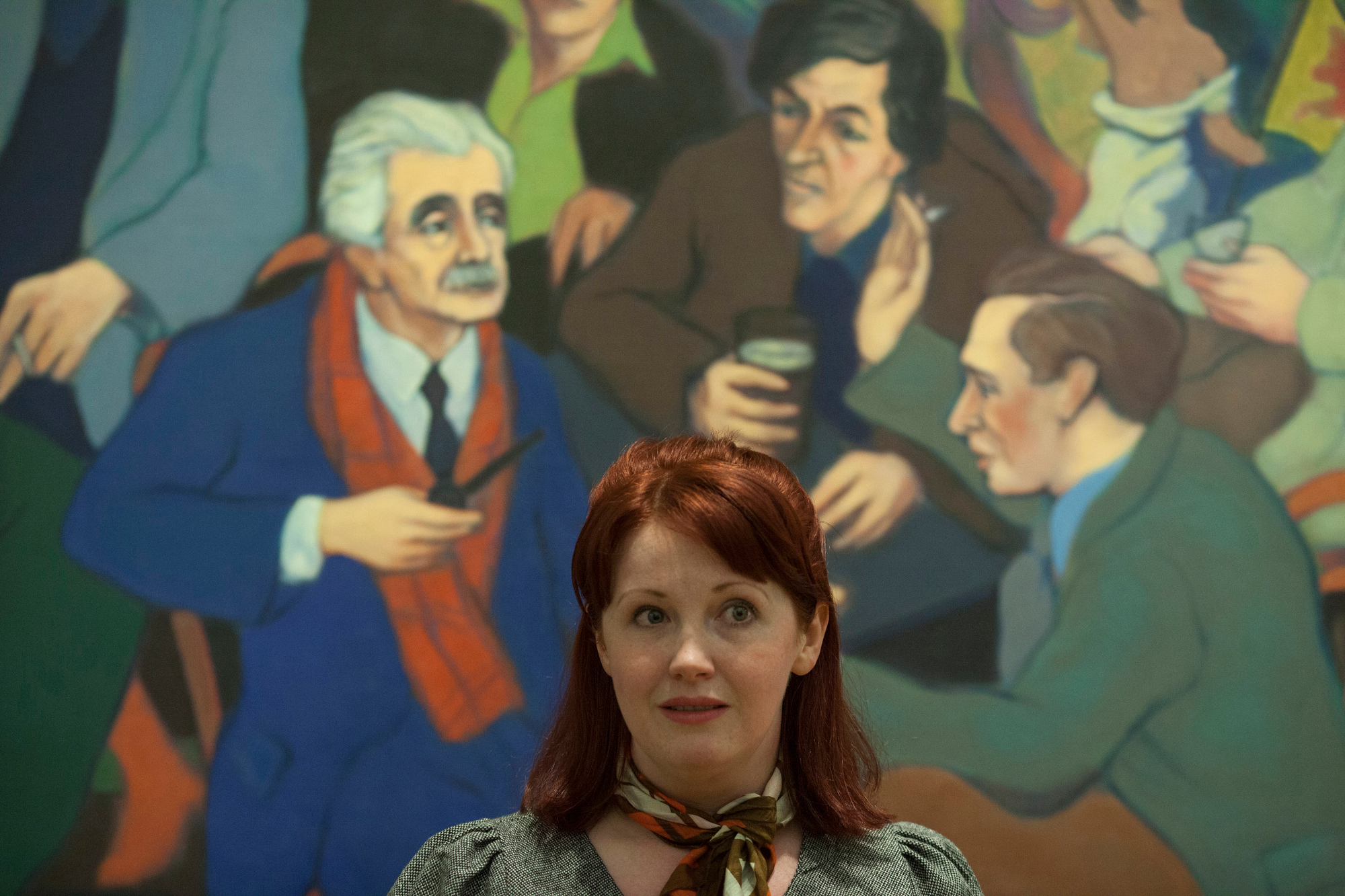
Sally Reid as the unnamed woman in the 'Poets' Pub'. Photo: Peter Dibdin Painting by Alexander Moffat (1980)

Sally Reid as the unnamed woman in the ‘Poets’ Pub’.
Photo: Peter Dibdin
Painting by Alexander Moffat (1980)

‘Finely-honed, finely-tuned productions … You’ll have to go twice – because the twenty short plays are split into two groups of ten, performed on alternate days.’

Editorial Rating:Nae Bad

A National Theatre of Scotland production.

Dear Scotland provokes some complex responses, but the concept underpinning it is a wonderfully simple one. As you’re led round the National Portrait Gallery on Queen Street, you’ll find actors stationed in front of portraits – each of them cast as the man or woman portrayed in the work of art. Each actor delivers a script penned by a different playwright, in the form of a letter addressed to the nation. So you might hear, for example, the unmistakeable voice of Liz Lochhead … but spoken by a man, in the persona of Robert Burns.

The actors are paired with portraits without reference to their looks, or (hilariously) even to their gender. Colin McCredie as the Queen is a particular highlight; in some ways, he better captures our image of the monarch than the unflattering portrait hanging behind him. Such an overt mismatch avoids some moral issues, too. Playwright Johnny McKnight isn’t putting words in Her Majesty’s mouth, but offering an alternative Queen – one who tells us things the real Elizabeth would never be so gauche as to say.

Another piece, written by Peter Arnott, pulls the same trick the other way around; this time, he has Walter Scott lay bare the things we think, but don’t dare to mention. A gender inversion again works well, with Lesley Hart offering a memorable performance as a thoroughly modern Sir Walter. But to see both the pieces I’ve mentioned, you’ll have to go twice – because the twenty short plays are split into two groups of ten, performed on alternate days.

It’s worth a second visit, since seeing the same actors re-cast in different roles presents some intriguing juxtapositions and parallels. The scenes explore a fine range of the gallery’s exhibits too, from an exalted king to a nameless woman and from photographs through paintings to sculpture. There’s even, bizarrely, a monologue delivered by a dancer’s knee (though mercifully it’s played over loudspeakers).

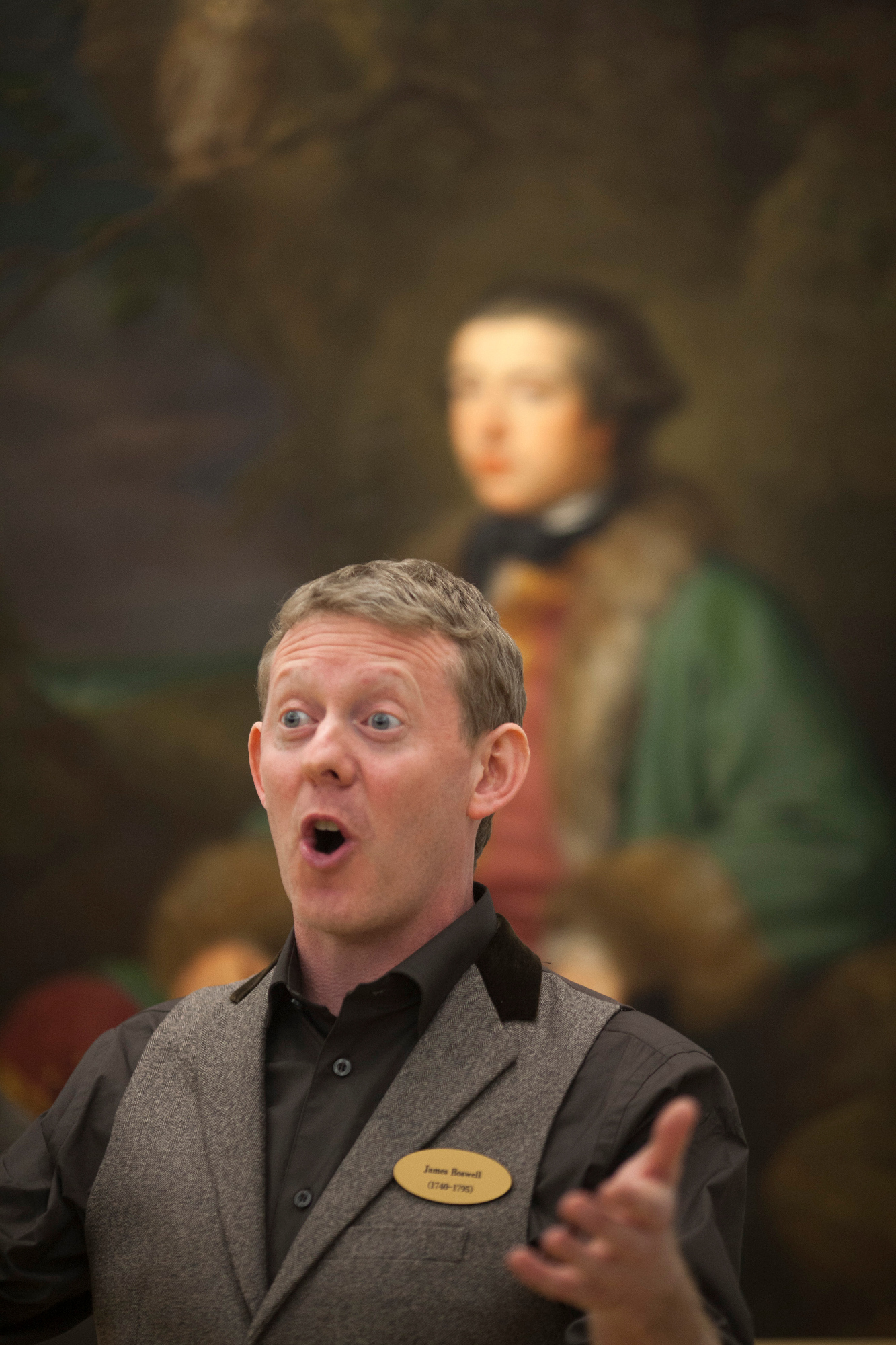
Colin McCredie as James Boswell Photo: Peter Dibdin Painting by George Willison (1765)

Colin McCredie as James Boswell
Photo: Peter Dibdin
Painting by George Willison (1765)

So the individual pieces are often compelling, but does the whole show hang together? Overall, yes; the itineraries are finely-honed, finely-tuned productions. The actors’ dress and poses subtly echo the portraits – enough for you to notice, but not so much that it starts to feel mechanistic or trite. And the logistics are impeccable too, with an array of assistants escorting the audience through the gallery, in groups which feel like they move at their own pace yet somehow never collide.

But inevitably perhaps, for a work built from so many different pieces, there’s a clumsy repetitiveness to some of the themes. “Tour B” in particular shoe-horns a discussion of independence into each and every vignette – as though the whole of Scottish consciousness can be reduced to a “yes” or a “no”. “Tour A” explores a wider view of society, and feels much more subtle and thoughtful as a result.

Across both nights, the most striking scenes were those which challenged our complacent assumptions – dared to suggest that some of our nation’s faults might originate from within. Zinnie Harris’ script for a chorus of forgotten women will linger in the memory, touching a type of pain that lives inside us all. And Nicola McCartney’s complex, riddling monologue, spoken by a bystander, opens with a welcome yet carries a bitter sting in its tail.

At the end, you’re invited to write your own note to the nation – so here is mine: ‘Dear Scotland, let’s remember how to have this conversation; not just till September, but onward, into whichever future we choose. Let’s carry on learning about our past, and speculating about our present; because, with this elegant production, the National Theatre of Scotland shows just how entertaining that thought-provoking dialogue can be.’

 nae bad_blue

Reviewer: Richard Stamp (26 & 28 April)

Visit Dear Scotland homepage here.

‘Skeleton Wumman’ (Traverse: 22 – 26 April ’14)

Buchan Lennon as Young Man and Amy Conochan as Skeleton Wumman. Photo: Lesley Black.

Buchan Lennon as Young Man and Amy Conochan as Skeleton Wumman.
Photo: Lesley Black.

‘Buchan is seamless, fluid and graceful. If he were Salome, I’d have the head of John the Baptist brought to him with an apple in its mouth.’

Editorial Rating: Nae Bad

“I’m not entirely sure I understood that,” I confided to no one in particular walking out into the thick Spring mist. The questions raised by Gerda Stevenson’s lunchtime script continued to buzz round my head as I wandered through the exhibition of Edward Lear watercolours at the National Gallery. It’s a sign that the magic of theatre is working I suppose. There’s a similarity in the way Lear represented mid-nineteenth century Greece and the seascape of myths conjured by Stevenson.

Both evoke folk memories held deep in the collective conscience. Both present skilled artists with a canvas for intricate flair – none of Lear’s paintings is larger than A3 while a Play, a Pie and Pint runs not much more than an hour. And neither entirely satisfy.

The muted colours of the Scots dialect run from Stevenson’s pallet into something of a monologue delivered by Amy Conachan as the Skeleton Wumman. The plot is an interplay of narratives woven from Inuit tales and mythology, offset by the innermost thoughts of a contemporary young girl.

There is an Inuit tale of a fisherman who ensnares bones of a forgotten young woman, cast out by her disapproving father. When the seemingly lifeless, barnacled relic of a past tragedy drinks a single tear shed in sorrow by the fisherman, her flesh and animation return, in turn ensnaring him. In Stevenson’s narrative the Skeleton Wumman might also stand for Sedna, Inuit goddess of the deep.

The young girl portrayed by Conachan is severely disabled. We find her at home being cared for by her father, an oldskool fisherman stuck on land by the inclement season. We hear her innermost thoughts, ideas and perspectives, which she is otherwise unable to communicate especially to her uncommunicative father.

Conachan leads a trio of performers who somehow sprint the marathon. She is an extremely gifted performer, one who knows how best to present the results of her Royal Conservatoire of Scotland training (where she is currently studying). She is the glue holding the narratives together and does not come unstuck even as the script’s monologue starts to skirt the bounds of monotony. Conachan’s relationships with Buchan Lennon (as her Father and as the Young Swimmer who has caught her eye at the city pool) are truly enervating.

Buchan is seamless, fluid and graceful. If he were Salome, I’d have the head of John the Baptist brought to him with an apple in its mouth. He inhabits both characters more like a Game of Thrones warg than someone playing make believe. Every nuance is there. The Father is at once terrified of nappies, especially now his daughter’s becoming a woman, whilst also tender, attentive and affectionate. The Young Swimmer is shy but friendly, a breath of fresh exotic air. Buchan fills Kipling’s unforgiving minute in If with miles of distance run.

Completing the trio is Seylan Baxter. Noted as one of the small, but growing, number of players reintroducing the cello into Scottish traditional music, Baxter provides far more than a soundscape. She employs the electric cello for both music and sound effects. The beating heart, the familiar musical phrase, the playful twist, each is managed from a push pedal system allowing her to sample herself as merrily she rolls along. Sitting on the far left, I’ve got the best view of the pedal system in action. Not a foot wrong, although one time Baxter almost hands Buchan an umbrella instead of an inflatable rubber ring; happens to the best of us.

The props, set, lighting and sound were all of the highest standard. The gentle sobbing from the techies responsible for all those cues added not unpleasantly to the overall effect. This was a production of very high production values and higher ambitions, the more so for having hit almost every mark.

I’ll be thinking about Stevenson’s script long after Edward Lear’s watercolours have washed out of memory. Spooky, to the point of spine-tingling, Skeleton Wumman is however unfairly weighted between the trio on stage. But that Conachan is a thoughtful and compelling performer, one who carries much more than her own weight, the play might have foundered.

nae bad_blue

Reviewer: Dan Lentell (Seen 22 April)

Visit Skeleton Wumman‘s homepage here.

‘The Comedy of Errors’ (King’s: 16 – 19 April ’14)

Guess who? Antipholuses of Ephesus x2 & Dromios of Syracuse x2. Photo: Nobby Clark

Photo: Nobby Clark

“James Tucker as Adriana pushed out all the stops. He built up a fantastic head of steam, crashing into the terminus barriers with enough force to lift the plot’s ludicrous conclusion to the heights of hilarity.”

Editorial Rating: Nae Bad

The three preceding (and four subsequent) plays of the RSC’s 2001 Histories Cycle had been so brilliant, that the unutterable awfulness of Edward Hall’s take on Henry V came as a serious shock to the system. It’s taken thirteen years of painstaking therapy for the flashbacks and nightmares to subside. Unforgettable was the moment when Hall had hundreds of tennis balls bounce across the stage on Essex’s line, “Tennis balls, my liege.” One of the most dangerous and dramatic moments in the canon blown out of all proportion for the sake of a cheesy visual gag. For those of us embarked on the whirlwind tour of eight history plays in six days the forced funny fell flat.

By contrast, two nights earlier the definitive Richard II of my lifetime had snatched our collected breath away. The late, much lamented Steven Pimlott punctuated the opening play of the Cycle with the lines, “I have been studying how I may compare, This prison where I live unto the world: And for because the world is populous And here is not a creature but myself, I cannot do it.” Shakespeare gave the line to Richard II alone. Pimlott shared it with Queen Anne (Act 3: Scene 4), Richard (Act 5: Scene 5) and at the very end with Bolingbroke. The effect was profound, out barding the Swan.

The recurring lines appealed to my grumpy teenaged sensibilities. More consequentially, it conclusively demonstrated that a director can be reverential to Shakespeare’s unmatched genius without embalming his text. David Troughton played Bolingbroke, opposite Sam West in the title role. Both are scions of great acting families. Edward Hall, director of the Propellor Theatre Company, has an equally impressive pedigree, but as Tony Benn liked to quip, there’s no such thing as an hereditary pilot.

Back in 2001, when mobile phones were still a novelty (just about), the cast of Henry V had been slouching around on stage at the start when a ringtone rang out. It was Pistol’s! How funny was that? What a clever and inventive way to remind people that they might inadvertently interrupt the script with a needless distraction.

Thirteen years later, we enter to find the same busy business on stage and off. Actors flit hither and dither one-sidedly chatting with the audience, establishing The Comedy of Error’s Rocky Horror aesthetic. Perhaps this bonphonie is your cup of tea. All I’d suggest is that in the nature of things, a person standing can’t help but talk down to a person sitting, figuratively and literally.

An all-male cast (as in Shakespeare’s own day) necessitates cross-dressing. Hold the panto, why are we meant to find this intrinsically funny? All-female Lears et al don’t tend to tap this varicose vein of comedy mould. In the week when India recognised transgender people as belonging to a third gender, I can’t help wondering if we aren’t being invited to backhandedly giggle at the black and white minstrels of our age.

Similarly the all-caucasian Mariachi band seemed to suggest something diminishing about Mexican culture not uttered, outside the Top Gear studio, since the producers of Fraiser toyed with the idea of Daphne being a laconic hispanic housemaid back in the early ‘90s. Did this production seep out of the Blue Peter millennial time capsule? Even the prolific use of football shirts nodded towards the Nick Hornby-era, when the beautiful game’s gentrification was at fever pitch. The 21st century appeared above the Madness inspired soundtrack in the form of the e-cigarette which is now all but ubiquitous in productions lacking mature vision.

The Comedy of Errors is a tough nut to crack. Two pairs of mistaken identical twins causing double the hilarious consequences. It’s a silly play requiring serious talent on stage. Fortunately, even the Dead Sea can reflect starlight.

This was an exceptional cast without exception. Joseph Chance and Dan Wheeler, as the twin masters, established the musky basenotes from which the playful rifts of Will Featherstone and Matthew McPherson, as the twin servants, emerged to enliven. Although all four were not on stage together until play’s end, they conjured a continuum which turned the narrative arc into a canopy of luscious woodbine, sweet musk-roses and eglantine which perfectly perfumed the performances of the entire cast.

James Tucker as Adriana pushed out all the stops. He built up a fantastic head of steam, crashing into the terminus barriers with enough force to lift the plot’s ludicrous conclusion to the heights of hilarity. Beneath the dragging drag act both he, as well as the flawless Arthur Wilson (Luciana), established the emotional range required for the darker comedy.

Dominic Gerrard as The Duke, as with the whole production, came into his own after the interval. Suddenly the pace got pacier, with time being left for the actors to enjoy the fruits of their labours. The plot may be thin as tissue during a paper pulp shortage but it frames some fantastic lines, banter and badinage.

To see a strong cast with swift bite slow to sink their teeth in requires the Russian Revolutionary remedy. After 1917 Soviet orchestras divested themselves of importunate conductors, preferring to guide the collective collaboration by the mutual light of their individual talents. The Propeller Theatre Company should propel their Jonah overboard.

nae bad_blue

Reviewer: Dan Lentell (Seen 18 April)

Visit Propellor at King’s homepage here.