Arcadia (Bedlam: 5-8 Feb.’14)

Arcadia apple   Arcadia2

the counterpoint of rhetoric as chat-show”

Editorial Rating: Nae Bad

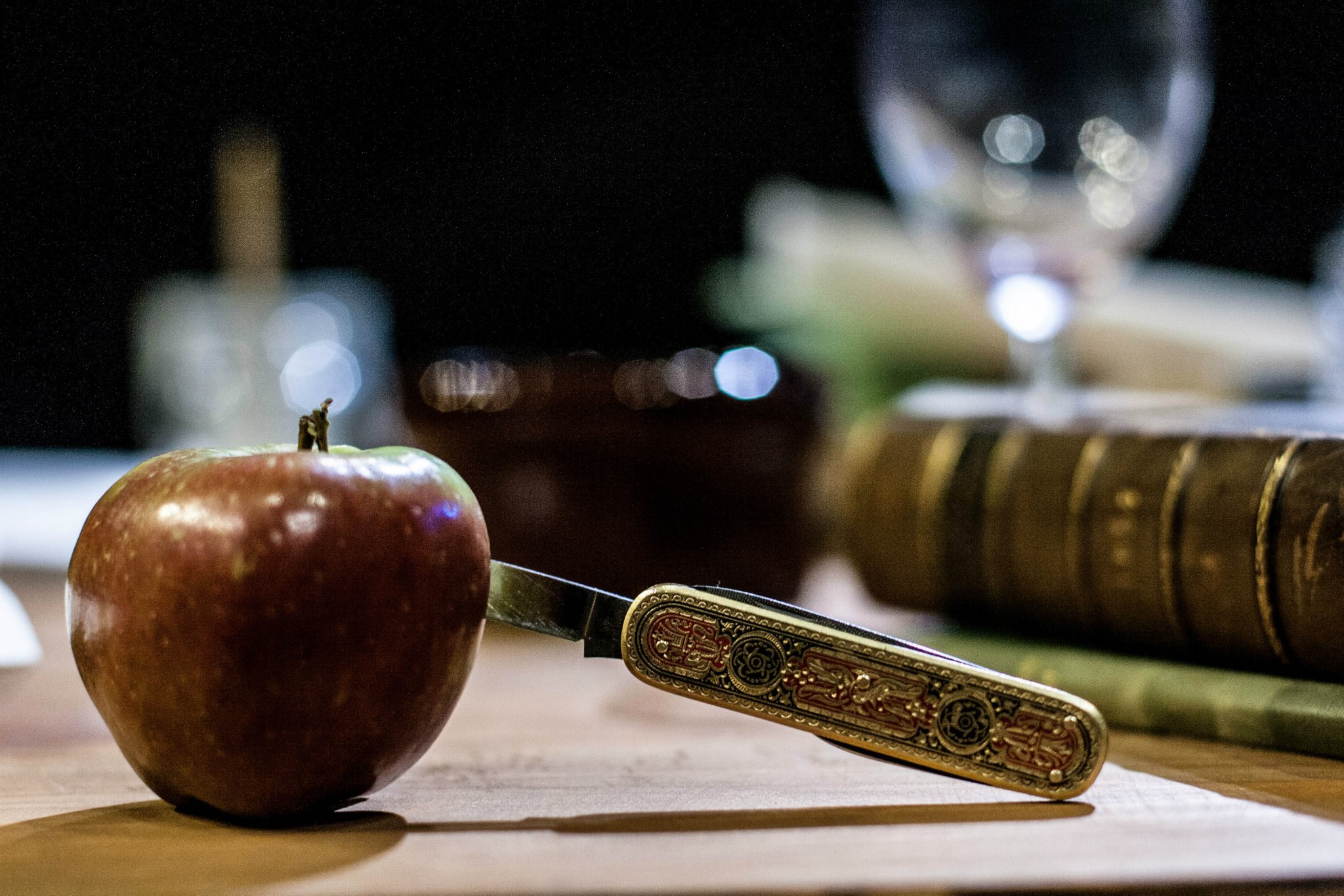
Tom Stoppard’s Arcadia (1993) still has time on its side. There are two apples on the table, the original that Gus offers Hannah at the end of scene two and now there’s Valentine’s MacBook.  Whether ‘Pro’ or ‘Air’ I don’t know but – for a while – let’s stay with ‘Pro’ because this is a student production with professional heft.

The principal roles carry with admirable ease; big ideas don’t sound too heavy; and the impression grows of well-rehearsed supportive work, for even the closing waltzers look to be in step.

Anyway, you don’t ‘do’ Arcadia lightly. This is a recognised heavyweight of modern British drama. Go to The New Yorker online for ‘Tom Stoppard’s Arcadia, at Twenty’ and see what I mean. The plot need not be reviewed – ‘I can’t do plots and have no interest in plots’, said Stoppard when interviewed for the Paris Review in 1988. OK, a soundbite and before Arcadia, but he makes it clear that he does not like ‘narrative mechanics’. What matters is structure (most difficult) and dialogue (easiest). He looks forward to writing ‘a literature play rather than an event play…. in one setting …. where all the time and the energy can be devoted to language, thought process, and emotion’. Eh voilà, a few years later, Arcadia, where Thomasina (13 and brilliant) picks up the leaf of the apple and says “We will start with something simple. I will plot this leaf and deduce its equation”. Note restricted use of ‘plot’. That, as it happens, leads to iterated algorithms of grouse numbers on the MacBook in Act 2 but Arcadia, for all its astonishing architecture, breadth and ingenuity, is a stage play and not a spreadsheet.

A pertinent example:
Bernard:     Because time is reversed. Tock, Tick goes the universe and then recovers itself, but it was enough, you were in there and you bloody know!
Valentine:   Are you talking about Lord Byron the poet?
Bernard:     No, you fucking idiot, we’re talking about Lord Byron the chartered accountant.
Valentine:   (Unoffended) Oh well, he was here all right, the poet.

Not that directors Eric Geistfeld & Charlotte Hodge have much room to enjoy this. The Bedlam stage has to be extended to accommodate the large table at its centre. Additional seating is provided onstage, left and right, but is unhelpful. Stoppard’s own description is of a bare room, uncarpeted, where ‘nothing is impressive but the scale’. Shooting parties are heard as noises-off and the schoolroom table accumulates the right props: folders, books, paper, pen, ink, an aged tortoise called ‘Lightening’ doubling as a paperweight. In the last scene, importantly, there is a pot of dwarf dahlias but otherwise the very large country house in Derbyshire in 1809, a stately home in 2014, is a distant setting in Bristo Place.

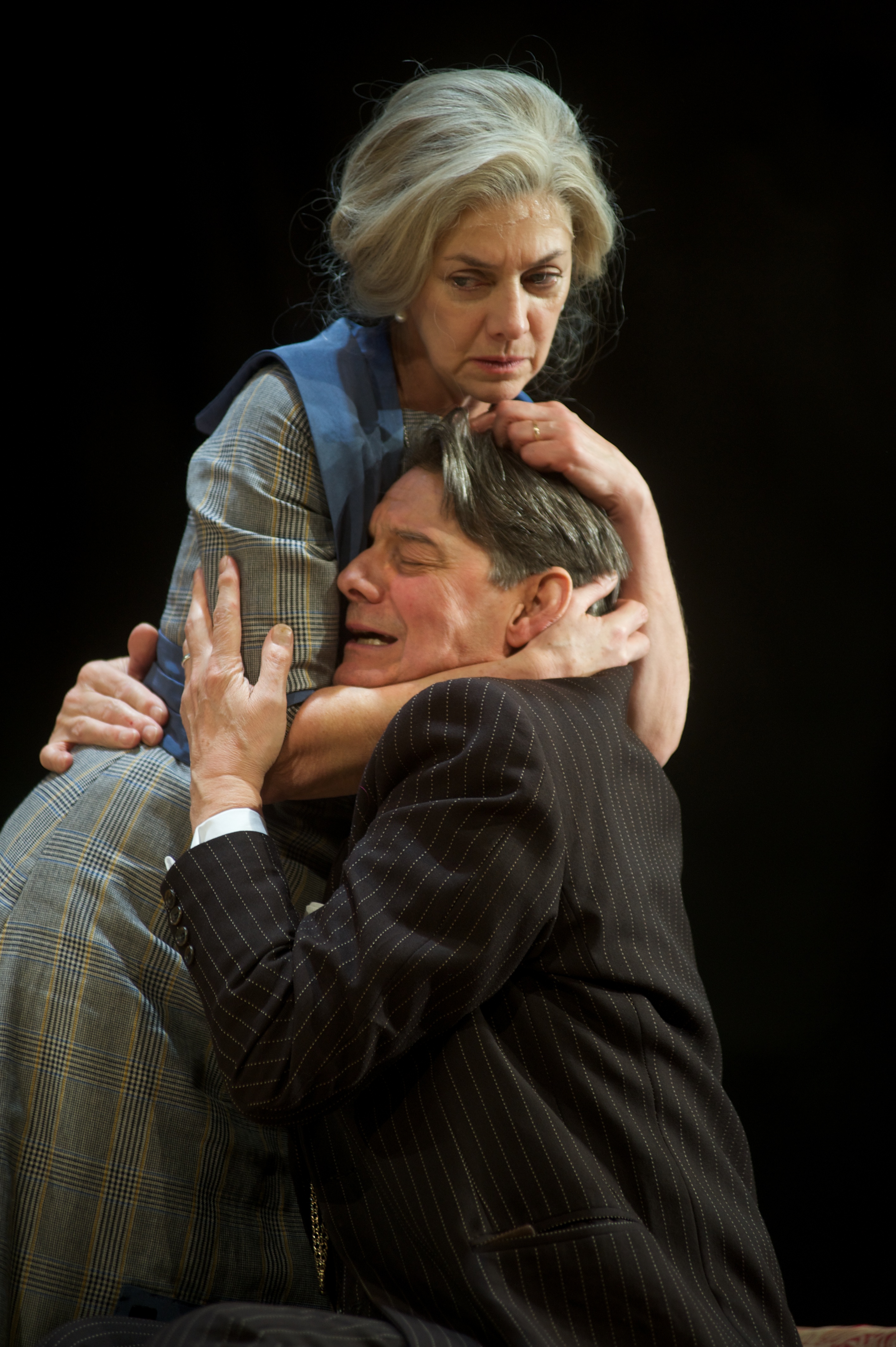
Upfront, down stage and around the table, however, there is solid, focused performance. Lauren Moreau is Thomasina Coverly and is entirely convincing as genius pupil and smart child (think Outnumbered Karen), who is as fascinated by jam in her rice pudding as she is by kissing. Pedro Leandro is her tutor, Septimus Hodge, who does languid and attractive intelligence to the nth degree of Fermat’s last theorem. Stoppard’s George in Jumpers (1972) belongs ‘to a school which regards all sudden movements as ill-bred’. Septimus went to Harrow, maybe played in the eleven with Byron, and learnt the same lesson. Leandro voices the elegant wit of the gentleman scholar as if to the manner born. Peter Stanley as Valentine Coverly, post-grad mathematician and modern day heir to Sidley Park, has the other sort of manor but the same gift of lazy concentration. As with Septimus, Valentine’s words provide rhythmic measure and reflection and Stanley makes you listen. Rik Hart as Bernard Nightingale provides the counterpoint of rhetoric as chat-show. Almost insufferable, ‘bouncy on his feet’, an academic bloodhound, the part drives the actor and Hart controls it very well.  Sita Sharma, as Hannah, has to manage this clever, unrelenting, assault and still stand her own ground. A threatened kick in the balls and calling him an “absolute shit” gives her an encouraging, winning, start that a poised Sharma does not relinquish.

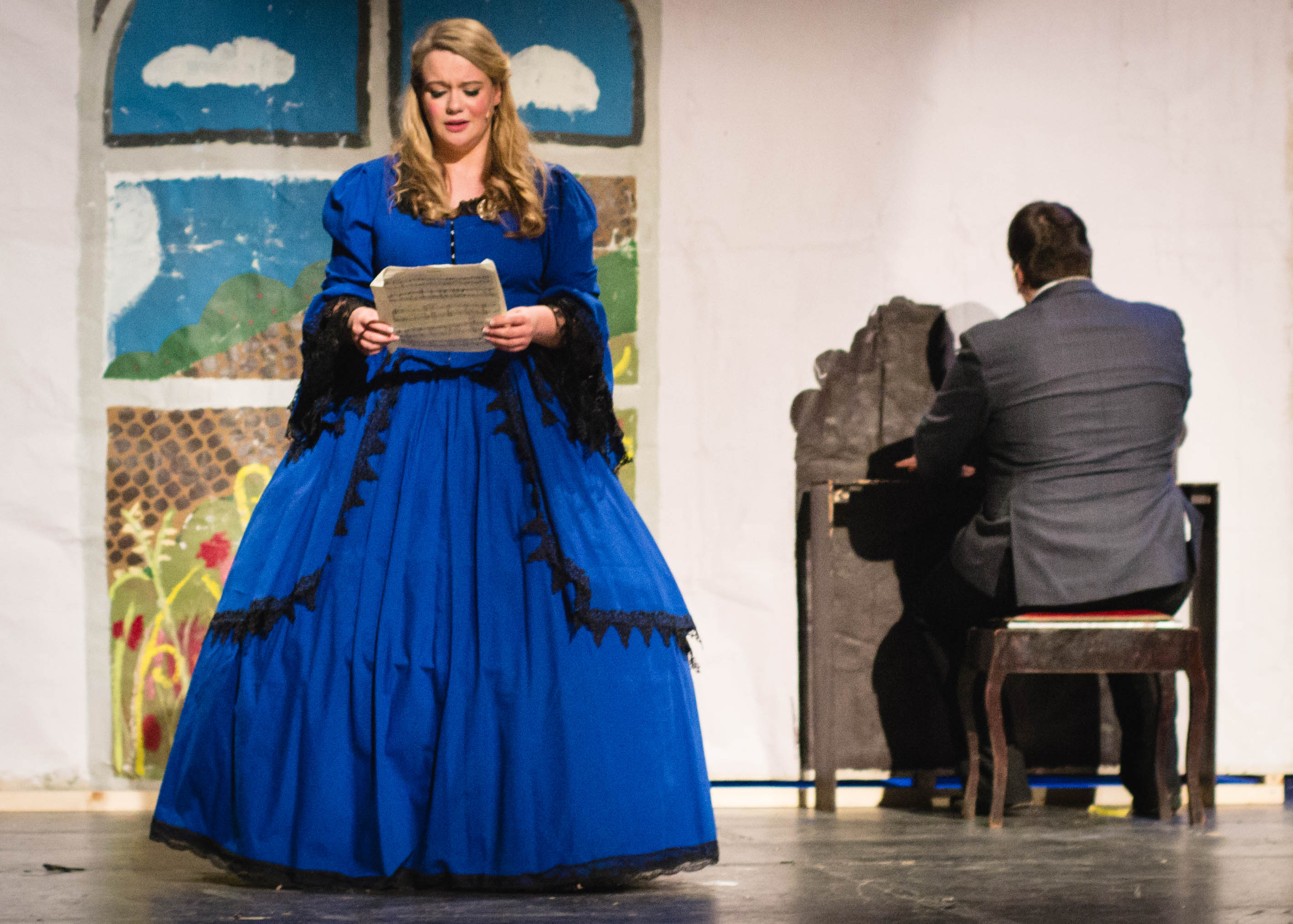
Supporting roles are better than also-rans but it is uneven going. Arcadia is an unforgiving estate in 1809. The costumes looked really good but this is not period drama and the physical comedy cramped up. Braying outrage from Henry Conklin as Chater and a glowering Capt.Brice RN. (Sebastian King) were fun but … too much. Rosie Pierce as Lady Croom went all out for pure-bred aplomb and witty hauteur, leaving Derbyshire far behind. Poor Mr Noakes (Lewis Robertson), jobbing landscape gardener, had no defence but a soft Scottish accent, which was nice. The remaining household: butler Jellaby (Will Naameh) and Lord Augustus (James Beagon) – stay impassive, dumb in my lordship’s case, and that served well.

In contemporary Sidley Park, Catherine Livesey is Chloe Coverly, 18 – giddy, kind and susceptible; whilst James Beagon is back and now speaks as ‘Gus, at Eton and pretty cool.

As students might plough a tough exam it is entirely possible to plough  Arcadia and bury it. But not this time. Directors Eric Geistfeld & Charlotte Hodge and cast should reap a reward.

nae bad_blue

Reviewer: Alan Brown (Seen 5 February)

Visit Arcadia homepage here.
The Seas of Organillo (Traverse: 4 Feb.’14)

Organillo

The Seas of Organillo is a birthing pool for puppets.”

Editorial Rating: Nae Bad

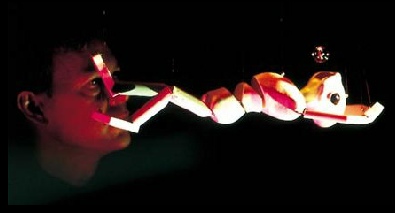
From above – and occasionally in – The Seas of Organillo master puppeteer Stephen Mottram manipulates a biosphere of his own making. In a general Wiki sense a biosphere is a closed, self-regulating system containing ecosystem(s) – ‘including artificial ones’. There you have it: a puppet show that is deeply immersed in itself as a creative process. Highfaluting? Not at all, once you’ve seen it, heard it, and come up for air.

The electro acoustic score is vital and accompanies the whole work rather like an evolutionary agent. Mottram explains its genesis after the show (and on YouTube). He brings on the organillo, a small hand-turned barrel organ, that he built himself over four months out of his old wardrobe, drain pipe, lining paper, and B & Q. Each cylinder roll provides eight minutes of music but multiple recordings of the whole clicking, bubbling, breathing, box provide the soundtrack. There is no speech. Call it organic, obviously.

There are seashore calls and off-shore waves but nothing on-shore. On the surface the seas support a couple out rowing but it is only a couple of turns around the bay before they’re gone and a swimmer comes into view. More homunculus than human, a tiny ET in a cycle helmet, really; for, says Mottram, “I liked the poetic idea of swimming creatures somewhere between fish and people”. Whatever they are, they love the sea – and each other, which is kind of the point.

The Seas of Organillo is a birthing pool for puppets. It is sex under water for little, primitive, humankind and as such it is both innocent and fascinating. You see a bubble of life-giving air rise to the (invisible) surface; hands move and stroke each other in deep space; an egg floats free. Sperm penetrates the egg and – as with a multiplying shoal, more or less – cell division begins, a womb is formed and new angelic life begins. Up top, Mum and Dad now row into sight with an infant in tow.

So much, so familiar in biological terms but the puppetry is something else. There are a lot of puppets in The Seas of Organillo and they are often moving alongside automata – “sexy machines”, Mottram calls them – to help create the liquid, holistic illusion. Occasionally I couldn’t figure it out: the triffid-octopus like ‘thing’ of a fallopian tube; the egg eating clam; the stripping-off of colourful layers from around the fertilised egg – but then, after the show, I read the helpful hand-out that I should have read before I went under.

I’m a pretty poor hand at keeping fish. They survive but without much support. In The Seas of Organillo, first conceived  around 1998-2000,  Stephen Mottram has made puppets akin to biotechnology. Probably a first.


nae bad_blue

Reviewer: Alan Brown (Seen 4 February)

Visit Stephen Mottram’s  homepage here.

Long Day’s Journey into Night (Lyceum : 17 Jan. – 8 Feb.’14)

Production photos for "Long Days Journey Into Night"

‘‘Health and happiness ’ and then, perfectly, ‘that’s a joke’.’

Editorial Rating: Nae Bad

By now Long Day’s Journey into Night has a lot of followers. Written in 1941 this is Eugene O’Neill’s Facebook page from hell – and back – and without any privacy settings. Received by the New York Times in 1956 as a ‘saga of the damned …. like a Dostoevsky novel in which Strindberg had written the narrative’ it is a remarkable and important play. Watch it (occasionally not easy), follow its story (not difficult) and you’ll realise, in epic Facebook terms, its ‘social utility’ for our time.

You will like the kind and sympathetic realization of character in this Lyceum production. Diana Kent, who plays Mary Tyrone, says “There’s no baddie in the play. Everybody is flawed, everybody damages everybody else, but there’s a reason for it, and everybody can be forgiven. It’s a hugely compassionate play” (HeraldScotland, 5 January). For director Tony Cownie it’s ‘a very personal family situation [turned] into a very meaningful intense drama’ (Lyceum programme). Guilt and retribution – the acid feed of some productions – come a discordant second to underscored themes of conflicted love and understanding. A word here for the dialect coaching of Lynn Bains, for the accents are never strained, however keenly pitched. Cue also sorrowful cello, piano, and a quiet sea  – off-stage right  – rather than screaming strings and raucous gulls.

Paul Shelley is James Tyrone, handsomely retired actor, who at sixty-five would still command the stage or living room with debonair gesture and manner. Seduced by $35000 a year net profit at the box office he gave up on Othello and Shakespeare for the lead in melodramas. He shows off his cigars but does not smoke them and the theatrical metaphor is never far away. ‘The final curtain will be in the poor house’ he declaims but whilst he can guard his whiskey (he’s an Irish American remember) and wryly attack the fecklessness of his sons he is again losing his wife to her morphine habit. Shelley shows the pronounced make-up of a man whose dignity and loyalties are keeping him together but are wearing him out at the same time.

Tyrone often holds his wife of thirty-six years but Mary is not really there. He might as well embrace the air for Diana Kent plays Mary as a woman in love with a happy, momentary, past. Her speech is limpid clear and sounds as lonely as she feels. Even when animated and with their vivacious young housekeeper, Cathleen (Nicola Roy), Mary is receding. Her addiction will reclaim her, is reaching her all the while, as inescapable and as all-enveloping as the sea fog that O’Neill would fold her in.  A muted foghorn signals the same. Kent’s performance is one to admire and to think about.

The two Tyrone ‘boys’, James Jnr (33) and Edmund (23), do love their parents and it is naturally selfless, unlike what came next in O’Neill’s A Moon for the Misbegotten (1947). Adam Best as James Jnr. and Timothy Evers as Edmund are very well matched. Their open exchanges provide a sure solidity and warmth that shore up the fragile state of their parents’ relationship. Granted they do drink a lot of whiskey but that allows Edmund, of all people, to propose ‘Health and happiness’ and then, perfectly, ‘that’s a joke’.

However, as is the case here, cut over an hour from O’Neill’s script and put too much distance between the Tyrones and the play’s autobiographical anguish, then you might, cheekily, unfairly, plot this Journey to a few miles out of Elie or maybe Troon. The Tyrone’s car might be a Lexus (actually it’s a Packard) but it looks cheap compared to their neighbour’s S class Mercedes. James Tyrone routinely buys to let and is cash poor; he worries about his electricity bill. He expects his sons to make money. He’s meanly content with the state hospital rather than pay out for private healthcare. Mary wants a proper upholstered home, preferably in the city. The men change into dapper suits to go to town. The full-on wooden wall of the ‘cottage’ interior looks like the neat cladding of apartments in Edinburgh’s Quartermile. There is, I think, a bourgeois milieu here that is pretty comfortable and spacious, some way off O’Neill’s cabined and pathological closeness, and that has to limit the tragedy of a family on the rocks.

Is it helpful to salvage significant pity and modest understanding from the fuller, near mythical qualities of this great American drama? Yes. This is a good, clear-sighted, production of Long Day’s Journey into Night that stops well short of the gloaming.

nae bad_blue

Reviewer: Alan Brown (Seen 21 January)

Visit Long Day’s Journey Into Night homepage here.

‘Peter Pan’ (King’s Theatre: 30 Nov ’13 – 19 Jan ’14)

PP_masthead

“On deck aboard the Jolly Roger, pint-sized John Darling, with obligatory top hat and brolly, upstages the big, very tall, Captain Hook (Grant Stott) with talk of human rights and the Geneva Convention”

Editorial Rating: Nae Bad 

Hook up with Peter Pan and you’re way beyond parental guidance. There is, of course, no ‘PG’ certificate attached to this ‘swashbuckling pantomime adventure’ that splashes music, dance, colour and broad comedy over young and old alike. J.M Barrie is in small print but never mind for within moments of Mrs Smee’s (Dame Allan Stewart) balloon landing she is squirting water from her eye-catching boobs and foolish, lovable, Mr Smee (Andy Gray) is off on a plump pantaloon’s dream ticket, riffing on ‘balloooon’ until his lugubrious jowls fold in helpless laughter.

The show fits its Christmas billing. The outsize programme features ‘Panto Puzzlers’ – try Michael’s Star Maze for example – and happy seasonal advertising for the young at heart. ‘If you can dream it, you can do it’ is a good enough way to Never Never Land (not Musselburgh) …  via the second star to the right. There is lots of fairy dust and spectacular lighting to fly us out of Edinburgh and to transform the ‘wee green bogey man’ into the fearless, battling, Peter who will not grow up.

On deck aboard the Jolly Roger, pint-sized John Darling, with obligatory top hat and brolly, upstages the big, very tall, Captain Hook (Grant Stott) with talk of human rights and the Geneva Convention. Poor preening, impotent Hook! There is snide mention of his little blue pills – Tiger Lily gets leered at – and his quarter-deck shakes a bit as he clashes swords with the agile Peter. His (over-used) command of ‘Pirates Attack’ brings on a nice dance trio who would not attack a sand-castle. Regardless, Stott preps for his dastardly role by a brief appearance as Mr Darling, twirling his moustache and singing a wicked little ‘It’s a banker’s life for me’. The later mention of Fred Goodwin is happily inevitable.

The really funny routines are firmly with the Smees. Allan Stewart and Andy Gray perform with gleeful, twittish and tickling spirit as sparring couple, squashed couple and as a pair of beached mermaids. One scene, involving mops on parade and the baldy joke, is too long but the two become real pantomime villains when with the lights up they turn a tv.camera on the audience. Grown-ups beware!

“But where”, the cry should go up, “is Peter?” Well, he is not quite as lost as his Lost Boys, but he is nowhere near Wendy either, which makes Maggie Lynne’s part sweet but distant. Daniel Healy flies in well – one leg perfectly bent at the knee – but it is not easy to land lines like ‘To die would be an adventure’ amidst the fire balls and dance numbers, not to mention an interloping 007 and Adele. Peter’s rousing ‘Cock a doodle doo’ greetings cannot stand against the fun to be had with sing-along ‘Rum tum tickle your bum, Everyone one shout hurrah!’ or a barfing, “HiYa”, Tinkerbell.

And give the animals their place in this entertaining show: one large Nana dog, all big eyes and paws; Hook’s smart-alec parrot; and the mother of all crocs. You do want to see that croc!

nae bad_blue

Reviewer: Alan Brown (Seen 17 December)

Visit Peter Pan homepage here.

‘Amanda’ (The Kilderkin: 28 Nov ’13)

“Actor Anne Kane Howie makes a nicely detached Amanda, far from emotionless yet tightly controlled, the perfect match for her ambiguous role”

Editorial Rating: Nae Bad 

Part of November’s “Theatre Uncut” season, the one-off short play Amanda lends an important global political issue a distinctively Scottish spin.  From a Holyrood office to a New Town retreat, we follow one woman’s progress through a perfectly ordinary day; a day that involves both struggle and compromise, sometimes with voices from her own past.

Wisely, given its twenty-minute duration, the story’s confined to a single scene and a single character – the titular Amanda.  In the company of two narrators, we visit Amanda in a moment of quiet introspection, alone in the bathroom of her Georgian flat.  Building such a short piece around such a low-key premise is a mature decision from playwright Kieran Hurley, but perhaps it’s a little too luxuriant; when all’s said and done, the piece develops slowly and ends with little territory explored.

Hurley does, however, deliver an elegantly subtle turnaround.  At first, it seems we’re expected to dislike Amanda (rather unfairly, since her only obvious crimes are to sprinkle her bath with rose petals and enjoy the sound of posh voices on Radio 4).  But later, we learn she’s a more complex character than she first appears; and perhaps, the script seems to suggest, our reactions to her need to be complex ones too.

Actor Anne Kane Howie makes a nicely detached Amanda, far from emotionless yet tightly controlled, the perfect match for her ambiguous role.  Nick Cheales and Yvonne Paterson perform well as the dual narrators; they’re unobtrusive without being inconspicuous, and their deft handling of the props required to create Amanda’s bathroom speaks of meticulous rehearsal.

As always, director Andy Corelli works in some charmingly quirky motifs – right up to the curtain-call, where he remembers something I’d completely forgotten, that Amanda needs to step out of the bath.  He also makes good use of the improvised space at the Kilderkin, proving that rooms behind a pub don’t have to be the exclusive preserve of stand-up comedy.  There’s an incongruity to the setting that can’t quite be denied, but some clever scene-setting and an opportunistic use of the Christmas lights successfully evoke the essence of the elegant New Town.

Overall, the odd thing about Amanda is that it’s not an activist piece – or even an especially political one.  You might choose to think that the title character has sold out her principles; but you might think she’s simply grown wiser as she’s grown up.  The script presents some facts about her life yet your interpretation of those truths comes entirely from within.  So is that an abdication of the playwright’s duty, or a valuable spark for debate?  On that question also, you’ll have to make up your own mind.

nae bad_blue

Reviewer: Richard Stamp (Seen 28 November)

‘White Christmas’ (Festival Theatre: 19 Nov ’13 – 4 Jan ’14)

White Chtistmas

“Steven Houghton and Paul Robinson as Bob and Phil capture the essential bromance shared by their characters. Their banter is spontaneous and like any good couple, they are fun to be around.”

Editorial Rating: Nae Bad

My companion finds me in Captain’s on South College Street. The outside world can bustle about all it wants in the brisk mid-winter air, in here is a cocoon of tranquillity. Looking up I see that someone has managed to deposit a Christmas-themed fruit machine on the stool next to mine. It has several strips of flashing LEDs whizzing around a scene depicting reindeer having a snowball fight while a large man, dressed in red, taps an impatient foot beside a huge roasted bird. “They can’t be making fruit machines out of wool,” I think, and they aren’t. It’s my companion fishing for a compliment on her Christmas jumper and red santa hat. I’m starting to understand just how excited she is about seeing Irving Berlin’s White Christmas: The Musical round the corner at the Festival Theatre. Secretly, I am too.

We enter the dress circle to the harmoniously discordant sound of the orchestra warming up. It brings on a tingle of anticipation, like the smell of like gently mulling cider. Their conductor is rising star, Andrew Corcoran. In the decade since he graduated, Corcoran has been involved with many of the best loved shows in the West End and beyond. Corcoran and his big band knock out the auld favourites at just the right tempo to hold things together while things move along swiftly. It’s going to matter that the music is kept pacey in this production.

Since leaving the US Army, Bob Wallace and Phil Davis have made it big. When the song and dance team are not delighting audiences of The Ed Sullivan Show, they are double dating two sisters in the same line. When a planned winter wonderland-style spectacular in Vermont is put on ice for want of snow, the duo determine to save the day for the sake of their former commanding general whose inn is imperilled by the lack of paying punters.

Steven Houghton and Paul Robinson as Bob and Phil capture the essential bromance shared by their characters. Their banter is spontaneous and like any good couple, they are fun to be around. Graham Cole, as General Waverly, is billed as one of the recognisable men in uniform on UK TV from his 25 years as PC Tony Stamp on The Bill. Cole was a particular favourite of my Aunty Elsie and I would have loved to have told her just how great he was.

Cole delivers a brilliantly rounded, emotive performance. He has a balancing act to perform, eliciting sympathy for a chap down on his luck whilst never letting us forget that his character once stood at the head of hundreds of fighting men. For the plot to make sense, the audience must comprehend the depth of Bob and Phil’s hero-worship for their former commander and why they are going at to such lengths to help him out. Cole’s appearance in the prologue, so much like George C. Scott at the start of Paton, made me want to see him slap one of the lads for cowardice in the face of the orchestra or fire a pair of pearl handled pistols into a low flying chorus line – Wendi Peters as the laconic Martha Watson might have been game.

Cole heads a lively company delivering a high standard of character work, Phil Cole as Ezekiel all but stole the show. Producers need to find a vehicle for Cole and Peters, the script gave only a taste of what they can achieve together. They are supported by a clever, downright witty, set design courtesy of the Tony-nominated Anna Louizos. The train scene is compact but expansive. The barn is expansive but intimate. The dressing rooms are just plain compact.

The problem was that the scenery had been fitted badly onto the large Festival Theatre stage. We were looking down into a lot of unused blank space. The stage floor was even more drably coloured than the dull orange pastells of the auditorium. The theatre’s interior, beyond the smashing glass front, has a rather calvinist approach to opulence. The impression is similar to that achieved in the better sort of Tex Mex outlet. When the men appeared in desperately dull suits of forest and olives greens I wondered if they would take an order for seafood enchiladas.

If the Santa on my companion’s jumper was ever minded to rename his team of reindeer after the essential elements of music theatre, he’d call them dance, music, set design, acting and script. The last of these would be the one in front with the red nose guiding the rest.

White Christmas is a fluffy, jolly script – a very funny script – but one which touches on deeper themes and meanings. It’s about America’s greatest generation growing old. Michael Curtiz was no less able to film a script capturing contemporary concerns in the 1954 movie than he had done with Everyone Goes to Rick’s twelve years earlier. In this production of White Christmas, the script’s tradgi-comic insight has been lost along the way.

Strong performances carried this production a long way but it still had far to go in fully releasing the magic from a script set at the most wonderful time of the year.

nae bad_blue

Reviewer: Dan Lentell (Seen 17 December)

Visit White Christmas homepage here.

‘The Mystery of Edwin Drood’ (Pleasance Theatre: 19-23 Nov ’13)

DSC_0242 (1)

“The songs are catchy, the dialogue’s sharp, and there’s a delightful knowingness to the banter with the audience”

Editorial Rating: Nae Bad 

Who killed Edwin Drood?  Many have wondered – but nobody quite knows, since Charles Dickens’ untimely death left his novel tantalisingly poised before the story’s dénouement.  This high-energy, high-risk production addresses the problem in twenty-first century style, by asking the audience to cast their votes on just who the miscreant should be.  Oh yes!  And by doing the whole thing as a musical.

It sounds an odd proposition, but by the time the curtain falls, it’s clear why Rupert Holmes’ innovative production was acclaimed on its debut in 1985. The songs are catchy, the dialogue’s sharp, and there’s a delightful knowingness to the banter with the audience.  And this student version from the Edinburgh University Savoy Opera Group retains the sense of daring which must have defined this first-ever interactive musical, with a vibe of joyful chaos and the cast electioneering amidst the crowd.

Before the vote can happen, though, there’s a whole load of Dickens to cavort through.  Actor Campbell Keith bears much of the responsibility for driving the plot, and duly gives it both barrels as the villainous Mr Jasper; if you enjoy his powerful early solo number, just wait till you see him dance. Rosa Bud, the target of Jasper’s lecherous affections, is beautifully portrayed by Alexandra Pittock, whose fine singing voice eloquently captures Rosa’s mix of chaste purity and independent spark.  Other stand-outs among the large cast include Ari L’Hevender as a big-hearted lady of ill repute, and Giselle Yonance, who gives a nuanced performance in the title role.

Holmes’ Tony-award-winning book pictures Edwin Drood performed in a late-Victorian music hall – complete with bickering divas, ill-disciplined clowns and a bombastic MC.  It’s a set-up that licenses some glorious over-acting, and EUSOG embrace that liberty with gusto; Austin Nuckols’ Reverend Crisparkle grows especially hilarious as time wears on.

The humour tends to broad parody – ranging from cor-blimey stereotype accents to a long-running lampoon of the entire musical form – and the treatment of a few key scenes might benefit from more light and shade.  In particular, the choir-master’s advances on his pupil Rosa deserve to be more stomach-churning, given the sad procession of stories of real-life abuse which has emerged over the past few years.  It must also be said that there were quite a few genuine bloopers mixed in among the accidental-on-purpose ones, though all were saved with engaging good humour by a supportive and adaptive cast.

So this isn’t the subtlest or most polished of work, but it’s big, it’s daring and it’s a whole load of fun.  What’s more, at a flab-free two-hours-forty, it’s great value too.  It is, in short, exactly what a student musical ought to be; see it if you can.

nae bad_blue

Reviewer: Richard Stamp (Seen 20 November)

Visit The Mystery of Edwin Drood homepage here.

‘Don Giovanni’ (Festival Theatre: 14, 17, 19, 21, 23 Nov ’13)

5. Scottish Opera's Don Giovanni, 2013. Directed by Sir Thomas Allen, Designed by Simon Higlett. Credit James Glossop.

Image courtesy of James Glossop

“Loporello’s rather oaf like simplicity contrasts brilliantly with Jacques Imbrailo’s suave, cool and arrogant Don Giovanni, sweeping about in a rather splendid coat like a cross between Zorro and Prince Charming”

Editorial Rating: Nae Bad

If Don Giovanni lived today, The Priory would have him in a heartbeat. I think it’s safe to say his lascivious antics would more than qualify him as a sex addict. Unfortunately for Don Giovanni  (and rather fortunately for the women of Western Europe it seems) instead of a £600 a night treatment programme, he finds himself dragged into the fiery depths of hell  -free of charge, I presume – to be toasted for all eternity by beings that rather resemble the desert people of Star Wars. Still, it makes a good opera.

In this version, presented by Scottish Opera, the drama has migrated east from its original setting of Spain to a shadowy 18th Century Venice. Perhaps they are hinting at the similarities between Don Giovanni and the legendary seducer Giacomo Casanova –acquaintance of Mozart and his librettist Lorenzo De Ponte.  Apart from this slight geographic adjustment, this production is a fairly traditional one – there’s no La Scala floor to ceiling mirrors to accuse the audience here! In a world abuzz with finding new adaptations, angles and settings, though, Scottish Opera prove that traditional does not have to mean dull.

One of the more challenging aspects of this rather tricky work is its drammo giocoso genre. Playing the comedic moments for optimum laughs whilst building the dramatic undercurrent to a climactic and rather sensational finale is an art, and something this production does well. It is a production of rich characters in which no emotion is half felt and the cast largely embody these.  The Laporello/Don Giovanni relationship eschews the more rigid servant/master dynamic in favour of a more shiny superhero and less successful sidekick feel. Laporello, played gloriously by Peter Kalman, draws hearty laughs from the audience with his reluctant service, sarcastic comments and fantastic acting. His rather oaf like simplicity contrasts brilliantly with Jacques Imbrailo’s suave, cool and arrogant Don Giovanni, sweeping about in a rather splendid coat like a cross between Zorro and Prince Charming. It’s safe to say his dark good looks and robust, velvety baritone proved an irresistible elixir for women both on and off stage.

Sneaking up behind him, though, is Barnaby Rea’s Masetto who oozes masculinity from every pore. It is a delight to watch him being frustrated and manipulated by the bewitching Anna Devin as Zerlina. In a cast of magnificent voices, Devin’s stands out as something particularly special. Apart from her delightful, impish acting, her soprano is as resonant as a bell, sailing effortlessly over the orchestra to caress and entice the audience. On a slightly disappointing note, Ed Lyon’s Don Ottavio stuck out as a little lost. Despite pleasing vocals, he lacked the developed character of the rest – and his Captain Hook costume was a little bizarre.

The passion flowing from the stage was matched by that rising from the pit. The orchestra seemed to delight in Mozart’s complex score, particularly the final, ombra soaked scene filled with drama, tension and trombone blasts. It was generally led well by the baton of Speranza Scapucci, although a slightly livelier tempo would have been no bad thing.

Mark Jonathan and Simon Higlett, too, should be congratulated on their lighting and set design. The dark palette and clever lighting (or rather, shadow) design kept the production cloaked in a veil of mystery and reinforced the dark nature of the plot, in a subtle rather than overpowering way.

Don Giovanni is one of the most performed operas in the world for a reason. It has excellent music, an engaging plot and some wonderful personalities. Scottish Opera have produced a very accessible production with some top notch character development, rich voices and effective staging. Whether you are a seasoned opera goer or a complete beginner, you could do worse than catch this interpretation of the Mozart classic.

nae bad_blue

Reviewer: Madeleine Ash (Seen 19 November)

‘The Importance of Being Interested’ (The Stand: 10 Nov ’13)

” Thereafter Ince takes his time, circles his subject(s), and loves the fact that when you engage him you get a ‘Rent-a-Gob’ actor-comedian who does intersecting illustrated monologues way before brevity”

Editorial Rating: Nae Bad

‘And speaking of the science of Life, have you got the cucumber sandwiches cut for Lady Bracknell?’

Robin Ince’s stand-up promotion of scientific understanding has serious pedigree now. There was his 2008 Fringe show Things I Like About Carl Sagan And Others, the 2009 Night of a Billion Stars, last year’s Happiness Through Science tour, and now this one, The Importance of Being Interested, which does exactly what it says on the tin. Boldly search for ‘Pedigree Chum’ and top of the Google tree comes ‘Pedigree Brighter Futures’, which is where Ince would land us.

Initial lift comes from an explosive tribute to Brian Blessed which actually has enough energy to fuel the whole show. Thereafter Ince takes his time, circles his subject(s), and loves the fact that when you engage him you get a ‘Rent-a-Gob’ actor-comedian who does intersecting illustrated monologues way before brevity. Of course, it’s an act and is far better navigated and controlled than this self-deprecating drift suggests.
Space is tight at ‘The Stand’ and the analogy of a black hole is never far away. You do not escape Ince’s argument that what really counts is to notice things. What things? It doesn’t matter as long as you look and learn. Ince does not mention that particular weekly magazine for children published from 1962 until 1982, preferring for his stage the more adult and risible Unexplained, but Look and Learn is most certainly where his 44 year old heart is. There and with his five year old son, Archie, who can do no wrong and whose grasp of quantum theory is cute, for ‘Observe me [being bad] and I’ll collapse into a state of good behaviour’.
Perhaps there is too much of little Archie in extortionate Legoland and in the bath exploring himself and not enough of Charles Darwin and Richard Feynman, but Ince’s sincerity makes that forgivable. He bends double in near fury as he fulminates against the stupidity of rote learning in schools and is wicked about the telltale physiognomy of Secretaries Gove and Osborne. Crawley, presumably disfigured by Gatwick airport, gets it in the neck and ends up on the event horizon of non-existence, as do former Archbishop George Carey and the fatuous DJs on commercial radio that no self-respecting alien would listen to.
Co-host of BBC4’s The Infinite Monkey Cage, Ince can only admire the size of Darwin’s nose – that unbelievably almost denied him passage on HMS Beagle – and would defend to the last piglet squid, earth worm, or naked mole rat the right of a child to ask questions of their universe. That way we get to understand it a little more and can wear the ‘tribal scars’ of a BCG jag with pride. This comedian’s rational, humanist credentials are right up there with the Voyager programme. Ince doesn’t get heckled, he gets footnotes, addendums … (his joke).


nae bad_blue

Reviewer: Alan Brown (Seen 10 November)


‘The Birds’ (Summerhall: 14-16 Nov ’13)

“Josephy McAulay is Bowie-esque as Tereus, King of the Birds. Flamboyant yet balanced. He owns the stage but is prepared to share.”

Editorial Rating: Nae Bad

Rosy fingered dawn breaks through the floor to ceiling windows of the Edinburgh49 conference room. Scylla and Charybdis have nothing on our esteemed editor when she’s on the warpath. If you’re lucky she’ll just turn you to stone gorgon-style. If not you’ll find yourself clutching a short straw waiting in line to see something so bad the shade of Achilles would thank his lucky stars he gets to flit about all day in the underworld.

But I’m in luck! Not only have I not been turned to stone (rock hard abs aside) but I’m in the queue to see Edinburgh University Classics Society (EUCS) performing Aristophanes, and I love Aristophanes. I love Aristophanes so much I have an autographed poster of Douglas M. MacDowell on my wall.

What is it reasonable to expect from students producing work likely to fall among their set texts? Obviously a solid, even reverential approach from young minds absorbed in the comic genius of ancient knob gags and innuendo – in your endo. But if you’re anticipating ropey acting, adequate costumes and limited choreography – you’d be wrong. Far from delivering an earnest but ham-dram performance, this production of Emily Ingram and Lauren Moreau’s adaptation of The Birds is well on the road to the Dionysia.

We enter to find Summerhall’s demonstration room bathed in dry ice. A piano keyboard sits upstage right and drawings of birds are pinned aside the chalkboard (also featuring a bird). This helps to illustrate that The Birds is about Birds. Or rather it is about two Athenian wideboys convincing the King of the Birds to blockade Olympus by stopping smoke rising to heaven from sacrifices offered to the gods by men.

Euan Dickson is Pisthetaerus, the brains behind the operation. Max Cumming as Euelpides is his birdbrained confederate. Aristophanes deploys their self-imposed (or maybe self-preserving) exile as a means to take satirical target at the foibles of his fellow Athenians. Where other adaptations might have entirely respun these comic threads into contemporary cloth, here the antique flavours are preserved. As opposed to the coach-tour approach of say, Fringe landmark Shakespeare for Breakfast, this production is free of naff pop-culture references (actually, there is one but it is essential to the plot). The audience, composed largely of classicists, is expected to make the ascent unaided.

Plenty of spectacle lines the script’s path so that even my companion, despite being a semi-barbarous science type, is never lost. Josephy McAulay is Bowie-esque as Tereus, King of the Birds. Flamboyant yet balanced. He owns the stage but is prepared to share. And there is plenty of talent to go round. Some great character work is on offer from Jacob Close (calm, pacy – the ideal foil to Dickson), Byron Jaffe (a middle order master of horizontal bat shots) and Matthias Vollhardt as the wandering poet lost in himself reminded me so much of Thom Dibdin I nearly fell off my bench in surprise.

A quick look down the cast & crew list suggests The Birds might be a rather plummy affair. Fortunately Rachel Bussom (as Tereus’ consort, Procne) and Jodie Mitchell (as his deadpan, pun-dropping doorkeeper) provide laconic counterpoise to the home counties Attic. While the chaps are larking about, they prick egos on stage and off – scorching without burning. Bussom is the best thing we’re likely to see before Jennifer Saunders returns in the second series of Blandings.

Birds in general, and the birds in The Birds in particular, are a showy order of creature. All feathers and dance steps, they’re never happier than when being admired. Tereus’ court centres on his spectacular daily cabaret. It’s a fantastically tall order for a production staged in a rather dreary auld lecture theatre. The dance routines were devised to look impressive without over-taxing the mixed company. Colourful (if malting) feather boas combine with garish, lacy things from the parts of Primark unseen by men to raunchercise proceedings – as does Gaia Arcagni (whose charming physical range runs the full gamut from crow to flamingo). Tamsyn Lonsdale-Smith all but steals the show with her brilliantly conceived entrance as Iris, floating in on the herculean arms of her devoted attendants.

The Birds is not without its shortcomings. The cast are under-directed when not centre stage. Dickson and Cumming do not blend into the background and their slapstick needs much polishing, as do Cumming’s shoes. The production is too prop light. The business necessary to successfully be off stage while on it is absent. Several of the birds decide to take up smoking for want of anything better to do – if they had wings instead of fingers the result could not be any clumsier. The pianist is utterly lost amid the hilarity with little to do. Either he needs a mask, or a bell with which to mark the passing of each bird-related pun. The venue acoustics are awkward and some are managing better than others.

This is a production deserving a much longer run. Over the course of a Fringe it would be polished and perfected so that it might exceed the success of the original 414 BC outing of The Birds and claim first prize. Even so, much effort has gone in and more that is clever, witty and insightful has come out. This is a great production which you’ll remember fondly even when pinned down by angry Spartans in a walled orchard listening to goatsong.

nae bad_blue

Reviewer: Dan Lentell (Seen 15 November)

Visit The Birds homepage here.