‘Twonkey’s Blue Cadabra’ (Mary King’s Close: 6 Nov ’13)

Twonkey pic three 2013

“Vickers weaves bizarre, bamboozling, absurdly nonsensical stories, which he tells with a mix of puppetry and song “

Editorial Rating: Nae Bad

Who is Twonkey?  What is a cadabra?  Why is Twonkey’s cadabra blue?  All your questions will be answered – sort of – in the course of this weirdly compelling performance, which combines freewheeling inventiveness with some genuinely touching storytelling.  Fresh from a much-starred run at the Edinburgh Fringe, this one-off appearance in the depths of Mary King’s Close also included some new material destined for next year’s follow-up show.

Any attempt to describe Paul Vickers’ one-man act is doomed to inadequacy, but here’s a quick list of just a few of the things he covers.  An oven talks; a tailor flies; a creepy cat just keeps coming back, and our host explains the best way to sneak up on an unsuspecting microphone.  Vickers weaves bizarre, bamboozling, absurdly nonsensical stories, which he tells with a mix of puppetry and song.  His parallel worlds have an internal consistency, and enough points of reference to hang onto – but if you’re expecting a close connection with reality, you’ll be set to rights within the first few minutes of his pleasantly perplexing routine.

It simply wouldn’t work if you took it too seriously.  But Vickers, who drifts in and out of character as Mr Twonkey, develops a rapid rapport with his audience; the crowd grew noticeably more relaxed with his complex material as the show wore on.  There’s a fair amount of comic bungling – it takes real panache to lose your props quite so endearingly, quite so often – and selected punters have their minds probed by psychic underwear, an ice-breaker which actually works remarkably well.

But for all the random wackiness, there’s a real poignancy to some of the storytelling.  Vickers’ biography of Stan Laurel might be untroubled by actual facts, but his imagined anecdote touches on big questions of fame, friendship, and the things a celebrity must leave behind.  And the most moving story of all was the very last one he told, which used a run-in with a drunken postman as the jumping-off point for a tale of lost love.  Suddenly, and very quietly, the whimsical took a devastatingly serious turn.

It might have been a touch more satisfying if the stories linked together – absurdist non-sequiturs can only take you so far – but Vickers’ greatest achievement is to leave you feeling that, in a way you can’t quite express, it all made perfect sense in the end.  A show like this is bound to split opinion, and if you want to be led by the hand through an intricately-constructed narrative you really won’t like it at all.  But if you relish the occasional outbreak of nonsense, you’ll find Twonkey’s Blue Cadabra a gloriously colourful show.
 

nae bad_blue

Reviewer: Richard Stamp (Seen 6 November)

Visit Twonkey’s Blue Cadabra homepage here.


‘Paul Bright’s Confessions of a Justified Sinner’ (Summerhall: 17-26 Oct ’13)

Paul Bright's Confessions prod 2 credit Tommy Ga-Ken Wan

Image by Tommy Ga-Ken Wan

“It is with wry humour, almost touched with disappointment, that the 1987-89 history of Confessions is presented.”

Editorial Rating: Nae Bad

This intriguing piece is ‘reconstructed’ by Untitled Projects. Any reassuring solidity provided by co-producers, National Theatre of Scotland, is shaky for this is a bit of a shape-shifter. It provides dramatic form, of that multi-media sort, to James Hogg’s astonishing Private Memoirs and Confessions of a Justified Sinner, published anonymously in 1824, and to the afflicted, near mad, efforts of actor/director Paul Bright in the late 1980s to put this resurgent, mind-bending, novel onto some kind of stage. It helps a lot if you accept the invitation to go to the four room exhibition – downstairs at the Summerhall – both before and after the show. It’s stark down there but there is much of real interest: archive film footage; Fringe fliers, past reviews, stuffed corbies – that substantiate what you will see/ have seen. And there’s a welcome wee dram to close with.

The host – actor George Anton – does it all, introducing Hogg’s book, introducing himself, meditating on acting, chronicling the history of Bright’s work, playing Bright in impassioned bursts, telling of their time together. He is well qualified to do so as Bright’s co-actor in three (of six ‘Episodes’ of the Confessions) and as his friend, which was clearly – in retrospect at least – one hell of a job.

A large screen assists all the while, showing captions, film – mostly grainy, jumpy and silent – various artefacts, and here-and-now interviews with others who knew and worked with Bright. If you know the book, then the split-screen, Gilmartin/Wringhim, Bright/Anton, doppelgänger scenes are especially successful; not least when you learn that Bright (brought up in Ettrick; but that is Ettrick, Kwa-Zulu Natal, & not Hogg’s Ettrick near Selkirk) had a twin brother who drowned when they were swimming together.

Bright protested Nature above Psychology and he would have his theatre ‘alive, dirty and dangerous’ and that does act against this production which is more intelligent composition, reflective anecdote and report than anything more forward or disturbing. It is with wry humour, almost touched with disappointment, that the 1987-89 history of Confessions is presented. The third Episode, ‘Trials’, was staged at the Queen’s Hall as original Scottish drama and as part of the Edinburgh International Festival . It was a ghastly trial for everyone, lasting nine hours and was a disaster: ‘an incomprehensible and pretentious assault on Scotland’s literary heritage’ was John Gross’s opinion in the Sunday Telegraph.

Unsurprisingly the last Episode 6, ‘The Road to the Suicide’s Grave,’ never happened. However,  here’s the real, valedictory, reconstruction that this production achieves. Paul Bright died in Brussels in 2010 at the age of forty-seven and up on the screen appears a fair sized box that George Anton got in the post from Belgium. It contained personal effects: notebooks, sketches, Bright’s copy of Hogg’s Confessions and a tape from a telephone answering machine. Listen to the message on that tape, watch the appreciably long final sequence and you understand that it is all underscored by affection for a lost friend who could not let go of an impossible project.

‘What can this work be?’ asks Hogg’s editor at the end of the sinner’s memoirs. ‘I cannot tell’ is his conclusion. Actor George Anton, writer Pamela Carter and director Stewart Laing create something more tangible of Paul Bright’s Confessions and in the end more definitive.

nae bad_blue

The Oak Tree (Bedlam: 16 – 17 Oct ’13)

965268_10153333436155858_1026221967_o

Image by Daniel Alexander Harris

The Oak Tree is the debut script from young author Ellie Deans, and it’s an impressive start to her writing career.”

Editorial Rating: Nae Bad

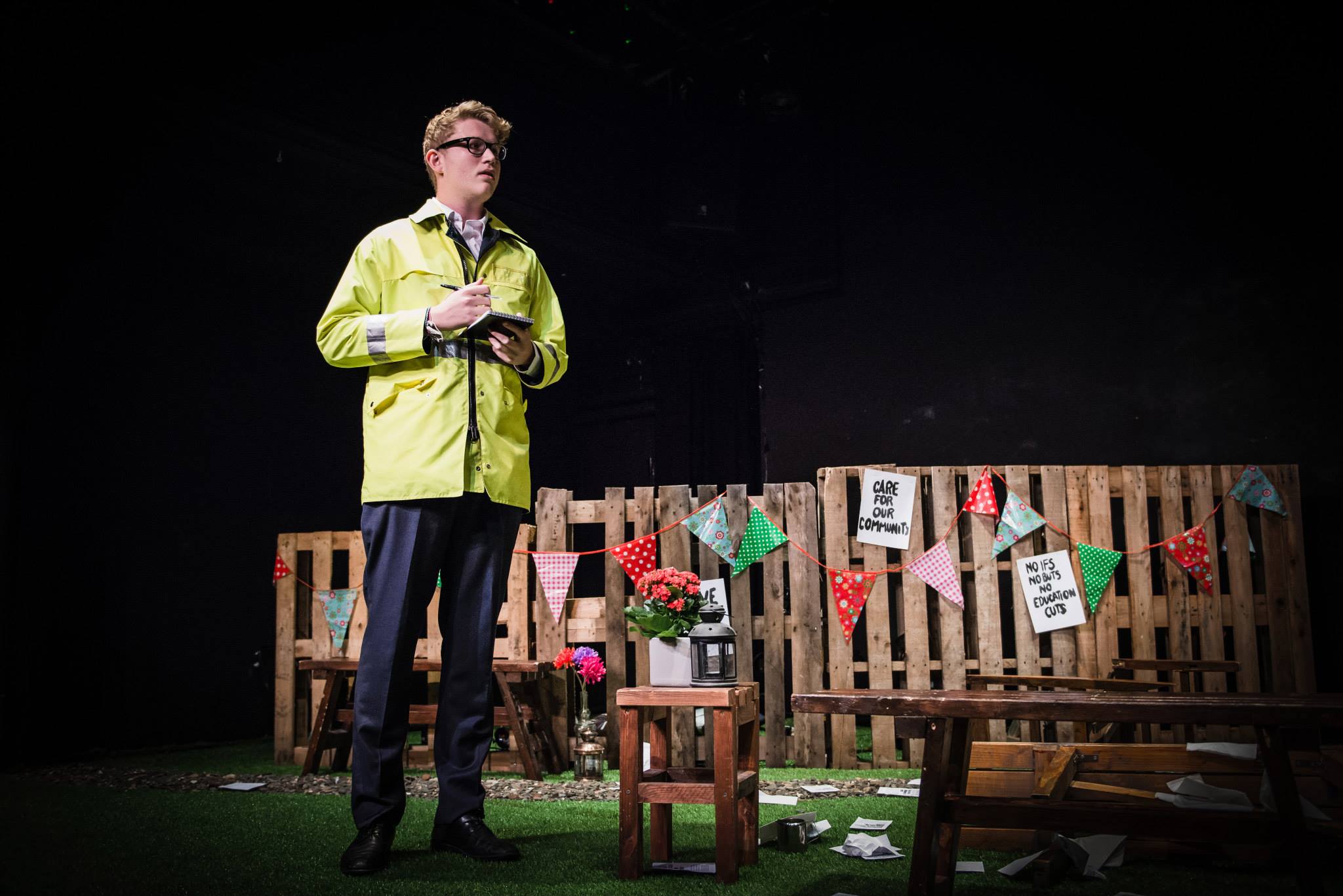
There’s a lot to catch your eye about this brand-new play – but the first thing you’ll notice is its expansive set.  Astro-turfing the whole Bedlam stage, it impeccably evokes the eponymous Oak Tree, a fading outdoor café in an equally fading part of London.  With its rustic fence and crunching gravel, the Oak Tree is both timeless and reassuringly familiar… but a man called Mark Duggan has just died in Tottenham, and in the course of a summer’s night, everything will change.

The Oak Tree is the debut script from young author Ellie Deans, and it’s an impressive start to her writing career.  The story’s revealed through well-paced dialogue, free from clumsy exposition; an occasional tendency to labour plot points is the only notable flaw.  Although it’s a political play, the tone is balanced and genuinely thought-provoking, and the characters are refreshingly nuanced too.

There’s both cleverness and chutzpah in the play’s construction, with a frothily entertaining first half yielding after the interval to a far darker tone.  Early highlights include a set-piece comic misunderstanding – which would stand scrutiny alongside many a TV sitcom – and a gloriously toe-curling business pitch, delivered in fearlessly hammy style by actor Robbie Nicol.  There are subtler motifs too: a touching bond between brother and sister, the burden of untold secrets, and the piquant realisation that the things we love can’t last forever.

But the script loses its way a little when it confronts its motivating theme, the riots of August 2011.  What caused the disorder?  Who should we blame? Is there room for understanding, or must we simply condemn?  The play touches on these important questions, but it doesn’t have time to explore many answers.  Deans is at her strongest when she’s pursuing a simpler agenda: illustrating how that summer’s shocking events tore families and communities apart in the parts of London left to deal with the aftermath on their own.

She’s aided in that task by a strong and confident cast.  Will Fairhead plays lascivious rich kid James with considerable relish, successfully drawing just a hint of likeability from his endlessly crass character.  Ella Rogers has the family matriarch nailed, bringing a gut-wrenching sense of tragedy to one emotional scene, while Casey Enochs puts in a finely-balanced performance as the other-worldly Annie – perhaps the most intriguing of Deans’ creations, and certainly the most saddening.

The Oak Tree undulates through a landscape of moods – from uplands of optimism to bleak valleys of despair – and at times, it’s deeply cynical.  But it’s defined throughout by a gentle, affectionate humour, and by characters complex enough to make you care.  Both playwright and cast deserve considerable credit for this engaging, inventive production.

nae bad_blue

‘Oedipussy’ (Traverse: 9 – 12 Oct ’13)

6

“The poet did not write ‘Agamemnon, Parthenon, Taramasalata’ but in Oedipussy it is intoned as a choric reminder that Greek tragedy developed from the earlier satyr plays whose revels and antics are right up there with Spymonkey’s use of song and physical theatre.”

Editorial Rating: Nae Bad 

Dangle an adapted classic in front of a critic and you invite trouble. So it was fun to hear Spymonkey open Oedipussy with a swipe at a hostile review of their Moby Dick (Edinburgh, February 2010). The boot went onto the other, platformed, foot with wicked intent and not a little of the ensemble playing that would follow.

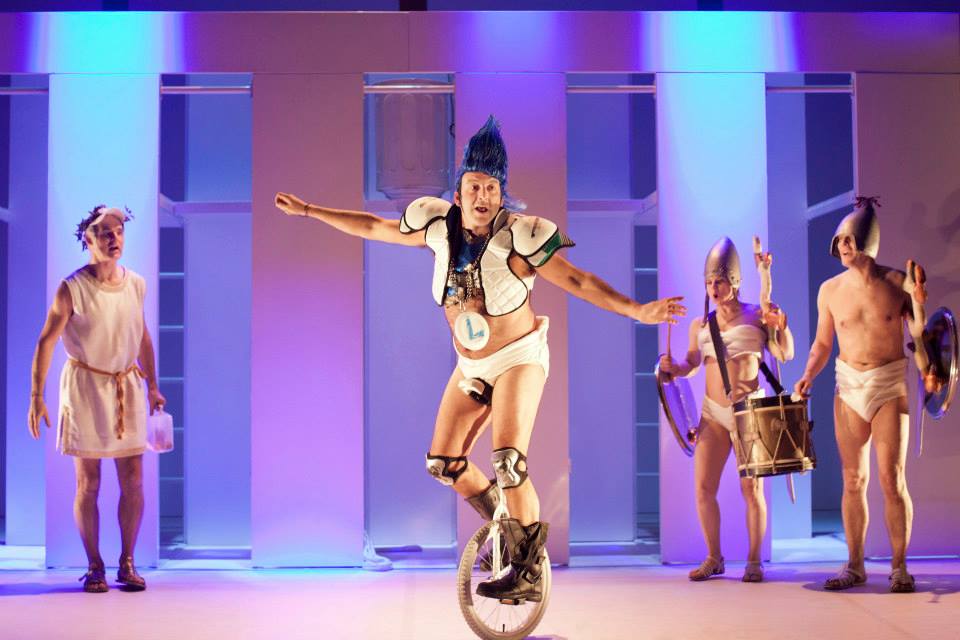
Oedipus has swollen feet, of course, which is not surprising as they are ‘pinned’ here using a cordless drill. Just one of the modern tools – add a unicycle, saxophone(s) and radio mic – that this production uses to ‘build up a dazzling mockery of delight’. The poet did not write ‘Agamemnon, Parthenon, Taramasalata’ but in Oedipussy it is intoned as a choric reminder that Greek tragedy developed from the earlier satyr plays whose revels and antics are right up there with Spymonkey’s use of song and physical theatre. ‘Woman-breasted Fate’ has her naked moment on stage as a wardrobe accident but otherwise the action is more ‘hot, hard, and in your face’ than anything stylised or reflective.

That said, ‘It’s not bloody panto’ either, as Jocasta (Petra Massey) would have the audience realise. The oracle may be hilariously represented by ballooned eyeballs – plus a red nose in a later manifestation – but the episodes are all here, from the infant Oedipus on Mount Kithairon to Jocasta’s suicide.

It is a post-modern piece though, if you allow 007 a mythic quality. Characters deconstruct as the four actors protest – along with Oedipus – that ‘this is the [real] me’: Petra Massey has problems with her feet and cannot have children; Aitor Basauri says he is not fat and tries out as a stand-up comic and Stephan Kreiss (Oedipus), at 51, needs pain relief from wild acting, and longs to go home to a more ordered Germany.

The Chorus (Park) does its job, singly, with a broken column on his head, and it seems is forever twirling in time as his robes wrap and unwrap around the white, ingeniously available set. Park is also Tiresias the blind prophet who has a remarkable turn as ‘a very bad David Bowie’ with outrageous pink cans on his head. Those costumes do stand out. They are colourful and outrageous, much more ‘Barbarella’(1968) than ‘Atlantis’ (2013).

Nevertheless, blood splatters and streams onto the stage and there are drum rolls to accompany the Eels’ ‘It’s a Motherf-’ – and, whilst the poetry is long gone, Oedipussy has its own tragic face. The production finally plays out to ‘Nobody does it better’, which is fair enough.

nae bad_blue

‘Educating Ronnie’ (Traverse: 2 – 5 Oct ’13)


MacRobert Arts Centre

“The money Joe sent would have provided the deposit on a house in a northern industrial town, or in more personal terms an engagement ring.”

Editorial Rating: Nae Bad

It is a touching story. It touched Joe Douglas for near on £19,300. By the end of the show, at the end of their story, Joe calculates exactly what it cost him over ten years to educate a young Ugandan, Ronnie.

It is a true morality tale that begins in 2002 with Joe, an 18 year old out of Stockport, enjoying a six week gap-year trip to Uganda, whose sights and sounds hit him ‘like a pop-up book’. It is not long after returning home that Ronnie ask Joe for help.

We never meet Ronnie but read and hear his emails and txts. They are pretty short, spell out how much money he needs to keep his education going and – later – how much to compensate the family of a fatal road traffic accident; how much to pay the hospital for his dying mother. The emails present on a video screen of a blackboard and then, diminished, pile up into an on-going reminder of Ronnie’s situation. There are beer mugs up there too, a nice calculation in student terms of how many pints can be bought for the £20 regularly sent to Ronnie by Western Union money transfer.

Joe introduces his story with the lights up. He is not a trained actor (the programme notes make clear his credentials as a director) and he would apologise for that. No need really; his one-man performance starts as he talks fondly to the seat reserved for his aunt Maria in the front row, for it is his auntie who looked after him in Uganda, and who interestingly did not take to Ronnie.

The money Joe sent would have provided the deposit on a house in a northern industrial town, or in more personal terms an engagement ring. He does actually take a ring out of his pocket and smiles, remarking that his parents paid for the wedding. And Ronnie? The BBC World Service went looking for him when this story was first staged at the Fringe in 2012. He has a FaceBook page apparently and does not want a copy of the script.

This work, a co-production by Macrobert and Utter, is smooth. Its careful technicals are well-rehearsed, the soundtrack is appropriate without sentimentality, Joe Douglas’s performance is characterful and honest. His story asks you to risk a leap of faith. I’m glad I did.

nae bad_blue

Reviewer: Alan Brown (Seen 2 October)

Visit Educating Ronnie homepage here.

‘Only Wolves and Lions’ (Summerhall; 12, 14-15 Sept ’13)

“From this melting pot, hopefully, will be drawn a social bond that will spark conversation when we finally sit back down to eat.”

Editorial Rating: Nae Bad

Only Lions and Wolves is a collaboration between British artist Leo Kay and his Basque collaborator Unai Lopez de Armentia. Their aim is to bring together a group of total strangers to select, cook and consume a menu of dishes made from an array of raw ingredients brought by us.

The dining table is set for an extended family banquet. Gas camping hobs have been set up  along the hall’s sides. At one end is a table of carbs (rice, flour etc) and condiments such as tinned tomatoes, olive oil et al. At the other end are the cooking pots, utensils and cutlery which we will use to prepare our dishes. A washing line runs behind this table hung with ladles and potato mashers and above it hangs a chandelier of colanders. We sit and, under Kay’s direction, introduce ourselves. The ice is melted with a free form dance warm up as well as bonobo impressions – bonobos and chimps are social creatures too runs the logic.

We team up and are asked to suggest possible dishes within our culinary range and the options available. Then we cook against a clock set for 45 minutes. From this melting pot, hopefully, will be drawn a social bond that will spark conversation when we finally sit back down to eat.

The frame may be hippy-dippy collectivist, but the content of Lions and Wolves feels a lot like the team building exercises, networking events and other assorted workshops strewn throughout corporate life. I am reminded why I’d never want to live in a commune. When Kay and de Armentia start talking Trotsky I regret there isn’t an ice pick on the washing line. It’s a shame that the meal is not billed as vegetarian – for an event aimed at deconstructing social barriers the line between herbivores and carnivores is jarring.

Discussing politics at the dinner table and in mixed company does not come easily. The work is much stronger, pacier too, when outlining broader philosophical lessons from thinkers such as Epicurus and how these might be applied topically to alleviate the symptoms of downturn and recession.

Only Lions and Wolves is a conceptual work in progress. Edinburgh has a well established dining club scene into which this format (if not the current means of execution) could easily fit. An ambitious yet inventive concept, it could hold better selected material, but what tailoring there is, is neat, stylish and bold. When they loosen up, the performers are a lovely bromantic couple in whose company it is a pleasure to spend an evening.

nae bad_blue

Reviewer: Dan Lentell (Seen 12 September)

Visit Only Wolves and Lions homepage here.