EIFF: “The Eyes of Orson Welles” (24 June ’18)

“A gem of cineast cinema.”

Editorial Rating: 5 Stars: Outstanding

If you have ever wondered whether Orson Welles’ larger-than-life persona could get any more layered with creativity, Mark Cousins has delivered the answer: more than most would imagine. With The Eyes of Orson Welles, Cousins has produced a gem of cineast cinema: a story of a filmmaker, told masterfully through the medium Welles dominated so masterfully himself, which illuminates forgotten tales of history with striking relevance and a remarkable amount of fun. It’s great. 

The documentary builds its approach from a literal treasure trove of artworks big and small, all hand-made by Welles himself, who produced over 1,000 drawings, paintings, sketches, and the like — many of which directly influenced his designs for films and documentaries of his own. It is structured in numerous parts, with the overarching hook that they are meant as a letter directly to Welles, delivered by Cousins in a second-person voiceover. The narration produces a fascinating narrative; the drawings function as pictorial evidence of Welles’ immense creativity and eye for visual complexity, while the shots by Cousins and his team breathe life into the diverse settings and characters within the brushstrokes. From Ireland to Morocco, from New York City to his western later-life abode, Cousins follows Welles’ travels and matches them flawlessly with the art he created in those spaces, partially with the help of his third daughter, Beatrice Welles, who offers priceless information and first-hand takes on how his personality influenced his artwork, and vice versa. 

The chapter-based structure works excellently, as Welles was such a complicated figure, both as a creative and simply as a man, that every side of him could warrant its own documentary. Most captivating is the chapter that Cousins wisely positions first in the progression, regarding Welles’  unfailing pursuit of social justice. There are some truly moving examples of his feelings towards the powerful, the powerless, and the power-hungry, especially along racial lines. For the detailed and remarkable story of Welles’ ‘Officer X’ broadcasts alone, this film ought to be seen the world over, especially anyone debating the relationship between art and social justice. When done well, this film suggests, one complements the other. Later chapters on his romantic entanglements and approach to film as art are just as immaculately well-measured, yet perhaps strain the runtime a tad. That is, until a delightfully surreal turn late in the film, which offers yet another reason why Cousins has made a fabulous choice of subject, and approach. 

Intriguingly, Cousins’ film offers a pleasant, optimistic take on the relationship between past and present, history and future, of talent then and of talent now. Welles’ astonishing creativity, and perhaps even genius, are not presented nostalgically, as if we will never see another like him and we should all give up now (a conclusion to which numerous reverent biographies unfortunately default), but rather as a beacon of inspiration for all who share his outlook on justice and the power of art as a healer and an educator. We should not give up, it seems to say, but rather take a cue from creators as wonderful as this. 

Helped along by a buoyant score by Matt Regan and splendid animation by Danny Carr, The Eyes of Orson Welles is a stupendously well-conceived and well-made presentation, and worthy of its multifaceted subject’s legacy. 


outstanding

StarStarStarStarStar

Reviewer: Nathaniel Brimmer-Beller (Seen 24 June)

See The Eyes of Orson Welles at the EIFF
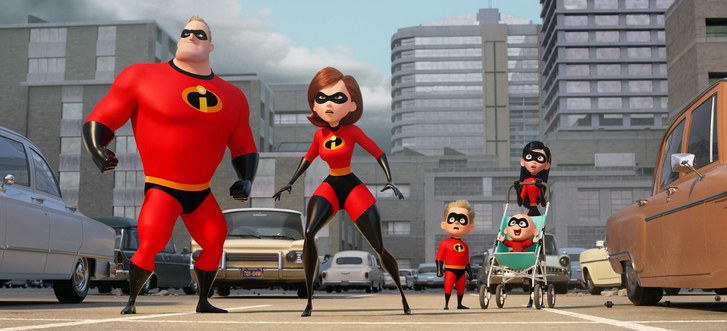
 

EIFF: “Incredibles 2” (22 June’18)

Walt Disney Studios Motion Pictures / Everett

“A true standout in action-excitement filmmaking.”

Editorial Rating: 4 Stars

There are a lot of superhero movies out there. I don’t need to explain the various cinematic universes that have quite efficiently conquered pop culture the world over in the past fifteen years or so. They are high-budget, immaculately shiny, and absolutely stuffed with characters  – and bombast. Yet despite the immense success of these high-concept sequels, in many ways Pixar’s own superhero sequel, Incredibles 2, leapfrogs way over their heads and delivers one of the most genuinely exciting, eye-popping cape-and-cowl films of them all. (Even though, of course,  there are no capes.)

Brad Bird returns to the director’s chair, fifteen years after creating the widely beloved original, which dropped viewers into a retrofuturistic world where ‘Supers’ are made illegal after a one too many superpowered scuffle totals a great deal of infrastructure. Incredibles 2 picks up seconds after the first one ended, finally letting all of us who wondered just how the titular family would deal with The Underminer, all those years ago, see the fight in full. Of course, even more infrastructure is totaled, so the Supers are run underground yet again. Not long after, a shiny-toothed businessman (Bob Odenkirk) and his mysterious sister (Catherine Keener) join the story and offer to help the family, and all Supers, become legal again and protect the city unrestricted. 

What separates the Incredibles films from others of their genre, in both cases, is the heavy focus on the actual people under the suits. Bob Parr, a.k.a. Mr. Incredible (Craig T. Nelson), is back and funnier than ever, as this time he is overshadowed by his much more marketable wife, Helen Parr, a.k.a. Elastigirl (Holly Hunter). In a quite timely and interesting turn of approach, the business siblings, (and, notably, the film itself) specifically decide to push the female-leadership angle as more compelling to “today’s” audience, and put Elastigirl front and center in most of the film’s breathtaking action set pieces. 

Consequently, the greatest takeaways Incredibles 2 has to offer are indeed these stupendous sequences. One helicopter chase in particular struck me instantly as the most exciting superhero set piece I’ve seen in a while, (and I, unsheepishly, am a die-hard MCU fan). Though Disney had some apologizing to do for not warning patrons of a particularly strobe-lit scene, the scene in question is action film lighting at its absolute best, with the eerie villain textured with an utmost nightmarish quality, producing quite unnerving visuals. The groundbreaking studio’s penchant for industry-best animation is on display yet again; just try not to swoon when a glass of water is placed down, even in the corner of the frame, and the bubbles and minuscule waves in the surface are given every pixel of detail you would see in real life. These details, and the heights the animation can reach, make Incredibles 2 a true standout in action-excitement filmmaking.

On a slightly different note, the other side of the animation and craft being so exemplary is that one notices when the story stalls here and there, which happens more often than not. The plot ‘twists’ are  … predictable! The jokes are mostly recycled from the first film, and though that is for the most part very welcome — for The Incredibles is one of the most daring animated ‘children’s’ films of all time, I’d say — some do make one wonder if Bird and company just forgot to write more material. The ending, in particular, feels like they ran out of time, especially when compared to the layered, satisfying final beats of the first. Plus, I hesitate to mention it, but the ‘Frozone’s hilariously sassy offscreen Black wife’ joke is not only tired, but getting kind of distasteful, and it is no surprise that in this film she is relegated to a quick line, as a callback. (Notably, somehow, though Incredibles 2 introduces a wide array of new Supers big and small, with the exception of the offscreen spouse, there are no Black women in the whole thing. Odd.)

Altogether, however, Incredibles 2 is good fun, and a pleasant continuation of the jauntiness and aesthetics of the brilliant first go round. Michael Giacchino’s score is still excellent, opting for a more noir sheen alongside his memorable and delightful main theme for the fantastic family. Bird has done well, albeit by doing what he already knew. 

outstanding

StarStarStarStar

Reviewer: Nathaniel Brimmer-Beller (Seen 22 June)

Go to Incredibles 2 at the EIFF


EIFF: “Cold War”, UK Premiere, 21 June ’18.

“One of the best films of the year. “

Editorial Rating: 5 Stars: Outstanding

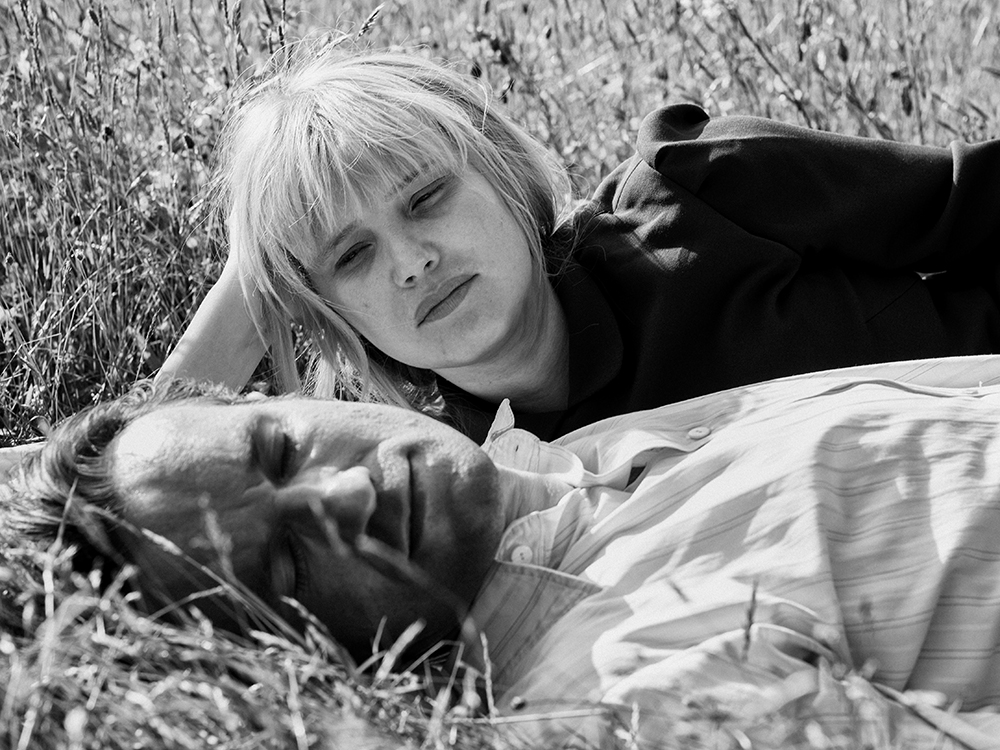
Pawel Pawlikowski has crafted a film that breathes life into multiple mid-century time periods and settings with the ease and authority of a master instrumentalist at play. Cold War, though not his first feature, is the Polish director’s second in a row shot in meticulously framed, gorgeously composed Academy-ratio monochrome. This approach began with the immensely celebrated Ida, which won the Academy Award for Best Foreign Language Film in 2015; yet while Ida’s plotting and method achieve their affecting levels of character development and artistic storytelling through a more bleak, distanced tone, Pawlikowski has imbued his latest with a pleasant amount of levity, joy, cinematic tricks, and transcendent musical sequences. It is no understatement to say Cold War ought to be regarded as one of the best films of the year. 

The story follows fifteen years of two parallel paths: that of complicated, tragically-fated lovers Wiktor and Zula, and that of complicated, tragically-fated Poland itself. The first scenes follow Wiktor (Tomasz Kot) and his team as they traverse the Polish mountain area in 1949, as part of a post-war effort to reinvigorate national pride through revitalizing traditional music. Through their search for singers and dancers for a government-sponsored traveling troupe, Wiktor meets Zula (Joanna Kulig), a captivating and immensely talented young woman, whose beauty is complemented well by her snarky wit. (During her singing audition for the troupe, she is told by Wiktor’s colleague that they have heard enough, to which she responds “Just the chorus,” and plows ahead, singing over the ‘Halt’ order — an example of the film’s wry and welcome sense of humour.) Their romance develops as the troupe’s tour radius grows larger and larger, encompassing more and more of the Soviet Union, until they are so well-known that the government decides to use them as a mouthpiece for its propagandic interests. More humour, albeit a darker tone of it, is on display as a government official suggests that they edit the carefree and poetic lyrics of the age-old folk songs the troupe normally sings, to better acquaint the citizenry with the government’s achievements, such as agricultural reform. 

Pawlikowski explores these dichotomous paths — a growing, twisting romance and a gradually  darkening society — in masterful contrast. Stalinism creeps in the edges of the love story with a breathtaking and unnerving progression, at one point literally coming out of nowhere as a massive depiction of Stalin rises above the dancers with nightmarish grandeur in one of their later performances. Most remarkably, the story of Wiktor and Zula becomes intractably interwoven with the imbalanced levels of freedom and artistry inside and out of the Soviet Union, for as Wiktor longs to leave and stay out, so does Zula question where her home truly is, and should be, leading her to some ill-advised returns to hostile territory. The perverted display of the traditional dancers performing Stalinist messages is contrasted with the liberally expressive Parisian musical scene as the action shifts to the mid-fifties, with some pitch-perfect jazz sequences offering some of the most pleasant monochrome pieces of filmmaking in my memory. Whatever possessed Pawlikowski to include so many musical scenes, from the introduction of Paris through a jazz solo to Wiktor’s alarmingly cacophonic piano playing as he experiences great loss, to the magnificent sequence where Zula throws herself around a bar to the tune of “Rock Around the Clock” by Bill Haley & His Comets, and most briefly but beautifully in a romantic moment between the two as they share a dance to “Is You Is Or Is You Ain’t My Baby,” this film treats its soundtrack incredibly well.

Credit must also go to the leading couple of Kot and Kulig, who ground the artistry in their compelling faces and physicalities; there are times where entire monologues of meaning are delivered in a silent glance or movement of the face. Also remarkable are the supporting performers, who represent the world outside Wiktor and Zula’s bumpy romance, from the stocky government stooge with a surprising amount of heart, Kaczmarek (Borys Szyc), to the stern but defiant musical director Irena (Agata Kulesza) to the amusingly pretentious French poetess Juliette (Jeanne Balibar). 

It came as delightful news when Pawlikowski was awarded Best Director at this year’s Cannes Film Festival, where Cold War premiered, and where I first saw the film. At the time, I would have said it was pretty good, maybe a niche art film crowd will like it. But on second viewing, I must say Cold War is much more: just as riveting as it is beautiful, just as musical as it is dramatic, just as prestigious as it is fun. Highly recommended viewing — and an excellent example of last minute scheduling .

outstanding

StarStarStarStarStar

Reviewer: Nathaniel Brimmer-Beller (Seen 21 June)

Go to Cold War at the EIFF here


EIFF: “Ideal Home” (Odeon 2: 21 June ’18)

“Fresh and clever”

Editorial Rating: 4 Stars

Andrew Fleming (Hamlet 2) delivers a through-and-through feel-good movie, with the crucial help of a particularly bombastic Steve Coogan and chameleonic talent Paul Rudd. Though some of the dialogue could use some editing, the film nevertheless achieves that rare balance between genuinely delightful comedy and grounded social relevance.

The action begins as it means to go on. A scrappy man and his elementary-age son scramble to escape a motel room as the cops wait outside. With them is a woman complaining that the scumbag inside stole her Chanel purse, her Chanel purse. The burly officer, between bangs on the door, turns to comfort her, saying “Hey, hey, I get it, I have some Chanel loafers that I love, so I understand.” Ideal Home continues in this vein of fabulously sardonic charm, as the story pivots to flamboyant couple Erasmus Brumble (Coogan) and Paul (Paul Rudd), who are suddenly saddled with the son from the opening. His father, now in custody, is Erasmus’ son, meaning Erasmus and Paul are all of a sudden in charge of a grandson they didn’t know existed. While this setup — the sudden introduction of a child that must be raised — has been done before, Fleming, Coogan, Rudd, and Jack Gore, as the kid himself, manage to make Ideal Home feel fresh and clever, and a welcome new chapter in the “family comes in all shapes and sizes” genre.

The film is fairly straightforward in its approach; in fact its main downside is the formulaic feeling of some of the dialogue and supporting characters. There is a conspicuous debt owed to The Birdcage for its presentation of bombastic men in love who offer quotable quips back and forth and prove over and over that the line between love and hate can at times seem very, very thin. But unlike previous iterations of these types of stories, Fleming’s film seems purposefully dotted with genuinely dark interactions here and there, from sudden fights to tragic revelations to near breakdowns; serious implications between the ditzy laughs. This changeable emotional landscape not only keeps the audience on their toes, but successfully recalls the knife edge on which many a family interactions walks, when an argument is only a few careless words away from exploding.

In moments like those, especially, but truly in the entire film, Mr. Rudd must be given credit for his all-in performance as put-upon partner Paul. While Coogan performs with candour aplenty, he nevertheless puts forward yet another version of his ubiquitous narcissistic jerk character, with some added heart, but not much. Rudd, on the other hand, explores entirely riveting sides of his extensively likeable persona, and it is nice to see such a versatile actor given a chance to go beyond his normal smiley self and try lashing out and being scornful for a change. Ideal Home is not all scorn and argument, of course, and thankfully Fleming and his cast have found room for loads of side-splitting lines and situations that I highly recommend you see for yourself.


StarStarStarStar


Reviewer: Nathaniel Brimmer-Beller (Seen 21 June)

Go to Edinburgh International Film Festival here

(Ideal Home is showing today Saturday 23 June & Monday 25th. See EIFF programme for details)


The Hour We Knew Nothing Of Each Other (Lyceum: 31 May-2 June ’18)

“A joy to watch”

Editorial Rating: 4 Stars: Outstanding

Peter Brook famously said he could take an empty space and call it a bare stage, continuing: “A man walks across this empty space, whilst someone else is watching him, and this is all that is needed for an act of theatre to be engaged.” In a masterclass of simplicity that Brook would be delighted with, The Hour We Knew Nothing Of Each Other is arguably very little more than several people walking across an empty space for the best part of 90 minutes, and the end result is nothing if not engaging throughout.

Inspired by an afternoon spent watching people come and go in a town square, playwright Peter Handke’s script transforms the actions of these normal people into a theatrical event, which is given new life here by directors Wils Wilson and Janice Parker, along with their community cast of over 90 (ninety!) Edinburgh residents.

The decision to use a large community cast works really well in bringing a sense of honesty and integrity to the action. These are people of all ages, backgrounds, shapes and sizes, with individual quirks that are celebrated on stage, but never embellished to make them ridiculous. Sure, there are some larger than life characters and a sprinkle of pizzazz to create some special moments, but the overall sense of realness conveyed by this piece makes it a joy to watch. Perhaps what’s most impressive though is how slick and deft everything is – one can only marvel at the intricacy that must go in to stage managing this huge cast and all their precise entrances and pathways on stage – it’s hard to spot a misstep anywhere.

Performed completely without words, this is a show that does ask quite a lot of an audience to keep with it, and Michael John McCarthy’s sound design and compositions are (excuse the pun) instrumental in creating a sense of wonderment throughout. His whimsical score facilitates a pleasing ebb and flow to the performance, as if you’re never sure if the music is leading the action or merely complementing it. There’s plenty of variety in the soundscape to punctuate different moods, yet enough consistency to keep it connected and grounded in some magical faraway place. Indeed, this is a production where all creative elements – from costume, design, sound, and direction (even the curtain!) – pull together towards a common goal, which manifests in a very high quality output.

In saying that, at almost an hour and a half in duration, this performance does verge on being too long and self-indulgent. In particular, the section where all performers cluster on stage feels like it should be the climax, but ends up being a surprisingly sloppy (in comparison to the rest of the show) and inconsequential few minutes, which peters out rather unceremoniously into more walking.

As a production that could easily be a rather bizarre lovechild of Samuel Becket and DV8, The Hour We Knew Nothing Of Each Other won’t appeal to everyone. But for me, there’s just such a vibrancy to this piece that leaves you 100% rooting for everyone involved. I’d happily go again.

outstanding

StarStarStarStar

Reviewer: Steve Griffin (Seen 1 June)

Visit the The Lyceum archive.

THIS REVIEW HAS NOT BEEN SUBEDITED

Dunedin Consort, Vivaldi’s ‘La Favorita’ (Queen’s Hall: 6 April ’18)

Dunedin Consort: Vivaldi’s La Favorita

“The very essence of live music making”

Editorial Rating:  5 Stars: Outstanding


Was this going to be, if not too much of a good thing, well, just too esoteric? It was a risk, and, while the stalls were a little over half full and just a few concertgoers in the balcony, such attendance levels are not unusual at the Queen’s Hall for chamber music. With Vivaldi, take away The Four Seasons and the Gloria and what have you got? A series of mostly string concertos that all sound very similar.


That is the perception. Friday’s concert by Edinburgh’s own Dunedin Consort proved it wrong. A cleverly chosen selection of seven string concertos from a cache of 27 manuscript volumes of composition discovered in Northern Italy in the 1920s provided a glorious treat of baroque music that whilst not having the gravitas or structure of his German contemporary Bach was a rewarding example of the Italian Baroque, and in many ways gentler on the ear. If Bach is the master of counterpoint, then surely Vivaldi is the master of ritornello? The tutti passages are more rounded.


The programme was titled La Favorita and this writer’s wicked sense of humour wondered if it was sponsored by a smart Edinburgh pizza group with its blinding, wood-fired, Cinquecentos. Not so, the title would have referred to one of the star female pupils under Vivaldi’s tutelage at the Ospedale della Pietá in Venice for whom a number of these works were written, possibly the mysterious “Anna” about whom we know very little. The boys learned a trade and had to leave the orphanage when they reached the age of fifteen. The girls received a musical education, and the most talented among them stayed and became members of the Ospedale’s renowned orchestra and choir.


La Favorita was reincarnated in a sense in the concert by Music Director and Soloist Cecilia Bernardini, leader of the Consort, who backed by two violins, cello, bass and harpsichord led us though an assortment of musical treats that entertained from start to finish.


The band kicked off with “Il Corneto da Posta” (RV 363), a joyful, simple work with a highly effective interplay between soloist and cello (honourable mention to Andrew Skidmore throughout the evening) in the first movement. Each work followed the classic three movement construct that was Vivaldi’s late Baroque hallmark. The Concerto for Strings and Basso Continuo (RV156) did everything it said on the tin and was an excellent, satisfying example of the continuo genre. There followed two Violin Concertos (RVs 387 and 224) where the players brought real verve and commitment to the music that otherwise might have seemed repetitive. We were being treated to some seriously good playing by the ensemble as a whole.


Following the interval came three more works, the first, very much in the Venetian tradition, being played up above us in the balcony, with the exception, for logistical reasons, of the harpsichordist. Stephen Farr wittily told us that the music he was reading from his iPad was an early 18th century Venetian model. Well, I guess we were only a few days past April Fool’s day. The Violin Concerto “Il Riposo” (RV270a) was tranquil, calming, and beautiful. A further Concerto for Strings and Basso Continuo (RV 128) and Violin Concerto (RV283) and a charming pizzicato encore brought the evening to a close.


In trying to summarise what made this evening so special, when to many a collection of unknown minor works from a late Baroque Italian composer famous only for a couple of numbers might seem at best, obscure, I have concluded that there were two drivers. Intelligent programme selection, and – here I am again extolling the joys of live music – truly excellent, committed playing on the night. The very essence of live music making. Bravo!


outstanding

StarStarStarStarStar

Reviewer: Charles Stokes (Seen 6 April)

Go to the Dunedin Consort

Visit Edinburgh49 at the  Queen’s Hall archive.

Footloose (King’s Theatre: 14-17 March ’18)

“Genuine wow-factor”

Editorial Rating: 4 Stars: Outstanding

When the stage musical of Footloose (based on the 1984 film) hit Broadway in 1998 its critical reception was mixed. But this week in Edinburgh the Bohemian’s Lyric Opera Company are cutting it loose with a near-perfect interpretation, with plenty of positives to shout about.

Following the story of a young man who moves to a new town that’s banned dancing for being a bad influence on children, it’s a fairly mediocre plot, but it’s a show packed with punch, heart and fun to get anyone’s weekend off to a good start.

What makes or breaks a show like Footloose – where dance is what the whole show is about – is being able to sell the choreography, and boy, do the Bohemians do just that: it’s hard to spot a foot or fingernail out of place in this full-on production. And what’s most impressive is that whether there are five or fifty dancers on stage, everything is slick, polished and performed with smiles. Dominic Lewis’s excellent choreography not only captures the overriding sense of freedom vs. containment throughout the show, but it really works to the strengths of this amateur company, creating complex patterns with simple moves that result in a genuine wow-factor.

Leading man Ren McCormack (Ross Davidson) brings all the charisma and light-footedness required for the out-of-towner who dares to be different, while Felicity Thomas as Ren’s love interest Ariel More is honest, likeable and very impressive vocally throughout the show. The main comedic moments are delivered by Willard Hewitt (Thomas MacFarlane), whose gawky brashness brings a lightness and joy to proceedings whenever he is on stage, while Christopher Cameron shows great authority and control as anti-hero Rev. Shaw More.

Musically, this show won’t be to everyone’s taste: there’s a real 80s vibe to the score, which to me makes the standout upbeat songs quite poppy and obvious, leaving the others feeling a little bland in comparison. In saying that, on the whole, everything is very capably sung with some stunning vocals on display – especially from the female leads. Cathy Geddie in particular brings tear-jerking emotion to Can You Find it in Your Heart, and Charlotte Jones pumps up the party diva-style with Let’s Hear it for the Boy. But it’s when Felicity Thomas, Cathy Geddie and Ciara McBrien combine in the spine-tingling Learning to be Silent that you know you’re watching something very special.

The only downfalls in this show are a few pitching and power issues with some of the male soloists, and a tendency for some of the duologue scenes to dip in energy following big production numbers, creating a sense of imbalance from scene to scene. On the whole though, this is a very polished production, so lose your blues and go and see Footloose!


outstanding

StarStarStarStar

Reviewer: Steve Griffin (Seen 15 March)

Visit the King’s Theatre archive.

THIS REVIEW HAS NOT BEEN SUBEDITED

Romeo and Juliet (Pleasance: 6 -10 March ’18)

Eliza Lawrence as Juliet and Douglas Clark as Romeo.
Photo: EUSC.

“A very appealing production “

Editorial Rating:  4 Stars: Outstanding


Can Romeo and Juliet be refreshing? Deffo.

For a start, as with Heineken, there’s the beer. Verona’s birra is Mastro Matto’s; in 1594 quite possibly a thriving business for either the house of Montague or of Capulet. Beer is liberally served in this production. The Prologue opens Act 2 truly blattered, heels in hand. The invitation to the Capulet party is ‘Pray come and crush a cup of wine’ [… or bottle of lager].

Downstage right and centre there’s a café. Mercutio and Benvolio are often in there, sitting down with a beer and talking lewd. You can forget how this high romantic tragedy starts way down low and mucky with the bawdy Sampson thrusting women –  ‘being the weaker vessels’ –  to the wall. However, no chance of that in this production: the Prince and the Friar are women, the Nurse is on man-topping form and Juliet is a very self-possessed #MeToo 16 year old.

Romeo sits ‘off’, to the side of the platform stage, appalled yet entertained, as Mercutio summons Rosaline’s ‘scarlet lip’ and ‘quivering thigh’. He’s then up on the platform, facing forward, for the balcony scene with Juliet behind him at the front of the main stage. It’s a terrific, captivating effect, each speaking to the other but straight at the audience as well. A window on wheels turns around to frame, alternatively, either the inside or the outside of Juliet’s room. This works well as an occasional framing device and is typical of Director Finlay McAfee’s ‘eye’ on his audience and how it will see and interpret the action.

What with body bags on a stark blue- grey set, Love looks ‘death-mark’d’ from the start, but this is not, I felt, a certainty. There is more immediacy and irresolution in the course of this production than in many, which is always appealing in a play whose awful end is common knowledge. The fighting –  tricky when Health & Safety shrinks rapier to titchy (plastic?) dagger – relies on fist, boot, and head bashing which looked sufficiently dangerous to make you realise how fatal accidents are so often juvenile and hot-headed. Mind you, Romeo’s dispatch of Tybalt is definitely murder.

Michael Black as Benvolio with Douglas Clark, Romeo.
Photo: EUSC.

Eliza Lawrence is Juliet and does indeed ‘teach the torches to burn bright’. (Probably not accidental then that Mercutio and Romeo play around with an LED lenser.) This Juliet may be sweet but you can believe that her suicide is the result of an extraordinary love and not momentary despair. Douglas Clark plays  Romeo with the same verve and assurance that he brought to Alan in Equus three years ago. That does make his wrecked helplessness with the Friar at the news of his banishment close to unbelievable but this is still (another) outstanding performance. Kirsten Millar’s programme profile says she is ‘immensely excited’ to add another old lady to her ‘eclectic portfolio’ and you can only admire her cracking truthfulness! Esmée Cook is a Friar whose diction over the whole piece is admirably steady, which helps in a play that can pitch and yaw from one scene to the next. Nathaniel Brimmer-Beller’s Capulet has attractive style – his jacket and shoes combo do half the talking – until he slaps his Juliet right across the face. Bam! And Will Peppercorn as Mercutio poses the usual problem: once he’s dead what’s to do without all that wit and energy? The draining effect of rainfall upon Romeo’s sleeping-bag in Mantua is actually genius!

As well as the yoof n’beer, it was Romeo sitting on the bed tying up his trainers after his few hours with Juliet that confirmed it. This is a very appealing production of Romeo and Juliet. Its effects may appear natural but are the result of new thinking and creative rehearsal. The musical score by Madison Willing – electro brooding Michael Nyman strings with grim rumbles – does ‘Tragedy’ proud, whilst the casual modern dress even gives it something of West Side Story. The Capulet ball, simply yet ingeniously staged, could have been in the Pear Tree. Does it serve Mastro Matto’s L’Ultima?

outstanding

StarStarStarStar

Reviewer: Alan Brown (Seen 7 March)

Go to Romeo and Juliet at the EUSC

Visit Edinburgh49 at the Pleasance archive.

Our Country’s Good (Bedlam: 26 February – 3 March)

BestPic2

“Bold and disciplined”

Editorial Rating: 4 Stars:  Outstanding

Lashings of intelligence here. That and the knowledge that ‘the shoulder blades are exposed at about 100 lashes’. There’s also sand on the stage floor, figuratively blood stained, but handy for gritty effect and for when you want to represent a play as ‘a diagram in the sand’, as proof of what could be and what might be changed for the better whatever the wretched circumstances.

And Lord knows that Australia has been there and done that. In literary terms it’s a swift line of descent: Robert Hughes’ ‘The Fatal Shore’ was published in 1986, Thomas Keneally’s ‘The Playmaker’ in 1987, and Timberlake Wertenbaker’s Our Country’s Good opened at the Royal Court, London, in September 1988. Historically it took eight months for the convict transports to get from Portsmouth to Botany Bay, arriving in January 1788. The action in Wertenbaker’s play – by now surely reckoned to be a modern ‘classic’ – is spread over five to six months. It is Edinburgh University’s official English Literature play of the year and this student production does it proud.

Of course, ‘Advance Australia Fair’ it ain’t. Major Robbie Ross (Amelia Watson) sees to that. He bitterly resents being in such an alien and depraved place, orders floggings for impertinence, and fears that any sign of weakness – ie. kindness – will result in revolt. Arguably it’s the toughest role because he is so singularly awful and Watson has the scowl and the whiplash voice to do it. He is opposed by Governor Arthur Phillip (Matthew Sedman) whose far-seeing humanity guides the play beyond the horror of its opening to its near jubilant close. Wertenbaker indicated that her play end with the ‘triumphant music of Beethoven’s 5th’ but perhaps that was felt to be too much for Bedlam on a freezing evening in February.

What Phillip does do is to require the production of George Farquhar’s Recruiting Officer (1706), directed by theatre loving 2nd Lieutenant Ralph Clark (Jacob Baird). The fact that Clark only has two copies of the play and that some of his cast cannot read and that Ross regards him as a sorry excuse for a Marine makes it a tall order to carry out. Baird is well cast as officer class decent but his character is frustrated almost to breaking point, emotionally and sexually. The relief provided by The Recruiting Officer is palpable and is far better for him than pining at his fly buttons for his beloved Betsey Alicia back home.

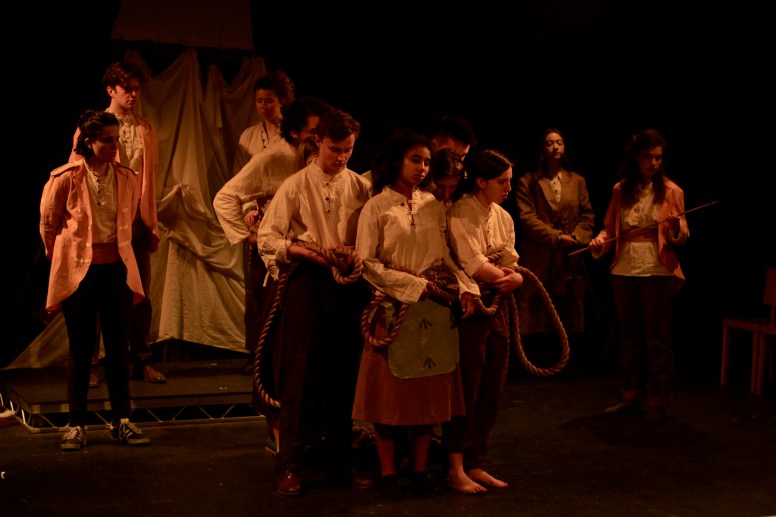
So, here’s the pre-text of late Restoration comedy within a docudrama, with its 22 strong cast list of gentlemen heroes (2), wise man (1) and villain (1), and the rest (several) as good-for-nothing, not! Robert Sideway (brilliant by Domi Ucar), pick-pocket to the gentry, and glorious ac-tor is a scuttling hoot, establishing her melancholy and rehearsing her bow. He is being flogged on deck when the play begins so it is a defining moment when during the second rehearsal scene he completely upstages a brutal Ross. No such joy for Midshipman Harry Brewer (Gordon Stackhouse) tormented by guilt and by his jealous love for his ‘Duckling’ girl (Anna Swinton). Their time together is raw and explicit and (for young actors) pretty impressive. Tiffany Garnham convinces that her Liz Morden, violent, in chains and born to be hanged, can still be redeemed. Jack McConnell is John Arnscott, transported for life, and so pleased that he can ‘be’ someone else. Erica Belton, speaks wonderfully as Ketch, apprentice hangman, who wants to be an actor because he remembers some players coming to his village in Ireland where they were loved ‘like the angels’. Anna Phillips’ shy Mary Brenham owns a precious and appealing dignity from the start. Anubhav Chowdhury’s Caesar is from Madagascar and you have to wonder at the bad luck that got him into a British penal colony but his French accent and daft woes do provide easy laughs. Hannah Robinson manages to be both upper class twit Campbell and illiterate Dabby, bless her, who never gives up on getting back to the soft rain of Devon.

IMG_4684

Matthew Sedman as Wisehammer and Anna Phillips as Mary, behind. Photo: Louis Caro.

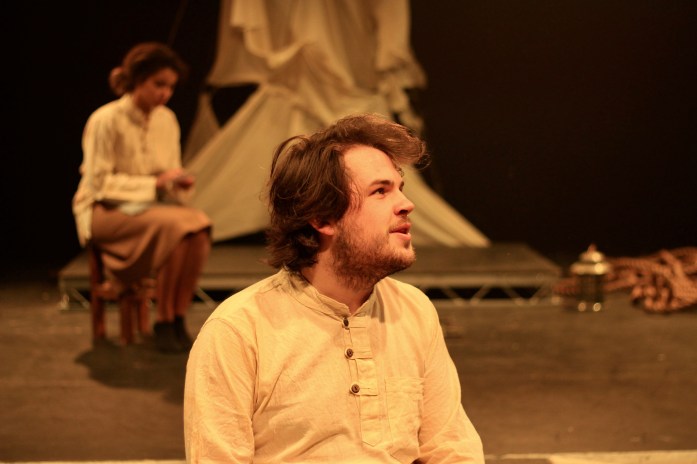
Two characters remain: Wisehammer (Matthew Sedman again) and the Narrator, the Aboriginal Australian. Both command attention but Sedman is outstanding. In this production the Narrator (Sophie Boyle) plays a signature phrase on the violin and her few linked lines are a reminder of the tragic consequences for her people that followed this European ‘entertainment’. Wisehammer, as you can guess, is something else: almost a gentle philosopher, certainly a writer, and Sedman’s careful Northern delivery nail the words, especially his simple Prologue that gives the play its title and it is intoned twice for effect. The fact that Ralph Clark reckons it would give Major Ross apoplexy is a quality judgement.

Our Country’s Good is serious drama and directors Luke Morley and Jane Prinsley take it seriously. This production is bold and disciplined, barely cut – if at all – and its actors work a demanding script with real attention. Yes, there’s some yelling – you would too if you’re being whipped – and it drowned Wisehammer’s astonishing, ghastly opening description of men and women ‘spewed from their country’. Naval uniform is in short supply and despite its appeal the thrust stage doesn’t work, but the actors being constantly visible, on or ‘off, does; and the onstage set design by Natasha Wood and Bryn Jones of a short mast, sail cloth and crossed spars is all that is needed.

I’m with Governor Phillip’s: ‘We will laugh, we may be moved, we may even think a little’. There’s a conviction worth upholding.

outstanding

StarStarStarStar

Reviewer: Alan Brown (Seen 26 February)

Go to Our Country’s Good at EUTC, Bedlam

Visit Edinburgh49  at the Bedlam  archive.

RSNO: Steffens. Ionita (Usher Hall: 9 Feb.’18)

Image result for karl steffens conductor

Karl-Heinz Steffens

“This was as close to perfection as live performance gets”

Editorial Rating: 4 Stars: Outstanding


With Valentine’s Day approaching the RSNO presented a programme on Friday of overtly romantic music: Schumann, Elgar, and, yes, Britten. They were under the baton of Karl-Heinz Steffens, a conductor of a rising reputation throughout his native Germany and also Scandinavia, who proved himself more than worthy of the occasion.

This was a concert of two halves, the first entirely adequate, the second quite exceptional.

In the first piece, Britten’s An American Overture, the band was let down by the relatively poor quality of the music. Not a criticism I would usually level at this composer, but Britten did himself deny all memory or knowledge of the piece when it was discovered in 1972 (it was composed in 1941 as a commission) and had to be shown the manuscript in his own handwriting to prove its provenance. It remained unperformed for a further 11 years. With shades of Copland and even Bernstein, there were flashes of interest in an otherwise fairly monochrome piece. The orchestra played it well, including some very exposed parts early on and while grateful for my knowledge of the repertoire being expanded through the experience, I have no particular wish to hear it again.

Next up the  – Oh, so romantic! –  Schumann Cello Concerto in A minor. RSNO Artist In Residence Jan Vogler was ill (Boy, has this been a season for withdrawals in Edinburgh!) and BBC New Generation Artist and 2015 International Tchaikovsky prizewinner Andre Ionita gamely took his place. The quality of the performance grew as the piece developed, one wondering if Ionita was playing con sordino as the sound coming forth initially lacked the necessary volume, and orchestra and soloist seemed a little out of synch, hardly surprising given the last minute replacement. Nonetheless in the second movement Langsam Ionita’s playing matched the music better, and in the final movement he brought out the necessary volume. His pizzicato encore left no one in any doubt as to his technique.

And now to the piece that everybody, I guess, had come to hear: Elgar’s Symphony No 1 in A flat major. If ever a case could be made for discipline in art, this was it. It would have been so easy to produce a piece of crowd pleasing schmaltz, but the words that come to my mind when analysing Steffens’s fine conducting and the orchestra’s magnificent playing are control, timing, tautness, controlled expression. Steffens showed himself to be a master of tempi, holding back and letting forth the players time and time again, including the final build-up in the brass where no one put a foot wrong. The flutes (I had seen Principal Flute Katharine Bryan chatting relaxedly in the hospitality suite only minutes earlier) kicked off the famous nobilmente with complete aplomb. I heard the cor anglais part clearly for the first time ever, and we were wafted away by the joyous playing of two harps in the final movement. This was as close to perfection as live performance gets. For that magical fifty minutes the RSNO were a world class orchestra. Bravo!


outstanding

StarStarStarStar

Reviewer: Charles Stokes (Seen 9 February)

Go to the RSNO, Scotland’s National orchestra

Visit Edinburgh49 at the Usher Hall archive.