+3 Review: Don’t Panic! It’s Challenge Anneka (Summerhall: 5-28 Aug: 14.50: 1hr)

“A beautiful and emotional journey”

Editorial Rating: 4 Stars: Outstanding

Much like deviser and performer Sophie Winter, I was also a huge fan of the TV programme Challenge Anneka in the 90s, so I couldn’t miss the chance to see a show featuring my favourite presenter from yesteryear. As the audience enters, Winter embodies her heroine – complete with bright jumpsuit, blonde wig and bumbag – welcoming us to the performance and offering treats. It’s a great way to set the tone as one of comfort, support, nostalgia and togetherness.

The piece follows the story of Holly – someone who suffers from anxiety – and we learn what brings it on and how it affects her and those around her. Anneka soon arrives on the scene to help restore Holly to her former happy self, and her challenge unfolds throughout the performance. Winter plays every character throughout the piece, showing great dexterity in capturing personas of people we can all relate to, including the boss who doesn’t listen, the doctor who uses too much technical jargon and the mum who tries to help buy doesn’t really understand.

The performance uses a lot of video, played through an oversized TV on stage, which, as well as demonstrating the level of care and attention put into this piece, allows Winter (as Holly) to react to these characters, and for us to see and feel these reactions close up. Holly comes right into the audience at times, showing her to be just another person like us, and it’s really engaging to see her honest and personal accounts and every side of suffering from anxiety.

I have to say that structurally I did get a little lost and at times I couldn’t quite tell when or where the action was taking place. But this a show where narrative is far less important than the beautiful and emotional journey we are taken on. The overall soul and spirit are absolutely intact and it is a real joy to experience.

As Winter points out at the end, there is no grand resolution to Holly’s anxiety, and that it may well be with her for the rest of her life. Drawing parallels with Anneka Rice’s challenges, the overall message of the piece is that just because a first big step is achieved, that doesn’t mean that the problem is solved. Ongoing support, nurturing, care and hard work are still required, and I think it’s right that this is highlighted, as it shows a real connection and openness with the subject matter.

An important an enjoyable work, on a highly topical subject matter. Please go and see it.

outstanding

StarStarStarStar

Reviewer: Steve Griffin (Seen 14 August)

Visit the Summerhall  archive.

THIS REVIEW HAS NOT BEEN SUBEDITED

+3 Review: The Marked (Pleasance Dome: 3rd-29th Aug: 13.30: 1hr)

“Remarkable theatre worthy of standing ovation”

Editorial Rating: 4 Stars: Outstanding

With an intricate set and haunting musical score, it’s clear from the off that this is a show that pays close attention to detail and creativity. And while, on the whole, this focus creates some remarkable theatre worthy of the standing ovation it received in this performance, for me at times it does border on being a little too artistic for its own good.

The story is fairly simple: homeless Jack (Bradley Thompson) is unable to sleep, as dreams of his aggressive, alcoholic mother haunt him. But he is able to overcome his demons by helping Sophie (Dorie Kinnear) – another homeless person he meets on the streets – from winding up in the same situation thanks to boyfriend Pete (Tom Stacy).

Told in a very visual way, we get to see into the darkest depths of Jack’s mind: the buried secret he’s been living with for so long, and the struggle he has to go through just to be able to help someone else. In terrifying flashback sequences, Jack becomes a child puppet and his mother a domineering masked figure whose eyes bleed while she brandishes a wine bottle, and in the most gut-wrenching of these she actually smashes the bottle on his head. The music, lighting and other effects come together in these moments to create a gripping dramatic intensity, made all the more stark by the slick changes back to the “real” world and its emptiness.

Through clever use of a repeated street scene (demonstrating the relentlessness and drudgery of homelessness), we see Jack’s journey – from tripping over faceless individuals he’s too scared to look at to start with, to their smiles and humanity at the end when he finally wins through. It’s a really powerful story, and Thompson more than delivers with raw emotion in this physically demanding role. Credit also to Kinnear and Stacy for every other character they play between them, as well as their handling of masks, puppets and various props.

While the visual and technical aspects of this show are absolutely outstanding, one of my main niggles is the appearance of the life-size talking pigeons towards the end (no, I’m not making this up). At this point in the show a bit of light relief is exactly what is needed to break up the emotional intensity of the previous scene, but this device cheapens the production and wholly detracts from what otherwise is a complex and well-thought through piece. To me this is one example of where Theatre Temoin try a bit too hard to be too creative, and at times I would have preferred a little less focus on all the “stuff”, and more on the basics of the acting and narrative.

The Marked is a stunning and unique performance, but perhaps just a little overreached creatively.

outstanding

StarStarStarStar

Reviewer: Steve Griffin (Seen 12 August)

Visit the Pleasance, Potterrow & Teviot  archive.

THIS REVIEW HAS NOT BEEN SUBEDITED

+3 Review: Tony Roberts – Card Magic (Assembly Roxy, Aug 5-28 : 21.30 : 1hr)

https://newimages.bwwstatic.com/columnpic7/iconsquaretonyroberts_0244_photobysteveullathorne.jpeg

“Absurdly clever card trickery”

Editorial Rating: 4 Stars Outstanding

I’ve never been very good at card tricks. As someone for whom maths lessons loomed like Banquo at the feast, knowing the number work at play in even the simplest sleight veered me sharply away. So when presented with someone who can do it with skill, I’m naturally impressed; and when presented with Tony Roberts, I was delighted.

Though the audience I saw him in was small, I feel this made no difference: Roberts is an expert at playing a crowd as if it was a one on one conversation, turning what could have been a small show in the Roxy downstairs into a warm, intimate and deeply interesting conclave. Hosted by the titular lauded businessman-cum-acclaimed street performer, ‘Card Magic’ (as Roberts so quickly and happily points out) is what it says on the tin – though perhaps without fully advertising the sheer quality of the product inside. And what that exactly is, much like the man himself, is hard to describe. Part comedy show, part biography and with a heaped helping of absurdly clever card trickery, this was a performance which never failed to intrigue and entertain.

This show’s greatest asset (quite fittingly) is Roberts himself. Deeply charismatic from the moment he opens his mouth, he fails to fall into the trap of braggadociousness which plagues so many contemporary street magicians. It’s like hanging out with an Australian uncle down the pub, if that very same uncle had spent a few years trapped in a Johnny Ace Palmer show. It’s clear from the get-go exactly how Roberts can draw crowds on a busy street – not only his wit, but his genuineness and warmth.

But, of course, being an ace with his suits doesn’t hurt either – and Roberts is clearly one of the best. Even with repeat viewings, his tricks would boggle the mind. Shaking his hand at the end of the show (as he humbly asks of every audience member), it’s almost surreal to recall the sheer dexterousness with which his fingers move. Although some of the tricks flowed a little too subtly on from his storytelling (though with shuffling skills like his, it’s difficult to tell when the real show’s starting), their denouement is always satisfying, whether you know you’re there at first or not.

This is the kind of show that makes children wish to grow up to be magicians, and adults wish they’d had the chance. But, as Roberts own story proves, it’s never too late to start seeing the magic – and I can think of no better show to pull back the curtain.

outstanding

StarStarStarStar

Reviewer: Jacob Close (Seen 7 August)

Visit the Assembly Roxy archive.

THIS REVIEW HAS NOT BEEN SUBEDITED

+3 Review: Jane Eyre: An Autobiography (Assembly Roxy: 4 – 29 Aug. 1115. 1h30m)

Image. Dyad Productions.

Image. Dyad Productions.

“Rebecca Vaughn’s solo work is outstanding.”

Editorial Rating: 3 Stars Outstanding

” ‘… and when I draw up the curtain this time, reader, you must fancy you see …’  me, plain and plain-spoken Jane Eyre, on stage for ninety minutes as I tell you the story of my life.”

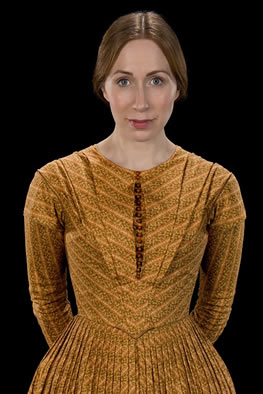
We have an autobiographical telling, dramatic and full of character, with nothing of substance left out and everything of significance retained. From the window seat in the breakfast room, aged 10, to the parlour of Ferndean Manor, some nine years later where the blind Mr Rochester – he of the ‘brow of rock’ – reclaims his darling Jane. Writer Elton Townend Jones calls his work ‘an impressionistic adaptation’ of Charlotte Bronte’s book. Well, fair enough, along with the charged immediacy of the scene(s) comes the solid narrative, fused and monumental.

Performer Rebecca Vaughan is definitely impressive. She is Jane, of course, but she is also everyone else – except the source of crazed laughter from the attic. There is, inevitably, a cartoon Mr Brocklehurst, who might as well be the grim progenitor of today’s (English) free schools. Mr Rivers, impossible for the irreligious to figure, is left pallid and decent. Mr Rochester is gruff and always amused by Jane’s frank determinations. As Jane, Vaughan is upright and indomitable, which makes her excitement and frailty when it comes to the love story just a bit tricky. However, if romance is your thing, then Jane’s virtuous path to happiness is surely realised.

What makes the novel probably undoes its efficient telling. Jane ‘hadn’t intended to love [Rochester]’ but does and she certainly never expected riches but she gets them. That, to use Bronte’s unlikely word, is a ‘stunner’. The stage-succinct explanation of her 20K inheritance does advance a parallel narrative that gives Jane an easy living that is more assured than the trials and anxieties of any self-respecting literary heroine should be. I wondered, listening hard, whether her assessment of Position, Fortune, & Age in the marriage stakes – our century’s life-style choices – was beginning to count for more than love, which (I concede) is rather uncharitable.

Dyad Productions have worked the text of Jane Eyre to lucid and creditable effect and Rebecca Vaughn’s solo work is outstanding. I just found the whole piece satisfying and accomplished rather than remarkable or radical, which the novel is.

outstanding

StarStarStar

Reviewer: Alan Brown (Seen 7 August)

Go to Dyad Productions

Visit Edinburgh49’s Assembly Roxy archive.

+3 Review: Hot Brown Honey (Assembly Roxy, 5 Aug – 28 Aug : 20:20 : 1hr)

https://i0.wp.com/d2752rta4dscqv.cloudfront.net/ImageCache/1462324008_hot_brown_honey_h_0516.c935f3ad275ed95b1576ad8fb546a7d8.jpg

“Gleefully challenges stereotypes of sex and race with a full grin, bared chest and raised middle finger.”

Editorial Rating: 5 Stars Outstanding

I sat for some time before writing this review trying to think of an introduction which best captured what I thought of Hot Brown Honey. But the truth is, there’s not much else which can compare to the bombastic gut punch of a burlesque show Assembly Roxy has somehow managed to contain inside their theatre. From the second that the glass-panelled hive lights roar to life, this show is a nonstop ride that has the audience welded to their seats.

Hosted by unapologetically badass MC Kim “Busty Beatz” Bowers, Hot Brown Honey is a raucously funny and entertaining trip through acrobatics, beatboxing, song, dance and everything in between. But don’t be fooled – despite considerable comedy thrills, it never strays from what makes it so compelling: a show which not only celebrates the power and complex femininity of women of colour, but gleefully challenges stereotypes of sex and race with a full grin, bared chest and raised middle finger.

To talk too much about the acts would lessen their impact, but it cannot be said enough that each segment of performance was distinct, feverishly well executed and consistently jaw dropping. Every single honey from this hive is impressive enough to warrant their own review, let alone packing every single one into a single critique. Of course, for those who aren’t fans of audience participation, proceed with tentative caution: a show like this one demands to spill out into the aisles, to surprising and hilarious results.

The honeycomb that links up this show, however, is both more subtle and infinitely more loud than the performers themselves. There are West End shows that could learn things from the tech team behind the burlesque extravaganza. The sync between every technical element and the behaviour of the set is nothing short of breathtaking, for those who can bear to concentrate on anything but the inspired spectacle going on centre stage.

But what makes Hot Brown Honey such an outstanding show goes beyond its strength in immediacy. When the applause stops and the doors are open, that doesn’t mean the show is over: the messages, ethos and enthusiasm for equality, sexuality and sensuality stick around far after the day is done. As a piece of burlesque, Hot Brown Honey is outstanding simply by merit of its performance. But as a complete show, its greatest triumph is that it fully achieves the vision set out by creators Bowers, Lisa Fa’alafi and Candy B: not simply social activism masquerading as entertainment, but a genuinely thought provoking thrill which, at least personally, will open the eyes of many to any issue they never even know existed.

If you like your shows sexy, superbly skillful and socially conscious, you cannot miss Hot Brown Honey this Fringe. It’s a rare show indeed.


outstanding

StarStarStarStarStar

Reviewer: Jacob Close (Seen 6 August)

Visit the Assembly Roxy archive.

THIS REVIEW HAS NOT BEEN SUBEDITED

+3 Review: Queen Lear (Assembly Roxy: 4 – 29 Aug. 16.10. 1h)

Image. Assembly & Ronnie Dorsey productions

Image. Assembly & Ronnie Dorsey productions

“Exquisite”

Editorial Rating:  4 Stars:  Outstanding

Shakespeare’s Lear is a pathetic apologist : ‘I am a very foolish, fond old man’, who (by his frail reckoning) would have fathered Cordelia in his late sixties. And he didn’t stop there. Why should he? He’s a King of ‘wild, roaring, lecherous men’ who live for ‘war, wine, and whoring’. So, in Ronnie Dorsey’s new and exquisite piece we come to his second queen, heavily pregnant and in great pain. No Lear is to be seen but his expectation of a son, for once legitimate, is almost unbearable.

Remember Lear’s ‘Let copulation thrive’? Well, he ends that hateful, mad, speech longing for anything ‘to sweeten my imagination’. Enter Queen Lear.

Three characters: the young queen; her devoted companion Ursula; and her priest, Lawrence. Back story: the queen was married at 16 and leaves her home in the Borders for good. She is cruelly abused by a husband who, after beating her, kicks her small dog to death. Rooks caw about the castle walls (we assume that the queen’s chamber is in a castle) and in these harsh, loveless, circumstances it is doubly touching to hear Ursula call her queen ‘Sweeting’.

Dorsey writes words that hold and sustain. Queen Lear grasps sympathy where it can be found and does not let go. The queen, who knows that she will not be remembered, talks of the coming birth with dread. She would have the child but fears she will not survive the labour. In her time a caesarean section is all about cutting and not delivery. Alice Allemano plays a woman living the agony of the fact that ‘this child is killing me’, so if ever a role has to be in extremis, then this is it. Jane Goddard plays Ursula with a loving solicitude that is never familiar but always kind. Mary McCusker, as Lawrence, has ‘his’ own confession to make in a performance of great sensitivity and control.

Mark Leipacher directs. It is a tight work, physically and emotionally close, as you’d expect of a confinement and what lightness and lift there is comes from the lyrical quality of Dorsey’s lines. Three benches and an embroidered bolster are the only props required. The queen is in an elegant gown that denotes her high rank but which confers neither influence nor power. She can only hope against hope that Lear’s Fool will somehow protect Cordelia.

When resolution comes to such a forlorn situation it’s hard to take. You might not accept it, but that’s the point. For Lear’s queen there is no healing touch for her ‘female wounds’.


outstanding

StarStarStarStar

Reviewer: Alan Brown (Seen 6 August)

Visit Edinburgh49’s Assembly Roxy  archive.

+3 Review: Early Doors (Pleasance pop-up @ The Jinglin’ Geordie: 5-29 Aug: 12.00: 1hr)

“A stunning piece of site-specific theatre”

Editorial Rating: 4 Stars: Outstanding

After the general bustle of buying drinks, finding seats and, of course, choosing your pub quiz team name, Early Doors opens with an introduction to each character, performed almost like an African tribal chant, which makes it feel like we (the bijou, but sell-out crowd) are being truly welcomed into their community. It’s rhythmic and theatrical but never over the top, and sets the tone for the lyrical, poetic styling of the piece as one long fable.

Our landlord and landlady are a young brother and sister who inherited the place when their mum died. They start by sharing memories of her, and set the scene for a potentially fractious relationship between them. We also meet various other characters in the community: the pub quiz master, who can’t help but share some details of his ongoing custody battle with his ex-wife; the bouncer, who recalls the end of his relationship with one of the local punters; and the “village idiot” who brings the comedy to proceedings. The characters are flawed but lovable, and the ensemble cast do a great job of sharing their world with us.

As the show progresses we get hints of the tensions and relationships between different characters, which help bring interest and drive the story. I did feel slightly robbed in some characters having comparatively little action, while others seemed quite unconnected to the main narrative, so for me, a little further development to see clearer links between each would really make this show spectacular – but this is only a small niggle considering the quality of action and overall performance value.

The piece is performed with wonderful energy, and the writing – in particular the language – of every aspect is exquisite, giving just enough detail to hook the audience without verging on rambling. Yet while some of the transitions between each section are smooth and logical, it is a shame that in other instances the show progresses by simply having one character leave and another mysteriously appear for no apparent reason.

There are so many wonderful aspects to this performance – the characterisation, storytelling, and sense of really being “in it” really are top notch and encapsulate everything I love about the Fringe. I would have just preferred some clearer links between sections and less disjointedness between some of the characters to give the piece a bit more cohesion.

Overall, I raise a glass to Not Too Tame and this stunning piece of site-specific theatre and urge you to go and join them at the Jinglin’ Geordie for a pint, a pub quiz and an engrossing performance.

outstanding

StarStarStarStar

Reviewer: Steve Griffin (Seen 6 August)

Visit the Pleasance, Potterrow & Teviot archive.

THIS REVIEW HAS NOT BEEN SUBEDITED

+3 Review: Teatro Delusio (Pleasance Courtyard: 5-29 Aug: 13.45: 1hr 15mins)

“Physical mask theatre at its finest”

Editorial Rating: 4 Stars: Outstanding

After last year’s sell-out smash Hotel Paradiso, I was excited to see what Familie Floz would come back with in 2016, and for the first 50 minutes at least, Teatro Delusio more than meets expectations. It’s physical mask theatre at its finest, with three actors playing well over 20 individual characters between them, each of whom are clearly defined, consistent and a joy to watch.

The setting is backstage at a theatre, where we see the stage crew attempt to set everything up (without killing themselves or each other in the process), and then assist various members of the orchestra, singers and ballet dancers onto stage, even though they may hate, love or just be plain bored with them.

There are tricks and treats aplenty, from simple slapstick moments of falling through ladders and playing with exploding lights, to sword fights and disappearing through trap doors. Familie Floz’s real strength, though, is their character work and dexterity of changes, from a grumpy stage manager to a diva singer, and my absolute favourite: a blind and deaf violinist who has no clue where he is. The changes are so slick you’d assume there were at least six performers constantly running around, while the physicality required to define each character was so perfect that simple gestures often had the audience howling with laughter.

Yet for all their great character work and ability to build a believable world on stage, I feel that Familie Floz perhaps tried to reach too far with this production, by introducing a few too many characters, and deliver a story that could easily have been at least 10 minutes shorter and not lost any of its power. About three quarters of the way through the performance, when ends could have been tied up and rounded off, still more new things happened, and the performance hit a new level of ridiculousness that I think lost me, and many of my fellow audience members. What began as a perfectly plausible, if a little stylised, day or two in the life of a Stage Manager seemed to turn into a dream sequence with stabbings, stage crew achieving their lifelong dream of filling in for wounded ballet dancers at the last minute and unexplained resurrections that pushed the suspension of disbelief a little too far.

A beautiful piece, but be prepared to get uncomfortable: those seats in the Pleasance Grand don’t give much wiggle room and by the end of this performance you’ll need it.

outstanding

StarStarStarStar

Reviewer: Steve Griffin (Seen 5 August)

Visit the Pleasance, Potterrow & Teviot archive.

THIS REVIEW HAS NOT BEEN SUBEDITED

Thon Man Moliere (Lyceum: 20 May – 11 June ’16)

Jimmy Chisholm as Moliere & Siobhan Redmond as Madeleine. Photo: Mihaela Bdlovic.

Jimmy Chisholm as Moliere & Siobhan Redmond as Madeleine.
Photo: Mihaela Bdlovic.

“Siobhan Redmond as Madeleine and Jimmy Chisholm as Molière are perfectly, affectionately, matched.”

Editorial Rating: 4 Stars  Outstanding

In February 1662 Louis XIV sent flowers on the occasion of the marriage of Molière (40) to the seventeen year old Menou (Armande) Béjart. Perhaps the feted playwright was encouraged by the success in the previous year of his School for Husbands. And maybe those flowers were roses, for Menou draws firm, long stemmed roses in her sketch book. Wait up, they look like roses but maybe they’re …. Oh no! Surely not?

This is Liz Lochhead’s new play and she can have a garland too. Thon Man Molière is a comfortable winner. First off, it is a tribute piece to the man’s comedic genius; but second, it closely involves the women in his life, and third this play loves theatre and theatre-making.

Lochhead is an artist with the man’s biography. Born Jean-Baptiste Poquelin, her MacMolière is ‘Pokey’ indoors. Scaramouche is a pal but the fortunes of the ‘Illustrious Theatre’ company are dire to the point of collapse (and imprisonment for debt). There is rarely enough money and there are too few commissions until the king: “Vive le Roi!” – tires of the tragedies of Racine and Corneille. Tartuffe may well be a great play – and Pokey is inordinately proud of it – but it took nearly five years to get its revised version past the Archbishop of Paris. Molière’s first child is named after his royal godfather but Louis dies at eleven months.

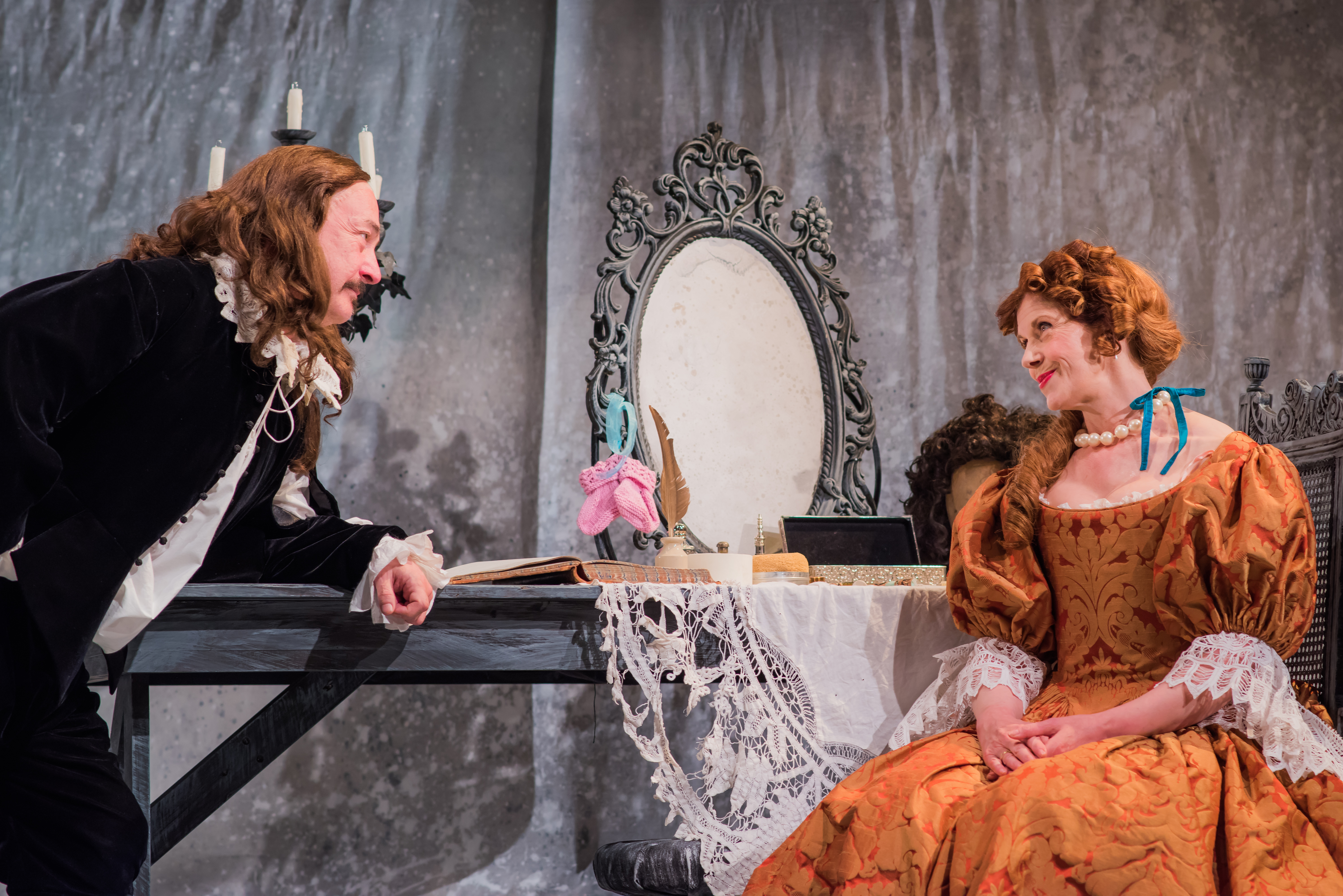
There is a sub-title to shape the facts: ‘Whit got [Pokey] intae aw that bother …’ – and it’s sex; not so much sex with his teenage wife but the naughty fact that Menou is the daughter of his former lover, business partner and bestie, Madeleine, and that Madame Béjart will not – under any circumstances – have her daughter tread the boards. Siobhan Redmond as Madeleine and Jimmy Chisholm as Molière are perfectly, affectionately, matched. She has the reserve, bearing, velvet voice and wide skirts of a grande dame. He has the effrontery, the wit and the audacity of his celebrated character.

Ever around and about the principals is the troupe, historically verifiable and altogether mischievous. Gros-René (Steven McNicoll), in streaked green wig, gives a command performance in lugubrious drinking and losing his breeks. Therese (Nicola Roy) is his bed-hopping wife, who would be so much more than the maid in yet another farce. James Anthony Pearson is Michel Baron, the huge star-to-be, lithe and cocksure, but who is still unable to seduce the naïve Armande, very engagingly played by Sarah Miele. At a guess, only the more than capable, laconic and kind Toinette (Molly Innes) is entirely the writer’s invention.

Tony Cownie directs with an assurance born of his previous productions at the Lyceum of Lochhead’s ‘Molières’: Tartuffe (1986!), Miseryguts (Le Misanthrope) in 2001, and Educating Agnes (L’Ecole des Femmes) in 2011. Musical entr’actes by Claire McKenzie, a la Lully, are accompanied by sweet mime and when the drapes lift the action resumes, ‘at home’ or backstage where outsize greyscale putti come second to the wooden stool, wicker baskets and some splendid costumes that were too much even for the Comédie – Francaise, aka. ‘La Maison de Molière’.

Dinnae think Thon Man Molière is daft. The script is too sharp for that and its composed effect is almost tender, which, with all those satiric impulses flying around, is some achievement.

The theatre programme contains an excellent ‘Who Was Molière?’ by Liz Lochhead herself and there’s a helpful preview article by Neil Cooper in the Herald.


outstanding

StarStarStarStar

Reviewer: Alan Brown  (Seen 24 May)

Go to Thon Man Moliere at the Lyceum

Visit Edinburgh49‘s Lyceum  archive.

Ring Road (Traverse: 12 – 16 April ’16)

Martin Donaghy as Mark and Angela Darcy as Lisa. Photo. Traverse theatre.

Martin Donaghy as Mark and Angela Darcy as Lisa.
Photo. Traverse theatre.

“Both actors perform brilliantly in a small space (and on a narrow bed)”

Editorial Rating: 4 Stars Outstanding

Fifth and last in this Spring season of A Play, A Pie and a Pint.

It was the prickly cactus that did it, that brought to mind Love’s Labour’s Lost and fun puns on pricks, butts and horns. Mark notices it by the Reception desk of the hotel that’s just off the ring road. He reckons he’s there for sex (oh, not the archery then) and he’s right. Lisa does want him but it’s more his sperm than his good self that she’s targeting. She desires a baby while Mark just fancies the pants off his teacher sister-in-law. Ouch!

Anita Vettesse has written a painfully entertaining comedy and director Johnny McKnight does indeed make the pants fly off the bed. Ring Road is frisky, certainly, but it is also sensitive to what Lisa is feeling. She is 40 years old, has ‘grown to love’ her husband, but is still without a child. The pressure is on big time.

A late afternoon’s delight via Dayuse.com might be all very well but Lisa (Angela Darcy) sees Mark (Martin Donaghy) more as a ‘facilitator’, which he’s not best pleased about. He is even less keen on the idea when brother Paul (a wry, downcast voice-over from Robbie Jack), Lisa’s husband, joins them by being put ‘on speaker’. The two brothers are plumbers, sharing the same van, rather than the same women but it’s still odds-on that the dismissive reference to Screwfix is deliberate.

Mark’s spattered overalls and rigger boots look strange in the tidy, unexciting hotel room and he knows that the whole situation is just not right. Twin beds are bad enough – and that ‘art’ on the wall!- but the twitchy tension is the real passion killer. Lisa, in particular and unsurprisingly, is a bundle of nerves. At worst Mark is confused, but she is probably more conflicted at the end than at the beginning, which is touching and sadly credible.

Both actors perform brilliantly in a small space (and on a narrow bed). Donaghy does “For fuck’s sake” as baffled, happy, hurt and kind all at once, while Darcy is no less expressive, just more couth and desperate. The fact that Ring Road is also very funny is down to the quality of Vettesse’s writing.


outstanding

StarStarStarStar

Reviewer: Alan Brown (Seen 12 April)

Go to Ring Road at the Traverse.

Visit Edinburgh49′s Traverse archive.