I Am Thomas (Lyceum: 23 March – 9 April ’16)

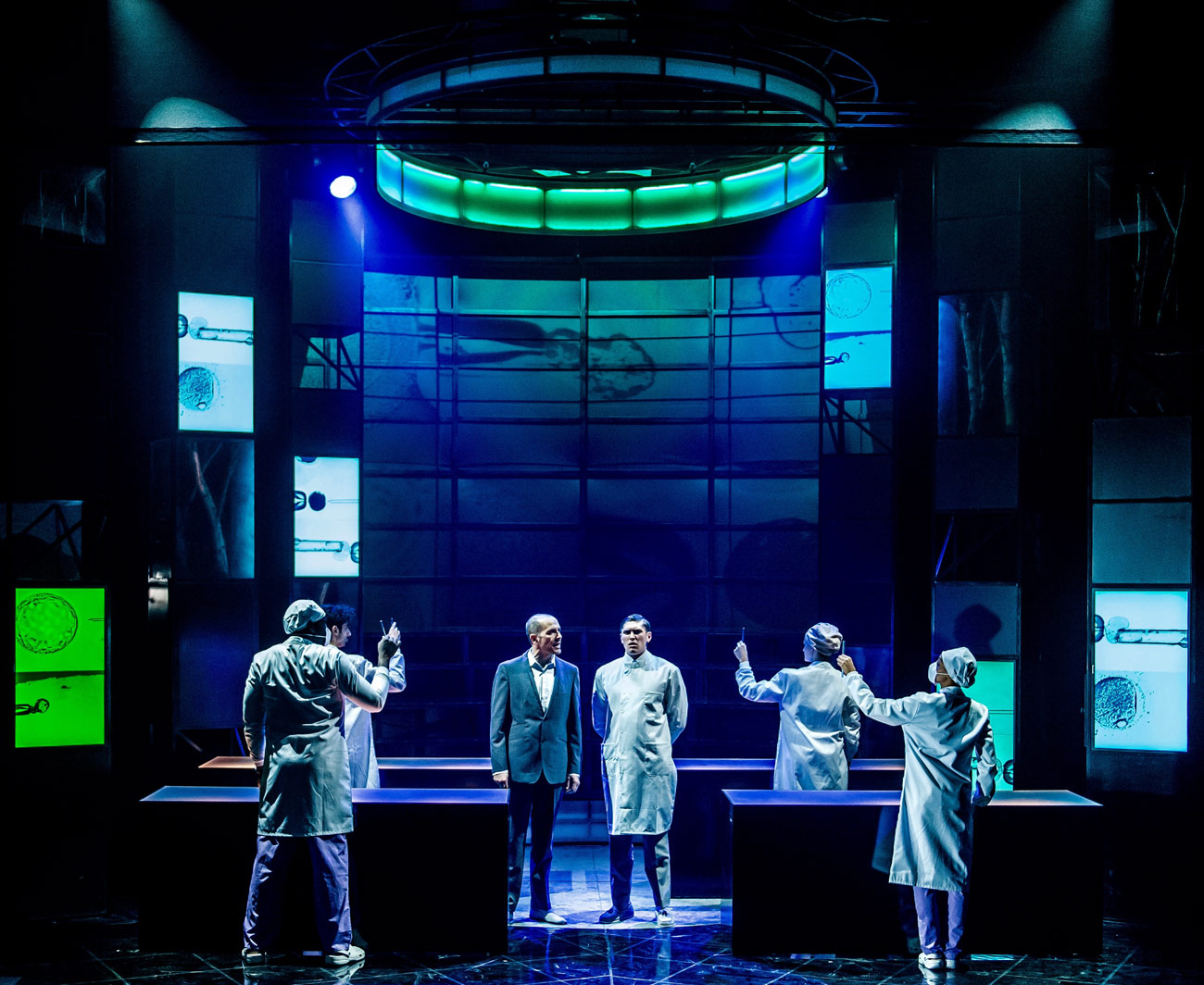
'Our God above is a God of Love' with Dominic Marsh, Hannah McPake (back), Amanda Hadingue, Charlie Folorunsho (back), Myra McFadyen, John Cobb, Iain Johnstone.

‘Our God above is a God of Love’ with Dominic Marsh, Hannah McPake (back), Amanda Hadingue, Charlie Folorunsho (back), Myra McFadyen, John Cobb, Iain Johnstone (back).

“Fiercely well executed”

Editorial Rating: 4 Stars

I suppose that it is justifiable that Edinburgh’s Gallow Lee was half a mile down Leith Walk and not on East(er) Road. You don’t want too much of the promise of the resurrection to hang about the gibbet. And what do atheists care anyway? Let the foul mouthed blasphemer swing. Or maybe not. It depends on the law, on the Kirk, on freedom of expression, on private conscience, on your reception of I Am Thomas.

Here’s an examination in popular, not judicial, terms of ‘Extreme Justice’ in its unholy alliance with the Scottish Presbytery of 1696. Did Thomas Aikenhead, a gobby twenty year old student at Edinburgh Uni., deserve to be put to death for railing and cursing against his God? Well, no, not in the opinion of this fiercely well executed (Ha!) piece of musical theatre.

There was just the one Thomas A. but there are several red T shirts with his name on it; one in French with ‘Je suis Thomas’ delivering its contemporary message of defiance in the face of intolerance, inhumanity and murder. Thomas might be Everyman but there is an Archie Gemmill shirt too and Match of the Day, for there’s the entertaining conceit – if you like football – of Thomas as a player who is beginning to make a name for himself. Archie Macpherson analyses his game while Thomas sets about committing offences. A short story by author James Robertson is credited as providing inspiration for this ‘brutal comedy with songs’; just possibly his ‘Portugal 5, Scotland 0’.

The songs are intense, all the more so when set against wicked ensemble work and vivid backcloths. Consequential lyrics, expertly crafted, are by Oxford Professor of Poetry Simon Armitage and musical direction is by composer Iain Johnstone, who is also on stage and does his ‘turn’ as Thomas and as penitent John Fraser, who picks up a yellow. There are eight performers and there is a lot of music making, if it’s only a moaning wind from a piano accordion. Listen up for Thomas’ ‘Rhapsody of Nonsense’ sung by Hannah McPake that really puts the boot into the Divinity – and gets him red-carded. As for Charlie Folorunsho’s ‘Our God above is a God of Love’, that is a LOL belter to grimace at.

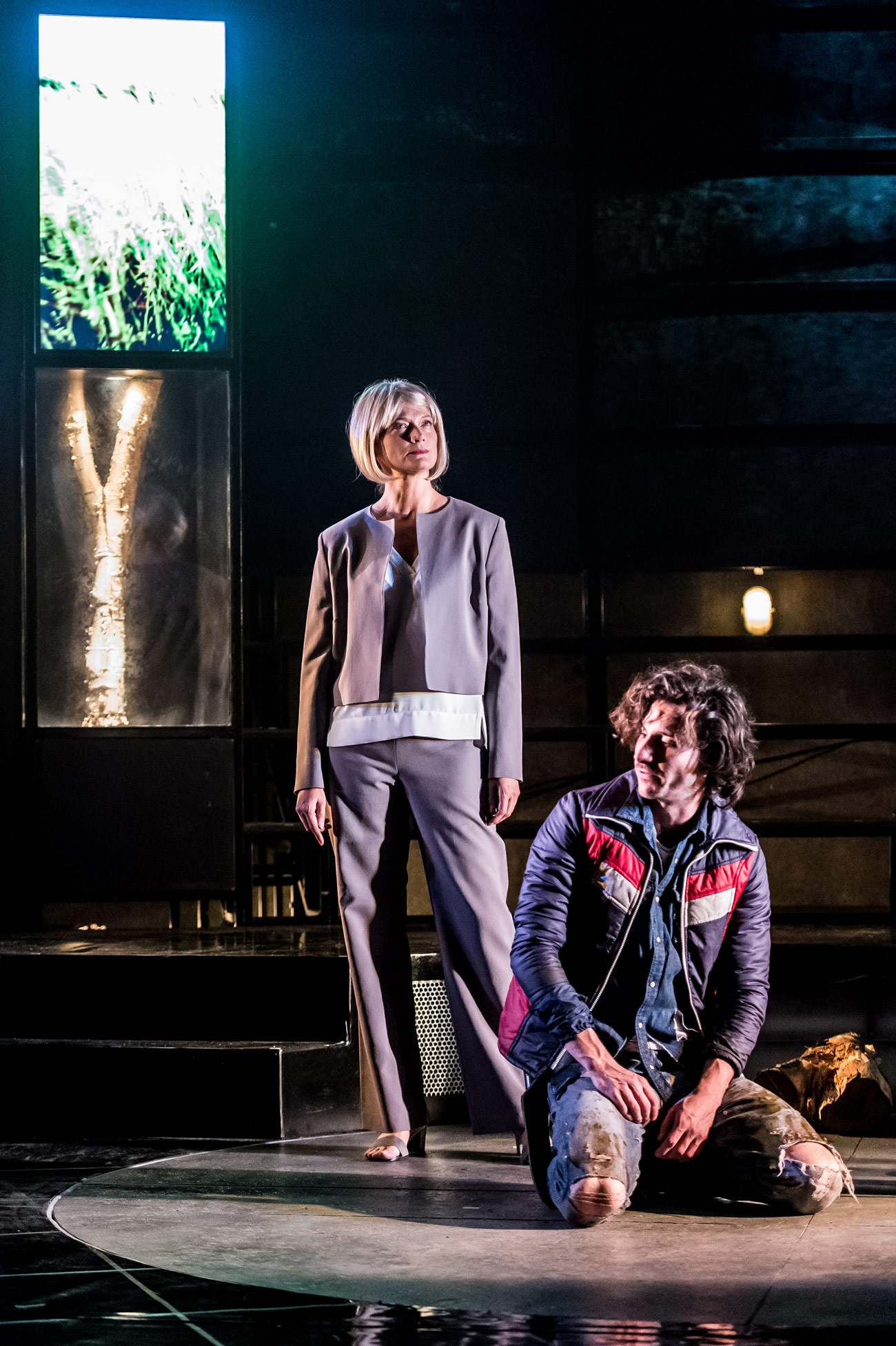
Charlie Folorunsho and Dominic Marsh. Photos. Manuel Harlan

Charlie Folorunsho and Dominic Marsh.
Photos. Manuel Harlan

The referee plays a blinding, prosecuting role that shouldn’t be his to play, of course; but then Thomas is monumentally unlucky with officialdom. It is bad enough that the chief witness against him is his friend Mungo Craig but to have the Lord Advocate James Stewart (Dominic Marsh) in charge is one hell of a sad joke. Stewart, himself indicted and condemned for treason and author of ‘The People’s Right to Defend Themselves’, characterises himself as the ‘rat catcher’ and is a problem for writers Told by an Idiot. The company excels in creating theatre that is larger than life but wily Jamie has an outsize history all of his own and it is his story, rather than poor young Thomas’s, that often starts to claim the audience’s attention. Still, the result of chronicling the two lives is an inventive, fluid and colourful montage that – you could say – is nearly always on the ball. Only in the second ‘half’, when Aikenhead moves onto exalted ground, with Messiah status and personal glitterball, does it get stuck in an heroic, almost self-regarding mode. There’s a call to freedom in there in an African strain that director Paul Hunter is obviously keen to liberate but I found it more distracting than helpful.

And there you have it: in I Am Thomas the lauded Scottish Enlightenment (not Harry Lauder) stays in the dressing room. What’s on stage is uglier, funnier and shockingly legitimate.


Star (blue)Star (blue)Star (blue)Star (blue)

Reviewer: Alan Brown (Seen 24 March)

Go to the Lyceum theatre, to the National Theatre of Scotland and to Told By An Idiot

Visit Edinburgh49‘s The Lyceum  archive.

SCO: IBRAGIMOVA & KRIVINE (Usher Hall 10 March ’16)

“I commend the SCO for their daring and committed performance tonight”

Editorial Rating: 3 stars


Thursday’s concert at the Usher Hall was designed to please, and did not fail. Mendelsohn’s Overture The Hebrides, Schumann’s Violin Concerto in D minor and Brahms’s Fourth Symphony span fifty years of the nineteenth century European Romantic genre and are all immensely satisfying upon the ear.

Yet when we talk of the Romantic genre we must not deceive ourselves with Batt-like portraits of composers gaining inspiration in the coffee house or at their desk by candlelight. These works are often borne out of insecurity and fear.

The Hebrides is really a tone poem in miniature, better known to us oldies as Fingal’s Cave, a short boat trip from Mull if you are interested. Mendelssohn struggled reconciling sonata form with tone painting, and wrote of the work as “the whole so-called development smells more of counterpoint than of blubber, gulls and salted cod”. In fact you would have to be an analytical cynic to agree with him, for it is a live, refreshing work and the SCO despatched it well.

Schumann’s Violin Concerto was also a cause of grief to its composer, who never heard it performed orchestrally. Swiftly composed in but thirteen days it was to languish for 125 years before its entry into the oeuvre after a series of family, political and technical issues. While fitting squarely into the romantic genre, and being a work of substance, it is nonetheless not without its problems. The first movement gives us soloist and orchestra working closely together more in the Baroque style, and this was exacerbated by imbalances between the two. Moreover, the positioning of instruments was curious, timpani within the main body, brass atop, basses to the left behind the first violins. Things came together better in the second slow movement when soloist Alina Ibragimova really came to the fore with confident bowing and tone. In the final movement it worked a treat and the band and soloist brought us romping home.

To me the ultimate version of the closing work, Brahms’s Fourth Symphony, has to be Carlos Kleiber’s extraordinary, almost eccentric 1981 recording for Deutsche Grammaphon with the Vienna Philharmonic, knocked off in a fraction less than 40 minutes. I have heard so many stodgy, proscenium arch type versions that I come to this oft performed work with some dread. I was delighted with the way the SCO tackled it. They took the opening movement very fast indeed – absolutely no trace of stodge here – and I would rather have a racy, resolute performance such as this with a few flaws (the trumpets a little too loud, some tricky moments in the horn section) than an immaculate, more pompous central European type interpretation. As we worked through the piece the playing became more assured, steady ensemble playing in the second movement after the hectic first, a slightly over keen entry to the third with the strings nailing it with their con attacas, a confident brass opening the final with the orchestra playing like the highly polished ensemble they can be.

All live music is a risk. I commend the SCO for their daring and committed performance tonight, and congratulate both them and Principal Guest Conductor Emmanuel Krivine drafted in at short notice to replace the indisposed Robin Ticciati. It was to his and the band’s credit that you never would have guessed.


Star (blue)Star (blue)Star (blue)

Reviewer: Charles Stokes (Seen 10 March)

Go to the Scottish Chamber Orchestra

Visit Edinburgh49‘s  Usher Hall archive

King Lear (Pleasance: 1 – 5 March ’16)

MacLeod Stephen as Poor Tom (Edgar) & Will Fairhead as Lear. Photos: Louise Spence.

MacLeod Stephen as Poor Tom (Edgar) & Will Fairhead as Lear.
Photos: Louise Spence.

“Expressionist-noir”

Editorial Rating: 4 Stars

In this ‘Year of Lear’ the Edinburgh University Shakespeare Company is not afraid. It should be though, for the ‘True Chronicle Historie of the life and death of King Lear and his three daughters’ is a terrifying play. The voracious, great, Samuel Johnson could not stomach its last scenes and for near on 200 years it had to put up with the rewrite to end all rewrites. This is the tragedy that puts the brave into bravo.

And, first off, there were standing cheers at the curtain call. Will Fairhead’s performance as the foolhardy, maddening, mad, Lear deserved them. MacLeod Stephen acted out of his skin and nearly out of Poor Tom’s loincloth. Goneril (Caroline Elms) and Regan (Agnes Kenig) did that nasty, alluring thing with crystal diction on high heels and Cordelia (Marina Windsor) would break any father’s heart. Oliver Huband put the bad boy into whoreson, if that’s possible, and Tom Stuchfield made the worthy Earl of Kent positively exciting. Dual death by dagger thrust – Cornwall’s (Jordan Roberts-Laverty) and of the servant who dares protest at the blinding of Gloucester – is admirably dealt and nothing, nothing, disguises the naked brutality of the action that follows the ‘hideous rashness’ of Lear’s decision to dismember his kingdom. Cue the ‘What is Britain?’ line, topical then as now.

Still, forget history, or politics come to that, which is a professional undertaking. Henry Conklin directs a student production that bleaches affection and colour in favour of cold and dreadful suffering. The air drums relentlessly. Grey / blue, white and black predominate in a setting that may as well be called expressionist-noir. Only the all-licensed Fool is allowed to stand out but where, oh where, is the motley coat? A cheeky alpine hat is not enough support, even for the accomplished and confident Pedro Leandro. The wit and the timing worked well enough in the moment, prompting chuckles, but the effect was more often glib than penetrating. There was too much bleak distance between the king and his fool to reach across. Rid them of sympathy and these huge lines get the shakes:

Fool:    Thou shouldst not have been old till thou hadst been wise.
Lear:    O! Let me not be mad, not mad, sweet heaven;
Keep me in temper; I would not be mad!

Actually, of all things, it was near indistinguishable costume not age or aging that looked inescapable. No one stoops and Edgar, as poor bare Tom, is unmissable. Lear, mad, should appear ‘fantastically dressed with wild flowers’. You are more likely to notice his pronounced twitching and swinging arm than his headband. Presumably, in a man of eighty plus, this is a sign of Parkinson’s but then it makes sense to join the destruction of Lear’s reason to a modern interpretation that trembles upon Alzheimer’s.

Caroline Elms as Goneril & Oliver Huband as Edmund.

Caroline Elms as Goneril & Oliver Huband as Edmund.

Set aside the difficulties of keeping the verse safe – and some of it is gunned down – Lear can still be a bewildering nightmare of a play, if not downright disorientating, which might put an audience alongside the blind Gloucester (Ben Schofield) who thinks that he has just thrown himself off the white cliffs of Dover when he’s just taken a tumble in a field. Incriminating letters fall out of pockets and the foul Edmund proves irresistible to both Goneril and Regan, which provoked some inopportune laughter. For some reason, at the herald’s command, ‘Sound’ [trumpet] you hear a bell. Swords are fencing foils and you are treated to some impressive attacks and parries.

At heart, of course, this is a production where that throwaway “Love you” at the end of a 21st century phone call meets Lear’s last howling entry with Cordelia dead in his arms. Conklin and cast have done their very best to get you back to 1606 when it really hurts.


Star (blue)Star (blue)Star (blue)Star (blue)

Reviewer: Alan Brown (Seen 3 March)

Go to Edinburgh University Shakespeare Company

Visit Edinburgh49’s Pleasance archive.

Brave New World (King’s: 29 September – 3 October ’15)

Photos: Touring Theatre Consortium Company

Photos: Touring Theatre Consortium Company

“Trim, bold and emphatic”

Editorial Rating: 3 Stars

This is a didactic staging of a hugely instructive book, so here are two questions from the lecture theatre: how near do you like your future and do you shop in ‘lower caste stores’? For me the answers are (i) pretty close and (ii) it depends.

Aldous Huxley wrote Brave New World in 1931, which seems a long time ago, but he was seriously long-sighted and along with keen definition came the vision thing. OK, his Doors of Perception (1954) is a mescaline trip but he really did see what might be and his World State is bad and appalling, unless that is ‘You’re worth it’, in which case you might love to bits its mind-numbing, slogan-ridden lifestyle.

As for the second question, I bought some excellent coffee at ALDI last week and am very pleased with my jacket from Tu Clothing at Sainsburys, which by Huxley’s reckoning makes me a quantifiable Delta. Naturally part of the ‘fun’ of reading Brave New World is knowing that at least you’re not an Epsilon-Minus lift operator.

Huxley’s story, this play, is about misfits in the sorted, post-apocalyptic society. Bernard is a maladjusted Alpha-Plus psychologist who sees his way to a snappy suit by introducing John, an impure bred, unconditioned primitive, to his lords and masters. Or rather to Margaret, Margaret Mond, Regional World Controller. Lenina, a Beta-Plus lab technician with dodgy longings for a monogamous relationship, joins Bernard on the visit to the Savage Reservation to look at those unfortunates, who still suffer childbirth, disease and aging and who still experience family, love and heartbreak. There they find John and bring him and his mother home to London. It all gets messy when John claims his right to be unhappy.

Mond (Sophie Ward) and John (William Postlethwaite)

Mond (Sophie Ward) and John (William Postlethwaite)

Dawn King’s adaptation of Huxley’s text is trim, bold and emphatic. Its Display settings are, if you like, maxed out: Bernard is so inadequate that voice recognition software won’t recognise him; Lenina is sweetly confused; Mond has an answer for everything and John would take an axe to the whole ignoble shebang. He won’t take soma though – a legal high gone stratospheric – or sex gum, which is a relief.

There is a whole new order to configure here so it is unsurprising that video, lighting and sound provide illustration and support for the ten strong cast. There are multiple screens, helicopter rides and ‘feelie’ films and an immodest electronic score by ‘These New Puritans’ that all make the use of a centre stage curtain look decidedly old-fashioned, if not clumsy.

There is no hiding, either, of the pared down script and my unfortunate impression was of good actors managing one educative but end-stopped line after another. Flow was there none. On the other hand, and to be fair, I read Brave New World so many times when I was at school that I’m a fastidious, prose bound geek and anyway Huxley’s narrative is ‘set’ on information overload. Nevertheless, I did like William Postlethwaite’s tousle-haired John, with his subversive use of Shakespeare. Even the uber-cool Mond (a poised Sophie Ward) would have him, which is way beyond Huxley; but Scott Karim as the rebel writer Helmholtz really isn’t given enough to say.

So, fittingly enough, this is Brave New World encapsulated as feature drama. It is a little plastic, a little lurid, but still potent.

Star (blue)Star (blue)Star (blue)

Reviewer: Alan Brown  (Seen 29 September)

Go to the Touring Consortium Theatre Company here.

Visit the King’s Theatre archive.

Charolais (Spotlites: 6 – 30 Aug.’15)

Photo: Sally Anne Kelly

Photo: Sally Anne Kelly

“Where l’amour freely transforms as l’amoooour’”

Editorial Rating:  5 Stars

To invoke an admiring Scot, even though this is an all-Irish production, Charolais is ‘warm-reeking, rich!’ Approach the slurry pit with care and whatever happens do not call your good woman a ‘Silly moo’ or a ‘Daft cow’(and Burns didn’t either). She may not catch the affection in your voice, especially if she’s a pretty heifer.

Siobhan has had enough of coming second to boyfriend Jimmy’s gorgeous cow. Siobhan is heavily pregnant with their child but Jimmy seems only to have eyes for Charolais, whose bright yellow ID tags appear like ‘cheap gold rings’. Such jealousy might be at the extreme end of an hormonal rush but Siobhan is thinking murder. But how? A wild barley feed can result in alcohol poisoning or you could slice the cow in the squeeze chute. As if Charolais’s charms are not enough to contend with, there’s Jimmy’s seriously protective mother, Breda (72), who regards Siobhan as a shameless hussy. Maybe Breda could meet a power surge on the electric fencing?

So it’s a down-on-the-farm love and sex story with writer/actor Noni Stapleton as Siobhan and as Charolais. This is where l’amour freely transforms as l’amoooour’ and back again with a delightful swish of blond hair and a lolling lascivious tongue. The fact that prized Charolais cattle are creamy white and have well developed udders is to invite a cowpat but I hope not. Anyhow, performer and Bigger Picture Projects go further and provide this cow with a husky singing voice. Think Piaf in the byre rather than this reviewer in the mire, please.

It is a sweet treat of a script too, both affectionate and grounded, and steamy with activity in the cowshed and with Siobhan trying to get Jimmy away from his mother. She succeeds, dramatically – even tragically – but not in the way(s) she imagined. And for a townie there’s the added bonus of hearing of calving jacks and herd books and – from Charolais’s point of view – of the ‘indignity of the AI man with the syringe’.

Stapleton’s performance is really good. Yes, in many respects it is a humorous monologue – for woman and cow – but it is also wholesome and generous. For much of the time she’s Siobhan, seven months pregnant and in a bloody apron, but she’s proud and ardent too. I was especially taken by the way Stapleton makes her space her own and looks astonishingly ‘at home’ – in wellies –  just a few feet from her audience.

I have seen a few too many plays recently that put the urban precinct, IT, and the disembodied centre stage. ‘Charolais’ achieves the primary opposite. It’s all heart.

Star (blue)Star (blue)Star (blue)Star (blue)Star (blue)

Reviewer: Alan Brown (Seen 28 August)

Go to Charolais and Bigger Picture Projects here.

Visit the Other archive.

My Name Is… (Summerhall, 13 – 30 Aug: 19:25 : 1hr 20mins)

“Striking, thought-provoking and immensely entertaining”

Editorial Rating:  5 Stars Outstanding

Plays based around well-known news stories are always a thorny matter. Based on the headline story from 2006, “My Name is…” tells of a family torn apart, and the struggles of identity which come from broken marriages. It would have been very easy for this play to take sides, especially given the venue, but what results is one of the most nuanced, balanced plays I’ve ever seen. “My Name Is…” considers the problems of split cultural identity and family dissonance with such multi-angled consideration that it wouldn’t look out of place in an academic study. This is a show which is as compelling as it is thought provoking, and one of the few which left me feeling humbled after it had ended.

Telling a story from two distinct perspectives, “My Name Is…” tackles the problems both with the skewing of information by the media and the apparent schism between secular European and Islamic standards of living – and, as easy as it could have been to the contrary, giving both an equal share of good and bad. This is a measured, well thought out production – one which mimics reality far better than the news reports upon which is is based. Sudha Bhuchar has created a script which simultaneously pulls no punches and leaves no stone unturned, telling an already intriguing story from every angle possible.

But the show would have been nothing without its extremely talented trio of actors. Ahmed, Bartke and MacDonald should all be commended for their performances, which reflected such realism and subtlety that I often forgot I was watching a play at all. Their emotions, their physicality, their delivery – all of it was so raw, and laid claim to such substance, that they not only acted the part, they became the part. These are undeniably talented performers, and they should all be proud of what they accomplished on the small Summerhall stage.

Combined with a cleverly put-together set, minimal-yet-effective lighting and a script which weaves multiple dialogues together like a verbal dance, “My Name Is…” was one of the most striking, thought-provoking and immensely entertaining shows I’ve seen at Fringe yet. This is one of those rare productions I wish everyone could see: one which approaches polarising subjects with sensitivity, nuance and tact, whilst retaining a thrilling degree of entertainment.

Absolutely bloody excellent.

outstanding

StarStarStarStarStar

Reviewer: Jacob Close (Seen 13 August)

Visit the Summerhall  archive.

THIS REVIEW HAS NOT BEEN SUBEDITED

Consumption (theSpace on the Mile, 14 Aug – 28 Aug: 11:05 : 55 mins)

Consumption

“A show bursting with acting talent”

Editorial Rating:  3 Stars

In a scathing commentary on western practices of consumption and living above one’s means, “Consumption” follows the tragic story of Sebastian, as the ins-and-outs of money, life and love threaten to swallow the unfortunate hero whole in a sea of fake smiles and credit card bills.

And what a tragic hero he is – Mark Wallington absolutely steals the show with his portrayal of seething, raw emotion, resulting in what was the most accurate representation of a man pushed to breaking point I’ve seen on stage. And Grace Bussey should be given praise for her portrayal of self-absorbed stand-in for the upper classes, Penelope: it takes skill to portray a character so viscerally unpleasant, and she does so magnificently. This is a show bursting with acting talent: every cast member pulled their own weight beautifully, and never missed a beat.

Of course, these character portrayals were benefited greatly by the Consumption’s surprisingly realistic dialogue. Whilst some of the more abstract portions of the show may be further removed from reality, the conversations between characters sounded very, very real – I wouldn’t have been surprised to hear some of them in the street. Joanne Griffiths stands up to her considerable writing credentials in this respect, and captures the spoken word with uncanny accuracy.

However, these strengths were overshadowed by weaknesses with the show’s plot, which oscillated wildly between intriguing and ridiculous. Whilst the message is admirable, it’s execution was sloppy: the jibes at western overconsumption weren’t so much on the nose as they were lodged somewhere in the frontal lobe. This was cemented by a major plot point near the end of the second act which ultimately had no consequence, no build-up, and no reason to exist other than to be a neon finger saying “Look at the evil overconsumption hath wrought”.

For a show which portrays its characters with such realism, it seemed so utterly removed from reality that it was nearly comical, betraying the dramatic tension so thick in the first act – and proving an infuriating waste of an otherwise excellent script.

Consumption’s cast should be congratulated on their stellar character work, in what was no doubt a tough show to put together and even tougher to pull off. It’s a shame that certain narrative elements marred it so greatly, especially in a script which showed such promise. With a few more revisions, I’m sure Griffiths’ admirable message can shine in the light it deserves.


Star (blue)Star (blue)Star (blue)

Reviewer: Jacob Close (Seen 12 August)

Visit the Other archive.

THIS REVIEW HAS NOT BEEN SUBEDITED

The Very Grey Matter of Edward Blank (Assembly Roxy, 7 – 31 Aug : 17.35 : 55mins)

https://s3.amazonaws.com/assembly_production/wp-content/uploads/2015/05/The-Very-Grey-Matter-of-Edward-Blank-square.jpg

“A potential creative masterpiece whose shortcomings locked it into simply being “alright””

Editorial Rating: 3 Stars

I’m a firm believer that the human mind is one of the most complicated and amazing pieces of organic engineering the world has ever seen. Therefore, a witty, entertaining show exploring its contents is like my personal holy grail; and whilst I nearly found it in The Very Grey Matter of Edward Blank, it fell excruciatingly short of something which could have been incredible.

The show tells the story of its titular, reclusive protagonist as he struggles with his own ill mind in a desperate attempt to identify a voice on an old tape; both helped and hindered by his inner voices, who clown and joke their way through his surprisingly dark existence. A nuanced and creative genius, Blank’s goal takes him into the often nonsensical depths of his own sick psyche, and his inner voices are all along for the ride.

To start with, members of the team whose job relies on hardly noticing their work: a huge congratulations to the set and team, who succeeded in creating an on-stage apartment which was not only visually pleasing, but also functioned very cleverly in some of the most simple yet effective visual trickery I’ve seen in a long time. And similar kudos must go to the costume and makeup which went into the creation of the simultaneously ghoulish and comic “Mister Boo-bag” (whose mime work was worth every second).

With regards to the acting talent on show, Edward Blank’s mad, clowning inner characters all had flashes of utter comic genius, and showed a cohesion in their onstage chemistry which many theatre companies could take lessons from. And especial praise must be given to Sam Redway, who played the eponymous Edward, for managing to play an unstable character who remained endearing, charming and dynamic without fail.

However, this was a show which was constantly leaving me wanting to see more, and unfortunately not in a good way. I often wanted to see more energy and dynamism from most of the inner voices, who were always tantalising close to having the physicality and force to really hammer their characters home, but only occasionally hit the target. And perhaps it was a matter of the (admittedly, very witty) writing, or some fault of the occasional silences or unintended moments of stillness, but the show seemed to have a problem maintaining it’s dramatic momentum. And, even worse, the show ended abruptly with a whimper rather than a bang. I was left feeling like I’d gotten to the last glorious bites of a meal, only to have it slapped out of my hand. Had this show’s world been able to maintain itself with the extra needed force, I would have been hooked. But as it stood, I couldn’t quite get into it.

Would I see Edward Blank again? With a few tweaks, gladly. But despite strong performances and clever writing, the show’s shortcomings often ripped me out of what could have been an utterly engrossing story – and even more frustratingly, it’s weaknesses felt just a draft away from being solved. This was a potential creative masterpiece whose shortcomings locked it into simply being “alright”.

If this returns to Fringe in any altered form, I’ll be the first in line – but until then, Edward Blank left me feeling a little grey.

Star (blue)Star (blue)Star (blue)

Reviewer:Jacob Close (Seen 7 August)

Visit the Assembly Roxy  archive.

THIS REVIEW HAS NOT BEEN SUBEDITED

‘The Children’ and ‘Mancub’ (Lyceum: 17 July ’15)

Mancub & The Children

“Evolutionary studies”

Editorial Rating: 3 Stars

A Lyceum Youth Theatre double bill.

It must be heroic happenstance that Mancub opened on the Lyceum stage on the same day, July 17, that Ant-Man came to a (film) theatre near you. The little guy wins out and gets out, but it’s tough going. As for The Children, performed by the senior class after the interval, it is kind of the same story but a whole lot nastier. The despairing cry is, “We’re not animals”. The shame is that no-one told the adults.

Mancub

Mancub is Douglas Maxwell’s 2005 adaptation of John Levert’s book Flight of the Cassowary. Paul is in S4. On the good days school is an adolescent aviary; on the bad days, it’s a jungle with teachers in their lairs. A diagram of the human eye is up there on the board in Biology class but Paul only sees foxy Karen (Emma Gribbon) and gulps with nerves. That’s the goldfish in him. He gets a red card in a cup game for roaring at the referee. That’s the grizzly bear in him. He makes friends with the neighbour’s dog (cute and canny Max Hampson) and they chat together. His younger brother, Wee Luke, hates Kipling’s Jungle Book but loves the Disney version. Their Mum and Dad don’t have the imagination to enjoy either.

Xana Mawick, Director, does well to put a cast of 26 on stage all the time and to keep the many episodes distinct. There’s a camera for bonus close-ups and five narrators do a good, clear voiced, job of introducing and accompanying the action. Alexander Levi is Paul, shy but plucky, and able to survive becoming the road kill of insensitive grown-ups; although Tom Borley as football coach, Susskind, is a likeable chump. Best friend Jerry, ably played by Carson Ritchie, is the smart dude with the knockout comeback lines.

The representation and/or mention of those other species, teachers, parents, gran, and – awkwardly, Neds – is a little sketchy, even foolish, but that’s evolutionary studies for you.

The Children tech

There is nothing ill-defined about Edward Bond’s The Children (2000). It is determinedly and definitely in your face – and there’s a brick to hand. When a mother’s instruction, fuelled by fags and booze, is to burn down a house it is no surprise that blood splatters to an acoustic treatment of The Offspring’s The Kids Aren’t Alright.

P

Daughter Jo, in a firm and touching performance by Caitlin Mitchard, does what she is told and is abandoned to a bleak, murderous, environment that offers no features, no direction, no way out (although Fraserburgh is on the map!). Her several – too many? – friends don’t make it. When, at the close, we’re in a harbour with a lighthouse the quiet relief is unlooked for and rather welcome.

There are two adult roles – principally Mum (Jenny Barron) and then the male Stranger shows up. Christie O’Carroll as director must have thought about playing the Stranger himself. Certainly Bond wanted that effect: the dreadful weight and mistaken, if not extinct, certainty of the adult up against the weaker, unscripted promise of the young – and at times it told.

All credit to LYT for holiday performances of a special kind.

Star (blue)Star (blue)Star (blue)

Reviewer: Alan Brown (Seen 17 July)

Go to LYT here.

Visit the  The Lyceum  archive.

‘The Venetian Twins’ (Lyceum: 24 April – 16 May ’15)

Angela Darcy as Columbina and Grant O'Rourke as Tonino. Photos by Alan McCredie

Angela Darcy as Columbina and Grant O’Rourke as Tonino.
Photos by Alan McCredie

“Helpless merriment awaits”

Editorial Rating: 4 Stars

The fun that there is to be had with twins, eh? And with the long-legged long lost sister who, naturally, is being wooed by one of the brothers, but which one? There’s a consultation on offer with Dr Freud but, nah, he stays in Vienna and it’s much more jolly here in a sun dappled piazza in rosy Verona.

Wednesday was a shocking day in Lothian and so all the more reason to enjoy one of Signor Goldoni’s cloudless comedies. It’s funny what a master drammaturgo can do with disinheritance, murder, suicide and a lovesick ginger loon in lime green.

That’s Carlo Goldoni of a Servant of Two Masters (1743) and many, many more of that ilk. Its near relation has to be I Due Gemelli Veneziani (1750), respectfully translated, because our Edinburgh is the city of La Favorita, ‘the authentic Italian experience’. And just like those jaunty yellow 500s that we see around and about so adaptor/director Tony Cownie delivers big time – in FIAT speak – ‘an emotional mixture of vintage flavours, where everything is colourful, joyful and [almost] authentic’, plus a high speed rally of Scots accents and banter. It’s also now around 1905, Italian railways are steaming in but a bag of gold and a box of jewels will still buy you a bride in an astonishing frock.

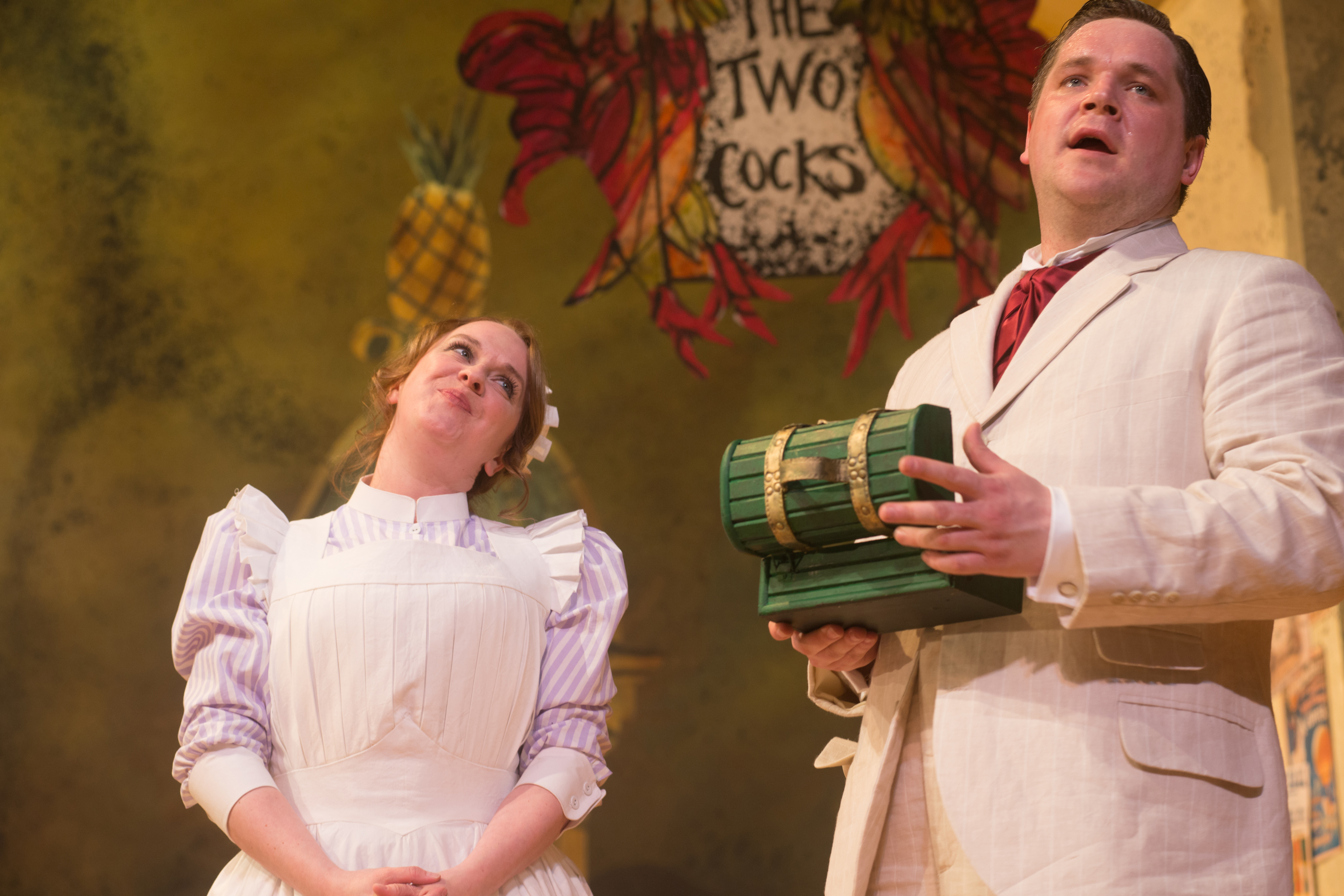
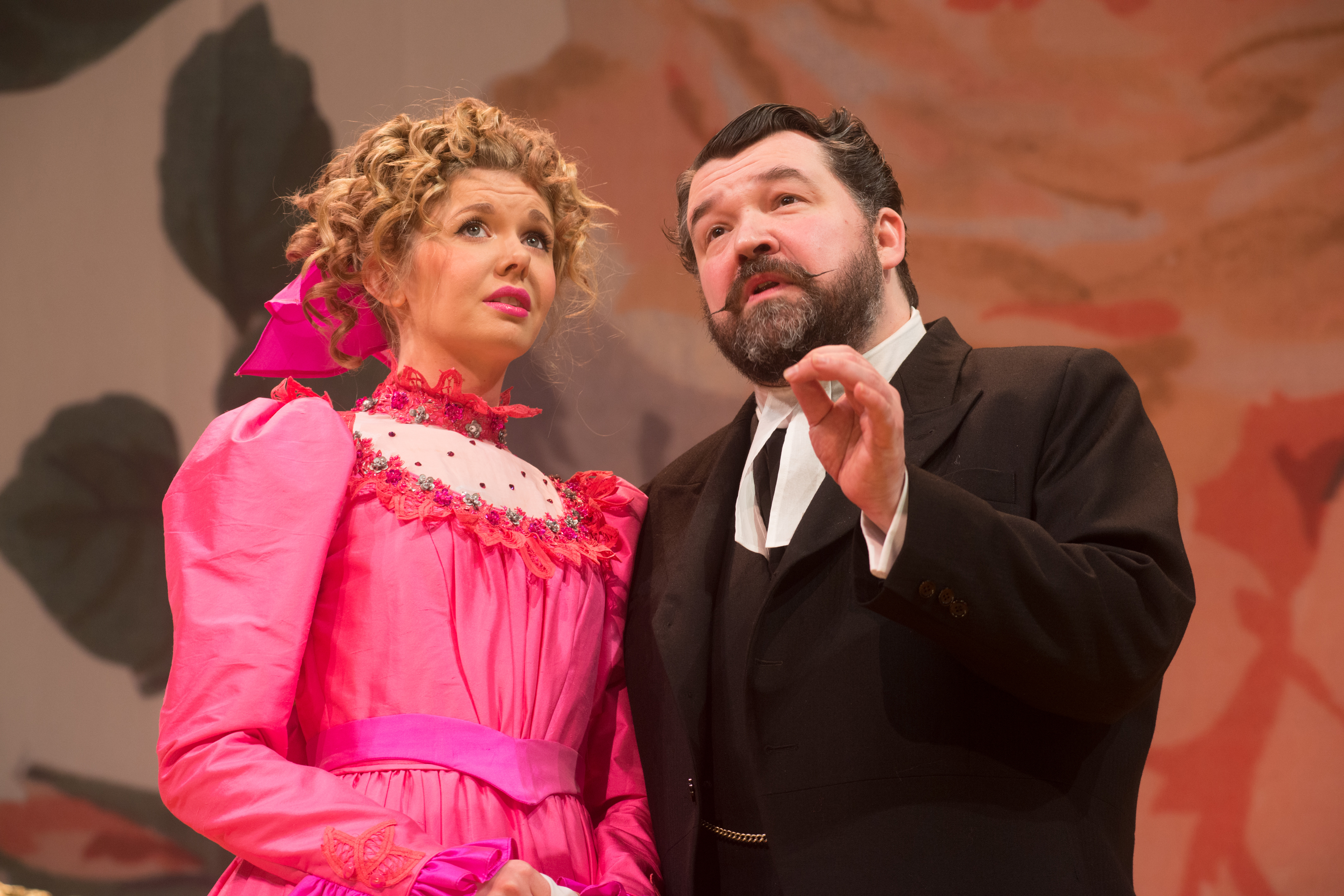
‘This place is mental, eh?, declares Twin 1, provincial Zanetto, who is a mild and endearing sort. He’s come to town from the sheep folds and pig pens of Bergamo to marry Rosaura, whom he’s never met, but who has been kept under house arrest for her (rich) Intended. Poor Rosaura! Home tuition didn’t help much and she suffers from acute malapropism, make-up dependency, and the lust of Pancrazio, the priest, who is a top graduate of the Tartuffe school of rank hypocrisy. Twin 2, is dauntless and debonair Tonino, whose tireless belief in the beauty that is Venice and in his no less beauteous self, probably led to his conflicted fiancée, Beatrice (PhD), running away to Verona where she meets …. Zanetto. Signore e signori, it’s the face-off show! Meanwhile, opposite Rosaura’s just has to be the inn of the Two Cocks where more helpless merriment awaits behind the bar.

Dani Heron as Rosaura and Steve McNicoll as Pancrazio

Dani Heron as Rosaura and Steve McNicoll as Pancrazio

Twins 1 and 2 are – or is – Grant O’Rourke. It is a treat of a ‘double’ performance where panache meets dead-pan humour and survives. Dani Heron serves up Rosaura as a pink sweetie and the whole piece, actually, is offered con brio: from the bright accordion music to the swashing sword play and pink cravat of posh boy Lelio (James Anthony Pearson). Kern Falconer’s turn as barmaid Mammy Flozzie is a shameless hoot whilst Steve McNicoll as the villainous Pancrazio exists seconds away from pantomime hisses.

The audience knows just about what to expect at every madcap moment because the characters delight in telling them – especially Angela Darcy’s fly Columbina; but there are a couple of slaps in the face, as a reminder that Goldoni’s laughs can and perhaps should at times own a keener edge. You won’t miss them, though, but you might feel for good ole’ Zanetto as I did.

Star (blue)Star (blue)Star (blue)Star (blue)

Reviewer: Alan Brown (Seen 5 May)

Go to ‘The Venetian Twins’ here

Visit the The Lyceum archive.