A Bottle of Wine and Patsy Cline (Rose Theatre: 1-30 Dec ’17)

“Everything about this production oozes quality”

Editorial Rating: 5 Stars

For the uninitiated (like me), Patsy Cline was an American country music singer who found fame in the late 1950s/early 1960s, and went on to become one of the most influential, successful and acclaimed vocalists of the 20th century. Her life was tragically cut short at the age of 30, and this production represents a fresh (and fitting) celebration of the star and her work as part of Gilded Balloon’s winter programme at the newly revived Rose Theatre.

Created by the team that introduced Doris, Dolly & The Dressing Room Divas to the world at the Fringe in 2015, A Bottle of Wine and Patsy Cline is a hilarious new musical play featuring all the classic songs fans will love. Yet the only wine you’ll see is the free (mini) bottle you get as part of your entry to the show…

Written as a whistle-stop tour of Cline’s short life, Morag Fullerton’s script slickly presents the turning points in her career and personal life, squeezing in the hits, plenty of laughs and a few of the sadder moments along the way. I would have liked to see more detail in some moments and more creative risk taken with the structure of the piece – it’s safe, straightforward biographical narrative ticks along at a consistent pace – but otherwise everything about this production just oozes quality.

Giving Cline new life in this production is local gal Gail Watson: one of the most accomplished performers currently working in Scotland. Not only a supremely talented singer and impressionist in her own right, Watson commands the stage as the title character and delivers a knockout performance, demonstrating stamina and vocal control performers half her age dream of. Her standing ovation is well-deserved.

Watson is more than capably supported throughout the performance by Sandy Nelson and Hannah Jarrett-Scott, who not only play numerous roles between them, but also act as band and backing singers during the musical numbers. Given the teases of brilliance they demonstrate, it’s a shame we don’t get to see more of each and the wonderful cameo roles they play throughout the show.

Beware – some audience members like to sing along with every song. Those who prefer a silent audience may cringe and crush their plastic cups at the thought, but it’s the kind of show where some formalities can be overlooked. In short: you’d be Crazy to miss it!


Star (blue)Star (blue)Star (blue)Star (blue)Star (blue)

Reviewer: Steve Griffin (Seen 9 December)

THIS REVIEW HAS NOT BEEN SUBEDITED

How To Disappear (Traverse: 8 -23 Dec.’17)

Owen Whitelaw, Robert, with Kirsty Mackay as Isla.
Image: Beth Chalmers.

“Help yourself to creative energy …”

Editorial Rating: 4 Stars Nae Bad


You don’t associate Elgin with hoodies, or Percy Pigs come to that. Go see Morna Pearson’s How To Disappear, however, and you will. The broad Doric may be less surprising and – at this time of year – why not put Narnia, downsized and upstage, through a cupboard in a bungalow?

If this sounds funny, it is, but it is not light-hearted. Far out, maybe. Imagine finding a squashed pot of Angel Delight in your Christmas stocking and you’re some way there. Or, because this is a play of alternatives, you’ve been given 2 DVDs: ‘I, Daniel Blake’ and ‘Room’. Great films but nonstarters in the Ho Ho Ho! stakes.

That’s a deliberate choice of films, of course. Robert, 28, lives on benefits that the Department of Work and Pensions wants to relieve him of. He has not left his room for twelve years, near enough. He has not been outside since he was eight. In the absence of their parents his kid sister, Isla (14-ish) looks after him as best she can, so it helps when she is excluded from school. A benefits assessor, Jessica, has come to ask Robert some questions.

But that’s barely the half of it. There’s a glowing blue portal and a stage revolve to expose the full story. Exactly when it turns is, for the audience, quite exciting; for Robert it’s an obsessional, skin picking quest, but for his pet tarantula it’s an unfortunate accident; and for Jessica it’s spew and ‘Wow!’ all the way.

Help yourself to creative energy then. Certainly Robert does. Copies of ‘New Scientist’ are stacked up against the walls so there’s not much space for him to move around and check his various alarm clocks but this is one clever ‘mannie’ who – all innocent of the metaphor  – dumps his benefits assessment into his bedpan. Owen Whitelaw is excellent in what could be a raw and painful role but is actually agile and sympathetic. His sister, Isla, is more aware, more aggrieved and angrier with what – on the face of it – is a distressing existence. Kirsty Mackay has that awkward dual role as ‘adult’ carer and S4 pupil who is still getting mercilessly bullied at school. (Note for school Guidance staff – you get a mouthful). Jessica (Sally Reid) is a paper shuffling caricature to some extent but with Robert as her ‘client’ is happily saved.

There is redemption here, which is good for a Christmas production. It’s in the near constant humour for one thing and in the marvellous sense of release, of stepping out of the room that comes at the end. But it’s not an easy given and director Gareth Nicholls keeps the action pretty edgy, using plunging lighting effects (exemplary from Kai Fischer) and sound from Michael John McCarthy that begins, it seemed to me, with a nod to ‘Big Country’ and then funnels down to close in on Becky Minto’s box frame of a set.

We need plays with moral outreach and How To Disappear is definitely out there to bring us in. We’re with Robert because he wants to help his father be with his mother, which is where the plot line folds into the mystic portal and you wonder where you are. Just hang on to the fact that he shares his Milky Way with his sister. We’re with Isla because she won’t get lost and hangs onto her brother because she loves him. We’re even with Jessica because she too is a strung out case who does what she can to help people and, like Robert, she loves the ‘Hot Tub Time Machine’, which says it all really.

Star ratings get done over in the wash in this one: 3, 4, 3, 4 … ?

Isla         ‘D’you kain whit number the washin machine goes on at?

Robert  Nut.

By the end, it’s 4* from me for an original and entertaining play. Fabric conditioner for the soul!

nae bad_blue

Star (blue)Star (blue)Star (blue)Star (blue)

Reviewer: Alan Brown (Seen 8 December)

Go to How To Disappear at the Traverse

Visit Edinburgh49 at the Traverse archive.

The Arabian Nights (Lyceum: 30 Nov ’17-6 Jan ’18)

The Arabian Nights. Photo credit - Tommy Ga-Ken Wan

“Visually stunning”

Editorial Rating: 3 Stars

The Arabian Nights is based on the well-loved book of the same name, and is adapted for stage here by Suhayla El-Bushra. Presented largely as a collection of short stories told by the central character (Scheherazade) in order to impress the Sultan who holds her mother captive, it’s a simple concept that all ages can find something magical in.

And there are several moments of wonderment and enjoyment to be had in the stories, which introduce many fantastical characters and scenarios: from people who get turned into animals, and vice versa; wives who love to shop and spend their husband’s ill-earned money; and, of course, spirits with the ability to grant wishes. El Bushra’s script stays faithful to many of the tales within the book, and also scatters some pleasingly modern references to keep the performance relevant to today’s audiences. A couple of interesting gender-blind casting choices also make for great amusement!

The show is performed by a ten-strong cast of multi-talented actor musicians who variably act, sing, play instruments, do puppetry and create all kinds of magic on stage, and for me it’s Rehanna MacDonald who really stands out as central character Scheherazade. A captivating storyteller: she impresses equally well on a bare stage as when there is a huge box tricks erupting behind her, and it often feels like she is the glue holding everything else together. A special mention also to Humera Syed and Brian James O’Sullivan as the hilarious, musical talking goats – my personal highlight of the show.

Visually, this production is stunning – no mean feat for a show with numerous changes of location, time and mood – yet designer Francis O’Connor’s set manages to achieve a great deal to marvel at, creating a sense of awe throughout.

The main downfall of this production, however, is its length, and therein much of the magic is lost as the performance drags on, with noticeable and frequent dips in quality and clarity with scene after scene after scene. It’s also a shame that for an adaptation of such magical stories, which does impress with its stagecraft at many points, there is such a reliance on actual fart jokes for cheap laughs, while the odd moments of audience interaction throughout the show are so half-baked they’re practically raw.

At times this production is spell-binding, but it’s very hit and miss, so to fully enjoy this bumpy carpet ride adults and kids alike will need to sit tight, listen in, keep up and just go with the flow…

Star (blue)Star (blue)Star (blue)

Reviewer: Steve Griffin (Seen 1 December)

Visit the The Lyceum archive.

THIS REVIEW HAS NOT BEEN SUBEDITED

Pomona (Summerhall: 21 -25 November ’17)

Oliver Beaumont as Zeppo, Lauren Robinson as Ollie & (masked) Eilidh Northridge as Keaton
Photography by Andrew Perry.

“Provokes incredulity, fascination, and applause”

Editorial Rating:  4 Stars:  Nae Bad

It’s brownfield land with serious history in central Manchester. It’s a Metrolink tram stop. It’s also Alistair McDowall’s award winning play set in a ‘hole in the middle of the city’ – ‘hole’ as in a rank pit. Pomona (2014) provokes incredulity, fascination, and applause. Without the applause you’d have a WTF play, so it’s a risky business doing this one.

All credit, therefore, to Edinburgh University’s Theatre Paradok for taking Pomona on and finding the perfect venue in Summerhall’s Demonstration Room. The fairy lights on the approach are a fortuitous joke. Little could be less seasonal than the bare grey walls, tiered wooden seating, electrical trunking and peeling paint. As the play requires a ‘concrete island’ in amongst ‘cracked asphalt and weeds’ we’re all set. Not forgetting the open box of cold chicken nuggets and the octopus monster mask.

Ollie (Lauren Robinson) meets zany Zeppo (Oliver Beaumont at stunning top speed). They could be at the tram stop. You might consider a post-apocalyptic situation, with The Road re-surfaced as the M60 Ring, but, no, property is still owned – much of it by Zeppo – and there’s odd but respectful mention of the police. Still, Ollie does not want police help to find her sister. Directions to the likeliest neighbourhood will do. That’ll be to creepy Pomona Strand then.

Indirection more like. For the play twists and turns and the different characters come and go within a looping time frame. Rubik cubes befuddle and provide a handy metaphor for the mixed-up story. It is puzzling but it is doable. There’s Moe (Liam Bradbury) who has had it with people, mainly because he beats them up for a living. There’s Fay (Abi Ahmadzadeh), a sex worker, whose husband hurt her and their child. Moe and Fay share a rare tender moment. Then Fay steals a laptop and valuable data from overseer Gale (Megan Lambie), but it’s all to the good, despite the ‘Kill’ order on Fay’s head. One figure, Keaton (Eilidh Northridge), seems to have the presence to sort it all out but she could just as well be a character out of Charlie’s (Tom Hindle) role playing game box. Charlie really is a bit of a droll card, complete with wacky, sticky fantasy and roaring daftness as and when the dice roll. Zeppo’s back at the close, but this time as a vengeful seagull.

For all his interest in, and skill at, spiel and character McDowall does supply an explanation of what’s going on inside the security fence on the ‘island’ and it’s gross and melodramatic and sensibly left unexplored; no doubt contributing to Moe’s feeling that he’s ‘drowning in an ocean of piss’.

Pomona is fitful and outlandish with no comfortable ‘Home’ for Ollie to navigate to, which very probably explains its appeal to a student audience, who loved its waywardness. Tom Whiston, Director, and Madeleine Flint, Movement Director, work the play with a stylish and disciplined assurance that is easy to underestimate and the cast respond in kind. Personally, I’d rather have Springsteen’s Darkness on the Edge of Town as music to leave by but that was 1978 and students have moved onto more uncertain and contemporary ground. Go occupy.


nae bad_blue

Star (blue)Star (blue)Star (blue)Star (blue)

Reviewer: Alan Brown (Seen 22 November)

Go to Theatre Paradok on Facebook

Visit Edinburgh49 at the Summerhall  archive.

Our Fathers (Traverse: 24 – 28 October ’17)

Rob Drummond (l) & Nicholas Bone (r)
Photo by Mihaela Bodlovic

“‘All Things Bright and Beautiful’ this is not, as a caustic version makes clear.”

Editorial Rating:

4 Stars: Nae Bad

Yet this is a kind piece, just possibly milder and more forgiving than its writers first intended. Rob Drummond and Nicholas Bone got together – which is a mighty draw in the first place – and offer Our Fathers as a sincere appraisal of their own lives as the doubting sons of clergymen. Their text – for this is a messaging service too – is Edmund Gosse’s celebrated memoir Father and Son (1907) with its epigraph, ‘Belief, like love, cannot be compelled’.

 Written and performed by Rob Drummond and Nicholas Bone, I should add, which is testament to the play’s personal and affecting quality. Whilst they take the parts of Philip Gosse (Drummond) and Edmund (Bone), they are also themselves, appearing friendly and unassuming, and only getting cross with one another rather than with the world. If anyone disappoints, and it is as sorrowful as it is a raging disappointment, it is the God of their fathers, who has definitely messed up. ‘All Things Bright and Beautiful’ this is not, as a caustic version makes clear.

Gosse the father was a biologist as well as an evangelical churchman, putting him squarely in the round hole of being a Christian scientist. He could write Evenings at the Microscope (1859) and still find plenty of time to rubbish the idea of evolution. One of his vivid illustrations of a jellyfish is revealed in the church hall cupboard, upstage right. Karen Tennent’s jewel of a set, so precisely lit by Simon Wilkinson, is particularly successful at focusing attention. The Victorian underslip is puzzling (a beloved dead mother?) but the fossils next to the plain wooden cross speak volumes. And there’s the fishbowl in which to dunk the book – [Told you that they get cross]. There’s an available reference to Prospero, promising to drown his learning [Like hell he will!] but then you could see it as some inventive gloss on baptism, which Drummond is especially keen to dish and seeks audience support to do so.

In Chapter 1 of Father and Son Edmund Gosse writes, ‘Several things tended at this time to alienate my conscience from the line which my father had so rigidly traced for it’. That ‘line’ is in the severe  clerical dress, the chalked up 5th commandment, and in the earnest hymn singing, but there’s also the sheer size of Philip (Drummond) alongside the much slighter Edmund, who draws up his little chair to his father’s big table. So it’s amusing that it’s Nicholas Bone who stands firm against Rob Drummond’s pleading to ‘play’ the son and it’s sad when young Edmund’s prayers fail and his looked-for faith is nowhere to be seen.

But all told Our Fathers is an easeful piece. Drummond makes light of the ribbing he got at school for ‘being the son a preacher man’. Hopefully it was good-natured, for let’s presume that he was, indeed is, ‘the sweet talking son of a preacher man’. Both men – tricky to call them actors at this affectionate point – hold up photographs of their fathers, whose recorded voices we hear.

On reflection, which is very much the point, I’m with the storyteller of Genesis 1:31: ‘God saw everything that he had made [including sons], and, behold, it was very good.’ This original, deceptively modest work, is also very good at what it asks and does.

nae bad_blue

Star (blue)Star (blue)Star (blue)Star (blue)

Reviewer: Alan Brown  (Seen 25 October)

Go to Our Fathers at the Traverse and touring with Magnetic North

Visit Edinburgh49 at the Traverse archive.

Hedda Gabler (Festival Theatre: 17-21 October ’17)

Photo. National Theatre, London

“Glistens with sparkling elements”

Editorial Rating: 3 Stars

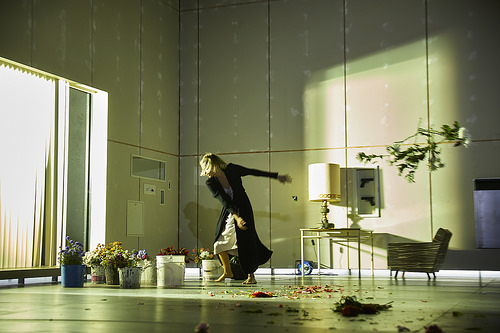
I wonder if there is a word, other than bewilderment, for the reaction to a writer who receives praise despite mediocre work. This is what Patrick Marber’s writing stokes inside me. His re-writing of Henrik Ibsen’s Hedda Gabler is by far the most lamentable element of this National Theatre production, which sometimes glistens with sparkling elements, but includes far too many misjudgments at the head-in-hands level .

To name a few: Leonard Cohen’s lovely yet done-to-death “Hallelujah” plays over a somber transition. Pale blue lights shine intermittently on the assembled actors, for no apparent reason. Physicality is dishearteningly overplayed at times, making the performers appear more like wet marionettes than characters telling a story. And yet, Marber’s script outdoes them all.

The play concerns itself with a day and a night in the apartment of academic wet blanket Tesman and the eponymous Hedda, his new, unfulfilled wife. Friends and former lovers of theirs come and go to moan and wail about their various woes, from dead-end marriages to unrequited love to jealousy over academic rivals’ successes. There are intriguing elements to these episodic entrances and exits, most compellingly when Tesman’s semi-rival Lovborg lays out his plan for his next work. This is what most frustrates about this show: there are so many glimmers of intriguing theatre, many stemming from Ivo Van Hove’s smart (yet here unexceptional) direction, but they are all but snuffed out by Marber’s tone-deaf phrasing and (I hazard) self-importance.

Hedda, a groundbreaking and fresh character in 1891, is nowadays much less extraordinary. She is the daughter of a prestigious general, and a young woman with many suitors, yet lacks any real goals or interests in life. This “poverty of spirit” as the play decides to call it, leads her to seek out increasingly sadistic means of exerting some kind of power over something, whether it be tearing up flowers or firing her father’s pistols at unsuspecting guests, and eventually much worse. This kind of bourgeois-fetishizing story creates just the sort of middle-of-the-road tension and intrigue that should be right up Marber’s alley. Is Tesman going to get his professorship? Is Hedda fulfilled? What is that maid doing there? Yet Marber seems to think he doesn’t need to convince an audience to care about these central questions of the script. So he fails to.

Much like in his magnum opus, Closer, Marber’s word choices can prove unfortunate and even unpleasant. The storyline is treated with such carelessness that it is unclear whether it is satirizing its own pomposity or reveling in it. It looks like Ibsen’s text has suffered a form of quantitative easing and the original is struggling to get back into shape. Certain big monologues (that strain the runtime for no apparent reason) are answered by brief ironic retort: when one character loses the precious, handwritten single draft of his upcoming masterpiece, he waxes poetic for no less than five minutes about his loss — to which another character quietly quips: “It’s just a book.” Somehow, this self-awareness gets squashed and replaced with showiness and shiny things.

There are many shiny things. The set is the unfurnished apartment owned by Hedda and Tesman and is immaculately underdressed. Hedda’s costume is a shiny nightgown. The lights gleaming out of an impressive side window are shiny, as is the display Hedda creates as she plays with the blinds out of increasingly aggressive boredom. The two handguns on show in their upstage glass case  are shiny, and even shinier when they are — spoiler alert — fired at certain characters. But shiny objects do not tell good stories by themselves. We seem to have a production that thinks having a smooth set and glossy production values can make up for a certain percentage of the narrative. They cannot. Some more work on character dynamics and relationships and a little less time stapling roses to walls would have helped quite a lot.

That being said, there is still much to be appreciated in the production. For their stamina alone, the actors deserve some credit. Wading through these lines with such patience must have been hard. Lead actress Lizzy Watts gives Hedda some delightfully cruel ticks, from turning her back on anyone she finds unworthy, to consciously tormenting her guests with their worst vices. Her dynamic with Richard Pyros, playing Lovborg, was the most electric to watch, especially as she toys with his teetotalism in the most vicious way. Adam Best as corrupt judge Brack is the most bombastic onstage presence by far, and his was a refreshing performance. Annabel Bates is good at looking sad, that’s for sure. Abhin Galeya waves his hands around far too much, but otherwise is a solid Tesman — though the character seemed meant to be much more pathetic than the relatively proud man Galeya has created. Christine Kavanagh is a charming red herring at the beginning, as her Aunt Juliana character deftly introduces the audience to the show, then disappears — which is a shame, as Kavanagh’s energy was possibly the best-measured. Madlena Nedeva is a solemn and well-crafted presence as Berte, the maid, yet her character is so untapped that she quite literally becomes more a piece of furniture than a participant.

Overall, an underwhelming and overwritten production of an important play. It is surprising and disappointing that others have eaten it up nonetheless.

Star (blue)Star (blue)Star (blue)

Reviewer: Nathaniel Brimmer-Beller  (Seen 17 October)

Go to Hedda Gabler at the Festival Theatre

Go to Edinburgh49‘s Festival Theatre archive.


Love Song to Lavender Menace (Lyceum Studio: 12 – 21 October ’17)

16.(L-R) Matthew McVarish and Pierce Reid. Photo credit - Aly Wight

Matthew McVarish and Pierce Reid. Photo credit – Aly Wight

“A delightful gem of a show”

Editorial Rating: 4 Stars

Bookshops, especially independent ones, often have a comforting and homey feel to them, providing a peaceful sanctuary and hidden paradise of worlds waiting to be explored. Indeed, that’s what Lavender Menace proved to be for many of those that visited it back in the 1980s, as Edinburgh’s foremost seller of LGBT and feminist literature – and that same feeling is what James Ley’s latest play captures in his moving and comical tribute not just to that shop, but to Edinburgh’s gay scene at the time, and the colourful characters that made it.

Set during the night after the shop’s final day’s trading, we meet two of its employees, Glen (Matthew McVarish) and Lewis (Pierce Reid) who spend the night packing away the books, while reminiscing and creating an homage about the place to perform for its founders the next morning. The pair recount how the bookshop came to be, the antics that occurred, and how their own friendship has developed during that time. It’s a simple setup, and while a little lacking in dramatic tension to really drive the piece forward, the stories themselves are easy to engage with, Ros Phillips’ direction keeps everything moving at a decent pace, and there are many laughs to be had throughout the various capers presented.

What’s most delightful about this performance is the vitality and honesty that oozes from its stars Reid and McVarish. The duo are instantly likeable storytellers, while their skill at multi-roling with speed and dexterity must also be applauded. Watching a full-length play with just two actors can sometimes be a bit of a slog, but this one flies by like an evening spent with good friends. Ley’s writing on the whole is very natural, providing some genuinely lovely snapshots of the shop’s history, but it’s Reid and McVarish who really bring those snapshots to life.

It’s a shame the structure of the play goes a little awry in the second half with various seemingly random changes in time, place and character. While such devices work smoothly early on in the production, seamlessly weaving together the different stories, it becomes much harder to follow as the piece progresses. Perhaps something around the hysteria of the characters, who have clearly been up most of the night by this point kicks in, but the tightness of Ley’s writing does unravel somewhat. For me, the love story between the two also seems a little shoe-horned in for dramatic effect, though its resolution is ultimately satisfying.

Overall, this is a delightful gem of a show, which, like a well-loved bookshop, might not be as glossy and polished as the more mainstream ones, but is definitely one I would be happy to visit again.

Star (blue)Star (blue)Star (blue)Star (blue)

Reviewer: Steve Griffin (Seen 13 October)

Visit the The Lyceum archive.

THIS REVIEW HAS NOT BEEN SUBEDITED

Cockpit (Lyceum: 6 – 28 October ’17)

Photo. Mihaela Bodlovic

“Director Wils Wilson goes all out to create predicament and danger”

Editorial Rating: 4 Stars: Nae Bad

Albert Camus’ La Peste was published in June 1947. The first Edinburgh International Festival was in August 1947. Bruno Walter conducted the Vienna Philharmonic in the closing concert and reckoned that “Here human relations have been renewed”. Bridget Boland’s Cockpit opened at the Playhouse, London, in February 1948 and mashed pestilence and optimism together. Now it’s back, thanks to David Greig, and fit for purpose: a raw and vehement history play, but without princes and kings.

London’s Cockpit theatre was on Drury Lane. It was probably another ‘Wooden O’, built around an actual cock pit. Boland’s play goes one better than Shakespeare’s Henry V, her ‘swelling [and vicious] scene’ holding not only ‘the vasty fields of France’ but the whole of Europe. Cockpit is actually set in a theatre. You get the immersive idea pretty quickly when you notice that the Lyceum has been commandeered by the ‘Allied Government’. It’s late 1945, it’s punishingly cold, and there’s still the reverberation of pulverising bombardment. We’re in the British Zone of Occupied Germany and a theatre is being used as an assembly centre for displaced persons (DPs), hundreds of them. They’re even huddled on the stage. Cast-off clothes are over the backs of the seats. There are ladders from boxes, screened by sacking, to the Stalls and – we’re told – German corpses in the boiler room. Transport is being arranged to take you home (whether you want to go back or not …).  You in the Dress Circle are going West. Those of you in the Stalls are going East. Jiri, on stage and silent, is from Lidice and has no home left. Willkommen im Umwelttheater!, as ingeniously constructed by designer Ana Inés Jabares-Pita.

It is a babel of Slavic voices and trouble. But surely a British officer can sort this lot out, provided he has a desk and reason on his side. Young Captain Ridley has been detached from his regiment because he has School Certificate German. He does have his service revolver. His sergeant, Sergeant Barnes, has no German, just loud Geordie and a Sten gun. Between them they put on a brave ‘show’ – in the choice Army sense of the word – but there’s a limit to how long they can just ‘Carry on’.

Conflict starts with ‘Who’s pinched my sauce pan?’ and very quickly turns serious, not least because the Poles hate the Jews ( – ouch!) and the Russians will kill the Poles and the Chetniks will kill anybody, especially socialist partisans. A French collaborator – but forced labour would qualify that – is certain that Marie, a Resistance fighter, will falsely denounce him. Add infectious disease and Capt. Ridley is in a desperate jam. There is some rallying round but a different kind of ‘show’ is needed to relieve the tension; after all, we’re in a playhouse. When it comes, two thirds through, we get an operatic cloth and a bravura performance from Sandra Kassman.

(L-R) Nebli Basani, Peter Hannah, Dylan Read (Bauer), Sandra Kassman (stairs), Kaisa Hammarlund (stairs) and Adam Tompa. Photo. Mihaela Bodlovic

This is Boland’s brilliant conceit. When the German stage manager, Bauer, says “You will need the theatre – afterwards”, you believe him. And when faced with the possibility that his theatre – probably one of the few buildings left standing in his flattened city – might be burnt down to halt contagion, the man is stricken with sadness. Bauer (Dylan Read), as comic denizen of his place, living in the flies, and true Propsmeister, is almost the only source of laughter in an otherwise sombre drama. Read also plays Duval, whose occasional spoken French, is so good that you appreciate the difficulties of staging a script that demands heavily accented English from several characters. Whatever ‘European’ means, this cast is it.

Director Wils Wilson goes all out to create predicament and danger. A chant is either angry or sorrowful and certainly incomprehensible (unless you’re Romanian). Rush and hurry can subordinate the personal stories. There is a stretch of choreographed movement for the whole company that would express the plight of the displaced anywhere, at any time. The excellent music by Aly Macrae is often discordant and broken, except for the quiet piano at the beginning of the second half. Capt. Ridley (sturdy by Peter Hannah) might be resolute, almost heroic, but it’s not enough. There is a passing mention of a major somewhere else but the chain of command appears well and truly absent, which will irritate Army types.

Cockpit is bold work, both then and now. It is theatrical but – more importantly – it’s humane. A Russian DP proclaims “20 million Russians died. It must not happen again”. That’s from the Stalls, going East. Primo Levi, after Auschwitz and going West, got it exactly right: ‘It happened, therefore it can happen again’.

nae bad_blue

Star (blue)Star (blue)Star (blue)Star (blue)

Reviewer: Alan Brown (Seen 10 October)

Go to Cockpit at the Lyceum

Visit Edinburgh49 at the The Lyceum  archive.

Jury Play (Traverse: 3-7 October ’17)

“The fourth wall isn’t so much broken as shattered”

Editorial Rating: 4 Stars: Outstanding

Sometimes the power and excitement of a show begin long before you take your seat, and remain with you for several days after. For Jury Play, a detailed email briefing is circulated in advance of the performance/court appearance, creating intrigue into what the evening will entail: it’s worth saying at this point that this is in no way like your standard trip to the theatre. The excitement only builds as you go through “security”, enter the (optional) ballot to become a jury member, and start to leaf through your court information pack while taking in Emily James’s impressive and sizeable courtroom set.

Yet what, on the surface, appears to be conceived as an interactive courtroom drama, where the prosecution and defence present facts about a given crime and a resolution is reached by the audience/jury, what Jury Play peels away at is what effect the trial process has on individual members of the jury, specifically for trials that last for weeks.

At various points during the trial, voiceovers expressing jury members’ thoughts are overlaid with the action, which include worries about getting children to school, paying bills, what specific legal terms mean, and even staying awake. Snippets of video conversation between writers Dr Jenny Scott and Ben Harrison about the performance also add a pleasingly Brecthian feel and help break up some of the monotony of the trial itself. So far, so so. Everything changes in Act ii, however, when the formal trial is over and the power lies in the jury’s hands. I won’t give away all the spoilers, but I shall simply reveal that organised chaos ensues, and the meat of the piece really comes out as an intelligent, human, and common sense discussion into the way we conduct trials.

When it comes to the performance it is John Betts as Judge who commands the show, and with his hilarious doddery asides and sensitive chairing of the discussion in the second half of the piece, you feel like you’re in his space, and he decides at any given point how comfortable anyone is to feel. Helen Mackay is also excellent as the conscious “everyman” figure Janis, who just wants to do her duty, and the cast as a whole make the performance very accessible: the fourth wall isn’t so much broken as shattered, with a piece of it distributed to each and every person in the room.

For me, though perhaps a reflection on the subject matter it discusses, Scott and Harrison’s script is too laboured and lengthy at points – missing some crucial details to aid comprehension in the first half, and dragging out its point in the second. The ending, while interesting and fitting stylistically with the piece, also feels like a bit of a cop-out and rather abrupt – as if the ideas just ran out at that point and there was nowhere else to go.

Overall this is a fascinating insight into the legal system, what it’s like to be a jury member, and how seemingly unfit for purpose the whole setup is – especially for people like me who have very little knowledge of its intricacies. Jury Play is absolutely worth taking part in, if there’s any room left in the public gallery.


outstanding

StarStarStarStar

Reviewer: Steve Griffin (Seen 5 October)

Visit the Traverse archive.

THIS REVIEW HAS NOT BEEN SUBEDITED

Pleading (Traverse: 3 – 7 October ’17)

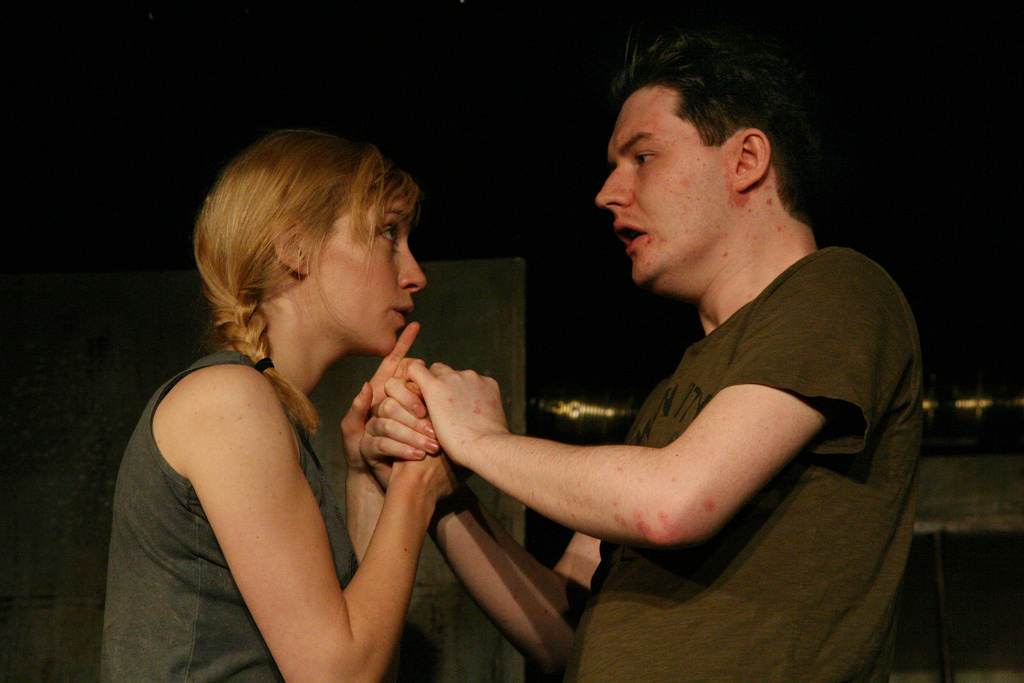
Kim Allan and Daniel Cameron
Photo: Oran Mor

““Everything is negotiable””

Editorial Rating: 3 Stars

Pleading is the first up of five plays in this season’s ‘A Play, A Pie and A Pint’. This is a spiky three-hander by Rob Drummond, surely a playwright on a roll; and there is something of a wrestling bout to its twists and holds. Heard as a radio drama on BBC4 in January, Pleading comes to the stage – but call it a mat – with a narrative thwack.

Michael (19) and Freya, his girl next door /one-time sweetheart, have been banged up in a foreign jail for three weeks now. They are brought together to talk to their assigned lawyer, Amelia Singh. Where exactly they are  is not given but they do face the death penalty for attempting to smuggle Class 1 drugs. That fate – and their flight itinerary: Singapore > Perth > Brisbane > prison – would suggest Malaysia or Thailand. No worries (really?), for Freya’s dad is a QC and in that part of the world “We’re not foreign, we’re British.” Er …? Cue Boris Johnson and the Road to Mandalay?

If ever a defence lawyer was gobsmacked and keeps talking, then it’s the calm and collected Amelia (Nicole Cooper). How to convince her jumpy clients to plead guilty and serve a prison sentence? Maybe then Daddy can come and flap his silk. “Everything is negotiable”, declares Amelia, but it helps if you keep your story straight and consistent. So, over 50 minutes, Freya and Michael ‘negotiate’ the possibilities of how heroin ended up in her backpack. It is conceivable that the truth is told at the end but who can tell? It’s always salutary to be reminded of our talent for lying.

It is an unsparing and sweaty tussle that is ably performed. Freya (Kim Allan) is more in control but her account is the more wayward. Michael (Daniel Cameron) is more fragile, even desperate. At the close they are hanging onto each other for support and the law is somewhere else entirely.

Director David Ian Neville has a good play for voices to work with. Movement is conspicuous and time parcelled out by Amelia’s visits to the remarkably quiet prison. There is credible tension and there is sympathy and anxiety but as a drama I felt it wanted more fear and a lawyer on the ropes.

Star (blue)Star (blue)Star (blue)

Reviewer: Alan Brown (Seen 3 October)

Go to Pleading at the Traverse

Visit Edinburgh49 at the Traverse archive.