Company (Paradise in St Augustine’s: 4-12 Aug: 21.30: 2hrs 15mins)

“Rarely do you see this level of talent from an amateur group on a Fringe stage.”

Editorial Rating: 5 Stars

Sondheim’s multi-award-winning Company burst onto Broadway in 1970, flying in the face of popular narrative-led musicals and instead presenting a series of vignettes around Bobby, a thirty-something man, happily single, but surrounded by couples who all want to see him get hitched. While the celebration of being happily unmarried may have caused quite a stir at the time, for today’s Tinder generation the themes still have great relevance, and Company comically dissects what being in a couple is really like.

And it’s the comic element of the show that EUSOG have really mastered with their interpretation. The sneaky looks, the perfect timing, the inflections and staging all contribute to the feeling of satire the whole musical embodies, and director Grace Dickson has done a marvellous job in weaving together one consistent style through what is really quite a fragmented production.

Of course, having the right cast helps, and this one is just oozing with talent and personality. Bella Rogers is a delight as airhead April, and Ellie Millar is on point as prudish housewife Jenny, whose attempts to swear while being stoned for the first time had me in stitches. But comically it’s Kathryn Salmond as Amy who steals Act 1 with a sensational rendition of the notoriously difficult patter song Getting Married Today. It’s fast, it’s controlled, completely in character and worth buying a ticket for for those few minutes alone.

Yet while I could really pick any number of songs as stand-out highlights of this performance, it’s Esme Cook’s The Ladies who Lunch that launches this show into the stratosphere. With depth, sensitivity and a killer belt, demonstrating maturity well beyond her years, Cook delivers a goosebump-inducing class act that deserves to be witnessed far and wide. Rarely do you see this level of talent from an amateur group on a Fringe stage.

And then of course there’s the main man, Ethan Baird who brings a subtle and amusingly awkward approach to central character, Bobby. His natural charisma and swagger make him instantly likeable, and he balances the role of observer and participant in the action with ease. His Being Alive builds and teases, much like the structure of the song itself, and the rousing final chorus is delivered with aplomb – a fitting finale to a powerhouse performance throughout.

The musical style and structure of Company isn’t for everyone, and at well over two hours (with interval) it’s quite a slog. At times the choreography lacks a little polish and pizzazz, and the sound levels could do with a bit more balancing out to allow some of the vocals to really soar, but weighing all that against the sheer heart of this performance, you’d really be mad to miss it. Go alone or go with company. Just go and see Company.

Star (blue)Star (blue)Star (blue)Star (blue)Star (blue)

Reviewer: Steve Griffin (Seen 6 August)

THIS REVIEW HAS NOT BEEN SUBEDITED

Douze (C Royale (studio 4): 2-28 Aug (not 14): 20.30: 60mins)

“Douze delivers by the bucketload”

Editorial Rating: 4 Stars

The format of Douze is simple enough: a musical group showcasing nine songs for Ireland’s latest Eurovision entry, and the audience has to vote for their favourite at the end. Voting slips will be found on the seats as the audience come in.

To begin, the lights go down and, as they return, the tension builds as the star of the show, Xnthony (Anthony Keiger), with his back to the audience, stands in front of a gold-tinselled backdrop. Xnthony is then revealed from behind an EU-starred cape, sporting statement make-up and a bespangled, very low-cut wrester’s singlet. Supporting him are the Penny Slots (Hannah Fisher and Tiffany Murphy), dressed in royal blue cheerleaders’ outfits, already out of breath and with make-up ready-smeared (emphasising the depiction of their supporting role).  And it only gets more crazy and energetic from there.

Yes, there are nine songs (which do a good job on satirising the various musical styles of Eurovision). Yes, there is a vote. Yes there is the cattiness and viciously competing egos under the showbiz smiles. Yes, there is politics. (You will hear “Yes” quite a lot during the show). All this though are buried under the physical slapstick on stage and the none-too-subtle comedy outrage perpetrated both on-stage and off.  The team make excellent use of the entire theatre space throughout the performance, but beware: sitting at the back may not save you from audience participation, which can verge on the blush-inducing.

As the action becomes increasingly energetic, the lasciviousness of the looks and poses become more apparent. While both women dance vigorously throughout, some of the noises, especially coming from Tiffany, are quite remarkable. One is pretty sure the Penny Slots get their name from their costumes. For sure that would be pre-decimal coinage.

Production levels in this medium-sized (at least for the Fringe) venue is good. Audio quality is high throughout and there is a tremendous use of cheap and cheerful props to great comic effect.  A critic’s duty is to keep watching but honestly, do close your eyes if asked: it really enhances the stage-magic. Thank goodness the venue is well-ventilated, even if only for the sake of the performers.

All three performers should be given full credit for the physical energy they bring to the stage. While the choreography is slapstick and sometimes quite lewd, they are all extremely funny.  Perhaps more vocal lines could have been assigned to the Penny Slots, as both Hannah and Tiffany demonstrate that they really can sing, and though Xnthony’s voice is never totally convincing, it doesn’t matter at all in this context.

A show about a group of Eurovision wannabes is never going to be an erudite and highbrow evening.  It doesn’t even matter whether one likes Eurovision. It’s about fun, laughter and outrage and that is exactly what Douze delivers by the bucketload.

Just be sure to give the pens back. Really, give them back.

                                        Star (blue)Star (blue)Star (blue)Star (blue)

Reviewer: Martin Veart

C Royale (studio 4)

THIS REVIEW HAS NOT BEEN SUBEDITED

Penetrator (C Cubed: 3-12 Aug: 18.25: 75mins)

“Flickers of brilliant storytelling”

Editorial Rating: 2 Stars

Anthony Neilson’s Penetrator covers the topics of masculinity, friendship, and how far a man will go for his mate. Max and Alan are friends and flatmates (with differing viewpoints on tidiness and laziness), when old friend of Max, Tadge, arrives unexpectedly, having been discharged from the army. Bringing a vast set of issues none in the group can comprehend we find out how much each of them is able to put up with.

Bizarrely, for a play that’s been produced at the Traverse, the Finborough and Royal Court (upstairs), it’s Neilson’s script which is really the weak link in this production, giving away frustratingly little about the backgrounds and motivations of each character. Conversation between Max and Alan frequently just dies and restarts again on a different topic for no reason, while any sort of tension and narrative drive appear only quite late on. Perhaps it’s all one over-burdened point by Neilson about men’s ability to communicate about emotion or anything of any depth, but even that wears thin as the chatter ploughs on about girls, haircuts, cards and cups of tea without feeling genuine.

The final fifteen minutes of drama are certainly attention-grabbing and tense, even if the motivation behind it feels rather flimsy with very little to establish it. Tadge’s accounts of the penetrators and his father never quite ring true, as the non-plussed reactions of the others smack of disbelief without enough intelligent dissection of the issues to draw the audience in. I was left wondering what all the fuss was about.

In saying all that, the cast do a fairly good job with the material – Chris Duffy is very relaxed and natural as Max, Matt Roberts suitably frustrated as Alan, and Tom White is the most convincing and compelling of the group as the war-affected Tadge. While the tense moments towards the end the production do get a little bit too shouty, the more emotional and thoughtful interchanges – particularly when recalling teenage incidents – are very well-delivered and stand head and shoulders above the rest in terms of emotional honesty as flickers of brilliant storytelling.

Given the amount of talent on display at moments during this performance, it’s clear that Fear No Colours as a company have the potential to produce great theatre, but unfortunately this production falls short in too many areas to show them in their best light.

Star (blue)Star (blue)

Reviewer: Steve Griffin (Seen 6 August)

THIS REVIEW HAS NOT BEEN SUBEDITED

Gossip (Zoo Southside: 4-15 Aug: 20.30: 75 mins)

“A chocolate box of visual delights”

Editorial Rating: 4 Stars: Outstanding

Gossip is a subject we can all relate too, and in a world of hearsay and “fake news”, the theme of Lenka Vagnerova & Company’s latest production is achingly relevant. Yet for a topic so closely associated with words, how does a dance piece explore its intricacies? On the whole, with zeal.

The action begins at a party, as guests arrive and go through the rigmarole of introductions and drinking. The movement is jarring and robotic – a cutting reflection of the forced politeness many of us display in social circumstances – and the skill and dexterity of each dancer’s exaggerated stilted reactions is really wonderful to watch. Tensions soon arise as gossip spreads, and then the real fun begins.

The whole piece follows different characters’ reactions to being gossiped about, joked with (or worse), with creative interpretations of what that experience feels like. From dancers being puppets on an evening out and inadvertently ending up in bed together, to another being physically swamped in a cape made up of all the things she doesn’t say about her husband, the whole performance is energetic, stylish and performed with the swagger one might expect of one of Czech Republic’s most lauded companies.

Yet while gossip is the overall theme, the undertones of the piece are much darker than you might expect – the taunts and fights are at times frightening, and the dramatic ending may be a lesson to us all in keeping our mouths shut and thinking about others before we act. It’s scintillating and dramatic, yet at times very funny, as facial expressions and stylised reactions add a slapstick feel at choice moments, giving the overall performance depth and balance.

The artistry, choreography and control are all stunning, with solos, duos, and ensemble moments, blurring the lines between dance and theatre. Daring lifts, throws and balancing acts will keep you on the edge of your seat and the clever use of changes in dynamic and music keep the performance moving and engaging throughout. This is a company that feels very natural on-stage, with all the creative elements and personalities working together to present of chocolate-box of visual delights.

For me the only disappointing aspect is the lack of clarity of through-line (dare I use the word “narrative”?) throughout the piece. At times it feels like a stream of ideas and explorations following no particular order or structure, and while some loose ends are tied up at the climax where the opening party scene is revisited, I would have liked for the piece to feel like it had more cohesion and completeness.

Overall, Gossip is a very high-quality performance with something for everyone. It certainly deserves to be talked about.

outstanding

StarStarStarStar

Reviewer: Steve Griffin (Seen 5 August)

THIS REVIEW HAS NOT BEEN SUBEDITED

+3 Interview: LOVE+ and BlackCatfishMusketeer

2017blackcb_5b 2017love_5b

“Our double-bill brings sex, technology, and sex with technology to this year’s festival.”

WHO: Breffni Holahan, Performer and Producer

WHAT: “You meet someone online. All you know is their name and that they seem to like you as much as you like them. In fact, you think you love each other. But do you? Can you? What even is love, anyway? Maybe we not only don’t know, we can’t know; we can only know what love isn’t. So, let’s say what it isn’t. BlackCatfishMusketeer doesn’t look like the internet, but it feels like it. It’s about trust, doubt, closeness at a distance, and being worried you’ll die alone and cats will eat you. #BlackCatfish

“What happens to romance when there’s a machine who cooks for you, cleans for you, never forgets your birthday or how you like your tea, tells you you’re beautiful, holds you when you’re crying, and still makes you cum? Love+ is a one-woman two-hander about the inevitability of human/robot relationships. It’s about loving, being loved, being human and whether those things are intertwined. It’s not about whether or not you can love machines, because we all already do. It’s about what it’ll be like when they love us back. #Loveplus”

WHERE: Summerhall (Venue 26) ​

WHEN: 19:10 (60 min)

MORE: Click Here!


Is this your first time to Edinburgh?

This will be our first time presenting in Edinburgh.

By the end of 2017, we will have produced 3 shows in as many years at Dublin Fringe, so thought we’d take two of those shows over to EdFringe and see if audiences there like them as much as our wonderful Dublin audiences.

We’ve visited the festival before and always had a ball, but participating as artists is a whole other beast. We’re pretty nervous, but we’re mostly very excited to meet new audiences and start new conversations.

Tell us about your show.

Our collective, MALAPROP Theatre, is presenting two shows at Summerhall. LOVE+ and BlackCatfishMusketeer will both make their international debuts as part of EdFringe ’17, and will alternate in rep..

Our double-bill brings sex, technology, and sex with technology to this year’s festival. While both shows are very different in terms of form and content, they are both told with a measured balance of wit and insight into The Now.

Our debut production, LOVE+, was a stand-out hit of Dublin Fringe 2015. It is a one-woman two-hander about the inevitability of human/robot relationships. It’s all about what happens when (not if!) the machines we all already love so much start loving us back.

Our second show, BlackCatfishMusketeer, was nominated for Best New Play at Dublin Fringe 2016. It is a play about online dating and being afraid you’ll die alone and cats will eat you. It gives us an insight into how the Internet (a character in the play) might feel about how we use it.

MALAPROP is a Dublin-based theatre collective that aims to challenge, delight, and speak to the world we live in (even when imagining different ones). Other work includes JERICHO (Bewley’s Café Theatre commission 2017) and Everything Not Saved (to premiere at Dublin Fringe 2017).

We hope to show those who come along to our double-bill a good time. Hopefully we’ll leave people with a chuckle and a few thought-kernels that make them go “Hmm” the next day. We’re also looking forward to seeing what opportunities lie ahead for the shows and for MALAPROP. We’re young and hungry and welcome The Future in a big way.

What should your audience see at the festivals after they’ve seen your show?

On your way out of LOVE+, you should definitely consider coming back to us for BlackCatfishMusketeer the following evening (or vice versa, of course)!

Cheekiness aside, we’d recommend checking out Culture Ireland’s programme at this year’s festival. We’ve seen the other shows they’re sending over and they’re total hits and we’re very proud to be considered in their league. Our must-see would be Oona Doherty’s Hope Hunt at Dance Base. She’s so cool and so talented and we’d like to be her, please.


LIKE WHAT YOU JUST READ? FOLLOW US ON TWITTER! FIND US ON FACEBOOK! OR SIGN UP TO OUR MAILING LIST!

INTERESTED IN BEING INTERVIEWED TOO? CLICK HERE!

“Be thoroughly prepared as far as the work is concerned, so you can handle the madness.” – Author Michael Mears discusses Fringe success and This Evil Thing

9780993197567

“The absolutists were as their name suggests, absolutely opposed to doing anything at all that could even remotely be construed as helping the war effort.”

In 1916, at the height of the First World War, Henry Asquith, Britain’s beleaguered Liberal Prime Minister, “begged leave to introduce a bill with respect to military service.” Little did he know just how strong the opposition to it would be. Although he had ensured, as a result of vigorous campaigning both inside and outside Parliament, that one of the exemptions contained in the bill would be, “on the ground of having a conscientious objection to bearing arms,” in practice it proved extremely difficult to obtain this exemption.

Arrests soon followed. C.O.s would be forcibly escorted to barracks and there ordered to put on a uniform, and do drill – which they politely refused to do. This civil disobedience would result in punishments, bread and water diets, solitary confinement, and worse. At least they couldn’t face the ultimate threat – execution – as they were not in the war-zone, and therefore not deemed to be on active service. Unless, of course the Army started sending C.O.s across the Channel to France…

Michael Mears – actor, playwright, long-distance walker – has enjoyed a rich and varied career in theatre, television, radio and film. His on stage work includes seasons with the National Theatre, the Royal Shakespeare Company, and the Peter Hall Company, portraying many classical and Shakespearean roles.

On television, Michael’s roles include Rifleman Cooper in Sharpe, two series of The Lenny Henry Show, and appearances in Parades End, The Colour of Magic, My Family, and Birds of a Feather. On film Michael is most delighted to have been the hotel barman who brings Hugh Grant and Andie McDowell together in Four Weddings And A Funeral.

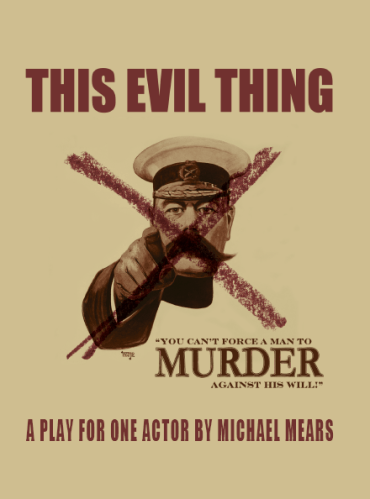
This Evil Thing was published in April 2017 by 49Knights. To find out more click here.


Why WWI conscientious objectors?

As a playwright, I was looking for a subject as the First World War 100 year commemorations were approaching. There I was, a pacifist, but I didn’t appreciate what my subject matter had to be until I casually picked up and read, the way you do, a book I’d been given for Christmas – Robert Graves’ autobiography, Goodbye To All That – in the course of which he describes his experiences in WW1, including his meeting and friendship with Siegfried Sassoon. Sassoon, known for his superb war (anti-war?) poetry – served loyally and courageously as a Lieutenant in the trenches, before having a Damascene conversion and realizing the horror and utter futility of it all – and becoming, in effect, a conscientious objector.

Oh yes, I now thought, who were the conscientious objectors exactly? Within days I was discovering all kinds of books, articles, you name it, about the subject – an utterly fascinating, riveting and rarely told part of the history of the First War. I felt compelled to make my own dramatic contribution, inspired by the stories I read, feeling I wanted to play my part in helping give their courageous stand against war and conscription more oxygen and daylight.

This Evil Thing is a play for one actor yet there are dozens of characters represented. What was your process to ensure that each has an individual voice?

michael-mears-in-this-evil-thing-2-999x450Myself and Rosamunde Hutt, my director, made sure that the smallest character, even an army sergeant who has just a couple of lines in the piece, say, had a name, a motivation and their own integrity. We ascertained what their background would be, how they might sound (through playful exploration) and similarly explored how they would move, what physical gestures/tics/mannerisms they might have. Obviously this work would be more in-depth when looking at the more substantial characters. We strenuously tried to avoid any kind of caricature – although occasionally a cartoon-like style might be briefly employed where appropriate.

You’ve enjoyed considerable success at the Fringe both with This Evil Thing and previous productions. What are the best and worst things a new company can do during August in Edinburgh?

Best things you can do – are to be thoroughly prepared as far as the work is concerned, so you can handle the madness of whirlwind get-ins and get-outs, as show follows show follows show. Be as charming and polite as possible to those you are given to work with in the venue, and your venue managers, publicity people etc. Whatever the frustrations, (and there are oh so many) try not to let these affect the way you are in public, and way you deal with people in public. And yes, unless you get that early 5-star review and then sell-out pronto, do hand out flyers and spread the word about your show on a daily basis, but as charmingly as possible – while being fully accepting of the many brush-offs and rejections of your leaflets that you will encounter. Tall order, I know.

Worst things – to get so inebriated, wrecked, spaced-out, whatever, that you can’t deliver brilliantly what you are here for in the first place. To quote some old playwright of yore – ‘The play’s the thing…’ (or the show, the stand-up act, the musical – substitute as necessary…) We all need a good moan. But try not to moan ad infintum. Edinburgh can be incredibly frustrating, but you’re there, you’re performing for better or worse in this huge arts festival, the city is beautiful and it’s an extraordinary place at Festival time, so relish being there, get out and see loads of stuff, especially the amazing stuff that comes from abroad, and let it feed your own work, your own imagination.

You’re an alumnus of the TV series Sharpe (in which Sean Bean plays the titular blood and guts Napoleonic war hero). Here you are writing a play about a different kind of heroism. Are the two types, soldiering and refusing to fight, antithetical?

chosenmen

My instinct is to say yes, and yet, as I highlight right at the end of This Evil Thing, there are different ways to be a hero, to be courageous. The very best soldiers are absolutely willing to sacrifice their lives for what they believe in – and it is exactly the same for the conscientious objectors. They were willing to face death if necessary, to face execution, rather than betray their belief that no man, no government, should be able to force another man to kill against his will.

And many COs, while imprisoned in barracks and guard-rooms, met soldiers who though they said they didn’t agree with the COs’ beliefs, nevertheless had great respect for them and their willingness to suffer in order not to betray those beliefs.

Did you ever mention that you might be a pacifist while playing Rifleman Cooper?

Warfare in those days, the days of Napoleon and Wellington, was a very different thing to warfare just a hundred years later. You got very close to your enemy, often saw the whites of their eyes, often grappled in hand to hand combat…somehow it seemed more honest, if that makes sense – unlike warfare now where generally it’s a question of dropping bombs from a great height or distance – without those doing the bombing ever having any contact with those to whom they are bringing such damage and devastation. The early 1800s was a fascinating period to research and though I was never truly comfortable holding and firing my rifle and taking part in those imagined battles, the characters were so vivid and rich and colourful – most of them survivors from the gutter, finding a home and purpose in the army. And at the time of filming Sharpe, in the early 1990s, I wasn’t consciously calling myself a pacifist. The job of being part of Sharpe was an acting challenge to me, first and foremost – to portray a hard-bitten soldier living on his wits and the camaraderie of his fellows, even though I would never have dreamt of joining the army in real life; much as to play Macbeth, you don’t actually have to have been a murderer (though I imagine it would help a bit).

Many of the absolutist COs came from a nonconformist background. Most Quakers, Methodists, etc accepted non-combat roles (such as front line stretcher bearing). What made the absolutists different, and how were they treated by their own congregational communities after WWI?

The absolutists were as their name suggests, absolutely opposed to doing anything at all that could even remotely be construed as helping the war effort. They were utterly opposed to this war, and in most cases, all war. There were 1,300 of them, and they endured tough prison sentences, with repeated stints of solitary confinement on bread and water diets, and enduring what was a Rule Of Silence for all prisoners in prison at that time. Many developed health problems as a result of their treatment.

After the war the responses the COs encountered on release varied – but in some communities there was a feeling that they had been shirkers, had had an easy war and didn’t deserve any kind of special treatment or status now. Finding work could prove very difficult, with many ads in the papers specifying that ‘COs need not apply’ ; and the vote was denied to COs for 5 years. But there were communities, such as in Huddersfield with its radical background and history, who were far more understanding of what the COs stood for and had endured.

Bert Brocklesby, the protagonist in my play, and who had been an absolutist, was ultimately spurned by his Methodist congregation in south Yorkshire. It wasn’t long before Bert joined the Quakers, understandably.

Do you see a difference between refusing wartime service between 1914-18 and 1939-45?

An early choice of title for my play was ‘What About Hitler?’ Sort of says it all, really – in terms of this question. The most passionate pacifists, and I consider myself one, are nevertheless brought up short when confronted with the ghastly phenomenon of AH. War is an appalling way to resolve international disputes, but when someone like Hitler appears on the scene – what do you do? But there were COs in WW2, a lot more in fact than in WW1, and because of those early trailblazers and the way in which they had in fact helped to reshape public opinion to a considerable extent, COs in WW2 generally had a far more sympathetic hearing.

Although This Evil Thing is a play for one actor you’ve been directed, stage managed, designed and produced. How does a solo player successfully pick a team?

There are all kinds of elements that go into picking a team – experience (the older you get, the more people you work with and thus gain an excellent knowledge of people’s abilities or particular skills); word of mouth; getting out there and seeing (in my case) other directors’ solo work (partly how I found Ros Hutt – I saw a splendid solo piece she had directed a year earlier); chance meetings; serendipity; and of course, calling on people you’ve worked with well before – like Mark Friend my set designer, who had designed a previous solo play of mine. I came across my sound designer Mark Noble, when I was in a play sat Salisbury that he had designed sound and video for – and I thought, ‘Gosh, he’s good. And he’s very young. So maybe he won’t be too expensive – yet!’

30477-6715What’s next for This Evil Thing?

A 600 seat tent, 3 Quaker school halls, the studio of Hull Truck theatre, London’s only surviving Elizabethan Church in Stoke Newington, a small wine bar in Wanstead, East London – all these with their differing shapes, sizes and acoustics, and many more, will be hosting the play this August, and through the autumn. Check out michaelmears.org for more details.

I’m also looking for possible American openings – no, not Hollywood, but the Quakers in Philadelphia perhaps…

What should be playing on the stereo when we’re reading This Evil Thing?

Ideally nothing. But if you do want something on in the background…then almost certainly something by Vaughan-Williams – his ‘Pastoral Symphony’ – which captures the sense of loss and sadness connected with the First World War… or his ‘The Lark Ascending.’

Or a haunting and beautiful piece of acapella music called ‘Unmarked Graves’ by Helen Chadwick, from her album ‘AMAR’ – she recorded other beautiful acapella material for the production of This Evil Thing.


LIKE WHAT YOU JUST READ? FOLLOW US ON TWITTER! FIND US ON FACEBOOK! OR SIGN UP TO OUR MAILING LIST!

War in America (Former Royal High School/King’s Theatre: 24-27 May ’17)

Connor McLeod as Mr Slype. Photo by Greg Macvean

“Some fine performances from the young cast”

Editorial Rating: 3 Stars

War in America’s revival in the build-up to the current UK General Election is very apt – and almost feels as if it is written especially for this moment, though it is now over 20 years old. The narrative sees the rise of a female political leader (known only as “She”), who hides behind a variety of lies, disguises and games in order to get to the top. Meanwhile, in a pleasingly Orwellian set-up, our little man Mr Slype (a rather spineless MP) is bullied by rival parties to vote for a law he neither wants nor doesn’t want, and some rather underhand tactics see him inadvertently give his vote to She, handing her the reins of the country. What happens after gets a little confusing.

Given the setup and opening few scenes where the main characters and topics are introduced, the first fifteen minutes of this production really makes it feel like a cutting-edge, gripping political drama – not too dissimilar from Mike Bartlett’s King Charles III, which I reviewed last year. Jo Clifford’s dialogue is cutting, intelligent and witty, Susan Worsfold’s direction is slick, and there’s palpable tension between rival factions to keep us on our toes. The production loses its way somewhat in the second half, however, and tries to cram in too much with too many characters and melodramatic revelations, that it becomes more of a slog to sit through.

That being said, there are some fine performances from the young cast, most notably Andrew Cameron as the cunningly-named and deftly acted Mr Fox, who is very charismatic and convincing and throughout. Scenes with him and his assistant Alfred (Mark O’Neill) were among the most compelling of the performance, and I could easily picture them on a bigger stage receiving great acclaim. Connor McLeod is also strong as Mr Slype, with great variation in swagger and guilt from scene to scene.

It is, however in the more dramatic scenes where the tension and integrity of the piece slips. She’s relationship with her estranged daughter fails to ring true throughout the piece – distinctly missing the deep emotional connection needed to be convincing, and its climactic resolution is very sloppy compared to the polish evident in other areas. Indeed, many aspects of the show like this come across as rather rushed, when a more considered approach would be more powerful. While in general it’s a gutsy effort from the young cast (and great for them to be getting involved with works on important subjects like this), I think in some cases it would have been beneficial to have some more experienced actors to give the brutal narrative the necessary punch it needs.

And the “too controversial” content, which led the show’s initial production being cancelled 20 years ago? For me that must have been a lot of fuss over very little, as the more overt elements were perfectly pitched within the overall mood of the piece, never seeming gratuitous or unnecessary. Indeed, the scenes with sexual content were handled and incorporated very well, and while spawning a few titters, were powerful insights and metaphors into the darker side of politics. If anything, I think these elements could be pushed further.

Overall this is a show with fantastic potential, and with some more development could be very special indeed.

Star (blue)Star (blue)Star (blue)

Reviewer: Steve Griffin (Seen 26 May)

Visit the King’s Theatre archive.

Glory on Earth (Lyceum: 20 May – 10 June ’17)

(L-R) Christina Gordon, Rona Morison, Kirsty Eila McIntyre
Photos: Drew Farrell

“Evocative, imaginative drama”

Editorial Rating: 3 Stars: Outstanding

You’re 18 and you don’t know the 2nd Psalm. Well, that’s you written off. You do know a good few dance moves but that doesn’t cut it. Your stock is worthless, you’re ignorant; best go home little girl.

Ah, but where’s home? And who are you calling cheap?

Ans: Mary Stuart, born Linlithgow, brought up in France from the age of 5; Queen of Scots and actually in Scotland from 1561 to 1568, forced to abdicate, kept ‘safe’ under house arrest in England for 19 years and then beheaded, aged 44, in February 1587. Mother, via the union of the crowns, of James VI and I.

So much for dates and titles – but that’s not to dismiss their grip, far from it – it’s just that Linda McLean’s new play creates evocative, imaginative drama from the baleful encounters of the young, attractive queen with the almighty John Knox. He’s there from the off, in front of the curtain, in clerical black and giving new definition to the reproving stare. God’s word, you understand very, very quickly, is “non-negotiable”.

At least Mary has the support of her ‘Marys’, six of them in this telling, who attend her, dance freakpop with her (… really liked that!), and review her suitors in a modern, OMG/ “Awkward”, kind of way. There’s a disciplined choric role in there too, in whispers, gesture, and half lines, as well as the harmonious choral interludes, mostly in French. In other, opposed, parts the Marys are privy councillors and reformers. Queen Mary’s life is here, opened and closed by the executioner’s block, but the tawdry and the sensational (& the melodramatic) are absent: no Darnley, no Rizzio, no Bothwell – just her searching and bold question to Knox, “Do you see a bad person, Sir?”

(L-R) Jamie Sives, Shannon Swan, Christie Gowans, Hannah Jarrett-Scott, Christina Gordon, Fiona Wood, Kirsty McIntyre, & Rona Morison

James Sives, as Knox, is too cool to rise to the question. And he’s damnably clever, in or out of his pulpit in St Giles. Hear Sives and hear the preacher’s ‘History of the Reformation’, righteous and utterly fearless. He walks on stage and kills the dancing stone dead. An unexpected and rather wishful soundtrack of France’s finest minstrels: Piaf, Francoise Hardy, Christine and the Queens (sic), cannot stand. However, Brel’s ‘La chanson des vieux amants’ probably does touch him, as he grieves for the loss of his first wife, but then Brel was Belgian.

Rona Morison, as Mary, has the sympathetic part, the level gaze (female) and the appealing voice. More principled and upright than pliant or weak, and so much younger, this Mary is an important addition to the historical strumpet/martyr and – should you browse Netflix – an invaluable corrective to the endless episodes of CBS’s  ‘Reign’.

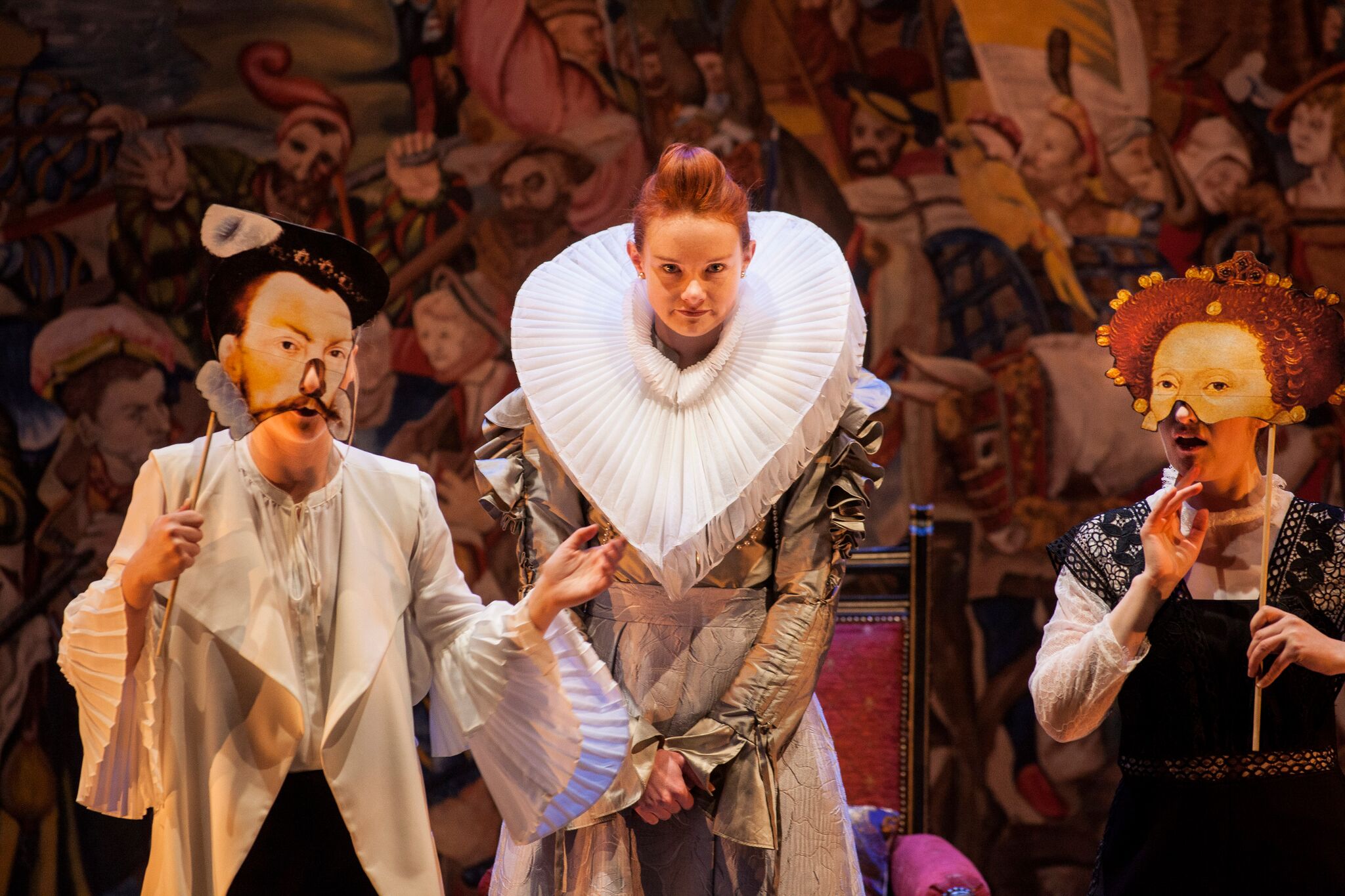
David Greig directs with a clear eye on what mattered then and should still matter now. Knox won and Mary failed. The austere and the severe are there in the steel blue lighting and the greys of an uncluttered set and in Knox’s strict delivery. Where there’s a wide and colourful tapestry, there’s dancing and short-lived levity. Elizabeth I, speaking through a mask, is both laughable and ominous and maybe the scheming Scottish nobility could have used the same distancing device. The disrobing of the queen at the end has its own proper and tragic significance.

‘Be wise now therefore, O ye kings: be instructed, ye judges of the earth.
Serve the LORD with fear, and rejoice with trembling.’    From Psalm 2.

You won’t fall to your knees but Glory on Earth will make you give thanks for new writing and live theatre.
.

outstanding

StarStarStar

Reviewer: Alan Brown  (Seen 23 May)

Glory on Earth is at the Lyceum

Visit Edinburgh49 at The Lyceum

For The Love of Cousins (Various: 13 May-24 June ’17)

Jack Elliot, Taylar Donaldson and Christie Russell Brown

“A very commendable effort”

Editorial Rating: 4 Stars: Nae Bad

Funerals are often melting pots where far-flung family members are reunited for the first time since the last significant event, and in For The Love of Cousins, we see seven semi-friendly cousins meet just before the funeral of their mutual and much-loved grandmother. They are a mixed-bag of characters, with different stories and relationships with each other, and as the piece unravels, we learn more about each one – their secrets, their prejudices, and vulnerabilities.

While there is no compelling narrative overall, where Blazing Hyena’s production really succeeds is in the overall feel of the piece and the clear sense of family the company really creates – the use of repetitive jokes, the ganging up and snipping at each other all feel very genuine. Truths come out and perspectives change over the course of the action, all of which are presented humanely and sensitively.

For a play that centres around family members about to attend a funeral, it is packed full with jokes, and while the cast weren’t afraid to go for the laughs, sometimes the focus on the comedy aspect detracts from the realness of the situation, which some cast members are more guilty of than others. For me it is Jack Elliot as David, Rosie Milne as Dayna and Gillian Goupillot as Ronnie who are most impressive in maintaining the integrity of their characters throughout (while still being funny) and deliver fine performances.

Jack Elliot’s script, while commendable in its weaving of different characters and perspectives, is structurally a little rough around the edges – comings and goings of each character could be have more significance, while the closely intertwined nature of the dialogue sometimes makes it difficult to follow specific streams of narrative and relationships. A few tweaks here and there could make it very special indeed.

Catherine Exposito’s direction capably keeps the action slick, with respect to the light and shade required to keep the piece engaging throughout. Sometimes the staging and specific actions seem rather forced (I lost count of how many times a tablecloth was unnecessarily rearranged as a time-filler), so I would have liked to see the company use more creative ways to explore the natural “low” moments in order to maintain authenticity.

Overall, it’s a very commendable effort from this young company – especially given the adaptability they have to perform in different venues each night as part of this, an extensive Scottish tour. Do try and catch it on one of their future dates if you can. Full details here.

nae bad_blue

Star (blue)Star (blue)Star (blue)Star (blue)

Reviewer: Steve Griffin (Seen 16 May)

THIS REVIEW HAS NOT BEEN SUBEDITED

My Country (Traverse: 11 – 13 May ’17)

Penny Layden (Britannia) & Christian Patterson (Cymru).
Photo: Sarah Lee, NT

“A cocktail of feelings: a little sweet and pleasantly bubbly, with just the right amount of bitterness.”

Editorial Rating: 4 Stars Outstanding

Public opinion is a funny thing. A dramatic shift occurs in our society and suddenly everyone has something to say about it. Which is wonderful, of course. The more of us who care about what happens in our country, the better. But one of the questions that people always seem to ask in times like this is; “Do you remember where you were?” Do you remember where you were when the Twin Towers were attacked? …When you heard Michael Jackson had died? …When Trump was elected President?

Now, do you remember where you were on the morning of 24th June 2016? Brexit Day. GB hands the European Union ‘our’ divorce papers. From that day, the word spread around the country like a hectic rash, spouting from the voice of every radio station, newspaper and neighbour. It was unstoppable, all-consuming and tense, yet it seemed to arouse a willingness in the people to debate and engage with the current events of our nation.

So what if the voices of these ordinary people from across our great lands were trumpeted aloud for all to hear? A creative way of bringing about social change, perhaps? Or a spark that will encourage us to listen, and prevent the fire of the debate extinguishing? The National Theatre seemed to think so. And when the NT starts to roll with an idea, it tends to pay off. Headed up by the company’s own Artistic Director, Rufus Norris, My Country came to the Traverse Theatre last week as part of its UK tour, bringing with it the voices of these people for us to hear.

We are immediately welcomed to a boardroom by Britannia, played by Penny Layden. Olivier-award-winning Katrina Lindsay’s simple yet effective set is businesslike and blue, complete with water cooler and official-looking desks, as well as a row of ballot boxes to remind us why we are there. In come the regions: Caledonia, Cymru, East Midlands, Northern Ireland, North East, and South West, with Britannia as our Westminster. A strong set of seven, each actor representing the heart and soul of their respective parts of a still United Kingdom. And so the debate ensues.

While the cast are solid overall, there are a few standout performance among them. Chris Patterson as the booming voices of Cymru gives a performance that is both buoyant and vulnerable, shifting from brash old pub-dweller to the touching voice of a thirteen year old who only wishes to see the good in others. Equally captivating is Laura Elphinstone as the voices of the North East. Warm, honest and heartbreaking in her moments, she is fantastic to watch. But the glue holding the regions together is Penny Layden’s Britannia. Representing the heart of our government, Layden’s portrayal of Westminster’s politicians is spot on, generating both laughs and anger.

There is, at times, a slight risk of these performances dancing on the borderline of caricature, but the actors never cross it; these are real people with real stories to tell, and their words are treated with respect. Throughout the performance, Britannia constantly urges us to simply “listen”, despite our own opinions. And we do.

A verbatim piece could quite easily turn boring. In Edinburgh, where 74% of voters chose to remain, an audience could have been so opposed to the opinions of  ‘Leavers’ that they shut down completely. Yet that night in the Traverse Theatre, the opposite seemed to happen. We wanted to listen, and this is one of those special productions that generates a cocktail of feelings: a little sweet and pleasantly bubbly, with just the right amount of bitterness. It makes you angry and sad and happy all at the same time, and you’re not sure whether you should laugh, scoff or just let go and cry. Sadly only in Edinburgh for three nights, the company continue to move around the UK until its final performance on, appropriately, the 24th June 2017. Jump on a plane, train or bus and go and see this show. The question I would ask you in ten years is: do you remember where you were when you saw My Country? Don’t be one of the people whose answer is no.


outstanding

StarStarStarStar

Reviewer: Rachel Cram (Seen 12 May)

Go to My Country, National Theatre on tour

Visit the Edinburgh49‘s Traverse archive.