Lysistrata (Kings: 27 – 28 Jan.’17)

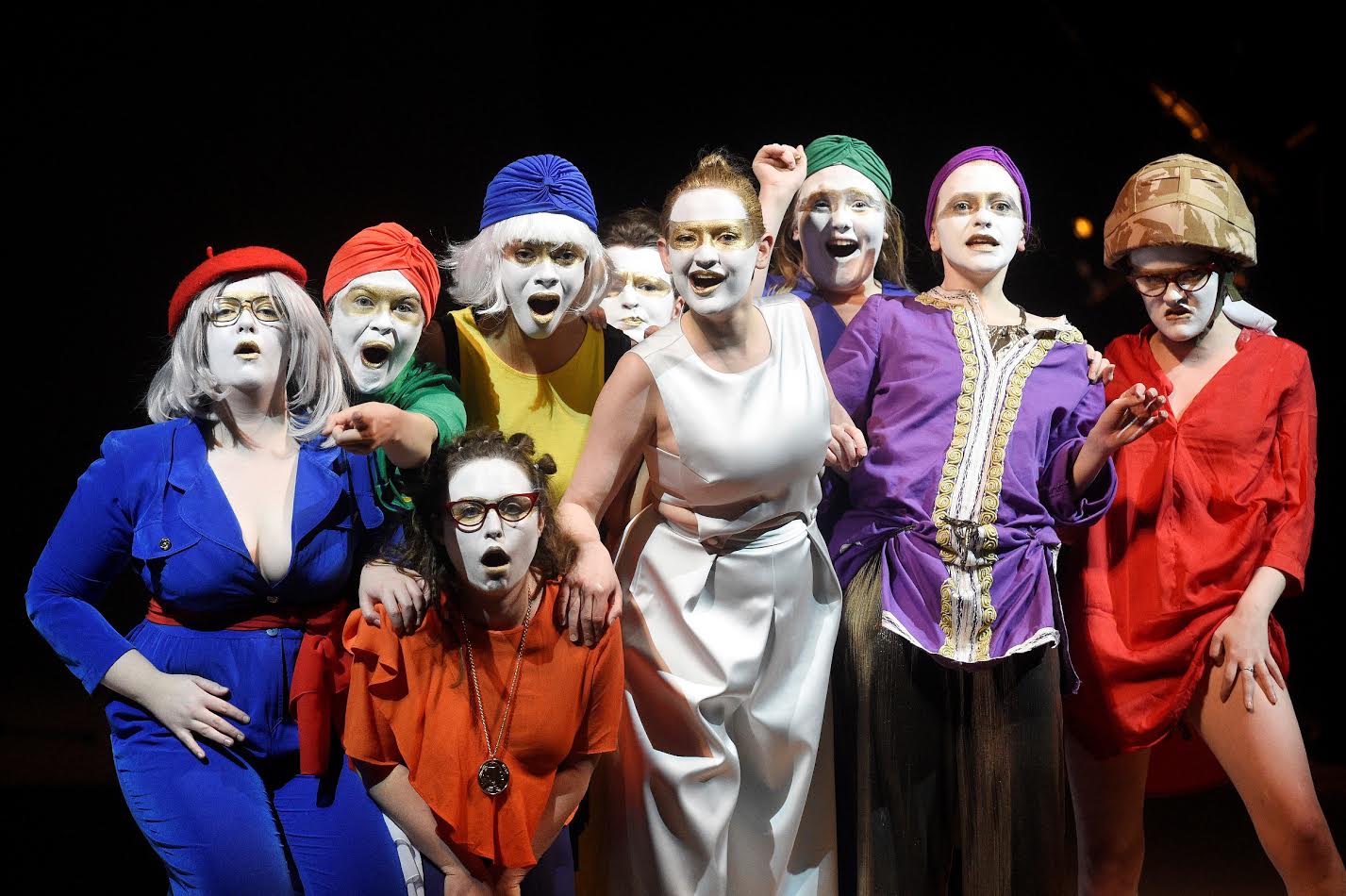
Cait Irvine, centre (Lysistrata) Photo: Greg Macvean

Cait Irvine, centre (Lysistrata)
Photo: Greg Macvean

“5th Century revel disarms ‘Call of Duty’”

Editorial Rating:  3 Stars: Outstanding

This is a tumultuous inaugural production by the Attic Collective. It has that shameless tumescent quality that really would ‘Make Greece Great Again’. Athens/Attica was still big in 411 BC but had been sorely bashed in Sicily and was hurting. Aristophanes’ Lysistrata must have been excruciating, urgent fun back then and it is remarkable that – in the right hands – it can still have the same effect.

As a play it’s less in-your-face than in-your-crotch. Just look at the tall curvy door, upstage centre, and reckon, pretty confidently, that it’s all about Pussy Power. Then there are the phalluses, not one of leather, but several of rubber and latex, and all impressive, but none more so than the Spartan emissary as gauche walking dick. Naturally enough there is supplication to Zeus for relief from priapism.

The men suffer because the women have crossed their legs. Lysistrata leads a women’s revolt that denies sex to husbands (and wives) until the Peloponnesian War ends. They occupy the Treasury – a smart kick in the balls –  and wait for their men to come to their senses, as it were. They are finally brought to it by the body beautiful of Kim Kardashian, aka. Aristophanes’ figure of Reconciliation. Of course, the women are frustrated too and invent desperate, hilarious, excuses to return home.

Conor McLeod (Men's Leader) and Megan Fraser (Statyllis)

Conor McLeod (Men’s Leader) and Megan Fraser (Statyllis)

This is when a 5th Century revel disarms ‘Call of Duty’. ‘Tits not Targets’ is the message. It’s summery: the men are in a uniform of white shirts, cropped chinos and canvas slip-ons. Not a spear or bronze helmet in sight. Just helmets from the Urban dictionary. Cinesias (Adam George Butler) has his shades. Their leader (Conor McLeod) is a dapper, convinced and convincing kind of chap. Meanwhile the women are a riot of colour with their white faces and ‘war paint’ and they soak the men with Water Blasters. It’s loud too, especially when Charlie West hits his box drum.

Arguably the on-stage debate is one-sided. Determined Lysistrata (Cait Irvine) and cocky Stratyllis (Megan Fraser) reduce the men to defensive huddles and oddly impotent hakas. Deciding  to dump the split Choruses of the old men and women of Athens does tilt the balance in favour of the youthful and the libidinous (no real loss!) and the sense of the words can go AWOL in dionysiac chant and jabber but there’s no doubting the drive and sense of the piece as a whole. Director Susan Worsfold and Musical Director Garry Cameron succeed in sustaining dramatic form, resolved in celebration, from a plot that is about as carnal and abandoned as it gets.

By the by, a Belgian lady senator called for a sex strike in 2011. It was meant as a provocative joke but it excited the Christian Democratic opposition to remark that “Politicians are not there to strike. On the contrary, politicians are there to arouse the country.” Hear! Hear! (Aristophanes).

outstanding

StarStarStar

Reviewer: Alan Brown (Seen 27  January)

Go to the Attic Collective with edtheatres.com.

The Edinburgh49 archive at the King’s Theatre

Mack the Knife (Bedlam: 25 – 26 Jan.’17)

mack-the-knife

“Lady, ‘the hottest ticket in town’”

Editorial Rating: 3 Stars

There’s a virtual Hall of Fame in this show: Brecht, Weill, Lotte Lenya, to start with; and a few music greats – Ella Fitzgerald, Ray Charles, Sinatra – and then Kevin Spacey as Bobby Darin with the title song. If you want more, there could be Tony Bennett and Lady Gaga’s The Lady is a Tramp and a passing literary reference to Raymond Chandler’s Philip Marlowe.

Nathaniel Brimmer-Beller would channel them all through his play. It’s a clever and applaudable conceit but the interference is too much. Too many signals from too many sources.  A mellow jazz intro’ – nice – leads into Oh, Lady Be Good which given what follows is practically hilarious. ‘Lady’ sings that she’s ‘all alone in this big city’ but for all her lonesomeness she is plainly making out just fine. It helps that the competition in the other clubs is thinning out, alarmingly so in fact, and the police appear clueless.

Detective Foster (Paddy Echlin) likes his work. He’s had lessons in psychological profiling and Jack the Ripper is on his mind rather than Georgia but he’s a poor sap. He has the sharp trench coat and the 50’s trilby but is not the hard-boiled character that he thinks he is. More a marshmallow with a toy gun.  Deacon (Jacob Brown), Lady’s trumpet player, is more on the case and knows a set-up when he sees one but unfortunately his incredulous WTF’s don’t help him. As for Lady, ‘the hottest ticket in town’, Jo Hill enjoys herself. She’s sassy at the mike, sings confidently, and is audacious beyond reckoning.

And here’s the rub. Lady’s luck – call it ‘cool’ if you must – is something else. It turns tension into the comic macabre, not least when she kneecaps herself and stays on her feet. Maybe her aim was off but even a flesh wound must hurt like hell. Then there’s the absolute gift of a police detective who ‘packs heat’ like Clouseau on holiday.

Will Briant on piano and Vebjorn Halvfjierdvik on bass give the piece a tempo and style that if extended – for the Fringe, say – could lift the play into the lighter, skilful register that Brimmer-Beller is reaching for.

Star (blue)Star (blue)Star (blue)

Reviewer: Alan Brown (Seen 25 January)

Go to Bedlam Theatre

Visit Edinburgh49‘s Bedlam archive.

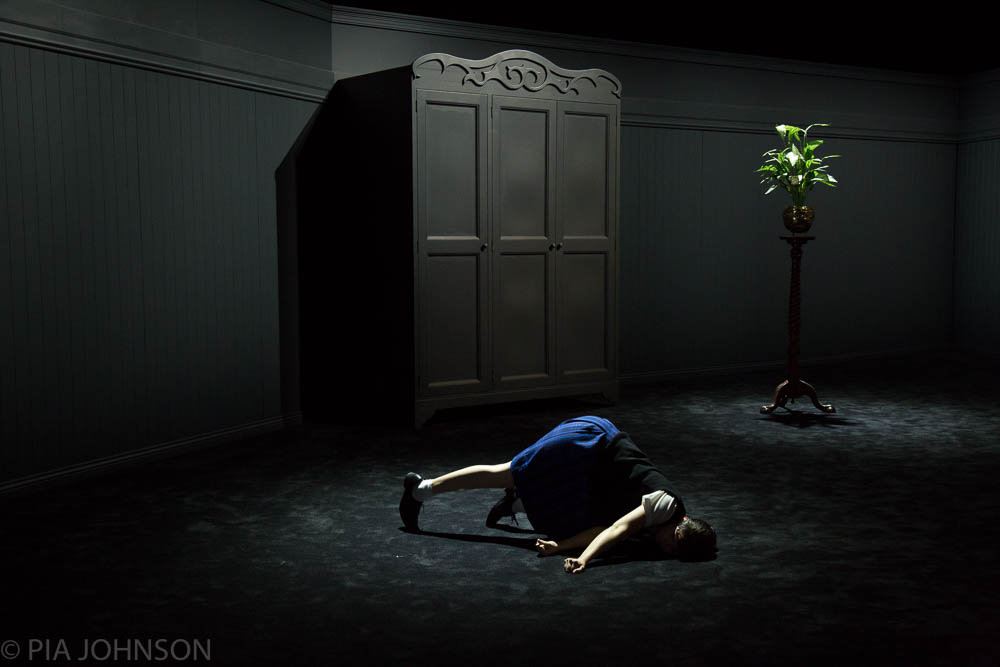
Picnic at Hanging Rock (Lyceum: 13 – 28 January ’17)

hanging-rock-1

“It’s cool, it’s chilling and it shocks”

Editorial Rating: 4 Stars: Nae Bad

Do you approach Hanging Rock expecting to see corsets hanging in mid-air? Well, in which case you will have noted that the excised last chapter of Joan Lindsay’s 1967 book provides this astonishing feature. Either that or you’re wandering in a Dreamtime of your own (adolescent) imagination, set about with eucalyptus trees and hot flushes from Peter Weir’s 1975 screenplay. Now here comes the wake-up call, a dramatic restorative, if you will.  It’s cool, it’s chilling and it shocks.

This Picnic at Hanging Rock is a stylish outing, to say the least, from Melbourne’s Malthouse Theatre and Perth’s Black Swan Theatre Company. That’s Perth, Western Australia, and that’s a collaboration over 2170 miles, but who’s counting? This is Tom Wright’s adaptation but as in Lindsay’s story distance is of no consequence and time is suspended, ‘running out and spooling in’, between grey black panelling topped with brushwood. No rock is visible and there is no interval.

There is thunder and a blackout and five schoolgirls suddenly appear, side by side across the stage, in immaculate uniform ready for Speech Day 2017. They tell the story, their shared creepy story, of what happened on St Valentine’s Day, 1900, when a daytrip from Appleyard College went to Hanging Rock and four girls and one teacher disappear. One of them, Irma, is later found, close to death, and with absolutely no memory of what happened. It is, at its opening, a composed and perfectly disciplined account that you realise is the sure and safe way to rationalise the irrational, the unknown and the dangerous. It is a long introduction but necessary, for in this telling you understand that an ancient landmark is an abcess to be swabbed away for the sake of white Australians everywhere and young ladies from proper schools can never be too English. Whatever happened, dear, it’s really too, too bad that it happened in the state of Victoria.

hanging-rock-2

There are parasols to ward off the sun, a grand aspidistra to maintain respectability, and – figuratively – there must be ‘lino, asphalt, and axminster’ to hide the red earth. Mrs Appleyard, founder and Headmistress, remembers Bournemouth but dreams of the  intimate touch of her (?dead) husband. Irma, returns to the school before leaving for a stay in England and is viciously attacked by girls suffocating in their own propriety. Director Matthew Lutton works to challenge perceptions: angling the girls in contorted positions, immobilizing their movements in successive freeze-frame ‘shots’, subjecting the narrative to enigmatic surtitles over frequent blackouts. How else to refresh, even subvert, what has become an almost mythological text, complete with panpipes?

It is actually without humour – an unusual and tense achievement over eighty-five minutes – but the performances of the several characters are still appealingly unaffected and distinct. Amber McMahon cross-dresses as the young Englishman, Michael Fitzhubert, but there’s no caricature here. Elizabeth Nabben is Mrs Appleyard and builds a fragile role to its last despairing moment; Nikki Shiels suffers as Irma, whose fate it is to keep her nightmares under control, whilst Arielle Gray and Harriet Gordon-Anderson are in supporting roles that they make important.

Is an audience bushwhacked by theatrical device and intelligence? I think so, but it is performed with considerable respect for its source and the script is smart, spare and ingenious. Technically it works a treat with outstanding lighting and sound and this is probably one production where the ‘best’ seats, for the best effect, are probably at the front of the Upper Circle and you should definitely read the Director’s and Writer’s programme notes after the show because they’re too helpful. The play’s the thing.

[FYI. Bruce Springsteen and the E Street Band play at Hanging Rock on Saturday 11 February. You simply cannot keep a good place down!]

nae bad_blue

Star (blue)Star (blue)Star (blue)Star (blue)

Reviewer: Alan Brown  (Seen 14 January)

Picnic at Hanging Rock at the Lyceum

Visit Edinburgh49‘s The Lyceum  archive.

Alice’s Adventures in Wonderland (Lyceum: 26 Nov – 31 Dec.’16)

Photo credit Drew Farrell. (L-R) David Carlyle as Gryphon, David James Kirkwood as cast, Jess Peet as Alice, Gabriel Quigley as Queen of Hearts, John Macaulay as King, Alan Francis as Duchess, & Tori Burgess as cast.

Photo credits: Drew Farrell.
(L-R) David Carlyle as Gryphon, David James Kirkwood as cast, Jess Peet as Alice, Gabriel Quigley as Queen of Hearts, John Macaulay as King, Alan Francis as Duchess, & Tori Burgess as cast.

“This particular and generous invitation to Wonderland should be accepted at once”

Editorial Rating:  4 Stars: Outstanding

When Alice’s Adventures in Wonderland was first published Britain also got its first speed limits for horseless vehicles. The Locomotive Act of 1865 meant no more than 4mph in the countryside and 2mph in towns, together with a red warning flag. No doubt Edinburgh Council is heading that way again, and for good reason, but that does not stop Anthony Neilson’s version of Lewis Carroll’s nonsense classic from being very welcome, fast and surprising.

‘A large rabbit-hole under the hedge’ it has to be, for how else could a very round White Rabbit (WR) go down it? Wowza! It is some exit! Children gasped. And ‘in another moment’ down went Alice after WR, feet first, ‘never once considering how in the world she was to get out again’. No worries – as Alice plummets towards Australia – remember that this is a ten year old on approach to Wonderland.

 The Lyceum is bedecked with small hot air balloons and a fluttering kite. Fairground music plays on and up goes the title in lights, announcing the main attraction as part gaiety theatre, part fond and exuberant dream. It is all, quite naturally, larger than life. Wait until you see the size of the Duchess’s baby. And those arms! Surreal. The Cheshire Puss grins from within the disc of the sun, Alice gets stuck inside WR’s des res and there’s alarming talk of Giant Child infestation. Set a jumbo tea service upon designer Francis O’Connor’s super revolve, press the ‘On’ button and see the glittering tea leaves fly …

(L-R) Jess Peet as Alice, Isobel McArthur as Dormouse, David Carlyle as March Hare, & Tam Dean Burn as the Mad Hatter

(L-R) Jess Peet as Alice, Isobel McArthur as Dormouse, David Carlyle as March Hare, & Tam Dean Burn as the Mad Hatter

It may, at the close, be all Victorian and ‘lingering in the golden gleam’ – and that’s ok, as Carroll admired Tennyson after all (& photographed him) – but in terms of performance and effect the surface quality is lively and attractive. There’s nothing adrift here; no pool of tears either. Instead Alice (Jess Peet) is pretty contemporary: sure-footed and unfazed, arguably more midshipman in the Home Fleet than a dreamy little girl from Oxford, but resolute with crystal diction and a level gaze. Tam Dean Burn plays the Hatter as mad as mad can be without terrifying a young audience and he has maniacal fun with the safety curtain. Mordant humour might well be the preserve of the Welsh and – for me – David Carlyle’s glum Gryphon, marvellously at odds with his colourful plumage, is the co-star of the show. He (and not the Knave) stands accused of stealing the Queen’s tarts – surely a preposterous charge, for who could refuse to follow his courtly lead in the Lobster Quadrille?

As wholesome children’s picture books go The Very Hungry Caterpillar is up there with the best and Eric Carle’s creation, unlike Carroll’s, does not smoke a hookah but then it has long been observed that you ‘Do not look to ‘Alice’s Adventures’ for knowledge in disguise’. Quite what you do look for is your crazy, delighted, business and it might even, with a lot of luck, be the same as a child’s vision. A recipe for mock-turtle soup as pepper spray won’t appeal but otherwise this particular and generous invitation to Wonderland should be accepted at once, not least because no hedgehog was harmed in its production.

outstanding

StarStarStarStar

Reviewer: Alan Brown (Seen 1 December)

Go to Alice’s Adventures in Wonderland at the Lyceum

Visit Edinburgh49’s The Lyceum archive.

Blackbird (Bedlam: 16-17 Nov ’16)

“Powerful and moving”

Editorial Rating: 3 Stars: Nae Bad

I was quite apprehensive before taking my seat, as to how Edinburgh University Theatre Company would present the strong, emotive themes of trauma, abuse and love in David Harrower’s intense two-hander. With the entire play focusing on one conversation between the two central characters Ray and Una, how well would the actors sustain and communicate this challenging piece?

The plot sees Una (Sophia Dowson-Collins) seek out Ray (Benjamin Aluwihare) to confront him about the sexual relationship they had fifteen years prior – when she was only a 12 year old girl whilst he was a grown man of 40. She wants to face the past but he is at first unwilling to speak to her. As the play progresses they both go through a range of emotions, sometimes screaming at each other and at other times talking calmly about trivial things, creating a dramatic if at times, confusing dynamic.

The script is complex, taking a while to build and reel the audience in before taking a deeper and darker turn. We get to piece together more about the identities and personalities of both characters, and some surprising twists and turns reveal the truth of what happened fifteen years ago and how both characters have dealt with their experiences since. The silent captivation from my fellow audience members throughout told its own story: at times there was perceptible discomfort, and I personally found the whole thing quite awkward and difficult to watch, but only because the performance felt so real.

Although both performers did well I was particularly impressed by Dowson-Collins’s performance: at times there were long streaks where only she would speak – sometimes to Ray but often more like she was speaking to herself. She was captivating and consistent throughout, bringing a great sense or realness to her character. Aluwihare seemed nervous and awkward for the most part and although fitting with Ray’s character, it was difficult to tell how much “acting” came into play.

The set was perfectly suited to the action: it was very simple with just a couple of seats, a table and some office lockers, making the actors do the work to convey the story. In saying that, what didn’t work so well was the use of a plastic sheet hanging behind Una and Ray, from behind which a girl would appear to represent Una becoming a ghost of herself through everything she had experienced. Although I could see what the production was trying to do I felt like this distracted from the dialogue between Una and Ray, and a more creative way of expressing this idea could have been used to greater effect.

All in I was very impressed by the performance. The themes may not be to everyone’s taste, but it was still a fascinating watch.

nae bad_blue

Star (blue)Star (blue)Star (blue)

Reviewer: Iona Young (Seen 16 November)

Visit the Bedlam archive.

Too Long the Heart (The Biscuit Factory: 10 -12 Nov.’16)

Ian Sexon as Brady from the 2013 Siege Perilous production. Photo: Nicola Garman

Ian Sexon as Brady from the 2013 Siege Perilous production.
Photo: Nicola Garman

“a low flame thriller, splintered with humour, affection, and a weighty sense of modern history”

Editorial Rating: 3 Stars Nae Bad

Inbetween the ArmaLite and the ballot box there’s some poetry, at least that’s how it is in writer David Hutchison’s reworking of Too Long the Heart (Edinburgh, 2013). In literary terms it’s Yeats with a telling fragment from Easter 1916; in a softer more lyrical vein there’s the Mountains of Mourne. We’re in Ireland, sure enough, in a freezing cold cottage in County Cork, armed with a tin of biscuits, tea, handcuffs, a heavy duty revolver and a semi-automatic pistol.

Get the picture? This is a low flame thriller, splintered with humour, affection, and a weighty sense of modern history. Split screen projection of news footage of ‘The Troubles’ – still an understatement to die for – makes the backstory all the more apparent. Bloody Sunday, the Loughgall ambush, Shoot to Kill, and ‘Historic Compromise’; they’re all here. And when it’s more introspective, there’s quiet, live music and song on cello, flute and guitar.

There are four characters gathered in this cottage. Caitlin (Cabrina Conaty) and her boyfriend Marty (Des O’Gorman) arrive first. She, for good reason, is eager and excited. Marty, a third year History under-graduate, is likeable but clueless. When it really would have been best to have their faces hidden, he doesn’t get his balaclava on in time. Nevertheless and as planned they manage to snatch an English tourist, who 30 years ago was an army captain in Belfast, and – eejit! – has come to the Republic for a spot of fishing. Neil Lawson (Steve Hay) denies it, of course, but he’s still got the haircut, the neat moustache, the tattersall shirt and real composure under fire. Maybe he was taught some Yeats at Sandhurst. Anyway, he certainly has to prove his mettle when he’s up against Brady (Ian Sexon), a Provisional IRA commander, who has some unfinished business with the British officer class.

Three years on, the script is tighter and sharper, reckons David Hutchison. The play is still being developed and the sightlines are not all they should be but it certainly cracks along under Andy Corelli’s direction and the more tense the moment, the better the action that is called for. The closing fifteen minutes in which Brady plays the police against the media is not so neat that the suspense cannot work. Up to that point it’s more a case of each character smacking against their past – or, with Yeats again, negotiating ‘the stone [that’s] in the midst of all’. The topicality of the projected imagery helps here and there’s some digital ‘doubling’ for each character to confront. Interestingly I was ‘with’ each one of them, so sympathetic is the characterisation. Brady ridding his unit of the out-and-out headcases (terrorists?) for instance. It’s Caitlin who makes the patriotic call for her beloved country of Ireland, which is ok until – unwittingly – she’s trumped by the line to ‘Take your country back’ and so I stay firmly with the Army’s riposte, if not belief, that national myths are ‘convenient evasions’. Poor Marty cannot find traditional Irish music on the radio, but then he’s more a ‘Snow Patrol’ kind of guy.

Too Long the Heart is ninety minutes of well calibrated drama. If for you ‘The Troubles’ are simply another dismal instance of ethno-nationalist conflict, then this should enliven and disturb the category.

nae bad_blue

Star (blue)Star (blue)Star (blue)

Reviewer: Alan Brown (Seen 10 November)

Visit Edinburgh49 at the Other  venue archive.

Lyceum Variety Nights (Lyceum, 6 Nov. ’16)

“Left me genuinely begging for more”

Editorial Rating: 5 Stars: Outstanding

One of the first things they teach you about writing reviews is not to gush: to keep your mass of uncontrolled instant reactions behind a dam and only let through those considered, pertinent and articulate comments that are most valuable to the reader. The Lyceum’s first variety night, however, attacked my stiff upper lip of a dam with such force as to make gushing almost inevitable, with an evening of real high quality and passionately delivered entertainment.

It feels very wrong to pass a simple two sentence judgement on each of the seven acts who graced the stage simply for the sake of wordcount – suffice to say every single one dazzled, entertained and left me, genuinely, begging for more. Author Christopher Brookmyre’s reading of a tale about a group of teenagers on an outing to see A Midsummer Night’s Dream transported us to that very place, creating wondrous magical moments; Luke Wright’s poetry had many audience members cheering before he’d even finished performing, with the gutsy IDS, a poem about Iain Duncan Smith, constructed using only words contain the vowel sound “i” being a real triumph of wordplay and wit. Jenna Watt’s excerpt from solo show Faslane beamed with all the relevance, energy and honesty of her five-star Fringe run earlier this year, and Glasgow band A New International brought the house down with some of their greatest theatrical gypsy folk pop songs, which was an uplifting and triumphant finale.

The acts themselves were all excellent – professional, well-prepared, and comfortable in the kind of setting where the audience is a bit more vocal than they might normally be. But the evening was hosted and compered by Sian Bevan and Jenny Lindsay who brought a wonderful human and sensitive likeability to their role. At times their witterings seemed a little underprepared, and it would have been nice to see them perform some of their own material, but it was easy to feel comfortable and inspired in their presence.

While pitched right in my personal sweet spot, it’s worth saying that at times the content was a little unashamedly left-leaning, and it’s a shame that there was quite a bit of similarity between some of the acts (for a real variety night I would have loved to have seen some more diverse art forms in there as well (for example: dance, art, circus, puppetry, maybe even a short film) but the relatively low-tech, one-night nature of the beast may well bring such limitations. One can only hope the format proves popular enough to make this event a more regular and extended feature within the Lyceum’s calendar.

Based on round one, I would urge anyone with any sort of passing interest in the arts to get themselves along to the next event on 26th February. I’ll be first in line.

outstanding

StarStarStarStarStar

Reviewer: Steve Griffin (Seen 6 November)

Visit the The Lyceum archive.

THIS REVIEW HAS NOT BEEN SUBEDITED

Grain in the Blood (Traverse: 1 – 12 Nov.’16)

l to r: Frances Thorburn (Violet), Sarah Miele, Andrew Rothney, John Michie, Blythe Duff. Photos: Mihaela Bodlovic

l to r: Frances Thorburn (Violet), Sarah Miele, Andrew Rothney, John Michie, Blythe Duff.
Photos: Mihaela Bodlovic

“This hair-trigger of a play”

Editorial Rating: 5 Stars: Nae Bad

What is it about valleys? There’s the BBC’s Happy Valley and Edward Norton in Down in the Valley, also far from ‘happy’, and – seminally – there’s the Valley of the Shadow of Death, which is as good a place as any in which to locate Rob Drummond’s latest enthralling work. Once upon a time, ‘for hundreds of years in the valley everything was just so’, but then the thanksgiving poetry ran out, like blood. Time now, then, for a spell of compassionate release.

That’s the hope anyway, and it is hope that supports Sophia, whose grand-daughter Autumn, needs a kidney transplant if she is to live much beyond her twelfth birthday. Isaac, Sophia’s grown son, has it in him to help but naturally, dramatically, it is not as easy as that. In fact, after 85 minutes, it has all still to be decided, either by the words of a child terribly wise beyond her years or out of the barrels of a 12 bore shotgun. Orla O’Loughlin’s direction respects this hair-trigger of a play right to its showdown.

The action rises over 3½ days, counted as ‘three sleeps’ by Autumn, who is brat reporter and ancient Chorus combined. She knows the ‘Verses of the Harvest’ by heart and the rhythmic invocation of the Grain Mother as provider of health and happiness- sad joke –  sounds solemn and serious, ‘even though She doesn’t fucking exist’. That’s the thing about Autumn (Sarah Miele): she has that unnerving sacrilegious streak that adults can’t manage.

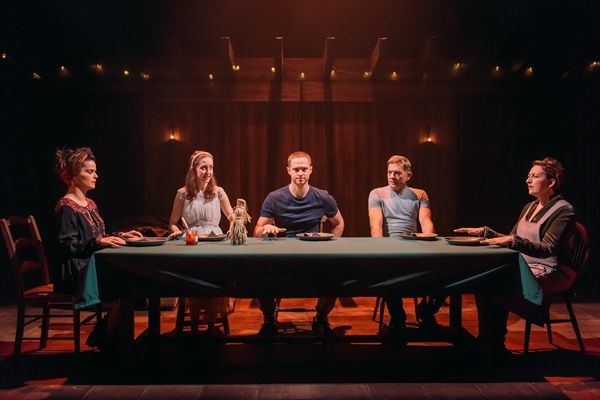
So, there is proper tension down on the farm. There’s even a game of ‘Truth or Dare?’ that contains the greatest reveal of them all, which is wickedly ironic as Isaac (Andrew Rothney) is described as ‘low risk’. Sophia (Blythe Duff) needs to believe that assessment whilst Burt (John Michie), is there as the phlegmatic companion to threatening circumstance. These two play out a nice challenge of ‘Would you kill scumbags to save your daughter?’, which just digs deeper into the disturbing, teasing, ethical dilemmas that Drummond delights in. Go to his Uncanny Valley for starters.

grain-in-the-blood-2

The remote rural location is part of the piece. Where better to unearth the unsettling and the rooted? The harvest moon can glint off Isaac’s blade and there’s the suffering of Auntie Violet’s horse to put alongside Sophia’s claim that ‘We’re all animals’, which might be what her veterinary practice has taught her. Her house is modern, of machined and polished wood, where you might expect low ceilings, wood smoke and warped timbers. The spare, snappy dialogue and careful movement suits the space, whose back wall slides away to show Autumn’s bed with its blood drip stand, or the barn, site of an earlier, bloodier horror. Introducing classical tragedy for our times, anyone?

Intrigued? You should be, because this is fascinating theatre, still and severe in its way, but emotionally resonant, well-focused and very well performed.

nae bad_blue

Star (blue)Star (blue)Star (blue)Star (blue)Star (blue)

Reviewer: Alan Brown  (Seen 1 November)

Go to Grain in the Blood at the Traverse

Visit Edinburgh49‘s Traverse archive

Dr Johnson Goes to Scotland (Traverse: 1 – 5 Nov. ’16)

l to r. Lewis Howden, Gerda Stevenson, Simon Donaldson, and Morna Young. Photo: Kirsty Anderson

l to r. Lewis Howden, Gerda Stevenson, Simon Donaldson, and Morna Young.
Photo: Kirsty Anderson

“Comic effect knocks against an open coffin on Iona”

Editorial Rating: 3 Stars

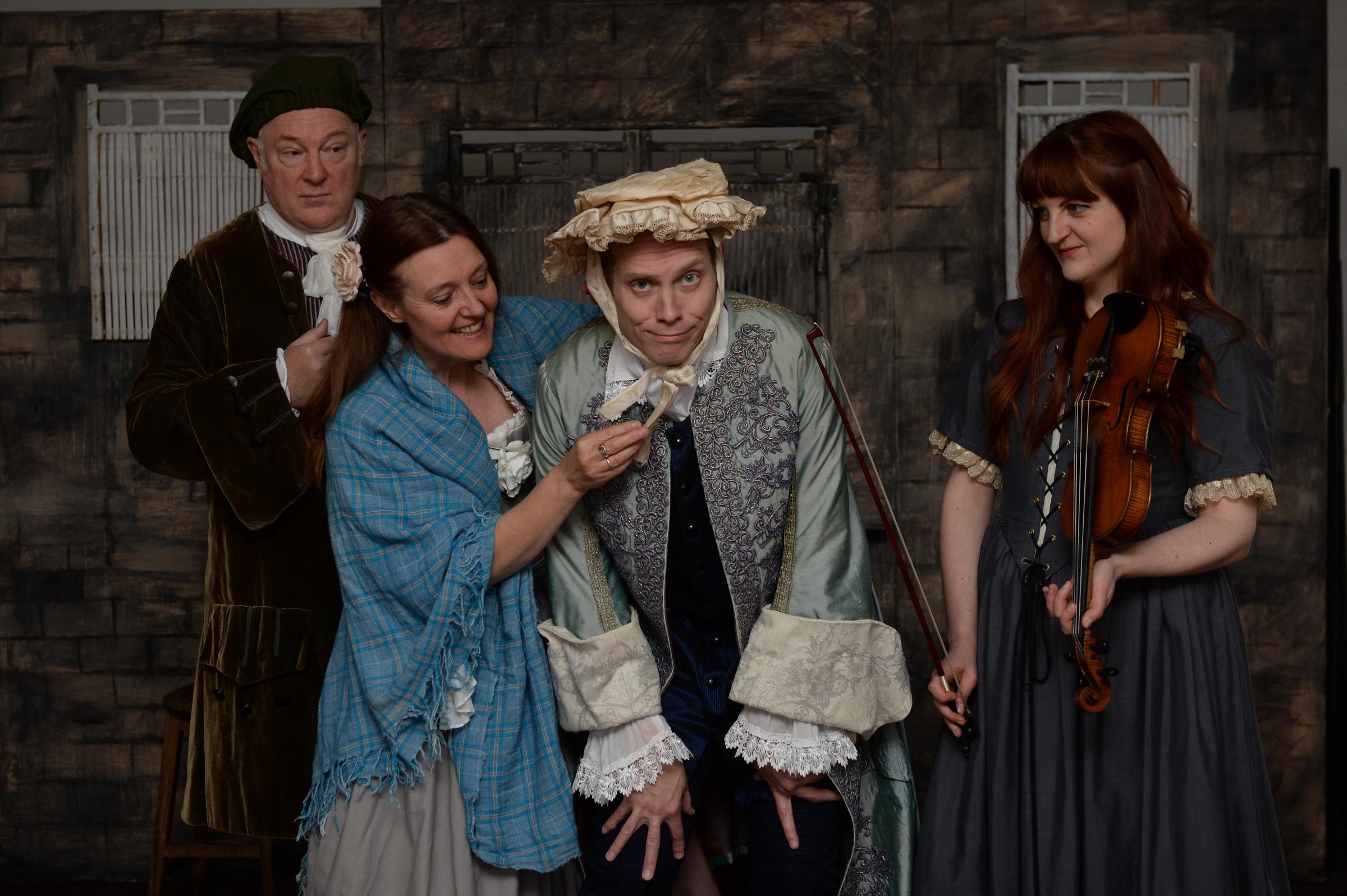
Would Samuel Johnson, heroic dictionary maker, essayist, critic, and celebrity wit ever have appeared on ‘Strictly’? Perhaps. He was, after all, prone to nervous shakes and tics and he would have been mercilessly brilliant at discombobulating the judges. Anyhow, in the last of the current season of a Play, a Pie, and a Pint, the big man is in polished boots and plaid and he steps up to a jig and seems to enjoy it.

And verily this is the same Dr Johnson, who noticed that ‘the whole [of Edinburgh] bears some resemblance to the old part of Birmingham’. Writer James Runcie continues his rehabilitation of the arch English nationalist by rowing him thoughtfully and fondly over the sea to Skye (and to Mull and Raasay). A Word with Dr Johnson – at the Traverse in October last year – was about the man, his wife, and his English dictionary; this time (1773) he’s in the boondocks and the heather and the Gaelic. For the proto London-centric it’s an ear-bending peregrination in a land where ‘you have more words than people’, which could well have been its chief attraction.

Lewis Howden plays Johnson sympathetically, of splendid girth and with orotund voice, and with a baffled interest in all things Scottish. An exploration of Fingal’s Cave, lantern in hand, leaves him only dimly enlightened but his enthusiasm for Thomas Braidwood’s school for the deaf and dumb is obviously sincere.  His companion throughout is, of course, the amiable James Boswell (admirable by Simon Donaldson), who treats us to evocative latin from Dunbar’s ‘Lament for the Makars’, whilst guarding his distinguished author friend from the sublime and local peril of being called a bampot.

So then, a pleasing trot through good old Scottish ways ? Runcie even brings on ‘Macbeth’ and the Bonnie Prince, which is fine until their comic effect knocks against an open coffin on Iona and a poem of freedom in earnest pursuit of the Scottish nation. Supporting roles by Gerda Stevenson and Morna Young are amusing and/or tuneful but my distinct impression was of looking in at the tartan themed windows of discount booksellers, The Works, on Princes Street. The learned Dr.’s eye would take in a remaindered copy of his  ‘A Journey to the Western Islands’; he would harrumph, say “I’m deeply obliged”, and move on.

Star (blue)Star (blue)Star (blue)

Reviewer: Alan Brown (Seen 1 November)

Go to Dr Johnson Goes to Scotland at the Traverse

Visit Edinburgh49‘s Traverse archive.

One Thinks of It All as a Dream (Traverse: 25-29 October ’16)

“Euan Cuthbertson as Syd shows great range and dexterity”

Editorial Rating: 3 Stars

Competent, solid, predictable: words probably rarely used to describe Pink Floyd’s music, but to me the most apt in summarising One Thinks of It All as a Dream – the latest instalment in the Traverse Theatre’s A Play, A Pie and A Pint season. The play, which follows the band’s early years, in particular Syd Barrett’s influence, is interesting for those that know little of the history, but in all other respects doesn’t give much to shout about.

For a theatre piece about such a genre-defining and experimental band, one might expect an edgy or original approach to form and structure to creatively fit the subject matter (drugs and mental illness are common themes), but instead this production follows a simple linear narrative and style typical of (and there have been so many) a musical star’s biopic.

It is structured well in giving nods to all the necessary turning points and dramatic moments to keep interest in the narrative, and the second half flows very naturally in terms of building up tension and allowing the actors to really sell the story. Early on the dialogue is quite forced to convey necessary information – in particular in one party scene the characters all sit around discussing what’s just happened, which comes across as very stilted.

The more engaging parts of this show are the longer and more developed scenes – the first television interview, Roger’s meeting with a psychiatrist and the final few minutes in particular enable the development of more emotional involvement with the action. As quite a pacy piece covering several years it’s quite hard to build a connection with each moment: before you know it you’re off somewhere else again, trying to keep up with who’s who and where and when we are.

The acting is good, Euan Cuthbertson as Syd shows great range and dexterity, particularly in scenes with his father, and the other actors give credible support to keep the action moving. Jonathan Scott’s design should also receive special mention, creating a flexible yet stylish space for the actors to move around in and facilitate a smooth performance.

It’s a perfectly passable show, but not a great show. For me, another brick in the wall.

Star (blue)Star (blue)Star (blue)

Reviewer: Steve Griffin (Seen 25 October)

Visit the Traverse archive.

THIS REVIEW HAS NOT BEEN SUBEDITED