Walking on Walls (Traverse: 18 – 22 October’16)

Image: Leslie Black

Image: Leslie Black

“Funny and searching by turns”

Editorial Rating: 4 Stars

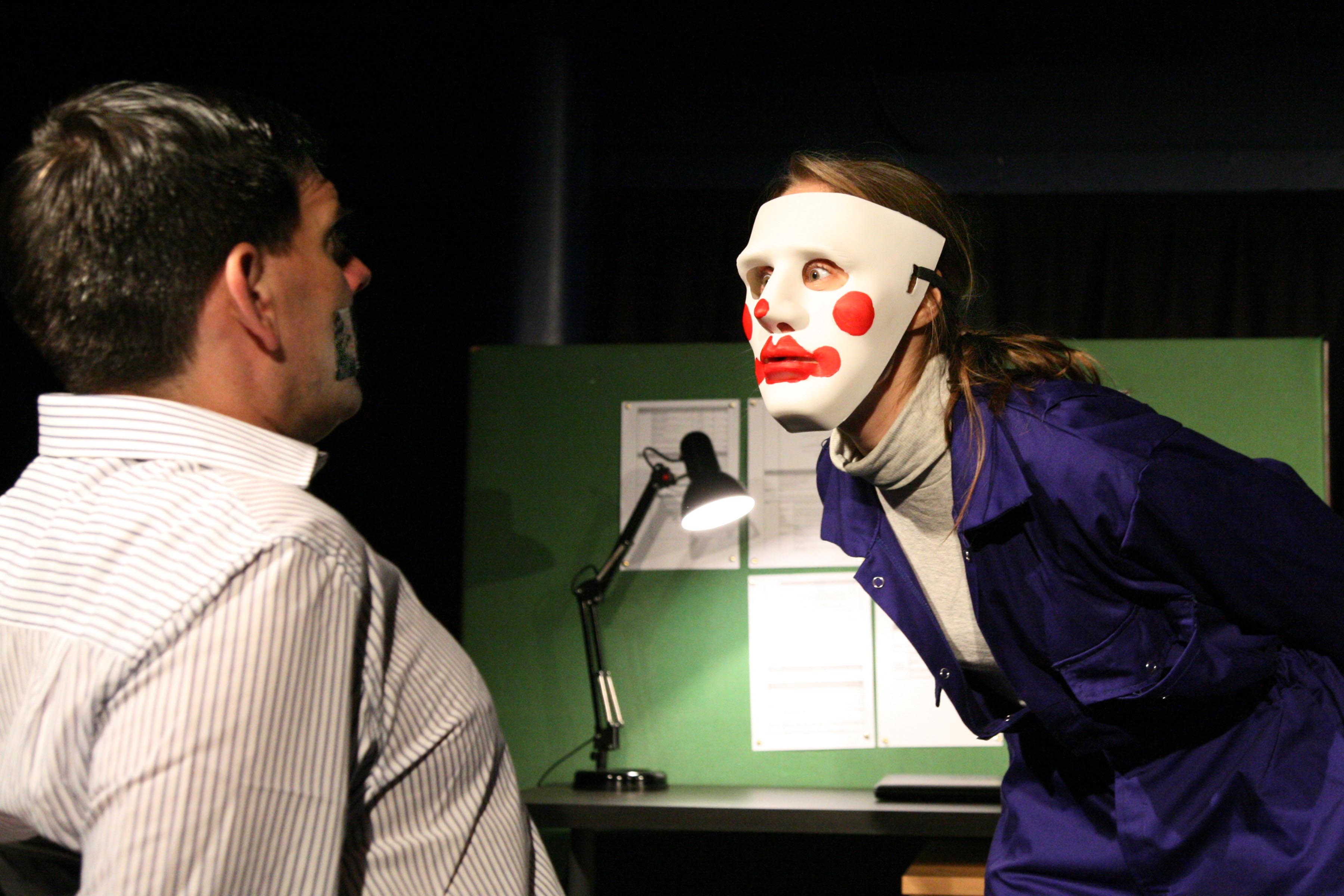
You would not take Claire for a creepy clown. Have there been any sightings in Edinburgh yet? With Halloween around the corner there may well be a few popping up at the window or from behind a wall, which is where Claire comes into her own. She’s the ever so earnest social scientist who doubles as a Super Helpful Person, who just happens to wear a clown mask when she’s out at night looking after people. You could say she looks over them.

Nobody’s laughing at the sinister clown craze, least of all the police, and we shouldn’t laugh at Claire, who has just called them – again; but we do laugh at her, just as the police do, because Morna Pearson’s script makes it all too easy to. Poor Claire with her big round specs and love of chat-defying stats, who’ll never be down the pub after work. But this is the same Claire who notices that (normal) ‘people don’t board themselves up’ unless they’ve been hurt and are vulnerable.

You’ll hear a lot from Claire (Helen MacKay) as she explains herself and her wacky, neighbourly, exploits. She is admirably audible, even from behind the mask. You’ll hear less from Fraser (Andy Clark), not least because of the duct tape across his mouth, but he’s impressive at being incredulous, dumb, and helpless. Unsurprisingly he’s in WTF mode and tries to stay there until he too is affected by Claire’s story. Well, he might be affected, and that’s the point of Pearson’s stinging, interrogatory close.

It is a questioning piece, funny and searching by turns. Who’s the victim here, for one thing, and what’s their space like? Andy is literally bound in his and is pushed around by a young woman, which has to be a valuable experience for him. With Claire it is more complicated. Work is probably the featureless desk, stage left. Home seems to have shut behind her and seems inextricably part of a very unhappy time at school. She sees the empty Buckie bottles and used condoms in the street and it’s all pretty ugly.

There’s tension, of sorts. I saw and heard the opening out and folding up of Claire’s neighbourhood map – with its anti-social ‘hotspots’ – and thought, characteristically, ‘Metaphor-for-Anomie’, which is almost certainly to go too far. Walking on Walls is more interested in seeking kindness than anything else.

Walking on Walls is the third play in the Traverse’s current series of ‘A Play, a Pie, and a Pint’ from Oran Mor, Glasgow.

Star (blue)Star (blue)Star (blue)Star (blue)

Reviewer: Alan Brown (Seen 18 October)

Go to Walking on Walls at the Traverse

Visit Edinburgh49‘s Traverse archive.

Frost / Nixon (Bedlam: 12 – 15 Oct.’16)

frost-nixon

David Frost (Callum Pope), left, interviews Richard Nixon (Paddy Echlin)

“The whole impression is one of a gathering and important moment.”

Editorial Rating:  4 Stars: Nae Bad

It’s a generational, media churned, thing. For Brits over 40 to call Peter Morgan’s Frost / Nixon (2006) the ‘real deal’, might be to ask ‘Collectable’ or ‘Antique’?; for Bedlam’s student audience this enthralling play on fact is simply ‘Legit’. Producer Patrick Beddow can be well pleased with its timeliness, coming as it does during the objectionable and tawdry business of the Hillary and Donald Show. Doubtless Frost / Nixon is relevant as U.S political history from 1977 but director Nathaniel Brimmer-Beller and cast make darned sure that it will still grab your attention as a piece of theatre.

David Frost died in 2013 and has the latest memorial stone in Poets’ Corner in Westminster Abbey, which says a lot about the influence of TV these days. Anyhow, he was 39 when he interviewed former President Richard Nixon, three years after Nixon was forced to resign following Watergate. Twenty-four hours plus of recorded material was edited into four ninety minute broadcasts. The first, on 5 May 1977, drew 45 million viewers, still the largest television audience for a political interview ever. Frost /Nixon is the story of how this big (and very real) deal happened, or kind of happened, and how it played out on all those screens. Frost was reckoned a lightweight, capable of only pitching softball questions, ‘puffballs’, that Nixon would just smash over the outfield fence and pocket $600,000. Well, he got his money – and a snazzy gift of Italian shoes – but not all the home runs.

Paddy Echlin is Nixon and Callum Pope is Frost and one on one, with a strong script, it’s a revealing double act. Frost, dapper and debonair, is still a shrewd operator. Nixon, is clever, practised, and self-assured almost to the last. Voice, gesture, timing are studied and effective. Off-camera – and there are cameras on stage – you get just enough of their personal lives to feel interested. Whether, you should sympathise with Richard Nixon is, of course, a contentious question but Echlin’s performance may well win you round. His chief of staff, Jack Brennan (Sasha Briggs), defends him against the liberal ‘side’, where Macleod Stephen as James Reston is particularly telling as player and commentator.

It’s 90 minutes straight through with no interval, which is a good call. Scenes proceed briskly and there are only a few chairs to move around and the whole impression is one of a gathering and important moment. The cameras provide some tight close-ups, and are a helpful reminder that this is a made-for-television ‘event’, but the flood lights do fade Nixon’s jowls to nothing. Otherwise, this is illuminating work.

nae bad_blue

Star (blue)Star (blue)Star (blue)Star (blue)

Reviewer: Alan Brown (Seen 12 October)

[Student? Want to review with us? Please email editor@edinburgh49.com]

Visit Bedlam Theatre

Visit Edinburgh49′s Bedlam archive.

Mischief (Traverse: 11-15 Oct ’16)

“Life-affirming and devastating in equal measure”

Editorial Rating: 3 Stars: Nae Bad

Ronnat and Brigid, mother and daughter, live alone on a small island, save for some cows that they tend to for a group of monks on a neighbouring island. But when the handsome young sailor Fari washes up on their beach, their little world is set to be changed forever. For his own good, Fari is sent off to live with the monks with the next dispatch of milk, but he soon becomes responsible for transporting the milk back and forward, meaning frequent visits to the women on the island, which have deeper effects on them all than any of them initially realise.

It’s a simple but intriguing set up, and Ellie Stewart’s writing creates a believable world and relationship web between the three characters that slowly unfurls as the play progresses. The plot is full of changes in direction and power between each one, keeping the tension alive throughout, and leading to a final scene and denouement that’s both life-affirming and devastating in equal measure.

While covering quite a “serious” overall topic, a fair amount of comedy is woven in, largely through quite overt sexualisation. Such moments are generally amusing, though do perhaps cheapen the play and divert attention away from the main drama, which is the piece’s real strength. Traditional singing and movement are also used throughout which in some ways add to the sense of history and ritual one would expect from such a setup, but in others seem a bit gratuitous in trying to cram in too many devices. Overall I think Mischief (a slightly misleading title) tries a bit too hard to do too much in such a short space of time.

What would make this play more effective would be a greater sense of stillness and time – there are quite a few scenes and scene changes as the story progresses at a pretty rollicking pace, but given the life-changing themes and choices presented, Gerda Stevenson’s slick direction never really gives enough opportunity for the situation or newly revealed facts to just hang and be absorbed. The young cast, in their earnestness, also seem very keen to over-emote and play up to stereotypical roles, when a subtler and more grounded approach would help make the play’s decisive moments stand out.

It’s a moving and captivating piece that’s cleverly written, but not realised to its full potential in this production.

nae bad_blue

Star (blue)Star (blue)Star (blue)

Reviewer: Steve Griffin (Seen 11 October)

Visit the Traverse archive.

THIS REVIEW HAS NOT BEEN SUBEDITED

The Suppliant Women (Lyceum: 1 -15 October ’16)

r. centre: Gemma May, Chorus Leader. Photos: Stephen Cummiskey.

r. centre: Gemma May, Chorus Leader.
Photos: Stephen Cummiskey.

“They do lovely huddled sounds of the night too, complete with sheep and Peloponnesian crickets.”

Editorial Rating: 4 Stars

Does it really come down to drink: a muscular Greek wine, £5.50 from Tesco say, against Egyptian small beer? Well, the libation was a full-bodied red and it went down a treat, all down the front of the stage in fact, and the bladdered sons of Aegyptos are repelled. The 50 refugee daughters of Danaus are safe in Argos – for now – protected by Zeus, the popular will, and by their father, whose clear head and savvy style suggests that he’s teetotal.

The Suppliant Women is heady, old theatre. Aeschylus wrote it for Athenians of his time (the demos of 500BC) and David Greig gives us his 90 minute version for our duty-free enfranchised time, when ‘border security’ matters and our leaders debate migrant quotas. Nevertheless and to its credit, as directed by Ramin Grey, this stays a civic piece, obliged to its community, retaining Aeschylus’ Chorus of (local) young women who seek asylum from forced marriage. It also – and very admirably – features original music by John Browne for percussion and aulos, single and double. What’s not to respect?

l.Imogen Rowe & Anna MacKennan, r.

l.Imogen Rowe & Anna MacKennan, r.

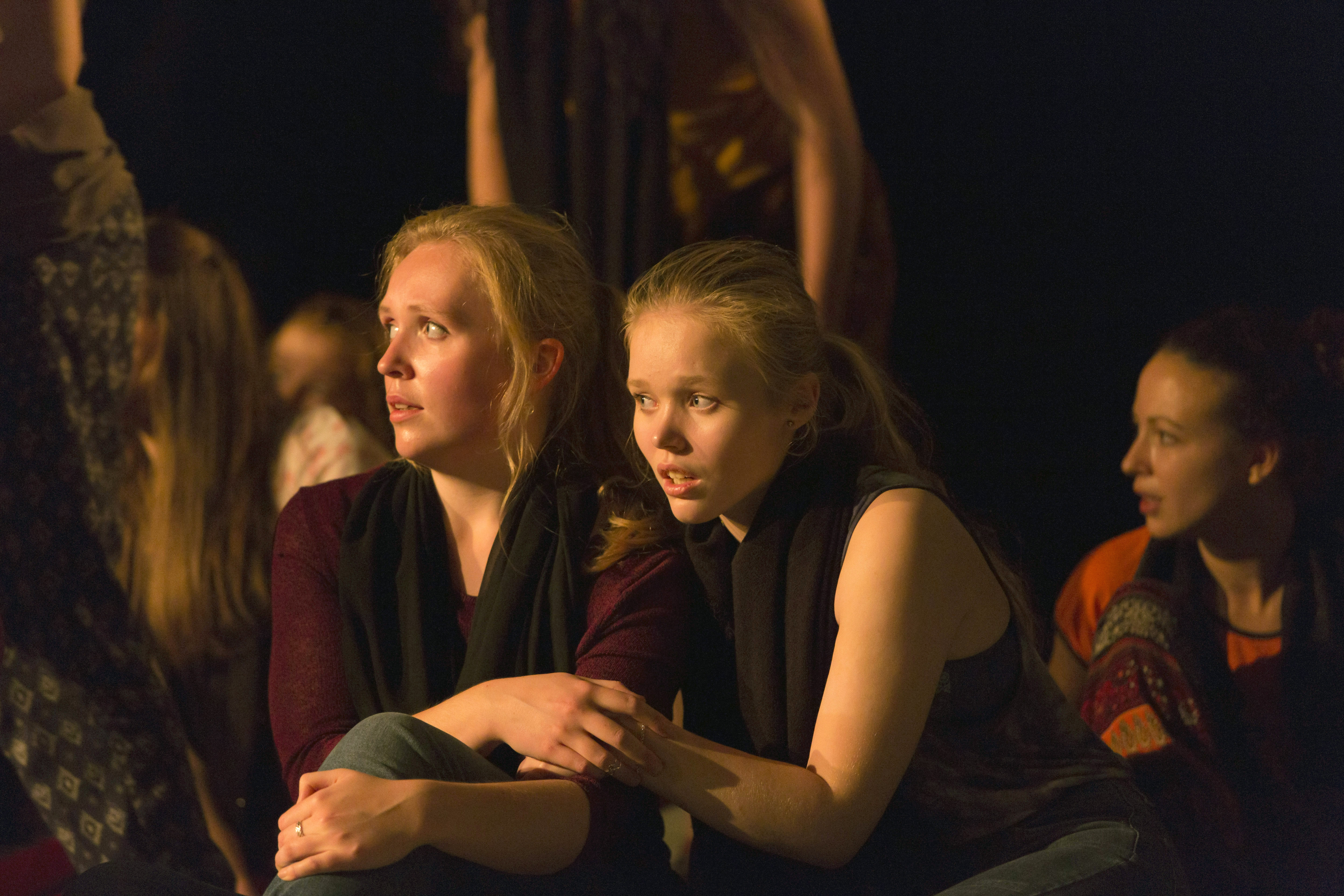
The Chorus is 36 determined volunteers from Edinburgh with a standout leader (Gemma May) and they have the angel’s share of the drama. The bare stage is all theirs, from top to bottom, side to side. It is sacred ground, a temple refuge supposedly, offering plenty of room for choreographed movement with some dance elements. Expert vocal direction from Stephen Deazley means that the devoted choral odes make sense and create their own rhythm and sway. They do lovely huddled sounds of the night too, complete with sheep and Peloponnesian crickets.

But still Father Danaus (Omar Ebrahim) presides. He is neat and conspicuous in black amongst the colourful mix of his daughters’ casual dress and his words are sage to the point, I thought, of being on a direct line to Zeus, which rather diminishes his daughters’ impressive praying. Pelasgos (Oscar Batterham), King of Argos, is the younger man and his sharp suit and tie speak ‘Lawmaker’. And, fair dues, he’s the one who has the job to do. How to convince his people to let these foreign women in? Sensitive. He pauses to consider the often terrible consequences of intervening in ‘another man’s war’ but, when in doubt and as quick as a Prime Minister in a jam, he decides: let the people vote … with some help from my silver tongue.

It is, actually, post-referenda, wildly familiar, if that’s not a paradox. The citizenry mistrusts authority, sees stitch-ups at its expense, and has faith only in the gods. Ah, but which god? And here’s where The Suppliant Women is mischievous and – in its modern semblance – a little muddled. For Aphrodite, she of lust and love, wants in on the act (and is in the cast photos of the suppliants, on p9 of the programme). If the women are saved from their Egyptian pursuers, why not – to honour the goddess – give themselves to their rescuers, the virile men of Argos? Father D, with an astonishing cherry metaphor, says “No, keep yourselves chaste”; whilst Zeus, ‘unknowable and unfathomable’, stays shtum. It is, at its stirring close, when the audience is face to face with Justice-For-Women, an appealing mash-up of the classic and the ballsy.

Star (blue)Star (blue)Star (blue)Star (blue)

Reviewer: Alan Brown(Seen 4 October)

Go to the Actors Touring Company  & The Suppliant Women

Visit Edinburgh49‘s The Lyceum archive.

Breaking the Ice (Traverse: 4-8 Oct ’16)

“[Why no] Danish pastries at a convention attended by the Danish?”

Editorial Rating: 3 Stars

The Arctic. Surrounded by seven of the world’s most prosperous and empire-building countries, and ripe for colonisation – if they can all agree on the best way to approach it. Breaking the Ice is set during The Arctic Council’s General Assembly 2016, where negotiations are to take place, and Frank, geologist and stand-in scientific advisor to the big dogs, is due to address the delegates upon the potential impacts of various courses of action. That’s if he manages to find his speech and get his suit dry-cleaned in time after spilling yogurt down it at breakfast.

From the opening few lines it’s clearly a comedy piece, with discussions into the lack of Danish pastries at a convention attended by the Danish and the merits of embossing on business cards, setting the tone somewhere between Dario Fo and Fawlty Towers. Steven McNicoll as Frank is a commanding and charismatic storyteller, and, dressed in a bath robe throughout (due to the yogurt debacle), can clearly be trusted to tell it as it is rather than giving any politico spin. He’s vulnerable, likeable, with a sense of being completely out of his depth but enjoying the ride anyway.

What’s disappointing though, is that as the play progresses (with kidnappings, arrests, and encounters with locals and lawyers), McNicoll’s tone and demeanour show very little variation or development, and by the time he finally gets to address the conference (late, and still in his bathrobe), he appears to be in no way affected by all that has gone before, approaching it as he would making a cup of tea. There is a distinct lack of build-up in tension towards the climax (which in itself fizzles into nothingness), meaning the whole thing feels a bit pointless.

That’s not to say the structure doesn’t facilitate a suspenseful build-up. Throughout his morning Frank encounters many different characters, all of whom have a different point of view on the conference and proposed developments, and all of whom try to persuade Frank to consider theirs when making his speech. It’s a great device to get these viewpoints across, but their rapidity, comic delivery and minimal effect on Frank make them seem like little more then neighbours passing comment about the Jones’s new car than individuals whose livelihoods are set to be deeply affected by the outcome of the conference. It doesn’t quite fit together.

McNicoll as Frank is certainly clear and engaging, if quite one-dimensional in his journey. Jimmy Chisholm is more impressive with his range of characters, creating strong contrasts to communicate the complexity of the situation, yet Nicola Roy’s more melodramatic style seems to be at odds with everything else on stage resulting in a bit of a mismatch in interpretation of the script and lack of consistency throughout.

While there are plentiful very witty lines, some of the dialogue seems quite forced in order to shoe-horn in the humour – in particular, a discussion into an environmental activist’s kidnapping prowess smacks of being thrown in for comic effect, given how little it adds to the overall piece. I spent much of this performance wishing they would just get on with it.

Ironically, Breaking the Ice does quite the opposite – merely skimming the surface of the debate into the economic and geological future of the Arctic, without ever prodding deep enough to build a strong connection with the issues to leave a lasting impression. Much like an iceberg, this production feels like there could be much more to it, but we’re not able to see it.

Star (blue)Star (blue)Star (blue)

Reviewer: Steve Griffin (Seen 4 October)

Visit the Traverse archive.

THIS REVIEW HAS NOT BEEN SUBEDITED

+3 Review: Ameé Smith – Relax, it’s not about you (Underbelly Med Quad: Aug 3 – 29: 15.00 : 1hr)

https://i0.wp.com/www.underbellyedinburgh.co.uk/images/uploads/15201-Ame_Smith_Relax_Its_Not_About_You.jpg

“Optimistic, off-the-wall and unapologetically human”

Editorial Rating: 4 Stars Outstanding

I try my best not to judge shows before they’re done. But, finding the queue as lonely as a tarantula’s birdcage, I confess to some trepidation as I waited for Ameé Smith’s “Relax, it’s not about you”. Shows with sub-dozen audiences can be tense at the best of times, and given the very personal nature of Smith’s themes, comedy’s need for reactivity and my own creeping paranoia about audience interaction, it seemed a bespoke recipe for awkwardness.

But, for once, it appears the mantra of the 2* performer rings true: the reviewer was dead wrong.

Who exactly “Relax, it’s not about you” is about could make for an excellent piece of theatre analysis – could be Smith’s ex’s, could be Smith herself; and, perhaps overarchingly, it could be about every person watching. Complete with examinations of toxic relationship types, explorations of what makes something TMI and confessions of Smith’s own foibles, “Relax, it’s not about you” is a frenetic, laugh-filled odyssey through the minefield that is interhuman relations.

Whilst it all might sound a bit metaphysical, it’s certainly entertaining. It’s somewhere between hearing stories from a drunk aunt and hanging out with an unlucky-in-love best friend: sometimes rambling ,sometimes short and sharp, and always cringingly self-aware. And whilst the occasional semantic meander leads to a dead-end, Smith seems to be an expert at winding back her own train of thought. And rest assured, despite the heavy premise, it’s a set with its fair share of laughs. You’ll never look at ceramic owls the same way again, and that’s a promise.

For such a blurry and ill-defined subject, it’s impressive how consistent the show feels for its duration. Smith’s nervy, almost fractious energy is a wonderful constant, even when presented with an audience of two. Never before have I seen a performer approach a nearly-empty house with such vigor. In truth, my greatest disappointment with this performance is that I never got to see how Smith would play off a full house. She is (fittingly and obviously) the greatest asset this show has, having cracked the comedian’s riddle of creating an obvious gulf of wit between her and the audience, whilst simultaneously closing it with an almost tactical show of real honesty and vulnerability.

This is perhaps the only time I’ve ever regretted that the jokey offer of a pint after the show was not capitalised upon, so enthralled I was with the sheer openness with which Smith presents herself. Even her dodgy guitar skills, though they open the show on a slightly jerky note, have their significance later. This is feel-good theatre, despite being based on one of the worst parts of romance.

This is a show which deserves far, far more than what I saw it receive. Ameé Smith has crafted a difficult and beautiful thing: a comedy show which thrives on universal truths, yet doesn’t claim to have any answers. And despite a few momentary stumbles, “Relax, it’s not about you” is exactly the kind of show that typifies the Edinburgh Fringe: optimistic, off-the-wall and unapologetically human. Ameé Smith isn’t making a show about you – but that doesn’t mean everyone shouldn’t see it.

outstanding

StarStarStarStar

Reviewer: Jacob Close (Seen 25 August)

Visit the Other archive.

+3 Review: Price (still) Includes Biscuits. (the Space @Surgeons Hall. Until Aug. 27 18:15)

“Paul’s deadpan delivery casts a spell over her audience.”

Editorial Rating: Stars: 4 Outstanding

When Naomi Paul comes out to the soundtrack of Sweet Dreams Are Made of This and plants herself stock still in the centre of the brightly-lit stage, one immediately gets the impression that this show is going to be different. So it proves to be. 

Paul reassures the audience that the price does indeed include biscuits but they come later. It is then straight in with her observations on living in modern Britain. Paul uses her home city of Birmingham to illustrate the ridiculousness of current government policy and the effects of prolonged spending cuts. Slowly her body starts to move and her stance becomes more natural as Paul starts her first piece of audience interaction. On a small side table, she displays her latest certificate: Radicalisation General Awareness Training. Do you need to take the test? Are you aware of the signs? Perhaps you are a radical already and need to be reported?

Moving on from modern multicultural Britain, Paul then reflects upon her own Jewish and Eastern European roots. Through the media of spoken word, song and a coat, Paul tells how her America-bound ancestors to ended up in the Welsh valleys. The story moves from the ancestral selling of haberdashery to the fitting of industrially-constructed bras. The best laid plans of her mother, attempting to preserve the virtue of the teenage Paul, didn’t exactly go as expected.

Through further songs and stories of poverty and the workhouse, we return to the present with a treatise upon the dangers of Thinking. Especially dangerous is being careless with the incriminating evidence of Thinking. Rubbish bags and computers should be treated with caution, as should the practice of speaking with strangers. With that due warning, it’s time for the audience Biscuit Break.

From biscuits and budding (if potentially subversive) audience relationships, Paul continues with the subject of modern social contact. For some, the most meaningful conversations are with the call-centre operator or a visiting Jehovah Witness. This sweeps into the area of mixed marriages, diversity and religion. Where is the best place to be Jewish at Christmas?

Price (still) Includes Biscuits goes beyond the normal boundaries of observation comedy and satire. Over the course of the hour, Paul’s deadpan delivery casts a spell over her audience, leading to an outcome which is different from any other show on the Fringe. Maybe she hasn’t got the best singing voice  but the show is funny, it works and, what’s more, it gets one thinking.

Thinking. Dangerous business that nowadays.

outstanding

StarStarStarStar

Reviewer: Martin Veart (Seen 25 Aug)

Visit the Assembly Roxy Bedlam Church Hill Theatre Festival Theatre King’s Theatre Other Pleasance, Potterrow & Teviot Summerhall The Lyceum The Stand Traverse archive.

THIS REVIEW HAS NOT BEEN SUBEDITED

+3 Review: Spoon-Feeders (The Space@ Surgeons Hall. Until Aug 27th, 20:30)

“Watson will certainly be a playwright to look out for in the future.”

Editorial Rating: 4 Stars: 

Tension is build from the start even as the audience take their seats to the soundtrack Go! by Public Service Broadcasting. On the small stage is a brightly-lit office set: a desk and chair beneath a window, the view outside blocked with a heavy venetian blind. Large filing boxes are stacked to the right hand side. Go! fades and is replaced by the sound of public disorder: a large crowd shouts, chants and the sound of police sirens. Max enters: forehead glistening, his business shirt heavily marked with sweat. He twitches the blind to view the scene outside but rapidly turns away. This is clearly a man under a huge amount of stress, steeling himself for something momentous.

The mood is totally shattered by the loud strains Sinatra’s New York, New York, badly sung a cappella by staffers Tibby and Jons as they literally prance into the office. Their carefree existence is soon under threat however, when Max informs them that a graduate, Stephen, will be joining the team. Will the office dogsbody, Fizz, ever get her time to shine?

Max (performed by the play’s author Patrick Watson) owns the acting agency and employs the others. His company specialises in voice-over for broadcast news items. They don’t actually gather news: the blind remains resolutely shut on the disturbances outside. Instead it is their job to repackage and filter: deciding what makes it out for public consumption. This, along with the office politics, forms the themes of the play and results in the creation of a dark satire.

Light relief comes from Tibby (Aidan Clancy) and Jons (James Howlett), whose characters are totally outrageous. This leads to some incongruity because Max, Stephen (Joseph Campbell-Smith) and Fizz (Alex Burns) are played in earnest. If there is a weak point to this production it may be the characterisation. It is hard to imagine any of them having much of a hinterland, or existing beyond the performance space. Then again this may be intentional on the part of Watson, a sly nod to the morality tales of theatre ages past when audiences were presented with characters as symbols, used to represent deeper truths.

There is an awful lot to praise in this outing by Newcastle University Theatre Society. Production values are very high – way beyond those usual to the Fringe – with excellent use of sound, set and props. The actors all perform well within their remits so due credit to them and director Lucy Sherratt. This is Watson’s first play and he should be applauded for taking on big issues from the outset. If he continues to do so, Watson will certainly be a playwright to look out for in the future.

Star (blue)Star (blue)Star (blue)Star (blue)

Reviewer: Martin Veart (Seen 25 Aug)

Visit the Assembly Roxy Bedlam Church Hill Theatre Festival Theatre King’s Theatre Other Pleasance, Potterrow & Teviot Summerhall The Lyceum The Stand Traverse archive.

THIS REVIEW HAS NOT BEEN SUBEDITED

+3 Review: Mungo Park (Summerhall: 3 – 27 Aug. 8.45pm 1h 20m.)

Images: Dogstar Theatre.

Images: Dogstar Theatre.

“… an invitation to taste the popcorn, then it’s serried lights and blinding action”

Editorial Rating: 5 Stars: Nae Bad

There is a Mungo Park Road in Gravesend, Kent, and sheltered housing at Mungo Park Court in Selkirk which seems all a bit sedentary when it comes to the tremendous life of Mungo P himself. Born in 1771, near Selkirk right enough, he ventured out down the Niger River and was the first European to reach Timbuktu. Of course, he did not have a passport so that nice phrasing, used in this show, about his Majesty ‘requests and requires [that] the bearer pass freely without let or hindrance’ did not apply. Instead his heroic travels are the stuff of bedtime stories, ‘To Selkirk … and beyond!’ if you will, which is where Mungo Park Theatre (Copenhagen) and Dogstar Theatre (Inverness) come flying in.

Writer and director Martin Lyngbo wants Hollywood-on-stage for the ‘inner eye of everyone in the audience’. So we get an invitation to taste the popcorn, then it’s serried lights and blinding action. We move swiftly from the Highlands, to London, and – via the two journeys of 1796 and 1805 – to central West Africa, on foot and in a canoe.

Travel at the wrong time and it’s very hot and wet and deadly out there. The African interior was a huge gap surrounded by a coastline, for its ‘heart lies in darkness’ and between August and October forty-one out of the forty-five or so Brits on the second expedition died of fever. How Parks survived for as long as he did is an open question but – to judge by this play – it was a combination of physical toughness, determination (to see home and family again), good sense and good luck. Africa for him is ‘a fragile network’ of peoples and customs and you got nowhere without respecting that.

Mungo Park goes back to 2006. That first Danish production was rehearsed during the crisis that surrounded publication in a newspaper of the Muhammad cartoons. This English language version, by Jonathan Sydenham, still looks as if it is significantly influenced by that controversy. Clever caricature asks questions of how individuals are represented and received by ‘others’, culturally akin or not. African kings Desse and Ali play ‘up’ their obvious differences in sing-song pidgin speech; their messengers play their crafty roles as would flunkies of a European court but with outlandish accents. Sir Joseph Banks, notable patron of the natural sciences, is as interested in gold as he is in plants. Lieutenant John Martyn, in command of Parks’ escort, is more blood thirsty racist than an officer and a gentleman. Desperate and dangerous confusion results from misunderstanding and prejudice.

Kingsley Amadi (l)

Kingsley Amadi (l)

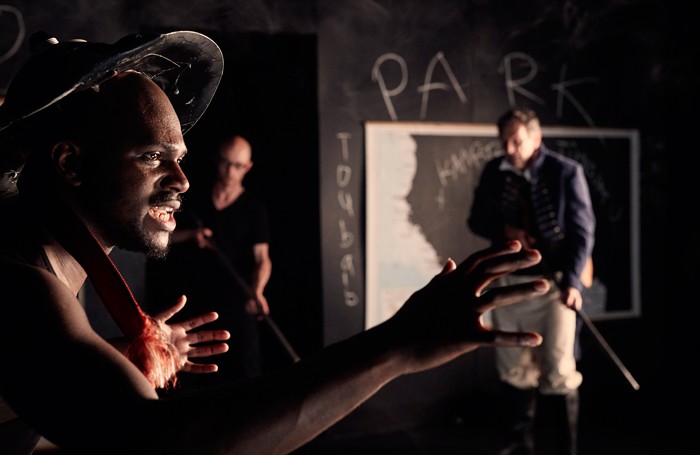
Matthew Zajac is impressive as the courageous and virtuous Mungo, whose story we follow at every turn, literally so as he fights his good fight on a turntable. Anders Budde Christensen is all exaggerated gesture and of wily tongue as emissary and as the not-so-enlightened James Rennell, map-maker, who would be master of all he surveys. Kingsley Amadi is black African potentate and crazy (white) army officer. It is so confidently performed that the zany is never risible, the indomitable never preposterous.

The rapid screenplay, to go with the filmic idea, produces strong exposition – particularly when its opening is chalked-up on the blackboard rather like title cards to a silent movie of colonial history in the making – and a dynamic narrative. No visual ‘shots’ are projected so there’s a spontaneous, on-the-spot quality to the whole piece. For the most part it is tightly focused upon Parks himself and when it isn’t there is some loss in terms of its depth of field. Performers running up and down the central aisle in a bright light did not look right.

Sturdy Mungo always has a satchel for his notebook and his Travels were published in 1799 but if you want a stirring measure of the man and of his life you won’t do better than this motion picture of a play.


nae bad_blue

Star (blue)Star (blue)Star (blue)Star (blue)Star (blue)

Reviewer: Alan Brown (Seen 24 August)

Go to Summerhall and the Dogstar Theatre Company

Visit Edinburgh49‘s  Summerhall archive.

+3 Review: Criminology 303 (Venue 13: 6-27 August: 21.30: 35 mins)

“An intriguing drama”

Editorial Rating: 2 Stars

Criminology 303 is an interesting concept – flipping between alternate scenes 40 years apart. Initially we meet retired detective Norma Bates (Jilly Bond) in 2016 reflecting on an unsuccessful investigation from her past, before the action reverts to 1976 where she is in the thick of it. We learn early on how this (the only unsolved case of her career) clearly still haunts her, so an intriguing drama is set up as to whether she might finally solve it on our presence.

Bond does a great job in switching between the two ages of her character – the crabby older version is a distinct progression from her greener and more confident younger self. And although prone to some overacting (I think her initial terror at the power point presentation misbehaving is a bit extreme), she shows great skill and stamina to drive the action in both scenarios.

This production’s main downfall, however, is its length. At barely half an hour, it feels like it only just gets going before very abruptly ending. There is no satisfactory resolution, no real sense of progression in either story beyond some scene-setting, and consequently the whole thing feels a bit pointless.

I would have liked to see the 2016 scenario develop into a discursive and positive look back at the case with a view to at long last solving it, rather than being a very rushed ghost story that scares Bates away from her own lecture. The pace of Bates’ descent into terror in this part feels very disingenuous, subverting the strength her character should have had (after 40 years in the force), so to me a more subtle and drawn-out approach here would have been more powerful.

In the flashback scenes Julian Gartside is commandingly creepy as Mr McLeod, yet Tommo Fowler’s direction has him physically touch and overpower Bates as detective on more than one occasion, which again feels forced and comes across as a cheap way to demonstrate status quickly, when other techniques would have had greater impact. The scene-setting and background to the background of the case in this scene is very well developed and delivered by Gartside, if seemingly a little irrelevant from the main story, but again I can’t help but feel this all would have been so much more effective if we got to see more about how the action panned out in the end – it is a frustrating beginning to a chapter that ends mid-sentence.

Star (blue)Star (blue)

Reviewer: Steve Griffin (Seen 24 August)

THIS REVIEW HAS NOT BEEN SUBEDITED