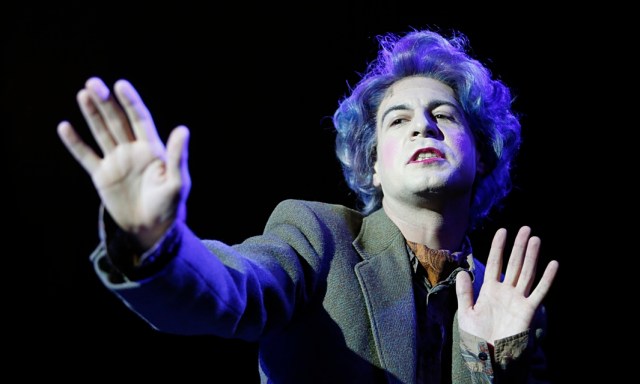
Thon Man Moliere (Lyceum: 20 May – 11 June ’16)

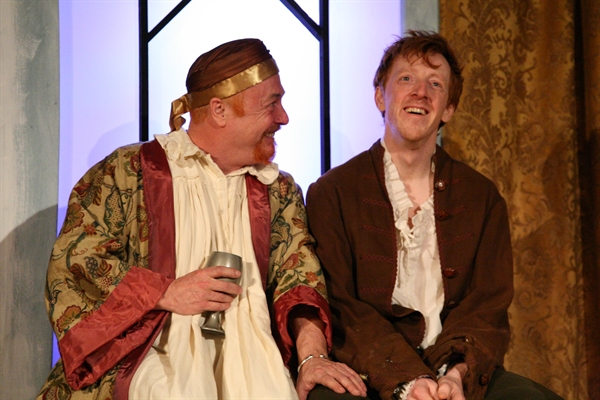
Jimmy Chisholm as Moliere & Siobhan Redmond as Madeleine. Photo: Mihaela Bdlovic.

Jimmy Chisholm as Moliere & Siobhan Redmond as Madeleine.
Photo: Mihaela Bdlovic.

“Siobhan Redmond as Madeleine and Jimmy Chisholm as Molière are perfectly, affectionately, matched.”

Editorial Rating: 4 Stars  Outstanding

In February 1662 Louis XIV sent flowers on the occasion of the marriage of Molière (40) to the seventeen year old Menou (Armande) Béjart. Perhaps the feted playwright was encouraged by the success in the previous year of his School for Husbands. And maybe those flowers were roses, for Menou draws firm, long stemmed roses in her sketch book. Wait up, they look like roses but maybe they’re …. Oh no! Surely not?

This is Liz Lochhead’s new play and she can have a garland too. Thon Man Molière is a comfortable winner. First off, it is a tribute piece to the man’s comedic genius; but second, it closely involves the women in his life, and third this play loves theatre and theatre-making.

Lochhead is an artist with the man’s biography. Born Jean-Baptiste Poquelin, her MacMolière is ‘Pokey’ indoors. Scaramouche is a pal but the fortunes of the ‘Illustrious Theatre’ company are dire to the point of collapse (and imprisonment for debt). There is rarely enough money and there are too few commissions until the king: “Vive le Roi!” – tires of the tragedies of Racine and Corneille. Tartuffe may well be a great play – and Pokey is inordinately proud of it – but it took nearly five years to get its revised version past the Archbishop of Paris. Molière’s first child is named after his royal godfather but Louis dies at eleven months.

There is a sub-title to shape the facts: ‘Whit got [Pokey] intae aw that bother …’ – and it’s sex; not so much sex with his teenage wife but the naughty fact that Menou is the daughter of his former lover, business partner and bestie, Madeleine, and that Madame Béjart will not – under any circumstances – have her daughter tread the boards. Siobhan Redmond as Madeleine and Jimmy Chisholm as Molière are perfectly, affectionately, matched. She has the reserve, bearing, velvet voice and wide skirts of a grande dame. He has the effrontery, the wit and the audacity of his celebrated character.

Ever around and about the principals is the troupe, historically verifiable and altogether mischievous. Gros-René (Steven McNicoll), in streaked green wig, gives a command performance in lugubrious drinking and losing his breeks. Therese (Nicola Roy) is his bed-hopping wife, who would be so much more than the maid in yet another farce. James Anthony Pearson is Michel Baron, the huge star-to-be, lithe and cocksure, but who is still unable to seduce the naïve Armande, very engagingly played by Sarah Miele. At a guess, only the more than capable, laconic and kind Toinette (Molly Innes) is entirely the writer’s invention.

Tony Cownie directs with an assurance born of his previous productions at the Lyceum of Lochhead’s ‘Molières’: Tartuffe (1986!), Miseryguts (Le Misanthrope) in 2001, and Educating Agnes (L’Ecole des Femmes) in 2011. Musical entr’actes by Claire McKenzie, a la Lully, are accompanied by sweet mime and when the drapes lift the action resumes, ‘at home’ or backstage where outsize greyscale putti come second to the wooden stool, wicker baskets and some splendid costumes that were too much even for the Comédie – Francaise, aka. ‘La Maison de Molière’.

Dinnae think Thon Man Molière is daft. The script is too sharp for that and its composed effect is almost tender, which, with all those satiric impulses flying around, is some achievement.

The theatre programme contains an excellent ‘Who Was Molière?’ by Liz Lochhead herself and there’s a helpful preview article by Neil Cooper in the Herald.


outstanding

StarStarStarStar

Reviewer: Alan Brown  (Seen 24 May)

Go to Thon Man Moliere at the Lyceum

Visit Edinburgh49‘s Lyceum  archive.

“I sensed that if I could draw solace from these two stories, then so might an audience.” – Author Mark Farrelly discusses Soho Lives

Mark-Farrelly-in-Quentin-0141

“I hope Patrick is not revived. I much prefer him to be a cult that only a small number of us know about. In this sense he is the literary equivalent of “Withnail and I”. Pass the secret on – but not too loudly.”

Soho Lives is a collection of two hit solo plays exploring the extraordinary lives and losses of two great Soho writers, Patrick Hamilton and Quentin Crisp. Greeted with huge acclaim since their debut productions, Mark Farrelly’s plays offer actors and audiences laughter, heartbreak, and an urgent, passionate reminder that the only thing that ever matters is being true to yourself.

Patrick Hamilton (1904 – 1962) was a shooting star playwright and novelist. His stage thriller Rope made him a hit on both sides of the Atlantic by the age of 25, and the play was later filmed by Hitchcock. Patrick repeated his success with the Victorian chiller Gaslight, while his highly regarded novels include Twenty Thousand Streets Under the Sky, Hangover Square and The Slaves of Solitude. His output – witty, cynical and beguilingly empathetic of all those “battered silly by life” – was cut brutally short by the loss of his battle with chronic alcoholism.

Quentin Crisp (1908 – 1999) was variously a rent boy, artist’s model and full time layabout. Shunned and beaten by London society for his flamboyant effeminacy, he concentrated simply on Being, and spawned a philosophy which enlightens to this day. After being portrayed by John Hurt in the classic TV film The Naked Civil Servant in 1975, he became an unlikely international treasure. Moving to New York in his seventies, he spent the rest of his life telling anyone who would listen ‘How to have a lifestyle’. Asked to give a young fan some life advice, he replied: “Remember – you don’t have to win”.

Mark Farrelly is an actor/writer. He was born in Sheffield and graduated with a double first in English from Jesus College, Cambridge. His West End credits include Who’s Afraid of Virginia Woolf? opposite Matthew Kelly at Trafalgar Studios. Mark is a veteran of numerous arts festivals and a regular favourite at the Edinburgh Fringe. He has performed his two hit solo plays, The Silence of Snow: The Life of Patrick Hamilton, and Quentin Crisp: Naked Hope over one hundred times. Mark’s latest project is as writer and co-star of Howerd’s End, celebrating the centenary of comedy legend Frankie Howerd.

Soho Lives: Two Solo Plays by Mark Farrelly (published by 49Knights, March 2016). To find out more click here.


Why Patrick Hamilton and Quentin Crisp?

Though I didn’t consciously know it at the time, they deeply mirrored aspects of my own life journey. Patrick’s personal life was a perpetual, drink-sodden mess (just read the highly autobiographical Hangover Square for a sense of this febrile fragility). I wasn’t in that league, but my personal life was certainly dysfunctional a few years ago. Around this time, me and my girlfriend of fifteen years split up, and I was truly on my own for the first time in life.

Horrifyingly, I found that adulthood could be postponed no longer (it seems that human adolescence now stretches to the age of 40). That’s where Quentin came in – the great guru of loneliness and laughing in the face of adversity. I was understandably drawn to Quentin’s story because it’s the tale of a man sitting in a flat on his own thinking life is over, which was very much me in 2012 /13, but then eventually things change and he ends up being the toast of New York.

I sensed that if I could draw solace from these two stories, then so might an audience… because we’re all suffering aren’t we? It’s a big part of what life is. The trick, as Quentin knew, is never to try to deal with it like Patrick – by running away.

Joining the two Lives is Soho. What was Soho like in their day and did Hamilton and Crisp ever meet there?

Soho (at least until recently) has always been what you want it to be. It’s a cipher for everyone’s inner ideal of a sanctuary from the harshness of life, but also a metaphor for the danger we like to flirt with in our younger days. So, for Patrick, it’s initially a boozy bolthole, a safe haven, idealised as a realm of “bottley glitter”. Later, as Patrick’s worldview darkened in the shadow of Hitler, Soho becomes a feeding ground for human sharks… conmen, narcissists, and also suicidal depressives.

Quentin likewise saw Soho initially as a refuge, hiding in what he called “layabout cafes”… until a “rough” or the police hassled him, angered by his brazen selfhood. Later he withdrew from it, and it existed only as a memory: “Soho used to be a more exciting place. You used to be able to get your throat cut on a really big scale”.

Did Patrick and Quentin ever meet? Unlikely. But I like to think they once unwittingly brushed past each other. Like so much of human interaction – almost connecting… but somehow never quite managing it.

Why have the novels of Patrick Hamilton dropped off the radar, and is he due a revival?

I suspect they dropped off the radar because there aren’t that many of them. He only wrote twelve books. The early ones are apprentice works, the later ones are blighted by the alcoholism that killed him at 58 (“I’ve been battered silly by life”), so for me that leaves only five flat-out great novels. They also have a narrowness of focus, compared to say E.M. Forster (another man who ‘only’ produced five great books). I hope Patrick is not revived. I much prefer him to be a cult that only a small number of us know about. In this sense he is the literary equivalent of Withnail and I. Pass the secret on – but not too loudly.

Quentin-Crisp.jpegDo John Hurt’s much celebrated portrayals of Quentin Crisp make it easier or harder for another actor to play him?

It didn’t really affect me. There have been thousands of Hamlets so I knew the world could cope with two Quentin Crisps. John Hurt (a great portrayer of victims, of whom it was rightly said “he suffers so well”) played to the hilt the bizarre upward inflections that Quentin sometimes spoke in. I deliberately toned this down for a solo play, as it would have become a bit annoying. So, at the wise encouragement of my superb director Linda Marlowe, I allowed some of my own voice to come into it. After all, the whole point of Quentin Crisp: Naked Hope is to encourage people to have the blind courage to be themselves at all times, however tough it is. Quentin said: “I simply refuse to bevel down my individuality to please other people”. Please dwell on what a great statement that is.

How do you go about researching your biographies, what sort of people do you meet, and what’s the single best insight you’ve gained?

The best research for writing a biographical piece is to have lots of psychotherapy. Find out who and what you are, what’s really going on beneath your behaviour patterns and your unexpressed wishes. Deeply explore why you are drawn to your subject, and what that says about you and the wider human “condition”. You’ll likely discover that your subject is what Jung called your shadow… some split-off, disowned part of yourself that you abandoned as a child in the face of criticism and aggression.

And now the soul burns to reconnect with all its parts. You’ve grown exhausted of listening to those dismal voices in your head, that embalmed Normal Bates gag reel of guff that keeps telling you that life is hopeless, you’re a failure and so on. It’s just a ghostly echo of everyone whose negativity you co-opted as a child, and you’ve spent years vainly trying to find the dimmer switch.

If (and it’s quite a big if) you are able to do this, then everything else will flow. Your reading, meeting surviving relatives, creating something of value… it will happen, though not necessarily in the manner you expected. The best insight (beautiful word) I had was when meeting Frances Ramsay, Quentin’s octogenarian niece. She said that whenever she was with Quentin, he would introduce her to his friends as “My niece Frances. She comes from real life”. And there it is. Quentin was an alien. Gloriously ironic that knowing yourself very deeply makes you an alien. And it does. Ninety percent of people I’ve met are phonies, imposters. I should know – I used to be one too.

14702423656_ac23f53089_k.jpgIf you had the chance to take Patrick Hamilton and Quentin Crisp to dinner where would you go and who would you also invite along?

Even after all my experience (I’ve played both men on stage over 100 times) I don’t know whether they would “click”. It would certainly be an interesting speed-date. I think we should go to the Garrick Club. Patrick (rare for him) felt at home there, and Quentin would, even today, raise eyebrows with his appearance. I would like no other diners present, I would want them all to myself. However, if I could freely subvert the known laws of space and time then I would like to be joined by Tim Welling, my dear friend who committed suicide in 2012. He helped me in the early days of these projects, and was one of the few people I’ve met who, like Quentin, was entirely himself regardless of who he was with or where he was. I miss him deeply.

You’re next project is a play about Frankie Howerd. If you’ll let us peek over your shoulder at the portrait while it’s still in progress, what’s emerging on the canvas?

I’ve realised that Frankie is the archetype of the human condition – nervous, haunted, hunted, desperately trying to keep the plates spinning before the whole lot disastrously crashes down. Of course, as Frankie’s partner of 40 years, Dennis Heymer, knew, letting the plates crash down might be a very good thing, but Frankie could never take that Rubiconic risk. This meant that he created a brilliant, brave, timeless form of stand-up comedy, but had the classic unhappy inner life. His act was a band-aid solution to the problem of being Frankie Howerd.

Next year is Frankie’s centenary, and we’ve never had a big comedic anniversary like this that I’m aware of. I think it’s extremely healthy for people to have proper goodbyes in life. I realised this when I went to see Monty Python at the O2 in 2014: we, and they, were getting a chance to say goodbye formally, and that’s very healing, allows you to move on in life. Two big romantic relationships of mine ended without a proper goodbye (“closure”) which did me a lot of damage.

So the play (Howerd’s End) is partly about how to let go properly. Dennis lived on for seventeen years after Frankie died in 1992, was often found clinging to the grave weeping, never came to terms with the loss. So what he and the audience have to learn during the course of the play is how to let go of Frankie. After all, one day we’ll have to let go of ourselves.

Above all: I want the play to be bloody funny. We’re apt to make our clowns very dark for the sake of drama. Every stranger I’ve spoken to about Frankie grins and says “Oh I loved him”, and so although I certainly want to provoke a few tears, I also want the audience to ride big waves of happiness. I asked Barry Cryer about this. He wrote for Frankie, and said that he’d seen a TV biopic about Frankie that “was so bleak you’d never have guessed Frank was a funny man”. Well, exactly. The world in 2016 is a pretty dark and frightening place, bombs seemingly going off by the hour… and I think we could all do with a damn good laugh. I know I could.

How important has your time at Edinburgh been for the development of both scripts?

Invaluable. Edinburgh is a brutal forcing house for new projects, and if you can survive it, possibly even get good reviews and interest from producers, then you’ve done very well indeed. There are three thousand shows in Edinburgh every year. When I first appeared there in 2002 it was one thousand. Gives you some idea of what you’re up against. Edinburgh to me is like the painting of the raft of the Medusa… thousands of egos fighting over a small bit of attention. It’s actually quite unpleasant, and when I performed there in 2014 I stayed away from much of the craziness by retreating, Quentin-style, to my room and listening to meditation tapes to remember how beautiful and special it is to be alive, because you can easily forget that in Edinburgh in August.

What’s the one thing anyone contemplating bringing a solo show to Edinburgh needs to consider?

Money.

What should be playing on the stereo when we’re reading Soho Lives: Two Solo Plays?

For Patrick, a selection of his beloved Ella Fitzgerald (he adored These Foolish Things).

For Quentin, complete silence, which was the soundtrack to many years of his life in Chelsea (“If I want anything, it’s peace. Quiet. The opportunity to stay in my room and just stagger on”). Then after you’ve read it, listen to Open All Night, Marc Almond’s beautifully dark album from 1999. It’s truly atmospheric, evocative of a lost Soho that probably never existed, and I think Patrick and Quentin would especially appreciate track 3: Tragedy.


LIKE WHAT YOU JUST READ? FOLLOW US ON TWITTER! FIND US ON FACEBOOK! OR SIGN UP TO OUR MAILING LIST!

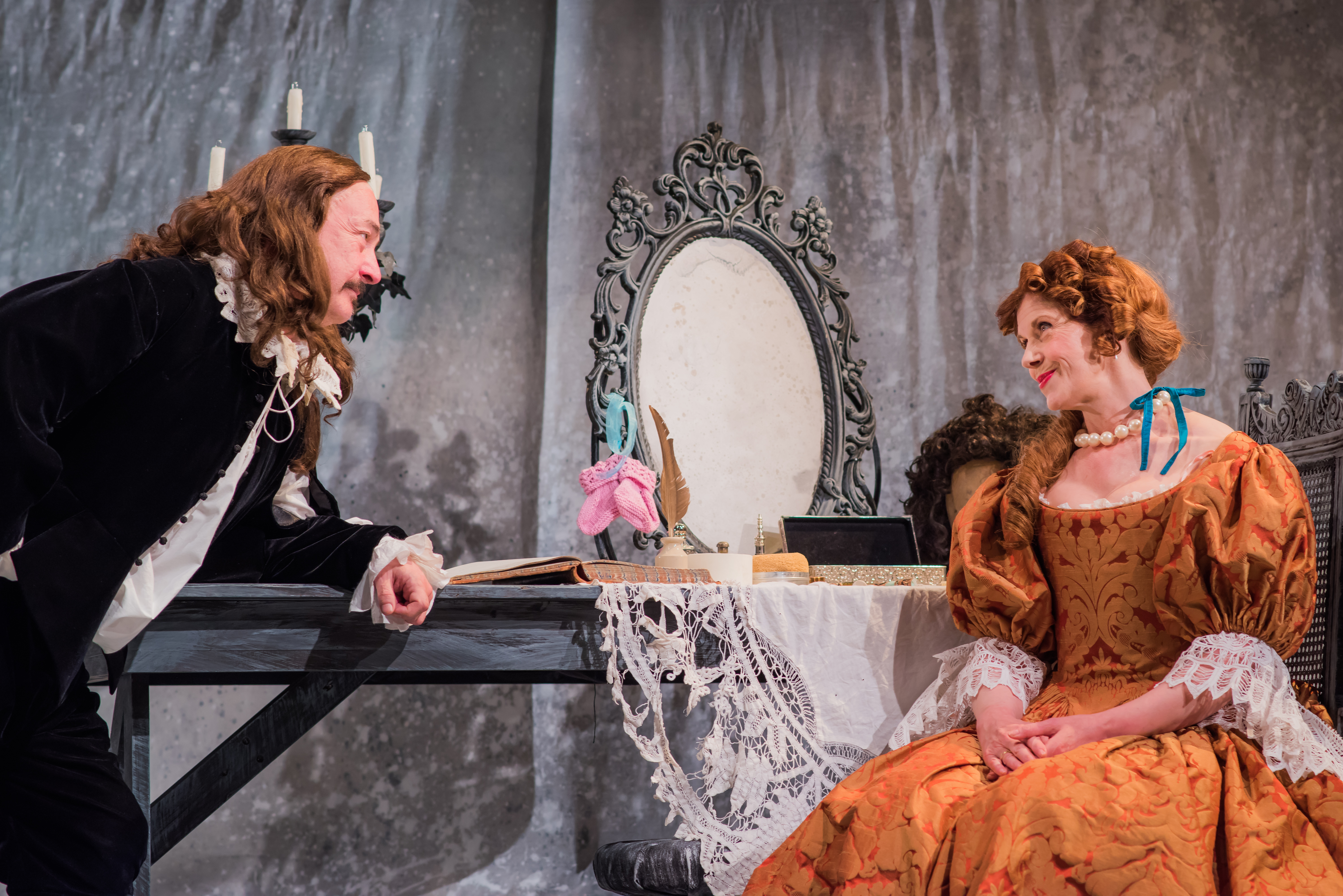
The Iliad (Lyceum: 20 April – 14 May ’16)

Ben Turner, downstage; Melody Grove, centre; & Emmanuella Cole, upstage.

Ben Turner, downstage; Melody Grove, centre; & Emmanuella Cole, upstage.

“This Iliad is forcefully staged and has the vehemence and colour of its core story.”

Editorial Rating:3 Stars Nae Bad

Mark Thomson’s last production as Artistic Director of the Lyceum for the past 13 years.

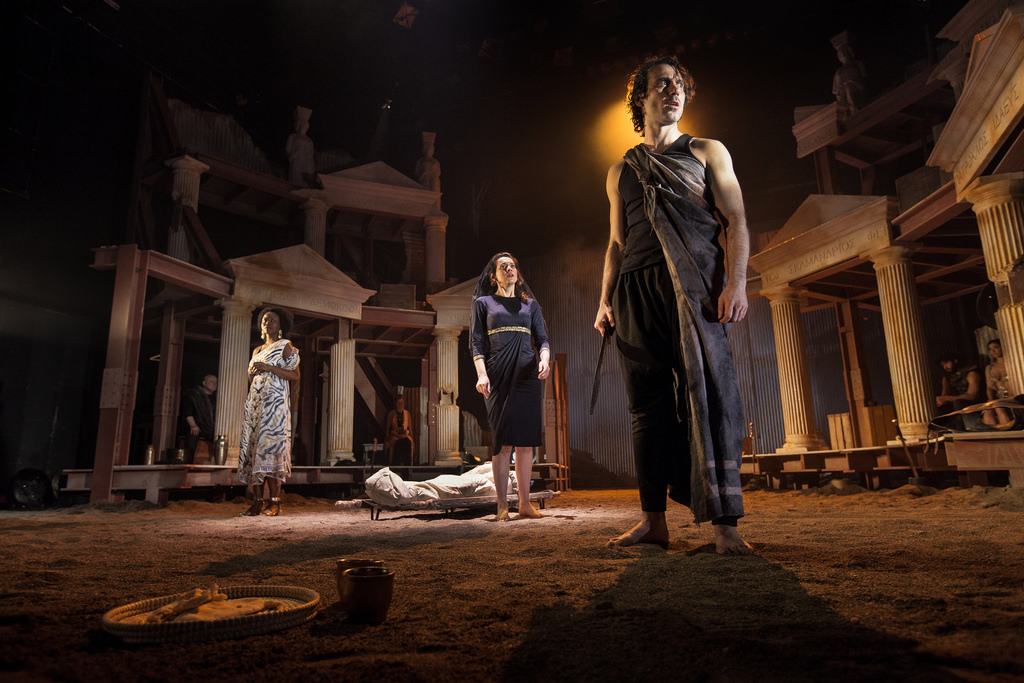
It is unsurprising that there’s plague about. There are no zips on the body bags on this beachhead and the Scamander River is full to overflowing with the dead. There’s Achilles’ refusal to dispose of Patroclus’s corpse until after he has killed Hector and then there’s the desecration of Hector’s body by lashing it to a chariot and dragging it through the dirt for twelve days, face down. No wonder – actually, yes, a lot of wonder is required – that Apollo took pity and ‘round him … wrapped the golden shield of storm so his skin would never rip’. Some say it was rose oil.

As epic tales go The Iliad is still the catchy, highly contagious one. It has tragic, raging action, love and sex, heroes and honour. There are no villains to speak of, just the ‘terrible beauty’ of Helen and the ‘smooth, full breasts’ of Aphrodite to sing of. Communicable? Certainly. Containable? Hardly.

Emmanuella Cole, left; Ben Dilloway centre; & Rueben Johnson, right, as Diomede.

Emmanuella Cole, left; Ben Dilloway centre; & Rueben Johnson, right, as Diomede.

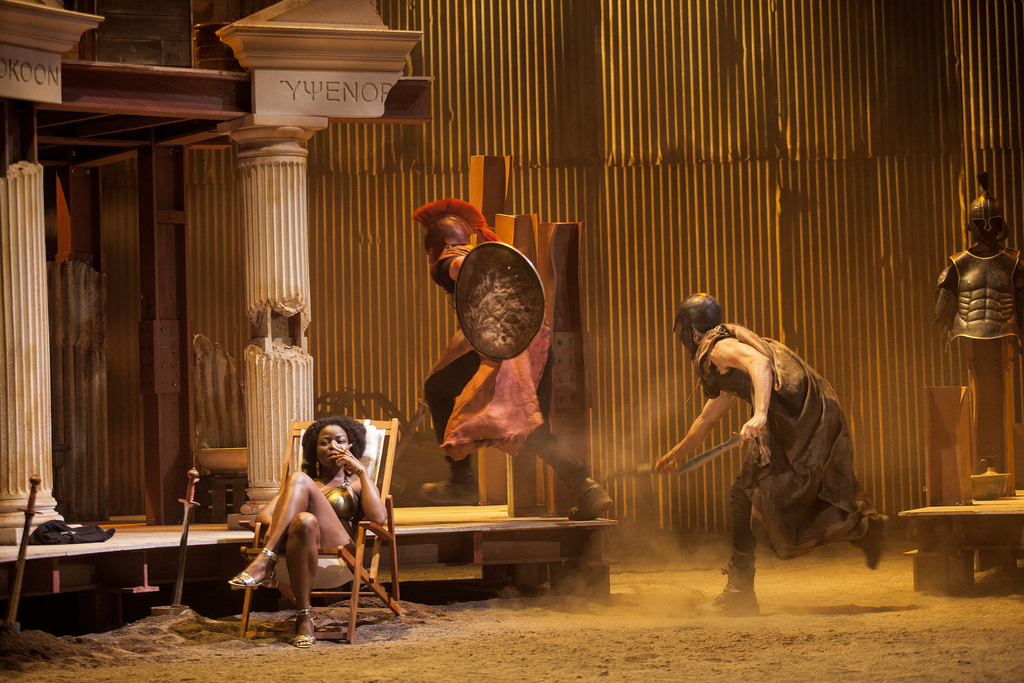
Fearless Mark Thomson takes writer Chris Hannan’s evocative script and directs an intrepid cast of twelve. Karen Tennent’s imposing set has broken columns and half pediments left and right with plenty of space and height for gods to take it easy in and for the Trojan women to look out anxiously over the ramparts. A massive wall of corrugated ‘bronze’ curves around them and the dust sometimes hangs in the air around a leather cuirass and plumed, hollow eyed helmet. The lighting design by Simon Wilkinson is as careful and as atmospheric as his work in Bondagers.

But there are 15,693 hexameter lines in Homer’s Iliad and probably as many ‘brazen spear points’ and slamming shields. What to do with them all? Thomson – to make an attractive prosaic point – starts his theatrical shebang with a baby’s cry and a cobbler hitting nails into a boot. (Think the traditional 3 knocks that alert a French audience to the start of a performance). More formally, several scenes begin and end as characters are dressed for their part, accompanied by near liturgical chant. No need though for Zeus (Richard Conlan) to dress up. His boxers and loose robe are as much Mustique as Olympus. Hephaestus (Daniel Poyser) has his iPad on the beach. ‘White-armed’ Hera (Emmanuella Cole) drifts in straight off Ebony magazine’s style pages and tells all. This is one all-mighty queen god who seems to owe her name to having had it up-to-here with her philandering husband (and brother BTW). We’re with you there, sister.

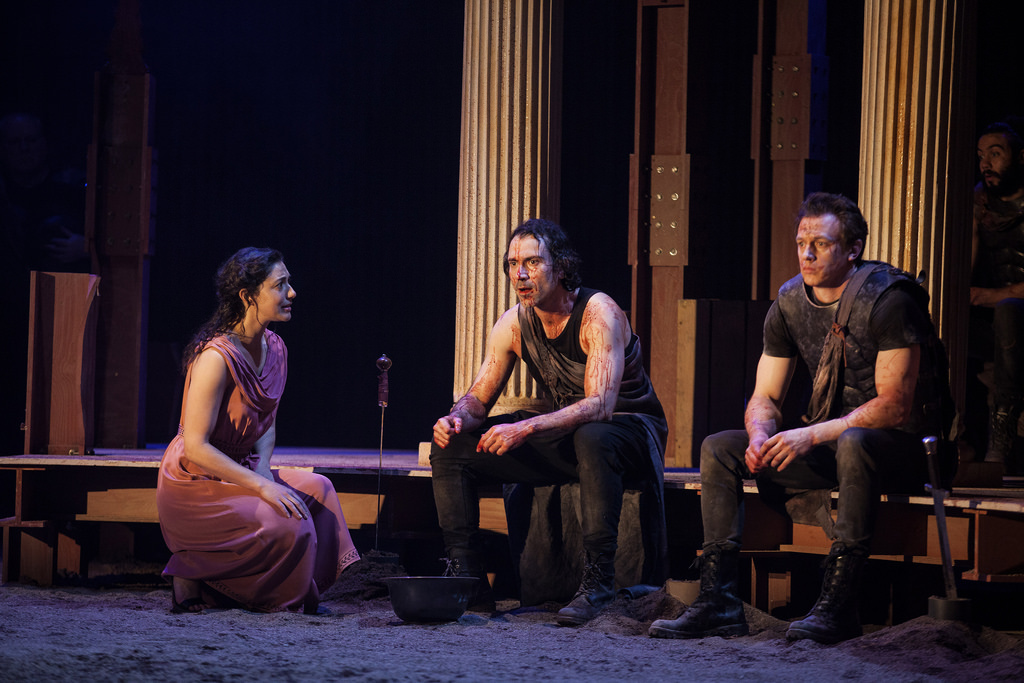
I worship Thetis,  because of passionate playing from Melody Grove, but otherwise these gods are the diverting side-show and narrative markers to the centre stage profiling of Achilles (Ben Turner). He stands, blood streaked, against all-comers, starting with ‘wine-mouth’ Agamemnon (Ron Donachie). There is pathos in the fine scene between the moping and vengeful Achilles and the shade of his beloved Patroclus (Mark Holgate) and the song at his companion’s funeral of his ‘head like a poppy drooping’ is an unlikely hit,  but it’s Thetis’s son vs. Hector (Benjamin Dilloway) that exercises fight director Raymond Short to his utmost. As well it might when he’s up against Brad Pitt and CGI – and a younger audience. Perhaps pounding Hector’s brains out is beyond even a screenplay.

Amiera Darwish, left, as Briseis; Ben Turner, centre; & Mark Holgate, right, as Patroclus.

Amiera Darwish, left, as Briseis; Ben Turner, centre; & Mark Holgate, right, as Patroclus.

This Iliad is forcefully staged and has the vehemence and colour of its core story. It is fiercely directed and there is a heart and soul to every performance, mortal or immortal, but it is so down to earth that it puts gods into deckchairs on a flyblown lido and so the topless towers of Ilium are levelled. I think it’s Hecuba (Jennifer Black) who says, ‘You clutch at emotions like clutching at straws’. That’s the problem when you go head-to-head with Homer.


nae bad_blue

Star (blue)Star (blue)Star (blue)

Reviewer: Alan Brown (Seen 26 April)

Go to The Iliad at the Lyceum.

Visit Edinburgh49‘s Lyceum archive.

Right Now (Traverse: 19 April – 7 May ’16)

Photos: Helen Murray

Photos: Helen Murray

“Funny and clever, disturbing and salacious”

Editorial Rating: 4 Stars

A Traverse Theatre Company, Theatre Royal Bath Ustinov Studio and Bush Theatre co-production.

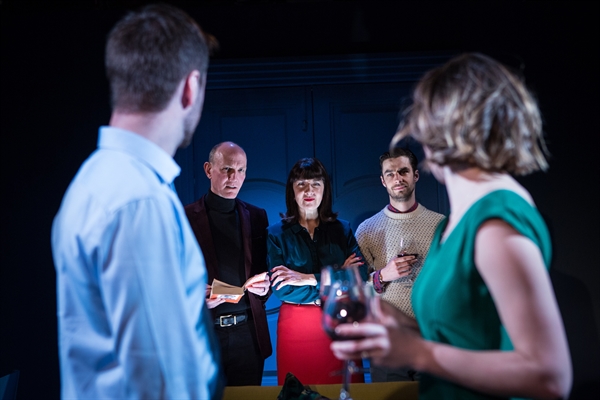
Ben is a junior doctor. He and Alice have been together for seven years and their work/life balance is screwed. As it happens, so far so familiar. Right now they’ve been in their new flat for six months, have just got the baby’s room to do, and things will get better. Only they don’t. Instead neighbours Juliette and Gilles and their son François come right on in from across the hall ….. Meet the Fockers from Quebec, everyone: with a ‘u’, inappropriate, out of order and way, way, out of bounds.

You watch your step in this pressing and uncomfortable comedy. You’re never too sure what’s underfoot or where it’s going. There’s a godawful squeaky toy behind the sofa and half a glass of red on the floor. ‘Beware’ should travel around the set like LED advertising at a sports ground. Beware Juliette with her penchant for flashing her knickers; beware Gilles’ prurient touch and tongue; beware François’s lacerating commentary. “They’re a bit odd” is Alice’s bang on estimate. “I like them” is Ben’s disastrous opinion. It’s funny and clever, disturbing and salacious, and very well performed.

Michael Boyd directs this production, which is a cracking compliment to French-Canadian writer Catherine-Anne Toupin. It looks clean, like a Farrow and Ball paint job by designer Madeleine Girling where the quality of the finish should never be in question. All the more effective, then, when a kind of moral distemper takes hold and it all gets corrupted, goes off-colour and becomes dubious. Guy Williams as Gilles is absolutely loathsome because his seduction of Alice is like a pet research project. He also, incidentally, proves that a black roll neck jumper and brown jacket are about as louche as it gets. Maureen Beattie, ever the mistress of the bewitching voice, is Juliette the mother temptress, against whom all resistance is futile. Just sticking a plaster on Dr. Ben’s hand makes him go weak at the knees. François – jittery and wacky by Dyfan Dwfor – may be appalled by his parents’ behaviour but is just as complicit.

Lindsey Campbell as Alice

Lindsey Campbell as Alice

If Toupin isolates a character, it’s Alice. The plot would push her under but she won’t go. Listen up in scene 5 for the psycho pairing of Ben (Sean Biggerstaff) and ‘Benny’ (that would be Biggerstaff too) but Alice stays there, screaming for help really. Lindsey Campbell has to do grieving and dirty dancing and horribly vulnerable all at once, which is why the sex is so desperate. It’s a class act and I think is what the show’s flier describes as traumatic, ‘teasing and thrilling’.

Right Now is as billed. It’s edgy, imminent, and contemporary, which makes it kind of Shakespearean: François as Feste maybe, Alice as the abused and distraught Ophelia; Juliette becomes Lady Macbeth, who has given suck, etc. Weird.

Star (blue)Star (blue)Star (blue)Star (blue)

Reviewer: Alan Brown (Seen 19 April)

See Right Now at the Traverse

Visit Edinburgh49‘s Traverse archive.

Ring Road (Traverse: 12 – 16 April ’16)

Martin Donaghy as Mark and Angela Darcy as Lisa. Photo. Traverse theatre.

Martin Donaghy as Mark and Angela Darcy as Lisa.
Photo. Traverse theatre.

“Both actors perform brilliantly in a small space (and on a narrow bed)”

Editorial Rating: 4 Stars Outstanding

Fifth and last in this Spring season of A Play, A Pie and a Pint.

It was the prickly cactus that did it, that brought to mind Love’s Labour’s Lost and fun puns on pricks, butts and horns. Mark notices it by the Reception desk of the hotel that’s just off the ring road. He reckons he’s there for sex (oh, not the archery then) and he’s right. Lisa does want him but it’s more his sperm than his good self that she’s targeting. She desires a baby while Mark just fancies the pants off his teacher sister-in-law. Ouch!

Anita Vettesse has written a painfully entertaining comedy and director Johnny McKnight does indeed make the pants fly off the bed. Ring Road is frisky, certainly, but it is also sensitive to what Lisa is feeling. She is 40 years old, has ‘grown to love’ her husband, but is still without a child. The pressure is on big time.

A late afternoon’s delight via Dayuse.com might be all very well but Lisa (Angela Darcy) sees Mark (Martin Donaghy) more as a ‘facilitator’, which he’s not best pleased about. He is even less keen on the idea when brother Paul (a wry, downcast voice-over from Robbie Jack), Lisa’s husband, joins them by being put ‘on speaker’. The two brothers are plumbers, sharing the same van, rather than the same women but it’s still odds-on that the dismissive reference to Screwfix is deliberate.

Mark’s spattered overalls and rigger boots look strange in the tidy, unexciting hotel room and he knows that the whole situation is just not right. Twin beds are bad enough – and that ‘art’ on the wall!- but the twitchy tension is the real passion killer. Lisa, in particular and unsurprisingly, is a bundle of nerves. At worst Mark is confused, but she is probably more conflicted at the end than at the beginning, which is touching and sadly credible.

Both actors perform brilliantly in a small space (and on a narrow bed). Donaghy does “For fuck’s sake” as baffled, happy, hurt and kind all at once, while Darcy is no less expressive, just more couth and desperate. The fact that Ring Road is also very funny is down to the quality of Vettesse’s writing.


outstanding

StarStarStarStar

Reviewer: Alan Brown (Seen 12 April)

Go to Ring Road at the Traverse.

Visit Edinburgh49′s Traverse archive.

The Silent Treatment (Traverse: 7 – 9 April ’16)

Photo: Lung Ha Theatre

Photo: Lung Ha Theatre

“A lot of barmy mischief making”

Editorial Rating: 3 Stars

Lung Ha Theatre Company is a leading theatre company for people with learning disabiities, in Scotland and internationally.

Shout it out: Lung Ha bucks trend! By the latest UK stats worker output per hour is down; well, not when you put 21 actors on stage and keep them acting all the while. All the more testing, when there’s little to no dialogue in Douglas Maxwell’s script of stage directions.

The Silent Treatment subjects its cast to keeping shtum – and alert. For the most part it is full on music and sound (by M J McCarthy) that cues the action. After Lung Ha’s Thingummy Bob with Cliff and The Shadows I had my old money on ‘Silence is Golden’ for some signature backing; but, no, that was 1967 and this play needs mobiles, scratchcards, emoticons and a chainsaw. Still, The Tremeloes’ lyrics have something relevant to say: here’s the second verse,

Talkin’ is cheap …
How could she tell? He deceived her so well.
Pity she’ll be the last one to know.

Billie (Nicola Tuxworth) thinks she has the secret to end all secrets. In fact, it’s her boyfriend (Stephan Tait) who’s got it and she won’t find it out until the end, when she will be speechless. In the meantime Billie goes with her little secret and sets out to try and wreck the sponsored silence that is being held to raise money for her mum, who’s in and out of hospital. Why would she do such a thing? That’s her secret and she’s not telling.

And, of course, no-one else is saying anything. The writing on the blackboard spells it out: SPONSORED SILENCE. No Phones (ignored), No Sleeping (impossible), No Eating (not when there’s a packet of Penguin biscuits around), No Knitting (didn’t see any), wheel noises and body noises don’t count (fair enough). It is the irrepressible Kenneth Ainslie as Toby who has real trouble with the rules but even he doesn’t speak.

Billie finds a helper in Stacey (Emma Clark) and the two of them, in and out of disguises and of the windows, do a lot of barmy mischief making under the stern nose of dominie Kitty (Kay Ann Jacobs); but it’s the four strong building crew (with foreman Mark Howie unmistakeably in charge) in high-vis vests and bowlers who do the heavy lifting, paying no attention whatsoever to Kitty’s gong.

The audience did not want to break the silence either. Hearty laughter seemed somehow disrespectful to Maria Oller’s close direction and the disciplined work of the performers on stage. With one great, if unholy, exception, the ingenious visual gags were met with appreciative chuckles rather than guffaws , and so when the end came – when it blossomed is actually more accurate – the applause was for hard study and successful work rather than for easy laughs.

Star (blue)Star (blue)Star (blue)

Reviewer: Alan Brown (Seen 7 April)

Go to The Silent Treatment and to Lung Ha Theatre Company

Visit Edinburgh49‘s Traverse archive.

Neither God Nor Angel (Traverse 5 – 9 April ’16)

Jimmy Chisholm as James VI and Gavin Wright as William. Photo: Leslie Black

Jimmy Chisholm as James VI and Gavin Wright as William.
Photo: Leslie Black

“To an eloquent vocabulary!”

Editorial Rating: 4 Stars

4th in this Spring’s season of a Play, a Pie and a Pint.

Union (2014), Tim Barrow’s second play, was full of the joys of the Referendum campaign – vigorous, disputatious, even romantic. Neither God Nor Angel, his third, is not ‘Union the prequel’ (by a century), but more of a light amuse-bouche to that earlier rich and hearty fare. This is a waggish two-hander, chummier, a pawky chamber piece.

It is an entertaining fact that James VI, King of Scotland, must have spent some part of the night of April 4th 1603 in Holyrood wondering what it was going to be like to be James I of England (& Ireland) to boot. He was away to London the following morning. Did he blow hot and cold about the whole enterprise? The Incarnation probably sprang to the mind of this godly, seriously literate and absolute monarch who, in 1598 and blessedly free of irony, wrote of ‘the Reciprock and Mutuall Dutie betwixt a free King and his naturall Subiectes’. Let there then steal upon the scene, for the purposes of comic wrangling over glasses of good Rhenish wine, one such subject.

Levity, clearly, is heaven-sent. Enter gawky William (Gavin Wright) to cheek and cheer his King, who has been in peevish sorts. James (Jimmy Chisholm) welcomes – and would embrace in all innocence – the impertinent company of a serving man. Better William, any day, than those ‘devious bastards, the bankers, with their velvet draped bollocks’; and so the toast, raised by His Majesty, ‘To an eloquent vocabulary!’

William speaks Leith and James, crowned at thirteen months, speaks privilege with moments of dainty Morningside. “Would you ken where yon bottle is hid?” might well be an habitual question in Hermitage Gardens but the interesting parts, in amidst the humour, is the forgotten or unfamiliar history: Royal pal Esmé Stewart is pined for; recall of Gowrie and the Ruthven raid shakes the King; his wife, Anne of Denmark, is cherished; and William is sacked for spilling wine on John Ramsay’s silk doublet, which could have happened. I liked all this, almost as much as the use of quill on paper.

It’s a good title, Neither God Nor Angel, provided you can accept that the king’s a man for a’ that, which he ain’t really. Director Ryan Dewar and his two actors do very well with this pithy play of make-believe.

Star (blue)Star (blue)Star (blue)Star (blue)

Reviewer: Alan Brown  (Seen 5 April )

Go to Neither God Nor Angel at the Traverse

Visit Edinburgh49‘s Traverse archive.

Uncanny Valley (Summerhall: 29 – 31 March) – part of Edinburgh International Science Festival

Photo:.Borderline Theatre

Photo:.Borderline Theatre

“Educational and entertaining, well-worth taking the kids to”

Editorial Rating: 3 Stars: Nae Bad

As a child I was never particularly into science. At school the lessons were boring and didn’t challenge me to think creatively or engage with it in real life situations. Uncanny Valley, however, does both, placing today’s children at the heart of a situation we may well find ourselves in 30 years’ time.

Essentially it’s a show about humans and robots, and the difference between the two. With the world becoming ever more robotic, the subject matter is engaging for audiences of all ages and I certainly learned a thing or two about artificial intelligence and the Turing Test during the performance. While I imagine 9-year-old me might have struggled with some of the concepts and sitting still through some of the longer “lesson” parts, many of the younger audience members seemed to grasp it fairly well and engage in the interactive elements.

As a children’s piece, one can forgive a certain amount of ridiculousness and be able to suspend disbelief to still be able to enjoy the action. Credit goes to the actors for keeping the performance engaging, with boundless energy creating big, bold characters that are instantly relatable. Kirsty Stuart in particular shines as the cut-throat Mayor who’ll stop at nothing to eliminate robots in her town.

I would have liked closer attention paid to the narrative to keep it seamless all the way through: there were quite a few unexplained jumps in time and location in the story, and I never quite believed Ada’s relationship with her adopted parents. In saying that, some of the theatrical elements are very well done: the Turing Test at the end of the show is funny and gripping; the open moral discussion about whether to swerve a car off road and kill a group of chickens to save yourself is very thought-provoking, and I was even able to feel emotional connection with the robot characters of OKAY and SARA, which adds a really nice dimension.

The beginning is a little confusing – I feel that Rob Drummond as facilitator perhaps tries too hard to convey a lot of factual information early on and doesn’t seem as comfortable in parts of audience interaction as I would expect from an experienced TIE professional. These are only small moments throughout the piece though, as on the whole it’s quite slick and professional.

Overall, Uncanny Valley is educational and entertaining, and well-worth taking the kids to, as long as you’re ready for a bit of thinking! Theatrically it is a bit rough around the edges but still full of heart.

nae bad_blue

Star (blue)Star (blue)Star (blue)

Reviewer: Steve Griffin (Seen 31 March)

Visit the Summerhall archive.

International Waters (Traverse: 30 March – 3 April ’16)

International Waters 1

Photos: Tommy Ga-Ken Wan

“Almost edifying”

Editorial Rating:3 Stars Outstanding

You have to wonder. Fifty minutes into the heaving swell of International Waters when we’re all dramatically well and truly cast off, the fire alarm lights flash red and the theatre is evacuated. It has to be a Fire Exit production. And the prime minister announces that there will be no fire sale of the UK’s steel industry but it could still all go down the pan; which is pretty much where David Leddy’s new play takes us. It’s gut-churning with intent, from programme-as-origami downwards. This is theatre in the raw; its passage probably indigestible without great work by Becky Minto (Design), Nich Smith (Lighting) and Danny Krass (Sound).

For the U-bend see a cabin suite for the super-rich in the bowels of a super-tanker, complete with champagne buffet and karaoke machine. Cheaper accommodation is in assorted containers where you might be stacked next to a tiger or two. It is all rather make-do, rather urgent, for this is the last ship out of London where the banks have really, really, done their mucky worst. It’s safe to assume that the ATMs are empty and that the poor are on the streets and burning porsches. Still, if you have shedloads of ready money you can look good in white linen, enjoy the Moët, do a line of coke, and singalong to doomsday. Unfortunately it turns out that Sarah, Ben, Sophia, and Arian are in the Caliban suite for a less than delightful reason and that their ‘escape’ will end wretchedly. There’s no mage on the bridge to save them or to get them away from each other’s throats … or crotches.

International Waters 2

Down below, gripped by burning cabin fever and flushing itself out, is the fabled 1%: powerful and greedy, vulnerable and unhappy. Sarah (Claire Dargo), Ben (Robin Laing), Sophia (Selina Boyack), and Arian (Lesley Hart) go at it with astonishing abandon, pulling each other’s chains – just to stay with the scatological – and soiling themselves and their values in the process. It’s abject, messy, and ridiculous and yet the acutely angled and allusive content is almost edifying.

Leddy unships a bulk load of issues: rogue algorithms, flagrant wealth, economic migrants, drowned refugees; the paranoid survivalist versus the self-obsessed, #Blessed; Twitter storms, Old Testament retribution and the gospel strains of New Testament promise. This is one crowded ark of a stage, freighted with ideas, that spills more than it holds, deliberately upset by intemperate behaviour, bad language, and scary discordant sound. If the play is dead in the water at its conclusion, it’s not rudderless or overblown, but simply exhausted.

FYI. The show continued after the fire alarm, which says a lot about the quality of the performance and the unlikely integrity of the piece. It is preposterous and explicitly farcical, yet Leddy goes in behind the theatrical facade. He says (see programme note) that he’s also after the romantic sublime. Well, here’s Adele on a comparable course from Rolling in the Deep: “Go ‘head and sell me out and I’ll lay your shit bare.” Nice!


outstanding

StarStarStar

Reviewer: Alan Brown (Seen 30 March)

Go to International Waters at the Traverse and at Fire Exit .

Visit Edinburgh49‘s  Traverse archive.

Endgame (Bedlam: 22-26 March ’16)

Thomas Noble as Hamm

Thomas Noble as Hamm

“The best student production I’ve seen in quite some time”

Editorial Rating: 4 Stars: Outstanding

One certainly cannot fault the courage of the students at Edinburgh University this year for taking on so many challenging productions, and to even attempt Beckett – whose works so often have age and world-weariness as themes – is admirable. I was lucky enough to spend an entire term studying Beckett at university, under the tutorship of a renowned expert on his works, but even then I worried that my final performance would be a tragic, naïve offering compared to what had gone before.

Beckett certainly isn’t for everyone, and Endgame is a one-act play with a running time of close to 90 minutes that has very little narrative development or real “action”. What is most satisfying about this production is the group’s sensitivity to Beckett’s text. The great man is notoriously particular about how his work should be performed, and Edinburgh University Theatre Company don’t try any tricks or fancy interpretations to make it new or innovative, but instead use subtlety to let the text speak for itself. Finlay McAfee’s masterful direction teases out various interesting repetitions in the dialogue and hints at some of the political undertones, but never makes bold statements or suggestions.

In saying that, this production also doesn’t take itself too seriously – it’s littered with comedic moments, just as Beckett intended, and is a very well-rounded and watchable show. Sarah Brown’s set is simple yet effective, using black and white as a nod to the “game” element, while all other creative elements are in sync to present a cohesive and professional mise-en-scene.

Thomas Noble as Hamm is the centrepiece of the actors – always on stage, centre stage, he commands attention with charisma and gusto. His moments of anger when flinging props aside are powerful, while he shows great contrast in more intimate conversations with Clov. In turn Clov (Michael Hajiantonis) is excellent as the down-trodden servant, whose development in confidence towards the end, extreme physicality and impressive Irish accent all contribute to a commendable performance.

Jennifer Jones is compelling to watch as Nag, with fantastic control over the small movements and expressions she makes inside the bin. Her physicality is exquisite, and her delivery of the tailor story is achingly on point. Antonia Weir is equally captivating and convincing as long-suffering wife Nell.

To me the only thing lacking from this production is a deeper sense of age and timelessness. The action all seemed a little too fresh and perhaps a touch too “performed” for it to be believable as a snapshot of continual drudgery. In saying that, I’d much rather a slight tip in this direction to keep it energetic and engaging rather than veering down the road of self-indulgent dawdling. In all other respects this show is hard to fault, it’s certainly the best student production I’ve seen in quite some time.

outstanding

StarStarStarStar

Reviewer: Steve Griffin (Seen 23 March)

Go to Endgame at Bedlam Theatre

Visit Edinburgh49‘s Bedlam archive.