“Few episodes of cultural collision in Victoria’s reign were more extreme.” – Author Paul Thomas Murphy discusses Shooting Victoria

In June 1840, when Victoria was pregnant but had no living children, the succession would have passed to Ernest, her widely-loathed eldest uncle. I can’t help but wonder, then, whether, hearing of the news of the failed attempt, Ernest thanked God – or cursed.

At about 4 p.m. on 10 June 1840, a young man took up a position on a footpath at Constitution Hill, near Buckingham Palace. He had with him a pair of poor quality pistols. Two hours later a young couple drew alongside seated in an open carriage. It was the moment Edward Oxford had been waiting for. He discharged his firearms but missed both the young (and pregnant) Queen Victoria as well as her Consort Prince Albert.

What could have proved a national calamity instead became a public relations coup, helping Victoria and Albert reshape the monarchy and its role.

Oxford became the first of a surprisingly long line of assailants who took pot shots at Britain’s second-longest reigning monarch. Each was an eclectic mix of poverty, grandiosity, and mental disorder. For the first time, author Paul Thomas Murphy has drawn together the threads of each case – criminal, medical, and political – into a single narrative. The result is an ever-shifting landscape portrait of Victoria and the age to which she gave her name.

Paul Thomas Murphy is the author of Shooting Victoria, a 2012 New York Times notable book. He holds advanced degrees in Victorian Studies from Oxford and McGill Universities and the University of Colorado, where he taught both English and writing on interdisciplinary topics. He currently resides in Boulder, Colorado.

Shooting Victoria (published by Head of Zeus (January 2013) To find out more click here.


Why Victoria and her assailants?

I strongly believe that one of the most effective ways to gain insight into a culture is to focus upon its episodes of extreme cultural collision. And few episodes of cultural collision in Victoria’s reign were more extreme, in terms of social, political, legal, and gender conflict, than these eight attempts by the Queen’s seven assailants. More than this, these attempts occurred throughout Victoria’s reign—the first occurring when she was twenty-one, newly married and newly pregnant, and the last when she was sixty-one and a great-grandmother.

By focusing on all of the attempts, therefore, I am able present a portrait of the era from an entirely new perspective – a sweeping depiction portrayal both of the endlessly fascinating Victoria, Queen and Empress, and of some of the darker aspects of her age in the stories of the seven malcontents who bedeviled her.

Seven boys and men attempted attacks on Queen Victoria between 1840 and 1882. What, if anything, did they have in common?

Every single one of them was an outsider, removed from society for a variety of reasons: two identified themselves as Irish, one suffered a painful and discernible physical disability, and several clearly suffered from mental impairment. More than this, with one possible exception each of them had an aching desire to be somebody: a desire to force themselves upon the collective consciousness of Britain and of the world through one dramatic act that at least temporarily placed them on a level with Victoria, the ultimate insider of the time.

The one possible exception—the one who apparently had no desire to be somebody — was the fourth assailant, the Irishman William Hamilton, who in 1849 made his attempt in order to trade his free but impoverished life for the social security of a long stint in prison. He got exactly what he wanted.

The first assailant was Edward Oxford, who had a uniform, military rules of conduct and a manifesto for a revolutionary organisation called Young England – of which he was the only member. Did you ever find yourself wondering if there was more to Oxford’s assault, the autocratic hand of Victoria’s reactionary uncle Ernest Augustus I of Hanover for instance?

That is certainly what Edward Oxford wanted the world to think, and he succeeded—for a few days, at least. And even when it became abundantly clear to the police and to the government that Young England was entirely a figment of Oxford’s fertile imagination, some people—Irish nationalist and politician Daniel O’Connell, for instance—continued to believe that dark and reactionary forces were at work behind Oxford’s attempt. Clearly, Oxford was not a pawn in a right-wing conspiracy, vast or otherwise. But it is equally clear that in inventing his backstory he was influenced by extreme political currents of the time. And although Victoria’s uncle Ernest was certainly innocent of any direct involvement in Oxford’s crime, he certainly would have profited by it: had Oxford succeeded: in June 1840, when Victoria was pregnant but had no living children, the succession would have passed to Ernest, her widely-loathed eldest uncle. I can’t help but wonder, then, whether, hearing of the news of the failed attempt, Ernest thanked God – or cursed Oxford.

The key statesmen of Victoria’s reign appear through the course of the narrative, from Wellington via Peel to Gladstone and Disraeli. What light do the attempts throw on them and their policies?

All of these men were, in the fullest sense of the term, ministers to Queen Victoria, and after every attempt, each one was caught up not simply in protecting the Queen, but in protecting, in redefining, and in promoting the institution of monarchy. In the wake of Oxford’s attempt Lord Melbourne, Victoria’s first Prime Minister, successfully fought for an act to make Prince Albert regent in the case of Victoria’s death. After the two attempts of Victoria’s second assailant John Francis, her second Prime Minister Robert Peel devoted himself to strengthening her security and the security of the monarchy, and when a month later John William Bean made his attempt, Peel is said to have wept openly in Victoria’s presence.

Of all of Victoria’s Prime Ministers, however, the one who did the most not simply to protect Victoria, but to rehabilitate and promote the institution of the monarchy, was —surprisingly enough— William Gladstone. It’s worth remembering that Victoria’s fifth assailant, Arthur O’Connor, had originally planned to attack the Queen during a Thanksgiving service at Westminster Abbey to celebrate the recovery of the Prince of Wales from Typhoid Fever. Gladstone had planned that Thanksgiving service meticulously as a way to force the Queen back into public life after her ten years’ seclusion and abandonment of her responsibilities after the death of Prince Albert. And though Victoria fought him, Gladstone succeeded magnificently. Of Victoria’s Prime Ministers, Benjamin Disraeli is usually the one seen as the unabashed proponent of the modern monarchy. But I would argue that Gladstone more than Disraeli deserves credit for shaping a monarchy that has endured to this day.

You write about the assassination of US President James Garfield, but not that of Lincoln. How come?

Timing, for one thing. Lincoln’s assassination, as it happens, occurred fifteen years after the fifth assault upon Victoria, and six years before the sixth. Garfield’s, on the other hand, occurred just a year before the seventh assault. So did the assassination of Tsar Alexander II. Those two assassinations demonstrate the specific threats facing Victoria in 1882: an assault by a madman, or an attack by political terrorists. Garfield’s attempt is therefore more directly a part of the story.

Saying that, Victoria’s response to Lincoln’s death does provide true insight into Victoria’s state of mind in 1865. Last April 15th — the 150th anniversary of Lincoln’s assassination — I republished in my blog Victoria’s heartfelt letter to Mary Todd Lincoln. “I cannot remain silent when so terrible a calamity has fallen upon you & your Country,” she wrote Lincoln’s widow. But Victoria showed her greatest sympathy not for the great loss to the United States, but in Mary Todd Lincoln’s sudden and devastating loss of her husband, so similar to Victoria’s own loss of Albert four years before: “No one can better appreciate than I can, who am myself utterly broken-hearted by the loss of my own beloved Husband, who was the Light of my Life, — my Stay — my all, — what your sufferings must be.”

What’s the most interesting place you’ve been in your search for Victoria’s assailants? Is there anything left to see outside the Public Records Office?

There is much to see outside the PRO. There’s the neighbourhood in Southwark where Edward Oxford lived before his attempt, and nearby Bethlehem Hospital (now the Imperial War Museum) where he was sent afterwards; there’s the Round Tower at Windsor, where Victoria’s letters and journals are archived. There’s the Museum of London, which contains, deep in its archives, a chain mail parasol created for Victoria’s protection. And then there’s Constitution Hill itself, the site of three of the attempts. But of all the places I’ve been to in researching Shooting Victoria, the oddest and the most evocative has got to be the apartment of assailant #5, Robert Pate. Pate, Victoria’s only wealthy assailant, lived in luxury on Piccadilly, four floors above what was then, and is now, Fortnum and Mason’s world-renowned shop.

Since Pate’s day, Fortnum and Mason has expanded upwards, and today—oddly appropriately—what was in 1850 Pate’s apartment is now the men’s furnishings department of that store. I visited the store as I was completing my research. By ignoring the ties, the belts, the hairbrushes and shaving kits, and by focusing on the views out the window onto the neighborhood of St James — views that Pate surely would have recognized — I never felt more as if I was seeing the world through one of Victoria’s assailants’ eyes.

Did you interview or encounter any of the descendants of any of the assailants?

I have had the pleasure of speaking with a descendant of Edward Oxford’s family—specifically a descendant of his grandparents and one of his many uncles. Interestingly, that particular uncle emigrated to India after Oxford’s attempt, and generations of Oxfords have lived in India since then. I also engaged in a fascinating correspondence with the descendant of a participant in the 1842 attempt of assailant #2, John Francis — a descendant of PC William Trounce, the officer who seized Francis after he shot at Victoria on Constitution Hill. Trounce’s act—admittedly embellished by the family with time — has become a central episode in the Trounce family mythology.

Who was the most fortunate of Victoria’s assailants and who was the least?

The most fortunate has to have been Robert Pate, poster child for the great benefits of Victorian penal sentence of transportation. Pate, in spite of his father’s great wealth and his own privileged lifestyle, was a miserable man when he smacked Victoria with his cane in 1850: solitary and desolate, suffering from debilitating mental illness. He was tried and sentenced to seven years’ hard labour in Van Diemen’s Land, and that sentence, remarkably enough, seems to have prompted something like a miracle cure: before his sentence expired he married, and for years he lived the life of a proper Hobart gentleman. When his father died Pate inherited his estate and returned to England, living by all accounts a full, stable, and happy life.

The least fortunate? That’s more difficult to say. Is it #3, John William Bean? After his short but humiliating imprisonment Bean lived a long life of alienation, depression and disability, before finally killing himself with an overdose of opium in 1882. Or is it #6, Arthur O’Connor, or #7, Roderick Maclean? Both struggled with mental illness for most of their lives, and after their attempts both suffered decades of depressing confinement, O’Connor in a series of asylums in New South Wales, Australia, and Maclean in dreary Broadmoor. Both died in confinement in the 1920s.

Shooting Victoria was your first book. What’s next?

I’ve just completed another narrative of extreme cultural collision, but this time dealing with a more limited social sphere, and focusing upon a lesser-known heroine than Queen Victoria. Pretty Jane and the Viper of Kidbrooke Lane—the title taken from a penny dreadful written soon afterwards—concerns the murder in 1871 London of Jane Clouson, a seventeen-year-old maid-of-all-work. The narrative follows the police investigation of the crime and, with the arrest for murder of Jane’s young master, the remarkable legal odyssey that ensued. While Victoria’s fame will never die, and while Jane Clouson has (until now) been forgotten, I believe that the story of this young servant can reveal as much about the Victorian age as did that of the woman who gave it its name. Pretty Jane and the Viper of Kidbrooke Lane is slated for release next April.

What should be playing on the stereo when we’re reading Shooting Victoria?

I suppose the obvious answer to this would be—something by Elgar: anything by Elgar. But I would recommend something else. At the beginning of Shooting Victoria, I provided two epigraphs. The first was written by Victoria after the final attempt in 1882: “It is worth being shot at to see how much one is loved.” The second is more recent, from 1976: “Don’t know what I want, but I know how to get it.” Nothing I’ve read more succinctly and accurately captures the mindset of the seven who bedeviled the Queen: their angst, their undefined and undefinable longing to lash out for something—for anything—different than the world they discontentedly inhabited. What did they have in common? That’s what they had in common. The author of that quote is John Lydon; it’s a line, of course, from the Sex Pistols’ Anarchy in the UK. And to get into the spirit of Shooting Victoria, you could do far worse than accompany your reading with a good cranking out of Never Mind the Bollocks – perhaps balanced with the occasional Elgar track?


LIKE WHAT YOU JUST READ? FOLLOW US ON TWITTER! FIND US ON FACEBOOK! OR SIGN UP TO OUR MAILING LIST!

The Addams Family (Pleasance: 17 – 21 Nov ’15)

Photos: Oliver Buchanan

Photos: Oliver Buchanan

“Funny to the point of tears…”

Editorial Rating: 4 Stars Nae Bad

I hate The Addams Family theme song. It’s not that I think it’s bad, I think it’s too good. It’s every bit as iconic as it is catchy. No matter who you are or what you do, as soon as you hear that da da dadum *click click*, you’ll be reduced to a finger-snapping, grinning mess. Driving a car? Doesn’t matter. Operating heavy machinery? Tough luck nerd. You’re on a one way bus trip to Addams-town and there’s only one song playing on the radio.

And just as epochal is the tune’s creepy, kooky subject matter. The cemetery-dirt stained shoes of the Addams family are impossibly large ones to fill, and although EUSOG’s ambitious production fell an inch or two short of six feet under, it’s a performance so bouncy and entertaining that you’d hardly even notice.

It’s crisis in the Addams household: Wednesday (Ashleigh More) is growing up fast, and even worse, she’s fallen in love with a guy so normal he makes white bread look like a Harley Davidson. Now, his parents are coming to town, and the family needs to be on their best behaviour. It goes just about as well as it sounds like it might. It’s hardly a daring new direction in terms of plot cliché, but there are fine seeds growing in this well-trod ground.

From the outset, it’s very clear that this is a talented cast. Scott Meenan’s Gomez is an utter joy to watch, and an even greater one to listen to. His comic timing and twitchy crispness of movement enhanced an already impressively funny repertoire of gags. But even more impressive was his emotional range: it’s easy to tickle a funnybone, but less so to pull a heartstring.

And whilst Melani Carrie’s Morticia often lacked the steely, sultry smugness which forms the character’s backbone, it’s hard not to be blown away by her voice – not to mention her knack for latin footwork. She was very much the smoky family matriarch, but when next to Meenan, she seemed oddly muted. However, this never affected the performance to the point of becoming a significant problem, and all feelings of flatness were limited to the spoken portions of the show. When Carrie opens her mouth, it’s like being hit by a verbal sledgehammer.

Though perhaps more nuanced than the footwork was More’s Wednesday Addams. Although usually presented as a monotone proto-goth, I was pleasantly surprised by More’s characterization. She perfectly embodies the sense of being pulled in two directions, and manages to do so in such an entertaining and genuine way that it never falls into the usual trap of feeling hackneyed or trope-ish. This was an excellent performance in every sense – especially the oddly sweet chemistry between her and masochistic brother Pugsley (Holly Marsden).

Championing the side of “normalcy” is the impressive Nitai Levi; having traded his moody rocker persona a-la Rent for  wonderfully dorky fianceé Lucas, he provided a great foil for More’s Wednesday, delicately dancing the line between nerdily sincere and annoying. And it seems like the talent runs in the family: Mother Alice (Esmee Cook) and Father Mal (Patrick Wilmott) inject ever more laughter into what is already a show bursting at the seams.

Addams Family 2

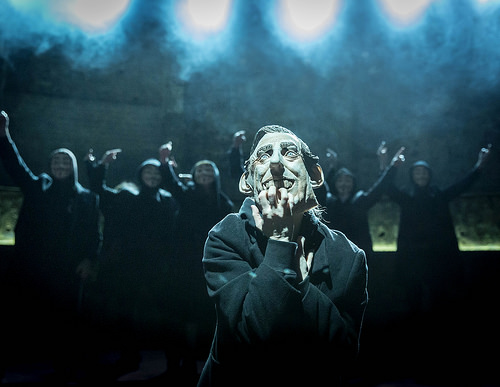
But if stealing a show was a jailable offence, Campbell Keith would be going away for a very long time. Acting as the show’s narrator, Keith’s Uncle Fester dominated the stage every time his weirdly pale head popped out of the wings. It’s hard to make a man who looks like Humpty Dumpty’s goth cousin charismatic, but I’ll be damned if he didn’t succeed.

But all the talent in the world, unfortunately, can’t control a tech setup. Whilst the swell of voices (especially thanks to the ghostly chorus of Ancestors) managed to rise above the band, the microphones were simply too quiet. I lost most of the lyrics in the first half, and the problem still persisted through some numbers in the second act.  And the lights, whilst vibrant and interesting, sometimes felt oddly out of sync with the action on stage. In isolation, either of these issues may not matter. But eventually, grains of sand do become a heap.

And although the chorus should be applauded for their brilliance in terms of both movement and vocal work, the choreography sometimes felt cluttered. There were times I was genuinely afraid an overenthusiastic kick might KO the cellist. Having fewer objects and people on stage may have helped this production breathe easy.

However, I’m loathe to admit the above for a number of reasons. The first being that it would be a crying shame to lose any of the strong chorus, and the masterful musical section – the former never faltering even in the show’s faster and more energetic sections. And secondly, changing the stage would mean altering the breathtakingly Burton-esque set dreamed up by Lu Kocaurek. I’d feel more comfortable pushing over a henge.

Although blighted by a few blips, this was a show more than worthy of its pedigree. Funny to the point of tears and touching to very much the same end, EUSOG’s Addams Family is just as creepy and kooky as that damned theme song promises. Check this one out while you can: Kate Pasola and Rebecca Simmonds have conjured up a brilliant show indeed.

nae bad_blue

Star (blue)Star (blue)Star (blue)Star (blue)

Reviewer: Jacob Close (Seen 17 November).

Go to EUSOG for The Addams Family & cast list.

Visit the  Pleasance archive.

King Charles III (Festival Theatre: 16 – 21 Nov ’15)

Photographs from the West End Production of 'Charles III' by Johan Persson

Photographs by Johan Persson from the West End Production of ‘King Charles III’

“The best of Shakespeare, bang up to date”

Editorial Rating: 4 Stars: Outstanding

Given how topical this production is, I still can’t quite get my head around why someone hasn’t thought of doing a play like this before. Yes, it’s daring and bound to spark discussion on either side of the Royalist debate, but perhaps that’s what makes it utterly ingenious.

Mike Bartlett’s script really is the star of the show – conceiving an idea both dangerous and compelling, that’s also utterly believable. That’s a mean enough feat for many a playwright, but then consider it is also written in Shakespearean style blank verse (with nods to more of his works than I could keep track of), bang up to date, witty, funny and gripping to the very last stage direction.

It’s cleverly structured to allow for scenes and opinions to unfold between all characters, and pacey enough to keep the action flowing, without ever cheating the audience of any details. I would have preferred more ensemble scenes to break up the endless soliloquies and duologues (again, very Will’), while a more contrasting sense of status between the Royals and others would have gone some way to create even more tension.

The style of the performance took some getting used to early on: interpretations of well-known people seemed over-theatricalised, while showing a distinct lack of respect to each other and occasion. This made it hard to engage with immediately, as I was expecting a subtler and more faithful approach to character. For this reason, for me it was the “made-up” characters of Mr Stevens (Giles Taylor) and Jess (Lucy Phelps) who rang most true, and achieved the optimum balance between the theatrical style of the script and connection with the audience.

Charles III 2

In saying that, the very beauty and intelligence of this piece is the subtle level of detachment from presenting something real and expected, to an exploration of imagination and possibility. Once this performance was in full swing, and I could appreciate the characters as part of an intriguing story (as opposed to what I would expect to see in real life), I was all but blown away by its power and craft. Ben Righton’s William was bang on the money in terms of character development throughout, progressing from stable wallflower to dominant leader, while the descent of Charles (Robert Powell) into public ridicule was nothing short of masterful.

If the King could grant me one wish, it would be to fast forward 100 years, when the population know comparatively little of our current royal family, and see how well it is received then. My money would be on it being viewed in the same way we lap up the best of Shakespeare today.

outstanding

StarStarStarStar

Reviewer: Steve Griffin (Seen 16 November)

Go to King Charles III at the Festival Theatre

Visit the Festival Theatre archive.

Hector (Traverse: 11 -12 Nov’15. Touring.)

Images: Peter Dibdin & Paul Davies.

Images: Peter Dibdin & Paul Davies.

“Distinct, succinct, and valuable”

Editorial Rating:  4 Stars: Nae Bad

Take two names of the same man, move him from Dingwall to Colombo, via Kandahar, Omdurman, and Bloemfontein, and you have an extraordinary life. It should be a history in an imperial sense – proud and impressive, monumentally worthy of respect – and in Scotland it surely is; but add sleazy allegations, the New York Herald, and a hotel bedroom in Paris and it’s all demeaned.

Born Eachann Gilleasbaig MacDhòmhnaill in Mulbuie on the Black Isle, Major General Sir Hector Archibald MacDonald shot himself in the head in the Hotel Regina on 25 March 1903. He was 50 years old. This distinct, succinct, and valuable play by David Gooderson, directed by Kate Nelson, would show how, in all likelihood, this came about.

There is a parade ground moment of wounding significance, there is a battle-field manoeuvre of astonishing derring-do, but actually it’s all set up in the mincing and treacherous line, ‘None of us would be called a fairy’, viciously twisted from ‘Three Little Maids from School Are We’. ‘Fighting Mac’, the crofter’s son from Ross-shire, had no defence against tittle-tattle and class prejudice. His face may have been on cigarette cards but the Governor’s wife cares only for (English) officers who can waltz.

https://i0.wp.com/www.tvbomb.co.uk/wp/wp-content/uploads/2015/10/Hector-1.jpg

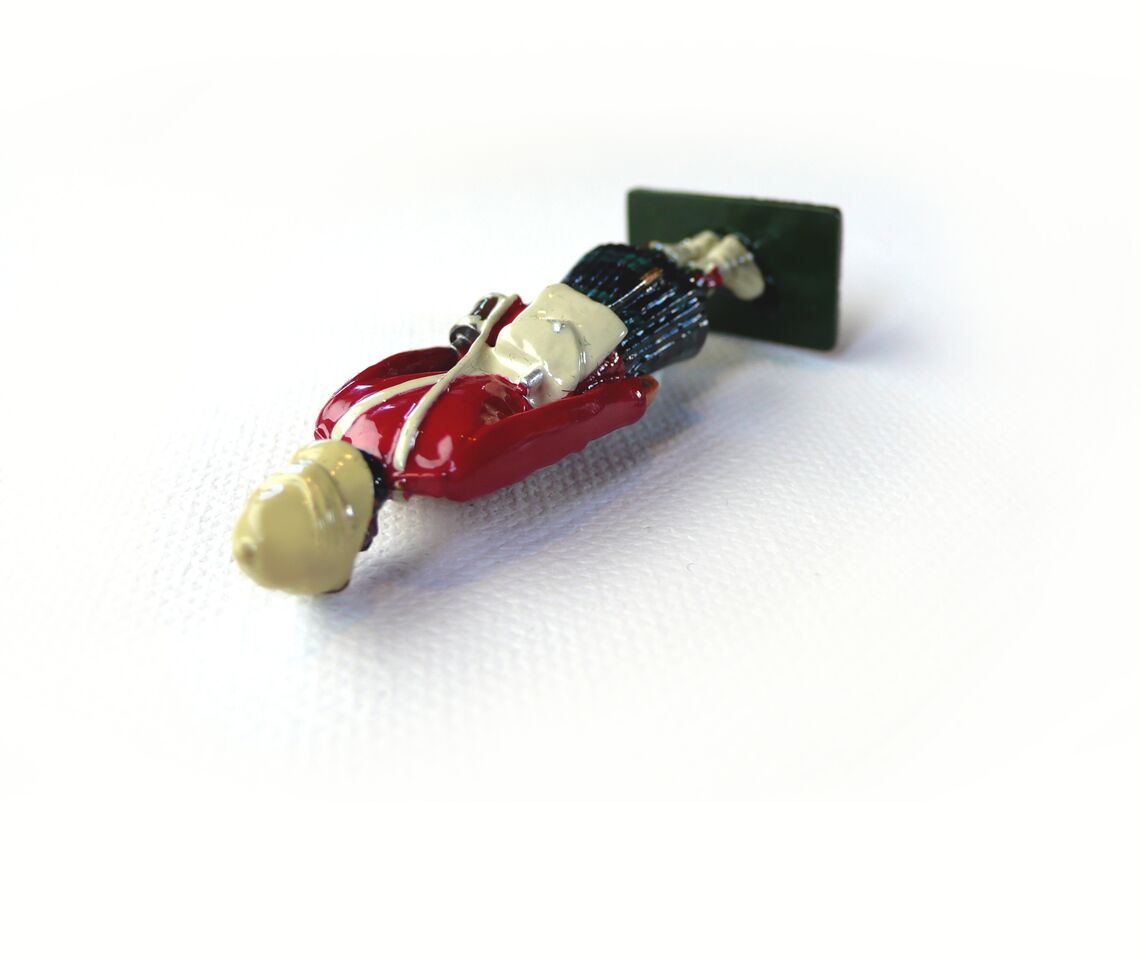
Look at Hector MacDonald, courtesy of ebay, and see Steven Duffy – broad, ramrod straight, level gaze – but without sword, sash and medals. Actually, keeping uniform to plain khaki and the odd puttee is quietly effective, as is the Highland lilt to Hector’s voice. Fancy jackets, drawled vowels, a certain moneyed ease and a torpid morality are the property of the colonial administrators and the plantation owners. Valentine Hanson is especially conspicuous as the scheming Hugh Phipps and an excellent Kevin Lenon is the chaplain, possessed of a conscience certainly, but with not quite enough of it to do any good. The Governor (Stevie Hannon) and his frightful Lady (Gowan Calder) would curl their upper lips in disdain if they knew that Hector’s London home is in middle-class Dulwich. And Hector has another, much more precious secret that comes as a smart surprise early in the second half.

Ali MacLaurin’s serviceable set is out of a military transport: an unfussy assembly of crates, a desert-blown tarp across the back, boarding steps, and a larger, rectangular box that doubles as wardrobe and coffin. (Listen up for the time of Hector’s funeral. It’s both sad and scandalous.) There is a tantalising snatch of the pipes and drums, just possibly of  ‘The Black Bear’, but the fuller, evocative sound is of strathspey and reel and of gaelic song, beautifully gathered at the close.

My one gripe is with Lord Roberts, supposedly Hector’s army mentor and ally. He bellows a final order that in fact does for Hector. I would have thought it would have been a kinder encounter along the lines of, “Now see here, Archie, this wretched business has to be faced down ….” However, what do I know? David Gooderson has had to work on what is known of MacDonald’s last years when it is clear that relevant letters and papers were ‘lost’ or destroyed. Fortunately, Raj Ghatak, who plays Roberts, also has the much more sympathetic part of the local bank manager, Vikram.

Poppy Day,  introduced in 1919, came too late for Hector MacDonald, but for him (and for the Gordon Highlanders) here are the concluding sentences to the Government Commission’s report on his death:
‘…. We find that the late Sir Hector MacDonald has been cruelly assassinated by vile and slanderous tongues … we cannot but deplore the sad circumstances of the case that have fallen so disastrously on one whom we have found innocent of any crime attributed to him.’

nae bad_blue

Star (blue)Star (blue)Star (blue)Star (blue)

Reviewer: Alan Brown (Seen 11 November)

Go to ‘Hector’ at Ed Littlewood Productions.

Visit the Traverse archive.

Balladynas and Romances (Assembly Roxy: 9 -10 November ’15)

Aphrodite. Photos from Teatr Pinokio, Lodz.

Aphrodite.
Photos from Teatr Pinokio, Lodz.

“The clucking immortality that is forever C-3PO.”

Editorial Rating: 3 Stars  Nae Bad

My namesake, Alan, has had his own school of motoring in Edinburgh since 1979. He also advertises that a Polish instructor is available, Lekcje nauki jazdy w języku polskim. That would have been handy, off-road, for Balladynny i Romanse. But then in these fluent days the President of the European Council and former Prime Minister of Poland is a Donald, so what the hell …

… which brings me to the Roxy where – appropriate for an old church – heaven and hell congregate on earth in director Konrad Dworakowski’s immersive staging of the Ignacy Karpowicz novel. It is long at 135 minutes but is disciplined and expert. Go to the excellent Polish Book Institute for a useful synopsis of the book and be drawn to Karpowicz’s other work, not least ‘Uncool’ (2006); all still waiting for publication in English.

What we get in Balladynas and Romances on stage is, however, eminently translatable as it’s a classic ‘What If …?’  What if the gods drop in while we’re about our ordinary, sometimes tacky lives, in and out of Poundland (the cute Polish equivalent is Biedronka or ‘Ladybird’ ), in and out of each other – warning: puppets perform sex acts – and what if Athena, Aphrodite, Jesus, and the rest, are a bit cheap and maybe past their sell-by date? The answers are not hard to come by, as the gods are very visible and like talking about themselves, but it is tricky to see if Olga, Janek, Artur and Kama notice that their tawdry domesticity is being messed with. ‘A remote god [may] be a redundant one’ but it has long been our Fate – aka. the Occasional Narrator – not to realize that Eros or Lucifer happens to be in the front room.

Balladyny2

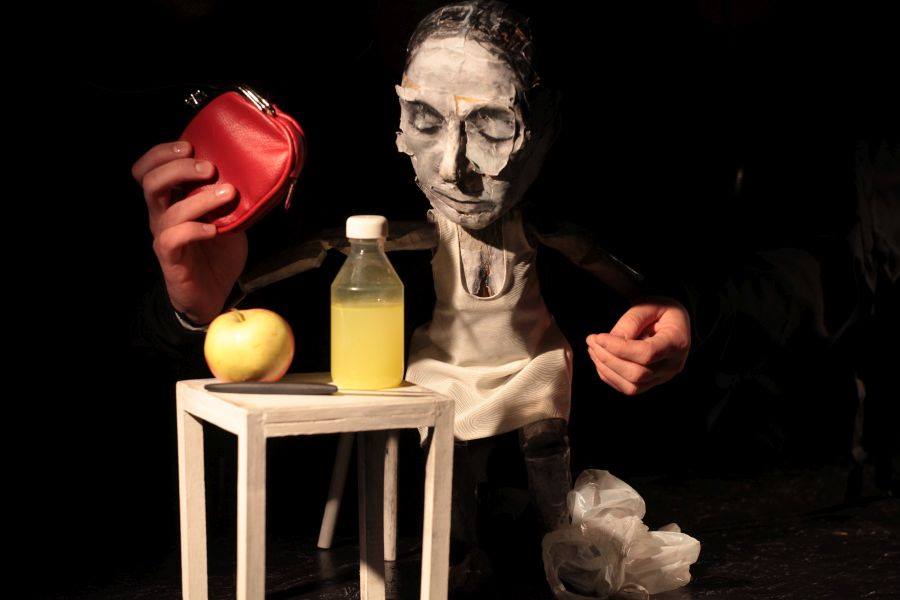
The little mortals are puppets and the gods are dressed in primary black and white, in bathrobes and shades for example. It provides for effective contrast(s), not least when Nike, god of Victory, tenderly cradles the tiny body of a bomb blast victim. Olga, Catholic, fifty something and living alone, undresses and takes a bath and her credulous faith is somehow all the more touching for being manipulated into being. It is the showy gods, though, who demand attention, dwelling as they do on their genealogy – which is a nightmare for Gender theorists – and selfish loves. Eros and Lucifer stand apart, interestingly, each musing on their lot; whilst Osiris’ slender shrouded form and huge eyes recalled the clucking immortality that is forever C-3PO.

Smart lighting and electronic music often snapped the piece back from self-indulgent space and without those puppets the drama would have died, which may well have been the point.

I missed Poland. Eros ruefully mentioned his adopted country at the end of the first half and there were, I’m sure, far more references available than I understood. I googled one Erika Steinbach when I got home and grasped why Old Nick, from Lodz, is a fan. Clearly Balladyna is important but her literary profile receded as, languorous yet scheming, she acted out her bridging role as demi-god fixer and apologist for the ills of the world. At one point, in marvellous conversation with an opinionated Chinese Fortune Cookie, she convinced me that Pinocchio Theatre really know what they are about.

Director: Konrad Dworakowski
Set designer: Marika Wojciechowska
Music: Piotr Klimek
Choreographer: Jacek Owczarek
Lighting director: Bary

Cast: Hanna Matusiak, Ewa Wróblewska, Żaneta Małkowska, Małgorzata Krawczenko, Mariusz Olbiński, Łukasz Bzura, Łukasz Batko, Natalia Wieciech, Anna Makowska.

nae bad_blue

Star (blue)Star (blue)Star (blue)

Reviewer: Alan Brown (Seen 9 November)

Go to ‘Balladynas and Romances’ at the Polish Cultural Institute & to Pinocchio Theatre, Lodz.

Visit the Assembly Roxy archive.

Thingummy Bob (Traverse: 29 – 31 October ’15)

Karen Sutherland and John Edgar. Photo: Douglas Jones & Emma Quinn.

Karen Sutherland and John Edgar.
Photo: Douglas Jones & Emma Quinn.

“Go Bob, go!”

Editorial Rating: 4 Stars: Nae Bad

A Lung Ha Theatre Company production in association with Luminate, Scotland’s creative ageing festival.

Go looking for ‘Thingummy’ in a dictionary and you’ll find ‘Thing + a meaningless suffix, colloquial [since] 1751′. Well, there is nothing sketchy, meaningless or dated about this prize piece from writer Linda McLean and Lung Ha Theatre. It is plain, touching, and enjoyable; which is totally unsurprising when you learn that its title song is The Young Ones by Cliff Richard and The Shadows, 1962 (and counting). It is a bit mean of me to draw your attention to line 6, ‘For we won’t be the young ones very long’, but that’s the inescapable bit.

Bob (John Edgar) is in a wheelchair in a care home and is on a mission to rescue his LP records and what he can of his memory. He knows that he likes caramel wafers and is none too keen on pill popping. He loves his wife Audrey very much and wants to get back to their house but he cannot find his keys. He is determined, resourceful and witty and when he says “I do so mean it”, he does.

Binox (Karen Sutherland) has the job of keeping her eyes on Bob. She is the speaking voice of the care home’s security system and – binoculars trained – she would follow him wherever he goes. Charge Nurse (Kenneth Ainslie) and auxiliary Cap (Mark Howie) do their caring best and his niece Gemma (Emma McCaffrey) is always reassuring and kind but Bob can be hard to keep track of. The police get in on the act too. Bob’s other niece, Lesley (Karen Sutherland again), sends warm letters and postcards but she’s in Sydney, Aus. so really it’s down to his neighbour, Mrs Johnson (Kenneth Ainslie once more), to put the kettle on for when Bob makes it home.

It’s a fun pursuit that is made all the more engaging by the breadth and space of the set design by Karen Tennent. M C Escher squares and a revolving centre piece might suggest a board game – with rapping moves –  but the projection of photographs from Bob’s family album adds a whole new dimension. Personal really. Music by Philip Pinsky provides a catchy accompaniment, complete with scratches from those treasured 33s.

At one point, when Bob is trying to reach Audrey, Gemma says ‘”This is too sad”. It is and it isn’t, which is the appeal of ‘Thingummy Bob’. McLean’s script is clever, switching from the short and conversational – especially Cap’s serial “Aye’s” – to the longer, more considered and reflective sequencing of Binox and Lesley. Certainly the issues of aging and dementia are well in place but it is Bob’s story and Edgar’s performance that hold the stage as he wheels around it.

Artistic director Maria Oller and Movement Director Janis Claxton find great, sympathetic, cheer from this closing couplet of ‘The Young Ones’, ‘And some day when the years have flown / Darling, this will teach the young ones of our own’. Go Bob, go!

nae bad_blue

Star (blue)Star (blue)Star (blue)Star (blue)

Reviewer: Alan Brown (Seen 30 October)

Go to Lung Ha Theatre Company and Luminate

Visit the Traverse archive.

Tipping the Velvet (The Lyceum, 28 Oct – 14 Nov ’15)

“An imaginative attempt at what could have been quite a bland adaptation”

Editorial Rating: 2 Stars

From the quills of established writer Sarah Waters and high-flying playwright Laura Wade, my expectations were certainly high on entering the auditorium for this new interpretation of the award winning novel. And with a very amusing opening skit and a dazzling number from Laura Rogers as Kitty, it certainly got off to a fine start.

However, while the amount of creativity on show – from daring aerial sequences, to lush period costumes and a Victorian Music Hall arrangement of a song famously featured on a Diet Coke advert – was impressive, unfortunately, this production’s lack of cohesion and staccato structure made it nigh-on infuriating for me to sit through.

In saying that, the show wasn’t without its laugh out loud moments – a landlady dressed in exactly the same design of fabric as the wallpaper in her house and lines such as “You exquisite little tart” certainly caused a few chuckles. However, the comedic aspects were pushed to their limits with a section involving animal carcasses being used as puppets in a song, and a certain “adult” section depicting Nancy’s experience as a prostitute. Definitely not recommended for the easily offended.

Sally Messiah is certainly charismatic as Nancy, Amanda Hadingue is very likeable as Annie (among other characters she plays), and Ru Hamilton delivers a delightful turn as gender-bending Alice. However, for me the most credit in this production should go to the stage hands, whose alarmingly efficient scene changes left me in a state of amazement on numerous occasions.

Much of Lizzie Clapham’s design was visually impressive, but use of space could definitely have been improved: at times the central characters would appear very lost towards the back of a somewhat empty stage, hindering the sense of intimacy they were trying to create. In a production with so many scenes, locations and jarring cuts between them all, a much more fluid approach to location and action would have been more engaging.

There were various musical numbers interspersed throughout the piece, almost all of which were interpretations of modern songs. In some instances, these worked well as a way to bring relevance to today’s audience, but in the second act when Nancy is desperate for a place to live, she belts out a line from one power ballad after another, with farcical impact. Rather than being able to relate to her struggle, she is instead alienated, and it becomes difficult to then reconnect with her in the following scene. This is part of what frustrated me the most about this production: at times we were allowed in to develop a bond with the characters, while in certain sections it was impossible to do so.

The constant bouncing between styles, coupled with the distinct over use of the compere/narrator/MC character, who incessantly dove on stage with needless interruptions between every scene, made this production feel like it was having some sort of pubescent identity crisis between Brechtian fable, cabaret variety show, and an episode of Jeremy Kyle. I could have handled any of those interpretations individually but all in one show was just too much.

In some ways I’m glad this production took some risks to create an imaginative attempt at what could have been quite a bland adaptation. It’s just a shame that so many different styles, techniques and devices were used in the process.


Star (blue)Star (blue)

Reviewer: Steve Griffin (Seen 29 October)

Visit the The Lyceum archive.

THIS REVIEW HAS NOT BEEN SUBEDITED

Spontaneous Sherlock’s Monthly Mystery (Canons’ Gait: 22 October ’15)

“Professional quality improv done so, so right.”

Editorial Rating: 4 Stars Nae Bad

If you’ve never read the collected works of Sir Arthur Conan Doyle while drunk, I wouldn’t recommend it. Intricate plotlines and skilful writing become an impenetrable morasse after a few strong drinks – which is all the happier, then, that the collected works of Eric Geistfeld, Will Naameh and Dove bear no such weakness.

Improvising a raucous (and often marvellously nonsensical) Sherlock Holmes mystery in the somewhat cramped underbelly of Canons Gait, Spontaneous Sherlock’s Monthly Mystery is immediately worthy of its considerable praise.  Of particular note were the considerable musical talents of the accompanying string and piano band (Bramwell, Coe, McGurty and Podborączyński), whose bouncy and dynamic tones lent a cartoonish energy to every scene they graced with a trill.

Scenes, it should be added, which in the hands of any other group would have been wasted. The Spontaneous Sherlock team took the strange suggestions to even stranger places – and what we got was a mystery involving a lollipop that turns people into weird monsters, Doctor Watson’s obsession with rulers and more latex-mask reveals than a Mission Impossible retrospective. But despite the madness and seeming incohesion, the show never lost its hold.

And that perhaps typifies what I liked so much about Spontaneous Sherlock. From the very beginning, I was taken aback by how complete the entire performance felt for an improvised show; from the upbeat, ambient music to the deliciously over-the-top physicality, the level of polish and cohesion between what could have been disparate components utterly shone.  This is professional quality improv done so, so right.

And, of course, that’s due in very large part to the considerable comic talent on display. Between Dove’s command of melodramatic ridiculousness, Geistfeld’s mastery of deadpan and Naameh’s utterly sublime line delivery, you’d be hard-pressed not to be immediately charmed. And despite the completely ridiculous plotline they pieced together, the show never felt like it got lost in itself. The ending was oddly satisfying and certainly more clever than most other long-form improv performances I’ve seen; both inside Fringe and out.

However, as with all improv of this type, there are weaknesses. Despite the often feverish energy present on stage, certain segments dipped and stalled noticeably in pace as the actors worked out where to go. Whilst that’s always to be expected, and it hardly affected the show as a whole, it was still a jarring crack in what was otherwise a pristine production.

This is certainly an event which lives up to its own hype. It’s not often that I mark a show in advance on my calendar, especially if it’s one I’ve reviewed before; but if you’re planning on attending next month’s ridiculous mystery, you might have to fight me for a seat.

nae bad_blue

Star (blue)Star (blue)Star (blue)Star (blue)

Reviewer: Jacob Close (Seen 22 October)

Visit the Other  archive.

THIS REVIEW HAS NOT BEEN SUBEDITED

Hidden (The Lyceum: 20-24 October ’15)

“Gives chills and thrills aplenty”

Editorial Rating: 3 Stars: Nae Bad

Hidden really is a treat for anyone who’s ever wanted to explore what goes on everywhere else in a theatre that audiences don’t normally get to see. Marry that with tales from the history of the building and a Victorian horror story and you have quite an intriguing evening’s entertainment. However, while the idea and overall style and feel of the piece were terrific, there was no clear narrative or sense of progression between each section, leaving me feeling a bit cheated as to specific details and stories.

Individual sections were generally great at creating an overall mood, setting a scene (the dressing rooms in particular stood out), or presenting a static idea, and the piece was littered with numerous magical moments  – terrified faces and screams, isolated “scenelets” and monologues. Yet we learned very little about who these characters were, why there were there, and how they related to anything else that was going on.

While for most of the performance, the audience is directed where to go next by theatre ushers, in one section in the scenery dock, three of the young performers (Xanthe Mitchell, Ellis Imrie and Anna Millar) more than capably moved us around to follow the action. Staying true to their characters and without speaking, they created a compelling and haunting theatrical moment, demonstrating commanding professionalism and presence beyond their years. Moving into the area beneath the stage, Gregor Weir delivered a very charismatic and spooky monologue about being trapped, making clever use of the space by hiding in between and rattling racks of stored stage lights.

Indeed this whole section (directed by Lyceum Artistic Director Mark Thompson), which allowed the audience to fill the space as they wanted and explore the action from the perspective they chose, gave the piece a very immersive and personal feel. It’s a shame that this sense of individual discovery was not carried through more parts of the performance, particularly the section on the stage, where instead we were asked to simply stand in a line to one side and observe.

In saying that, the section in the stairwell leading up to “the Gods” (very emotively delivered by Emma Simpson and Tegan Wright) was a great way to follow the action, and break-up the sense of travelling from one part to the next by making the travelling itself part of the performance. Similarly, walking behind the bar in the stalls, past three caged performers shrieking to be let out, also helped make the “journey” more interesting to experience.

While it wouldn’t have been right to have delivered this piece in tour guide style, I feel that making more effort to communicate some of the background to each section would have been really beneficial. I felt it also lacked a little bit of diversity in terms of mood – it was almost all a chilling ghost story, when some happier or funnier moments of the theatre’s history would have added another layer of depth to the performance.

Given that this performance was devised and delivered by young people, in collaboration with four different directors, one must give them due credit for their achievement – this is a very ambitious project that gives chills and thrills aplenty, and is a worthy education and exploration into just how exciting theatre can be. For me it just lacked that bit of cohesion to make it really special.

nae bad_blue

Star (blue)Star (blue)Star (blue)

Reviewer: Steve Griffin (Seen 20 October)

Visit the The Lyceum archive.

THIS REVIEW HAS NOT BEEN SUBEDITED

Descent (Traverse: 20 – 24 October ’15)

Photo: Leslie Black

Photo: Leslie Black

” … doolally moments get longer and longer”

Editorial Rating: 4 Stars: Nae Bad

The fourth in this autumn’s ‘A Play, a Pie, and a Pint’; presented in association with Luminate, Scotland’s creative ageing festival.

Do you play ‘Trivial Pursuit’? Remember the rules? Where do those wee scoring wedges go, the ones that make up the ‘pie’? When did England win the World Cup? Rob is certain he knows the answers but he doesn’t, not at all.

You might go down with a bad cold, but Rob is going down with dementia and he’s probably only in his mid-fifties. That’s ‘Younger Onset Dementia’ then.

Linda Duncan McLaughlin’s play is not comfortable and it is definitely not trivial. It takes 60 minutes of stage time for Rob to go from running his own architectural practice to forgetting how to sit in a chair. His wife, Cathy, does more than her best to care for him but their daughter, Nicola, can see that there comes a point when Dad is too far gone and that Mum cannot continue the struggle to keep him at home, not least for the sake of her own health.

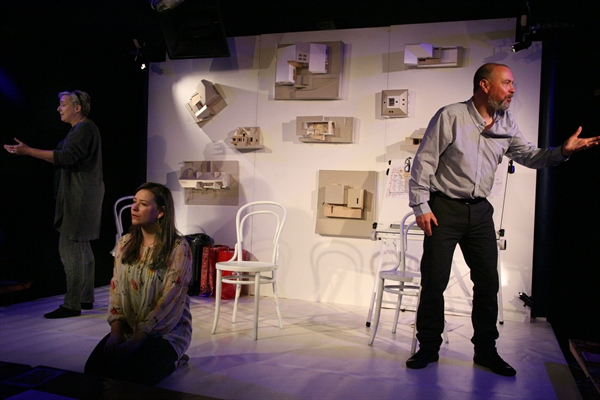
That Rob is an architect is a cruel touch. He has always found pleasure, even beauty, in design and function but here is laid low, kaboshed, by a condition that reduces his brain to formless mush. While he grows frantic because he cannot find his pen we see display models carefully arranged on the wall and neat plans on his drawing board. Rob knuckles his forehead in frustration as his doolally moments get longer and longer but there’s nothing feeble-minded about Barrie Hunter’s performance.

“Everything’s slipping”, says Cathy, and a clock tick-tocks away in the dark scene intervals. Wendy Seager’s calm presence is all the more disquieting in this exacting role. Cathy holds on to Rob as long as she can, which puts her at considerable risk, but their home grows silent, then empty, and finally there is nothing left, just an absence. Nicola (Fiona MacNeil) has, as she puts it, ‘to kick the walls down’.

It is a steep descent, narrowing all the while. McLaughlin and director Allie Butler steady it with a retrospective structure, instances of shared speech and some explicit commentary. The audience, selfishly, is  especially alert when the signs-to-look-out-for are tested at home. Rob, bless him, is appalled – and scared.

NHS Lothian is ‘Making Edinburgh dementia friendly’ at the moment. Look out for a leaflet in the libraries asking whether you are ‘Worried about your memory or someone else’s?’ If you’re not, Descent will make you think again.

nae bad_blue

Star (blue)Star (blue)Star (blue)Star (blue)

Reviewer: Alan Brown(Seen 20 October)

Go to Descent at the Traverse here

Visit the Traverse archive.