Who’s Afraid of Virginia Woolf? (Bedlam: 13 – 17 October ’15)

zmNi2cSofHsDbaIu5q-ZCYi3vqRNwW5e63TtyzVN5zI,f1EKqPn7WaRX-pS8CIy4irpbv6ccB19vfHCH_eUY46U,D3UV8nQ7mgS7WOJ6yu2AIVkv_JjciZjbTs92rIMErL8,vNbY3VPQeN9NnOf0OBZQ5XYk4-h5o47OPKJJfiCgOVE

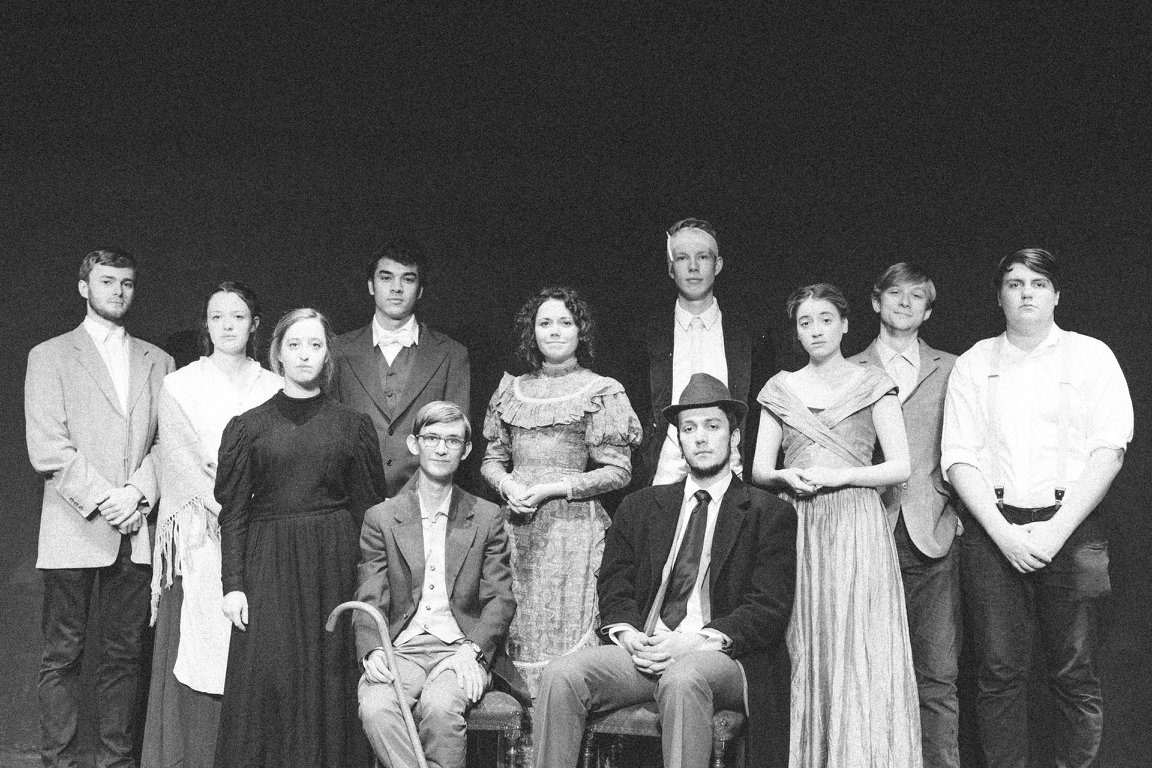
Henry Conklin as George and Caroline Elms as Martha.

“Courageous and spirited performance”

Editorial Rating: 4 Stars: Outstanding

There are drinks before a party and there are drinks after a party. The LADbible, a new source for Edinburgh49, lists ‘17 Things That Always Happen During Pre-Drinks’; but what about Post-Drinks? The lads should go back to George and Martha’s place and learn how Mom and Dad get down at two in the morning on a Saturday night. And then some. Don’t play these party games at home, boys and girls.

Edward Albee’s 1962 play is a lacerating shocker of a marriage on the rocks. Martha is 52, is really high-maintenance and has a nice line in mixing ice-cubes and tears. George is 46 and – to quote his wife – doesn’t “do anything; you never mix. You just sit around and talk”, which explains the two chesterfield sofas on stage but under-estimates by a long, long shot George’s mocking and mordant words. Total war is not declared until halfway through the second act but the skirmishing is unrelenting and bloody. When they are not ripping into each other they practice on their late night guests, Nick (30) and Honey (26), whom they have just met.

We’re in a small university town in New England where George hasn’t made professor in the History faculty, despite marrying the college President’s daughter, and Nick – fresh in from Kansas, blond and bright – has just joined the Biology Department.

It’s like Albee is swirling his first couple in a highball glass (and note the cheeky correspondence between George and Martha Washington …). Actors Henry Conklin and Caroline Elms give a performance of such fortified intensity that you wonder how they’ll recover. Conklin is the measured, oiled one, his level delivery only once or twice spilling into fury. Elms is more intemperate, emotionally more profligate, but still vulnerable. Albee would have her past her prime, which is tricky at the undergraduate stage, but then George is supposed to be thin and going grey. Neither performer worries about that and they give each other such a goddam kicking that not for one second did I doubt the wasted nature of their twenty-three years of marriage. Tender proof positive is provided by their exhausted, mutual dependence at the end.
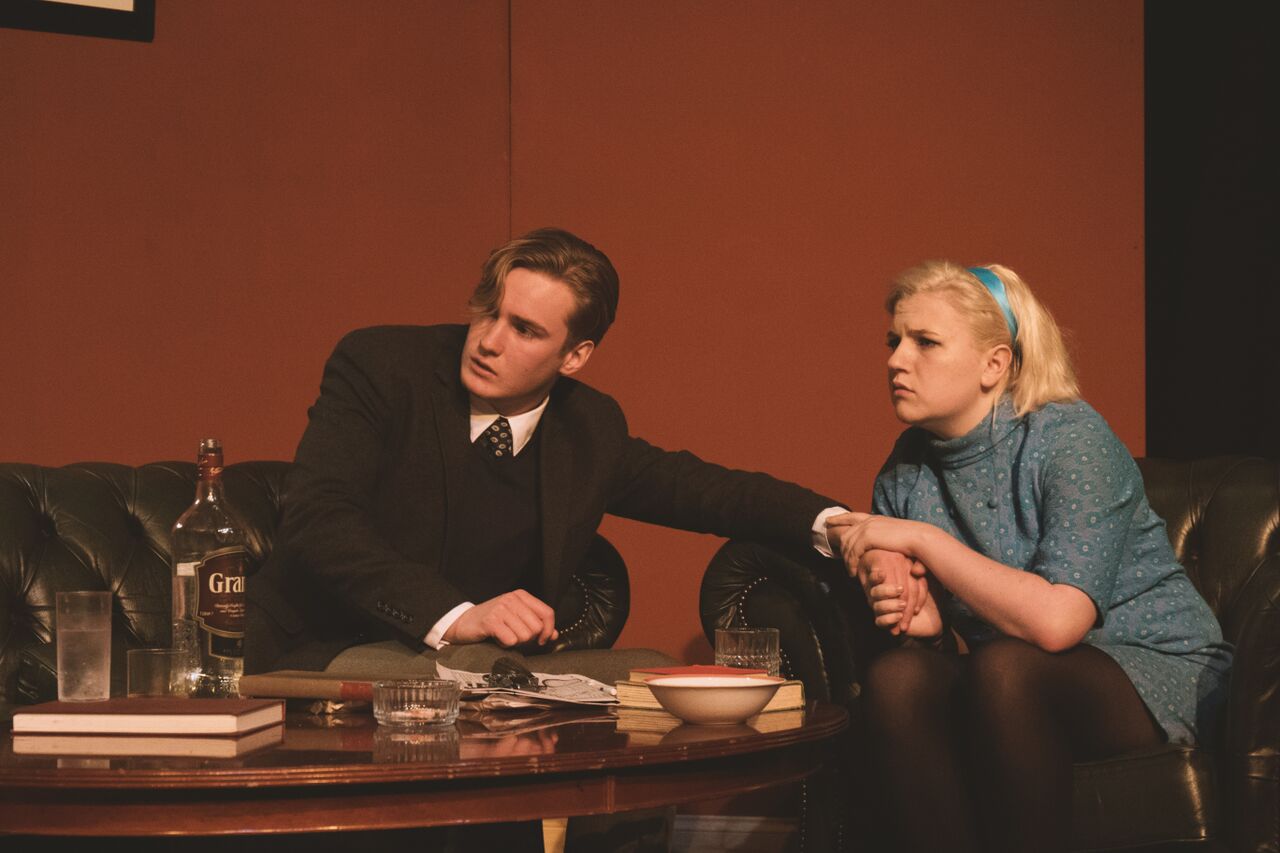
Stephen MacLeod as Nick and Jodie Mitchell as Honey.

Macleod Stephen as Nick and Jodie Mitchell as Honey.

George calls Nick and Honey ‘children’ and they are: not so much innocent as defenceless. Jodie Mitchell plays Honey as – frankly – clueless and squiffy and there’s an honesty to it that is very appealing.  Macleod Stephen has the harder part, trying to stand against George, to withstand Martha (he flops) and manage several whisky sodas. Nick’s sudden understanding of the acute sadness that slashes through the whole action is important but was almost blindsided.

Director Pedro Leandro should be delighted with courageous and spirited performance. It is a long play but the tension held and what might have turned mannered and flat did not. The sofas, stage left, could have been more in the centre and I did miss Martha banging against the door chimes (my bad, I reckon) which needs to be seen to make sense of George’s ruthless masterplan to wipe her out.

Simon and Garfunkel’s The Dangling Conversation opens up the second act and is a pitch perfect choice. Remember the line, “Is the theatre really dead?” Well, it ain’t.

outstanding

StarStarStarStar

Reviewer: Alan Brown  (Seen 13 October)

Go to EUTC here

Visit the Bedlam archive.

Lord of the Flies (Festival Theatre: 13 – 17 October ’15)

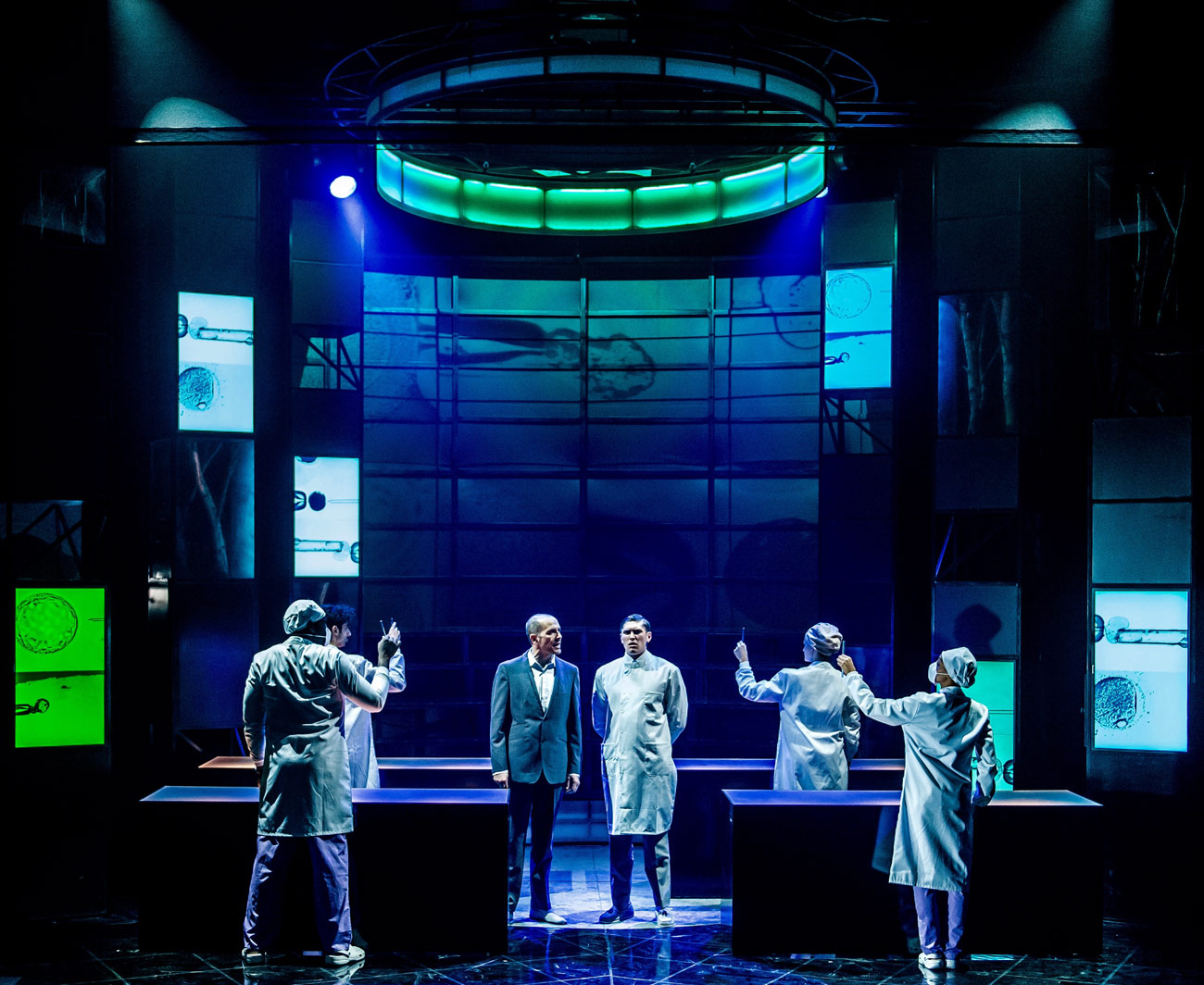
Set design: Jon Bausor Photo: Regent's Park Theatre.

Set design: Jon Bausor
Photo: Regent’s Park Theatre.

“Big, bold and gutsy”

Editorial Rating: 3 Stars: Nae Bad

For me, with the May general election in mind, this is a timely production of Lord of the Flies: a charismatic, commanding and fear-mongering leader on one side; a righteous and idealistic leader who is unable to win mass support on the other; and one guy in the middle who doesn’t fit into either camp and who is killed off. I wonder if William Golding knew back then how important and relevant his book would still be 61 years after its publication. And that’s without postulating that Michael Gove might make a ‘good’ Beast. This Regent’s Park Theatre production certainly doesn’t shy away from the issues – it’s big, bold and gutsy, but in my opinion, tries too hard to make its point.

I must start with Jon Bausor’s design – the first thing you see on entering the auditorium. It’s visually spectacular, with the focal point being a very believable carcass of a crashed aeroplane to one side, strewn with suitcases. On the other a sizable ramp leads up and off, and everything is surrounded by trees and hanging branches in Naturalistic style. Yet while stunning, I felt the set ended up being too much of a dominating presence, causing unnecessary overlaps with different scenes occurring concurrently (and confusingly) in the same part of the stage. I would have preferred a more mapped-out use of the space to clearly define the different locations in the story and help distinguish the separateness inherent in the characters.

One of this production’s strengths was the energy and dynamism with which the warrior-like sections were portrayed. With frantic movement, chanting, and a commanding performance from Freddie Watkins as ringleader Jack, these moments were terrifying and powerful, and an effective glimpse into what a group of boys might turn into without effective parenting. Indeed, this interpretation puts Jack’s character front and centre (rather than Ralph’s), giving more focus to the brutality of the boys’ behaviour throughout.

However, some of the effectiveness of the “savagery” was lost given a distinct lack of contrasting moments of quietness and subtlety. I found the whole thing too unnecessarily shouty: Piggy and Ralph would communicate in raised and pained voices when alone. Commands were all aggressive, and fright seemed to always be expressed very loudly. Even the Officer shouted all of his lines, reducing his status to that of the children, when his presence could have been communicated far more effectively through physicality and control.

Anthony Roberts as Piggy.

Anthony Roberts as Piggy.

In saying that, there were occasions where the dynamic changed to great effect: early in the second act when Ralph and Piggy discuss how to get Piggy’s glasses back is a rare glimpse of depth and subtlety in performance style, allowing the audience to connect with these two as different from the others. It’s a shame this technique wasn’t used more in the first half of the production. Anthony Roberts gave a valiant performance as Piggy, and I would have liked to have seen more of him.

The sound and lighting were both excellent in supporting the action and setting the scene, and the occasional music added to the ambience without being overpowering. The evolution, down the way, in costume and makeup to underline each character’s descent into savagery was clever and effective. That all went to show that clearly a lot of thought and creative energy has been put into this production, but for me a couple of big flaws hold it back from being remarkable.

nae bad_blue

Star (blue)Star (blue)Star (blue)

Reviewer: Steve Griffin (Seen 13 October)

Go to ‘Lord of the Flies’ at the Festival Theatre

Visit the Festival Theatre archive.

The Seagull (Bedlam: 7 – 8 October ’15)

The cast. Photo: EUTC Facebook page.

The cast.
Photo: EUTC Facebook page.

“Enlivening”

Editorial Rating: 4 Stars Nae Bad

At a guess, the Scottish Seabird Centre in North Berwick is not a must-go destination for students. Well, maybe directors Holly Marsden and Kathryn Salmond are the happy exception for their production of The Seagull gets as up close and personal as the centre’s webcams. And, critically, it does so unencumbered by tradition. No sentimental guano here.

Don’t get me wrong. This Seagull does the business: it’s intelligent, funny and sad – but it is also grounded and plain. Nina’s lofty ‘I am a seagull … No, that’s not it’ is lost on the wind (or cut) and her fraught state at the end of the play is all the more effective for being low-key.

Leave the real emoting to Konstantin (Douglas Clark), who does a fine, anguished job of it – just as he did as Alan Strang in Equus in March. It is not so much an uptight, stressy, performance as an upright one: earnest, principled, and lonely. Kostia stands apart as young and intense, a little weird, which goes down well with an EUTC audience. Chekhov is suitably amended. Where, back then, Kostia left university in his 3rd year ‘owing to circumstances’; now he did politics at uni. and got nowhere.

A seagull is still the emblem of the Moscow Arts Theatre and it is appealing to see how the play is up to date. There’s embattled youth with dreams and no prospects; parent(s) brittle with glee and anxiety and a professional class whose diplomas are looking tired and whose pensions are meagre. Town and country are miles apart and there is the constant engagement with what pays and what doesn’t. There’s even bingo and the fortunate winner who takes all, including the girl.

For Kostia, theatre just exists as nice vistas in abstracted space, which is a cheerless and absent place to be. It is more enlivening, by far, to stay in the company of others. There’s uncle Sorin, played with bleak glee by William Hughes; doctor Dorn, a gently sardonic Finlay McAfee; and the famous literary cad Trigorin, whom a soulful Jonathan Ip rescues from the censure that he probably deserves. However, it’s the women who really people the stage: Arkadina, Kostia’s impossible, self-absorbed mother, is strongly played by Elske Waite; Nina, lovely and brave, is a beautifully articulate Katya Morrison; and an unerring Sally Pendleton is the trapped but resolute Masha. I thought all three performers offered a junior master class in diction.

Of especial note in a solid, more than pleasing production was the spare quality of the costume and stage set. For once the doors opened and shut without shaking the ‘walls’ and a single fireplace, a table and a few chairs proved just enough.

We’re told that this is the first time that The Seagull has been put on at Bedlam. I’d be happy to see it or its relations fly back soon. Three Sisters, anyone?

nae bad_blue

Star (blue)Star (blue)Star (blue)Star (blue)

Reviewer: Alan Brown  (Seen 8 October)

Go to Bedlam Theatre and the Edinburgh University Theatre Company here.

Visit the Bedlam archive.

Brave New World (King’s: 29 September – 3 October ’15)

Photos: Touring Theatre Consortium Company

Photos: Touring Theatre Consortium Company

“Trim, bold and emphatic”

Editorial Rating: 3 Stars

This is a didactic staging of a hugely instructive book, so here are two questions from the lecture theatre: how near do you like your future and do you shop in ‘lower caste stores’? For me the answers are (i) pretty close and (ii) it depends.

Aldous Huxley wrote Brave New World in 1931, which seems a long time ago, but he was seriously long-sighted and along with keen definition came the vision thing. OK, his Doors of Perception (1954) is a mescaline trip but he really did see what might be and his World State is bad and appalling, unless that is ‘You’re worth it’, in which case you might love to bits its mind-numbing, slogan-ridden lifestyle.

As for the second question, I bought some excellent coffee at ALDI last week and am very pleased with my jacket from Tu Clothing at Sainsburys, which by Huxley’s reckoning makes me a quantifiable Delta. Naturally part of the ‘fun’ of reading Brave New World is knowing that at least you’re not an Epsilon-Minus lift operator.

Huxley’s story, this play, is about misfits in the sorted, post-apocalyptic society. Bernard is a maladjusted Alpha-Plus psychologist who sees his way to a snappy suit by introducing John, an impure bred, unconditioned primitive, to his lords and masters. Or rather to Margaret, Margaret Mond, Regional World Controller. Lenina, a Beta-Plus lab technician with dodgy longings for a monogamous relationship, joins Bernard on the visit to the Savage Reservation to look at those unfortunates, who still suffer childbirth, disease and aging and who still experience family, love and heartbreak. There they find John and bring him and his mother home to London. It all gets messy when John claims his right to be unhappy.

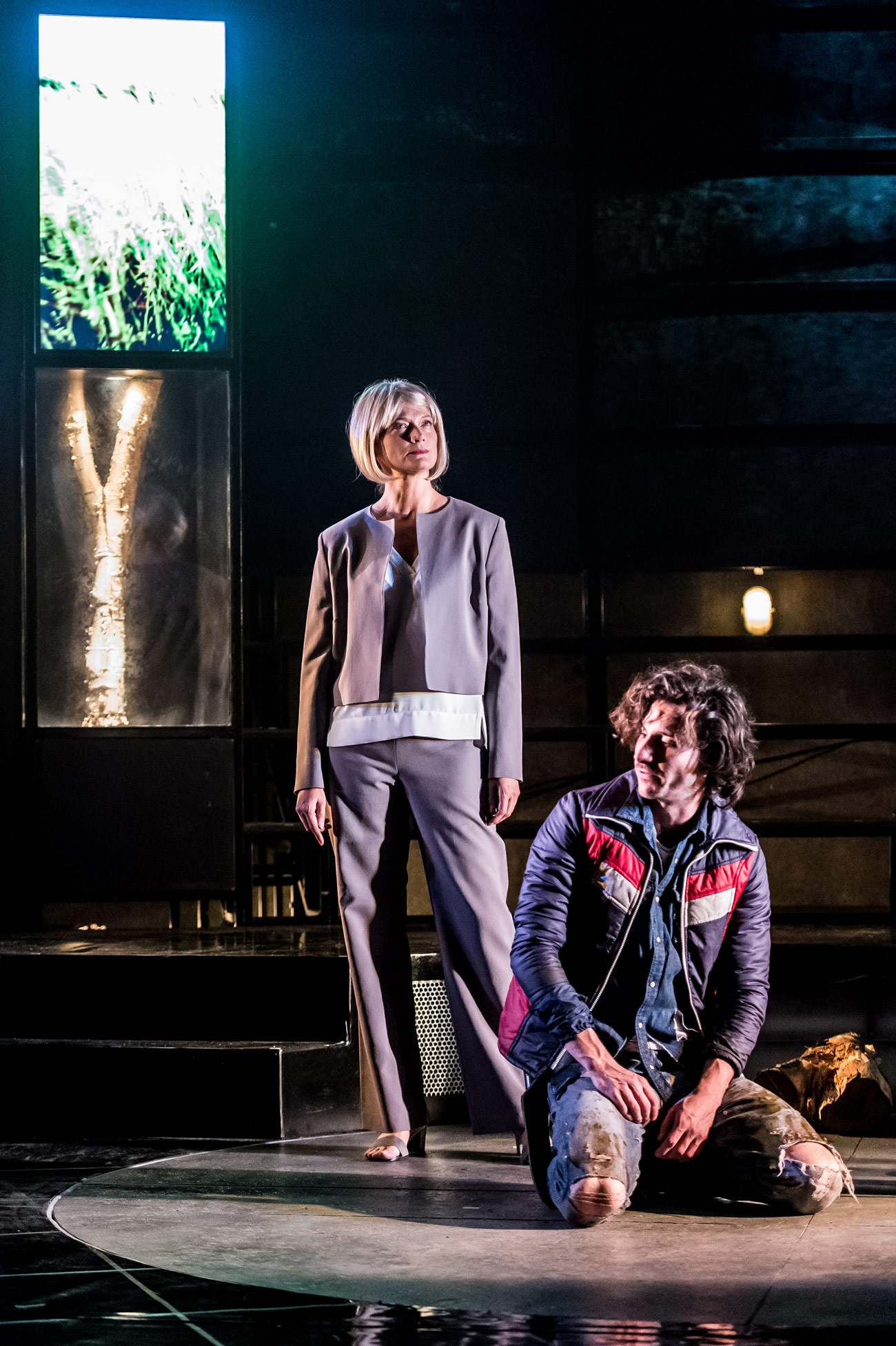
Mond (Sophie Ward) and John (William Postlethwaite)

Mond (Sophie Ward) and John (William Postlethwaite)

Dawn King’s adaptation of Huxley’s text is trim, bold and emphatic. Its Display settings are, if you like, maxed out: Bernard is so inadequate that voice recognition software won’t recognise him; Lenina is sweetly confused; Mond has an answer for everything and John would take an axe to the whole ignoble shebang. He won’t take soma though – a legal high gone stratospheric – or sex gum, which is a relief.

There is a whole new order to configure here so it is unsurprising that video, lighting and sound provide illustration and support for the ten strong cast. There are multiple screens, helicopter rides and ‘feelie’ films and an immodest electronic score by ‘These New Puritans’ that all make the use of a centre stage curtain look decidedly old-fashioned, if not clumsy.

There is no hiding, either, of the pared down script and my unfortunate impression was of good actors managing one educative but end-stopped line after another. Flow was there none. On the other hand, and to be fair, I read Brave New World so many times when I was at school that I’m a fastidious, prose bound geek and anyway Huxley’s narrative is ‘set’ on information overload. Nevertheless, I did like William Postlethwaite’s tousle-haired John, with his subversive use of Shakespeare. Even the uber-cool Mond (a poised Sophie Ward) would have him, which is way beyond Huxley; but Scott Karim as the rebel writer Helmholtz really isn’t given enough to say.

So, fittingly enough, this is Brave New World encapsulated as feature drama. It is a little plastic, a little lurid, but still potent.

Star (blue)Star (blue)Star (blue)

Reviewer: Alan Brown  (Seen 29 September)

Go to the Touring Consortium Theatre Company here.

Visit the King’s Theatre archive.

All My Sons (King’s: 22 – 26 September ’15)

Robbie Jack as Chris. Photo. Rapture Theatre.

Robbie Jack as Chris.
Photo. Rapture Theatre.

“From event to moral consequence to personal calamity”

Editorial Rating: 3 Stars

Edinburgh theatregoers can salute one of the 20th century’s greatest playwrights this week, as Scottish company Rapture Theatre bring Arthur Miller’s All My Sons to the King’s Theatre. Marking the end of their month-long tour of Scottish cities, Rapture’s production does not disappoint and ensures that Miller’s 1947 play still hits home. This week’s breaking news of Volkswagen AG marketing dodgy car engines in US  is an unlooked for dividend. At the heart of Miller’s plot are faulty cylinder heads shipped out to the Pacific ‘theatre’ during WWII. High diesel emissions don’t kill outright but Joe Keller’s cracked engine blocks killed twenty-one pilots.

The backyard set is minimal, portable yet effective, and closes tight around the Kellers as the story is stitched together. It felt a little uncomfortable at first but grew familiar, with more ‘give’ as the actors took hold. Paul Shelley as Joe Keller gives a commendable performance in that epitome of Miller roles: the grafter with no college education behind him who has managed to make it from shop floor to Board room. It is easy to believe in the image of the honest family man but that only adds to the effect of the sudden breakdown in relations with his second son, Chris. Equally credible, but with good reason, Trudie Goodwin is the heartbroken Kate Keller, a mother unwilling to accept the fact that her first son, Larry, did not come marching home. That grim acronym ‘MIA’, missing in action, is stamped all over the fate of Mr and Mrs Keller.

Robert Jack’s portrayal of Joe’s son Chris is especially notable and is the role to underline. A far cry from his Jacko in Gary: Tank Commander, Jack’s performance grows through each scene and his electric presence on stage is almost palpable. Deliberately more contained in the first act, Jack developed Chris’ character in such a way that the audience couldn’t help but be drawn into his hope for love, and subsequent devastation at the discovery of his father’s actions.

Throughout the play, sound effects are used to bring back the past as characters are reminded of their time as children back home in the yard. While an interesting idea, this often sounded clunky, and the nostalgia broke off from the rest of the production.

Despite some disappointing and/or distracting American accents from supporting cast members, which is often a big ask to get right, director Michael Emans does deliver the goods. The three central performances by Shelley, Goodwin and Jack are well sustained and the ‘unwinding’, as Miller put it, from event to moral consequence to personal calamity is unforgiving and inescapable.

Rapture Theatre are currently showcasing their Arthur Miller season in Scotland and will be at Summerhall with The Last Yankee next month.

Star (blue)Star (blue)Star (blue)

Reviewer: Rachel Cram  (Seen 22 September)

Go to All My Sons at the King’s here

Visit the King’s Theatre archive.

Waiting for Godot (Lyceum: 18 September – 10 October ’15)

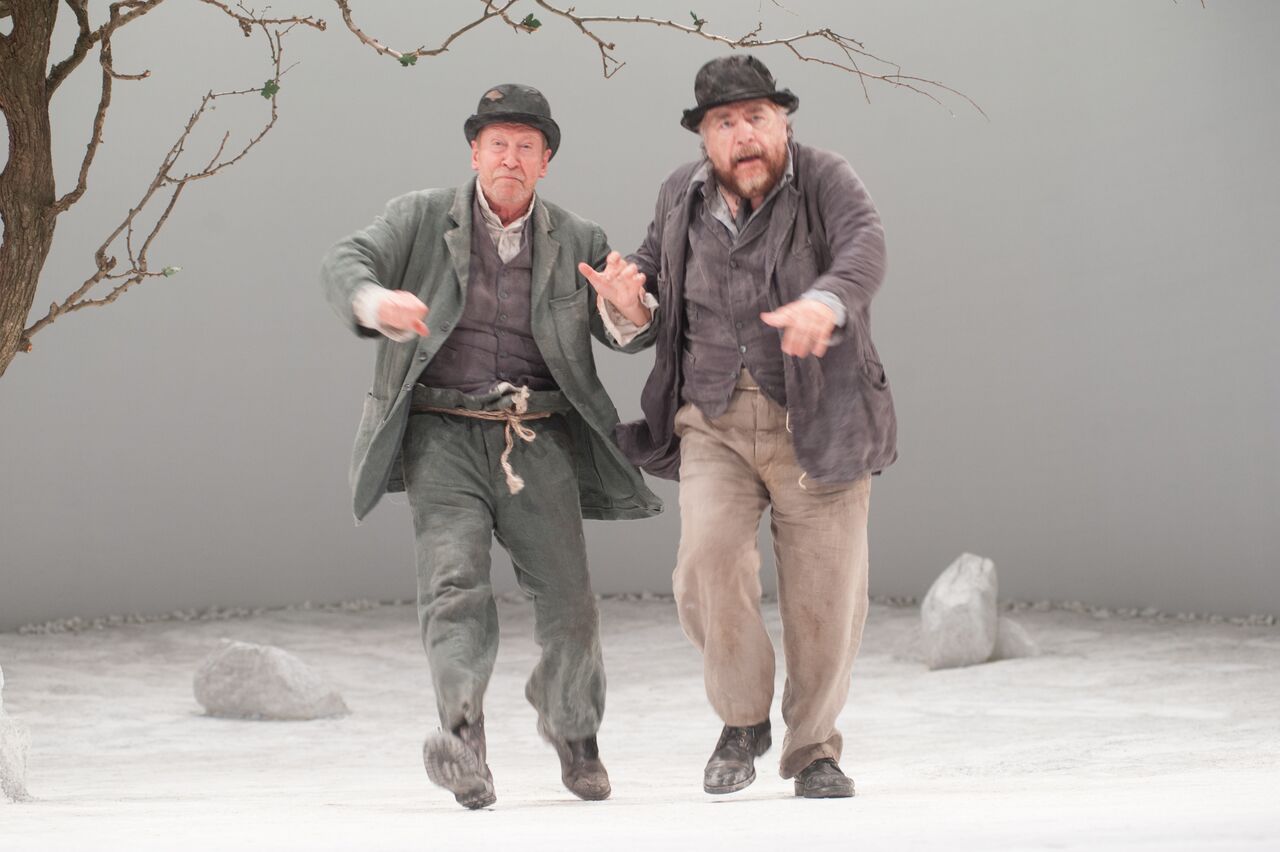
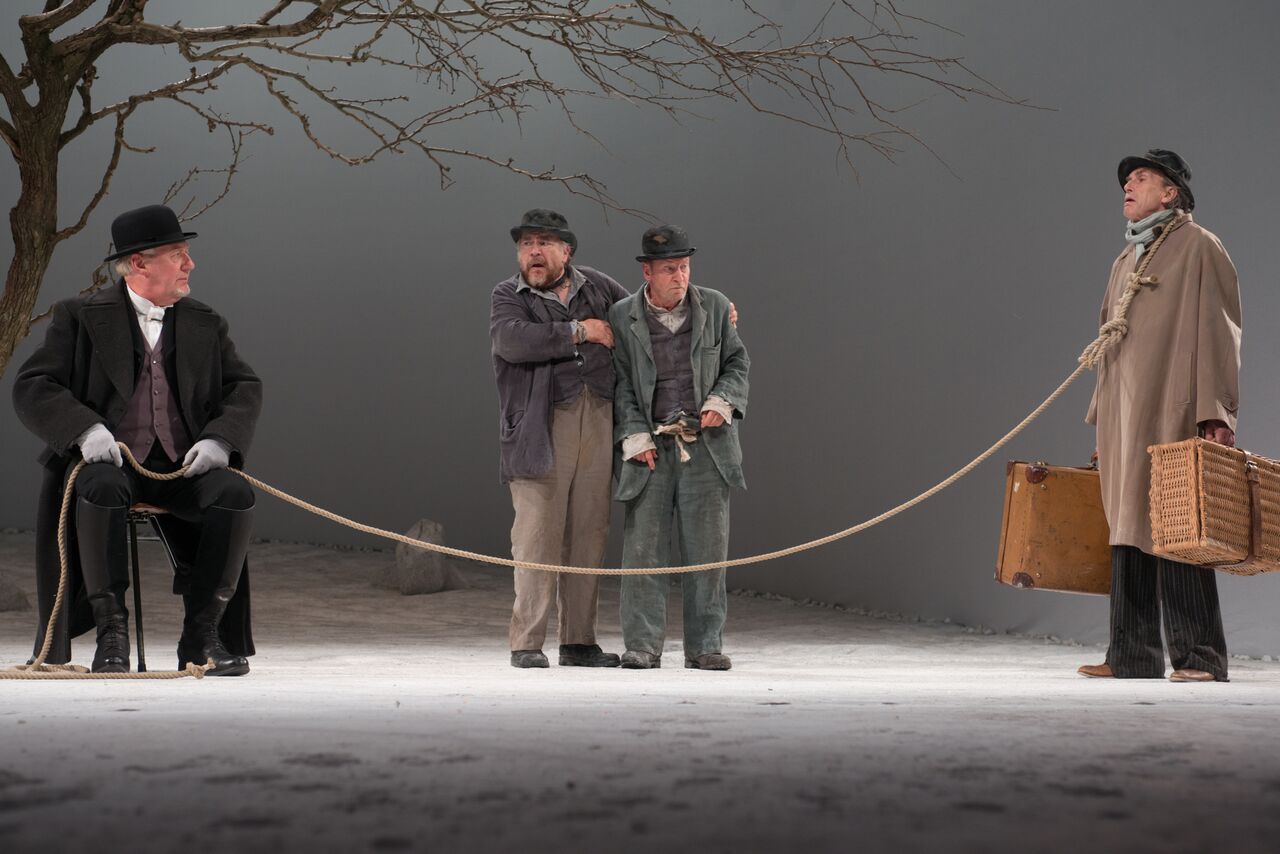
Bill Paterson and Bian Cox as Estragon and Vladimir. Photos by Alan McCredie.

Bill Paterson and Bian Cox as Estragon and Vladimir.
Photos by Alan McCredie.

“Magic and compassionate”

Editorial Rating: 5 Stars  Outstanding

A production dedicated to the memory of Kenny Ireland (1945 – 2014), artistic director of the Royal Lyceum Theatre Company from 1992 to 2003.

It’s celebratory. 50 years of the Lyceum Theatre Company and 50 years, thereabouts, that Vladimir and Estragon reckon that they’ve been together. It’s always nice to be definite about those two, as over the years they’ve acquired a reputation for being as equivocal and as moot as Monsieur Godet, Godot, or Godin, himself. Well, not any more, for this indelible production of Samuel Beckett’s famous play nails them as surely as any I’ve seen – and that includes the Ian McKellan and Patrick Stewart show of 2009. I’m in complete agreement with Gogo (Estragon) when he says ‘They all change. Only we can’t’.

It is probably Didi’s pee stained trousers that did it. For a play that elsewhere is often taken as an exhibition piece for metaphor, where the grave digger puts on the forceps, etc., here a weak bladder in a sixty-two year old man is a weak bladder and that’s that. Gogo’s boots stink, his feet are putrid, and every time that he is reminded that they’re waiting for Godot he stiffens in a gut churning, stomach cramped response. It is unsurprising then that the here and now – the blasted tree on the bleached cold set, the vicious kicks to the hapless Lucky – is ‘kackon country’.

And there’s the marvel: one shitty situation made bearable by kindness and affection, because that is what the magic, compassionate, pairing of Brian Cox and Bill Paterson achieves. Cox plays Vladimir as philosopher clown, constrained to smile rather than laugh. Paterson as Estragon has the pallor to match his delivery. It would be deadpan were it not so forlorn. And it would, of course, be a Laurel and Hardy tribute act were it not for the existential, timeless, pitch and spin of the dialogue. There’s that moment, early in Act 1, when Vladimir is telling the story of the two thieves crucified alongside Christ and Estragon is seriously unimpressed by the ‘Saviour’ word. Didi just wants his story listened to and Cox makes light of his exasperation with a gentle, relaxed ‘Come on, Gogo, return the ball, can’t you, once in a way?’ The half crouch and the outstretched hands look to be off the rugby field to me, which is neat (and topical). Funny too how easily Beckett’s language adapts to Scottish performance for there’s a near constant exchange between blethering and ‘discourse’ that is practically endearing and is certainly comic.

This is not bleak end-gamed Beckett. Take Estragon’s sudden ‘Que voulez-vous?’ that arrests another of their little riffs. That could be a surly or desperate, ‘What do you want?’, but actually it’s much more generous and appealing than that. ‘What do you know [of me]?’ is what Mark Thomson, as director, answers and so two preposterous, hopeless down-and-outs from somewhere wasted and foreign, acquire an extraordinary humanity that fetches warm-hearted laughter from their audience. They might have finished themselves off years ago ‘hand in hand off the top of the Eiffel Tower’ but too late for that now. Instead, we hear of Gogo and Didi picking grapes in Burgundy and Didi rescuing his friend from a suicidal dive into the Rhone.

John Bett as Pozzo (l) and Benny Young as Lucky (r)

John Bett as Pozzo (l) and Benny Young as Lucky (r)

So the blaring inhumanity of the nihilist Pozzo (John Bett) towards Lucky (Benny Young) is made all the more pronounced. These two are truly displaced, dispossessed, and bound. The rope between them just gets shorter as they become increasingly helpless and incoherent. As they collapse, Estragon’s spirits rise and he is almost cheerful. Paterson has that wonderful line: ‘We’ll go to the Pyrenees .. I’ve always wanted to wander in the Pyrenees’.

Yes, it is a question of make-believe and tone but this Godot stands in the light at the mouth of the tunnel and turns its back on the darkness beyond. I found it really illuminating.

(And, ‘cos it’s good and relevant, go to the BBC’s Today programme on http://www.bbc.co.uk/programmes/p031g8l1 to hear a magisterial Michael Billington explain why Waiting for Godot is not in his list of ‘101 Greatest Plays’. Actor Lisa Dwan will have none of it.)


outstanding

StarStarStarStarStar

Reviewer: Alan Brown  (Seen 22 September)

Go to Waiting for Godot at the Lyceum here.

Visit the The Lyceum archive.

#Realiti (theSpace @ Surgeons Hall, 24 – 29 Aug : 22.45 : 1 hr)

“The concept is great, and the thought behind it commendable”

Editorial Rating: 2 Stars

#Realiti is a new take on the television programme Big Brother, where we see five housemates get to know each other, while their every move is watched and tweeted about by the world. And of course, one by one they get voted out of the house.

What the actual “prize” is for the winner though, doesn’t become clear right until the end of the piece. On one hand this is frustrating because I spent most of this performance trying to work out what was going on, but on the other hand it was somewhat masterful, as many of the questions I had throughout were resolved in the final moments, and it does stay with you long after leaving the auditorium.

Slowly each character’s reason for being in the house is revealed, and it becomes clear that it isn’t your ordinary big brother house. While for some their backstories and motivations were very apparent, for others we didn’t learn very much at all, so it would have been good to have a structure that allowed for a more comprehensive introduction to each, and a greater sense of their relationship with each other. At no stage was it clear how long any of them had been in the house, or indeed what time period the performance itself covered, but perhaps this was unimportant if the purpose was to get the audience to focus more on the wider concept than the details. If so, unfortunately its subtleties were lost on me.

Indeed, one of the main downfalls of #Realiti is how complicated it is to grasp. A very wordy piece performed by an Italian company in Italian, naturally it is somewhat more difficult to access than it might be for a native audience. There are subtitles on the screen at the back which do help, and perhaps this would have been fine if the concept itself had not also been quite obtuse, but the two together made it quite a strain on the brain.

In saying all that, the acting isn’t bad: there’s a great range of emotion on display and in the sections where each character has a “solo” to camera at the front of the stage we do feel very drawn in to their world and are able to develop an emotional rapport with them. The tensions between some of the characters is palpable, while the final scene where the big reveal happens is also very moving.

The concept of this show is great, and the thought behind it commendable. However, the delivery of it needs much more work to make it accessible to an audience, and a clearer idea of what the audience is supposed to think or feel by the end would help navigate this piece out of obscurity.


Star (blue)Star (blue)

Reviewer: Steve Griffin (Seen 28 August)

Visit the Other archive.

THIS REVIEW HAS NOT BEEN SUBEDITED

Cleansed in Blood (Thistle King James Hotel: 20-25, 27-31Aug : 14:00 : 45mins)

“Minimalist in it’s set design but wonderfully baroque in it’s storytelling”

Editorial Rating: 4 Stars  Nae Bad

In the grand scheme of generally unpleasant tales, the hierarchy usually runs thus: tales of moral downfall a-lá Citizen Kane, ones about the dangers of religious overzealousness, and stories about cancer. Put ‘em together and what have you got? Bippity-Boppity-Cleansed in Blood.

The brainchild of talented writer and actor Thom Jordan, “Cleansed in Blood” tells the story of cancer-survivor-turned-preacher Paul, and his trials and tribulations in his feverish pursuit of glory upon the sanctified stage. Pulling together Jordan’s own experience as the son of a minister and the real-life events surrounding the now infamous Michael Guglielmucci, Cleansed in Blood is a story of ambition, deception and redemption all packed into a dense 45-minute performance.

Presenting the show decked out in a nasal feed, Jordan’s stage gravitas is palpable. With minimal set and near non-existent tech, the show lived or died by his performance – and I was very glad to say it was very much kicking. There’s a very raw, unpleasant realism to Jordan’s performance which had me squirming in my seat for a large majority of the performance – a testament to his skill at inhabiting a character. As he strode around the small stage, you’d be forgiven for thinking Thom Jordan a simple pseudonym for charismatic and fervent Paul.

And that’s helped in large part by Jordan’s skill as a writer. His accolades are well-won: even without the considerable skill with which it’s executed, this is just a good story, with a twist which will leave you reeling in your chair. However, the structure of the play is less vertigo-inducing. Some plot points feel as if they come too late, and there are moments where certain story strands feel oddly wasted as Jordan rattles through to a nevertheless very satisfying ending.

Minimalist in it’s set design but wonderfully baroque in it’s storytelling, Cleansed in Blood makes for an oddly grim yet entertaining way to spend your afternoon. Forceful, provocative and thoughtful, it’s a compelling window into oddly rockstar world of high-profile preachers – and the dangers that lie with fame.


nae bad_blue

Star (blue)Star (blue)Star (blue)Star (blue)

Reviewer: Jacob Close (Seen 26 August)

Visit the Other  archive.

THIS REVIEW HAS NOT BEEN SUBEDITED

Charolais (Spotlites: 6 – 30 Aug.’15)

Photo: Sally Anne Kelly

Photo: Sally Anne Kelly

“Where l’amour freely transforms as l’amoooour’”

Editorial Rating:  5 Stars

To invoke an admiring Scot, even though this is an all-Irish production, Charolais is ‘warm-reeking, rich!’ Approach the slurry pit with care and whatever happens do not call your good woman a ‘Silly moo’ or a ‘Daft cow’(and Burns didn’t either). She may not catch the affection in your voice, especially if she’s a pretty heifer.

Siobhan has had enough of coming second to boyfriend Jimmy’s gorgeous cow. Siobhan is heavily pregnant with their child but Jimmy seems only to have eyes for Charolais, whose bright yellow ID tags appear like ‘cheap gold rings’. Such jealousy might be at the extreme end of an hormonal rush but Siobhan is thinking murder. But how? A wild barley feed can result in alcohol poisoning or you could slice the cow in the squeeze chute. As if Charolais’s charms are not enough to contend with, there’s Jimmy’s seriously protective mother, Breda (72), who regards Siobhan as a shameless hussy. Maybe Breda could meet a power surge on the electric fencing?

So it’s a down-on-the-farm love and sex story with writer/actor Noni Stapleton as Siobhan and as Charolais. This is where l’amour freely transforms as l’amoooour’ and back again with a delightful swish of blond hair and a lolling lascivious tongue. The fact that prized Charolais cattle are creamy white and have well developed udders is to invite a cowpat but I hope not. Anyhow, performer and Bigger Picture Projects go further and provide this cow with a husky singing voice. Think Piaf in the byre rather than this reviewer in the mire, please.

It is a sweet treat of a script too, both affectionate and grounded, and steamy with activity in the cowshed and with Siobhan trying to get Jimmy away from his mother. She succeeds, dramatically – even tragically – but not in the way(s) she imagined. And for a townie there’s the added bonus of hearing of calving jacks and herd books and – from Charolais’s point of view – of the ‘indignity of the AI man with the syringe’.

Stapleton’s performance is really good. Yes, in many respects it is a humorous monologue – for woman and cow – but it is also wholesome and generous. For much of the time she’s Siobhan, seven months pregnant and in a bloody apron, but she’s proud and ardent too. I was especially taken by the way Stapleton makes her space her own and looks astonishingly ‘at home’ – in wellies –  just a few feet from her audience.

I have seen a few too many plays recently that put the urban precinct, IT, and the disembodied centre stage. ‘Charolais’ achieves the primary opposite. It’s all heart.

Star (blue)Star (blue)Star (blue)Star (blue)Star (blue)

Reviewer: Alan Brown (Seen 28 August)

Go to Charolais and Bigger Picture Projects here.

Visit the Other archive.

Odd Shaped Balls (theSpace, 17 – 29 Aug : 19.15 : 50 mins)

“Powerful, energetic and frank”

Editorial Rating: 4 Stars

The story follows professional rugby player James Hall as he comes to terms with his own sexual identity and deal with getting “outed” in the media. We see him as his club’s star player – someone who really needs rugby in his life – as they get promoted into the Premiership at the start of the play. We follow some very touching relationships he has with various characters – his coach, his father, his girlfriend and his teammates – all played by Matthew Marrs.

It’s a very pacey piece, packed with short scenes and snippets of conversations, which enables the audience to see the range of people in Hall’s life, and their reactions and relationships to him. While in certain sections of the play this works very well in communicating the franticness going on in Hall’s head and not knowing who to turn to, at times it also becomes quite confusing as to who he’s talking to, what scene we’re in, and how much time has lapsed in between them.

It’s certainly a commanding and masterful performance from Matthew Marrs, who manages to convey all the individual characters, as well as drive the performance with passion and vigour. He effortlessly captures the angst of Hall’s dilemma, showing a great range of emotion, while also being very grounded. What I liked about the character was that he seemed very real and that dialogue flowed naturally, without having been over-polished. My favourite of the other characters was Hall’s plain-speaking Welsh teammate who, at one point, very brazenly described “jackpot threesomes”, with hilarious effect.

While a very commendable and powerful concept for a piece, the writing and structure did let it down somewhat, as did, arguably, the decision to make this a one-man show. For almost every conversation throughout this piece, Marrs played both sides, which I feel was a somewhat lazy device in communicating the narrative. I think it would have been more powerful for at least some of these to have been shown from one side only, to allow us to connect more with the character on show, rather than the constant flip between two or three different characters played by the same actor. Alternatively, having one or more supporting actors for Marrs to play off could have simplified some of the scenes where there was a lot of back and forth.

In saying all that, this was a terrific show – powerful, energetic and frank, with a very important message.

Star (blue)Star (blue)Star (blue)Star (blue)

Reviewer: Steve Griffin (Seen 28 August)

Visit the Other archive.

THIS REVIEW HAS NOT BEEN SUBEDITED