+3 Review Moondogs (Edinburgh International Film Festival: 17 June ’16)

“Heartwarming and well written”

Editorial Rating: 3 Stars: Nae Bad

This year the 70th edition of the Edinburgh International Film Festival brought a wide range of films and documentaries home to Scotland. We took a look at the world premiere of Philip John’s Moon Dogs – a Scottish coming-of-age film – released on the 17th of June 2016.

Two step-brothers Michael (Jack Parry-Jones) and Thor (Christy O’Donnell) are thrown together through their parents’ marriage and the relationship between the two is far from perfect. Michael is a temperamental, slightly gullible young lad who having just finished high school is trying to figure out his future. Thor is the more quiet, reserved, artistic type who prefers to lock himself in his room to focus on his music and block out the rest of the world.

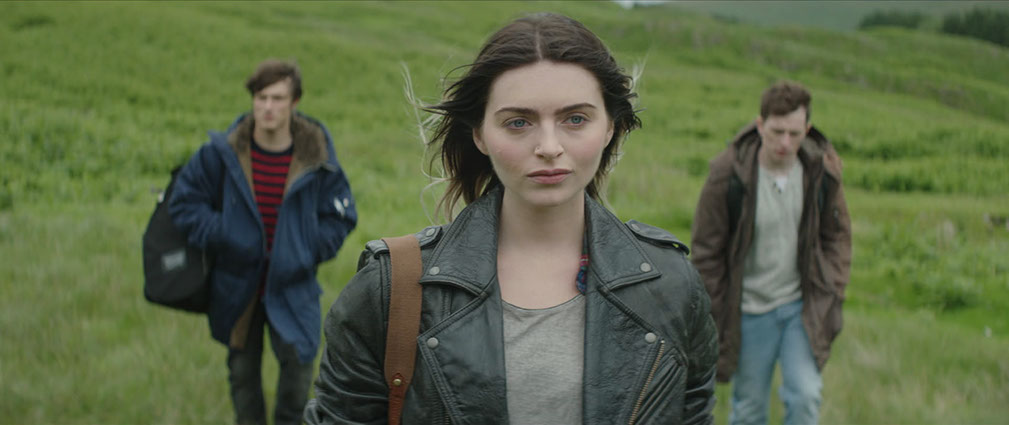
For their own individual reasons they decide to embark on a trip from their home on Shetland to Glasgow. With no money or any idea how they will get to there, they are lucky – or perhaps unlucky – to meet the wild, free-spirited yet slightly troubled young woman Caitlin (Tara Lee) who decides to accompany them on their journey.

The story focuses on the trio’s travels rather than their final destination. Throughout the film there are some beautiful shots of Scottish scenery and at times it almost feels like you are on a tour through Scotland’s landscapes and its society. With brutal honesty the film shows the best and the worst sides of Scotland. The three meet a variety of characters, from kind hearted locals to cruel criminals, whom anybody in their right mind would avoid.

The script, written by Derek Boyle and Raymond Friel, brings out a range of emotions with some charming and funny exchanges but also some darker, serious moments. Although this independent drama does at times appear a little awkward and staged this could be a reflection of how the characters themselves are feeling. At the beginning the boys, despite needing one another to make their journey to Glasgow possible, are both displeased at the idea of travelling together. As they begin to warm to each other the scenes and the interaction between the three appears to become more natural, resulting in some endearing moments for the audience and some sympathetic giggling.

The casting works. Michael and Thor are naive through their sheltered upbringing and young age and actors Parry-Jones and O’Donnell are very authentic in their roles. Tara Lee gives a captivating performance as Caitlin, although her questionable decision making and flirtatious nature make her a somewhat difficult character to comprehend. Personally I found this made her quite difficult to warm to, although perhaps the point of her role is more to provoke the boys and test their boundaries rather than to be a likeable character.

I would say Moon Dogs is a heartwarming, well written film that causes much amusement as the trio battle with the hardships of their journey and with growing up – as you do!

 

nae bad_blue

Star (blue)Star (blue)Star (blue)

Moondogs at the EIFF 2016 & at the British Films Directory

Reviewer: Iona Young (Seen 17 June)

Julius Caesar (Augustine United Church 1 – 5 March ’16)

Antony (Tom Birch), Caesar (Adam Butler) and Calpurnia (Heather Daniel)

“The kind of unbridled creativity I often only see in student productions”

Editorial Rating: 3 Stars

Reimagining Shakespeare’s classic tale in the modern day world of professional football may seem like lunacy to some, but with themes like loyalty, pride in one’s city, questions over physical fitness and a bit of back-stabbing, the parallels between ancient Rome and football today aren’t as dissimilar as might be first assumed – it certainly piqued my interest. However, as can happen in football, I think there was perhaps too much theorising behind this production, which didn’t quite convert to success on the pitch.

Much like when reading a Hilary Mantel novel, I worry when I find myself constantly having to flick back to the character list to be reminded who everyone is and what side they’re on. And with this interpretation assigning each character a footballing role (for one or more teams) as well, it’s certainly not the easiest to follow for someone unfamiliar with the play.

Adam Butler as Caesar is every inch the star player in this outing, commanding attention and respect from all around him, and it is easy to build rapport with him as the fans’ favourite. He is confident, charismatic and handles Shakespeare’s text very well. Charlie Angelo is also enjoyable and convincing as Casca, bringing an air of comedy into what is otherwise quite an intense evening’s entertainment.

Various women are cast in male roles in this production, the most interesting of these being Alice Markey as Decius, who holds her own with strength and precision. However, in arguably the most important scene of the play, where Calpurnia convinces Caesar not to go out, only for Decius to then persuade him otherwise, I would have really liked to have seen the female Decius use a more sexual approach to her argument, heightening the tension in the scene which unfortunately seemed rather rushed.

Indeed, missed opportunities seemed the name of the game throughout, with many great ideas going unfulfilled or veering off-target. With almost all characters being football players, it is surprising how much standing around there is in group scenes, whereas seeing some football in action and the interactions that come naturally within that could add more depth and integrity to the performance. Given the interpretation of this piece I was also disappointed the fight scenes are not reimagined as football matches between the rival factions, and that stabbing is so faithfully used as the murder method of choice. With interesting references to performance-enhancing and other kinds of drugs throughout, maybe “dagger” could have had a whole new meaning?

However, what I particularly enjoyed about this production was the inventiveness of the projected films throughout, showing characters as models, celebrities and footballers on the pitch. These sections work very well to give background and depth to the characters, and to cover any edits from the original script. Additionally, when all characters are on stage reacting to Antony’s speech after Caesar’s death the atmosphere is very powerful and sustained, while the fight scenes show great energy and control. The use of hoodies instead of cloaks, paparazzi and mobile phones were all nice modern touches showing the kind of unbridled creativity I often only see in student productions.

Overall, I admire the headstrong strategy and imagination of the squad in this play, but for me the formation didn’t allow it to achieve a resounding victory.

Star (blue)Star (blue)Star (blue)

Reviewer: Steve Griffin (Seen 2 March)

Visit the Other archive.

THIS REVIEW HAS NOT BEEN SUBEDITED

‘The Great Train Race’ (Interchange, Galashiels: 29 Nov. ’15)

Ellie Zeegen and Simon Donaldson Photo: Firebrand Theatre

Ellie Zeegen and Simon Donaldson
Photo: Firebrand Theatre

“You might want to take sides and cheer your engine along”

Editorial Rating: 4 Stars: Outstanding

Where better to stage this play of trains than in a bus and railway station? And so to the impressive Galashiels Interchange, which may have a Borders postcode, but whose track once more runs straight to Edinburgh and onto the ED49 platform. The permanent way is back – ‘Hurrah!’ – and the winding A7 is properly historic.

Redoubled ‘Hurrahs!’ too for the return of Robert Dawson Scott’s 2013 flag waving, whistle tooting, tale of men and locomotives (and a gender bending signal box). It is the summer of 1895 and two railroad companies – the North British and the Caledonian – are competing to run the fastest overnight service between London and Aberdeen. They take different routes – up the east and west coasts respectively – but the two eventually converge at Kinnaber Junction, 38 miles from the finish, which is where the signal box comes in – big time. And, just to add to the headlong fun, there are no speedometers in the cabs.

This is main-line ‘Play, Pie and a Pint’: three actors and 45-50 minutes long, which happily enough is almost the journey time between Gala’ and Waverley on the Borders Railway. Could The Great Train Race be performed on a moving train? Maybe director Richard Baron entertained the idea and brought it to the (Fat) Controllers of ScotRail. Well, we do get a Sir Topham Hatt character of sorts, and the piece is staged in the rectangular ‘round’. Not exactly in a carriage but the action goes from side to side, round n’ round, with the passengers occasionally buffeted by the wind from a passing train. Never mind, you might be on a ‘Grouse Express’ and the shooting parties have lobster in their hampers. You might want to take sides and cheer your engine along or – more likely – just sit forward and enjoy a show performed at speed and with great, engaging, spirit.

It is easy to distinguish the actors. When they are not sporting beards or holding balloons or dumping ‘hot’ coals in your lap, livery is all. Ali Watt is decent Norrie, railway clerk of the North British. He has the uniform, English accent, and manners of a man who believes in the rulebook and in fair competition. Dumping timetables and ‘dropping’ stations is simply not on. On the other footplate, in overalls, is Cammie (Simon Donaldson, educ. Earlston High School), a fitter in the engine sheds whose speech runs more along the lines of “Yer dancer”, which to describe a 2-4-0 ‘Hardwicke’ locomotive is going some. In-between the two and indicatively Doric, stands Kinnaber (Ellie Zeegen), whose friendly and eager narrative is the coupling rod.

It is a chuffing good story, merrily told, and with such invention and detail that the Borders Railway might wish that they were passenger numbers. Oh, sorry, there are tales of overcrowding already; which is scarcely Firebrand Theatre’s fault.

outstanding

StarStarStarStar

Reviewer: Alan Brown (Seen 29 November)

Go to Firebrand Theatre


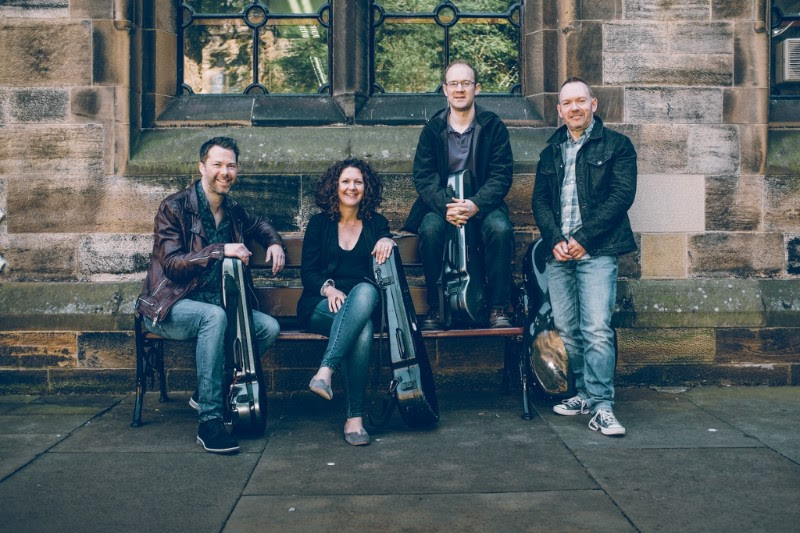
♫ The Edinburgh Quartet (St Andrew’s and St George’s West: 14 Oct.’15)

The Edinburgh Quartet. Photo: EQ.

“Intimacy and Excellence”

Editorial Rating:  5 Stars

The Edinburgh Quartet premiered its 2015/2016 Season with not so much a concert as a cleverly curated musical event.

The theme of The Edinburgh Quartet’s first trimester is “Intimate Voices”.  First Violin Tristan Gurney introduced the evening by explaining that they wanted a theme that reflected the medium’s capacity for intimate expression, and that there were many composers who chose to write for it because of this intimacy at the very core of the musical experience.  They exploited this brilliantly with their choice of opening work, Janacek’s String Quartet No. 2, Intimate Letters.

Janacek’s work is rewarding but challenging, and to plunge headlong into this incredibly varied, complex and intense oeuvre at a rush hour 5.30pm concert after a hard day at the office would have been a lot to ask of even the most ardent fan.  So they didn’t.  They led us in gently, and it made for an informed, involved and thoroughly inclusive musical evening of delight and difference.

The band kicked off with a beautifully together, easy on the ear interpretation of a waltz by Janacek’s contemporary Dvorak, and you immediately had the confidence that here was a quartet at ease with themselves, their music and their audience. We relaxed. Then Tristan got us into Janacek with his pleasing Romance for Violin ( accompanied on piano by the versatile second violin Gordon Bragg).  In a bright move that greatly helped us all in the appreciation of the music that was to follow, Edinburgh Makar/Poet Laureate Ron Butlin introduced us to Janacek’s 11 year long,  passionate, barely requited and entirely platonic romance with Kamila Stosslova, and read extracts from his love letters, whose poignancy enhanced the accessibility of the music and put it in context.

And what music it was! A beautifully woven tapestry of multifarious musical styles reflecting the panoply of emotions this extraordinary love affair engendered: bold unison openings, contrasting with passages so quiet that they were barely audible; rich melodic lines; frantic near dissonance; folk song; all greater than the sum of its parts in a way reminiscent of Beethoven’s late quartets. All in, a four movement work of less than half an hour’s duration for just four instruments!

And last, but of course not least, the playing.  Sure, the string quartet is intimate, but it is also a quite disproportionately expressive genre.  The Edinburgh Quartet is a well honed team, delivering demanding notation, phrasing and bowing, including pizzicato and sul ponticello, with not only great capability but real understanding, anticipating and following each other and never absorbed in their own playing at the expense of the group. Yet still with first class individual flair.  Fiona Winning’s viola richly developing and sustaining the theme of Kamila from early on, with Mark Bailey’s cello in confident support and finally getting his moment of glory in the last movement.  The violins, leading, supporting, ducking and diving throughout this rich, multi faceted and immensely enjoyable work.  An artistic and audible treat.

Star (blue)Star (blue)Star (blue)Star (blue)Star (blue)

Reviewer: Charles Stokes (Seen 14 October)

Go to Edinburgh Quartet here.

Visit the Other archive.

RENT (Paradise in St Augustine’s, 7 – 30 Aug : 18.00 : 2hrs 40 mins)

“Full of the life and passion that the ethos of this show embodies”

Editorial Rating: 4 Stars: Outstanding

There’s always something really special about seeing the closing night of a particular show, as they can often trigger performers into giving everything they have left in their bodies to deliver the performance of their lives. That’s exactly what happened with Uncompromising Artistry’s Edinburgh Fringe production of RENT.

Opening chorus number Rent was bursting with energy and was a fantastic introduction to the desperation, hardship and grit of 90s New York, while being full of the life and passion that the ethos of this show embodies. The company filled the stage with their presence and the theatre with stunning vocals, and it was a truly wonderful sequence. It seems somewhat unfortunate that after setting the bar so high so early on, the remaining chorus numbers, although excellent, were not quite able to live up to that show-stopping standard.

There were however, some exhilarating solo performances. For me, Johnny Newcomb absolutely stole the show as Roger, bringing a wonderful fragility to the character, while nailing every note he sung. He was captivating to watch in every scene, and showed a huge emotional range, even in the chorus numbers when he wasn’t centre of attention.

Injoy Fountain was also incredibly engaging in each of her minor roles, bringing bags of vitality to every scene, as well as a truly knockout vocal performance, including that riff in Seasons of Love. Zia Roberts as Joanne and Janet Krupin as Maureen really came into their own during Take Me or Leave Me, which was spine-tinglingly delivered, while Jonathan Christopher’s performance as Collins in the funeral scene was emotional enough to bring everyone to tears.

What really made this show special though was engagement with the audience and the cast’s ability to really bring us into the performance. During every chorus number the performers made eye contact with various people in the audience, always in character and with purpose. Seasons of Love was deliberately performed right at the front of the stage in one line, giving a very inclusive and welcoming feel to the show.

However, while showcasing some truly phenomenal individual moments, at times some of the staging seemed a little clumsy and laboured, with a few too many moments that relied on stage crew to move various things around on stage. In addition some of the choreography, particularly the death motif, seemed a bit over the top. But in all other respects this really was a tremendous effort and a very emotionally charged performance from still such a young company. Vive la vie bohème.

outstanding

StarStarStarStar

Reviewer: Steve Griffin (Seen 30 August)

Visit the Other  archive.

THIS REVIEW HAS NOT BEEN SUBEDITED

#Realiti (theSpace @ Surgeons Hall, 24 – 29 Aug : 22.45 : 1 hr)

“The concept is great, and the thought behind it commendable”

Editorial Rating: 2 Stars

#Realiti is a new take on the television programme Big Brother, where we see five housemates get to know each other, while their every move is watched and tweeted about by the world. And of course, one by one they get voted out of the house.

What the actual “prize” is for the winner though, doesn’t become clear right until the end of the piece. On one hand this is frustrating because I spent most of this performance trying to work out what was going on, but on the other hand it was somewhat masterful, as many of the questions I had throughout were resolved in the final moments, and it does stay with you long after leaving the auditorium.

Slowly each character’s reason for being in the house is revealed, and it becomes clear that it isn’t your ordinary big brother house. While for some their backstories and motivations were very apparent, for others we didn’t learn very much at all, so it would have been good to have a structure that allowed for a more comprehensive introduction to each, and a greater sense of their relationship with each other. At no stage was it clear how long any of them had been in the house, or indeed what time period the performance itself covered, but perhaps this was unimportant if the purpose was to get the audience to focus more on the wider concept than the details. If so, unfortunately its subtleties were lost on me.

Indeed, one of the main downfalls of #Realiti is how complicated it is to grasp. A very wordy piece performed by an Italian company in Italian, naturally it is somewhat more difficult to access than it might be for a native audience. There are subtitles on the screen at the back which do help, and perhaps this would have been fine if the concept itself had not also been quite obtuse, but the two together made it quite a strain on the brain.

In saying all that, the acting isn’t bad: there’s a great range of emotion on display and in the sections where each character has a “solo” to camera at the front of the stage we do feel very drawn in to their world and are able to develop an emotional rapport with them. The tensions between some of the characters is palpable, while the final scene where the big reveal happens is also very moving.

The concept of this show is great, and the thought behind it commendable. However, the delivery of it needs much more work to make it accessible to an audience, and a clearer idea of what the audience is supposed to think or feel by the end would help navigate this piece out of obscurity.


Star (blue)Star (blue)

Reviewer: Steve Griffin (Seen 28 August)

Visit the Other archive.

THIS REVIEW HAS NOT BEEN SUBEDITED

Melody (Clerk’s Bar, 8 Aug – 29 Aug : 16:45 : 50mins)

https://www.thestage.co.uk/wp-content/uploads/2015/08/Melody-Jemima-Foxtrot.jpg

“Foxtrot embodies the sensations of the everyday”

Editorial Rating: 4 Stars Nae Bad

One of my favourite things about poetry is the great dissonance you often get between the initial appearance of the poets, and the sheer power of their voices and minds. Watching Jemima Foxtrot perform is like watching a pistol shoot anti-tank bullets – there’s a very sincere and powerful energy to her work.

Taking the audience on an evocative journey through city streets “Melody” explores the memories they summon as Foxtrot wends her way between heartbreak to joy, with a warmth and oddly dreamy sort of lyricism that fits her imagery’s day-to-day beauty to a tee.

The biggest boon to this performance is how easily Foxtrot embodies the sensations of the everyday, and presents familiar emotions and thoughts in a way that makes them rough yet compelling. It’s not very often that a performer’s vocal skill and physicality mirror each-other so well, but as she bounces from piece to piece, she embodies each new feeling with vigour.

However, Foxtrot’s lack of pretense and startling sincerity in her work also forms a needed cover to the inevitable inertia when solo, unbacked vocal work pauses to become spoken word – but her energetic yet laid back style still suffered slightly in the sometimes jarring empty space. However, this hardly detracted, thanks in turn for the sheer power of her lyrics and honesty of her imagery.

This is definitely a free fringe find. Foxtrot’s presence onstage utterly transforms the familiar atmosphere of the Clerks Bar basement – no mean feat. As the 2015 Fringe starts to roll to a close, make sure you make your way to Jemima Foxtrot – “Melody” definitely impresses.


nae bad_blue

Star (blue)Star (blue)Star (blue)Star (blue)

Reviewer: Jacob Close (Seen 25 August)

Visit the Other archive.

THIS REVIEW HAS NOT BEEN SUBEDITED

Charolais (Spotlites: 6 – 30 Aug.’15)

Photo: Sally Anne Kelly

Photo: Sally Anne Kelly

“Where l’amour freely transforms as l’amoooour’”

Editorial Rating:  5 Stars

To invoke an admiring Scot, even though this is an all-Irish production, Charolais is ‘warm-reeking, rich!’ Approach the slurry pit with care and whatever happens do not call your good woman a ‘Silly moo’ or a ‘Daft cow’(and Burns didn’t either). She may not catch the affection in your voice, especially if she’s a pretty heifer.

Siobhan has had enough of coming second to boyfriend Jimmy’s gorgeous cow. Siobhan is heavily pregnant with their child but Jimmy seems only to have eyes for Charolais, whose bright yellow ID tags appear like ‘cheap gold rings’. Such jealousy might be at the extreme end of an hormonal rush but Siobhan is thinking murder. But how? A wild barley feed can result in alcohol poisoning or you could slice the cow in the squeeze chute. As if Charolais’s charms are not enough to contend with, there’s Jimmy’s seriously protective mother, Breda (72), who regards Siobhan as a shameless hussy. Maybe Breda could meet a power surge on the electric fencing?

So it’s a down-on-the-farm love and sex story with writer/actor Noni Stapleton as Siobhan and as Charolais. This is where l’amour freely transforms as l’amoooour’ and back again with a delightful swish of blond hair and a lolling lascivious tongue. The fact that prized Charolais cattle are creamy white and have well developed udders is to invite a cowpat but I hope not. Anyhow, performer and Bigger Picture Projects go further and provide this cow with a husky singing voice. Think Piaf in the byre rather than this reviewer in the mire, please.

It is a sweet treat of a script too, both affectionate and grounded, and steamy with activity in the cowshed and with Siobhan trying to get Jimmy away from his mother. She succeeds, dramatically – even tragically – but not in the way(s) she imagined. And for a townie there’s the added bonus of hearing of calving jacks and herd books and – from Charolais’s point of view – of the ‘indignity of the AI man with the syringe’.

Stapleton’s performance is really good. Yes, in many respects it is a humorous monologue – for woman and cow – but it is also wholesome and generous. For much of the time she’s Siobhan, seven months pregnant and in a bloody apron, but she’s proud and ardent too. I was especially taken by the way Stapleton makes her space her own and looks astonishingly ‘at home’ – in wellies –  just a few feet from her audience.

I have seen a few too many plays recently that put the urban precinct, IT, and the disembodied centre stage. ‘Charolais’ achieves the primary opposite. It’s all heart.

Star (blue)Star (blue)Star (blue)Star (blue)Star (blue)

Reviewer: Alan Brown (Seen 28 August)

Go to Charolais and Bigger Picture Projects here.

Visit the Other archive.

Odd Shaped Balls (theSpace, 17 – 29 Aug : 19.15 : 50 mins)

“Powerful, energetic and frank”

Editorial Rating: 4 Stars

The story follows professional rugby player James Hall as he comes to terms with his own sexual identity and deal with getting “outed” in the media. We see him as his club’s star player – someone who really needs rugby in his life – as they get promoted into the Premiership at the start of the play. We follow some very touching relationships he has with various characters – his coach, his father, his girlfriend and his teammates – all played by Matthew Marrs.

It’s a very pacey piece, packed with short scenes and snippets of conversations, which enables the audience to see the range of people in Hall’s life, and their reactions and relationships to him. While in certain sections of the play this works very well in communicating the franticness going on in Hall’s head and not knowing who to turn to, at times it also becomes quite confusing as to who he’s talking to, what scene we’re in, and how much time has lapsed in between them.

It’s certainly a commanding and masterful performance from Matthew Marrs, who manages to convey all the individual characters, as well as drive the performance with passion and vigour. He effortlessly captures the angst of Hall’s dilemma, showing a great range of emotion, while also being very grounded. What I liked about the character was that he seemed very real and that dialogue flowed naturally, without having been over-polished. My favourite of the other characters was Hall’s plain-speaking Welsh teammate who, at one point, very brazenly described “jackpot threesomes”, with hilarious effect.

While a very commendable and powerful concept for a piece, the writing and structure did let it down somewhat, as did, arguably, the decision to make this a one-man show. For almost every conversation throughout this piece, Marrs played both sides, which I feel was a somewhat lazy device in communicating the narrative. I think it would have been more powerful for at least some of these to have been shown from one side only, to allow us to connect more with the character on show, rather than the constant flip between two or three different characters played by the same actor. Alternatively, having one or more supporting actors for Marrs to play off could have simplified some of the scenes where there was a lot of back and forth.

In saying all that, this was a terrific show – powerful, energetic and frank, with a very important message.

Star (blue)Star (blue)Star (blue)Star (blue)

Reviewer: Steve Griffin (Seen 28 August)

Visit the Other archive.

THIS REVIEW HAS NOT BEEN SUBEDITED

Learning to Live (Espionage, Pravda room, 24 – 30 Aug : 19:45 : 1hr)

“The craft of every word is excellent, the delivery spot on”

Editorial Rating: 4 Stars

Learning to Live by Isla Cowan is a collection of poems from a young woman who shares her journey of moving to university, the search for a new identity and the struggle to connect with old friends after time apart. The showcase also includes an honest and unglossed ode to a parent, a poem about poverty and a poem called Shakespeare in the sunshine – certainly not a combination one comes across every day.

Cowan’s opening poem is The Night We Went to Life – a reflection on those nights spent clubbing and not being entirely sure why. This is a piece with great rhythm and musicality, with comic moments and a story that all of us can relate to. Next up, The Library is slower and more contemplative, showing great maturity and sense of perspective. Every poem in this show is full of fantastic imagery and a sense of a captured moment, but the last in the set is one called Memories, in which she utters the inimitable line “I am nothing but memories”. To me this summed up the overall ethos of the performance – a collection of lessons learned, delivered simply and beautifully.

My favourite poem from the collection performed was The Lightbulb, which to me demonstrated an accessible and educated view on mental turmoil through clever use of metaphor. Indeed, when Cowan does use metaphor throughout her work, it’s both selective and effective. Great examples include the idea of being “between dinner and dreamland” after a night and morning with that special someone, and carrying “worries in a basket” along with the rest of one’s shopping. Though the subject matter of her work is relatively simple, there’s a lovely feel about it all that reflects her coming of age, but without trying to be too pretentious or flamboyant.

The craft of every word in Cowan’s poetry is excellent, and the delivery of her work is also spot on. She clearly knows the pieces inside out, and captures every rise and fall, rhyme and pause with precision. The tone of her voice carries perfect sympathy with the subject matter of each line, and the whole show just felt very natural and comfortable.

If I were to be really picky, I felt that some of the poems ended quite abruptly, causing the odd jar in what was otherwise a very smooth and enjoyable evening. I’d also like to see her take a few more risks, both in terms of style and content, but perhaps that’s one for next year, as, for a debut show for a novice performer of tender age this really was cracking stuff.


Star (blue)Star (blue)Star (blue)Star (blue)

Reviewer: Steve Griffin (Seen 27 August)

Visit the Other archive.

THIS REVIEW HAS NOT BEEN SUBEDITED