‘Bitter Sweet’ (Discover 21 Theatre: 27 Feb -1 March ’15)

Bitter Sweet 2

“Distorted Love”

Editorial Rating: 3 Stars: Nae Bad

Shocking.

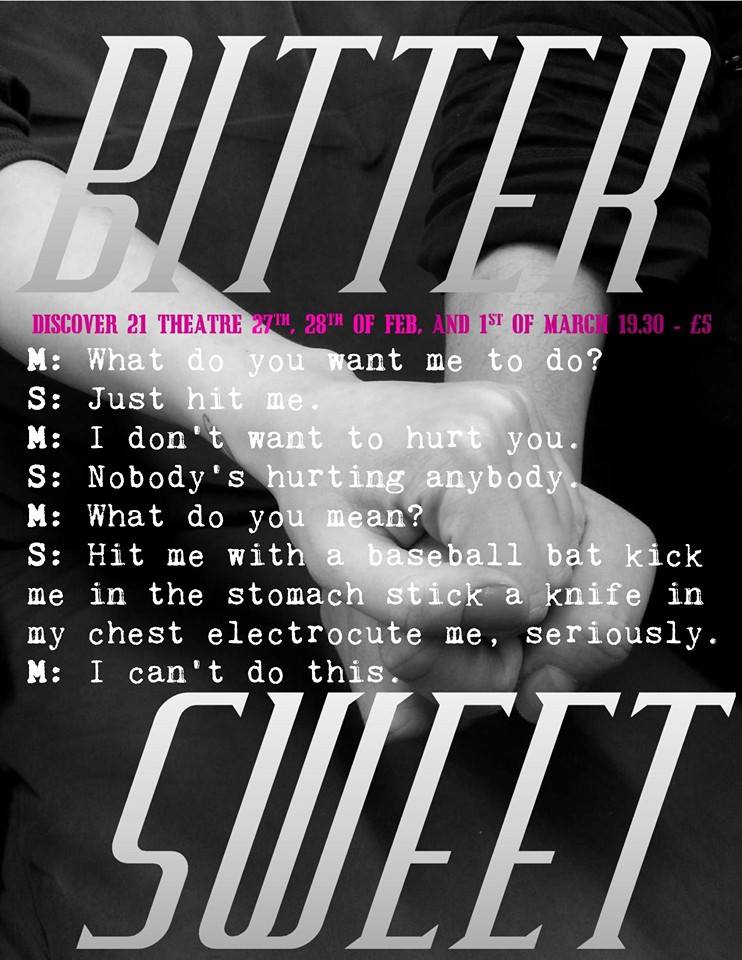
That’s the first word that springs to mind when looking back on the journey followed in Bitter Sweet. Writer and Director Kolbrun Bjort Sigfusdottir created a show that saw reality and fantasy twisted and contorted into a near horror story.

The venue, Discover 21 Theatre, was a perfectly intimate venue that provided closeness to the action that was necessary for this performance to deliver its full impact.

The set was simple, yet detailed. The hints of Steig Larsson’s influence on the script were mirrored in the set – his books featured on the shelves of the bookcase and were reflected in S’s character traits. A small fold-out sofa that sat stage-right was used in a variety of ways that kept the action from becoming too similar and repetitive.

Technically, this play was slick. The music was well-fitted to the rising tensions and served to heighten emotions – both loving and dark. The tone of the scene changed with the lighting cues which was a clever technique to keep the course of the play as disjointed as the relationship.

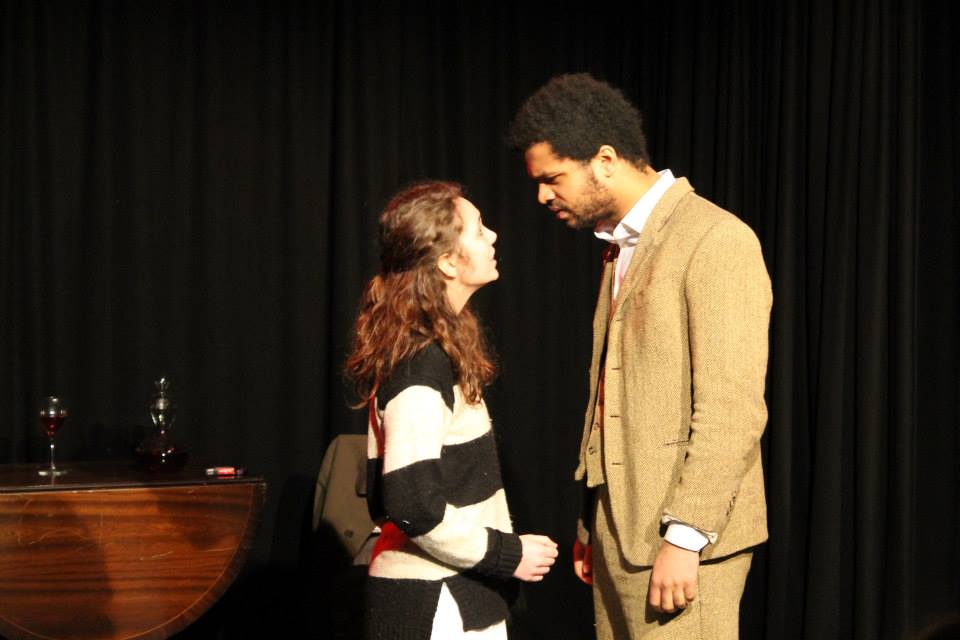
Both Kate Foley-Scott and Ben Blow tackled this difficult script with a tenacity that is commendable.

Depression and its effects on love feature heavily in this show. Foley-Scott was completely convincing in her portrayal of a manic depressive. Her pleads to be hurt were difficult to watch but impossible to look away from. Her character, known only as S, was desperate to feel anything, while inflicting nothing but pain on her partner. Despite her small stature, Foley-Scott offered a huge performance that was warmly received by the audience.

Ben Blow approached this play masterfully. His constant switching between the softly spoken, sensitive boyfriend and the angry, resentful, jilted lover was fascinating to watch. Blow owned the stage in both roles and that made for confident performance, even the most controversial scenes between the couple were grimly tenable.

The sensitive subject matter of sexual violence left the audience reeling; perhaps it really was too vivid and coarse. A less abrasive way to introduce the idea could have been to perform the scene in a black-out so only the voices could be heard. In all honesty, one scene was too graphic and uncomfortable to the point where it was unwatchable.

It would be wrong to say that this show was enjoyable – what with its dark content – but it certainly grips you. It was a shame that the audience were so few in number, but their appreciation for the performance was genuine and well-deserved.


nae bad_blue

Star (blue)Star (blue)Star (blue)

Reviewer: Amy King  (Seen 27 February)

Visit Discover 21 theatre here .

THIS REVIEW HAS NOT BEEN SUBEDITED

‘Leap in Time’ : Erich Salomon and Barbara Klemm (Stills: 07 February – 05 April ’15)

[2015-02-20] Leap in time (Stills)Image: The Fall of the Wall, Berlin (1989) Barbara Klemm. © Barbara Klemm


‘ Isolating the unguarded human moment within the ebb and flow of history ‘

Editorial Rating: 4 Stars: Outstanding

‘My aim is to document things that everyone can see if they want to but that people do not really notice in the course of their everyday lives… To record the unspectacular, something that takes place in public everywhere and is able to tell part of the story of our lives …’ — Barbara Klemm

Photojournalism is a strange beast. With its origins in war photography, the medium straddles the documentary aspirations of reportage and the loftier aspirations of artistic photography – with the best examples able to move seamlessly from one to the other. Such is the case with the images that make up the current exhibition at the Stills gallery, ‘Leap in Time’: Erich Salomon & Barbara Klemm. Organised in conjunction with the Institut für Auslandsbeziehungen/Institute for Cultural Relations (IFA), Germany, and the Goethe-Institut, Glasgow, this exhibition presents the work of two of Germany’s most profoundly influential and sensitive photographers. Though there is no overlap in the careers of Salomon and Klemm, together their work provides a deep, poignant and multifaceted view of twentieth century German life.

Upon entering the exhibition space at Stills many visitors will be tempted to linger among the more recognisable and recent subjects of Barbara Klemm’s work in the front gallery. For the sake of chronology, however, I would recommend charging through to the rear gallery and beginning with the work of Erich Salomon. Though he took to photography late in life, Salomon’s innovations came to dominate the golden age of photojournalism, including coining the phrase “the candid camera” and pioneering “hidden camera” techniques in his work – famously cutting a hole for the camera lens in his bowler hat. With his education, wealth and social standing, Salomon found easy access to the highest echelons of Weimar society. Such access allowed him to photograph scenes such as the Reichstag debating chamber, private meeting rooms at the League of Nations and The Hague, imbuing the scenes with a reality and a human urgency that leaves the printed word behind.

Salomon’s social access extended beyond politics, and the exhibition includes candid and personal photographs of contemporary celebrities, including an intimate photograph of Marlene Dietrich on the telephone with her daughter. Even without celebrity subjects, Salomon’s work is characterised by his ability to capture unguarded moments, those opportunities to peek behind the curtain of public events and see the actors as fellow human beings.

Barbara Klemm’s portion of the exhibition, which occupies the front gallery, the stairwell and the reception area one floor below, beautifully parallels that of Erich Salomon. Though Klemm’s career spanned from the 1960s through to the 1990s, the loose groupings of celebrity, politics, society, and social commentary retain their power. Working at a time when photojournalism had become codified as a profession, there are necessarily differences between Klemm’s work and Salomon’s, but Klemm nonetheless shares Salomon’s gift for isolating the unguarded human moment within the ebb and flow of history. She possesses an uncanny ability to capture the individual at a moment when they stand for something greater than themselves.

Nowhere is this skill more evident than in Klemm’s political photography. Covering the tumultuous period surrounding Germany’s reunification, Klemm’s photographs manage to display great tension and joy, but they also find moments of stillness and contemplation – often within the same image. Among my personal favourites is the photograph, View Over the Wall, Berlin 1977. Here the ominous, monolithic imagery of the Berlin wall dominates the space, while the mood is gently subverted by the presence of two men casually  standing and chatting atop an unmanned watchtower while a young boy playfully perches on the tower railing.

Notably, within this exhibition of twentieth century German photography there are few overt references to the Second World War. In fact, the Nazis make a lone, foreboding appearance in Salomon’s photograph National Socialists in Their Party Uniform in the Reichstag, Berlin, 30 October 1930. From a purely practical perspective this was because Salomon didn’t photograph them; he largely disregarded the Nazis and considered their actions unworthy of his interest. He was able to leave Germany for Holland and worked in The Hague but was detained during the Occupation. He died in Auschwitz in July 1944.

This is not to say that the war is ignored by the exhibition; its antecedents and effects are as present in both photographers’ work as they are in the lives they photographed. Rather, the effect of this absence on the exhibition is akin to that of the candid portraiture in both artists’ work. The goal of such photography is to catch the rarely seen side of a subject we’ve seen so often that we feel we know it. The combined work of Barbara Klemm and Erich Salomon create a complex portrait of Germany that is often overlooked, shining a light on the more private, unguarded and human side of the country’s recent history.

outstanding

StarStarStarStar

Reviewer: Michelle Lee Leonard

Visit Stills here

THIS REVIEW HAS NOT BEEN SUBEDITED

♫ Kat Healy (Voodoo Rooms: 17 December ’14)

“I only seem to write songs about boys and the weather”

Editorial Rating: 3 Stars: Nae Bad

Kat Healy is an Edinburgh singer­-songwriter, based in Leith, with an acoustic, folk-influenced style. She kicked off her set with Weatherman (“I only seem to write songs about boys and the weather”), accompanying herself on guitar in a finger­picking style. There are quotations on Kat’s website comparing her to Joni Mitchell… yes… well… maybe. Certainly Kat’s voice is beautiful, expressive with a huge amount of control, able to sustain the final note in each phrase with excellent tone and apparent ease – all the more remarkable given that she is currently suffering with a heavy cold.

The patter between numbers is entertaining, chatty. Graham joins the stage on guitar for Frozen Smile, his playing style is understated, staccato notes with lots of muting, an excellent accompanist. The keys emphasise the scrunchy dissonance of the 9th and 11th chords. Kat did not play guitar for this and that allowed for fuller vocals and expression. Unfortunately the next song was spoiled by an annoying PA hum from the electric guitar that Graham had swapped to. Paul Gilbody, who had done his own very entertaining guitar and vocal slot in support earlier, joined on double bass and, for me, this didn’t add too much to the performance; mainly pizzicato root notes with octave leaps, notes that were already being played on keys.

Paul’s bass part for the next song, No Heros, did add a lot to the music, with a well­ crafted line with a nice hook which leaped effectively to a high register, overlapping with the guitar part. This was a great song, where Kat performed with a real emotional depth – though the bass notes on the keys in the chorus were a little ham­fisted.

Heart strings were tugged with a song about Kat’s late mother. However, this beautiful song was marred as the buzzing electric guitar returned and, with no other instruments playing to mask it, the fault was quite stark. Kim Edgar and Emily Kelly, who had both done support earlier, joined in for the final piece, I’ll Fly Away, from the American songbook. This was a fun, upbeat, three­ part close­harmony version. There were a few balance issues with Kim being quite a bit quieter than the other two, but they clearly enjoyed singing this song.  And that, along with a great little guitar solo from Graham, was a fitting end to the night.

As a gig it was good value at £9, especially with the three support acts. I found Kat’s professionalism of performing whilst feeling under the weather to be great, BUT starting the gig over half an hour late was not! I came to hear Kat’s amazing voice and I got that, but I do feel that she is at her best when she is not playing guitar herself. As a set then one or two more up­beat numbers would not have gone amiss, but that emotion, always on the edge of melancholy does have its place and maybe, quite possibly, the world needs a female equivalent of Ben Howard or Benjamin Francis ­Leftwich.

nae bad_blue

Star (blue)Star (blue)Star (blue)

Reviewer: David Jones (Seen 17 December)

Visit Kat Healy here

Visit our Assembly Roxy Bedlam Church Hill Theatre Festival Theatre King’s Theatre Other Pleasance, Potterrow & Teviot Summerhall The Lyceum The Stand Traverse archive.

THIS REVIEW HAS NOT BEEN SUBEDITED

‘Seven Dwarves’ (The Vault: 12 – 16 November ’14)

Seven-Dwarves-Photo-Charlotte-Productiosn-538x302

“Glimpses of Laura Witz’s peculiar genius for distant intimacy shoot from the confusion of Seven Dwarves, and are as welcome as will be the snowdrops when winter’s worst is done.”

Editorial Rating: 2 Stars

When the director is also the writer, and is also on stage in a main role, it would be reasonable to suppose that a production will pivot towards a particular personality. In the topsy-turvy creative world of Laura Witz however, more is less. Too little in fact.

I number myself among Charlotte Productions (& Witz in particular)’s biggest fans. Glimpses of her peculiar genius for distant intimacy shoot from the confusion of Seven Dwarves, and are as welcome as the snowdrops will be when winter’s worst is done. Had Witz not been so much below decks, on stage and in the engine room, she might have been able to steer a clearer course.*

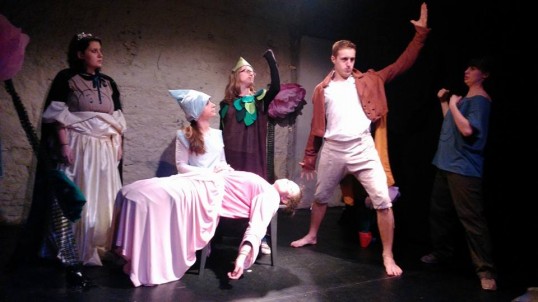
We enter to find the titular small people prepping a theatrical production of the fairy tale. (I think, like I say, one definite casualty of the confusion was the narrative arc.) Doc, Sleazy, Happy, Bashful, Grumpy, Jumpy and Dopey are waiting on confirmation that they are to perform before the Queen and her beautiful daughter.

Samuel Pashby is Prince Edward, the Princess’ nice but dim fiancé. He’s on hand to deliver, or rescind, the command for performance, depending on the royal whim of his future mother-in-law. Thus, the stage is set for a discourse on Disney-esque notions of female perfection versus the experience of most women (I think).

As the only guy on stage, Pashby is more Chris Noth than Ron Livingston, or heaven forbid Mikhail Baryshnikov. Yet his pinpoint maneuvering fails to find a plug. In this he is not alone, the bonny bubbliness of Erin Elkin (as Jumpy) is never given an opportunity to contrast fully with the brooding bristles of Blanca Siljedahl (as Grumpy). Trapped on stage, Sarah Calmus has to be constantly Happy, Daphne-fying her onstage presence into a towering laurel tree in whose shadow other performances sometimes struggle to show. In fact, Calmus dressed up as a tree at one point. (I’m not entirely sure why.)

However, Miriam Wright (as Sleazy) nails the part. What’s more, she possesses the reactive powers to suit her gear to the road ahead. It is hard to be off stage while on it, and not all the cast succeeded in this essential talent as well as Wright. As the only character with a unique storyline, Sara Shaarawi (as Doc) needed (and deserved) the space to establish the conflict between her romance and reality. Krisztina Szemerey (as Dopey) provided much needed physicality with a comic twist. She was also responsible for the Lotte Reiniger-style shadow puppetry.

Now, it’s fair to say I have a mixed history with puppets. I’ve been escorted from a super-tedious Vietnamese Water puppet show after trying to drown the dragon. I’ve been in a fist fight with Terry Eurovision. In the case of Seven Dwarves however, I’m going to take their side. Szemerey et al delivered a stylish, useful piece of staging which could have been extended to cover the spaces filled with jarring slides of perfect princelings from the Disney magic factory.

In the blocking, Witz was attempting to resolve the clutter and confusion of the stage, and she was not Bashful in taking an unmistakably directorial position. She stands out, but was not far enough back to take control. For her fans, boosters, and supporters, Seven Dwarves is a magic eye example of Laura Witz’s style – you need to be looking at it from a very particular position if it is to make any sense.

*Witz was a stand-in for Bridgette Richards, who was originally cast in the role of Bashful.

Star (blue)Star (blue)

Reviewer: Dan Lentell (Seen 12 November)

Visit our Assembly Roxy Bedlam Church Hill Theatre Festival Theatre King’s Theatre Other Pleasance, Potterrow & Teviot Summerhall The Lyceum The Stand Traverse archive.

THIS REVIEW HAS BEEN SUBEDITED

‘Tales of Correction’ (Vault: 31 May & 1 June ’14)

Tales of Correction

‘Quite how to distinguish the proper from the improper is all to do.’

Editorial Rating: Nae Bad

“We are now returning to Edinburgh to get some preferment in the Acting way.”  From Love and Friendship (1790) by Jane Austen.

The Vault in Merchant Street is a good venue for Tales of Correction. It is hard by the garage of the Edinburgh Sheriff Court where prison vans deliver and collect. As it happens, and an awful lot does happen in these two short plays, the feckless, unfortunate Augustus in Love and Friendship does time in Newgate before being thrown out of an overturned carriage – and dying.

This Charlotte Productions double bill is a preview of the ‘project’ that this strong student born company is taking to the Jane Austen Festival in Bath in September where it is bound to be well received as both literary exercise and imaginative response.

Mansfield Presents is first on. We are in a cosy ‘back-stage’, back parlour space during on-off rehearsals of Lovers’ Vows, the actual society theatrical within-the-novel. As in Austen’s story, Fanny Price has a lot of needle-work to do and exactly as on-the-page(s) she has the admirable intelligence to stay quiet as all around her sound off. The red velveteen curtain is hung and the characters that matter are in place, costumes are just so, Rushworth’s sword has gone missing, and Maria is swooning over Henry Crawford. Edmund will, for sure, love Fanny and she him, but not yet. For the time being all the talk is of sexy subterfuge and Lovers’ Vows and of those related, tantalising questions: is it suitable for a private party (when ladies are present) and how does true delicacy show itself? Quite how to distinguish the proper from the improper is all to do.

Florence Bedell-Brill as Fanny is a study in self-possession; James Stewart, in wonderful voice as Mr Crawford, is the perfect gentleman for 1800, at least in her presence. Grace Knight as Mary Crawford provides the ringlets, wit and the fun whilst James Beagon and Jess Flood, as Edmund and Maria Bertram, embody good sense and trembling sensibility respectively. Leaving George Selwyn Sharpe – there’s a Regency name for you – as the loud buffoon in a cloak, which he inhabits handsomely.

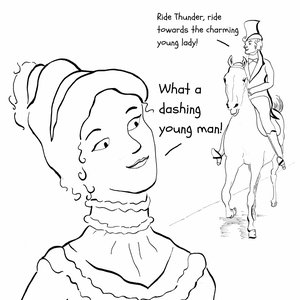
The second play, Love and Friendship, with the same six actors, is writer Laura Witz’s adaptation of the 14 year old Austen’s parody of the sentimental novel. It is a glad, ludicrous and enjoyable piece where the broad comedy is still clever and effective. A melancholy cello plays on (ironically) while costumes change with bewildering speed from out of a suitcase and James Stewart, as an elm tree, sways in the wind that is George Selwyn Sharpe. Jess Flood narrates throughout and conveys just the right touch of wonder, incredulity and hand over breast excitement. Now it is Florence Bedell-Brill’s turn to swoon, which she does splendidly, taking Grace Knight down with her. James Beagon manages the rare double-act of coachman and pawing horse.

The two Tales of Correction are in order (i) heady, as in Think About This, because you should; and (ii) headlong, as in “Whoa!”, the wheels could come off. Well, they don’t because the direction, also by Laura Witz, is secure and the performances stay together.

Perhaps a young woman could review the plays in Bath. Laurie Penny would be my choice, echoing Edmund’s question in Chapter 15 of Mansfield Park, “But what do you do for women?”


nae bad_blue

Reviewer: Alan Brown  (Seen 1 June)

Visit about Charlotte Productions here.

‘Dear Scotland’ (Scottish National Portrait Gallery: 24 April to 3 May)

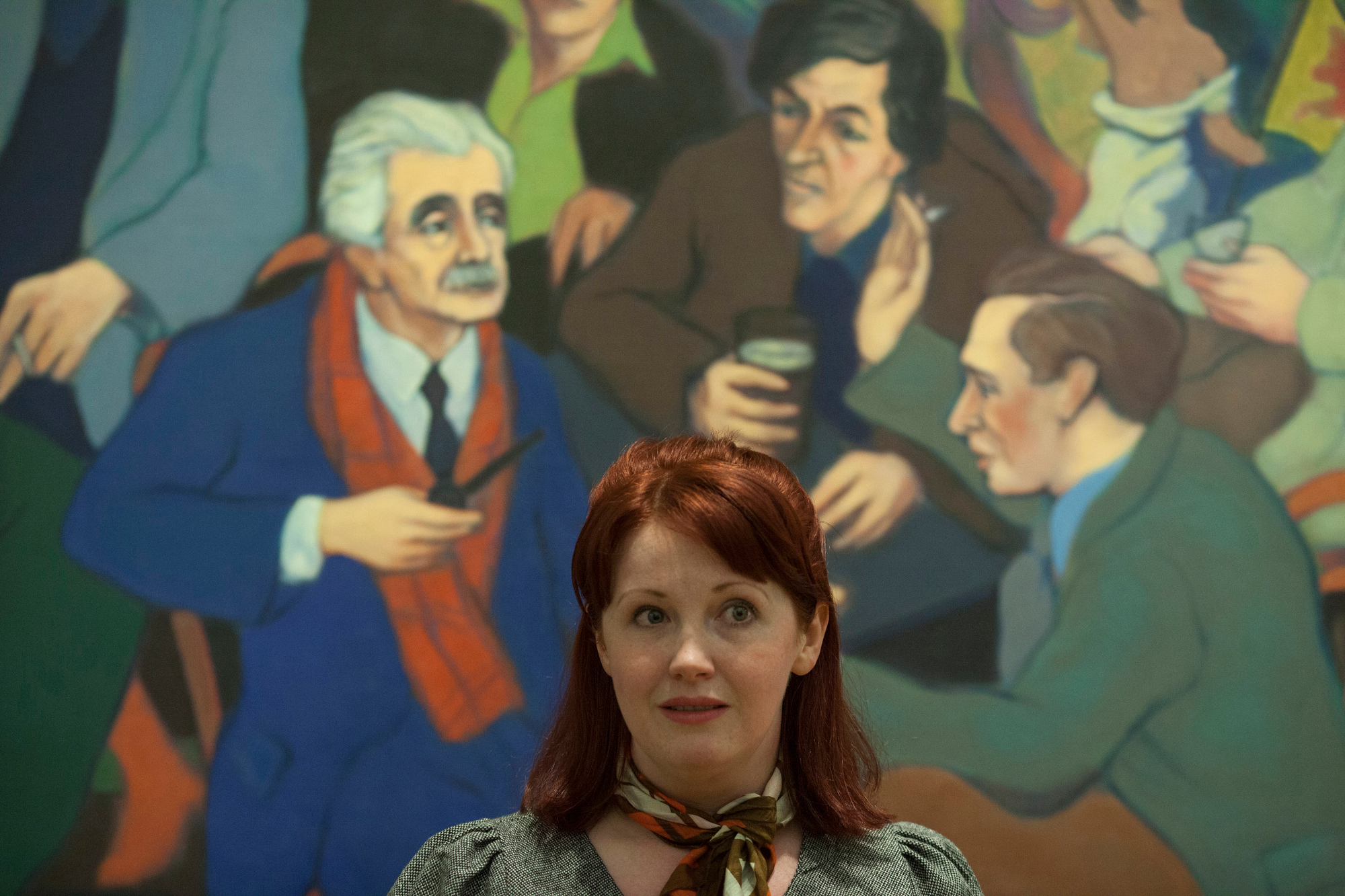
Sally Reid as the unnamed woman in the 'Poets' Pub'. Photo: Peter Dibdin Painting by Alexander Moffat (1980)

Sally Reid as the unnamed woman in the ‘Poets’ Pub’.
Photo: Peter Dibdin
Painting by Alexander Moffat (1980)

‘Finely-honed, finely-tuned productions … You’ll have to go twice – because the twenty short plays are split into two groups of ten, performed on alternate days.’

Editorial Rating:Nae Bad

A National Theatre of Scotland production.

Dear Scotland provokes some complex responses, but the concept underpinning it is a wonderfully simple one. As you’re led round the National Portrait Gallery on Queen Street, you’ll find actors stationed in front of portraits – each of them cast as the man or woman portrayed in the work of art. Each actor delivers a script penned by a different playwright, in the form of a letter addressed to the nation. So you might hear, for example, the unmistakeable voice of Liz Lochhead … but spoken by a man, in the persona of Robert Burns.

The actors are paired with portraits without reference to their looks, or (hilariously) even to their gender. Colin McCredie as the Queen is a particular highlight; in some ways, he better captures our image of the monarch than the unflattering portrait hanging behind him. Such an overt mismatch avoids some moral issues, too. Playwright Johnny McKnight isn’t putting words in Her Majesty’s mouth, but offering an alternative Queen – one who tells us things the real Elizabeth would never be so gauche as to say.

Another piece, written by Peter Arnott, pulls the same trick the other way around; this time, he has Walter Scott lay bare the things we think, but don’t dare to mention. A gender inversion again works well, with Lesley Hart offering a memorable performance as a thoroughly modern Sir Walter. But to see both the pieces I’ve mentioned, you’ll have to go twice – because the twenty short plays are split into two groups of ten, performed on alternate days.

It’s worth a second visit, since seeing the same actors re-cast in different roles presents some intriguing juxtapositions and parallels. The scenes explore a fine range of the gallery’s exhibits too, from an exalted king to a nameless woman and from photographs through paintings to sculpture. There’s even, bizarrely, a monologue delivered by a dancer’s knee (though mercifully it’s played over loudspeakers).

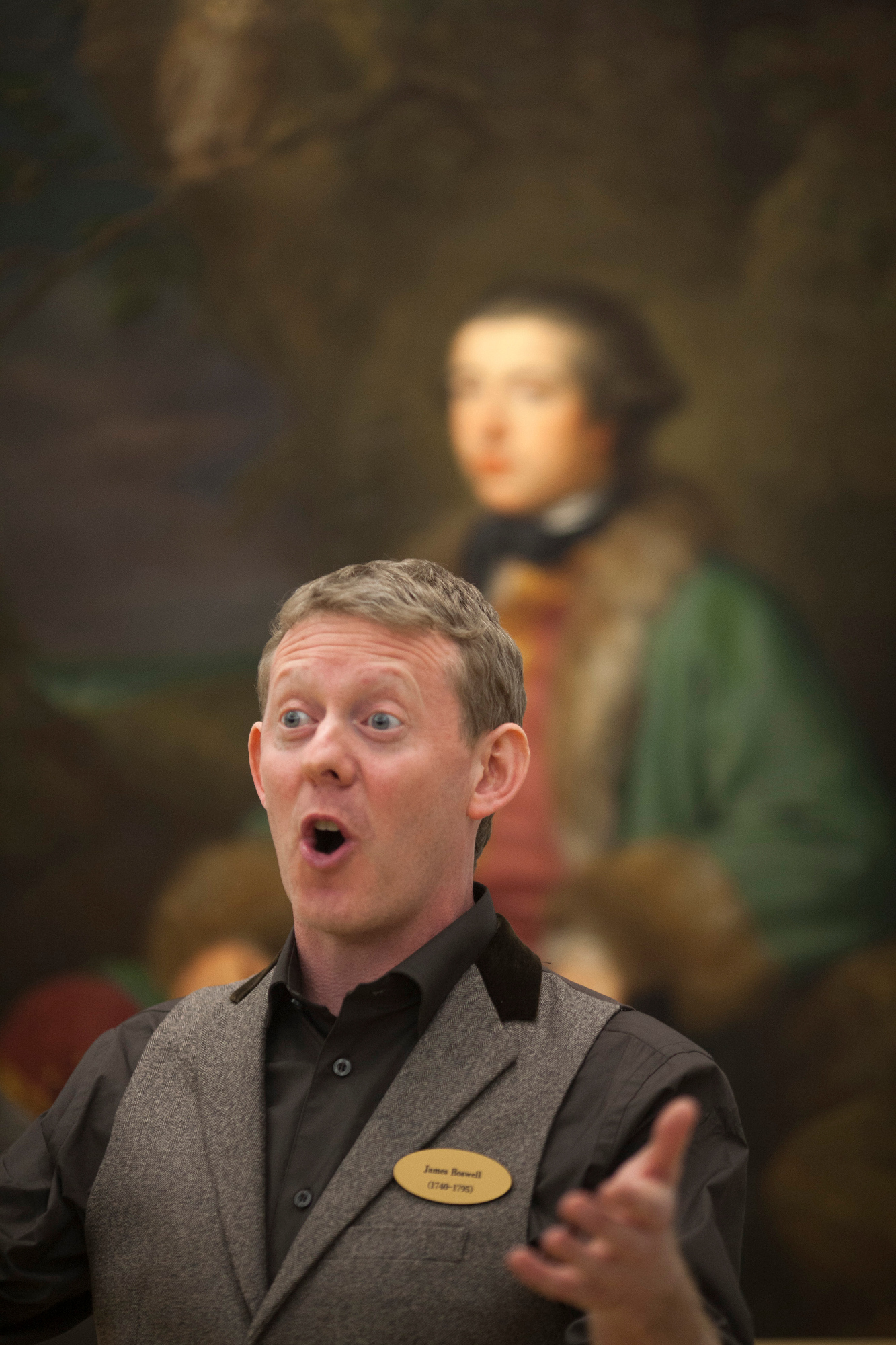
Colin McCredie as James Boswell Photo: Peter Dibdin Painting by George Willison (1765)

Colin McCredie as James Boswell
Photo: Peter Dibdin
Painting by George Willison (1765)

So the individual pieces are often compelling, but does the whole show hang together? Overall, yes; the itineraries are finely-honed, finely-tuned productions. The actors’ dress and poses subtly echo the portraits – enough for you to notice, but not so much that it starts to feel mechanistic or trite. And the logistics are impeccable too, with an array of assistants escorting the audience through the gallery, in groups which feel like they move at their own pace yet somehow never collide.

But inevitably perhaps, for a work built from so many different pieces, there’s a clumsy repetitiveness to some of the themes. “Tour B” in particular shoe-horns a discussion of independence into each and every vignette – as though the whole of Scottish consciousness can be reduced to a “yes” or a “no”. “Tour A” explores a wider view of society, and feels much more subtle and thoughtful as a result.

Across both nights, the most striking scenes were those which challenged our complacent assumptions – dared to suggest that some of our nation’s faults might originate from within. Zinnie Harris’ script for a chorus of forgotten women will linger in the memory, touching a type of pain that lives inside us all. And Nicola McCartney’s complex, riddling monologue, spoken by a bystander, opens with a welcome yet carries a bitter sting in its tail.

At the end, you’re invited to write your own note to the nation – so here is mine: ‘Dear Scotland, let’s remember how to have this conversation; not just till September, but onward, into whichever future we choose. Let’s carry on learning about our past, and speculating about our present; because, with this elegant production, the National Theatre of Scotland shows just how entertaining that thought-provoking dialogue can be.’

 nae bad_blue

Reviewer: Richard Stamp (26 & 28 April)

Visit Dear Scotland homepage here.

‘The Medea’ (The Vault: 2 – 5 April ’14)

10153047_619181111495743_1639459291_n

Sophie Harris as Medea and Olivier Husband as Jason.

‘Sophie Harris’s Medea has as much self-loathing as hatred for Jason – her love for him does not make her weak, it hurts her and she wants the pain to stop.’

Editorial Rating: Nae Bad

Rosy-shouldered dawn shrugs disconsolately at the thick fog which has covered the Grange for days. The smell of wild garlic perfumes the air as I trudge earlymorningedly through the lanes. While Monty-The-Dog, a single headed cerberus, sniffs daintily at lampposts through his muzzle, Robert Graves’ The Golden Fleece tumbles from my iPod.

Graves’ Argonauts are a fractious lot, just about held together by the strings of Orpheus’ lyre. His Jason, a somewhat querulous figure, is little more than the unwitting product of circumstances and Chiron’s peerless tutelage. It’s easy to see how Graves’ Jason might have ended up on stage at the Vault in Victoria Fairlie’s adaptation of the Euripidean afterword.

Where I was dragged up you didn’t win the school classics prize if you described the story of Jason’s divorce from the headstrong princess Medea as an ‘afterword’ to the swashbuckling Argonautica. Edinburgh49’s editor (a former teacher himself) assures me this holds true most everywhere.

Up until last night I never fully appreciated the reasoning (other than antiquity) for the play’s enduring appeal. Euripides’ take on the jilted wife, who spites her lost love by destroying his new wife and father-in-law, before slaughtering her own two children by him for the sake of revenge, had always rather baffled me. What is there in a statement on the nexus of neurosis inherent in a barbarian woman who has betrayed her own kind to be with a foreign prince who in turn betrays her?

Through Fairlie’s well-scaled adaption I have (belatedly) come to appreciate that The Medea holds universal insights into the sorrow of falling out of love. Sophie Harris in the title role was sensational. Her strong, perfectly-paced voice opened proceedings, and her subtle variations kept the darkness bright. Harris’s Medea has as much self-loathing as hatred for Jason – her love for him does not make her weak, it hurts her and she wants the pain to stop.

The cast excel at squeezing the juice out of Fairlie’s lines until the pips squeak. “Don’t get me wrong, I love Medea.” My keyboard lacks punctuation marks expressive enough to encapsulate what James Beagon, as Marnes, did with that line. Another instance is the interplay between Medea and her importunate friend Althaia (Leyla Rana Doany). When the latter states, “A man is not your life” Medea retorts, “Maybe not every man, but this one was.”

The Classics Society should know its material like their degrees depended on it. That they do shows up in some A* character summations. Medea is “a shuddering mess of a woman,” whereas Jason’s new wife, Glauce, is “a pretty woman with an empty life.”

Fairlie calzones the script, flipping one half over the other to preserve the heat and amplify the flavour. Rather than relying on the traditional Chorus, the narration is provided by simultaneous retrospection from a Medea haunted by the incarnations of her good and bad angels. Maddie Haynes and Alice Vail shoulder something of the weight of expectations carried so artfully by Harris. They tease out her nuance, throwing up ideal dramatic uplighting.

Gone with the Chorus is Creon’s kingship. Cormac Rae presents Jason’s new father-in-law as a shady figure, wielding influence, rather than power, as might a supreme mafioso. Rae’s clipped tones saturate simple lines such as, “I’d like you to stop,” with quietly assertive menace. His crucial scene with Medea is played with a beguiling understatement. It’s very different from the bombast so often deployed at this familiar moment in the drama. Rae’s Creon is a concerned but devoted father. Perhaps he even harbours an apologetic sympathy for Medea denied disclosure by family loyalty.

Harris’ reactions are as essential as her acting. She is fortunate in her soundingboards, who bring depth and creativity to their roles. I’d like to see the colossally tall Josh Reid fending off bi-planes as he clings to the outside of the David Hume Tower, clutching the diminutive Harris in his hand. The difference in their size may be comic, but the exchanges between them crackle with sombre tension when Reid as Aegeus convinces Medea to connive.

I was not much taken with Olivier Huband’s previous outing as Jason, during the Dionysia. In his reprise of the role he has reached further and achieved more. The somewhat slimy efforts to overpower Medea with sexual magnetism are gone, replaced by a more thoughtful and thought-provoking interplay with Harris. Huband has tremendous poise, shaping himself to the moment as though he has stepped from an Attic vase. He also posses a powerful delivery. In the reprise he has proven he can use it to be more E-Type Jag than Centaur Tank.

This production and adaptation were not without faults. The tinkering with the death of Glauce and Creon’s needless survival were unimpressive. The backdrop of electoral politics hindered rather than helped the contemporary feel. Neither did the script allow Medea to do much more than scorch her bridges with Creon, when for the plot’s sake they needed to be burned entirely. The swearing was unnecessary. If an audience can cope with infanticide they’re not going to be upset by the f-word.

A good production avoids its weaknesses as much as it displays its strength. This was not the cast to present grief stricken fathers coming upon the fresh corpses of innocent children. The ending was downright muddled. If Beagon wants to be credited as a script editor, he needs to demonstrate at least as much ruthlessness as when he reduced Sword at Sunset to a mere three and half hours.

Reflecting on how much Fairlie’s adaptation has furthered my understanding of this oh so dark tale, I cannot help but be mightily impressed – it’s what you want from a Classics Society production. The venue may suit lines about cold, dark and dank environs but, as Harris so flawlessly demonstrates, the Vault is a great incubator of vibrant, compelling talent.

nae bad_blue

Reviewer: Dan Lentell (Seen 2 April)

Visit The Edinburgh University Classics Society’s Facebook page here.

‘Banknote’ (Lauriston Hall: 26 – 30 March’14)

BanknoteCM Photography

“The offbeat ideas just roll gloriously on”

Editorial Rating: Unrated

According to their website, Theatre Paradok aim to be “experimental without being exclusive” – and if Banknote is anything to go by, they’ve got that brief comprehensively nailed. In the space of 90 minutes, their eminently experimental play anthropomorphises the Bank of Scotland £1 note, imagining it as – what else? – a Victorian-era burlesque star. The eponymous banknote’s key virtues (like being trustworthy, or difficult to copy) are exhibited in a series of broadly-comic vignettes; and those vignettes lampoon distinctly non-Victorian cultural phenomena, ranging from The Proclaimers to ‘Blind Date’. This is every bit as perplexing as it sounds.

But Paradok get away with such a bizarre concept, because their pecuniary antics are laugh-out-loud funny almost the whole way through. Star of the show is Euan Dickson, who plays compere to most of the set-pieces and brings just the right level of pantomime exaggeration to his role. The gaggle of “burlesque dancers” aren’t quite as burlesque as they want to be, but they successfully develop rounded individual characters and perform with genuine skill. And there’s a welcome change of pace from a compelling performance poet, despite the fact that his appearance ended in what may or may not have been scripted confusion.

There are sharper moments – at one point a dippy, put-upon dancer casually reveals a far more intelligent side – but in the main, the offbeat ideas just roll gloriously on. As is mandatory in experimental theatre, the cast drop out of character to conduct an artistic quarrel. There’s a well-timed intervention from a bare-chested man in boxing gloves (who’s spent three-quarters of the play standing at the back of the room doing absolutely nothing at all). And it all ends with the most cheerfully tuneless song-and-dance number you’ll ever have heard – which still contrived, through sheer chutzpah and charisma, to get the whole audience happily chanting along.

What’s missing, though, is an overall sense of coherence. While there is a narrative thread running through the set-pieces, it isn’t strong enough to stitch them together, leaving the work as a whole with an episodic and juddering feel. For a minute or two after the interval, there’s a glimpse of the anchoring theme this play so badly needed; the obsessive chemist Alexander Crum Brown takes centre stage, describing his quest to develop the “impossible” perfect banknote. But that promising insight is passed over in a moment, lost among a flurry of over-complex allegory and wilfully-anachronistic humour.

In short, Theatre Paradok’s experiment has bubbled somewhat out of control. Never mind though; it was hugely enjoyable to watch, and I’m sure it was just as much fun to perform in. Student theatre’s allowed to be freewheeling – they have the rest of their lives to rein their imagination in.

Reviewer:Richard Stamp (Seen 28 March)

Visit Banknote homepage here.

‘The Gentleman’s Stratagem’ (The Vault: 18 – 23 March ’14)

GS3

“Rebecca Smith, as Lady Henrietta, establishes herself across the emotional range of the script. When she’s happy, she’s happy. When she’s angry, Lord help you.”

Editorial Rating: Nae Bad

The traffic was bad coming in from Livingstone and the Current Mrs. Dan was feeling rushed. “I’m glad we’re seeing this tonight and not the other stuff you’ve seen this week,” she confided. We’re on the same page. Last November she’d been left unaccustomedly speechless by Charlotte Productions’ Goblin’s Story – the best thing I’ve seen since the Fringe.

For Gentleman’s Stratagem director Laura Witz took the same straightforwardly tangential approach to under-read literature of yesteryear. Her script is a remodeling of Maria Theresa Kemble’s Smiles and Tears, or The Widow’s Stratagem. Witz started by knocking through the script’s internal walls, reducing the original locations to a single, open plan scene set in the reception room and garden of a smart house in Richmond Upon Thames.

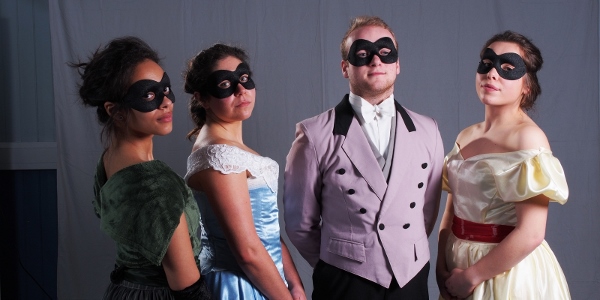
Lord Earnest Gerald, together with his friend Mr. Belmore, is attending a masque ball. Lord Earnest’s aunt, Mrs Stanly, wants him wed to the frightfully ambitious Lady Delaval, but Earnest has eyes only for Miss O’Donolan. Mr. Belmore is embroiled in litigation, his affairs are in a precarious state. Will the gents be able to find resolutions to their affairs among the studied graces of the smart set at play?

Witz is no embalmer. With the assured hand of the truly reverential, she surgically removed Kemble’s “sentimental narrative.” This would not have gone down well with the original audiences (a bolshy lot at the best of times), but for a 21st century audience the fashion for high melodrama is as remote as powdered wigs and smallpox.

Witz delivers a bright and breezy script, full of life, wit and sparkle. No one, but no one, does timing like Witz. The play runs not a moment too long or too short – its elegant proportions are genuine Georgian.

“They should have gone more Cruel Intentions and not tried to do it in costume.” I suggest afterwards.

“Rubbish!” The Current Mrs Dan was having none of it. “I loved the costumes. It was so P&P.”

I’m not sure what postage and packaging have to do with it, but on reflection the Austen-era costume was great fun and made the clothes swap at the centre of the plot properly entertaining.

The set, however, felt cluttered. The cane screen which severed the stage created too much dead space. Neither did it effectively delineate inside from outside, garden from ballroom, as was perhaps the intention.

Upstage right there’s a door from a mid-century suburban semi, with the handle on upside down. Why? There’s nothing similar on the opposite side also used for comings and goings. Overhead paper lanterns, set amid floating fabrics, flicker distractingly. The Vault might do chinoiserie – provided it’s of the Maoist, brutalist kind.

The start of the show was partially drowned out by an unsuitable cacophony. There was also a heater on full blast, until it was poked at with a stick. The music too eventually settled down to something more reflective and sedate.

George Selwyn Sharpe, who played Lord Earnest, must be one of those method actors. Other than deciding that his character had been traumatised by tales of Sweeney Todd, the demon barber of Fleet Street, I can’t think why he’d be sporting 5 o’clock shadow to a high class ball. He’s got strong stage presence, a confident mastery of his lines and a playful approach to their delivery, but Sweeney was a Victorian invention, so maybe Earnest can have a shave after all.

Michael Heard-Snow and Nuri Syed Corser are the yin and yang of footmen. Heard-Snow is poised, deferential, dry as Gin Lane. Syed Corser, by contrast, is a labradoodle in a tailcoat who ought to look to Catherine Livesey and Francesca Street for tips on the art of being supernumerary without being superfluous.

Rebecca Smith, as Lady Henrietta, establishes herself across the emotional range of the script. When she’s happy, she’s happy. When she’s angry, Lord help you. Her performance is the most in keeping with the direction of the script – primary colours not shades of grey.

The kindling romance between Florence Bedell-Brill as Lady Henrietta and Bryon Jaffe as Mr. Belmore was sophisticatedly adolescent, Wildian almost. Jaffe is moving up the batting order, mastering some bolder strokes than when I saw him in The Birds.

Saskia Ashdown as the villainous Lady Delaval struggles to find her inner bitch. Ashdown is young and pretty. She doesn’t quite inhabit the ageing, cloying, clawing Delaval. Similarly, Shannon Rollins as Mrs Stanly is not quite the dreadnaught doyenne. I can’t help but blame the cane screen – it has a such muting effect, not least because it so physically imposes on the limited space available.

I’d spent the day starting to reorder World FringeReview, the online hub for performers and reviews at Fringe festivals from Adelaide to Edinburgh. I made sure to keep up the many pictures of the late, hugely lamented Adrian Bunting – he who developed Kemble’s Riot into such a hit with audiences.

Bunting was fascinated by Maria Theresa Kemble and her family. I hope he’d have liked what Witz has done with one of her scripts, especially how she inverted the characters’ genders. Reverential yes, but where there might be disagreements of taste Witz remained respectful, while being right to make the changes she did.

nae bad_blue

Reviewer: Dan Lentell (Seen 20 March)

Visit The Gentleman’s Stratagem‘s homepage here.

‘The Hold’ (NMS: 12 – 16 March ’14)

“Howie so naturally slips into the physicality of his role as William, a museum security guard, that several times he disappears in plain sight.”

Editorial Rating: Nae Bad

“That’s the way to do it. They’re really good.” My companion, an HR honcho at an international hotel chain, is seriously impressed by the smooth operation of the ushers who are taking us around the National Museum. They’re moving several dozen people from point to point through the usual Saturday throng of visitors. With smiling (but ruthless) efficiency we are maneuvered into the best spots from which to view the drama unfold.

The lads are in rather splendid tartan waistcoats, the lasses in sashes. Half the waistcoats and sashes are backed in gold, the other in blue. The intention is to help orientate the tour’s two tracks. The effect is to fill the NMS entry concourse with figures costumed like they are serving command and science roles aboard the USS Excelsior – the starship on which Scotty served as Captain.

Peter is being forced to take stock. The long retired museum worker is moving on. Surrounded by boxes and boxes (and more boxes) of mementos, he sets out on a journey into his past punctuated by the stories held in each carefully cherished item. As is revealed to his acerbic young assistant, Sally, Peter’s story involves both love and loss. He can hold onto objects but struggles to remain close to people.

The underlay of writer Adrian Osmond’s narrative weave is a satisfyingly springy comic conceit – a retired museum worker who is also a compulsive hoarder. John Edgar as Peter perfectly balances the sympathy due to his elderly character without ever flinching from exposing those curiosities in Peter’s personality which make him such an oddball.

Teri Robb as Sally is Edgar’s idea foil. Her reactions, together with her growing understanding of Peter, pilot us through the script’s twists, turns and flashbacks. Robb is the valve through which we can all let off steam.

We see Peter as a young man bashfully courting Alice, his muse. Rising star Derek Darvell justifies his reputation as one to watch by filling out Edgar’s portrayal of Peter with intricate touches and touching intricacies. Nicola Tuxworth as Alice is poised and stylish – it’s not hard to see why Peter fell so hard for her.

Brilliant. It’s the only word to describe Stephen Tait as the bumptious, terribly busy Professor Stone, proprietor and chief curator of Peter’s museum. From the deadpan bossiness with which he opens proceedings, through the pitch perfect comic timing of his lecture on the nature of objects, to the final scenes in which he closes the drama, Tait offers up a masterclass in disciplined, pacy work.

The pairing of Tait with Mark Howie is pure genius – the best since someone put David Jason and Nicholas Lyndhurst in a room together. Howie so naturally slips into the physicality of his role as William, a museum security guard, that several times he disappears in plain sight. As Stone’s shadow, William deflates his pomposity even while building up his boss’ authority.

Osmond’s script is a triumvirate of duos with one exception. Emma McCaffrey as Bridget plays a bad hand well. Without a partner to whom she can position her delivery, too much of her performance is lost in the cacophonous hubbub of the venue. Noise bleed was more than a problem. Especially in the early scenes it became the woolly mammoth in the Renaissance Gallery. Too often it was a real strain to hear what was going on. The impact of the final scene was lost altogether when we stood under a gantry echoing with footsteps overhead.

Since it’s the fashion to believe that under-10s learn best by osmosis, I tend to avoid the museum at weekends, when it’s packed with noisy children learning about the stone age through proximity to arrowheads. Staging a mature drama amid the shrieking hordes of Tamsins and Hamishes was a daft idea.

It’s a real shame because so much of the staging was so clever and engaged. The tent in the Neolithic Room, the pine cones by the Roman headstones – devices which set the scene and dressed the stage with the speed and clarity of a signal lamp. Not since Henry VI Part III has a paper crown been used to such effect as it was in Stone’s lecture.

Set against a haunting backdrop of live music, which sent a thrill down the spine, director Maria Oller delivered a Scandinavian-style flatpack of concepts quickly assembled by a well drilled yet fluid company. The Hold set weighty ideas on a very human scale. This hard working, talented cast deserved the serenity of an after hours outing.

nae bad_blue

Reviewer: Dan Lentell (Seen 15 March)

Visit The Hold‘s homepage here.