Stardust (Pleasance Dome: 1-27 Aug: 16:20: 60 mins)

“Entertains and enlightens”

Editorial Rating: 4 Stars

While, to many, the Fringe is a place to be entertained, it is also a place to be challenged and to learn something new. I’m not ashamed to say that before watching Stardust I knew very little about the country of Columbia. And that my knowledge extended barely any further than the stereotype it has garnered for being the home of cocaine – another subject about which my knowledge was paltry. Step up, then, this part-documentary, part one-man-theatrical-masterclass which entertains and enlightens on both counts.

In entering the space, performer Miguel Hernando Torres Umba gives each audience member a warm welcome and entrusts a select few to look after mysterious boxes, which go on to become significant parts of the show (nothing scary!). The mood set is one of familiarity and friendship as Umba then explains his Columbian heritage and the purpose of the show he has created as artistic director of Blackboard Theatre.

What follows is a whistle-stop tour through the history of cocaine, how it has become a multi-million pound (and very dangerous) industry, and the wider effects this industry has around the world. With very imaginative use of audience interaction, projections, sound, contemporary dance and many other devices besides, it’s certainly a feat in creative communication. Yet while each section is captivating and powerful, the connection between them often comes across as a little disparate and scrappy, working against the relaxed and open atmosphere at the heart of this show. The game show element in particular is engaging and fun, though rattled through almost too quickly to get the most out of it, and then we’re on to a different aspect of the story.

The joy of this performance, though, is driven by the passion and personality of Umba. His likeability and charm make the learning very enjoyable, and his honesty and communication style are very engaging without going over the top. He shows himself to be adept at multiple performance styles within the piece and knowledgeable and authoritative about his subject.

Overall, Stardust is a well-thought out and compelling discussion, though disappointingly (albeit achingly honestly) leaves a bittersweet taste as there appears to be no resolution or obvious path forward. Well worth watching to learn a few facts about Columbia’s biggest export, though.


Star (blue)Star (blue)Star (blue)Star (blue)

Reviewer: Steve Griffin (Seen 2 August)

Visit the  Pleasance, Potterrow & Teviot archive.
THIS REVIEW HAS NOT BEEN SUBEDITED

Bowjangles: Excalibow (Gilded Balloon: 1-26 Aug: 14:00: 60 mins)

“I don’t think I’ve ever come across a more multi-talented group”

Editorial Rating: 4 Stars: Outstanding

Bowjangles are not your average string quartet. Indeed, they extend the well-known triple threat (performers who can sing, dance and act) to a fourth dimension by adding the musical string to their bow. (Sorry). And what’s more: they can do all four at the same time. Prepare to be amazed as these performers act out a dramatic saga while accompanying themselves (more than capably) on their instruments.

Excalibow is Bowjangles’ latest Fringe offering (marking the troupe’s 10th year together) and sees them embark on an adventure to find the magical bow Excalibow, which will enable them to become (ahem) the Lords of the Strings. Yes, the jokes and musical puns are that good throughout. It’s a fairly ridiculous story, that unfortunately come across as a rather hastily put together pastiche of fairytales, but the characters are fun and fantastical, and the ever-changing mood created by the performers and their instruments is nothing short of masterful. I don’t think I’ve ever come across a more multi-talented group in all my years of reviewing.

What really makes this performance special, though, is the chemistry and personality that ooze from this awesome foursome. They appear very natural onstage together, and are clearly very well-rehearsed and comfortable in being able to deliver this slick and energetic production. Their smiles never stop beaming, so even if the thought of watching an all-singing, all-dancing string quartet brings you out in a cold sweat, you’ll no doubt find yourself swayed into at least a grin by their charm and charisma.

For me, the overall structure and narrative of the piece is where it all falls a little awry, as the action chops and changes between many locations and subplots that it all gets somewhat confused – though the fun and frolicking nature of the performance makes this relatively unimportant in terms of overall enjoyment. Particular highlights include a snippet from a well-know ABBA song, and a comedic take on a certain moment from the film Titanic.

This is a show that’s bags of fun, packed with personality and great for the whole family (bar the odd naughty word which slips out). A definite for the shortlist as a welcome break from some of the harder-hitting shows out there.


outstanding

StarStarStarStar

Reviewer: Steve Griffin (Seen 2 August)

Visit the Pleasance, Potterrow & Teviot archive.

THIS REVIEW HAS NOT BEEN SUBEDITED

FCUK’D (Gilded Balloon: 1-27 Aug: 12:30: 60 mins)

“Hints of truly brilliant wordplay”

Editorial Rating: 4 Stars

There’s been a pleasing rise in popularity in spoken word and verse performances over the last couple of years, opening theatre up not just to new audiences, but also new artists who might previously have thought the medium too inaccessible for them. And what makes the Fringe so special is being able to experience stories of those that don’t normally get a stage. FUCK’D is one such verse piece, where a young man from an estate in Hull, who dropped out of school early, longs simply to stop his little brother being taken away from his broken home by the authorities.

Following their mother’s breakdown having being left by their father, the two boys must fend for themselves, and when the clipboarded do-gooders finally arrive in their shiny cars, the elder brother makes the split-second decision for them to both jump out the window and run for it. With no plan and less money, the journey they make is one of desperation, reflective of the plight of many such teenagers around the country today.

Niall Ransome’s script cleverly interweaves narrative drive with descriptive passages to tease out the background and develop the world the characters grew up in. A romanticised view of their home estate and its personalities nestles next to the tense escape scene, while reminiscences of rainy picnics are juxtaposed with hiding under a bridge, to add poignancy and personality. It’s artistic and moving with hints of truly brilliant wordplay.

George Edwards is the performer tasked with delivering this urgent tale, and he commands the stage with power and honesty. It’s a tough task to sustain the rhyme and mood for almost an hour, but this is a commendable effort, supported by a simple yet effective soundscape.

While the narrative and performance quality lacks some of the artistry and finesse of works by similar artists such as Luke Wright, this is a solid and capable outing that is almost aching with potential. It would be great to see a bit more pumping pace and extremes in mood to create more intensity – and while Edwards does very well to carry the performance, more dynamic changes and depth would really make this show zing.

A sterling effort, that with a bit more polish could become something very special.

Star (blue)Star (blue)Star (blue)Star (blue)

Reviewer: Steve Griffin (Seen 2 August)

Visit the Pleasance, Potterrow & Teviot archive.

THIS REVIEW HAS NOT BEEN SUBEDITED

Formation Festival: Cowards Anonymous (10-12 July)

“Leaves you feeling pleasantly contemplative”

Editorial Rating: 4 Stars

Cowards Anonymous – a support group for shy people who don’t like to make tough decisions. Hosted by some very colourful characters (who begin wearing masks), the welcome given feels more like you’re about to participate in a bizarre shared event, rather than sit back in the shadows to merely observe. And a shared event it becomes, as audience members are picked on at frequent intervals to give their views on a variety of topics and questions.

For many, the term ‘audience participation’ is the stuff of nightmares – the thought of being dragged up on stage, laughed at, or even just spoken to from the comfort of your seat by a performer with a big personality and a microphone – can send shudders down one’s spine and bring on the cold sweats alarmingly quickly. And while one of the aims of Cowards Anonymous is to create a sense of discomfort and awakening to some rather sticky issues, it is mediated in a relaxed and comedic way that nurtures a safe space in order to openly discuss difficult topics – mainly moral choices and philosophical debates.

Indeed, the main strength of this production is the pace and personality driven through it by performers Izzy Hourihane and Eilidh Albert-Recht who do the bulk of the direct addresses to the audience. They bounce off each other well and successfully navigate the tightrope between likeability and authority throughout. Their performance also gives the frequent sense of having gone completely off-book, adding to that feeling of awakening through nigh-on cringeworthy uncertainty of what happens next. Gripping stuff.

Josh Overton’s script dissects the notion of what it means to be a coward, and indeed what it means to be oneself – given the acting up we all do in different situations to please those around us. Posing several thought-provoking scenarios and more than a fair whack of comedy, it leaves you feeling pleasantly contemplative, even if the killer punch of the piece is somewhat lacking. Many excellent ideas are presented, but none quite strongly enough to elicit purposeful action.

Director Tyler Mortimer does well to highlight the comedic and playful aspects of the production, yet while the pacing is generally quite rip-rollicking and upbeat, some more variation in tone and timbre might help emphasise the points being made by this piece.

For many reasons, this show is likely to be divisive, yet for those open to something new, it’s an enlightening way to spend an hour. For me, this production just needs to shake off some of its scrappy and unpolished edges, embrace its direct and intelligent confrontational approach and go full steam ahead. It’s refreshing to have one’s mind challenged in this thoughtful way, and I’d encourage more people to do the same.


Star (blue)Star (blue)Star (blue)Star (blue)

Reviewer: Steve Griffin (Seen 11 July)

Visit the Assembly Roxy archive.

THIS REVIEW HAS NOT BEEN SUBEDITED

Formation Festival: Conspiracy (11-12 July)

“A sterling effort”

Editorial Rating: 4 Stars

Loring Mandel’s Conspiracy, which many may know from the 2001 HBO film starring Kenneth Branagh, dramatises the 1942 Wannsee conference in Nazi Germany – where several powerful members of various agencies and government departments met to discuss and agree upon a “final solution” to the “Jewish problem”. Undoubtedly one of the major turning points in global history, it is almost sickening now to witness the frank discussions from these men of how best to be rid of millions – millions – of Jews. Strap in.

Upon entering Assembly Roxy’s large Central space, you get a feeling something big is going to happen: the impressive design encompasses a crescent shaped 15-seat conference table – complete with place names, glasses and cigarettes – while a full-on buffet spread is arranged behind it. This is a production that doesn’t shy away from details, as the excellent vintage costuming also pertains to.

Stylistically, Mandel’s script doesn’t quite have the wow-factor of some of its comparable contemporaries: the dialogue doesn’t sing as much as in Aaron Sorkin’s A Few Good Men, while it lacks some of the narrative drive of Reginal Rose’s 12 Angry Men. What it does have, though, is a gut-wrenching sense of inevitability as the decision is reached with a pitiful defence of humanity, and it’s this short journey which makes it a powerful ensemble piece – achingly relevant to the political landscape unfolding in America now.

Director Robin Osman gives himself a mammoth task in pulling off this production, and a real strength is managing the cast of 16 at all points to maintain interest and relevant focus. Indeed the down-time moments of the meeting are almost more impressive than the lengthy debate, which often seems at odds with itself when it comes to levels of tension, frustration and power with each character. The overall presentation comes across as slick and well-rehearsed, though some cast members are somewhat guilty of overacting their smaller parts, creating a bizarre sense of imbalance to those with a more subtle approach.

For me, the standout performers are: Alexander Gray as Dr Wilhelm Stuckart, who navigates the most complex emotional journey throughout the piece; Chris Pearson as Dr Wilhelm Kritzinger, for exuding a natural quiet authority; and Ben Blow for his compelling and convincing turn as Otto Hoffman.

Overall, this is a sterling effort for an amateur production of this challenging play. It’s a bit of a slog to sit through, but well worth it for the vital history lesson, if nothing else.


Star (blue)Star (blue)Star (blue)Star (blue)

Reviewer: Steve Griffin (Seen 11 June)

Visit the Assembly Roxy archive.

THIS REVIEW HAS NOT BEEN SUBEDITED

Formation Festival: Mr & Mrs She (7-8 July)

“Pleasingly disquieting”

Editorial Rating: 3 Stars: Outstanding

It’s not often I’m lost for words when coming out of the theatre, but Mr & Mrs She is one of the most bizarre plays I’ve ever seen. Yet, while its incomprehensibility may be perceived as a negative, there’s something to be said for a play whose questions stay with you for many hours – even days – afterwards.

The show opens with what appears to be a fairly stereotypical wealthy couple enjoying a generous amount of their favourite tipple and getting rather merry. Cue the entry their very eager-to-please staff, a comment about enjoying oneself too much before breakfast, and suddenly the play takes a much darker turn.

Hollie Glossop’s script may well be abstract, but there’s something gripping about the subversion of power from these seemingly stock characters that becomes pleasingly disquieting. The level of detail and pace at which the action develops is masterful, and while I would prefer a greater sense of grounding and cohesion to be able to connect more with the action, Glossop has created a world that begs to be explored further.

Sofia Nakou’s direction embraces and extends the quirkiness with intelligent physicality and proxemics, making the most of the large performance area to highlight the power struggle between each character and the vast emptiness each one is in. As the action creeps closer to the audience, the level of discomfort rises on all fronts and it’s impossible to predict what will happen next, or how you should feel about it.

Kudos to all of the young company performing this work, embracing its weirdness and committing to their roles in it. David Llewellyn in particular demonstrates fantastic range and risk-taking throughout his demise, while Grant Jamieson is suitably sinister as his butler.

It would be fantastic to see this show developed further – it has the makings of a truly memorable piece of theatre. That being said, it seems somewhat unfair to attribute a star-rating to a piece like this, which might easily alienate some audiences while titillating others. Either way, if you’re on the lookout for something different that will leave you with many unanswered questions to debate afterwards, this may well be for you.


outstanding

StarStarStar

Reviewer: Steve Griffin (Seen 8 July)

Visit the Assembly Roxy archive.

THIS REVIEW HAS NOT BEEN SUBEDITED

Formation Festival: Straight Outta Saughton (7-8 July)

“Charming”

Editorial Rating: 3 Stars: Nae Bad

Straight Outta Saughton presents the unlikely but intriguing scenario of two recently released inmates (and cellmates) from HMP Edinburgh banding together to perform as drag queens, having struggled to find other employment. The senior, and more confident of the two, Peter (Callum Thomson) is old hat and knows his way around a wig and a pair of heels, but his younger (and very vocally heterosexual) counterpart Dave (Greg Sives) is most certainly not in his comfort zone, setting up a potentially juicy 45 minutes of real-time action before the two must take to the stage and lip-synch for their living.

Katy Nixon’s script is charming throughout, setting up a very believable situation, peppered with relevant and laugh-out-loud witticisms. It teases out revelations about each character at a good pace, setting up a fair amount of twists and turns to maintain interest.

What’s missing though is a real sense of narrative drive and urgency to keep the action moving and create more dynamics within the piece. While director Deborah Whyte does well to make the most of the small performance space and create different levels throughout, it does sometimes feel a little flat and laboured. The action often comes across as very “blocked” and unnatural, while it’s disappointing not to see more made of the make-up makeover, which feels a bit rushed and underutilised, both artistically and metaphorically.

It’s the actors who really make this piece shine though. Thomson is a natural on the stage, and commanding in his portrayal of the flamboyant Peter. He also shows great emotional range when opening up about his more personal life and demonstrates great dexterity throughout. Sives is more subtle as the reluctant Dave, but every inch believable in his frustrations and discomfort about the situation he finds himself in. The pair have great chemistry together and I could easily watch them for longer.

There’s definitely something here, that with a bit more workshopping could become a really gripping play. Still, it’s a very enjoyable production as it is, and I hope we see more of it in the future.


nae bad_blue

Star (blue)Star (blue)Star (blue)

Reviewer: Steve Griffin (Seen 8 July)

Visit the Assembly Roxy archive.

THIS REVIEW HAS NOT BEEN SUBEDITED

EIFF: “Swimming With Men” (30 June ’18)

“Fun performances and sweet turns of narrative … Swimming With Men is a comedic success”

Editorial Rating: 4 Stars

Imagine The Full Monty, in Speedos. That’s the long and short of Swimming With Men. But despite some predictable setups, Oliver Parker’s new film is charming, sweet, and genuinely quite funny, mostly due to a delightful-as-ever performance by Rob Brydon. It is not a rush-to-the-theatre type of film, but as a nice way to spend an hour and a half, it does not disappoint.

Brydon plays Eric Scott, a bit of a loser who finds himself out of step with his own life. His accounting job is a monotonous waste of his time and talent, and he is growing apart from his wife Heather (Jane Horrocks) due to his own jealousy at her success as a local politician. The only place he finds peace is in the local pool, where he meets a motley crew of men who have banded together as a synchronized swimming team. Led by the charming Luke (Rupert Graves), the men decide to incorporate Eric into their routine, and so begins a series of amusing training sessions and actually quite impressive swimming stunt work. Played by various British comedy talents such as Adeel Akhtar, Daniel Mays, Thomas Turgoose, and the excellent Jim Carter, the team is a fun group to watch, and their onscreen chemistry is a highlight.

The story is a classic one, where Eric finds not only his own worth in his connection to these men, but the worth of self-expression and all that; credit again to Brydon that he makes this simplistic path far more pleasant than predictable. Charlotte Riley is notably fun as Susan, a swimmer who is drawn into being the team’s coach, and gets them good enough to complete in the international men’s championships in Milan for a rousing, very fun finale. The film is quite sweet, but not without its conflicts, as old habits, lost loves, and personal differences come to derail some of the team’s momentum over and over. But overall, this is an agreeable and satisfying film with something to say about male friendship and trust, which is very well suited to Brydon’s charm and talent as an Everyman with real presence. One scene of his in an elevator late in the film is a particular standout; perhaps it’s a shame he does not get more to do over the course of the film.

Parker’s aesthetic choices are unexceptional, yet liven up when the men are in and around the pool, a clever reflection of the freeing possibilities of the team and their routines. Some sequences are filmed quite creatively, especially the hypnotic boredom of Eric’s office and certain dreamlike shots of the men twirling and floating around underwater.

(Outside of the film itself, it is an intriguing coincidence that this year’s 71st Cannes Film Festival featured a French film called Le grand bain [or Sink or Swim], directed by Gilles Lellouche and starring Mathieu Amalric, which seems to have the exact same plot. Perhaps synchronized men’s swimming has become the choice cinematic metaphor for rethinking the mechanics of team-based masculinities of today.)

For Brydon’s commendable turn in the lead role, plus some fun performances and sweet turns of the narrative, Swimming With Men is a comedic success, and well worth a rainy-day watch. (So, perfect for Scottish audiences.)

This enjoyable film brought the 72nd Edinburgh International Film Festival to a close, and my coverage ends with it. It has been a truly fun and informative time watching and waxing about all these films and seeing film history made-in-Edinburgh. I hope my writing has been useful and thank you for reading!


Star (blue)Star (blue)Star (blue)Star (blue)

Reviewer: Nathaniel Brimmer-Beller (Seen 30 June)

Go to Swimming with Men at the EIFF


EIFF: “Piercing” (30 June ’18)

“A trippy, entertaining, & masterfully nightmarish romp.”

Editorial Rating: 4 Stars: Outstanding

For a completely bonkers, aesthetically anarchic, sonically and visually unnerving nightmare thrill ride, Piercing has a lot of humor, heart, and fabulous artistry beneath its hood. The film is directed by Nicolas Pesce, creator of well-liked arthouse horror The Eyes of My Mother, and based on a novel by Ryû Murakami, the mind behind some of Japanese cinema’s most twisted and depraved screenplays. This film is very much in the same vein, but swaps its Japanese influences for Italian Giallo and a charming 70s setting. While it is revoltingly violent and demented, somehow everything in Pesce’s film just works, and it is a truly outstanding genre film.

Piercing continues a pleasing trend in many of the films this year: performers who traditionally fill supporting roles getting a shot at the lead. Take, for example, Kelly Macdonald in Puzzle, Natalie Dormer in In Darkness, Nick Offerman in Hearts Beat Loud, Rob Brydon in Swimming With Men, Steven Ogg in Solis. And now, Christopher Abbott as Reed, the enigmatic, bizarre focus of Pesce’s surreal tale. Abbott has turned in fascinating, unsettling, always capable performances in films like Sweet Virginia and Tyrel, (plus his lead role in the small James White), and it is lovely to see him stretch out as the protagonist in a film so odd. He is joined by the always entertaining Mia Wasikowska, and the charming Laia Costa, all of whom get their share of fascinating chances to shine and bend the audience’s minds.

The film follows Reed as he decides to take some time away from his wife (Costa) and child, so he can indulge his twisted murderous fantasies. He meticulously plans to lure and dispatch an unsuspecting prostitute, and in true jet-black humor fashion, Pesce has the camera follow Reed around the room he has rented as he walks through the steps of exactly how he will administer the necessary sedatives, do the deed, and dispose of the body. The clincher is, Pesce includes all the implied sound effects of the execution, and as Reed mimes the sawing, hacking, and gruesome handling of the various parts and bits, the squelches and drips are heard in full. This is a stylistic highlight, yet Piercing features many more sequences of filmmaking just as delightfully twisted. 

Wasikowska plays Jackie, the prostitute he eventually lures into his plan, but needless to say it does not go according to plan. The story twists and turns with gleeful insanity, with Reed and Jackie taking it in turns to torment the other with horrifying weapons and substances. It all spirals into hallucinogenic madness, perfectly contrasted against remarkable production design and music. Delirious grotesqueries are frequently performed on and around plush 70s interior design, while stupendously odd themes from classic Giallo films play above them. The film intermittently cuts to an uncanny miniature set meant to evoke the heights and depths of the New York City skyline, evoking a maze or a puzzle akin to the disorienting content of Reed’s story. 

It’s a trippy, entertaining, masterfully nightmarish romp, with an unlikely balance of class and cruelty, harrowing scenes and hilarious horror, and a hellishly sadomasochistic partnership for the ages in Abbott and Wasikowska’s characters. If you enjoy stylish craftiness and chills down the spine, plus some captivating costume work and musical dexterity, pick Piercing, and have fun with it.


outstanding

StarStarStarStar


Reviewer: Nathaniel Brimmer-Beller (Seen 30 June)

Go to Piercing at the EIFF


EIFF: “In Darkness” (28 June ’18)

“A daringly twisty, commendably unpredictable erotic thriller with much more to it than meets the eye.”

Editorial Rating: 3 Stars: Nae Bad

If and when you watch In Darkness, you will think a lot of thoughts. Many of them might go something like “What just happened?” or “What am I watching?” or “Is this all the same movie?” but suffice it to say that this daringly twisty, commendably unpredictable erotic thriller has much, much more to it than meets the eye. That is not always a good thing, as the film spends most of its runtime running off the rails of its supposed ‘plot,’ but I would be lying if I said it wasn’t an entertaining trip.

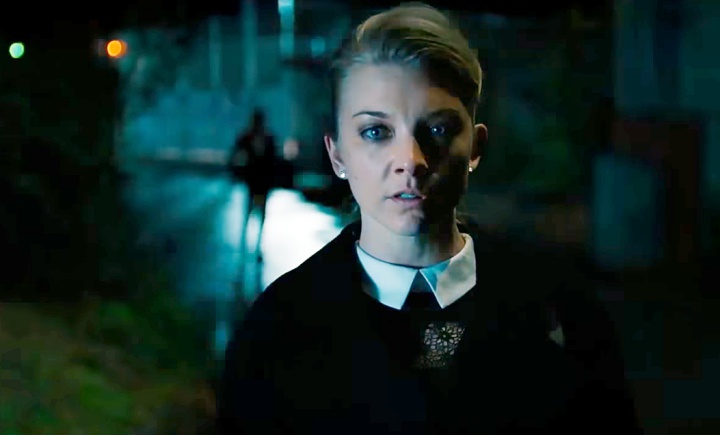
The film was written by real-life partners Anthony Byrne and Natalie Dormer; Byrne directs, Dormer stars. If you are fan of Ms. Dormer’s, possibly from her star turns in Game of Thrones or the Hunger Games franchise, then you will enjoy this film. It is a star-vehicle through and through, with nearly every shot focusing on some part of Dormer, whether her striking face or nimble physicality. Notably, Dormer proves her mettle as a very capable lead actress, and this film makes a solid case for more female-led stories written by the actresses themselves; Dormer’s character, Sofia, is a well-rounded and trustworthy focal point of the story, flitting through classy and dangerous scenarios with grace and thrilling movement. 

If only the story was as well-rounded and trustworthy. Heavens, what a license Dormer and Byrne’s story takes with the audience’s suspension of disbelief! After a striking, standout title sequence (which sets the stage excellently for a slick, exciting thriller to come), we are introduced to Sofia, a blind musician who glides around London with remarkable street smarts and style. The first 20-25 minutes continue like this, with a rich aesthetic palette and a fun, knife-edge sense of building danger. Her upstairs neighbor Veronique (Emily Ratajkowski) is clearly wrapped up in some nasty business, and when she turns up dead on the pavement outside their building, the plot thickens with Hitchcockian craftiness. Who killed her and why are the setup for the rest of the film’s twists and turns, but without spoiling anything, let me forewarn you that Veronique quickly becomes old news in favor of a much scummier, more complicated spider’s web of crime and revenge. 

For the first leg of In Darkness, the film makes a truly riveting imitation of classic Hitchcock and Wait Until Dark-esque blind-character craftwork — especially in a tense, nail-biting scene where assassin Marc (Ed Skrein) intends to kill Sofia for what she has seen, but notices her blindness and decides to follow her around her apartment in silence. Scenes like these are so fun and well crafted that the later dramatic shifts in tone and focus are more unfortunate than thrilling — there is a notable shift from Hitchcock to Jason Bourne all of a sudden that undoes a great deal of the film’s accomplishments with head-scratching intensity. 

Ultimately, that is the central problem of In Darkness — it has so many fetching elements to it, from the compelling star to the vintage first chapter to the stupendous use of music (again, only up until the tone change), yet it keeps undoing all that commendable work with silly plot twists. Twists, plural, mind you — each of which edge the film closer to completely undoing itself. As a fan of twists myself, I commend Dormer and Byrne’s ballsiness in their final few reveals, but I came out of the theatre feeling played for a fool, rather than hoodwinked by a clever storyteller. 

In Darkness is amusing genre excitement, and has potential as a twist-film highlight among those who enjoy just being confused, but it will mostly remind you how much better a straight-shooting classic crime thriller treats its own plot. Credit belongs to Natalie Dormer, however, for rooting it all in a fascinating lead — I can honestly say I would watch whatever she writes and stars in next. 

nae bad_blue

Star (blue)Star (blue)Star (blue)

Reviewer: Nathaniel Brimmer-Beller (Seen 28 June)

Go to In Darkness at the EIFF