The Cheviot, the Stag and the Black, Black Oil (Lyceum: 14 – 24 Sept’16)

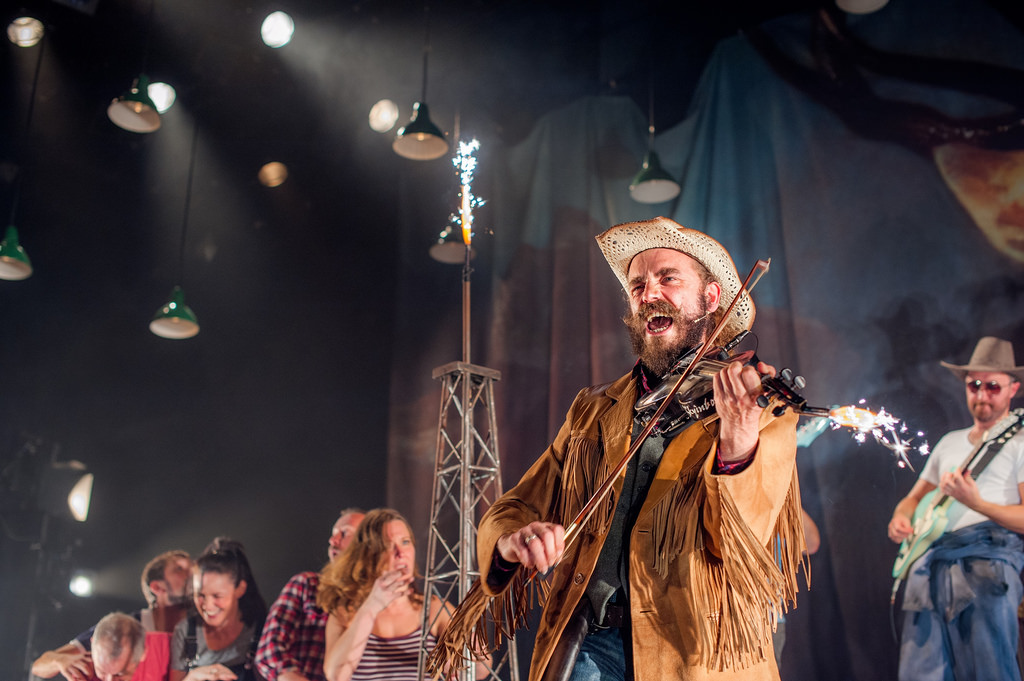
Alasdair Macrae, Musical Director, as Texas Jim . Photo:Tommy Ka-Gen Wan

Alasdair Macrae, Musical Director, as Texas Jim .
Photo:Tommy Ka-Gen Wan

“43 years of agitprop stardom”

Editorial Rating: 4 Stars: Outstanding

Popular entertainment is a broad church. It is entertaining (& mildly provocative) when the Union flag is raised above Craigmillar Castle, as it has been these past few days, and – to pursue a theme – there’s the BBC’s Scotland and the Battle for Britain to watch and absorb. And now, from 1973 but fresh from Dundee and fit as a fiddle, comes Tom McGrath’s fabled The Cheviot, the Stag, and the Black, Black Oil. From the off you’ll be singing These Are My Mountains and asking yersel, ‘And whose mountains are those, exactly?’

For this is about the land and of its people (& famously of the 7:84 theatre company that brought it across the land to the people). You don’t see the vans but you could just about pack up these actor musicians, their many costumes and their instruments, into two Ford Transits, with room to spare for model crofts, wee sheep, an oil derrick and some fancy digital kit. It’s all highly portable and hugely worth the telling – and the singing and the dancing. The staging, in the Lyceum space, does not lend itself to community theatre but this is still a barnstorming effort.

This is not Land Economy by ceilidh and clàrsach but it’s not far off, which is actually the point, because here’s the old story-on-stage, ingeniously played but plainly told, of the people of Sutherland and Ross-shire being expropriated and displaced by the forces of profit and loss. The sturdy Highlander cannot stand against the combined agency of absent landowner, factor, police and lots of sheep. In fact Porky Highlander (Stephen Bangs) doesn’t stand at all but takes prudent cover behind his women and shoogles off to Canada in a string vest. It’s much the same when it comes to the east coast and Aberdeen with oil, Texaco and Mobil, and company men; and now – to update our scene, as this production cleverly does – there’s the Trump International Golf Links and layoffs on the rigs. And what are the burghers of Edinburgh going to do about that? Hmm, sadly, probably not that much, but we can tap our feet to Texas Jim (Alasdair Macrae), laugh at Jo Freer’s turn as hideous property developer Andy McChuckemup, and wonder what on earth the ghillie (Calum MacDonald) is talking about, because his gaelic is way beyond our ken.
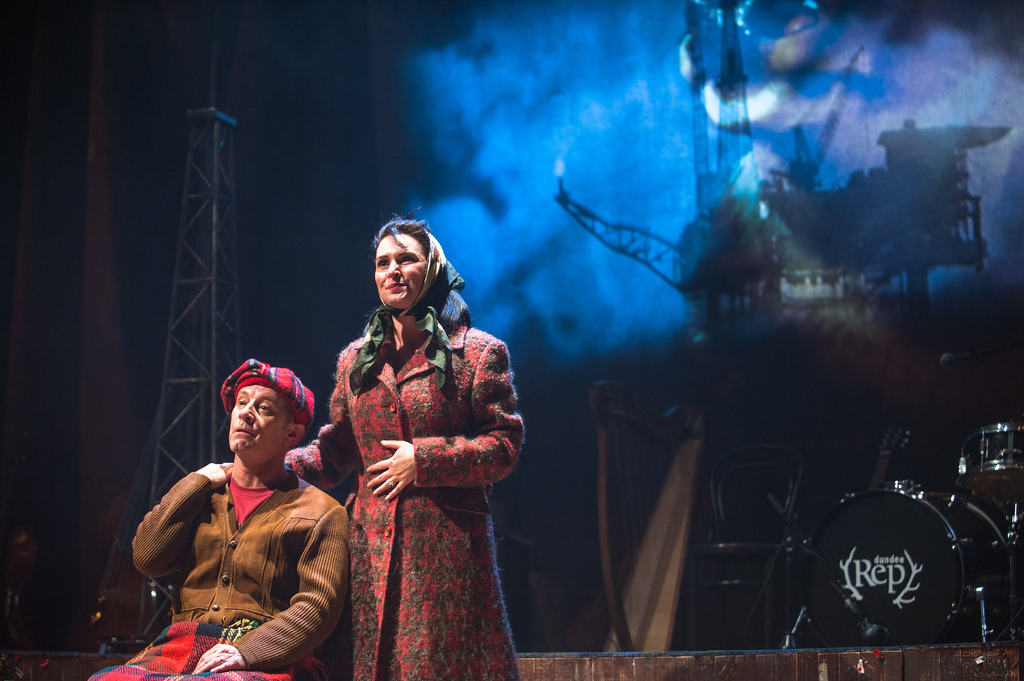
Barry Hunter & Jo Freer.

Barry Hunter & Jo Freer. Photo:Tommy Ka-Gen Wan

Director Joe Douglas plays the script for what it’s worth, which is still not devalued by 43 years of agitprop stardom. The humour is all there, from panto to banter, as is the braying English accent (Emily Winter, all tweed and Golly!) and ‘Land of Hope and Glory’ on kazoo. There is also the nastiness and the pity of it: evictions in the face of defiance and protest; loss and frailty; the dignity of labour forced down and out by ‘owners’ who monetise the works, from creel to North Sea platform. Irene Macdougall’s top hatted Loch is as villainous and intractable as her Announcer’s role is friendly and open.

It is a young Bill Paterson who, in the 1974 TV adaptation of The Cheviot, the Stag, and the Black, Black Oil, introduces the story of ‘What’s been happening here in the Highlands, a story that has a beginning, a middle, but as yet no end’. Well, conceivably, the Scottish Parliament and land reform might wrap it up, or the price of crude could do it, or – Whisht! – a second vote on independence, but for the time being Dundee Rep is bringing it on just fine.

(That Union Jack at Craigmillar Castle? Sony Pictures is filming Outlander there … )


outstanding

StarStarStarStar

Reviewer: Alan Brown (Seen 14 September)

Go to Dundee Rep and  the Lyceum

Visit Edinburgh49‘s The Lyceum  archive.

+3 Review: Ameé Smith – Relax, it’s not about you (Underbelly Med Quad: Aug 3 – 29: 15.00 : 1hr)

https://i0.wp.com/www.underbellyedinburgh.co.uk/images/uploads/15201-Ame_Smith_Relax_Its_Not_About_You.jpg

“Optimistic, off-the-wall and unapologetically human”

Editorial Rating: 4 Stars Outstanding

I try my best not to judge shows before they’re done. But, finding the queue as lonely as a tarantula’s birdcage, I confess to some trepidation as I waited for Ameé Smith’s “Relax, it’s not about you”. Shows with sub-dozen audiences can be tense at the best of times, and given the very personal nature of Smith’s themes, comedy’s need for reactivity and my own creeping paranoia about audience interaction, it seemed a bespoke recipe for awkwardness.

But, for once, it appears the mantra of the 2* performer rings true: the reviewer was dead wrong.

Who exactly “Relax, it’s not about you” is about could make for an excellent piece of theatre analysis – could be Smith’s ex’s, could be Smith herself; and, perhaps overarchingly, it could be about every person watching. Complete with examinations of toxic relationship types, explorations of what makes something TMI and confessions of Smith’s own foibles, “Relax, it’s not about you” is a frenetic, laugh-filled odyssey through the minefield that is interhuman relations.

Whilst it all might sound a bit metaphysical, it’s certainly entertaining. It’s somewhere between hearing stories from a drunk aunt and hanging out with an unlucky-in-love best friend: sometimes rambling ,sometimes short and sharp, and always cringingly self-aware. And whilst the occasional semantic meander leads to a dead-end, Smith seems to be an expert at winding back her own train of thought. And rest assured, despite the heavy premise, it’s a set with its fair share of laughs. You’ll never look at ceramic owls the same way again, and that’s a promise.

For such a blurry and ill-defined subject, it’s impressive how consistent the show feels for its duration. Smith’s nervy, almost fractious energy is a wonderful constant, even when presented with an audience of two. Never before have I seen a performer approach a nearly-empty house with such vigor. In truth, my greatest disappointment with this performance is that I never got to see how Smith would play off a full house. She is (fittingly and obviously) the greatest asset this show has, having cracked the comedian’s riddle of creating an obvious gulf of wit between her and the audience, whilst simultaneously closing it with an almost tactical show of real honesty and vulnerability.

This is perhaps the only time I’ve ever regretted that the jokey offer of a pint after the show was not capitalised upon, so enthralled I was with the sheer openness with which Smith presents herself. Even her dodgy guitar skills, though they open the show on a slightly jerky note, have their significance later. This is feel-good theatre, despite being based on one of the worst parts of romance.

This is a show which deserves far, far more than what I saw it receive. Ameé Smith has crafted a difficult and beautiful thing: a comedy show which thrives on universal truths, yet doesn’t claim to have any answers. And despite a few momentary stumbles, “Relax, it’s not about you” is exactly the kind of show that typifies the Edinburgh Fringe: optimistic, off-the-wall and unapologetically human. Ameé Smith isn’t making a show about you – but that doesn’t mean everyone shouldn’t see it.

outstanding

StarStarStarStar

Reviewer: Jacob Close (Seen 25 August)

Visit the Other archive.

+3 Review: Price (still) Includes Biscuits. (the Space @Surgeons Hall. Until Aug. 27 18:15)

“Paul’s deadpan delivery casts a spell over her audience.”

Editorial Rating: Stars: 4 Outstanding

When Naomi Paul comes out to the soundtrack of Sweet Dreams Are Made of This and plants herself stock still in the centre of the brightly-lit stage, one immediately gets the impression that this show is going to be different. So it proves to be. 

Paul reassures the audience that the price does indeed include biscuits but they come later. It is then straight in with her observations on living in modern Britain. Paul uses her home city of Birmingham to illustrate the ridiculousness of current government policy and the effects of prolonged spending cuts. Slowly her body starts to move and her stance becomes more natural as Paul starts her first piece of audience interaction. On a small side table, she displays her latest certificate: Radicalisation General Awareness Training. Do you need to take the test? Are you aware of the signs? Perhaps you are a radical already and need to be reported?

Moving on from modern multicultural Britain, Paul then reflects upon her own Jewish and Eastern European roots. Through the media of spoken word, song and a coat, Paul tells how her America-bound ancestors to ended up in the Welsh valleys. The story moves from the ancestral selling of haberdashery to the fitting of industrially-constructed bras. The best laid plans of her mother, attempting to preserve the virtue of the teenage Paul, didn’t exactly go as expected.

Through further songs and stories of poverty and the workhouse, we return to the present with a treatise upon the dangers of Thinking. Especially dangerous is being careless with the incriminating evidence of Thinking. Rubbish bags and computers should be treated with caution, as should the practice of speaking with strangers. With that due warning, it’s time for the audience Biscuit Break.

From biscuits and budding (if potentially subversive) audience relationships, Paul continues with the subject of modern social contact. For some, the most meaningful conversations are with the call-centre operator or a visiting Jehovah Witness. This sweeps into the area of mixed marriages, diversity and religion. Where is the best place to be Jewish at Christmas?

Price (still) Includes Biscuits goes beyond the normal boundaries of observation comedy and satire. Over the course of the hour, Paul’s deadpan delivery casts a spell over her audience, leading to an outcome which is different from any other show on the Fringe. Maybe she hasn’t got the best singing voice  but the show is funny, it works and, what’s more, it gets one thinking.

Thinking. Dangerous business that nowadays.

outstanding

StarStarStarStar

Reviewer: Martin Veart (Seen 25 Aug)

Visit the Assembly Roxy Bedlam Church Hill Theatre Festival Theatre King’s Theatre Other Pleasance, Potterrow & Teviot Summerhall The Lyceum The Stand Traverse archive.

THIS REVIEW HAS NOT BEEN SUBEDITED

+3 Review: Spoon-Feeders (The Space@ Surgeons Hall. Until Aug 27th, 20:30)

“Watson will certainly be a playwright to look out for in the future.”

Editorial Rating: 4 Stars: 

Tension is build from the start even as the audience take their seats to the soundtrack Go! by Public Service Broadcasting. On the small stage is a brightly-lit office set: a desk and chair beneath a window, the view outside blocked with a heavy venetian blind. Large filing boxes are stacked to the right hand side. Go! fades and is replaced by the sound of public disorder: a large crowd shouts, chants and the sound of police sirens. Max enters: forehead glistening, his business shirt heavily marked with sweat. He twitches the blind to view the scene outside but rapidly turns away. This is clearly a man under a huge amount of stress, steeling himself for something momentous.

The mood is totally shattered by the loud strains Sinatra’s New York, New York, badly sung a cappella by staffers Tibby and Jons as they literally prance into the office. Their carefree existence is soon under threat however, when Max informs them that a graduate, Stephen, will be joining the team. Will the office dogsbody, Fizz, ever get her time to shine?

Max (performed by the play’s author Patrick Watson) owns the acting agency and employs the others. His company specialises in voice-over for broadcast news items. They don’t actually gather news: the blind remains resolutely shut on the disturbances outside. Instead it is their job to repackage and filter: deciding what makes it out for public consumption. This, along with the office politics, forms the themes of the play and results in the creation of a dark satire.

Light relief comes from Tibby (Aidan Clancy) and Jons (James Howlett), whose characters are totally outrageous. This leads to some incongruity because Max, Stephen (Joseph Campbell-Smith) and Fizz (Alex Burns) are played in earnest. If there is a weak point to this production it may be the characterisation. It is hard to imagine any of them having much of a hinterland, or existing beyond the performance space. Then again this may be intentional on the part of Watson, a sly nod to the morality tales of theatre ages past when audiences were presented with characters as symbols, used to represent deeper truths.

There is an awful lot to praise in this outing by Newcastle University Theatre Society. Production values are very high – way beyond those usual to the Fringe – with excellent use of sound, set and props. The actors all perform well within their remits so due credit to them and director Lucy Sherratt. This is Watson’s first play and he should be applauded for taking on big issues from the outset. If he continues to do so, Watson will certainly be a playwright to look out for in the future.

Star (blue)Star (blue)Star (blue)Star (blue)

Reviewer: Martin Veart (Seen 25 Aug)

Visit the Assembly Roxy Bedlam Church Hill Theatre Festival Theatre King’s Theatre Other Pleasance, Potterrow & Teviot Summerhall The Lyceum The Stand Traverse archive.

THIS REVIEW HAS NOT BEEN SUBEDITED

+3 Review: The Glummer Twins (Paradise in The Vault: 22-28 Aug. 11.35am 1h.)

“The guys are genuinely funny”

Editorial Rating: 3 Stars: Nae Bad

On a small, well-lit stage, deep in subterranean Edinburgh, The Glummer Twins start their set with Just Turned Sixty and Taking it Badly: a really good bemoaning of being the owner of an ageing body.  Through the medium of beat poetry and music, the Glummer Twins (David Harmer and Ray Globe) take a look back to 60’s childhood, 70’s aftershave and 80’s yuppies.  They ask the important question of whatever happen to the mods?  Autobiography is included, such as after moving from south London, the warm welcome David received from his new Doncaster school chums.

The Twins look forward to the future with the poems  Old Bloke Blues and Fiery Jack: the latter a must-hear for any pharmacist or person taking a large range of medications.  Groans and laughs are generated in equally generous measure as we follow the puntastic adventures of poet-noir detective Percy Shelly – private dick.  The poems comes thick and fast, with fifteen being delivered over the hour.

The theme of the show is ageing and reminiscing because there comes a time in life, theirs in particular, that there is a lot to look back on but not so much to look forward too.  The Glummer Twins state they have been coming to the Fringe for thirty one years and obviously love what they do.  The audience are in the safe hands of veterans.  Both were members of the performance group Circus of Poets, which in the 1980s appeared on nation television and toured Europe.

The style of comedy is, fair to say, gentle.  That does not mean unfunny: far from it.  While Percy Shelly is undoubtedly the comedic highlight, the spirit and black humour of South Yorkshire is also evoked.  Whatever will happen to Derek the Trainspotter?  One also has to ask, in the wake of the recent Brexit vote, whether there is deeper meaning to the poems Mediterranean Homesick Blues and Speak Scandi?

Harmer and Globe are good, solid performers who deliver rhymes and laughter.  Globe handles the musical side with electric guitar, pedal beat boxes and shares vocals, while Harmer’s performance is spoken word and costume change.  The show is squarely aimed at older generations.  They know that their style and material are not going to rock the foundations of comedy but that does not matter.  The guys are genuinely funny.  Watching The Glummer Twins is a fine way to wind up a morning on the Fringe.

P.S. – if one wants to know the origins of the name, Google “The Glummer Twins” and see what comes up.

nae bad_blue

Star (blue)Star (blue)Star (blue)

Reviewer: Martin Veart  (Seen 26 August)

Visit the Assembly Roxy Bedlam Church Hill Theatre Festival Theatre King’s Theatre Other Pleasance, Potterrow & Teviot Summerhall The Lyceum The Stand Traverse archive.

THIS REVIEW HAS NOT BEEN SUBEDITED

+3 Review: Mungo Park (Summerhall: 3 – 27 Aug. 8.45pm 1h 20m.)

Images: Dogstar Theatre.

Images: Dogstar Theatre.

“… an invitation to taste the popcorn, then it’s serried lights and blinding action”

Editorial Rating: 5 Stars: Nae Bad

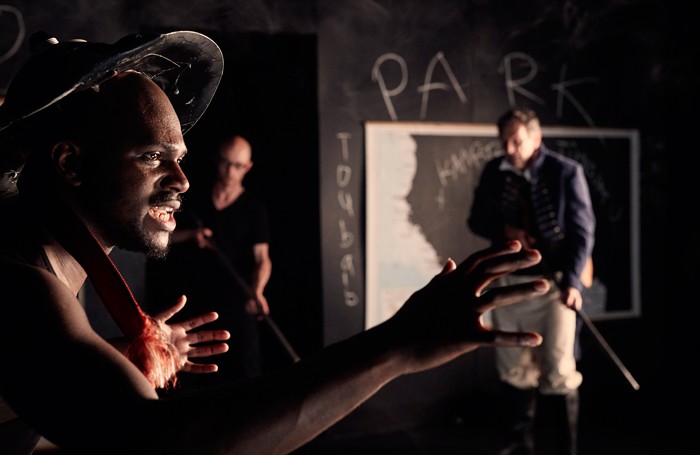
There is a Mungo Park Road in Gravesend, Kent, and sheltered housing at Mungo Park Court in Selkirk which seems all a bit sedentary when it comes to the tremendous life of Mungo P himself. Born in 1771, near Selkirk right enough, he ventured out down the Niger River and was the first European to reach Timbuktu. Of course, he did not have a passport so that nice phrasing, used in this show, about his Majesty ‘requests and requires [that] the bearer pass freely without let or hindrance’ did not apply. Instead his heroic travels are the stuff of bedtime stories, ‘To Selkirk … and beyond!’ if you will, which is where Mungo Park Theatre (Copenhagen) and Dogstar Theatre (Inverness) come flying in.

Writer and director Martin Lyngbo wants Hollywood-on-stage for the ‘inner eye of everyone in the audience’. So we get an invitation to taste the popcorn, then it’s serried lights and blinding action. We move swiftly from the Highlands, to London, and – via the two journeys of 1796 and 1805 – to central West Africa, on foot and in a canoe.

Travel at the wrong time and it’s very hot and wet and deadly out there. The African interior was a huge gap surrounded by a coastline, for its ‘heart lies in darkness’ and between August and October forty-one out of the forty-five or so Brits on the second expedition died of fever. How Parks survived for as long as he did is an open question but – to judge by this play – it was a combination of physical toughness, determination (to see home and family again), good sense and good luck. Africa for him is ‘a fragile network’ of peoples and customs and you got nowhere without respecting that.

Mungo Park goes back to 2006. That first Danish production was rehearsed during the crisis that surrounded publication in a newspaper of the Muhammad cartoons. This English language version, by Jonathan Sydenham, still looks as if it is significantly influenced by that controversy. Clever caricature asks questions of how individuals are represented and received by ‘others’, culturally akin or not. African kings Desse and Ali play ‘up’ their obvious differences in sing-song pidgin speech; their messengers play their crafty roles as would flunkies of a European court but with outlandish accents. Sir Joseph Banks, notable patron of the natural sciences, is as interested in gold as he is in plants. Lieutenant John Martyn, in command of Parks’ escort, is more blood thirsty racist than an officer and a gentleman. Desperate and dangerous confusion results from misunderstanding and prejudice.

Kingsley Amadi (l)

Kingsley Amadi (l)

Matthew Zajac is impressive as the courageous and virtuous Mungo, whose story we follow at every turn, literally so as he fights his good fight on a turntable. Anders Budde Christensen is all exaggerated gesture and of wily tongue as emissary and as the not-so-enlightened James Rennell, map-maker, who would be master of all he surveys. Kingsley Amadi is black African potentate and crazy (white) army officer. It is so confidently performed that the zany is never risible, the indomitable never preposterous.

The rapid screenplay, to go with the filmic idea, produces strong exposition – particularly when its opening is chalked-up on the blackboard rather like title cards to a silent movie of colonial history in the making – and a dynamic narrative. No visual ‘shots’ are projected so there’s a spontaneous, on-the-spot quality to the whole piece. For the most part it is tightly focused upon Parks himself and when it isn’t there is some loss in terms of its depth of field. Performers running up and down the central aisle in a bright light did not look right.

Sturdy Mungo always has a satchel for his notebook and his Travels were published in 1799 but if you want a stirring measure of the man and of his life you won’t do better than this motion picture of a play.


nae bad_blue

Star (blue)Star (blue)Star (blue)Star (blue)Star (blue)

Reviewer: Alan Brown (Seen 24 August)

Go to Summerhall and the Dogstar Theatre Company

Visit Edinburgh49‘s  Summerhall archive.

+3 Review: Penetrating Europe, or Migrants Have Talent (Paradise in Augustines: until 28th Aug: 21:35: 1hr)

“Sandalovych doesn’t simply engage the audience, she immerses us in the tumultuous narrative.”

Editorial Rating: 3 Stars:  Nae Bad 

Our host (Dave Strudelbar) for this evening’s episode of Migrants Have Talent bounds down the stairs before introducing the evening’s two judges: immigration officer, Nigel Nobson (Uilleam Blacker) as well as glamorous former illegal immigrant, Nigella Smith (Lesya Liskevych).  Nigella explains that she was talent-spotted after five years of cleaning the toilets at Television Centre. She cleaned toilets under her original name, she minor celebs with a new one, changed by deed poll. Together Nigel and Nigella decide who stays and who is deported, with the audience voting in the event of a tie.

There are five contestants. Actor Iaroslav Tsigan’s character is from Ukraine. He traveled to Britain on false Polish papers. A likeable character, his honesty fails to impress the stern judges. Interwoven with the talent show format are the stories of two young people, who relate how it is to travel and cross borders. One is going east to Ukraine for an adventure; the other west, by land and sea, to join family already in Britain.

These paired stories, delivered solo with other cast members playing the role of various officials, are the most effective part of the production.  The contrasting experiences and expectations of the two young people are increasingly moving. Actor Ira Sandalovych compellingly portrays a descent into fear. Sandalovych doesn’t simply engage the audience, she immerses us in the tumultuous narrative.

Most of the large cast are employed in the Migrants Have Talent sections.  Writers Blacker and Olesha Khromeychuk deploy a tongue in cheek style of satire that seeks to lighten what are, in reality, stories of genuine human suffering. At no point are we allowed to forget that not a million miles away from the Fringe, real people are really living through such uncomic tragedies. Still, this is above all a theatre piece. How effective (as opposed to affecting) is it?

The message is crystal clear. Humanity is common: borders and suffering man made.

If there is a problem it’s is one of counterpoint. Does the satire sparkle bright enough against the darkness of the immigrants’ tales? The lighting is handed well and sound, with the ensemble song describing cranes flying away to die in foreign lands (a poem from 19th century Ukraine) is truly beautiful in such a small venue.  However, with such a large cast, the staging does slip into awkward moment but, overall, this is a more than likeable production whose heart is definitely in the right place.
nae bad_blue

Star (blue)Star (blue)Star (blue)

Reviewer: Martin Veart   (Seen 23 August)

Visit the Assembly Roxy Bedlam Church Hill Theatre Festival Theatre King’s Theatre Other Pleasance, Potterrow & Teviot Summerhall The Lyceum The Stand Traverse archive.

THIS REVIEW HAS NOT BEEN SUBEDITED

+3 Review: The Other Guys – Well Sung (TheSpace@ Symposium Hall: Aug 16 – 20: 16.10 : 50 mins)

https://i0.wp.com/edinburgh.carpediem.cd/data/afisha/o/8c/a9/8ca969a213.jpg

 “Substantive, deep and intricate”

Editorial Rating: 4 Stars Nae Bad

I think the mark of a good group name is its capacity for inciting mild social chaos when you try and explain you’re going to see them. And whilst The Other Guys win points for being delightfully vague from the outset, their talent is nothing if not definite.

Formed in 2004, the St Andrews based acapella group has already received significant critical and celebrity accolade; and from the moment the voices start raising, it’s immediately clear why. Well Sung, despite the punderful name, is a set list with multifaceted focus: the quality of the vocals, tonal layers and overarching charmingness of the performance all come together to form what is certainly a spectacle worthy of spectation.

From the first note, what is immediately apparent is the sheer singing skill present throughout the group. The way in which many solo vocalists seemed to swoop and crest throughout their range was genuinely (and indeed, pleasantly) surprising, and it certainly makes for good acapella. It goes a long way to making the sentiments behind the songs seem genuine – for those of the patriotic persuasion, prepare for a performance of “Loch Lomond” that’ll make your knees shiver.

But even more than quality, what marks out The Other Guys is their rich tonality. Falling somewhere between glee club and old school barbershop, the harmonic layering of each vocalist during more group-orientated numbers is so rich and layered that it’s difficult to convey without hearing it. It’s the taste of red wine, or the smell of pine smoke – substantive, deep and intricate.

However, this interoperability is a fickle advantage: despite lending a definite veneer of quality to their songs, it comes at a cost: the more energetic numbers sometimes lacked the volumatic punch needed to fully capture the spirit of their original composition; and whilst tailor-made to show off that rich barber-shop-esque quality, the arrangements occasionally failed to show the same uniqueness which makes the vocals themselves so compelling.

Ultimately, though, it’s hard to deny the charm and talent of this group of young men. From acapella virgins to die-hard fans, this is a show that demands to be seen. Despite its shortcomings, Well Hung is a rare thing: a feast for the ears in which one can choose their portion. It’s very easy to get lost in the sheer vocal texture – but equally so to simply watch as the beauty unfolds.


nae bad_blue

Star (blue)Star (blue)Star (blue)Star (blue)

Reviewer: Jacob Close (Seen 20 August)

Visit the Other  archive.

THIS REVIEW HAS NOT BEEN SUBEDITED

+3 Review: Karmana, Songs of the Roma (Summerhall: 12-20 August: 21.15: 1 hour)

“Fantastic, moving and highly recommendable”

Editorial Rating: 4 Stars

Karmana, Songs of Roma is performed in the Library Gallery of Summerhall. As the Scottish guitarist and composer Simon Thacker and Polish cellist Justyna Joblonska walked in to the room the small crowd fell silent. They did not introduce themselves which I found a little odd but as Thacker began his solo instrumental performance of Albedo I guessed this was to add to the dramatic effect of the song. Immediately I could see that this is one very talented musician who is clearly passionate about his work.

For the second song Thacker was joined by his playing partner Jablonska who’s performance was equally captivating. The flowing sounds of the cello combined with the intricate sounds of the guitar hypnotised the crowd, who remained so  silent throughout you could have heard a pin drop.

Throughout the show Thacker takes the audience on a Romani musical journey with songs from the gypsy tradition. In between songs he explains the history and meaning of each song including his thoughts and reasoning behind each composition. His own personal experience with Indian, Balkan and Spanish music add a special twist to the performance from beginning to end.

Personally I thought the highlight of the evening was when the endearing singer and violinist Masha Natanson joined to complete the trio. Originally from Lubin, Poland, Natanson adds a new, traditional element to the performance. As cliché as it may sound, I really did get goosebumps when she began to sing Ne Govorite Mne O Nem (Don’t Talk To Me About Him). Natanson sang with such emotion that although I couldn’t understand the Russian lyrics I could tell she was portraying a heart-broken woman. At one point she even charmed the audience with her premiere of speaking in English to a crowd and no one could help but smile and giggle as she tried her very best!

Perhaps I have been caught up in the excitement and excess of the Fringe but the only thing I would like to have seen improved was the set. The whole room was lit in a romantic red but I feel focusing more of the lighting on the performers would have added to the dramatic effect of the songs.

Overall it was a fantastic, moving and highly recommendable show – particularly for those interested in the traditional music of different cultures.

Star (blue)Star (blue)Star (blue)Star (blue)

Reviewer: Iona Young (Seen 16 August)

Visit the Summerhall archive.

THIS REVIEW HAS NOT BEEN SUBEDITED


+3 Review: The Free Association – Jacuzzi (Pleasance: 4-21 Aug: 23.00 : 1hr)

faimprov_cogarts_london_thebeauvoir_andrealops-113.jpg

 “Wild, witty and wickedly funny”

Editorial Rating: 4 Stars Nae Bad

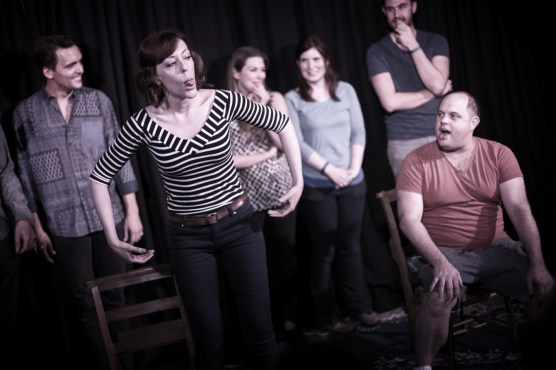
I always approach live improv shows with a degree of trepidation: though a lot of the fun lies in its often wild unpredictability, it’s easy for a forced joke or sudden case of comedian’s block to sour an entire set. However, from the moment the Free Association players arrived on stage, I felt as if the audience was in very safe hands.

Basing scenes from improvised monologues by “special guests”, it’s a streamlined one-two punch of comedy flavours. The changeover from stand-up style presentation to off-the-wall improv is smooth, sharp and very crisp, handily overcoming the transitional inertia that would threaten less cohesive groups. From start to finish, it’s this veneer of professionalism that really brings the Free Association together; very seldom is improv so akin to a well-oiled machine.

But far from it to say the comedy is mechanical: I’d almost recommend a helmet to protect against the ideas bouncing off the walls. From Blue Peter themed suicide pacts to rad skateboarding private-school bait-and-switches (it somehow made sense at the time), you’d be hard pressed to try and follow the cognitive bead of sense for more than ten minutes – and this show is all the better for it. Despite a few jokes which fell flat or dampened the usually excellent energy, when the material’s good, it’s hysterical.

This unpredictability was aided by the novel way in which the Free Association goes about its work. They tout themselves as being “based on the American style of long-form improv but with [their] own unique spin”, and the latter is pointedly true. Jacuzzi often blurs the line between short form and long form improv, with overarching plots and characters weaving in and out of the utter chaos on stage at breakneck pace.

For a more amateur company, this may have been a tall order, but the talent driving this show can’t be denied. Despite the extreme difficulty in discerning a favourite from such a strong cast,  Comedy MVP inevitably must go to Alison Thea-Skot: I’ve never seen such a wide comedic range – it’s a hard job to make an audience really believe they’re watching a heavily-scottish football coach who’s forcibly making their players fat to win games  – again, plenty of sense at the time – but I’ll be damned if I didn’t expect a true-life biopic about it to be in the works by the time the set ended.

The Free Association is certainly deserving of its acclaim. Wild, witty and wickedly funny, “Jacuzzi” is a classic example of improv comedy done right.


nae bad_blue

Star (blue)Star (blue)Star (blue)Star (blue)

Reviewer: Jacob Close (Seen 17 August)

Visit the  Pleasance, Potterrow & Teviot archive.

THIS REVIEW HAS NOT BEEN SUBEDITED