‘The Caucasian Chalk Circle’ (Lyceum: 18 Feb. – 14 March ’15)

Grusha :Amy Manson Photo: Alan McCredie

Grusha :Amy Manson
Photo: Alan McCredie

“Compelling”

4 Stars: Outstanding

‘Standing between doorway and gateway, she heard
Or thought she heard …’

Listen up, “I’ve looked into the pockets of the rich and that is [considered] bad language.” Here is a contemporary, full-on production of Bertolt Brecht’s great and humane play; its profane political resonances not so much hanging in the air as gusting out of the wind machine. As it goes, these days and then, HSBC (Swiss arm) could be up there on the gallows with the town judge, the Chief Tax Collector and the rest. At a grim stretch, you’ve seen what’s happening in the eastern Ukraine, well, here we go again.

We’re talking piastres of indeterminate (Ottoman?) origin rather than of pound, franc or euro but who cares provided you’ve got a shedload? And that’s the economics of the piece: “Those who had no share in the fortunes of the mighty / Often have a share in their misfortunes.” Out of confusion, collapse, coup and revolution come the have-nots-have-all stories of brave Grusha and of His Worship the excellent, the most scurrilous Azdak. Theirs, in amongst the rifles, rape and the noose, is the unlikely, virtuous, lyrically unco traffic of our stage.

The Caucasian Chalk Circle is a play with songs and director Mark Thomson realises how entertaining it should and can be, in or out of the shadow of Soviet tractors. Sarah Swire, as the Singer-Narrator, is not Brecht’s ‘sturdy man of simple manners’ but a punchy and versatile performer whose style and presence guides and informs rather than commands. Cast members double as musicians and Composer/Musical Director Claire McKenzie creates a strong and urgent soundscape: the city falls to a fearsome clockwork beat; Grusha is held in a ghastly tango by her brute of a husband. There is dancing, quite rightly, at the close.
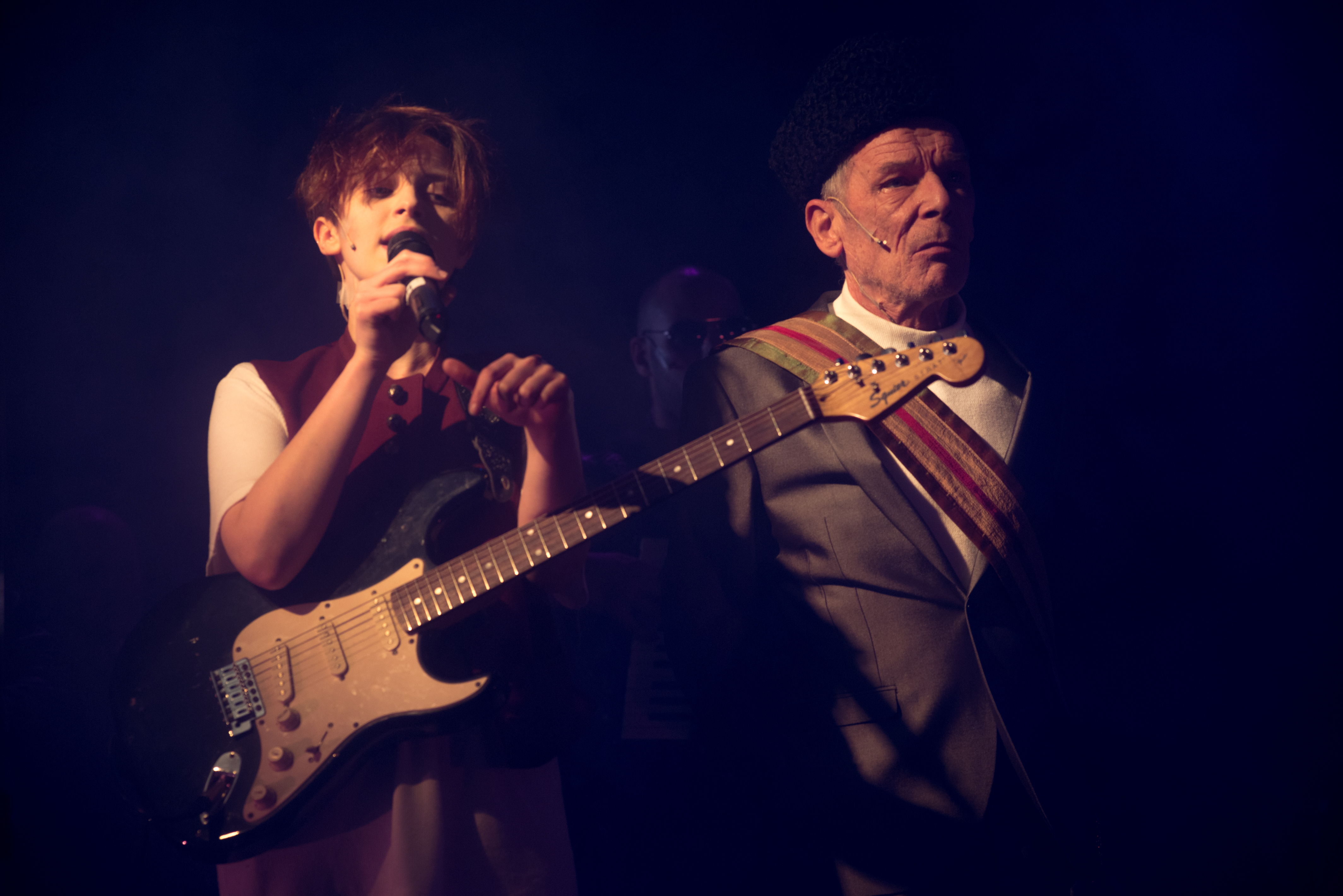
The Singer: Sarah Swire Azdak: Christopher Fairbank Photo: Alan McCredie

The Singer: Sarah Swire
Azdak: Christopher Fairbank
Photo: Alan McCredie

The Singer sings of once upon a time, for the legend of the circle of chalk is based upon an old Chinese play. At its centre Brecht places Grusha, the kitchen maid, who saves the Governor’s child and runs for the mountains. These are not kind times. Papa’s head ends up on a lance and soldiers are hunting them down. Grusha’s flight is perilous, not least when she’s crossing a 2000 foot drop on a half rotten bridge. This is terrifically staged, as befits the moment when ‘Grushna Vachnadze decided to be the child’s mother’. Thomson realizes that this play works when an audience is exposed to why people behave the way they do. Azdak’s decision not to hand over the fugitive Grand Duke makes sense when you are gripped by his arch reasoning. Trial by chalk circle is palpably, deliberately, grotesque but it’s a dramatic triumph.

Christopher Fairbank is a stomping success as Azdak. More the truculent Ariel than any burdened mage, he is the rogue Time Lord with an impish spirit who obliges and provokes in the blink of an eye. Amy Manson gives an unwavering performance as the steadfast Grusha and harvests all the sympathy that the audience as collective can supply. Nasty, uncomfortable menace comes from the Sergeant, frighteningly well played by Deborah Arnott whilst Shirley Darroch as fat Prince Kazbeki is a cigar chomping nightmare, only marginally offset by her blaring trombone.

Kazbeki: Shirley Darroch Photo: Alan McCredie

Kazbeki: Shirley Darroch
Photo: Alan McCredie

Alistair Beaton’s translation matches the lucidity of his programme notes on translating Brecht but is not helped when the accents travel far and wide: from the Thames estuary to the Welsh valleys, to Birmingham, to the North East, and to Scots, high and low. Strained rather than epic, I thought. And light features like smooth, RP-ridden lawyers, Barbour-clad farmers, mobiles, and a Lidl bag signify too much, too unnecessarily. You can speak uber German, I’m told, but all the same posh English for the ‘upper’ class is becoming too easy a target to mean much.

Still, “All pleasures have to be rationed” says the Girl Tractor Driver. Actually, not so in this eager and compelling production.


outstanding

StarStarStarStar

Reviewer: Alan Brown (Seen 21 February)

Visit The Caucasian Chalk Circle at the Lyceum here.

Visit the Assembly Roxy Bedlam Church Hill Theatre Festival Theatre King’s Theatre Other Pleasance, Potterrow & Teviot Summerhall The Lyceum The Stand Traverse archive.

THIS REVIEW HAS NOT BEEN SUBEDITED

‘Leap in Time’ : Erich Salomon and Barbara Klemm (Stills: 07 February – 05 April ’15)

[2015-02-20] Leap in time (Stills)Image: The Fall of the Wall, Berlin (1989) Barbara Klemm. © Barbara Klemm


‘ Isolating the unguarded human moment within the ebb and flow of history ‘

Editorial Rating: 4 Stars: Outstanding

‘My aim is to document things that everyone can see if they want to but that people do not really notice in the course of their everyday lives… To record the unspectacular, something that takes place in public everywhere and is able to tell part of the story of our lives …’ — Barbara Klemm

Photojournalism is a strange beast. With its origins in war photography, the medium straddles the documentary aspirations of reportage and the loftier aspirations of artistic photography – with the best examples able to move seamlessly from one to the other. Such is the case with the images that make up the current exhibition at the Stills gallery, ‘Leap in Time’: Erich Salomon & Barbara Klemm. Organised in conjunction with the Institut für Auslandsbeziehungen/Institute for Cultural Relations (IFA), Germany, and the Goethe-Institut, Glasgow, this exhibition presents the work of two of Germany’s most profoundly influential and sensitive photographers. Though there is no overlap in the careers of Salomon and Klemm, together their work provides a deep, poignant and multifaceted view of twentieth century German life.

Upon entering the exhibition space at Stills many visitors will be tempted to linger among the more recognisable and recent subjects of Barbara Klemm’s work in the front gallery. For the sake of chronology, however, I would recommend charging through to the rear gallery and beginning with the work of Erich Salomon. Though he took to photography late in life, Salomon’s innovations came to dominate the golden age of photojournalism, including coining the phrase “the candid camera” and pioneering “hidden camera” techniques in his work – famously cutting a hole for the camera lens in his bowler hat. With his education, wealth and social standing, Salomon found easy access to the highest echelons of Weimar society. Such access allowed him to photograph scenes such as the Reichstag debating chamber, private meeting rooms at the League of Nations and The Hague, imbuing the scenes with a reality and a human urgency that leaves the printed word behind.

Salomon’s social access extended beyond politics, and the exhibition includes candid and personal photographs of contemporary celebrities, including an intimate photograph of Marlene Dietrich on the telephone with her daughter. Even without celebrity subjects, Salomon’s work is characterised by his ability to capture unguarded moments, those opportunities to peek behind the curtain of public events and see the actors as fellow human beings.

Barbara Klemm’s portion of the exhibition, which occupies the front gallery, the stairwell and the reception area one floor below, beautifully parallels that of Erich Salomon. Though Klemm’s career spanned from the 1960s through to the 1990s, the loose groupings of celebrity, politics, society, and social commentary retain their power. Working at a time when photojournalism had become codified as a profession, there are necessarily differences between Klemm’s work and Salomon’s, but Klemm nonetheless shares Salomon’s gift for isolating the unguarded human moment within the ebb and flow of history. She possesses an uncanny ability to capture the individual at a moment when they stand for something greater than themselves.

Nowhere is this skill more evident than in Klemm’s political photography. Covering the tumultuous period surrounding Germany’s reunification, Klemm’s photographs manage to display great tension and joy, but they also find moments of stillness and contemplation – often within the same image. Among my personal favourites is the photograph, View Over the Wall, Berlin 1977. Here the ominous, monolithic imagery of the Berlin wall dominates the space, while the mood is gently subverted by the presence of two men casually  standing and chatting atop an unmanned watchtower while a young boy playfully perches on the tower railing.

Notably, within this exhibition of twentieth century German photography there are few overt references to the Second World War. In fact, the Nazis make a lone, foreboding appearance in Salomon’s photograph National Socialists in Their Party Uniform in the Reichstag, Berlin, 30 October 1930. From a purely practical perspective this was because Salomon didn’t photograph them; he largely disregarded the Nazis and considered their actions unworthy of his interest. He was able to leave Germany for Holland and worked in The Hague but was detained during the Occupation. He died in Auschwitz in July 1944.

This is not to say that the war is ignored by the exhibition; its antecedents and effects are as present in both photographers’ work as they are in the lives they photographed. Rather, the effect of this absence on the exhibition is akin to that of the candid portraiture in both artists’ work. The goal of such photography is to catch the rarely seen side of a subject we’ve seen so often that we feel we know it. The combined work of Barbara Klemm and Erich Salomon create a complex portrait of Germany that is often overlooked, shining a light on the more private, unguarded and human side of the country’s recent history.

outstanding

StarStarStarStar

Reviewer: Michelle Lee Leonard

Visit Stills here

THIS REVIEW HAS NOT BEEN SUBEDITED

‘Sister Act’ (King’s: 18 – 21 February ’15)

 SisterAct2

“Divine”

Editorial Rating:  4 Stars: Nae Bad 

‘The Bohemians’, established in 1909, are one of Edinburgh’s major amateur musical companies.

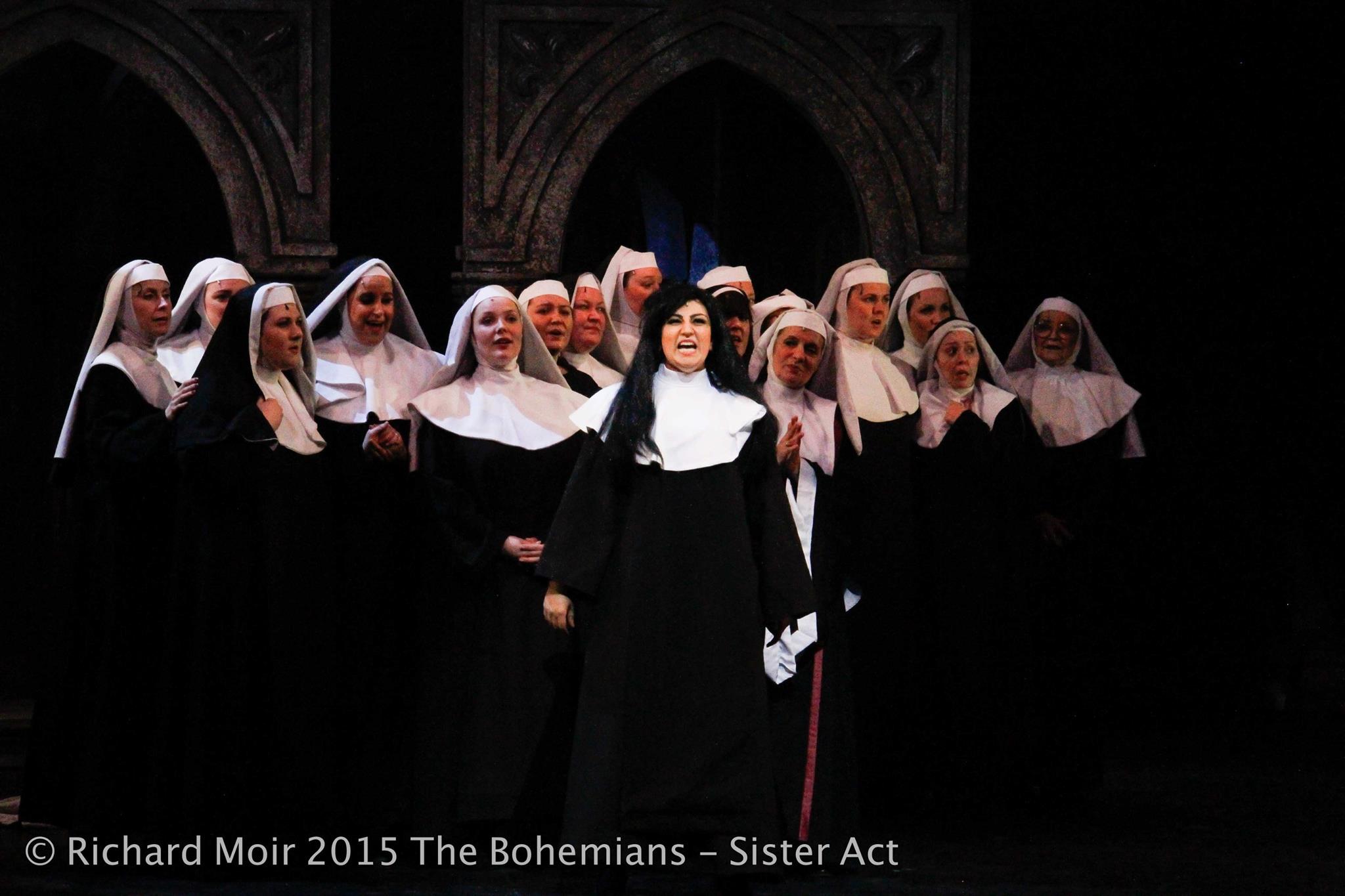
Sister Act was one of the first DVDs I was ever given as a child. There was always a magic to the film that I adored and Whoopi Goldberg never failed to have me dancing and singing along with the other nuns. Cheri and Bill Steinkellner adapted the Whoopi Goldberg classic for stage; something I am so glad they did. Bohemians’ director Colin Cairncross took on the challenge, bringing to the stage a production full of vivacity and talent. For an amateur production, this show really did impress.

Ian Monteith-Mathie took on the role of Musical Director for this production and worked with Alan Menken’s music score to create a beautiful sound from the performers – the harmonies in the full cast numbers were incredible. His orchestra carried the cast through the show in funky rhythms and soulful melodies.

Niloo-Far Khan took a walk in Whoopi’s shiny heeled boots as Deloris Van Cartier and commanded stage with ease. Vocally, her performance was faultless and she gave great gusto to her character. Her on-stage rapport with Mother Superior – portrayed by Dorothy Johnstone – was as entertaining as it was electric. The pair shone in the spotlight as they battled to prove the other wrong before finally reconciling their differences. Johnstone carried a wisdom about her that was evident in both action and song and her protective instincts towards the nuns shone through. It was truly delightful to witness the transformation of the choir of nuns – the resulting musicality from the hard work of Deloris (and Monteith-Mathie) raised hairs on the neck. It was, for lack of a better word, divine.

Officer Eddie Souther lamented that he “Could Be That Guy” and if he was referring to a talented singer and a joy to watch on stage, then Gareth Brown certainly was “that guy”. His soft, awkward character was greatly set against the imposing Curtis Jackson. Padraig Hamrogue’s portrayal of Curtis was reminiscent of the black and white gangster movies – his menacing demeanour coupled with a bluesy bass range created an imposing mobster who demanded respect through fear. His three henchmen, Joey, TJ and Pablo juxtaposed his dark humour by lighting the stage with their comical desperation to please their boss. Thomas MacFarlane, Lewis McKenzie and Andrew Knox really threw themselves into their characters and greatly entertained the audience with their antics – their song, “Lady in the Long Black Dress”, was hysterical, offering the comic trio a real chance to hustle the limelight.

The show was bathed in colour. The costumes – a superb effort from Jean Wood and Liz Kenyon – were fantastic; Lighting Designer Jonnie Clough filled the stage with a complex programme of spotlights, colourwashes and dazzling effects. The set design from UK Productions Ltd, although perhaps too large and busy for the stage space, was certainly impressive in its detail. This production was full of glitz and glamour; even the nuns were able to lose the basic black habit for something a little (or a lot) more colourful. The cast raised their voices and they raised the roof. This was an uplifting performance and a fantastic show.

nae bad_blue

Star (blue)Star (blue)Star (blue)Star (blue)

Reviewer: Amy King  (Seen 18 February)

Visit ‘The Bohemians‘ here

Visit the  King’s Theatre archive.

THIS REVIEW HAS NOT BEEN SUBEDITED

‘The Vagina Monologues’ (Teviot: 11, 13 -14 February ’15)

v monologues

“No hiding.”

Editorial Rating: 4 Stars: Outstanding

Let’s talk about what it means to be a woman, and let’s be real about it.

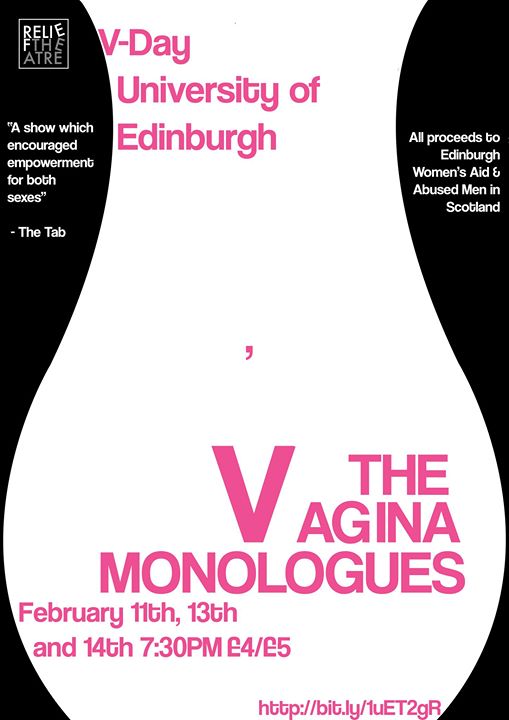
That is the message of The Vagina Monologues from Edinburgh University’s Relief Theatre.

There was no hiding from the awkwardness of the topic. Director Rachel Bussom was not about to allow for the comfort of anonymity that an audience can revel in, cloaked in darkness and removed from the stage space. This theatre-in-the-round was intimate and uncomfortable and sobering. A lack of props kept this show from feeling like a staged event. Instead, it took on the live and shameless persona of an organic story-telling. The close proximity to the actors in a brightly lit room created a close connection; a sense of shared identity regardless of age or gender.

Sex is a common theme in theatre, but sexuality is more obscure. Obscurer still is female sexuality in all its forms. Not today. Today, women were talking, or in the case of Julia Carstairs they were shouting, about vaginas and everything that comes with them.

For instance: hair. Martha Myers’ exasperation and resignation shone through as she hit home about the societal pressures attached to expectations of body image  – something Julia Carstairs’ first monologue, “My Short Skirt”, energetically pulled apart.

The combined efforts of the narrators, Ella Rogers, Caitlin McLean and Maddie Haynes, along with Marina Johnson’s statistical ‘Factbook’, kept the show current and hard-hitting – an impressive task considering the original show premiered nineteen years ago and society’s views on women and womanhood have changed since then. That this strong production is dedicated to the transgender community is also properly noteworthy.

Carstairs’ second monologue, “Cunt”, was a valiant attempt to reclaim a word used solely now as a derogatory term. Her exploration of sound, language and pace was invigorating and allowed a positive humour to surround the controversial language. That humour was carried on by En Thompson who offered a passionate performance in honour of her “Angry Vagina”. Her bluntness and frustration was eye-opening and tore through long-accepted notions of what womanhood means and entails.

Her anger was shared and increased tenfold in a gut-wrenching performance by Kirstyn Petras who fiercely conveyed the utter devastation of the Bosnian women who had been interviewed by playwright Eve Ensler after being subjected to the horror of rape camps. Petras pulled no punches, emulating a loathing that raised hairs and drew tears – the pain so tangible and the truth unbearable.

Jezneen Belleza may have been talking about vaginas, but her performance certainly took a pair of brass ones. As “The Woman Who Loved Vaginas”, she discussed the life of a sex worker with an honesty and intensity that, despite some more uncomfortable moments, made it impossible not to watch, listen and laugh. She lightened the mood with comedic re-enactments and did so with a grace that kept the story from becoming farcical. Instead, her frank analysis reached deep into the beauty and magic of female sexuality.

Both Isobel Dew and Siân Davies tackled sexuality and body image in a kinder manner – managing to capture the incredible feeling of self-discovery, and the subsequent elation, in a beautiful way. Sophie Harris, too, carried an air of hope in her phoenix-like rising from such a dark place to a position of acceptance and learning. Meanwhile, Ruth Brown’s impressive embodiment of generations gone by in her recollection of “The Flood” brought an endearing humour as well as a sense of pity and despair to the play. For Danielle Farrow it is the sheer beauty of womanhood and nature that matters as she recounted being present for the birth of her granddaughter. Her testimony was infectious and heart-warming.

Leaving the venue, I felt elated and empowered. This  is an inspiring production that entertains, empathises and educates. Bussom, assistant director Mary McGuire and sole male of the team – producer Jacob Close – bring together a group of really talented women who do themselves, and all women, justice.

outstanding

StarStarStarStar

Reviewer: Amy King  (Seen 11 February)

Go to Relief Theatre at EUSA here

Visit the Potterrow & Teviot  archive.

THIS REVIEW HAS NOT BEEN SUBEDITED

‘Rent’ (Churchill Theatre: 10 – 14 February ’15)

“Meenan is on interstellar form. His lightning fast, fluid movements suggest he’d be the one to back in a 2-on-1 prize fight against Jackie Chan and Dame Edna.”

Editorial Rating: 5 Stars: Nae Bad

“Dove sono le Puccini?” The gondolier looked up excitedly, “le puttane?!” “Err… no mate. Le Puccini? Opera a palazzo.” The Venetian working-man seemed disappointed. “Non è così buono,” he muttered sadly as we glided off towards an intimate encounter with La bohème.

Italian Giacomo Puccini adapted the narrative from Frenchman Henri Murger’s vignettes about Paris’ bohemian denizens. A century after La bohème’s 1896 premiere in Turin, American Jonathan Larson’s rock musical reimagining opened on New York’s Broadway. From there Rent emerged for one of the longest, most commercially successful, runs in musical history. Murger’s Scènes de la vie de bohème have thus been around the block so many times, the Gondolier’s puttane might have seemed positively virginal by comparison.

It’s Christmas Eve in the East Village. It’s a time before hipsters. A filmmaker and a rock musician – two noble artists, both alike in poverty – are told by their ex-roommate, now their current landlord, that they must pay the back rent owed. Solemnly they refuse. Joe Christie (as filmmaker Mark) and Nitai Levi (as rock musician Roger) establish strong leads, demonstrating possession of the several narrative arcs, the prism through which Larson’s sketchy urban landscape emerges. Jonathan Ip as landlord Benny demonstrates a determined gravity that centres the action.

Rent’s cast of bohemian characters provide fertile ground for a company well-suited to clever character studies. As Tom Collins – the maverik, homosexual college professor – Benjamin Aluwihare stands out as one of those student performers you hope will graduate into the major league. It’s all the more impressive because he is sharing the stage, romance and tragedy with Scott Meenan (as Angel, Collins’ cross-dressing significant other).

Meenan is on interstellar form. His lightning fast, fluid movements suggest he’d be the one to back in a 2-on-1 prize fight against Jackie Chan and Dame Edna. Meenan is camp, courageous, charming and – above all – courteous – daring to share the limelight so as to shine more brightly.

Not since Lily Cade met India Summers has a sapphic combo been as hot as the pairing of Caroline Elms (as lesbian lawyer Joanne) and Roz Ford (as bisexual performance artist Maureen). Both have superb presence, a mastery of pace and comic timing. Together they’re an alchemy reminiscent of Candice Bergen in Murphy Brown, Carla Gugino in Spin City, or Moira Kelly in The West Wing.

If Rent was truly bohemian (rather than theatrical hand sanitizer) we might have seen Rachael Anderson tumbled into their heady mix in a ménage-à-hell-yeah. Anderson’s jaw dropping portrayal of erotic dancer Mimi slips the surly bonds of physicality, lifting this production into a godlike orbit, circling the clumsy trendiness of Lawson’s checklist re-rendering of La Belle Époque original.

Eilidh Bruce Bass’ costumes establish the production’s look and feel as high 90s – existing somewhere between when Fraiser stopped looking like Cheers, but before Friends stopped looking like Seinfeld. Her clever attention to detail provides a palette of subtle retrospection on the period, touching up where Rent’s oh-so earnest themes have faded. The costumes achieve the remarkable feat of blending with the set without being lost in it.

And it really is a brilliant set. The band are incorporated without being outsourced to a balcony or platform. The back lighting comes through grimy green industrial window panes, each one an individual tale of neglect underscoring the dramatic meaning rising from below. The ensemble draw the various levels together passing props up and down with never a fumble. The stage right lighting rig is part of the set. That tubular grey lattice – which in most productions needs to be blanked out by the mind’s eye – it’s hanging there, at an angle, bold as brass. Who’d have thunk it? Well Andrew McDivitt did and it’s why his set designs are worth the ticket price alone (and then some).

As musical theatre Rent is what it is from when it was. The songs aren’t especially catchy, the narrative arcs are a muddled rainbow, the characters are embalmed in worthy sentiment. Jonathan Larson’s tragic death on the opening night of his work in progress denied audiences the chance to see the tweaks and changes he might have made.

Still, it’s hard not to get excited when Footlight’s production time comes around. High professional standards abound, not least from the ensemble who supercharge everything with which they come into contact. First-timer Campbell Keith is first among equals for his infectious enthusiasm, commitment and drive.

For me, as an essentially sedentary being, watching this cast might be what a flightless penguin feels looking up at a flock of starlings – isn’t it marvellous! How do they co-ordinate like that? And what kind of fish do they catch in the sky?

nae bad_blue

Star (blue)Star (blue)Star (blue)Star (blue)Star (blue)

Reviewer: Dan Lentell (Seen 10 February)

Visit Rent & the Edinburgh University Footlights here.

Visit the Assembly Roxy Bedlam Church Hill Theatre Festival Theatre King’s Theatre Other Pleasance, Potterrow & Teviot Summerhall The Lyceum The Stand Traverse archive.

THIS REVIEW HAS NOT BEEN SUBEDITED

♫ ‘A French Feast’, RSNO (Usher Hall, 6 Feb.’15)

A French Feast

“Müller-Schott’s cello lines sing”

Editorial Rating: 4 Stars Outstanding

A ‘French Feast’ of music with the Royal Scottish National Orchestra

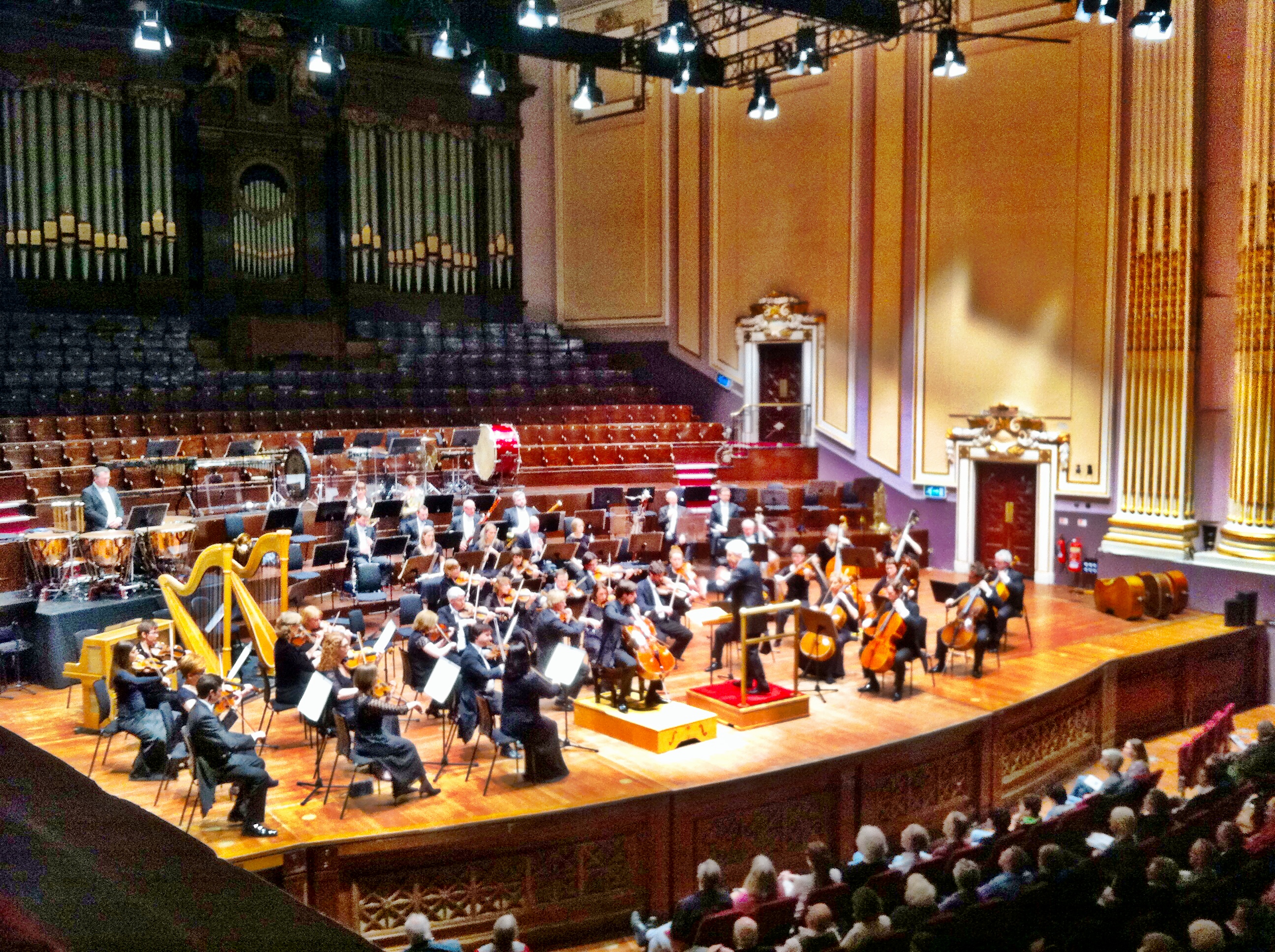
Tall, dark-haired, handsome, talented, humble, charming – yet I still cannot begrudge him anything. Daniel Müller-Schott was the immensely capable German solo cellist taking part in tonight’s performance of a ‘French Feast’ of music with the Royal Scottish National Orchestra. In a talk in the bar of the Usher Hall with RSNO violinist Ursula Heidecker Allen prior to the concert, Müller-Schott described his musical ability as being “his mother’s fault”, she being an accomplished harpsichord player who always had the house full of music and musicians when he was growing up. He had many anecdotes, including the time his friend Philipp Lahm, former captain of the German football team, came to his house. Lahm had a go on Müller-Schott’s cello but professed that he might find it easier if he could play it with his feet!

This concert, of largely Romantic music, kicked off without the cellist. César Franck’s Les Éolides is a symphonic poem based on a poem of the same name and was composed during the latter part of his life when, as professor of organ music at the Paris Conservatoire, he was at his happiest and his work was more refined. The beginning of this piece has a lot of exposed entries by different orchestral groups and unfortunately one of the brass entries slightly misfired, but it was largely unnoticed by the audience. The silver-haired Gilbert Varga, conducting, has a very elegant baton style and strikes a debonair pose on the podium. He conducted without a score and, despite being a guest conductor, connected really well with the orchestra, conveying subtleties within the subdued dynamics which really evoked the ebb and flow of the wind subject of the original poem.

Müller-Schott  joined the orchestra for Camille Saint-Saëns’ Cello Concerto No.1 in A-minor. I liked the programme. French-born Saint-Saëns wrote the piece for Belgian cellist Tolbecque; Franck, whose music came before, became a citizen of France but was originally Belgian. Ok, maybe I’m just being a bit of a sad europhile, but it tickled me. What anybody could appreciate, however, was the quality of the performance. This is a gem of a piece of music anyway; regarded by Rachmaninoff, no less, as the best cello concerto ever written. But Müller-Schott’s cello lines sing, achieving a remarkably consistent tone from the lowest open strings through to the highest register, from dazzlingly quick triplets to whole phrases in harmonics. He achieves the hardest thing: to make the virtuosic look effortless. Müller-Schott’s own modesty showed through in the music as he let the music speak and it spoke magnificently.

The melancholic Elégie to follow was all emotion and so beautiful. Every time I hear Fauré’s music I always think “I must listen to more Fauré”. I suppose it’s akin to watching the Olympics and vowing to get fit, you know it’s good for you. The audience loved Müller-Schott’s performances and did not want to let him go. For his encore he played a movement from one of Benjamin Britten’s cello concertos. I feared at first that it would be a little too discordant for the ‘French Feast’ audience but they lapped it up. I think he could have played anything!

Some conductors are a bit too up themselves to even attempt to engage meaningfully with an audience, but Varga is not one of them and he made a deliberate, helpful, effort to introduce and explain each piece. After the intermission he quoted Einstein, “Imagination is stronger than knowledge”, and explained that “we musicians give you food for your imaginations, especially in Ravel’s Five Tales from Childhood”. Ma mère l’Oye (Mother Goose) is the collective title for them. It was a pleasant surprise to see a conductor who has the courage to get the strings to play so quietly for conductors are often “More string, please!” and it really allowed the woodwind soloists to be fully ‘cantabile’. Orchestral lead Maya Iwabuchi enjoyed some lovely, very expressive, solo lines in the 4th and 5th sections.

The finale was Ravel’s La Valse, a hugely fun, engaging piece of music which I think is difficult to get right but which the RSNO pulled-off with energy and precision. Varga’s conducting became purposefully jerky and robotic towards the end, hamming-up the idea of the music representing a petulant child breaking up his ‘waltz’ toy to make something more mechanical, supposedly better, but actually more ferocious and alarming.

Great entertainment and musical good times! We can be proud to have a national orchestra such as this and with upcoming programmes to suit a variety of tastes I would certainly recommend supporting them at a concert near you soon.

.outstanding

StarStarStarStar

Reviewer: David Jones (Seen 6 February)

Visit RSNO here.  Visit Usher Hall here.

THIS REVIEW HAS NOT BEEN SUBEDITED

‘The Real Inspector Hound’ (Bedlam: 28-29 January ’15)

Real Inspector Hound

“…utterly absurd and completely entertaining”

Editorial Rating: 3 Stars: Nae Bad

A buzz of excitement rippled through the café during the wait for the doors to open. Inside the auditorium the audience is greeted with the strains of period music and a spotlight trained on a man in an armchair with a notebook to hand, who would later be introduced to us as Moon, played by Ben Horner.

As can be expected of any of Tom Stoppard’s work, The Read Inspector Hound is a wordy script with many a tricky speech to deliver, which at times proved a challenge  – but not one the actors were defeated by – and a journey for its audience that can be difficult to follow. Director Cameron Scott was brave to tackle this play but his addition of updated jokes including Real McCoys – the crisps – and a myriad of highly comical moments from his cast proved that he was more than capable of handling such a project.

This murder mystery play-within-a-play delved with ease into the absurdity of the human condition and the blurring of lines between what is real and what we desire to be real , drawing the audience in and gripping them from the very beginning with the fast pace and rapidly building hysteria.

The production team’s terrific set design included patio doors, a very large Persian rug and two tables, one holding the drinks, the other waiting for the drinkers. The elevated pair of armchairs, occupied by Moon and his most respectable reviewing counterpart Birdboot, brought to life by Finlay MacAfee, worked well to maintain the separation of reality and imagination – at first.

As a duo, MacAfee and Horner were most convincing; Moon’s nervous disposition and Birdboot’s self-righteous air coloured the play throughout and their back-and-forth monologues were highly entertaining.

Leyla Doany gave a great performance – her busybody Mrs Drudge’s facial expressions, dusty white hair and reactions to the goings on around her kept the stage alive with comic ridicule.

The suave Simon Gascoyne – a smooth delivery from Leopold Glover – and his scorned lovers had the audience in hysterics; both Lady Cynthia Muldoon and Felicity Cunningham proved they could hold their own against the stud. Liss Hansen and Heather Daniel’s respective characters certainly appeared to take some satisfaction in the slaps they delivered so soundly.

Capturing madness and mayhem in his enigmatic performance, Joseph Macaulay’s manic portrayal of Inspector Hound was impressive in its crazed delivery. The long-winded speeches and wrongful assumptions were delivered with a high energy and conviction of character. His deer-stalker, binoculars and wellington boots were comic props used to their fullest potential, much like their owner.

To add to the further absurdity, the casting of Megan Burt as Albert, who was masquerading as the crippled brother Magnus, brought comic timing and a most-amusing manoeuvring of Magnus’s wheelchair. Her adorned beard was a favourite in the costume department. The big reveal at the close of the play – that Albert is also the real ………….. – stays true to the whodunit nature of this bizarre adventure.

A special mention must also be given to Liam Rees who arguably had the most difficult part to play of all – the corpse. How he was able to lie still and play dead surrounded by the onslaught of commotion, without so much as a twitch and a chuckle, is beyond me.

Technically, this production was slick. Jack Simpson’s work on lighting and sound effects did enhance the action with the constant ringing of the telephone (with the cut cable!) and dramatic spotlights at every opportune moment.

As the story unravelled and reviewers Moon and Birdboot are sucked into the madness of the play, the action and pace built and built to a dizzying climax, ending in death and further confusion. Stoppard always keeps you guessing.

The production team – Cameron Scott, producer Tabitha James, stage manager Jonathan Barnett and tech manager Jack Simpson, evidently put a lot of energy into creating this show and their hard work most certainly paid off. All in all, as a reviewer reviewing a play of reviewers reviewing a play, I must admit this show was utterly absurd and completely entertaining.

nae bad_blue

Star (blue)Star (blue)Star (blue)

Reviewer: Amy King  (Seen 28 January)

Visit the Bedlam archive.

THIS REVIEW HAS NOT BEEN SUBEDITED

‘Faith Healer’ (Lyceum: 14 January to 7 February ’15)

Photo: Eoin Carey

Sean O’Callaghan as Frank. Photo: Eoin Carey

“He walks across a cobbled yard and smack into classical tragedy.”

Editorial Rating: 4 Stars: Outstanding

I don’t suppose Glasgow’s Celtic Connections features a whippet on the bagpipes. Well, Brian Friel’s forlorn yet devout play has one. It also has an Academy Award Best Original Song, from 1936, in The Way you Look Tonight and the Troon to Larne ferry. From Ceann Loch Biorbhaih (aka Kinlochbervie) in Sutherland to Welsh Methodist halls to Donegal to digs in rundown Paddington, Faith Healer – first performed in 1980 – has evocative mileage.

It is all in the voice and the story telling and in the sad and unaccountable distance between them. Three characters explain themselves to their audience. Simples. Each in turn stands alone on stage and talks of how it was when they were together, how it is now, and how it might have been – or might have seemed. Memory is fallible. What you once thought you had learnt by heart or by experience, bitter or sweet, can be a struggle to recall. Their time is provisional. Contingent. (Go to Philip Larkin in Ambulances where ‘what cohered ..across the years .. the unique random blend .. At last begin to loosen’.) You cannot miss the tatty banner, centre, ‘Fantastic Francis Hardy, Faith Healer. One Night Only’.

We have a correlated but discrepant narrative. That’s four monologues in four scenes. Francis, or Frank, appears first and last; first, anxious to justify his billing, dismissive of rhetoric but still fervent of speech and gesture. An act, in effect, that he protests is balanced between ‘the absurd and the momentous’. And last, in an extraordinary extended coda, he is steadier, a little prouder, and with a crumpled press clipping of ‘10 Healed in Glamorgan’ he walks across a cobbled yard and smack into classical tragedy. Grace, mother of his child, loves him selflessly but suffers incomprehension and loss. She has the second scene, casting Frank as immoderately talented but possessed by his own impossible calling. Then, after the interval, there’s Teddy from down the Old Kent Road or Stepney or Bow. Breezy, enduring, big-hearted Teddy: skint impresario, dog lover, pigeon manager, fixer, van driver and bedsit philosopher. Teddy’s responsible for the ‘Fan-tas-tic’ on the banner and his exasperated, “For Gawd’s sake!” is about as Christian as this play gets. Friel, after all, dumped the priesthood.

Nevertheless, I think director John Dove is going for Frank’s miraculous redemption here. Earnest self-doubt proves definitive, more so than the poetic drifts over Loch Clash. The set may be cheerless and angular with a job lot of bistro chairs arranged left stage but then Frank is lucky if more than half a dozen of the lame or the disfigured roll up to receive his ‘gift’.  The keen monologue form is necessarily upfront and in your face, as it were, but even so the acting is unusually expressive and open. Gesture is weighted. The lightest it gets is Teddy (Patrick Driver) wafting another pale ale onto the table. Frank (Sean O’Callaghan) seeks rest and certainty with dire conviction. Grace (Niamh McCann), fighting despair, is bright eyed with hope. Driver’s performance does stand out, “Dear ‘earts”, almost too much maybe, but Teddy’s bow tie and patter can do soul searching as well as the single crucifix high on the side wall and when he chokes up it is all the more compelling.

Anticipating the ignorant and hapless English soldiers of Friel’s next play, Translations, Teddy is not understood in the Irish-speaking community of Baile Beag / Ballybeg. Regardless, this is an eloquent production. Admirable in fact.

(By n’ by, listen up for Translations on BBC Radio 4 Extra on Sunday 25 January at 1330.)


outstanding

StarStarStarStar

Reviewer: Alan Brown  (Seen 17 January)

Visit Faith Healer at the Lyceum here

Visit the Assembly Roxy Bedlam Church Hill Theatre Festival Theatre King’s Theatre Other Pleasance, Potterrow & Teviot Summerhall The Lyceum The Stand Traverse archive.

THIS REVIEW HAS NOT BEEN SUBEDITED

♫ Kat Healy (Voodoo Rooms: 17 December ’14)

“I only seem to write songs about boys and the weather”

Editorial Rating: 3 Stars: Nae Bad

Kat Healy is an Edinburgh singer­-songwriter, based in Leith, with an acoustic, folk-influenced style. She kicked off her set with Weatherman (“I only seem to write songs about boys and the weather”), accompanying herself on guitar in a finger­picking style. There are quotations on Kat’s website comparing her to Joni Mitchell… yes… well… maybe. Certainly Kat’s voice is beautiful, expressive with a huge amount of control, able to sustain the final note in each phrase with excellent tone and apparent ease – all the more remarkable given that she is currently suffering with a heavy cold.

The patter between numbers is entertaining, chatty. Graham joins the stage on guitar for Frozen Smile, his playing style is understated, staccato notes with lots of muting, an excellent accompanist. The keys emphasise the scrunchy dissonance of the 9th and 11th chords. Kat did not play guitar for this and that allowed for fuller vocals and expression. Unfortunately the next song was spoiled by an annoying PA hum from the electric guitar that Graham had swapped to. Paul Gilbody, who had done his own very entertaining guitar and vocal slot in support earlier, joined on double bass and, for me, this didn’t add too much to the performance; mainly pizzicato root notes with octave leaps, notes that were already being played on keys.

Paul’s bass part for the next song, No Heros, did add a lot to the music, with a well­ crafted line with a nice hook which leaped effectively to a high register, overlapping with the guitar part. This was a great song, where Kat performed with a real emotional depth – though the bass notes on the keys in the chorus were a little ham­fisted.

Heart strings were tugged with a song about Kat’s late mother. However, this beautiful song was marred as the buzzing electric guitar returned and, with no other instruments playing to mask it, the fault was quite stark. Kim Edgar and Emily Kelly, who had both done support earlier, joined in for the final piece, I’ll Fly Away, from the American songbook. This was a fun, upbeat, three­ part close­harmony version. There were a few balance issues with Kim being quite a bit quieter than the other two, but they clearly enjoyed singing this song.  And that, along with a great little guitar solo from Graham, was a fitting end to the night.

As a gig it was good value at £9, especially with the three support acts. I found Kat’s professionalism of performing whilst feeling under the weather to be great, BUT starting the gig over half an hour late was not! I came to hear Kat’s amazing voice and I got that, but I do feel that she is at her best when she is not playing guitar herself. As a set then one or two more up­beat numbers would not have gone amiss, but that emotion, always on the edge of melancholy does have its place and maybe, quite possibly, the world needs a female equivalent of Ben Howard or Benjamin Francis ­Leftwich.

nae bad_blue

Star (blue)Star (blue)Star (blue)

Reviewer: David Jones (Seen 17 December)

Visit Kat Healy here

Visit our Assembly Roxy Bedlam Church Hill Theatre Festival Theatre King’s Theatre Other Pleasance, Potterrow & Teviot Summerhall The Lyceum The Stand Traverse archive.

THIS REVIEW HAS NOT BEEN SUBEDITED

‘The Devil Masters’ (Traverse: 10 – 24 December’14)

Photo: Mihaela Bodlovic

Photo: Mihaela Bodlovic

“Chains, mordant humour and lashings of sharp comment”

Editorial Rating: 3 Stars Nae Bad

Admire the set. Designed by Anthony Lamble and lit by Colin Grenfell. Very tasteful, very Royal Circus; to begin with, at least, and then it looks unhinged.

It is Christmas Eve and Cameron and Lara Leishman are ‘At Home’ for drinkies, the remains of a chinese carry-out and lots of presents, just the two of them and their Skye terrier, Maximilian, and that’s how they like it. That these two advocates are self-satisfied is to put it mildly, but then their swish garden flat is in the New Town and no doubt they have worked so very hard to afford it. You might have called round earlier, expressing mild surprise that Cameron isn’t a QC yet and thought it all a touch chichi, maybe, but it is still absolutely fabulous … “and do have a lovely time this evening, just the two of you”.

Except that they don’t, not at all.

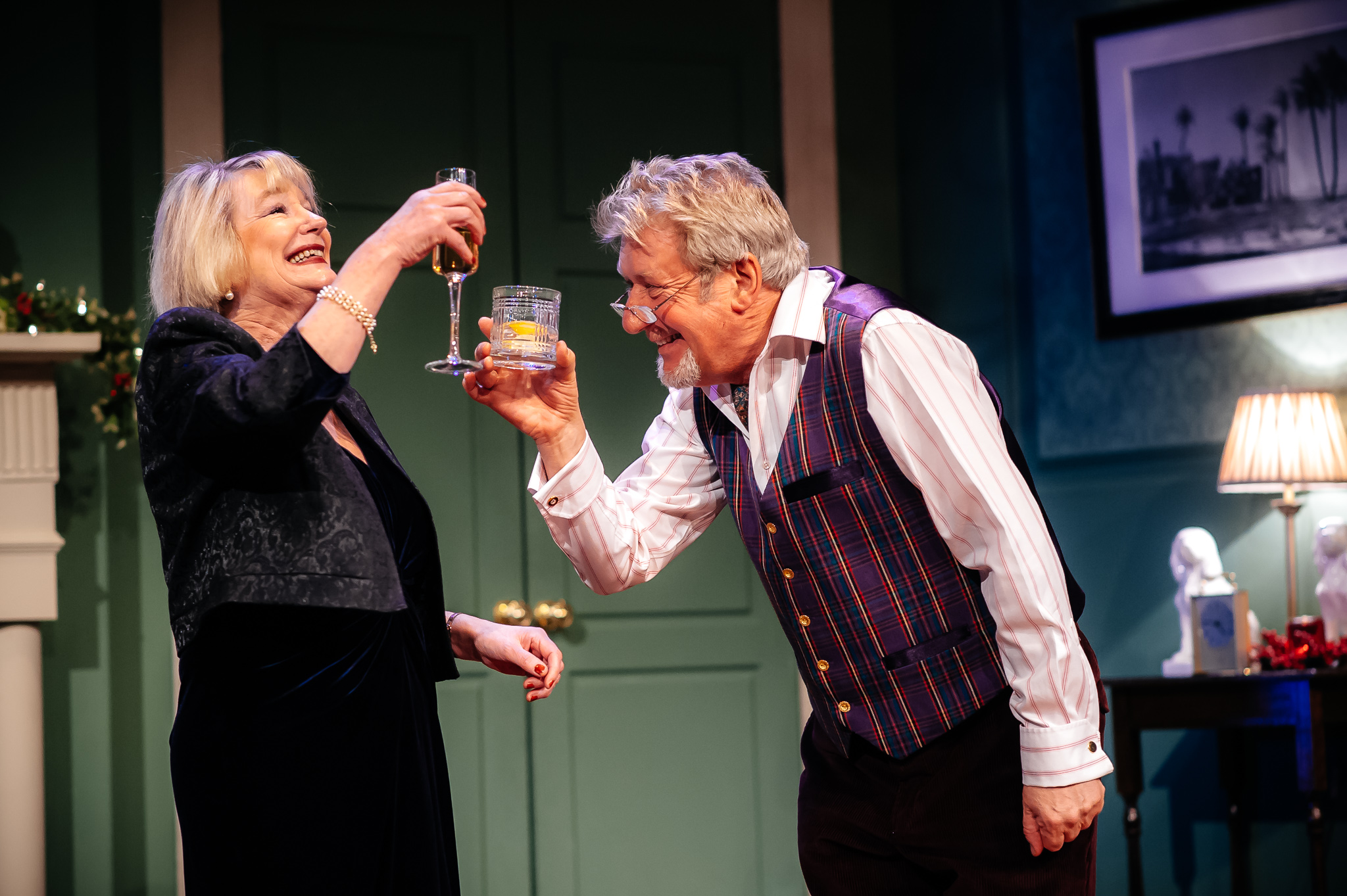
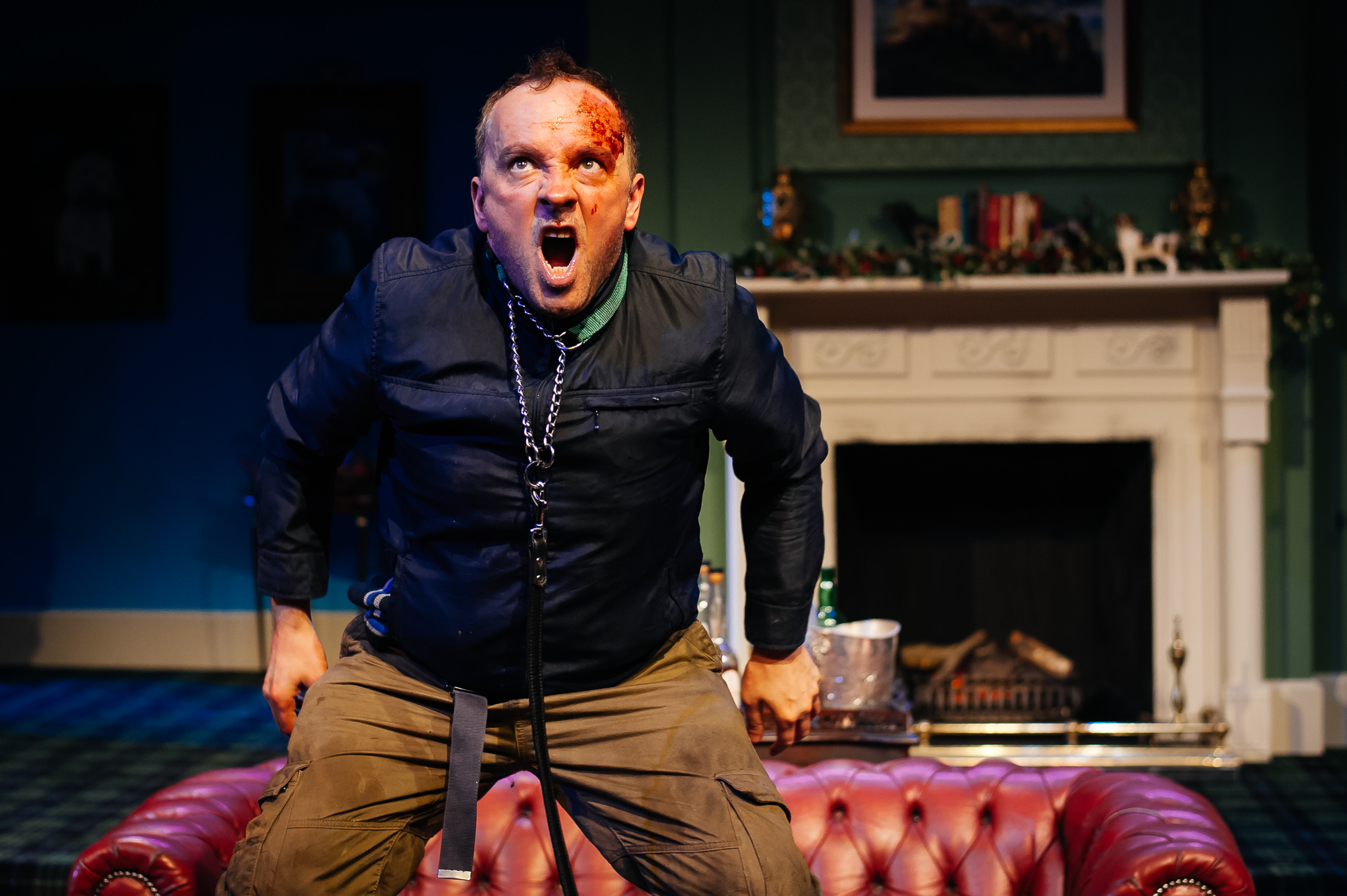
‘Season’s Greetings’ are a joke when it comes to what happens to the Leishman’s. For a start, Max’ gets dognapped and second there’s that pun in their name. Iain Finlay Macleod gives us pedigree ‘Christmas Carol’, the writer’s mega cut. No redemption is offered but this story has chains, mordant humour and lashings of sharp comment .

The first gift is unwrapped and admired and Cameron and Lara receive an unexpected and unwelcome visitor. John watches ‘The Wire’, so he says he’s from ‘the projects’. For Lara he’s a schemie, feral, the low life of the Sheriff’s Courts. He needs house training. Cameron, well bred, is a little more accommodating. He realises that for John to have had to leave Fettes junior school after only a couple of years was not one of life’s lucky breaks (!). John (Keith Fleming) has nerve, wit and honesty but gets it in the neck. He’s walking wounded in a nasty class war that Lara (Barbara Rafferty) prosecutes with all her vicious might. Cameron (Johnny Bett) would intercede but plays junior counsel to his partner’s vengeful brief. Director Orla O’Loughlin brings on action that is outrageous, radge and lurid.

Photo: Mihaela Bodlovic

Photo: Mihaela Bodlovic

It is close to home. Some will wince in recognition at lookalike ANTA interiors. There’s Albinoni on the invisible Sonos wireless system. Cameron knocks plebian Glasgow. Edinburgh lawyers acquire frightfully mannered English accents. There’s the EH3 postcode, Georgian cornicing, John’s pals from Pilton with their howling dogs, fireworks at New Year, and a legal profession prejudicially bent on fee income. But there’s more to it. David Hume’s statue is arraigned, or more accurately his toe is. What would the great philosopher make of the Leishman’s behaviour? For sure, they only actually do anything – as opposed to decorating their tree with photographs of past pooches – when they’re frightened or threatened. At best this is difficult to live with; at worst, it’s deranged.

I’ll stay with Christmas rather than moral philosophy. Go to ‘The Devil Masters’ with this text in mind: ‘He came unto his own, and his own received him not. (John 1:11) ’. Dispute ownership.


nae bad_blue

Star (blue)Star (blue)Star (blue)

Reviewer: Alan Brown  (Seen 10 December)

Visit ‘The Devil Masters’ at the Traverse here.

Visit our Assembly Roxy Bedlam Church Hill Theatre Festival Theatre King’s Theatre Other Pleasance, Potterrow & Teviot Summerhall The Lyceum The Stand Traverse archive.

THIS REVIEW HAS NOT BEEN SUBEDITED