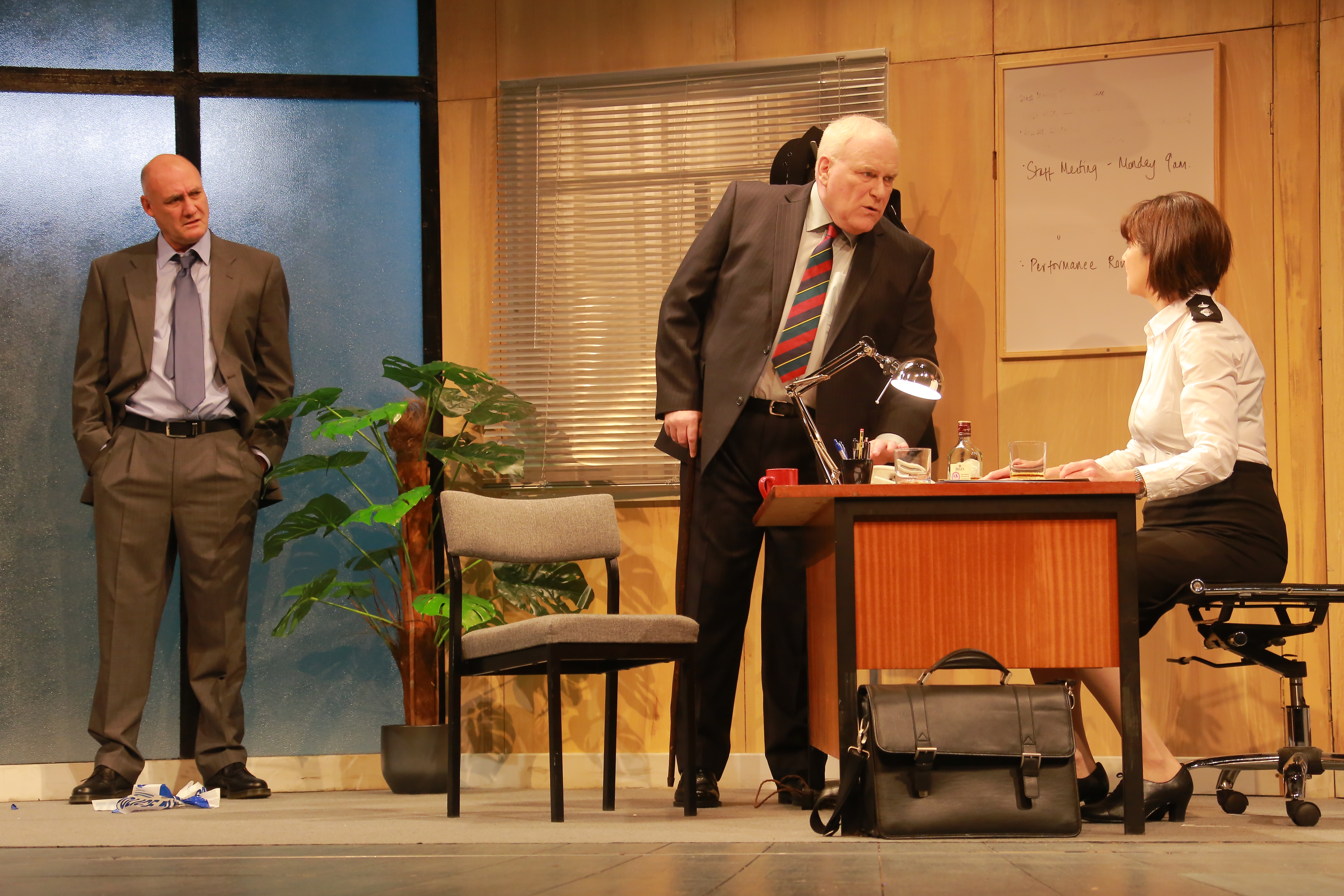
‘Oedipussy’ (Traverse: 9 – 12 Oct ’13)

6

“The poet did not write ‘Agamemnon, Parthenon, Taramasalata’ but in Oedipussy it is intoned as a choric reminder that Greek tragedy developed from the earlier satyr plays whose revels and antics are right up there with Spymonkey’s use of song and physical theatre.”

Editorial Rating: Nae Bad 

Dangle an adapted classic in front of a critic and you invite trouble. So it was fun to hear Spymonkey open Oedipussy with a swipe at a hostile review of their Moby Dick (Edinburgh, February 2010). The boot went onto the other, platformed, foot with wicked intent and not a little of the ensemble playing that would follow.

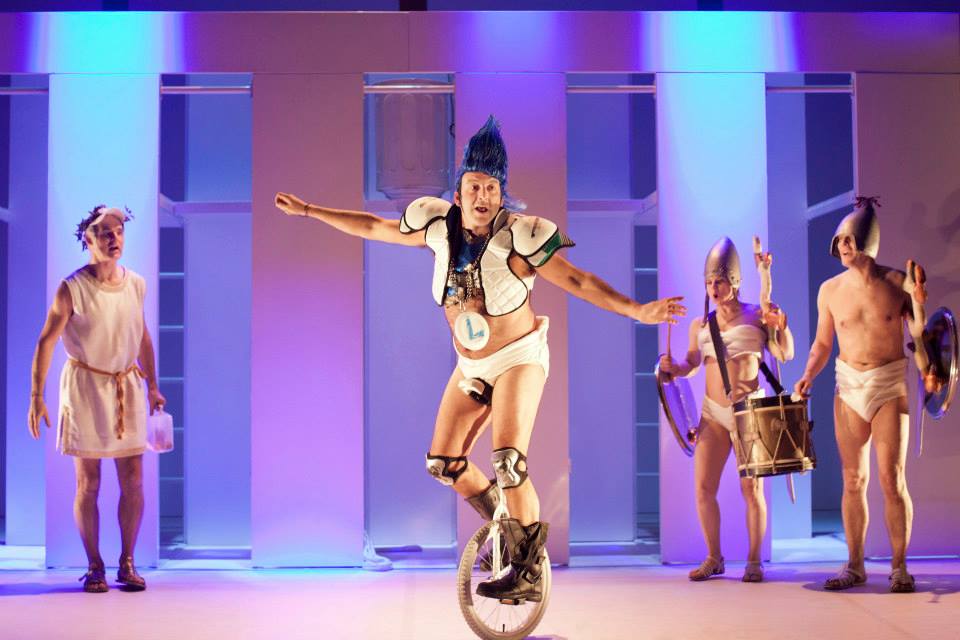
Oedipus has swollen feet, of course, which is not surprising as they are ‘pinned’ here using a cordless drill. Just one of the modern tools – add a unicycle, saxophone(s) and radio mic – that this production uses to ‘build up a dazzling mockery of delight’. The poet did not write ‘Agamemnon, Parthenon, Taramasalata’ but in Oedipussy it is intoned as a choric reminder that Greek tragedy developed from the earlier satyr plays whose revels and antics are right up there with Spymonkey’s use of song and physical theatre. ‘Woman-breasted Fate’ has her naked moment on stage as a wardrobe accident but otherwise the action is more ‘hot, hard, and in your face’ than anything stylised or reflective.

That said, ‘It’s not bloody panto’ either, as Jocasta (Petra Massey) would have the audience realise. The oracle may be hilariously represented by ballooned eyeballs – plus a red nose in a later manifestation – but the episodes are all here, from the infant Oedipus on Mount Kithairon to Jocasta’s suicide.

It is a post-modern piece though, if you allow 007 a mythic quality. Characters deconstruct as the four actors protest – along with Oedipus – that ‘this is the [real] me’: Petra Massey has problems with her feet and cannot have children; Aitor Basauri says he is not fat and tries out as a stand-up comic and Stephan Kreiss (Oedipus), at 51, needs pain relief from wild acting, and longs to go home to a more ordered Germany.

The Chorus (Park) does its job, singly, with a broken column on his head, and it seems is forever twirling in time as his robes wrap and unwrap around the white, ingeniously available set. Park is also Tiresias the blind prophet who has a remarkable turn as ‘a very bad David Bowie’ with outrageous pink cans on his head. Those costumes do stand out. They are colourful and outrageous, much more ‘Barbarella’(1968) than ‘Atlantis’ (2013).

Nevertheless, blood splatters and streams onto the stage and there are drum rolls to accompany the Eels’ ‘It’s a Motherf-’ – and, whilst the poetry is long gone, Oedipussy has its own tragic face. The production finally plays out to ‘Nobody does it better’, which is fair enough.

nae bad_blue

‘The Fantasticks’ (Bedlam: 9 – 12 Oct ’13)

1391627_536699813084181_349070085_n

Image by Louise Spence

“Performed in New York almost continuously since 1960, The Fantasticks is a curiously-constructed musical.  The first act is cutesy – sometimes to a fault – telling the knowingly-ridiculous tale of a forbidden teenage romance, and of two fathers’ efforts to control their love-struck offspring.”

Editorial Rating: Unrated

“Try to remember the kind of September / When life was slow, and oh, so mellow,” exhorts The Fantasticks’ famed opening song. Well, they’ve missed September by a week or two, but in every other respect Edinburgh University Theatre Company have fulfilled that brief: this is a warm-hearted, uncomplicated production, which gently lulls you backwards into an agreeably nostalgic haze.  Sadly, however, the lyric also foretells this production’s main weakness.  It’s all just a little bit slow.

Performed in New York almost continuously since 1960, The Fantasticks is a curiously-constructed musical.  The first act is cutesy – sometimes to a fault – telling the knowingly-ridiculous tale of a forbidden teenage romance, and of two fathers’ efforts to control their love-struck offspring.  But after the interval, the scenes grow dream-like and altogether darker, in a dislocating transition which this particular production never quite pulled off.  It doesn’t help that the original boy-meets-girl plot is wrapped up by the end of Act One, leaving the second half to lumber away from an awkward standing start.

But we can’t blame EUTC for the plot’s idiosyncrasies, and they’ve certainly had fun responding to its old-style American charm. Jordan Robert-Laverty neatly captures the clean-cut naivety of a 1950’s college boy, while Claire Saunders excels as his swooning 16-year-old paramour, milking the comedy of her role without ever quite crossing the line into over-acting.  Saunders’ voice lends her songs an almost operatic tone, and contrasts nicely with the more natural style of Alexandre Poole – who brings an understated authority to his multi-faceted role as both villain and narrator.

Muscially, however, the performance suffered from frustrating inconsistency, with almost all the actors delivering showstopping performances for some songs while clearly struggling with others.  The surprising exceptions were Daniel Harris and Thomas Ware, playing the two teenagers’ warring fathers; their characters seem at first to be formulaic comedy chumps, but soon prove to be far more.  Harris and Ware both have fine, comforting voices, and their harmonising duets proved a thoroughly unexpected highlight – enhanced by some genuinely witty, if slightly methodical, dance.

Indeed, the whole production demonstrates a playful sense of physicality, with an impressive swordfight (and gloriously extended death scene) raising the stakes just before the interval.  But whenever the pace wasn’t being dictated by the music, the energy ebbed away.

So EUTC’s production isn’t quite fantastic – but it’s an enjoyable, stylish, and life-affirming version of a cosily charming musical. Credit must also go to pianist Dan Glover and harpist (yes, harpist) Sam MacAdam, whose position at the side of the stage brings them very much into the heart of the performance.  It’s a show I’ll be sure to remember.

Dan Lentell in Conversation with Toby Park re. ‘Oedipussy’

oedipussy150

On the afternoon of 9 October ’13 Edinburgh49‘s Dan Lentell met up with Toby Park, artistic director of Spymonkey productions to talk about their unconventional take on an old classic.

https://getyourcoatson.com/wp-content/uploads/2013/10/listen-to-our-interview-with-toby-park.mp3

Listen to our interview with Toby Park

Visit Oedipussy homepage here.

Read Alan Brown’s review of the show (forthcoming).

‘Educating Ronnie’ (Traverse: 2 – 5 Oct ’13)


MacRobert Arts Centre

“The money Joe sent would have provided the deposit on a house in a northern industrial town, or in more personal terms an engagement ring.”

Editorial Rating: Nae Bad

It is a touching story. It touched Joe Douglas for near on £19,300. By the end of the show, at the end of their story, Joe calculates exactly what it cost him over ten years to educate a young Ugandan, Ronnie.

It is a true morality tale that begins in 2002 with Joe, an 18 year old out of Stockport, enjoying a six week gap-year trip to Uganda, whose sights and sounds hit him ‘like a pop-up book’. It is not long after returning home that Ronnie ask Joe for help.

We never meet Ronnie but read and hear his emails and txts. They are pretty short, spell out how much money he needs to keep his education going and – later – how much to compensate the family of a fatal road traffic accident; how much to pay the hospital for his dying mother. The emails present on a video screen of a blackboard and then, diminished, pile up into an on-going reminder of Ronnie’s situation. There are beer mugs up there too, a nice calculation in student terms of how many pints can be bought for the £20 regularly sent to Ronnie by Western Union money transfer.

Joe introduces his story with the lights up. He is not a trained actor (the programme notes make clear his credentials as a director) and he would apologise for that. No need really; his one-man performance starts as he talks fondly to the seat reserved for his aunt Maria in the front row, for it is his auntie who looked after him in Uganda, and who interestingly did not take to Ronnie.

The money Joe sent would have provided the deposit on a house in a northern industrial town, or in more personal terms an engagement ring. He does actually take a ring out of his pocket and smiles, remarking that his parents paid for the wedding. And Ronnie? The BBC World Service went looking for him when this story was first staged at the Fringe in 2012. He has a FaceBook page apparently and does not want a copy of the script.

This work, a co-production by Macrobert and Utter, is smooth. Its careful technicals are well-rehearsed, the soundtrack is appropriate without sentimentality, Joe Douglas’s performance is characterful and honest. His story asks you to risk a leap of faith. I’m glad I did.

nae bad_blue

Reviewer: Alan Brown (Seen 2 October)

Visit Educating Ronnie homepage here.

Four to Paw: The Stand: October ’13

This October Edinburgh49‘s Four to Paw shows at The Stand are:

Black History Month Benefit (20:00, 6th October, The Stand)

“The Coalition for Race Equality and Equality Rights host another mix of comedy and entertainment from Scotland’s BME community. Stand-up against racism and celebrate Scotland’s Black History Month with the triple whammy of Hari Sriskantha, Katai Kasengele and Wayne Mazadza. Compering will be the irrepressible Susan Morrison.”

Marcel Lucont – Gallic Symbol (20:30, 13th October, The Stand)

“Witty, acerbic, magniloquent Frenchman seeks willing, intelligent audience for fun, adventure, maybe something more. Must have own underwear, socks and breath but be prepared to have these charmed off, laughed off and taken away respectively.

As seen on Russell Howard’s Good News (BBC3), Live at The Electric (BBC3) and Set List (Sky Atlantic).”

Nordoff-Robbins Scotland Comedy Gala 2013 (20:30, 15th October, The Stand)

“Scotland’s only music therapy charity. Our therapists use music to improve the quality of life, communication and wellbeing of people of all ages with a range of conditions from autism and dementia to brain injury and stroke. www.nordoffrobbinsscotland.org.uk

With Raymond Mearns, John Gavin, Ray Bradshaw, Teddy and host Des Clarke.”

Steve Hughes: While It’s Still Legal (20:30, 30th October, The Stand)

“Direct from sell-out shows at the Sydney, Melbourne, Brisbane and New Zealand Comedy Festivals, the sublime Australian comic and ex heavy-metal drummer returns to UK shores to embark upon his second solo tour.

He stormed the UK last year with his sell-out debut tour, with extra dates added due to phenomenal demand. On TV, he’s recently performed stellar sets on Live at the Apollo and Michael McIntyre’s Comedy Roadshow (BBC One), Stand Up For The Week (CH4) & One Night Stand (Dave).

This brand new show features more thoughtful, outspoken social commentary courtesy of a masterful, erudite and provocative performer. Laid-back, effortless charm and caustic anti-establishment humour from a truly unique, world class performer.”

‘Dark Road’ (Lyceum: 25 Sept – 19 Oct ’13)

Robert Gwilym as Frank Bowman , Ron Donachie as Fergus McLintock and Maureen Beattie as Isobel McArthur

Image by Douglas McBride

“The production is a mixed bag in most regards.”

Editorial Rating: Unrated

Ian Rankin is no stranger to Edinburgh’s criminal underworld –fictionally, of course. Inspector Rebus, Rankin’s most famous literary creation, is known to millions as the slightly off-beat but loveable curmudgeon, for whom this city’s cobbled streets are home. Perhaps it is no surprise, then, that his theatrical debut (in collaboration with the Lyceum’s own Mark Thomson) is firmly rooted in this world.

It is twenty five years since the conviction of Alfred Chalmers for the murder and mutilation of four young Edinburgh women (there are definite comparisons to be made with the BBC’s hit series The Fall). This, combined with her thirtieth anniversary of being on the force, provokes Superintendent Isobel McArthur (Maureen Beattie) to reflect on what proved a land mark case in her career; or, more specifically, on a nagging doubt she has harboured since that day. Dredging up the past, however, reveals a well of raw emotions in both her closest work colleagues and her only daughter, Alexandra.

The production is a mixed bag in most regards. On the one hand, much of the writing is disappointingly predictable – not simply in terms of the plot, but also the inclusion of well-worn topics such as sexism in the police, the role of a policeman’s ‘hunch’ in conviction, and the bureaucratic barrier of paperwork that stands between policemen and ‘real police work’; a commentary that fails to really add any new angles on these issues. On the other, some of the writing is delicious – finding its strongest moments in scenes of quippy character interaction.

Similarly, a handful of characters were intensely believable – Philip Whitchurch’s portrayal of Alfred Chalmers was magnetic, managing to baffle the audience and leave us in a confused state, somewhere between terror and sympathy. But, at the other end of the spectrum, Sara Vickers (Alexandra) was lumped with a caricature of a teenage girl, whose mood swings between being angsty and angry, and as horny as a bitch in heat, leave her little room for development.

An area of no doubt, however, was staging – which was certainly the production’s strongest suit. The three room revolve worked incredibly well, particularly with the addition of corridors which provided both a realistic edge and an extra dimension to the performance. Furthermore, the soundtrack, ranging from a lamenting violin to Psycho inspired string segments, did much to add dramatic tension in scenes and maintain atmosphere between them; combining well with projections that slowly built a visual backstory for the audience.

Dark Road has the beginnings of a good production, but there is work to be done. It would benefit from some trimming – particularly in the first half, where certain scenes and ideas dragged on too long – and a more careful concealment of the plot to avoid the predictability that currently plagues it. As it stands, Dark Road is middle of the road.

Reviewer: Madeleine Ash (Seen 28 September)

Visit Dark Road homepage here.

‘The Baroness: Karen Blixen’s Final Affair’ (Traverse; 27-28 Sept ’13)

Dogstar Theatre The Baroness Roberta Taylor (Karen Blixen (Isak Dinesen) Photo credit Leila Angus

Image by Leila Angus

 “Among Denmark’s literary superstars few are more fascinating than Karen Blixen, pen name Isak Dinesen (1883-1962). The Baroness is the story of her final affair: a platonic entanglement with a much younger poet.”

Editorial Rating: Unrated

For a country where summer temperatures struggle to exceed 20°C, in terms of cultural exports, Denmark and all things Danish are surprisingly hot right now. Successes such as The Killing and Borgen have rocketed outside awareness and interest. Among Denmark’s literary superstars few are more fascinating than Karen Blixen, pen name Isak Dinesen (1883-1962). The Baroness is the story of her final affair: a platonic entanglement with a much younger poet.

We enter to find two harp-shaped window frames with fewer right angles than the Goetheanum. In one hangs a tribal mask intended to conjure images of Blitzen’s years as a coffee planter in Africa (I think it resembles Norman Tebbit). An eclectic harmony of furniture perfectly captures the sense that we are looking into the dwelling place of a mind born for the Belle Époque. Her young companion is evidently much less at home. He belongs instead to that new generation which Kennedy’s Danish-American speechwriter would describe a year before Blixen’s death as “tempered by war, disciplined by a hard and bitter peace.”

The friendship of Blixen and Thorkild Bjørnvig is a matter of historical record. At times the script creeps into the realm of docudrama. When Blixen encourages her protégée to abandon his wife, child and work in order to compel the flow of his artistic creativity, she laments that Denmark is “flat as a duck pond”. Similarly, the muted script gives little sense of a tempest brewing in, or subsequently howling through, the hearts of the protagonists.

Roberta Taylor as Blixen and Ewan Donald as Bjørnvig provide well-rounded individual character sketches. There are flashes of real insight, such as Donald’s steadily improving posture, but there is little shared fascination. Blixen is portrayed at the centre of a social and cultural web in which she occultishly snares young bloods with which to feed her imagination.

Several of the techniques deployed to fill a stylized frame with stylish content are over hesitant. The dramatic function of the mutual friend (played charmingly by Romana Abercromby), for example, is uncertain – diverting more than developing the over-lengthy central narrative. By the interval I think I’ve got the point. Other than the brightly conceived set transition from Blixen’s home to Bjørnvig’s northern hideaway, not much more is said or done.

Pace was a problem throughout. Far from crisp efficiency, the frequent scene changes are slow (although composer Aiden O’Rourke’s bold, introspective score make this less of a negative). Projection was a problem too, I did not feel played to in the steeply tiered back row of Traverse One.

Dogstar Theatre squeezed hard and a good amount of zesty juice was delivered into the glass. If their future endeavours maintain the very high standards set by The Baroness for smart, funny staging of deep, moody drama then we can expect great things from them in the coming years.

Reviewer: Dan Lentell (Seen 28 September)

Visit The Baroness homepage here.

‘Only Wolves and Lions’ (Summerhall; 12, 14-15 Sept ’13)

“From this melting pot, hopefully, will be drawn a social bond that will spark conversation when we finally sit back down to eat.”

Editorial Rating: Nae Bad

Only Lions and Wolves is a collaboration between British artist Leo Kay and his Basque collaborator Unai Lopez de Armentia. Their aim is to bring together a group of total strangers to select, cook and consume a menu of dishes made from an array of raw ingredients brought by us.

The dining table is set for an extended family banquet. Gas camping hobs have been set up  along the hall’s sides. At one end is a table of carbs (rice, flour etc) and condiments such as tinned tomatoes, olive oil et al. At the other end are the cooking pots, utensils and cutlery which we will use to prepare our dishes. A washing line runs behind this table hung with ladles and potato mashers and above it hangs a chandelier of colanders. We sit and, under Kay’s direction, introduce ourselves. The ice is melted with a free form dance warm up as well as bonobo impressions – bonobos and chimps are social creatures too runs the logic.

We team up and are asked to suggest possible dishes within our culinary range and the options available. Then we cook against a clock set for 45 minutes. From this melting pot, hopefully, will be drawn a social bond that will spark conversation when we finally sit back down to eat.

The frame may be hippy-dippy collectivist, but the content of Lions and Wolves feels a lot like the team building exercises, networking events and other assorted workshops strewn throughout corporate life. I am reminded why I’d never want to live in a commune. When Kay and de Armentia start talking Trotsky I regret there isn’t an ice pick on the washing line. It’s a shame that the meal is not billed as vegetarian – for an event aimed at deconstructing social barriers the line between herbivores and carnivores is jarring.

Discussing politics at the dinner table and in mixed company does not come easily. The work is much stronger, pacier too, when outlining broader philosophical lessons from thinkers such as Epicurus and how these might be applied topically to alleviate the symptoms of downturn and recession.

Only Lions and Wolves is a conceptual work in progress. Edinburgh has a well established dining club scene into which this format (if not the current means of execution) could easily fit. An ambitious yet inventive concept, it could hold better selected material, but what tailoring there is, is neat, stylish and bold. When they loosen up, the performers are a lovely bromantic couple in whose company it is a pleasure to spend an evening.

nae bad_blue

Reviewer: Dan Lentell (Seen 12 September)

Visit Only Wolves and Lions homepage here.

Three to See: Summerhall: September ’13

This September Edinburgh49‘s Three to See events at Summerhall are:

Only Wolves and Lions (18:30 – 12 & 14, 14:30 – 15 September, Summerhall)

“Only Wolves And Lions takes a fresh look at human behaviour in the pursuit of happiness. After food clothes and shelter, what do we need? Exploring ideas surrounding community, isolation and the meaning of the word crisis, Leo Kay and Unai Lopez de Armentia invite you to cook, eat and speak together”

Images Were Introduced (11:00-18:00 – Daily until 27 September, Summerhall)

“Michael Nyman’s first ever exhibition in Scotland will consist of a major installation in Summerhall’s Upper Church Gallery (off Hope Street Terrace) showing simultaneously the video film-maker, photographer and composer’s ten (10!) remakes of the famous vintage film “Man with a Movie Camera” by the Russian film-maker Dziga Vertov and his wife Yelizaveta Svilova (who edited the film).”

Neu! Reekie! 39 (19:00, 27 September, Summerhall)

“Brought to you my Michael Pedersen and Kevin Williamson Neu! Reekie! is a delicious feast of spoken word, music, animation and film fusion.”

Four to Paw: The Stand: September ’13

This September Edinburgh49‘s Four to Paw shows at The Stand are:

Red Raw (19:30, 2nd, 9th, 16th 23rd & 30th September, The Stand)

“Our long-running weekly beginner’s showcase is regarded as the best open mic night in the UK. Catch up to ten new acts – some treading the boards for the very first time. This is where everyone starts and it’s your chance to see the stars of tomorrow today. Watch out for older hands dropping in to try out new material too.”

With Matt Rudge and host Scott Gibson.

Whose Lunch is it Anyway (13:30, 8th, 15th, 22nd & 29th September, The Stand)

“Our long-running improvised comedy show will have you in stitches. Marvel as resident duo Stu & Garry weave comedy magic from your suggestions. It’s the perfect way to nurse a hangover and a sure-fire way to kick-start your weekend after the big night out. There’s a special menu too so you’ll be in danger of laughing with your mouth full.”

The Sunday Night Laugh-In (19:30, 22nd September, The Stand)

“Round off the weekend with our comedy cocktail which has the emphasis on the chilled and the laid back. At least five acts on each bill ensure variety and its great value at just a fiver. With Chris Conroy, Gareth Mutch and host Ben Verth.”

Best of Scottish Comedy (20:30, 25th September, The Stand)

“Talk about doing what it says on the tin! Here you go a carload of simply the best comics on the contemporary Scottish circuit. At least four acts on every bill with seasoned headliners joining forces with newer kids on the comedy block each month.”