International Waters (Traverse: 30 March – 3 April ’16)

International Waters 1

Photos: Tommy Ga-Ken Wan

“Almost edifying”

Editorial Rating:3 Stars Outstanding

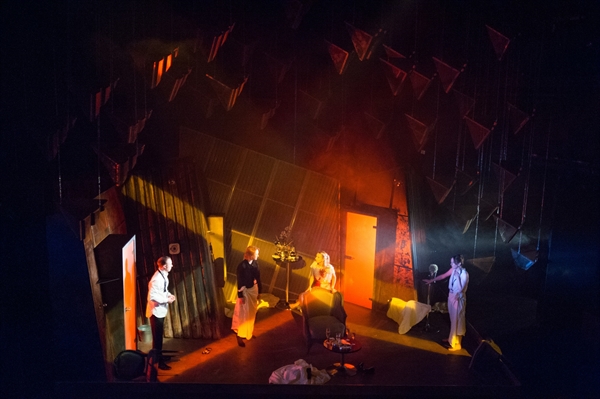
You have to wonder. Fifty minutes into the heaving swell of International Waters when we’re all dramatically well and truly cast off, the fire alarm lights flash red and the theatre is evacuated. It has to be a Fire Exit production. And the prime minister announces that there will be no fire sale of the UK’s steel industry but it could still all go down the pan; which is pretty much where David Leddy’s new play takes us. It’s gut-churning with intent, from programme-as-origami downwards. This is theatre in the raw; its passage probably indigestible without great work by Becky Minto (Design), Nich Smith (Lighting) and Danny Krass (Sound).

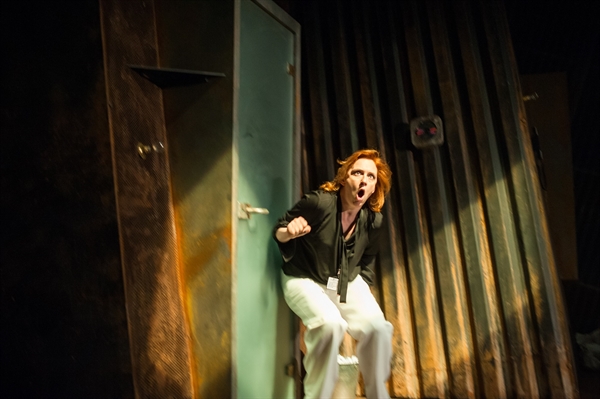
For the U-bend see a cabin suite for the super-rich in the bowels of a super-tanker, complete with champagne buffet and karaoke machine. Cheaper accommodation is in assorted containers where you might be stacked next to a tiger or two. It is all rather make-do, rather urgent, for this is the last ship out of London where the banks have really, really, done their mucky worst. It’s safe to assume that the ATMs are empty and that the poor are on the streets and burning porsches. Still, if you have shedloads of ready money you can look good in white linen, enjoy the Moët, do a line of coke, and singalong to doomsday. Unfortunately it turns out that Sarah, Ben, Sophia, and Arian are in the Caliban suite for a less than delightful reason and that their ‘escape’ will end wretchedly. There’s no mage on the bridge to save them or to get them away from each other’s throats … or crotches.
International Waters 2

Down below, gripped by burning cabin fever and flushing itself out, is the fabled 1%: powerful and greedy, vulnerable and unhappy. Sarah (Claire Dargo), Ben (Robin Laing), Sophia (Selina Boyack), and Arian (Lesley Hart) go at it with astonishing abandon, pulling each other’s chains – just to stay with the scatological – and soiling themselves and their values in the process. It’s abject, messy, and ridiculous and yet the acutely angled and allusive content is almost edifying.

Leddy unships a bulk load of issues: rogue algorithms, flagrant wealth, economic migrants, drowned refugees; the paranoid survivalist versus the self-obsessed, #Blessed; Twitter storms, Old Testament retribution and the gospel strains of New Testament promise. This is one crowded ark of a stage, freighted with ideas, that spills more than it holds, deliberately upset by intemperate behaviour, bad language, and scary discordant sound. If the play is dead in the water at its conclusion, it’s not rudderless or overblown, but simply exhausted.

FYI. The show continued after the fire alarm, which says a lot about the quality of the performance and the unlikely integrity of the piece. It is preposterous and explicitly farcical, yet Leddy goes in behind the theatrical facade. He says (see programme note) that he’s also after the romantic sublime. Well, here’s Adele on a comparable course from Rolling in the Deep: “Go ‘head and sell me out and I’ll lay your shit bare.” Nice!


outstanding

StarStarStar

Reviewer: Alan Brown (Seen 30 March)

Go to International Waters at the Traverse and at Fire Exit .

Visit Edinburgh49‘s  Traverse archive.

A Play, A Pie and A Pint – Billy (The Days of Howling) (Traverse: 22 – 26 March, ’16)

“A dark, eye-opening fable of flawed humans and why they do what they do”

Editorial Rating: 5 Stars

On the surface, this could so easily be “Mumsnet: the play”: a tale of a mother passing judgement on the parents of another child that attends the same nursery as her daughter, juxtaposed with an admin worker whose main priorities are arranging for a pinboard to be put up in her office and responding to radio phone-in competitions. But scrape away that layer of shallow prejudice and what lies beneath is a dark, eye-opening fable of flawed humans and why they do what they do.

The play is written almost exclusively as three intertwining monologues, allowing us to understand multiple viewpoints, with rare yet powerful instances of dialogue when the characters’ paths cross. Director Rosie Kellagher shrewdly opts for simple staging throughout, with each character in their own part of the stage, and keeps the action slick, resulting in an engaging performance I couldn’t take my eyes off.

The writing in this piece is very clever, and quite understandably of award-winning quality, in how it teases and develops action throughout. Early on we are led to be on the side of Alice’s Mum in her mission to ensure a child is properly looked after, while Billy’s Dad comes across as the kind of lout we all love to hate. The tensions are clear, but as the action unwinds and we learn more about who’s who and what has led them to where they are, perspectives slowly change, and at the play’s chilling denouement I was left unsure as to who I should feel most sorry for and whether they really had it coming.

Rosalind Sydney displays great depth, power and fragility as the do-goody Alice’s Mum, from her cutting judgements to her exquisite intonation as a heard-it-all-before call centre operative. It’s hard to believe that Anthony Strachan is anything other than the foul-mouthed, donut-eating, wrestling fanatic Billy’s Dad given the integrity of his performance, while Hilary Lyon is a master of deadpan comedy as the Admin Lady. The acting is controlled, consistent and utterly believable from all three.

In saying that, there were a couple of moments when the action didn’t quite ring true and seemed a little far-fetched (an anecdote of spending 20 hours waiting in A&E being one example), while the weight of action seemed to leave one character a little redundant for the second half of this performance. However, on the great scale of things, these are very minor idiosyncrasies to what is on the whole a compelling production.

For a show that’s this energetic, chopping and changing between three stories with such rapidity, you do have to be on your toes to keep up, but it’s absolutely worth it. Get in there quick.

Star (blue)Star (blue)Star (blue)Star (blue)Star (blue)

Reviewer: Steve Griffin (Seen 22 March)

Visit the Traverse archive.

THIS REVIEW HAS NOT BEEN SUBEDITED

A Play, A Pie and A Pint – Some Other Stars (Traverse: 15 – 19 March, ’16)

“Gripping until the very end”

Editorial Rating: 4 Stars

There was a real buzz at this, the opening performance of the first in the new season of A Play, A Pie and A Pint at the Traverse Theatre, as audience members of all ages filled the studio – an indicator of the wide appeal the programme has. Opening the batting order is Some Other Stars, which depicts honestly, beautifully and painfully, the journey travelled by a loving couple when one of them, for whatever reason, ends up in a coma.

Performed as two interweaving monologues, Clare Duffy’s script deftly covers a plethora of feelings and thoughts from both sides, from confusion and pain in the early days, through hope, helplessness, boredom and betrayal. The play begins in darkness, with a sizeable monologue from Ian (Martin McCormick) describing what’s going on in his head while in a vegetative state. The discomfort of the darkness and simplicity and repetition of his words work to set a deep and personal tone, drawing us into the obvious conflict of his physical incapability of communicating with his wife, Cath (Kristin Murray).

Once the action gets going it’s quite a pacy affair that is full of dramatic contrasts in perspective that interweave, each seamlessly making way for the next without ever getting bogged down on one idea. Cath’s opening speech is delivered very fast, which on one hand jars against the sensitive, human element of the production, while on the other very ably and stylishly communicates a headful of thoughts that aren’t able to form themselves into cohesive sentences before the next comes along. Perhaps a little too “theatrical” for me, but powerful all the same.

Both McCormick and Murray are very believable in their respective roles, with a command of emotion and tension that makes this play gripping until the very end. While not wholly believable in terms of chemistry as a couple, their energy, pace and variety of emotional intensity are evenly balanced, and that missing spark almost works in their favour in sections where the breakdown in their relationship becomes more apparent.

Yet while the acting is on whole very powerful, I wasn’t convinced by Jonathan Scott’s design which seemed too “artsy” against the very sensitive performance. The use of a hospital bed with a body constructed of plastic bottles and other flotsam certainly represented Ian’s apparent lifelessness, but to me detracted from the integrity of the emotion on display, especially when it was being interacted with. Some of the other design elements also seemed redundant – the table and dolls downstage and the gazebo-like structure didn’t add anything to the production, and I feel that a more stripped back approach, relying on the actors to do the work with their physicality would have aided to the rawness and fragility of the piece. There were moments of this towards the end of the production, where Cath, in desperation straddles her husband in his wheelchair in the hope to get him to feel, which were very moving and required no special effects. It’s a shame this technique was not used more often.

Overall, this is a simple yet moving exploration of a situation none of us ever hopes to be on either side of, presented with real human honesty. Compelling.

Star (blue)Star (blue)Star (blue)Star (blue)

Reviewer: Steve Griffin (Seen 15 March)

Visit the Traverse archive.

THIS REVIEW HAS NOT BEEN SUBEDITED

The Table (Traverse, 3rd Feb ’16) part of the Manipulate visual theatre festival

Edinburgh, UK. 17/08/2011. Fringe First winners, Blind Summit, present "The Table", starring Moses, the Bunraku table puppet, who is ably assisted into being by Mark Down, Nick Barnes and Sean Garratt. Photo credit: Jane Hobson

“One of the most wonderful performances I have ever witnessed”

Editorial Rating: 5 Stars: Outstanding

One table, one puppet, three men, no strings. And one of the most wonderful performances I have ever witnessed.

While it might seem quite basic, this spectacular puppet show (which could also be classified as stand-up comedy – more on that later) is a tour-de-force in keeping theatre simple yet incredibly effective. Within seconds, the carefully constructed cardboard face and cloth body became an intriguing old man whose every word and movement held me completely captive. And for a show an hour long, that’s no mean feat for something with no pulse.

The puppet began by introducing us to his table – his home – pointing out the garden, his vegetable patch, and where it might be extended to grow more carrots. All the while, he kept us entertained with witticisms most comedians would be proud of, and a dash of audience interaction to keep us all on our toes. And it’s all delivered so naturally, I was completely transported into the world of the table.

Yet while the slow and sometimes inappropriate ponderings of a confused old man were a delight in themselves, the crux of the performance lay in its original purpose – to retell the story of Moses’ saving of the Israelites and his eventual death on the mountainside. In this guise we see him humble, we see him angry and we see him defeated. We see him battle against the elements and lie down to sleep (which is far more difficult for a puppet than it may be assumed). And when he finally leaves the table, I genuinely felt lost and upset to say goodbye. Perhaps this says something about my childish tendencies, but the sell-out crowd of all ages seemed just as moved as I was.

The hands and voice behind this masterpiece – Nick Barnes, Mark Down and Sean Garratt – lovingly move every centimetre of the puppet with precision in care, and always in sync, down to their own breathing. What was particularly enjoyable about their roles were the playful and apparently improvised moments of the show, where the performers joked with and challenged each other to keep up with the pace. At one stage the poor puppet’s hand fell off, probably by accident, but this was covered and managed very well, even if the performers found themselves creasing up with infectious laughter.

About two minutes in I was hooked and thought this show has the potential to launch itself into my top ten favourite things I’ve ever seen on stage, and by the end it had firmly secured its place. Simply masterful.

outstanding

StarStarStarStarStar

Reviewer: Steve Griffin (Seen 3 February)

Go to The Table at Manipulate and Blind Summit

VisitVisit Edinburgh49’s  Traverse archive.

Macbeth: Without Words (Traverse, 2nd Feb ’16) – part of the Manipulate visual theatre festival

Sandra Franco photo. Ludens Ensemble

Sandra Franco photo.
Ludens Ensemble

“A compelling, highly intelligent and creative retelling of the famous story”

Editorial Rating: 4 Stars: Outstanding

Macbeth: Without Words is one of those shows you see from time to time where you can’t quite decide if you love or hate it. It’s gutsy, original, and a full-on hour long assault of the senses that I couldn’t take my eyes off.

The piece starts with one actor, in a corset and clown make-up, leaping around the stage acrobatically before picking up a microphone and making a range of strange noises. Those with a more traditional perspective on Shakespearian theatre might baulk at the very interpretative style, which I’ll admit took some getting used to, but what unfolded was a compelling, highly intelligent and creative retelling of the famous story.

It is a very physical performance, as it needs to be to convey the monstrous action. There is no spoken dialogue. The dexterity of performers was sensational, as the cast of three managed to create almost every character from the play – all identifiable through their physicality and token elements of props and costume. Stand out moments included the initial stabbing of the king silhouetted through a plastic sheet, and Lady Macbeth appearing through that same plastic sheet towards the end, in all her ghostly presence.

Although without speech, it was not without noise; and many of the sounds were created by the performers live – either vocalised into microphones or using various banging, rubbing and scraping of props and instruments. The layering and looping of these created fantastic tension and atmosphere, with a real sense of baleful magic and connection between the performers and the action. Given how powerful this technique was, especially at the beginning where a complex soundscape was created very simply, it was a shame that for some scenes the company relied on pre-recorded sound, leaving me feeling a little bit cheated. At one point a recording of bagpipes was played, and I felt the company – in Edinburgh of all places – missed a trick.

It was also disappointing that for a show pertaining to be “without words”, that short excerpts from the script were occasionally projected onto a screen to clarify the action on stage. I admit that the task to portray every nuance of Shakepeare’s work without any words at all is nigh-on impossible, but in some scenes it was done so well – the incantations of the witches, the murders, the washing of the hands, the breaking of the news – all performed using physicality, silhouette and props,  that it was such a shame that the company “copped out” in those rare moments. It seemed that with a little bit more work or development the company will have created a piece truly “without words” and fit for any European Capital of Culture.

This could have been one of those mind-blowing, life-changing performances that I’ll never forget, but unfortunately, those few flaws held it back somewhat. Still, ‘tis far from a sorry sight and overall the battle was far more won than lost.

outstanding

StarStarStarStar

Reviewer: Steve Griffin (Seen 2 February)

Go to Macbeth: Without Words at Manipulate

Visit Edinburgh49’s Traverse archive

LoopsEnd (Traverse, 2nd Feb ’16)

LoopsEnd

“A visual feast”

Editorial Rating: 3 Stars: Outstanding

I have seen many spectacular aerial displays over the years, from companies all over the world,  and with their latest work, LoopsEnd, Edinburgh and LA based Paper Doll Militia is definitely right up there with the best of them in terms of risk, precision and wow-factor. However, while technically the gymnastics were great, I was a bit disappointed by the overall cohesion of the work.

A performance in two parts, the first half, Ashes, was inspired by the tearing down of an industrial estate where the group used to rehearse. The main visual element of the piece was two long ropes hanging from the rigging, twisted and weighted down with bags of powder. Even watching the ropes untwist and retwist in the empty space was graceful and compelling, and when combined with George Tarbuck’s stunning lighting design and the trademark tricks and treats of a seasoned aerial company, this piece was, at times, nothing short of a visual feast.

Throughout the performance, white powder was used in various ways to represent the “ashes” – one performer literally had a pile on his shoulders in the opening sequence, while the closing image was of the two bags attached to the hanging ropes slowly emptying as the ropes swung in the space. These individual instances were very powerful visually, but it was difficult to see the link between these, and any sort of narrative or progression within the piece. Indeed, many of the “theatrical” devices seemed under-developed and incomplete: there were too many moments of clichéd wide-eyed wonder and writhing around in angst, and at one point one performer walked back and forward many times, overtly undecided about whether to touch the rope. Such basic and overused devices unfortunately offset the splendorous vision of the other sections.

In the second piece, Unhinged XY, projection was also used, which in some ways added another dimension to the visual smorgasbaord, but in others gave a seemingly unnecessary layer of complexity and confusion to the action – again, it often wasn’t clear how the costumes, music, acrobatics, projections and design all married up.

The aerial silk work in this piece, and the use of wind and fabric combined to make some stunning visuals and standout moments. When one performer walked up a hanging piece of silk, weighted at the bottom by another, while competing with gusts around her, I was awestruck by the strength and artistry on show.

It was a bit of a shame that both pieces relied quite so heavily on overpowering recorded sound and music. While at some points it was great in setting and supporting the overall tone of each section, its constant use meant the work was unable to establish a mood for itself, so I would have preferred a more selective and sensitive approach to the aural aspects of the performance.

Overall, there’s no denying the talent and visual creativity that have earned Paper Doll Militia their excellent reputation. However, LoopsEnd left me somewhat hanging in mid-air, rather than applauding with my feet flat on the ground.

outstanding

StarStarStar

Reviewer: Steve Griffin (Seen 2 February)

Go to Paper Doll Militia

Visit Edinburgh49‘s  Traverse archive.


Tracks of the Winter Bear (Traverse: 9- 24 December ’15)

Traverse Theatre

Traverse Theatre

“Cool and works a treat”

Editorial Rating: 4 Stars: Nae Bad

Now here’s a frosty cracker of a show in two acts: Act 1 written by Stephen Greenhorn and directed by Zinnie Harris; Act 2, written by Rona Munro and directed by Orla O’Loughlin. Each Act tells a different story with different characters but pull them apart and – with a muffled bang – you get a Christmas message and a novelty polar bear torch. There’s a ginormous bear as well, but that would explode the cracker idea way beyond belief.

As last year, with The Devil Masters, we’re close to home but it’s the sanctimonious New Town no more; no, it’s Craigmillar, Abbeyhill, and on the beach at Portobello. Act 1 opens up high, probably on the Crags, looking ‘down there’ on Edinburgh. Act 2, for the most part, is up a hillside but closes on a tenement stair. It is most definitely winter in both acts. You can almost hear the soft snow crunch beneath the boots – and it stays white n’ even – and there are bare trees suspended from the sky. Kai Fischer (Designer) and Simon Wilkinson (Lighting) make it blue and cold and pretty empty. But there’s keen writing, much humour, a lot of tenderness and a finely attuned soundscape from David Paul Jones. And the audience is close-in on both sides of a narrow traverse stage, behind scrim gauze, which is cool and works a treat.

Deborah Arnott and Karen Bartke Photos: Mihaela Bodlovic

Deborah Arnott and Karen Bartke
Photos: Mihaela Bodlovic

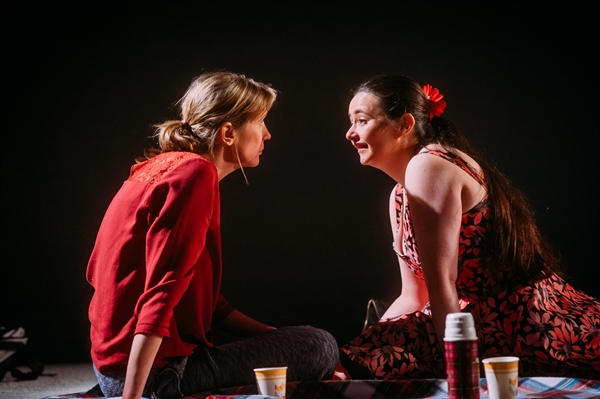
Act 1, Greenhorn’s work, is the love story of Shula (Deborah Arnott) and Avril (Karen Bartke). Shula went away after exams and came back to find Avril married to Craig, which both women find hard to take. ‘How to cope?’ falls somewhere between nostalgia and vodka, which makes it a slightly unsteady mix of the sad and the satisfying. The story is told in retrospective snatches of memory and loss. Arnott does forsaken and hurt very well; whilst Bartke has the gentler, healing role. Watch out too for the graveside wit of Mairi (Kathryn Howden) as she tends the memory of her Donald.

Act 2, Munro’s piece, is funnier, more outrageous. Jackie (Kathryn Howden again) has had enough of being Mrs Claus in a tacky Winter Wonderland but along comes her one big ‘wee adventure’ involving a killer polar bear with a bloodcurdling roar and a fantastic nose for shortbread. As Jackie mentioned Snowball cocktails, I thought Advocaat, and then of Dutch author Hans de Beer’s lovely Little Polar Bear stories; and indeed Munro’s bear (a magnificently swaddled Caroline Deyga) is a kind creature, once she has digested and expressed the men in her life, but I still wouldn’t bring susceptible children to this show.

Kathryn Howden and Caroline Deyga

Kathryn Howden and Caroline Deyga

‘Look at you!’ calls out a delighted Jackie as she passes under the Bridges. She is, naturally, on the back of a polar bear and having a whale of a time. No doubt the water is freezing but I still found the Tracks of the Winter Bear to be peculiarly heart-warming, which is always good at this time of year.


nae bad_blue

Star (blue)Star (blue)Star (blue)Star (blue)

Reviewer: Alan Brown (Seen 9 December)

Go to Tracks of the Winter Bear

Visit the Traverse archive

Hector (Traverse: 11 -12 Nov’15. Touring.)

Images: Peter Dibdin & Paul Davies.

Images: Peter Dibdin & Paul Davies.

“Distinct, succinct, and valuable”

Editorial Rating:  4 Stars: Nae Bad

Take two names of the same man, move him from Dingwall to Colombo, via Kandahar, Omdurman, and Bloemfontein, and you have an extraordinary life. It should be a history in an imperial sense – proud and impressive, monumentally worthy of respect – and in Scotland it surely is; but add sleazy allegations, the New York Herald, and a hotel bedroom in Paris and it’s all demeaned.

Born Eachann Gilleasbaig MacDhòmhnaill in Mulbuie on the Black Isle, Major General Sir Hector Archibald MacDonald shot himself in the head in the Hotel Regina on 25 March 1903. He was 50 years old. This distinct, succinct, and valuable play by David Gooderson, directed by Kate Nelson, would show how, in all likelihood, this came about.

There is a parade ground moment of wounding significance, there is a battle-field manoeuvre of astonishing derring-do, but actually it’s all set up in the mincing and treacherous line, ‘None of us would be called a fairy’, viciously twisted from ‘Three Little Maids from School Are We’. ‘Fighting Mac’, the crofter’s son from Ross-shire, had no defence against tittle-tattle and class prejudice. His face may have been on cigarette cards but the Governor’s wife cares only for (English) officers who can waltz.

https://i0.wp.com/www.tvbomb.co.uk/wp/wp-content/uploads/2015/10/Hector-1.jpg

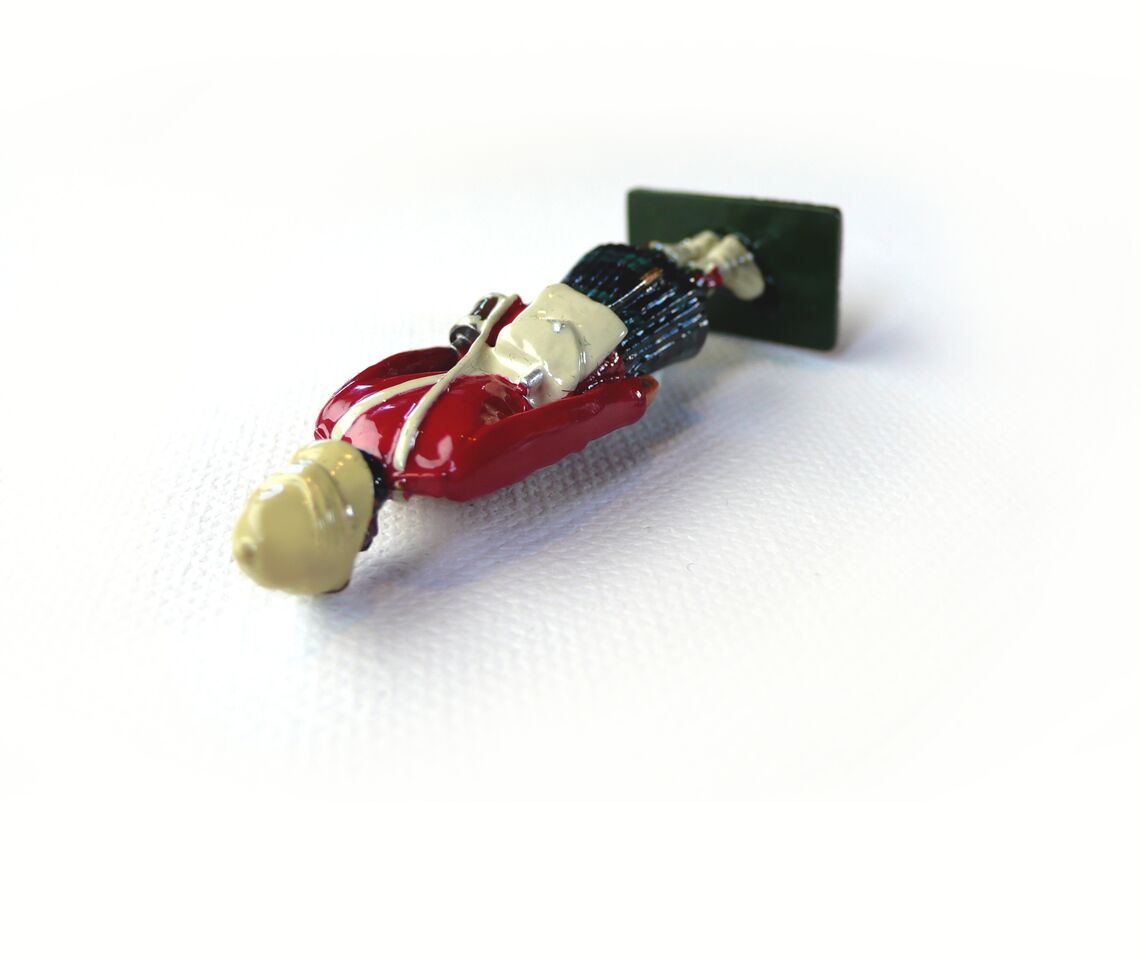
Look at Hector MacDonald, courtesy of ebay, and see Steven Duffy – broad, ramrod straight, level gaze – but without sword, sash and medals. Actually, keeping uniform to plain khaki and the odd puttee is quietly effective, as is the Highland lilt to Hector’s voice. Fancy jackets, drawled vowels, a certain moneyed ease and a torpid morality are the property of the colonial administrators and the plantation owners. Valentine Hanson is especially conspicuous as the scheming Hugh Phipps and an excellent Kevin Lenon is the chaplain, possessed of a conscience certainly, but with not quite enough of it to do any good. The Governor (Stevie Hannon) and his frightful Lady (Gowan Calder) would curl their upper lips in disdain if they knew that Hector’s London home is in middle-class Dulwich. And Hector has another, much more precious secret that comes as a smart surprise early in the second half.

Ali MacLaurin’s serviceable set is out of a military transport: an unfussy assembly of crates, a desert-blown tarp across the back, boarding steps, and a larger, rectangular box that doubles as wardrobe and coffin. (Listen up for the time of Hector’s funeral. It’s both sad and scandalous.) There is a tantalising snatch of the pipes and drums, just possibly of  ‘The Black Bear’, but the fuller, evocative sound is of strathspey and reel and of gaelic song, beautifully gathered at the close.

My one gripe is with Lord Roberts, supposedly Hector’s army mentor and ally. He bellows a final order that in fact does for Hector. I would have thought it would have been a kinder encounter along the lines of, “Now see here, Archie, this wretched business has to be faced down ….” However, what do I know? David Gooderson has had to work on what is known of MacDonald’s last years when it is clear that relevant letters and papers were ‘lost’ or destroyed. Fortunately, Raj Ghatak, who plays Roberts, also has the much more sympathetic part of the local bank manager, Vikram.

Poppy Day,  introduced in 1919, came too late for Hector MacDonald, but for him (and for the Gordon Highlanders) here are the concluding sentences to the Government Commission’s report on his death:
‘…. We find that the late Sir Hector MacDonald has been cruelly assassinated by vile and slanderous tongues … we cannot but deplore the sad circumstances of the case that have fallen so disastrously on one whom we have found innocent of any crime attributed to him.’

nae bad_blue

Star (blue)Star (blue)Star (blue)Star (blue)

Reviewer: Alan Brown (Seen 11 November)

Go to ‘Hector’ at Ed Littlewood Productions.

Visit the Traverse archive.

Thingummy Bob (Traverse: 29 – 31 October ’15)

Karen Sutherland and John Edgar. Photo: Douglas Jones & Emma Quinn.

Karen Sutherland and John Edgar.
Photo: Douglas Jones & Emma Quinn.

“Go Bob, go!”

Editorial Rating: 4 Stars: Nae Bad

A Lung Ha Theatre Company production in association with Luminate, Scotland’s creative ageing festival.

Go looking for ‘Thingummy’ in a dictionary and you’ll find ‘Thing + a meaningless suffix, colloquial [since] 1751′. Well, there is nothing sketchy, meaningless or dated about this prize piece from writer Linda McLean and Lung Ha Theatre. It is plain, touching, and enjoyable; which is totally unsurprising when you learn that its title song is The Young Ones by Cliff Richard and The Shadows, 1962 (and counting). It is a bit mean of me to draw your attention to line 6, ‘For we won’t be the young ones very long’, but that’s the inescapable bit.

Bob (John Edgar) is in a wheelchair in a care home and is on a mission to rescue his LP records and what he can of his memory. He knows that he likes caramel wafers and is none too keen on pill popping. He loves his wife Audrey very much and wants to get back to their house but he cannot find his keys. He is determined, resourceful and witty and when he says “I do so mean it”, he does.

Binox (Karen Sutherland) has the job of keeping her eyes on Bob. She is the speaking voice of the care home’s security system and – binoculars trained – she would follow him wherever he goes. Charge Nurse (Kenneth Ainslie) and auxiliary Cap (Mark Howie) do their caring best and his niece Gemma (Emma McCaffrey) is always reassuring and kind but Bob can be hard to keep track of. The police get in on the act too. Bob’s other niece, Lesley (Karen Sutherland again), sends warm letters and postcards but she’s in Sydney, Aus. so really it’s down to his neighbour, Mrs Johnson (Kenneth Ainslie once more), to put the kettle on for when Bob makes it home.

It’s a fun pursuit that is made all the more engaging by the breadth and space of the set design by Karen Tennent. M C Escher squares and a revolving centre piece might suggest a board game – with rapping moves –  but the projection of photographs from Bob’s family album adds a whole new dimension. Personal really. Music by Philip Pinsky provides a catchy accompaniment, complete with scratches from those treasured 33s.

At one point, when Bob is trying to reach Audrey, Gemma says ‘”This is too sad”. It is and it isn’t, which is the appeal of ‘Thingummy Bob’. McLean’s script is clever, switching from the short and conversational – especially Cap’s serial “Aye’s” – to the longer, more considered and reflective sequencing of Binox and Lesley. Certainly the issues of aging and dementia are well in place but it is Bob’s story and Edgar’s performance that hold the stage as he wheels around it.

Artistic director Maria Oller and Movement Director Janis Claxton find great, sympathetic, cheer from this closing couplet of ‘The Young Ones’, ‘And some day when the years have flown / Darling, this will teach the young ones of our own’. Go Bob, go!

nae bad_blue

Star (blue)Star (blue)Star (blue)Star (blue)

Reviewer: Alan Brown (Seen 30 October)

Go to Lung Ha Theatre Company and Luminate

Visit the Traverse archive.

Descent (Traverse: 20 – 24 October ’15)

Photo: Leslie Black

Photo: Leslie Black

” … doolally moments get longer and longer”

Editorial Rating: 4 Stars: Nae Bad

The fourth in this autumn’s ‘A Play, a Pie, and a Pint’; presented in association with Luminate, Scotland’s creative ageing festival.

Do you play ‘Trivial Pursuit’? Remember the rules? Where do those wee scoring wedges go, the ones that make up the ‘pie’? When did England win the World Cup? Rob is certain he knows the answers but he doesn’t, not at all.

You might go down with a bad cold, but Rob is going down with dementia and he’s probably only in his mid-fifties. That’s ‘Younger Onset Dementia’ then.

Linda Duncan McLaughlin’s play is not comfortable and it is definitely not trivial. It takes 60 minutes of stage time for Rob to go from running his own architectural practice to forgetting how to sit in a chair. His wife, Cathy, does more than her best to care for him but their daughter, Nicola, can see that there comes a point when Dad is too far gone and that Mum cannot continue the struggle to keep him at home, not least for the sake of her own health.

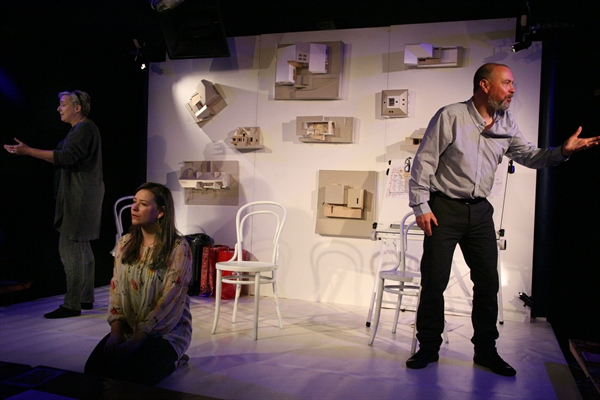
That Rob is an architect is a cruel touch. He has always found pleasure, even beauty, in design and function but here is laid low, kaboshed, by a condition that reduces his brain to formless mush. While he grows frantic because he cannot find his pen we see display models carefully arranged on the wall and neat plans on his drawing board. Rob knuckles his forehead in frustration as his doolally moments get longer and longer but there’s nothing feeble-minded about Barrie Hunter’s performance.

“Everything’s slipping”, says Cathy, and a clock tick-tocks away in the dark scene intervals. Wendy Seager’s calm presence is all the more disquieting in this exacting role. Cathy holds on to Rob as long as she can, which puts her at considerable risk, but their home grows silent, then empty, and finally there is nothing left, just an absence. Nicola (Fiona MacNeil) has, as she puts it, ‘to kick the walls down’.

It is a steep descent, narrowing all the while. McLaughlin and director Allie Butler steady it with a retrospective structure, instances of shared speech and some explicit commentary. The audience, selfishly, is  especially alert when the signs-to-look-out-for are tested at home. Rob, bless him, is appalled – and scared.

NHS Lothian is ‘Making Edinburgh dementia friendly’ at the moment. Look out for a leaflet in the libraries asking whether you are ‘Worried about your memory or someone else’s?’ If you’re not, Descent will make you think again.

nae bad_blue

Star (blue)Star (blue)Star (blue)Star (blue)

Reviewer: Alan Brown(Seen 20 October)

Go to Descent at the Traverse here

Visit the Traverse archive.