‘The Strange Case of Jekyll and Hyde’ (Traverse: 19 – 21 March ’15)

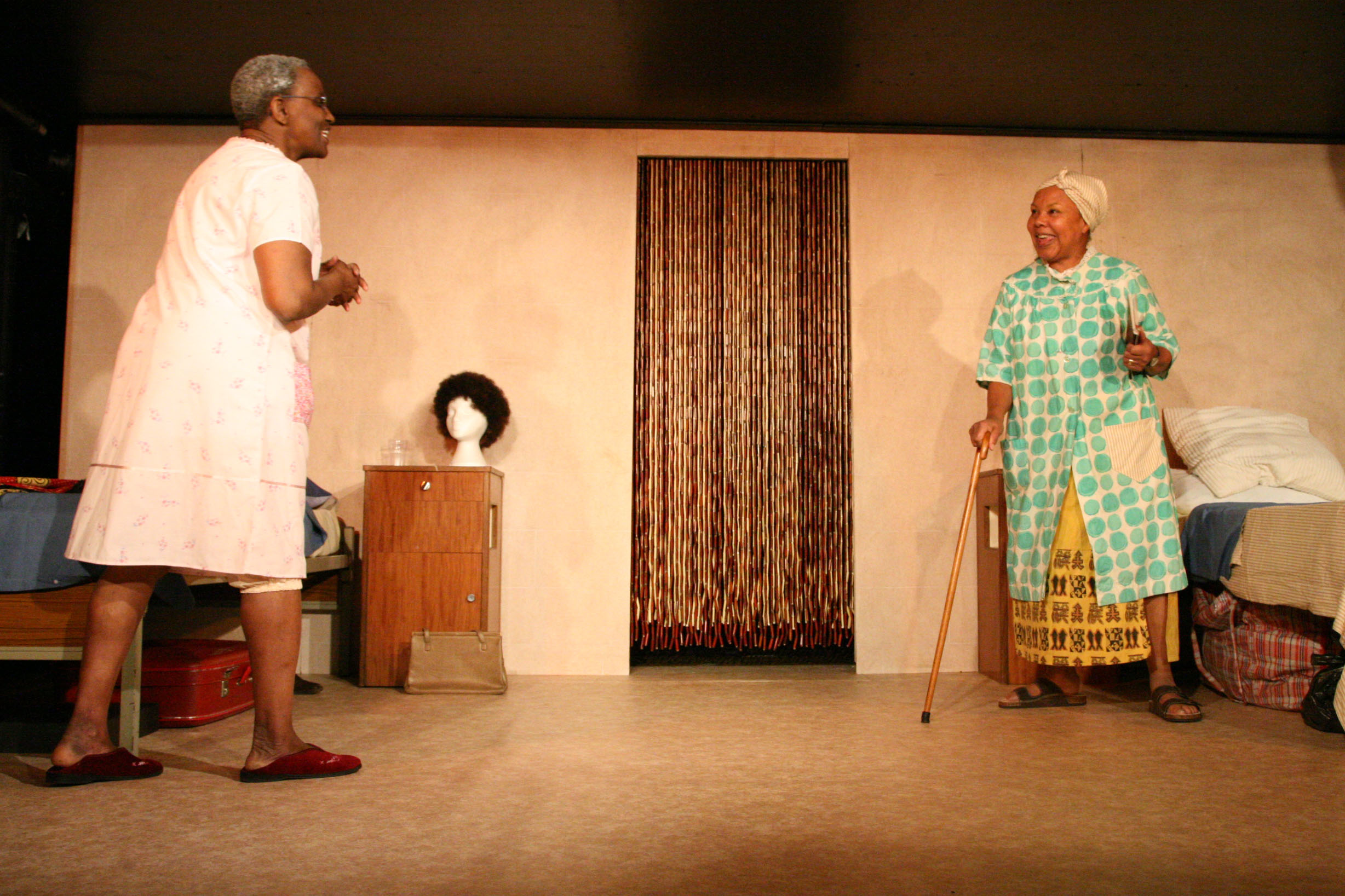
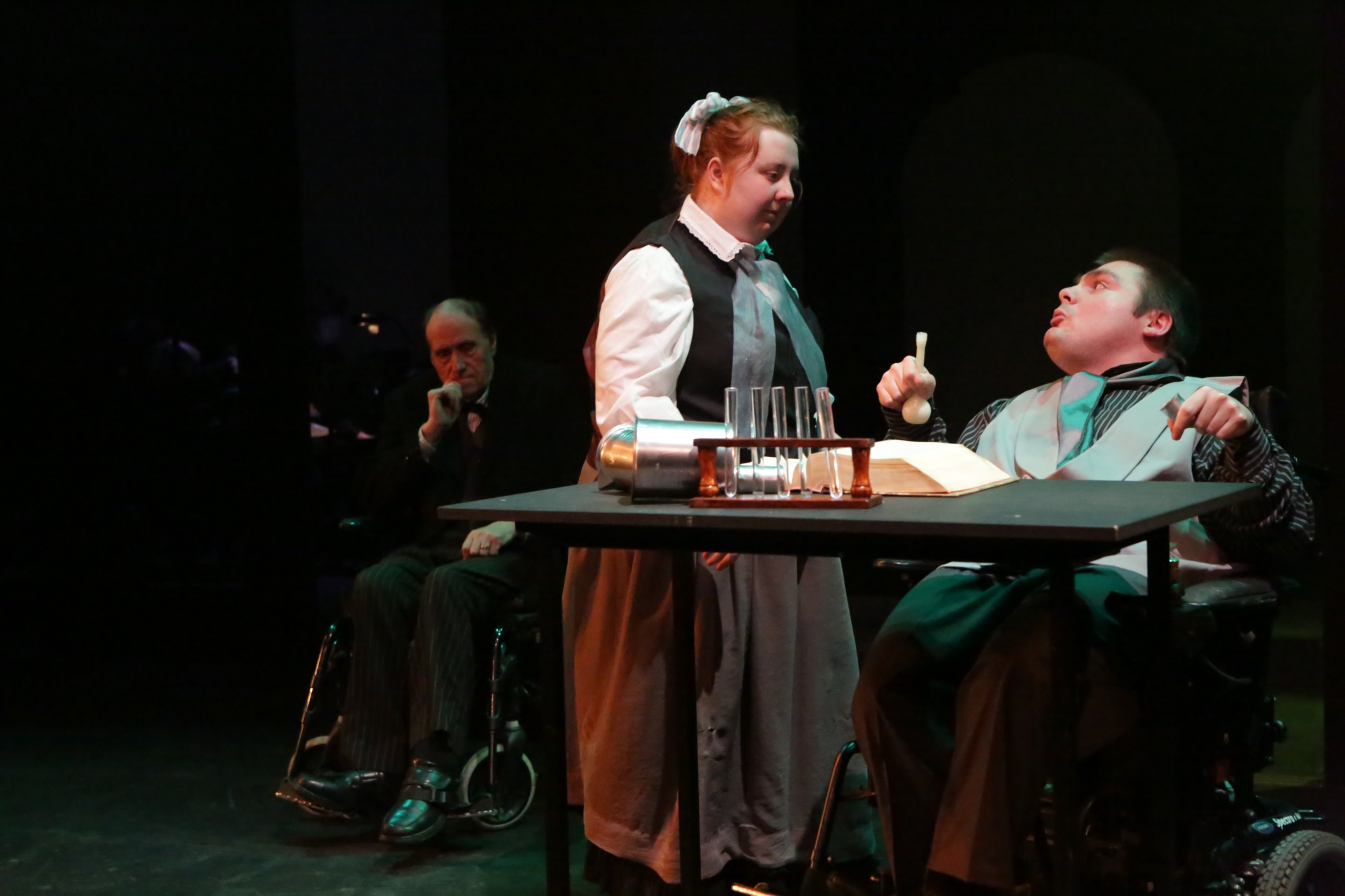
(l - r) John Edgar as Poole, Emma McCaffrey as Miriam Jekyll and Stephen Tait as Dr Jekyll Photos: Douglas Jones

(l – r) John Edgar as Poole, Emma McCaffrey as Miriam Jekyll and Stephen Tait as Dr Jekyll
Photos: Douglas Jones

“A fleet and surprising adaptation of a famous story”

Editorial Rating: 4 Stars

It is strange indeed when Miriam Jekyll puts Hyde onto her shoulders and carries her off stage. You might think that light work is being made of RLS’s ‘classic’ shocker of morbid psychology. You’d be wrong though. Stevenson’s story is here, it’s just been gifted with some nimble ideas and relocated to Edinburgh. Hair restoration and topiary outrages in the New Town are up there together with the double consciousness.

Writer Morna Pearson gives Dr Jekyll a family: Jane, his wife, who finds anaesthesia from marriage in drink; William, his son, a friendly soul who is never going to get to Uni’; and Miriam, his daughter, who should be in the Chemistry labs but who has become Hugo’s darling Intended. It is Miriam who helps herself to her father’s green potion and who finds Hyde (a dead ringer for The Woman in Black) at the bottom of the glass. And it is together, through the toun, that the two young women enact ‘the thorough and primitive duality of man’. It is not the case, in this version, that when Hyde appears Jekyll disappears. No, theirs is a prime alliance.

The pathological strain is replaced by social horrors: Jekyll has money problems and his creditor, Dr Black, sexually assaults Miriam. Hyde fights back. Police enquiries get nowhere as the good folk cannot see that the evil doers are just like them – sometimes. To frame the action Director Caitlin Skinner has the twenty cast members divide into pairs and to eyeball each other accusingly and then “Shush!” us into a conspiracy of silence.

The thematic assists from composer Greg Sinclair and the musicians of Drake Music work extremely well. The opening soundscape of bells and chimes and hooves quickly gives way to single notes and jagged chords. Miriam suffers the effects of the concoction as pins and needles stick in our ears. Solo voices intone in uncanny ways and wind about the silhouetted archways, stairs and closes of the city.
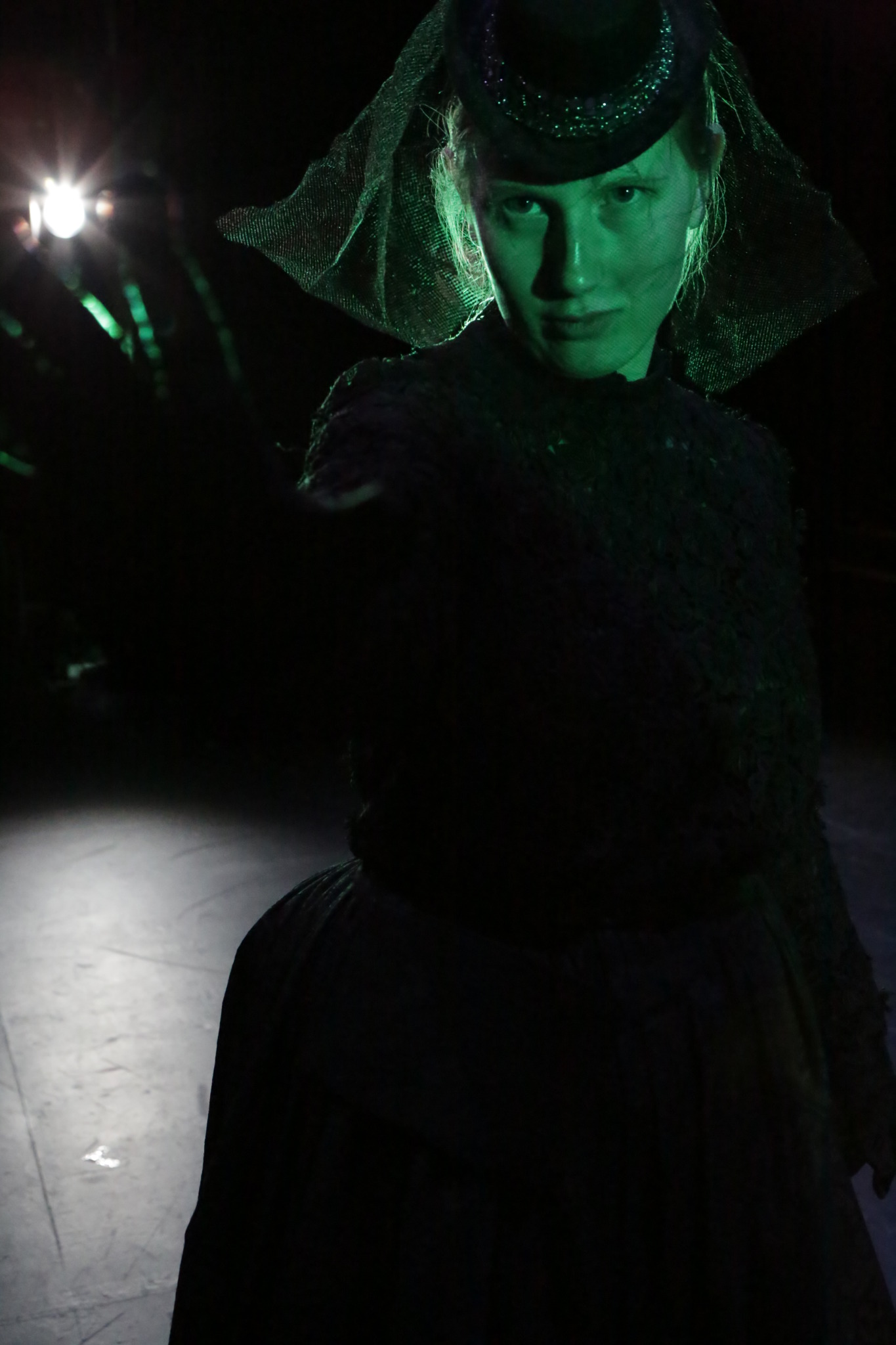
Nicola Tuxworth as Hyde

Nicola Tuxworth as Hyde

The open stage and precise blocking allows the performers to distinguish themselves. Stephen Tait as Dr Jekyll is the focused professional with secrets to concentrate on. He loves his daughter but is the late Victorian father with some lunatic ideas about the brain. Emma McCaffrey’s Miriam responds with due affection but has her own abiding demon to wrestle with, both in the parlour and on the roof. Hyde (Nicola Tuxworth) does not speak but is a veiled and forbidding presence whose outstretched hand you would not want to hold. For me, though, it is the lugubrious Poole (John Edgar), butler to Jekyll’s household, whose words you hang onto. After all, it is Poole who reveals that he has heard Miriam talking to her ‘friend’.

So, a fleet and surprising adaptation of a famous story that really belongs to Edinburgh and which Lung Ha Theatre make their own.

Star (blue)Star (blue)Star (blue)Star (blue)

Reviewer: Alan Brown (Seen 21 March)

Go to Lung Ha Theatre Company and Drake Music Scotland here.

Visit the Traverse archive.
‘The Devil Masters’ (Traverse: 10 – 24 December’14)

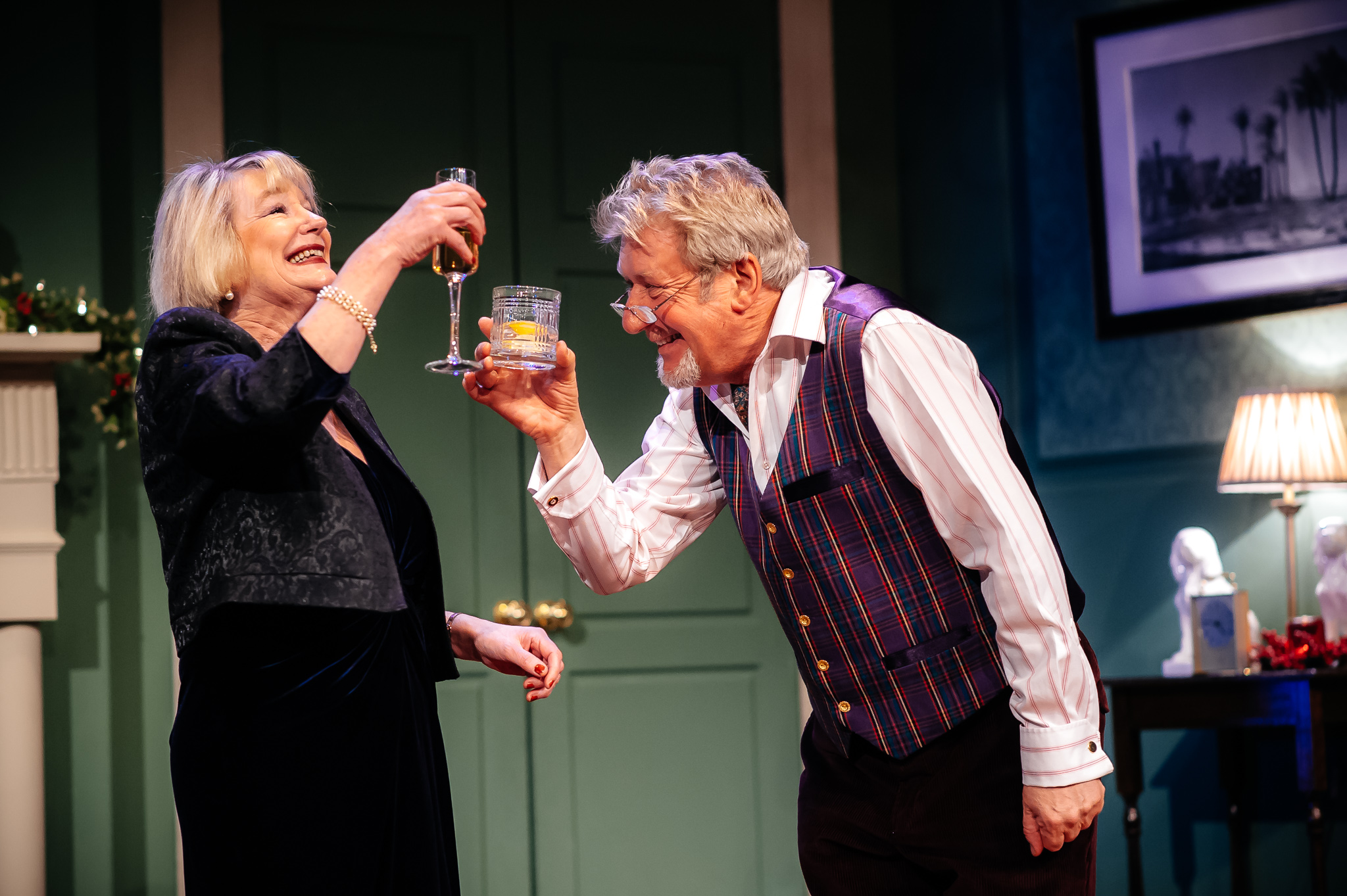
Photo: Mihaela Bodlovic

Photo: Mihaela Bodlovic

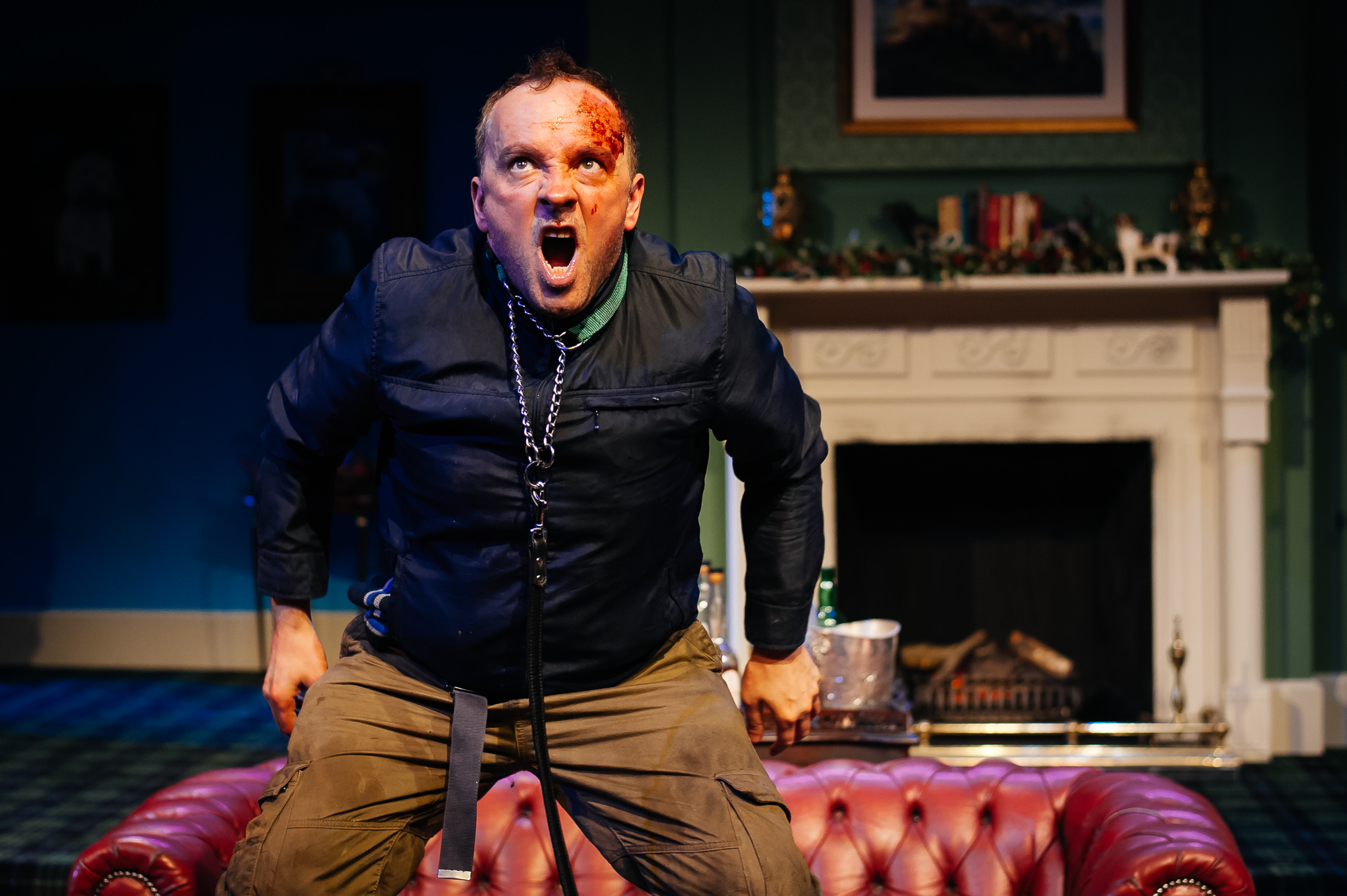
“Chains, mordant humour and lashings of sharp comment”

Editorial Rating: 3 Stars Nae Bad

Admire the set. Designed by Anthony Lamble and lit by Colin Grenfell. Very tasteful, very Royal Circus; to begin with, at least, and then it looks unhinged.

It is Christmas Eve and Cameron and Lara Leishman are ‘At Home’ for drinkies, the remains of a chinese carry-out and lots of presents, just the two of them and their Skye terrier, Maximilian, and that’s how they like it. That these two advocates are self-satisfied is to put it mildly, but then their swish garden flat is in the New Town and no doubt they have worked so very hard to afford it. You might have called round earlier, expressing mild surprise that Cameron isn’t a QC yet and thought it all a touch chichi, maybe, but it is still absolutely fabulous … “and do have a lovely time this evening, just the two of you”.

Except that they don’t, not at all.

‘Season’s Greetings’ are a joke when it comes to what happens to the Leishman’s. For a start, Max’ gets dognapped and second there’s that pun in their name. Iain Finlay Macleod gives us pedigree ‘Christmas Carol’, the writer’s mega cut. No redemption is offered but this story has chains, mordant humour and lashings of sharp comment .

The first gift is unwrapped and admired and Cameron and Lara receive an unexpected and unwelcome visitor. John watches ‘The Wire’, so he says he’s from ‘the projects’. For Lara he’s a schemie, feral, the low life of the Sheriff’s Courts. He needs house training. Cameron, well bred, is a little more accommodating. He realises that for John to have had to leave Fettes junior school after only a couple of years was not one of life’s lucky breaks (!). John (Keith Fleming) has nerve, wit and honesty but gets it in the neck. He’s walking wounded in a nasty class war that Lara (Barbara Rafferty) prosecutes with all her vicious might. Cameron (Johnny Bett) would intercede but plays junior counsel to his partner’s vengeful brief. Director Orla O’Loughlin brings on action that is outrageous, radge and lurid.

Photo: Mihaela Bodlovic

Photo: Mihaela Bodlovic

It is close to home. Some will wince in recognition at lookalike ANTA interiors. There’s Albinoni on the invisible Sonos wireless system. Cameron knocks plebian Glasgow. Edinburgh lawyers acquire frightfully mannered English accents. There’s the EH3 postcode, Georgian cornicing, John’s pals from Pilton with their howling dogs, fireworks at New Year, and a legal profession prejudicially bent on fee income. But there’s more to it. David Hume’s statue is arraigned, or more accurately his toe is. What would the great philosopher make of the Leishman’s behaviour? For sure, they only actually do anything – as opposed to decorating their tree with photographs of past pooches – when they’re frightened or threatened. At best this is difficult to live with; at worst, it’s deranged.

I’ll stay with Christmas rather than moral philosophy. Go to ‘The Devil Masters’ with this text in mind: ‘He came unto his own, and his own received him not. (John 1:11) ’. Dispute ownership.


nae bad_blue

Star (blue)Star (blue)Star (blue)

Reviewer: Alan Brown  (Seen 10 December)

Visit ‘The Devil Masters’ at the Traverse here.

Visit our Assembly Roxy Bedlam Church Hill Theatre Festival Theatre King’s Theatre Other Pleasance, Potterrow & Teviot Summerhall The Lyceum The Stand Traverse archive.

THIS REVIEW HAS NOT BEEN SUBEDITED

‘Flying with Swans’ (Traverse: 4 – 8 November ’14)

Photo: Leslie Black

Photo: Leslie Black

“Well-met, if slightly over the guard rail”

Editorial Rating: 4 Stars

Last in the autumn season of A Play, A Pie and a Pint.

Three elderly women embark upon on a “Great Day Out” to Arran, and indeed it kind of turns out that way. The weather is mild, the ice cream is good, and they stay on deck for the entire crossing. Brodick is dead ahead, but this is forty-five minutes of diverting, mischievous dialogue from Glasgow writer Jack Dickson. Its most acute moments are pin-sharp sad, but the piece is funny and kind-hearted too. Sage, no’ Saga.

As over seventy fives, Dolly, Jean, and Mona go back years, and there is some fond reminiscing, which is where the whooper swans fly in. However, the old girls talk as much of the present as of the past. For a start, there’s Mona’s ‘borrowed’ and bashed car that retired and repressed solicitor-advocate Dolly feels obliged to report to the police. Meanwhile, Jean is escaping an anxious daughter who is taking her duty of care to neurotic heights.

The play is, naturally, a tale of age and loss but not in any mawkish fashion. No one’s sick on this CalMac service. However, the passage of time has probably hurt Dolly (Anne Kidd) the most. Her schnauzers are gone, and she may appear trim and resolute and but her friends know the truth, and offer her the love and support that she needs – and finally accepts. For carefree, absconding Mona (Karen Ramsay), it’s different, which you can see from her nightie and Nessie hoodie! Vague, intuitive Jean (Kay Gallie), with her bag full of blue and red pills, probably has the most telling line. “I miss me,” she says.

The casting is excellent and the three performances are well-met, if slightly over the guard rail, for Dickson is writing incautiously and with affection. His programme credit reads that Flying with Swans is offered as ‘a tribute to the women who feature in all our lives’. I’m on board with him.

Star (blue)Star (blue)Star (blue)Star (blue)

Reviewer: Alan Brown (Seen 4 November)

Visit Traverse Homepage here

Visit our Assembly Roxy Bedlam Church Hill Theatre Festival Theatre King’s Theatre Other Pleasance, Potterrow & Teviot Summerhall The Lyceum The Stand Traverse archive.

THIS REVIEW HAS BEEN SUBEDITED

Crash (Traverse: 28 Oct – 1 Nov ’14)

Photo. Leslie Black

Photo. Leslie Black

“More slo-mo skid and shunt than full-on collision, more  crunch than splat”

Editorial Rating:  4 Stars: Nae Bad

In the Autumn line-up of A Play, A Pie and a A Pint.

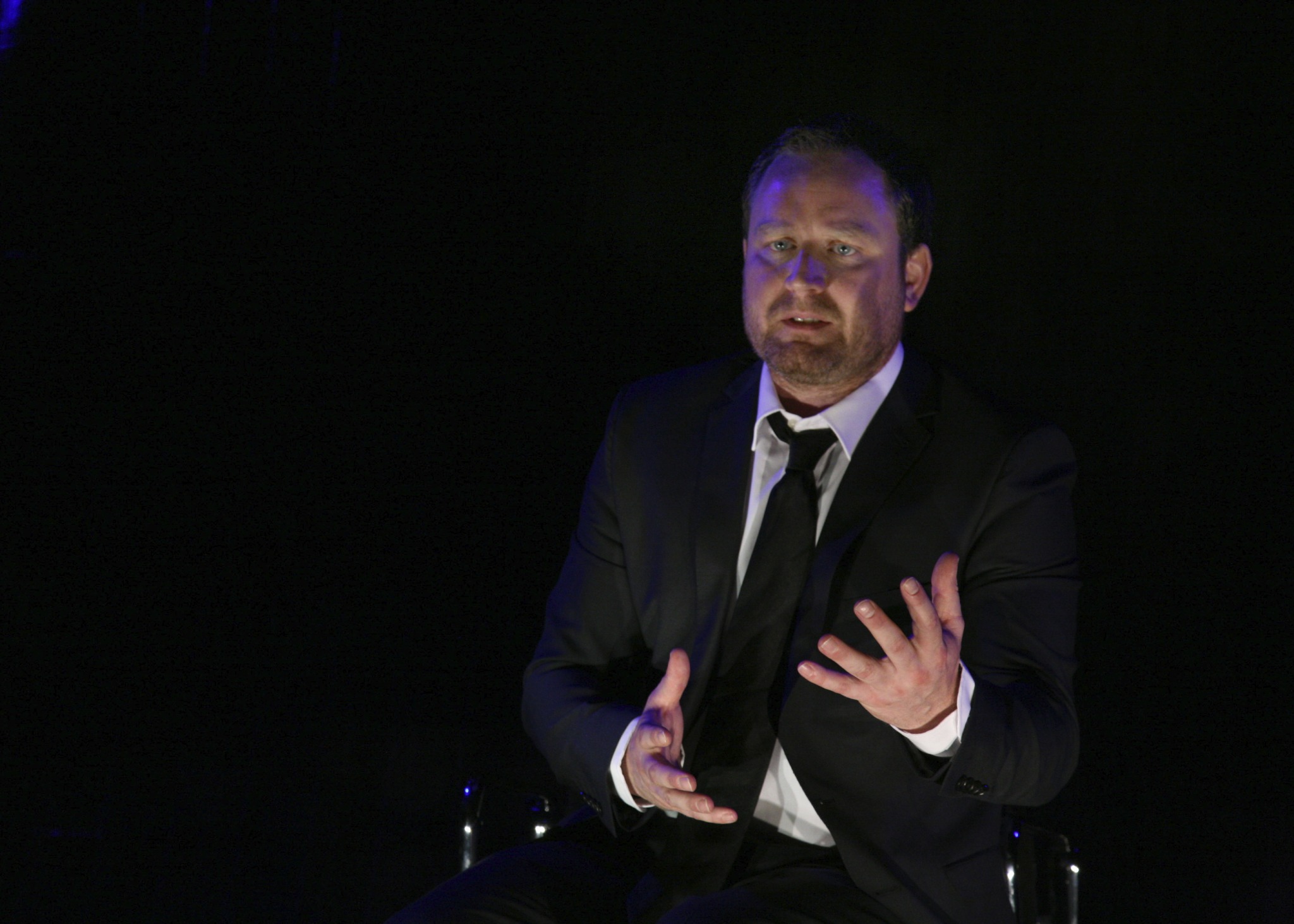
A whacked City trader speaks. He’s Scottish but it’s a quids in, pound sterling monologue, unassuming and on the level; a penny plain real deal, in fact, provided you accept that asset management is an emotional as well as a financial business. Finally, even naturally, the ‘game’ wastes you. There’s a wreck at the end of the tunnel.

Writer Andy Duffy’s single character has no name. He is a man alone in a sober suit and tie on a shiny office chair in a smooth glossy space. He could be in Aberdeen or across the way in Standard Life House, but still I incline to the Square Mile. His story begins on the night of 23 August 2007. (For the record Lehman Brothers declared bankruptcy on 15 November 2008.) He is precise like that; where he can he will enumerate, when he can’t he’ll simply point out that you don’t make money by being careful. And, instinctively, he has made and is still making lots of it.

Man (Jamie Michie) reads a piece in the ‘Financial Times’. His new girlfriend, Kate, prefers novels, which he considers to be self-indulgent pap. Man had a wife once but Alison died, which he’s sorry about, but shit happens when you lose control at the wheel, or when your investments go south. That’s ‘unprecedented volatility’ for you, which is where I’d bring in Russell Brand, who had lunch with the FT just last week. Brand finds the pink pages ‘hard to understand’ and opposes his ardent belief in spiritual ideologies to the FT’s economic one(s). So too even our trader, bruised and shaken by his wife’s death, attends meditation classes where in mid-mantra he finds consolation in … Kate’s long blond hair and tight figure. Nothing too revolutionary there to upset the capital markets .

Crash is more slo-mo skid and shunt than full-on collision, more crunch than splat, and so more revealing. There is the head-rest proposition that ‘money equals power and freedom’ but how is that supportable? Every now and again something is going to pile in from behind and the result will be bloody. You can hear it happening. There is a thrum of white noise – not Traverse 2’s air con – and the lighting gets colder. I was reminded of a Tube train coming into Bank. Man rises from his chair and/or collapses on a park bench and you wonder, not for the first time since the last financial horror show, if getting minted is worth it.

A driven, strong play that is expertly directed by Emma Callander and impressively performed by Jamie Michie.

nae bad_blue

Star (blue)Star (blue)Star (blue)Star (blue)

Reviewer: Alan Brown (Seen 28 October)

Visit Traverse Homepage here

Visit our Assembly Roxy Bedlam Church Hill Theatre Festival Theatre King’s Theatre Other Pleasance, Potterrow & Teviot Summerhall The Lyceum The Stand Traverse archive.

THIS REVIEW HAS NOT BEEN SUBEDITED

‘Outlying Islands’ (Traverse: 1 – 4 October ’14)

Martin Richardson. Photo: Graham Riddell

Martin Richardson.
Photo: Graham Riddell

“Wide, invigorating views in a small space”

Editorial Rating: 4 Stars: Outstanding

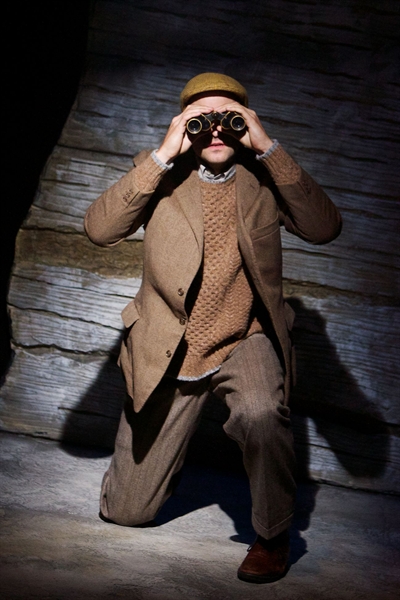
“‘Scuse my French,” says birdwatcher John – repeatedly. This thoroughly decent young man, BA. Cantab., has had enough – again! The year is 1939 and John is on the remotest of the Western Isles with stinking socks and his gimlet-eyed pal, Robert, who is bound to get the sweet girl first. You might hear the romantic airs of Local Hero within Outlying Islands, for the Celtic soundscape is lovely, but instead I see a fab, screwed up Tintin-esque adventure amongst the fork tailed petrels.

I reckon playwright David Greig likes Hergé’s impeccable line, after all, he did adapt Tintin in Tibet  for a Christmas show at the Barbican in 2005. Outlying Islands has the same startling and redemptive quality of that blameless story. However, the play’s audience also sees scary biological warfare and delightful sex.

It is the sharp clarity of the piece that impresses most. The first lines open with “I have noticed,” and it as if the audience are the ones with the binoculars, watching intently and enjoying what they discover. A bright and acute script paired with alert, insightful direction by Richard Baron is as effective as fixer in old style photographic processing, which you’ll be reminded of. We get focus and definition all throughout, with flashbulbs and nae pixels.

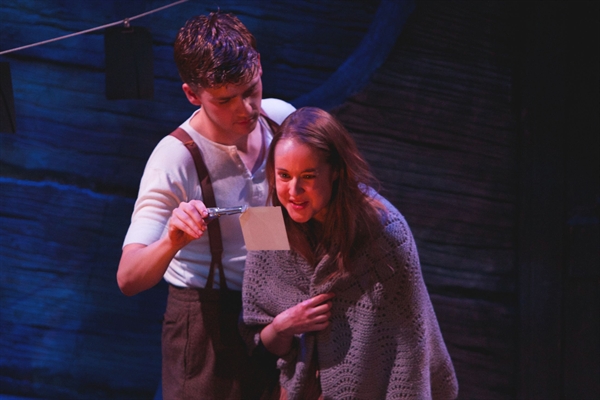
James Rottger and Helen Mackay. Photo: Graham Riddell

James Rottger and Helen Mackay.
Photo: Graham Riddell

We are way out west, literally in a rock burrow, and cinematically in Laurel and Hardy territory. Their 1937 film is Ellen’s favourite but for her ‘Free’ church uncle, Kirk (!), the cinema is a place of darkness where only the Fallen gather. London, by way of the same Calvinist conviction, is a ‘gannetry of random defecation’. What’s a young woman to do – apart from prepare puffin stew? Ellen’s happiness at finding an answer in unforeseen liberty is wonderful, and Helen MacKay is jubilant in the role. Nice John or Johnny, played straight and true by James Rotger, is not a happy chappie when confronted by deep feelings – arguably like Tintin – therefore his discomfort, naked on the kitchen table, is understandable. Martin Richardson is utterly convincing as Robert. Probably amoral, certainly sensitive, fiercely rational, and undoubtedly bad for Kirk’s health, he has the dash of the pagan about him. Crawford Logan has the unsympathetic (adult) roles, playing Kirk, who is mean in spirit, calculating, a relic to be parodied, and, very briefly, the Captain of the ship that returns to take them off the island and back to …. Ullapool?

During the referendum campaign David Greig spoke of Scotland and a Scottish population that had been wearing UK goggles for long enough: ‘goggles which say you never ask questions’. ‘Outlying Islands’ has come back, post Yes/No, and offers wide, invigorating views in a small space. You might pick holes at some cartoonish excess or at the fly-away innocence of the plot or even at some speech bubble dialogue, but I saw an excellent production from  Firebrand Theatre; the same company that brought ‘Blackbird’ (not Leach’s petrel) to Summerhall in February. That was outstanding too.

outstanding

StarStarStarStar

Reviewer: Alan Brown (Seen 1 October)

Visit Outlying Islands homepage here.

THIS REVIEW HAS BEEN SUBEDITED

‘The Forbidden Experiment’ (Traverse: 1 – 3 May ’14)

Michael John O'Neill and Rob Jones Photo: Chris McNulty

Michael John O’Neill and Rob Jones
Photo: Chris McNulty

‘Halting thesis: that we exist to be dumbfounded’

Editorial Rating: Unrated

Produced by ‘Enormous Yes’, The Arches Platform 18 Award Winners.

Ever wanted to get inside a clever comic strip? Here’s your chance. For me The Forbidden Experiment is highbrow, secret, Numskulls from The Beano. D.C.Thomson can be proud of this Glasgow borne variation on its team of little technicians who live inside your head, trying ever so hard to do it right but suffering mischievous upset and body blows time and again. The play is self-conscious, ingenious and cerebrally in-your-face; but its audience, to experiment with the passive voice, is likely to end up scatterbrained.

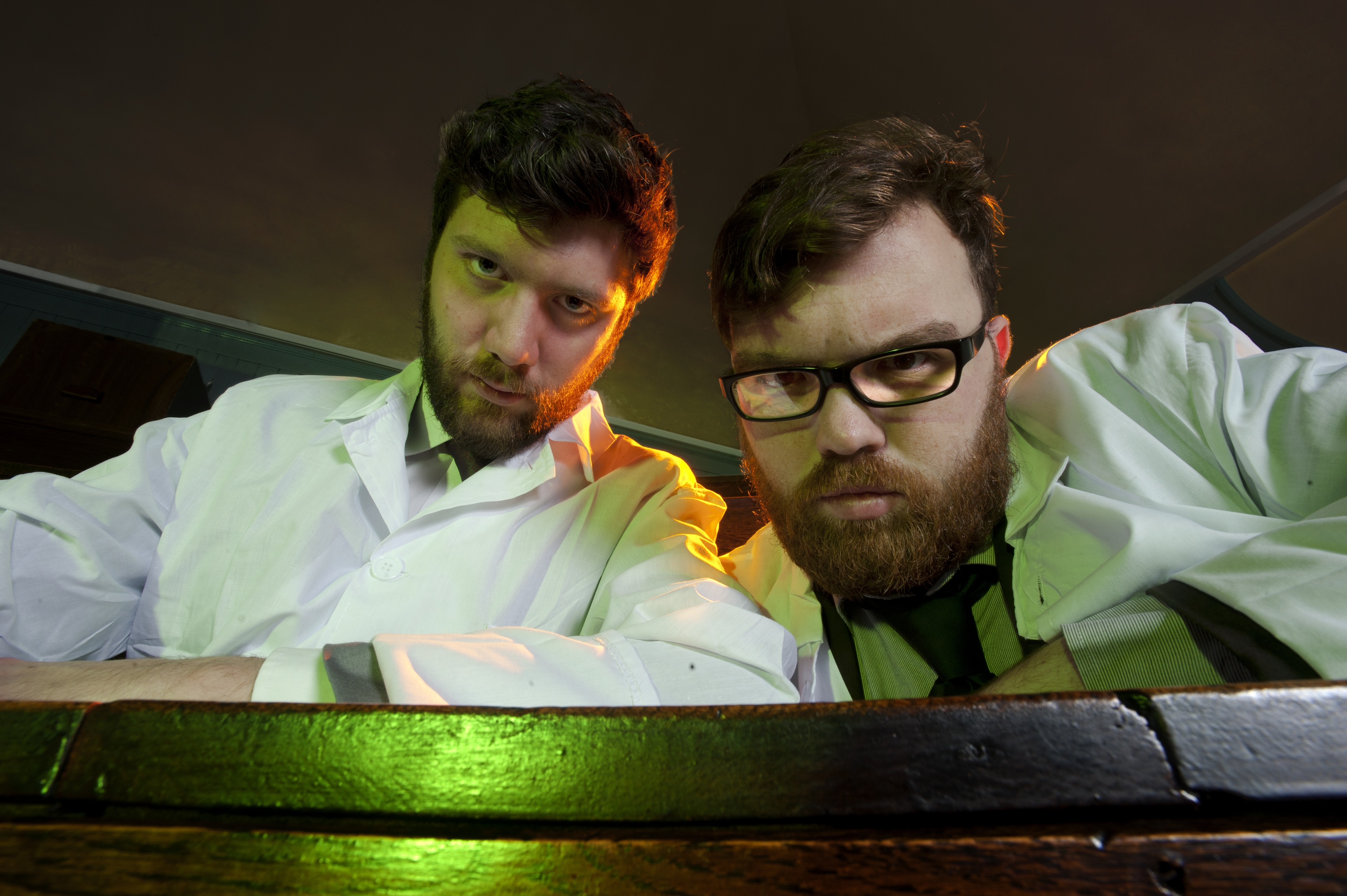
Not that there isn’t strategic purpose. It’s there in box loads over the impressive laboratory of a set: microscope, desk microphone, molecule model, lots of important looking files marked ‘Inchkeith’ with – a bit of a date fixer, these two – a carousel slide projector and a rolling blackboard (never used; shame!). All to investigate what may have happened on Inchkeith island out there in the Firth in – specifically – 1493 and 1944/45. Subjects of study are (i) Language before we fouled it up at Babel and (ii) Language when we messed with it again but this time with practised deceit, as in the British Fourth Army on Inchkeith and with radioactive fallout from the Manhattan Project . You may think that there’s not too much to go on to join (i) and (ii) but that’s where you’re wrong and the two guys in lab coats are right, kind of.

Halting thesis: that we exist to be dumbfounded, for our understanding is forever partial.

So, there’s writer/actor Michael John [Brainy] O’Neill as Himself in a white coat, when he’s not cut up in love or sailing out to Inchkeith with those boxes. He is also penitent, freighted, James IV, who would learn to speak with God, and Mr Alvarez whose small ranch in Socorro County, New Mexico, turns out to be way too close to the nuclear test site. And there’s director Rob [Blinky] Jones, with suitable beard and always in a white coat, a natural at the lab bench you might think, but no. Laconic and spare assistance – not least on keyboards, guitar and harmonica – is provided by Matt [Radar]Regan, whose Abbot Counsellor to James IV is Gollum at his most precious. The Company is completed by Zosia Jo (too expressive for a Numskull), whose dancing in the two roles of ‘Creature’ and Michael John’s ‘Ex’ is especially demanding and pairs well with the cryptic kaleidoscope of the slide show.

Were there an ‘Only Connect’ wall on that blank blackboard then The Forbidden Experiment would have been easier. As it is its different narratives describe fraught or frenetic situations that defy sorted outcomes, let alone a conclusion. Radiation sickness breaks down Alvarez’s speech; redacted documents frustrate History, capital ‘H’. Love overturns a dingy crossing to Inchkeith. We are left with revolving images and impressions of marvellous and necessarily strained acting – O’Neill’s in particular – and the light relief of actors, as well as boffins, getting peeved with each other and with the script.

As a body of work The Forbidden Experiment is terrific and will stay in your head. Mine is not big enough to see it all at once.


Reviewer: Alan Brown (Seen 1 May)

Visit The Forbidden Experiment homepage here.

‘The Queen of Lucky People’ (Traverse: 29 April – 3 May ’14)

Eileen Nicholas as Patrice French Photo: Lesley Black

Eileen Nicholas as Patrice French
Photo: Lesley Black

‘Patrice’s impish tittle-tattle lands her in some embarrassing shite.’

Editorial Rating: Nae Bad

The last in the Traverse’s very welcome A Play, a Pie and a Pint season.

A venetian blind is prone to twitch not tweet. Anyhow, it provides the tell-tale keeking backdrop to The Queen of Lucky People, without doubt set in a tenement flat near you.

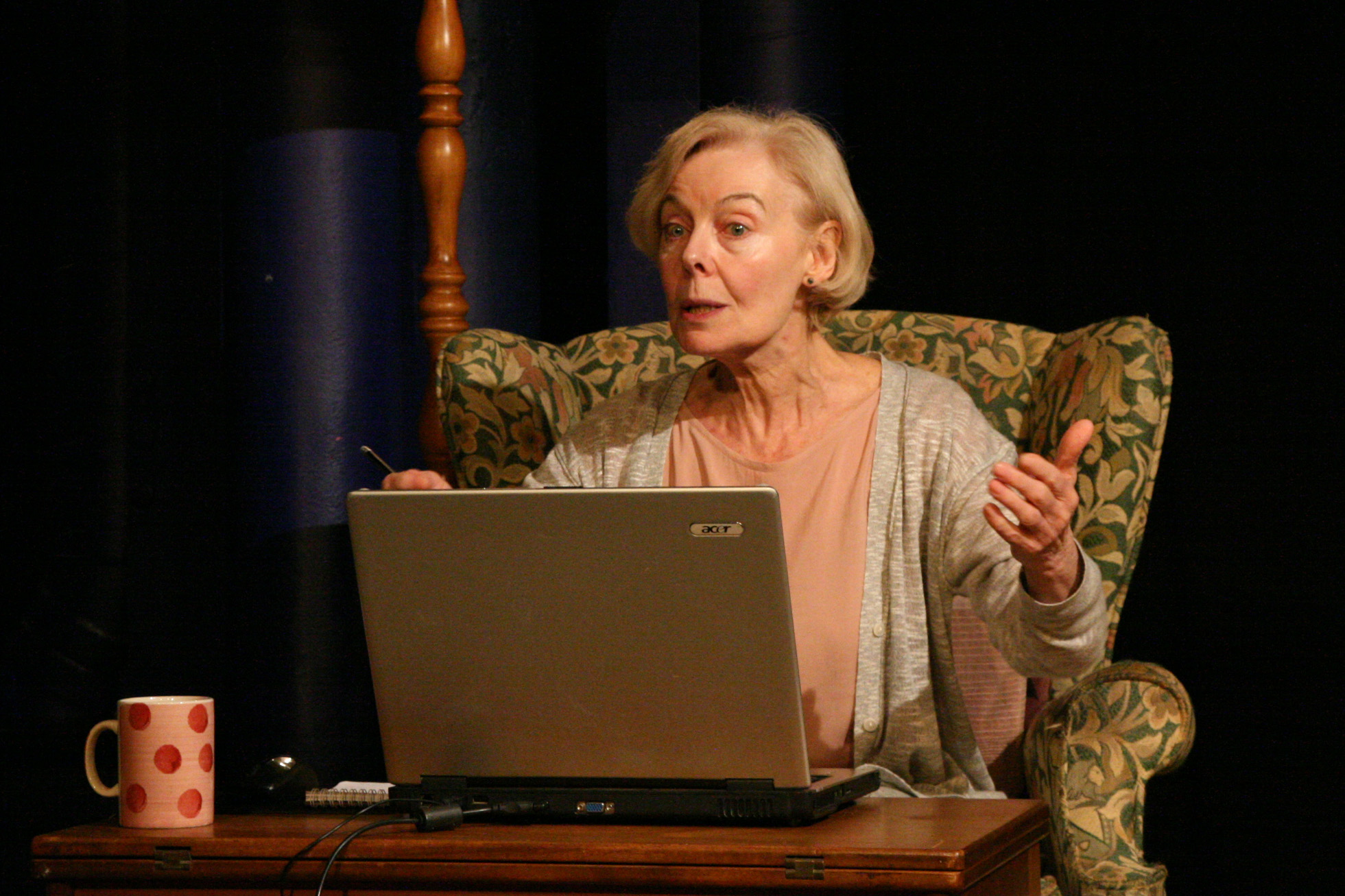
Patrice French, clerical officer, retired, lives there, which might just be the cheap end of Kelvin Drive, G20, or off the Warriston Road, EH7; either way, close enough to really notice the neighbours and to go out once in a while for a walk by the river. Not that Patrice gets out much as she prefers to be in the immediate vicinity of her laptop, spending cushioned hours within her social network of choice, ‘Lucky People’.

She has the site’s language at her fingertips. She tallies ‘Awesomes’, ‘LOLs’, and ‘Friends’ –  they’re ‘Buddies’ on ‘Lucky People’ –  with mounting glee and notes her “Record!” stats with pride. A euphoric Third-Age experience or late onset OCD? Regardless, out of sight and careless, Patrice pushes out her gossipy posts. She does not answer the phone and the blind is kept down.

Writer Iain Heggie gives Eileen Nicholas as Patrice many a winning line of solo banter. Laughs are frequent (and a little easy?) when you give an elderly character the energy and the assurance of the hip and snappy catchphrase. The script is at its best when, through the piece, Patrice’s impish tittle-tattle lands her in some embarrassing shite. You will be pleased to see how Marigold Extra-Life kitchen gloves and doggie bags, off, do the business.

It is a redemptive tale. You might argue that Patrice is a better person for having discovered – and thrown out – the troll within. Certainly Nicholas’ sure and appealing performance is of a lonely woman who is happier and kinder at the end. Sympathetic direction by Emma Callander and focused design by Patrick McGurn combine to lift a bright but brittle character into a companionable place. And so the blind goes up.

My only problem, and quite possibly mine alone, was that I could not get Alan Bennett’s A Woman of No Importance and the other Talking Heads out of my head. It is actually to compliment Iain Heggie that the thought of Bennett’s Miss Schofield (Patricia Routledge) with a lap-top is so alarming. Patrice, though, is the more forgiving creation. More of a quiche person, than a pie eater.


nae bad_blue

Reviewer: Alan Brown (Seen 1 May)

Visit The Queen of Lucky People homepage here.

‘Factor 9’ (Traverse: 24 – 26 April’14)

Matthew Zajac as Bruce (Norval)

Matthew Zajac as Bruce (Norval)

‘Blood bags swing in the central section … Death certificates litter the stage floor throughout.’

Editorial Rating: Outstanding

There is an eye-catching stainless steel angel outside the Scottish National Blood Transfusion Service centre in Ellen’s Glen Road, Liberton, barely four miles south of the Traverse. There is also, facing Reception, a rust streaked 40 cubic yard capacity waste skip. Factor 9 shows us what happened when, in 1984, contaminated blood product did not end up in the bin.

Injury, pain, hurt and a raging sense of injustice is how writer Hamish MacDonald sees it. His script could have taken on some late gothic horror, as in Stevenson’s Olalla, but that is torpid and exotic compared to the energy and ghastly proximity of Factor 9.

Dramatic, genuine, testimony is given by two haemophilia sufferers, Rab (Stewart Porter) and Bruce (Matthew Zajac). Together, but occasionally taking different parts along the way, they tell the story of their lives. In medical reports and studies they are classified as ‘Unfortunate individuals’ who were exposed to that single batch of HIV contaminated factor VIII concentrate from Scottish donors. Rab would have been a ghillie but now only drives into the hills to scream insults at the view. Bruce tried to be a nurse but is thrown off his course – and onto the streets – as an unacceptable infectious risk. He has a recurring hopeless dream of taking a hammer to water and trying to smash his way out of all-enveloping misery. Bruce has, in his words, become shockproof: “Fucking unfortunate?” No, try “Fucking incredible”.

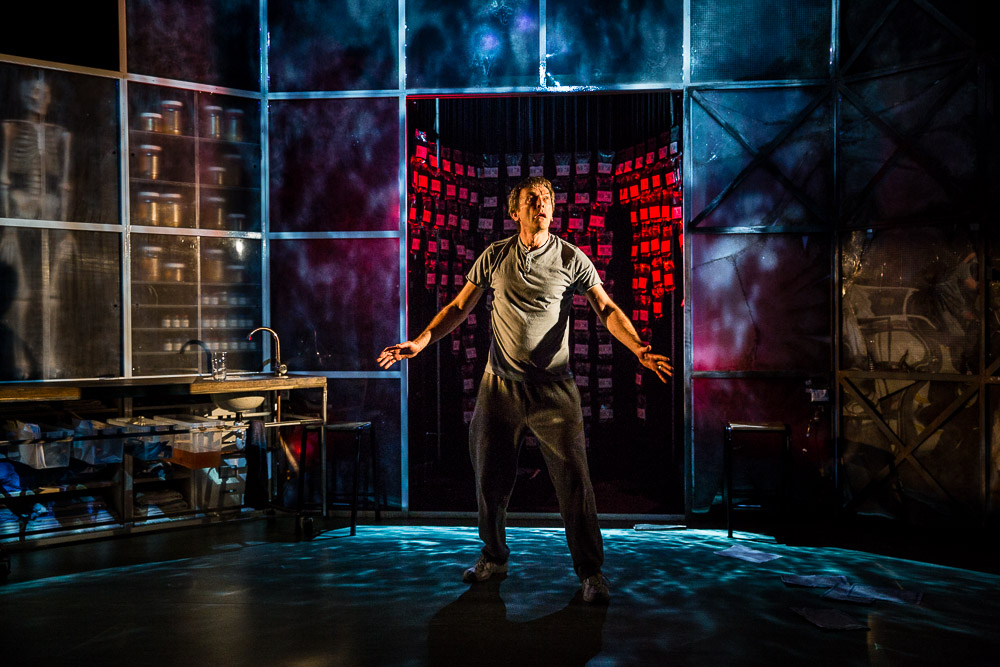
“How could this happen?” is the furious and tendentious question that fronts Factor 9. Director Ben Harrison and Designer Emily Jones get the answers out in impressive and surprising order. Visual, contextual information is screened on the grid squares of a threefold set. Important dates and locations clearly register, not least the security fencing around the Arkansas state prison(s) where donor prisoners are paid for their blood, some of it infected with viral hepatitis and HIV. White symbols turn red when, of those 32 patients in that 1984 cohort, another one is ‘away’. A lab bench wheels into use as a bed. Utility chairs are in the Waiting area where Rab and Bruce and their families spend a horrible amount of time. Blood bags swing in the central section and the names of drug companies – notoriously IG Farben and latterly Hoechst, Armour, Baxter and Bayer – are indexed above. Death certificates litter the stage floor throughout.

L. Stewart Porter as Rab (Mackie)

L. Stewart Porter as Rab (Mackie)

Actors Porter and Zajac are utterly convincing. You see Rab and Bruce briefly, innocently, having fun in the Children’s Hospital when their parents have gone home for the night but otherwise, as stigmatised plague-carriers and guinea-pigs, it is their outright, unequivocal anger that registers. Rab knows magic tricks and the vehemence of his ironic “Abracadabra” when significant medical records just disappear is punishing. Zajac also plays the haematology consultant and actually wins sympathy for a professional who, grappling with the uncertain and the unknown, finally does not know what to say. The scene when an anatomical skeleton is substituted for the doctor and ‘examined’ by his patients is ingenious and macabre.

Factor 9 is properly more than a tongue-lashing for pharma. Neither is it a pitiless exposee of medical practice in the face of an emerging pandemic within the haemophila community. It is much better than viral polemic because of terrific performance and inventive direction. In the House of Commons the Contaminated Blood (Support for Infected and Bereaved Persons) Bill waits for its 2nd Reading. This Dogstar Theatre production should introduce it.

outstanding

Reviewer: Alan Brown (Seen 24 April)

Visit Factor 9‘s homepage here and preview the show’s Fringe ’14 run here.

‘Skeleton Wumman’ (Traverse: 22 – 26 April ’14)

Buchan Lennon as Young Man and Amy Conochan as Skeleton Wumman. Photo: Lesley Black.

Buchan Lennon as Young Man and Amy Conochan as Skeleton Wumman.
Photo: Lesley Black.

‘Buchan is seamless, fluid and graceful. If he were Salome, I’d have the head of John the Baptist brought to him with an apple in its mouth.’

Editorial Rating: Nae Bad

“I’m not entirely sure I understood that,” I confided to no one in particular walking out into the thick Spring mist. The questions raised by Gerda Stevenson’s lunchtime script continued to buzz round my head as I wandered through the exhibition of Edward Lear watercolours at the National Gallery. It’s a sign that the magic of theatre is working I suppose. There’s a similarity in the way Lear represented mid-nineteenth century Greece and the seascape of myths conjured by Stevenson.

Both evoke folk memories held deep in the collective conscience. Both present skilled artists with a canvas for intricate flair – none of Lear’s paintings is larger than A3 while a Play, a Pie and Pint runs not much more than an hour. And neither entirely satisfy.

The muted colours of the Scots dialect run from Stevenson’s pallet into something of a monologue delivered by Amy Conachan as the Skeleton Wumman. The plot is an interplay of narratives woven from Inuit tales and mythology, offset by the innermost thoughts of a contemporary young girl.

There is an Inuit tale of a fisherman who ensnares bones of a forgotten young woman, cast out by her disapproving father. When the seemingly lifeless, barnacled relic of a past tragedy drinks a single tear shed in sorrow by the fisherman, her flesh and animation return, in turn ensnaring him. In Stevenson’s narrative the Skeleton Wumman might also stand for Sedna, Inuit goddess of the deep.

The young girl portrayed by Conachan is severely disabled. We find her at home being cared for by her father, an oldskool fisherman stuck on land by the inclement season. We hear her innermost thoughts, ideas and perspectives, which she is otherwise unable to communicate especially to her uncommunicative father.

Conachan leads a trio of performers who somehow sprint the marathon. She is an extremely gifted performer, one who knows how best to present the results of her Royal Conservatoire of Scotland training (where she is currently studying). She is the glue holding the narratives together and does not come unstuck even as the script’s monologue starts to skirt the bounds of monotony. Conachan’s relationships with Buchan Lennon (as her Father and as the Young Swimmer who has caught her eye at the city pool) are truly enervating.

Buchan is seamless, fluid and graceful. If he were Salome, I’d have the head of John the Baptist brought to him with an apple in its mouth. He inhabits both characters more like a Game of Thrones warg than someone playing make believe. Every nuance is there. The Father is at once terrified of nappies, especially now his daughter’s becoming a woman, whilst also tender, attentive and affectionate. The Young Swimmer is shy but friendly, a breath of fresh exotic air. Buchan fills Kipling’s unforgiving minute in If with miles of distance run.

Completing the trio is Seylan Baxter. Noted as one of the small, but growing, number of players reintroducing the cello into Scottish traditional music, Baxter provides far more than a soundscape. She employs the electric cello for both music and sound effects. The beating heart, the familiar musical phrase, the playful twist, each is managed from a push pedal system allowing her to sample herself as merrily she rolls along. Sitting on the far left, I’ve got the best view of the pedal system in action. Not a foot wrong, although one time Baxter almost hands Buchan an umbrella instead of an inflatable rubber ring; happens to the best of us.

The props, set, lighting and sound were all of the highest standard. The gentle sobbing from the techies responsible for all those cues added not unpleasantly to the overall effect. This was a production of very high production values and higher ambitions, the more so for having hit almost every mark.

I’ll be thinking about Stevenson’s script long after Edward Lear’s watercolours have washed out of memory. Spooky, to the point of spine-tingling, Skeleton Wumman is however unfairly weighted between the trio on stage. But that Conachan is a thoughtful and compelling performer, one who carries much more than her own weight, the play might have foundered.

nae bad_blue

Reviewer: Dan Lentell (Seen 22 April)

Visit Skeleton Wumman‘s homepage here.

The Last Bloom (Traverse: 15 – 19 April’14)

Anni Domingo as Cynthia and Cleo Sylvestre as Myrtle in The Last Bloom. Photo by Lesley Black

Anni Domingo as Cynthia and Cleo Sylvestre as Myrtle Photo by Lesley Black

” … questions about the alternative lives we all could have led, and whether it’s so very wrong to seek solace in them”

Editorial Rating: Unrated

In an old folks’ home somewhere in Jamaica, two elderly women squabble over the room they’re forced to share. Myrtle is fussy, inflexible, used to getting her way; Cynthia likes to please, but quickly turns prickly when she’s pushed too far. Myrtle’s the type who knows everyone else’s business, while Cynthia has a secret or two she’d really rather hide. The two have been sharing the room for three days now … and yet, they’ve only just got round to learning each other’s names.

It sounds like the set-up for a sit-com, and there are indeed some delicate moments of humour in this softly-spoken production. But as soon becomes clear, the bickering’s not quite as inconsequential as it seems: there’s a tragedy, perhaps two tragedies, developing before our eyes. It’s something we can easily imagine happening to people we love. It’s something which, one, day, might happen to ourselves.

Anni Domingo is striking as the newcomer Cynthia, deftly introducing the almost-imperceptible moments of confusion which hint at a weakness in her ageing mind. Later, when she starts to flash a child-like smile, it’s hard to know whether to feel deepest sorrow or purest joy. Cleo Sylvestre, meanwhile, perfectly embodies a character we all think we recognise – cantankerous and obstructive, yet soft and tender inside her shell. But the young-looking actors don’t quite capture the physical decay implied by the script; there are some stiff joints, admittedly, but the true bone-weariness we’re told they feel never quite comes through.

There are some interesting ideas in Amba Chevannes’ script: questions about the alternative lives we all could have led, and whether it’s so very wrong to seek solace in them. There are terrifying insights, too, into the future that might await us, and the possibility that the one thing we hold most precious might be stolen away.

And in a year when Scotland has its eyes turned inward, it’s refreshing to see the Traverse stage a play that’s set in Jamaica. The women’s shared patois is challenging at first, but soon develops into a well-judged point of interest – an insight into life that’s an ocean away, yet very much the same as our own.

Ultimately, though, the script leaves too much unexplained or unexplored. At times it feels like there’s a missing scene; at one point, an inconceivably terrible wrong is forgiven and forgotten in the blink of an eye. And the brief epilogue, though poignant, returns to the generic – doing little to crystallise or resolve the tumult that’s gone before.

It’s a shame, because this is a play which speaks of personal experience, and it feels like Chevannes has an elusive message she’s hoping we might hear. But still, there’s plenty to ponder. And perhaps it’s appropriate – when the play’s so much about lying – that it isn’t too specific about what we’re meant to believe.

Reviewer:Richard Stamp (Seen 15 April)

Visit The Last Bloom homepage here.