‘This May Hurt A Bit’ (Traverse: 8 – 12 April’14)

ThisMayHurtABit_0743

‘The Grim Reaper cannot wait for the good times to roll.’

Editorial Rating:Nae Bad

NHS England and not NHS Scotland is examined in Stella Feehily’s agile new work, which is mildly or wildly reassuring depending on the state of your health and where you live. This May Hurt a Bit is still a jag of a play, needle sharp where it matters and good for you. It will also, with luck, get stuck into government.

There is no squirming away from the political point of Feehily’s writing or from Max Stafford-Clark’s expert direction. The National Health Service is sixty-six years old, is in a High Dependency Unit, and needs your support before it is wheeled off as a terminal case. Here is an acute and tender understatement of a critical condition.

The play begins deep in the vein, if you will, of Ken Loach’s new film, the documentary The Spirit of ’45 when in his words ‘generosity, mutual support and co-operation were the watch words of the age.’ Aneurin Bevan, Minister of Health in the post-war Labour government, is on stage and brings the attention of the House to the extraordinary fact that ‘we are still able to do the most civilised thing in the world – put the welfare of the sick in front of every other consideration.’

That was in 1948, as indicated by the LED display. Move straight on to 2011 and then to the here and now but not before I, poor sap, thought that the medical staff were ‘serving’ customer/patient No.1948. Rather like those long waits in the East Coast advance booking hall at Edinburgh Waverley or, come to think of it, my time in A&E at the new ERI when a low-flying discus cracked my head.

The set of This May Hurt a Bit actually looks like an interior of the Old Royal before the PFI op. You cannot see it but there’s blood on the ceiling. Long and narrow gothic windows and grubby whitewashed brickwork and a screened treatment area centre stage with a disconcertingly large EXIT sign suspended above it. By scene 17, of 18, The Grim Reaper cannot wait for the good times to roll.

Nicholas James (66) is being treated for a prostate the size of a space hopper but has the good manners not to worry anyone but himself. His mother, Iris (91), suffers a fall and is admitted to the local District General for investigation. Fond but limited daughter Mariel is visiting from New York where all-American husband, Hank, is an orthopaedic surgeon. In Hank’s professional opinion – because you die in city hospitals – Iris should be treated privately where she’ll enjoy a lovely view of the Thames. Iris, bless her, swears (profanely) by NHS care, and refuses to move. Nicholas is with his mother all the way.

On the wards, or more accurately on the corridors, there is near bedlam. As well as Iris, Nurse Gina has to look after incontinent stroke patient Rev. John and dementing, bonkers, Dinah. Paramedics, porters, and police dispense black humour. There is a corpse in the screened cubicle, left.

Deadpan funny is rarely in remission but neither is the rolling political script. There is no positive narrative behind NHS reform, Prime Minister, so you just go out there and spiel away; and Feehily provides a wacky retinue – from within the cast of eight – of singing nurses, advisors, strategists, a board of directors, Churchill, a weather girl, and Maggie Thatcher on her perch. I have mentioned Death.
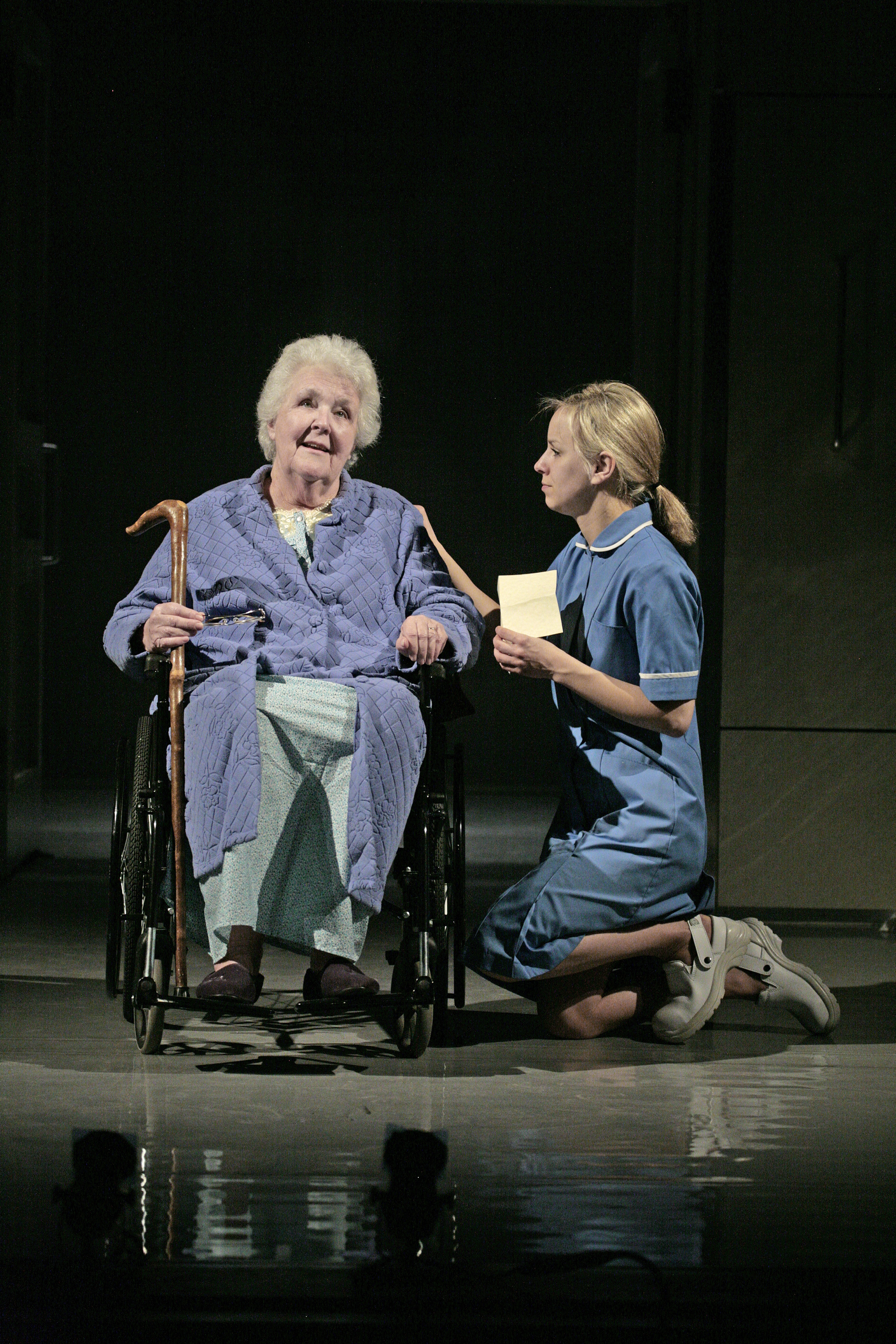
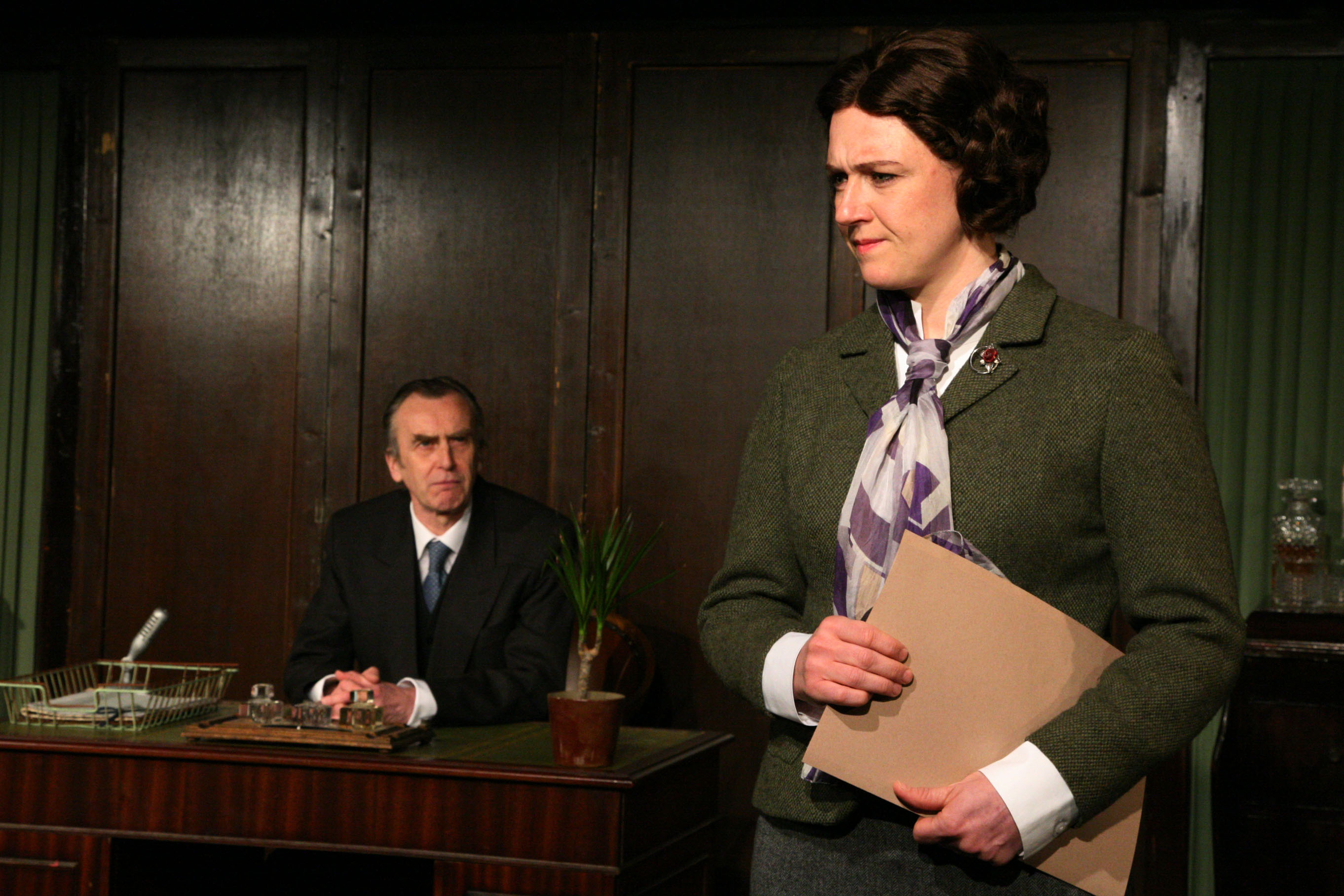
Stephanie Cole and Natalie Klamar

Stephanie Cole and Natalie Klamar

Iris is at the play’s selfless heart. Her absolute, principled, and dear refusal to leave NHS care means she is immune to what afflicts it. Peerless Stephanie Cole cannot be touched in the role. Similarly, Natalie Klamar as Nurse Gina from God knows where – possibly Poland, maybe Serbia – has an angelic part, made all the sweeter when she explodes in effing fury at the specious ‘Culture’ of shitty spending cuts.

It is a bit too easy, I think, to import Hank as the big bad US example – not one reference to French or German systems of social health insurance for instance – but that goes with the staked out territory of this continuing debate, which as Freehily palpably demonstrates gets far too close for comfort to the cynical truths of ‘Yes, Minister’.

This May Hurt a Bit has deft feel and touch all over it but it is also an invigorating shot in the arm for the campaign to keep the NHS safe and in public hands. Scotland, I propose, is reminded to keep its resistance up.

nae bad_blue

Reviewer: Alan Brown (Seen 9 April)

Visit Traverse, This May Hurt  A Bit  homepage here.
‘A Perfect Stroke’ (Traverse: 8 – 12 April ’14)

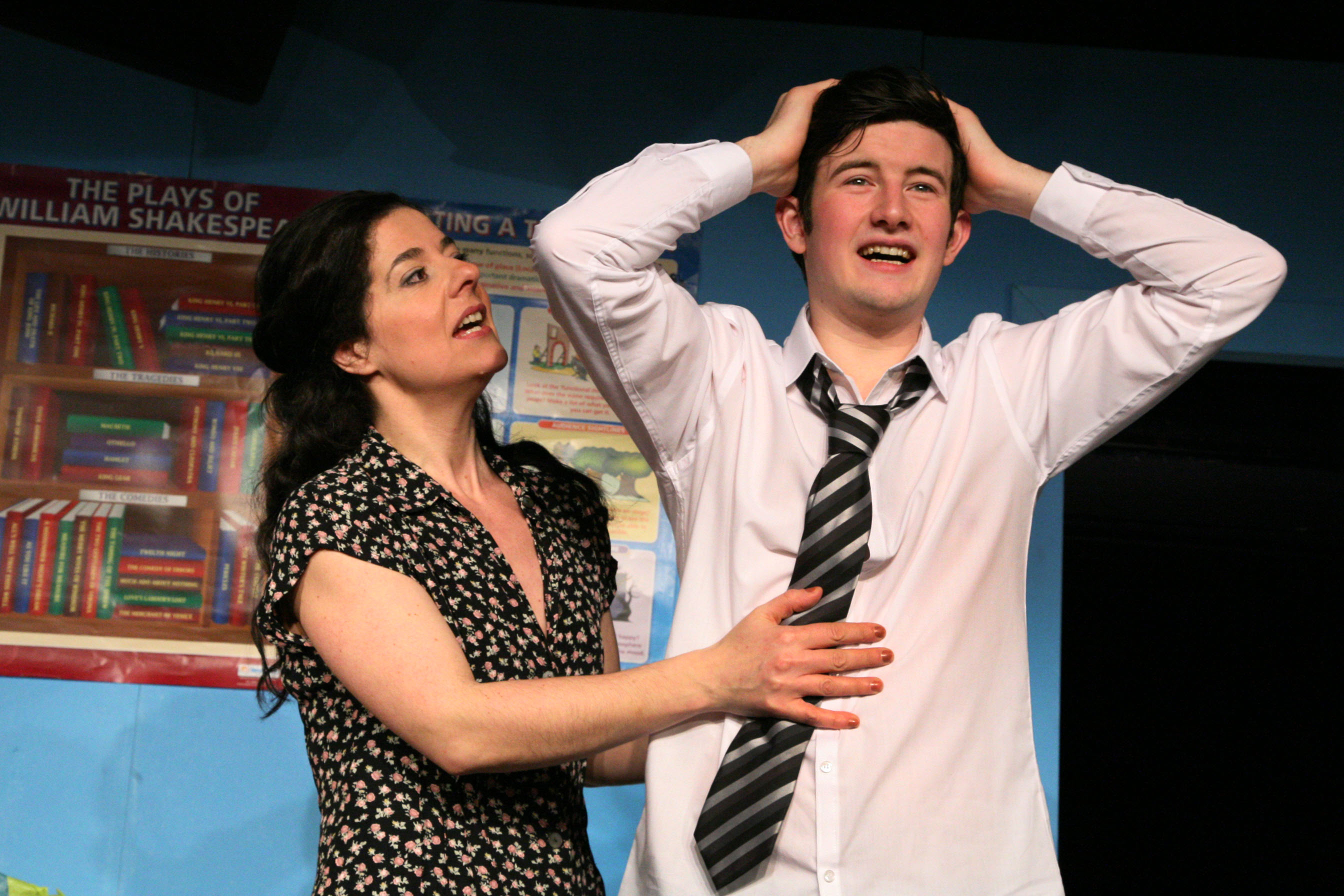
Anita Vettesse and Scott Reid. Photo: Lesley Black

Anita Vettesse and Scott Reid. Photo: Lesley Black

‘The superbly cast Scott Reid (Thomas) proves he’s still very much in-touch with his inner 16-year-old gobshite.’

Editorial Rating: Nae Bad

We enter to find a typical classroom. The learning environment consists of teacher’s desk set before a blue background wall. The audience are in the round. Between me (on the far left, as ever) and the performance space is the actors’ door onto the stage. Beside the door are two clear boxes of universal props. These, together with the drama studies posters, tell us that we’re at the heart of Spud Control.

That pejorative is how the other teachers, them what teach grammar and sciences, describe Ms. Stone’s Drama department. It’s where the kids not unique enough to be special go to pass the day. Despite the condescension of the foreign language teachers, Ms. Stone hasn’t given up hope. She gives as much of herself to releasing the potential of pupils like Thomas as she once gave to her on-screen parts in Casualty, etc – ‘those who can, teach’ and all that.

Thomas has an important audition coming up and Ms. Stone is forgoing her Friday evening to coach him. As she teases out his inner Romeo the teacher/pupil relationship blossoms into a thorn-bush.

Johnny McKnight’s script is as packed with sweet and sour flavours as one of the Warhead Candies me and the other school spanners shared behind the bikesheds. At first you’re watching the introductory moments of a Naughty America porno – young guy being beguiled by a sexy older teacher – then the tables are turned, you can’t remember who’s exploiting who, and by the end everyone feels nice and dirty.

“No teacher would allow such a situation”, cluck a gaggle of mortar-boarded, Easter-happy schoolmarms within earshot. Despite the suspension of professional realities, McKnight insists we must experience the unfolding emotional manipulation as prescribed. Society’s moral certainties are not up for discussion. Unlike Glen Chandler’s Fringe ’13 landmark adaptation of Sandel, and more like A Play For September of the same year, McKnight’s script closes off the audience’s options for moral self-determination.

Even so, director Amanda Gaughan gets serious mileage out of the railroading. You could cut the tension with a metaphor. It’s been ratcheted up as though for a tyre change on a fleet of Hummers. Anita Vettesse (Ms. Stone) compellingly combines sensitive charm with dramatic flair. She is so real and really something. The superbly cast Scott Reid (Thomas) proves he’s still very much in-touch with his inner 16-year-old gobshite. Reid’s genius is to hint at the man Thomas is becoming as much as to lampoon the boy he is. Vettesse and Reid demonstrate active and reactive character work of the highest order.

Dani Heron’s finely carved cameo as Carly, Thomas’ girl, replete in skimpy schoolgirl outfit, allegorically illustrates that this cast is overdeveloped for the limited material allowed in the time available. Until Heron bursts in, you might be forgiven for worrying you’re stuck watching theatre about theatre – isn’t the Alexander Technique hilarious?

‘Actors only exist to serve the script’ agrees everyone when only I am allowed to speak. But there are times when the script must play supernumerary to stellar performances, and this is one such. Yet there’s no doubt McKnight knows how to bring the funny; the three-way with Heron especially could teach Catherine Tate a thing or two.

In the hands of this cast and director this script deserves a second half. Presently Ms. Stone’s crisis point is absent. It’s not clear where she eventually found her courage. Could it have been from imagining Thomas’ true treatment of Carly, with whom she might have more in common that she’d care to admit? There isn’t time to tell.

nae bad_blue

Reviewer: Dan Lentell (Seen 9 April)

Visit A Perfect Stroke‘s homepage here.

‘Love With a Capital ‘L” (Traverse: 1 – 5 April’14)

Benny Young and Lesley Hart. Photo by Lesley BlackPhoto: Lesley Black

‘How, in the name of all that is haughty and holy ….. ?’

Editorial Rating: Nae Bad

The first of the five short plays within the annual ‘A Play, A Pie and A Pint’ series that runs through April. Edinburgh49 is reviewing all five.

Loved it. And I’m not just talking about the Scotch pie and the pint before or afterwards. [Hot tip: the venison pies go quickly.]

Writer Tony Cox’s first stage play, directed by Hamish Pirie, is top-drawer work. A cross-examination of (i) rectitude on air and of (ii) the sneaky premise that all marriages are like potted plants – terminally pot bound – Love With a Capital ‘L’ is Radio4’s Thought for the Day with attitude.

It is ethically spiky. John Reith, the BBC’s first Director General, challenges Hilda Matheson, the Corporation’s ‘Head of Talks’. She, in straight-backed, imperturbable, manner, challenges him back and … a nice yucca plant is smashed to the floor.

This well-researched script is right in there at the beginning of public service broadcasting. We are in Reith’s office in Savoy Hill in June 1929. The BBC employs around 400 people at that time. Matheson has invited H G Wells to go on the radio to talk about world peace. George Bernard Shaw is due ‘on’ the election. Reith, son o’ the Free manse, regards both as ‘Reds’ and Bolshevik apologists but what really riles him is the air time being given to the Bloomsbury set and in particular to Vita Sackville-West and to her husband Harold Nicholson. Their views on marriage, open affairs, ‘free’ love, and the rest of it – most of it gay – appal him. How, in the name of all that is haughty and holy can ‘the keeper of the nation’s conscience’, allow it? Answer, if you would, Miss Matheson, please.

Easy: in brief, “Will that be all, Director General? I have work to do.”

Actually, that is far from all, as Reith has Matheson read his diary. Personal history will out and both characters are drawn sympathetically, if briefly, together.

Benny Young plays John Reith. It is the driven self-control, self-censorship, and the tight smile that gets you and the force of the interrogatory “Why?” Reith, momentarily wobbling, quotes Puck who will ‘put a girdle round about the earth / In forty minutes’ and you acknowledge that what Reith created at the BBC was unique and valuable. What Young gives us, also in forty minutes or so, is a more compassionate man than the unsparing biographies would suggest.

Lesley Hart is Hilda Matheson, who would have been forty-one in 1929; one year older than John Reith. Hart does not flinch once and plays Matheson as the extraordinary and successful woman she must have been. The script provides wit and intelligence enough but the confident bearing and sense of self-worth is Hart’s doing.

It is not on the wireless but you will want to listen in to Love With a Capital ‘L’. Its subject and its acting reward that kind of close attention.


nae bad_blue

Reviewer: Alan Brown  (Seen 1 April)

Visit PPP Love With a Capital L homepage here.

‘Double Bill’ (Traverse: 27 – 29 March’14)

Double Bill

“Open-sourced quality”

Editorial Rating: Nae Bad

This is the Traverse Theatre Company’s starred pairing of Clean by Sabrina Mahfouz and of A Respectable Widow Takes to Vulgarity by Douglas Maxwell; both plays directed by Orla O’Loughlin. Indisputable showcase productions, they’re looking sharp for the Brits Off-Broadway season on the 59E59 ‘A’ stage from 2nd to 27th April.

Clean is as in, “We searched her and her luggage and she was clean”. Only unapologetic protagonists Zainab, Chlöe and Katya, are not. It is just that they specialise in criminal work that scrubs up well: credit card fraud, emerald smuggling, and share price ‘protection’. They work and talk alone until one lucrative job and an evil Mr Big brings them together.

They make a game trio on the same spare platform, which is Mahfouz’s point. Clean is Bold Girls (at Level 1) on an Android OS: mobile, smart and sassy. Its story might as well be released for a PS4 console in search of female characters. Mahfouz’s on-off poetry is attractive with quick dialogue pressing hard on ‘Refresh’, providing feminist content and voice(s) within an all-user setting.

The performances display just as distinctly. Emma Dennis Edwards is Zainab. Hackney street-wise and ‘sick’, man; save that this is one sorted 23 year old who does not need a man in her life. She moves, sometimes raps, in-between poised, posh Chlöe (Jade Anouka) and Russki, Katya (Chloe Massey), whose accent is as hard, probably, as her steel toe-caps. OK it’s off-script, but you don’t ask Lara Croft if she has a younger sister, obvs.

Clean deserves to clean up in New York, which is more than Candy Crush’s listing managed.

A Respectable Widow Takes to Vulgarity has the same open-sourced quality as Clean. It looks explicitly to class and culture but plays nicely alongside the character graphics of Mahfouz’s piece. Director Orla O’Loughlin puts this on second, probably because it is funnier, less edgy and virtual, I suppose. Regardless, the direction is just as tight.

Writer Douglas Maxwell describes it as “My Fair Lady in reverse”. Sounds good. Well-spoken Annabel from purlieus douce meets young employee Jim Dick at her husband’s funeral. He’s emphatically not James Dick of Dick Place, EH9, the most expensive street in Scotland. Annabel would converse, he cannot without tripping into his f’ing vernacular that embarrasses him and fascinates her. There you have it. Flippin’ Pygmalion flipped.

Joanna Tope is Annabel and has just to adjust her scarf for you to realise that she does not shop at Accessorize, as the spelling would appal her. Her speech is pitched so well that ‘cadence’ probably registered on her P1 report. Gavin Jon Wright as James plays very reluctant, wired, ‘teacher’ with the merriment of an actor who knows he has a gift of a part. See him on the terraces when Annabel goes one word too far!

A crude joke of a name ends the piece and has them both choking on their Big Macs. An appetite for language is always healthy.


nae bad_blue

Reviewer: Alan Brown (Seen 27 March)

Visit Double Bill’s homepage here.

‘Bloody Trams; A Rapid Response’ (Traverse: 19 – 20 March ’14)

image

“The overall tone went a long way to suggesting that if the voice of the people is the voice of God, then stepping aboard a tram may incur the wrath of heaven.”

Editorial Rating: Nae Bad

“You’ll have had your trams.” Not since Aneirin, court poet at Din Eidyn in the sixth century, rhymed ‘Ywain’ and ‘cairn’ has a line so pithily captured local frustration. The intervening history is spectacularly dotted with SNAFUs – Flodden, the muddleheaded wombatry of Edinbuggers during the ‘45, lacking Nashville’s knack of reconstructing Parthenons, and of course the reinstallation of the trams ripped out during the mid-twentieth century’s fetish for civic self-harm.

Joe Douglas, he of Educating Ronnie fame, has been out and about interviewing folk for their take on the city’s 7 year itch. Douglas arranged the material, collected from sources in and out of the loop, into 50 minutes of dramatically rendered vox pop. The overall tone went a long way to suggesting that if the voice of the people is the voice of God, then stepping aboard a tram may incur the wrath of heaven.

We enter to find an upright piano, manned stage right by David Paul Jones; a fluorescent jacket hanging on a coat stand far upstage centre; and two chairs downstage, leftish, occupied by Nicola Roy and Jonathan Holt. To the sound of Jones’ seductive tickling of the ivories – “Once I built a railroad, now it’s done, Brother, can you spare a dime?” – Roy and Holt set out to distill Douglas’ captured voices into a lotion of essential oil.

It’s not always clear if this balm is intended to soothe or aggravate. At times I get to wondering where lies the line between satire, sackcloth and ashes. Tribal identity is a strange thing. If a bloke’s kickball team teeters on the edge of relegation he feels personally embarrassed. If his cooncil ignorantly mismanages a major infrastructure project he feels personally shamed.

Several of the interviewees argued that the trams would damage Edinburgh’s reputation. Perhaps I am too divorced from the starched self-regard of the city’s professional classes, but I suspect globetrotters will not be crossing Auld Reekie off their to do list because of the trams – it would be like avoiding the Nuit Blanche festival because Toronto’s mayor likes the hard stuff.

Roy and Holt heave and rally, dragging up the dead weight (after all there is only so much entertainment to be drawn from the politics of civil engineering) with style and flare. Watching them is like observing a competitive game of dress up, as each leaps into the voice (if not always the movement) of the character they are inhabiting.

Roy was flawless: dynamic control matched by a powerful delivery. Holt might have been this too, only his villainous German contractor accent (surely there was comedy gold to be had there) was so bad he’d have struggled to be admitted to the cast of ‘Allo ‘Allo!

My old Newcastle People’s Theatre pal Tom Saunders on the sound and lighting desk did what he does best, being artful without being showy. Despite the minimalist staging, Saunders created 3 distinct spaces with an interplay of sparingly applied foundation. If, for the sake of a Cancer Research promoting selfie, this production decided to do without his makeup it might well have appeared noticeably more harassed and haggard.

This was a serious-minded production for serious-minded people. Although I didn’t stay for the after show talk, I had a prior engagement to gnaw my own leg off, I would like to have seen Douglas producing something beyond the earnest range he conquered in Educating Ronnie. He does a great line in upfront sincerity – as does Edinburgh’s most recent famous son, Tony Blair.

The use of recorded prompts feeding into the ears of Roy and Holt was a bold move. It provided meaty monologue on short notice, might have gone horribly wrong, but paid off handsomely. For all that Holt isn’t going to be playing Willy Brandt any time soon, (he does a fine impression of his director BTW), both he and Roy demonstrated a discipline under pressure matched only by their lightness of touch. The clay rose from their wheel into an innovative, engaging piece of fringe theatre.

nae bad_blue

Reviewer: Dan Lentell (Seen 19 March)

Visit Bloody Trams homepage here.

‘Gym Party’ (Traverse: 4 – 5 March’14)

Gym Party - production shot 3

Try saving face with your head in a bucket of water”

Editorial Rating: Nae Bad

Created by Made in China for a mental and physical work out.

I see that Made in China has the same optimistic regard for web addressing as Edinburgh49.  Search for this review site and you used to get lots of EH postcodes and street numbers. Search for Made in China and – well, it’s predictable – you get, ‘Your source for Quality Products.com’. Tag ‘Made in China’ with ‘theatre’ and you hit quality stage work.

The company’s Gym Party was at Summerhall during the Fringe and is back for two nights at the Traverse before moving on. In my onetime professional opinion it should play at high schools and colleges up and down the land because this is a show that would fit any ‘Curriculum for Excellence’ and put PSHE (Personal, Social & Health Education) up there in LED and neon.

For S5 and S6 only, perhaps, for ‘Take a bow and get off the fucking podium’ is not, on the face of it, the best lesson for the younger years; although actually it makes perfect (and entertaining) sense and in that all-important cross-curricular sense too. How should we measure achievement? Is it ‘above’ understanding? Are grades better than marks? What counts? How do we grow up: ‘Evolve? Fight or flight?’ Importantly, who cares for the losers? At one time or another we are all on the C/D, Pass/Fail border.

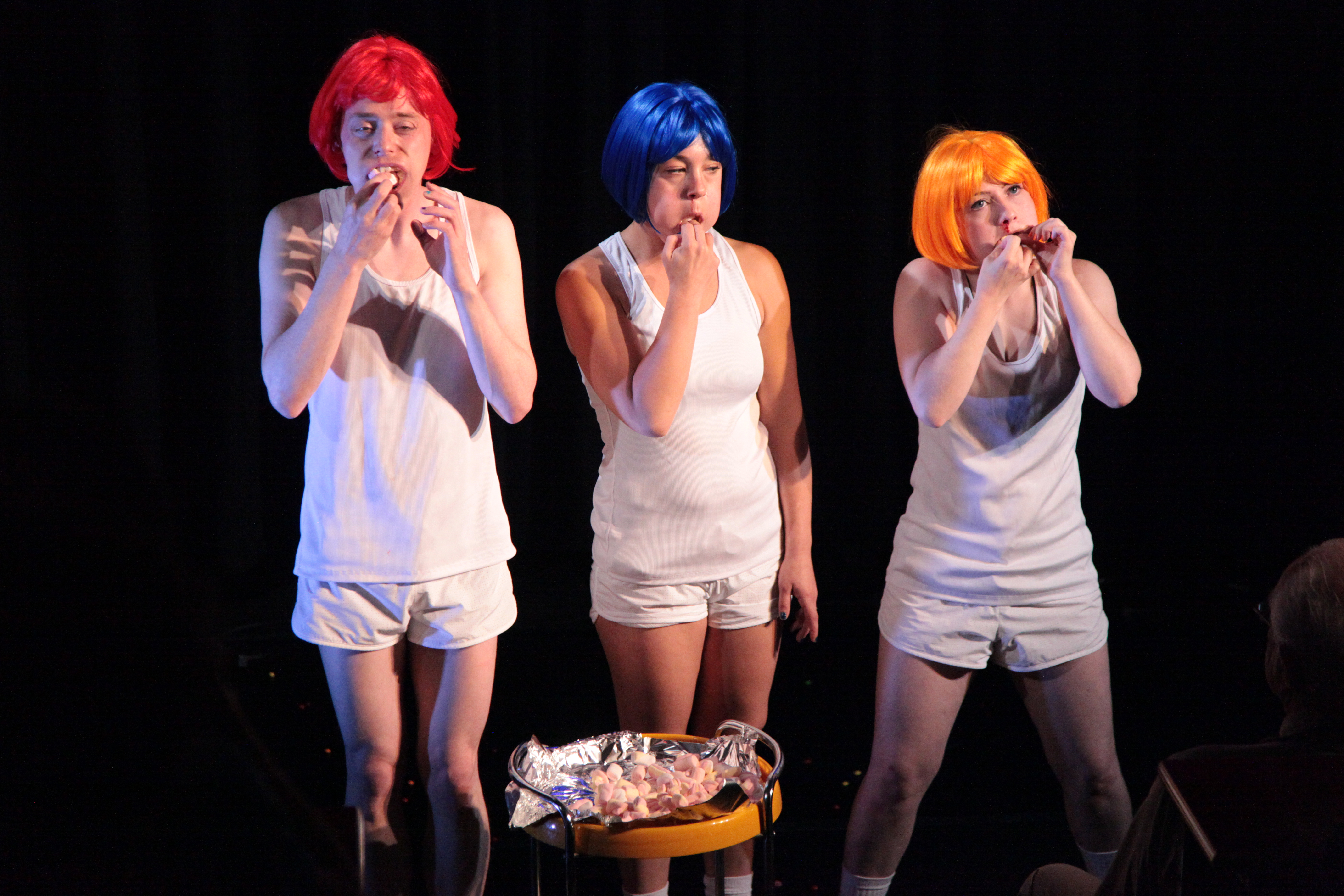
Gym Party is moral exercise. Literally. Three contestants – Ira, Chris’ and Jess (tellingly their real names) – compete for points and for applause.  In regulation 1960s issue PE kit, white singlet & shorts, but with red Converses and vividly mop-headed, they do Games and suffer the results. Ask yourself, age 12, what it took to win and then, in turn, try wacky, awkward, aerobics, and then stuff your mouth with Skittles, marshmallows, and little oranges. It looks daft, is hilarious, but how did you feel with only 17 marshmallows next to the winner, your ‘friend’ maybe, with 22?

Edifying? Up to a point, for sure. Try out for the next round: who, of the three, is the most attractive, the richest, the best kisser, the most trustworthy? Who, the class question, had the best upbringing? Suddenly, you’re not twelve anymore and the playground is not so much fun, especially when failure is penalised. Try saving face with your head in a bucket of water, held under by a fellow contestant.

Adult stretch and pull is all the while provided by extended use of the audience, ‘the group, the pack, the whole’. ‘We’re here for you’ is just one of those exhausted mantras that puts us in the spotlight or under the glitterball of frustration and loss . Actors/contestants look for support, ie. your votes, as they go through their desperate routines. In the confessional rest breaks you just about share their (chewing) gum with the same appalled mix of relief and nerves.

I particularly liked the use of accent: Canadian/New York state (Chris’), NYC American (Jess’), boarding school Home Counties English (Ira) and quizmaster sonorous (anon.).  The natural combination worked a sweet treat in terms of providing the mawkish cheer of game show tv.

Gym Party is fun, energetic and loaded.

nae bad_blue

Reviewer: Alan Brown (Seen 4 March)

Visit Made in China homepage here.

Grit (Traverse: 6 Feb.’14)

Grit

an admirable sincerity”

Editorial Rating: Unrated

Presented as part of Manipulate, a week-long festival of visual theatre, Grit is an earnest analysis of how children around the world are affected by war.  Well-regarded by critics during 2012’s Edinburgh Fringe, it views this biggest of topics through a close-up lens – using a war photographer’s diary to frame the story, and drawing occasional parallels with his own life at home.

The tale’s told through a mix of puppetry, projection, and shadow-play – a combination of techniques which occasionally feels overwhelming, but in the end comes together remarkably well.  It’s not the most original of styles, but there are some creative details to enjoy: an especially powerful projected sequence cleverly brings just parts of an image into focus, picking out first a ruined building, then a man cradling a child.

But if the presentation’s deft, the storytelling’s clumsy.  Exposition comes courtesy of a pre-recorded voiceover, which very definitely tells-not-shows the photographer’s reactions to the horrors that he’s seen.  It’s desperately unsubtle, and oddly uncompelling; a war correspondent ought to be a fascinating, contradictory, damaged character, but here he seems cast as Everyman.

And sadly, it feels as though they don’t quite trust their puppets to hold our attention or to tell their story.  One otherwise-effective scene, consisting of a striking series of shadow vignettes, is accompanied by a narration so literal and descriptive it begins to feel like a sequence from a children’s TV show.  As we see a young foot thrust into an army boot, the voice tells us that a boy has become a soldier – a plot point which, quite honestly, they could have trusted us to work out for ourselves.

It would be crass to overlook the importance of Grit’s theme, and there’s an admirable sincerity to the way Tortoise in a Nutshell confront it.  But this is recognisably an early work, from a company which have (by all accounts) since gone on to great things.  It flits too quickly between too many different stories, and in the end – unlike that clever projection – never quite throws the focus on any of them.

Reviewer: Richard Stamp (Seen 6 February)

Visit Tortoise in a Nutshell homepage here.

Hotel de Rive (Traverse: 6 Feb.14)

Hotel de Rive

an existential struggle for meaning that made Giacometti’s eyeballs dance in front of his head”

Editorial Rating: Unrated

You can tell that Hôtel de Rive is not UKIP territory. A German, French, Swiss co-production based upon surrealist writing accompanied by alpine horns, l’Hôtel is foreign. The show has Vorsprung durch Technik design credentials. It looks expensive, it runs well, has done 60+ outings since 2011, and – critically speaking – has definite and appealing hybrid form. But what, exactly, is it doing on stage? There’s your existential question, especially if you’re not in the Euro zone.

A search engine helps, which is a bit of shame, but Hôtel de Rive needs its back story. Its subject, Swiss artist sculptor Alberto Giacometti (1901-1966), had to stay in Geneva during the German occupation of Paris between 1942 and 1945. Biographies now headline this period as coinciding with his ‘critical transition period [beginning in 1935] … when he questions his work and tries to find a new way of looking and translating what he sees.’ He took a room at the Hôtel de Rive and his sculptured figures grew smaller and smaller, some barely a few centimetres high. They were imagined on a wide and shifting flat surface and not in anything as reassuring as three dimensional space. Insomnia took hold and Geneva nights (as back home in Paris) were spent in bars and clubs. Shabby, grubby, a chain-smoker, ‘on’ six to ten cups of coffee a day, and not exhibiting his work for twelve years, the artist then was a long, long, way off 60 million pound auction prices and being the face of Switzerland’s 100 franc note.

But you can see where the hallucinogenic Hôtel de Rive is coming from: an existential struggle for meaning that made Giacometti’s eyeballs dance in front of his head, which – projected – is like a bio-exorcism out of Beetlejuice. There was appreciative if nervous laughter from the audience.

Of that anxious, frustrating and near impossible time Giacometti said, “A large figure appeared wrong to me, while a small one was intolerable, and then they became so minuscule that with a final cut of the knife they often disappeared into the dust … and tirelessly I began again, only to end up, a few months later, at the same point”; which might have been the crumbling, enervating effect of Hôtel de Rive. Fortunately its creator, Frank Soehnle, responsible for ‘Set and Play’, has given its animation more visual and literary coherence than you might think.

A more than nodding acquaintance with Giacometti’s The Dream, the Sphinx and the Death of T (tellingly published in Labryinthe magazine) would have helped a lot. I didn’t have a clue but now know, for instance, that the Sphinx – outlawed and closed down in 1946 – is/was the celebrated, bizarre, brothel in Montparnasse. Its pleasures are, surely, represented in l’Hôtel by hot trombone and a shimmying, bejewelled, and wasted puppet with a purple flower for a head whose petals fold delicately when she settles into an outsize wine glass. See it, and more, on YouTube: http://www.youtube.com/watch?v=TguqiDIXGfM .

Single actor, Patrick Michaelis (who has to be Giacometti), suffers sand pouring over his head, then a wee demon of a puppet- familiar on his skull, then a yellow spider, then outstretched, skeletal arms protruding as if from the back of his coat. Did I appreciate the following elucidatory text on a screen somewhere: “A blind man extends his hand in the void (in the dark? In the night?/The days pass and I dream of catching, stopping that which flees”? No, I did not; Giacometti’s 1952 haiku-like poem probably was evident somewhere but there were too many available options: actor’s voice, electronic voice, chalkboard, tablet screen, revolving PC monitor, big screen. And the music plays all the while: on conch, muted trombone, synthesiser, and those impressive alpenhorns.

This breadth of choice, I suppose, derives from the show’s extended title, Hôtel de Rive – Giacometti’s horizontal time (lost to UK marketing), where linear narrative style is discounted in favour of a segmented disc on a single plane. A different event is contained in each segment that narrows to a single, all-inclusive point. Got it? Anyhow, the show does actually close with an up-tempo approach to the artist’s last work, Paris sans fin, a series of 150 lithographs of that city.

I’m pleased that I know more of Alberto Giacometti’s life and art. I liked watching Hôtel de Rive work its inventions out but it was a slow, creepy, ride. Accomplished, skilful, polished; but really just an assembly of clever components, I felt.

Reviewer: Alan Brown (Seen 6 February)

Visit Figuren Theater Tubingen homepage here.

The Seas of Organillo (Traverse: 4 Feb.’14)

Organillo

The Seas of Organillo is a birthing pool for puppets.”

Editorial Rating: Nae Bad

From above – and occasionally in – The Seas of Organillo master puppeteer Stephen Mottram manipulates a biosphere of his own making. In a general Wiki sense a biosphere is a closed, self-regulating system containing ecosystem(s) – ‘including artificial ones’. There you have it: a puppet show that is deeply immersed in itself as a creative process. Highfaluting? Not at all, once you’ve seen it, heard it, and come up for air.

The electro acoustic score is vital and accompanies the whole work rather like an evolutionary agent. Mottram explains its genesis after the show (and on YouTube). He brings on the organillo, a small hand-turned barrel organ, that he built himself over four months out of his old wardrobe, drain pipe, lining paper, and B & Q. Each cylinder roll provides eight minutes of music but multiple recordings of the whole clicking, bubbling, breathing, box provide the soundtrack. There is no speech. Call it organic, obviously.

There are seashore calls and off-shore waves but nothing on-shore. On the surface the seas support a couple out rowing but it is only a couple of turns around the bay before they’re gone and a swimmer comes into view. More homunculus than human, a tiny ET in a cycle helmet, really; for, says Mottram, “I liked the poetic idea of swimming creatures somewhere between fish and people”. Whatever they are, they love the sea – and each other, which is kind of the point.

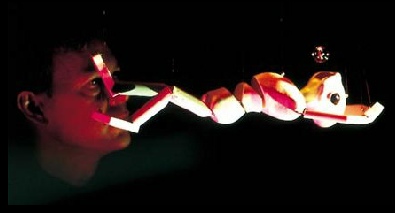
The Seas of Organillo is a birthing pool for puppets. It is sex under water for little, primitive, humankind and as such it is both innocent and fascinating. You see a bubble of life-giving air rise to the (invisible) surface; hands move and stroke each other in deep space; an egg floats free. Sperm penetrates the egg and – as with a multiplying shoal, more or less – cell division begins, a womb is formed and new angelic life begins. Up top, Mum and Dad now row into sight with an infant in tow.

So much, so familiar in biological terms but the puppetry is something else. There are a lot of puppets in The Seas of Organillo and they are often moving alongside automata – “sexy machines”, Mottram calls them – to help create the liquid, holistic illusion. Occasionally I couldn’t figure it out: the triffid-octopus like ‘thing’ of a fallopian tube; the egg eating clam; the stripping-off of colourful layers from around the fertilised egg – but then, after the show, I read the helpful hand-out that I should have read before I went under.

I’m a pretty poor hand at keeping fish. They survive but without much support. In The Seas of Organillo, first conceived  around 1998-2000,  Stephen Mottram has made puppets akin to biotechnology. Probably a first.


nae bad_blue

Reviewer: Alan Brown (Seen 4 February)

Visit Stephen Mottram’s  homepage here.

Bestiaires (Traverse: 3 Feb.’14)

1. bestiaires_ester_photo_Jaka_Ivanc

Zeus is packed off, squashed into a crate marked ‘Fragile’, for sale to China – again.”

Editorial Rating:  Outstanding

Bestiaires is part of the Visual theatre Festival, 31 January to 8 February, at the Traverse Theatre. Edinburgh49 is reviewing four productions. Bestiaires was the opening show.

Mythology is flexible and so is foam rubber. This provides Duda Paiva and his company with all it needs to create Bestiaires or – for its Norwegian audience last September– Manbeast. The work is not a monster manual, although there’s a golden, hungry, Cerberus; nor is it really an outing for the properties of polyurethane/latex, although they’re wonderful; no, this is about the enduring life of the gods in our more secular time. The exclamation “For Gods’ sake!” is used often enough to make you think, sadly, of how they’re getting on.

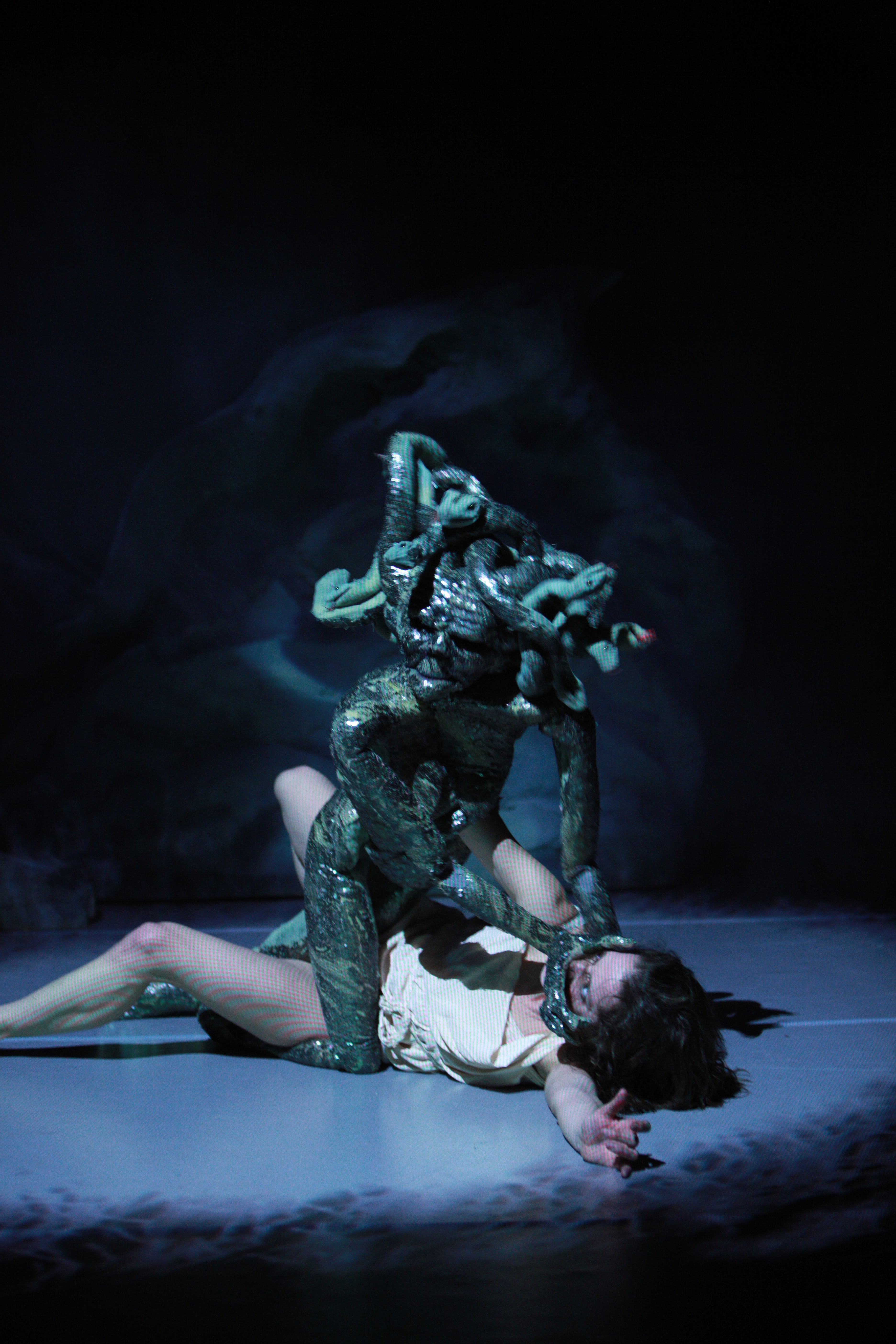
Not too many gods – Cupid, Persephone, Hades, Zeus and Athene principally – and the Medusa, transformed from fit dancer, Ilija Surla, (that’s elasticity for you – check out your Pindar) to writhing Gorgon puppet. Nowadays all is far from well on Olympus. Death-dealing Hades has become western ‘civilisation’s’ best-selling export and Zeus is packed off, squashed into a crate marked ‘Fragile’, for sale to China – again. For the time being: a relative concept in this show of seventy memorable minutes – Cupid (Mart Müürisepp) holds the stage as rueful narrator and demi-Chorus: his bow, a long microphone lead; with a hip flask of whisky to lend him a dram of Dutch courage.

Nevertheless and in generous spirit (to restore Greek finances) Cupid would reunite a wilting Persephone and a Hades, who’s looking the other way at Medusa’s pects. Cue Hades’s immortal line: “You’re hot. You want to party?” There’s some easy morphing of Demeter and Persephone but no matter; what has real, unequivocal presence is the dancing of puppeteer and foam rubber puppet. By now, since 2004, this is the company trademark and it is exceptional. Video animation of spring flowers and unerring sound, musical and vocal, complete the impression that everything on stage is alive, not least those gods.

Ester Natzijl is literally inside the square head of Zeus who does not stand tall. Instead he’s reduced to amused contemplation of the F word, as applicable to his small condition, as in “Get me the F out of here!” or “What the F!”. Classically moulded Hades gets grossly fat and cannot regain his place. Three mouthed Cerberus may play ‘Fetch’ with Cupid’s wig but it can still get very dark out there. Put the mirror of eternal beauty in the hands of these gods and you invite trouble. Medusa and Athene dance in jealous, nightmarish combination.

There is a compilation of acts on dudapaiva.com called Break the Legend. Bestiaires is original work of high quality that would do just that. Zeus, unfazed by market conditions in China, gives a homily on love – of all his attributes, the least familiar – that has probably held him together since those titan wars. It must be the magic quality of that rubber for, as Duda Paiva puts it, “I’m just fascinated by foam, because it is generous, it is about generosity.  It’s such a giver.”

In a respectful word: awesome!

outstanding

Reviewer: Alan Brown (Seen 3 February)

Visit Duda Paiva Company homepage here.