‘Stella’ (Traverse: 19-30 Nov ’13)

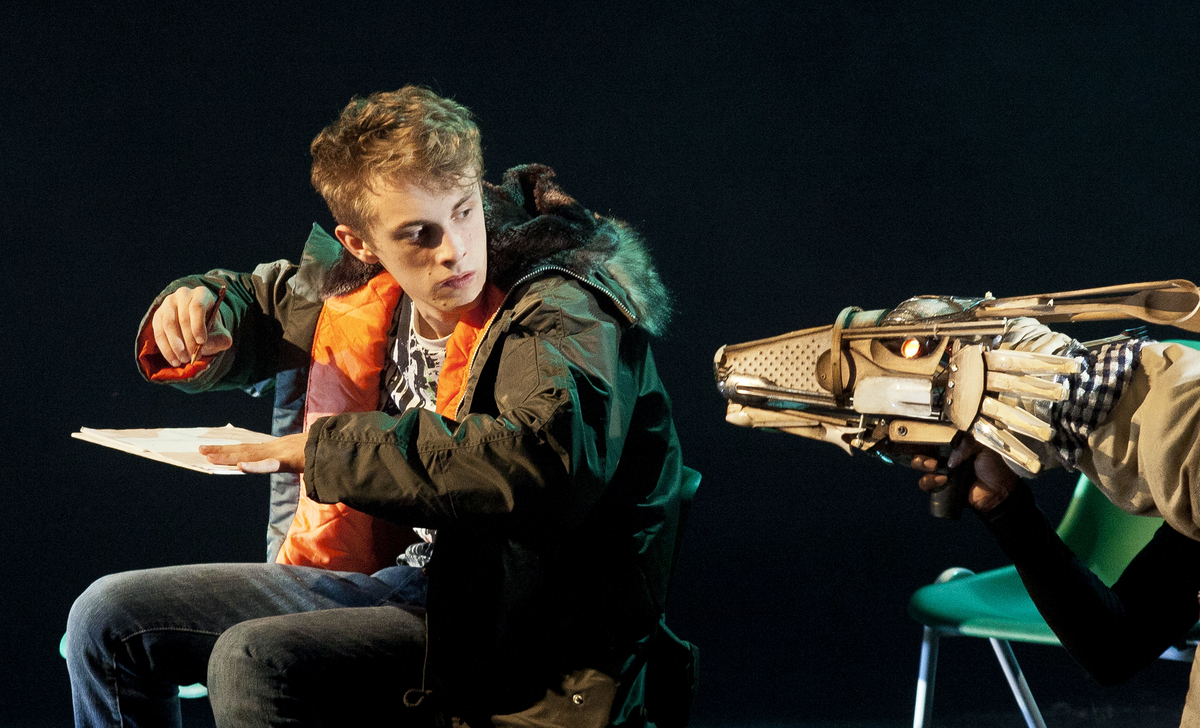
Stella Image by Richard Gamper

Image courtesy of Richard Gamper

“An elegant design from Gus Munro, and some emotive acting – particularly from an impassioned Kathyrn Pogson – can’t save it from an over-embellished yet under-developed plot”

Even if you’re up to speed on the history of science, you may never have heard of Caroline Herschel.  A woman working in a world dominated by men, she’s eclipsed by her famous brother William; yet even during her own lifetime, she was recognised as a talented astronomer in her own right.  Using that most time-worn of framing devices – a modern-day woman reading a diary – Stella challenges our ignorance, telling the tale of Herschel’s career as she joins her brother in England.  But if you’re expecting a detailed insight into the unique achievements of this female pioneer… you may well be disappointed.

The clue’s in the subtitle, really.  Stella is “a story of women, their men and astronomy”, very definitely in that order.  We hear a lot about Herschel’s relationship with her brother, whose marriage and fatherhood late in life sets the scene for some classic familial discord, but there’s regrettably little assessment of what she truly contributed to her field of study.  The script skips oddly quickly over her independent discoveries, essentially casting her as a diligent but put-upon helper – and while the notes on the back of the programme go some way towards justifying that choice, the play itself could do much more to explain the nuances and contradictions of her role.

On the plus side, both script and actors convey a fine sense of the mysteries of the cosmos, not least the incomprehensible wonderment surrounding the Herschels’ surprise discovery of the planet Uranus.  Some gentle humour works well, and at the heart of the plot there’s an excellent hook – a black hole of torn-out pages from Caroline’s meticulous diary.  But the script never quite sells that mystery, instead choosing to plod chronologically onwards, always displaying perfect confidence that matters will be revealed in time.

Perhaps because the main storyline’s so conspicuously short on drama, the production adds a second string: a neat parallel between the violence of the Arab Spring and the burning of the ancient Great Library of Alexandria.  It’s rounded out by some telling quotations from the martyred fourth-century female philosopher Hypatia, which serve well to keep things thematically complete.  There’s enough in that clever concept to support a whole separate play, but here it feels like an afterthought – especially since its emotionally-wrought conclusion is so strikingly different to the rest of the tone.

Stella is a missed opportunity.  Rather than exploring what’s distinctive in Herschel’s story, it diverts all too frequently onto expository sidelines, or less-than-subtle parallels with the present day.  An elegant design from Gus Munro, and some emotive acting – particularly from an impassioned Kathyrn Pogson – can’t save it from an over-embellished yet under-developed plot.

Reviewer: Richard Stamp (Seen 19 November)
 

‘Ciphers’ (Traverse: 12-14 Nov ’13)

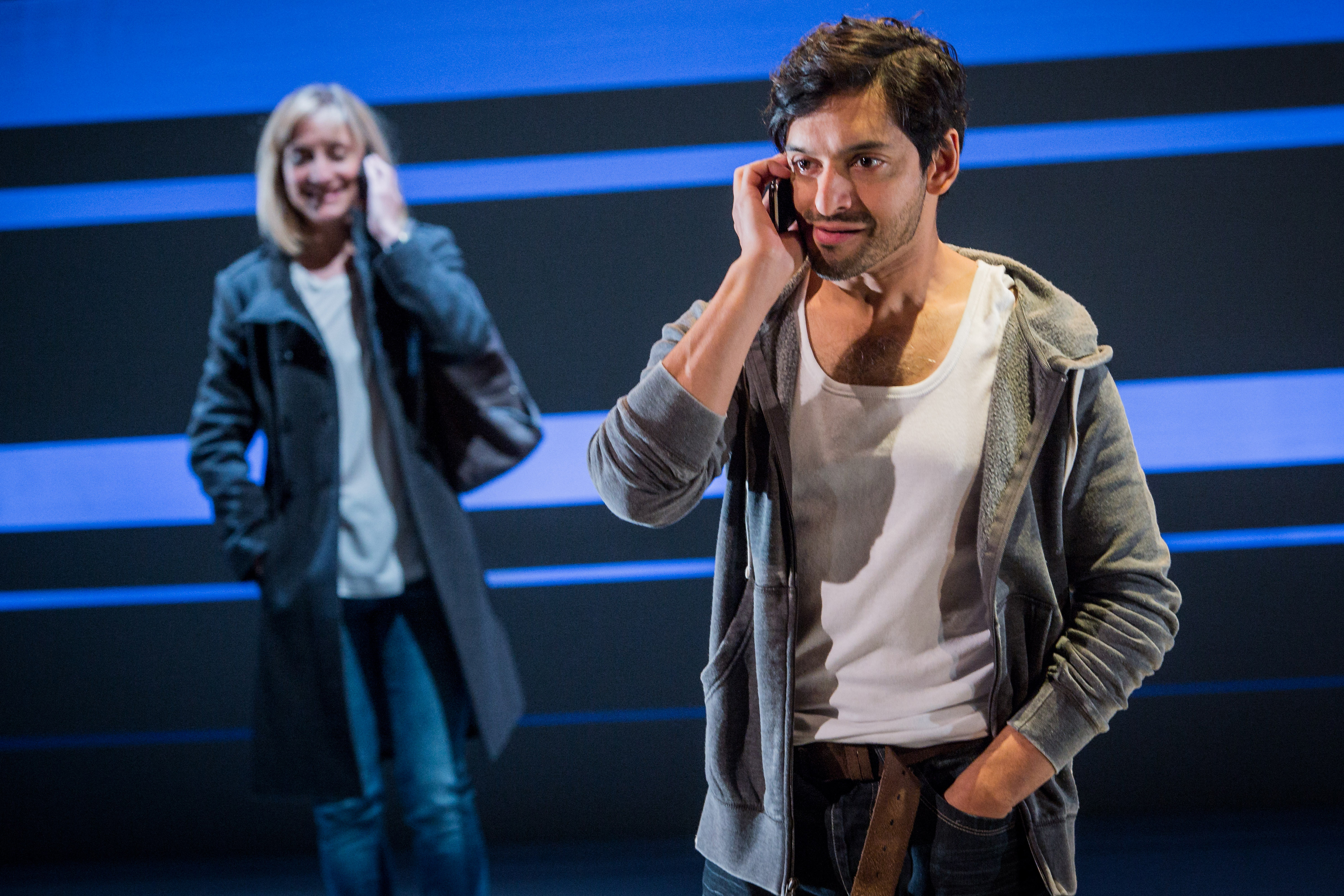
ciphers-008 Grainne Keenan Ronny Jhutti

Image courtesy of http://www.traverse.co.uk

Ciphers’ emotional software is not stripped down but it is obviously engineered. The best scene, I thought, because it is securely plausible, is ‘in a pleasant suburban garden’ where Justine’s father is ‘pottering about sweeping leaves’”

A while back I watched a London Duck Tour run its amphibious vehicle off the Albert Embankment slap bang alongside the MI6 building. The tourists on the DUKW whooped and hollered but that happy eager sound was never going to carry into the showy headquarters of the British Secret Intelligence Service. Accept that Ciphers would take you down a similar edgy slipway and – despite appearances – you get much the same subdued effect.

Ciphers is by Dawn King, whose outstanding debut play Foxfinder won her an 2012 ‘Offie’ award for most promising new playwright. Ciphers has the same director, Blanche McIntyre, but it is very different – check out Michael Billington’s review of ‘Foxfinder’ to see how different – although just as ambitious and it will do King’s CV no harm at all. However, whilst to write a drama about a young woman whose life is taken over by her work for the secret service is superficially attractive – if you can, just think ‘Homeland’ for a moment – it gets a whole lot more demanding when the action and the psychology have to be live and convincing for two hours on a bleached stage. And this is one production that really does not need the distraction of an interval break, let alone ice-creams.

So Justine steps out in defence of the realm but without much protection, mental, physical or electronic. Ciphers’ emotional software is not stripped down but it is obviously engineered. The best scene, I thought, because it is securely plausible, is ‘in a pleasant suburban garden’ where Justine’s father is ‘pottering about sweeping leaves’. His other daughter, Kerry, is on an angry mission. She wants to know why ‘if [Justine] was an analyst why is she fucking dead!’ Neither father nor daughter knows what Justine did all day: ‘Sometimes I imagine her, doing … I don’t know. Spy things …’. Yet there unfortunately is the lameness of Ciphers. The euphemistic ‘intelligence community’ does not do ‘At Home’; its windows are one-way, and its best plots are kept secret.

How to make up the story then? Have large blank screens on stage to project English translations of Russian and a few chat-up lines in Japanese. Slide those screens to smart effect, move time around – a lot, and approach Justine’s story from multiple angles with demanding paired roles.

Gráinne Keenan plays Justine and Kerry, both sensitive and vulnerable; Bruce Alexander is their father, Peter with his garden broom, and is also the predatory, knowing, diplomat, Koplov. Between them Keenan and Alexander have the most reliable, natural, exchanges. It is harder for Ronny Jhutti as artist Kai and youth worker Kareem and for Shereen Martin as Anoushka, Kai’s wife, and as Sunita, an MI5 officer – could be MI6, who knows? These are the shallow roles where lines like ‘I’m shit’ or ‘We don’t have the resources’ are thin. Worse, if like me you’re trying not to decode Ciphers as subfusc Spooks, is the accidentally topical ‘Mohammad’s slipped surveillance. We don’t know where he is’.

Ciphers plays at the Bush Theatre, Hammersmith, from 14 January. That is barely two miles from the river where DUKW tours are suspended after one of the ‘Ducks’ caught fire downstream from the MI6 building. It will be interesting to follow how this spare, edgy, drama goes down. Personally, I don’t think that it rides that high in the water.

Reviewer: Alan Brown (Seen 12 November)

Visit Ciphers’ homepage here.


‘Dragon’ (Traverse: 30 Oct – 2 Nov ’13)

Dragon prod pic 4 Drew Farrell

Image by Drew Farrell

“And there are dragons!  Dragons everywhere.  Not the gold-hoarding recluses of British folklore, but the sensuous, bewitching creatures of the Orient”

Editorial Rating: Outstanding

A play for older children and big-hearted grown-ups, Dragon is filled with beauty from its very first scene.  A comforting kind of magic flows from its enchanting, nostalgic backdrop: searchlights pick out a city’s rooftops, while ghostly clouds hang in the moonlit sky.  But this isn’t a Disney fairytale. Within seconds of the opening, we’re thrust into a hospital ward – and there we witness a young teenager, Tommy, bidding his dying mother goodbye.

A host of motifs come together in this stylish, inventive performance.  Black-clad actors prowl the stage, wielding props which make up a dynamic and ever-changing set.  At its best, the choreography is breathtaking; look out for the scenes at Tommy’s school, where he sits still in the centre of the stage and classroom after classroom appears around him.  There’s plenty of humour, and there are elements of stage magic worked in too – props and even actors appear as if from nowhere, thanks to clever misdirection or ingenious tricks of the light.

And there are dragons!  Dragons everywhere.  Not the gold-hoarding recluses of British folklore, but the sensuous, bewitching creatures of the Orient, evoked here through a smattering of technical wizardry and a wealth of compelling puppetry.  As the story rolls on, you’ll come to recognise what Tommy’s dragon represents, and you’ll notice it growing and changing over the course of the play.  Sometimes it’s sinister, sometimes it’s as cute as a puppy, but towards the end it’s a monster… a terror to be fled, or faced down.

As befits a family-friendly show, Dragon’s plot is straightforward, and the emotions it plays on are big and simple ones.  Unaccompanied grown-ups might wish it were a little more nuanced, but if you’ve taken the kids you’ll find plenty of important themes to talk through later.  Tommy’s story encompasses loss, grief, anger and acceptance; along the way he discovers the importance of connecting with others, and learns that inner dragons always seem less scary when you bring yourself to face them head-on.

There’s very little spoken dialogue – which, incidentally, makes Dragon eminently accessible for people who are Deaf or hard of hearing – but the visual delight is accompanied by an atmospheric soundscape, lending tempo and portent to the action on stage.  Being picky, the lighting wasn’t executed quite as flawlessly as the rest of the production, and the slow-mo fight sequences felt hackneyed at times.  But the ending has a beguiling simplicity which complements that gorgeous opening, and there’s wonderment and poignancy in all that comes in between.  A must-see show for children aged 9 and up, and for adults who remember how to play.

outstanding

Reviewer: Richard Stamp (Seen 30 October)

‘Translunar Paradise’ (Traverse: 18-19 Oct ’13)

Translunar Paradise @ MAC by Alex Brenner (_D3C6294)

Image by Alex Brenner

“The piece meanders between the couples’ experience of youth and old age, a personal tragedy, the war and a daily routine that proves hard to break when he is left alone.”

Editorial Rating: Unrated 

A Fringe hit in 2011 and 2012, Theatre Ad Infinitum’s Translunar Paradise has since travelled the globe, appearing everywhere from Colombia to Croatia. Last week, as part of its national tour, it swept into Edinburgh’s familiar surroundings once more.

The production’s global reach is testament to its wonderfully universal nature. The subject matter – the difficulties of losing a loved one – is one that everyone, regardless of culture, status or age, can relate to in their own way, and the delivery of this narrative entirely in mime ensures language is no barrier. Using such a universal story and no spoken word creates a space for each audience member to project their own story, their own experience of loss, onto the characters – leading to a very personal experience and not a few emotional sniffs.

Whilst this is a strength in one respect, in another it leads to a fairly predictable, if touching, story arc: we watch as a man in his twilight years struggles to adjust to daily life after his wife of many years passes away – though her spirit remains, intervening, to help her pained husband move forward. The piece meanders between the couples’ experience of youth and old age, a personal tragedy, the war and a daily routine that proves hard to break when he is left alone.

To illustrate the jumps between youth and old age, the cast employ the use of masks. Initially, these are incredibly effective, Michael Sharman (William, the husband) and Deborah Pugh (Rose, the wife) incorporate them seamlessly into their fantastically crumpled and stiff physicalities, complete with the soundscape of old age: the sighs, strains and the hrumphs. However, as the story progresses the masks begin to hinder rather than help. Once they have been removed once or twice we lose the illusion that they are part of the actors, and increasingly become aware that there is a face behind them, that they are actors playing a character – which could easily have been forgotten in the opening sequence. Moreover, the actors’ faces are so lively and full of expression that when the masks return you become acutely aware of just how much they limit expression, stuck as they are in one position. This became a particular problem in sadder moments as the female mask seems to contain just a hint of a smile.

Accompanying the actors is Kim Heron, who brings her haunting vocals, Yann Tiersen-esque accordion playing and a crucial pair of hands to the production (having actors limited to just one hand while the other holds the mask makes carrying and staging quite tricky. Luckily, Heron’s knack for multitasking – simultaneously singing, playing the accordion and carrying props around for the actors – helps keep the production moving). The accompaniment is beautiful and effectively highlights the mood and period of a scene, for instance using war time classics such as ‘We’ll Meet Again’ ‘It’s a Long Way to Tipperary’. However, its continuous use and somewhat samey feel means it loses effect. By the time the final moments arrive, where a well-placed accompaniment could convert a few sniffs to flowing tears and a much greater emotional climax, it is so familiar that it lacks the impact it could so easily have.

At the moment Translunar Paradise errs on the slower, more drawn out side –not helped by the predictability of the story. However, it is also a warming, gentle piece of theatre, with interesting staging, a lovely universality to it and the potential to do even more.

‘Oedipussy’ (Traverse: 9 – 12 Oct ’13)

6

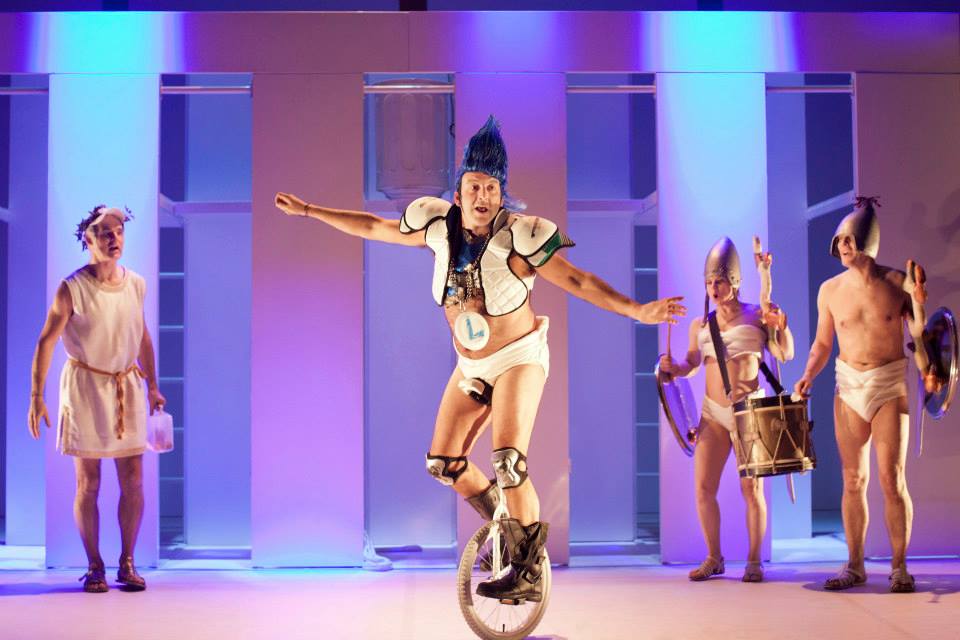
“The poet did not write ‘Agamemnon, Parthenon, Taramasalata’ but in Oedipussy it is intoned as a choric reminder that Greek tragedy developed from the earlier satyr plays whose revels and antics are right up there with Spymonkey’s use of song and physical theatre.”

Editorial Rating: Nae Bad 

Dangle an adapted classic in front of a critic and you invite trouble. So it was fun to hear Spymonkey open Oedipussy with a swipe at a hostile review of their Moby Dick (Edinburgh, February 2010). The boot went onto the other, platformed, foot with wicked intent and not a little of the ensemble playing that would follow.

Oedipus has swollen feet, of course, which is not surprising as they are ‘pinned’ here using a cordless drill. Just one of the modern tools – add a unicycle, saxophone(s) and radio mic – that this production uses to ‘build up a dazzling mockery of delight’. The poet did not write ‘Agamemnon, Parthenon, Taramasalata’ but in Oedipussy it is intoned as a choric reminder that Greek tragedy developed from the earlier satyr plays whose revels and antics are right up there with Spymonkey’s use of song and physical theatre. ‘Woman-breasted Fate’ has her naked moment on stage as a wardrobe accident but otherwise the action is more ‘hot, hard, and in your face’ than anything stylised or reflective.

That said, ‘It’s not bloody panto’ either, as Jocasta (Petra Massey) would have the audience realise. The oracle may be hilariously represented by ballooned eyeballs – plus a red nose in a later manifestation – but the episodes are all here, from the infant Oedipus on Mount Kithairon to Jocasta’s suicide.

It is a post-modern piece though, if you allow 007 a mythic quality. Characters deconstruct as the four actors protest – along with Oedipus – that ‘this is the [real] me’: Petra Massey has problems with her feet and cannot have children; Aitor Basauri says he is not fat and tries out as a stand-up comic and Stephan Kreiss (Oedipus), at 51, needs pain relief from wild acting, and longs to go home to a more ordered Germany.

The Chorus (Park) does its job, singly, with a broken column on his head, and it seems is forever twirling in time as his robes wrap and unwrap around the white, ingeniously available set. Park is also Tiresias the blind prophet who has a remarkable turn as ‘a very bad David Bowie’ with outrageous pink cans on his head. Those costumes do stand out. They are colourful and outrageous, much more ‘Barbarella’(1968) than ‘Atlantis’ (2013).

Nevertheless, blood splatters and streams onto the stage and there are drum rolls to accompany the Eels’ ‘It’s a Motherf-’ – and, whilst the poetry is long gone, Oedipussy has its own tragic face. The production finally plays out to ‘Nobody does it better’, which is fair enough.

nae bad_blue

Dan Lentell in Conversation with Toby Park re. ‘Oedipussy’

oedipussy150

On the afternoon of 9 October ’13 Edinburgh49‘s Dan Lentell met up with Toby Park, artistic director of Spymonkey productions to talk about their unconventional take on an old classic.

https://getyourcoatson.com/wp-content/uploads/2013/10/listen-to-our-interview-with-toby-park.mp3

Listen to our interview with Toby Park

Visit Oedipussy homepage here.

Read Alan Brown’s review of the show (forthcoming).

‘Educating Ronnie’ (Traverse: 2 – 5 Oct ’13)


MacRobert Arts Centre

“The money Joe sent would have provided the deposit on a house in a northern industrial town, or in more personal terms an engagement ring.”

Editorial Rating: Nae Bad

It is a touching story. It touched Joe Douglas for near on £19,300. By the end of the show, at the end of their story, Joe calculates exactly what it cost him over ten years to educate a young Ugandan, Ronnie.

It is a true morality tale that begins in 2002 with Joe, an 18 year old out of Stockport, enjoying a six week gap-year trip to Uganda, whose sights and sounds hit him ‘like a pop-up book’. It is not long after returning home that Ronnie ask Joe for help.

We never meet Ronnie but read and hear his emails and txts. They are pretty short, spell out how much money he needs to keep his education going and – later – how much to compensate the family of a fatal road traffic accident; how much to pay the hospital for his dying mother. The emails present on a video screen of a blackboard and then, diminished, pile up into an on-going reminder of Ronnie’s situation. There are beer mugs up there too, a nice calculation in student terms of how many pints can be bought for the £20 regularly sent to Ronnie by Western Union money transfer.

Joe introduces his story with the lights up. He is not a trained actor (the programme notes make clear his credentials as a director) and he would apologise for that. No need really; his one-man performance starts as he talks fondly to the seat reserved for his aunt Maria in the front row, for it is his auntie who looked after him in Uganda, and who interestingly did not take to Ronnie.

The money Joe sent would have provided the deposit on a house in a northern industrial town, or in more personal terms an engagement ring. He does actually take a ring out of his pocket and smiles, remarking that his parents paid for the wedding. And Ronnie? The BBC World Service went looking for him when this story was first staged at the Fringe in 2012. He has a FaceBook page apparently and does not want a copy of the script.

This work, a co-production by Macrobert and Utter, is smooth. Its careful technicals are well-rehearsed, the soundtrack is appropriate without sentimentality, Joe Douglas’s performance is characterful and honest. His story asks you to risk a leap of faith. I’m glad I did.

nae bad_blue

Reviewer: Alan Brown (Seen 2 October)

Visit Educating Ronnie homepage here.

‘The Baroness: Karen Blixen’s Final Affair’ (Traverse; 27-28 Sept ’13)

Dogstar Theatre The Baroness Roberta Taylor (Karen Blixen (Isak Dinesen) Photo credit Leila Angus

Image by Leila Angus

 “Among Denmark’s literary superstars few are more fascinating than Karen Blixen, pen name Isak Dinesen (1883-1962). The Baroness is the story of her final affair: a platonic entanglement with a much younger poet.”

Editorial Rating: Unrated

For a country where summer temperatures struggle to exceed 20°C, in terms of cultural exports, Denmark and all things Danish are surprisingly hot right now. Successes such as The Killing and Borgen have rocketed outside awareness and interest. Among Denmark’s literary superstars few are more fascinating than Karen Blixen, pen name Isak Dinesen (1883-1962). The Baroness is the story of her final affair: a platonic entanglement with a much younger poet.

We enter to find two harp-shaped window frames with fewer right angles than the Goetheanum. In one hangs a tribal mask intended to conjure images of Blitzen’s years as a coffee planter in Africa (I think it resembles Norman Tebbit). An eclectic harmony of furniture perfectly captures the sense that we are looking into the dwelling place of a mind born for the Belle Époque. Her young companion is evidently much less at home. He belongs instead to that new generation which Kennedy’s Danish-American speechwriter would describe a year before Blixen’s death as “tempered by war, disciplined by a hard and bitter peace.”

The friendship of Blixen and Thorkild Bjørnvig is a matter of historical record. At times the script creeps into the realm of docudrama. When Blixen encourages her protégée to abandon his wife, child and work in order to compel the flow of his artistic creativity, she laments that Denmark is “flat as a duck pond”. Similarly, the muted script gives little sense of a tempest brewing in, or subsequently howling through, the hearts of the protagonists.

Roberta Taylor as Blixen and Ewan Donald as Bjørnvig provide well-rounded individual character sketches. There are flashes of real insight, such as Donald’s steadily improving posture, but there is little shared fascination. Blixen is portrayed at the centre of a social and cultural web in which she occultishly snares young bloods with which to feed her imagination.

Several of the techniques deployed to fill a stylized frame with stylish content are over hesitant. The dramatic function of the mutual friend (played charmingly by Romana Abercromby), for example, is uncertain – diverting more than developing the over-lengthy central narrative. By the interval I think I’ve got the point. Other than the brightly conceived set transition from Blixen’s home to Bjørnvig’s northern hideaway, not much more is said or done.

Pace was a problem throughout. Far from crisp efficiency, the frequent scene changes are slow (although composer Aiden O’Rourke’s bold, introspective score make this less of a negative). Projection was a problem too, I did not feel played to in the steeply tiered back row of Traverse One.

Dogstar Theatre squeezed hard and a good amount of zesty juice was delivered into the glass. If their future endeavours maintain the very high standards set by The Baroness for smart, funny staging of deep, moody drama then we can expect great things from them in the coming years.

Reviewer: Dan Lentell (Seen 28 September)

Visit The Baroness homepage here.