Learning to Live (Espionage, Pravda room, 24 – 30 Aug : 19:45 : 1hr)

“The craft of every word is excellent, the delivery spot on”

Editorial Rating: 4 Stars

Learning to Live by Isla Cowan is a collection of poems from a young woman who shares her journey of moving to university, the search for a new identity and the struggle to connect with old friends after time apart. The showcase also includes an honest and unglossed ode to a parent, a poem about poverty and a poem called Shakespeare in the sunshine – certainly not a combination one comes across every day.

Cowan’s opening poem is The Night We Went to Life – a reflection on those nights spent clubbing and not being entirely sure why. This is a piece with great rhythm and musicality, with comic moments and a story that all of us can relate to. Next up, The Library is slower and more contemplative, showing great maturity and sense of perspective. Every poem in this show is full of fantastic imagery and a sense of a captured moment, but the last in the set is one called Memories, in which she utters the inimitable line “I am nothing but memories”. To me this summed up the overall ethos of the performance – a collection of lessons learned, delivered simply and beautifully.

My favourite poem from the collection performed was The Lightbulb, which to me demonstrated an accessible and educated view on mental turmoil through clever use of metaphor. Indeed, when Cowan does use metaphor throughout her work, it’s both selective and effective. Great examples include the idea of being “between dinner and dreamland” after a night and morning with that special someone, and carrying “worries in a basket” along with the rest of one’s shopping. Though the subject matter of her work is relatively simple, there’s a lovely feel about it all that reflects her coming of age, but without trying to be too pretentious or flamboyant.

The craft of every word in Cowan’s poetry is excellent, and the delivery of her work is also spot on. She clearly knows the pieces inside out, and captures every rise and fall, rhyme and pause with precision. The tone of her voice carries perfect sympathy with the subject matter of each line, and the whole show just felt very natural and comfortable.

If I were to be really picky, I felt that some of the poems ended quite abruptly, causing the odd jar in what was otherwise a very smooth and enjoyable evening. I’d also like to see her take a few more risks, both in terms of style and content, but perhaps that’s one for next year, as, for a debut show for a novice performer of tender age this really was cracking stuff.


Star (blue)Star (blue)Star (blue)Star (blue)

Reviewer: Steve Griffin (Seen 27 August)

Visit the Other archive.
THIS REVIEW HAS NOT BEEN SUBEDITED

Edinburgh Gin’s Night of Literature and Liquor (Edinburgh Gin Distillery, 10 – 31 Aug (Mondays only) : 19.00 : 1hr 30 mins)

“Thoroughly enjoyable and educational”

Editorial Rating: 4 Stars

The cosy Edinburgh Gin Distillery is the perfect venue for a tour of literature’s liquor references, washed down with no less than four gin-based cocktails. It’s comfortable, intimate (audience numbers are limited to 20), and a delightful escape from the bustle of the Fringe.

The show is presented by the quirky and immensely knowledgeable Ewan Angus, who welcomes us to the distillery and talks us through the first of our evening’s beverages. He soon moves on to the good stuff – the literature – starting with who else but Robert Burns.

Throughout the evening, Angus covers a complete range of work, covering writers as diverse as Dickens, Zola, Eliot and Carroll, to lesser known modern authors including Thomas Pynchon and Jim Dodge. He explains the context of each piece, including society’s attitude towards alcohol, and reads selected excerpts which wonderfully describe or talk about liquor and its effects.

Of course, there were features on the well-known gin drinkers of the 20s (Fitzgerald, Hemingway et al.) but no show about literature and liquor would be complete without inclusion of Ian Fleming’s James Bond. Indeed, one of the many surprising facts I learned during this show was how Fleming would knock back up to a bottle of gin a day while writing his last novels. To further his argument into Fleming’s obsession with gin, Angus references passages from Casino Royale and Thunderball, which both give detailed accounts of the many charms of a martini. I’m sure there are plenty more.

However, while gin is commonly known as “mothers’ ruin” – the etymology of which is also discussed in this show, it was somewhat surprising that so few female writers were included. Only works by George Eliot and Elizabeth Gaskell made the cut, though Angus explains that while his research was extensive, it seems women were generally more restrained in their references to liquor.

While Angus is clearly very knowledgeable and passionate about his subject, his delivery was at times a little introverted and rushed, and I would have liked to see more confidence and charisma come through. However, as this show is still very new, I’m sure that will come in future performances.

Overall, this is a very well-researched and informative show, and apart from leaving somewhat more inebriated than on one’s arrival, it’s thoroughly enjoyable and educational.

Star (blue)Star (blue)Star (blue)Star (blue)

Reviewer: Steve Griffin (Seen 24 August)

Visit the Other archive.

THIS REVIEW HAS NOT BEEN SUBEDITED

In His Own Write (The Voodoo Rooms, 8 – 30 Aug : 17.10 : 1hr)

“A thoroughly enjoyable performance, accessible to adults of all ages”

Editorial Rating: 4 Stars: Outstanding

In His Own Write is a delightfully bonkers collection of short stories, written by none other than John Lennon. Last staged at at the National Theatre in 1968, it seems incredulous that it hasn’t been seen since. However, perhaps this version has been given the ok due to its very simple and honest approach to just telling the stories, without any of the pomp, prestige or impersonation that could be associated with adapting such a work.

The show opens with (and indeed each story is preceded by) a short pencil-sketch animation in the style of the illustrations in the original book. Immediately the tone is set as being playful and non-fussy – embodying the spirit of the book perfectly. The trio of performers set straight to it, capturing the innocence of each story with energy and clarity, but at no point going over the top into pantomime.

What makes this collection so enjoyable is the wordplay used by Lennon on selective phrases, often changing just one or two letters to make a new word with a completely different meaning. My favourite came quite early on, in Flies on Trash, where a character is described as “a former beauty queer”, and is portrayed by the actor accordingly. Another character later on is described as “dead and duff”, and another “wandered lonely as a sock”. The deadpan delivery of every line was the perfect accompaniment to the absurdity of the writing in letting it speak for itself.

Of course, for a piece written in 1964, there are bound to be some words and phrases used that today we find a little unsavoury, and use of them could probably get one sacked from the BBC. But given the honest style of the show’s delivery – presenting the work just as it was written without any comment or spin – such phrases ring home very naturally, and don’t seem out of place in the context. If anything, they give an added layer of hilarity.

As a performance it is very slick and professionally put together, and there’s also great variety used in the techniques to share each story. A couple are sung a capella, one or two are delivered solo, some contain a few outlandish props, but all delivered clearly, with great vitality and passion for the craft. It’s well rehearsed and the transitions are smooth, maintaining the level of interest and engagement throughout.

I think for what the company were trying to achieve in the faithful presentation of the book, they succeeded with aplomb. Whether this piece is everyone’s cup of tea, or could have had more dramatic structure or development is another question. Either way, it is a thoroughly enjoyable performance, accessible to adults of all ages.

outstanding

StarStarStarStar

Reviewer: Steve Griffin (Seen 24 August)

Visit the Other archive.

THIS REVIEW HAS NOT BEEN SUBEDITED

Edith in the Dark (Momentum Venues @ St Stephens, 5 – 30 Aug : 16.25 : 1hr 20 mins)

“A truly superb performance from Blue Merrick as the title character”

Editorial Rating: 4 Stars

Edith in the Dark is perhaps one of the most curious adaptations at the Fringe this year, combining a selection of Edith Nesbit’s earlier, and much darker, works, with elements of her real life. From the pen of award-winning and respected playwright Philip Meeks I was expecting a well conceived piece, but could it bring the threads together to be a work of art in its own right?

The concept is very simple: Nesbit escapes to her attic (and study) during one of her husband’s parties. In the adjoining room lies an invalid girl, rescued by Nesbit from the street. A guest (Mr Guasto) joins her, proclaiming to be a fan of her work and to have snuck in having spied her earlier. They have a brief flirtation and Nesbit agrees to read aloud for him. They are interrupted by Nesbit’s maid, Biddy Thricefold, but the reading goes ahead, and soon we are sucked into the world of the ghostly stories.

The script is very natural, and flows well, capturing the mood and period very sympathetically. The twist at the end was certainly effective and well concealed, even if it did leave me a bit confused. The direction is subtle, although there were a couple of moments when Nesbit walked down stage to deliver lines straight forward that did jar from the otherwise very realistic style.

The actors are excellent throughout, playing multiple characters in the reading of the stories, but of special note is the truly superb performance from Blue Merrick as the title character. She enthralls with a commanding stage presence, and performs with enough light and shade to make Nesbit believable but without ever being overly theatrical.

The set and effects were also very impressive, with smoke and lighting used to give atmosphere, and the exposed and expansive wooden set giving a real sense of the bare attic room. Overall, it’s a very solid production, that’s been pulled off well.

However, despite the fact that this performance is an abridged version of the script, it does still feel quite lengthy, and there’s not quite enough drama to keep it completely engaging throughout. Perhaps with more characters, narrative development or interruptions it could have been something really quite spectacular. Still, definitely worth watching.


Star (blue)Star (blue)Star (blue)Star (blue)

Reviewer: Steve Griffin (Seen 23 August)

Visit the Other  archive.

THIS REVIEW HAS NOT BEEN SUBEDITED

Hannah and Hanna (Assembly George Square, 6 – 30 Aug : 13.20 : 1hr)

“A very heartfelt performance from two fine young actresses”

Editorial Rating: 3 Stars: Nae Bad

Hannah and Hanna is a story examining two sides of the immigration debate, which, given UKIP’s performance in this year’s general election, and the more recent events involving migrants in Calais, couldn’t be more perfectly timed.

Hannah (played by Cassandra Hercules), lives in Margate, Kent, where she’s been her whole life. Like her boyfriend and peers, she’s fiercely anti-immigration, believing that local resources should be kept for the locals. Hanna (Serin Ibrahim) is a refugee from Kosovo and sees Margate as a dreamland, and all she wants is to fit in and be accepted. Their worlds collide and a special bond is formed between them, transcending the prejudices of their families.

The play is very simply staged, with character and location indicated by token props and subtle changes in lighting. Between the two of them, Hercules and Ibrahim play a multitude of characters, ages and nationalities, but are at their best when playing Hannah and Hanna. Ibrahim brings beautiful sensitivity and naivety, while Hercules is vibrant with energy and passion. Both actresses, in their twenties in real life, capture and portray their 16 year old characters effortlessly, and through their physicality and delivery of the script it is uncannily believable that they are indeed that young. The bond they form is genuine, and the chemistry between the two is strong enough to make you feel warm and fuzzy inside.

However, despite being a very commendable effort from the performers, this play does fall down in certain areas, with parts of the script requiring a lorry-sized suspension of disbelief. While all the necessary ingredients are there (characters representing different points of view, a decent story arc and plenty of dramatic tension), it does all feel very rushed, and at times hard to follow.

Hannah is won around by Hanna’s charm very early on, and the pair seem to form an unbreakable friendship after only five minutes. The final 10 minutes of this play are quite confusing, with lots of ups and downs and jumps in time and location making it quite difficult to follow, and the ending isn’t as resounding or emphatic as it could have been considering the topic. What’s really missing is that, apart from the two central characters, there isn’t really a sense of anyone having learnt anything or viewpoints changing, so at worst it feels a bit pointless, and at best just a nice story.

I believe that if the company had longer to work on the piece (it was developed in just two weeks), and were prepared to make some changes to the initial script to extend and clarify it, this could be something very special. At the moment it’s a very heartfelt performance from two fine young actresses, but little more.

nae bad_blue

Star (blue)Star (blue)Star (blue)

Reviewer: Steve Griffin (Seen 23 August)

Visit the Other  archive.

THIS REVIEW HAS NOT BEEN SUBEDITED

Trans Scripts (Pleasance Courtyard, 5 – 31 Aug : 15.00 : 1hr 30 mins)

“Gutsy, inspiring and emotional… get a ticket by any means possible”

Editorial Rating: 5 Stars

Trans Scripts is a verbatim play, which examines the lives of six transgender women, and is performed by six fantastic transgender actresses. It’s simply structured as six monologues, interwoven and staged with very little fuss and theatricality, allowing the stories to speak for themselves.

We follow the women from when they knew something was wrong with their bodies, through reactions from their families and peers, their transitions, and their lives since. Each story is unique and heartbreaking in its own right, but when told as a collection, you do really get to see many different sides to being trans. We see familial acceptance, we see homelessness, we see violence, suicide attempts, broken relationships and even the reaction of a church. There are highs, lows, twists, turns, and a real cross-section of experiences that go some way to representing a very misunderstood group.

One example is Josephine (played by Catherine Fitzgerald), who becomes trans when she’s married with children, and longs just to fit in as a woman. She’s managed to maintain an amazing relationship with her wife, but struggles to comprehend the reaction of her wife’s colleagues and friends. The most touching story for me though, which reduced me to tears many times, was that of Eden, who having been born with both female and male genitalia, was made a “boy” at the insistence of her father. We follow her struggle with her identity, relationships and family, learning about how she almost died during her gender reassignment surgery, and her first steps to meeting her mum again, having been estranged for over 20 years. The delivery of this monologue was gut-wrenchingly powerful from Rebecca Root, who really stood out with impressive physicality and emotive range throughout.

While very much six individual stories, there are occasional moments of interaction between the characters as well. The most interesting of these involved a heated discussion as to the necessity of having the full operation, and how this affects identity. As became evident, even within the trans community there are differences of opinion as to whether such steps are necessary to really fit in, shining further light on the struggle to be accepted and happy in their own bodies.

Overall, this is a very important and engaging piece of theatre, which has been crafted with precision and sensitivity by writer Paul Lucas, and is a gutsy, inspiring and emotional performance from six women who’ve all made incredible journeys in their lives. Get a ticket by any means possible.


Star (blue)Star (blue)Star (blue)Star (blue)Star (blue)

Reviewer: Steve Griffin (Seen 22 August)

Visit the Pleasance, Potterrow & Teviot archive.

THIS REVIEW HAS NOT BEEN SUBEDITED

Mansplaining Masculinity (Cabaret Voltaire, 8 – 30 Aug : 12.05pm : 1hr)

“An engaging and thought provoking discussion… honest, revealing and accessible”

Editorial Rating: 4 Stars: Outstanding

“This isn’t a comedy” Dave tells us, wearing a purple dress and a fedora, without a hint of irony. It is however, an incredibly engaging and thought provoking discussion into the notion of masculinity that’s honest, revealing and accessible. My words, not his.

The show is framed around a survey carried out by Pickering, which asked 1,000 men to share their opinions and experiences about patriarchy and masculinity (anonymously). It also includes a raw account of his own sexuality and identity, and during the performance he attempts to piece the two together.

Although researched to an almost painstaking degree, and written and structured with a lot of love, Pickering doesn’t pretend to have all the answers, or that his show will somehow cure the world of its ills. Instead it’s an exploration of an idea, and insight into a side of the human state that receives little attention. It was passionately and engagingly delivered, and he even gives references for further reading on the topic – a first for me at a Fringe show.

During the performance Pickering certainly doesn’t shy away from the big issues – there’s talk of rape, emotional abuse, bullying and more. But it’s not spouted in a preachy or melodramatic way – it’s a simple recount of some very personal experiences from his own life, mixed with responses from the survey, and weaved together with some very intelligent discussion and line of questioning.

As a discursive show, it was very effective when Pickering referred to results from the survey, but it was almost tantalising that he did so only rarely, as I would have loved to have glimpsed further into the world of what men really think. He did at times refer to other well known (but uncited) general facts which did give the piece some added clout – how men commit more crimes, carry out more successful suicide attempts, and earn more money.

The anecdotal parts of this show, where Pickering shared memories from his traumatic home and school life, and his first sexual experiences were very moving, and made me question my own coming of age and identity within the “patriarchy”. His openness is absolutely commendable, and it really enriches the piece by bringing in personal as well intellectual engagement.

I feel the content of carries great social importance for people of all sexes and ages, and this is a very entertaining and enlightening way to spend an hour. I urge you to see this show.

outstanding

StarStarStarStar

Reviewer: Steve Griffin (Seen 22 August)

Visit the Other archive.

THIS REVIEW HAS NOT BEEN SUBEDITED

Aunty Donna (Gilded Balloon, 5 – 31 Aug : 22.00 : 1hr)

“An all guns blazing comedy rampage”

Editorial Rating: 4 Stars

The first thing that hits you about Australian comedy troupe Aunty Donna is undoubtedly their energy. This is a one hour, all guns blazing comedy rampage, with never a dull moment. Between the three of them, they caper around as an array of characters, delivering one of the slickest sketch shows I’ve ever seen. Each section melts into the next seamlessly, and it’s a testament to the performers’ dedication that it flows so naturally.

I particularly enjoyed the lip-synching to various songs, that had clearly been very well rehearsed and were delivered with aplomb. During an early mime sequence to a very loud track, one audience member gets pointed at whenever the word “no” is sung – at one stage, several times in quick succession – and the build up and dramatic focus in this section had the audience in stitches.

Throughout there’s a great balance between longer, more developed sequences and a few one liners, including a simple section of reading out “texts from your parents”. My favourite sketch featured someone who “completely misread the situation”, leaning in for a kiss when it totally wasn’t appropriate. With no dialogue, just a scene title and some great physicality, they delivered a simple and very funny moment.

For an Australian group performing the the UK, there were a number of risks taken in making fun of some wonderfully British stereotypes. From our penchant for queuing, to chip butties and even reference to Tottenham Hotspur playing cricket, they strike a great balance between topical humour, without crossing the line into offensive territory. This is a show that is well thought-out and has been perfectly targeted to this market.

In the final third of the performance the group start to reference their own jokes from earlier on, and thankfully, as they had been well-written and delivered, it showed an added layer of intelligence and thought. At no point was it gratuitous though, every moment was carefully selected and well weaved in, and helped tie the piece together into a cohesive performance.

However, for me this show was at times a bit too loud and too full on, and I would have preferred more contrast and subtlety in some of the sketches. In saying that, Aunty Donna’s style is very much their style, and on the whole it delivers laughs aplenty. If you want a loud, high energy, fast paced and at times just a bit weird sketch show, this one is definitely for you.

Star (blue)Star (blue)Star (blue)Star (blue)

Reviewer: Steve Griffin (Seen 20 August)

Visit the Pleasance, Potterrow & Teviot archive.

THIS REVIEW HAS NOT BEEN SUBEDITED

Unexpected Excesses (Edinburgh Drawing School Gallery : 9 -30 Aug : from 11am)

Unexpected Excesses

“Prepare to be dazzled”

Editorial Rating: 5 Stars: Outstanding

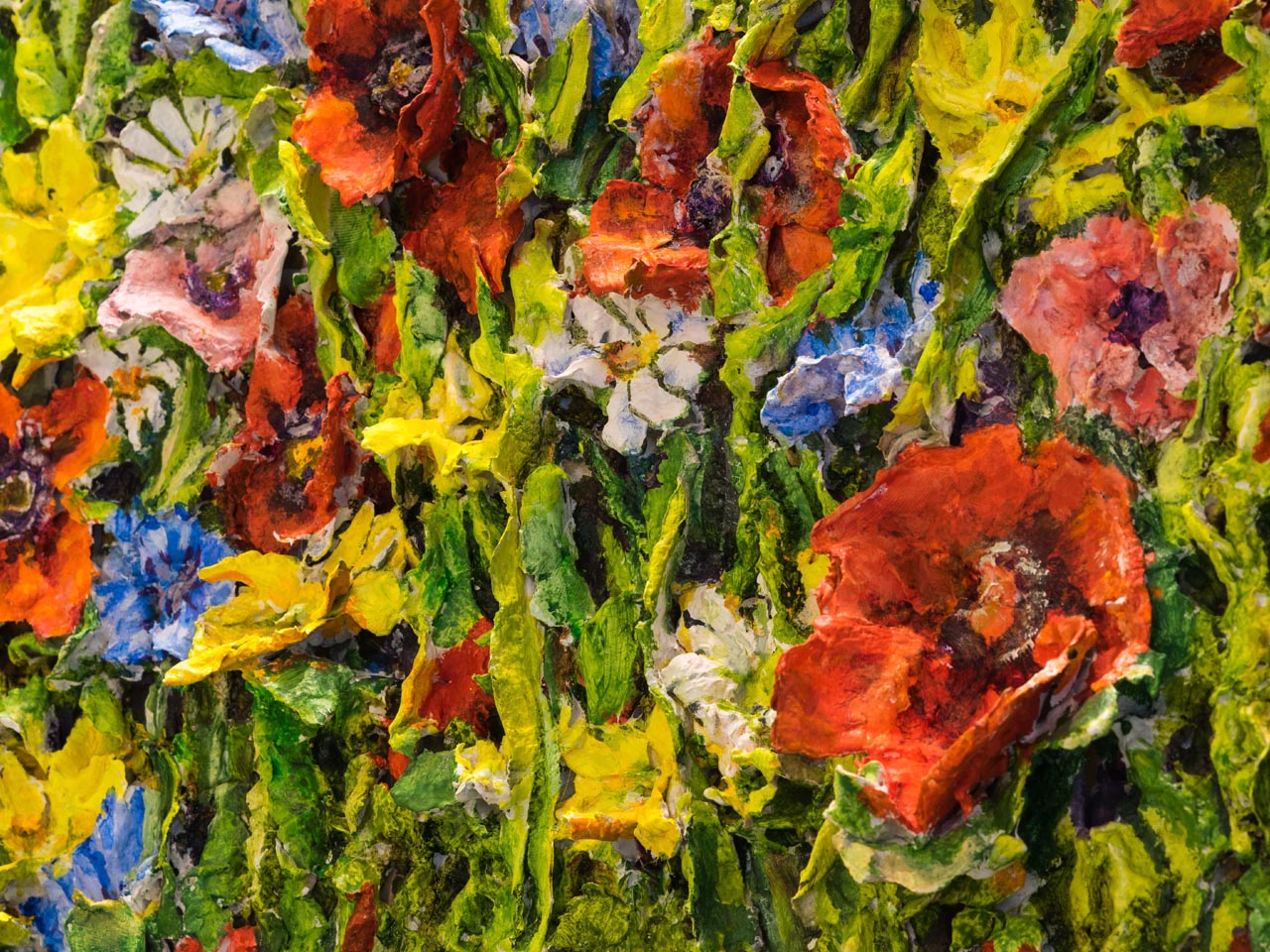
Walking through the doorway into Unexpected Excesses (an exhibition of work from Jan Knibbs and Lizz Watts), my immediate impression was a riot of colour, texture and form. However, thankfully Watts was there to guide us through the collection and how it was created.

One of the most striking pieces, a framed collage called The Return, juxtaposes broken ceramic teapots with papier mache flowers, which appear to grow from the ground in which the pottery has fallen, representing the circle of life. It was full of vibrancy and energy, and a great example of the vivid style of the work on show.

In talking to Watts about her pieces, she revealed that she likes her work to develop organically. She may start off with an idea but at some point it develops a life of its own, and many pieces tell a story. A favorite theme is nature and the changing seasons. A particularly impressive vase with a group of swans’ necks curving from the lip was always intended to be connected to swans thematically, but the final form they took in the piece was completely organic and unplanned. There are certainly no two pieces alike.

The clothes, hats, shoes and other gloriously opulent and embroidered textiles by Jan Knibbs were displayed on mannequins and elsewhere scattered through the exhibition, the effect combining gracefully with the ceramics.The philosophy behind both the textile and ceramic creations is concerned with practicality as well as being stunning to look at: the clothes and shoes are wearable, the bowls and vases usable.

What really makes this exhibition special is that it is both interactive and experiential. Not only are visitors able to talk to the artists but they are also positively encouraged to handle the pieces, feel them and examine them closely. In doing this it can be a pleasant surprise to find a continuation of the decorative motif on the inside or throughout pieces, as well just on the surface. On top of this, when I visited, a harpist (Bianca Watts) appeared and played for us to give an added layer of decadence, and I was lucky enough to be given a glass of Prosecco to enrich my Sunday afternoon with further “unexpected excess”. If that weren’t enough, visitors are invited to contribute a few lines to a daily poem, started by poet in residence Dawn Gorman, in order to really become part of the work.

Unexpected Excesses

As one might expect, this exhibition is an extravagant, beautiful and seemingly chaotic collection of work. Yet there was a real cohesion to it – the ceramics complemented the textiles, and all the added extras fit perfectly into the overall theme. On close examination there were many hidden treasures: ribbons at the back of dresses, decoration inside pots, and lots of small details that made me want to keep examining every piece further. The atmosphere in the room was intimate and relaxed without feeling stuffy or overpowering.

This exhibition is called Unexpected Excesses, and it’s easy to understand that some visitors may see the room, and indeed some of the pieces in it, as too much, too ornate, a gilded lily. But whether it’s your personal taste or not, it’s definitely worth experiencing. There is a varied programme of guest artists and things going on, from poetry to music, as well the incredible art on display. Check the programme before planning your visit, or just turn up and prepare to be dazzled.

outstanding

StarStarStarStarStar

Reviewer: Steve Griffin (Seen 16 August)

Visit the Other  archive.

THIS REVIEW HAS NOT BEEN SUBEDITED

Photo credits: Bill Johnston

To Kill A Machine (ZOO, 7 – 31 Aug : 20.55 : 1hr)

To Kill a Machine, a new full length play written by Welsh writer Catrin Fflur Huws about the life of Alan Turing. Director: Angharad Lee Scriptography Productions Dress Rehearsal May 5 2015 ©keith morris www.artswebwales.com  keith@artx.co.uk  07710 285968 01970 611106

“One of the finest acting performances I have ever seen at the Fringe”

Editorial Rating: 4 Stars: Outstanding

In a year that has seen Alan Turing receive an official royal pardon and a blockbuster film about his achievements, it seems somewhat surprising that there aren’t more shows at this year’s Fringe about him. However, this work from Welsh company Scriptography Productions is absolutely sensational, and features on of the finest acting performances I have ever seen on the Fringe.

The play starts with Turing as a schoolboy, and goes on to show his first love, his work at Bletchley, and the relationship that would see him found guilty of gross indecency. It’s certainly not afraid to be bold, and at times brutal, focussing primarily on Turing’s sexual identity and personal life.

Turing himself is played by Gwydion Rhys, who brings so much emotional depth, softness and realism to this disturbed character that I genuinely wanted to jump on stage and stand in the way of him being chemically castrated in the play’s final scene. It’s a controlled and commanding performance without ever being over the top, and well worthy of a Fringe award. The supporting cast of Rick Yale, Francois Pandolfo and Robert Harper, who between them play 14 characters, also deliver highly commendable performances.

The production moves at quite a fast pace, but it’s the moments of stillness and sensitivity, which to me were the most powerful. In particular, watching Turing’s mind whir as he develops his theory for the first computer, and his damning confession and inability to lie while in the witness box are utterly compelling.

While I wasn’t 100% convinced by snippets of the high energy quiz show scattered throughout, which posed questions to reflect theories developed by Turing, these sections did serve as a stark Brechtian contrast and awakening to his manipulation and ultimate downfall. I would have liked to have seen a closer integration between these sections and the genuine interrogation he received in the courtroom to really complete the circle of that idea.

It was also disappointing for me that this show was only an hour long, I could easily have stayed engaged for two, and would have welcomed more exploration into some of the other themes – gender identity, machines vs humans, and more cultural context of the period of his life. In saying that, for the length it was, I think it was written and structured excellently, with an engrossing narrative and compelling action. This show is a must-see.

outstanding

StarStarStarStar

Reviewer: Steve Griffin (Seen 17 August)

Visit the Other  archive.

THIS REVIEW HAS NOT BEEN SUBEDITED