Edinburgh Quartet: Queen’s Hall (12 Nov.’17)

Image result for kamila stosslova

Janacek’s “Intimate Letters’  to Kamila Stosslova

“The Edinburgh Quartet go on tour to all four points of the compass, to build lasting relationships with communities in the North, South, East and West of Scotland”

Editorial Rating: 4 Stars


I have not reviewed the Edinburgh Quartet since March when they played a combination of Mozart, Beethoven and Shostakovich as part of their “Revolution” series. They have been busy since, including a fascinating mixed media “Dance” performance reviewed in June by my colleague Steve Griffin. The Quartet are not a conventional, formal concert giving band, and have a clear market and music focus: different themes for every season, and outreach to the local community, including incorporating artists, makars, dancers, and, tonight, student musicians. Sunday’s 3pm matinee was one of only a few conventional concert hall offerings this season. Otherwise there are rush hour concerts, lunchtime concerts, free concerts and concerts all over Scotland including as far afield as Lerwick. It is almost as if ‘Edinburgh’ is a misnomer. Their publicity rightly states that “the Edinburgh Quartet go on tour to all four points of the compass, to build lasting relationships with communities in the North, South, East and West of Scotland”.  They are a quartet for the nation.

With this creative and outward looking disrespect for inertia we also have had change in the line up almost to the point of it being a band of session musicians, Mark Bailey on cello apart. This does not trouble the band, and nor should it us. The vacant seats give an opportunity for up and coming musicians to try out their playing in a quartet as opposed to an orchestra or solo role, and it brings something new for each concert, where all the different line-ups I have reviewed deliver a surprising homogeneity.

Yet the move from homogeneity to synergy requires players in total empathy with one another and second guessing them, often for years, which is why great quartets are always better than star studded put-together ensembles.  Only the first violin seat remains to be filled, probably, I understand in the New Year. On balance, this is to be welcomed.

The programme took us from Haydn, through Tchaikovsky and Janacek to a new work by Scottish composer Tom Harrold.

Haydn’s String Quartet in F minor Op 20 No5 is part of his ‘Sun’ series, but this stupid name, based on a cover illustration, belies an austere work that is satisfying rather than uplifting. It was competently and confidently played.

The Janacek String Quartet No 2 “Intimate Letters’ was written 150 years later (1772, 1927 respectively) and in style probably quite demanding for the largely elderly Sunday afternoon audience. Written in the last year of Janacek’s life it reflects upon the woman for whom he fell head over heels, Kamila Stosslova, nearly 40 years his junior and to whom he wrote over 1000 letters, 300 in his last eighteen months*.   Certainly all manner of feeling was in this work, amounting to a conviction piece that, while not easy listening by any stretch, was as rewarding as it was demanding. That the relationship was reciprocated only platonically no doubt contributed to his and the music’s angst. The Quartet despatched its considerable demands with ease. So much so that when the work stopped in order for second violin Tom Hankey to return to the anteroom to pick up the rest of his music nobody minded, such is the quartet’s informal rapport with their audience.

Following the interval the quartet was joined with a “shadow” quartet of students from St Mary’s Music School: Briona Mannion and Marie-Sophie Baumgartner on violin, Rachel Spence and Finn Mannion on viola and cello respectively. They were playing the world premiere of Tom Harrold’s short piece “Elegy”. Harrold described the work as simple but the timings were very difficult (and which the shadow quartet managed very well) and there was a considerable amount of pizzicato to handle. Intensely quiet at the opening the piece developed into a pleasing, romantic work in the modern vein.

The evening ended with Tchaikovsky’s String Quartet No 2 in F, Op 22, a great, classical work relatively unknown outside of the musical world, for being within the chamber music genre, I suspect. Contrast it with the hugely popular Piano Concerto No 1 in B flat minor, Op 23. Both have the honour of being dismissed by Rubenstein: the Quartet “not really chamber music”, and the “Concerto “unplayable” It took considerable reserves of energy and musicality to deliver a work of this substance at the end of a long but engrossing Sunday afternoon. The elusive first violin seat was on this night guested by Nicolas Dupont from Belgium. He had most of the heavy lifting to do, ably supported by his colleagues. Whoever takes the first violin seat permanently has a lot to live up to.


***********

 * For those who want to know more about this extraordinary 11 year ‘non romance’ I recommend “Notes for a Hausfrau: Intimate Letters: Leos Janacek to Kamila Stosslova”, edited and translated by John Tyrell and published by Faber in 1994 at £25.  It may be out of print, so go to the excellent review in the Independent by Michael White that gives the gist of this extraordinary muse:  http://www.independent.co.uk/arts-entertainment/book-review-notes-fof-a-hausfrau-intimaye-letters-leos-janacek-to-kamila-stooslove-ed-trs-hohn-1410383.html


Star (blue)Star (blue)Star (blue)Star (blue)

Reviewer: Charles Stokes (Seen 12 November)

Go to the Edinburgh Quartet

Visit Edinburgh49 at the Queen’s Hall archive.
RSNO: Gomez, Sunwoo (Usher Hall:10 Nov.’17)

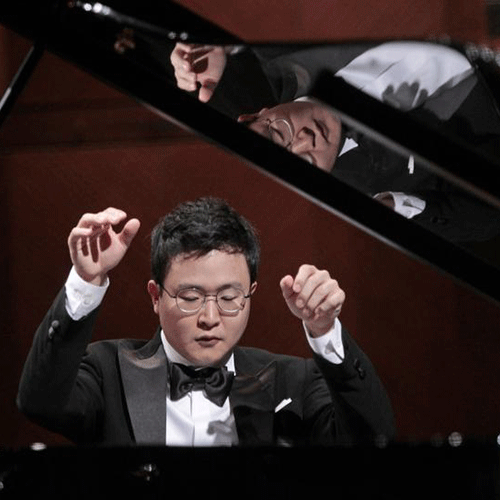
Yekwon Sunwoo
Photo: Philadelphia Chamber Music Society

“Sunwoo’s opening was utterly assured in its relaxed confidence, disposing of the keys with easy liquidity so that we were leaning forward in our seats to capture every nuance of interpretation”

Editorial Rating:  5 Stars Outstanding


I have written before of the RSNO’s skill in concert programming, often successfully juxtaposing contrasting yet somehow complementary works. Friday’s concert was to be a full blown Romantic affair in the Russian 20th century genre starting with the exquisite and rarely performed Vocalise, but, alas, illness, so common in the concert world at this time of the year, forced a programme and artist change. No Vocalise. Instead, we got Zulu, by British composer Daniel Kidane (b.1986). Quite a change.


Yet after the initial upset there was no room for disappointment. Jose Luis Gomez stood in for the indisposed Christian Macelaru at the last minute and arrived from America with a score of the symphony in his pocket. “Who doesn’t travel with Shostakovich 12?” His credentials were impressive, Assistant to Paavo Jarvi at the Frankfurt Radio Symphony Orchestra and in 2010 winner of First Prize in the Solti Conducting Competition. Currently he is Music Director of the Tucson Symphony Orchestra.


Prize winning credentials were also the order of the day for piano soloist Yekwon Sunwoo, prizewinner at the 2017 Van Cliburn International Piano Competition, and the programme change from Rach 2 to Rach 3 was in fact a welcome change from the much played second concerto to its slightly less well known, but in every other way equal sibling.


So on to the playing. Zulu was five minutes of noise. Enthusiastic brass playing, well orchestrated, good rhythm and momentum. Composer Daniel Kidane has studied at the Royal Northern, Royal College and privately at St Petersburg. The work was chosen from his participation in the RSNOs Composers’ Hub. It was a conceptual stretch to include it in the programme, but it made for a lively opening.


Next up was Rachmaninov’s Piano Concerto No 3 in D minor. I have seldom heard this work played so well, certainly not in the hands of a 21 year old. Sunwoo’s opening was utterly assured in its relaxed confidence, disposing of the keys with easy liquidity so that we were leaning forward in our seats to capture every nuance of interpretation. As the first movement Allegro ma non tanto developed so did Sunwoo’s attack, holding nothing back yet stopping way short of pastiche. You do not have to wear Rachmaninov on your sleeve to get the best out of of it. The RSNO accompanied him with playing that was glorious in its phrasing and intensity. The work has long solo and barely accompanied passages, not exactly cadenzas, but close. Time and again Sunwoo nursed and coaxed freshness of interpretation from this well known, much loved piece. Notwithstanding 45 minutes of bravura playing we were treated to an encore. The quiet and restful interpretation of Tchaikovsky’s Autumn Song from the Seasons lasted a full five minutes bringing the dramatic first half of the evening to a relaxing, introspective close. If you don’t know it, find it here on You Tube.


The second part of the evening was an assured, storming interpretation of Shostakovich’s 12th Symphony The Year 1917. Written in 1961 when Shostakovich was still not out of the political woods it is obviously a political work but without taking anything away from its inherent musicality. “Revolutionary Petrograd” started with typically haunting, bleak cellos and basses suggesting barren topographical (and political) landscapes full of desolation and foreboding before being joined by the upper strings in a more purposeful and positive timbre. Played continuously for 40 minutes the demanding work gave the whole orchestra, from expertly played woodwind soloists to stunning percussion, the opportunity to give the best possible account of themselves, which they did. The work built up though tableaux such as “Razliv” (Lenin’s revolutionary headquarters), “Aurora” (the battleship that fired the opening shots of the Bolshevik coup) and, finally the optimistically named “Dawn of Humanity” which was at least in musical terms a summation of all the themes that had gone before, and gave the orchestra the opportunity to demonstrate fluent, assured playing that whilst on occasions very loud, was never forced.


I have often said that one of the reasons live music is so exciting is the risk of failure. Here we had a last minute change of two out of the three pieces in the programme and a conductor no one had met or played under before the previous day. The result? Perhaps the most exciting and enjoyable concert I have been to this year. The RSNO continues to improve and impress


StarStarStarStarStar

Reviewer: Charles Stokes (Seen 10 November)

Go to the RSNO, Scotland’s National Orchestra

Visit Edinburgh49 at the Usher Hall archive.

RSNO: Oundijan; Vogler; Wang. Usher Hall. 3 Nov.’17

Related image

Jan Vogler

“Great if you like twelve-tone. Not so great if you don’t”

Editorial Rating:  4 Stars


Combined concerti for violin and cello are relatively rare, and on Friday at the Usher Hall we got two, separated in composition by 128 years. Such was the nature of the new work, however, that it was more like a comparison of the Viennese Salon of the 1890s and the 1930s’ Second Viennese School.


As is his custom, conductor and Director of Music Peter Oundjian gave us an introductory talk alongside cello soloist and this year’s Artist in Residence Jan Vogler. Not unreasonably, the majority of the talk was about the UK premiered work Duo Concerto by Wolfgang Rihm. Rihm was born in 1952 in Karlsruhe and is a professor of composition at the University of Music there. The work was commissioned by the Friends of Dresden Music Foundation to celebrate ten years since the reopening of the Frauenkirche and received its world premiere in Purchase, NY and in Europe in Dresden in 2015. It was written for performance by Vogler and tonight’s violin soloist, Mira Wang. Vogel’s association with the work, and his being the orchestra’s Artist In Residence, explains its choice on tonight’s programme in addition to its legitimacy as a composition.


The work lasts for 25 minutes in one movement. The soloists are in play almost the entire time, and the work has a heavy texture and is written in the twelve-tone technique. “Great if you like twelve-tone”, said Vogler. “Not so great if you don’t”. The work in fact had momentum, good orchestration, and a particularly demanding part for violin soloist Mira Wang. It was, perhaps, down to the limitations of twelve tone that it sounded remarkably similar to Schoenberg albeit composed seventy years later.


Our hardworking soloists carried straight on into the Brahms Double Concerto in A minor. Brahms is the master of melody, and we were into a glorious cello theme just four bars in. Whereas Wang did most of the heavy lifting in the Rihm, this work was Vogel’s and in fact a case could be made for writing out the violin part altogether, taking nothing away from Wang’s fine playing and   interplaying with Vogel beautifully when the score allowed it. The orchestra played with excellent phrasing and balance and were clearly very comfortable in their skin, supporting the soloists with all effortlessly harmonised under Oundjian’s baton.


After the interval we returned for Beethoven’s Symphony No 6 in F major, the ‘Pastoral’. What can a music writer add to the reams that have already been written about this glorious work? Well, you could feel the hall relax as we snuggled into this closing number, the orchestra were on top form, fully rehearsed and sure of foot, and familiarity did not disappoint. One notable difference in interpretation were the strings playing of the first subject in the final movement (Shepherd’s Song), Oundjian holding them back just a little so we could hear more of the supporting wind. He bought them back to the fore before the finale.


And did you know the Shepherd’s Song was used as music in the TV commercial for Lentheric’s Tweed fragrance in the 1960s? Now, you will find that degree of historical research only in Edinburgh49.


Star (blue)Star (blue)Star (blue)Star (blue)

Reviewd by Charles Stokes (Seen 3 November)

Go to the RSNO, Scotland’s National Orchestra

Visit Edinburgh49 at the Usher Hall archive.

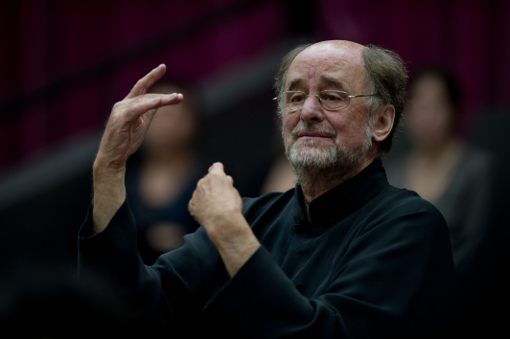
RSNO: Norrington (Usher Hall 21 Oct’ 2017)


Sir Roger Norrington
Photo: Alberto Venzago

“Sometimes good things come in small packages”

Editorial Rating: 4 Stars


There was much more to Friday’s excellent RSNO/Roger Norrington gig than met the eye. Of course it was a thrill to be in the hands of the maestro of historically informed musical performance, last seen here at the Edinburgh Festival for his assured and thrilling Monteverdi performances, as well as for the reassurance of an evening’s accessible, if not easy listening, classical music. Yet we got so much more, namely an insight into the deceptively futuristic ahead-of-its-time works of Robert Schumann and Felix Mendelssohn-Bartholdy.

The first question one was forced to ask oneself was, “When is a symphony not a symphony?” The initial work, Schumann’s Overture, Scherzo and Finale was originally titled Symphonette and played out in three movements in around 19 minutes. Both Prokofiev and Shostakovich wrote symphonies of lesser duration, the former at the beginning and the latter towards the end of their symphonic canon, so why the name change? In admittedly three movements rather than four, it was greater than the sum of its parts and was a satisfying, rounded piece developing all the way through towards a Finale: Allegro molto vivace that was recognisably mature Schumann as compared to its more Mozartian beginnings.

After the deftest of scene changes (only three first violin desks to move out of the way in this cut down band) to bring on the concert grand Steinway, Roman Rabinovich delighted us in a relaxed, assured and thrilling interpretation of Mendelssohn’s Piano Concerto No 1 in G minor.   In an underrated work clearly ahead of its time – that reminded me of Brahms and Tchaikovsky a generation later  – we were treated to excellent solo and ensemble playing of a dramatic operatic opening followed by a strong melodic line and taut together playing under Norrington’s understated, enabling direction.

The evening concluded with Schumann’s Symphony No 1 in B flat minor (Spring). I cannot find any reference to Tchaikovsky being influenced by Schumann in his ground breaking fourth symphony but the opening two bars of the Spring symphony were near identical. The orchestra were sufficiently beefed up for this work to make one forget it was contemporaneous with the opening number. We went from two French horns to five, nought to three trombones and were full on for more than half an hour. The playing and direction were disciplined and effective with well-managed crescendos and an elaborate brass coda in the first movement. The band continued to provide a rich tone in the second, but in the elaborate and extended finale, following on a beautiful flute intervention, the brass gave into themselves showing tone a little coarsened by virtue of their evident enthusiasm. Never mind, this was joyous music making.

As I left the auditorium I noticed that I was leaving at the remarkably early hour of ten past nine. We had, in fact, just one and a quarter hours of music making when on a good night one can expect nearer two hours. Yet it was a well-put together programme and hard to see how it could have been justifiably fleshed out. Some times good things come in small packages.


Star (blue)Star (blue)Star (blue)Star (blue)

Reviewer: Charles Stokes (Seen 20 October)

Go to  the RSNO, Scotland’s National Orchestra

Visit Edinburgh49 at the  Usher Hall .

Edinburgh Academy Musicians (Queen’s Hall: 28 April ’17)

image-124.jpg

 “Almost three hours of glorious, live music, from the promising to the near professional”

Editorial Rating:  4 Stars: Nae Bad

That the Edinburgh Academy hires the Queen’s Hall for their Summer Concert is not just a capacity issue but a fitting testimony to the quality of their music.   Yes, perhaps the venue shed a little magic dust over gifted performers, but in turn they rocked the joint in in an eclectic programme that ranged from Vivaldi to Katy Perry and kept us engaged all evening.

Parents, whether it is for amateur dramatics or any other of the performing arts, are a loyal, enthusiastic and forgiving lot, but there was no need for any suspension of the critical faculties or parental indulgence here.  The students acquitted themselves magnificently.  Every moment of the evening was a pleasure, none a duty.  Some of it passed for professional standard. As the evening progressed it became clear that many of those performing were talented musicians who just happened to be at school, not students who just happened to take the music option.

As I found my way to my seat I was accompanied by the merry chink of ice in glasses as stressed out, end of the week parents – and benign grandparents – found comfort and delight in the Queen’s Hall’s bar. I noted no less than eight acts and 18 works in the programme. It would be wrong to exclude any from commentary.

The orchestral pieces comprised the first part of the evening and ranged from a disciplined Junior Orchestra who concentrated hard and demonstrated good phrasing and tempo, with some really effective pizzicato in the Shrek Medley and some good underpinning by the violas and cellos. Lily Penman, in particular, deserving an honourable mention on the cello front desk, and – to no one’s surprise –  appearing latterly in the senior orchestra. The Ragtime rendition got a good swing rhythm going.


image-4.jpg


Next up we heard the String Orchestra with Timothy Wong delivering an assured rendering of the Allegro from Haydn’s Violin Concerto in G major with good bowing and attack, followed by Hugh Cameron playing Vivaldi’s Concert Sonata No 5, who once in his stride showed great feeling and in the Allegro demonstrated an assured and well executed piece of playing. Confident violins led us into the beautiful melody of Allegro piacevole from Elgar’s Serenade for Orchestra Op 20, sensitively played with a good melodic line.

The Senior Orchestra then came on to tackle three early concerto pieces and an ensemble. First up was Ross Macnaughton playing the Allegro from the Bassoon Concerto in B flat Major by Mozart. Ross got great tone from this difficult instrument and made it look easy. It isn’t. He demonstrated an extraordinarily well executed cadenza including a couple of splendid Mozartian farts in the lower register. Great keywork and phrasing with terrific breathing. Matthew Black followed on with Mozart’s Andante in C K315 for flute. Matthew has a very clear, pure tone and the orchestra brought a real sheen to some of their playing and good pizzicato.   Jean-Claude Hubert’s clarinet brought a beautiful rich tone to the Weber Concertino, demonstrating real mastery of the keys in the Allegro. The orchestra were at their best in the concluding Pomp and Circumstance march no 1 in D by Elgar, causing one member of the audience to sing along and this writer and his companion to sway a little, Proms style.   Perhaps late nineteenth and early twentieth century music is best for developing orchestras, earlier compositions leaving things a little exposed.


image-59.jpg


Following the interval it was Band time. The Junior Concert Band punched above their weight with a warm, expansive tone in Brian Balmages’s Rain. The Senior Concert Band kicked off with Copland’s Variation on a Shaker Melody, with a spot on trumpet opening, echoed by the clarinets in a thoughtful, competent and uplifting piece of playing. The rock solid rendition of the Star Wars theme provided a lively, brass driven contrast.

Now it was time for the Voice. The G2 Choir, so young in years, demonstrated an early grasp of the discipline of choral singing: immaculately presented, eyes on the conductor, no music, and purity of youthful sound making up for any relative loss of volume. Big shout out for the soloists as well, and a good sense of rhythm in both Wade in the Water and Electricity (from Billy Elliott).

Sophie Penman and Kirsten Taylor gave a clear and assured performance of the Laudamus Te from Vivaldi’s Gloria, backed by a string quartet, playing standing as is often the Chamber style. Intriguing to hear this large-scale work played in miniature. It worked.

The Chamber Choir were a joy. The best was plainly being kept until last. Very clear diction, focus and precision with a good balance between soloists and ensemble was shown in Billy Joel’s The Longest Time. Eric Whiteacre’s Sleep, in pure musical terms, was the event of the evening: beautiful tone colours, effortless moving up and down the dynamic range, unforced, quietly confident with assured handling of the dissonance, this moving piece was not so much sung as painted. The choir concluded with a clever and sensitive arrangement of Katy Perry’s Chained to the Rhythm by their conductor/director Angus Tully, who actually stopped and restarted them when they temporarily lost their way in a difficult piece that they were singing without music. I have only seen this done once before and that was by Nigel Kennedy! Nobody minded. It was great to get this unofficial encore.

image-148.jpg

If musically the Chamber Choir was the act of the evening, the Big Band topped the bill for sheer entertainment value. Masses of noise in Starsky and Hutch, huge musical laughs in the Pink Panther, with the finale of Quincy Jones’s Soul Bossa Nova No 2 bringing the house down. Terrific solos on Sax by Jean-Claude Hubert and Freya Scott, drums by Niclas Coli, Daniel Jourdan on vibes and others, I am afraid, too numerous to mention. A very talented bunch.


image-171.jpg


So there we have it, not so much a concert but a festival of almost three hours of glorious, live music, from the promising to the near professional. Philip Coad and his team played a blinder and the musicians themselves should be proud. In an age where the teaching of music is in danger in many schools, the Edinburgh Academy provides a beacon to how it should be done. “Grounded in Scotland, ready for the world” was emblazoned on the school van as I walked back down the alleyway from the rear entrance to the Hall. Yes indeed, the future of live music, whether in Scotland or even perhaps the world, is safe in the hands of those gifted young people we heard tonight.

nae bad_blue

Star (blue)Star (blue)Star (blue)Star (blue)

Reviewer: Charles Stokes (Seen 28 April)

Go to the Edinburgh Academy website

Visit Edinburgh49 at the Queen’s Hall archive.
RSNO. Sondergard, Williams: Beethoven, Mahler, Sibelius (Usher Hall: 21 April ’17)

Image result for Sibelius pictures

Jean Sibelius (1865-1957)

“Their playing of Sibelius’s Finlandia was one of the best, if not the best, I have ever heard, live or recorded. “

Editorial Rating: : 4 Stars: Nae Bad

One of the excitements of live music is that you never know quite how it is going to turn out on the night. You think you’ve got it at rehearsal, but performance is something different. Only a very few orchestras turn out a consistently really high standard, time after time.

After two years in Edinburgh I am becoming increasingly impressed by the quality of the local bands, and Friday’s concert contained some excellent playing in a well chosen, thoughtful programme that while relatively well supported was deserving of a larger audience. Clearly the Florida sun has sown benefits. It was a very good concert indeed.

The RSNO’s opening numbers are sometimes a little shaky before they get into their stride. Not so tonight. Their playing of Sibelius’s Finlandia was one of the best, if not the best, I have ever heard, live or recorded. The opening chords of the brass were well rounded and melodic whilst still conveying the angst of the Russian threat to the mother country in this highly nationalistic piece. Not a trace of blaring or vulgarity. The mournful strings provided a similarly well-rounded tone in what was a very well executed opening number, convincing and moving. Applause was loud and long. Deservedly.

It was a very interesting choice to follow with Mahler’s Der Knaben Wunderhorn, a less austere work than Kindertotenlieder, or, for example, Das Klagende Liede.   Five songs were selected from the original 24 settings, covering nature, folklore and soldiers’ tales. Baritone Roderick Williams gave a well-executed performance in which the orchestra again shone, but perhaps a little too brightly. There were issues of balance between soloist and orchestra and one would have preferred the soloist not to have referred to his music.   This notwithstanding, the intriguingly named “St. Anthony of Padua’s Sermon to the Fish” was sung and played beautifully, and was well balanced. Also, “Where the Fair Trumpets Sound” was the star of the set with gentle orchestral backing, melodic singing.

After the interval it was back to Sibelius and The Oceanides. I confess I had not heard this 11 minute miniature before and I loved it. It started with a most unusual but effective piece of string writing that reminded me of sea mists and tides, to be followed by the increasingly effective flute section before building to something stronger involving the whole orchestra evoking the ocean’s sheer vastness and permanence. Commissioned and first performed in America, one critic described the new work (1914) as “the finest evocation of the sea which has ever been produced in music”. Well, there is plenty of competition for that, not least Debussy’s La Mer, but it certainly stands the comparison.

Our evening was brought to a close by Beethoven’s Symphony No 1 in C Major. Critics have often categorised his first two symphonies as Mozartian, with the composer coming of age with the Eroica. I am not so sure. The first few bars’ shifting harmonic sands alone, quite startling in early 19th century Vienna, point to something more revolutionary, and although there is a classical theme overall  – such as can be found in both Mozart and Haydn –  as Tovey said, the symphony has “more of the 19th century Beethoven in its depths than he allows to appear on the surface.” This contention was certainly supported by Thomas Sondergard’s interpretation, which was mature and grounded in what was a hugely enjoyable performance by an orchestra that was clearly loving what it was doing. So did we.

nae bad_blue

Star (blue)Star (blue)Star (blue)Star (blue)

Reviewer: Charles Stokes (Seen 21 April )

Go to the RSNO website

Visit Edinburgh49 at the Usher Hall archive.

Edinburgh Quartet (Queen’s Hall: 27 March’17)

Painting by Erik Petrie

“The band’s playing being bolder and more committed as they got into their stride”

Editorial Rating:  3 Stars

The life of a professional musician has always been tricky, whether you were Mozart churning out prodigious quantities of glorious music against impossible deadlines and demanding creditors, Shostakovich keeping Stalin and his apparatchiks at bay, or even today as a rank and file player with the necessity often to freelance and keep several irons in the fire, both for the benefit of professional development and regular employment.

All these aspects were present at Monday’s Queen’s Hall recital by the Edinburgh Quartet. First, the line up. The first violin desk has been filled by a variety of (very talented) artists since Tristan Gurney left for London last year and was tonight filled by Zoe Beyers. Second violin Gordon Bragg also plays for the RSNO and is currently touring with them in Florida, his place being taken on the night by Tom Hankey. Catherine Marwood ably took the viola desk on behalf of Fiona Winning, leaving only Mark Bailey on cello as part of the regular band. I am afraid, notwithstanding good individual playing, it showed – a bit. Talented individuals do not necessarily an ensemble make.

The evening started with Mozart’s String Quartet in D Major K575. Composed towards the end of his life and published posthumously it is an enjoyable work that allows each member of the band to show off their individual talents, a wise choice here in that their experience of playing together is limited. It made for an easy to get into start to the evening, with Catherine Marwood’s viola to the fore supported by Mark Bailey’s Cello.

There followed Shostakovich’s String Quartet No 1 in C major. A short (fourteen minute) romantic work, yet of some intensity but also tunefulness, it surprised and pleased the audience as not coming as too much of a shock after the Mozart; the band’s playing being bolder and more committed as they got into their stride.

The evening concluded with Beethoven’s String Quartet in C major No 3 ‘Rasumovsky’ one of three so named after its sponsor, the Russian Ambassador to Vienna. Again, the work offers plenty of scope for the individual players to respond to, as well as some good ensemble playing as the Quartet were by now fully warmed up. There was real verve in the opening movement, particularly in the Allegro vivace, smooth togetherness in the Andante con moto quasi allegretto supported by well despatched cello pizzicato and really good ensemble playing in the Menuetto. The work was brought to a close with a high sprirted, high speed Allegro molto.

The concert was part of the Edinburgh Quartet’s season branded ‘EQ:Revolution’ and as before an artist from a different genre offered a complementary interpretation. In this instance it was Erik Petrie who went on stage, as he has done at others, to describe three colourful artworks, influenced by music and revolution, commissioned by the Quartet. The theme is certainly applicable to Shostakovich but more nuanced elsewhere. Petrie is an artist and was a little uncomfortable talking, understandably so when mentioning that the artworks were available for sale, albeit with the very noble cause of thereby providing financial support to the Quartet.

Star (blue)Star (blue)Star (blue)

Reviewer: Charles Stokes (Seen 27 March)

Go to the Edinburgh Quartet

Visit Edinburgh49‘s Queen’s Hall archive.

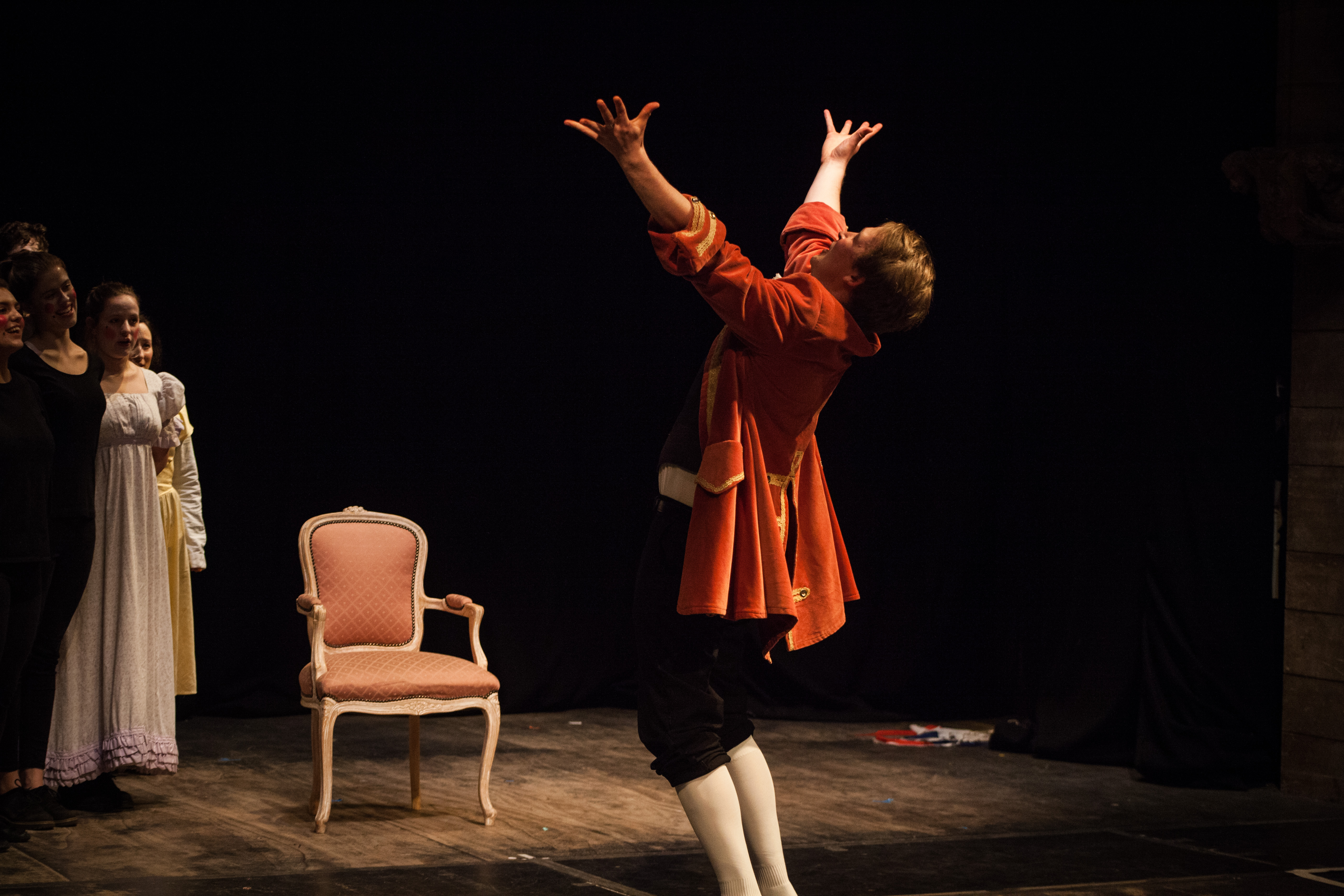
EUSOG, HMS Pinafore (Assembly Roxy, 21 – 25 March ’17)

Photos. EUSOG.

“Every member of the cast should be pleased with their committed, lively, fun and engaging performance that made for a great night out”

Editorial Rating: 4 Stars: Nae Bad

It is a moot point whether the restraint of trade as practised, for example in the Middle Ages by the City of London Livery Companies, and more recently by some trades union through the closed shop, protects the integrity of the brand through quality control, or acts merely as an effective way of cornering the market, but the arrangement between Arthur Sullivan and W S Gilbert with Richard D’Oyly Carte, whereby the D’Oyly Carte Opera Company held exclusive performance rights to their entire operettic oeuvre for 90 years must be one of the most spectacular coups de theatre in the history of the genre. Of course, it was all about the money, including staging at the Savoy Theatre, and served both parties well.

The D’Oyly Carte licence expired in 1961 and unleashed a torrent of enthusiastic amateur productions while the D’Oyly Carte Company managed to maintain brand leadership amongst the professional shows. The relative ease of the music to play and sing, along with its catchy tunes (alas, poor Arthur Sullivan with his longing to be a serious composer: he actually wrote some quite good serious stuff)) gave the works a new lease of life. In 1962 this writer played the Sergeant of Police in a prep school production of the Pirates of Penzance, other G&S triumphs followed …..

So it would be some surprise to Gilbert and Sullivan that the Edinburgh University Savoy Opera Group would exist at all. However I am sure they would have been delighted, as was I, with the spirited and enthusiastic performance they are currently giving of HMS Pinafore at the Assembly Roxy.

Director Holly Marsden’s interpretation aims to criticise the British class system and to question what it is to be British through setting it in the modern era aboard a cruise ship. As she rightly claims, this mimics Gilbert and Sullivan’s original intentions, for they were ruthless satirists, but had such a light touch that their politically immune audiences considered it merely “poking fun”. Conceptually the production can bring nothing other than the enduring relevance of  “Englishness” and class, but that’s powerful stuff in a Scotland (re)considering independence and/or Brexit.  ‘Class’ may be an Edinburgh thing but it seems pretty resplendent around my way. Yet, and again to the director’s credit and in the spirit of the original, this was not some heavy handed student left wing rant, but a joyous fun filled romp played for laughs which came aplenty.

The orchestra struck up the familiar overture sounding small in number but large in enthusiasm, perhaps rather too like a ship’s orchestra before they settled in, and then the “ship’s company” took us through the opening ensemble “We sail the ocean blue” and we set off on a cruise of musical merriment that lasted the entire evening without a drop. The liveliness of the cast was engaging, honourable mentions going to Angus Bhattacharya’s wonderfully effete and arrogant Sir Joseph Porter, complete – naturally – with pelvic thrust, and to Talya Stenberg’s Buttercup, whose Californian accent was delightfully incongruous before she got under way. The most musical voice on stage that night belonged to Biomedical Sciences student Livi Wollaston, who should seriously consider switching to a degree in Vocal Studies at the Conservatoire.

The mentioning of a few should not disappoint the many who made such an effective contribution to the show.  Every member of the cast, and creative team,  should be pleased with their committed, lively, fun and engaging performance that made for a great night out.

nae bad_blue

Star (blue)Star (blue)Star (blue)Star (blue)

Reviewer: Charles Stokes (Seen 22 March)

Go to EUSOG & HMS Pinafore

Visit Edinburgh49 at the Assembly Roxy archive.

Benedetti; Oundjian; RSNO (Usher Hall 10 Mar.’17)

Image result for RSNO Images

“I was happy to leave the concert hall with a spring in my step and wish them bon voyage on their long flight to Orlando”

Editorial Rating:  3 Stars

The RSNO are rounding off their glorious 125th Season with a tour of the USA, Florida to be exact. Why Florida? Because classical music’s largest constituency is older people, and Florida is a state where they are legion, both full time residents and the “Snowbirds” who go for the winter. And Florida has more world-class concert halls than any other state in the USA. Five, no less. They played their final concerts in Glasgow on Thursday, and Edinburgh on Friday. There was a real whiff of excitement in the air. The last time they toured the States was 1992, before the fabulous Nicola Benedetti was born.

So Friday night’s audience, loyal to their orchestra and adoring of their favourite soloist, were in no mood to be troubled by the niceties of musical criticism, they were there to have a good time, and they did. Alas, it is the job of the music writer to point out the subtler issues.

The first half of the concert was, on paper, a romantic’s dream, Debussy’s Prelude a l’apres-midi d’un faune, followed by the ultra romantic Bruch violin concerto. This writer anticipated both eagerly. Both disappointed.

Principal flute Katharine Bryan led off the Debussy confidently and competently in what is an extremely exposed solo in a difficult register. The orchestra answered in a well played ten minute exposition of the theme, but only on a fairly superficial level. This work has mystery, shades of eroticism and soul, and we didn’t get this. Indeed, in the entire first half of the concert Peter Oundjian’s baton was there for the score, but too restrained in the exposition.

By all accounts Nicola Benedetti had given a bravura performance of the Brahms’s Violin Concerto in Glasgow the previous evening. Tonight we were all well up for the Bruch, arguably the most romantic violin concerto ever written, if not as great a work as the other three German concerti: by Beethoven, Brahms, & Mendelssohn. While one doesn’t want the soloist – or orchestra – to wear their hearts on their sleeves, there was much more that could have been brought out of the work by the soloist in terms of phrasing, power and sheer bravura of performance. Competently executed and, yes, restrained, we were left feeling puzzled and short changed. The presence of sheet music tucked away on a stand suggested a performer perhaps a little weary before the USA trip, allied with, unusually, no encore. Yet, of course, in the eyes of the RSNO claque she can do no wrong, and was applauded enthusiastically. The orchestra played well.

Live music is a fickle mistress and often provides the unexpected, both disappointing and pleasing. What on earth could the RSNO bring to Beethoven’s Fifth Symphony, and what new is there to write about it?

Well, the RSNO brought a fresh, lively approach to the work from the beginning of the well known opening theme. It was as if they had received a half time pep talk. They made a lively pace throughout, notably the cellos in the andante con moto, along with the cleverest, anticipatory build up to the final Allegro. Clearly a game of two halves, I was happy to leave the concert hall with a spring in my step and wish them bon voyage on their long flight to Orlando


Star (blue)Star (blue)Star (blue)

Reviewer: Charles Stokes (Seen 10 March)

Go the the RSNO

Visit Edinburgh49 at the Usher Hall


The Marriage of Figaro (Assembly Roxy: 1st, 3rd and 4th March ’17)

img_1893

I have seen grander productions of The Marriage of Figaro… but not better ones.”

Editorial Rating: : 4 Stars:  Nae Bad

It’s hard not to enjoy Figaro. The tunes are familiar, the plot is a delightful melange of innocent deceit and caprice, and all ends happily. It is true, however, that the subject matter of powerful men demanding sex from young women who are effectively in their thrall has deeply unpleasant contemporary undertones. However the sheer good nature of the plot, the cunning of the women involved in cleverly winding up and trapping the men (aided and abetted by the master of cunning himself, Figaro), allows us to dismiss any politically correct concerns. It’s a lot more female friendly than The Benny Hill Show, and overall is a happy opera that allows us to laugh at the foibles of human nature as we re-attach ourselves to the finer strands of love, forgiveness and commitment. Cosi Fan Tutte it is not.

This production is staged by Edinburgh Studio Opera: a well-established group of University music (and other disciplines) students who team up with musicians starting out on their professional careers, and on the whole is a very successful follow-up to last year’s triumph, Carmen.

It uses a number of quite clever production devices in its storytelling in order to compensate for its stripped back set (a necessity of student productions!) – just clothes hampers and a door. We are led to believe we are watching an opera audition to start with, with cast getting into their costumes on stage. Quite why the chorus is dressed in black with grotesque make up in the manner of a Greek Chorus such as in Bacchae, is harder to understand, but arguably acts as a reminder that at this moment there are three entities in play; us, the audience; such actors as were robed; and the chorus being aspirant players hoping to get in on some of the action (which ultimately they did).

For me, this device works because the opera starts off with just two people on stage and the full company arrives only later on.  For the guise to return just as the interval and finish approach, as the chorus cast off their (over) garments on stage and wheel them off in laundry baskets is .entertaining but puzzling.  Again, perhaps a reminder that we were watching an audition, but could have been more thoroughly explored to make a clearer through-line. Other charming (if a little bizarre) moments are when the chorus also act as a very animated set of trees in the forest scene, a humorous foil to the shenanigans going on between the Count and Cherubino.

The libretto is sung in English with a commendable clarity that engages from the start. There is some fine solo as well as ensemble singing, with Jessica Conway (Rosina) delivering a couple of demanding arias very close together more than capably, while Jonathan Forbes Kennedy’s Count and Timothy Edmunson’s Figaro bring just the right balance of authority and vulnerability to their parts both vocally and with their acting. But for me, the star of the evening without doubt is Sarah Gilford’s Susanna, who not only sings beautifully, but acts with coquettish smiles, joyful humour and a streak of kind cunning. The Count never had a chance.

The production runs until the 4th March and I strongly recommend it for its inventive, professional approach. Ingenuity and creativity, allied to committed singing, acting and orchestral playing soon make one forget the necessarily stripped production. It is a joy from start to finish, and played for laughs which come aplenty. I have seen grander productions of The Marrage of Figaro, but not, in terms of sheer engagement with the work, better ones.  It feels as if the company really are giving it all they have, perhaps in the absence of more luxurious proscenium arch props, which sprinkles it with an extra layer of magic.


nae bad_blue

Star (blue)Star (blue)Star (blue)Star (blue)

Reviewer: Charles Stokes(Seen 28 February)

Visit the Assembly Roxy  archive.

THIS REVIEW HAS NOT BEEN SUBEDITED