Carmen (Assembly Roxy, 23-27 Feb. ’16)

Anna Keenan and Robert Forrest

Anna Keenan and Robert Forrest

“For such a young company to produce a work of such masterful quality… sometimes you just have to be in awe.”

Editorial Rating: 4 Stars

I’ll admit that I’m not exactly an opera buff and I wasn’t particularly familiar with Carmen before entering the theatre last night, so despite the accessibility of the English libretto in this production, there were times during Act 1 when even I wished Bizet et al had been a little less self-indulgent with their lyricism and more efficient with the quill. In saying that, the magnitude of this production never appeared to be too daunting or a stretch too far for the company, who did their level-best to keep the performance alive and engaging throughout. And for me, it is the stars of the show who deserve the lion’s share of the credit for that.

Anna Keenan is an absolute delight as Carmen, oozing sexiness and style, with a voice full of richness, warmth and subtlety to portray important changes in tone during the performance. Her stage presence and demeanour command attention and it is difficult not to be drawn to her throughout. Robert Forrest as Don Jose is similarly impressive, demonstrating fantastic strength and vocal and emotional range in a role that is very demanding. And considering both leads are still students, one wonders just what heights they may achieve in the future given the talent both displayed in this performance – remember those names. Monica Toll also dazzled as Micaela with gorgeous tones and depth to her voice, particularly in Micaelea’s Aria which was very moving.

Early on I was worried that this production lacked the fierceness and melodrama required to really sell an opera, as the opening couple of chorus numbers were a little flat and pedestrian. At times the stage seemed very full, with chorus members appearing a little lost when not singing. Yet, with each act the energy seemed to be turned up a notch, so by the rousing What A Bargain! in the final act, my earlier thoughts were dispelled as the pomp and gusto had lifted to breath-taking levels with great characterisation, action and a spine tingling sound.

What I particularly enjoyed about this production was how creatively the space was used. Often the performers would enter or exit through the audience, engaging us in the action, while the orchestra (who were magnificent throughout) were placed within the first few rows, which added to that sense of involvement, rather than traditional separation. And as this production is set at the time of the Spanish Civil War, I feel these touches really helped achieve a sense of comradeship with the chorus in their plight, so the whole show became more of an experience than a spectacle – certainly a commendable feat.

I didn’t really know what to expect from this production before seeing it, but I am certainly more than pleasantly surprised by the experience. For such a young company to produce a work of such masterful quality, with just as much energy and vocal strength at the end of the show as the beginning, sometimes you just have to be in awe. Bravo.

Star (blue)Star (blue)Star (blue)Star (blue)

Reviewer: Steve Griffin (Seen 24 February)

Visit the Assembly Roxy archive.

THIS REVIEW HAS NOT BEEN SUBEDITED

Guys & Dolls (Church Hill Theatre, 9-13 Feb. ’16)

Adam Makepeace as Nicely Nicely Johnson

Adam Makepeace as Nicely Nicely Johnson

“A feel-good romp of a show”

Editorial Rating: 4 Stars: Nae Bad

Guys & Dolls has a special place in my heart, as it was my first footlights show at university some ten years ago. I remember the hours I spent rehearsing the gruelling dance sequences and complex harmonies, so I was amazed at how well this cast of Edinburgh University students delivered on both counts. The scene in Havana was perhaps a bit ambitious choreographically and could have contained more progression and showpiece moments, but overall the chorus numbers were performed with great vim and pizazz.

The stars of show also delivered with aplomb. Ellie Millar as Sgt Sarah Brown had a voice that danced with the purity and clarity worthy of a leading lady, and her rendition of If I Were a Bell struck a fine balance between comedy and stunning vocal range. Oliver Barker oozed with masculinity and presence as Sky Masterson, while Tom Whiston brought a likeable naivety to Nathan Detroit. Mae Hearons was a delight as Miss Adelaide, and really came into her own in act two with a string of dazzling songs.

While the vocals across the board during the first half of the production were a little shaky (I’ll put it down to nerves in front of a packed house early in the run), the second half was littered with many a five-star moment, including Adelaide’s moving second lament, a Sinatra-esque Luck Be a Lady, and the precise and energetic Crapshooters Ballet. However, for me, the vocal performance of the night was by Adam Makepeace as Nicely Nicely Johnson, who delivered a rousing and extremely capable rendition of the tricky Sit Down You’re Rockin’ the Boat. A special mention also to Tilly Bartholomew as Arvide Abernathy, who was charming and note perfect in More I Cannot Wish You, and displayed great tenderness and well-placed comedy throughout the performance.

This show aimed to take the original musical back to its roots in the 1930s, and some nice touches in Grace Dickson’s choreography – particularly in Take Back Your Mink – felt very reminiscent of that golden era. Director Lucy Evans also cast some females in traditionally male roles as a nod to some of the period’s female gangsters, and, while a brave choice, I felt Evans could have gone one step further in allowing these characters to explore their femininity and interact with the male characters as women, rather than women pretending to be men. Still, Lila Pitcher was commanding as Chicago big-shot Big Jule in an interesting gender twist.

Yet for all the great work by the performers and band (who never faltered under Steven Segaud’s masterful musical direction), I was a little disappointed in the production values of the set and costumes. These elements were quite basic, and with a bit more attention could have added much more “wow factor” and style to be sympathetic to the show’s overall creative aims and chosen time period.

All-in-all, a feel-good romp of a show. Don’t gamble – buy a ticket.

nae bad_blue

Star (blue)Star (blue)Star (blue)Star (blue)

Reviewer: Steve Griffin (Seen 10 February)

Go to the Edinburgh University Footlights

Visit the Church Hill Theatre  archive.

The Table (Traverse, 3rd Feb ’16) part of the Manipulate visual theatre festival

Edinburgh, UK. 17/08/2011. Fringe First winners, Blind Summit, present "The Table", starring Moses, the Bunraku table puppet, who is ably assisted into being by Mark Down, Nick Barnes and Sean Garratt. Photo credit: Jane Hobson

“One of the most wonderful performances I have ever witnessed”

Editorial Rating: 5 Stars: Outstanding

One table, one puppet, three men, no strings. And one of the most wonderful performances I have ever witnessed.

While it might seem quite basic, this spectacular puppet show (which could also be classified as stand-up comedy – more on that later) is a tour-de-force in keeping theatre simple yet incredibly effective. Within seconds, the carefully constructed cardboard face and cloth body became an intriguing old man whose every word and movement held me completely captive. And for a show an hour long, that’s no mean feat for something with no pulse.

The puppet began by introducing us to his table – his home – pointing out the garden, his vegetable patch, and where it might be extended to grow more carrots. All the while, he kept us entertained with witticisms most comedians would be proud of, and a dash of audience interaction to keep us all on our toes. And it’s all delivered so naturally, I was completely transported into the world of the table.

Yet while the slow and sometimes inappropriate ponderings of a confused old man were a delight in themselves, the crux of the performance lay in its original purpose – to retell the story of Moses’ saving of the Israelites and his eventual death on the mountainside. In this guise we see him humble, we see him angry and we see him defeated. We see him battle against the elements and lie down to sleep (which is far more difficult for a puppet than it may be assumed). And when he finally leaves the table, I genuinely felt lost and upset to say goodbye. Perhaps this says something about my childish tendencies, but the sell-out crowd of all ages seemed just as moved as I was.

The hands and voice behind this masterpiece – Nick Barnes, Mark Down and Sean Garratt – lovingly move every centimetre of the puppet with precision in care, and always in sync, down to their own breathing. What was particularly enjoyable about their roles were the playful and apparently improvised moments of the show, where the performers joked with and challenged each other to keep up with the pace. At one stage the poor puppet’s hand fell off, probably by accident, but this was covered and managed very well, even if the performers found themselves creasing up with infectious laughter.

About two minutes in I was hooked and thought this show has the potential to launch itself into my top ten favourite things I’ve ever seen on stage, and by the end it had firmly secured its place. Simply masterful.

outstanding

StarStarStarStarStar

Reviewer: Steve Griffin (Seen 3 February)

Go to The Table at Manipulate and Blind Summit

VisitVisit Edinburgh49’s  Traverse archive.

Macbeth: Without Words (Traverse, 2nd Feb ’16) – part of the Manipulate visual theatre festival

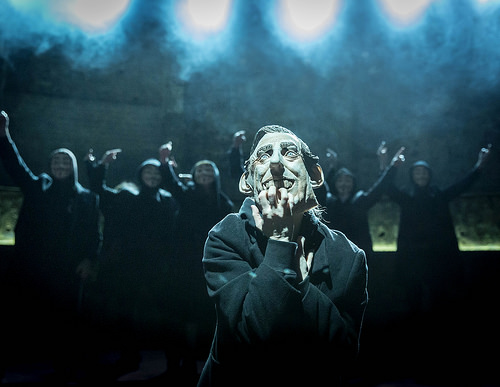
Sandra Franco photo. Ludens Ensemble

Sandra Franco photo.
Ludens Ensemble

“A compelling, highly intelligent and creative retelling of the famous story”

Editorial Rating: 4 Stars: Outstanding

Macbeth: Without Words is one of those shows you see from time to time where you can’t quite decide if you love or hate it. It’s gutsy, original, and a full-on hour long assault of the senses that I couldn’t take my eyes off.

The piece starts with one actor, in a corset and clown make-up, leaping around the stage acrobatically before picking up a microphone and making a range of strange noises. Those with a more traditional perspective on Shakespearian theatre might baulk at the very interpretative style, which I’ll admit took some getting used to, but what unfolded was a compelling, highly intelligent and creative retelling of the famous story.

It is a very physical performance, as it needs to be to convey the monstrous action. There is no spoken dialogue. The dexterity of performers was sensational, as the cast of three managed to create almost every character from the play – all identifiable through their physicality and token elements of props and costume. Stand out moments included the initial stabbing of the king silhouetted through a plastic sheet, and Lady Macbeth appearing through that same plastic sheet towards the end, in all her ghostly presence.

Although without speech, it was not without noise; and many of the sounds were created by the performers live – either vocalised into microphones or using various banging, rubbing and scraping of props and instruments. The layering and looping of these created fantastic tension and atmosphere, with a real sense of baleful magic and connection between the performers and the action. Given how powerful this technique was, especially at the beginning where a complex soundscape was created very simply, it was a shame that for some scenes the company relied on pre-recorded sound, leaving me feeling a little bit cheated. At one point a recording of bagpipes was played, and I felt the company – in Edinburgh of all places – missed a trick.

It was also disappointing that for a show pertaining to be “without words”, that short excerpts from the script were occasionally projected onto a screen to clarify the action on stage. I admit that the task to portray every nuance of Shakepeare’s work without any words at all is nigh-on impossible, but in some scenes it was done so well – the incantations of the witches, the murders, the washing of the hands, the breaking of the news – all performed using physicality, silhouette and props,  that it was such a shame that the company “copped out” in those rare moments. It seemed that with a little bit more work or development the company will have created a piece truly “without words” and fit for any European Capital of Culture.

This could have been one of those mind-blowing, life-changing performances that I’ll never forget, but unfortunately, those few flaws held it back somewhat. Still, ‘tis far from a sorry sight and overall the battle was far more won than lost.

outstanding

StarStarStarStar

Reviewer: Steve Griffin (Seen 2 February)

Go to Macbeth: Without Words at Manipulate

Visit Edinburgh49’s Traverse archive

LoopsEnd (Traverse, 2nd Feb ’16)

LoopsEnd

“A visual feast”

Editorial Rating: 3 Stars: Outstanding

I have seen many spectacular aerial displays over the years, from companies all over the world,  and with their latest work, LoopsEnd, Edinburgh and LA based Paper Doll Militia is definitely right up there with the best of them in terms of risk, precision and wow-factor. However, while technically the gymnastics were great, I was a bit disappointed by the overall cohesion of the work.

A performance in two parts, the first half, Ashes, was inspired by the tearing down of an industrial estate where the group used to rehearse. The main visual element of the piece was two long ropes hanging from the rigging, twisted and weighted down with bags of powder. Even watching the ropes untwist and retwist in the empty space was graceful and compelling, and when combined with George Tarbuck’s stunning lighting design and the trademark tricks and treats of a seasoned aerial company, this piece was, at times, nothing short of a visual feast.

Throughout the performance, white powder was used in various ways to represent the “ashes” – one performer literally had a pile on his shoulders in the opening sequence, while the closing image was of the two bags attached to the hanging ropes slowly emptying as the ropes swung in the space. These individual instances were very powerful visually, but it was difficult to see the link between these, and any sort of narrative or progression within the piece. Indeed, many of the “theatrical” devices seemed under-developed and incomplete: there were too many moments of clichéd wide-eyed wonder and writhing around in angst, and at one point one performer walked back and forward many times, overtly undecided about whether to touch the rope. Such basic and overused devices unfortunately offset the splendorous vision of the other sections.

In the second piece, Unhinged XY, projection was also used, which in some ways added another dimension to the visual smorgasbaord, but in others gave a seemingly unnecessary layer of complexity and confusion to the action – again, it often wasn’t clear how the costumes, music, acrobatics, projections and design all married up.

The aerial silk work in this piece, and the use of wind and fabric combined to make some stunning visuals and standout moments. When one performer walked up a hanging piece of silk, weighted at the bottom by another, while competing with gusts around her, I was awestruck by the strength and artistry on show.

It was a bit of a shame that both pieces relied quite so heavily on overpowering recorded sound and music. While at some points it was great in setting and supporting the overall tone of each section, its constant use meant the work was unable to establish a mood for itself, so I would have preferred a more selective and sensitive approach to the aural aspects of the performance.

Overall, there’s no denying the talent and visual creativity that have earned Paper Doll Militia their excellent reputation. However, LoopsEnd left me somewhat hanging in mid-air, rather than applauding with my feet flat on the ground.

outstanding

StarStarStar

Reviewer: Steve Griffin (Seen 2 February)

Go to Paper Doll Militia

Visit Edinburgh49‘s  Traverse archive.


Snow White and the Seven Dwarfs (King’s Theatre: 28 Nov. ’15 – 17 Jan. ’16)

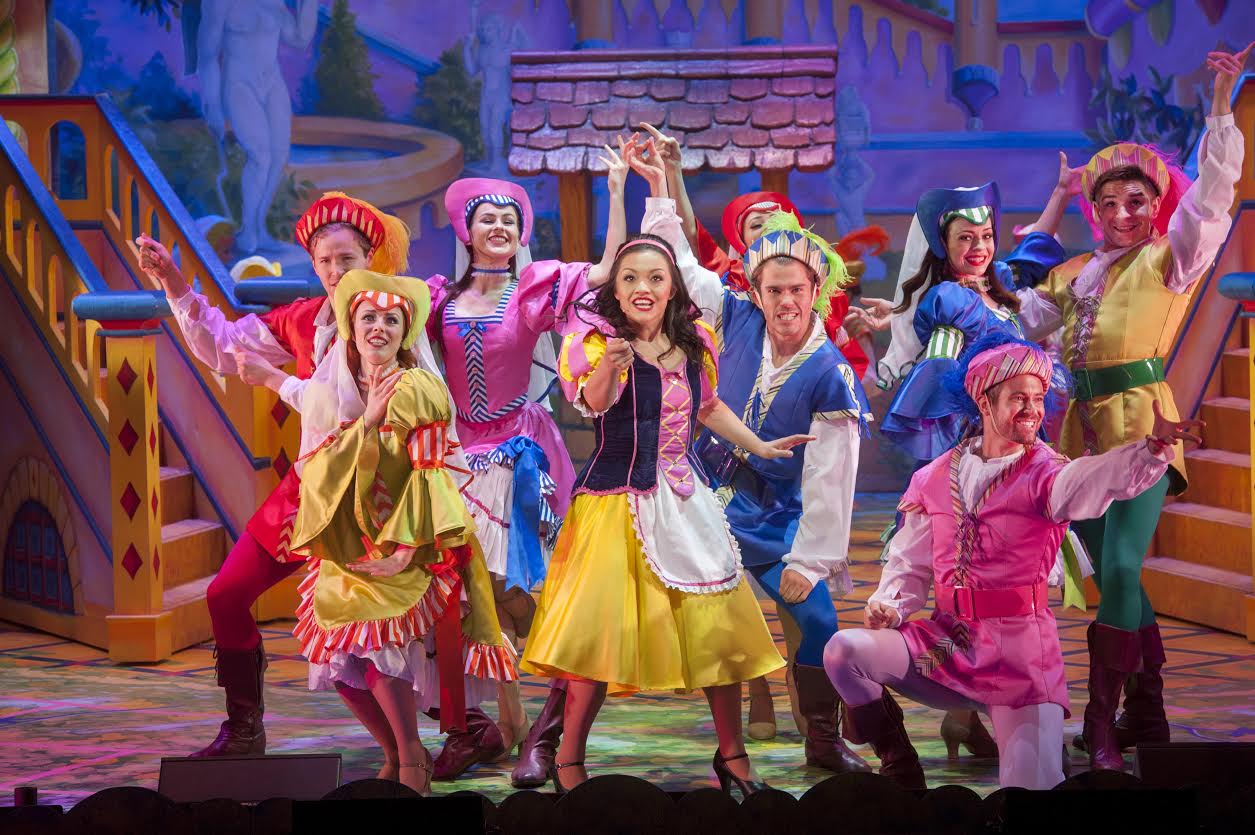
Frances Mayli McCann as Snow White with Ensemble. Photos by Douglas Robertson

Frances Mayli McCann as Snow White with Ensemble.
Photos by Douglas Robertson

“Packed with laughs for audiences of all ages”

Editorial Rating: 4 Stars: Outstanding

I’ll admit, ever since the age of about 9, panto has never been very near the top of the list of my favourite art forms. And it’s true that I do tend to like my theatre a bit more high-brow. In saying that, this panto all but shattered my age-old preconceptions by being very, very funny, and at the same time embodying surprisingly high production values.

Where to start, but with Edinburgh’s pantomime royalty – Grant Stott, Allan Stewart and Andy Gray. Their on-stage chemistry is just as visible as they say it is, with lots of friendly jibes and presence that oozed confidence and star quality. The banter between them was great, and their improvisation and cover-up skills were spot-on. Stewart in particular impressed as Nurse May, with a dazzling array of seamless costume changes and a likeability that almost made the stage feel instantly more alive whenever he was on it.

Andy Gray, Allan Stewart and Grant Stott.

Andy Gray, Grant Stott and Allan Stewart.

Both Greg Barrowman as Prince Hamish and Frances Mayli McCann as Snow White also impressed with powerful singing voices, and their personalities perfectly balanced out those of their more esteemed cast members. But for me it was the dwarfs who stole the show, in particular the scene where they were riding an array of animals, and I was disappointed these characters were not used more often. The troupe showed fantastic energy and comic timing, and brought the ridiculous hilarity already on display to new heights every time they made an entrance (or exit!).

The script wasn’t so much littered as smothered with witty one-liners, topical references, football jokes, and a healthy sprinkling of good old-fashioned farce. Indeed, this show certainly has a bit of everything for the little’uns and their respective elders: there’s flying, dinosaurs, pyrotechnics, colourful costumes and a touch of audience interaction. I defy anyone not to giggle at at least one element of this offering.

The musical numbers were all delivered with aplomb, with dance sequences many grades above the step-ball-change choreography I was expecting. Song selection (mainly covers of popular songs) often seemed shoehorned in for the spectacle, but then again, one doesn’t go to panto for that. Still, the music was upbeat, in tune and full of fun.

I can forgive that the structure was a bit all over the place, that some of the scenes between the fab three bordered very closely on self-indulgent, and the almost never-ending rendition of a well-known Christmas song towards the end. It’s a show packed with laughs for audiences of all ages, and brings a lot of sparkle to brighten even the hardest of hearts. Oh yes it does!

outstanding

StarStarStarStar

Reviewer: Steve Griffin (Seen 8 December)

Go to Snow White and the Seven Dwarfs.

Visit the King’s Theatre archive.

‘To Breathe’ (Summerhall: 24 – 28 Nov ’15)

To Breathe 1


Photography: Andrew Perry. Back line, l to r: Erin Whalley, Tiffany Soirat, Anna Elisabeth Thomsen. Front line, l to r, Adela Briansó, Lewis McDonald, Maddie Flint.

“Inventive and intriguing”

Editorial Rating: 3 Stars: Nae Bad

It’s not often you see student theatre groups perform original work with such a strong dance element, especially pieces on complex themes with so much thought behind them. They generally take hours upon hours to devise and rehearse, so one must give Theatre Paradok kudos for even getting to the startline of this show, and for packing Summerhall’s Demonstration Room to the rafters with an eager audience on a Thursday night.

Given the premise of To Breathe as a physical exploration of body and breath, to me it was a somewhat strange choice to develop it with a cast of performers with limited dance experience and training. The lack of finesse and technique on display in the more choreographed elements unfortunately detracted from what could have been a very powerful and moving (no pun intended) performance, and this was the lasting impression I took with me – a great concept, but perhaps slightly overreached.

As a theatrical spectacle, it was certainly very accomplished: it contained a lot of light and shade, tension and calm, with a good sense of progression and drive, and the performers’ ability to create changing moods seamlessly was very impressive. Early on the piece was very playful, and the performers raised several laughs in their innocent self-discovery, before moving onto more emotive storytelling. Rachel Stollery’s design really complemented the action, as did the subtle use of music, and with a healthy mix of ensemble and solo sections, structurally this show ticks all the boxes.

What the troupe may not have shown in dance technique or grace, they more than made up for in emotional intensity, concentration and sheer gumption. There was a great energy and spirit to the performance, with the whole company throwing themselves into it wholeheartedly. Maddie Flint in particular was utterly watchable throughout, with a very engaging and expressive face.


To Breathe 2

Lewis MacDonald and Tiffany Soirat

While choreographically it was a fairly safe piece (albeit with a few too many cliched motifs for my liking), there were moments of dramatic risk that were inventive and intriguing. In one of the duets (performed by Lewis McDonald and Tiffany Soirat) the dancers fought and tussled to cover each other in paint, in a sequence that was both passionate and very well controlled. There were some great lifts on show, and this section oozed with sexual chemistry. Later on, the dancers experimented with different movements with their hands in a pile of mud, which again showed great creativity, yet it was difficult to see the connection between this and the rest of the performance.

Overall, the heart and soul of this performance were absolutely in the right place – but I would have liked to have seen more focus on the dance elements to make it more complete.

nae bad_blue

Star (blue)Star (blue)Star (blue)

Reviewer: Steve Griffin (Seen 26 November)

Go to Theatre Paradok

Visit the Summerhall archive.

King Charles III (Festival Theatre: 16 – 21 Nov ’15)

Photographs from the West End Production of 'Charles III' by Johan Persson

Photographs by Johan Persson from the West End Production of ‘King Charles III’

“The best of Shakespeare, bang up to date”

Editorial Rating: 4 Stars: Outstanding

Given how topical this production is, I still can’t quite get my head around why someone hasn’t thought of doing a play like this before. Yes, it’s daring and bound to spark discussion on either side of the Royalist debate, but perhaps that’s what makes it utterly ingenious.

Mike Bartlett’s script really is the star of the show – conceiving an idea both dangerous and compelling, that’s also utterly believable. That’s a mean enough feat for many a playwright, but then consider it is also written in Shakespearean style blank verse (with nods to more of his works than I could keep track of), bang up to date, witty, funny and gripping to the very last stage direction.

It’s cleverly structured to allow for scenes and opinions to unfold between all characters, and pacey enough to keep the action flowing, without ever cheating the audience of any details. I would have preferred more ensemble scenes to break up the endless soliloquies and duologues (again, very Will’), while a more contrasting sense of status between the Royals and others would have gone some way to create even more tension.

The style of the performance took some getting used to early on: interpretations of well-known people seemed over-theatricalised, while showing a distinct lack of respect to each other and occasion. This made it hard to engage with immediately, as I was expecting a subtler and more faithful approach to character. For this reason, for me it was the “made-up” characters of Mr Stevens (Giles Taylor) and Jess (Lucy Phelps) who rang most true, and achieved the optimum balance between the theatrical style of the script and connection with the audience.

Charles III 2

In saying that, the very beauty and intelligence of this piece is the subtle level of detachment from presenting something real and expected, to an exploration of imagination and possibility. Once this performance was in full swing, and I could appreciate the characters as part of an intriguing story (as opposed to what I would expect to see in real life), I was all but blown away by its power and craft. Ben Righton’s William was bang on the money in terms of character development throughout, progressing from stable wallflower to dominant leader, while the descent of Charles (Robert Powell) into public ridicule was nothing short of masterful.

If the King could grant me one wish, it would be to fast forward 100 years, when the population know comparatively little of our current royal family, and see how well it is received then. My money would be on it being viewed in the same way we lap up the best of Shakespeare today.

outstanding

StarStarStarStar

Reviewer: Steve Griffin (Seen 16 November)

Go to King Charles III at the Festival Theatre

Visit the Festival Theatre archive.

Tipping the Velvet (The Lyceum, 28 Oct – 14 Nov ’15)

“An imaginative attempt at what could have been quite a bland adaptation”

Editorial Rating: 2 Stars

From the quills of established writer Sarah Waters and high-flying playwright Laura Wade, my expectations were certainly high on entering the auditorium for this new interpretation of the award winning novel. And with a very amusing opening skit and a dazzling number from Laura Rogers as Kitty, it certainly got off to a fine start.

However, while the amount of creativity on show – from daring aerial sequences, to lush period costumes and a Victorian Music Hall arrangement of a song famously featured on a Diet Coke advert – was impressive, unfortunately, this production’s lack of cohesion and staccato structure made it nigh-on infuriating for me to sit through.

In saying that, the show wasn’t without its laugh out loud moments – a landlady dressed in exactly the same design of fabric as the wallpaper in her house and lines such as “You exquisite little tart” certainly caused a few chuckles. However, the comedic aspects were pushed to their limits with a section involving animal carcasses being used as puppets in a song, and a certain “adult” section depicting Nancy’s experience as a prostitute. Definitely not recommended for the easily offended.

Sally Messiah is certainly charismatic as Nancy, Amanda Hadingue is very likeable as Annie (among other characters she plays), and Ru Hamilton delivers a delightful turn as gender-bending Alice. However, for me the most credit in this production should go to the stage hands, whose alarmingly efficient scene changes left me in a state of amazement on numerous occasions.

Much of Lizzie Clapham’s design was visually impressive, but use of space could definitely have been improved: at times the central characters would appear very lost towards the back of a somewhat empty stage, hindering the sense of intimacy they were trying to create. In a production with so many scenes, locations and jarring cuts between them all, a much more fluid approach to location and action would have been more engaging.

There were various musical numbers interspersed throughout the piece, almost all of which were interpretations of modern songs. In some instances, these worked well as a way to bring relevance to today’s audience, but in the second act when Nancy is desperate for a place to live, she belts out a line from one power ballad after another, with farcical impact. Rather than being able to relate to her struggle, she is instead alienated, and it becomes difficult to then reconnect with her in the following scene. This is part of what frustrated me the most about this production: at times we were allowed in to develop a bond with the characters, while in certain sections it was impossible to do so.

The constant bouncing between styles, coupled with the distinct over use of the compere/narrator/MC character, who incessantly dove on stage with needless interruptions between every scene, made this production feel like it was having some sort of pubescent identity crisis between Brechtian fable, cabaret variety show, and an episode of Jeremy Kyle. I could have handled any of those interpretations individually but all in one show was just too much.

In some ways I’m glad this production took some risks to create an imaginative attempt at what could have been quite a bland adaptation. It’s just a shame that so many different styles, techniques and devices were used in the process.


Star (blue)Star (blue)

Reviewer: Steve Griffin (Seen 29 October)

Visit the The Lyceum archive.

THIS REVIEW HAS NOT BEEN SUBEDITED

Hidden (The Lyceum: 20-24 October ’15)

“Gives chills and thrills aplenty”

Editorial Rating: 3 Stars: Nae Bad

Hidden really is a treat for anyone who’s ever wanted to explore what goes on everywhere else in a theatre that audiences don’t normally get to see. Marry that with tales from the history of the building and a Victorian horror story and you have quite an intriguing evening’s entertainment. However, while the idea and overall style and feel of the piece were terrific, there was no clear narrative or sense of progression between each section, leaving me feeling a bit cheated as to specific details and stories.

Individual sections were generally great at creating an overall mood, setting a scene (the dressing rooms in particular stood out), or presenting a static idea, and the piece was littered with numerous magical moments  – terrified faces and screams, isolated “scenelets” and monologues. Yet we learned very little about who these characters were, why there were there, and how they related to anything else that was going on.

While for most of the performance, the audience is directed where to go next by theatre ushers, in one section in the scenery dock, three of the young performers (Xanthe Mitchell, Ellis Imrie and Anna Millar) more than capably moved us around to follow the action. Staying true to their characters and without speaking, they created a compelling and haunting theatrical moment, demonstrating commanding professionalism and presence beyond their years. Moving into the area beneath the stage, Gregor Weir delivered a very charismatic and spooky monologue about being trapped, making clever use of the space by hiding in between and rattling racks of stored stage lights.

Indeed this whole section (directed by Lyceum Artistic Director Mark Thompson), which allowed the audience to fill the space as they wanted and explore the action from the perspective they chose, gave the piece a very immersive and personal feel. It’s a shame that this sense of individual discovery was not carried through more parts of the performance, particularly the section on the stage, where instead we were asked to simply stand in a line to one side and observe.

In saying that, the section in the stairwell leading up to “the Gods” (very emotively delivered by Emma Simpson and Tegan Wright) was a great way to follow the action, and break-up the sense of travelling from one part to the next by making the travelling itself part of the performance. Similarly, walking behind the bar in the stalls, past three caged performers shrieking to be let out, also helped make the “journey” more interesting to experience.

While it wouldn’t have been right to have delivered this piece in tour guide style, I feel that making more effort to communicate some of the background to each section would have been really beneficial. I felt it also lacked a little bit of diversity in terms of mood – it was almost all a chilling ghost story, when some happier or funnier moments of the theatre’s history would have added another layer of depth to the performance.

Given that this performance was devised and delivered by young people, in collaboration with four different directors, one must give them due credit for their achievement – this is a very ambitious project that gives chills and thrills aplenty, and is a worthy education and exploration into just how exciting theatre can be. For me it just lacked that bit of cohesion to make it really special.

nae bad_blue

Star (blue)Star (blue)Star (blue)

Reviewer: Steve Griffin (Seen 20 October)

Visit the The Lyceum archive.

THIS REVIEW HAS NOT BEEN SUBEDITED