Balladynas and Romances (Assembly Roxy: 9 -10 November ’15)

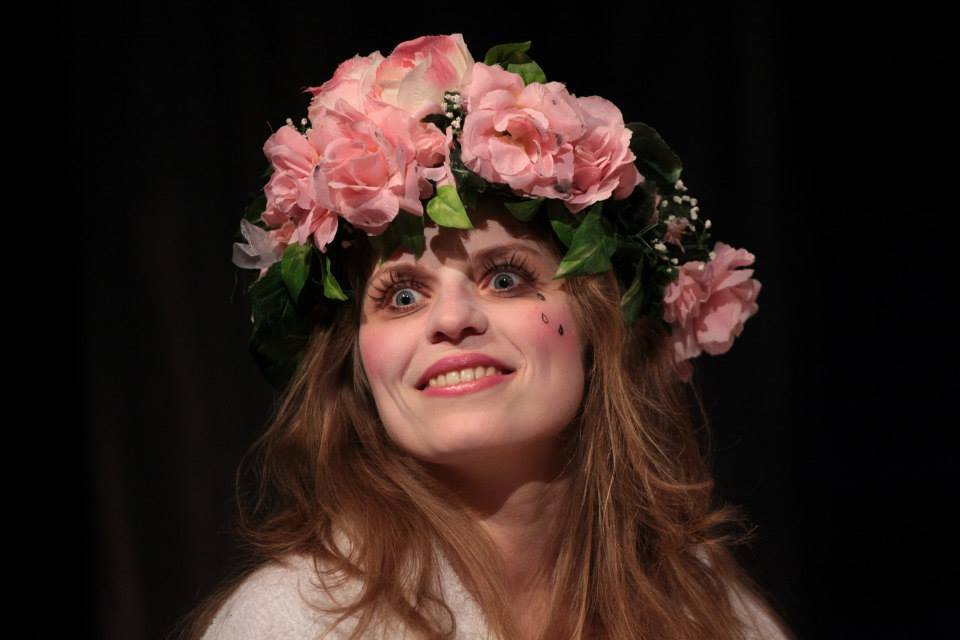
Aphrodite. Photos from Teatr Pinokio, Lodz.

Aphrodite.
Photos from Teatr Pinokio, Lodz.

“The clucking immortality that is forever C-3PO.”

Editorial Rating: 3 Stars  Nae Bad

My namesake, Alan, has had his own school of motoring in Edinburgh since 1979. He also advertises that a Polish instructor is available, Lekcje nauki jazdy w języku polskim. That would have been handy, off-road, for Balladynny i Romanse. But then in these fluent days the President of the European Council and former Prime Minister of Poland is a Donald, so what the hell …

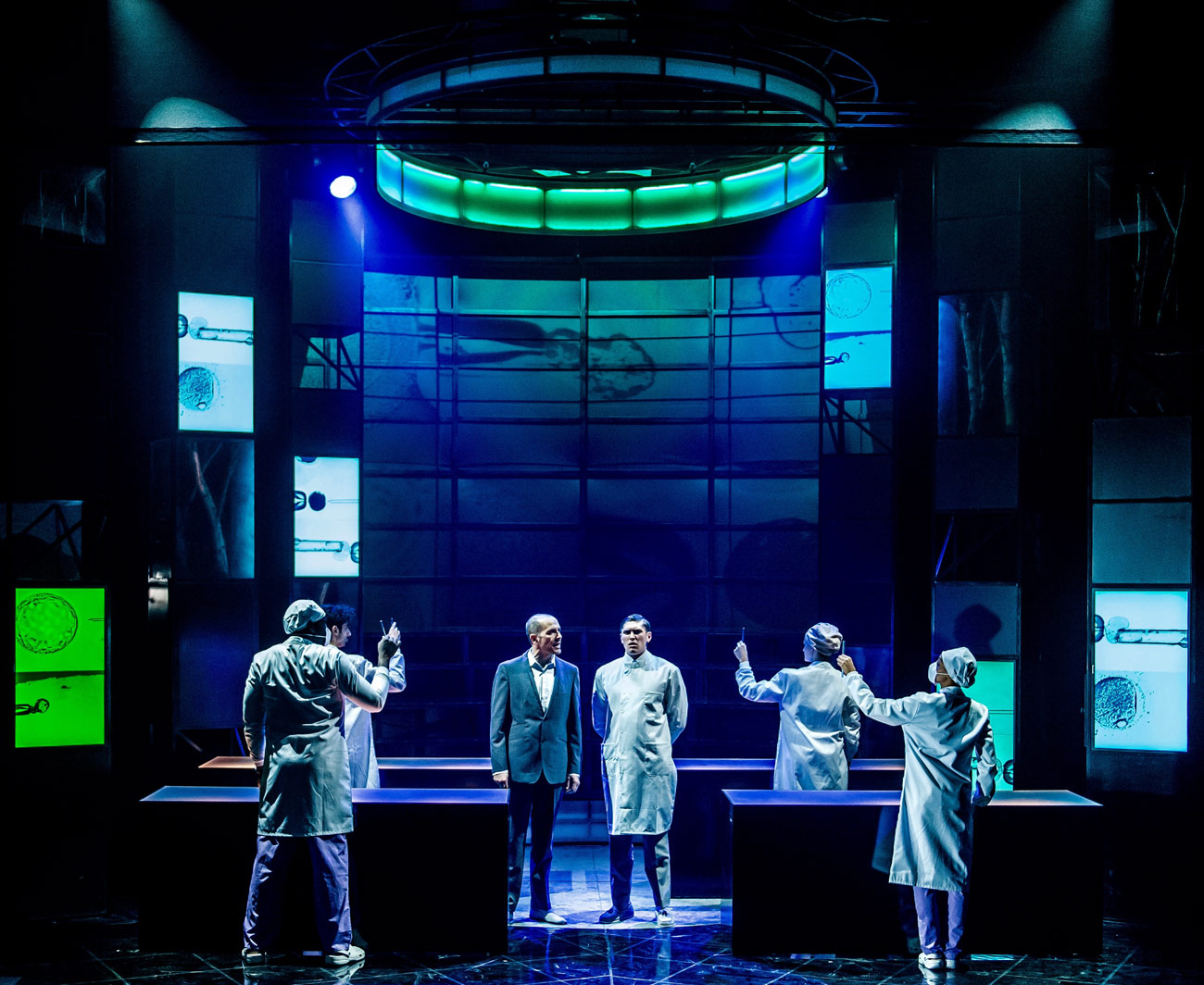
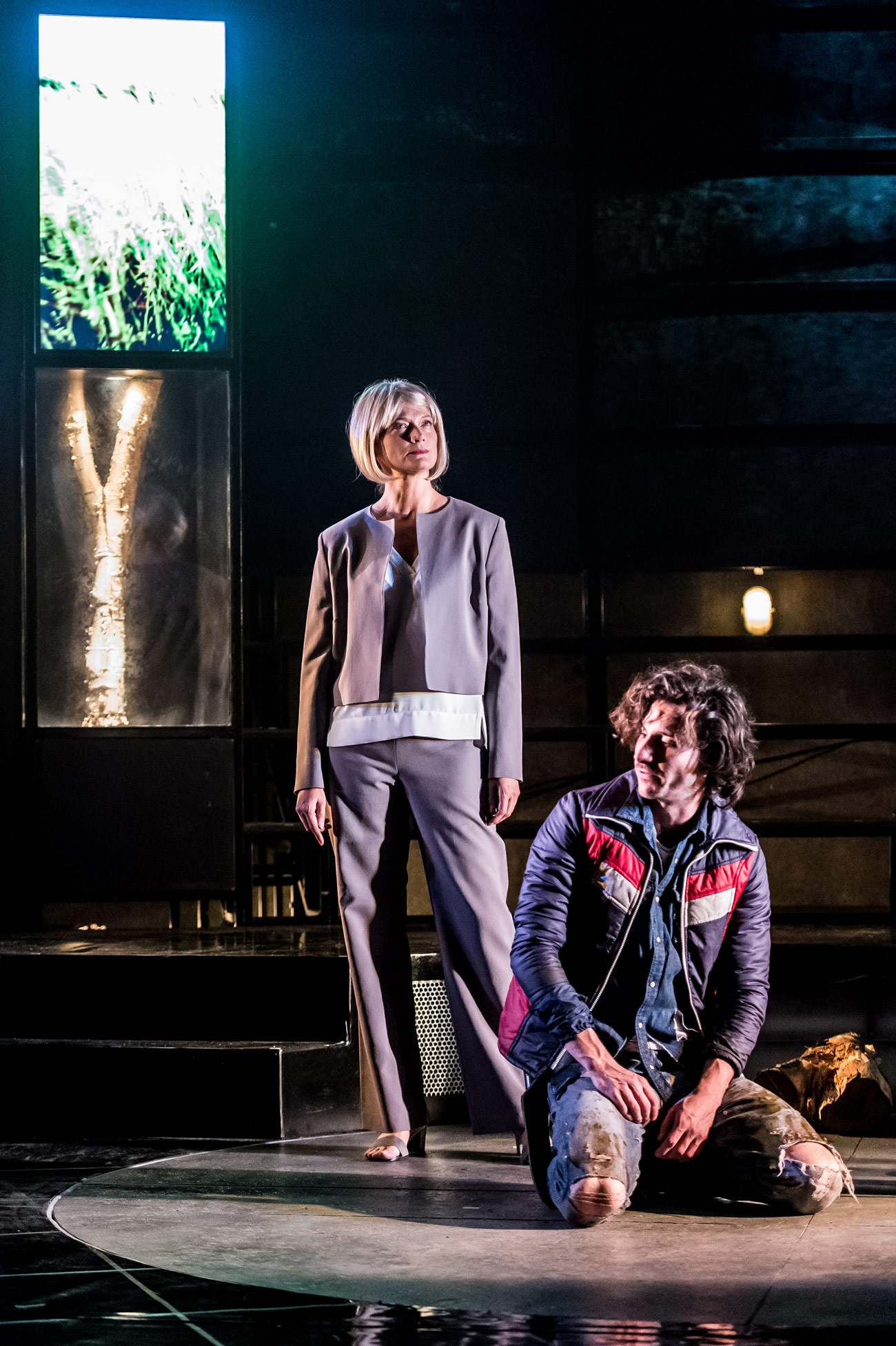
… which brings me to the Roxy where – appropriate for an old church – heaven and hell congregate on earth in director Konrad Dworakowski’s immersive staging of the Ignacy Karpowicz novel. It is long at 135 minutes but is disciplined and expert. Go to the excellent Polish Book Institute for a useful synopsis of the book and be drawn to Karpowicz’s other work, not least ‘Uncool’ (2006); all still waiting for publication in English.

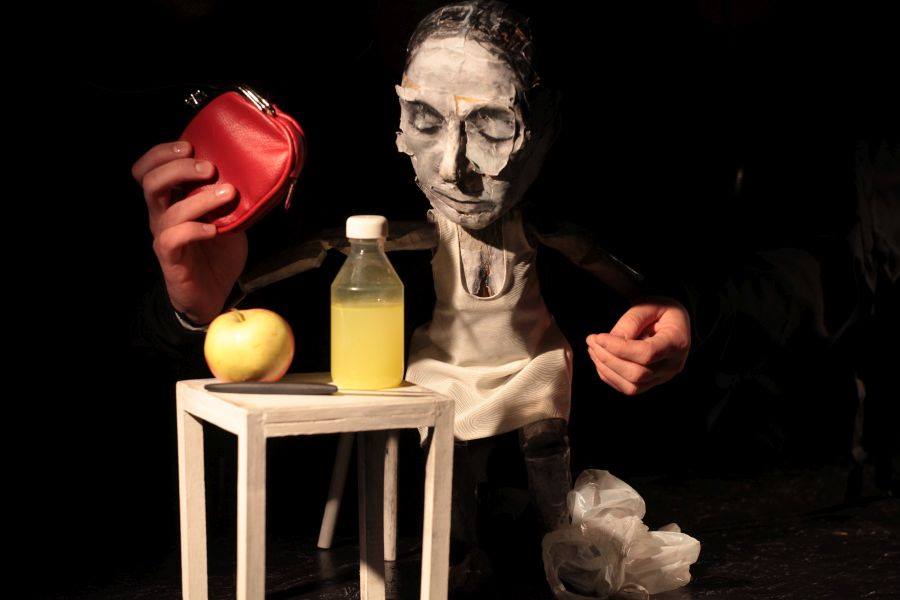
What we get in Balladynas and Romances on stage is, however, eminently translatable as it’s a classic ‘What If …?’  What if the gods drop in while we’re about our ordinary, sometimes tacky lives, in and out of Poundland (the cute Polish equivalent is Biedronka or ‘Ladybird’ ), in and out of each other – warning: puppets perform sex acts – and what if Athena, Aphrodite, Jesus, and the rest, are a bit cheap and maybe past their sell-by date? The answers are not hard to come by, as the gods are very visible and like talking about themselves, but it is tricky to see if Olga, Janek, Artur and Kama notice that their tawdry domesticity is being messed with. ‘A remote god [may] be a redundant one’ but it has long been our Fate – aka. the Occasional Narrator – not to realize that Eros or Lucifer happens to be in the front room.
Balladyny2

The little mortals are puppets and the gods are dressed in primary black and white, in bathrobes and shades for example. It provides for effective contrast(s), not least when Nike, god of Victory, tenderly cradles the tiny body of a bomb blast victim. Olga, Catholic, fifty something and living alone, undresses and takes a bath and her credulous faith is somehow all the more touching for being manipulated into being. It is the showy gods, though, who demand attention, dwelling as they do on their genealogy – which is a nightmare for Gender theorists – and selfish loves. Eros and Lucifer stand apart, interestingly, each musing on their lot; whilst Osiris’ slender shrouded form and huge eyes recalled the clucking immortality that is forever C-3PO.

Smart lighting and electronic music often snapped the piece back from self-indulgent space and without those puppets the drama would have died, which may well have been the point.

I missed Poland. Eros ruefully mentioned his adopted country at the end of the first half and there were, I’m sure, far more references available than I understood. I googled one Erika Steinbach when I got home and grasped why Old Nick, from Lodz, is a fan. Clearly Balladyna is important but her literary profile receded as, languorous yet scheming, she acted out her bridging role as demi-god fixer and apologist for the ills of the world. At one point, in marvellous conversation with an opinionated Chinese Fortune Cookie, she convinced me that Pinocchio Theatre really know what they are about.

Director: Konrad Dworakowski
Set designer: Marika Wojciechowska
Music: Piotr Klimek
Choreographer: Jacek Owczarek
Lighting director: Bary

Cast: Hanna Matusiak, Ewa Wróblewska, Żaneta Małkowska, Małgorzata Krawczenko, Mariusz Olbiński, Łukasz Bzura, Łukasz Batko, Natalia Wieciech, Anna Makowska.
nae bad_blue

Star (blue)Star (blue)Star (blue)

Reviewer: Alan Brown (Seen 9 November)

Go to ‘Balladynas and Romances’ at the Polish Cultural Institute & to Pinocchio Theatre, Lodz.

Visit the Assembly Roxy archive.

Hidden (The Lyceum: 20-24 October ’15)

“Gives chills and thrills aplenty”

Editorial Rating: 3 Stars: Nae Bad

Hidden really is a treat for anyone who’s ever wanted to explore what goes on everywhere else in a theatre that audiences don’t normally get to see. Marry that with tales from the history of the building and a Victorian horror story and you have quite an intriguing evening’s entertainment. However, while the idea and overall style and feel of the piece were terrific, there was no clear narrative or sense of progression between each section, leaving me feeling a bit cheated as to specific details and stories.

Individual sections were generally great at creating an overall mood, setting a scene (the dressing rooms in particular stood out), or presenting a static idea, and the piece was littered with numerous magical moments  – terrified faces and screams, isolated “scenelets” and monologues. Yet we learned very little about who these characters were, why there were there, and how they related to anything else that was going on.

While for most of the performance, the audience is directed where to go next by theatre ushers, in one section in the scenery dock, three of the young performers (Xanthe Mitchell, Ellis Imrie and Anna Millar) more than capably moved us around to follow the action. Staying true to their characters and without speaking, they created a compelling and haunting theatrical moment, demonstrating commanding professionalism and presence beyond their years. Moving into the area beneath the stage, Gregor Weir delivered a very charismatic and spooky monologue about being trapped, making clever use of the space by hiding in between and rattling racks of stored stage lights.

Indeed this whole section (directed by Lyceum Artistic Director Mark Thompson), which allowed the audience to fill the space as they wanted and explore the action from the perspective they chose, gave the piece a very immersive and personal feel. It’s a shame that this sense of individual discovery was not carried through more parts of the performance, particularly the section on the stage, where instead we were asked to simply stand in a line to one side and observe.

In saying that, the section in the stairwell leading up to “the Gods” (very emotively delivered by Emma Simpson and Tegan Wright) was a great way to follow the action, and break-up the sense of travelling from one part to the next by making the travelling itself part of the performance. Similarly, walking behind the bar in the stalls, past three caged performers shrieking to be let out, also helped make the “journey” more interesting to experience.

While it wouldn’t have been right to have delivered this piece in tour guide style, I feel that making more effort to communicate some of the background to each section would have been really beneficial. I felt it also lacked a little bit of diversity in terms of mood – it was almost all a chilling ghost story, when some happier or funnier moments of the theatre’s history would have added another layer of depth to the performance.

Given that this performance was devised and delivered by young people, in collaboration with four different directors, one must give them due credit for their achievement – this is a very ambitious project that gives chills and thrills aplenty, and is a worthy education and exploration into just how exciting theatre can be. For me it just lacked that bit of cohesion to make it really special.

nae bad_blue

Star (blue)Star (blue)Star (blue)

Reviewer: Steve Griffin (Seen 20 October)

Visit the The Lyceum archive.

THIS REVIEW HAS NOT BEEN SUBEDITED

Lord of the Flies (Festival Theatre: 13 – 17 October ’15)

Set design: Jon Bausor Photo: Regent's Park Theatre.

Set design: Jon Bausor
Photo: Regent’s Park Theatre.

“Big, bold and gutsy”

Editorial Rating: 3 Stars: Nae Bad

For me, with the May general election in mind, this is a timely production of Lord of the Flies: a charismatic, commanding and fear-mongering leader on one side; a righteous and idealistic leader who is unable to win mass support on the other; and one guy in the middle who doesn’t fit into either camp and who is killed off. I wonder if William Golding knew back then how important and relevant his book would still be 61 years after its publication. And that’s without postulating that Michael Gove might make a ‘good’ Beast. This Regent’s Park Theatre production certainly doesn’t shy away from the issues – it’s big, bold and gutsy, but in my opinion, tries too hard to make its point.

I must start with Jon Bausor’s design – the first thing you see on entering the auditorium. It’s visually spectacular, with the focal point being a very believable carcass of a crashed aeroplane to one side, strewn with suitcases. On the other a sizable ramp leads up and off, and everything is surrounded by trees and hanging branches in Naturalistic style. Yet while stunning, I felt the set ended up being too much of a dominating presence, causing unnecessary overlaps with different scenes occurring concurrently (and confusingly) in the same part of the stage. I would have preferred a more mapped-out use of the space to clearly define the different locations in the story and help distinguish the separateness inherent in the characters.

One of this production’s strengths was the energy and dynamism with which the warrior-like sections were portrayed. With frantic movement, chanting, and a commanding performance from Freddie Watkins as ringleader Jack, these moments were terrifying and powerful, and an effective glimpse into what a group of boys might turn into without effective parenting. Indeed, this interpretation puts Jack’s character front and centre (rather than Ralph’s), giving more focus to the brutality of the boys’ behaviour throughout.

However, some of the effectiveness of the “savagery” was lost given a distinct lack of contrasting moments of quietness and subtlety. I found the whole thing too unnecessarily shouty: Piggy and Ralph would communicate in raised and pained voices when alone. Commands were all aggressive, and fright seemed to always be expressed very loudly. Even the Officer shouted all of his lines, reducing his status to that of the children, when his presence could have been communicated far more effectively through physicality and control.

Anthony Roberts as Piggy.

Anthony Roberts as Piggy.

In saying that, there were occasions where the dynamic changed to great effect: early in the second act when Ralph and Piggy discuss how to get Piggy’s glasses back is a rare glimpse of depth and subtlety in performance style, allowing the audience to connect with these two as different from the others. It’s a shame this technique wasn’t used more in the first half of the production. Anthony Roberts gave a valiant performance as Piggy, and I would have liked to have seen more of him.

The sound and lighting were both excellent in supporting the action and setting the scene, and the occasional music added to the ambience without being overpowering. The evolution, down the way, in costume and makeup to underline each character’s descent into savagery was clever and effective. That all went to show that clearly a lot of thought and creative energy has been put into this production, but for me a couple of big flaws hold it back from being remarkable.

nae bad_blue

Star (blue)Star (blue)Star (blue)

Reviewer: Steve Griffin (Seen 13 October)

Go to ‘Lord of the Flies’ at the Festival Theatre

Visit the Festival Theatre archive.

Brave New World (King’s: 29 September – 3 October ’15)

Photos: Touring Theatre Consortium Company

Photos: Touring Theatre Consortium Company

“Trim, bold and emphatic”

Editorial Rating: 3 Stars

This is a didactic staging of a hugely instructive book, so here are two questions from the lecture theatre: how near do you like your future and do you shop in ‘lower caste stores’? For me the answers are (i) pretty close and (ii) it depends.

Aldous Huxley wrote Brave New World in 1931, which seems a long time ago, but he was seriously long-sighted and along with keen definition came the vision thing. OK, his Doors of Perception (1954) is a mescaline trip but he really did see what might be and his World State is bad and appalling, unless that is ‘You’re worth it’, in which case you might love to bits its mind-numbing, slogan-ridden lifestyle.

As for the second question, I bought some excellent coffee at ALDI last week and am very pleased with my jacket from Tu Clothing at Sainsburys, which by Huxley’s reckoning makes me a quantifiable Delta. Naturally part of the ‘fun’ of reading Brave New World is knowing that at least you’re not an Epsilon-Minus lift operator.

Huxley’s story, this play, is about misfits in the sorted, post-apocalyptic society. Bernard is a maladjusted Alpha-Plus psychologist who sees his way to a snappy suit by introducing John, an impure bred, unconditioned primitive, to his lords and masters. Or rather to Margaret, Margaret Mond, Regional World Controller. Lenina, a Beta-Plus lab technician with dodgy longings for a monogamous relationship, joins Bernard on the visit to the Savage Reservation to look at those unfortunates, who still suffer childbirth, disease and aging and who still experience family, love and heartbreak. There they find John and bring him and his mother home to London. It all gets messy when John claims his right to be unhappy.

Mond (Sophie Ward) and John (William Postlethwaite)

Mond (Sophie Ward) and John (William Postlethwaite)

Dawn King’s adaptation of Huxley’s text is trim, bold and emphatic. Its Display settings are, if you like, maxed out: Bernard is so inadequate that voice recognition software won’t recognise him; Lenina is sweetly confused; Mond has an answer for everything and John would take an axe to the whole ignoble shebang. He won’t take soma though – a legal high gone stratospheric – or sex gum, which is a relief.

There is a whole new order to configure here so it is unsurprising that video, lighting and sound provide illustration and support for the ten strong cast. There are multiple screens, helicopter rides and ‘feelie’ films and an immodest electronic score by ‘These New Puritans’ that all make the use of a centre stage curtain look decidedly old-fashioned, if not clumsy.

There is no hiding, either, of the pared down script and my unfortunate impression was of good actors managing one educative but end-stopped line after another. Flow was there none. On the other hand, and to be fair, I read Brave New World so many times when I was at school that I’m a fastidious, prose bound geek and anyway Huxley’s narrative is ‘set’ on information overload. Nevertheless, I did like William Postlethwaite’s tousle-haired John, with his subversive use of Shakespeare. Even the uber-cool Mond (a poised Sophie Ward) would have him, which is way beyond Huxley; but Scott Karim as the rebel writer Helmholtz really isn’t given enough to say.

So, fittingly enough, this is Brave New World encapsulated as feature drama. It is a little plastic, a little lurid, but still potent.

Star (blue)Star (blue)Star (blue)

Reviewer: Alan Brown  (Seen 29 September)

Go to the Touring Consortium Theatre Company here.

Visit the King’s Theatre archive.

All My Sons (King’s: 22 – 26 September ’15)

Robbie Jack as Chris. Photo. Rapture Theatre.

Robbie Jack as Chris.
Photo. Rapture Theatre.

“From event to moral consequence to personal calamity”

Editorial Rating: 3 Stars

Edinburgh theatregoers can salute one of the 20th century’s greatest playwrights this week, as Scottish company Rapture Theatre bring Arthur Miller’s All My Sons to the King’s Theatre. Marking the end of their month-long tour of Scottish cities, Rapture’s production does not disappoint and ensures that Miller’s 1947 play still hits home. This week’s breaking news of Volkswagen AG marketing dodgy car engines in US  is an unlooked for dividend. At the heart of Miller’s plot are faulty cylinder heads shipped out to the Pacific ‘theatre’ during WWII. High diesel emissions don’t kill outright but Joe Keller’s cracked engine blocks killed twenty-one pilots.

The backyard set is minimal, portable yet effective, and closes tight around the Kellers as the story is stitched together. It felt a little uncomfortable at first but grew familiar, with more ‘give’ as the actors took hold. Paul Shelley as Joe Keller gives a commendable performance in that epitome of Miller roles: the grafter with no college education behind him who has managed to make it from shop floor to Board room. It is easy to believe in the image of the honest family man but that only adds to the effect of the sudden breakdown in relations with his second son, Chris. Equally credible, but with good reason, Trudie Goodwin is the heartbroken Kate Keller, a mother unwilling to accept the fact that her first son, Larry, did not come marching home. That grim acronym ‘MIA’, missing in action, is stamped all over the fate of Mr and Mrs Keller.

Robert Jack’s portrayal of Joe’s son Chris is especially notable and is the role to underline. A far cry from his Jacko in Gary: Tank Commander, Jack’s performance grows through each scene and his electric presence on stage is almost palpable. Deliberately more contained in the first act, Jack developed Chris’ character in such a way that the audience couldn’t help but be drawn into his hope for love, and subsequent devastation at the discovery of his father’s actions.

Throughout the play, sound effects are used to bring back the past as characters are reminded of their time as children back home in the yard. While an interesting idea, this often sounded clunky, and the nostalgia broke off from the rest of the production.

Despite some disappointing and/or distracting American accents from supporting cast members, which is often a big ask to get right, director Michael Emans does deliver the goods. The three central performances by Shelley, Goodwin and Jack are well sustained and the ‘unwinding’, as Miller put it, from event to moral consequence to personal calamity is unforgiving and inescapable.

Rapture Theatre are currently showcasing their Arthur Miller season in Scotland and will be at Summerhall with The Last Yankee next month.

Star (blue)Star (blue)Star (blue)

Reviewer: Rachel Cram  (Seen 22 September)

Go to All My Sons at the King’s here

Visit the King’s Theatre archive.

Floe­-Joe’s Faces (Just The Tonic @ The Mash House, 24 -30 Aug : 21.00 : 1hr)

“A very entertaining show, with plenty of giggles”

Editorial Rating: 3 Stars: Nae Bad

The premise of this character comedy show is very interesting – having three different characters discuss their contribution to the mysterious “Floe-Joe’s” new album, track by track, at its first “listening party”, hosted by the main man. The whole show is underpinned by a selection of what I can only describe as incidental hip-hop – the kind that might play in the lift of a trendy club, which sets out a very clear vibe for the show overall, and its use and styling works very well to cover the transitions between each character, as well as giving each one its own soundtrack.

First up is the drunken and ballsy Irishman Fergyl Walsh, whose brother is Louis Walsh. He rants about being misunderstood and the angst involved in creating the album. It’s a gutsy performance, even if the accent slipped a little from time to time.

Next up is recently graduated RnB singer U (yes, that’s his name), who is desperate to move on from being a hooker (the singer that just sings the “hook” of a song, while the rapper hogs most of the limelight). Compared to the brash Fergyl, U is shy and assuming, and because of that is very likeable. Through various snippets in this section, Fairey also boasts a surprisingly impressive singing voice, and it was a shame not to hear more of it.

The final character of the show is the multi-faceted and over-confident street dancer, Lydia Left, who longs to break away from her dance troupe and achieve the stardom she dreams of. While something of a stereotype that doesn’t bring much uniqueness to the stage, she still manages to get the party started and the whole audience on their feet.

As can be expected of a slightly quirky character comedy, there are various moments when Fairey interacts with the audience -asking us to recount something good that’s happened today, or to predict what song might be playing in our heads. There’s also a great moment at the end where we get the chance to try out a few dance moves on stage, which was actually very refreshing and nowhere near as awkward as one might think.

A couple of the jokes fell a little flat, and there were a few moments that Fairey seemed a little apologetic for the performance, rather than oozing with confidence that a show like this really needs. However, on the whole it was a solid and very entertaining show, with plenty of giggles, and different to anything I’ve seen before.


nae bad_blue

Star (blue)Star (blue)Star (blue)

Reviewer: Steve Griffin (Seen 27 August)

Visit the Other archive.

THIS REVIEW HAS NOT BEEN SUBEDITED

Hannah and Hanna (Assembly George Square, 6 – 30 Aug : 13.20 : 1hr)

“A very heartfelt performance from two fine young actresses”

Editorial Rating: 3 Stars: Nae Bad

Hannah and Hanna is a story examining two sides of the immigration debate, which, given UKIP’s performance in this year’s general election, and the more recent events involving migrants in Calais, couldn’t be more perfectly timed.

Hannah (played by Cassandra Hercules), lives in Margate, Kent, where she’s been her whole life. Like her boyfriend and peers, she’s fiercely anti-immigration, believing that local resources should be kept for the locals. Hanna (Serin Ibrahim) is a refugee from Kosovo and sees Margate as a dreamland, and all she wants is to fit in and be accepted. Their worlds collide and a special bond is formed between them, transcending the prejudices of their families.

The play is very simply staged, with character and location indicated by token props and subtle changes in lighting. Between the two of them, Hercules and Ibrahim play a multitude of characters, ages and nationalities, but are at their best when playing Hannah and Hanna. Ibrahim brings beautiful sensitivity and naivety, while Hercules is vibrant with energy and passion. Both actresses, in their twenties in real life, capture and portray their 16 year old characters effortlessly, and through their physicality and delivery of the script it is uncannily believable that they are indeed that young. The bond they form is genuine, and the chemistry between the two is strong enough to make you feel warm and fuzzy inside.

However, despite being a very commendable effort from the performers, this play does fall down in certain areas, with parts of the script requiring a lorry-sized suspension of disbelief. While all the necessary ingredients are there (characters representing different points of view, a decent story arc and plenty of dramatic tension), it does all feel very rushed, and at times hard to follow.

Hannah is won around by Hanna’s charm very early on, and the pair seem to form an unbreakable friendship after only five minutes. The final 10 minutes of this play are quite confusing, with lots of ups and downs and jumps in time and location making it quite difficult to follow, and the ending isn’t as resounding or emphatic as it could have been considering the topic. What’s really missing is that, apart from the two central characters, there isn’t really a sense of anyone having learnt anything or viewpoints changing, so at worst it feels a bit pointless, and at best just a nice story.

I believe that if the company had longer to work on the piece (it was developed in just two weeks), and were prepared to make some changes to the initial script to extend and clarify it, this could be something very special. At the moment it’s a very heartfelt performance from two fine young actresses, but little more.

nae bad_blue

Star (blue)Star (blue)Star (blue)

Reviewer: Steve Griffin (Seen 23 August)

Visit the Other  archive.

THIS REVIEW HAS NOT BEEN SUBEDITED

Sophie Pelham: Country Files (Pleasance Courtyard, 7 – 30 Aug : 16.45 : 1hr)

“Likeable, effusive, hilarious”

Editorial Rating: 3 Stars: Nae Bad

Upon entering the Pleasance Cellar (sorry, Dorset) the audience is offered a tot of sherry and a sausage roll to get into the mood. For me, in this, my third back-to-back show, this seemed like a dream come true. And indeed the dream continued for the first 10 minutes or so when Pelham, as village lady-of-leisure Vanessa Bluwer hilariously tells us about life in Kilmington, her noble employers, and the various courses she runs on a voluntary basis (everything from breast-feeding to bereavement counselling). As this character Pelham is likeable, effusive and strikes a good balance between prepared material and audience interaction.

Alas, after this the show falters somewhat, with a series of less well developed characters, too much audience interaction and little drive to keep the performance moving. Pelham’s Lord Ponsanby, a drunken country gent utters my funniest line of the show “I’m not homosexual, just bloody posh”, but falls flat after a few minutes and it’s a bit of a relief when she goes off to change again. Two of her characters are animals (a badger and a fox respectively, the less said about those the better), but posh school girl Primrose and yummy mummy Sulky Waterboat are both enjoyable, making fun of relevant stereotypes.

While some parts of the audience interaction in this show were great – getting various members to hold a hobby horse, read a letter and answer the odd question – I felt that on the whole there was an over reliance on this, and as the show went on there was a definite sense of awkwardness in the room, particularly among those in the front row who seemed to get “picked on” multiple times.

And just as the level of audience interaction was pushing it, sometimes her jokes also strayed over the line into being somewhat cringeworthy, the worst offender of these definitely being the one about the Muslims… hushed silence all round. Some gags were spot on tone-wise though: safer topics included politics and class, both suitably ridiculed, while even references to underage sex got a few chuckles.

Overall, I think this show has the bones of something that could be really special, but would be better if it focused on fewer individual characters, and having a clearer sense of narrative between them, to keep the show flowing from one scene to the next. A good effort.

nae bad_blue

Star (blue)Star (blue)Star (blue)

Reviewer: Steve Griffin (Seen 22 August)

Visit the Pleasance, Potterrow & Teviot archive.

THIS REVIEW HAS NOT BEEN SUBEDITED

Qyeen SweeTs: NorthernXposure (The Stand, 18 – 30 Aug : 22.40 : 1hr)

“A clever balance between physicality, language and accent”

Editorial Rating: 3 Stars

This show is part stand-up, part forthright declaration about feminism and heritage, and part mish-mash of the two. The comedy sections were generally well delivered and funny, the ranting clear and powerful, if somewhat serious, while all the bits in the middle were neither one nor the other, so it was difficult to know whether I was supposed to be finding them funny or not.

There were elements of the show which were particularly enjoyable, and to me where SweeTs strengths, are in the stylistic imitation of the various characters in her story. In particular “lassie” – the well-spoken lady from London, and her other interrogators on her visit. She used a clever balance between physicality, language and accent to make her characters at once recognisable and human.

Indeed, the parts of the set which focussed on storytelling (tales of her recent trip to London and recounts of her school days) were the easiest parts to follow and interweave jokes and caricatures. SweetYs excels at honing in on key moments and delivering one liners deadpan irony, while her selective repetition of some lines in her stories, each time delivered with a slightly different emphasis to show the thought process were also very amusing. We all know that sometimes if you say something more than once it might make more sense, and this idea SweetYs explores with great success.

What I was most disappointed in and let down by about this show was its climax. When referring to her encounter in London she loudly and proudly declared to her gathered audience that she was indeed the only female African Scottish rapper, and was prepared to do a rap to any beat she was given to prove that yes, she did rap. So that was when the beat kicked in, and I was expecting some lyric spitting of a very high calibre. Unfortunately, what followed was a rather measly few lines as a chorus and a lot of pregnant pauses filled with strutting around the stage and trying to get the audience to clap along.

Like much of the show, I couldn’t tell if this was an ironic moment, or a genuine attempt at rapping. Either way, the impact was lost and this turned into a bit of a downer on what otherwise was quite a promising performance.

Star (blue)Star (blue)Star (blue)

Reviewer: Steve Griffin (Seen 18 August)

Visit the The Stand archive.

THIS REVIEW HAS NOT BEEN SUBEDITED

The Bakewell Bake Off: A New Musical (C, 5 – 22 Aug : 17.00 : 1hr 10 mins)

“A sweet, easy-to-watch crowd pleaser”

Editorial Rating: 3 Stars: Nae Bad

It was only a matter of time before a GBBO-themed show made it to the Fringe, and this one has all the necessary ingredients for a sweet, easy-to-watch crowd pleaser.

The plot is exactly what you would expect – an eclectic group of wannabe bakers pit their culinary skills against each other to please three ultra-competitive judges and be crowned Bakewell’s best baker. There are some interesting characters and relationships, including a cross-dresser, a nun, a woman obsessed with Christmas, an Asian doctor (who becomes the subject of some racist abuse), and it’s all hosted by the very talkative yet incredibly likeable hostess called Victoria Sponge.

The script is full of wonderful baking-related puns: from characters whose names include, Tina Tartan and Henrietta Apfelstrudel, to a nun’s “Desecrated Coconut” cake, which tickled me the most. Indeed the writing is clever throughout the piece with lots of quips and wordplay to keep the audience amused, even if the narrative itself is pretty thin.

For me Sophie Forster as catty judge Griselda Pratt-Dewhurst delivered the best comic performance with an array of scathing put downs, while rival judge Hugh Dripp, played George Rexstrew, commanded the stage with great presence and energy.

Overall the singing was good, but at its best in the choral numbers. One can’t be too critical of sound levels of a student production in the Fringe space – the soloists did as best they could and with a full band and microphones I am sure they would have dazzled. This was most evident in gospel number Bake Your Way to Heaven, where I was longing for Imogen Coutts’s vocals to soar above the rousing backing singers. Alas, a commendable effort.

The choreography was perhaps more impressive, with a great range of routines for the varied musical numbers, all delivered deftly and with great energy. My favourite was the tango to the cleverly named “The Original Bakewell Tart”, which was performed with great finesse.

At an hour and 10 minutes this show is a decent length, although I feel that one or two of the characters could have been sacrificed to allow us to get to know the others better and build up more tension between them. There was a lovely moment towards the end between Freddie Twist (Charlie Keable) and Susie Sunflower (Ros Bell), who formed a very believable romance throughout the competition, and more layers like this would help turn this show from being good into really great.

nae bad_blue

Star (blue)Star (blue)Star (blue)

Reviewer: Steve Griffin (Seen 16 August)

Visit the Other archive.

THIS REVIEW HAS NOT BEEN SUBEDITED