EIFF: “In Darkness” (28 June ’18)

“A daringly twisty, commendably unpredictable erotic thriller with much more to it than meets the eye.”

Editorial Rating: 3 Stars: Nae Bad

If and when you watch In Darkness, you will think a lot of thoughts. Many of them might go something like “What just happened?” or “What am I watching?” or “Is this all the same movie?” but suffice it to say that this daringly twisty, commendably unpredictable erotic thriller has much, much more to it than meets the eye. That is not always a good thing, as the film spends most of its runtime running off the rails of its supposed ‘plot,’ but I would be lying if I said it wasn’t an entertaining trip.

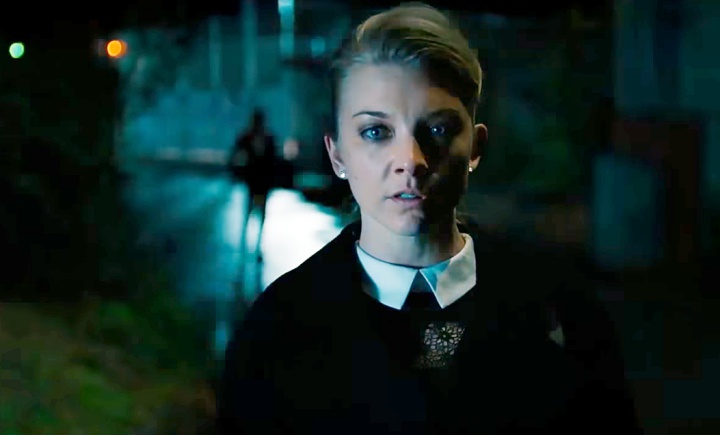
The film was written by real-life partners Anthony Byrne and Natalie Dormer; Byrne directs, Dormer stars. If you are fan of Ms. Dormer’s, possibly from her star turns in Game of Thrones or the Hunger Games franchise, then you will enjoy this film. It is a star-vehicle through and through, with nearly every shot focusing on some part of Dormer, whether her striking face or nimble physicality. Notably, Dormer proves her mettle as a very capable lead actress, and this film makes a solid case for more female-led stories written by the actresses themselves; Dormer’s character, Sofia, is a well-rounded and trustworthy focal point of the story, flitting through classy and dangerous scenarios with grace and thrilling movement. 

If only the story was as well-rounded and trustworthy. Heavens, what a license Dormer and Byrne’s story takes with the audience’s suspension of disbelief! After a striking, standout title sequence (which sets the stage excellently for a slick, exciting thriller to come), we are introduced to Sofia, a blind musician who glides around London with remarkable street smarts and style. The first 20-25 minutes continue like this, with a rich aesthetic palette and a fun, knife-edge sense of building danger. Her upstairs neighbor Veronique (Emily Ratajkowski) is clearly wrapped up in some nasty business, and when she turns up dead on the pavement outside their building, the plot thickens with Hitchcockian craftiness. Who killed her and why are the setup for the rest of the film’s twists and turns, but without spoiling anything, let me forewarn you that Veronique quickly becomes old news in favor of a much scummier, more complicated spider’s web of crime and revenge. 

For the first leg of In Darkness, the film makes a truly riveting imitation of classic Hitchcock and Wait Until Dark-esque blind-character craftwork — especially in a tense, nail-biting scene where assassin Marc (Ed Skrein) intends to kill Sofia for what she has seen, but notices her blindness and decides to follow her around her apartment in silence. Scenes like these are so fun and well crafted that the later dramatic shifts in tone and focus are more unfortunate than thrilling — there is a notable shift from Hitchcock to Jason Bourne all of a sudden that undoes a great deal of the film’s accomplishments with head-scratching intensity. 

Ultimately, that is the central problem of In Darkness — it has so many fetching elements to it, from the compelling star to the vintage first chapter to the stupendous use of music (again, only up until the tone change), yet it keeps undoing all that commendable work with silly plot twists. Twists, plural, mind you — each of which edge the film closer to completely undoing itself. As a fan of twists myself, I commend Dormer and Byrne’s ballsiness in their final few reveals, but I came out of the theatre feeling played for a fool, rather than hoodwinked by a clever storyteller. 

In Darkness is amusing genre excitement, and has potential as a twist-film highlight among those who enjoy just being confused, but it will mostly remind you how much better a straight-shooting classic crime thriller treats its own plot. Credit belongs to Natalie Dormer, however, for rooting it all in a fascinating lead — I can honestly say I would watch whatever she writes and stars in next. 

nae bad_blue

Star (blue)Star (blue)Star (blue)

Reviewer: Nathaniel Brimmer-Beller (Seen 28 June)

Go to In Darkness at the EIFF
EIFF: “Hearts Beat Loud” (30 June ’18)

Credit: courtesy of Sundance Film Festival

“A sweet, caring hug of a movie.”

Editorial Rating: 3 Stars

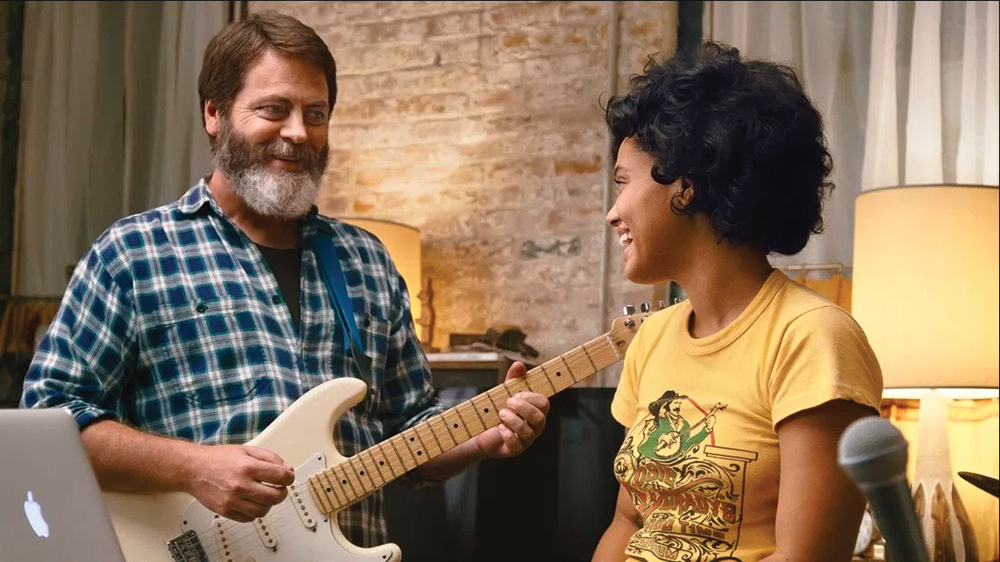
Baristas. Beard oil. Acoustic sessions. Obscure pastries. Brooklyn. Brett Haley’s Hearts Beat Loud has no shortage of any of these. It is a sweet, caring hug of a movie. If you would like a nice time, and do not mind drowning in sweetness, you might enjoy it. If you find acoustic guitar soliloquies somewhat overrated, then you might want to spend your time some other way.

Haley’s film was supposedly crafted as a “response” to all the disgusting behavior coming out of the White House and other assorted American institutions — to his credit, the film bathes itself in the loveliest versions of American city life it can imagine, from an adorable record store to a biracial family to a deeply loving father-daughter dynamic to a healthy dose of LGBT positivity. These are all, don’t get me wrong, very good things, and especially in these times when calls for more diversity in the film world are met with pathetically backwards ignorance. Haley has done very well to color his film the way he has. Thankfully, Hearts Beat Loud does show more darkly realistic sides as well, for example: the record store, owned by father Frank Fisher (Nick Offerman), is running out of money and time; Frank has had to raise his daughter Sam (Kiersey Clemons) alone as his wife passed away in a bike accident years before; Sam is going to UCLA, on the other side of the country, which means her fledgling summer love is destined to come to an unfortunately early end. All these are solid plot points, yet despite them, the film just cannot quite graduate out of the sickly-sweet genre into genuine character drama at any point. 

The plot follows Frank as he decides he has to close his store, Red Hook Records, in order to pay for Sam’s college. In a cute attempt to cheer himself and his daughter up, Frank drags Sam to their “jam sesh” room, where Sam plays a few lines from a song she wrote earlier that day. They record the song with their inexplicably state-of-the-art home studio (this, from a man who later claims to ‘not have a penny’ to his name), and Frank covertly uploads it to Spotify. It becomes an overnight sensation, and although Sam would rather go to college than be in a band with her dad, Frank is torn whether they should try and go for success in the industry or continue living their local lives. 

Offerman and Clemons are the lifeblood of this film; without them it would truly have been an unremarkable experience. Offerman in particular taps into his talent for hilariously giddy facial expressions very well, and imbues Frank with serious charm and kindness. Clemons, after blowing us all away with her scene-stealing turn in Rick Famuyiwa’s mini-masterpiece Dope, is captivating as ever as Sam, particularly when she plays music and sings so darn well — mark my words, Clemons can seriously sing. Supporting them is a nice cast of characters with mostly nice performances; Blythe Danner is charming as Frank’s mischievous mother Marianne, Toni Collette and Ted Danson are fine as Frank’s adult friends, and Sasha Lane is alright but a little morose as Sam’s girlfriend Rose.

The hit song itself, titled, of course, “Hearts Beat Loud,” is a fun and catchy indie pop number that will probably get your toe tapping, and is genuinely well-written, but so like every other fun, catchy indie pop number that the effect is somewhat limited. Other than this track, however, the songs are either overwrought or twee as hell. One unintentionally funny scene comes when Frank tries to convince Sam they should play more music together by getting out his acoustic guitar and moaning out one of his old songs he wrote back in the day; the scene ends with Sam in tears at what a moving performance her father just gave, but, gosh, what a dull and unremarkable tune it was.

This is part of the issue with Hearts Beat Loud: it gives you nice feelings here and there, but a lot of the themes and plot beats are just not as ‘important’ as Haley seems to think they are. Take the way the script handles music itself: sure, artists like Mitski and Animal Collective are exceedingly talented musicians, but two scenes each featuring different characters describing how great they are is too much. Look at it this way: you know that feeling when someone describes a band to you that you don’t know all that well, and won’t stop telling you about them anyway? This film sounds like that, for 97 minutes. Couple that with an insufferable amount of Brooklyn-specific references and a pretty lame sense of humor, and that is the base of Hearts Beat Loud’s approach. (Side note: Haley seems to have inadvertently created a personification of what The Guardian called ‘The New Boring‘ – referring to perfectly harmless tunes and ‘beige pop’ tendencies that has taken over the music scene of the last few years – this is essentially the movie version.)

To be fair, there are moments that are compelling through and through. Offerman is on top form during the scene where he realizes the band has gone viral, the true comedic highlight of the film. The final performance has energy and style to spare. And yes, the central question of how Sam and Frank are going to handle their potential for transcendent music-making is quite interesting. (Although, it is a little insulting from time to time that the film seems to suggest Sam is considering not going to the medical school she has dreamed of since childhood to pursue playing indie pop with her dad instead … an infuriatingly stupid plot point that, if the film had ended a certain way, would have lowered this even farther in my regard.)

Overall, this is a forgettable film with some pleasant performances and a truly nice heart, for better or worse.

Star (blue)Star (blue)Star (blue)

Reviewer: Nathaniel Brimmer-Beller (Seen 30 June)

Go to Hearts Beat Loud at the EIFF


EIFF: “Humor Me” (28 June ’18)

Image courtesy of LA Film Festival

“Explores the relationship between fatherhood, responsibility, and humor with grace.”

Editorial Rating: 3 Stars: Nae Bad

A warning to all who see this film: you will be telling and re-telling all the giddily awful jokes and one-liners within it to yourself and whoever will listen for days to come. Sam Hoffman’s Humor Me is a mixed bag of thin plotting, some uneven performances, and a few touching moments, but its elaborate jests are a laudable standout. As a relatively well-crafted, harmless dramedy, it satisfies.

The film stars New Zealand comedy goldmine Jemaine Clement as Nate, a self-doubting playwright, who hits rock bottom all at once and must move in to a retirement home community with his father Bob, played by the legendary Elliott Gould. Lowbrow yet brilliant jokes are Bob’s stock and trade, and Hoffman must be commended for the reverent way he realizes the elaborate scenarios the setups describe. Humor Me opens in striking monochrome, with vintage music and sound, all amusingly presented as if it is meant for a different film entirely, until Gould’s voiceover begins and it becomes clear this is all leading towards an elaborate punchline. These visuals return every time a particularly long-winded joke is delivered, and the effect is far and away the most memorable and creative aspect Humor Me has to offer. Not to imply that the film is otherwise dithering, far from it, yet nothing quite fits together as well as these scenes.

Clement is a pleasant lead, albeit with a slightly strangled delivery here and there, which can be forgiven as his American accent is not his natural lilt. Gould is certainly a standout for his layered portrayal of the aging jokester, especially in later scenes of conflict; two quite moving examples can be found in moments where Nate questions how Bob has moved on after his wife’s passing, for one, and most notably when they re-watch a VHS of Nate’s first play, which includes, and indicts, an all-too-familiar joking father who seems to ignore pressing problems within his own family. In scenes like these, the film explores the relationship between fatherhood, responsibility, and humor with grace. 

However, the weaker sides of the film are unfortunately hard to overlook. While the monochrome joke-telling segments are delightful, most of the rest of the comedic lines are just not all that funny. To paraphrase an ‘SNL’ (NBC’s Saturday Night Live) zinger, the lines are funny, but not “ha-ha” funny. The whole script is reminiscent of the kind of neurotic-chic off-Broadway play that Nate himself works on within the film, yet it is unclear whether Hoffman finds this style laughable or laudable. The title of Nate’s first play, A Crack In the Clouds, and the way he speaks about theatre in general, are so pretentious that one would think Hoffman is making a joke about derivative, self-important writing, yet the film itself has lines and scenarios just as irritatingly overwrought as the plays he seems to be mocking. One montage in particular, set to the song “Be Ok” by Ingrid Michaelson (who plays supporting love interest Allison fairly well) is just so twee I thought I would implode. Michaelson’s character, and the character of Nate’s ex-wife (played by Maria Dizzia), are also low points in the script; with the exception of some very amusing old ladies, most of the female characters are complete afterthoughts or stereotypes, particularly the ‘heartless ex-wife’ schtick, personified in a character so unbelievably cold and uncaring that one might reasonably think Hoffman has a serious hang-up about ex-wives. 

Hoffman, previous to his filmmaking career, was well-known as the creator of popular podcast Old Jews Telling Jokes, which is everything it says on the tin. It comes as no surprise then that this, his feature debut, is basically Old Jews Telling Jokes: The Movie, but if that sounds up your street, then by all means give the overall pleasant Humor Me a go. 

nae bad_blue

Star (blue)Star (blue)Star (blue)

Reviewer: Nathaniel Brimmer-Beller (Seen 28 June)

Go to Humor Me at the EIFF

EIFF: “Whitney” (22 June ’18)

“A warts-and-all telling of a seriously complicated story, with awe-inspiring moments to spare.”

Editorial Rating: 3 Stars

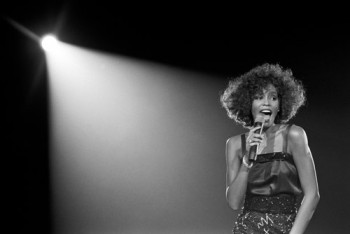
A true pop culture behemoth deserves a proper beginning-to-end document of their journey. Academy Award-winning Scottish filmmaker Kevin Macdonald has attempted as much for megastar Whitney Houston with his new, sprawling, film Whitney, an uneven but deeply moving document of Houston’s life. The film he has made is a curious case; while it performs dutifully as a warts-and-all telling of a seriously complicated story, with awe-inspiring moments to spare, its treatment of its immensely talented subject is not that sympathetic. 

The film ought to be commended for its deeply detailed depictions of Houston’s upbringing and rise to stardom. The access to such personal details is completely owed to the openness of the family, who began the process of getting the film made, not Macdonald. Thankfully, their hand in the process has not exempted them from any hard truths coming to light, and in fact some of the most devastating descriptions of mistreatment or disrespect surrounding Houston and her journey come directly from the family members who were responsible or complicit in the actions. The film almost feels like a scripted slow build; at times, as Macdonald admitted in a post-screening Q&A, even the documentarians are shocked by what their subjects reveal about Ms. Houston and her family. Like many rise-to-stardom stories, there are heartbreakingly tragic double-crosses, miscalculations, and traumas to be found just under the surface, and the film shies away from none of them. 

It must be noted, artistically, there is little directorial signature or flair on the finished product — it mostly runs as a series of clips and related interviews, assembled in chronological order. The lion’s share of the memorable moments are down to Ms. Houston herself; clip after clip of archival footage proves again and again that she was truly one of the most talented pop singers of all time. By the time the film reaches the date of her death in 2012, the viewer will most likely empathize with the tragically doomed Houston more than ever. This is the true triumph of Whitney, for the film makes a compelling argument for her complete exoneration from the gruesome tabloid rumors that sank not only her career but her self-confidence. The film does well to simply play a performance of hers in full from time to time, just to recall what a breathtakingly beautiful voice she possessed. (You just try and maintain a dry eye when they revisit her performance of the ‘Star Spangled Banner’ at the 1991 Super Bowl – you just try!)

That being said, Macdonald’s framing of the story does such a good job pointing out the mercilessness of tabloid interference in famous lives like Houston’s, that the nature of his own film gets consequently called into question. Horrid headlines concerning Houston’s dirty laundry and possible vices are sprawled across the screen as the film reaches the 2000s, Houston’s worst period of self-destruction; while this effect is well-measured, as the film itself began revealing similarly lurid details, I found myself beginning to question what the difference really is between the two outlets. Though Macdonald defended his film as ‘the truth,’ so therefore ‘better’ than tabloid journalism, the film does take a few steps too far into broadcasting the darkest sides of Houston’s past as if their tragic implications have entertainment value. 

The film’s clinical approach to telling the story seems to treat its sensitive material at an arm’s length, which somewhat irresponsibly allows for sarcasm and humor where there really should be compassion and understanding. From the racial implications of its subjects’ statements, to certain allegations of terrible abuse, to the private inconsistencies of some contacts of hers, (her complicated ex-husband Bobby Brown asserting that Houston did not have a drug problem at all, for instance), the film simply has too many moments where the heartbreaking material seems meant to elicit a laugh, rather than a tear or a moment of reflection, and though there are more high points than low, Macdonald’s film never quite feels entirely respectful as a result.

Overall, however, Whitney is a fascinating two hours, and a must for any fans of The Prom Queen of Soul, or fans of the music biz in general. 

nae bad_blue

Star (blue)Star (blue)Star (blue)

Reviewer: Nathaniel Brimmer-Beller (Seen 22 June)

Go to Whitney at the EIFF


EIFF: “Papillon” (22 June ’18)

“Quite compelling.”

Editorial Rating: 3 Stars: Nae Bad

This film is, conspicuously, a remake. Not in the sense that it broadcasts its similarities and differences to the original, (in this case the 1973 version of Henri Charrière’s seminal autobiography), like some decades-later remakes do, but in the sense that it simply re-makes the first. This begs a question which Michael Noer’s new Papillon never quite answers: why was this film made?

The action follows a dashing Paris criminal known as ‘Papillon’ (Charlie Hunnam), cracking safes in style in 1931, as he gets some brutal comeuppance for swindling his boss, and is framed for murder. His sentence is life in prison, specifically an overwhelmingly horrible penal colony in French Guiana. There, and over the next few decades, he attempts various escapes through a partnership with wealthy but weak Louis Dega (Rami Malek), and experiences disturbing and inhumane treatment from the prison’s guards and higher-ups. The kicker is that it’s all based on a true story, by the real Henri ‘Papillon’ Charrière, whose book of the events, published in 1969, has sold over 13 million copies worldwide.  Charrière was pardoned of murder in 1970.

There is a confusion to Noer’s film, however, for on its surface, it is quite compelling, but underneath, it is really just a re-done version of a film that has already been made. Steve McQueen and Dustin Hoffman embodied the roles of Papillon and Dega, respectively, in Franklin J. Schaffner’s original, which, though not considered a great film, is still a notable work in American depictions of agony in incarceration. Noer’s film has cinematic agony to spare, and at times verges into outright body horror as Papillon and others are starved, savagely beaten and whipped, and in some cases dismembered and murdered. It’s not a very fun time for anyone.

Yet, despite the aspects that befuddle and disgust, Papillon delivers some affecting cinema here and there. The casting should be commended above all else; Hunnam and Malek are without a doubt two of the most capable yet underused leading men onscreen today, and it is very satisfying to watch them play off each other. Hunnam continues to impress with his ability to flaunt his physicality and his grim charm, and for fans of his star turn in James Gray’s underrated The Lost City of Z, this film will not disappoint. Yet it is Malek who stands out the most remarkably here, and his Dega, weak-chinned but crafty, might be one of the more memorable characters of this entire festival so far.

In terms of craft, Danish director Noer makes some odd choices, but none really take away too deleteriously. One qualm I had is the complete lack of establishing shots in the first half of the visuals — in a film so focused on a hellish jungle landscape, it is strange that the camera focuses more on medium shots in quite random succession. Until we get one breathtaking shot of the South American sunset on a river, followed by another strange bout of shots where a small boat at sea takes up three quarters of the frame, and an ensuing storm is relegated to a distant speck. Perhaps these are all intentional distortions of what we expect to see, but it struck me more as unsuccessful attempts to shoot around a small effects budget, which detracts from the epic nature of this decades-long story. Nevertheless, the film may be slow, but it is not boring; it is odd but not off-putting — unnecessary, but not unwelcome.

nae bad_blue

Star (blue)Star (blue)Star (blue)


Reviewer: Nathaniel Brimmer-Beller (Seen 22 June)

Go to Papillon at the EIFF here


EIFF: “Puzzle” (Festival Theatre: 20 June’18)

“Genuinely affecting moments of liberation and subtle defiance.”

Editorial Rating: 3 Stars

Our first coverage of the film festival. Nathaniel Brimmer-Beller will keep them rolling.

As she addressed the gathered public at the opening screening of the 72nd Edinburgh International Film Festival on Wednesday, Kelly Macdonald expressed both gratitude — that her new film, Puzzle, directed by former producer Marc Turtletaub, was opening Scotland’s foremost film festival — and amusement that in it the Glasgow-born actress was playing an American. “I’m in nearly every frame of the film,” Macdonald continued, “so I’m sorry! But you’re in your seats and the doors are locked so you can’t leave now!”

From that introduction, one might expect Puzzle to be a point of embarrassment for the experienced actress. Macdonald has worked with talent as renowned as the Coen brothers (No Country for Old Men), Martin Scorsese (Boardwalk Empire), and Danny Boyle (Trainspotting, T2), yet Puzzle marks her first prominent, meaty leading role. Macdonald oughtn’t be embarrassed by her work in Turtletaub’s film, however, quite the opposite; yet by the time the credits roll, one is left wishing she was given more to do within all those frames. 

This, Turtletaub’s directorial debut, is a remake of Argentinian film Rompecabezas, directed by Natalia Smirnoff in 2009, and follows shrinking violet suburban housewife Agnes (Macdonald) as she gradually sheds the suffocating monotony of her daily life caring for her boorish husband (David Denman) and two insufferable teenage sons. In the film’s opening sequence, a stylistic high point in an otherwise unremarkable storytelling strategy, Agnes diligently weaves through a house party, existing in the background as her guests make a mess and ignore her. After a few minutes of watching her scrub and kowtow, Agnes reveals an impressive birthday cake, and the guests sing Happy Birthday to … her. Her servile existence at her own birthday celebration presents a perfect introduction to the character as a product of circumstance. As Agnes unwraps her presents, she finds a 1,000-piece puzzle, which, although average citizens remark it will take days to complete, she finishes within half an afternoon. Soon, she seeks out more puzzles, and through them, more control, more exploration, and more freedom, assisted along the way by her serendipitously-met “puzzle partner” Robert (Irrfan Khan). To its credit, though the initial setup of a film based entirely on one person’s self-discovery through 1,000-piece puzzles seems like an aggressively dull use of 103 minutes, the film manages to achieve some genuinely affecting moments of liberation and subtle defiance that avoid total insignificance. 

Unfortunately, I would not blame viewers for tuning out before these moments are reached, for despite that beginning, Puzzle begins to lose its grasp over its plot’s moving pieces quite quickly. Turtletaub, though partially responsible in his role as a producer on films such as Little Miss Sunshine and Loving for some of the more compelling family-based stories of the 21st century, can’t quite master the art of keeping the story fresh and maintaining depth. Too often, the dialogue between Agnes and her family lists into high-school-play levels of one-dimensionality, with displeasing references to veganism, Buddhism, and masculinity in “today’s youth” that come off as tone-deaf. Nearly every stereotypical “overdramatic indie film” line you can imagine is somewhere to be found in here, which becomes frustrating — not to mention its lamentably obvious central metaphor. In case you hadn’t guessed, the eponymous activity comes to represent the unsolvable puzzles in Agnes’s own life, and yes, there is a dramatic monologue about the cosmic connection between solving a particularly hard 1,000-piecer and solving yourself. (Though, to be fair, it is delivered by Mr. Khan, who continues to elevate uninteresting Hollywood ideas with his undeniable charm and masterful delivery — though the words he recites are unoriginal and formulaic, his performance of them is everything but.)

Overall, Puzzle does a lot more telling than it does showing. It is less a film than an overlong Hallmark ad, with a semi-profound lesson in there somewhere that is often overlooked in favor of ‘family drama’ beats that we have all seen before, repeatedly. If you are looking for bombast, style, or cutting-edge storytelling, all of which this year’s EIFF promises to offer by measure over the next two weeks, Turtletaub’s film is not for you. Yet, though such a clichéd film is a puzzling choice to open such a dynamic festival, as a calm, pensive look at a chronically overlooked type of person, this film fits well. 


Star (blue)Star (blue)Star (blue)

Reviewer: Nathaniel Brimmer-Beller (Seen 20 June)

Go to Edinburgh International Film Festival here


The Belle’s Stratagem (Lyceum: 15 Feb. to 10 March ’18)

Angela Hardie as Laetitia.
Photo. Mihaela Bodlovic.

“Jaunty, diverting and quick. A noteworthy woman playwright is not short-changed”

Editorial Rating:  3 Stars Nae Bad

There was gleeful mention of the ‘shit wagon’ and of the reeking ‘Nor Loch’ but these early New Town characters keep their stockings a blinding white and the hems of their fancy gowns spotless. It’s that kind of play: a slight comedy of appearances. Or should that be ‘sleight’?

The Belle’s Stratagem is a jaunty piece, giddy even. Its leading man is Doricourt (Angus Miller), although he’s led by the nose, and he has ‘l’air enjoué’ of a chap with too many Air Miles and too many hours in Club class. Well, he would have, except this is 1788 when Gold Cards and guineas were more likely gifted by pedigree than work. He’s back in Edinburgh after his ‘Grand Tour’ of assorted lounges, demoiselles and signorinas and finds himself betrothed to Letitia (Angela Hardie), known almost from birth and now two years out of boarding school, and he’s not impressed. She, Letitia, is pissed at this – vulgarity clearly crossed Princes Street – and is determined to have her man love her or lose her. Meanwhile, Sir George Touchwood (32 and of the Jacob Rees-Mogg brigade, benign branch) is back in town with his lovely, guileless, wife, Lady Frances. Beware! Cad about, Courtall by name (geddit?), who will have the lady.

Tony Cownie has adapted Mrs Cowley’s Belle’s Stratagem of 1780 and removed the whole play to Scotland, aka that ‘subjugated bunch of hills north of Berwick’. Deacon Brodie is stealing about; Doricourt and the honourable Saville (John Kielty)  are soft Jacobites; Laetitia’s father is Edinburgh’s Provost and Laetitia (in disguise) wins Doricourt’s heart and the audience’s with an aching ‘Will ye no come back again?’ The best joke of the evening is Courtall’s as he goes off to France for an assignation with the Revolution.

Theatre history is all over this piece, if you look for it. The big brother of Cowley’s original has to be George Farquhar’s Beaux Stratagem from 1707. Farquhar had arrived in London in 1697 from Dublin’s wonderfully evocative Theatre Royal at Smock Alley. Cowley’s play opened at the Theatre Royal Covent Garden. Nicola Roy’s Kitty, a prostitute with a proper sense of what’s decent, would fit well into those dodgy streets. She’s the key to foiling Courtall’s foul intrigue. The two widows, Racket (Pauline Knowles) and Ogle (Roy, again) give lechery a good name by repeatedly calling out the hypocrisies of male behaviour but enjoy eyeing the men themselves.

Helen Mackay as Lady Frances and Grant O’Rourke as Sir Edward.
Photo: Mihaela Bodlovic

Historians place The Belle’s Stratagem at the endpoint of a period when the Comedy of Manners went bourgeois. Marriage and compatibility within a marriage become a pair and so enter Sir Edward and Lady Frances, who (for me) are more interesting and entertaining than an infatuated Doricourt and the infantile Laetitia of the first half and the minx Laetitia of the second. Grant O’Rourke plays the country squire (ok, laird) as if to the manor born. He’s a kind fellow, whose daft helplessness (check O’Rourke’s real comic quality in the Venetian Twins) rallies to the call of defending his wife. He ends up an endearing character and – a near no-no in the Restoration comedy of times past – a deserving husband. And Lady Frances (admirably done by Helen Mackay) is bold enough to love him true once she has established her own rights, which again is rather refreshing. The New Town will be all the better for their rectitude during their three months residence in town! Laetitia’s father, the Provost, is more typecast as the lookout for a wealthy son-in-law but Steven McNicoll gives the part considerable warmth and humanity, not least in a party dress.

There’s pretty music, dancing, a masquerade, numpty grumpy footmen, and squeaky clean, impressively silent Heriot Row facades but all the same I longed for some ruggedness, more spit and bite. The gossip columnist, Flutter, is played by an impish John Ramage and that gets close, but finally it’s light and undemanding. The ‘modern’ script is frequently diverting and quick, actors help it on enormously, and a noteworthy woman playwright is not short-changed, but the intrigue unwinds too rapidly and I found much of the humour either forced or slack.

nae bad_blue

Star (blue)Star (blue)Star (blue)

Reviewer: Alan Brown (Seen 21 February)

Go to The Belle’s Stratagem at the Lyceum

Visit Edinburgh49 at The Lyceum  archive.

FAME! The Musical (Church Hill Theatre: 6-10 Feb ’18

“Plenty of individual noteworthy performances”

Editorial Rating: 3 Stars: Nae Bad

Fame! The Musical follows a group of performance arts students through their formative years at the “Fame” high school, and is full of vivid characters, energetic dance numbers, and show-stopping songs. Largely an ensemble piece, it’s the perfect choice and platform to allow Edinburgh University Footlights’ members to present their considerable talents as actors and singers, and there are plenty of individual noteworthy performances throughout.

Mimi Joffroy demonstrates all the ingredients of a stellar leading lady as Carmen, most evident in the goosebump-inducing In L.A.; Matt Galloway delivers a laugh a line as the charismatic Joe, and dance captain Connie McFarlane proves she’s a genuine triple threat in the gospel-tinged Mabel’s Prayer. Alice Hoult and Adam Makepeace show great chemistry as romantic leads Serena and Nick, and Mhairi Goodwin serves up a killer belt as Miss Sherman in These Are My Children. Liam Bradbury never quite convinces he’s actually a hip-hop dancer as Jack, though comes into his own during the character’s signature song Dancing on the Sidewalk.

Yet given all this obvious talent, what holds this production back is being able to effectively embrace the script’s very bitty nature, made up of lots of short scenes taking place over a number of years. EU Footlights’ simple set proves very constraining to this end, often dragging the action to the back of stage, while there’s precious little to link each part and show progression over time. There are pleasing teases of getting it right during Think of Meryl Streep, as action continues behind the singer, so it’s slightly frustrating not to see more creativity in the presentation of each scene throughout to make it feel like one cohesive piece.

Additionally, Fame! is a show that is chock-full of dancing, requiring much more from a cast and choreographer than your average production. The company certainly give it their all during this performance and there are some wonderful moments during the dances (especially some of the daring lifts!), but there’s also a scrappiness to the performance – particularly in the ballet sequences – which, although charming at times, more often detracts from a lot of the other great things happening on stage. Some extra time spent in brushing these up would go a long way to adding to the quality of this production.

Overall, Fame! is a feel-good show with plenty to enjoy, and EU Footlights should be very proud of the job they’ve done with it. Though one can’t help but feel that we ain’t see the best of them yet.


nae bad_blue

Star (blue)Star (blue)Star (blue)

Reviewer: Steve Griffin (Seen 7 February)

Visit the Church Hill Theatre archive.

THIS REVIEW HAS NOT BEEN SUBEDITED

The Arabian Nights (Lyceum: 30 Nov ’17-6 Jan ’18)

The Arabian Nights. Photo credit - Tommy Ga-Ken Wan

“Visually stunning”

Editorial Rating: 3 Stars

The Arabian Nights is based on the well-loved book of the same name, and is adapted for stage here by Suhayla El-Bushra. Presented largely as a collection of short stories told by the central character (Scheherazade) in order to impress the Sultan who holds her mother captive, it’s a simple concept that all ages can find something magical in.

And there are several moments of wonderment and enjoyment to be had in the stories, which introduce many fantastical characters and scenarios: from people who get turned into animals, and vice versa; wives who love to shop and spend their husband’s ill-earned money; and, of course, spirits with the ability to grant wishes. El Bushra’s script stays faithful to many of the tales within the book, and also scatters some pleasingly modern references to keep the performance relevant to today’s audiences. A couple of interesting gender-blind casting choices also make for great amusement!

The show is performed by a ten-strong cast of multi-talented actor musicians who variably act, sing, play instruments, do puppetry and create all kinds of magic on stage, and for me it’s Rehanna MacDonald who really stands out as central character Scheherazade. A captivating storyteller: she impresses equally well on a bare stage as when there is a huge box tricks erupting behind her, and it often feels like she is the glue holding everything else together. A special mention also to Humera Syed and Brian James O’Sullivan as the hilarious, musical talking goats – my personal highlight of the show.

Visually, this production is stunning – no mean feat for a show with numerous changes of location, time and mood – yet designer Francis O’Connor’s set manages to achieve a great deal to marvel at, creating a sense of awe throughout.

The main downfall of this production, however, is its length, and therein much of the magic is lost as the performance drags on, with noticeable and frequent dips in quality and clarity with scene after scene after scene. It’s also a shame that for an adaptation of such magical stories, which does impress with its stagecraft at many points, there is such a reliance on actual fart jokes for cheap laughs, while the odd moments of audience interaction throughout the show are so half-baked they’re practically raw.

At times this production is spell-binding, but it’s very hit and miss, so to fully enjoy this bumpy carpet ride adults and kids alike will need to sit tight, listen in, keep up and just go with the flow…

Star (blue)Star (blue)Star (blue)

Reviewer: Steve Griffin (Seen 1 December)

Visit the The Lyceum archive.

THIS REVIEW HAS NOT BEEN SUBEDITED

Hansel and Gretel (Roxy: 9-11 November ’17)

“A futuristic and fantastical interpretation of the age-old story”

Editorial Rating: 3 Stars

One of the many charms of fairy tales is their enduring relevance, and the Grimm Brother’s Hansel and Gretel is no exception. In their production of Engelbert Humperdinck’s fairly short opera of the same name, Le Petit Verre attempt to present a futuristic and fantastical interpretation of the age-old story, which, while daring and creative, often gets a bit lost in its own figurative forest.

Given its simple set-up and small cast it’s a wise choice of show for this new student company to flex their imagination and demonstrate their talent, and they certainly go all out with intricate theming and design of almost every aspect of the production.

Yet while some of the company’s artistic choices bring a pleasingly modern and relevant twist to proceedings (Hansel’s choreography and overall styling as a street-wise teenager, for example), unfortunately most of the creative elements suffer from a lack of congruence resulting in a rather disjointed production.

The programme notes and opening lyrics of the piece place the action firmly in a modern (potentially post-nuclear war) poverty-stricken household with no food, and where children are left alone to do chores for hours on end. It’s somewhat confusing, then, to see the all performers in glittery costumes with elaborate hair and make-up – and it’s never clear how these two themes are reconciled. The ad hoc appearance of a robotic masked chorus certainly doesn’t ease any of the comprehension.

Musically though, the assembled 40-piece orchestra makes an impressive sound and the singing on the whole is well-matched to the instrumentation, though it’s a shame the lack of microphones prevent the vocals from really being able to soar throughout the production. Patrick Dodd impresses most as the Father with his rich, warming baritone voice, while the rare duet moments between Hansel (Claire Lumsden) and Gretel (Alexandra Elvidge) are delightful to listen to. Hebe James is charming as the Gingerbread Witch and Deborah Holborn brings great characterisation to the role of the Mother.

Underneath all the gloss and glitter of this production there are lots of lovely things going on, and it’s great to see young companies coming through and taking risks with their work. While this one is a little too rough and unready, there are plenty of positives to take away from this debut production, and I look forward to Le Petit Verre’s next show.


Star (blue)Star (blue)Star (blue)

Reviewer: Steve Griffin (Seen 11 November)

Visit the Assembly Roxy archive.

THIS REVIEW HAS NOT BEEN SUBEDITED