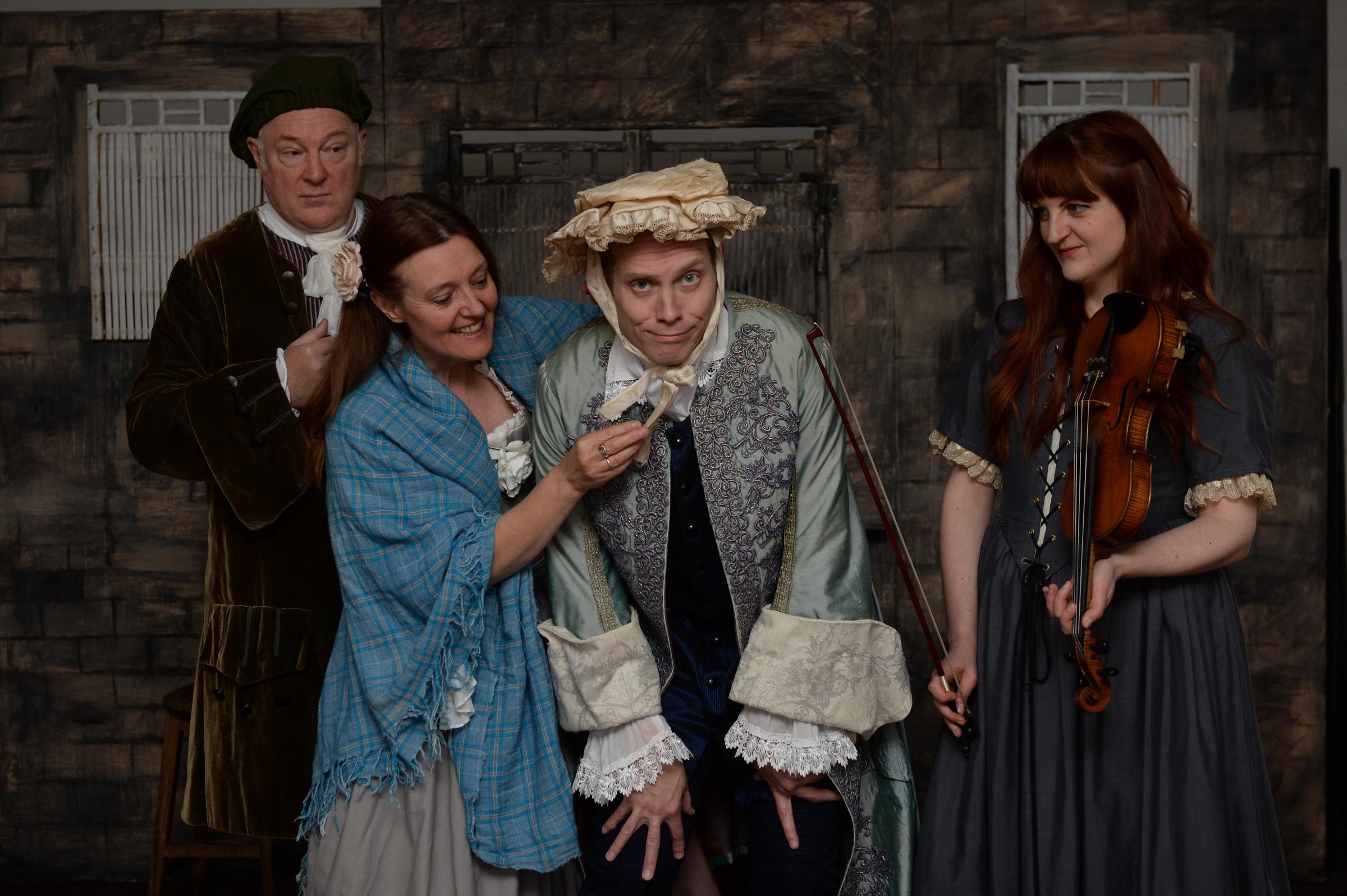
Dr Johnson Goes to Scotland (Traverse: 1 – 5 Nov. ’16)

l to r. Lewis Howden, Gerda Stevenson, Simon Donaldson, and Morna Young. Photo: Kirsty Anderson

l to r. Lewis Howden, Gerda Stevenson, Simon Donaldson, and Morna Young.
Photo: Kirsty Anderson

“Comic effect knocks against an open coffin on Iona”

Editorial Rating: 3 Stars

Would Samuel Johnson, heroic dictionary maker, essayist, critic, and celebrity wit ever have appeared on ‘Strictly’? Perhaps. He was, after all, prone to nervous shakes and tics and he would have been mercilessly brilliant at discombobulating the judges. Anyhow, in the last of the current season of a Play, a Pie, and a Pint, the big man is in polished boots and plaid and he steps up to a jig and seems to enjoy it.

And verily this is the same Dr Johnson, who noticed that ‘the whole [of Edinburgh] bears some resemblance to the old part of Birmingham’. Writer James Runcie continues his rehabilitation of the arch English nationalist by rowing him thoughtfully and fondly over the sea to Skye (and to Mull and Raasay). A Word with Dr Johnson – at the Traverse in October last year – was about the man, his wife, and his English dictionary; this time (1773) he’s in the boondocks and the heather and the Gaelic. For the proto London-centric it’s an ear-bending peregrination in a land where ‘you have more words than people’, which could well have been its chief attraction.

Lewis Howden plays Johnson sympathetically, of splendid girth and with orotund voice, and with a baffled interest in all things Scottish. An exploration of Fingal’s Cave, lantern in hand, leaves him only dimly enlightened but his enthusiasm for Thomas Braidwood’s school for the deaf and dumb is obviously sincere.  His companion throughout is, of course, the amiable James Boswell (admirable by Simon Donaldson), who treats us to evocative latin from Dunbar’s ‘Lament for the Makars’, whilst guarding his distinguished author friend from the sublime and local peril of being called a bampot.

So then, a pleasing trot through good old Scottish ways ? Runcie even brings on ‘Macbeth’ and the Bonnie Prince, which is fine until their comic effect knocks against an open coffin on Iona and a poem of freedom in earnest pursuit of the Scottish nation. Supporting roles by Gerda Stevenson and Morna Young are amusing and/or tuneful but my distinct impression was of looking in at the tartan themed windows of discount booksellers, The Works, on Princes Street. The learned Dr.’s eye would take in a remaindered copy of his  ‘A Journey to the Western Islands’; he would harrumph, say “I’m deeply obliged”, and move on.

Star (blue)Star (blue)Star (blue)

Reviewer: Alan Brown (Seen 1 November)

Go to Dr Johnson Goes to Scotland at the Traverse

Visit Edinburgh49‘s Traverse archive.

One Thinks of It All as a Dream (Traverse: 25-29 October ’16)

“Euan Cuthbertson as Syd shows great range and dexterity”

Editorial Rating: 3 Stars

Competent, solid, predictable: words probably rarely used to describe Pink Floyd’s music, but to me the most apt in summarising One Thinks of It All as a Dream – the latest instalment in the Traverse Theatre’s A Play, A Pie and A Pint season. The play, which follows the band’s early years, in particular Syd Barrett’s influence, is interesting for those that know little of the history, but in all other respects doesn’t give much to shout about.

For a theatre piece about such a genre-defining and experimental band, one might expect an edgy or original approach to form and structure to creatively fit the subject matter (drugs and mental illness are common themes), but instead this production follows a simple linear narrative and style typical of (and there have been so many) a musical star’s biopic.

It is structured well in giving nods to all the necessary turning points and dramatic moments to keep interest in the narrative, and the second half flows very naturally in terms of building up tension and allowing the actors to really sell the story. Early on the dialogue is quite forced to convey necessary information – in particular in one party scene the characters all sit around discussing what’s just happened, which comes across as very stilted.

The more engaging parts of this show are the longer and more developed scenes – the first television interview, Roger’s meeting with a psychiatrist and the final few minutes in particular enable the development of more emotional involvement with the action. As quite a pacy piece covering several years it’s quite hard to build a connection with each moment: before you know it you’re off somewhere else again, trying to keep up with who’s who and where and when we are.

The acting is good, Euan Cuthbertson as Syd shows great range and dexterity, particularly in scenes with his father, and the other actors give credible support to keep the action moving. Jonathan Scott’s design should also receive special mention, creating a flexible yet stylish space for the actors to move around in and facilitate a smooth performance.

It’s a perfectly passable show, but not a great show. For me, another brick in the wall.

Star (blue)Star (blue)Star (blue)

Reviewer: Steve Griffin (Seen 25 October)

Visit the Traverse archive.

THIS REVIEW HAS NOT BEEN SUBEDITED

Edinburgh Quartet and Guests: St Andrew’s and St. George’s West: 25 Oct ’16

Image result for edinburgh quartet

“the standard of playing remains remarkably high …all the more commendable in the main work that was technically very demanding in terms of phrasing, notation and timing.”

Editorial Rating:  3 Stars

The Edinburgh Quartet are skilful not only in their playing but in their approach to their constituency. Their 2016/17 series is a combination of daytime, rush hour and evening sets in order to reach new listeners and move away from the relative predictability and, for some, the difficulty of getting to evening gigs. Each season, or part of season, has a theme, and this season’s theme is vested in their Scottish roots. Tuesday’s concert programme contained works inspired by the island of Skye and the actual words of Robbie Burns. Informal in approach within the relaxing environs of St Andrew’s and St George’s West in Edinburgh, the occasion is probably more accurately described as an informal lecture recital rather than a concert, and none the worse for that.

Cleverly, the band started with a brief introductory piece, demanding in intonation and timing, which they played without music. Gordon Bragg then interviewed composer Alasdair Nicolson who spoke of the inspiration behind his String Quartet No 3, “Slanting Rain”, which was the centrepiece of the evening. After that Mairi Campbell, guest musician and one of two violists in the opening number, spoke of her love of the Scottish dance and folk music idiom and her approach to her music.

On to the main event. “Slanting Rain” is a six movement work full of chromatics, a wide variety of bowing techniques, harmonics and dissonance. It is a difficult play, and not an easy listen. I did think that the advanced technical construction of the work got in the way of its musicality. The introduction to the fourth movement, “Impossibly distant tree lined paths”, treated us to a melodic introduction by EQ Apprentice Competition winner Morag Robertson on viola, and the sixth movement, “Into an abyss made of time”, was a very clever melange of time signatures and orchestration that definitely worked.

The evening drew to a conclusion with a deeply moving rendition of a Robbie Burns poem sung and played by Mairi Campbell, followed by James MacMillan’s “Memento”.

Those familiar with the Edinburgh Quartet’s line up would have noticed some new faces, some planned, some drafted in at the last moment. Tristan Gurney has left and the first Violin chair is currently being recruited for. Tonight’s locum was taken ill on the morning of the concert, and Gordon Bragg nobly took on the first violin part, bringing in Rachel Spencer on second violin. Morag Robertson will take the viola desk for the first part of the season while Fiona Winning remains on maternity leave.  Mark Bailey remains at the cello desk.   All these changes notwithstanding, the standard of playing remains remarkably high and, astonishingly, the cohesion of the band appears completely unaffected, as if they had all being playing together for years, all the more commendable in the main work that was technically very demanding in terms of phrasing, notation and timing.

Star (blue)Star (blue)Star (blue)

Reviewer: Charles Stokes (Seen 25 October)

Go to Edinburgh Quartet‘s homepage

Visit Edinburgh49’s St Andrew’s and St George’s West archive.

Mischief (Traverse: 11-15 Oct ’16)

“Life-affirming and devastating in equal measure”

Editorial Rating: 3 Stars: Nae Bad

Ronnat and Brigid, mother and daughter, live alone on a small island, save for some cows that they tend to for a group of monks on a neighbouring island. But when the handsome young sailor Fari washes up on their beach, their little world is set to be changed forever. For his own good, Fari is sent off to live with the monks with the next dispatch of milk, but he soon becomes responsible for transporting the milk back and forward, meaning frequent visits to the women on the island, which have deeper effects on them all than any of them initially realise.

It’s a simple but intriguing set up, and Ellie Stewart’s writing creates a believable world and relationship web between the three characters that slowly unfurls as the play progresses. The plot is full of changes in direction and power between each one, keeping the tension alive throughout, and leading to a final scene and denouement that’s both life-affirming and devastating in equal measure.

While covering quite a “serious” overall topic, a fair amount of comedy is woven in, largely through quite overt sexualisation. Such moments are generally amusing, though do perhaps cheapen the play and divert attention away from the main drama, which is the piece’s real strength. Traditional singing and movement are also used throughout which in some ways add to the sense of history and ritual one would expect from such a setup, but in others seem a bit gratuitous in trying to cram in too many devices. Overall I think Mischief (a slightly misleading title) tries a bit too hard to do too much in such a short space of time.

What would make this play more effective would be a greater sense of stillness and time – there are quite a few scenes and scene changes as the story progresses at a pretty rollicking pace, but given the life-changing themes and choices presented, Gerda Stevenson’s slick direction never really gives enough opportunity for the situation or newly revealed facts to just hang and be absorbed. The young cast, in their earnestness, also seem very keen to over-emote and play up to stereotypical roles, when a subtler and more grounded approach would help make the play’s decisive moments stand out.

It’s a moving and captivating piece that’s cleverly written, but not realised to its full potential in this production.

nae bad_blue

Star (blue)Star (blue)Star (blue)

Reviewer: Steve Griffin (Seen 11 October)

Visit the Traverse archive.

THIS REVIEW HAS NOT BEEN SUBEDITED

Breaking the Ice (Traverse: 4-8 Oct ’16)

“[Why no] Danish pastries at a convention attended by the Danish?”

Editorial Rating: 3 Stars

The Arctic. Surrounded by seven of the world’s most prosperous and empire-building countries, and ripe for colonisation – if they can all agree on the best way to approach it. Breaking the Ice is set during The Arctic Council’s General Assembly 2016, where negotiations are to take place, and Frank, geologist and stand-in scientific advisor to the big dogs, is due to address the delegates upon the potential impacts of various courses of action. That’s if he manages to find his speech and get his suit dry-cleaned in time after spilling yogurt down it at breakfast.

From the opening few lines it’s clearly a comedy piece, with discussions into the lack of Danish pastries at a convention attended by the Danish and the merits of embossing on business cards, setting the tone somewhere between Dario Fo and Fawlty Towers. Steven McNicoll as Frank is a commanding and charismatic storyteller, and, dressed in a bath robe throughout (due to the yogurt debacle), can clearly be trusted to tell it as it is rather than giving any politico spin. He’s vulnerable, likeable, with a sense of being completely out of his depth but enjoying the ride anyway.

What’s disappointing though, is that as the play progresses (with kidnappings, arrests, and encounters with locals and lawyers), McNicoll’s tone and demeanour show very little variation or development, and by the time he finally gets to address the conference (late, and still in his bathrobe), he appears to be in no way affected by all that has gone before, approaching it as he would making a cup of tea. There is a distinct lack of build-up in tension towards the climax (which in itself fizzles into nothingness), meaning the whole thing feels a bit pointless.

That’s not to say the structure doesn’t facilitate a suspenseful build-up. Throughout his morning Frank encounters many different characters, all of whom have a different point of view on the conference and proposed developments, and all of whom try to persuade Frank to consider theirs when making his speech. It’s a great device to get these viewpoints across, but their rapidity, comic delivery and minimal effect on Frank make them seem like little more then neighbours passing comment about the Jones’s new car than individuals whose livelihoods are set to be deeply affected by the outcome of the conference. It doesn’t quite fit together.

McNicoll as Frank is certainly clear and engaging, if quite one-dimensional in his journey. Jimmy Chisholm is more impressive with his range of characters, creating strong contrasts to communicate the complexity of the situation, yet Nicola Roy’s more melodramatic style seems to be at odds with everything else on stage resulting in a bit of a mismatch in interpretation of the script and lack of consistency throughout.

While there are plentiful very witty lines, some of the dialogue seems quite forced in order to shoe-horn in the humour – in particular, a discussion into an environmental activist’s kidnapping prowess smacks of being thrown in for comic effect, given how little it adds to the overall piece. I spent much of this performance wishing they would just get on with it.

Ironically, Breaking the Ice does quite the opposite – merely skimming the surface of the debate into the economic and geological future of the Arctic, without ever prodding deep enough to build a strong connection with the issues to leave a lasting impression. Much like an iceberg, this production feels like there could be much more to it, but we’re not able to see it.

Star (blue)Star (blue)Star (blue)

Reviewer: Steve Griffin (Seen 4 October)

Visit the Traverse archive.

THIS REVIEW HAS NOT BEEN SUBEDITED

+3 Review: The Glummer Twins (Paradise in The Vault: 22-28 Aug. 11.35am 1h.)

“The guys are genuinely funny”

Editorial Rating: 3 Stars: Nae Bad

On a small, well-lit stage, deep in subterranean Edinburgh, The Glummer Twins start their set with Just Turned Sixty and Taking it Badly: a really good bemoaning of being the owner of an ageing body.  Through the medium of beat poetry and music, the Glummer Twins (David Harmer and Ray Globe) take a look back to 60’s childhood, 70’s aftershave and 80’s yuppies.  They ask the important question of whatever happen to the mods?  Autobiography is included, such as after moving from south London, the warm welcome David received from his new Doncaster school chums.

The Twins look forward to the future with the poems  Old Bloke Blues and Fiery Jack: the latter a must-hear for any pharmacist or person taking a large range of medications.  Groans and laughs are generated in equally generous measure as we follow the puntastic adventures of poet-noir detective Percy Shelly – private dick.  The poems comes thick and fast, with fifteen being delivered over the hour.

The theme of the show is ageing and reminiscing because there comes a time in life, theirs in particular, that there is a lot to look back on but not so much to look forward too.  The Glummer Twins state they have been coming to the Fringe for thirty one years and obviously love what they do.  The audience are in the safe hands of veterans.  Both were members of the performance group Circus of Poets, which in the 1980s appeared on nation television and toured Europe.

The style of comedy is, fair to say, gentle.  That does not mean unfunny: far from it.  While Percy Shelly is undoubtedly the comedic highlight, the spirit and black humour of South Yorkshire is also evoked.  Whatever will happen to Derek the Trainspotter?  One also has to ask, in the wake of the recent Brexit vote, whether there is deeper meaning to the poems Mediterranean Homesick Blues and Speak Scandi?

Harmer and Globe are good, solid performers who deliver rhymes and laughter.  Globe handles the musical side with electric guitar, pedal beat boxes and shares vocals, while Harmer’s performance is spoken word and costume change.  The show is squarely aimed at older generations.  They know that their style and material are not going to rock the foundations of comedy but that does not matter.  The guys are genuinely funny.  Watching The Glummer Twins is a fine way to wind up a morning on the Fringe.

P.S. – if one wants to know the origins of the name, Google “The Glummer Twins” and see what comes up.

nae bad_blue

Star (blue)Star (blue)Star (blue)

Reviewer: Martin Veart  (Seen 26 August)

Visit the Assembly Roxy Bedlam Church Hill Theatre Festival Theatre King’s Theatre Other Pleasance, Potterrow & Teviot Summerhall The Lyceum The Stand Traverse archive.

THIS REVIEW HAS NOT BEEN SUBEDITED

+3 Review: Penetrating Europe, or Migrants Have Talent (Paradise in Augustines: until 28th Aug: 21:35: 1hr)

“Sandalovych doesn’t simply engage the audience, she immerses us in the tumultuous narrative.”

Editorial Rating: 3 Stars:  Nae Bad 

Our host (Dave Strudelbar) for this evening’s episode of Migrants Have Talent bounds down the stairs before introducing the evening’s two judges: immigration officer, Nigel Nobson (Uilleam Blacker) as well as glamorous former illegal immigrant, Nigella Smith (Lesya Liskevych).  Nigella explains that she was talent-spotted after five years of cleaning the toilets at Television Centre. She cleaned toilets under her original name, she minor celebs with a new one, changed by deed poll. Together Nigel and Nigella decide who stays and who is deported, with the audience voting in the event of a tie.

There are five contestants. Actor Iaroslav Tsigan’s character is from Ukraine. He traveled to Britain on false Polish papers. A likeable character, his honesty fails to impress the stern judges. Interwoven with the talent show format are the stories of two young people, who relate how it is to travel and cross borders. One is going east to Ukraine for an adventure; the other west, by land and sea, to join family already in Britain.

These paired stories, delivered solo with other cast members playing the role of various officials, are the most effective part of the production.  The contrasting experiences and expectations of the two young people are increasingly moving. Actor Ira Sandalovych compellingly portrays a descent into fear. Sandalovych doesn’t simply engage the audience, she immerses us in the tumultuous narrative.

Most of the large cast are employed in the Migrants Have Talent sections.  Writers Blacker and Olesha Khromeychuk deploy a tongue in cheek style of satire that seeks to lighten what are, in reality, stories of genuine human suffering. At no point are we allowed to forget that not a million miles away from the Fringe, real people are really living through such uncomic tragedies. Still, this is above all a theatre piece. How effective (as opposed to affecting) is it?

The message is crystal clear. Humanity is common: borders and suffering man made.

If there is a problem it’s is one of counterpoint. Does the satire sparkle bright enough against the darkness of the immigrants’ tales? The lighting is handed well and sound, with the ensemble song describing cranes flying away to die in foreign lands (a poem from 19th century Ukraine) is truly beautiful in such a small venue.  However, with such a large cast, the staging does slip into awkward moment but, overall, this is a more than likeable production whose heart is definitely in the right place.
nae bad_blue

Star (blue)Star (blue)Star (blue)

Reviewer: Martin Veart   (Seen 23 August)

Visit the Assembly Roxy Bedlam Church Hill Theatre Festival Theatre King’s Theatre Other Pleasance, Potterrow & Teviot Summerhall The Lyceum The Stand Traverse archive.

THIS REVIEW HAS NOT BEEN SUBEDITED

+3 Review: Please Excuse My Dear Aunt Sally (Pleasance Courtyard: until 28 Aug: 12.50: 1hr 10mins)

“A compelling story”

Editorial Rating: 3 Stars

Walking out of the auditorium I knew I’d need a decent amount of time to gather my thoughts and be able write this review properly, but even 36 hours on my mind is just as confused as it was then. The reason for this is two-fold: Please Excuse My Dear Aunt Sally is the story of an affair told from the point of view of (and narrated in the first person by) a mobile phone. It’s a fantastic and original concept, but does take a bit of getting used to. Couple that with the fact the role of the narrator (the phone) switches between all five actors on stage at alarming speed and suddenly you find yourself struggling to keep up with who’s who and what’s what.

As a device I can absolutely see the merits of the decision to share the narration – at times it creates great dramatic tension with multiple voices reminiscent of a Greek chorus, while some of the physicality of the group narration is really powerful. However, I don’t think these effects are enough to counter the sense of it all being just a bit too artsy and unnecessarily complicated. For me it would make much more sense to have just one actor as the narrator throughout. Given the concept, I feel this production needs to let it resonate and allow the audience to grasp it properly before trying to add additional layers of complexity.

The same can be said of the styling and direction of the piece. Performed in a stark open space with a few movable white blocks, a huge hole in the middle of the stage and various other stylised props, it seems like the actors are constantly trying to work around or fit into the design, rather than have it support them. Sequences within cars and the tennis match in particular come across as the most forced and restrained. In saying that, some of the physical aspects of the direction (like the lifts) work really well – there just seems to be a jarring between all the different elements going on, adding to the sense of confusion.

Putting all that aside, the absolute star of this show is Kevin Armento’s script. It’s inventive, dramatic and adds wonderful detailing to make the phone really feel like a character with thoughts and emotions of its own – happiest when at home (in its owner’s pocket), and knowing when it needs to be hooked up to its drip (to charge the battery). The plot is well-developed, unfolding the story piece by piece, with tensions arising as each character learns more about what is (or what they believe to be) going on. The final quarter does get a little far-fetched for my liking, but the end manages to work itself out well enough.

As an ensemble piece of theatre, the acting from the cast is very good – the actors blend in and out of narrator and individual character roles, showing great depth and versatility. For me the stand-out performer is Sarah-Jane Casey, who displays great energy and emotional range as Red’s mother, and is captivating to watch throughout.

Overall this is a compelling story presented by a great cast who create some wonderful dramatic moments, I just feel like it needs to go back to the drawing board creatively and adopt a simpler approach.

Star (blue)Star (blue)Star (blue)

Reviewer: Steve Griffin (Seen 16 August)

THIS REVIEW HAS NOT BEEN SUBEDITED

+3 Review: Paper Hearts the Musical (Underbelly Med Quad: 5-29 Aug: 18.40: 1hr 15mins)

“Potential to be a real best-seller”

Editorial Rating: 3 Stars: Nae Bad

A musical about finding love in a bookshop sounds like pretty much all of my favourite things in one. And just like everyone’s favourite independent bookshop, the first thing that strikes me about Paper Hearts is how little space there is to move around in on stage.  Unfortunately in this case it doesn’t work in the group’s favour, and if they had been used to rehearsing in a larger space, the translation to this venue isn’t effective enough to overcome many of the obstacles faced by that challenge: the choreography looks clumsy, performers squeeze past each other when moving about and the musicians are a bit too dominant visually – it’s a shame that this is the lasting impression I have of this show rather than the artistic merits, of which there are many.

The story follows Atticus Smith (Adam Small) – a book store manager and hapless writer – who is determined to finish his novel, even though his store is very quickly going out of business and is set to be bought by a corporate giant. But of course, there’s a convenient young writers’ competition he could enter and win to save the day. So far, so so. Throw into the mix a difficult relationship with his father and a chance meeting with the consultant set to take over the bookshop and an intriguing plot unfurls.

What I particularly enjoyed about this show in terms of narrative are the clever parallels between Atticus’s own life and the characters in his book, and the relationship he as a writer has with those characters. Even though the book is set in Russia in the 1940s, Atticus channels his situation through his leading character and inadvertently ends up resolving his own problems.

From a performance perspective, bizarrely it’s the Russian scenes that come across as the most genuine and accomplished, and these are the most enjoyable to watch. Much of the rest of the performance, however, feels very rushed. From the opening scene where characters are introduced, to Atticus’s break-up with his girlfriend, meeting someone else, having a huge argument the next day and winning a writing competition, it all seems quite superficial. There are lots of lovely ideas in there, but, much like the stage, everything is a bit too crammed in.

Liam O’Rafferty’s music and lyrics are tight, with several great original songs. Hot is a fun and sassy number with great personality, Shame is a cutting and comedic look at the flaws of the two central characters, and title song Paper Hearts has a real West End ring to it. All songs featured within the Russian scenes have great folk authenticity, so musically this show has a lot going for it.

I’d love to see Paper Hearts come back as a longer, more developed piece, and performed in a different venue that gives it room to breathe. It has the potential to be a real best-seller.

nae bad_blue

Star (blue)Star (blue)Star (blue)

Reviewer: Steve Griffin (Seen 14 August)

THIS REVIEW HAS NOT BEEN SUBEDITED

+3 Review: Mark Smith – Old Smudge (Cowgatehead: Aug 15-16, 18-27: 17.30: 50 mins)

https://files.list.co.uk/images/2013/07/23/mark-smith-LST118856.jpg

“Witty, energetic and incorrigible”

Editorial Rating: 3 Stars Nae Bad

Although used to seeing Mark Smith backgrounded by a wall covered in his own name, he loses none of his charm when foregrounding walls are covered in the shattered dreams of interior designers. It’s hard to make a venue like his seem welcoming, especially in amongst all the cracked paint, but somehow Smith makes it a job that seems doable.

Ranging on subjects from bowling to duck penises, Smith’s methods are comfortably (depending on your disposition) familiar: witty, everyday observational humour with a wicked sting in the tail. The moment that Smith takes a pause after an apparent punchline is like watching a boxer wind up for a knock-out left hook: there were times when I was blown away by the sheer unexpectedness of his thinking, to wonderful effect.

And there’s no denying Smith is a charming man. You could see yourself going out for a pint with him, and when flashes of genuineness peek through the bravado, his inventively crude observations take on an almost sweet tone. Almost.

However, this was not a performance without its pitfalls. Smith sometimes spends far too long waiting on an audience which, in my case, was admittedly rather shy. At best it feels like stalling, and at worst it turns excellent pieces in jarring exercises in long pauses. His material works best when Smith is forging boldly ahead with his obviously prodigious skill, rather than symbolically asking the audience for permission to start the engines.

If you’ve a free afternoon, Mark Smith is an excellent way to banish the increasingly grey summer heat. Witty, energetic and incorrigible, it’s clear to see why Smith has graced many a television screen to great effect.


nae bad_blue

Star (blue)Star (blue)Star (blue)

Reviewer: Jacob Close (Seen 12 Aug)

Visit the  Other archive.

THIS REVIEW HAS NOT BEEN SUBEDITED