“Hardiman would laugh at how uneasy I am around the animals that he loves!” – Author Susan Grossey talks about ‘Ostler: The Cambridge Hardiman Mysteries Book 1’

“If you were transported from modern Cambridge to Regency Cambridge, the first thing you would notice is how busy the river is. Nowadays it is rather pretty and has gentle punts on it, but Gregory would have seen it literally packed with boats delivering supplies to the growing town.”

WHAT: “It’s the late Regency period in Cambridge, and fine wines and precious artworks are disappearing from St Clement’s College. But just who is responsible, and how far will they go to keep their secret?

After the horrors of the Napoleonic Wars, ex-soldier Gregory Hardiman is enjoying the quiet life of an ostler at a Cambridge coaching inn. But when the inn’s cook is found drowned in the river in the spring of 1825 and his distraught widow pleads for help, Gregory finds himself caught up in the unexpectedly murky world of college life in the town. He navigates uneasily between the public world of the coaching inn and the hidden life behind the high walls of the college. And when a new law requires the university to create a cadre of constables, will Gregory take on the challenge?”

WHO: “For twenty-five years Susan Grossman ran her own anti-money laundering consultancy. In 2013 she published ‘Fatal Forgery’ – a mystery focused on the case of a historical real-life Regency banker. Her narrator, a well-meaning, slightly crusty, deeply honourable magistrates’ constable called Sam Plank, would return for a further six novels.

In 2023 Susan released the first of her Gregory Hardiman series set in Regency Cambridge where she herself had been a student.”

MORE? Here!


Why Ostler?

While I was writing my London series – narrated by magistrates’ constable Sam Plank – I started to wonder whether my hometown of Cambridge had had a similar, experimental period of policing. When I discovered that in 1825 – right in the middle of my favourite decade – parliament had passed a piece of legislation called the Universities Act, permitting the universities (at the time, only Cambridge and Oxford) to appoint their own constables, my fate was sealed.

However, being a university constable was only a part-time job: six o’clock to ten o’clock, about five nights a week. No man could have survived on those wages, so I had to give my constable a day job. I wanted him to be able to move freely about the town and to know people at the university – and then I read about ostlers. They look after horses at the inns, and are usually the first to hear all the gossip – and that seemed an ideal choice.

When did you first “meet” Gregory Hardiman? Did he arrive in your mind’s eye all at once, or did a portrait of him establish one layer at a time? Is he based on or inspired by a particular individual?

The first thing I chose was his name. I knew I wanted a fish out of water – a country lad living in a town – and Hardiman was a common Norfolk surname at the time. I then wanted to hint delicately at another of his outsider characteristics: his religion. And Gregory is a popular Catholic name…

I was worried that Gregory would end up a carbon copy of Sam Plank (whom I loved), so I wrote down a list of how he could be different. Sam is married, so Gregory is not. Sam spent his whole life in London, so Gregory has travelled: I put him in the army, and he spent time in Spain, Gibraltar and Australia. And then I realised I had a big problem: I know nothing of military history. I was moaning about this one day during the lunch-break at court (I am a magistrate) and in one of those serendipitous moments of life, my fellow magistrate said that he was an expert in Napoleonic history and would be happy to devise a service history for Gregory! He has done that, and I stick to it like glue.

Finally, Sam is rather vain, so I wanted Gregory to be the opposite. In fact, I wanted him to be ashamed of his appearance, so I decided he should be disabled in some way. I initially thought of making him an amputee – very common in the period, with old soldiers – but of course that would mean he couldn’t be a constable, as they had to be physically fit. I eventually lighted on a large facial scar, which does not affect his health but makes people react to him.

Hardiman is an instinctive and experienced horse handler. Is that something you know about, or something you’ve had to learn? How would Hardiman judge and asses your horsemanship?

I lived in Newmarket – the home of horseracing – for five years when I was a child, so I know a little of the expensive end of horse ownership. And I know that horses are skittish and intelligent. But I have no natural skill as a horsewoman and now avoid riding at all costs after being rolled on by a fat Thelwell pony when I was nine! Thankfully, I am friends with another self-published author who is a horse-owner and knows everything I could possibly ask her about the care and management of horses – and I run every horse-based scene past her for approval. Hardiman would laugh at how uneasy I am around the animals that he loves!

The Hardiman mysteries are set in Regency Cambridge. What sights, sounds, and scenes should be included in the discerning Time Traveller’s itinerary? Where would you recommend staying overnight?

The second question is easy: you should of course stay at the Hoop Inn, run by the ambitious William Bird, and where ostler Gregory Hardiman will take excellent care of your horse. If you were transported from modern Cambridge to Regency Cambridge, the first thing you would notice is how busy the river is. Nowadays it is rather pretty and has gentle punts on it, but Gregory would have seen it literally packed with boats delivering supplies to the growing town. The boat folk were hard-working and coarse, and their shouts as they steered through the water-based throng would have been heard all over town.

You would also notice the stink of the town: the King’s Ditch (now thankfully covered up and superseded by modern sewers) ran right through the middle of town. The town would have been much darker at night – electric street lighting came only to a couple of streets in the 1820s – and bickering over whose responsibility it was to keep the streets clean and safe was almost a full-time occupation for the Mayor of the town and the Vice-Chancellor of the University. And a visit to the daily market was a must: much larger than it is now, and with a huge range of goods brought in on those boats, Cambridge’s market was famous for miles around. Particularly popular was the local butter, which was sold by the yard.

Who are the authors and sources you most rely on while recreating Regency Cambridge? Have you made any deliberate departures?

It has been hard to find many contemporary descriptions of Cambridge – the two main diarists were Henry Gunning (who wrote up to 1820) and Josiah Chater (writing in the 1840s). And very few people at all have written novels set in the 1820s – which is partly why I love it so! But that’s not to say I have been without original sources. I rely heavily on archives of the two newspapers at the time: the conservative Cambridge Chronicle and Journal (which offered no editorial comment at all) and the left-wing Independent Press (which offered perhaps too much). And – as always – local historians and librarians are an astonishing and generous source of information, no matter how obscure the question.

And no, I am very careful not to make any deliberate departures. One of the joys for me of writing historical – rather than contemporary – fiction is the puzzle of having to fit my made-up story within the known confines of history. I cannot alter something that happened or existed just because it does not fit my story; rather, I must alter the story so that it works. As I say, it’s sometimes a puzzle, but one that I love solving.

Has diving deep into Regency Cambridge shifted, altered, or enhanced your perspective on today’s Town and Gown? Is there something they got right that we are getting wrong?

Interestingly, the year I am researching and writing about now – 1827 – was the year of the first acknowledged Town and Gown Riot, on 5 November. But I am not yet sure how that will affect my story, with Gregory being a university constable while having many friends in the town. What is clear is that the two halves of Cambridge life have always found it difficult to understand each other. I have to say that my sympathy in the 1820s is with the town, because the University was so parsimonious and condescending when it came to paying its (agreed, fair) share of lighting, sewage and cleaning bills. Indeed, when I look at college accounts from the period, it seems that the colleges spent most of their money on coal and alcohol, to keep warm and drunk in the frigid Cambridge climate!

How does writing Gregory Hardiman’s Cambridge compare and contrast to writing Sam Plank’s London?

In some ways, it is easier to write about a smaller, more distinct community – London was (is!) such a vast and sprawling and cosmopolitan place that you have to pick only a small element to concentrate on. I feel I have more of a general grasp of life in Cambridge, as it is a more manageable size. That said, I can feel myself getting completist about it and wanting to know EVERYTHING about Cambridge in the 1820s, which is of course impossible.

When I was writing the London series I was fierce with myself about visiting every location that Sam went to, and – where possible – following the routes he took. We called this Walking the Plank! I used to book days in my diary, go down on the train, and just walk and walk and walk. All of this is much simpler now that I am setting books in Cambridge; if I want to check a location, I can just whizz out on my bike and get my answer within minutes.

You’ve had a rather interesting pre-literary career. Where on the journey did you turn around and say, “I really ought to put this in a book?”

For twenty-five years I ran an anti-money laundering consultancy, advising banks, accountancy and law firms, trust companies, casinos, estate agencies and the like on how to spot and avoid criminal money. But I read English at university, and I always suspected that one day I would want to try and write a novel. When that urge became irresistible (and I thought, if not now, then when?) I realised that I had become obsessed with criminal money, and that it would make a great angle for a crime novel. I published my first eight novels while I was still working full-time, and it was such fun to escape into the past but armed with my understanding of criminal attitudes to money. Of course, in the 1820s they hanged fraudsters…

You self-publish your work. How are you finding that process, and what’s the biggest thing you’ve learnt that you wish you’d known on Day 1?

I should say that I did not choose to self-publish my novels. Once I had finished the first Sam Plank book Fatal Forgery (although at the time I did not realise it was the first book – I thought it was the only book!) I submitted it to nine agents and publishing houses. They all replied in the same vein: it’s a good story, well-written, but we can’t sell it because no-one is interested in financial crime. I disagreed – remember my obsession? – and as I had already self-published dozens of non-fiction books in my working life, I decided to self-publish the novel. And that was it: I never tried again with the agents or publishing houses. I enjoy the process of self-publishing, which has changed and improved immeasurably over the years. And I like feeling that each novel is all my own work: I write it, produce it and sell it.

As for what I wish I had known on Day 1, well, it’s that nothing is forever. You can always change things: pressing the big red Publish button is not the end of the world. You can upload a new file, you can change the cover, you can publish via a different system. All of that would have made it less scary and more fun – much more like it is now!

What are you currently working on?

I am currently writing Gregory 3, which I promise you will have a better title by the time it appears in early December. It is set in 1827, and touches – among other things – on silver mines in Bolivia, balloon rides in Cambridge, and quack remedies in London.

LIKE WHAT YOU JUST READ? FOLLOW US ON TWITTER! OR SIGN UP TO OUR MAILING LIST!
“There were plenty of them who you would not want to go on a beach holiday with.” – Author Steve Tibble talks about ‘Templars’

“Helping to make the British Isles more peaceful and productive was a consequence of their actions. But it was a by-product rather than a primary goal.”

WHAT: “The Knights Templar have an enduring reputation―but not one they would recognise. Originally established in the twelfth century to protect pilgrims, the Order is remembered today for heresy, fanaticism, and even satanism.

In this bold new interpretation, Steve Tibble sets out to correct the record. The Templars, famous for their battles on Christendom’s eastern front, were in fact dedicated peace-mongers at home. They influenced royal strategy and policy, created financial structures, and brokered international peace treaties―primarily to ensure that men, money, and material could be transferred more readily to the east.

Charting the rise of the Order under Henry I through to its violent suppression following the fall of Acre, Tibble argues that these medieval knights were essential to the emergence of an early English state. Revealing the true legacy of the British Templars, he shows how a small group helped shape medieval Britain while simultaneously fighting in the name of the Christian Middle East.”

WHO: “Steve Tibble is a graduate of Cambridge and London Universities, and is a research associate at Royal Holloway College, University of London. He is one of the foremost academics currently working in the field of the crusades, and is the author of the warfare and strategy chapters in both ‘The Oxford Illustrated History of the Crusades’ and ‘The Cambridge History of the Crusades’ (2023).

His recent publications have been critically acclaimed and include ‘The Crusader Armies’ (Yale, 2018) and ‘The Crusader Strategy’ (Yale, 2020, short-listed for the Duke of Wellington’s Military History Prize).”

MORE? Here!


Why ‘Templars – The Knights Who Made Britain’?

Basically, it’s about trying, in my own minor way, to remedy an injustice.The British Templars were small in numbers but they achieved extraordinary things, through commitment, focus and setting themselves the most demanding of standards. But, because of the outlandish things they were accused of by the French crown at the end of the crusades, their reputation has been distorted and tarnished beyond all recognition. Their fall was the biggest tabloid story of the Middle Ages.

That’s not to say that I agree with everything the Templars did – there were plenty of them who you would not want to go on a beach holiday with. But, with so many crazy lies and theories in circulation, I thought it would be good to go back to basics and revisit the truth.

The Templars certainly deserved better, particularly in terms of their reputation.

How did the Templars come to play such a pivotal role in English state formation?

There were two very distinct groups of ‘British Templars’ (and ‘British’ is an important distinction…they were very influential at the Scottish court as well as the English one).

One group, the order’s British soldiers in the front-line military arm, had the ‘glamorous’ but dangerous job of fighting in its armies and manning its castle garrisons in the East – these Templar volunteers performed heroic acts of outstanding bravery in the defence of the Holy Land.

But they were supported in their increasingly forlorn endeavours by the less dramatic but vital work undertaken on their behalf by their fellow brothers back in Britain. This other group, the British Templars on the ‘home front’, had the task of running farms, organising financial support and, often more importantly, lobbying the governments of England and Scotland. These were the Templar brothers who sent money and volunteers to aid the war effort and used their influence to ensure that British kings and queens did as much as possible to help the crusading movement.
They weren’t coming over all Mother Teresa: they wanted Britain to be in as good shape as possible to support the crusading movement.

Paradoxically, helping to make the British Isles more peaceful and productive was a consequence of their actions. But it was a by-product rather than a primary goal.

Are there still any Templars who can legitimately trace their roots back to the knights of auld?

Hmm…we have to remember that they were a devout Catholic religious order, reporting directly to the pope, who were accused of crazy things, eventually exonerated but closed down in the early fourteenth century.

The two big clues are the date (they ceased to exist a very long time ago), and that they were a papal order (there is no such papal group now and there hasn’t been one for 700 years). You can draw your own conclusions.

Claims to be a ‘Templar’ say far more about us than it does about the real thing.

None of this stops the conspiracy industry, however. Evidence is not the true arbiter of debate. The Templar mythology has much in common with the recently manufactured discussions about the authorship of Shakespeare’s plays. The interesting issue is not ‘who wrote Shakespeare?’ (correct answer: he did) but, rather, why would anybody ask the question in the first place.

Let’s take Freemasonry as an example.

The internet is the obvious driver of such conspiracies in our own time. But the tradition of Templar false histories vastly predates it. The eighteenth century was a turning point. Freemasonry had begun to take off. There was a need to explain the origins of the new movement in suitably impressive and mysterious ways. This called for a grand, albeit spurious, backstory – something that linked them, for reasons of snobbishness, with the knightly classes of the Middle Ages. But it also needed to be a story with a whiff of magic, a dash of arcane knowledge and a huge helping of secrecy. The Templars were a perfect match.

In the 1760s, the German Freemasons began to retrofit, for the first time, their supposed links with the Templars. The order, it was claimed, had long been a centre for secret wisdom and profound magical insights. Luckily, just before he was arrested, the last master of the Templars, James of Molay, was able to package up all this information and pass it on to his successor. This new ‘master’ and hence the Templar order itself were thus (in the story at least) the ancestors of modern freemasonry.

We can only guess what James of Molay, a devout papal servant and one of the least imaginative of men, would have made of all this. He would undoubtedly be shocked to hear of a continuing association of the order with blasphemous, occult activity – and the story is, of course, completely unencumbered by evidence.

What are the main Templar sights still to be seen in Britain?

The main one is the ‘New Temple’ – ‘new’ in the sense that it was built in the 1150s, to replace an older structure! It is in London, just off Fleet Street – absolutely beautiful. You can still see the funerary monuments of William Marshal (a Templar associate who later became a full brother on his deathbed) and his sons there.

But the wonderful thing about the Templars is that their presence is still all around us. When I wrote the book, I was mostly sitting at a desk that is walking distance from one Templar preceptory and a short drive from another. And when I go to the library, I am a ten-minute stroll away from a third Templar preceptory. Britain is not big and there were a lot of preceptories. It’s a great excuse to go out and enjoy our heritage.

There is also a strange correlation between beautiful old settlements (where the Templars are over-represented) and interesting pubs….

Were the Templars simply a bunch of posh boys and girls on the medieval version of a gap year or were they more socially inclusive?

A big ‘No’ to all of that I’m afraid…

There were no Templar women (the brothers were at the cutting edge of medieval warfare, and this was one of the few areas of medieval life where female involvement was kept to a very minimum); they weren’t aware of our moral judgements and played by the rules and mores of their day.

Similarly, this was no ‘gap year’. There were different types of membership but the baseline meant that you had to become a monk, embrace celibacy and subdue your personal desires to the discipline and needs of the order. Almost the definition of an anti-gap year!

There was no social inclusivity either. Just like the vast majority of pre-twenty-first century societies or groups, they had no sense that diversity or inclusivity was valuable or useful. Most of the brothers (volunteers) came from families at the ‘upper-middle’ range of society. But a lack of inclusivity did not mean that they were racially bigoted. Racial identity was by no means as important a signifier as it has recently become. Ironically from that perspective, the main task of the order was to protect the Holy Land and its Arab, Syrian and Armenian inhabitants, most of whom were, of course, still Christian at this point in time.

The key thing from the point of view of a historian is to resist the temptation to superimpose our own obsessions and inflated sense of moral superiority onto the actions of peoples in previous ages.

If you could ask a senior Templar, such as Sir Robert Eddison in the final scene of Indiana Jones and the Last Crusade – one thing, what would it be?

Ah, dear Robert! Perfect for that role.

Q. What did you do with the Holy Grail? (other than bury it in Essex and wait for the Detectorists to find it)

The Royston Cave in Hertfordshire, what’s that all about?

I’m not sure I’m afraid. What little I’ve read seems inconclusive. I always assume these kinds of things are nice stories, but without a lot of hard evidence to allow you to draw a proper judgement from. Newspapers often run stories about the discovery of ‘Templar graves’ etc in the silly season (there was an outbreak of that last summer)…but if you look at them you can see that they are, at best, medieval graves with very little that is specifically ‘Templar’ about them.

And that says a lot about the enduring image of the Templars – huge numbers of people want to be associated with them or to ‘find’ objects that are associated with them.

If you could mess up the timeline and become an advisor to the Templars, when would you go back to and what would you suggest?

On a macro level, I’d go back and try to persuade them not to do it. The crusades were unwinnable. The attempt to recover and defend the old Christian heartlands of the Middle East were demographically unsustainable. The west and central Mediterranean (areas such as Spain, Portugal, Sicily, southern Italy and so on) could be recovered as they were closer to the heart of Europe. But the eastern Mediterranean was definitely a bridge too far. Anyone with five minutes’ access to GoogleMaps could tell you that it’s not going to end well.

And, of course, the heroism and commitment of the Templars ironically made things worse – the best outcome, if you had to start the crusades, was that they should come to a swift end. The Templars’ courage and efforts just extended the pain.

How are the Templars understood in the Muslim world?

I think at the moment the brothers are swept up in the broader maelstrom of name-calling that reverberates around the Middle East – ‘crusaders’ and ‘jihadists’ are both misrepresented and caricatured terms now, and that is deliberately exploited for their own purposes by politicians of all cultures and religions.

At the time, however, views were surprisingly measured. We know that the brothers on the ground in the Middle East were fairly well-integrated, both within their own local Arab communities (who were mainly Christians) and with their Muslim neighbours. Lines were drawn, of course, and these were communities at war on an almost perpetual basis – but we know that individual Templars had Muslim friends and close diplomatic relationships with their neighboring states.

Ironically, the brothers were often accused of being too friendly towards their Muslim opponents by crusaders who were newly arrived from the west – in their ignorance of local affairs, they often thought the Templars had ‘gone native’.

What are you currently working on?

I’m just finishing a book entitled ‘Crusader Criminals’, which will be published by Yale this summer.

I’ve had such fun writing it. Everyone one assumes (correctly) that the crusades saw a spike in warfare and military ghastliness. What no one has ever studied, however, is the impact which this influx of violent, armed and disinhibited young men had on civil society and the huge uptick this meant for all aspects of criminality…the crusader states really became the ‘Wild East’.

So it’s a book with an interesting and unusual anthropological background, but also with loads of great stories. A British pirate who saved a king, changed the course of the crusades and, over-achieving as ever, became a saint. Bedouin bandits. Viking crusaders going on mounted lion-hunting expeditions. Murdering monks. Crusader prisoners of war in Cairo who, like Robert Leadam (great middle name) Eddison, stayed behind after the crusades had ended…unlike dear Robert, however, they chose to become gangsters and corner the Egyptian market in illicit alcohol and prostitutes rather than guarding the Holy Grail. You couldn’t make it up.

Anyway, crazy, hilarious stuff!

LIKE WHAT YOU JUST READ? FOLLOW US ON TWITTER! OR SIGN UP TO OUR MAILING LIST!
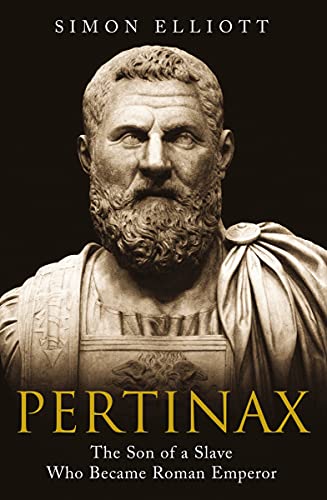
“He excelled as a military leader!” – Author Simon Elliot talks about ‘Pertinax’

“Being worthy can come at a cost!”

WHAT: Born in Italy, the son of a freed slave, his early years were spent in obscurity. After earning his living as a teacher, Publius Helvius Pertinax would undergo one of history’s most successful professional reincarnations. With the support of influential patrons, he joined the Roman legions rising through the ranks along the cursus honorum, in a spectacular career which included senior commands from Syria to Brittania as well as key civil and military postings in between.

Pertinax was last confidant and friend of the Emperor Marcus Aurelius to survive the tumultuous and violent rule of the philosopher/statesman’s son, Commodus, who was killed in a palace coup on 31 December 192. Then serving as Urban Prefect of Rome, Pertinax found himself in the right place at the right time to unwillingly don the purple, yet his reign would last for just three months in before he too was assainated, this time by the rapacious and unruly Praetorian guards.

“Is Rome worth one good man’s life?” asks Connie Nielsen as she stands over the fresh corpses of Russell Crowe (as Maximus) and Joaquin Phoenix (as Commodus) at the end of Gladiator. “We believed it once. Make us believe it again.” Step up, step forward Derek Jacobi wearing Pertinax’s beard and less of Claudius’ drool.

Gibbon narrates the election of the Roman Emperor Pertinax with more precision than Ridley Scott, though with no less drama. “The measures of the conspirators were conducted with the deliberate coolness and celerity which the greatness of the occasion required. They resolved instantly to fill the vacant throne with an emperor whose character would justify and maintain the action that had been committed. They fixed on Pertinax, prefect of the city, an ancient senator of rank, whose conspicuous merit had broke through the obscurity of his birth, and raised him to the first honours of the state.”

Macchiavelli would write of Pertinax, “hatred is acquired as much by good works as by bad ones, therefore, as I said before, a prince wishing to keep his state is very often forced to do evil; for when that body is corrupt whom you think you have need of to maintain yourself—it may be either the people or the soldiers or the nobles—you have to submit to its humours and to gratify them, and then good works will do you harm.”

In Pertinax: The Son of a Slave Who Became Roman Emperor Simon Elliott brings together the threads of this remarkable life, setting a stage set at the high noon of Rome’s imperial power and prestige. The portrait that emerges is a flash of lightning which illuminates much of the moment and the man as it and he was, whilst also illustrating why Pertinax has been so much admired down the interveening centuries.

WHO: “Simon Elliott is an historian, archaeologist, author and broadcaster based in Kent. In 2017 he completed his PhD at the University of Kent in Archaeology, where he studied the military presence in Britain during the Roman occupation with a particular focus on the Classis Britannica regional fleet. Simon is now an Honorary Research Fellow at the University. He has a Masters Degree in War Studies from KCL and a Masters Degree in Archaeology from UCL, both completed part-time in the past decade and an original BSc in History and Politics.”

MORE? Here!


Why Pertinax?

I have great interest in the emperor Septimius Severus who ruled at the height of the empire’s power in my opinion. He also launched the last, but ultimately failed, campaigns to conquer the far north of Britain (now the region of modern Scotland) in AD 209 and AD 210, before dying in York in February AD 211. Severus was the ultimate victor in the Year of the Five Emperors in AD 193, with the first incumbent being Publius Helvius Pertinax. The more I studied this emperor the more fascinated I became, he the son of a manumitted slave who eventually rose through hard work, grit and diligence to become the emperor. He was also Severus’ mentor throughout much of his life.

What’s the one thing everyone should know about Pertinax?

That he was initially a Grammaticus teacher until his mid 30s when he suddenly decided to join the military out of knowhere, then rising through the ranks to become the most senior trouble shooter in the empire for the great Marcus Aurelius and mad and bad Commodus.

How did Pertinax feature in the minds of later generations down to our own time?

In the Roman world through to late antiquity, and even later, he was as famous as Julius Caesar or Augustus. The man who had risen from the bottom of Roman society all the way to the top. Further, in standing up to the Praetorian Guard when they demanded he pay them off, he upheld the highest of Roman ideals of worthy leadership. That this cost him his life only added to his contemporary fame. Since then, certainly from the 18th century, he has been used as an example of the worthy ruler, willing to stand up for his beliefs, even if at the cost to his own life.

Without his own legions to overpower hostile local power structures in Rome (including the Praetorians), could Pertinax have ever been anything more than a caretaker emperor?

I actually think Pertinax became emperor because of his standing as a civil leader, being the right man in the right place as city prefect at the point when Commodus was killed. Indeed, he could have called on his loyal legions to support him in power at any time but chose not to do so, making him vulnerable to the Praetorians. Being worthy can come at a cost!

A month on campaign / assignment with Pertinax; a long weekend with him at his country retreat; or a day in the Library of Alexandria – which appeals most?

Oh a month on campaign definitely, and north of the Danube against the Marcomanni in enemy territory. He excelled as a military leader!

If you could own one object described in the book what are you having and why?

An original copy of the Historia Augusta, one of the key primary texts for the period, in the hope I might find out who wrote it!!!

Clearly, Pertinax is overdue the attentions of a novelist. They’re all waiting outside your office to be interviewed for the job. Rosemary Sutcliffe, Gore Vidal, Robert Graves, Margaret George etc. Who are you picking and why?

Blimey they are all amazing. But for me Rosemary Sutcliffe given she was such an inspiration for my love of all things Roman!

If you could ask Pertinax one question what would it be, and what would you expect his answer to be?

Why oh why oh why oh why didn’t you call out your personal guard when you heard the Praetorians were on their way to the palace to confront you! And he would answer…because I thought they would listen to reason from such a seasoned veteran.

What’s the one primary source on Pertinax you know in your heart once existed, but which has been lost? What could it tell us?

Difficult to say given we probably have less than 5% of anything ever written about Pertinax from the classical world, and maybe even less!

What are you currently working on?

Proofreading Great Battles of Early Imperial Rome thru Pen & Sword out in November, and writing Vandal Heaven, my brand new take on post-Roman North Africa after my extensive travels there, this for Casemate Publishing.

LIKE WHAT YOU JUST READ? FOLLOW US ON TWITTER! OR SIGN UP TO OUR MAILING LIST!

“Set small goals that stretch you a bit but are achievable.” – Author Ian Robertson talks about ‘How Confidence Works’

“An enhancer believes you can do it and communicates that belief. A saboteur fears you will fail…”

WHAT: “Why do boys instinctively talk bull more than girls? How do economic recessions shape a generation’s confidence? Can we have too much confidence and, if so, what are the consequences? Imagine we could discover something that could make us richer, healthier, longer-living, smarter, kinder, happier, more motivated and more innovative.

Ridiculous, you might say… What is this elixir? Confidence. If you have confidence, it can empower you to reach heights you never thought possible. But if you don’t, it can have a devastating effect on your future. Confidence lies at the core of what makes things happen.”

WHO: “Ian Robertson is Co-Director of the Global Brain Health Institute (Trinity College Dublin and University of California at San Francisco) and T Boone Pickens Distinguished Professor at the Centre for BrainHealth at University of Texas at Dallas. A trained clinical psychologist as well as a neuroscientist, he is internationally renowned for his research on neuropsychology.

He has written five books and numerous newspaper and magazine articles and comment pieces in the Guardian, Times, Telegraph, Irish Times, Time magazine and New York magazine, amongst others. He has appeared on BBC Radio and featured in several major television documentaries. He is a regular speaker at major futurology and business conferences in Europe, the USA and Asia.”

MORE? Here!


Why How Confidence Works?

Because confidence is the most precious resource a person can have – and it is therefore important to understand how it works.

What is anxiety and is there an alternative?

Anxiety is an essential emotion to get us to take action when we are under threat. The problem arises when our brain’s ability to project into the future extends and expands that sense of threat to lead to excessive or long-lasting anxiety. We need to learn to control our attention so as to control that sense of threat. Methods such as mindfulness can be useful for this, among others.

As there differences in how men and women experience anxiety?

Not really, but women are on average less over-confident than men and confidence is one of the most powerful antidotes to anxiety.

What has Padraig Harrington golf caddy got to tell us about confidence?

The words you say to yourself – particularly after failure – are crucial. These words help focus our attention on the next small goal and take our minds away from the what-ifs and potential bad things in the future that make us anxious and so disrupt our performance, creating a vicious cycle.

What’s the most important thing everyone needs to remember about confidence?

Set small goals that stretch you a bit but are achievable. Build on small successes that you define as success, not in comparison with other people. Congratulate yourself when you achieve them. Focus your attention on these small goals and not on big future achievements or risks.

What’s the difference between a confidence enhancer and a confidence sabateur, and is there a way to spot them while speed dating?

An enhancer believes you can do it and communicates that belief. A saboteur fears you will fail – or in some cases, maybe unconsciously or consciously wants you to fail to make them feel better.

I’m thinking about climbing a mountain. When I imagine my assent, what should I be doing to help me get to the top?

Talk yourself up – “I can do this’ – “push through this” …

What does it mean when a parent hides the ladder?

Most success is 90% luck, grit and persistence but too many successful people come to believe that their success is a result of some specialness in them. Their children pick this up and believe that they can’t succeed because they don’t have that specialness.

I’ve got daughters – an 8 year auld, a 5 year auld, and a 1 and some spare change year auld – what do I need to read next to better understand the road ahead?

When they are older get them to follow The Female Lead on social media.

What re you currently working on?

I’m working on a book on virtue.

LIKE WHAT YOU JUST READ? FOLLOW US ON TWITTER! OR SIGN UP TO OUR MAILING LIST!
“Nothing was more important to Stalin than ideas.” – Author Geoffrey Roberts talks about ‘Stalin’s Library’

“What surprised me most about Stalin’s library was his high regard had for Trotsky’s writings, especially the defence of Bolshevik authoritarianism in Terrorism and Communism (1920) – a book that Stalin read with relish and gushing agreement!”

WHAT: “Stalin, an avid reader from an early age, amassed a surprisingly diverse personal collection of thousands of books, many of which he marked and annotated revealing his intimate thoughts, feelings, and beliefs. Based on his wide-ranging research in Russian archives, Roberts tells the story of the creation, fragmentation, and resurrection of Stalin’s personal library. As a true believer in communist ideology, Stalin was a fanatical idealist who hated his enemies―the bourgeoisie, kulaks, capitalists, imperialists, reactionaries, counter-revolutionaries, traitors―but detested their ideas even more.”

WHO: “Geoffrey Roberts is an historian, biographer, and political commentator. A renowned specialist in Russian and Soviet foreign and military policy and an expert on Stalin and the Second World War, his books have been translated into Arabic, Chinese, Czech, Estonian, Greek, Finnish, French, German, Japanese, Korean, Persian, Polish, Portuguese, Romanian, Russian, Spanish, Swedish and Turkish.

His latest book is Stalin’s Library: A Dictator and His Books (Yale University Press 2022) – selected as a Book of the Year by The Australian, History Today, and India’s Open magazine.

He is Emeritus Professor of History at University College Cork and a Member of the Royal Irish Academy.”

MORE? Here!


Why Stalin’s Library?

Because the remnants of his personal book collection – especially the hundreds of books that he marked and annotated – is such a fantastic source. Nowadays we have many confidential sources about Stalin’s life and career but none so personal, spontaneous and revealing as the evidence of his private library. My book explores the books Stalin read, how he understood them and what they taught him. Stalin’s books – those he wrote and edited as well as those he read – allow us to glimpse the world through his eyes. We get to wear his spectacles, so to speak.

Stalin amassed more than 20,000 books in his lifetime. Are they all still together in one collection?

I estimate that by the time Stalin died in 1953 there were about 25,000 items in his personal library. Mostly books but also pamphlets and periodicals. It was a working library, scattered about his office and living spaces, but from the mid-1930s the bulk of the library was housed at a newly constructed dacha for Stalin on the outskirts of Moscow. Nicknamed ‘nearby’ because it wasn’t too far from the Kremlin and easily accessible by a fast road, one of this mansion’s biggest rooms was the library, a place in which Stalin spent a lot of time. Indeed, that was the room in which that he suffered a fatal stroke.

Stalin’s book collection was broken up after he was denounced as a brutal dictator by his successor as Soviet leader, Nikita Khrushchev, at the 20th party congress in 1956. But a remnant of 5,500 books survived this purge of Stalin’s personal effects, including about 500 texts that he had written in. These latter books are kept in an archive in Moscow, while the unmarked texts – most of which bear his ex-libris stamp – are housed in the city’s main historical library.

Was Stalin an intellectual?

Indubitably. Nothing was more important to Stalin than ideas. He spent most of his life reading, editing and writing. Stalin believed that ideas, when allied to revolutionary practice, could shape not just people’s consciousness but human nature itself. He sought and used power ruthlessly but that was a means not an end, He wielded power in the service of communist ideas.

Importantly, Stalin felt the ideas he believed in – he was an emotionally engaged intellectual. It this feature of his intellectuality that screams at you from the pages of the books he marked.

Stalin made many notes in the margins of his books. Are there any signs that Stalin ever fundamentally challenged any of his intellectual, spiritual, or moral assumptions?

Stalin read to learn, and he derived his ideas and information from any useful source, including the writings of his enemies.

Stalin was a fanatic with no secret doubts. In all the thousands of pages of books that he marked there is not even so much as a whisper of a hint of doubt about his Marxist ideology and communist beliefs. That does not mean that Stalin’s ideas did not change during the course of his lifetime. Stalin adapted his belief system to practical realities, whether that be in relations to strategies for revolution, the problems of building the world’s first socialist society, the requirements of military strategy or the changing nature of international politics.

Stalin was blinkered by his dogma but not blinded by it. He could see out and beyond the Marxist canon when he needed to. But that never led to any fundamental reappraisal of his basic beliefs.

Who are the most surprising authors to have been read and admired by Stalin?

As a Marxist, Stalin believed his ideology was an all-encompassing framework for understanding human history and its social dynamics. Most of his library’s books were written by Marxists or other varieties of socialist. His favourite and most-read author was Vladimir Lenin, the founder of Bolshevism, and Stalin’s role model as an intellectual and political leader. His favourite historian, however, was Robert Vipper, a non-Marxist who wrote lively narratives about ancient Rome and Greece and the history of early Christianity. Vipper also published a study of Ivan the Terrible – a book that was enormously influential in shaping Stalin’s view of Russia’s history, especially the various Tsars’ struggles to build a strong Russian state that would defend its peoples from foreign attack. While Stalin had a lot of time for the Terrible, Peter the Great and other Tsars, mostly he looked upon them with disdain and thought that he and his comrades could do a better job defending the country.

What surprised me most about Stalin’s library was his high regard had for Trotsky’s writings, especially the defence of Bolshevik authoritarianism in Terrorism and Communism (1920) – a book that Stalin read with relish and gushing agreement!

Stalin’s personal split with Trotsky came much later than most people think. The political rivalry began in earnest after Lenin’s death in 1924 but not until the the late 1920s was Trotsky expelled from the USSR, supposed because he was an ‘anti-party’ element. In the 1930s Stalin increasingly saw Trotsky as not just a political rival but a personal enemy who was allied with Nazis and Fascists and attempting to overthrow the Soviet socialist system.

In 1940 Trotsky was assassinated in Mexico by a Stalinist agent. Yet Stalin didn’t think Trotsky was all bad, telling a private gathering of creative workers that even enemies of the revolution should be painted in complex human colours.

Did Stalinism have any unique or innovative intellectual features or was it an entirely derivative worldview?

Stalin contributed ideas about nationalism to the Marxist canon and propounded the damaging theory – which he derived from Lenin -that the stronger Soviet socialism became the more desperately its enemies would seek to undermine it – an idea that was key to Stalin’s Great Terror in the 1930s when many millions of innocent people were deemed enemies of the revolution and perished in a maelstrom of political violence.

While Stalin had his own spin on Marxist theory, his greatest strength as an intellectual was the simplicity and clarity of his thinking and articulation. He was a hugely effective populariser of Marxist ideas. He was also enormously attractive to fellow intellectuals. As the Austrian Marxist art critic, Ernst Fischer wrote in his memoirs, intellectuals ‘succumbed’ to Stalin because of the dictator’s ability to combine ‘the critical reason of the thinker with the élan, the all or nothing of the man of action.’

If you could own one of Stalin’s books, which would it be?

There was a Russian translation of Hitler’s Mein Kampf that Stalin may well have read. It would be interesting to see if Stalin marked the book in any way, but no such copy is known to exist. There is also a lot of speculation about whether or not Stalin read Machiavelli’s The Prince and took on board its realpolitik precepts. Some people claim they have seen Stalin’s marked copy of this book but there is no actual evidence. Personally, I think Lenin and Trotsky, not Machiavelli were Stalin’s teachers when it came to power politics. Also, influential was that master of realpolitik, the ‘Iron Chancellor’, Otto von Bismarck, whose books Stalin certainly did read and engage with.

But the book I would really like to own would be Stalin’s copy of The Bible when he was a seminary student. It would be fascinating to see how he marked that book!

Stalin turned his back on Christianity as a rebellious teenager when he embraced Marxism and revolutionary socialism. By all accounts, the boy Stalin was a dedicated reader and emotionally attached to his Christian creed – a habit and sensibility that he transferred to his new-found secular socialist faith.

If you could ask Stalin anything (and not end up in a gulag) what would it be?

I would like know to what extent Stalin really believed that Trotsky and his other former allies in the Bolshevik party were guilty of the conspiracy, treason and subversion that they were accused of at the Moscow show trials of the mid-1930s.

But I can’t think of a way posing the question to Stalin that would have kept me out of the Gulag!

If you were going to gift Stalin a book published after 1953, perhaps as a birthday present (and you knew he would read it), what would you give him?

Stalin’s Library, of course– in the hope that he would pepper it with his favourite annotation – NB, indicating that I really had discovered what made him tick. More likely, though, is that he would utilise his second-favourite annotation – the derisive ha ha!

What are you currently working on?

A book called Stalin’s Peacemakers – a history of the communist-led peace movement after the Second World War. The experience and lessons of that movement’s valiant efforts to avert nuclear Armageddon have never been more relevant.

LIKE WHAT YOU JUST READ? FOLLOW US ON TWITTER! OR SIGN UP TO OUR MAILING LIST!
‘Murray Pittock: Old Scotia’s Gradeur Springs’ (Book Festival, AUG 17th)

“This was no dry and dusty seminar, but a breezy and accessible chat about the influence of Scotland’s culture and history on how it sees itself and its place in the UK (or out of it) and the wider world.”

If, like me, you haven’t been to the Edinburgh Book Festival since those far off days of 2019, you’ll notice that Charlotte Square is looking uncharacteristically deserted this Summer. That’s because the world’s biggest public celebration of the written word has decamped and moved to a new base at the Edinburgh College of Art in Lauriston Place. Whilst many will miss the horticultural charm of Charlotte Square, this new venue retains much of that bucolic vibe, with plenty of outdoor green space – but, importantly, that’s coupled with plentiful indoor lecture theatre space which (I think) is an improvement on the marquees and tents of yesteryear.

The first event I attended was the launch of Scotland: the Global History, 1603 to the Present, the latest publication by Prof. Murray Pittock, probably Scottish academia’s leading cultural commentator, who has held a number of high-profile appointments as well as authoring several key texts on Scottish history, identity, and literature. This latest work carries readers from Scotland’s involvement in the Thirty Years’ War to the 2016 EU referendum. A sizeable audience gathered in the grand surroundings of the Bailie Gifford Sculpture Court for the event, which took the form of an interview chaired by the broadcaster and journalist Ruth Wishart.

These two figures, both well-known in Scots literary circles, made an excellent duo, seeing to it that this was no dry and dusty seminar, but a breezy and accessible chat about the influence of Scotland’s culture and history on how it sees itself and its place in the UK (or out of it) and the wider world. Always a nation that’s punched above its weight, the nation’s disproportionately high-profile role in a number of spheres was discussed: the Enlightenment, the British Empire, science, and literature. To keep the tone light-hearted, there was even some teasing about the rival fortunes of Dundee United and Aberdeen FC. After 45 minutes, there was a quarter hour of questions from both the live and the online audience, many of which touched upon Scotland’s lively political scene. In case there is any doubt about the current significance of the ideas being discussed this talk, the following day the leader column in the Scottish edition of The Times newspaper used the occasion as the basis for a discussion on conflicting ideas of what it is to be Scottish or British in the current nationalist debate.

The book festival runs until 29th August, with numerous authors appearing live for lectures, talks, and book-signings. All related works, along with a huge selection of great Scottish literature, are for sale in the excellent on-site bookshop. So come for the fascinating talks; stay for a coffee and a slice of cake in the superb café; leave with a book signed by your favourite author. Get your coats on and go see this!


ALL our recent coverage? Click here!

“It would be useful to know what was in Æthelflæd’s mind when she was planning her campaigns against the Viking armies who had occupied eastern England.” – Author Tim Clarkson talks about ‘Lady of the Mercians’

“Why Æthelflæd? Well, I had wanted to write a book-length study of her for quite some time, mainly because she is my favourite person from the entire early medieval period. Her life and political career have always fascinated me, more so than those of any of the kings whose deeds I have written about. For me, Æthelflæd stands out from the crowd.”

WHAT: “The narrative incorporates my usual focus on political history with an emphasis on warfare. It considers the military campaigns not only of Æthelflæd but also those of her father Alfred the Great and of her brother Edward the Elder. Hence there are frequent mentions of battles, fortresses, treaties and alliances. But there is much more to Æthelflæd than the Anglo-Saxon warrior queen visualised in modern artworks. She was an educated, literate woman with strong religious beliefs. She had a keen interest in saints – especially Mercian ones – and actively promoted their veneration by establishing new cult-centres in various parts of her domain. She was also adept at what we now call ‘urban planning’ and has left her mark on the modern street-pattern in a number of west midland towns.”

WHO: “Tim Clarkson graduated with a PhD in medieval history in 2003. His dissertation’s title was ‘Warfare in Early Historic Northern Britain’. Prior to this he gained an MPhil in archaeology with a research thesis entitled ‘The Solway Region AD 400-650 and the Kingdom of Rheged’. Since completing his doctoral thesis Tim has continued to pursue his interests in early medieval history as an “independent scholar”.”

MORE? Here!


Why “The Lady of the Mercians”?

This book was a slight departure from my usual track, my previous books having had a focus on Scotland. But it fitted with the broad theme of early medieval rulership that runs through my Scottish books. The main difference is that it switches the focus to England. Why Æthelflæd? Well, I had wanted to write a book-length study of her for quite some time, mainly because she is my favourite person from the entire early medieval period. Her life and political career have always fascinated me, more so than those of any of the kings whose deeds I have written about. For me, Æthelflæd stands out from the crowd. In an early medieval context she was a rare individual: a powerful female ruler in an era when high-level politics was seen as a male preserve. The land she ruled was western Mercia, basically the west side of the English midlands, which includes my home county of Cheshire. So, being a modern-day Mercian myself, I felt it would be good to pay homage to one of the greatest rulers of my ancient homeland by writing a biography of her.

Was the historical Æthelflæd at all concerned with her father’s vision of a united English kingdom?

Hard to say, but the question is an important one. It would be useful to know what was in Æthelflæd’s mind when she was planning her campaigns against the Viking armies who had occupied eastern England. As a princess of Wessex and a daughter of its famous king Alfred the Great, she can be seen on the one hand as continuing her father’s policy of reclaiming the conquered lands and bringing them back under English control. Wessex and Mercia were close allies in this task. On the other hand, we know that she worked hard to restore a sense of Mercian identity – by vigorously promoting the cults of Mercian saints, for example – so perhaps her guiding principle was Mercia first, England second. This is the scenario I’m inclined to go with. I suspect her main priority was putting the old pre-Viking kingdom of Mercia back together again, strengthening its frontiers and making sure its people felt safe, before giving any thought to a grand strategy of unifying all the English.

Many towns and churches claim an association with Æthelflæd, but are there any places, any buildings in particular, we know for certain she was present at?

A lot of what we think we know about early medieval history is based on informed guesswork rather than absolute certainty. Even when we have a contemporary account saying that a particular person was in a particular place at a particular time, we can rarely take it at face value. The writer may have had a personal (or political) reason for wanting the reader to believe that something happened in a particular way. In Æthelflæd’s case, we have a few instances where a contemporary document puts her in a specific location and is probably telling the truth. One such document is a charter which recorded a gift of land from Æthelflæd and her husband Lord Æthelred to a monastery at Much Wenlock in Shropshire. The charter was issued after a meeting of the Mercian ‘witan’ (a council of senior nobles and clergy) at Shrewsbury in the year 901. It says that Æthelflæd attended the meeting, so this is one instance where we can, with a fair amount of confidence, say she was in a specific place. The exact site of the meeting is, however, unknown.

If you could possess one item described in your narrative, what would it be?

In my book I mention that Æthelflæd’s tomb lay at St Oswald’s Priory in Gloucester. After her death at Tamworth in June 918, her body was taken to St Oswald’s to be entombed alongside her husband Æthelred who had died seven years earlier. Together they had founded the priory as their personal church and mausoleum. It was built around a shrine to the seventh-century Northumbrian king and martyr Oswald whom they both greatly revered. Unfortunately, the priory is now just a ruin and nothing survives of the shrine. Whatever graves lay at the site have been obliterated, except for part of a tenth-century sculptured stone that looks like it came from a high-status tomb. Some people like to believe the tomb in question was Æthelflæd’s but there’s no proof of that. So, if I could obtain one object mentioned in my book, it would be a piece of Æthelflæd’s real tombstone. I’d take a few photos of it for my blog, then hand it over to the city museum at Gloucester (where the aforementioned fragment is kept).

What’s the one thing we don’t know for sure about Æthelflæd that you wish we did?

I would like to know if she ever referred to herself as a queen. Contemporary English sources such as the Anglo-Saxon Chronicle call her the Lady of the Mercians and we can probably assume she was happy to be addressed by this title. But non-English sources like the Irish annals refer to her as a queen, so I’d like to know what she thought about that. She was the ruler of Mercia, one of the ancient English kingdoms. Its last king had still been around when Æthelflæd was in her teens. Yet her husband Æthelred was known as the Lord of the Mercians after he took control of the kingdom. Why not ‘King of the Mercians’? The usual explanation is that Alfred the Great, Æthelflæd’s father, didn’t want any more kings in England other than himself and his heirs. This may be true, but I can’t imagine the people of Mercia feeling too happy about it. Perhaps Lord Æthelred, and Æthelflæd herself, weren’t too happy about it either? I have often wondered if they really didn’t mind if someone addressed them as King and Queen, but I would like to know if they went as far as using these titles openly.

If you could tell Æthelflæd one thing and see her reaction, what would it be?

In the twelfth century, 200 years after Æthelflæd’s death, an English monk and historian called William of Malmesbury wrote about her in his book on the rulers of England. He included a curious tale in which Æthelflæd tells her husband that she won’t be having sex any more because, despite being briefly pleasurable, sexual intercourse ultimately leads to the pain of childbirth. She had given birth to one child, a daughter, and apparently didn’t intend to put herself through it again. It’s a strange little episode and William of Malmesbury is the only writer who mentions it. Is it based on truth? One theory suggests that there might be some historical basis to the tale, perhaps rooted in tenth-century dynastic politics, with Æthelflæd telling her husband that she didn’t want any more children in case one of them was an ambitious son who might decide to break the alliance with Wessex.

I’m not convinced by this explanation, mainly because I can’t imagine a powerful ruler like the Lord of the Mercians agreeing to abandon the chance of producing a male heir. So maybe the tale is nothing more than fiction, created simply to portray Æthelflæd as a woman of pure morals – like a nun or saint. We know William of Malmesbury sometimes got his facts wrong and wasn’t averse to making things up, so is he letting his imagination run away with him here? I’d be interested to see what Æthelflæd thought of it. I would quietly and very politely mention the story to her and see how she reacted. My guess is that her eyebrows would furrow deeply and she’d say something like ‘Do people actually believe this stuff?’

What’s the one thing you wish every school child knew about Æthelflæd?

That she existed. That she was a powerful female ruler, on a par with Boudicca and Elizabeth I, even if (unlike those two women) she doesn’t receive much attention in today’s history textbooks. Also, whenever the school curriculum turns to the Vikings and their raids on England, it would be good to point out that not all of the heroic leaders who stood against them were men. A question likely to pop up at this point is ‘Did Æthelflæd fight in battles?’ The answer is ‘probably not’ but it would be an interesting topic to discuss in class.

You get to spend 6 months back packing around England in Æthelflæd‘s time (without changing the timeline), what’s on your bucket list of things to see and do?

First, I’d go to Cheshire, to the places where I spent my childhood, just to see how they looked 1100 years ago. Next, I’d travel to the north-west border of English territory, to the frontier with the Kingdom of Strathclyde. I wrote a book on Strathclyde some years ago and supported a theory that the kingdom’s tenth-century border lay near Penrith in what is now the county of Cumbria. I’d be curious to visit this area, to see if the theory is right or wrong. Another destination on my list would be a large urban settlement with a bustling marketplace. This would give me a real taste of what life was like for ordinary folk in those times.

My books tend to focus on high-status people like kings and bishops (and Æthelflæd herself) but I think it would be good to see what went on lower down the social hierarchy: the day-to-day existence of the majority population. It’s something I don’t usually write about, so it would give me a different perspective on the whole era. After that, I would probably stay at a monastery for the rest of my trip, offering to work in the fields as payment for my accommodation. I’m not a deeply religious person but I’ve written about the important role of monasteries in early medieval times and I’d like to see how one of these places operated. I’d visit the monastic library every day, to peruse the manuscripts, even though some people might say I was wasting an opportunity (‘What? You were given the chance to travel anywhere in tenth-century England and you just sat in a library?’).

Can you still picture Æthelflæd without conjuring an image of Millie Brady in your mind?

Yes and no. Yes, because I don’t know what Æthelflæd looked like. So, whenever I imagine her, the image isn’t a clearly drawn portrait. It’s indistinct, almost as if she’s standing outside the light: a hazy figure in the shadows, forever out of reach. But, at the same time, I think Millie Brady did a fantastic job of bringing Æthelflæd to life, depicting her as a serious yet charismatic individual who commanded respect and devotion from the Mercian elite. I’m sure the way Millie stole every scene she was in has helped to ensure that more people than ever before are now aware of Æthelflæd .

What are you currently working on?

A book on the Isle of Man in the early medieval and Late Norse periods (AD 400 to 1265). It will be published in 2023.

LIKE WHAT YOU JUST READ? FOLLOW US ON TWITTER! OR SIGN UP TO OUR MAILING LIST!

“Charles Dickens was a big fan of coach travel. And as well as being a great storyteller he is the master at description. I’d love to mysteriously acquire a notebook he’d used to scribble down his thoughts as he hurtled northwards.” – Author Steve Silk talks about ‘The Great North Road’

“I was attracted to the road we now call the A1 because it had been such a big part of my life. As a youngster growing up in Southern England but studying at Newcastle University I was up and down it all the time. Later I worked as a newspaper reporter in Darlington and then a TV reporter in Peterborough. So whatever I did with my life, the Great North Road seemed to be close by.”

WHAT: “The Great North Road is Britain’s Route 66 – we’ve just forgotten how to sing its praises

In 1921, Britain’s most illustrious highway, the Great North Road, ceased to exist – on paper at least. Stretching from London to Edinburgh, the old road was largely replaced by the A1 as the era of the motor car took hold.

A hundred years later, journalist and cyclist Steve Silk embraces the anniversary as the perfect excuse to set off on an adventure across 11 days and 400 miles. Travelling by bike at a stately 14 miles per hour, he heads north, searching out milestones and memories, coaching inns and coffee shops.

Seen from a saddle rather than a car seat, the towns and the countryside of England and Scotland reveal traces of Britain’s remarkable past and glimpses of its future. Instead of the familiar service stations and tourist hotspots, Steve tracks down the forgotten treasures of this ancient highway between the two capitals”

WHO: “Steve Silk is a journalist working for BBC Look East in Norwich. His two previous books – The Wherryman’s Way and Hidden Riverside Norwich – saw him take to a canoe to explore the Norfolk Broads. He’s now more comfortable on an old-fashioned touring bike with a pannier full of obsolete maps and flapjack.”

MORE? Here!


Why ‘The Great North Road’?

Well, before you even know what it is and where it goes, isn’t it a great name? Can any true traveller resist the thought of exploring such a highway? Slightly more prosaically, I was attracted to the road we now call the A1 because it had been such a big part of my life. As a youngster growing up in Southern England but studying at Newcastle University I was up and down it all the time. Later I worked as a newspaper reporter in Darlington and then a TV reporter in Peterborough. So whatever I did with my life, the Great North Road seemed to be close by.  Finally, as a cyclist seeking a new challenge, I felt the 400-mile length between London and Edinburgh offered just the right amount of jeopardy and adventure.

You are following in the tyre tracks of the Victorian cycling writer, Charles Harper. 100 years from now, what are the things about the landscape you cycled through that you expect will have changed the most?

That’s a tough one. I’m going to start off with what won’t change. We will always need places to eat and places to stay. So there will be cafes and inns – even if we call them something different. In fact, my friends with electric cars tell me they are currently spending more time in service station type places – because charging takes longer than filling up.

Moving on to changes, I guess the quality of road will improve. We’ve already seen huge upgrades in recent decades, yet north of Alnwick in Northumberland, the road does largely revert to a single carriageway in each direction. The obvious next step is dualling all the way to Edinburgh. With my history hat on, I have mixed feelings about this. Certainly, we need to make the most of those wild and woolly stretches while we can.

You write that of all the Coaching Inns still extant on the route, it’s the Bell in Barnby Moor that would be most familiar to Harper – even to the extent that he might have to take a moment to realise the time difference. What spot on the route would you like to change the least in the century to come?

I have a soft spot for Newcastle. I have a seriously soft spot for the moment you cross the Tyne gorge across the Tyne Bridge. That whole vista has improved immeasurably over the last 20 years. The Quayside looks the business, Gateshead has been transformed, they’ve got rid of the dodgy floating nightclub and the Millennium Bridge looks a million dollars. Now just leave it alone!

If you could go back in time and travel part of the route during the golden age of stagecoaches, which would it be and would you be sitting inside or outside?

I like the fact that the A1 gets noticeably wilder once you cross the border. So, I would summon up some bravery and be one of the “outsides” on that stretch where the road runs close to the North Sea between Lamberton and Burnmouth.

Here, you don’t need much of an imagination to summon up the ghosts of mail coaches past. It is still a truly exhilarating road made more dramatic by the proximity of the coastline. (Incidentally, this is one of many sections of the road where it would be suicidal – if not illegal – to travel by bike. I had to find quieter lanes further inland instead.)

What’s the one relic or artefact from the golden age of coaching (that you could fit on your writing desk) that you would want to acquire money and rarity presenting no problems?

Charles Dickens was a big fan of coach travel. And as well as being a great storyteller he is the master at description. I’d love to mysteriously acquire a notebook he’d used to scribble down his thoughts as he hurtled northwards. I feel I could certainly learn a few tricks from seeing the world through his sharp, all-seeing eyes.

What’s the best place to stand and see/sense the Great North Road as it would have been before the arrival of automobiles?

Stilton in Cambridgeshire. The Bell at Stilton is one of my favourite GNR pubs – it still looks like a coaching inn after all these years. But what sets Stilton apart is the breadth of its high street and the fact that it’s been so thoroughly bypassed that nothing had to change. Yes, you can hear the modern A1 in the background, but look more closely and I swear you can summon up at least the mirage of a four-in-hand, the horses snorting and the guard blowing his bugle.

You pack a lot of historic factoids into the narrative. What’s the best one that didn’t make the final edit?

There’s a museum directly under the A1(M) in Hertfordshire and it doesn’t even get a mention! Disgraceful I know, but I just had too much history at that point in my journey to weave in the archaeology around some Roman Baths. That is one of the challenges of a book like mine. To keep readers reading, you need a good mix of description, action and personality. The road provides my narrative thread, but I can’t always control the pace of the facts. There was just too much going on here. Many apologies to the museums department of Welwyn Hatfield council.

If you could share a convivial meal at an inn with any one of the great and the good personalities mentioned by you and Harper who would it be?

Well, first of all I would want Harper along too. I suspect we would argue quite a bit, but while several people have written about the Great North Road over the decades, we all accept that he’s the Boss. 

As for the personality, I’d go for John Palmer. He was a Bristol man, rather than a GNR sort of chap, but he is single-handedly responsible for the introduction of the mail coach system. Before he came along the post was taken from place to place by slightly dozy blokes on horses. They were often beholden to – or in league with – the local highwaymen. Palmer travelled regularly from Bristol to Bath by stagecoach and grew fed up with their lack of get-up-and-go.

He was the one who came up with the idea of specialist mail coaches, protected by a guard armed with pistols and a blunderbuss. He also suggested that the turnpike barriers should be specially opened to increase their speed and reliability. Because the railways came along so soon afterwards, we forget how phenomenal a logistical achievement that was.

The Three Tuns at Beamish sounds like an epically brilliant concept. What are your top tips (sans bedbugs) that you would insist on for the sake of authenticity?

So, just to explain, Beamish Museum wants to build a replica coaching inn at its huge outdoor site in County Durham. Since Covid it’s actually gone a bit quiet but I’m sure they will get it sorted at some point. The original Three Tuns was at Scotch Corner – the place where Scotland-bound travellers had to decide whether to continue up the east coast to Edinburgh or cross the Pennines en route to Glasgow.

The museum wants to give people the chance to stay overnight at a “genuine” coaching inn. It’s a fantastic idea. I know there’s rightly a lot of emphasis on the food and the beer and the ambience. But I’d want horses – lots of them. They were what made coaching inns, coaching inns. I would want horses in stables, complete with an ostler shouting at stable hands and the “coachy” walking round like he owned the place. The sights and the sounds of a forgotten world.

What are you currently working on?

I have another road in my sights. You might have imagined that having done the A1, I would have chosen one of other biggies – the A2,3,4,5 or 6 in England or 7,8 and 9 in Scotland.  In fact I’m going for the relatively unheralded A40. I’ve chosen it simply because I fancy the route. It goes over the Chilterns to Oxford and then includes the Cotswolds, the Wye Valley and the Brecon Beacons, finishing at Fishguard on the Welsh coast. It should be stunning.

I’m currently at the research stage. I am very much a part-time author, but I happen to have a week off at the moment, so Saturday saw me at Burford in Oxfordshire where there was an annual ceremony remembering three Levellers who were shot on Cromwell’s orders during the English Civil War. It’s rather complicated to explain here, but it’s just the kind of historical nugget that I enjoy digging out. On Sunday I did a 30-mile bike round around Oxford including Shotover Hill – once a haunt of highwaymen and more recently made famous by a Supergrass song. And on Monday I was exploring old chair factories around High Wycombe. When – or even if – this all morphs into an intelligible book is anyone’s guess.

LIKE WHAT YOU JUST READ? FOLLOW US ON TWITTER! OR SIGN UP TO OUR MAILING LIST!

“Boots planted firm, shield shoulder strong, weapon hand unflinching … and prayers already said.” – Author Michael Livingston talks about ‘Never Greater Slaughter: Brunanburh and the Birth of England’

“Not only does Old English Brunanburh become Modern English Bromborough, the landscape, social, and political situations of the Wirral are a perfect match for everything we know about the battle.”

WHAT: Late in AD 937, four armies met in a place called Brunanburh. On one side stood the shield-wall of the expanding kingdom of the Anglo-Saxons. On the other side stood a remarkable alliance of rival kings – at least two from across the sea – who’d come together to destroy them once and for all. The stakes were no less than the survival of the dream that would become England. The armies were massive. The violence, when it began, was enough to shock a violent age. Brunanburh may not today have the fame of Hastings, Crécy or Agincourt, but those later battles, fought for England, would not exist were it not for the blood spilled this day. Generations later it was still called, quite simply, the ‘great battle’. But for centuries, its location has been lost.

Today, an extraordinary effort, uniting enthusiasts, historians, archaeologists, linguists, and other researchers – amateurs and professionals, experienced and inexperienced alike – may well have found the site of the long-lost battle of Brunanburh, over a thousand years after its bloodied fields witnessed history. This groundbreaking new book tells the story of this remarkable discovery and delves into why and how the battle happened. Most importantly, though, it is about the men who fought and died at Brunanburh, and how much this forgotten struggle can tell us about who we are and how we relate to our past.”

WHO: “Michael Livingston is a two-time winner of the Distinguished Book Prize from the International Society for Military History (2017, 2020), an author of best-selling fiction, an award-winning full professor at The Citadel, and a frequent public lecturer, and occasionally even a person on TV. At present, he serves as the Secretary-General for the United States Commission on Military History and sits on the Board of the South Carolina Academy of Authors.”

MORE? Here!


Why Brunanburh?

In 937, a massive alliance of Scots, Vikings, and Britons came together to try to eradicate England at a place called Brunanburh. From the first time I heard about the battle as a student, I found it fascinating. It sits at this enormously tantalizing crossroads of being an event of enormous importance in the history of the British Isles … yet it’s also an event about which very little is known. I’ve always liked puzzles, and as historical events go, this is a terrific one!

Other than the location, what are the things we don’t know about the battle and its context that you wish we did?

The absolute number one thing we’re missing, without question, is how the alliance came together. All three of the kings who banded together – Constantine of the Scots, Anlaf of the Dublin Vikings, and Owain of the Strathclyde Britons – had reason to hate each other, and yet they set these differences aside to try to take on King Athelstan of the English. The negotiations must have been fascinating, but we don’t know what they were. We don’t even know for sure whose idea it was at the start!

What’s your elevator pitch for Brunanburh’s having taken place on the Wirral?

Not only does Old English Brunanburh become Modern English Bromborough, the landscape, social, and political situations of the Wirral are a perfect match for everything we know about the battle.

How did Brunanburh live in the memory of ordinary folk in the immediate generations after the battle?

They called it simply the “Great Battle,” which speaks volumes about how horrific it must have been. As I say in the book, the violence shocked a violent age. How did they remember it over time? Well, poetry has long been a vital way of preserving the past, and Brunanburh was certainly no exception to this. The most famous “artifact” of the battle today is a powerful poem in the Anglo-Saxon Chronicle – the sole information that it records for the year 937. Likely there were many such things told in the years after the bloodshed, and we’re fortunate that this one survived.

If you could possess one item mentioned in your narrative, what would it be and why?

According to one chronicler, a Frankish duke sent King Athelstan a long list of treasures, including “the sword of Constantine the Great, inscribed with the ancient owner’s name in golden letters, with one of the iron spikes used to crucify our Lord affixed to the scabbard with golden fastenings.” I feel like that would be a nice addition to the office, right?

If it was possible for you to own a from life photograph portrait of any one of the characters chronicled in the story, who would you want to see and what would you be looking for?

I’d want to see Athelstan, immediately after the battle. Thousands had fought and died for him. How much did the bloodshed impact him? How much did the trauma haunt him? He no doubt wore a public face, but I’d want to see the look in his eyes when he thought no one was watching.

What’s the best way to stand in a shield wall and live to tell the tale?

Boots planted firm, shield shoulder strong, weapon hand unflinching … and prayers already said. It was unbelievably brutal combat.

Bernard Cornwell wrote the preface to the book. What’s the best thing about his “Last Kingdom” series of novels and are there any parts you aren’t so keen on?

I love Cornwell’s novels – and not just the Last Kingdom ones! Wouldn’t change a thing about them, honestly. What I love best about them is the ways in which he manages to respect the hard work of historians while also pulling off that a bit. I mean, what are the odds that his Uhtred of Bebbanburg, being born in the 850s, would still be effectively swinging a sword at Brunanburh in 937? Not high, but damn if it doesn’t make for an awesome story!

You’ve got one year living as an observer in the 930s. What’s on your bucket list of sights to see?

Can I witness Brunanburh – and all the arrangements that made it happen – without participating in it? I’d do that if I could, just to satisfy my final curiosities. And what downtime I had I’d spend riding the roads from Hastings to Winchester to London and then up to York. Figure I’d knock out some other questions along the way!

What are you currently working on?

In June I’ve got another historical investigation in the same vein of Never Greater Slaughter coming out: Crécy: Battle of Five Kings. I’m really excited for people to get their hands on it. Right now I’m working on its sequel, which is an investigation and reconstruction of the Battle of Agincourt.

LIKE WHAT YOU JUST READ? FOLLOW US ON TWITTER! OR SIGN UP TO OUR MAILING LIST!

“I think Napoleon planned his offensive against the Papacy like a military campaign. Manoeuvring, invasion, battle, victory, and capitulation were the set pattern of his triumphs.” – Author Ambrogio A. Caiani talks about ‘To Kidnap a Pope’

“I’d love to ask Pius VII what kept him going during his imprisonment/exile? It would be fascinating to know if his faith that he would be delivered from and survive his incarceration ever wavered.”

WHAT: The story of The Story, of Christianity as it appears in the historical record, is a constant tussle between those empowered solely by their spiritual faith and those holding supreme temporal power. For the Catholic Church, the established church of Western Europe, the multidimensional Venn diagram of overlapping spiritual and temporal interests has been a fractal labyrinth through which very few have successfully navigated. There is scarcely a polity – not an Earldom, Dukedom, Kingdom, or Empire – in which Church and state have ever coexisted in perfect balance without the unfolding, all consuming drama of a Beckett or a Borgia, a Henry or an Honorius. Since the fall of Rome, the history of Europe has always been, in one sense or another, the history of Church and state.

Amid the aftershocks of the political and intellectual earthquake known to us as the French Revolution, Napoleon Bonaparte (1769-1821) and Pope Pius VII (1742 -1823) attempted to reconcile the latter’s old church with the former’s new state. The early signs were promising. Together in 1801 they formalized an agreement, but relations between them rapidly deteriorated. In 1809, to the horror of the faithful across the continent, Napoleon ordered the Pope’s arrest. Pius’ imprisonment, which would vary in severity and isolation, lasted until Napoleon’s fall in 1814.

In his pioneering account of the tempestuous relationship between the Emperor and his most unyielding opponent Ambrogio Caiani draws on original findings in the Vatican and other European archives. He uncovers the nature of Catholic resistance to Napoleon’s aggression; charts Napoleon’s approach to Papal power; and reveals how the Emperor attempted to subjugate the church to his particular vision of modernity.

“In gripping, vivid prose, Caiani brings to life the struggle for power that would shape modern Europe. It all makes for a historical read which is both original and enjoyable.” – Antonia Fraser, author of ‘Marie Antoinette’.

WHO: Ambrogio A. Caiani is senior lecturer in modern European history at the University of Kent. He is the author of ‘Louis XVI and the French Revolution 1789-1792‘.

MORE? Here!


Why ‘To Kidnap a Pope’?

Well, the title is meant to provide the reader with the basic storyline of the book: in 1809 Napoleon ordered that Pius VII be removed from Rome against his will. He would remain the French Emperor’s prisoner for nearly five years. I have always been fascinated by the politics of religion. The more I researched this topic in the Vatican Archives, and National Archives in Paris, the more I became convinced that its legacy cast a long shadow over the Catholic Church. Indeed, the age of revolutions catalysed the decline in church and state relations that had its roots in the long eighteenth century. The experience of persecution under the French Revolution and Napoleon ensured that the Papacy would view modern states with unconcealed distrust.

Biographers are often asked if they came to like and / or respect their subjects. How do you feel about these two personalities now compared to when you started out? Would you want to share a small and remote holiday cottage with either for an indeterminate period?

Ultimately, I learned to respect both my protagonists as men of principle. Regrettably for them their most deeply held convictions set them on a collision course that was to have disastrous consequences for Europe and the Church. If I had to spend a wet weekend with them…. that’s easy …. Napoleon would definitely be better company than the taciturn and contemplative, former monk, Barnaba Chiaramonti, who was elected Pope in March 1800. I imagine that it would have been tricky to pry even the smallest of conversations out of Pius. He was a deeply religious man, and I am not sure he was that keen on human company. His companions tended to be theologians and confessors. He only really spoke freely to a tiny circle of friends and family.

Whereas Napoleon adored conversation and, when he was not in one of his dark moods, he was, apparently, very good company and a scintillating conversationalist (you just have to read the memorial de Sainte-Hélène to realise that this was the case). Having said this, I suspect that a hyperactive guest, who barely slept four hours a night, like the French Emperor would have tried the endurance skills and energy levels of even the most consummate host. Despite this snag, I think I would be willing to risk it.

How does Napoleon’s struggle with the Papacy of Pius VII stack up against his more famous military campaigns in terms of planning, execution, and adaption to shifting circumstances? Did he have a particular idea of what ultimate victory might look like?

That’s a great question, I think Napoleon planned his offensive against the Papacy like a military campaign. Manoeuvring, invasion, battle, victory, and capitulation were the set pattern of his triumphs. He, probably, expected that he could follow a similar grand design, and ultimately subordinate the Catholic Church to his will. Yet, like in Spain and Calabria, he met a determined group of ecclesiastical resisters, especially the Pope, who simply refused to concede defeat and yield. Simply put, Chiaramonti, unlike a Habsburg or Hohenzollern sovereign, was unresponsive to bullying and military intimidation. Pius’ weapons and provisions were spiritual. He organised a mass campaign of passive resistance that made French rule in the papal states next to impossible. Such tactics prove much more effective in resisting Napoleon than brute force.

Neither Napoleon or Pius were especially modern political thinkers. Neither believed that political legitimacy rests exclusively on the consent of the governed. Keynes described Newton as the last magician rather than the first scientist. Did you ever find yourself wondering if you were chronicling a late medieval struggle rather than an early modern chapter of European history?

Well you say that … but I do wonder if anything, at the end of the day, is really that modern. Napoleon often drew parallels between himself and the medieval investitures crisis of the eleventh century. For example, the struggle that pitted Gregory VII against the Emperor Henry IV, or that which saw Philip IV, possibly, murder Boniface VIII bear remarkable analogies to the events of my book. Yet, by the same logic, the investiture crisis that set Communist China against the Holy See, in the early twenty first century, bears some, loose, though striking parallels to the Napoleonic Empire’s relationship with the Catholic Church. Governments, whether ancient or modern, have and will continue to put pressure on the Church to yield to the power of the state. A harmonious relationship between church and state remains an elusive objective even to this day.

What lessons from this period could the Papacy have absorbed and applied when it came to dealing with 20th century dictators such as Mussolini and Hitler?

Let me start by saying that in general concordats have a good track record in the long history of the Catholic Church. When both contracting parties have upheld the bargain, then, these treaties often created harmonious periods in church and state relations. This was particularly the case in nineteenth century Latin America. Such agreements cemented the Church’s position, rather than undermining it, in South America. A major problem emerges when one party is ‘not playing by the rules.’ The soft power of the church unsupported by hard power of the state could only go so far. The church negotiated these agreements in good faith, but it did not possess the means to force secular states to adhere to the terms of the concordats it signed. The dictators of the twentieth century proved unscrupulous and manipulative in their selective reading of the concordats they had ratified. Like Napoleon, they showed little respect for the Church’s prerogatives and position.

Unlike the French Emperor, they did not kidnap a Pope and exile him (although apparently at one point Hitler did consider kidnapping Pius XII according to one author). Ultimately, there is no easy lesson for the Papacy to draw from the Napoleonic period. Perhaps focusing on its pastoral mission, and avoiding politics where possible, could only be to the church’s advantage.

You express an admiration for Marie Louise, Napoleon’s second wife and the mother of his son. Why has she been so overlooked? Why does she deserve a greater share of the limelight?

I think we tend to be dismissive of arranged marriages in our society as they lack the romance and passion of courtship. In consequence, I guess, the public dismisses the marriage of Napoleon to Marie Louise as mere politics. This eclipses the fact that Marie Louise and Napoleon formed a notable political partnership. Unlike Josephine, she served as regent of France in 1813-1814 while the Emperor was on campaign. This was certainly a token of the trust and esteem Napoleon placed on her. Indeed, as Michael Broers has stated, she attended the council of state and was given a good education. After Napoleon’s fall, she became Duchess of Parma where she is remembered as an enlightened ruler. Under her beneficent guidance, Parma achieved some of the highest literacy rates in Italy, and she was a renowned patron of the arts, especially Italian opera. It has even been suggested that the quality controls and production standards for Parma ham were inspired by her. I also quite like that Napoleon was only husband number one (out of three), so she clearly was a strong woman who put her stamp on an age ruled by men. I do wish somebody would write a political biography of this formidable princess.

If you could directly ask one question of each of your protagonists what would you ask them and what answers would you expect?

I’d love to ask Pius VII what kept him going during his imprisonment/exile? It would be fascinating to know if his faith that he would be delivered from and survive his incarceration ever wavered. I suspect I would not be likely to get an honest answer. Once freed, the Pope claimed his emancipation was a clear manifestation of divine providence. We have no real source with which access to Pius VII’s inner most thoughts which is frustrating for a historian.

To Napoleon I would ask why he wavered (which was out of character) on what to do with his prisoner? Why he wrote to Fouche, his minister of police, claiming that taking the Pope into custody had never been his intention (a manifest lie)? Perhaps I would also ask if deep down he had some lingering belief in the Catholic God… I suspect we’ll never know.

If you could possess one artefact mentioned in your narrative, what would it be and why?

Oh dear, I am not very good when it comes to the ‘material turn’ in history or the current obsession some historians have with knick-knacks. But I would love to possess some of the notes and fragments of paper that Pius smuggled out of Savona, in the seams of his cassock, to communicate with the outside world. It would be fun to spend hours trying to decipher and reassemble his messages to loyal Catholics across Europe.

Was Pius VII an effective Pope? Does he have any wider claim to fame other than having reigned and suffered in interesting times?

Oh, definitely! He was, to an extent, the architect of the Catholic revival of the nineteenth century. The re-establishment of the Jesuit order in 1814, the rediscovery of baroque/popular piety and the drive towards Marianism, can all be attributed to his post-Napoleonic reign. He was determined to not only ensure the church survived the Napoleonic episode, but prospered after one of its darkest hours. He showed an iron determination that the Papacy should retain its central Italian principality. This turned out to be a lost cause and left something of a burdensome legacy. He created a church that was spiritually vibrant. Indeed, numbers of vocations and worshippers increased in rural Europe in the decades following his pontificate. Yet, at the same time, he left much unfinished business with the modern secular state. He would not be the last Pope forced to leave Rome and lose his principality.

What are you currently working on?

I am working on a political history of Global Catholicism during the age of revolutions 1700-1903. It is a great challenge but must say I am loving every minute of it!

LIKE WHAT YOU JUST READ? FOLLOW US ON TWITTER! OR SIGN UP TO OUR MAILING LIST!