+3 Interview: Konstantin Kisin: Orwell That Ends Well

“I think the job of comedians is to challenge the mainstream narrative, not reinforce it.”

WHO: Konstantin Kisin, Comedian

WHAT: “Konstantin Kisin, who made international headlines by refusing to sign a safe space contract for a university gig, offers an intelligent, uncompromising look at free speech and “wokeness” in his debut show. Full of strong gags, tales of rags-to-riches, back-to-rags (as the son of a former oligarch) and razor-sharp observations about the world, Kisin’s comedy walks the line between offence and humour as he tears into the sacred myths of modern society. Directed by Jonathan Pie with co-writer Andrew Doyle, the show is guaranteed to entertain and ruffle feathers in equal measure.”

WHERE: Gilded Balloon Teviot – Wee Room (Venue 14) 

WHEN: 19:00 (60 min)

MORE: Click Here!


Is this your first time to Edinburgh?

It’s my debut hour but I’ve been a couple of times before to do shorter shows and I lived in Edinburgh for many years.

What’s the biggest thing to have happened to you since Festivals ’18?

I made international headlines when I refused to sign a “behavioural agreement form” for a gig at a London university.

Tell us about your show.

The show is called Orwell That Ends Well and it’s about the eroding freedom of expression in the UK. I think the job of comedians is to challenge the mainstream narrative, not reinforce it so it’s a show that will make you laugh, think and sometimes it might even piss you off.

What should your audience see at the festivals after they’ve seen your show?

Chris McGlade – you’ve never seen a comedian like him.


LIKE WHAT YOU JUST READ? FOLLOW US ON TWITTER! FIND US ON FACEBOOK! OR SIGN UP TO OUR MAILING LIST!

INTERESTED IN BEING INTERVIEWED TOO? CLICK HERE!

+3 Interview: Robin Morgan: What A Man, What A Man, What A Man, What A Mighty Good Man (Say It Again Now)

“It’s got a very stupidly long title – something I thought would be funny to see on posters but has really battered my word-count in the brochure. So that’s a lesson learnt.”

WHO: Robin Morgan, Writer / Performer

WHAT: “Following a sell-out 2018 Fringe and debut UK tour, the ‘utterly hilarious’ **** (BroadwayBaby.com) stand-up returns with a new hour. Robin’s a father to his son. A son to his father. But what makes a good male role model? As seen on BBC Two’s Stand-Up At BBC Wales. Writer for The Mash Report (BBC Two) and The News Quiz (BBC Radio 4). Tour support for Ellie Taylor and Iain Stirling. Warm-up for The Graham Norton Show. **** (Sunday Times).”

WHERE: Laughing Horse @ The Pear Tree – Main room (Venue 257) 

WHEN: 16:05 (60 min)

MORE: Click Here!


Is this your first time to Edinburgh?

This will be my fourth year performing at the Fringe – I did a 30 minute show in 2015, my first hour in 2016, second in 2018 and here we are now, in the Year of our Lord 2019. I’ve loved every one, but last year was wonderful – great audiences, loved my venue – so much so that I’m going back to the same room, at the same time. What a treat.

What’s the biggest thing to have happened to you since Festivals ’18?

I’ve just finished my first tour – I took the show I did at the 2018 festival around the UK which was lovely, being able to give it life after Edinburgh.

But in more important news, my wife is pregnant with our second child, due 10 days after Edinburgh 2019 finishes. Oh boy.

Tell us about your show.

It’s got a very stupidly long title – something I thought would be funny to see on posters but has really battered my word-count in the brochure. So that’s a lesson learnt.

It’s a new hour of stand-up about my Dad, my son, and what makes a good male role model in 2019. I’ve been slowly building it since September last year, and I’m really excited to take it to Edinburgh. I’ve had 5 people walk out so far at the same bit of material, which I find hilarious, because I’ve never been polarising before, and I really think it could be the thing to start off my bad-boy persona.

I think I’ll tour the show in Spring 2020 but perhaps under a title that won’t baffle people.

What should your audience see at the festivals after they’ve seen your show?

They should see Comedy In The Dark. It’s mad. Four comics perform their sets in a pitch black room. Visual jokes OBVIOUSLY don’t work but it’s so fun to do. I’m hosting it every day.

But if you’re sick of me, then Sophie Duker and Helen Bauer have their debut shows which will be nothing short of brilliant. Maisie Adam and Olga Koch have been making me cry with laughter when I’ve gigged with them recently so definitely them too.


LIKE WHAT YOU JUST READ? FOLLOW US ON TWITTER! FIND US ON FACEBOOK! OR SIGN UP TO OUR MAILING LIST!

INTERESTED IN BEING INTERVIEWED TOO? CLICK HERE!

+3 Interview: Art of Believing – Flamenco

“Our Flamenco Company consists of truly wonderful musicians who not only have the raw talent but an exceptional passion for what they do.”

WHO: Gabriela Pouso, Manager & Dancer

WHAT: “Daniel Martinez Flamenco Company presents Art of Believing, a must-see powerful flamenco performance bursting with passion and authenticity. Daniel’s unique production boasts incredible musicians (singers, guitarists, percussionists, a violinist and a dancer), joining Daniel in a mesmerising and evocative flamenco music/dance show. Art of Believing debuted in Edinburgh’s Royal Lyceum Theatre in 2017. Since, the Daniel Martinez Flamenco Company has been touring with sell-out theatre performances and gracing the stages of prestigious guitar festivals. After 2018’s hugely successful Edinburgh Festival Fringe, Daniel returns with his vibrant and exciting production full of fantastic new material.”

WHERE: theSpaceTriplex – Big (Venue 38) 

WHEN: 21:15 (65 min)

MORE: Click Here!


Is this your first time to Edinburgh?

As the Daniel Martinez Flamenco Company, this is our second year in the Edinburgh Fringe, but as individual artists, we have all been involved in the festival for many years; ranging between 4 and 16 years!

Daniel came to perform as a Flamenco Guitarist in the Edinburgh Fringe of 2015…and the rest is history! During that month he met myself, a Flamenco dancer, as well as incredible Flamenco singers Inma Montero and Danielo Olivera.

From there we all began working together in various projects, including the annual Fringe Festival.

What’s the biggest thing to have happened to you since Festivals ’18?

Since last year’s festival, we have been continuing our tour of the UK.

In 2019 so far we have performed in theatres in Surrey and Brighton as well as the prestigious Royal Conservatoire of Birmingham’s guitar festival, playing alongside amazing artists such as David Russell and Miloš Karadaglic.

In June we are taking our production to Liverpool’s Epstein Theatre and we have been invited back for a second year running to Ludlow’s Fringe Festival.

Tell us about your show.

‘Art of Believing’ was written and composed by Daniel himself and premiered in Edinburgh’s Royal Lyceum Theatre. The company has since gone on to perform in theatres and festivals across some of the most fantastic cities in the UK…and counting!

Our Flamenco Company consists of truly wonderful musicians who not only have the raw talent but an exceptional passion for what they do. Daniel is joined on stage by Flamenco singers, percussionists, guitarists, a dancer and a violinist which together produce real authentic Flamenco music and dance from the heart.

Don’t miss this fantastic show, whether you are new to Flamenco or are a true aficionado, we promise you a beautiful trip to Andalucia…ole!

What should your audience see at the festivals after they’ve seen your show?

They should check out Tu Flamenco’s ‘Flamenco Tablao’ and ‘FlamencoNova’ as well as The Rootless Company’s ‘From India to Triana’ – both fantastic!


LIKE WHAT YOU JUST READ? FOLLOW US ON TWITTER! FIND US ON FACEBOOK! OR SIGN UP TO OUR MAILING LIST!

INTERESTED IN BEING INTERVIEWED TOO? CLICK HERE!

“History is much bigger than I am.” – Author Harry Turtledove discusses Agent of Byzantium

“Keep writing.  Nothing happens if you don’t.”

WHAT: The Byzantine Empire has not only survived but flourishes. However, the Eastern Roman Empire has many jealous enemies. Enter Basil Argyros, Byzantium’s version of 007, who has his hands full thwarting subversive plots from plotters foreign and domestic. In each story, Argyros finds himself operating in the context of a newly emerging technology – including the printing press, gunpowder, and distilled alcohol – each of which has the potential to disrupt the civilisation and society he is pledged to protect.

WHO: Harry Turtledove is an author in the genres of alternate history, historical fiction, fantasy, and science fiction. In this universe, he was born in Los Angeles, CA in June 1949. After failing out of his freshman year at Caltech, he attended UCLA, where he received a Ph.D. in Byzantine history in 1977. His dissertation was on ‘The Immediate Successors of Justinian: A Study of the Persian Problem and of Continuity and Change in Internal Secular Affairs in the Later Roman Empire During the Reigns of Justin II and Tiberius II Constantine (A.D. 565-582).’

In 1979, Turtledove published his first two novels, ‘Wereblood’ and ‘Werenight’, under the pseudonym Eric G. Iverson. Turtledove later explained that his editor at Belmont Towers did not think people would believe the author’s real name was “Turtledove” and suggested that he come up with something more Nordic. He continued to use the “Iverson” name until 1985 when he published his ‘Herbig-Haro’ and ‘And So to Bed’ under his real name. Since then he has gone on to write bestselling ficition, including stories set in a world in which the Confederacy triumphed in the American Civil War, and in which aliens invaded Earth during WWII.

He is married to mystery writer Laura Frankos. They have three daughters.

MORE? Here!


Why ‘Agent of Byzantium’?

Why not?  I was someone who wanted to write science fiction.  I had a doctorate in Byzantine history.  Was I going to write about Estonians?

When one of the big streaming services comes knocking to produce ‘Agent of Byzantium’ as a miniseries, which actor would you like to play Basil Argyros?

Given how little TV and how few movies I watch, I have no idea who actors are these days.

You’ve collaborated with other writers, including Richard Dreyfuss and Judith Tarr. What are the pros and cons? Does collaboration result in better writing?

With luck, the big pro is getting someone who is strong in areas where you are less so, and at the same time shoring up that person’s weaknesses.  The weakness, of course, is that in a collaboration each partner does 100% of the work for less than 100% of the money.

Is there a historical period you haven’t yet tackled that you’d like to?

Probably.  Almost certainly.  History is much bigger than I am.

As a writer what’s the one rule you never break?

Keep writing.  Nothing happens if you don’t.

If you could turn back time and make one change to make today’s world a better place, other than smothering some would-be-tyrant in their crib, when are you going and what are you altering?

There are so many unintended consequences and the web of history is so vast and complex, you never know what changing anything would do.  Even smothering tyrants is dangerous.  There was going to be a World War II after World War I; reasonably smart people saw it as early as the end of the first war.  If you strangle Hitler in his crib, maybe the Germans get a more capable dictator in 1939.

You’ve got a PhD in Byzantine history. What drew you to this “tedious and uniform tale of weakness and misery”?

I read L. Sprague de “Camp’s Lest Darkness Fall” when I was 14 or 15.  I got fascinated and started trying to find out what he was making up and what was real (not much and most of it, respectively).  After I flunked out of Caltech at the end of my freshman year–calculus was much tougher than I was–I looked around for something else to do.  Byzantium turned out to be it.  A colleague in grad school got drawn in the same way by Gore Vidal’s “Julian”.

What’s the one thing everyone should know about the Persian problem and of continuity and change in internal secular affairs during the reigns of Justin II and Tiberius II Constantine (AD 565–582)?

Justin II and Tiberius II were trying to hold together the expanded Empire Justinian had left them with the paper clips and duct tape he’d also left them after burning through resources to expand it.  That didn’t go real well.

You’ve got a solo return ticket for either a year on campaign with Julius Caesar; a fortnight with Hadrian and his entourage at Tivoli; or a day in the library of Alexandria. Which do you pick?

None of them would do me much good, I fear.  Campaigns are apt to be unpleasant and dangerous, I’m no warrior, and I presume I’m not allowed an AK-47. 😉  I don’t speak Latin, and I’m not really enough of a paleographer to work through manuscript Greek, which was written in all caps and without spaces between the words.  So I’ll stay in the 21st century, thankyouverymuch, with antibiotics, anaesthetics, and the Net that lets me annoy people at great distances and with great speed.

What are you working on now, what’s next for you?

I’m writing a new straight historical, “Salamis”, which is next in the adventures of Menedemos and Sostratos, the Hellenistic traders.  It will be done by this fall.  And I’m working on an a-h novella set in a time more recent than the 4th century BC(E).  We’ll see what happens with it.

LIKE WHAT YOU JUST READ? FOLLOW US ON TWITTER! FIND US ON FACEBOOK! OR SIGN UP TO OUR MAILING LIST!
Interview: Shine (Traverse 16 – 18 May ’19)

“The show has been like therapy to me…”

WHAT: “Kema’s 3 years old when his family move from Zambia to Newcastle.

It’s a story of new surroundings, about making a new life and then watching that life fall apart. A story about self-belief, trusting your head, your heart and always chasing your dreams.

Actor, rapper, singer, rising star and Live Theatre Associate Artist Kema Sikazwe (I, Daniel Blake), also known as Kema Kay, makes his powerful stage debut mixing a bittersweet coming-of-age story with an electrifying live soundtrack and heartfelt words.”

WHO: Kema Sikazwe, writer & performer

MORE? Here!


Why ‘Shine’?

The title of the show, Shine, is named after my name which means ‘one who shines’ in one of the Zambian languages. I hope people join me on this journey of finding out who we are, accepting who we are, and come away inspired to go find their shine! It’s never too late.

This is your life story. How have the people in your life and audiences reacted to its telling?

There are definitely find some parts in the show they can relate but you can never really judge how an audience will respond. There are a lot of questions that are left unanswered and I know people will want to know. The show has been like therapy to me and I just want the audience to keep fighting the good fight of life and find their shine!

What’s the one thing about Zambia that everyone should know?

It’s a beautiful country!

The Newcastle and Gateshead skylines are famous for their bridges. Which is your favourite?

The Millennium Bridge. I love when it lights up!

What’s the one thing you wish you’d known at the start of rehearsals?

I underestimated how emotional it would be. It’s been a real mixture of emotions. In rehearsals, I broke down a few times as I realised how much bottled emotion I’ve had in over the years. Also, I wrongly judged theatre in the beginning, but once I got a taste of it, I was hooked from then onwards. I’ve been a sponge since starting but I’ve learnt so much in a short space of time.

LIKE WHAT YOU JUST READ? FOLLOW US ON TWITTER! FIND US ON FACEBOOK! OR SIGN UP TO OUR MAILING LIST!

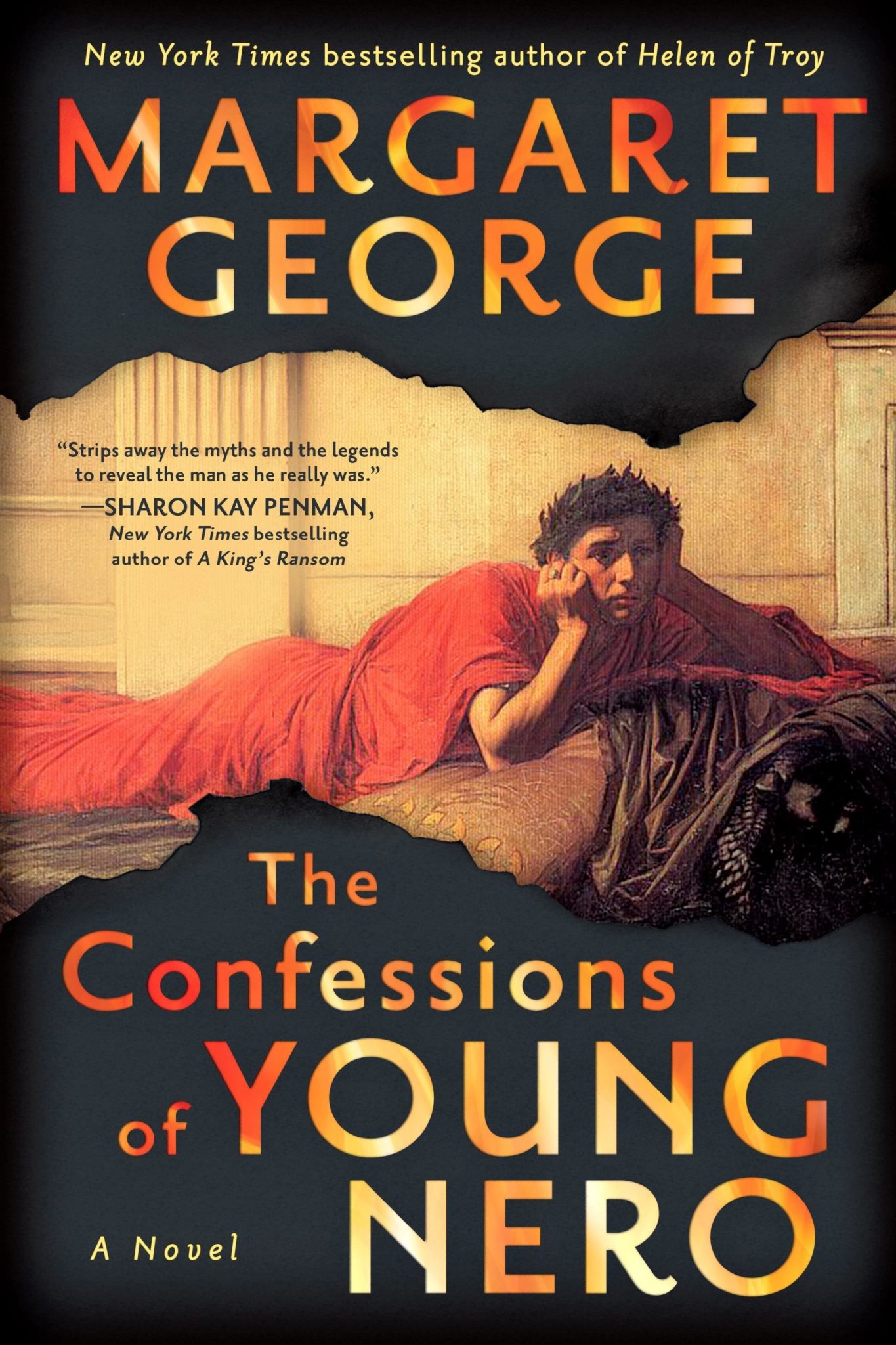
“So many people were killed to make Nero Emperor, it was kind of his destiny. He couldn’t opt out of it.” – Author Margaret George discusses The Confessions of Young Nero

“I’ve known a lot of Neros in my life, maybe I’m sort of a Nero too because I was lucky that I could write novels and make a living as an artist, but so few people can.”

WHAT: A mother’s deadly ambitions. A boy who would be sovereign. A name that would be infamous. This is the epic tale of Nero’s rise to power, a thrilling story of survival, betrayal, love, and the struggle for the Roman empire that would change history.”

WHO: Margaret George writes biographical novels about outsized historical characters: Henry VIII, Mary Queen of Scots, Cleopatra, Mary Magdalene, Helen of Troy, and Elizabeth I. Her latest subject is covered in ‘The Confessions of Young Nero’ and ‘The Splendour Before The Dark’. Her novels have been ‘New York Times’ bestsellers, and the Cleopatra novel was made into an Emmy-nominated ABC-TV miniseries.

Margaret especially enjoys the research she has done for the novels, such as racing in an ancient Greek stadium, attending a gladiator training school in Rome, and studying the pharmacology of snake poison.

MORE? Here!


Why Nero?

Why Nero? It’s because I think of all the Roman emperors, he seemed more like a person that you know. He seemed very modern. He reminded me of so many people I know personally who want to be artists. How many people do you know like that? Children want to go to film school, they want to become playwrights, they want to write novels, they want to play music and their parents say “No, I really think you’d better go to law school”.

So he was very modern in that way. It just happened that the law school his parent wanted him to go to was being the Emperor. That’s not something you can refuse by saying, “Well I don’t care to go to law school, I don’t want to be a doctor.” When that happens, most parents usually say, “All right then, go off to New York and if you don’t make it in five years, you’re going to come crawling back and we’ll see about law school.”

In this case, so many people were killed to make Nero Emperor, it was kind of his destiny. He couldn’t opt out of it. That was what really made him so interesting to me. It made his character alive in a way that say, Septimius Severus or even Julius Caesar or any of those people, who didn’t have that other side, couldn’t be. That is where I got the idea of the three Neros from. The Augustus one that did his duty, the artist in him and, last of all, the third one that had to facilitate the other two.

I feel as if I’ve known a lot of Neros in my life, maybe I’m sort of a Nero too because I was lucky that I could write novels and make a living as an artist, but so few people can.

Of course, this was a real life story so it wasn’t up to me to come up with a plot for the sequel that was as good as the first one, because history itself has provided me with that plot. It was a tragedy, of course. I must be drawn to tragic figures because when I think about it, Mary Queen of Scots was executed, Cleopatra and Nero committed suicide, Helen of Troy caused a war where many people were killed, and I’ve written about all of them. Life is sad even if you’re an emperor.

I like to write novels that cover a whole life. I think that you can’t understand the adult until you’ve met their younger self. The modern thing is to do just a slice of the life. When I started out I wanted to write about Henry VIII. At the time most of the books and plays just focused on a small part, usually the Anne Boleyn part and / or the Thomas More part – but I thought, “you can’t understand those out of context, you have to know the person, how he grew up, what formed him, you can’t just leap into the middle of his life.” That’s what people do now, because of space, I think, which is understandable, but I think you wouldn’t know the grown- up Nero until you knew the child.

How did you find writing the story in the shadow of Robert Graves’ I, Claudius novels?

I am thankful that ‘I, Claudius’ is told from Claudius’ point of view. Thank goodness Robert Graves didn’t get to do too much about Nero, because I find myself, especially from the mini-series, I just can’t get out of my mind the images I have of the actors that played those roles. Livia will always be Siân Phillips and of course, Caligula will always be John Hurt to me. Had there been a continuation with a grown-up Nero, I would certainly have had trouble in battling that image in my mind.

[DL: It’s interesting that neither you or Robert Graves haven’t got very much nice to say about Seneca.]

Neither of us do, do we? You know there’s such a difference of opinion about Seneca. He’s rather a mystery. It’s the old problem – stay within an institution and try to improve it, work from within and do what you can, don’t desert the field— or do you quit like Thomas More and say, “I just can’t have anything to do with this.” Seneca chose the first path, though he’s criticized a lot for that. You can make a case for the fact that he tried, he didn’t desert the ship. But you can also make a case that he stayed because he was getting so fabulously rich from serving Nero.

Is rehabilitating the reputation of Nero the ultimate act of iconoclasm?

I found that people are the most resistant to rehabilitating Nero. More so than they were to Henry VIII, which is kind of surprising because Henry was so much closer to modern times. What I found in some of the reviews, and some of the comments, is that people really prefer the villain. I have a friend who’s trying to rehabilitate Richard III, but it’s really hard because that colourful kind of villain is so attractive. Even in my Mary Magdalene book, Maureen Dowd in the ‘New York Times’ said that we prefer the golden-haired reformed prostitute because she’s so visual, she’s so easy to identify with. The disciple is not as interesting.

I was a little naïve in thinking that I could change many people’s judgment about Nero. I can see now how entrenched these ideas are about him. Public Broadcasting System recently did a programme, a kind of rehabilitation, called ‘The Nero Files’ and I braced myself. In it forensic scientists examined the case against the crimes of Nero and concluded was that he didn’t do a lot of these purported things and we can prove it by scientific evidence, for example, that plant-based poisons, which is what they had in the ancient world, worked slowly and could not cause someone to drop dead instantly, as Britannicus did. I wonder if many people watched the show and if some were convinced.

[DL: There is, of course, one crime that Nero’s associated with which is his kicking to death of his Empress Poppaea and her unborn child. She is perhaps the most famous victim of domestic abuse in history…]

Many modern historians don’t think that happened, and even the ancients fudged about it. But even if it wasn’t really true, it is so much in the popular mind that there had to be a version of it in the novel that involved Nero, but was involuntary. I couldn’t just get away with the modern view that she was ill and she had had a miscarriage. I had to acknowledge the belief that blamed Nero. But the only way to answer it, without being accused of just dodging the whole thing, was to have it happen but have it be an accident.

I say in my author’s afterword that Nero was not known to take physical action against people, striking them or abusing them. So it’s out of character if he did that, especially to his wife whom he loved very much, and they both wanted children. There’s even a papyrus, a poem written in Egypt afterwards, about Nero and Poppaea and their love, and no mention of his injuring her.

One of the problems of being a historical novelist is that a real historian can say here are the theories: one, two, three, four and he can lay them all out for the reader. But, if you’re writing a novel it has to be consistent, and you can only choose one, just one, not a list of alternative theories. So, that’s the way I handled it.

Other famous events in his reign you really cannot get away from, such as the fire in Rome and his killing Agrippina— those things really happened. The only way I can handle those them is to try to give the reasons they happened, not pretend they didn’t.

Do you have a role in selecting the narrators of the audiobook editions of your
novels?

Long, long ago when they still had cassette tapes, I would preview tapes for books from the library for a long car trip, because if I didn’t like the sound of the narrator I knew I couldn’t stand listening to it for hours. Sometimes the narrator just isn’t right.

After a certain point in my publishing career, I got the right to select the readers and that makes such a difference. If someone doesn’t sound like Nero or doesn’t sound like what I think he sounds like, I think that it just won’t capture the spirit of the book.

[DL: Why was Susan Denaker, the reader for the poisoner Locusta, so noticeably an American? Steve West, the reader for Nero, only once gives his new-found Americanness away with his pronunciation of ‘herbs’.]

I really wanted the main characters to be British – because everybody knows—ha ha— that the ancient Romans spoke with British accents. At least they do in all the movies! I think Susan sounded like an older, canny woman, the other two proposed readers sounded either really spacey or weird or else way too prissy to be like I pictured Locusta— a wise, older, and very level headed and practical person, so I hope it wasn’t too jarring that she had a different accent.

Since Peter Ustinov is unavailable, who would you cast to play your Nero?

People think of Nero as so much older than he really was. Every time I give a talk and I say, “you know he didn’t live long – he died when he was 30”, people are shocked. They had no idea. I’d like the young Robert Redford, but the current actor I came up with is Joe Alwyn. He’s 28, he looks like the young Nero, and of course, he’s British so he has the right accent.

I thought it was brilliant Zeffirelli cast ‘Romeo and Juliet’ with actual teenagers. You get older actors playing teenaged parts sometimes and it just feels ‘off’. Since the death of Luke Perry, ‘90210‘ has been back in the news. But the actors playing teenagers in it were not teenagers. One woman was 30 and Luke Perry himself was 26 so I think that if you really want to get the real Nero, you had better ask an actor who is that age, and so Joe Alwyn is my choice and I hope he is available! If he’s not taken up with Taylor Swift! But yes I think he’ll be perfect but we’ve got to do it right away or he’ll soon be too old.

[DL: Is there anything in the works to bring the novels to the screen?]

No not yet. I do have an agent in Hollywood who is working very hard to find a way of bringing it to the screen because the streaming services, like Amazon and Netflix and now Apple, are budgeting billions of dollars to bring out new series. So I’m hoping that in this climate there will be an interest in Nero because of course, a mini-series offers so much more scope than a two-hour movie. I don’t see how you could get Nero’s story into a traditional 2-hour movie format.

Did Nero’s rule produce any lasting achievements?

Ah, that’s a good question. I’m not trying to dodge this, but let me frame it a little, and consider whether anybody has real lasting achievements. It’s very rare because often the person’s accomplishments, at least within a couple of centuries, get superseded or wiped out. Nero had great diplomatic success with that treaty of peace with Parthia. That lasted 50 years.

Longer term, I would say the beginning of urban planning is his lasting legacy. He was the first one to tackle this, as he had a clean slate after the devastating Great Fire of Rome, so he had an opportunity to put green space in the rebuilding plan of Rome. He also dictated that the new streets had to be a certain width. They had to have fire fighting equipment in each house and the walls had to be at least a yard apart with no more common walls, and they had to build with a certain kind of stone that was fire resistant. Of course, people grumbled about these restrictions but he could mandate them because he was the emperor. Today we accept the necessity of city planning, but it was a radical idea then.

I have a new issue of ‘National Geographic’ examining planning cities – what did China do wrong in the last 30 years and Los Angeles in the last 15 years? How do you shape urban spaces in cities? How do we learn from past mistakes so that we have pleasant places to live? I’d say that urban planning is Nero’s one legacy which he would be very surprised about. He was proud of it but it came to him by accident because of the fire. It’s not that he set out saying, “I think I will redesign a city.” He was too focused on a different kind of art.

I would also say perhaps preparing the way for Hadrian was a legacy. Nero was a bit ahead of his time. Later, Hadrian could grow a beard and be a Grecophile and be gay, be all kinds of things that Nero did and was pilloried for.

If you could possess any one item associated with Nero, what would you have?

I would like to have his very own cithara, I could have it enthroned in some kind of shrine because none have survived from his time, and it was a very difficult virtuoso instrument to master. I’ve seen statues of Apollo holding it and that way it’s like 3D; you can walk around it and see how big and boxy and bulky it was but I’d like to see the real thing.

I do have some things from Nero’s time. I have coins which I have collected and I do have some jewellery from that era that is wearable. That I love having because I know someone wore it when Nero was emperor. I have learnt so much about history through my coin collecting. I did it with Cleopatra too.

If you could ask Nero any question what would it be?

I assume by your question that that means he’d have a retrospective vision. Because if he knows what’s happened since I would ask him for an honest appraisal of his art. Would he make the same choices knowing how posterity has painted him? To answer he would have to know how posterity painted him.

In the book I have him saying, “Do I care enough to throw everything over for my art?” If he cannot know what happened after his life, I would still ask him toward the end of his life: if you could go back and do it all over again, will you throw everything over for your art?

You’ve got a one way ticket to the Roman Empire for you and your family, you’re not coming back, when and where are you taking them?

I’m never coming back? Then I would go to England at the time when Hadrian was building his wall, and it would be okay for me to stay there because my ancestors were all there, so I’m going back to my roots. That’s one reason I want to go, seriously, but the Roman Empire in Britain fascinates me. It’s odd that Britain ever was in the Roman Empire, but it was for 400 years, so it’s a bit like the EU and Britain. Were they ever really and truly in their hearts, part of it?

I’d like to see Roman Britain at its height. I want to live in one of those heated villas but that’s so far from Rome it’s almost a mythological place. I remember my father saying years and years ago when I was writing Henry VIII, that I ought to do a novel about the end of the Roman Empire in Britain because they just upped and left and it must have been very strange to have this suddenly happen for both sides. So that’s what I would do but I’d better take some warm clothes.

You’ve got a solo return ticket for either a year on campaign with Julius Caesar; a fortnight with Hadrian and his entourage at Tivoli; or a day in the library of Alexandria. Which do you pick?

I wouldn’t take the library of Alexandria because I’ve spent so much time in libraries lately, I need a change of scene. And I’m sure I’d have a great time with Hadrian and his entourage, but I would choose the Julius Caesar campaign. Now I hope, because I’m being magically transported back in time, this would mean that I could keep up with the rigors of the campaign as I would be a ramped up version of myself.

I became fascinated by Caesar when I saw him through Cleopatra’s eyes as I was writing about them. He’s such an extraordinary character and I am curious about his genius on campaigns. But he also had the trait of being easy going and tolerant of his soldiers. When some of them ran away in a key battle, he grabbed them by the shoulders, turned them around and said calmly, “the enemy is this way.” He was unique and I would just like to watch him in action.

Also, his campaigns were the beginning of Europe, when it was wild and untamed. I would like to experience that moment in time. When Augustus, (Octavian) and Antony split up the Roman Empire, Octavian got the bad part, he got Europe, and Antony got the rich part, the Eastern part. How things have changed!

What are you working on now, what’s next for you?

I would love to stay in the ancient world and as I said I really am drawn to Britain and Roman Empire Britain. I haven’t quite decided who is calling me to go there. I hear a few voices, but I’m not sure which one is absolutely the loudest–or the most beguiling. So I will demur on that until I know for sure.

LIKE WHAT YOU JUST READ? FOLLOW US ON TWITTER! FIND US ON FACEBOOK! OR SIGN UP TO OUR MAILING LIST!
Interview: Hand to God (Assembly Roxy 9 – 13 April ’19)

“I wish I had appreciated how difficult it is to focus when you’re laughing your head off!”

WHO: David Grimes, Director

WHAT: “Mild-mannered, shy Jason has sought solace in his mother’s Christian puppet ministry after the death of his father. In the basement of a conservative church in Cypress, Texas, Jason discovers a blossoming talent for puppetry and thinks that things might just turn out okay. His mom and Pastor Greg seem pleased, the local bully is largely indifferent, and his puppetry has even caught the eye of the cute girl in the youth group.

But the youth group has a monster in their midst: Jason’s puppet, Tyrone. As Tyrone’s foul-mouthed, irreverent, and devilishly funny influence over Jason steadily grows, no one’s secrets are safe. Not content with mere anarchy, Tyrone won’t be satisfied until
he’s dragged everyone to hell and back.

Is Tyrone simply Jason’s voice of grief and rage, or is Tyrone something far more sinister? Is Tyrone what he claims to be: the devil?

Hand to God, a play the New Yorker called Sesame Street meets The Exorcist, is a hilarious, lightening-paced, very adult comedy that explores the startling fragile nature of faith, morality, and familial ties that bind.”

WHERE: Assembly Roxy

DATES: 9 – 13 April (not Friday 12)

TIMES: 20:00

MORE: Click Here!


Why ‘Hand to God’?

I was fortunate to see ‘Hand to God’ in the West End in 2016, multiple times.  Perhaps it’s my southern US upbringing, but the play really resonated with me.  I found it to be one of the funniest plays I had ever experienced, and also one of the most moving and thought-provoking.  At the interval of my first viewing, I was already thinking about how much I wanted to get my hands on the material.  I come from the same area of the US that the play is set in.  I understand these characters.  I know them.  And yes, I’ve actually seen these youth ministries… I probably even participated in them during my childhood!  While the events may be exaggerated for humour, they are absolutely rooted in a US reality.

This is famously a script with a lot of premise and a lot of edge.  What’s at its heart?

‘Hand to God’ uses shock and extreme humour to slip important issues and an emotional punch past your defences.  Yes, the sweary puppets are funny.  Sure, the ending is gruesome.  Yes, the puppet sex is outrageous and you’ll hate yourself for laughing at Margery and Timothy, but you won’t be able to stop yourself from laughing.  All the while, the play delivers a deep message about grief, family, hope and healing.  After the laughter ends, you’ll still be thinking about the deeper messages and moments from the play.

Have you ever worked with puppets before?  And will you again?

I had a limited amount of experience with puppets prior to ‘Hand to God’.  I wasn’t a newbie, but hardly an expert.  Thankfully, most of the performers who manipulate the puppets were in the same boat.  Two had been in productions of Avenue Q previously.  Our puppets are dual arm rod puppets, which make them more difficult to manipulate.  We allowed for a longer rehearsal schedule to give the actors plenty of time to practice with their puppets.  We also built all of the puppets from scratch, as opposed to hiring them in.  Creating the puppets ourselves allowed us to tailor each puppet to meet its specific needs.  I’ve really enjoyed working with the puppets – they know their lines, always hit their blocking, and never complain!  I certainly wouldn’t shy away from another show with puppets, but the show would have to live up to the amazing script that we’ve had with ‘Hand to God’.

What will the EGTG production have that the original production missed?

We hope an audience!  In all seriousness, our production has a lot of heart.  Everyone involved is passionate about this project.  The performers have thrown themselves in with everything they’ve got and have produced a show that is really special.

What’s the one thing you know now that you wish you’d known at the start of rehearsals?

I wish I had appreciated how difficult it is to focus when you’re laughing your head off!


LIKE WHAT YOU JUST READ? FOLLOW US ON TWITTER! FIND US ON FACEBOOK! OR SIGN UP TO OUR MAILING LIST!

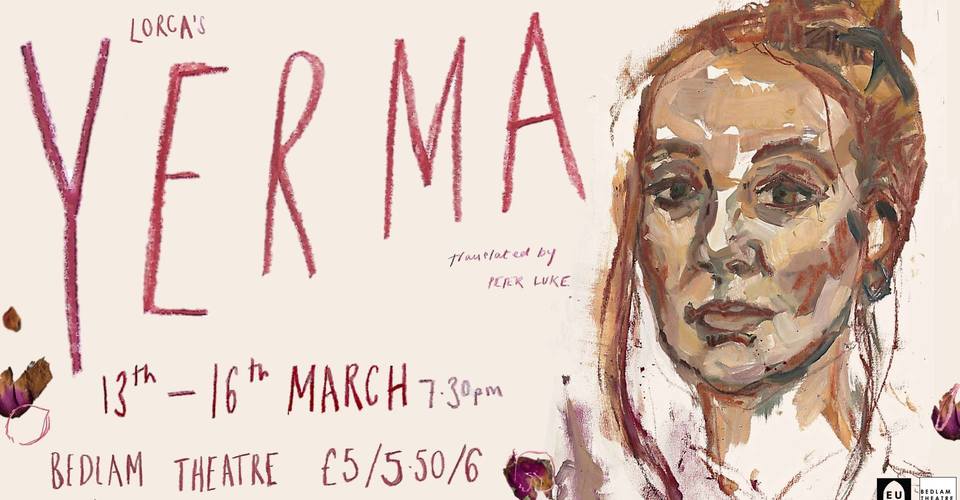
Interview: Yerma (13 – 16 March ’19)

“Lorca’s confidence in his plays is palpable in this beautiful subtly that we seldom see on stage today.”

WHO: Jane Prinsley and Laura Hounsell, co-Directors

WHAT: “A young woman is driven to the unthinkable by her desperate longing to conceive a child. Yerma, meaning barren in Spanish, is tortured by her inability to conceive and becomes increasingly consumed and disoriented by her pain.

Federico Garcia Lorca’s 1934 piece challenged the social order of the time and the claustrophobic expectations of a rural Spanish village. It is relevant in our world of pressure and expectation, where women can be just as crippled by the judgment around them.

In this bold new multi-sensory adaptation, Lorca’s age-old themes will be rendered contemporary.”

WHERE: Bedlam

DATES: 13 – 16 March

TIMES: 18:00

MORE: Click Here!


Why Yerma?

Lorca’s writing is timeless. He manages to articulate the pain of lost love, oppression and unfulfilled dreams in a totally contemporary way. The roles he has written for female actresses are second to none and the atmosphere of claustrophobia that he creates is beautifully painful. It was an exciting challenge to do justice to his talent.

How will such a young cast, most focused on their studies rather than settling down to parenthood, approach the play’s central themes?

Whilst our actors’ lives have taken different paths from their characters, they are predominantly the same age. It is fascinating for us to explore the lives of young people in a different setting. Furthermore, the play’s central themes of social pressure and expectation is ageless. Most people feel the pressure of their surroundings and so actors have been able to draw on their own insecurities and uncertainty about the world they live in. Also as ambitious female students, motherhood is something which we must seriously consider in our future plans. Whilst we are currently focusing on our studies, the pressures of having a family and a success carer is ever present and pressing. The themes of motherhood, loss and societal pressure on women are as familiar to us as they are to the play’s characters and we will approach them with the truth of our own concerns.

This play is set in a society more claustrophobic and traditionally-orientated than our own. Will contemporary audiences relate to this writing as anything more than a historical curiosity?

The pressures on Yerma and Juan to be parents and to have a successful relationship may have become more subtle in the years between today and Lorca’s rural Spain, but these pressures very much still shape our lives today. Lorca was a modern thinker and knew that most women were not best suited to being a housewife, but the stereotypes he was fighting against in his literature are still apparent. We have chosen to stage the play in an atemporal rural setting so that audiences from around the UK will be able to draw on their own experiences and backgrounds. Audiences can look forward to seeing a magnified version of our society today, where the New Zealand Prime Minister is asked on the BBC if she would propose to a man and where our own Prime Minister’s shoes receive more attention than her policies. Motherhood and femininity is so interwoven with being a modern woman that Yerma feels as relevant now as it did in the 1930s. In our adaptation of Yerma we have focussed more on these central themes as opposed to the historicism and hope to transcend the original 1930s setting.

The production is billed as a “multi-sensory adaptation”. What can we look forward to?

You can absolutely look forward to the music. Singer-songwriter Eve Simpson is joining our cast as an actor-musician and she has set Lorca’s poems to music. Oftentimes Lorca’s poems are cut or spoken, but we have tried to remain as true to his intentions as possible by having them sung. Furthermore, to create our atemporal aesthetic, Eve Simpson and Robin Gage have drawn on musical traditions from across the British Isles and some Flamenco styles.  We really are trying to create something multi-sensory, so also expect beautiful scents, visions and sounds in this production.

How does Yerma fit into the rest of the season at Bedlam?

The Bedlam season is varied and uncurated which is one of our many strengths. Yerma will bring innovation, music, joy, thought and opportunities for brilliant female actresses. It is exciting to overcome the challenge of staging a famous and loved play, which incorporates verse and prose and spoken and sung, but it is something that we as directors, our creative team and our talented cast have all relished. This week, Abi Morgon’s 2011 play Love Song is on at Bedlam and draws on similar themes of love and motherhood, so Yerma follows nicely. It is a coincidence that similar themes are being covered in both weeks, but perhaps the Spring weather has got us all thinking about fertility…

If you could ask the playwright a question, what would it be? What do you think he might answer?

How did you manage to write such convincing and tragic female parts? How were you able to articulate the female struggle in the Andalusian rural villages so perfectly and did you know at the time that you were creating something universal? Lorca was homosexual and a socialist and was seen as a threat to the far-right nationalist forces who murdered him. Perhaps his own struggle and isolation is written subtly into the women (and men) in his plays, who deal with repressed love, broken dreams and the feeling of being trapped.

What’s the one thing everyone should know about Lorca?

His fearless politics and how that manifested itself in his art, both as a writer and a painter. For Lorca, his art was a lifeline and one that cost him his life.

Is Yerma as good as Blood Wedding?

What a strange question! They are often printed together, along with The House of Bernarda Alba, and are sometimes billed as a rural tragedy trilogy, although that is to forget Dona Rosita the Spinster, another masterpiece. All of these plays have different plots and characters, but there is usually a woman fighting against expectation, oppressed love, an imposing older woman and men who seem lost. They are all reminiscent of Greek tragedy but feel distinctly modern. Yerma is our favourite because of the central theme of motherhood and the pressures around parenthood that do not seem to have changed since the 1930s. The play’s rapid energy and descent into madness was also something we were captivated by when we first encountered it. It is like a train that speeds towards its final crash.

Are there living artists who can hold a candle to Lorca and the Generation of ’27?

Lorca continues to inspire artists and creators but people should always read more of his work as it is rare to find words rendered as beautifully as his. We found a recent modern staging of Yerma to be contrary to the original aim of the piece as we love how the pain that Lorca portrays is elegantly told. His work is often simple and important action can happen offstage. Lorca’s confidence in his plays is palpable in this beautiful subtly that we seldom see on stage today.

What’s the one thing you know now, that you wish you had known at production’s start?

Collaboration is great. We’ve worked so much better together than we could have ever done individually. It is brilliant to bounce ideas around, disagree, agree and improve our work together. Going forward, we will always look to work in a collaborative style, both on the creative team and with actors.


LIKE WHAT YOU JUST READ? FOLLOW US ON TWITTER! FIND US ON FACEBOOK! OR SIGN UP TO OUR MAILING LIST!

“I’m sure the circa 2008 red was distinctive because I had no expectations at all, yet it startled me.” – Author Kevin Begos discusses Tasting The Past

“Anything from Alaverdi Monastery in Georgia. Beautiful wines, and they are making heroic efforts to save local native grapes.”

After a chance encounter with an obscure Middle Eastern red, journalist Kevin Begos embarked on a ten-year journey to seek out the origins of wine.* What he unearthed is a whole world of forgotten grapes, each with distinctive tastes and aromas, as well as the archaeologists, geneticists, chemists-even a paleobotanist-who are deciphering wine down to molecules of flavour. In his Tasting The Past we meet a young scientist who sets out to decode the DNA of every single wine grape in the world; a researcher who seeks to discover the wines that Caesar and Cleopatra drank; and an academic who has spent decades analyzing wine remains to pinpoint ancient vineyards. Science illuminates wine in ways no critic can, and it has demolished some of the most sacred dogmas of the industry: for example, well-known French grapes aren’t especially noble.

Kevin Begos is an award-winning writer in the fields of energy, science, wine, the environment, and everyday people. He’s been a Knight Science Journalism Fellow at MIT and was a Correspondent for The Associated Press. Among the many titles in which his work has been published are A Field Guide for Science Writers, Scientific American, The New York Times, The Washington Post, MSNBC, Tablet, and The Christian Science Monitor. In 1992 Kevin conceived and published one of the first ever electronic books. The archive of papers from that pioneering project, undertaken 18 years before the invention of the iPad, are now held at the Bodleian Library.

*In the time since Kevin’s first encounter with the mysterious red in a Jordanian hotel room, Cremisan wines have been brought to wider attention through the critical praise of iconic restauranteur Yotam Ottolenghi and his sommeliers.

Tasting the Past: The Science of Flavor & the Search for the Origins of Wine was published in June 2018 by Algonquin Books. To find out more click here.


Why Tasting the Past?

I hoped to evoke three things: my original quest for a wine that I was never able to taste again; then my search for ancient grape varieties; finally an allusion to Proust.

This is the story of an encounter that became an obsession. At what point did you know for certain that you were actually writing a book?

2014, when I saw that the Cremisan wine could be part of a larger narrative.

Where was wine first produced?

At the moment evidence points towards the Caucasus Mountain region about 8 to 10,000 years ago, but there are vast areas along the Silk Road to the East that really haven’t been properly explored. The Chinese may have drunk a different type of wine even earlier.

If I could meet anyone from history, I’d like to meet the nameless individual who constructed the first shelf – the first artificial surface atop two brackets. What made them think of a shelf? What did they use it for? How did others react to the innovation? Is there a similar figure, lost in the mists of early wine technology and culture whom you would like to encounter?

The person who realized that some vines were self-pollinating hermaphrodites that always produce grapes. I’d call that the first domestication.

What’s the single worst / most disruptive thing to happen to wine since phylloxera?

The Napa Valley? OK, I am being bad. But I think that mad yet very successful focus on just a few French grape varieties influenced wine markets around the world, and not in a good way.

You’re castaway on a desert island. You have with you eight bottles of wine. What are they and why?

  1. The Cremisan Jandali/Hamdani white, because it connects me to the Cremisan red I will never taste again.
  2. COS Pithos Bianco, a complex orange/amphora wine from Sicily that suggests what the Romans might have drunk.
  3. Anything from Alaverdi Monastery in Georgia. Beautiful wines, and they are making heroic efforts to save local native grapes.
  4. Loup D’Or from Deidre Heekin. Her wines are often wildly surprising, and this one uses hybrid American grapes.
  5. “Our Wine” Rkatsiteli from Georgia. Gloriously primitive winemaking.
  6. Taylor Fladgate 20 Tawny Port. Because I love port but won’t have a fabulously expensive older bottle on hand when I get stranded (see next note).
  7. A pre-phylloxera bottle of Lafite Rothschild. Because I sold everything to buy it and became a castaway.
  8. A Rhone Syrah, because I love Syrah and find so many surprises among producers there.

Honestly, was the Israeli/Palestinian, pre-commercial vintage of Cremisan wine you encountered at the start of your journey any good or were you sampling with rose-tinted tastebuds?

I’m sure the circa 2008 red was distinctive because I had no expectations at all, yet it startled me. Their winemaker then had been at Cremisan for many decades, and others say he really knew what he was doing.

On the day you come to supreme power what’s the first law you’ll decree in relation to wine?

Everyone has to try an unfiltered amphora/orange wine at least once.

You published one of the first e-books, Agrippa (1992). It’s kind of like hearing that President Grant was issued a $20 speeding ticket in 1872. How did you one go about publishing an e-Book in the late 20th century?

I did it either very badly or fabulously well, opinions differ. In the beginning, I didn’t have the faintest idea how to create an e-book. An idle comment turned into a wild obsession, then a few programmers/hackers made it happen, notably John Perry Barlow, John Gilmore, and one person who chose to remain anonymous.

What’s next for you?

Either a medieval poet or Darwin and orchids.


LIKE WHAT YOU JUST READ? FOLLOW US ON TWITTER! FIND US ON FACEBOOK! OR SIGN UP TO OUR MAILING LIST!

“It’s too easy to depict the women as the only victims of the ambition and cruelty that pervaded the dynasty.” – Author Guy de la Bédoyère discusses Domina

“Who could resist the chance to take time out at Tivoli? It’s the Roman world in miniature…”

Notorious. What other word can encompass the lives led by the women of the Julio-Claudian dynasty? As Rome morphed from a Republic to an Empire under the emperors Augustus, Tiberius, Caligula, Claudius, and Nero their wives and mothers took centre stage. With varying profiles of courage, ruthlessness, and skill women such as Livia, Octavia, as well as the elder and younger Agrippina, emerged as the true backbone of the dynasty. Their stories are familiar from the pages of I, Claudius. The various and nefarious paths each woman took to power are chronicled in Guy de la Bedoyere’s Domina, a behind-the-scenes tour of the machinery and chicanery that really made the Roman Empire tick.

Guy de la Bédoyère was born in Wimbledon and studied Archaeology and History at the Universities of Durham and London. Starting in 1998 he appeared regularly on the Channel 4 archaeological television series Time Team. That same year he became a freelance writer and broadcaster. In addition to his many respected studies of the Romans, especially during their occupation of Britain, Guy has published books chronicling the lives and friendship of the diarists Samuel Pepys and John Evelyn.

Domina: The Women Who Made Imperial Rome was published in September 2018 by Yale University Press. To find out more click here.


Why ‘Domina’?

Domina was the formal name for the female head of a household. Indeed, it comes from the word for a house, domus. The senior women of the imperial family were addressed by that title though some were also called Augusta if they had been given that title (not all empresses were). Domina covers all of them.

Roman women ran the household, many of which were staffed by people held as slaves. Why are we still surprised that Roman women knew how to successfully manage, manipulate, and tyrannise?

Roman history is completely dominated by accounts of men and written in terms of their lives or careers. There are no ‘lives’ of the empresses, for example. Roman women, especially powerful ones, were subjected to a great deal of stereotyping by Roman historians who either depicted them as women of great honour and purity, or as duplicitous and immoral schemers. These were rhetorical devices that were used by them to depict their husbands and sons in a good or bad light. Extrapolating the truth is very difficult and perhaps now impossible.

What is clear is that while women were able to operate outside the ‘system’ because they held no office, they were also restricted by having to work through men. There is no doubt that this led to a certain amount of subterfuge and lateral approaches. Those who were most successful were also the most vulnerable and liable to terrible retribution. But it is important to understand that the men of the dynasty suffered equally hideous fates too. It’s too easy to depict the women as the only victims of the ambition and cruelty that pervaded the dynasty.

The book details many of the objects created to enhance the image of the Julio/Claudian dynasty. If you could pocket one, even if you needed a very big pocket, which would it be?

I already have it. It’s the silver cistophorus coin of Claudius and Agrippina the Younger made at Ephesus in 51. There they are with their heads beside each other in the manner of joint rulers. It was unprecedented and never repeated. It shows how far she had managed to get. I was so fascinated by the coin I purchased it. It inspired the book.

Did Agrippina the Elder live up to the hype? Would she have made a good Augusta?

Agrippina the Elder was dealt a terrible blow when her husband Germanicus died in 19 in Syria. That destroyed any chance she had of becoming an empress unless she had been allowed long enough to survive into her son Caligula’s reign. Again, what is the truth? Tacitus was keen to depict her as a victim and as a woman of great dignity. It would seem that in some respects he may have been right. Germanicus and she would have been celebrated by the mob had he been made emperor. But for all we know he could have descended into despotism like their son Caligula. Who knows what Agrippina would have turned into?

Might the stupendous fabric of the Roman system have resisted yielding to the pressure of its own weight for longer if women had been woven in directly and able to exercise power in their own right, rather than through an occasionally pliant male?

Again, this is completely speculative and with so many factors involved it is impossible to say. The rise of the Severan women in the third century and then certain women like Galla Placidia in the fifth show that under certain circumstances women could gain even more remarkable power than the Julio-Claudians. But the Roman world was a militarized superstate and it depended on military leadership to survive. The women would have had to be prepared to lead armies. Agrippina the Elder showed that some women came close to being able to do that.

I’m guessing there’s a copy of ‘I, Claudius’ somewhere on your bookshelves. Are there any contemporary novelists (who use ancient Rome as their setting) there too? Who do you esteem and recommend?

In all honesty, I do not read much fiction and especially not ancient fiction. The real story is quite compelling enough. In fact, had a novelist invented the Julio-Claudians and their story he or she would have been laughed at for writing something so implausible. The little ancient fiction I have read usually contains the odd quite significant error that makes them totally implausible.

You’ve got a one-way ticket to the Roman Empire for you and your family. When and where are you taking them?

Funnily enough, not Rome. It would either be Pompeii and the chance to see the faces of the people who lived in the houses I have visited there, and to smell the place, or it would be Lullingstone Villa in Kent. I know Lullingstone very well. The setting is little changed and I’d love to see the original house as a living home with the people who lived there.

You’ve got a solo return ticket for either a year on campaign with Julius Caesar; a fortnight with Hadrian and his entourage at Tivoli; or a day in the Library of Alexandria. Which do you choose?

Who could resist the chance to take time out at Tivoli? It’s the Roman world in miniature with fabulous buildings and doubtless visited by interesting people, but most especially because of Hadrian. I’d like to meet him. He’d have been mesmerized by tales of the Renaissance and the Industrial Revolution.

Will there ever be anything as good as Time Team on telly again?

Was it really that good? There’s a lot of rose-tinted spectacles going on with Time Team. It was great fun to be on and a privilege to participate in. I saw some remarkable places and met some very special people. But it was around for too long. The experience became repetitive and began to turn into a dog-day afternoon, especially on dud sites where we scrabbled around for a story. In fact making TV programmes is generally very boring and I got very bored of it.

On the whole I avoid TV like the plague now. The thought of hanging round all day on set is too ghastly to contemplate. Time Team was very expensive to make and those days are long gone. There will certainly be nothing like it again, at least not in our time, because the budgets do not exist to make shows like that. As for ‘as good’ I’m sure that as time moves on later generations will find plenty in their own lives that is just as good, even if it’s completely different. All things must pass. And Time Team is past – forever.

What’s next for you?

Perhaps I should think about selling one of my 1970s Honda motorcycles before I do anything else! I’ve been writing books for over thirty years. That is what I mainly do now, but with an increasing sense of uncertainty about where books and publishing are headed. I have two books on the boil at the moment, one a survey book of life in the Roman army from original sources, and one about how the Romans became rich and what it did to them.

I have lecture tours in Australia and New Zealand in 2020. After that, who knows? I travel a lot with my wife and we are enjoying seeing our granddaughters grow up. I’m 61 now and keen to make the most of being fit and well and having the time to do things I haven’t an opportunity to do before. Mick Aston was only five years older than I am now when he died. Robin Bush, Time Team’s archivist, was only six years older than I am now when he went. Tragedies like that are a lesson not to sit around waiting for the ‘right time’ to do something. As Mr Micawber said in David Copperfield, ‘something will turn up’.


LIKE WHAT YOU JUST READ? FOLLOW US ON TWITTER! FIND US ON FACEBOOK! OR SIGN UP TO OUR MAILING LIST!