The Sorcerer, EUSOG (Pleasance: 27 – 31 March ’18)

Photos. Erica Belton

” A hoot from start to finish”

Editorial Rating:  4 Stars Nae Bad


As one who grew up when the D’Oyly Carte closed shop was in full swing this writer was perhaps somewhat of a trailblazer in being one of the first to take part in an independent production in 1962 while at prep school (the copyright on Gilbert’s words having expired in 1961). I was the Sergeant of Police in The Pirates of Penzance, probably the one and only time this Bass part has been sung by a Treble. It was thus with almost a sense of ownership that I went along to see the Edinburgh University Savoy Opera Group’s presentation of the relatively unknown Gilbert and Sullivan operetta, The Sorcerer, set  in 1969’s Summer of Love. (Well, that was ’67 if you went to San Francisco, Ed.)

There is a long history of The Savoy Opera Group introducing topical elements into the songs and dialogue. However a “modern dress” production (albeit from the 60s) is rarer, more common in Shakespeare or Grand Opera, perhaps like the new production of Cosi Fan Tutte premiering at the Met in New York this very Saturday that is set in Coney Island ten years earlier.

So. A relatively unknown work. A hippy production (I show my age).  A student company. In a word, a risk. Did it work?

The costumes paid only a passing reference to 60’s fashion: the occasional mini skirt, Aline’s dress, floral crowns for the female company and the occasional floral shirt and scarf for the men. Not a single hipster bellbottom or Zapata moustache in sight. But actually none of this really mattered and was presumably a way of keeping down wardrobe costs. After all, this was essentially pantomime. And it was a hoot from start to finish.

The Sorcerer made its debut in 1877 and was the first Gilbert and Sullivan collaboration in which the two had complete control of the production. It was highly successful for its time, which encouraged the author and composer to continue working together and expanding the possibilities of satiric operetta. The Sorcerer introduced the comic duet, the patter song, the contrapuntal double chorus, the tenor and soprano love duet and the soprano showpiece aria that became staples of all the G & S productions that followed.

The Sorcerer also introduced W. S. Gilbert’s passion for satirizing the excessive focus of the English on class differences with a plot that turns the entire social order upside down. As the operetta begins, the villagers of Ploverleigh are celebrating the betrothal of Alexis, son and heir of Sir Marmaduke Pointdextre, to the only maiden of suitable rank in the neighbourhood, Aline, daughter of Lady Sangazure. Alexis and Aline sign the marriage contract, but it appears that Alexis, despite the fact that he loves Aline, does not share his father’s outmoded notions that only men and women of equivalent rank should marry, without regard to such nonsense as romantic inclination.

Alexis has, in fact, hired a sorcerer, John Wellington Wells, to test his theories. Wells casts a spell and creates a love potion that is administered to all the villagers through tea poured from a large teapot during the banquet following the betrothal. All who drink it immediately fall asleep, just as Wells has predicted. When they awaken, he promises, each will fall madly in love with the first person he or she sees (shades, obvs, of A Midsummer Night’s Dream and why not of Sgt Pepper’s Lonely Hearts Club too?). Those who are already married are conveniently immune.

As we might anticipate, when the villagers awaken at midnight, chaos ensues. Sir Marmaduke himself, much to his son’s displeasure, falls in love with the lowly and elderly Mrs. Partlet, the pew opener. Lady Sangazure falls in love with the sorcerer himself, who spends most of the second act trying to elude her grasp. Even Alexis’ own betrothed, the lovely Aline, drinks the potion and falls out of love with Alexis and in love with the vicar of the village. Order can be restored only by the sacrifice of either Alexis or Mr. Wells …… But does it work out OK? Well, go and find out for yourself, but you can probably guess.

Did the players bring it off? Yes they did. Right from the start the opening ensemble inspired one in their confident, loud singing and homogeneity. I thought they were all miked up, such was the pleasing volume level, but, no, that was only the Principals. The chorus sang and acted enthusiastically, convincingly and were thoroughly entertaining from start to finish, particularly when the yummy potion took effect.

As for the Principals, I do question the choice of a female playing Alexis and dressed ambiguously with fitted shirt, trousers and cravat – again token costuming –  and Tilly Botsford handled the lower register singing only adequately, but acted convincingly. The finest singing came from Julia Weingartner’s Lady Sangazure with some hilariously over the top potion-induced amorous attention paid to the wickedly well played John Wellington-Wells (Angus Bhattaharya). The other Principals, Olivia Wollaston (a suitably pure Aline), Gordon Home (a well portrayed Pointdextre), Georgia Maria Rodgers (a frustrated adolescent Constance), Ewan Bruce (a suitably troubled and decent Dr Daly) and Niamh Higgins (a scream as Mrs Partlet) all drew us into the performance and had us rooting for them.

This was an evening of huge entertainment. Great singing, convincing acting, and tremendous fun. Everybody from Producer to orchestra member should take a bow.

 

nae bad_blue

Star (blue)Star (blue)Star (blue)Star (blue)


Reviewer: Charles Stokes (Seen 28 March)

Go to EUSOG, the Edinburgh University Savoy Opera Group

Visit Edinburgh49 at the Pleasance archive.

SCO: Ticciati, Martin (Usher Hall: 22 March ’18)

Image result

Robin Ticciati

“Edinburgh’s loss is Berlin’s gain”

Editorial Rating: 4 Stars Nae Bad

I started checking the website the previous evening. And every couple of hours on the day. Would the great man show up? He has been plagued by back problems, and has publicly announced he is “doing less, to give himself more space”. Tell that to Valery Gergiev. A number of recent concerts have been missed.


Well he did, and well he had to, didn’t he? For this was the official farewell concert of Robin Ticciati as Principal Conductor of the SCO having taken up the position of Music Director of the Deutches Symphionie-Orchester Berlin. Pleasing that as Rattle leaves the BPO another Brit takes over at the DSO. Lucky Berlin to have such talented Brits.


As expected, there was a full house. Everybody knew they were in for something special. Robin and the band did not disappoint. Whilst mainstream repertoire was chosen, it was played with insight, intuition and zest. This was not a case of bashing out a few lollipops to keep the punters happy.


That having been said, the choice of Bach’s Orchestral Suite No 4 in D did not in my opinion sit well with the post romantic nature of the rest of the programme. It was played enthusiastically and fluently, notwithstanding the somewhat stilted, staccato-esque scoring. The standing violins and violas reminded me of Christopher Warren-Green’s London Chamber Orchestra and like them played from memory. This gave an effective theatrical turn to the interplay between solo first violin and viola, creating an atmosphere of baroque’n’roll.


Unusually scored for strings, harp and piano the Copland Clarinet Concerto is a hybrid work in the classical/jazz idiom akin to some of the music of Leonard Bernstein.   In two movements and but 18 minutes long, it is a work of depth, intensity and contrasts. The first movement “Slowly and expressively” was exquisitely played by Maximiliano Martin and is a real tearjerker akin to Samuel Barber’s Adagio for Strings. Seldom has the harp and viola introduction been played so sensitively intoned, followed by the lyricism and restraint of the soloist. Following a demanding and striking cadenza the second movement, “Rather fast – trifle faster” was virtually jazz (it was written for Benny Goodman) and was delivered with aplomb by Martin, light on his feet as if he were the Pied Piper. With much applause Martin stood next to the game pianist and granted us an encore.


Following the interval it was time for the party piece, Dvorak’s Symphony No 9 ‘From the New World’. These accursed titles do one no good in trying to get in touch with the music. Like the Moonlight Sonata they are publishers’ whims to help with their marketing. The work is a wonderful example of post-romantic symphonic form (1893), well constructed in four movements, tuneful and melodic throughout. And while there may be influences of Native American music and American Folk Song, it is on record that Dvorak thought that there was nothing much to distinguish between Native American, African –American or even Scottish music. We take the music on its merits, which are considerable.


The piece is so well known it is difficult to avoid cliché, but the orchestra played with such convincing phrasing and freshness that there was nothing hammy or schmaltzy at all, it was almost as if listening with fresh ears, albeit to a superbly classic interpretation. A wonderful note for Robin Ticciati to go out on, save for the lyrical “Song without Words” encore.


Robin Ticciati will be back conducting the SCO in the Brahms symphonic cycle for the Edinburgh Festival. In the meantime, Edinburgh’s loss is Berlin’s gain.


nae bad_blue

Star (blue)Star (blue)Star (blue)Star (blue)

Reviewer: Charles Stokes (Seen 22 March)

Go to the Scottish Chamber Orchestra here

Visit the Usher Hall archive.

SCO: Emelyanychev, Spacek (Usher Hall: 15 March ’18)

Image result

Josef Spacek

“If it were a blind tasting you would be definitely getting a taste of premier cru”

Editorial Rating: 4 Stars: Nae Bad


The winter season has been cruel to the fans of the more well known soloists booked by the Scottish Chamber Orchestra. Thursday’s concert, the latest of three I had planned to attend, was, for the third time in a row for me, blighted by the non-appearance of not only the soloist but also the conductor. The SCO points out in its no-show apology that there are no refunds because they have the right to substitute artists. Other Scottish orchestras take a less severe line. I had wanted to see Schiff a few weeks ago, I had wanted to see Tetzlaff on Thursday. I wanted to see Ticciati. That’s why I put the concert in the diary. All pulled. Ticciati’s on-going back problems deserve sympathy and should be recorded here. One hopes he can make it for his farewell concert next week. For the others, one wonders.


I decided to stay, not least because I feared that opportunities to review the SCO were proving elusive. I am glad I did, because that fickle spirit, Live Music, triumphed, and I learnt a lesson.


The B Team were young, but what they lacked in experience they made up for in enthusiasm, technical competence, and considerable depth of interpretation beyond their years. The concert was a joy from start to finish, melodic, engaging, very well played, relaxed and entertaining. Maxim Emelyanychev stood in for Robin Ticciati. A student of Rozhdesvensky and the Moscow Conservatory he has, at the tender age of 29, yet to conduct a first rank orchestra, but is booked next season for the Royal Philharmonic, the St Petersburg Philharmonic and at Glyndebourne with the Orchestra of the Age of Enlightenment. So tonight we were shown a window into a promising future.


Perhaps Josef Spacek, standing in for Christian Tetzlaff, has a few more pips on his shoulder. He has appeared not only with his native Czech Philharmonic, but also, among others, the Philadelphia Orchestra, Bamberger Symphoniker, Rotterdam Philharmonic and Netherlands Philharmonic. This was his first gig with a British orchestra. The 32 year old did well.


And so to the music. Of the three concertos written by Dvorak, I would put the piano concerto in the second division, the violin concerto at the bottom end of the first, and the cello concerto as a masterpiece. I personally prefer the Romance for Violin and Orchestra to the concerto, but of course the latter is a more substantial work. Spacek took immediate control with confidence, smooth phrasing, great tone and sufficient volume even way up high on the E string, standing out from the orchestra notwithstanding the limitations of his instrument.   Emelyanychev kept the orchestra in balance but brought everything out of the piece in a conducting style that was confident and far from laid back. The orchestra was competent and supportive after just the slightest waver on the fiendishly difficult and exposed horn opening, and one was in no doubt as to the natural synergy between the triad of orchestra, soloist and conductor, completely forgetting that two of them were stand-ins.


I cannot write about Schubert’s 9th Symphony without a reference to my then eight year old daughter chatting to a violinist from the London Philharmonic Orchestra during the interval at a concert at the Royal Festival Hall, just before playing the work. He said that he and his colleagues called it “The Great Sea Monster” and that is what the Great C Major has been in our household ever since.


The symphony is not without its challenges to the listener. The key of C has its limitations, and for Schubert it is relatively long. There is plenty of melody, but also quite a bit of ‘fill’. The solution, as rightly executed by Emelyanychev, is to take it at a cracking pace.  The SCO was melodic, cohesive, disciplined and played it better than many. I should give a special mention to the timpanist who unusually was given an opportunity to demonstrate his considerable expertise. Overall it was a very accomplished performance by both orchestra and conductor.


The lesson for this writer is, once again, with live music you never know what you are gong to get. Stars can disappoint, relatively unknowns can surprise and impress. To mix my metaphors, while the names tonight were perhaps more Naxos than DG, if it were a blind tasting you would be definitely getting a taste of premier cru.


nae bad_blue

Star (blue)Star (blue)Star (blue)Star (blue)

Reviewer: Charles Stokes (Seen 15 March)

Go to  the SCO, Scotland’s national chamber orchestra

Visit Edinburgh49 at the the Usher Hall archive.

RSNO: Steffens. Ionita (Usher Hall: 9 Feb.’18)

Image result for karl steffens conductor

Karl-Heinz Steffens

“This was as close to perfection as live performance gets”

Editorial Rating: 4 Stars: Outstanding


With Valentine’s Day approaching the RSNO presented a programme on Friday of overtly romantic music: Schumann, Elgar, and, yes, Britten. They were under the baton of Karl-Heinz Steffens, a conductor of a rising reputation throughout his native Germany and also Scandinavia, who proved himself more than worthy of the occasion.

This was a concert of two halves, the first entirely adequate, the second quite exceptional.

In the first piece, Britten’s An American Overture, the band was let down by the relatively poor quality of the music. Not a criticism I would usually level at this composer, but Britten did himself deny all memory or knowledge of the piece when it was discovered in 1972 (it was composed in 1941 as a commission) and had to be shown the manuscript in his own handwriting to prove its provenance. It remained unperformed for a further 11 years. With shades of Copland and even Bernstein, there were flashes of interest in an otherwise fairly monochrome piece. The orchestra played it well, including some very exposed parts early on and while grateful for my knowledge of the repertoire being expanded through the experience, I have no particular wish to hear it again.

Next up the  – Oh, so romantic! –  Schumann Cello Concerto in A minor. RSNO Artist In Residence Jan Vogler was ill (Boy, has this been a season for withdrawals in Edinburgh!) and BBC New Generation Artist and 2015 International Tchaikovsky prizewinner Andre Ionita gamely took his place. The quality of the performance grew as the piece developed, one wondering if Ionita was playing con sordino as the sound coming forth initially lacked the necessary volume, and orchestra and soloist seemed a little out of synch, hardly surprising given the last minute replacement. Nonetheless in the second movement Langsam Ionita’s playing matched the music better, and in the final movement he brought out the necessary volume. His pizzicato encore left no one in any doubt as to his technique.

And now to the piece that everybody, I guess, had come to hear: Elgar’s Symphony No 1 in A flat major. If ever a case could be made for discipline in art, this was it. It would have been so easy to produce a piece of crowd pleasing schmaltz, but the words that come to my mind when analysing Steffens’s fine conducting and the orchestra’s magnificent playing are control, timing, tautness, controlled expression. Steffens showed himself to be a master of tempi, holding back and letting forth the players time and time again, including the final build-up in the brass where no one put a foot wrong. The flutes (I had seen Principal Flute Katharine Bryan chatting relaxedly in the hospitality suite only minutes earlier) kicked off the famous nobilmente with complete aplomb. I heard the cor anglais part clearly for the first time ever, and we were wafted away by the joyous playing of two harps in the final movement. This was as close to perfection as live performance gets. For that magical fifty minutes the RSNO were a world class orchestra. Bravo!


outstanding

StarStarStarStar

Reviewer: Charles Stokes (Seen 9 February)

Go to the RSNO, Scotland’s National orchestra

Visit Edinburgh49 at the Usher Hall archive.

SCO: Ticciati. Atkins. Cargill. (Queen’s Hall: 11 January ’18)

Image result

Jean-Fery Rebel (1666-1747)

” A consummate synergy of soloist and orchestra.”

Editorial Rating: 4 Stars:  Nae Bad

Thursday’s 2018 Season opener by the Scottish Chamber Orchestra, “Chaos and Creation”, was one of the most creative, surprising and varied concert programmes that I have ever come across – with the exception of the Haydn. But more of that later.


Do you know Jean-Féry Rebel? No, he is not a rock star or DJ, but was a composer (1666-1747) at the French Court at the time of Louis XV and a favourite of Madame de Pompadour. He came of a dynasty of court musicians, lived a long and successful life and wrote Les Elemens at the age of 72. It is a most extraordinary piece, with a sort of full on slam-dunk opening that reminded me of Honegger, 250 years later. Special effects were very much the thing in European Baroque and we were treated to a bird warbler at the rear of the auditorium, a whoop whistle reminiscent of Oliver Postgate’s The Clangers, and a wonderful theorbo – basically an oversized lute – whose fretboard must have been at least four feet long. At times I thought I was listening to the soundtrack of The Magic Roundabout. Violin bodies were used as percussion, the conductor did a dance with the principal violist, and everyone had a good time. I never knew Baroque could be so much fun.


A darker form of intensity followed with principal violist Jane Atkins taking the solo spot in Martinu’s Rhapsody-Concerto for Viola and Orchestra (1951). She acquitted herself well, aided by her confident and lively persona. Although less celebrated now than his compatriot, Antonin Dvorak, Martinu was a successful composer and America took to him. The work is steeped in the Bohemian folksong style with a deep romanticism breaking away from his earlier neo-classical style. Atkins brought everything out of the work, producing rich melodic tones and light dance-like flashes that engaged us throughout. A consummate synergy of soloist and orchestra.


There was no let up in the treats Robin Ticciati and his band had in store for us after the interval. The Czech genre continued with Dvorak’s Biblical Songs. (1876). Scottish Mezzo Soprano Karen Cargill gave an assured and rewarding performance of the ten songs, commendably handling the Czech language without difficulty. Cargill has memorably sung Schoenberg’s Gurrelieder at the 2017 Proms with Sir Simon Rattle, and we were lucky to have her. I firmly believe this accomplished Mezzo, winner of the 2002 Kathleen Ferrier Award, to be on the verge of being one of the greatest Mezzos, and listening to her was a privilege.


The evening concluded with Haydn’s Symphony No. 96 (1791), wrongly called the Miracle Symphony for reasons we need not concern ourselves with here. Played with zest and not a hint of tiredness after a demanding programme, the orchestra acquitted itself well under Ticciati’s baton in this microcosm of Haydn’s symphonic genre, the first of his London Symphonies. But why it was included in the programme is open to question. It was  out of kilter with the other more esoteric works of the evening. Nonetheless it made an enjoyable finale.


nae bad_blue

Star (blue)Star (blue)Star (blue)Star (blue)

Reviewer: Charles Stokes (Seen 11 January)

Visit the SCO, the Scottish Chamber Orchestra

Go to Edinburgh49’s Queen’s Hall archive.

Edinburgh Quartet: Queen’s Hall (12 Nov.’17)

Image result for kamila stosslova

Janacek’s “Intimate Letters’  to Kamila Stosslova

“The Edinburgh Quartet go on tour to all four points of the compass, to build lasting relationships with communities in the North, South, East and West of Scotland”

Editorial Rating: 4 Stars


I have not reviewed the Edinburgh Quartet since March when they played a combination of Mozart, Beethoven and Shostakovich as part of their “Revolution” series. They have been busy since, including a fascinating mixed media “Dance” performance reviewed in June by my colleague Steve Griffin. The Quartet are not a conventional, formal concert giving band, and have a clear market and music focus: different themes for every season, and outreach to the local community, including incorporating artists, makars, dancers, and, tonight, student musicians. Sunday’s 3pm matinee was one of only a few conventional concert hall offerings this season. Otherwise there are rush hour concerts, lunchtime concerts, free concerts and concerts all over Scotland including as far afield as Lerwick. It is almost as if ‘Edinburgh’ is a misnomer. Their publicity rightly states that “the Edinburgh Quartet go on tour to all four points of the compass, to build lasting relationships with communities in the North, South, East and West of Scotland”.  They are a quartet for the nation.

With this creative and outward looking disrespect for inertia we also have had change in the line up almost to the point of it being a band of session musicians, Mark Bailey on cello apart. This does not trouble the band, and nor should it us. The vacant seats give an opportunity for up and coming musicians to try out their playing in a quartet as opposed to an orchestra or solo role, and it brings something new for each concert, where all the different line-ups I have reviewed deliver a surprising homogeneity.

Yet the move from homogeneity to synergy requires players in total empathy with one another and second guessing them, often for years, which is why great quartets are always better than star studded put-together ensembles.  Only the first violin seat remains to be filled, probably, I understand in the New Year. On balance, this is to be welcomed.

The programme took us from Haydn, through Tchaikovsky and Janacek to a new work by Scottish composer Tom Harrold.

Haydn’s String Quartet in F minor Op 20 No5 is part of his ‘Sun’ series, but this stupid name, based on a cover illustration, belies an austere work that is satisfying rather than uplifting. It was competently and confidently played.

The Janacek String Quartet No 2 “Intimate Letters’ was written 150 years later (1772, 1927 respectively) and in style probably quite demanding for the largely elderly Sunday afternoon audience. Written in the last year of Janacek’s life it reflects upon the woman for whom he fell head over heels, Kamila Stosslova, nearly 40 years his junior and to whom he wrote over 1000 letters, 300 in his last eighteen months*.   Certainly all manner of feeling was in this work, amounting to a conviction piece that, while not easy listening by any stretch, was as rewarding as it was demanding. That the relationship was reciprocated only platonically no doubt contributed to his and the music’s angst. The Quartet despatched its considerable demands with ease. So much so that when the work stopped in order for second violin Tom Hankey to return to the anteroom to pick up the rest of his music nobody minded, such is the quartet’s informal rapport with their audience.

Following the interval the quartet was joined with a “shadow” quartet of students from St Mary’s Music School: Briona Mannion and Marie-Sophie Baumgartner on violin, Rachel Spence and Finn Mannion on viola and cello respectively. They were playing the world premiere of Tom Harrold’s short piece “Elegy”. Harrold described the work as simple but the timings were very difficult (and which the shadow quartet managed very well) and there was a considerable amount of pizzicato to handle. Intensely quiet at the opening the piece developed into a pleasing, romantic work in the modern vein.

The evening ended with Tchaikovsky’s String Quartet No 2 in F, Op 22, a great, classical work relatively unknown outside of the musical world, for being within the chamber music genre, I suspect. Contrast it with the hugely popular Piano Concerto No 1 in B flat minor, Op 23. Both have the honour of being dismissed by Rubenstein: the Quartet “not really chamber music”, and the “Concerto “unplayable” It took considerable reserves of energy and musicality to deliver a work of this substance at the end of a long but engrossing Sunday afternoon. The elusive first violin seat was on this night guested by Nicolas Dupont from Belgium. He had most of the heavy lifting to do, ably supported by his colleagues. Whoever takes the first violin seat permanently has a lot to live up to.


***********

 * For those who want to know more about this extraordinary 11 year ‘non romance’ I recommend “Notes for a Hausfrau: Intimate Letters: Leos Janacek to Kamila Stosslova”, edited and translated by John Tyrell and published by Faber in 1994 at £25.  It may be out of print, so go to the excellent review in the Independent by Michael White that gives the gist of this extraordinary muse:  http://www.independent.co.uk/arts-entertainment/book-review-notes-fof-a-hausfrau-intimaye-letters-leos-janacek-to-kamila-stooslove-ed-trs-hohn-1410383.html


Star (blue)Star (blue)Star (blue)Star (blue)

Reviewer: Charles Stokes (Seen 12 November)

Go to the Edinburgh Quartet

Visit Edinburgh49 at the Queen’s Hall archive.

RSNO: Gomez, Sunwoo (Usher Hall:10 Nov.’17)

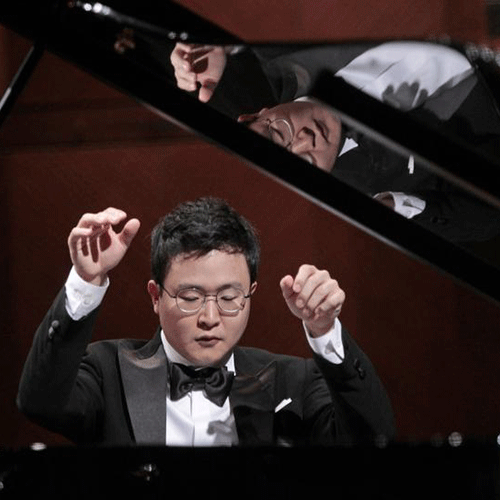
Yekwon Sunwoo
Photo: Philadelphia Chamber Music Society

“Sunwoo’s opening was utterly assured in its relaxed confidence, disposing of the keys with easy liquidity so that we were leaning forward in our seats to capture every nuance of interpretation”

Editorial Rating:  5 Stars Outstanding


I have written before of the RSNO’s skill in concert programming, often successfully juxtaposing contrasting yet somehow complementary works. Friday’s concert was to be a full blown Romantic affair in the Russian 20th century genre starting with the exquisite and rarely performed Vocalise, but, alas, illness, so common in the concert world at this time of the year, forced a programme and artist change. No Vocalise. Instead, we got Zulu, by British composer Daniel Kidane (b.1986). Quite a change.


Yet after the initial upset there was no room for disappointment. Jose Luis Gomez stood in for the indisposed Christian Macelaru at the last minute and arrived from America with a score of the symphony in his pocket. “Who doesn’t travel with Shostakovich 12?” His credentials were impressive, Assistant to Paavo Jarvi at the Frankfurt Radio Symphony Orchestra and in 2010 winner of First Prize in the Solti Conducting Competition. Currently he is Music Director of the Tucson Symphony Orchestra.


Prize winning credentials were also the order of the day for piano soloist Yekwon Sunwoo, prizewinner at the 2017 Van Cliburn International Piano Competition, and the programme change from Rach 2 to Rach 3 was in fact a welcome change from the much played second concerto to its slightly less well known, but in every other way equal sibling.


So on to the playing. Zulu was five minutes of noise. Enthusiastic brass playing, well orchestrated, good rhythm and momentum. Composer Daniel Kidane has studied at the Royal Northern, Royal College and privately at St Petersburg. The work was chosen from his participation in the RSNOs Composers’ Hub. It was a conceptual stretch to include it in the programme, but it made for a lively opening.


Next up was Rachmaninov’s Piano Concerto No 3 in D minor. I have seldom heard this work played so well, certainly not in the hands of a 21 year old. Sunwoo’s opening was utterly assured in its relaxed confidence, disposing of the keys with easy liquidity so that we were leaning forward in our seats to capture every nuance of interpretation. As the first movement Allegro ma non tanto developed so did Sunwoo’s attack, holding nothing back yet stopping way short of pastiche. You do not have to wear Rachmaninov on your sleeve to get the best out of of it. The RSNO accompanied him with playing that was glorious in its phrasing and intensity. The work has long solo and barely accompanied passages, not exactly cadenzas, but close. Time and again Sunwoo nursed and coaxed freshness of interpretation from this well known, much loved piece. Notwithstanding 45 minutes of bravura playing we were treated to an encore. The quiet and restful interpretation of Tchaikovsky’s Autumn Song from the Seasons lasted a full five minutes bringing the dramatic first half of the evening to a relaxing, introspective close. If you don’t know it, find it here on You Tube.


The second part of the evening was an assured, storming interpretation of Shostakovich’s 12th Symphony The Year 1917. Written in 1961 when Shostakovich was still not out of the political woods it is obviously a political work but without taking anything away from its inherent musicality. “Revolutionary Petrograd” started with typically haunting, bleak cellos and basses suggesting barren topographical (and political) landscapes full of desolation and foreboding before being joined by the upper strings in a more purposeful and positive timbre. Played continuously for 40 minutes the demanding work gave the whole orchestra, from expertly played woodwind soloists to stunning percussion, the opportunity to give the best possible account of themselves, which they did. The work built up though tableaux such as “Razliv” (Lenin’s revolutionary headquarters), “Aurora” (the battleship that fired the opening shots of the Bolshevik coup) and, finally the optimistically named “Dawn of Humanity” which was at least in musical terms a summation of all the themes that had gone before, and gave the orchestra the opportunity to demonstrate fluent, assured playing that whilst on occasions very loud, was never forced.


I have often said that one of the reasons live music is so exciting is the risk of failure. Here we had a last minute change of two out of the three pieces in the programme and a conductor no one had met or played under before the previous day. The result? Perhaps the most exciting and enjoyable concert I have been to this year. The RSNO continues to improve and impress


StarStarStarStarStar

Reviewer: Charles Stokes (Seen 10 November)

Go to the RSNO, Scotland’s National Orchestra

Visit Edinburgh49 at the Usher Hall archive.

RSNO: Oundijan; Vogler; Wang. Usher Hall. 3 Nov.’17

Related image

Jan Vogler

“Great if you like twelve-tone. Not so great if you don’t”

Editorial Rating:  4 Stars


Combined concerti for violin and cello are relatively rare, and on Friday at the Usher Hall we got two, separated in composition by 128 years. Such was the nature of the new work, however, that it was more like a comparison of the Viennese Salon of the 1890s and the 1930s’ Second Viennese School.


As is his custom, conductor and Director of Music Peter Oundjian gave us an introductory talk alongside cello soloist and this year’s Artist in Residence Jan Vogler. Not unreasonably, the majority of the talk was about the UK premiered work Duo Concerto by Wolfgang Rihm. Rihm was born in 1952 in Karlsruhe and is a professor of composition at the University of Music there. The work was commissioned by the Friends of Dresden Music Foundation to celebrate ten years since the reopening of the Frauenkirche and received its world premiere in Purchase, NY and in Europe in Dresden in 2015. It was written for performance by Vogler and tonight’s violin soloist, Mira Wang. Vogel’s association with the work, and his being the orchestra’s Artist In Residence, explains its choice on tonight’s programme in addition to its legitimacy as a composition.


The work lasts for 25 minutes in one movement. The soloists are in play almost the entire time, and the work has a heavy texture and is written in the twelve-tone technique. “Great if you like twelve-tone”, said Vogler. “Not so great if you don’t”. The work in fact had momentum, good orchestration, and a particularly demanding part for violin soloist Mira Wang. It was, perhaps, down to the limitations of twelve tone that it sounded remarkably similar to Schoenberg albeit composed seventy years later.


Our hardworking soloists carried straight on into the Brahms Double Concerto in A minor. Brahms is the master of melody, and we were into a glorious cello theme just four bars in. Whereas Wang did most of the heavy lifting in the Rihm, this work was Vogel’s and in fact a case could be made for writing out the violin part altogether, taking nothing away from Wang’s fine playing and   interplaying with Vogel beautifully when the score allowed it. The orchestra played with excellent phrasing and balance and were clearly very comfortable in their skin, supporting the soloists with all effortlessly harmonised under Oundjian’s baton.


After the interval we returned for Beethoven’s Symphony No 6 in F major, the ‘Pastoral’. What can a music writer add to the reams that have already been written about this glorious work? Well, you could feel the hall relax as we snuggled into this closing number, the orchestra were on top form, fully rehearsed and sure of foot, and familiarity did not disappoint. One notable difference in interpretation were the strings playing of the first subject in the final movement (Shepherd’s Song), Oundjian holding them back just a little so we could hear more of the supporting wind. He bought them back to the fore before the finale.


And did you know the Shepherd’s Song was used as music in the TV commercial for Lentheric’s Tweed fragrance in the 1960s? Now, you will find that degree of historical research only in Edinburgh49.


Star (blue)Star (blue)Star (blue)Star (blue)

Reviewd by Charles Stokes (Seen 3 November)

Go to the RSNO, Scotland’s National Orchestra

Visit Edinburgh49 at the Usher Hall archive.

RSNO: Norrington (Usher Hall 21 Oct’ 2017)


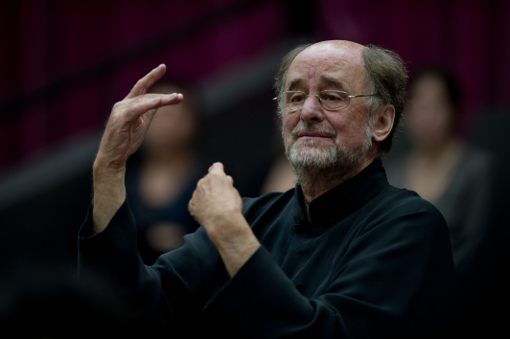
Sir Roger Norrington
Photo: Alberto Venzago

“Sometimes good things come in small packages”

Editorial Rating: 4 Stars


There was much more to Friday’s excellent RSNO/Roger Norrington gig than met the eye. Of course it was a thrill to be in the hands of the maestro of historically informed musical performance, last seen here at the Edinburgh Festival for his assured and thrilling Monteverdi performances, as well as for the reassurance of an evening’s accessible, if not easy listening, classical music. Yet we got so much more, namely an insight into the deceptively futuristic ahead-of-its-time works of Robert Schumann and Felix Mendelssohn-Bartholdy.

The first question one was forced to ask oneself was, “When is a symphony not a symphony?” The initial work, Schumann’s Overture, Scherzo and Finale was originally titled Symphonette and played out in three movements in around 19 minutes. Both Prokofiev and Shostakovich wrote symphonies of lesser duration, the former at the beginning and the latter towards the end of their symphonic canon, so why the name change? In admittedly three movements rather than four, it was greater than the sum of its parts and was a satisfying, rounded piece developing all the way through towards a Finale: Allegro molto vivace that was recognisably mature Schumann as compared to its more Mozartian beginnings.

After the deftest of scene changes (only three first violin desks to move out of the way in this cut down band) to bring on the concert grand Steinway, Roman Rabinovich delighted us in a relaxed, assured and thrilling interpretation of Mendelssohn’s Piano Concerto No 1 in G minor.   In an underrated work clearly ahead of its time – that reminded me of Brahms and Tchaikovsky a generation later  – we were treated to excellent solo and ensemble playing of a dramatic operatic opening followed by a strong melodic line and taut together playing under Norrington’s understated, enabling direction.

The evening concluded with Schumann’s Symphony No 1 in B flat minor (Spring). I cannot find any reference to Tchaikovsky being influenced by Schumann in his ground breaking fourth symphony but the opening two bars of the Spring symphony were near identical. The orchestra were sufficiently beefed up for this work to make one forget it was contemporaneous with the opening number. We went from two French horns to five, nought to three trombones and were full on for more than half an hour. The playing and direction were disciplined and effective with well-managed crescendos and an elaborate brass coda in the first movement. The band continued to provide a rich tone in the second, but in the elaborate and extended finale, following on a beautiful flute intervention, the brass gave into themselves showing tone a little coarsened by virtue of their evident enthusiasm. Never mind, this was joyous music making.

As I left the auditorium I noticed that I was leaving at the remarkably early hour of ten past nine. We had, in fact, just one and a quarter hours of music making when on a good night one can expect nearer two hours. Yet it was a well-put together programme and hard to see how it could have been justifiably fleshed out. Some times good things come in small packages.


Star (blue)Star (blue)Star (blue)Star (blue)

Reviewer: Charles Stokes (Seen 20 October)

Go to  the RSNO, Scotland’s National Orchestra

Visit Edinburgh49 at the  Usher Hall .

EQ: Dance! (Various, until 14 June ’17)

“A real treat”

Editorial Rating: 4 Stars: Outstanding

The Edinburgh Quartet are one of our favourite live music acts here at Edinburgh49, and while normally it’s my colleague Charles we defer to for his superior knowledge of classical music, I was interested to see how a collaboration with Youth Dance Scotland would work, and what unexpected gems might be uncovered when combining classical music with contemporary dance.

The evening commences with a traditional musical performance by the quartet, followed by three dance/music collaborations: all original compositions for the quartet, and with original choreography from Marc Brew.

The first of these, For Sonny captures a very childlike and playful feel, with the dancers darting in and around the musicians (who are positioned centre-stage), seeming to make the rules up as the go along. There’s an element of give and take to the piece as the dancers respond directly to strokes from the quartet in the quieter elements, and to movements from each other – as if playing a rather bizarre version of “follow the leader” throughout. It’s fascinating to see such a close relationship between the dancers and the musicians, even though the danger of collisions sometimes causes the heart-rate to rise somewhat!

The quartet move to the side of the stage for the final two pieces, yet still feel integrated within the performance as the dancers watch and respond to them throughout. The second piece feels just slightly more grown up as the dancers adopt a more uniform and unison approach to their movement, though they become more animalistic – like a set of production line workers in rebellion against the formality of the everyday. Different dancers take turns to break out from the group, using more and more of the space, until they surround the quartet at the end, as if waiting for their next direction or inspiration.

Silent Shores has a significantly more ensemble feel, and combines the best of both of the previous two pieces, with some daring lifts and tableaux in direct response to the music, following its stops and starts with playfulness and control. Reflecting the nature of the isle of Arran, it’s a complex interrelationship as the different aspects of the piece – contrasting stillness and frantic movement – bring about a sense of ongoing time and flow, like the changing of the seasons.

Overall what’s most pleasing about the whole setup is the relationship between the dance and live music, which is cleverly structured and choreographed to integrate the two. At times the movements did lack a little polish and finesse – but perhaps given that the piece is touring across different venues in Scotland for just one night at a time, it can be expected that the dancers will have to adapt to the size and shape of their performance spaces each time, not allowing them to fully relax into each performance.

Something for both dance and classical music aficionados, a real treat. It’s a shame that, at just shy of an hour, the performance is so short.

outstanding

StarStarStarStar

Reviewer: Steve Griffin (Seen 10 June)

Visit the Summerhall archive.