RSNO: Leticia Moreno; Thomas Sondergard: Usher Hall: 6 May ’16

“They really went for it full on, you got everything you wanted and hoped to hear, but it was never over the top…..terrific playing…..quite something!”

Editorial Rating:  4 Stars:  Nae Bad

The RSNO’s Friday night Edinburgh concerts really set you up for the weekend, and last Friday’s cornucopia of delights was eagerly awaited: Bartok and Stravinsky, an orgy of brass, dissonance and full on orchestral razzmatazz. We were not disappointed.

There was much in the plots that drove the ballet suite parts of the programme that was descriptive writing of the louche – if not actually sordid – kind, not to mention the fecund. Robbers setting up a young girl as bait, consent to coition in order to effect the death of the punter, and Spring as the enduring symbol not just of birth, but of fertility, and finally the sacrifice of a virgin to appease, one suspects, not only the Gods but also senile and jealous Elders. No wonder the performances as ballets caused such a stir in the early part of the twentieth century.

First off was Bartok’s Suite from the ballet The Miraculous Mandarin. As for the story, Google it for all the gory details, but suffice it to say the premiere in Cologne in 1926 (conducted by none less than the composer Erno Dohnanyi) caused catcalls, whistles, boos, stamping and a walk out by the clergy present, with the work being banned in a number of cities. Nothing could do more to promote the piece. As for the music, well, exciting is not a strong enough word, and what impressed me is how the band got into the groove of this really quite demanding work straight away: dissonant, chaotic, resemblant of street life, some pointers to Walton’s Belshazzar’s Feast. The lilting, seductive melodies supplanted by raucous, glorious trombones and brass in general, with the strings coming in at the end and taking us away like furies. Wow! A great start to the evening, twenty minutes of exquisite bombast.

There followed Stravinsky’s Violin Concerto played by Spanish violinist Leticia Moreno on a 1762 Gagliano. The Concerto as a musical form is often compared as either a contest or a love affair between soloist and orchestra, with early examples (e.g. Vivaldi) featuring the soloist as first among equals, and later composers taking the soloist more out front. This latter approach is inherently more difficult with instruments such as the violin and guitar that find it difficult through volume limitations to stand out as a piano or trumpet would, and this limitation is the more obvious in later, more heavily orchestrated works, of which the Stravinsky is certainly one. Only in the second and final movements did the soloist really come to the fore, with a lightly supported melody in the second, and a lively toccata in the fourth enabling her to do so. Elsewhere conductor Thomas Sondergard was doing what he could to restrain the orchestra without rendering them inaudible. This also resulted in too soft playing from the clarinet so unfortunately the performance as a whole of this underestimated, supposedly austere work never quite satisfied. The audience nonetheless delighted in it and sent the players off to the interval with enthusiastic applause ringing in their ears.

The last work of the evening was Stravinsky’s  The Rite of Spring, a brilliant choice of programming given the glorious Spring day that was now drawing to a close. The playing here was absolutely first class with spectacularly clear and well articulated woodwind – not at all outdone by the “heavier” brass – playing with real clean attack and verve; but by the time the work was over you knew that everyone in the 105 piece band had had their moment in the sun, from the ten timpani, three huge Wagner tubas, seven trumpets, eight horns, washboard, rattle, tam-tam etc. – get it? The strings soared gloriously and one was reminded that, as is so often the case, although this sounded like it was chaotic, it is in fact a highly structured, cleverly orchestrated work that raised the roof and actually caused a riot when it premiered in Paris in 1913. One hundred years on its excitement and sheer jaw-dropping daring nature does not pale and the RSNO gave the sort of performance a seasoned concertgoer loves. They really went for it full-on and you got everything you wanted and hoped to hear, but it was never over the top. Terrific playing with the structure and discipline that strong composition enables. Quite something!

 

nae bad_blue

Star (blue)Star (blue)Star (blue)Star (blue)

Reviewer: Charles Stokes (Seen 6 May)

Go to the RSNO here

Visit Edinburgh49‘s Usher Hall archive.

Scottish Chamber Orchestra and Chorus (Queen’s Hall: 28 April ’16)

“A very appealing and appropriate choice of works”

Editorial Rating:  3 Stars:

Thursday’s SCO concert at The Queen’s Hall was to celebrate the 25th anniversary of the SCO Choir, and like at all the best gigs, the star attraction came on after the interval, following an impressive warm up by the band themselves.

Indeed, “warm up” is a particularly apposite description. The gallery was unusually crowded owing to the need for the ground floor to accommodate both the orchestra and 60 strong chorus, as half the centre stalls had been taken out. Heat rises, and for some reason the upper half of the house was uncomfortably warm, the lower a little too refreshingly cool.   Deliberate attempt to boost interval bar sales? Of course not; worried staff were toying with the radiators all evening.

Hot stuff? (Groan). Yes, it was an interesting programme, very much in the classical vein.

First up was Bach’s Overture from Suite No 3. Conductor Richard Eggar engaged with us immediately, explaining that this piece was “the one before Air on a G string” which I guess made us feel at home. My concerns about the Master’s orchestration including three trumpets playing very much in the high register, reminiscent of Handel and in truth slightly jarring (absolutely no reflection on the playing) was confirmed by the view taken by musicologist Joshua Rifkin that the piece may originally have been conceived for strings alone. Nonetheless it made for a lively opening to the evening’s entertainment.

Next came Mendelssohn’s Fifth Symphony. Yes, Fifth. Most people think he wrote only four, and in fact this work was composed probably somewhere between the first and second, much delayed in the performance. Nothing like the “Italian” or “Scottish” symphonies, it is a highly classical work, fitting in well with the Bach, and includes in the scoring a part for that intriguing instrument of yore, the Serpent, that I would imagine sounds rather like a cardboard tube made of brass.

A short while through the first movement I thought I was listening to Wagner. How could this be? Well, both Mendelssohn in this work, and Wagner in Parsifal, use the chorale-like orchestration of Martin Luther’s setting of Psalm 46, Ein’ feste Burg (“A safe stronghold’). Later on there were reminders of Haydn’s ‘London’ Symphony (no 104) with the use of the Dresden ‘Amen”. This ‘Reformation” symphony was an orchestral link between concert hall and church, a prelude of what was to come after the interval.

Mendelssohn featured again after the interval with the choir performing his hymn-like Verleih uns Frieden’, or “Peace in our time”, later to have such resonant connotations.   It was a pleasure to hear choral singing with such soothing melodic lines in this brief, dignified work.

Finally, the piece de resistance, Bach’s Magnificat in D. Confident choral singing with a strong, reassuring opening ably supported by brass and wind. The “Et exultavit…” that followed suffered from a slight lack of volume from the solo soprano, but the work as a whole provided a compleat combination of chorus, soloists and orchestra.

So Happy Birthday, SCO Chorus and Band, a very appealing and appropriate choice of works to celebrate this joyful occasion!


Star (blue)Star (blue)Star (blue)

Reviewer: Charles Stokes (Seen 28 April)

Go to the SCO and the Queen’s Hall

Visit Edinburgh49‘s Queen’s Hall archive.

Scottish Chamber Orchestra: Ain Anger & Olari Elts

https://i0.wp.com/angusarts.org/wp-content/uploads/2015/05/SCO2.jpg


“No musician could fail to admire, and secretly envy, the sheer bravura and chutzpah of this performance…

 Editorial Rating: 3 Stars Nae Bad

Thursday’s Scottish Chamber Orchestra concert at the Queen’s Hall was a fascinating melange of the contemporary, romantic and classical. As a result we experienced a variety of different musical experiences in an exciting evening’s musical entertainment.

I suspect the main draw must have been the evergreen Beethoven’s Fifth Symphony, but more of this later. The gig kicked off with Brett Dean’s “Testament”, a work some years in evolution that, to quote the composer “in some way related to Beethoven’s life and music”. I personally found it hard to trace this link back to the great man, notwithstanding the composer’s consultation with the string section of the Berlin Philharmonic and studying of the Heiligenstadt Testament. There were strong influences of Honegger, Adams and even Lutoslawski, as well as some clear 19th century style melodic lines in what was a mosaic of musical styles. It made for an entertaining and lively start to the evening and the orchestra dispatched it with enthusiasm and considerable skill.

By way of a contrast followed Mussorgsky’s Songs and Dances of Death. Mussorgsky had planned to set eight songs by the poet Arseny Golenishchev-Kutuzov, with whom he shared rooms. In the event he set only four of them and died before he got around to orchestrate them, which his eminent fans Rimsky-Korsakov and Shostakovich were happy to do, as has contemporary Australian composer James Ledger. This latter was the version chosen for us. Perhaps an unconventional choice in view of his illustrious forebears, the orchestration undoubtedly worked in an atmospheric and almost mysterious way, including an extraordinary clarinet glissando in the third song Trepak (described as “death dances with a drunk in the forest at night). Leading contemporary Wagnerian and Estonian born Bass Ain Anger gave a deep, clear and resonant account of this very Russian work in the folk idiom. The power of the magnificent, but I repeat pleasingly clear bass voice was enthusiastically supported, especially by the brass, as it drew to its sombre, striking conclusion.

And so on to the popular, oft played, recorded and interpreted Beethoven’s Fifth Symphony in C minor. One almost wonders what the point of performing this work is; how can one possibly bring anything new? Everyone, from Von Karajan, the wonderful Carlos Kleiber, and even the Bee Gees in Saturday Night Fever, has had a crack at this gloriously barmy work, and the only person who hasn’t heard it properly in the civilised world is probably Beethoven himself.

To their credit the SCO did pull a rabbit out of a hat. They went off at a cracking pace like the crews in the Boat Race, taut, together, on the money with every new passage and actually managed to convey the excitement of hearing the piece for the first time. A confident opening by the cellos in the Andante con moto made the most of the crescendo in the initial cadence and there were good dynamics and clarity even in the small supporting parts, in particular woodwind and pizzicato strings, and the more so of this latter in the subsequent Allegro. The final, fourth movement Allegro brought the work, and the evening, to a resounding conclusion.

So what to make of this interpretation of the well-known work? Full marks for enthusiasm as caution was thrown to the winds, not afraid of turning up the volume, raw, earthy, almost ‘street’, spirited and raucous. I am sure my school director of music would think that conductor Olari Elts was being a bit naughty with the work, and there were a number of bum notes and other flaws, particularly in the often exposed brass. However, no musician could fail to admire, and secretly envy, the sheer bravura and chutzpah of this performance. Roll over Beethoven!

nae bad_blue

Star (blue)Star (blue)Star (blue)

Reviewer: Charles Stokes (Seen 7 April)

Go to the Scottish Chamber Orchestra

Visit Edinburgh49‘s Queen’s Hall archive.

RSNO: BENEDETTI & OUNDJIAN (Usher Hall: 18 March ’16

“Full on enthusiasm, lightness of touch and an abundance of joy”

Editorial Rating:  5 Stars Outstanding.

It was a bit like getting ready to hear Mahler’s Eighth Symphony, The Symphony of a Thousand. For there were musicians, and musical instruments, seemingly everywhere. Six timpani, two bass drums, two harps, five French horns, a bass tuba, and I reckoned a hundred young choristers, all dressed in black, sitting neatly at the back. Clearly we were in for quite a show.

And it was a show full of contrasts, spaced over almost 200 years of composition, yet all compellingly complementary. The beautiful austerity of James MacMillan; the lush, joyful optimism of Hector Berlioz; and the intense twentieth century romanticism of Karyl Szymanowski.

Sir Kenneth MacMillan’s Little Mass for children’s chorus was “little” only in the sense of limiting itself to the Kyrie, Sanctus and Agnus Dei and scoring it for young voices. It is a work of substance, first performed in Liverpool almost a year ago and premiered in Scotland with us. A piece of some drama: ghoulish, austere, dissonant and utterly beautiful. Undoubtedly a difficult work to perform, the RSNO Junior Chorus gave an excellent account of themselves in a composition many senior choirs would struggle with. Difficult intonations, tricky entries and fiercely challenging harmonies were sung with confidence and precision, with the cherry on top of the composer coming on to the platform to receive the applause and rightly point to the choir’s laudable achievement. Promising start.

A few minutes later on came Scotland’s musical sweetheart, Nicola Benedetti, resplendent in what looked like a Dolce and Gabbana figure-hugging long black dress with signature cascading curls hairstyle. It is a credit to her playing that one soon forgot such superficial accoutrements. Szymanowski and Benedetti have history, of the good kind. His first violin concerto was the piece that won her Young Musician of the Year in 2004 and her recording premiere for Deutsche Grammophon a year later. Tonight we heard her play the second concerto, a more complex work with a lot of writing in the higher register. Benedetti gave it everything and we got it all back. The young woman combines a phenomenal technique with extraordinary feeling; her 1717 ‘Gariel’ Stradivari more than responding to what she asked of it as it approaches its 300th birthday. Szymanowski’s intelligent and well-rounded orchestration gave the band ample opportunity to support and interplay with the solo part in this break-less twenty-five minute piece in the twentieth century romantic genre. Fine playing throughout. Kindly, this young woman who has absolutely no side, treated us to a Bach sarabande for an encore, considerately thanking us for our applause and announcing what she was going to play.

There is often a slight feeling of flatness as one dutifully returns to the auditorium for the second, usually symphonic part of the programme after the glamour and fireworks of the soloist and concerto have gone. Peter Oundjian and the RSNO were having none of this and brought Berlioz’s Symphonie Fantastique to light in a way that I have rarely heard it played, with full on enthusiasm, lightness of touch and an abundance of joy. More a symphonic poem than a symphony, there is a danger of the brass dominating, but Oudjian let everybody have their say: a beautiful intertwining of a very exposed but very well played cor anglais and timpani in the third movement; glorious, roaring brass in the fourth, and almost a fairground cacophony in the final fifth movement, the strings being given their head and the conductor, who one felt was liberating rather than directing the orchestra, ensuring balance, never vulgarity, and not once committing the cardinal sin of “looking encouragingly at the brass”. We left the auditorium chuckling.

StarStarStarStarStar

Reviewer: Charles Stokes (Seen 18 March)

Go to RSNO & Season 2016- 17

Visit Edinburgh49‘s Usher Hall archive.

SCO: IBRAGIMOVA & KRIVINE (Usher Hall 10 March ’16)

“I commend the SCO for their daring and committed performance tonight”

Editorial Rating: 3 stars


Thursday’s concert at the Usher Hall was designed to please, and did not fail. Mendelsohn’s Overture The Hebrides, Schumann’s Violin Concerto in D minor and Brahms’s Fourth Symphony span fifty years of the nineteenth century European Romantic genre and are all immensely satisfying upon the ear.

Yet when we talk of the Romantic genre we must not deceive ourselves with Batt-like portraits of composers gaining inspiration in the coffee house or at their desk by candlelight. These works are often borne out of insecurity and fear.

The Hebrides is really a tone poem in miniature, better known to us oldies as Fingal’s Cave, a short boat trip from Mull if you are interested. Mendelssohn struggled reconciling sonata form with tone painting, and wrote of the work as “the whole so-called development smells more of counterpoint than of blubber, gulls and salted cod”. In fact you would have to be an analytical cynic to agree with him, for it is a live, refreshing work and the SCO despatched it well.

Schumann’s Violin Concerto was also a cause of grief to its composer, who never heard it performed orchestrally. Swiftly composed in but thirteen days it was to languish for 125 years before its entry into the oeuvre after a series of family, political and technical issues. While fitting squarely into the romantic genre, and being a work of substance, it is nonetheless not without its problems. The first movement gives us soloist and orchestra working closely together more in the Baroque style, and this was exacerbated by imbalances between the two. Moreover, the positioning of instruments was curious, timpani within the main body, brass atop, basses to the left behind the first violins. Things came together better in the second slow movement when soloist Alina Ibragimova really came to the fore with confident bowing and tone. In the final movement it worked a treat and the band and soloist brought us romping home.

To me the ultimate version of the closing work, Brahms’s Fourth Symphony, has to be Carlos Kleiber’s extraordinary, almost eccentric 1981 recording for Deutsche Grammaphon with the Vienna Philharmonic, knocked off in a fraction less than 40 minutes. I have heard so many stodgy, proscenium arch type versions that I come to this oft performed work with some dread. I was delighted with the way the SCO tackled it. They took the opening movement very fast indeed – absolutely no trace of stodge here – and I would rather have a racy, resolute performance such as this with a few flaws (the trumpets a little too loud, some tricky moments in the horn section) than an immaculate, more pompous central European type interpretation. As we worked through the piece the playing became more assured, steady ensemble playing in the second movement after the hectic first, a slightly over keen entry to the third with the strings nailing it with their con attacas, a confident brass opening the final with the orchestra playing like the highly polished ensemble they can be.

All live music is a risk. I commend the SCO for their daring and committed performance tonight, and congratulate both them and Principal Guest Conductor Emmanuel Krivine drafted in at short notice to replace the indisposed Robin Ticciati. It was to his and the band’s credit that you never would have guessed.


Star (blue)Star (blue)Star (blue)

Reviewer: Charles Stokes (Seen 10 March)

Go to the Scottish Chamber Orchestra

Visit Edinburgh49‘s  Usher Hall archive

RSNO: Carlos Miguel Prieto; Boris Giltburg (Usher Hall: 26 Feb. ’16)


Editorial Rating: 5 Stars

“The playing’s the thing…”

Friday night is music night – well pretty much every night is actually – at the Usher Hall, but it is also RSNO night and this last Friday they played a successful combination of the well known, the eccentric, and the obscure.

Let’s start with the obscure.  Our evening kicked off with Rodion Schredrin’s Concerto for Orchestra No 1Ozorniye Chatuski”, roughly (but appropriately) translated as Naughty Limericks, the music being based on short and bawdy popular songs.  Had you heard of Shchedrin?  Did you know that, unlike Shostakovich, he had few problems with the State authorities, or that Leonard Bernstein was a fan?  I confess I didn’t, and I warmed to this delightful eight-minute pastiche that certainly had shades of not only Bernstein’s West Side Story but also Walton’s Facade.  The RSNO played with precision and affection that set us up well for the evening.

There followed what I suspect everybody came for, Rachmaninov’s Piano Concerto No 3 in D minor.  This is a glorious piece, Rachmaninov’s passport to his new life in the USA, and premiered with him soloing with the New York Symphony Orchestra under Walther Damrosch in 1909.  The work is so gorgeously, gloriously and unashamedly romantic that it is tempting, especially for the younger soloist, to ham it up. Hats off, then, to the 31 year old Boris Giltburg, Russian born but now based in Tel Aviv, whose performance was restrained, measured and perfectly controlled so that you felt that it was the composer rather than the soloist speaking to you. The slower than normal tempo of the opening Allegro ma non tanto allowed clear as a bell timbre in terms of notation and phrasing so that you felt you were really getting to the music rather than being overwhelmed by romantic mush.  The long solo passages again made you feel you could hear every note in every chord with extraordinary attention to detail with well judged and never over the top expression. The young man demonstrated maturity beyond his years and true artistic humility that won the hearts of audience and orchestra alike.  His encore was an extraordinary exercise in bravura.

And what of the orchestra? I would describe their playing as both totally integrated with the soloist but also supportive, with solo wind, especially flute and cor anglais, almost curling round the piano part as if they were dancing together. The strings brought out everything we wanted to hear but rightly stopped just short of Hollywood. Percussion and brass were necessarily bold and strong. We heard the piece uncut, symphonic in length and also stature.

Following the interval came Shostakovich’s Symphony No 6. Shostakovich wrote a patchwork quilt of fifteen symphonies from the full on 5th, 7th and 8th to the miniscule 15th. The sixth comes stylistically somewhere near the latter, a mere 35 minutes and three movements, but to their credit guest conductor Carlos Miguel Prieto and the RSNO made me take this eccentric work more seriously than before. A sombre first movement with a broad, bleak opening line from the violas and cellos followed by sparse, exposed flute and trumpet made this a signature Shostakovich work. As it progressed we were given some lighter relief in terms of joyful woodwind and even humorous, full on brass, resounding tam tam and timpani. A short work rich in contrasts and emotions, well played.

This was a surprisingly good concert given, or maybe because of, the choice of programme. I was impressed by the depth of the interpretations of the Shchedrin and Shostakovich, and the restraint and maturity shown in the Rachmaninov. So I wondered, what makes a successful concert? Programming, interpretation, of course, but perhaps above all the degree of engagement between players, soloist and conductor, and above all between players and audience. The orchestra and their guest conductor clearly had an excellent rapport, as did they with us, rewarding us with a delightful Chabrier style parody encore. So the engagement, and to misquote Hamlet, “the playing’s the thing”. Well played.

StarStarStarStarStar

Reviewer: Charles Stokes (Seen 26 February)

Visit the Usher Hall archive.

Edinburgh Quartet (Queen’s Hall, 17th Feb. ’16)

Image result for edinburgh quartet pictures


“An interpretation of utter conviction, inspiration and stellar playing throughout”

Editorial Rating:  4 Stars: Nae Bad

The Edinburgh Quartet continued the second phase of their 2015/16 Season under the banner of “Storm and Stress”, derived from the loose translation of the German ‘Sturm und Drang’ movement of the eighteenth century. In this movement passionate expression was given free rein in literature, but also in music with works by Haydn and Mozart at the forefront. The Quartet performed a typical Sturm und Drang work by Haydn, Op 76 No 2 “The Fifths” alongside Bartók’s thrilling, dissonant but rewarding 3rd Quartet and Grieg”s surprisingly complex and at times  dark Quartet in G minor.

The Quartet got straight into their opening number with final tuning completed off stage. This, along with their precision and togetherness, immediately gave the audience confidence that they were in safe hands and in for a treat. So it proved.

The Haydn has (if you will forgive the pun) no hidin’ place (geddit?) in the transparency and openness of 18th century music, and chamber music in particular. The quartet were not found wanting. Clarity, accuracy, full on expression and commitment were the order of the day, and brought this 200-year-old work fully to life. At the end of the first movement I could not stop myself whispering “Wow” under my breath. By the third movement what impressed me most about this band was their sheer synergy. Disciplined, supportive pizzicato to Tristan Gurney’s lead violin, lightness of touch in the final movement with lead violin again doing most of the heavy lifting, as well as the dramatic opening fifths that told us this band meant business.

I have to say I had my heart in my mouth for the Bartok. A complex, austere work with brutal sul ponticello and col legno bowing, glissando fingering and a deep contrapuntal architecture, all grafted on to Hungarian folk song in a collage of different shades and expressions, at times highly dissonant, at others wistfully melodic. A hard act to pull off and a work after which the string quartet genre was never quite the same again. It has probably only been done justice by the Alban Berg Quartet, although the Takacs have given a creditable performance, and it was refreshing to hear the Edinburgh Quartet’s assured version of this piece that makes demands of players and audience alike.

I particularly enjoyed how the musicians let the music speak for itself – the various techniques demanded by the composer contributed to the overall musical experience rather than distracting through novelty or sensationalism. By this I mean the disconcerting col legno (basically bashing the bow up and down on the strings, even reversing the bow so the wood strikes them) was artistically justified!

We needed a breather after that and the interval proved welcome respite. We returned to the auditorium expecting some dreamy Grieg. Not so. This was more Peer Gynt than the Holberg Suite. A major, serious work full of contrasts, based on Spillemand, a Norwegian song from 1876, that gave us a strong, dramatic opening leading into a more lyrical style as it progressed. The quartet rewarded us with an interpretation of utter conviction, inspiration and stellar playing throughout. Special mention here has to be made to Cellist Mark Bailey laying down a melody of plaintive yearning, sensitively supported by ripieno violins and viola.

So, taken in the round, once again some really creative programming delivered with enthusiasm and élan. Putting Haydn and Bartok together before the interval took some courage, and it worked, albeit lacking just a touch of the transcendental magic shown in the Quartet’s previous outing. An engrossing, rewarding evening’s music. Bravo.


nae bad_blue

Star (blue)Star (blue)Star (blue)Star (blue)

Reviewer: Charles Stokes (Seen 17 February)

Visit the Queen’s Hall archive.

THIS REVIEW HAS NOT BEEN SUBEDITED

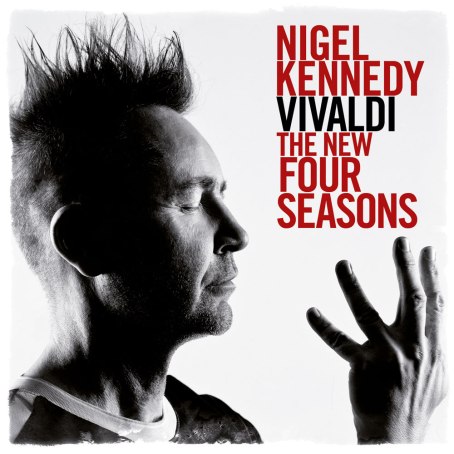
Nigel Kennedy: The New Four Seasons + Nigel Kennedy Dedications (Usher Hall: 27 Jan. ’16)


Editorial Rating: 5 Stars:  Outstanding

“Superlative musicianship … beautiful music from about two inches of steel E string  “

“Have you got anything by Nigel Kennedy?”  the enthusiastic lady said to the bemused shop assistant in the HMV Record Store, Oxford Street, some thirty years ago.  Mostly people asked for music by title or by composer, and when  by artist only those of a more traditional, established genre.  Here was a new phenomenon: the classical musician as rockstar.  Since then, more have come.  But Kennedy was the trailblazer.

It has been greatly to Kennedy’s credit that his unconventional dress sense and stage demeanour (fist bumps, shouts, foot stamping et al) has not got in the way of his superlative musicianship.  Yes, he has succeeded in making classical music more attainable, but not by getting into crossover or dumbing down.  Notwithstanding the informal approach, he has always taken his music intensely seriously.  Comparisons may be odious, but Joshua Bell played the Usher Hall a couple of weeks ago.  Both players are at the top of their game.  But I know who nailed it. 

Wednesday’s programme was a music critic’s nightmare.  None of the works (apart from the original ‘Four Seasons’)  is in the public domain (for once, Grove failed to come to the rescue) and the programme notes contained nothing about the music, just biographies of the band, a largely Polish contingent of exceptional ability.  I was on my own.

Never fear, Nigel introduced the pieces and in every one you could see where he was coming from.  First off was an Amuse bouche of a Bach partita that threw the theme back and forth between violin and cello, exquisitely played with a real bond between the star and talented acolyte Peter Adams.

There then followed four of Kennedy’s own compositions.  Dia Jarka, dedicated to contemporary guitarist/composer Jarek Smetana –  and as far as we can tell, no relation to Bedrich – had the guitars and double bass laying down a raga style line, with nuances of the Beatles’ Maharishi phase.   Stephane Grappelli was a folk/jazz fusion as one might expect, but not in the “swing” Grappelli style; more intense. Kennedy’s relationship with Grappelli, was, of course, similarly deep, from when he first disobeyed the orders of his over strict teachers at the Juilliard to go on stage to play jazz with the old man at Carnegie Hall, with brandy having been taken to steady the nerves as he risked expulsion.  One is reminded of Nureyev in his early days rebelling against the Kirov. Different political system; similar didactic musical approach.

For Isaac Stern came next with a beautiful interpolation of violin and viola, followed by a tribute to American bluegrass composer/violinist Mark O’Connor with the unusual but effective combination of violin, bowed double bass and guitar.

After some playful fooling around deceiving the audience they were going to hear more, Kennedy made the audience friendly announcement “Ladies and gentleman it is my sad duty to stop playing and let you go to the bar”.  So we did.

The second half was Kennedy’s signature piece, The Four Seasons, but in his own arrangement for strings, two guitars and piano.  It worked. Antonio Vivaldi would not be so much as turning in his grave as wanting to get out of it so that he could join the party.  There followed some forty five minutes of “extras” – one would hardly call them encores because they were generously offered without the audience asking, and a near three hour set was concluded with a sublime rendition of the Londonderry Air, taking it right up into the highest register (could it have been eleventh position?) and Kennedy still getting beautiful music from about two inches of steel E string.  I was reminded, perhaps not too strangely, how the Rolling Stones played way over time at Wembley in 1990 having had to finish early the previous evening.  Oh, Danny Boy, we were sorry to see him go, but, boy, had we had our money’s worth!

outstanding

StarStarStarStarStar

Reviewer: Charles Stokes (Seen 27 January)

Visit the Usher Hall

The Academy of Saint Martin In The Fields (Usher Hall: 10 January 2016)

Image: ASMF org.

Image: ASMF org.

“The quality of the playing was at a consistently high standard throughout.”

Editorial Rating:  4 Stars:  Nae Bad

A cold wet sleety January afternoon did not deter the hardy Edinburgh cognoscenti from gathering eagerly and loudly in the foyer of the Usher Hall on Sunday.  The Hall’s Twitter feed had advised  the 250 or so who had arranged to pick up their tickets from the box office to come early because of demand.  To begin with this certainly stopped the ticket queue from standing in the rain, and one got the impression the queue wouldn’t have minded anyway, but by 2.45pm the line was well out of the doors.

The draw was, of course, The Academy of Saint Martin In The Fields, perhaps the finest chamber orchestra in the world, now undergoing a new lease of life under the directorship of player/conductor Joshua Bell, subway busker and near megastar. Bell was certainly a brilliant catch for this magnificent band after Sir Neville Marriner’s retirement four years ago.

The other huge name on the bill was cellist Steven Isserlis, again, world class in stature.  The combined group are on a UK and European Tour, and it was Edinburgh’s turn to hear the magic.

The programme selection was both esoteric and matinee attractive.  The concert was relatively short, at a total of less than an hour and a half’s playing time, but nobody left feeling they had been short changed.  In art, as perhaps in matters of the heart, it is not so much the duration, but the intensity of the experience that provides the enduring memory.

The programme began with a snippet by Dvorak, “Silent Woods”, originally  “Waldesruhe”, a piece for piano for four hands, later transcribed for cello, and ultimately for cello and orchestra, which was the version we heard. Quiet, gentle, soothing, with flavours, understandably, of Smetana’s Ma Vlast, one wondered whether this lullaby-like jewel, played with such beguiling ease, would send the postprandial audience to sleep.

If it did (and the enthusiastic applause suggested otherwise) the blast of Beethoven’s Eighth Symphony would have them wide awake in no time.  This is not a great symphony, and apart from the lively Allegro vivace con brio, which the orchestra delivered in cracking form, the remaining three movements (a comment on the composition, not the playing), save for a spirited final Allegro vivace, plodded along a little.

After the interval we were treated to the second movement from Schumann’s posthumously published violin concerto,  along with a tiny but fascinating codetta written by Benjamin Britten.  Ten minutes of understated, beautiful playing, with Bell the absolute master of his art.

The concert ended with the “must have” item, the Brahms Double Concerto for Violin, Cello and Orchestra. What followed was secure, utterly capable ensemble playing with the two soloists interweaving with each other as warp and weft.  There was none of the stodginess you sometimes get in Brahm’s full on orchestration with the band moving nimbly through the familiar passages in support of the soloists.

Overall, not only did this concert have eminent soloists and an interesting programme, the quality of the playing was at a consistently high standard throughout.  At the time of their foundation 55 years ago, Sir Neville Marriner promised that the Academy would never go on stage unless thoroughly rehearsed.  True today as it was then, what we got was  not so much a concert as a performance, in the truest and fullest sense of the word.

nae bad_blue

Star (blue)Star (blue)Star (blue)Star (blue)

Reviewer: Charles Stokes (Seen 10 January)

Go to the Academy of St Martin’s in the Field.

Visit the Usher Hall and archive.


Scottish Chamber Orchestra: John Butt (Queen’s Hall: 10 Dec. ’15)

11 generations john butt real square listing

“But few will now be able to forget the jazz-like syncopations and whirling demisemiquavers”

Editorial Rating:  4 Stars

“Since 13 May 1871 Bach’s blood has ceased to flow in mortal veins!” concluded the Aberdonian scholar Charles Sandford Terry in 1930. Despite Johann Sebastian having 20 children, ten surviving to adulthood, it was for many years thought this centuries-old line of exceptional musicians had died out.

Genealogists have been delighted to discover, however, that the eldest son Wilhelm Friedemann Bach was not only a highly productive (if temperamental) musician, but through his fecund daughter a tiny band of U.S. based descendants have in recent years been discovered. At the Queen’s Hall on Thursday 10 December, it was for many the survival of W. F. Bach’s “Adagio and Fugue” F 65 (c.1740-5) which was the great discovery; the limpid flute-writing of adagio giving way to a vigorous and angular fugue of high order: subject, countersubject, stretto and inversion being hurled, attaco, by the enthusiastic players of the SCO.

Conductor John Butt firstly gave a stylish rendering of Johann Sebastian’s 4th Suite (Ouverture) in D, BWV 1069. The repetitive nature of gavottes, minuets and bourreés can sound tritely mechanical, but with subtle changes to phrasing and articulation, coupled with flexible tempi, the whole became animated and variegated, right up to the triumphal final Rejouissance.

Central to the programme was virtuoso bassoonist Peter Whelan, in the demanding C. P. E. Bach Concerto in A minor, Wq 170. Few will have heard this adaptation for bassoon before; but few will now be able to forget the jazz-like syncopations and whirling demisemiquavers. It is this superb instrumentalist who makes the galant writing a hit, and without him ovation and encore would be lesser or absent. Whereas the W. F. Bach work is a tribute to papa (reminiscent the more horribly difficult fugues of the Well Tempered Clavier (BWV 846-893), his brother at the court of Frederick the Great, namely Carl Phillip Emmanuel, is here in full rebellion against the structural emphasis of the father. The work swerves in mood and tempo: a son in a traffic-weaving go-faster Porsche, attempting to overtake the father in his stately processional Mercedes ……

The programme thus takes us from Baroque to Classical via the half-world represented by the Bach sons. To end: the well-familiar Symphony No 40 in G minor by Mozart; in the acoustic comfort-zone for many. Nevertheless, the minor key keeps the audience in thrall to the hints of tonal instability, and even menace, interplaying with the gracious theme of the first movement. At one point the strings’ suspirum seems more like expiration than sighing; and the natural horns are strangely dominant to one side of the hall. Their authentic resonance enlivens the sound universe for the work; more balance would be a further plus: try horns centre stage?

Meanwhile, let’s repeat this programmatic formula: the trusted repertoire enlivened by the Butt baton, and supplemented by the artful compositions of the younger Bachs. The audience went away filled with good things. May they return for more  …..


Star (blue)Star (blue)Star (blue)Star (blue)

Reviewer: Peter Smaill (Seen 10 December)
Peter is a guest contributor to Edinburgh49 and Chairman of Bach Network UK, a charity founded by John Butt and others to facilitate international dialogue and understanding of the works and context of Johann Sebastian Bach, amongst musicologists, performers and enthusiasts.

Go to the Scottish Chamber Orchestra

Visit the Queen’s Hall archive.