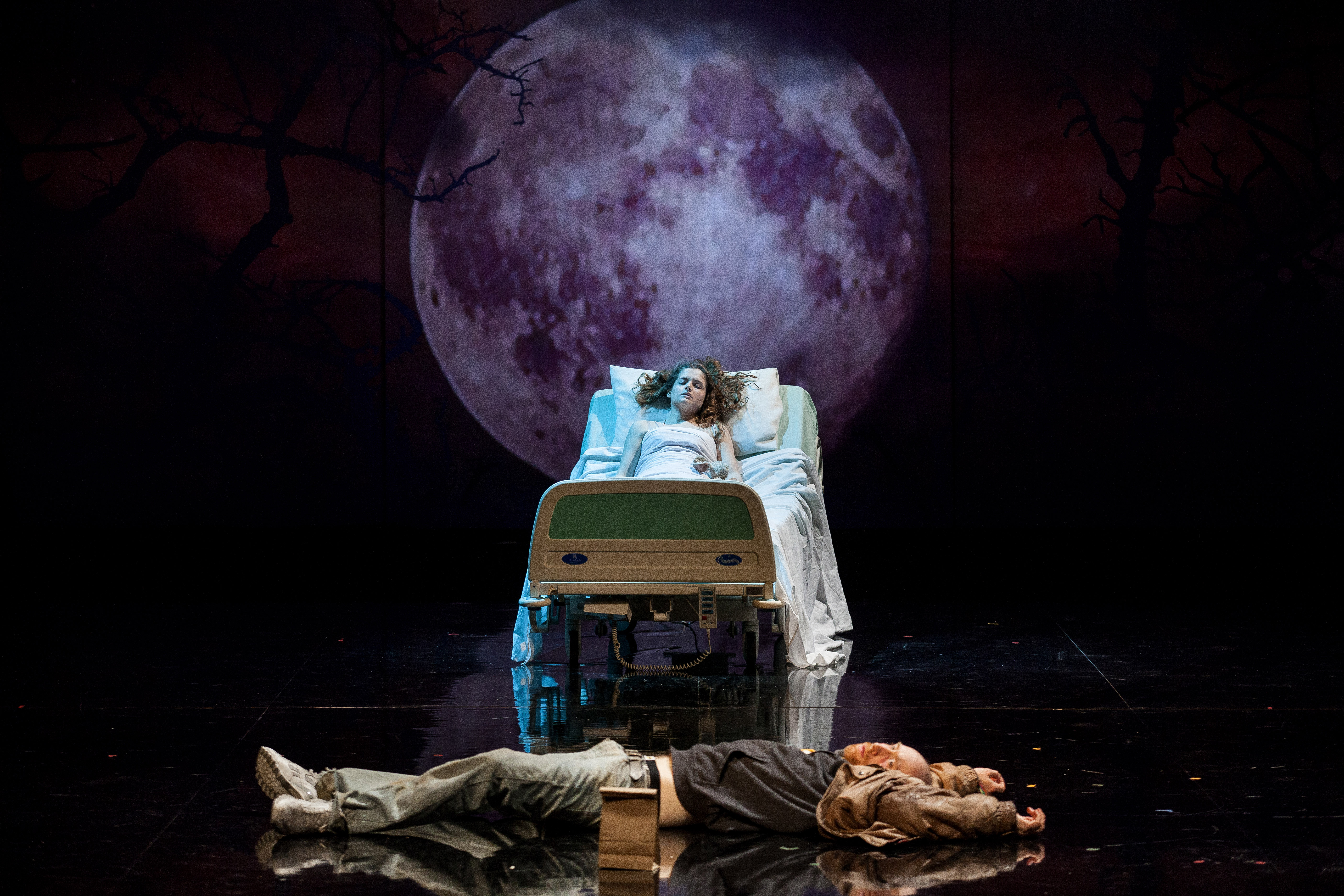
Glory on Earth (Lyceum: 20 May – 10 June ’17)

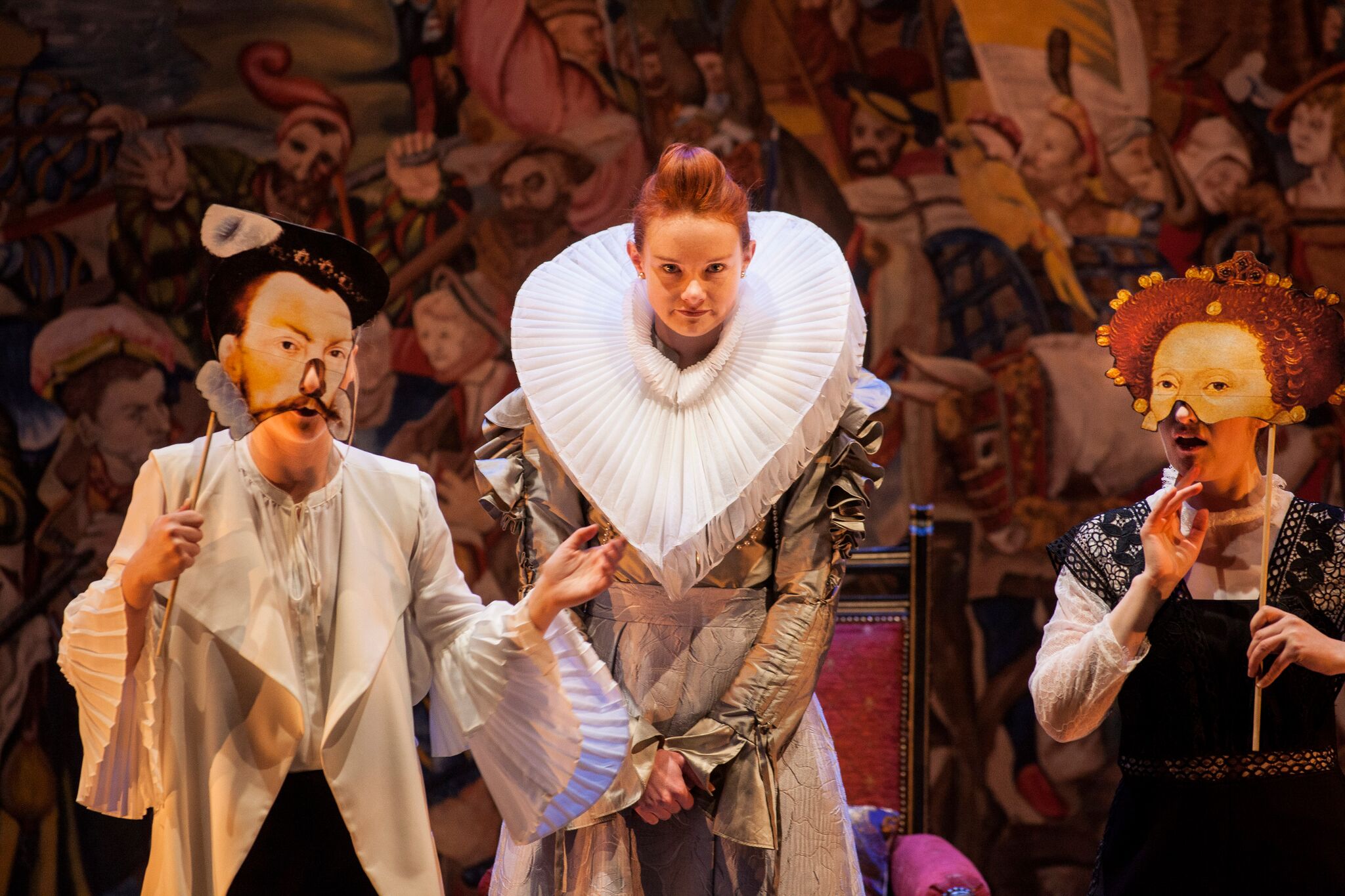
(L-R) Christina Gordon, Rona Morison, Kirsty Eila McIntyre
Photos: Drew Farrell

“Evocative, imaginative drama”

Editorial Rating: 3 Stars: Outstanding

You’re 18 and you don’t know the 2nd Psalm. Well, that’s you written off. You do know a good few dance moves but that doesn’t cut it. Your stock is worthless, you’re ignorant; best go home little girl.

Ah, but where’s home? And who are you calling cheap?

Ans: Mary Stuart, born Linlithgow, brought up in France from the age of 5; Queen of Scots and actually in Scotland from 1561 to 1568, forced to abdicate, kept ‘safe’ under house arrest in England for 19 years and then beheaded, aged 44, in February 1587. Mother, via the union of the crowns, of James VI and I.

So much for dates and titles – but that’s not to dismiss their grip, far from it – it’s just that Linda McLean’s new play creates evocative, imaginative drama from the baleful encounters of the young, attractive queen with the almighty John Knox. He’s there from the off, in front of the curtain, in clerical black and giving new definition to the reproving stare. God’s word, you understand very, very quickly, is “non-negotiable”.

At least Mary has the support of her ‘Marys’, six of them in this telling, who attend her, dance freakpop with her (… really liked that!), and review her suitors in a modern, OMG/ “Awkward”, kind of way. There’s a disciplined choric role in there too, in whispers, gesture, and half lines, as well as the harmonious choral interludes, mostly in French. In other, opposed, parts the Marys are privy councillors and reformers. Queen Mary’s life is here, opened and closed by the executioner’s block, but the tawdry and the sensational (& the melodramatic) are absent: no Darnley, no Rizzio, no Bothwell – just her searching and bold question to Knox, “Do you see a bad person, Sir?”

(L-R) Jamie Sives, Shannon Swan, Christie Gowans, Hannah Jarrett-Scott, Christina Gordon, Fiona Wood, Kirsty McIntyre, & Rona Morison

James Sives, as Knox, is too cool to rise to the question. And he’s damnably clever, in or out of his pulpit in St Giles. Hear Sives and hear the preacher’s ‘History of the Reformation’, righteous and utterly fearless. He walks on stage and kills the dancing stone dead. An unexpected and rather wishful soundtrack of France’s finest minstrels: Piaf, Francoise Hardy, Christine and the Queens (sic), cannot stand. However, Brel’s ‘La chanson des vieux amants’ probably does touch him, as he grieves for the loss of his first wife, but then Brel was Belgian.

Rona Morison, as Mary, has the sympathetic part, the level gaze (female) and the appealing voice. More principled and upright than pliant or weak, and so much younger, this Mary is an important addition to the historical strumpet/martyr and – should you browse Netflix – an invaluable corrective to the endless episodes of CBS’s  ‘Reign’.

David Greig directs with a clear eye on what mattered then and should still matter now. Knox won and Mary failed. The austere and the severe are there in the steel blue lighting and the greys of an uncluttered set and in Knox’s strict delivery. Where there’s a wide and colourful tapestry, there’s dancing and short-lived levity. Elizabeth I, speaking through a mask, is both laughable and ominous and maybe the scheming Scottish nobility could have used the same distancing device. The disrobing of the queen at the end has its own proper and tragic significance.

‘Be wise now therefore, O ye kings: be instructed, ye judges of the earth.
Serve the LORD with fear, and rejoice with trembling.’    From Psalm 2.

You won’t fall to your knees but Glory on Earth will make you give thanks for new writing and live theatre.
.

outstanding

StarStarStar

Reviewer: Alan Brown  (Seen 23 May)

Glory on Earth is at the Lyceum

Visit Edinburgh49 at The Lyceum
For The Love of Cousins (Various: 13 May-24 June ’17)

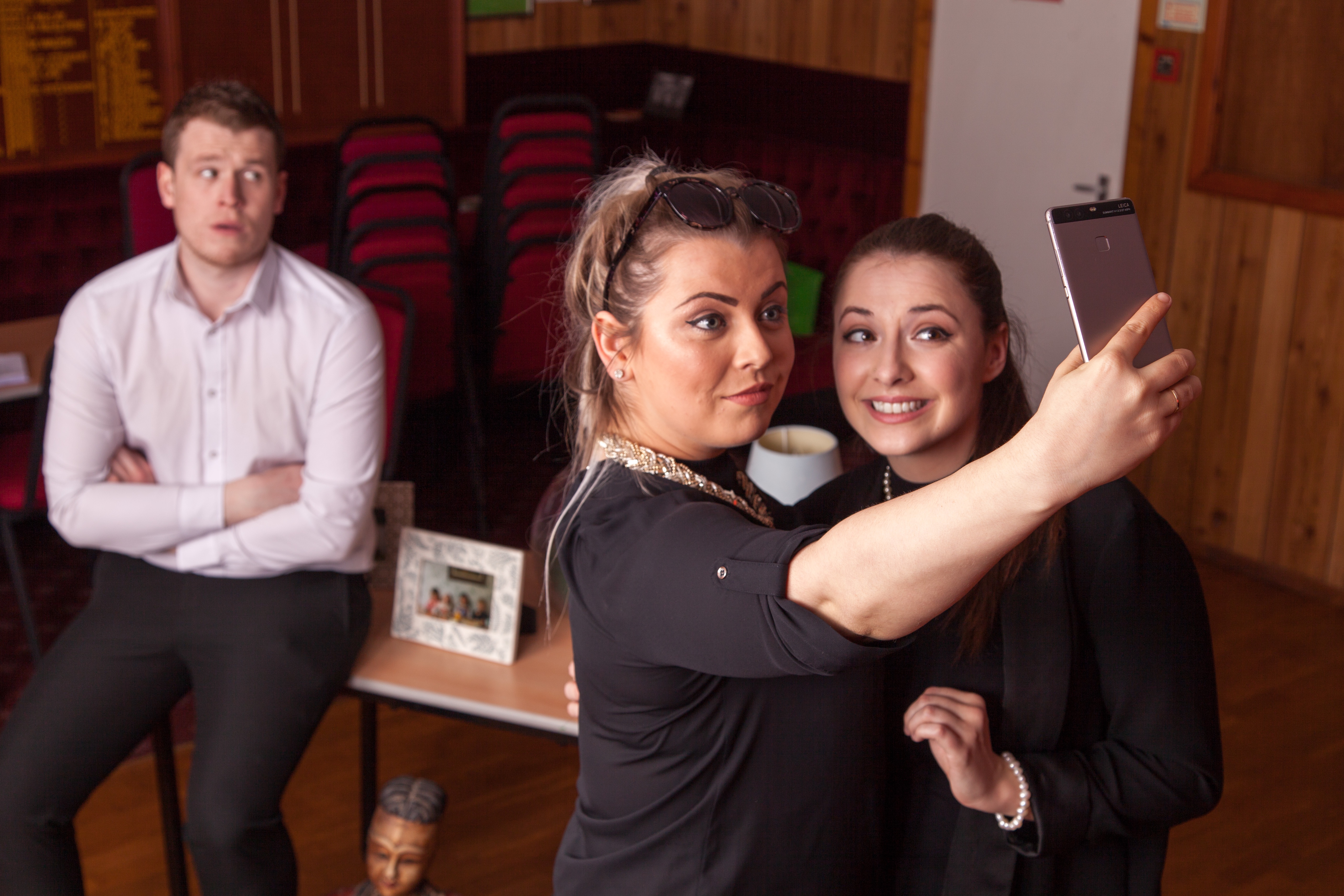
Jack Elliot, Taylar Donaldson and Christie Russell Brown

“A very commendable effort”

Editorial Rating: 4 Stars: Nae Bad

Funerals are often melting pots where far-flung family members are reunited for the first time since the last significant event, and in For The Love of Cousins, we see seven semi-friendly cousins meet just before the funeral of their mutual and much-loved grandmother. They are a mixed-bag of characters, with different stories and relationships with each other, and as the piece unravels, we learn more about each one – their secrets, their prejudices, and vulnerabilities.

While there is no compelling narrative overall, where Blazing Hyena’s production really succeeds is in the overall feel of the piece and the clear sense of family the company really creates – the use of repetitive jokes, the ganging up and snipping at each other all feel very genuine. Truths come out and perspectives change over the course of the action, all of which are presented humanely and sensitively.

For a play that centres around family members about to attend a funeral, it is packed full with jokes, and while the cast weren’t afraid to go for the laughs, sometimes the focus on the comedy aspect detracts from the realness of the situation, which some cast members are more guilty of than others. For me it is Jack Elliot as David, Rosie Milne as Dayna and Gillian Goupillot as Ronnie who are most impressive in maintaining the integrity of their characters throughout (while still being funny) and deliver fine performances.

Jack Elliot’s script, while commendable in its weaving of different characters and perspectives, is structurally a little rough around the edges – comings and goings of each character could be have more significance, while the closely intertwined nature of the dialogue sometimes makes it difficult to follow specific streams of narrative and relationships. A few tweaks here and there could make it very special indeed.

Catherine Exposito’s direction capably keeps the action slick, with respect to the light and shade required to keep the piece engaging throughout. Sometimes the staging and specific actions seem rather forced (I lost count of how many times a tablecloth was unnecessarily rearranged as a time-filler), so I would have liked to see the company use more creative ways to explore the natural “low” moments in order to maintain authenticity.

Overall, it’s a very commendable effort from this young company – especially given the adaptability they have to perform in different venues each night as part of this, an extensive Scottish tour. Do try and catch it on one of their future dates if you can. Full details here.

nae bad_blue

Star (blue)Star (blue)Star (blue)Star (blue)

Reviewer: Steve Griffin (Seen 16 May)

THIS REVIEW HAS NOT BEEN SUBEDITED

My Country (Traverse: 11 – 13 May ’17)

Penny Layden (Britannia) & Christian Patterson (Cymru).
Photo: Sarah Lee, NT

“A cocktail of feelings: a little sweet and pleasantly bubbly, with just the right amount of bitterness.”

Editorial Rating: 4 Stars Outstanding

Public opinion is a funny thing. A dramatic shift occurs in our society and suddenly everyone has something to say about it. Which is wonderful, of course. The more of us who care about what happens in our country, the better. But one of the questions that people always seem to ask in times like this is; “Do you remember where you were?” Do you remember where you were when the Twin Towers were attacked? …When you heard Michael Jackson had died? …When Trump was elected President?

Now, do you remember where you were on the morning of 24th June 2016? Brexit Day. GB hands the European Union ‘our’ divorce papers. From that day, the word spread around the country like a hectic rash, spouting from the voice of every radio station, newspaper and neighbour. It was unstoppable, all-consuming and tense, yet it seemed to arouse a willingness in the people to debate and engage with the current events of our nation.

So what if the voices of these ordinary people from across our great lands were trumpeted aloud for all to hear? A creative way of bringing about social change, perhaps? Or a spark that will encourage us to listen, and prevent the fire of the debate extinguishing? The National Theatre seemed to think so. And when the NT starts to roll with an idea, it tends to pay off. Headed up by the company’s own Artistic Director, Rufus Norris, My Country came to the Traverse Theatre last week as part of its UK tour, bringing with it the voices of these people for us to hear.

We are immediately welcomed to a boardroom by Britannia, played by Penny Layden. Olivier-award-winning Katrina Lindsay’s simple yet effective set is businesslike and blue, complete with water cooler and official-looking desks, as well as a row of ballot boxes to remind us why we are there. In come the regions: Caledonia, Cymru, East Midlands, Northern Ireland, North East, and South West, with Britannia as our Westminster. A strong set of seven, each actor representing the heart and soul of their respective parts of a still United Kingdom. And so the debate ensues.

While the cast are solid overall, there are a few standout performance among them. Chris Patterson as the booming voices of Cymru gives a performance that is both buoyant and vulnerable, shifting from brash old pub-dweller to the touching voice of a thirteen year old who only wishes to see the good in others. Equally captivating is Laura Elphinstone as the voices of the North East. Warm, honest and heartbreaking in her moments, she is fantastic to watch. But the glue holding the regions together is Penny Layden’s Britannia. Representing the heart of our government, Layden’s portrayal of Westminster’s politicians is spot on, generating both laughs and anger.

There is, at times, a slight risk of these performances dancing on the borderline of caricature, but the actors never cross it; these are real people with real stories to tell, and their words are treated with respect. Throughout the performance, Britannia constantly urges us to simply “listen”, despite our own opinions. And we do.

A verbatim piece could quite easily turn boring. In Edinburgh, where 74% of voters chose to remain, an audience could have been so opposed to the opinions of  ‘Leavers’ that they shut down completely. Yet that night in the Traverse Theatre, the opposite seemed to happen. We wanted to listen, and this is one of those special productions that generates a cocktail of feelings: a little sweet and pleasantly bubbly, with just the right amount of bitterness. It makes you angry and sad and happy all at the same time, and you’re not sure whether you should laugh, scoff or just let go and cry. Sadly only in Edinburgh for three nights, the company continue to move around the UK until its final performance on, appropriately, the 24th June 2017. Jump on a plane, train or bus and go and see this show. The question I would ask you in ten years is: do you remember where you were when you saw My Country? Don’t be one of the people whose answer is no.


outstanding

StarStarStarStar

Reviewer: Rachel Cram (Seen 12 May)

Go to My Country, National Theatre on tour

Visit the Edinburgh49‘s Traverse archive.

Charlie Sonata (Lyceum: 29 April – 13 May ’17)

Sandy Grierson as Chick. Lauren Grace as Audrey.
Photos: Drew Farrell.

“You have to wonder: tragedy or comedy .. or, better, a car crash of the two?”

Editorial Rating: 4 Stars: Outstanding

There’s been a road accident. One casualty, a 17 year old girl, is in a coma. Relatives and friends are gathered around her hospital bed for what could well be a long and awful night. Wait up! There’s a fabulous tousled fairy godmother with LED High Top shoes on. They’re flashing blue, which figures, but you have to wonder: tragedy or comedy .. or, better, a car crash of the two? So, bring on the dispassionate Narrator (Robbie Gordon), in neat suit and waistcoat, and pay attention. Lots of it.

Here is a story of a sleeping beauty – arguably the Sleeping Beauty – and of three pals from Uni’, of Mumsnet, soft play, mental health and booze. And there’s no stopping it: one hour and fifty five minutes with no break, just a red telephone box sliding on and off, establishing a line between London and Scotland, holding the line open between 1974 and 1994. Chick, Prince Charlie Sonata III, walks the line, unsteadily, with whisky in his grip bag and love in his heart and Neil Young’s Needle and the Damage Done (1972) on his lips.

You cannot help but love Chick in return. For a start, he read English rather than Law at Stirling; he’s also selfless, trusting and honest, and … completely wrecked to the point of offering earnest and lucid advice about alcohol consumption to a 13 year old. See Sandy Grierson in the role and you see a fallen saint: downcast, stooping, shabby, ‘a disgrace’, who may have given up on hope and faith but never on charity.

Granny in Douglas Maxwell’s Yer Granny is a gleeful barking grotesque in carpet slippers in a tenement. It’s contained comic strip Broons territory. In Charlie Sonata, directed by Matthew Lenton, Maxwell puts wasted innocence out there and as a drama it’s immediately more troublesome, more responsible. Where’s emergency care when you need it? Not with consultant surgeon Mr Ingram (Barnaby Power), who has forgotten the name of his patient. Try the drunk in the pub opposite. “Where’s your adult?” is one (funny) call; “Can this be right?” is another, the Narrator’s more insistent appeal to an audience looking for help between the shifting scenes.

It’s inventive and knowing and addled but I liked it, not least because of the play’s sincere attention to youth and to growing up. Chick made a mess of it. ‘Why?’ goes unanswered. His bladdered time in London is abject and you will wince at the cockney creatures who prey on him. Kinder, but not kind enough to invite Chick to their wedding, are Gary (Kevin Lennon) and Kate. Gary is the lawyer, a happier student than he is a bullied lawyer. Kate (Kirsten McLean) is not at all sure that she has got her parenting sorted. Her daughter, Audrey (Lauren Grace), is the RTA casualty that Chick would save, and quite right too as she’s fun, quick, and charming. Jackson (Robbie Jack), the handsome third of the Stirling Uni’ trio, reckons that as time folds in on itself, you’re much better off living in the 60s, even though it’s the 90s. Hence, no doubt, why he’s ended up owning Castleland, a children’s play centre.

Sandy Grierson as Chick with Meg Fraser as Meredith.

Then there’s Meredith (Meg Fraser), all mascara and running lights below the tutu, and banter. She has ‘history’ as well – all too naughty and recent in the case of the Latvian choreographer – but she’s a kindred soul for Chick. And she brings with her the land of faery and make-believe and shimmer (brilliantly, momentarily, visualised by designer Ana Inés Jabares-Pita) where – in Chick’s words – “if there’s love, the thorns will part”. Go see for yourselves.

outstanding

StarStarStarStar

Reviewer: Alan Brown (Seen 3 May)

See Charlie Sonata at the Lyceum

Visit Edinburgh49 at The Lyceum  archive.

Edinburgh Academy Musicians (Queen’s Hall: 28 April ’17)

image-124.jpg

 “Almost three hours of glorious, live music, from the promising to the near professional”

Editorial Rating:  4 Stars: Nae Bad

That the Edinburgh Academy hires the Queen’s Hall for their Summer Concert is not just a capacity issue but a fitting testimony to the quality of their music.   Yes, perhaps the venue shed a little magic dust over gifted performers, but in turn they rocked the joint in in an eclectic programme that ranged from Vivaldi to Katy Perry and kept us engaged all evening.

Parents, whether it is for amateur dramatics or any other of the performing arts, are a loyal, enthusiastic and forgiving lot, but there was no need for any suspension of the critical faculties or parental indulgence here.  The students acquitted themselves magnificently.  Every moment of the evening was a pleasure, none a duty.  Some of it passed for professional standard. As the evening progressed it became clear that many of those performing were talented musicians who just happened to be at school, not students who just happened to take the music option.

As I found my way to my seat I was accompanied by the merry chink of ice in glasses as stressed out, end of the week parents – and benign grandparents – found comfort and delight in the Queen’s Hall’s bar. I noted no less than eight acts and 18 works in the programme. It would be wrong to exclude any from commentary.

The orchestral pieces comprised the first part of the evening and ranged from a disciplined Junior Orchestra who concentrated hard and demonstrated good phrasing and tempo, with some really effective pizzicato in the Shrek Medley and some good underpinning by the violas and cellos. Lily Penman, in particular, deserving an honourable mention on the cello front desk, and – to no one’s surprise –  appearing latterly in the senior orchestra. The Ragtime rendition got a good swing rhythm going.


image-4.jpg


Next up we heard the String Orchestra with Timothy Wong delivering an assured rendering of the Allegro from Haydn’s Violin Concerto in G major with good bowing and attack, followed by Hugh Cameron playing Vivaldi’s Concert Sonata No 5, who once in his stride showed great feeling and in the Allegro demonstrated an assured and well executed piece of playing. Confident violins led us into the beautiful melody of Allegro piacevole from Elgar’s Serenade for Orchestra Op 20, sensitively played with a good melodic line.

The Senior Orchestra then came on to tackle three early concerto pieces and an ensemble. First up was Ross Macnaughton playing the Allegro from the Bassoon Concerto in B flat Major by Mozart. Ross got great tone from this difficult instrument and made it look easy. It isn’t. He demonstrated an extraordinarily well executed cadenza including a couple of splendid Mozartian farts in the lower register. Great keywork and phrasing with terrific breathing. Matthew Black followed on with Mozart’s Andante in C K315 for flute. Matthew has a very clear, pure tone and the orchestra brought a real sheen to some of their playing and good pizzicato.   Jean-Claude Hubert’s clarinet brought a beautiful rich tone to the Weber Concertino, demonstrating real mastery of the keys in the Allegro. The orchestra were at their best in the concluding Pomp and Circumstance march no 1 in D by Elgar, causing one member of the audience to sing along and this writer and his companion to sway a little, Proms style.   Perhaps late nineteenth and early twentieth century music is best for developing orchestras, earlier compositions leaving things a little exposed.


image-59.jpg


Following the interval it was Band time. The Junior Concert Band punched above their weight with a warm, expansive tone in Brian Balmages’s Rain. The Senior Concert Band kicked off with Copland’s Variation on a Shaker Melody, with a spot on trumpet opening, echoed by the clarinets in a thoughtful, competent and uplifting piece of playing. The rock solid rendition of the Star Wars theme provided a lively, brass driven contrast.

Now it was time for the Voice. The G2 Choir, so young in years, demonstrated an early grasp of the discipline of choral singing: immaculately presented, eyes on the conductor, no music, and purity of youthful sound making up for any relative loss of volume. Big shout out for the soloists as well, and a good sense of rhythm in both Wade in the Water and Electricity (from Billy Elliott).

Sophie Penman and Kirsten Taylor gave a clear and assured performance of the Laudamus Te from Vivaldi’s Gloria, backed by a string quartet, playing standing as is often the Chamber style. Intriguing to hear this large-scale work played in miniature. It worked.

The Chamber Choir were a joy. The best was plainly being kept until last. Very clear diction, focus and precision with a good balance between soloists and ensemble was shown in Billy Joel’s The Longest Time. Eric Whiteacre’s Sleep, in pure musical terms, was the event of the evening: beautiful tone colours, effortless moving up and down the dynamic range, unforced, quietly confident with assured handling of the dissonance, this moving piece was not so much sung as painted. The choir concluded with a clever and sensitive arrangement of Katy Perry’s Chained to the Rhythm by their conductor/director Angus Tully, who actually stopped and restarted them when they temporarily lost their way in a difficult piece that they were singing without music. I have only seen this done once before and that was by Nigel Kennedy! Nobody minded. It was great to get this unofficial encore.

image-148.jpg

If musically the Chamber Choir was the act of the evening, the Big Band topped the bill for sheer entertainment value. Masses of noise in Starsky and Hutch, huge musical laughs in the Pink Panther, with the finale of Quincy Jones’s Soul Bossa Nova No 2 bringing the house down. Terrific solos on Sax by Jean-Claude Hubert and Freya Scott, drums by Niclas Coli, Daniel Jourdan on vibes and others, I am afraid, too numerous to mention. A very talented bunch.


image-171.jpg


So there we have it, not so much a concert but a festival of almost three hours of glorious, live music, from the promising to the near professional. Philip Coad and his team played a blinder and the musicians themselves should be proud. In an age where the teaching of music is in danger in many schools, the Edinburgh Academy provides a beacon to how it should be done. “Grounded in Scotland, ready for the world” was emblazoned on the school van as I walked back down the alleyway from the rear entrance to the Hall. Yes indeed, the future of live music, whether in Scotland or even perhaps the world, is safe in the hands of those gifted young people we heard tonight.

nae bad_blue

Star (blue)Star (blue)Star (blue)Star (blue)

Reviewer: Charles Stokes (Seen 28 April)

Go to the Edinburgh Academy website

Visit Edinburgh49 at the Queen’s Hall archive.

RSNO. Sondergard, Williams: Beethoven, Mahler, Sibelius (Usher Hall: 21 April ’17)

Image result for Sibelius pictures

Jean Sibelius (1865-1957)

“Their playing of Sibelius’s Finlandia was one of the best, if not the best, I have ever heard, live or recorded. “

Editorial Rating: : 4 Stars: Nae Bad

One of the excitements of live music is that you never know quite how it is going to turn out on the night. You think you’ve got it at rehearsal, but performance is something different. Only a very few orchestras turn out a consistently really high standard, time after time.

After two years in Edinburgh I am becoming increasingly impressed by the quality of the local bands, and Friday’s concert contained some excellent playing in a well chosen, thoughtful programme that while relatively well supported was deserving of a larger audience. Clearly the Florida sun has sown benefits. It was a very good concert indeed.

The RSNO’s opening numbers are sometimes a little shaky before they get into their stride. Not so tonight. Their playing of Sibelius’s Finlandia was one of the best, if not the best, I have ever heard, live or recorded. The opening chords of the brass were well rounded and melodic whilst still conveying the angst of the Russian threat to the mother country in this highly nationalistic piece. Not a trace of blaring or vulgarity. The mournful strings provided a similarly well-rounded tone in what was a very well executed opening number, convincing and moving. Applause was loud and long. Deservedly.

It was a very interesting choice to follow with Mahler’s Der Knaben Wunderhorn, a less austere work than Kindertotenlieder, or, for example, Das Klagende Liede.   Five songs were selected from the original 24 settings, covering nature, folklore and soldiers’ tales. Baritone Roderick Williams gave a well-executed performance in which the orchestra again shone, but perhaps a little too brightly. There were issues of balance between soloist and orchestra and one would have preferred the soloist not to have referred to his music.   This notwithstanding, the intriguingly named “St. Anthony of Padua’s Sermon to the Fish” was sung and played beautifully, and was well balanced. Also, “Where the Fair Trumpets Sound” was the star of the set with gentle orchestral backing, melodic singing.

After the interval it was back to Sibelius and The Oceanides. I confess I had not heard this 11 minute miniature before and I loved it. It started with a most unusual but effective piece of string writing that reminded me of sea mists and tides, to be followed by the increasingly effective flute section before building to something stronger involving the whole orchestra evoking the ocean’s sheer vastness and permanence. Commissioned and first performed in America, one critic described the new work (1914) as “the finest evocation of the sea which has ever been produced in music”. Well, there is plenty of competition for that, not least Debussy’s La Mer, but it certainly stands the comparison.

Our evening was brought to a close by Beethoven’s Symphony No 1 in C Major. Critics have often categorised his first two symphonies as Mozartian, with the composer coming of age with the Eroica. I am not so sure. The first few bars’ shifting harmonic sands alone, quite startling in early 19th century Vienna, point to something more revolutionary, and although there is a classical theme overall  – such as can be found in both Mozart and Haydn –  as Tovey said, the symphony has “more of the 19th century Beethoven in its depths than he allows to appear on the surface.” This contention was certainly supported by Thomas Sondergard’s interpretation, which was mature and grounded in what was a hugely enjoyable performance by an orchestra that was clearly loving what it was doing. So did we.

nae bad_blue

Star (blue)Star (blue)Star (blue)Star (blue)

Reviewer: Charles Stokes (Seen 21 April )

Go to the RSNO website

Visit Edinburgh49 at the Usher Hall archive.

A Number (Lyceum: 6 – 15 April ’17)

(L-R) Peter Forbes and Brian Ferguson
Photo: Aly Wight

“If a play can have a cell line, this is it”

Editorial Rating: 4 Stars: Nae Bad

Presented in partnership with the Edinburgh Science Festival

Caryl Churchill’s A Number is 15 years old. It’s still Sci-Fi though, as opposed to science history. Yes, Dolly the sheep, the world’s first cloned mammal born on 5 July 1996, is now referenced as Exhibit Z.2003.40 in the National Museum, but there’s still no comparable human ‘display’. And if ‘it’ does appear – when it appears? – it might well provoke some distress amongst its close relations. So, there’s the scenario.

Bernard 2 (35) finds out that he is one of an unknown number of cloned Bernards. He’s not at all happy about it and his father doesn’t help by saying that he doesn’t know how many ‘things’ are out there either. Dad, for painful reasons, thought he’d signed off for one, not a whole batch. At which point you might idly recall Miller’s All My Sons or, better, Huxley’s Brave New World and the Bokanovsky Process that could, on average, produce 72 embryos from a single egg. However, Dad hasn’t read the book. No chance. Dad is far less interested in informed consent than in what an able lawyer can do for him, for them even, and he has a point …

A Number opened at the Royal Court Theatre in London on 23 September 2002. The public inquiry into unauthorised organ retention at Bristol Royal Infirmary and at Alder Hey hospital, Liverpool, had delivered its final report in January 2001. By early 2003 families of the victims at Alder Hey accepted an out-of-court settlement of £5 million. The Human Tissue Act (Scotland) followed in 2006.

If a play can have a cell line, this is it: 50 minutes of tightly sequenced work by two actors; five exacting scenes between father and son(s) played out within a small bare room beneath a naked bulb. It’s stark and clean, with wallpaper from the DNA Helix collection. There is no warm light until the appearance of the affable Bernard 3, aka Michael Black. Scenes divide suddenly as the ‘family’ multiplies.

As Balvennie in the James Plays Peter Forbes grabbed land and titles with all the appetite of a lesser man on the make. In A Number he’s the father, Salter, and he’s on the defensive in a sympathetic study of the ethically dispossessed. Brian Ferguson plays three differently consituted Bernards: searching, angry, and content. It’s a nimble and impressively disciplined act, even when toppling a chair across the stage.

Smartly directed by Zinnie Harris, this is a brisk and absorbing production of a play that always invites critical admiration. Churchill does not offer any way out of the cloning debate but she certainly moderates it. Next time that you shop for a Little Gem Lettuce you will – (!)cos of this play– examine it a tad more specifically, wondering not ‘How many?’ but ‘Is that me?’

nae bad_blue

Star (blue)Star (blue)Star (blue)Star (blue)

Reviewer: Alan Brown  (Seen 8 April)

Go to A Number at the Lyceum

Visit Edinburgh49 at The Lyceum archive

Girl in the Machine (Traverse: 3 – 22 April ’17)

Rosalind Sydney as Polly.
Photos: Mihaela Bodlovic

“Galvanising”

Editorial Rating: 4 Stars

Time was when wireless simply meant a radio and Mr Chips taught Latin and Greek. Now we’re practically Wi-Fi dependent and it’s definitely ‘Goodbye, Mr Chips’ and ‘Hello’ Citizen Chip. Soon enough you’ll be living beyond 120 and if you’re lucky the worst you’ll suffer physically is an itchy forearm when your chip is updated. Mentally, however, you might get fried.

That’s where Stef Smith’s galvanising new play has us: in the near enough future when ‘the gap is getting smaller between the human and the hardware’. ATMs now ask how you’re feeling and robots are cleaning up on the wards. Owen, a Charge Nurse, might be out of a job soon. The only ‘shit’ left to deal with is what his lawyer wife, Polly, does for a living, for the outside world is going down the pan big time. Stress is a plug-in on her iPad Pro. Polly is not in a happy place, although she does love Owen and he loves her. He’s just brought her a present in a black box to help her feel better, which it does, but she really should have just stayed with the nice hot bath, the scented candles and a glass or two of Merlot.

It’s a container load of a drama, ingeniously designed and neatly packaged. Owen and Polly inhabit a rectangular box, complete with geometric floor covering and modular seating. It’s a neutral, pastel space inside a post-industrial shell. It must have been tempting to put an Amazon Echo (or Samsung Smart TV) centre stage; as it is, Polly is freaked out by a data file eavesdropped from her memory of better days whilst Owen appreciates how ‘our house looks much bigger with no electricity in it’.

This must be the angst of a neo-Millennial generation – and not that of those who worry whether their passports should be blue or burgundy. Polly (Rosalind Sydney) and Owen (Michael Dylan) are in their 30s, see their neighbour as a man ‘whose face looks like a smashed circuit board’, and yet wonder at their growing inability to feel for each other. Polly is digitally hooked, ‘twitches’ for a connection and finally, fatally, makes one. Owen resists the circuitry. That this is a loving relationship in crisis is never in doubt – such is the quality of the performance – but that the destruction of an intelligent woman is caused by a gadget on speed is more of an ask. The script also suffers from some philosophical surges that are best characterised by Polly’s despairing repetition of ‘I can’t stop thinking’.

Michael Dylan as Owen.

The villain of the piece is the arch voice of the Black Box programme. It seduces indiscriminately and without mercy, because it’s a rogue bot. The hero is certainly Orla O’Loughlin whose sympathetic, human, direction moves her two actors every which way along a traverse stage, not least to the killing beat of Kylie’s ‘Can’t Get You Out Of My Head’ (!), and who also holds them together in still exchanges that in less capable hands could sound derivative and forced.

Back in 1934, in Mr Chips’ last days, Black Magic chocolates were a year old. He probably gave Mrs Chipping a box of them and didn’t worry a jot about their tantalising centres. And then came the digital age and a virtual Raspberry Heaven (or Caramel Caress).

Star (blue)Star (blue)Star (blue)Star (blue)

Reviewer: Alan Brown (Seen 5 April)

Go to Girl in the Machine

Visit Edinburgh49 at the Traverse .

Edinburgh Quartet (Queen’s Hall: 27 March’17)

Painting by Erik Petrie

“The band’s playing being bolder and more committed as they got into their stride”

Editorial Rating:  3 Stars

The life of a professional musician has always been tricky, whether you were Mozart churning out prodigious quantities of glorious music against impossible deadlines and demanding creditors, Shostakovich keeping Stalin and his apparatchiks at bay, or even today as a rank and file player with the necessity often to freelance and keep several irons in the fire, both for the benefit of professional development and regular employment.

All these aspects were present at Monday’s Queen’s Hall recital by the Edinburgh Quartet. First, the line up. The first violin desk has been filled by a variety of (very talented) artists since Tristan Gurney left for London last year and was tonight filled by Zoe Beyers. Second violin Gordon Bragg also plays for the RSNO and is currently touring with them in Florida, his place being taken on the night by Tom Hankey. Catherine Marwood ably took the viola desk on behalf of Fiona Winning, leaving only Mark Bailey on cello as part of the regular band. I am afraid, notwithstanding good individual playing, it showed – a bit. Talented individuals do not necessarily an ensemble make.

The evening started with Mozart’s String Quartet in D Major K575. Composed towards the end of his life and published posthumously it is an enjoyable work that allows each member of the band to show off their individual talents, a wise choice here in that their experience of playing together is limited. It made for an easy to get into start to the evening, with Catherine Marwood’s viola to the fore supported by Mark Bailey’s Cello.

There followed Shostakovich’s String Quartet No 1 in C major. A short (fourteen minute) romantic work, yet of some intensity but also tunefulness, it surprised and pleased the audience as not coming as too much of a shock after the Mozart; the band’s playing being bolder and more committed as they got into their stride.

The evening concluded with Beethoven’s String Quartet in C major No 3 ‘Rasumovsky’ one of three so named after its sponsor, the Russian Ambassador to Vienna. Again, the work offers plenty of scope for the individual players to respond to, as well as some good ensemble playing as the Quartet were by now fully warmed up. There was real verve in the opening movement, particularly in the Allegro vivace, smooth togetherness in the Andante con moto quasi allegretto supported by well despatched cello pizzicato and really good ensemble playing in the Menuetto. The work was brought to a close with a high sprirted, high speed Allegro molto.

The concert was part of the Edinburgh Quartet’s season branded ‘EQ:Revolution’ and as before an artist from a different genre offered a complementary interpretation. In this instance it was Erik Petrie who went on stage, as he has done at others, to describe three colourful artworks, influenced by music and revolution, commissioned by the Quartet. The theme is certainly applicable to Shostakovich but more nuanced elsewhere. Petrie is an artist and was a little uncomfortable talking, understandably so when mentioning that the artworks were available for sale, albeit with the very noble cause of thereby providing financial support to the Quartet.

Star (blue)Star (blue)Star (blue)

Reviewer: Charles Stokes (Seen 27 March)

Go to the Edinburgh Quartet

Visit Edinburgh49‘s Queen’s Hall archive.

Casanova, Northern Ballet (Festival Theatre: 23 – 25 March ’17)

Giuliano Contadini as Casanova.
Photos. Guy Farrow, Northern Ballet.

“Sooo awesome!”

Editorial Rating: 5 Stars: Nae Bad

Casanova is a brand new ballet on its world premier tour, choreographed by Kenneth Tindall in his first major work. This could have gone either way but be reassured: this is a really exciting piece.

The story itself is based upon the life of Giacomo Casanova, taken from Ian Kelly’s biography of Casanova. It starts with Casanova (Giuliano Contadini), a trainee priest, intent upon following his vocation when he meets musicians the Savorgnan Sisters, Nanetta & Marta (Abigail Prudames and Minju Kang). Together the sisters seduce the young priest and take his virginity. Upon discovery, Casanova is cast out of the seminary with only his violin and a book: a forbidden text given to him by Father Balbi (Jeremy Curnier), a renegade priest who, being hunted by Inquisition, offloads the book on to the young man.

What follows is a story of the rise and fall of Casanova, first in his native Venice and afterwards again in Paris after being forced to flee by the Inquisition. Casanova takes himself seriously: he is an intellectual, a mathematician and a social climber. Ultimately though it is a story of talent wasted through dissipation and through that, he loses the women who loved him and whom he loves in turn: Henriette (Hannah Bateman) and Manon Balletti (Ayami Miyata).

In the central role of Casanova, Contadini (almost literally) carries the entire production. This is an incredibly demanding performance, having to show a wide range of emotions, the intellectual acuity, the boredom of unending lust and upmost despair to the brink of self destruction. Contadini is a good choice: the proportions of his Italian frame adds a level of authenticity to the production. The role itself is incredibly physical, one of the toughest I have seen for a male dancer, so it is with little wonder that there was just the slightest sign of fatigue by the end. As Henriette, Bateman’s performance is very moving and, as the nun M.M., Ailen Ramos Betancourt is extremely seductive. The cast delivered their roles wonderfully in a fabulous ensemble performance. Casanova should be sexy and frankly this lot are sex-on-a-stick. Christopher Oram (Costume and Set design) really delivers on this point: creating dance costumes that invoked the 18th. Century while being as revealing as a Berlin cabaret. His set is extremely versatile, which along with the change in lighting (Alastair West) allows the action to be set in the grandeur of Venice, in the glitter of Paris and down in the dungeons of the Inquisition.

The whole production is driven, almost relentlessly, by the score written by Kerry Muzzey. Again the music is modern while being true to the roots of the period. For this writer it brought back memories Michael Nyman’s music for the film The Cook, The Thief, His Wife and Her Lover (1989). The music certainly is cinematic in quality, which is reasonable given this is Muzzey’s background. One audience member was heard to say afterwards “You could have watched that blind. The music!” Tindall is reported as saying that he approached Muzzey to create the music because neither of them have had the experience of creating a major production for ballet before. It shows, but not in a bad way. If one is used more to the Russian style, the choreography perhaps lacks the ostentation and even some of the elegance in comparison. However, the audience is instead offered something a lot more visceral and more approachable. During the interval I met a friend in the audience who had never seen a ballet before. Her eyes were glowing as she said “It is sooo awesome!”

In Casanova, Tindall has created a new ballet which is quickly going to be accepted as a modern classic.


nae bad_blue

Star (blue)Star (blue)Star (blue)Star (blue)Star (blue)

Reviewer:  Martin Veart (Seen 23 March)

Go to Casanova at the Festival Theatre and to Northern Ballet

Visit Edinburgh49’s  Festival Theatre archive.