‘Yoga with Jillian – A New Comedy’ (Venue 33, until AUG 28th Aug)

“…a screwball comedy that feels more like sitting in as a visitor at the yoga class from hell rather than watching a play.”

Editorial Rating: 4 Stars (Nae Bad)

Described by producers Project Y and Richard Jordan Productions as a screwball comedy, this drama feels more like sitting in as a visitor at the yoga class from hell rather than watching a play. As the title suggests, this is quite a physical drama, not only on the part of the eponymous protagonist, but also from the seven volunteer audience members who joined her on stage to do their stuff on mats.

But Jillian is no carrot juice-drinking guru; Michole Biancosino plays her as a feisty, neurotic ex-lawyer, who uses yoga to cope (not always successfully) with her chaotic urban life. Whilst celebrity yogis like Gwyneth Paltrow may exude glamorous woo-woo tranquillity, at one with the world around her, Jillian sometimes struggles to find enough inner peace to even get along with her rival yogis. As the show progresses, the ancient Hindu fitness philosophy is used as a framework and metaphor for the ups, downs, stretches, and fine balances of Jillian’s life story. Whilst a none too perfect practitioner herself, she is a less than fully sympathetic teacher, as her passive-aggressive relationship with her “class” often shows to hilarious effect.

The seven audience members (two men, five women) who joined the class onstage lend a weirdly voyeuristic vibe to watching the show that is quite different from a normal audience experience in a theatre. At several stages, we found ourselves facing a row of seven backsides presented to us as the class bent over to touch their toes. From my front row seat, at one point I had a man’s right foot only two feet from my face as, at Jillian’s bidding, they adopted the downward-facing three-legged dog position. At the other end of the stage, a middle-aged woman in a calf-length dress had perhaps wisely turned herself to face the audience into order to more modestly point her leg upstage. It must be said that these volunteers were able to do what was asked for them without too much stress or embarrassment. (Though, if you’re going along and plan to volunteer – maybe wear leggings and have a pedicure beforehand?)

Whilst yoga itself may not be a pursuit to everyone’s taste, this show is nonetheless a quirky, ironic take on its subject, rather as I’d hoped it would be. Lia Romeo’s writing comically explores the conflict between the outwardly calm philosophy of its subject and the angst-ridden lives of some of its devotees. So, get your coats on and go see it. Go whether or not you’ve been to a yoga class before. Stay for the mat-based philosophical humour. Leave thinking about how all of that stretching and balancing helps to soothe some screwed-up lives.


ALL our recent coverage? Click here!

‘…And This Is My Friend Mr Laurel’ (Venue 33, until AUG 28th)

“There are laughs aplenty in this show, but the problems the two men faced in their personal and professional lives provide a strong undercurrent of tragedy and pathos. “

Editorial Rating: 4 Stars (Nae Bad)

To draw a full house for a late morning show on the first Sunday of the Fringe bodes well for any show up here. Is it the pulling power of a performer with a successful TV career behind him, or the familiarity of the eponymous subject? Either way, ex-sitcom star Jeffrey Holland (Hi-De-Hi, You Rang, M’Lord) drew a round of applause upon his entrance as well as at the end of this entertaining one-man show in the Pleasance Courtyard Upstairs.

Set in the bedroom of a very ill and silent Oliver Hardy in the 1950s, this tragi-comic drama shows us Stan Laurel’s last visit to see his dying former screen partner. Perhaps wisely, Holland avoids a constant tribute-act impersonation of Laurel, preferring to rely for most of the performance on a more relaxed off-screen version of the legendary comedian’s persona. However, there are regular short episodes where, donning a bowler hat, Holland enacts memorable exchanges from their most successful films; and here we get a fine impression of Laurel’s absurd comic gravitas, along with Ollie’s frustratedly blustering replies.

There are laughs aplenty in this show, but the problems the two men faced in their personal and professional lives provide a strong undercurrent of tragedy and pathos. With Ollie struck dumb by a crippling stroke, it’s left to Stan to look back on the triumphs and frustrations of their Hollywood career. As anyone familiar with their work knows, those short films from their heyday in the 1930s usually portray the couple as a pair of bums down on their luck and trying to make a dime in the Depression-era USA. It’s sad to note that the reality of Hollywood at the time meant that, despite their huge success, the two actors received only comfortable salaries, rather than the mind-boggling fees that stars expect today. Laurel in particular should have been a millionaire as the scriptwriter of their immortal routines. At several points Holland breaks down to portray what must have been very a real frustration felt by Laurel upon realising how he’d been ruthlessly exploited and fleeced by the studio system of the day. As this play suggests, the familiar trope of the melancholy behind the comic mask is very real – Tears of a Clown, indeed.

As is also quite well known, both men had chequered personal lives involving multiple and often disastrous marriages. This introduces more light and shade, with Holland movingly contrasting happy memories of love and romance, soon clouded over by the dark shadows of some messy divorces. Was there even a hint of mutual resentment between the two? Though a passive stooge on screen, Laurel was the leader behind the scenes, slaving at his typewriter and thrashing out deals with the studios whilst “Babe” (Ollie) spent his days on the golf course.

This already popular how runs until the end of the month, so get your coats on and go see it! Go to see a telly star play a film star. Stay to laugh at the jokes then cry along with Stan’s tears. Leave with the thought that screen laughter is often dearly bought by those whose lives are devoted to entertaining us.

‘Edgar Allan Poe: The Murders in the Rue Morgue’ (Venue 53, until AUG 26th)

“…a slick performance in which his character exudes the gravitas required of a predecessor to Sherlock Holmes, often giving light relief with heavily-accented asides that veer towards the comic buffoonery of Inspector Clouseau.”

Editorial Rating: 3 Stars (Nae Bad)

Often described as the first modern detective story, Edgar Allan Poe’s 1841 classic overlaps with the horror genre as the mystery at its heart unfolds. This is a welcome stage adaptation of the tale that introduced the world to the French sleuth Auguste Dupin.

Actors Darren Haywood and James Nicholas present us with a straightforward two-hander in a black box setup with minimal scenery. Haywood as Dupin delivers a slick performance in which his character exudes the gravitas required of a predecessor to Sherlock Holmes, often giving light relief with heavily-accented asides that veer towards the comic buffoonery of Inspector Clouseau. For such a dark tale, there were often moments when the audience chuckled at episodes of quickfire banter onstage. One such particularly engaging passage portrayed a police officer interviewing a succession of witnesses to the eponymous murders. In a cross-channel double act of gallic repartee, Nicholas played the investigating gendarme, while the elastic-faced Haywood adopted a lively comic sequence of caricatures of low-life Parisians.

Nonetheless, I’m afraid I struggle to give this production and its cast the four-star review that parts of it deserve. Overall the play depended rather too heavily on narration and exposition, such as the reading aloud of an explanatory newspaper article. Stage adaptations of literary works can be very engrossing, but to avoid the feel of a radio play this show needs a little more physicality, business with props and costumes, and more imaginative use of the set, however basic it may be. Leaving the denouement to narration backed by sound effects rather emphasises the audio character of this production.

The performance I saw was the first of a month-long run, which I hope will give the cast the opportunity to work up a little more visual action into what is a potentially gripping drama.
That said, both cast members are appearing in other shows at the Fringe this year, including an adaptation of a Conan Doyle story featuring Dupin’s immortal literary successor: Sherlock Holmes, in The Speckled Band. Coming down at well under an hour, this show is suited to those who like their entertainment traditional and on the literary side. So get your coats on and go see this. Come for the classic detective tale that fired the starting gun for a whole genre. Stay for the gallic repartee. Leave to investigate clues in the Fringe brochure that will lead you to discover The Speckled Band!


ALL our recent coverage? Click here!

‘Cecil Beaton’s Diaries’ (Greenside at Nicolson Square – Lime Studio, until AUG 27)

“As we romp through the highlights and lowlights of a lively and eventful career, there is much Wodehousian whimsy and theatrical high camp to raise many a smile.”

Editorial Rating: 4 Stars (Nae Bad )

Society and celebrity photographer Sir Cecil Beaton (1904-1980) was something of a legend in his own lifetime. Also an award-winning designer in the world of fashion, theatre, and film, he was a lifelong diarist, and his journals read like a Who’s Who of the great and the good of the 20th century. His picture portraits of queens and commoners flattered his subjects, but after his death, the pen-pictures revealed in his unexpurgated diaries most certainly did not. These documents are very entertainingly adapted for the stage and performed in this one-man show by Richard Stirling (Bridgerton, The Crown, Jeeves and Wooster).

1930s Rolleiflex camera in hand, the Panama-hatted, linen-suited Stirling looks every inch the suave Beaton, his note-perfect dialogue engagingly capturing the aristocratic hauteur with which his subject viewed the world. As we romp through the highlights and lowlights of a lively and eventful career, there is much Wodehousian whimsy and theatrical high camp to raise many a smile. But in stark counterpoint, the less genial side of Beaton’s character often pokes through. His private thoughts about even royal clients could be mercilessly cruel: one laugh-out-loud moment came when Princess Margaret was referred to as looking like “a wealthy seaside landlady”. No punches are pulled here when it is also revealed that at one point in the 1930s, Beaton was suspected of holding – in common with many of his class at that time – anti-semitic views. He strenuously denied this, but for some time as a result he was blacklisted by several Hollywood studios. It is perhaps revealing that when Beaton himself became the subject of a portrait in oils by the artist Francis Bacon, he loathed the nightmarish Dorian Gray-like vision that Bacon created.

Whilst Beaton may not remain a household name these days, this mid-day show nonetheless attracted a quite sizeable and receptive audience who shared the roomy black-box auditorium with me. Stirling’s fine performance is well supported by a generous selection of Beaton’s most famous images, which are back-projected onto a large screen at the back of the sparsely-furnished set. But perhaps a little more in the way of scenery and a few smart decorative touches might visually improve this show about a man to whom style and appearances were everything? Nonetheless, the sustained applause at the end confirmed my impression of a worthwhile and entertaining piece of theatre.

So come for the photos. Stay for the pithy dialogue. Leave with a smile on your face. Get your smartest coats on and go see this.


ALL our recent coverage? Click here!

‘Bird with Kylie Vincent’ (Gilded Balloon Patter Hoose, until AUG 28)

“This is edgy and very funny stuff, delivered with self-deprecating wit that invites much laughter”

Editorial Rating: 4 Stars (Nae Bad)

There is no shortage of stand-up comedy at the Fringe these days, which is rather taking over from theatre. This production (and I think that’s the right word for it) comes somewhere between the two. Kylie Vincent takes the stage as a feisty in-your-face young comedian, opening with some funny if fairly conventional observation about being an American in Edinburgh.

But we quickly realise there’s going to be more to this act than meets the eye. The traditional relationship trope of performer and audience is exploded by her analysis of a heckle she received at a gig in New York – to which we listen on audiotape – before this leads her off into a revealing and confessional exploration of her self-image and personal life. The usual idea of a comic making wry observations about the world we all share is abandoned as we are drawn into the sometimes dysfunctional and abusive world of her “white trash” family upbringing. This is edgy and very funny stuff, delivered with self-deprecating wit that invites much laughter – but I noticed there were several highly introspective episodes when there was scarcely a giggle for some minutes as the audience were raptly absorbed in listening to stories that were a little too painful for amusement. Jerry Sadowitz this ain’t – and I mean that as a compliment.

The eponymous “Bird” is Kylie’s name for herself. She sees herself and others as metaphorical animals, with other friends and family referred to by names such as “the deer” or “the gazelle”. Tellingly, all of the males in her life are monkeys or apes, with her father being “the gorilla”. Although a fine emotional rollercoaster of a show, I felt that overall it fell a little too far down between the two stools of dramatic monologue and stand-up comedy to be an out-and-out success in its current form. But Kylie Vincent is someone to watch: this combination of misery memoir and wryly observational humour felt like a work in progress that has much potential and I suspect we’ll be hearing more from Ms Vincent in years to come.

So come for the laughs, stay for the heartbreak, and leave thinking a little more about the ups and downs of your own family life. Get your coats on and go see this emerging new genre of tragicomedy.


ALL our recent coverage? Click here!

‘Twinkle’ (theSpace @ Surgeons Hall, until AUG 13)

“…captures the script’s heights of tragicomic absurdity creating a reflection on the human condition that is most powerful.”

Editorial Rating: 4 Stars (Nae Bad)

Revenge is a dish best served cold and ageing panto dame Harold Thropp has much to be angry about. His art form is going out of fashion. His co-stars are entitled Z-list gobshites. His dressing room is not the best. The venue he’s at for the season is as neglected and uninspired as the town it’s in. Harold has been bereaved. He’s bereft of all things, as well as that one person, who made life worth living. But he’s got himself a plan.

Our script is by Phillip Meeks, the writer of numerous pantomimes. It’s a no holds barred treatment of the genre, its eccentricities, personality types, and tropes. It’s laugh-out-loud funny, but has this chap on the edge of tears in the final bittersweet moments. As Harrold, Robert Walsh, spends the hour’s traffic of the stage, getting into character. It’s quite a palaver and to-do. There’s the makeup, rather a lot of makeup. There’s the wig, the bloomers, the shoes, and the dress of course. As Harrold prepares we are treated to his life story, reflections on seasons past, lessons learned, obstacles encountered, hearts broken.

There’s no getting away from the hot weather this EdFringe. It’s oppressive. It seems to have taken the sparkle out of the performance making it a wee bit flatter than fizzy but Robert soldiers on. He captures the script’s heights of tragicomic absurdity creating a reflection on the human condition that is most powerful. The unostentatious set speaks to the faded grandeur of the imagined playhouse while maximizing the garish impact of a fully armoured British Panto Dame sailing out in all her glory. I liked the lack of a hatstand most of all.

This is a solid, sensitive, and striking production that hits all the high notes, though not yet as loudly as it might. Go for the script, stay for a performance that (like any great panto dame) can only get better with age.


ALL our recent coverage? Click here!

‘Delivered’ (Town and Gown, 15-17 November)

“Melia’s choices are excellent, she is an Alice through whom we experience this strange and skewed reality.”

Editorial Rating: 4 Stars (Nae Bad)

Tabitha has received a liver transplant. She writes to thank her donor family, but her letters go unanswered. So she takes matters into her own hands, creating an algorithm that will allow her to independently track down the family who saved her life. Will Tim return the letters to sender, or is he ready to be delivered?

We enter to find the audience divided, like a chocolate bourbon, with the filling in the middle also divided between the realm of Tabitha on one side and that of Tim on the other. This is an ultra Fringy set, one that could quickly be taken down under the gaze of the most time-conscious festival venue manager. It speaks to the future ambitions the writer has for this most ambitious script. First workshopped at the Arcadia theatre all those eons ago in 2019, ‘Delivered’ is the debut play from the Town and Gown’s own Lisa MacGregor, inspired by her own family’s liver transplant journey.

As Tabitha, Jessica Melia breathes life into a role that provides numerous potential avenues, a rabbit warren of persona, personality, passion, and pain. Melia’s choices are excellent, she is an Alice through whom we experience this strange and skewed reality. Together with Adam Boyle (as Tim) MacGregor’s material is stretched out but not frayed or torn. The standing ovation and the tears of the audience speak to MacGregor’s skill as an authentic storyteller who really does make us laugh and cry.

This production is a young wine which could (and should) mature into a premier vintage in the right conditions. Whereas Melia’s performance as Tabitha is a skillfully placed shotgun to the heart, Boyle needs to improve his more shadowy sharpshooting. We know what Tabitha is thinking and feeling. Tim is a darker horse, a grieving widower as well as a young father with the parent’s job to do alone. Last night, Boyle seemed hesitant to fully illuminate the emotional rollercoaster his character is on. He hit all the right notes, but not as hard as he might have. Hopefully this will change as the number of live performances under his belt sharpen Boyle’s focus.

Get your coats on and go see this debut play from an author in the early days of a long and illustrious career. Come for a script that is deeply personal and darkly funny. Stay for two performances which are sharp and which will (hopefully) get sharper as the nights roll on.


Reviewer: Dan Lentell

ALL our Town & Gown coverage? Click here!

“The Monstrous Heart” (Traverse Theatre, 22 Oct – 2 Nov : 19:30 : 1hr 15mins)

onyK4_DA

Photography by Mihaela Bodlovic

” Elegant and attentive direction”

Editorial Rating: 3 Stars Nae Bad

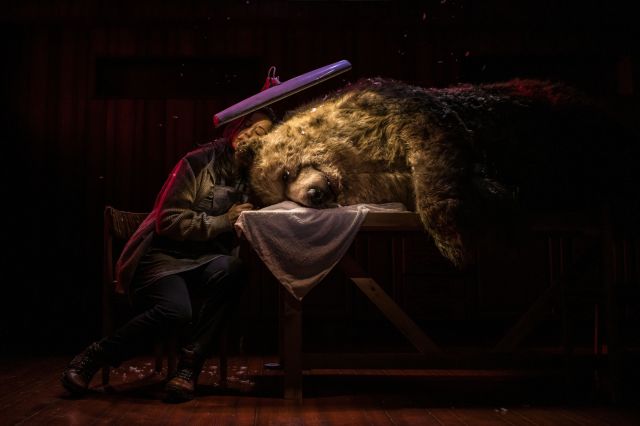
An obvious symbol lies on a table at the centre of the stage.

A dead beast as the first actor of an analogy game that unfolds itself like a Russian nesting doll – the monstrous, the wild, the Other, the Mother, the Daughter. A metaphor and, ultimately, a show that rushed like hot blood within a febrile body: hastily.

During a storm in the Canadian mountains, the prodigal daughter visits her mother after a long time to seek answers and amend past decisions.

The attempted analysis of the human passions and post-freudian determinism (which of course condemns women first) with clear romantic allegories (Frankestein, connection between nature and sentiments through sound and light design) fails along the way. A good idea, but unfortunately without resolution.

Director Gareth Nicoll’s taste for Shakespearean, abrupt violence and the delicate language of gestures are as easily seen in this production as his others. But even elegant and attentive direction and fairly competent acting cannot save a flat plot and circumspect script.

A neatly conducted rhythm at the first part of the dialogue becomes a self-explanatory, polarised monologue. Rather than raise drama or empathy, the self indulgent storytelling leaves one wondering if one character is listening to the story or the actress is simply waiting to say her speech.

There’s a lack of tension all the way through the script: the position of power remains always the same, embodied by the daughter, whose acting is quite hectic and leaves no room for audience expectancy at the beginning. Nevertheless, her physical characterisation is superb. The restraint of the mother was sometimes staggered by little details (dramatic hand tics in particular), but the character blossoms once she downs a dram and the actress allows herself to relax.

In short, this is a strong initial concept that craves revision. I hope that it’s returned to, for the simple reason that the idea, the discourse, the creative team’s work and the cast have so much to offer – but, unfortunately, cannot be cured from the restraints of the substandard playwriting.

Maybe the magnificence of a living bear cannot be portrayed if the insides are not beating guts, but soft stuffing.

nae bad_blue

Star (blue)Star (blue)Star (blue)

Reviewer: Helena Salguiero (Seen 23 October)

Little Shop of Horrors (theSpace @ Surgeon’s Hall: Aug 19 – 24 : 17:45: 1hr)

“A faithful, fun adaptation of a well loved classic.”

Editorial Rating: 3 Stars: Nae Bad

I’ve always had a weakness for Little Shop. Call me puerile, but there’s a lot of musicals that’d benefit from a giant, bloodthirsty jazz plant. Fiddler on the Roof is an amazing show, but imagine Sunrise, Sunset with Levi Stubbs scatting in the background. It was with glee, then, that I saw a production was to be brought my doorstep.

For those who don’t know, the premise of Little Shop of Horrors is classic black comedy: a nerdy schmuck finds an alien plant that changes his life for the better – the only catch being that Audrey II demands human blood in exchange for continued success. Think Faust, if Faust was a rock opera set mostly in a flower shop.

Bob Hope Theatre stays true to this narrative whilst squeezing the original work into a tight hour – and, in that respect, it’s a real success. As someone who is shamefully familiar with its predecessors, places where material was cut and fused for time was surprisingly seamless, incorporating the dramatic flow into the changes with masterful attention to inter-scene connection. Though a few scenes (especially those reliant on emotional revelations) felt a little pressed for space, it’s a necessary evil of the Fringe business.

Performances are strong across the board, with every player slipping into Little Shop’s caricature cut-out roles with aplomb. Whilst not doing anything particularly new with the roles, there was no place where the demands of the characters were not met. Richard Cooper is wonderfully nebbish as Seymour, in stark contrast to Sarah Leanne-Howe’s Audrey – straight out of the pages of a 1950s Good Housekeeping. Kris Webb’s murderous Audrey II, whilst lacking the booming presence of his predecessors, brought a pointedly creepy smoothness to his role. Managing to look vaguely threatening in a big frond costume is tough, but honest to God it happens.

MVP of the production must go to Andy Moore, with his standout performance as Orin Scrivello. Energetic, gleefully sadistic and uncomfortably charismatic, Moore keenly captures not only the essential energy of the play, but also the essence of what makes his character such a joy to watch. Praise for energy also goes to Paul Stone as Mushnik. Though his accent takes certain peaks and troughs during the performance, he immediately lights up the stage with each appearance.

However, Little Shop demands more than theatrical chops. Rock Opera is a hard beast to wrangle, especially on the small stage. And don’t think for a moment that the singing performances in this show are not incredibly worthy – they are, especially in the case of Chiffon, Crystal & Ronette. However, technical mastery is just one facet of this kind of performance, and unfortunately, the necessary punch and energy required to really hammer home the intensity and spectacle of a rock opera simply wasn’t there. The songs had heart, but (apart from a select few) nothing every really comes in for the killing blow. Tension doesn’t range high enough, sorrow cannot go low enough. This is a cast with the potential to hit the audience like a sledgehammer, and it’s disappointing to see it miss.

It’s deceptively hard to pull off an established show, especially with a smaller budget and Fringetastic time constraints. The performance by Bob Hope Theatre, whilst not bombastic, is nevertheless a faithful, fun adaptation of a well loved classic.

nae bad_blue

Star (blue)Star (blue)Star (blue)

Reviewer: Jacob Close  (Seen 20 August)

ALL our +3 (festivals) coverage? Click here!

Will Gompertz: Double Art History – The Sequel (Underbelly Bristo Square: Aug 19 – 25 : 15:35: 1hr)

“A fun hour.”

Editorial Rating: 3 Stars: Nae Bad

It’s a fairly uncontroversial opinion to say I like art. Art is pretty neat. Van Gogh, Edward Hopper and Monet have pride of place in my apartment, but as far as really knowing anything about art goes, I’m basically like if someone put a dog in a high school class. Will Gompertz, of Tate and Guardian fame, assures me that he can change that in an hour.

Double Art History – The Sequel is a straightforwardly constructed piece: a humorous lecture wherein Gompertz teaches the fundamentals to a crowd of mostly drunk Fringe goers, with a ‘big exam’ as the dramatic raison d’être. There aren’t many shows where I find myself holding a tiny pencil, wondering if a joke is going to be on the test – though, it’s not as distracting as one might think.

And, overall, it works. It works better than one might expect, and that’s not simply down to the demureness of Edinburgh’s day drinkers. Gompertz proves to be a compelling core for a one man show, and brings an energy that’s seldom seen on the Fringe stage. It’s difficult to describe: somewhere south of nervousness, east of smug, and altogether interpersonally compelling. Evidence of his knowledgeability is widely documented, and this show merely adds to the pile. The way he handles the material, the genuinely loving lilt of his voice when describing a form of expression he clearly holds dear to his heart. Whether or not you even like art, Will Gompertz probably likes it enough for the both of you.

And, to his credit, I like art a little more after Double Art History. There’s a wealth of material presented in the short hour, and it’s presented well. Gompertz’ approach is highly accessible, aided by the bare smattering of tech, and almost lulls you into a false sense of ignorant security. If you’re irritatingly curious like I am, you’re guaranteed to have your attention held.

However, this is a show that leans harder on the “lecture” side of its composition, as opposed to the “Fringe show” side. The theatrical elements feel more like artifice than fully integrated parts of the production, and whilst lectures are by no means bad, that visible separation sometimes proves genuinely jarring. Key moments of audience interaction felt as if they had no reason to be happening, other than a misplaced sense of theatrical convention. Whilst playing up the cartoonish theatricality of the whole thing is a boon for marketing, I often found myself wishing I could have just listened to Gompertz talk shop for an hour, rather than listen to setups involving an art teacher who doesn’t exist.

That’s not to say the show isn’t charming. It is, and aggressively so. Gompertz and his crew create an atmosphere where, whilst everything doesn’t go right, it’s not for lack of earnestness. There is a fundamental joy about art at the heart of this show, and it shines clearly.

Double Art History – The Sequel is a fun hour, sitting in the presence of someone who knows their field inside out. Whilst it’s not likely to get your pulse pounding, you might come away with a better appreciation for what it means to make art.

nae bad_blue

Star (blue)Star (blue)Star (blue)

Reviewer: Jacob Close  (Seen 20 August)

ALL our +3 (festivals) coverage? Click here!