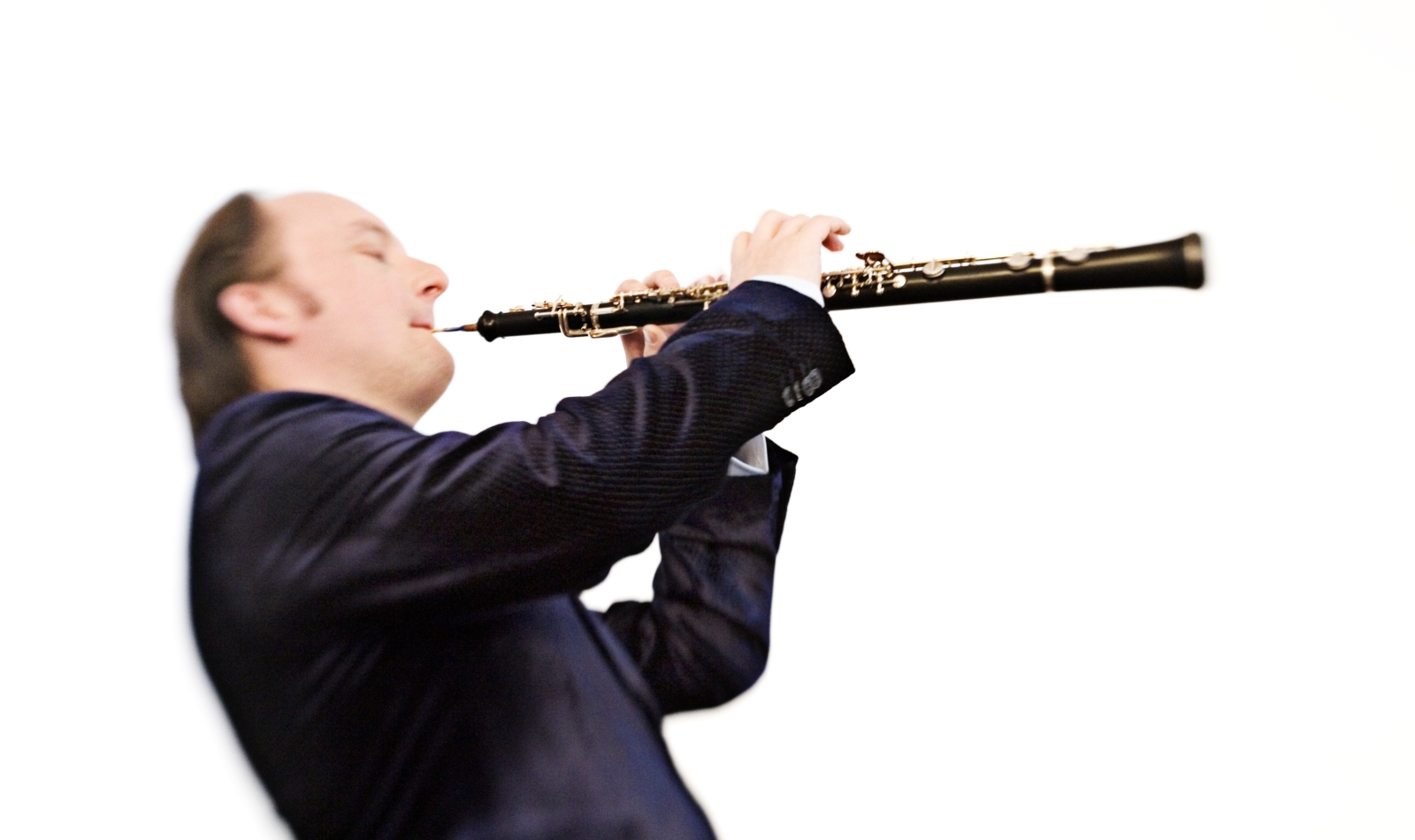
SCO: Leleux (Queen’s Hall: 29 Mar.’19)

Image result for lelaux oboist

Francois Leleux – Oboist and Conductor

“Leleux….. has an engaging conducting style relating to, rather than directing, the orchestra.”


Editorial Rating: 4 Stars: Nae Bad

My mother spoke little of her life before her children were born, but it was clearly an interesting one.  The youngest of six children of a Northamptonshire shoe manufacturer and general bigwig, the first of her family to go to Oxford (and a woman to boot) and a wartime spent at Bletchley Park.  But what I remember most clearly, as we were both musical (at Oxford she sang in Ted Heath’s Bach Choir), was her telling me of her experience kissing an oboist whom she went out with for a while at University.  She told of his incredible muscular lips (by virtue of the necessary embouchure of blowing two reeds together) which made the embrace distinctly unusual.  As a result oboists – and the oboe (I love its clear, piercing tone, as did she) – have held a particular fascination for me, although I have never kissed one, reserving my affections quite by chance for the string section.


Consequently the SCO’s appointment of premier oboist Francois Leleux as an artist in residence for the 2018/19 season was a must-see.  I could not get to the first two gigs but enjoyed Thursday’s “Three Serenades” Concert enormously.


Generally, I have reservations about soloists who migrate into conductoring, even of the musical standard of Ashkenazy and Rostropovich, as it is a bit like film stars wanting to be directors: they rarely cut the mustard.  However, it has to be said that Leleux, either with baton or more restrained with instrument in mouth, has an engaging conducting style relating to, rather than directing, the orchestra.


Our first work was Hugo Wolf’s Italian Serenade, played in a splendidly happy rendition that clearly showed a bond between conductor and orchestra.  Good tempi, very together for so early on in the evening, a surprisingly enjoyable piece from this manic depressive composer written before the dark times took over his life.


Next up was Dvorak’s Serenade in D minor, Op.44. A wind ensemble of ten, including contrabassoon, accompanied by cello and bowed double bass, all standing save the latter two; this time with Leleux taking the oboe lead as well as directing.  Leleux’s tone was clear, fresh without being over bright, at times soaring over the rest of the ensemble.  In the third movement Andante con moto he engaged in charming interplay with the clarinettist opposite.  It was good to get our fix of the great man.


After the interval we heard by far the most substantive work of the evening, Brahms’s Serenade No 1 in D major, Op.11 with the full 40 strong orchestra on stage, quite an upgrade from its original conception as a nonet.  Albeit written earlier on in his career alongside the Piano Concerto No.1 this is a mature work with a great deal more roundedness and depth than the rustic Bohemian fare we received earlier.  In six varied movements ranging from close harmonies in the brass to full on orchestral romance, pretty little wind passages accompanied by the put-put of the bassoon and a mad rush to the finish, one was reminded of the near chaotic finish to the Academic Festival Overture.


Perhaps my only regret of the Leleux season was that he played only one concerto throughout, the Haydn.  One would have wished for the Mozart with its glorious third movement Rondo.  Never mind, it is always best to be left wanting more.


Star (blue)Star (blue)Star (blue)Star (blue)

Reviewer: Charles Stokes (Seen 28 March)

Go to the Scottish Chamber Orchestra

Visit Edinburgh49 at the Queen’s Hall archive.

Local Hero (Lyceum, 14 March – 4 May ’19)

Katrina Bryan as Stella, with that telephone box at her elbow.
Photography by Stephen Cummiskey

“Expert and smooth”

Editorial Rating: 5 Stars: Nae Bad

 This is one to admire, less with wonder perhaps than with unbounded appreciation: a musical with perspective and high-flying credits to match. With its ‘Book’ by pre-eminent film maker Bill Forsyth and David Greig, new music and lyrics by Mark Knopfler, and directed by John Crowley, this Local Hero is pitched at anyone who has seen Forsyth’s film, which after 36 years is a lot of delighted people, and at anyone who would put the planet above getting filthy rich. By now, of course, Local Hero is circling above and beyond Scotland. Al Gore, American vice-president and author of An Inconvenient Truth, reckoned on Oprah that it was up there as his favourite film. This is generational stuff that could be set on an interstellar trajectory. Next point of passage, London’s Old Vic.

… Houston, We Have a Problem

Once upon a time it was boom time for the black, black, oil and Knox Oil and Gas of Houston, Texas, is looking to build a refinery in Ferness on the north west coast. Young exec. ‘Mac’ MacIntyre – of Hungarian descent naturally – flies in to make the deal, effectively to buy out the village, lock, stock and lobster pot. Down on the beach, old Ben holds out for more. By sly congruence, he’s called Knox too. Ben is one laid-back negotiator who would tell you how many grains of sand that he can hold in one hand but what really counts are his astronomical records, sightings of events that go back a hundred plus years. There’s no limit, it appears, to an oil bonanza until you factor in the beauty of the Northern Lights and celestial messengers. And then, down on earth and in the MacAskill Arms there’s kindred folk and community, the love of a hard but beautiful land.


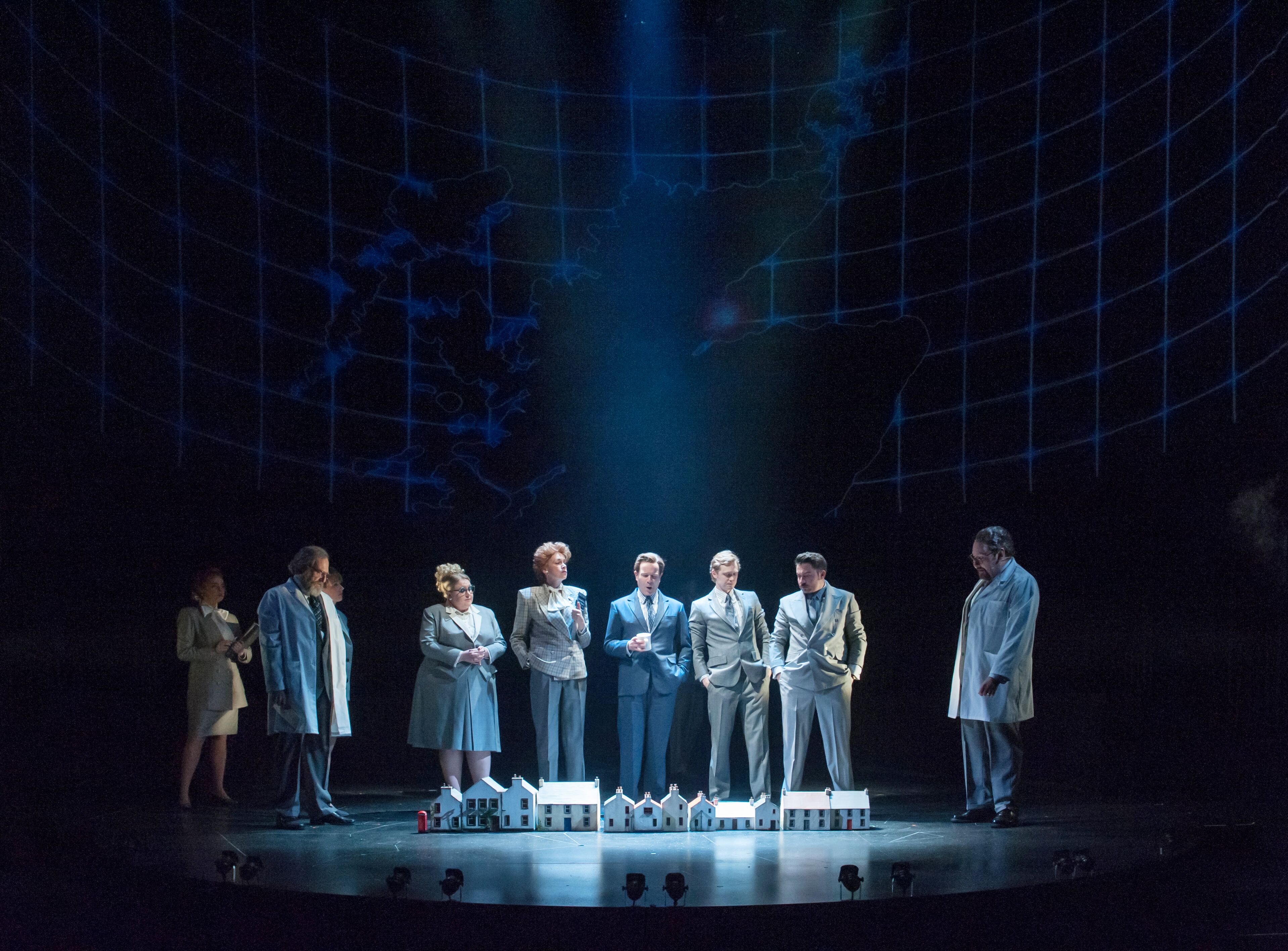
By rock and water and that iconic telephone box it could be wistful and charming and a homage to a great soundtrack. However, today we have Spotify Connect, of control and play, and whilst this production is very easy to listen to, with a proper fusion score where Dire Straits meets ceilidh, yearning and lament, it’s the neat switch to solid musical theatre that is most impressive. It may be a long haul: ten numbers in each half, no duds, with the whole show lasting 2 hours and 25 minutes – but it is expert and smooth, with standout lighting and atmospheric projection where the sky’s the limit, literally. Ferness is a tiny line of houses arranged along a curve of the harbour wall. The 15 strong cast has a wide dance floor to work with and the band is nearly always backstage,  invisible (regrettably) within an outsize grey ‘hillside’.

Lets get ‘Filthy Dirty Rich’

Character is in plain sight. Mac (Damian Humbley) may have an option on a new Porsche but he is always going to fall in love with Furness and an ardent blow-in from Glasgow. She, Stella (Katrina Bryan), is the principled romantic whilst flexible Gordon (Matthew Pidgeon) could launch himself onto the 54th floor of any oil company. Viktor (Adam Pearce), the burly Russian trawler skipper with share portfolio, is vigorous and fun. Ben (Julian Forsyth) is especially heroic as he’s wrapped in a tartan rug in his armchair and withstands his removal to a retirement home by the village lovelies.


The company sings ‘That’d Do Me’ in anticipation of the good folk hitting pay dirt. The prospect of being served langoustine rather than packing them is rather fine. And then, with Mac and Stella and Ben, you’re gently steered onto a kinder, Greener, more responsible course. That was always the tricky bit of make-believe, now advanced by nostalgia. Still, the fond passion and dollars of Knox Oil president Felix Happer give Ben a backstop and Furness is saved, again, which has to be counted a blessing. When that telephone rings is it Mac calling or Heaven?


nae bad_blue

Star (blue)Star (blue)Star (blue)Star (blue)Star (blue)

Reviewer: Alan Brown (Seen 26 March)

See Local Hero at the Lyceum

Go to Edinburgh49 at its Lyceum archive.

SCO: Swensen, Lewis (Usher Hall: 14 Mar.’19)

“Elegiac, more like a tone poem, with the baton-less Swensen using his hands more like a magician than conductor”

Editorial Rating: 4 Stars: Nae Bad


Thursday’s Scottish Chamber Orchestra’s gig played to a larger and more diverse audience than at their normal Queen’s Hall venue, and the audience showed their appreciation with a near full house, enthusiastic applause, restraint with seasonal agues such as coughing (your beleaguered writer included!) and respectful post performance silences following the conductor’s upraised baton at the end of the quieter pieces.  It was a joy to be among the cognoscenti.


The programme was a contrast of early and late Romantic works, with composition dates ranging from 1787 to 1924. Curiously, three of the works comprised several years in their gestation, and the remaining Coriolan Overture was written for no apparent purpose at all other than composition for the sake of it (not that there is anything wrong with that, but it is more of a 20th rather than 19th century idea, in a past age of mostly commissioned music). Beethoven spent 11 years finalising his Concerto No 2 in B flat, Op 19 (which was in fact his first concerto), and Sibelius the best part of a decade on his last two symphonies.  That is, I have calculated, about 3 minutes music per year in the case of the latter, one minute in the case of the Beethoven.  I guess that they had one or two other things to attend to as well?  Even George R R Martin is doing better than that with the concluding ‘Game of Thrones’ book.


Was the deliberation in terms of timescale worth it? In the case of the Beethoven I would say yes, for Sibelius, I would be less sure.


Conductor Joseph Swensen bounded on to the podium to start off the proceedings with Beethoven’s Coriolan Overture, Op 62.  An amiable great big bear of a man, heavily bearded, of mixed Japanese and Norwegian heritage, he kicked off the playing without ado and drove us through ten minutes of classical gothic music without reference to a score.  The orchestra responded well to his enthusiastic conducting (no baton) and we experienced a fluent, well played opener that lifted our spirits.


Next up the wonderfully adept Paul Lewis took us through the Beethoven Piano Concerto no 2.  Only last week Can Cakmur gave us a spellbinding interpretation of the third with the RSNO in the very same hall.  The second was a completely different work, of almost a different world, mature Mozart rather than Beethoven at the height of his powers, eleven years separating their composition. To compare them would be comparing chalk with cheese. Lewis played with consummate ease and brought everything out of the work that he should have.  After the long, tautly played orchestral opening Lewis entered with bright, clear tone, good intonation and phrasing.  The well known third movement Rondo: Molto Allegro was a delightful, reassuring romp.  Enthusiastic applause but alas no encore, the more surprising in view of the relatively short duration of the programme.  Never mind, mustn’t be greedy.


Two Sibelius symphonies filled the second half of the programme, No 6 in D minor, Op 104 (1923) and No 7 in C, Op 105 (1924).  This was the programme feature of the evening, and one wondered what our charming rather enigmatic conductor, with his Scandinavian roots, would make of these relatively unknown works compared to the over popular 2nd and 5th symphonies


The 6th is constructed in conventional four movement style and lasts approximately 25 minutes.  Too much, in my opinion, has been made of the fact that Sibelius was studying Palestrina when he wrote it.  More telling, I suspect, was that it was rather overshadowed by the fifth symphony being written at the time.  Sibelius himself said that it reminded him of snow falling.  A sublime, ethereal string orchestra opening followed by woodwind calling.  Elegiac, more like a tone poem, with the baton-less Swensen using his hands more like a magician than conductor.  The second movement built up the tension and the third was a return to the more plaintive; the final Allegro Molto a return to the brass we know so well.  I wanted to rush home and listen to it again and again.  A privilege to hear this “Cinderella” of Sibelius symphonies being done by so rightly by a deeply sensitive conductor and orchestra.


Finally to the final Sibelius symphony, No 7.  A single movement work of a little under 25 minutes, more of a tone poem and originally entitled Fantasia Symphonica No 1, Robert Layton has described it as “completely original in form, subtle in its handling of tempi, individual in its treatment of key and wholly organic in growth”.  Moreover ‘New Grove’ describes it as “Sibelius’s most remarkable symphonic achievement”.   Hmm.  It does grow and deliberately lacks the shape of a symphony. I suppose one should regard it as a musical development, even if one does not always know where it is going.  A string opening very much in the tragic genre, with the brass making its presence felt and gradually taking over.  Bruckner does brass with forcefulness and aggression, Wagner with foreboding, but Sibelius does brass with soul!  The work, much favoured by many, made for an intriguing essay in related sounds and passages conjuring up imaginings of mystical Finnish folklore.


nae bad_blue

Star (blue)Star (blue)Star (blue)Star (blue)

Reviewer: Charles Stokes(Seen 14 March)

Go to the Scottish Chamber Orchestra

Visit Edinburgh49 at its Usher Hall archive.

RSNO: Watanabe, Cakmur (Usher Hall: 8 Mar.’19)

“The Wheel of Fortune” from the original manuscript of the Carmina Burana , c.1230

“This is a wonderful time to be a concert goer in Edinburgh”

Editorial Rating: 4 Stars: Nae Bad

There are considerable advantages to living in a city with such an enlightened and broad church approach to the performing arts.  And being – in global terms – for music a second city compared to, say, Berlin, New York, London or San Francisco, we tend to see up and coming artists before they get the bookings on the true world stage.  We thus look into the future.  And the future is bright.


Can you recognise the names in the headline?  I doubt it.  Kensho Watanabe hit the big time two years ago when, just appointed Assistant Conductor of the Philadelphia Orchestra aged 29, he stood in at the last minute for his mentor Yannick Nezet-Seguin to make his critically acclaimed subscription concert debut with the Philadelphia and pianist Daniil Trifanov.  On his debut with the RSNO on Thursday he showed masterly control and grasp of the complexities involved in conducting a major full length piano concerto, and an hour long Choral and Orchestral work.  One had complete confidence in him.


And Can Cakmur?  A Turkish pianist who won the 2017 Scottish International Piano Competition, 22 years old, and about to debut with the Tokyo Symphony Orchestra.  We shall be seeing and hearing a great deal more from this highly educated, personable young man.


So I suspect the draw, with all due respect to the principals, was the programme: Beethoven’s Piano Concerto No 3 in C minor Op 37, and Carl Orff’s Carmina Burana. A mixture, perhaps, of the sacred and profane. A full house, bar the usual few leg-numbing seats in the gods.


It resonated with me personally that the Beethoven was being performed fifty years after Radu Lupu’s astonishing and winning performance in the final of the Leeds International Piano Competition. In particular, his rendering of the second movement Largo demonstrated thoughtful restraint and tenderness and left me mesmerised.  Then we had a successor, twenty years on, to the other legendary Romanian pianist , Dinu Lipatti.  And now a Turk interprets the grand man, and an exhilarating interpretation it was.  After the lengthy orchestral introduction, brass and wind a little out of balance with the strings to start with, but soon settling down, Cakmur almost threw the opening scales off the piano in a brave, individualistic but convincing interpretation that proves the international piano competition world is not just throwing out sterile, technically competent clones.  This young man showed a grasp of the work way beyond his years.  Rightly pausing so the unfortunate plethora of uncontrolled audience coughing and sputtering finished, Cakmur created a sense of calm before the opening solo chords of the second movement Largo.  The pianist’s sensitivity of playing and interpretation pleased this disciple of Radu Lupu, taking one to a level of transcendence that almost, but not quite, extinguished the insensitive uncontrolled coughing of the audience, who should not have attended in those circumstances, and should learn to cover their mouth with a handkerchief.  If only the management could advise this at the beginning of the programme when they talk about mobile phones.


Without a break we rushed into the final movement Rondo: Allegro.  Could have been Presto.  Uplifting, joyous, fun.


Cakmur introduced his encore that was a melange of Liszt and Schumann overlaid by Bach.  Ingenious.  What stamina these professionals have, to play like that after thirty minutes of intense keyboard bashing!


There was much to enjoy in the second set’s Carmina Burana, and I always get more out of listening to works that I have performed, such as this, with the mighty Beckenham Chorale.  I counted at least 100 voices in the RSNO chorus who gave a very good account of themselves, a full on O Fortuna to open the proceedings, clear diction of the Latin text, great rhythmical singing in the jazz like Veni, Veni, Venias, glorious unrestrained joy in the Blanziflor et Helena.  The children’s choir performed clearly without words or music, showed exemplary discipline, and have clearly been very well trained.  Soloists Fflur Wyn, Adrian Dwyer and Stephen Gadd contributed well, if sparsely, giving in particular amusing renditions of a swan not enjoying about to be eaten and a drunken abbot.


This is a wonderful time to be a concert goer in Edinburgh.


nae bad_blue

Star (blue)Star (blue)Star (blue)Star (blue)

Reviewer: Charles Stokes (Seen 8 March)

Go to the RSNO, Scotlnd’s National Orchestra

Visit Edinburgh49 at the Usher Hall archive.

A Note of Explanation (Assembly Roxy: 1-3 Mar.’19)

Justin Skelton as Edwin
Photo: Grant Jamieson

“Lively and intelligent”

Editorial Rating: 3 Stars Nae Bad


It fits that A Note of Explanation, a work-in-progress preview, is part of the third Formation Festival at Assembly Roxy. This adaptation of a children’s story by Vita Sackville-West is coming together rather well.

Some Kind of Theatre could argue that their 45 minute production is in kit form: neatly engineered, quick to put up, and soon to be nicely habitable. It is, after all, based upon a very small book in the library of a doll’s house. Yes, a priceless doll’s house with imperial foundations, but director and script adaptor, Emily Ingram, has carefully and respectfully remodelled A Note of Explanation (1924) for our declining and more anxious, times. I believe Sackville-West would applaud, whilst Edwin Lutyens, architect, might question what on earth we mean by ‘modernizing’. However, Lutyens is tutored and charmed by a bright and perky fairy, so all is to the good.

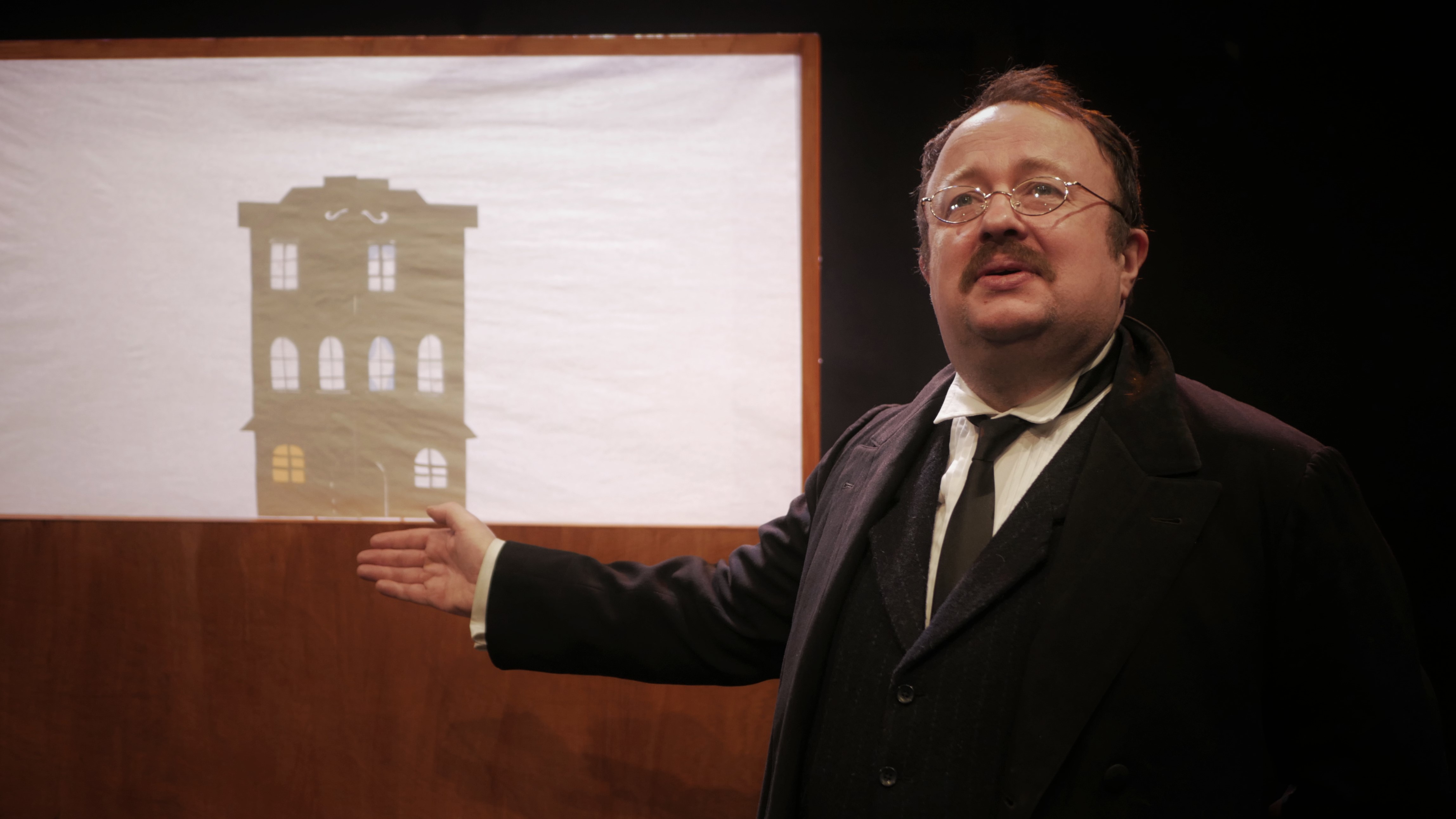
Quercus, ageless sprite of the house, has ‘memoirs’ to enact from standing in the wings of story time. She is forever young and capable (and Scottish) and her tales of Cinderella, the Shellycoat, Bluebeard, and Jack and the Beanstalk, are cheery, cheeky, variants upon the originals. Nothing too scary here, only a silly goose. Cheery but helpful too, as each has an ecological edge; perhaps not as keen as the woodcutter’s axe but good and pronounced all the same. When Quercus accuses Lutyens of imprisoning her within the skeleton of her oak tree the royal architect is truly sorry. Fortunately there is one magic acorn left ….

Ably performed by a cast of three – Gillian Goupillot, as Quercus; Imogen Reiter; and Justin Skelton, as Edwin Lutyens – with support from puppets of tree(s), agile squirrels and a carriage, A Note of Explanation is a lively and intelligent children’s show in the making.  


(& by ‘n by, for grown-ups:

Lutyens: https://www.architectural-review.com/essays/the-rise-and-fall-and-rise-of-edwin-lutyens/10029787.article

Robert Graves’ poem, The Stake, in ‘Poems: abridged for Dolls and Princes’, 1922, in the library of Queen Mary’s Doll House.  Haunted, but has an honest oak tree at its centre.)


nae bad_blue

Star (blue)Star (blue)Star (blue)

Reviewer: Alan Brown (Seen 1 March)

Enjoy Some Kind of Theatre

Visit Edinburgh49 at the Assembly Roxy

9 to 5 (Pleasance: 5-9 Feb.’19)

“A damn good show .. poetry in a big, shiny sequined dress”

Editorial Rating:  4 Stars Nae Bad 


l-r: Anna Sheen as Violet, Jemma Lowcock as Judy, & Alice Hoult as Doralee.
Images: Andrew Perry

Dolly, Dolly, Dolly. What is there to say about the undisputed Queen of Country that hasn’t already been said? Other than the fact it’s what I blast during weightlifting 80% of the time (so now if you see me, congrats, you know!), it’s hard to come up with praise that hasn’t been done to death. I thought I’d get lucky when I got to talk about something Parton-adjacent, but unfortunately for me and very fortunately for everyone else in the audience, the praise vocabulary has a lot of overlap.

9 to 5 tells the story of Violet (Anna Steen), Judy (Gemma Lowcock) and Doralee (Alice Hoult): three embattled women struggling to stay strong in a world designed to keep them down. That world is typified by their boss, Franklin Heart Jr, neatly summed up as a “sexist, egotistical, lying, hypocritical bigot”. After a chance encounter with the devil’s lettuce, the three heroines find themselves in far deeper than they intended, but with a chance to change both their lives, and the lives of their co-workers, for the better.

From the outset, I need to make it clear: this is a damn good show, with damn good performers. If the star rating wasn’t enough to tip you off, Footlights’ production of 9 to 5 is one to be proud of. The lynchpin of that success was the central trio of Hoult, Lowcock, and Steen. It’s not often that I get to see talent on the student stage that would fit seamlessly into a professional production, but then again, it’s also not often that you see not one but three vocalists who can not only sing to character, hit notes right in their centre zone and (as my opera teacher used to say) throw their voices out so hard you could hammer a nail with them. Even better is the obvious talent at play outside the soundtrack: Steen balanced great comedic sensibilities with an unexpectedly genuine reflection of the struggles faced by powerful women; Lowcock threw levels of vulnerability and hidden nerve into what could’ve easily been a cookie-cutter “beaten down protagonist in a musical” role; and Hoult could basically get a job as a Dolly Parton impersonator – sometimes it was genuinely difficult to tell the difference from sound alone.

‘Around Here’

And that’s even more satisfying when supported by a keenly talented secondary cast. Daniel Stansfield’s Franklin is a wonderfully grotesque, gurning gargoyle of a man, whose revelry in his own personal toxicity is almost a treat (almost); Mhairi Goodwin’s fawning office drone Roz was not only a brilliantly half-sympathetic secondary antagonist, but probably had my favourite performance in the entire production (you’ll know it when you see it); and special props go to Brett McCarthy Harropin a stunningly chameleonic performance as both a dancer, and the show’s sleeper comedy MVP, Josh. Honestly, most of this review could just be praise for the acting. Even if you are not mentioned here, please rest assured: I noticed you, and you were glorious.

Of course, what’s an actor without blocking? And although certain productions on the Pleasance Stage have erred towards A-Level Drama sensibilities in the past, this is certainly a welcome break. I was unable to find a fully-titled choreographer, but whoever in this production created the movement should be very proud of their work: the dancework has the precision of a watch movement. Every part of the stage had its own novel and interesting motions, fully cohesive to the overall pitch and wave of the beat. Darn good to watch, especially the opening number.

To round off the positives, many that there are: this is a musical. Not just a musical, but a Musical. If you’ve watched one or two, you’ll be very familiar with the emotional beats, levels and general plot. But parts of this show felt like I was seeing the familiar tropes for the very first time. When this production gets going and finds its stride, it’s poetry in a big, shiny sequined dress.

Doralee enjoys a Cowgirl’s Revenge

However, this gem is not without flaws. These seem most glaring behind the scenes: whoever was on sound needs to review their operations. The levels between the band and singers were usually abysmal for the first half of most songs, which makes it feel as if whoever was on script watch was distracted. In between the constant volume switching, and a feedback boom in the first half that could have blown fillings out, it ultimately came off as sloppy and far less than what a production like this should be capable of. Although fixed by due diligence, it was disappointing that such a big feature was handled so poorly.

That said, my one large criticism of what I was seeing directly onstage was that the opening number didn’t set my expectations high. I can’t tell if it’s a comparative lack of rehearsal or some mistake on the night, but the all-important 9 to 5 number sounded off key, off time and sluggish for maybe half of the time. Luckily the show recovered soon after, but I distinctly recall being viscerally afraid the rest would be much like it.

I wish I could’ve given the show an ‘Outstanding’, but these two issues  – mostly the former – marred it enough that the entire experience didn’t reach the heights I knew it could have, given the rest of its parts.

However, the above flaws should be fixable, and even if not, I would still recommend this show. The sheer spectacle of a good musical is really hard both to organise and act in, but the levels of talent at play here are exactly what Edinburgh’s come to expect from the university’s Footlights in recent years. Despite the factors holding it back, 9 to 5 is a credit to the cast and team that have brought it to Pleasance, and it deserves every seat sold. In a world that’s all takin’ and no giving, this production definitely bucks the trend.

nae bad_blue

Star (blue)Star (blue)Star (blue)Star (blue)

Reviewer: Jacob Close (Seen 6 February)

Go to 9 to 5 at the Edinburgh University Footlights

Visit Edinburgh49 at the Pleasance.


Touching the Void (The Lyceum: 25 Jan – 16 Feb. ’19)

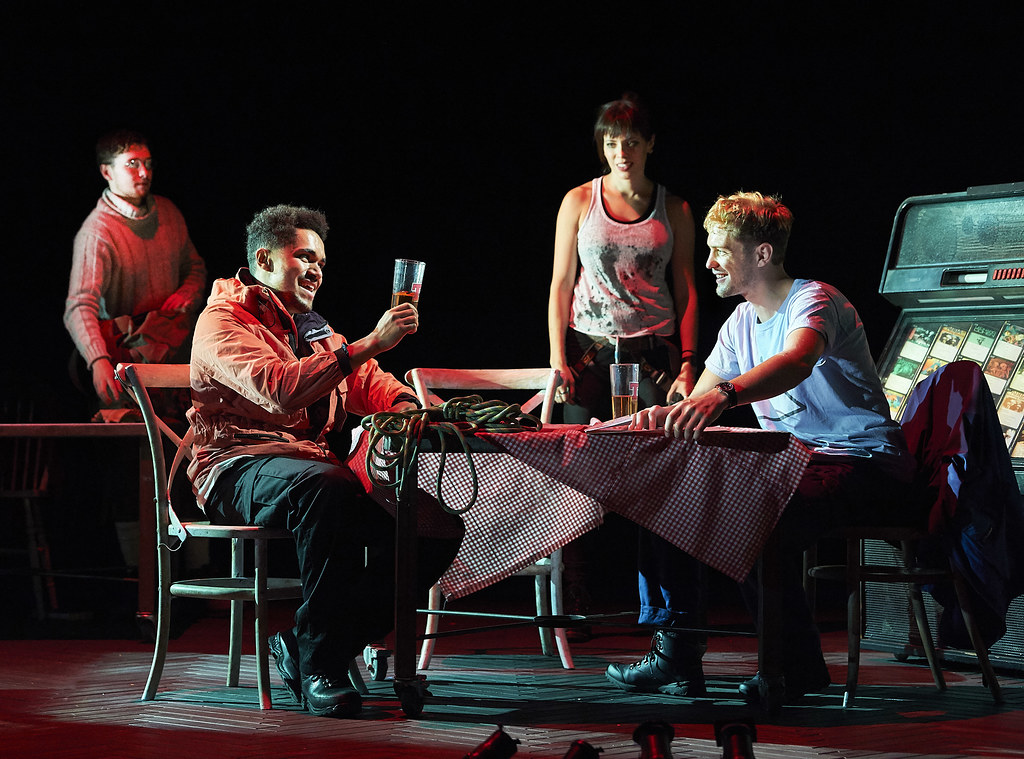
l to r. Patrick MacNamee, Josh Williams, Fiona Hampton, & Edward Hayter

A hell of a ride

Editorial Rating: 2 Stars Nae Bad 


I’m what you’d call a “small-time climber”. I used to get drunk on Arthur’s Seat a lot, and am occasionally known to change lightbulbs and hang things using a cheeky ladder or two. But despite my solid credentials, I haven’t got the first inkling as to why someone might upgrade from ‘Ladder’ to ‘Pile of rocks .. and death’, and although Touching the Void certainly gave me an insight into those who do, I can’t say I left as a Gore-Tex convert.

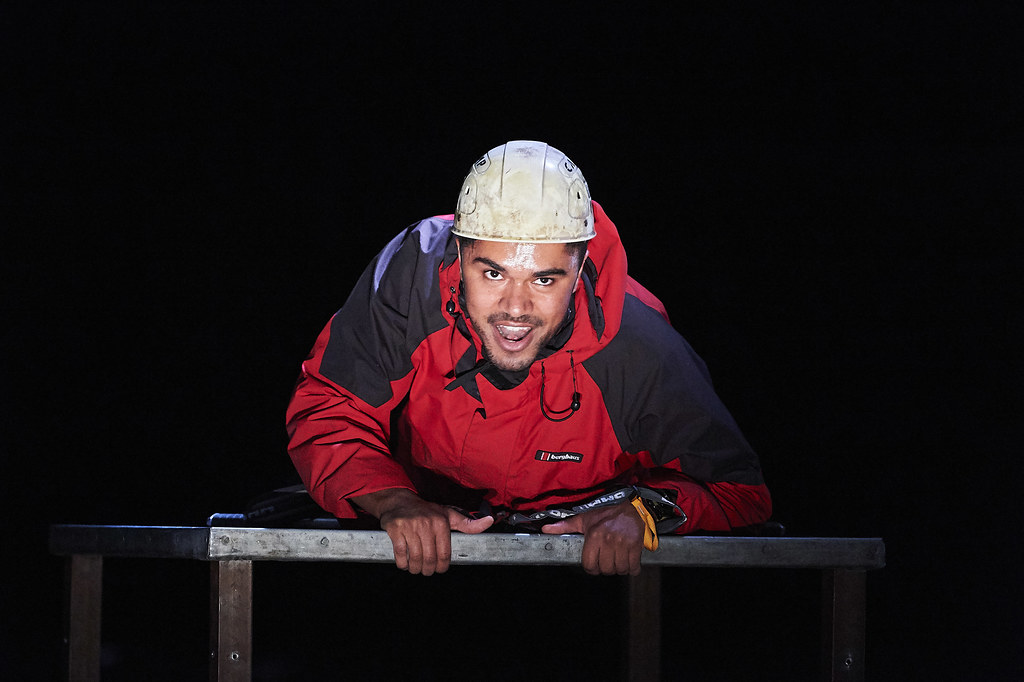
Touching the Void, from director Tom Morris and based on the book by Joe Simpson, follows climbers Joe (Josh Williams)  and Simon (Edward Hayter), who face true calamity on their descent of the Siula Grande mountain in the Peruvian Andes. The plot is fairly complex from a “Who’s doing what, when?” perspective, but the most basic synopsis without spoilers is:  things don’t go amazingly well. What follows is an excruciating story of sweat and almost supernatural human will – and even if the details tell you how it ends, it’s still a hell of a ride.

What works in this show is incredibly clear from the get-go: it’s a spectacle. The Carroll-esque flock of chairs floating above a neon jukebox, the unnerving dark abyss created only by light and sheets, the climbable, rotating metal strut cliff face. As just something to watch, this show is an utter delight. Actors, obviously trained to the point of safety, almost seem a dynamic part of the scenery as they scrambled, hung and climbed over places I’d never even seen lit on a Lyceum stage before. Forget the plot – the performances told an unspoken story of sweat and suffering before the play even began.

The theme of spectacle returns once again if we concentrate on the acting. Each of the four characters had at least one moment where it was abundantly clear why they had been chosen for the role. Fiona Hampton (as Sarah, Joe’s sister)  even got some tears from my theatre partner that night, using nothing but an empty stage and a letter. My personal MVP goes to Josh Williams, however, if only for the sheer grit it must’ve taken to drag himself around the stage and still emote realistically for a solid forty minutes. All good news for the theatre-going public.

However, as this show quite emphatically demonstrates, for every climb there is a fall. And unfortunately, there were a few trenches that this production did not seem to have the will to climb out of.

I wanted to like this show. I liked the ideas at play, I loved the staging – but I have never seen a show so willing to undercut its own potential excellence for seemingly no reason. The source material is jaw dropping and the actors are clearly talented, and the play is full of moments which if left to stand on their own, within their moment, are powerful. But for some reason it seems like it doesn’t have enough confidence that they will stand, and so things are extended, or repeated or just simply cluttered up and sabotaged by so many different elements that the simplicity and effectiveness of the particular is lost. This happens consistently: one of the most frustrating examples includes a tense and exciting scene of Joe and Simon battling a storm on a cliff face, which was then overlaid with Patrick McNamee’s soothing, folksy twang, quipping merrily around like he’d spent his time offstage pounding hash and Ordnance Maps.

Or, even worse, a legitimately good scene just simply goes on too long. A painful scene of a man dragging his broken body across a rock ridge is harrowing for ten minutes of sobbing and inching, but after twenty with little more than a weird song (we will get to those), it feels a lot more like filler than chiller.

But most frustrating of all were the dances and choral spoken word. In amongst what is clearly a physically capable and dedicated cast with choreographers who can achieve so much in other areas, it baffles me why numbers like an unexpected spoken word rap about Ice Axe technique could not only mismatch tonally but also feel as if they’d barely been choreographed at all. The use of repetition and spoken word material has the potential to be well done, but at best it breaks the play’s natural flow, and at worst is actually a little boring after the third chorus of “Because it’s [F -ing] there”.

More than anything else, this was a disappointing show. All the more so because those glittering moments of excellence weren’t just in my privileged reviewer dreams but are there on stage – for just a second. It feels as if this production could have been much more than it was, and didn’t trust the talent it had and the story it adapted. Looking at other reviews it seems I’m quite lonely here on my Portaledge. Maybe I just don’t get it, but knowing that less is definitely more for Alpine Climbers, I found myself longing for it to be the same of theatre adaptations as well.

nae bad_blue

Star (blue)Star (blue)

Reviewer: Jacob Close (Seen 25 January)

Go to Touching the Void at the Lyceum

Visit Edinburgh49 at The Lyceum archive.


Education, Education, Education (Bedlam: 14 – 17 Nov.’18)

” It’s funny and fast, dances to a 90s soundtrack, and skewers English education.”

Editorial Rating:  4 Stars:  Nae Bad

“Willkommen, Tobias. Boys and girls, please welcome Tobias from Berlin who will be helping out in the Modern Languages department”. And Tobias has the lunatic misfortune of arriving at Wordsworth comprehensive school on ‘Muck Up Day’ when the Year 11 (S5) pupils go off into the fabled ‘mists of Study Leave’. Run-up activities include include pinging shag bands, playing basketball in the corridors and placing a live chicken in the library. The finale will be an Achievement Assembly with a suicidal child on the roof.

Welcome, also, by happy coincidence to May 2, 1997 when Labour wins a record-breaking 419 seats to form its first government since 1979. The manifesto promise of ‘Education, Education, Education’ is all over the staff room. The teachers are excited, jumpy, and the febrile atmosphere is only fanned by the breakout of Cool Britannia. Noel Gallagher of ‘Oasis’ will be at a Downing Street reception on the 10th, but Tobias (Max Prentice) is friendly and unassuming, a ‘Take That’ kind of guy. You’ll like him immediately and come to trust him, which is handy because where there’s perspective and order, there’s Tobias. Elsewhere, on this important day, the school is a frenzied, entertaining mess.

Education, Education, Education won a ‘Fringe First’ in 2017 for the Wardrobe Ensemble. It seems, to my mind, a perfect choice for student performance. It’s funny and fast, dances to a 90s soundtrack, and skewers English education. Headteacher Hugh (Fergus Head) has all the moves – watch him go in D:ream’s Things Can Only Get Better – wants the best for all his pupils but all his enthusiasm cannot remedy the fact that his school is falling apart and has porta-cabins for classrooms. His Deputy, Louise (Kelechi Hafstad), is trying to hold it all together with discipline and an imaginary semi-automatic, which is dodgy, surely. History teacher Paul (most convincing by Lewis Foreman) has seen too many awkward kids to bother with them anymore. Tim (Giorgio Bounous) is the gormless PE jock and Sue (Becca Chadder) is the dedicated English teacher who inhabits that lovely world where she would share Malory’s Morte d’Arthur with 14 year olds but without the resources of Games of Thrones. No wonder then that Tobias marvels at it all whilst quietly enjoying a confiscated cheestring.

A serious narrative is provided by Lauren’s story. Lauren Robinson is spot on as the difficult, challenging, pupil who shouldn’t be expelled but who probably will be. It’s good to learn, within Tobias’ retrospective account, that it’s Lauren who comes out to Berlin to visit him and to see a grown-up European country. Director Tom Whiston ensures that your sympathies go where they should.

It’s those twenty years, 1997 to 2017, that give the play its bite. Its frenetic pace and half daft characters are contained within a frame that exposes the optimism of that Labour promise. Jack Whitehall’s Bad Education (BBC 3 2012 -14) was brilliant and ridiculous. As a 60 minute stage show this production of Education, Education, Education cannot be telly but it’s a riot of understanding and good sense, which ain’t easy.

nae bad_blue

Star (blue)Star (blue)Star (blue)Star (blue)

Reviewer: Alan Brown  (Seen 14 November)

Go to Education, Education, Education at Bedlam theatre

Visit Edinburgh49 at its Bedlam archive.

The Unreturning (Traverse: 24-27 October ’18)

“The third storyline takes place in a (presumably Brexit-induced) war-torn futureworld, where everyone’s information is publicly displayed by the government, people are wanted for ‘Dissent,’ and everything has completely gone to hell.”

Editorial Rating: 3 Stars: Nae Bad

The effect of armed conflict on the already fragile male psyche is a deeply fascinating subject. Anna Jordan’s The Unreturning takes a timelessly important issue — the return of the soldier from war — and creatively explores touching and interesting variations on what these returns mean and have meant through time. Told through three constantly overlapping and intersecting storylines, the play paints a gripping and tragic picture of the collision of memory, trauma, and men who will never exist the same way again — for whom a true ‘return’ is impossible. Performers Jared Garfield, Joe Layton, Jonnie Riordan, and Kieton Saunders-Browne take on the production with intense spirit, and compellingly elevate Jordan’s impactful choice of subject matter. One will truly feel moved by the real-life implications of the play’s content, such as meditations on the legacy of war crimes, the role of friends, family, and average people in the return of discharged members of the military, and how truly detached so many of us are from the experience of war. 

This play is produced by Frantic Assembly, a group both admired and infamous for the wall-to-wall physicality of their shows. The Unreturning plays to their strengths in many respects; the extensive and balletic movement all four performers put themselves through over the course of the three stories are a marvel to watch, and embed the stories with clever visual connections. The structure of the show is at its best when the three stories overlap in direct parallel to each other, such as a sequence near the beginning when all three board or initiate their respective transports ‘home’ — home in each case being Scarborough. George (Garfield), boards a train; Frankie (Layton) sits in a cramped plane next to sunburnt tourists; Nat (Riordan) barters with Norwegian boatmen to smuggle him into a war-torn United Kingdom. The parallel is revisited in a breathtaking setpiece following the three men as they wander around the area, each distraught for their own reasons, and deliriously visit Scarborough monuments and landmarks; they stand next to each other onstage, separated by time but alike in their disconnection from what is meant to be their home. George, you see, is returning home after armistice in 1918; Frankie has been discharged for committing a hate crime in Afghanistan in 2013; Nat is searching a bombed-out Scarborough for his brother in 2026. 

Yes, 2026. The third storyline takes place in a (presumably Brexit-induced) war-torn futureworld, where everyone’s information is publicly displayed by the government, people are wanted for ‘Dissent,’ and everything has completely gone to hell. For all the immense emotional intelligence at work in The Unreturning, this aspect of Jordan’s script, along with director Neil Bettles’ over-reliance on the overcomplicated revolving set, render a great deal of the actual stage time irritatingly silly. For although the subject matter is compelling, the tone and pace of the Frantic Assembly approach are a poor match. The breakneck energy, high-bravado set-changes and head-spinning multi-roling repeatedly jar against the profundities of the story, producing deeply unfortunate moments like a floating hat and dress cartoonishly symbolizing George’s lovestruck wife, or the discordant wiggling the company members return to over and over when George experiences haunting flashbacks or Frankie succumbs to substance abuse. 

The show has a lot of wiggling. This is not always a bad thing, of course, though it seems to be Frantic Assembly’s bread and butter. To evoke a shaky memory, the actors wiggle. To show the passage of time or space, the actors wiggle. To recreate a pub or a discotheque, the actors wiggle drunkenly. All this wiggling is finely choreographed and expertly executed, but the main result of it all is a simple: why? Why take so much focus away from the intriguing narrative elements to just move around like spaced out dancers? It is pleasant, impressive movement, but mostly has very little to do with the gravity of the situation — like if a bunch of mourners started breakdancing at a wake. Sure, it’s impressive, but is now the time?

When the wiggles pause, and moments of achingly tender performance are allowed to play out, the talent is notable. Garfield, in particular, imbues George with a brilliantly measured depth, wherein he visibly wrestles with both his wartime experience and anxiously rethinks every aspect of the rest of his life. Jordan’s script detracts from itself, especially early on, by piling far too many profound statements on top of each other in nearly every line, yet Garfield turns most of them into affecting ruminations rather than fortune-cookie-esque dictums — his parable about the Christmas day truce near the middle of the show is the performative high point of the piece, without a doubt. Layton is also an electric performer, who displays expert timing and delivery every time he is onstage; while Frankie has much less multi-dimensionality than George (the supposed ambiguity of his character’s racial crimes are a weaker element of the script), Layton nevertheless leaves a lasting impression as a versatile actor. This is not as true for Riordan, who is outmatched by his fellow actors; the 2026 storyline he leads is, again, incongruously silly, and Riordan deserves credit for the desperation and consistency of his take on Nat’s miserable trajectory, but overall he does not bring enough verve to a storyline already lacking justification. Saunders-Browne, playing various supporting parts, does a solid job bouncing around so many characters and time periods, and in his case, the future-set monologue he delivers late in the show is thankfully not so opaque as the rest of that storyline to overshadow his well-measured delivery. 

Overall, The Unreturning is a curious example of a potentially mismatched writer and company. Yet, aside from the more incongruous choices onstage, the performances are memorable and affecting, the treatment of the subject matter is mostly excellent, and one can easily overlook the weaker elements in favor of a truly noble intention.


nae bad_blue

Star (blue)Star (blue)Star (blue)

Reviewer: Nathaniel Brimmer-Beller (Seen 24 October)

Visit the Traverse archive.


Arctic Oil (Traverse: 9-20 Oct.’18)

Photo: Roberto Ricciuti

“An intelligent piece from an ambitious team.”

Editorial Rating: 3 Stars: Nae Bad

In the genre of ‘home drama’ (call it neo-kitchen sink realism), blood relatives screaming devastating jabs and hurling haunting revelations back and forth feels oddly natural; what kind of play would deny an audience their fair share of soul-baring conflict and painful familial reconciliation when there is literally a functioning washbasin onstage? Claire Duffy’s new play Arctic Oil both soars and drops as it follows this particular approach to dramatic storytelling. It goes high, with its airtight atmosphere and its dialogue’s sweeping scope, and achieves a good deal. 

However, Duffy’s script, while clever and relevant by all means, flaps a few times too often, mixing stale melodrama into its more striking twists, and thereby takes the air out from under it. Not much harm comes of this, for actors Neshla Caplan and Jennifer Black are very capable of holding the audience’s attention and heartstrings as necessary, and imbue their respective characters with internal torments and desires. 

Caplan is Ella, an activist and young mother struggling with existential guilt for staying at home to raise her baby, Sam, rather than fight the forces of capitalism alongside her more daredevil comrades. Black is Margaret, Ella’s entirely different-minded mother — or so it initially appears — a woman so concerned that her daughter’s activism will cause irreversible damage to herself and her son that she takes her worry to uncomfortably strict lengths. Set on “a remote Scottish island,” it’s all contained within a pristine bathroom, in which Margaret has chosen to lock Ella and herself so that Ella does not pursue what might be a fatal mission protesting an oil rig. As with any home drama worth its salt, while the characters spar and try to explain their side, accusations of abandonment, betrayal, and shoddy parenting fly, harrowing family secrets are uncovered, and certain thematic topics are eventually revealed to have been proxies for familial resentments and personal demons. Climate change gets a number of notable and nod-worthy statements, but the political discussions melt away fairly quickly into allegories for generational divide and reconciliation with past wrongdoing between mother and child. The effect is literary, but rather loses the environmental focus of the first half.

Director Gareth Nicholls builds the rage and personal angst but once the initial shock of the play’s claustrophobic setting has worn off, and apart from one or two sharper later moments, a sense of what is important goes missing. In particular, one ill-measured fakeout sequence near the middle is so hammed up that whatever energy the play had been coasting on is visibly squashed for no discernible reason, other than melodrama.

Visually, Nicholls does well to trap the viewer in this oppressive box of anger and anxiety, with considerable credit due to his and Kevin McCallum’s cleverly imposing set design, a warped construction of a modern bathroom that looms over both the characters and audience to morbid effect. Duffy’s script also generously offers moments of levity that land well, most memorably in the head-turning line: “The truth? You wouldn’t know the truth if it farted in your face.”

Less successful is the uneven and unnecessary musical underscoring. The soundtrack mostly consists of glum electronic hums and whirs, which does set the tone at the beginning, layering the fateful onto the domestic surfaces. Frustratingly, these sounds are brought back again and again and again, undercutting some interesting dialogue and generally siphoning the clarity out of the show . The use of music seemed like a safeguard against the audience possibly not understanding that a conversation was ‘Important’, but in reality, Duffy’s characters and the skilled performances are capable enough on their own without the heavy-handed signaling. 

Arctic Oil uses mother and daughter in conflict to cut through to political topics of current consequence. Its conversations are difficult and compelling but do force inconsistencies into the drama.  It is, regardless, an intelligent piece from an ambitious team.


nae bad_blue

Star (blue)Star (blue)Star (blue)

Reviewer: Nathaniel Brimmer-Beller (Seen 11 October)

Go to Arctic Oil at the Traverse

Go to Edinburgh49‘s Traverse archive.