EIFF: “In Darkness” (28 June ’18)

“A daringly twisty, commendably unpredictable erotic thriller with much more to it than meets the eye.”

Editorial Rating: 3 Stars: Nae Bad

If and when you watch In Darkness, you will think a lot of thoughts. Many of them might go something like “What just happened?” or “What am I watching?” or “Is this all the same movie?” but suffice it to say that this daringly twisty, commendably unpredictable erotic thriller has much, much more to it than meets the eye. That is not always a good thing, as the film spends most of its runtime running off the rails of its supposed ‘plot,’ but I would be lying if I said it wasn’t an entertaining trip.

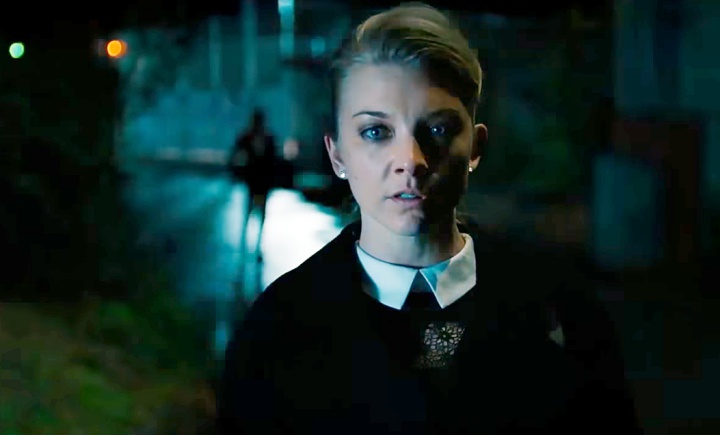
The film was written by real-life partners Anthony Byrne and Natalie Dormer; Byrne directs, Dormer stars. If you are fan of Ms. Dormer’s, possibly from her star turns in Game of Thrones or the Hunger Games franchise, then you will enjoy this film. It is a star-vehicle through and through, with nearly every shot focusing on some part of Dormer, whether her striking face or nimble physicality. Notably, Dormer proves her mettle as a very capable lead actress, and this film makes a solid case for more female-led stories written by the actresses themselves; Dormer’s character, Sofia, is a well-rounded and trustworthy focal point of the story, flitting through classy and dangerous scenarios with grace and thrilling movement. 

If only the story was as well-rounded and trustworthy. Heavens, what a license Dormer and Byrne’s story takes with the audience’s suspension of disbelief! After a striking, standout title sequence (which sets the stage excellently for a slick, exciting thriller to come), we are introduced to Sofia, a blind musician who glides around London with remarkable street smarts and style. The first 20-25 minutes continue like this, with a rich aesthetic palette and a fun, knife-edge sense of building danger. Her upstairs neighbor Veronique (Emily Ratajkowski) is clearly wrapped up in some nasty business, and when she turns up dead on the pavement outside their building, the plot thickens with Hitchcockian craftiness. Who killed her and why are the setup for the rest of the film’s twists and turns, but without spoiling anything, let me forewarn you that Veronique quickly becomes old news in favor of a much scummier, more complicated spider’s web of crime and revenge. 

For the first leg of In Darkness, the film makes a truly riveting imitation of classic Hitchcock and Wait Until Dark-esque blind-character craftwork — especially in a tense, nail-biting scene where assassin Marc (Ed Skrein) intends to kill Sofia for what she has seen, but notices her blindness and decides to follow her around her apartment in silence. Scenes like these are so fun and well crafted that the later dramatic shifts in tone and focus are more unfortunate than thrilling — there is a notable shift from Hitchcock to Jason Bourne all of a sudden that undoes a great deal of the film’s accomplishments with head-scratching intensity. 

Ultimately, that is the central problem of In Darkness — it has so many fetching elements to it, from the compelling star to the vintage first chapter to the stupendous use of music (again, only up until the tone change), yet it keeps undoing all that commendable work with silly plot twists. Twists, plural, mind you — each of which edge the film closer to completely undoing itself. As a fan of twists myself, I commend Dormer and Byrne’s ballsiness in their final few reveals, but I came out of the theatre feeling played for a fool, rather than hoodwinked by a clever storyteller. 

In Darkness is amusing genre excitement, and has potential as a twist-film highlight among those who enjoy just being confused, but it will mostly remind you how much better a straight-shooting classic crime thriller treats its own plot. Credit belongs to Natalie Dormer, however, for rooting it all in a fascinating lead — I can honestly say I would watch whatever she writes and stars in next. 

nae bad_blue

Star (blue)Star (blue)Star (blue)

Reviewer: Nathaniel Brimmer-Beller (Seen 28 June)

Go to In Darkness at the EIFF

EIFF: “Humor Me” (28 June ’18)

Image courtesy of LA Film Festival

“Explores the relationship between fatherhood, responsibility, and humor with grace.”

Editorial Rating: 3 Stars: Nae Bad

A warning to all who see this film: you will be telling and re-telling all the giddily awful jokes and one-liners within it to yourself and whoever will listen for days to come. Sam Hoffman’s Humor Me is a mixed bag of thin plotting, some uneven performances, and a few touching moments, but its elaborate jests are a laudable standout. As a relatively well-crafted, harmless dramedy, it satisfies.

The film stars New Zealand comedy goldmine Jemaine Clement as Nate, a self-doubting playwright, who hits rock bottom all at once and must move in to a retirement home community with his father Bob, played by the legendary Elliott Gould. Lowbrow yet brilliant jokes are Bob’s stock and trade, and Hoffman must be commended for the reverent way he realizes the elaborate scenarios the setups describe. Humor Me opens in striking monochrome, with vintage music and sound, all amusingly presented as if it is meant for a different film entirely, until Gould’s voiceover begins and it becomes clear this is all leading towards an elaborate punchline. These visuals return every time a particularly long-winded joke is delivered, and the effect is far and away the most memorable and creative aspect Humor Me has to offer. Not to imply that the film is otherwise dithering, far from it, yet nothing quite fits together as well as these scenes.

Clement is a pleasant lead, albeit with a slightly strangled delivery here and there, which can be forgiven as his American accent is not his natural lilt. Gould is certainly a standout for his layered portrayal of the aging jokester, especially in later scenes of conflict; two quite moving examples can be found in moments where Nate questions how Bob has moved on after his wife’s passing, for one, and most notably when they re-watch a VHS of Nate’s first play, which includes, and indicts, an all-too-familiar joking father who seems to ignore pressing problems within his own family. In scenes like these, the film explores the relationship between fatherhood, responsibility, and humor with grace. 

However, the weaker sides of the film are unfortunately hard to overlook. While the monochrome joke-telling segments are delightful, most of the rest of the comedic lines are just not all that funny. To paraphrase an ‘SNL’ (NBC’s Saturday Night Live) zinger, the lines are funny, but not “ha-ha” funny. The whole script is reminiscent of the kind of neurotic-chic off-Broadway play that Nate himself works on within the film, yet it is unclear whether Hoffman finds this style laughable or laudable. The title of Nate’s first play, A Crack In the Clouds, and the way he speaks about theatre in general, are so pretentious that one would think Hoffman is making a joke about derivative, self-important writing, yet the film itself has lines and scenarios just as irritatingly overwrought as the plays he seems to be mocking. One montage in particular, set to the song “Be Ok” by Ingrid Michaelson (who plays supporting love interest Allison fairly well) is just so twee I thought I would implode. Michaelson’s character, and the character of Nate’s ex-wife (played by Maria Dizzia), are also low points in the script; with the exception of some very amusing old ladies, most of the female characters are complete afterthoughts or stereotypes, particularly the ‘heartless ex-wife’ schtick, personified in a character so unbelievably cold and uncaring that one might reasonably think Hoffman has a serious hang-up about ex-wives. 

Hoffman, previous to his filmmaking career, was well-known as the creator of popular podcast Old Jews Telling Jokes, which is everything it says on the tin. It comes as no surprise then that this, his feature debut, is basically Old Jews Telling Jokes: The Movie, but if that sounds up your street, then by all means give the overall pleasant Humor Me a go. 

nae bad_blue

Star (blue)Star (blue)Star (blue)

Reviewer: Nathaniel Brimmer-Beller (Seen 28 June)

Go to Humor Me at the EIFF

EIFF: “Whitney” (22 June ’18)

“A warts-and-all telling of a seriously complicated story, with awe-inspiring moments to spare.”

Editorial Rating: 3 Stars

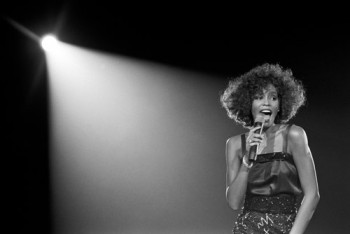
A true pop culture behemoth deserves a proper beginning-to-end document of their journey. Academy Award-winning Scottish filmmaker Kevin Macdonald has attempted as much for megastar Whitney Houston with his new, sprawling, film Whitney, an uneven but deeply moving document of Houston’s life. The film he has made is a curious case; while it performs dutifully as a warts-and-all telling of a seriously complicated story, with awe-inspiring moments to spare, its treatment of its immensely talented subject is not that sympathetic. 

The film ought to be commended for its deeply detailed depictions of Houston’s upbringing and rise to stardom. The access to such personal details is completely owed to the openness of the family, who began the process of getting the film made, not Macdonald. Thankfully, their hand in the process has not exempted them from any hard truths coming to light, and in fact some of the most devastating descriptions of mistreatment or disrespect surrounding Houston and her journey come directly from the family members who were responsible or complicit in the actions. The film almost feels like a scripted slow build; at times, as Macdonald admitted in a post-screening Q&A, even the documentarians are shocked by what their subjects reveal about Ms. Houston and her family. Like many rise-to-stardom stories, there are heartbreakingly tragic double-crosses, miscalculations, and traumas to be found just under the surface, and the film shies away from none of them. 

It must be noted, artistically, there is little directorial signature or flair on the finished product — it mostly runs as a series of clips and related interviews, assembled in chronological order. The lion’s share of the memorable moments are down to Ms. Houston herself; clip after clip of archival footage proves again and again that she was truly one of the most talented pop singers of all time. By the time the film reaches the date of her death in 2012, the viewer will most likely empathize with the tragically doomed Houston more than ever. This is the true triumph of Whitney, for the film makes a compelling argument for her complete exoneration from the gruesome tabloid rumors that sank not only her career but her self-confidence. The film does well to simply play a performance of hers in full from time to time, just to recall what a breathtakingly beautiful voice she possessed. (You just try and maintain a dry eye when they revisit her performance of the ‘Star Spangled Banner’ at the 1991 Super Bowl – you just try!)

That being said, Macdonald’s framing of the story does such a good job pointing out the mercilessness of tabloid interference in famous lives like Houston’s, that the nature of his own film gets consequently called into question. Horrid headlines concerning Houston’s dirty laundry and possible vices are sprawled across the screen as the film reaches the 2000s, Houston’s worst period of self-destruction; while this effect is well-measured, as the film itself began revealing similarly lurid details, I found myself beginning to question what the difference really is between the two outlets. Though Macdonald defended his film as ‘the truth,’ so therefore ‘better’ than tabloid journalism, the film does take a few steps too far into broadcasting the darkest sides of Houston’s past as if their tragic implications have entertainment value. 

The film’s clinical approach to telling the story seems to treat its sensitive material at an arm’s length, which somewhat irresponsibly allows for sarcasm and humor where there really should be compassion and understanding. From the racial implications of its subjects’ statements, to certain allegations of terrible abuse, to the private inconsistencies of some contacts of hers, (her complicated ex-husband Bobby Brown asserting that Houston did not have a drug problem at all, for instance), the film simply has too many moments where the heartbreaking material seems meant to elicit a laugh, rather than a tear or a moment of reflection, and though there are more high points than low, Macdonald’s film never quite feels entirely respectful as a result.

Overall, however, Whitney is a fascinating two hours, and a must for any fans of The Prom Queen of Soul, or fans of the music biz in general. 

nae bad_blue

Star (blue)Star (blue)Star (blue)

Reviewer: Nathaniel Brimmer-Beller (Seen 22 June)

Go to Whitney at the EIFF


EIFF: “Papillon” (22 June ’18)

“Quite compelling.”

Editorial Rating: 3 Stars: Nae Bad

This film is, conspicuously, a remake. Not in the sense that it broadcasts its similarities and differences to the original, (in this case the 1973 version of Henri Charrière’s seminal autobiography), like some decades-later remakes do, but in the sense that it simply re-makes the first. This begs a question which Michael Noer’s new Papillon never quite answers: why was this film made?

The action follows a dashing Paris criminal known as ‘Papillon’ (Charlie Hunnam), cracking safes in style in 1931, as he gets some brutal comeuppance for swindling his boss, and is framed for murder. His sentence is life in prison, specifically an overwhelmingly horrible penal colony in French Guiana. There, and over the next few decades, he attempts various escapes through a partnership with wealthy but weak Louis Dega (Rami Malek), and experiences disturbing and inhumane treatment from the prison’s guards and higher-ups. The kicker is that it’s all based on a true story, by the real Henri ‘Papillon’ Charrière, whose book of the events, published in 1969, has sold over 13 million copies worldwide.  Charrière was pardoned of murder in 1970.

There is a confusion to Noer’s film, however, for on its surface, it is quite compelling, but underneath, it is really just a re-done version of a film that has already been made. Steve McQueen and Dustin Hoffman embodied the roles of Papillon and Dega, respectively, in Franklin J. Schaffner’s original, which, though not considered a great film, is still a notable work in American depictions of agony in incarceration. Noer’s film has cinematic agony to spare, and at times verges into outright body horror as Papillon and others are starved, savagely beaten and whipped, and in some cases dismembered and murdered. It’s not a very fun time for anyone.

Yet, despite the aspects that befuddle and disgust, Papillon delivers some affecting cinema here and there. The casting should be commended above all else; Hunnam and Malek are without a doubt two of the most capable yet underused leading men onscreen today, and it is very satisfying to watch them play off each other. Hunnam continues to impress with his ability to flaunt his physicality and his grim charm, and for fans of his star turn in James Gray’s underrated The Lost City of Z, this film will not disappoint. Yet it is Malek who stands out the most remarkably here, and his Dega, weak-chinned but crafty, might be one of the more memorable characters of this entire festival so far.

In terms of craft, Danish director Noer makes some odd choices, but none really take away too deleteriously. One qualm I had is the complete lack of establishing shots in the first half of the visuals — in a film so focused on a hellish jungle landscape, it is strange that the camera focuses more on medium shots in quite random succession. Until we get one breathtaking shot of the South American sunset on a river, followed by another strange bout of shots where a small boat at sea takes up three quarters of the frame, and an ensuing storm is relegated to a distant speck. Perhaps these are all intentional distortions of what we expect to see, but it struck me more as unsuccessful attempts to shoot around a small effects budget, which detracts from the epic nature of this decades-long story. Nevertheless, the film may be slow, but it is not boring; it is odd but not off-putting — unnecessary, but not unwelcome.

nae bad_blue

Star (blue)Star (blue)Star (blue)


Reviewer: Nathaniel Brimmer-Beller (Seen 22 June)

Go to Papillon at the EIFF here


The Sorcerer, EUSOG (Pleasance: 27 – 31 March ’18)

Photos. Erica Belton

” A hoot from start to finish”

Editorial Rating:  4 Stars Nae Bad


As one who grew up when the D’Oyly Carte closed shop was in full swing this writer was perhaps somewhat of a trailblazer in being one of the first to take part in an independent production in 1962 while at prep school (the copyright on Gilbert’s words having expired in 1961). I was the Sergeant of Police in The Pirates of Penzance, probably the one and only time this Bass part has been sung by a Treble. It was thus with almost a sense of ownership that I went along to see the Edinburgh University Savoy Opera Group’s presentation of the relatively unknown Gilbert and Sullivan operetta, The Sorcerer, set  in 1969’s Summer of Love. (Well, that was ’67 if you went to San Francisco, Ed.)

There is a long history of The Savoy Opera Group introducing topical elements into the songs and dialogue. However a “modern dress” production (albeit from the 60s) is rarer, more common in Shakespeare or Grand Opera, perhaps like the new production of Cosi Fan Tutte premiering at the Met in New York this very Saturday that is set in Coney Island ten years earlier.

So. A relatively unknown work. A hippy production (I show my age).  A student company. In a word, a risk. Did it work?

The costumes paid only a passing reference to 60’s fashion: the occasional mini skirt, Aline’s dress, floral crowns for the female company and the occasional floral shirt and scarf for the men. Not a single hipster bellbottom or Zapata moustache in sight. But actually none of this really mattered and was presumably a way of keeping down wardrobe costs. After all, this was essentially pantomime. And it was a hoot from start to finish.

The Sorcerer made its debut in 1877 and was the first Gilbert and Sullivan collaboration in which the two had complete control of the production. It was highly successful for its time, which encouraged the author and composer to continue working together and expanding the possibilities of satiric operetta. The Sorcerer introduced the comic duet, the patter song, the contrapuntal double chorus, the tenor and soprano love duet and the soprano showpiece aria that became staples of all the G & S productions that followed.

The Sorcerer also introduced W. S. Gilbert’s passion for satirizing the excessive focus of the English on class differences with a plot that turns the entire social order upside down. As the operetta begins, the villagers of Ploverleigh are celebrating the betrothal of Alexis, son and heir of Sir Marmaduke Pointdextre, to the only maiden of suitable rank in the neighbourhood, Aline, daughter of Lady Sangazure. Alexis and Aline sign the marriage contract, but it appears that Alexis, despite the fact that he loves Aline, does not share his father’s outmoded notions that only men and women of equivalent rank should marry, without regard to such nonsense as romantic inclination.

Alexis has, in fact, hired a sorcerer, John Wellington Wells, to test his theories. Wells casts a spell and creates a love potion that is administered to all the villagers through tea poured from a large teapot during the banquet following the betrothal. All who drink it immediately fall asleep, just as Wells has predicted. When they awaken, he promises, each will fall madly in love with the first person he or she sees (shades, obvs, of A Midsummer Night’s Dream and why not of Sgt Pepper’s Lonely Hearts Club too?). Those who are already married are conveniently immune.

As we might anticipate, when the villagers awaken at midnight, chaos ensues. Sir Marmaduke himself, much to his son’s displeasure, falls in love with the lowly and elderly Mrs. Partlet, the pew opener. Lady Sangazure falls in love with the sorcerer himself, who spends most of the second act trying to elude her grasp. Even Alexis’ own betrothed, the lovely Aline, drinks the potion and falls out of love with Alexis and in love with the vicar of the village. Order can be restored only by the sacrifice of either Alexis or Mr. Wells …… But does it work out OK? Well, go and find out for yourself, but you can probably guess.

Did the players bring it off? Yes they did. Right from the start the opening ensemble inspired one in their confident, loud singing and homogeneity. I thought they were all miked up, such was the pleasing volume level, but, no, that was only the Principals. The chorus sang and acted enthusiastically, convincingly and were thoroughly entertaining from start to finish, particularly when the yummy potion took effect.

As for the Principals, I do question the choice of a female playing Alexis and dressed ambiguously with fitted shirt, trousers and cravat – again token costuming –  and Tilly Botsford handled the lower register singing only adequately, but acted convincingly. The finest singing came from Julia Weingartner’s Lady Sangazure with some hilariously over the top potion-induced amorous attention paid to the wickedly well played John Wellington-Wells (Angus Bhattaharya). The other Principals, Olivia Wollaston (a suitably pure Aline), Gordon Home (a well portrayed Pointdextre), Georgia Maria Rodgers (a frustrated adolescent Constance), Ewan Bruce (a suitably troubled and decent Dr Daly) and Niamh Higgins (a scream as Mrs Partlet) all drew us into the performance and had us rooting for them.

This was an evening of huge entertainment. Great singing, convincing acting, and tremendous fun. Everybody from Producer to orchestra member should take a bow.


nae bad_blue

Star (blue)Star (blue)Star (blue)Star (blue)


Reviewer: Charles Stokes (Seen 28 March)

Go to EUSOG, the Edinburgh University Savoy Opera Group

Visit Edinburgh49 at the Pleasance archive.

SCO: Ticciati, Martin (Usher Hall: 22 March ’18)

Image result

Robin Ticciati

“Edinburgh’s loss is Berlin’s gain”

Editorial Rating: 4 Stars Nae Bad

I started checking the website the previous evening. And every couple of hours on the day. Would the great man show up? He has been plagued by back problems, and has publicly announced he is “doing less, to give himself more space”. Tell that to Valery Gergiev. A number of recent concerts have been missed.


Well he did, and well he had to, didn’t he? For this was the official farewell concert of Robin Ticciati as Principal Conductor of the SCO having taken up the position of Music Director of the Deutches Symphionie-Orchester Berlin. Pleasing that as Rattle leaves the BPO another Brit takes over at the DSO. Lucky Berlin to have such talented Brits.


As expected, there was a full house. Everybody knew they were in for something special. Robin and the band did not disappoint. Whilst mainstream repertoire was chosen, it was played with insight, intuition and zest. This was not a case of bashing out a few lollipops to keep the punters happy.


That having been said, the choice of Bach’s Orchestral Suite No 4 in D did not in my opinion sit well with the post romantic nature of the rest of the programme. It was played enthusiastically and fluently, notwithstanding the somewhat stilted, staccato-esque scoring. The standing violins and violas reminded me of Christopher Warren-Green’s London Chamber Orchestra and like them played from memory. This gave an effective theatrical turn to the interplay between solo first violin and viola, creating an atmosphere of baroque’n’roll.


Unusually scored for strings, harp and piano the Copland Clarinet Concerto is a hybrid work in the classical/jazz idiom akin to some of the music of Leonard Bernstein.   In two movements and but 18 minutes long, it is a work of depth, intensity and contrasts. The first movement “Slowly and expressively” was exquisitely played by Maximiliano Martin and is a real tearjerker akin to Samuel Barber’s Adagio for Strings. Seldom has the harp and viola introduction been played so sensitively intoned, followed by the lyricism and restraint of the soloist. Following a demanding and striking cadenza the second movement, “Rather fast – trifle faster” was virtually jazz (it was written for Benny Goodman) and was delivered with aplomb by Martin, light on his feet as if he were the Pied Piper. With much applause Martin stood next to the game pianist and granted us an encore.


Following the interval it was time for the party piece, Dvorak’s Symphony No 9 ‘From the New World’. These accursed titles do one no good in trying to get in touch with the music. Like the Moonlight Sonata they are publishers’ whims to help with their marketing. The work is a wonderful example of post-romantic symphonic form (1893), well constructed in four movements, tuneful and melodic throughout. And while there may be influences of Native American music and American Folk Song, it is on record that Dvorak thought that there was nothing much to distinguish between Native American, African –American or even Scottish music. We take the music on its merits, which are considerable.


The piece is so well known it is difficult to avoid cliché, but the orchestra played with such convincing phrasing and freshness that there was nothing hammy or schmaltzy at all, it was almost as if listening with fresh ears, albeit to a superbly classic interpretation. A wonderful note for Robin Ticciati to go out on, save for the lyrical “Song without Words” encore.


Robin Ticciati will be back conducting the SCO in the Brahms symphonic cycle for the Edinburgh Festival. In the meantime, Edinburgh’s loss is Berlin’s gain.


nae bad_blue

Star (blue)Star (blue)Star (blue)Star (blue)

Reviewer: Charles Stokes (Seen 22 March)

Go to the Scottish Chamber Orchestra here

Visit the Usher Hall archive.

SCO: Emelyanychev, Spacek (Usher Hall: 15 March ’18)

Image result

Josef Spacek

“If it were a blind tasting you would be definitely getting a taste of premier cru”

Editorial Rating: 4 Stars: Nae Bad


The winter season has been cruel to the fans of the more well known soloists booked by the Scottish Chamber Orchestra. Thursday’s concert, the latest of three I had planned to attend, was, for the third time in a row for me, blighted by the non-appearance of not only the soloist but also the conductor. The SCO points out in its no-show apology that there are no refunds because they have the right to substitute artists. Other Scottish orchestras take a less severe line. I had wanted to see Schiff a few weeks ago, I had wanted to see Tetzlaff on Thursday. I wanted to see Ticciati. That’s why I put the concert in the diary. All pulled. Ticciati’s on-going back problems deserve sympathy and should be recorded here. One hopes he can make it for his farewell concert next week. For the others, one wonders.


I decided to stay, not least because I feared that opportunities to review the SCO were proving elusive. I am glad I did, because that fickle spirit, Live Music, triumphed, and I learnt a lesson.


The B Team were young, but what they lacked in experience they made up for in enthusiasm, technical competence, and considerable depth of interpretation beyond their years. The concert was a joy from start to finish, melodic, engaging, very well played, relaxed and entertaining. Maxim Emelyanychev stood in for Robin Ticciati. A student of Rozhdesvensky and the Moscow Conservatory he has, at the tender age of 29, yet to conduct a first rank orchestra, but is booked next season for the Royal Philharmonic, the St Petersburg Philharmonic and at Glyndebourne with the Orchestra of the Age of Enlightenment. So tonight we were shown a window into a promising future.


Perhaps Josef Spacek, standing in for Christian Tetzlaff, has a few more pips on his shoulder. He has appeared not only with his native Czech Philharmonic, but also, among others, the Philadelphia Orchestra, Bamberger Symphoniker, Rotterdam Philharmonic and Netherlands Philharmonic. This was his first gig with a British orchestra. The 32 year old did well.


And so to the music. Of the three concertos written by Dvorak, I would put the piano concerto in the second division, the violin concerto at the bottom end of the first, and the cello concerto as a masterpiece. I personally prefer the Romance for Violin and Orchestra to the concerto, but of course the latter is a more substantial work. Spacek took immediate control with confidence, smooth phrasing, great tone and sufficient volume even way up high on the E string, standing out from the orchestra notwithstanding the limitations of his instrument.   Emelyanychev kept the orchestra in balance but brought everything out of the piece in a conducting style that was confident and far from laid back. The orchestra was competent and supportive after just the slightest waver on the fiendishly difficult and exposed horn opening, and one was in no doubt as to the natural synergy between the triad of orchestra, soloist and conductor, completely forgetting that two of them were stand-ins.


I cannot write about Schubert’s 9th Symphony without a reference to my then eight year old daughter chatting to a violinist from the London Philharmonic Orchestra during the interval at a concert at the Royal Festival Hall, just before playing the work. He said that he and his colleagues called it “The Great Sea Monster” and that is what the Great C Major has been in our household ever since.


The symphony is not without its challenges to the listener. The key of C has its limitations, and for Schubert it is relatively long. There is plenty of melody, but also quite a bit of ‘fill’. The solution, as rightly executed by Emelyanychev, is to take it at a cracking pace.  The SCO was melodic, cohesive, disciplined and played it better than many. I should give a special mention to the timpanist who unusually was given an opportunity to demonstrate his considerable expertise. Overall it was a very accomplished performance by both orchestra and conductor.


The lesson for this writer is, once again, with live music you never know what you are gong to get. Stars can disappoint, relatively unknowns can surprise and impress. To mix my metaphors, while the names tonight were perhaps more Naxos than DG, if it were a blind tasting you would be definitely getting a taste of premier cru.


nae bad_blue

Star (blue)Star (blue)Star (blue)Star (blue)

Reviewer: Charles Stokes (Seen 15 March)

Go to  the SCO, Scotland’s national chamber orchestra

Visit Edinburgh49 at the the Usher Hall archive.

The Belle’s Stratagem (Lyceum: 15 Feb. to 10 March ’18)

Angela Hardie as Laetitia.
Photo. Mihaela Bodlovic.

“Jaunty, diverting and quick. A noteworthy woman playwright is not short-changed”

Editorial Rating:  3 Stars Nae Bad

There was gleeful mention of the ‘shit wagon’ and of the reeking ‘Nor Loch’ but these early New Town characters keep their stockings a blinding white and the hems of their fancy gowns spotless. It’s that kind of play: a slight comedy of appearances. Or should that be ‘sleight’?

The Belle’s Stratagem is a jaunty piece, giddy even. Its leading man is Doricourt (Angus Miller), although he’s led by the nose, and he has ‘l’air enjoué’ of a chap with too many Air Miles and too many hours in Club class. Well, he would have, except this is 1788 when Gold Cards and guineas were more likely gifted by pedigree than work. He’s back in Edinburgh after his ‘Grand Tour’ of assorted lounges, demoiselles and signorinas and finds himself betrothed to Letitia (Angela Hardie), known almost from birth and now two years out of boarding school, and he’s not impressed. She, Letitia, is pissed at this – vulgarity clearly crossed Princes Street – and is determined to have her man love her or lose her. Meanwhile, Sir George Touchwood (32 and of the Jacob Rees-Mogg brigade, benign branch) is back in town with his lovely, guileless, wife, Lady Frances. Beware! Cad about, Courtall by name (geddit?), who will have the lady.

Tony Cownie has adapted Mrs Cowley’s Belle’s Stratagem of 1780 and removed the whole play to Scotland, aka that ‘subjugated bunch of hills north of Berwick’. Deacon Brodie is stealing about; Doricourt and the honourable Saville (John Kielty)  are soft Jacobites; Laetitia’s father is Edinburgh’s Provost and Laetitia (in disguise) wins Doricourt’s heart and the audience’s with an aching ‘Will ye no come back again?’ The best joke of the evening is Courtall’s as he goes off to France for an assignation with the Revolution.

Theatre history is all over this piece, if you look for it. The big brother of Cowley’s original has to be George Farquhar’s Beaux Stratagem from 1707. Farquhar had arrived in London in 1697 from Dublin’s wonderfully evocative Theatre Royal at Smock Alley. Cowley’s play opened at the Theatre Royal Covent Garden. Nicola Roy’s Kitty, a prostitute with a proper sense of what’s decent, would fit well into those dodgy streets. She’s the key to foiling Courtall’s foul intrigue. The two widows, Racket (Pauline Knowles) and Ogle (Roy, again) give lechery a good name by repeatedly calling out the hypocrisies of male behaviour but enjoy eyeing the men themselves.

Helen Mackay as Lady Frances and Grant O’Rourke as Sir Edward.
Photo: Mihaela Bodlovic

Historians place The Belle’s Stratagem at the endpoint of a period when the Comedy of Manners went bourgeois. Marriage and compatibility within a marriage become a pair and so enter Sir Edward and Lady Frances, who (for me) are more interesting and entertaining than an infatuated Doricourt and the infantile Laetitia of the first half and the minx Laetitia of the second. Grant O’Rourke plays the country squire (ok, laird) as if to the manor born. He’s a kind fellow, whose daft helplessness (check O’Rourke’s real comic quality in the Venetian Twins) rallies to the call of defending his wife. He ends up an endearing character and – a near no-no in the Restoration comedy of times past – a deserving husband. And Lady Frances (admirably done by Helen Mackay) is bold enough to love him true once she has established her own rights, which again is rather refreshing. The New Town will be all the better for their rectitude during their three months residence in town! Laetitia’s father, the Provost, is more typecast as the lookout for a wealthy son-in-law but Steven McNicoll gives the part considerable warmth and humanity, not least in a party dress.

There’s pretty music, dancing, a masquerade, numpty grumpy footmen, and squeaky clean, impressively silent Heriot Row facades but all the same I longed for some ruggedness, more spit and bite. The gossip columnist, Flutter, is played by an impish John Ramage and that gets close, but finally it’s light and undemanding. The ‘modern’ script is frequently diverting and quick, actors help it on enormously, and a noteworthy woman playwright is not short-changed, but the intrigue unwinds too rapidly and I found much of the humour either forced or slack.

nae bad_blue

Star (blue)Star (blue)Star (blue)

Reviewer: Alan Brown (Seen 21 February)

Go to The Belle’s Stratagem at the Lyceum

Visit Edinburgh49 at The Lyceum  archive.

SCO: Ticciati. Atkins. Cargill. (Queen’s Hall: 11 January ’18)

Image result

Jean-Fery Rebel (1666-1747)

” A consummate synergy of soloist and orchestra.”

Editorial Rating: 4 Stars:  Nae Bad

Thursday’s 2018 Season opener by the Scottish Chamber Orchestra, “Chaos and Creation”, was one of the most creative, surprising and varied concert programmes that I have ever come across – with the exception of the Haydn. But more of that later.


Do you know Jean-Féry Rebel? No, he is not a rock star or DJ, but was a composer (1666-1747) at the French Court at the time of Louis XV and a favourite of Madame de Pompadour. He came of a dynasty of court musicians, lived a long and successful life and wrote Les Elemens at the age of 72. It is a most extraordinary piece, with a sort of full on slam-dunk opening that reminded me of Honegger, 250 years later. Special effects were very much the thing in European Baroque and we were treated to a bird warbler at the rear of the auditorium, a whoop whistle reminiscent of Oliver Postgate’s The Clangers, and a wonderful theorbo – basically an oversized lute – whose fretboard must have been at least four feet long. At times I thought I was listening to the soundtrack of The Magic Roundabout. Violin bodies were used as percussion, the conductor did a dance with the principal violist, and everyone had a good time. I never knew Baroque could be so much fun.


A darker form of intensity followed with principal violist Jane Atkins taking the solo spot in Martinu’s Rhapsody-Concerto for Viola and Orchestra (1951). She acquitted herself well, aided by her confident and lively persona. Although less celebrated now than his compatriot, Antonin Dvorak, Martinu was a successful composer and America took to him. The work is steeped in the Bohemian folksong style with a deep romanticism breaking away from his earlier neo-classical style. Atkins brought everything out of the work, producing rich melodic tones and light dance-like flashes that engaged us throughout. A consummate synergy of soloist and orchestra.


There was no let up in the treats Robin Ticciati and his band had in store for us after the interval. The Czech genre continued with Dvorak’s Biblical Songs. (1876). Scottish Mezzo Soprano Karen Cargill gave an assured and rewarding performance of the ten songs, commendably handling the Czech language without difficulty. Cargill has memorably sung Schoenberg’s Gurrelieder at the 2017 Proms with Sir Simon Rattle, and we were lucky to have her. I firmly believe this accomplished Mezzo, winner of the 2002 Kathleen Ferrier Award, to be on the verge of being one of the greatest Mezzos, and listening to her was a privilege.


The evening concluded with Haydn’s Symphony No. 96 (1791), wrongly called the Miracle Symphony for reasons we need not concern ourselves with here. Played with zest and not a hint of tiredness after a demanding programme, the orchestra acquitted itself well under Ticciati’s baton in this microcosm of Haydn’s symphonic genre, the first of his London Symphonies. But why it was included in the programme is open to question. It was  out of kilter with the other more esoteric works of the evening. Nonetheless it made an enjoyable finale.


nae bad_blue

Star (blue)Star (blue)Star (blue)Star (blue)

Reviewer: Charles Stokes (Seen 11 January)

Visit the SCO, the Scottish Chamber Orchestra

Go to Edinburgh49’s Queen’s Hall archive.

How To Disappear (Traverse: 8 -23 Dec.’17)

Owen Whitelaw, Robert, with Kirsty Mackay as Isla.
Image: Beth Chalmers.

“Help yourself to creative energy …”

Editorial Rating: 4 Stars Nae Bad


You don’t associate Elgin with hoodies, or Percy Pigs come to that. Go see Morna Pearson’s How To Disappear, however, and you will. The broad Doric may be less surprising and – at this time of year – why not put Narnia, downsized and upstage, through a cupboard in a bungalow?

If this sounds funny, it is, but it is not light-hearted. Far out, maybe. Imagine finding a squashed pot of Angel Delight in your Christmas stocking and you’re some way there. Or, because this is a play of alternatives, you’ve been given 2 DVDs: ‘I, Daniel Blake’ and ‘Room’. Great films but nonstarters in the Ho Ho Ho! stakes.

That’s a deliberate choice of films, of course. Robert, 28, lives on benefits that the Department of Work and Pensions wants to relieve him of. He has not left his room for twelve years, near enough. He has not been outside since he was eight. In the absence of their parents his kid sister, Isla (14-ish) looks after him as best she can, so it helps when she is excluded from school. A benefits assessor, Jessica, has come to ask Robert some questions.

But that’s barely the half of it. There’s a glowing blue portal and a stage revolve to expose the full story. Exactly when it turns is, for the audience, quite exciting; for Robert it’s an obsessional, skin picking quest, but for his pet tarantula it’s an unfortunate accident; and for Jessica it’s spew and ‘Wow!’ all the way.

Help yourself to creative energy then. Certainly Robert does. Copies of ‘New Scientist’ are stacked up against the walls so there’s not much space for him to move around and check his various alarm clocks but this is one clever ‘mannie’ who – all innocent of the metaphor  – dumps his benefits assessment into his bedpan. Owen Whitelaw is excellent in what could be a raw and painful role but is actually agile and sympathetic. His sister, Isla, is more aware, more aggrieved and angrier with what – on the face of it – is a distressing existence. Kirsty Mackay has that awkward dual role as ‘adult’ carer and S4 pupil who is still getting mercilessly bullied at school. (Note for school Guidance staff – you get a mouthful). Jessica (Sally Reid) is a paper shuffling caricature to some extent but with Robert as her ‘client’ is happily saved.

There is redemption here, which is good for a Christmas production. It’s in the near constant humour for one thing and in the marvellous sense of release, of stepping out of the room that comes at the end. But it’s not an easy given and director Gareth Nicholls keeps the action pretty edgy, using plunging lighting effects (exemplary from Kai Fischer) and sound from Michael John McCarthy that begins, it seemed to me, with a nod to ‘Big Country’ and then funnels down to close in on Becky Minto’s box frame of a set.

We need plays with moral outreach and How To Disappear is definitely out there to bring us in. We’re with Robert because he wants to help his father be with his mother, which is where the plot line folds into the mystic portal and you wonder where you are. Just hang on to the fact that he shares his Milky Way with his sister. We’re with Isla because she won’t get lost and hangs onto her brother because she loves him. We’re even with Jessica because she too is a strung out case who does what she can to help people and, like Robert, she loves the ‘Hot Tub Time Machine’, which says it all really.

Star ratings get done over in the wash in this one: 3, 4, 3, 4 … ?

Isla         ‘D’you kain whit number the washin machine goes on at?

Robert  Nut.

By the end, it’s 4* from me for an original and entertaining play. Fabric conditioner for the soul!

nae bad_blue

Star (blue)Star (blue)Star (blue)Star (blue)

Reviewer: Alan Brown (Seen 8 December)

Go to How To Disappear at the Traverse

Visit Edinburgh49 at the Traverse archive.