EIFF: “Papillon” (22 June ’18)

“Quite compelling.”

Editorial Rating: 3 Stars: Nae Bad

This film is, conspicuously, a remake. Not in the sense that it broadcasts its similarities and differences to the original, (in this case the 1973 version of Henri Charrière’s seminal autobiography), like some decades-later remakes do, but in the sense that it simply re-makes the first. This begs a question which Michael Noer’s new Papillon never quite answers: why was this film made?

The action follows a dashing Paris criminal known as ‘Papillon’ (Charlie Hunnam), cracking safes in style in 1931, as he gets some brutal comeuppance for swindling his boss, and is framed for murder. His sentence is life in prison, specifically an overwhelmingly horrible penal colony in French Guiana. There, and over the next few decades, he attempts various escapes through a partnership with wealthy but weak Louis Dega (Rami Malek), and experiences disturbing and inhumane treatment from the prison’s guards and higher-ups. The kicker is that it’s all based on a true story, by the real Henri ‘Papillon’ Charrière, whose book of the events, published in 1969, has sold over 13 million copies worldwide.  Charrière was pardoned of murder in 1970.

There is a confusion to Noer’s film, however, for on its surface, it is quite compelling, but underneath, it is really just a re-done version of a film that has already been made. Steve McQueen and Dustin Hoffman embodied the roles of Papillon and Dega, respectively, in Franklin J. Schaffner’s original, which, though not considered a great film, is still a notable work in American depictions of agony in incarceration. Noer’s film has cinematic agony to spare, and at times verges into outright body horror as Papillon and others are starved, savagely beaten and whipped, and in some cases dismembered and murdered. It’s not a very fun time for anyone.

Yet, despite the aspects that befuddle and disgust, Papillon delivers some affecting cinema here and there. The casting should be commended above all else; Hunnam and Malek are without a doubt two of the most capable yet underused leading men onscreen today, and it is very satisfying to watch them play off each other. Hunnam continues to impress with his ability to flaunt his physicality and his grim charm, and for fans of his star turn in James Gray’s underrated The Lost City of Z, this film will not disappoint. Yet it is Malek who stands out the most remarkably here, and his Dega, weak-chinned but crafty, might be one of the more memorable characters of this entire festival so far.

In terms of craft, Danish director Noer makes some odd choices, but none really take away too deleteriously. One qualm I had is the complete lack of establishing shots in the first half of the visuals — in a film so focused on a hellish jungle landscape, it is strange that the camera focuses more on medium shots in quite random succession. Until we get one breathtaking shot of the South American sunset on a river, followed by another strange bout of shots where a small boat at sea takes up three quarters of the frame, and an ensuing storm is relegated to a distant speck. Perhaps these are all intentional distortions of what we expect to see, but it struck me more as unsuccessful attempts to shoot around a small effects budget, which detracts from the epic nature of this decades-long story. Nevertheless, the film may be slow, but it is not boring; it is odd but not off-putting — unnecessary, but not unwelcome.

nae bad_blue

Star (blue)Star (blue)Star (blue)


Reviewer: Nathaniel Brimmer-Beller (Seen 22 June)

Go to Papillon at the EIFF here


The Sorcerer, EUSOG (Pleasance: 27 – 31 March ’18)

Photos. Erica Belton

” A hoot from start to finish”

Editorial Rating:  4 Stars Nae Bad


As one who grew up when the D’Oyly Carte closed shop was in full swing this writer was perhaps somewhat of a trailblazer in being one of the first to take part in an independent production in 1962 while at prep school (the copyright on Gilbert’s words having expired in 1961). I was the Sergeant of Police in The Pirates of Penzance, probably the one and only time this Bass part has been sung by a Treble. It was thus with almost a sense of ownership that I went along to see the Edinburgh University Savoy Opera Group’s presentation of the relatively unknown Gilbert and Sullivan operetta, The Sorcerer, set  in 1969’s Summer of Love. (Well, that was ’67 if you went to San Francisco, Ed.)

There is a long history of The Savoy Opera Group introducing topical elements into the songs and dialogue. However a “modern dress” production (albeit from the 60s) is rarer, more common in Shakespeare or Grand Opera, perhaps like the new production of Cosi Fan Tutte premiering at the Met in New York this very Saturday that is set in Coney Island ten years earlier.

So. A relatively unknown work. A hippy production (I show my age).  A student company. In a word, a risk. Did it work?

The costumes paid only a passing reference to 60’s fashion: the occasional mini skirt, Aline’s dress, floral crowns for the female company and the occasional floral shirt and scarf for the men. Not a single hipster bellbottom or Zapata moustache in sight. But actually none of this really mattered and was presumably a way of keeping down wardrobe costs. After all, this was essentially pantomime. And it was a hoot from start to finish.

The Sorcerer made its debut in 1877 and was the first Gilbert and Sullivan collaboration in which the two had complete control of the production. It was highly successful for its time, which encouraged the author and composer to continue working together and expanding the possibilities of satiric operetta. The Sorcerer introduced the comic duet, the patter song, the contrapuntal double chorus, the tenor and soprano love duet and the soprano showpiece aria that became staples of all the G & S productions that followed.

The Sorcerer also introduced W. S. Gilbert’s passion for satirizing the excessive focus of the English on class differences with a plot that turns the entire social order upside down. As the operetta begins, the villagers of Ploverleigh are celebrating the betrothal of Alexis, son and heir of Sir Marmaduke Pointdextre, to the only maiden of suitable rank in the neighbourhood, Aline, daughter of Lady Sangazure. Alexis and Aline sign the marriage contract, but it appears that Alexis, despite the fact that he loves Aline, does not share his father’s outmoded notions that only men and women of equivalent rank should marry, without regard to such nonsense as romantic inclination.

Alexis has, in fact, hired a sorcerer, John Wellington Wells, to test his theories. Wells casts a spell and creates a love potion that is administered to all the villagers through tea poured from a large teapot during the banquet following the betrothal. All who drink it immediately fall asleep, just as Wells has predicted. When they awaken, he promises, each will fall madly in love with the first person he or she sees (shades, obvs, of A Midsummer Night’s Dream and why not of Sgt Pepper’s Lonely Hearts Club too?). Those who are already married are conveniently immune.

As we might anticipate, when the villagers awaken at midnight, chaos ensues. Sir Marmaduke himself, much to his son’s displeasure, falls in love with the lowly and elderly Mrs. Partlet, the pew opener. Lady Sangazure falls in love with the sorcerer himself, who spends most of the second act trying to elude her grasp. Even Alexis’ own betrothed, the lovely Aline, drinks the potion and falls out of love with Alexis and in love with the vicar of the village. Order can be restored only by the sacrifice of either Alexis or Mr. Wells …… But does it work out OK? Well, go and find out for yourself, but you can probably guess.

Did the players bring it off? Yes they did. Right from the start the opening ensemble inspired one in their confident, loud singing and homogeneity. I thought they were all miked up, such was the pleasing volume level, but, no, that was only the Principals. The chorus sang and acted enthusiastically, convincingly and were thoroughly entertaining from start to finish, particularly when the yummy potion took effect.

As for the Principals, I do question the choice of a female playing Alexis and dressed ambiguously with fitted shirt, trousers and cravat – again token costuming –  and Tilly Botsford handled the lower register singing only adequately, but acted convincingly. The finest singing came from Julia Weingartner’s Lady Sangazure with some hilariously over the top potion-induced amorous attention paid to the wickedly well played John Wellington-Wells (Angus Bhattaharya). The other Principals, Olivia Wollaston (a suitably pure Aline), Gordon Home (a well portrayed Pointdextre), Georgia Maria Rodgers (a frustrated adolescent Constance), Ewan Bruce (a suitably troubled and decent Dr Daly) and Niamh Higgins (a scream as Mrs Partlet) all drew us into the performance and had us rooting for them.

This was an evening of huge entertainment. Great singing, convincing acting, and tremendous fun. Everybody from Producer to orchestra member should take a bow.


nae bad_blue

Star (blue)Star (blue)Star (blue)Star (blue)


Reviewer: Charles Stokes (Seen 28 March)

Go to EUSOG, the Edinburgh University Savoy Opera Group

Visit Edinburgh49 at the Pleasance archive.

SCO: Ticciati, Martin (Usher Hall: 22 March ’18)

Image result

Robin Ticciati

“Edinburgh’s loss is Berlin’s gain”

Editorial Rating: 4 Stars Nae Bad

I started checking the website the previous evening. And every couple of hours on the day. Would the great man show up? He has been plagued by back problems, and has publicly announced he is “doing less, to give himself more space”. Tell that to Valery Gergiev. A number of recent concerts have been missed.


Well he did, and well he had to, didn’t he? For this was the official farewell concert of Robin Ticciati as Principal Conductor of the SCO having taken up the position of Music Director of the Deutches Symphionie-Orchester Berlin. Pleasing that as Rattle leaves the BPO another Brit takes over at the DSO. Lucky Berlin to have such talented Brits.


As expected, there was a full house. Everybody knew they were in for something special. Robin and the band did not disappoint. Whilst mainstream repertoire was chosen, it was played with insight, intuition and zest. This was not a case of bashing out a few lollipops to keep the punters happy.


That having been said, the choice of Bach’s Orchestral Suite No 4 in D did not in my opinion sit well with the post romantic nature of the rest of the programme. It was played enthusiastically and fluently, notwithstanding the somewhat stilted, staccato-esque scoring. The standing violins and violas reminded me of Christopher Warren-Green’s London Chamber Orchestra and like them played from memory. This gave an effective theatrical turn to the interplay between solo first violin and viola, creating an atmosphere of baroque’n’roll.


Unusually scored for strings, harp and piano the Copland Clarinet Concerto is a hybrid work in the classical/jazz idiom akin to some of the music of Leonard Bernstein.   In two movements and but 18 minutes long, it is a work of depth, intensity and contrasts. The first movement “Slowly and expressively” was exquisitely played by Maximiliano Martin and is a real tearjerker akin to Samuel Barber’s Adagio for Strings. Seldom has the harp and viola introduction been played so sensitively intoned, followed by the lyricism and restraint of the soloist. Following a demanding and striking cadenza the second movement, “Rather fast – trifle faster” was virtually jazz (it was written for Benny Goodman) and was delivered with aplomb by Martin, light on his feet as if he were the Pied Piper. With much applause Martin stood next to the game pianist and granted us an encore.


Following the interval it was time for the party piece, Dvorak’s Symphony No 9 ‘From the New World’. These accursed titles do one no good in trying to get in touch with the music. Like the Moonlight Sonata they are publishers’ whims to help with their marketing. The work is a wonderful example of post-romantic symphonic form (1893), well constructed in four movements, tuneful and melodic throughout. And while there may be influences of Native American music and American Folk Song, it is on record that Dvorak thought that there was nothing much to distinguish between Native American, African –American or even Scottish music. We take the music on its merits, which are considerable.


The piece is so well known it is difficult to avoid cliché, but the orchestra played with such convincing phrasing and freshness that there was nothing hammy or schmaltzy at all, it was almost as if listening with fresh ears, albeit to a superbly classic interpretation. A wonderful note for Robin Ticciati to go out on, save for the lyrical “Song without Words” encore.


Robin Ticciati will be back conducting the SCO in the Brahms symphonic cycle for the Edinburgh Festival. In the meantime, Edinburgh’s loss is Berlin’s gain.


nae bad_blue

Star (blue)Star (blue)Star (blue)Star (blue)

Reviewer: Charles Stokes (Seen 22 March)

Go to the Scottish Chamber Orchestra here

Visit the Usher Hall archive.

SCO: Emelyanychev, Spacek (Usher Hall: 15 March ’18)

Image result

Josef Spacek

“If it were a blind tasting you would be definitely getting a taste of premier cru”

Editorial Rating: 4 Stars: Nae Bad


The winter season has been cruel to the fans of the more well known soloists booked by the Scottish Chamber Orchestra. Thursday’s concert, the latest of three I had planned to attend, was, for the third time in a row for me, blighted by the non-appearance of not only the soloist but also the conductor. The SCO points out in its no-show apology that there are no refunds because they have the right to substitute artists. Other Scottish orchestras take a less severe line. I had wanted to see Schiff a few weeks ago, I had wanted to see Tetzlaff on Thursday. I wanted to see Ticciati. That’s why I put the concert in the diary. All pulled. Ticciati’s on-going back problems deserve sympathy and should be recorded here. One hopes he can make it for his farewell concert next week. For the others, one wonders.


I decided to stay, not least because I feared that opportunities to review the SCO were proving elusive. I am glad I did, because that fickle spirit, Live Music, triumphed, and I learnt a lesson.


The B Team were young, but what they lacked in experience they made up for in enthusiasm, technical competence, and considerable depth of interpretation beyond their years. The concert was a joy from start to finish, melodic, engaging, very well played, relaxed and entertaining. Maxim Emelyanychev stood in for Robin Ticciati. A student of Rozhdesvensky and the Moscow Conservatory he has, at the tender age of 29, yet to conduct a first rank orchestra, but is booked next season for the Royal Philharmonic, the St Petersburg Philharmonic and at Glyndebourne with the Orchestra of the Age of Enlightenment. So tonight we were shown a window into a promising future.


Perhaps Josef Spacek, standing in for Christian Tetzlaff, has a few more pips on his shoulder. He has appeared not only with his native Czech Philharmonic, but also, among others, the Philadelphia Orchestra, Bamberger Symphoniker, Rotterdam Philharmonic and Netherlands Philharmonic. This was his first gig with a British orchestra. The 32 year old did well.


And so to the music. Of the three concertos written by Dvorak, I would put the piano concerto in the second division, the violin concerto at the bottom end of the first, and the cello concerto as a masterpiece. I personally prefer the Romance for Violin and Orchestra to the concerto, but of course the latter is a more substantial work. Spacek took immediate control with confidence, smooth phrasing, great tone and sufficient volume even way up high on the E string, standing out from the orchestra notwithstanding the limitations of his instrument.   Emelyanychev kept the orchestra in balance but brought everything out of the piece in a conducting style that was confident and far from laid back. The orchestra was competent and supportive after just the slightest waver on the fiendishly difficult and exposed horn opening, and one was in no doubt as to the natural synergy between the triad of orchestra, soloist and conductor, completely forgetting that two of them were stand-ins.


I cannot write about Schubert’s 9th Symphony without a reference to my then eight year old daughter chatting to a violinist from the London Philharmonic Orchestra during the interval at a concert at the Royal Festival Hall, just before playing the work. He said that he and his colleagues called it “The Great Sea Monster” and that is what the Great C Major has been in our household ever since.


The symphony is not without its challenges to the listener. The key of C has its limitations, and for Schubert it is relatively long. There is plenty of melody, but also quite a bit of ‘fill’. The solution, as rightly executed by Emelyanychev, is to take it at a cracking pace.  The SCO was melodic, cohesive, disciplined and played it better than many. I should give a special mention to the timpanist who unusually was given an opportunity to demonstrate his considerable expertise. Overall it was a very accomplished performance by both orchestra and conductor.


The lesson for this writer is, once again, with live music you never know what you are gong to get. Stars can disappoint, relatively unknowns can surprise and impress. To mix my metaphors, while the names tonight were perhaps more Naxos than DG, if it were a blind tasting you would be definitely getting a taste of premier cru.


nae bad_blue

Star (blue)Star (blue)Star (blue)Star (blue)

Reviewer: Charles Stokes (Seen 15 March)

Go to  the SCO, Scotland’s national chamber orchestra

Visit Edinburgh49 at the the Usher Hall archive.

The Belle’s Stratagem (Lyceum: 15 Feb. to 10 March ’18)

Angela Hardie as Laetitia.
Photo. Mihaela Bodlovic.

“Jaunty, diverting and quick. A noteworthy woman playwright is not short-changed”

Editorial Rating:  3 Stars Nae Bad

There was gleeful mention of the ‘shit wagon’ and of the reeking ‘Nor Loch’ but these early New Town characters keep their stockings a blinding white and the hems of their fancy gowns spotless. It’s that kind of play: a slight comedy of appearances. Or should that be ‘sleight’?

The Belle’s Stratagem is a jaunty piece, giddy even. Its leading man is Doricourt (Angus Miller), although he’s led by the nose, and he has ‘l’air enjoué’ of a chap with too many Air Miles and too many hours in Club class. Well, he would have, except this is 1788 when Gold Cards and guineas were more likely gifted by pedigree than work. He’s back in Edinburgh after his ‘Grand Tour’ of assorted lounges, demoiselles and signorinas and finds himself betrothed to Letitia (Angela Hardie), known almost from birth and now two years out of boarding school, and he’s not impressed. She, Letitia, is pissed at this – vulgarity clearly crossed Princes Street – and is determined to have her man love her or lose her. Meanwhile, Sir George Touchwood (32 and of the Jacob Rees-Mogg brigade, benign branch) is back in town with his lovely, guileless, wife, Lady Frances. Beware! Cad about, Courtall by name (geddit?), who will have the lady.

Tony Cownie has adapted Mrs Cowley’s Belle’s Stratagem of 1780 and removed the whole play to Scotland, aka that ‘subjugated bunch of hills north of Berwick’. Deacon Brodie is stealing about; Doricourt and the honourable Saville (John Kielty)  are soft Jacobites; Laetitia’s father is Edinburgh’s Provost and Laetitia (in disguise) wins Doricourt’s heart and the audience’s with an aching ‘Will ye no come back again?’ The best joke of the evening is Courtall’s as he goes off to France for an assignation with the Revolution.

Theatre history is all over this piece, if you look for it. The big brother of Cowley’s original has to be George Farquhar’s Beaux Stratagem from 1707. Farquhar had arrived in London in 1697 from Dublin’s wonderfully evocative Theatre Royal at Smock Alley. Cowley’s play opened at the Theatre Royal Covent Garden. Nicola Roy’s Kitty, a prostitute with a proper sense of what’s decent, would fit well into those dodgy streets. She’s the key to foiling Courtall’s foul intrigue. The two widows, Racket (Pauline Knowles) and Ogle (Roy, again) give lechery a good name by repeatedly calling out the hypocrisies of male behaviour but enjoy eyeing the men themselves.

Helen Mackay as Lady Frances and Grant O’Rourke as Sir Edward.
Photo: Mihaela Bodlovic

Historians place The Belle’s Stratagem at the endpoint of a period when the Comedy of Manners went bourgeois. Marriage and compatibility within a marriage become a pair and so enter Sir Edward and Lady Frances, who (for me) are more interesting and entertaining than an infatuated Doricourt and the infantile Laetitia of the first half and the minx Laetitia of the second. Grant O’Rourke plays the country squire (ok, laird) as if to the manor born. He’s a kind fellow, whose daft helplessness (check O’Rourke’s real comic quality in the Venetian Twins) rallies to the call of defending his wife. He ends up an endearing character and – a near no-no in the Restoration comedy of times past – a deserving husband. And Lady Frances (admirably done by Helen Mackay) is bold enough to love him true once she has established her own rights, which again is rather refreshing. The New Town will be all the better for their rectitude during their three months residence in town! Laetitia’s father, the Provost, is more typecast as the lookout for a wealthy son-in-law but Steven McNicoll gives the part considerable warmth and humanity, not least in a party dress.

There’s pretty music, dancing, a masquerade, numpty grumpy footmen, and squeaky clean, impressively silent Heriot Row facades but all the same I longed for some ruggedness, more spit and bite. The gossip columnist, Flutter, is played by an impish John Ramage and that gets close, but finally it’s light and undemanding. The ‘modern’ script is frequently diverting and quick, actors help it on enormously, and a noteworthy woman playwright is not short-changed, but the intrigue unwinds too rapidly and I found much of the humour either forced or slack.

nae bad_blue

Star (blue)Star (blue)Star (blue)

Reviewer: Alan Brown (Seen 21 February)

Go to The Belle’s Stratagem at the Lyceum

Visit Edinburgh49 at The Lyceum  archive.

SCO: Ticciati. Atkins. Cargill. (Queen’s Hall: 11 January ’18)

Image result

Jean-Fery Rebel (1666-1747)

” A consummate synergy of soloist and orchestra.”

Editorial Rating: 4 Stars:  Nae Bad

Thursday’s 2018 Season opener by the Scottish Chamber Orchestra, “Chaos and Creation”, was one of the most creative, surprising and varied concert programmes that I have ever come across – with the exception of the Haydn. But more of that later.


Do you know Jean-Féry Rebel? No, he is not a rock star or DJ, but was a composer (1666-1747) at the French Court at the time of Louis XV and a favourite of Madame de Pompadour. He came of a dynasty of court musicians, lived a long and successful life and wrote Les Elemens at the age of 72. It is a most extraordinary piece, with a sort of full on slam-dunk opening that reminded me of Honegger, 250 years later. Special effects were very much the thing in European Baroque and we were treated to a bird warbler at the rear of the auditorium, a whoop whistle reminiscent of Oliver Postgate’s The Clangers, and a wonderful theorbo – basically an oversized lute – whose fretboard must have been at least four feet long. At times I thought I was listening to the soundtrack of The Magic Roundabout. Violin bodies were used as percussion, the conductor did a dance with the principal violist, and everyone had a good time. I never knew Baroque could be so much fun.


A darker form of intensity followed with principal violist Jane Atkins taking the solo spot in Martinu’s Rhapsody-Concerto for Viola and Orchestra (1951). She acquitted herself well, aided by her confident and lively persona. Although less celebrated now than his compatriot, Antonin Dvorak, Martinu was a successful composer and America took to him. The work is steeped in the Bohemian folksong style with a deep romanticism breaking away from his earlier neo-classical style. Atkins brought everything out of the work, producing rich melodic tones and light dance-like flashes that engaged us throughout. A consummate synergy of soloist and orchestra.


There was no let up in the treats Robin Ticciati and his band had in store for us after the interval. The Czech genre continued with Dvorak’s Biblical Songs. (1876). Scottish Mezzo Soprano Karen Cargill gave an assured and rewarding performance of the ten songs, commendably handling the Czech language without difficulty. Cargill has memorably sung Schoenberg’s Gurrelieder at the 2017 Proms with Sir Simon Rattle, and we were lucky to have her. I firmly believe this accomplished Mezzo, winner of the 2002 Kathleen Ferrier Award, to be on the verge of being one of the greatest Mezzos, and listening to her was a privilege.


The evening concluded with Haydn’s Symphony No. 96 (1791), wrongly called the Miracle Symphony for reasons we need not concern ourselves with here. Played with zest and not a hint of tiredness after a demanding programme, the orchestra acquitted itself well under Ticciati’s baton in this microcosm of Haydn’s symphonic genre, the first of his London Symphonies. But why it was included in the programme is open to question. It was  out of kilter with the other more esoteric works of the evening. Nonetheless it made an enjoyable finale.


nae bad_blue

Star (blue)Star (blue)Star (blue)Star (blue)

Reviewer: Charles Stokes (Seen 11 January)

Visit the SCO, the Scottish Chamber Orchestra

Go to Edinburgh49’s Queen’s Hall archive.

How To Disappear (Traverse: 8 -23 Dec.’17)

Owen Whitelaw, Robert, with Kirsty Mackay as Isla.
Image: Beth Chalmers.

“Help yourself to creative energy …”

Editorial Rating: 4 Stars Nae Bad


You don’t associate Elgin with hoodies, or Percy Pigs come to that. Go see Morna Pearson’s How To Disappear, however, and you will. The broad Doric may be less surprising and – at this time of year – why not put Narnia, downsized and upstage, through a cupboard in a bungalow?

If this sounds funny, it is, but it is not light-hearted. Far out, maybe. Imagine finding a squashed pot of Angel Delight in your Christmas stocking and you’re some way there. Or, because this is a play of alternatives, you’ve been given 2 DVDs: ‘I, Daniel Blake’ and ‘Room’. Great films but nonstarters in the Ho Ho Ho! stakes.

That’s a deliberate choice of films, of course. Robert, 28, lives on benefits that the Department of Work and Pensions wants to relieve him of. He has not left his room for twelve years, near enough. He has not been outside since he was eight. In the absence of their parents his kid sister, Isla (14-ish) looks after him as best she can, so it helps when she is excluded from school. A benefits assessor, Jessica, has come to ask Robert some questions.

But that’s barely the half of it. There’s a glowing blue portal and a stage revolve to expose the full story. Exactly when it turns is, for the audience, quite exciting; for Robert it’s an obsessional, skin picking quest, but for his pet tarantula it’s an unfortunate accident; and for Jessica it’s spew and ‘Wow!’ all the way.

Help yourself to creative energy then. Certainly Robert does. Copies of ‘New Scientist’ are stacked up against the walls so there’s not much space for him to move around and check his various alarm clocks but this is one clever ‘mannie’ who – all innocent of the metaphor  – dumps his benefits assessment into his bedpan. Owen Whitelaw is excellent in what could be a raw and painful role but is actually agile and sympathetic. His sister, Isla, is more aware, more aggrieved and angrier with what – on the face of it – is a distressing existence. Kirsty Mackay has that awkward dual role as ‘adult’ carer and S4 pupil who is still getting mercilessly bullied at school. (Note for school Guidance staff – you get a mouthful). Jessica (Sally Reid) is a paper shuffling caricature to some extent but with Robert as her ‘client’ is happily saved.

There is redemption here, which is good for a Christmas production. It’s in the near constant humour for one thing and in the marvellous sense of release, of stepping out of the room that comes at the end. But it’s not an easy given and director Gareth Nicholls keeps the action pretty edgy, using plunging lighting effects (exemplary from Kai Fischer) and sound from Michael John McCarthy that begins, it seemed to me, with a nod to ‘Big Country’ and then funnels down to close in on Becky Minto’s box frame of a set.

We need plays with moral outreach and How To Disappear is definitely out there to bring us in. We’re with Robert because he wants to help his father be with his mother, which is where the plot line folds into the mystic portal and you wonder where you are. Just hang on to the fact that he shares his Milky Way with his sister. We’re with Isla because she won’t get lost and hangs onto her brother because she loves him. We’re even with Jessica because she too is a strung out case who does what she can to help people and, like Robert, she loves the ‘Hot Tub Time Machine’, which says it all really.

Star ratings get done over in the wash in this one: 3, 4, 3, 4 … ?

Isla         ‘D’you kain whit number the washin machine goes on at?

Robert  Nut.

By the end, it’s 4* from me for an original and entertaining play. Fabric conditioner for the soul!

nae bad_blue

Star (blue)Star (blue)Star (blue)Star (blue)

Reviewer: Alan Brown (Seen 8 December)

Go to How To Disappear at the Traverse

Visit Edinburgh49 at the Traverse archive.

Oliver! (Pleasance Theatre: 28 Nov-2 Dec ’17)

1 press

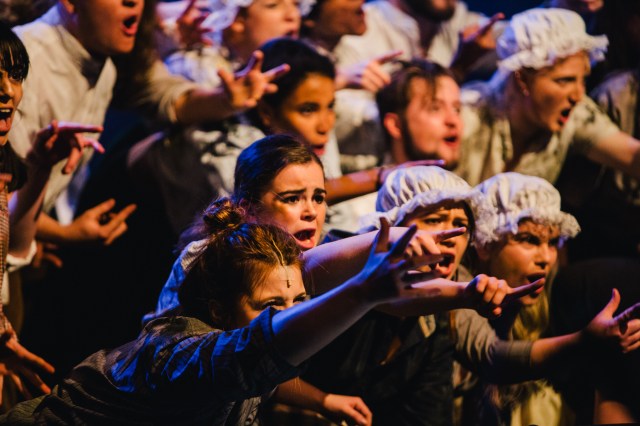
Cast of Oliver! Photo by Andrew Perry.

“FSELRES_382c628d-c6dd-48a3-859b-dfb8d567e430SELRES_d4a5f1dc-f027-48ef-8ada-6aca7f57b286SELRES_d0508c34-80ff-4d1c-9452-b9a4c366ffeaSELRES_007f217a-44d6-4932-8fa1-3d14d5861ee5FFull of EUSOG’s trademark heart and powerful vocalsSELRES_007f217a-44d6-4932-8fa1-3d14d5861ee5SELRES_d0508c34-80ff-4d1c-9452-b9a4c366ffeaSELRES_d4a5f1dc-f027-48ef-8ada-6aca7f57b286SELRES_382c628d-c6dd-48a3-859b-dfb8d567e430

Editorial Rating: 4 Stars: Nae Bad

Lionel Bart’s classic musical, Oliver! is an iconic story of cruelty, deceit and murder set in Victorian London, and features some of the best-known songs in musical theatre. Edinburgh University Savoy Opera Group (EUSOG) first performed this show in 1988, and almost 30 years on they’re back with a fresh, youthful take on the traditional tale.

While some of the company’s creative and casting choices in this revival absolutely do work in keeping the show relevant to today’s young people, unfortunately others are over-reached and not as well realised. Early on, the choreography and staging seem unnecessarily stompy and frantic, while some of the fight and chase scenes come across as a little under-rehearsed and clumsy.

But let’s start with the positives, of which there are many. In no particular order, Grace Dickson’s Nancy is a real highlight of the show, and her human, emotive rendition of As Long As He Needs Me deservedly gets the biggest cheer of the night. Rebecca Waites shines as Charlie with terrific energy throughout, and Ashleigh More is also excellent as the Artful Dodger, with a commanding stage presence and exquisite voice and physicality. In fact, the whole Consider Yourself scene More leads is the first where everything – choreography, vocals and direction – really falls into place to present the kind of show-stopping number that EUSOG are so good at.

What student productions – and EUSOG in particular – also tend to do very well is unearthing a script’s hidden comedy, especially with smaller characters. In this production, Kirsten Millar stands out as the Sowerberrys’ maid, Charlotte, bringing life and humour to each of her scenes, while Richard Blaquiere gives a hilarious geeky awkwardness to the role of Mr Bumble. Ewan Bruce as Mr Brownlow and Niamh Higgins as Mrs Bedwin also deserve a special mention for bringing a sense of calm maturity and experience to their older characters – a pleasant contrast from the energy of some of the other scenes.

In addition to casting females in some of the other main parts, EUSOG also opt for a female Fagin, which, unfortunately doesn’t prove as successful. Kathryn Salmond certainly gives it her all in this challenging role, though the songs (in particular You’ve Got To Pick A Pocket or Two) are very low in her register, meaning a lot this character’s authority is lost and at times it’s a struggle to follow the dialogue. I almost wish the company had gone one step further to make Fagin a female character to see what dynamic that would bring to proceedings. Yann Davies pleases in the title role with a purity and innocence to his voice, though something about the way this show is put together makes it seem like the character of Oliver is almost a bit part – his presence often gets lost in among everything else going on on stage.

Overall this show is full of EUSOG’s trademark heart and powerful vocals, with some wonderful individual performances, but lacks some polish and pace to be a truly spectacular production.

nae bad_blue

Star (blue)Star (blue)Star (blue)Star (blue)

Reviewer: Steve Griffin (Seen 29 November)

Visit the Pleasance, Potterrow & Teviot archive.

THIS REVIEW HAS NOT BEEN SUBEDITED


Pomona (Summerhall: 21 -25 November ’17)

Oliver Beaumont as Zeppo, Lauren Robinson as Ollie & (masked) Eilidh Northridge as Keaton
Photography by Andrew Perry.

“Provokes incredulity, fascination, and applause”

Editorial Rating:  4 Stars:  Nae Bad

It’s brownfield land with serious history in central Manchester. It’s a Metrolink tram stop. It’s also Alistair McDowall’s award winning play set in a ‘hole in the middle of the city’ – ‘hole’ as in a rank pit. Pomona (2014) provokes incredulity, fascination, and applause. Without the applause you’d have a WTF play, so it’s a risky business doing this one.

All credit, therefore, to Edinburgh University’s Theatre Paradok for taking Pomona on and finding the perfect venue in Summerhall’s Demonstration Room. The fairy lights on the approach are a fortuitous joke. Little could be less seasonal than the bare grey walls, tiered wooden seating, electrical trunking and peeling paint. As the play requires a ‘concrete island’ in amongst ‘cracked asphalt and weeds’ we’re all set. Not forgetting the open box of cold chicken nuggets and the octopus monster mask.

Ollie (Lauren Robinson) meets zany Zeppo (Oliver Beaumont at stunning top speed). They could be at the tram stop. You might consider a post-apocalyptic situation, with The Road re-surfaced as the M60 Ring, but, no, property is still owned – much of it by Zeppo – and there’s odd but respectful mention of the police. Still, Ollie does not want police help to find her sister. Directions to the likeliest neighbourhood will do. That’ll be to creepy Pomona Strand then.

Indirection more like. For the play twists and turns and the different characters come and go within a looping time frame. Rubik cubes befuddle and provide a handy metaphor for the mixed-up story. It is puzzling but it is doable. There’s Moe (Liam Bradbury) who has had it with people, mainly because he beats them up for a living. There’s Fay (Abi Ahmadzadeh), a sex worker, whose husband hurt her and their child. Moe and Fay share a rare tender moment. Then Fay steals a laptop and valuable data from overseer Gale (Megan Lambie), but it’s all to the good, despite the ‘Kill’ order on Fay’s head. One figure, Keaton (Eilidh Northridge), seems to have the presence to sort it all out but she could just as well be a character out of Charlie’s (Tom Hindle) role playing game box. Charlie really is a bit of a droll card, complete with wacky, sticky fantasy and roaring daftness as and when the dice roll. Zeppo’s back at the close, but this time as a vengeful seagull.

For all his interest in, and skill at, spiel and character McDowall does supply an explanation of what’s going on inside the security fence on the ‘island’ and it’s gross and melodramatic and sensibly left unexplored; no doubt contributing to Moe’s feeling that he’s ‘drowning in an ocean of piss’.

Pomona is fitful and outlandish with no comfortable ‘Home’ for Ollie to navigate to, which very probably explains its appeal to a student audience, who loved its waywardness. Tom Whiston, Director, and Madeleine Flint, Movement Director, work the play with a stylish and disciplined assurance that is easy to underestimate and the cast respond in kind. Personally, I’d rather have Springsteen’s Darkness on the Edge of Town as music to leave by but that was 1978 and students have moved onto more uncertain and contemporary ground. Go occupy.


nae bad_blue

Star (blue)Star (blue)Star (blue)Star (blue)

Reviewer: Alan Brown (Seen 22 November)

Go to Theatre Paradok on Facebook

Visit Edinburgh49 at the Summerhall  archive.

Our Fathers (Traverse: 24 – 28 October ’17)

Rob Drummond (l) & Nicholas Bone (r)
Photo by Mihaela Bodlovic

“‘All Things Bright and Beautiful’ this is not, as a caustic version makes clear.”

Editorial Rating:

4 Stars: Nae Bad

Yet this is a kind piece, just possibly milder and more forgiving than its writers first intended. Rob Drummond and Nicholas Bone got together – which is a mighty draw in the first place – and offer Our Fathers as a sincere appraisal of their own lives as the doubting sons of clergymen. Their text – for this is a messaging service too – is Edmund Gosse’s celebrated memoir Father and Son (1907) with its epigraph, ‘Belief, like love, cannot be compelled’.

 Written and performed by Rob Drummond and Nicholas Bone, I should add, which is testament to the play’s personal and affecting quality. Whilst they take the parts of Philip Gosse (Drummond) and Edmund (Bone), they are also themselves, appearing friendly and unassuming, and only getting cross with one another rather than with the world. If anyone disappoints, and it is as sorrowful as it is a raging disappointment, it is the God of their fathers, who has definitely messed up. ‘All Things Bright and Beautiful’ this is not, as a caustic version makes clear.

Gosse the father was a biologist as well as an evangelical churchman, putting him squarely in the round hole of being a Christian scientist. He could write Evenings at the Microscope (1859) and still find plenty of time to rubbish the idea of evolution. One of his vivid illustrations of a jellyfish is revealed in the church hall cupboard, upstage right. Karen Tennent’s jewel of a set, so precisely lit by Simon Wilkinson, is particularly successful at focusing attention. The Victorian underslip is puzzling (a beloved dead mother?) but the fossils next to the plain wooden cross speak volumes. And there’s the fishbowl in which to dunk the book – [Told you that they get cross]. There’s an available reference to Prospero, promising to drown his learning [Like hell he will!] but then you could see it as some inventive gloss on baptism, which Drummond is especially keen to dish and seeks audience support to do so.

In Chapter 1 of Father and Son Edmund Gosse writes, ‘Several things tended at this time to alienate my conscience from the line which my father had so rigidly traced for it’. That ‘line’ is in the severe  clerical dress, the chalked up 5th commandment, and in the earnest hymn singing, but there’s also the sheer size of Philip (Drummond) alongside the much slighter Edmund, who draws up his little chair to his father’s big table. So it’s amusing that it’s Nicholas Bone who stands firm against Rob Drummond’s pleading to ‘play’ the son and it’s sad when young Edmund’s prayers fail and his looked-for faith is nowhere to be seen.

But all told Our Fathers is an easeful piece. Drummond makes light of the ribbing he got at school for ‘being the son a preacher man’. Hopefully it was good-natured, for let’s presume that he was, indeed is, ‘the sweet talking son of a preacher man’. Both men – tricky to call them actors at this affectionate point – hold up photographs of their fathers, whose recorded voices we hear.

On reflection, which is very much the point, I’m with the storyteller of Genesis 1:31: ‘God saw everything that he had made [including sons], and, behold, it was very good.’ This original, deceptively modest work, is also very good at what it asks and does.

nae bad_blue

Star (blue)Star (blue)Star (blue)Star (blue)

Reviewer: Alan Brown  (Seen 25 October)

Go to Our Fathers at the Traverse and touring with Magnetic North

Visit Edinburgh49 at the Traverse archive.