Thon Man Moliere (Lyceum: 20 May – 11 June ’16)

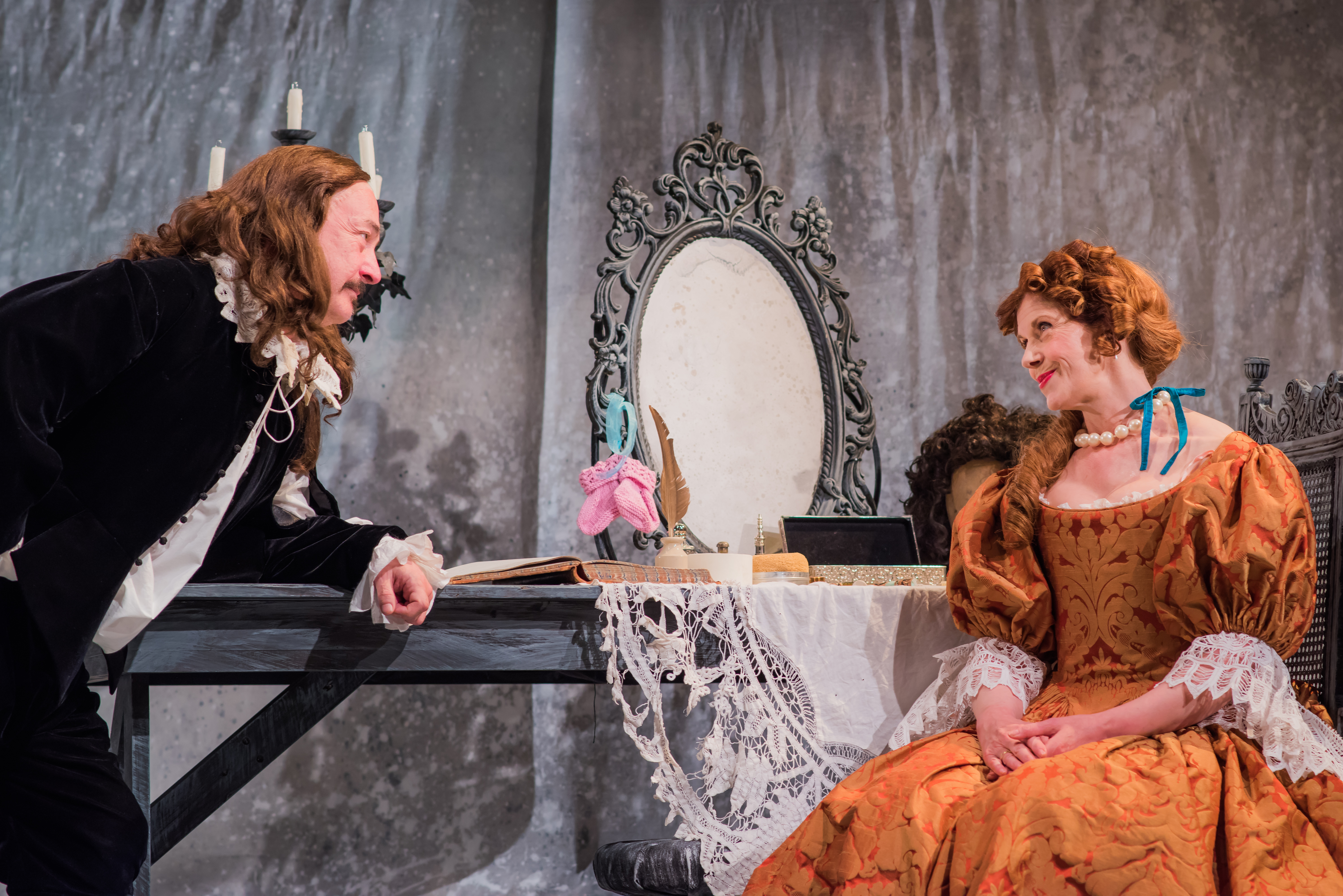
Jimmy Chisholm as Moliere & Siobhan Redmond as Madeleine. Photo: Mihaela Bdlovic.

Jimmy Chisholm as Moliere & Siobhan Redmond as Madeleine.
Photo: Mihaela Bdlovic.

“Siobhan Redmond as Madeleine and Jimmy Chisholm as Molière are perfectly, affectionately, matched.”

Editorial Rating: 4 Stars  Outstanding

In February 1662 Louis XIV sent flowers on the occasion of the marriage of Molière (40) to the seventeen year old Menou (Armande) Béjart. Perhaps the feted playwright was encouraged by the success in the previous year of his School for Husbands. And maybe those flowers were roses, for Menou draws firm, long stemmed roses in her sketch book. Wait up, they look like roses but maybe they’re …. Oh no! Surely not?

This is Liz Lochhead’s new play and she can have a garland too. Thon Man Molière is a comfortable winner. First off, it is a tribute piece to the man’s comedic genius; but second, it closely involves the women in his life, and third this play loves theatre and theatre-making.

Lochhead is an artist with the man’s biography. Born Jean-Baptiste Poquelin, her MacMolière is ‘Pokey’ indoors. Scaramouche is a pal but the fortunes of the ‘Illustrious Theatre’ company are dire to the point of collapse (and imprisonment for debt). There is rarely enough money and there are too few commissions until the king: “Vive le Roi!” – tires of the tragedies of Racine and Corneille. Tartuffe may well be a great play – and Pokey is inordinately proud of it – but it took nearly five years to get its revised version past the Archbishop of Paris. Molière’s first child is named after his royal godfather but Louis dies at eleven months.

There is a sub-title to shape the facts: ‘Whit got [Pokey] intae aw that bother …’ – and it’s sex; not so much sex with his teenage wife but the naughty fact that Menou is the daughter of his former lover, business partner and bestie, Madeleine, and that Madame Béjart will not – under any circumstances – have her daughter tread the boards. Siobhan Redmond as Madeleine and Jimmy Chisholm as Molière are perfectly, affectionately, matched. She has the reserve, bearing, velvet voice and wide skirts of a grande dame. He has the effrontery, the wit and the audacity of his celebrated character.

Ever around and about the principals is the troupe, historically verifiable and altogether mischievous. Gros-René (Steven McNicoll), in streaked green wig, gives a command performance in lugubrious drinking and losing his breeks. Therese (Nicola Roy) is his bed-hopping wife, who would be so much more than the maid in yet another farce. James Anthony Pearson is Michel Baron, the huge star-to-be, lithe and cocksure, but who is still unable to seduce the naïve Armande, very engagingly played by Sarah Miele. At a guess, only the more than capable, laconic and kind Toinette (Molly Innes) is entirely the writer’s invention.

Tony Cownie directs with an assurance born of his previous productions at the Lyceum of Lochhead’s ‘Molières’: Tartuffe (1986!), Miseryguts (Le Misanthrope) in 2001, and Educating Agnes (L’Ecole des Femmes) in 2011. Musical entr’actes by Claire McKenzie, a la Lully, are accompanied by sweet mime and when the drapes lift the action resumes, ‘at home’ or backstage where outsize greyscale putti come second to the wooden stool, wicker baskets and some splendid costumes that were too much even for the Comédie – Francaise, aka. ‘La Maison de Molière’.

Dinnae think Thon Man Molière is daft. The script is too sharp for that and its composed effect is almost tender, which, with all those satiric impulses flying around, is some achievement.

The theatre programme contains an excellent ‘Who Was Molière?’ by Liz Lochhead herself and there’s a helpful preview article by Neil Cooper in the Herald.


outstanding

StarStarStarStar

Reviewer: Alan Brown  (Seen 24 May)

Go to Thon Man Moliere at the Lyceum

Visit Edinburgh49‘s Lyceum  archive.

Ring Road (Traverse: 12 – 16 April ’16)

Martin Donaghy as Mark and Angela Darcy as Lisa. Photo. Traverse theatre.

Martin Donaghy as Mark and Angela Darcy as Lisa.
Photo. Traverse theatre.

“Both actors perform brilliantly in a small space (and on a narrow bed)”

Editorial Rating: 4 Stars Outstanding

Fifth and last in this Spring season of A Play, A Pie and a Pint.

It was the prickly cactus that did it, that brought to mind Love’s Labour’s Lost and fun puns on pricks, butts and horns. Mark notices it by the Reception desk of the hotel that’s just off the ring road. He reckons he’s there for sex (oh, not the archery then) and he’s right. Lisa does want him but it’s more his sperm than his good self that she’s targeting. She desires a baby while Mark just fancies the pants off his teacher sister-in-law. Ouch!

Anita Vettesse has written a painfully entertaining comedy and director Johnny McKnight does indeed make the pants fly off the bed. Ring Road is frisky, certainly, but it is also sensitive to what Lisa is feeling. She is 40 years old, has ‘grown to love’ her husband, but is still without a child. The pressure is on big time.

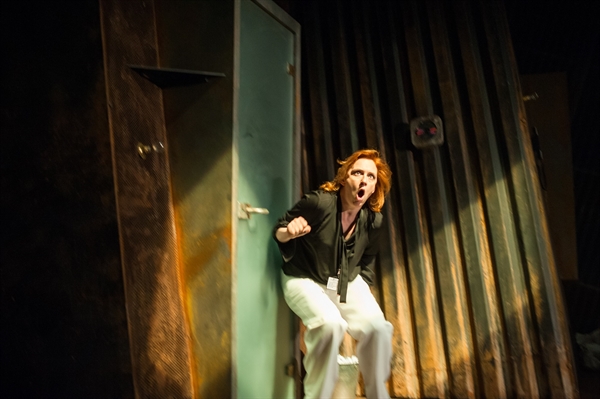
A late afternoon’s delight via Dayuse.com might be all very well but Lisa (Angela Darcy) sees Mark (Martin Donaghy) more as a ‘facilitator’, which he’s not best pleased about. He is even less keen on the idea when brother Paul (a wry, downcast voice-over from Robbie Jack), Lisa’s husband, joins them by being put ‘on speaker’. The two brothers are plumbers, sharing the same van, rather than the same women but it’s still odds-on that the dismissive reference to Screwfix is deliberate.

Mark’s spattered overalls and rigger boots look strange in the tidy, unexciting hotel room and he knows that the whole situation is just not right. Twin beds are bad enough – and that ‘art’ on the wall!- but the twitchy tension is the real passion killer. Lisa, in particular and unsurprisingly, is a bundle of nerves. At worst Mark is confused, but she is probably more conflicted at the end than at the beginning, which is touching and sadly credible.

Both actors perform brilliantly in a small space (and on a narrow bed). Donaghy does “For fuck’s sake” as baffled, happy, hurt and kind all at once, while Darcy is no less expressive, just more couth and desperate. The fact that Ring Road is also very funny is down to the quality of Vettesse’s writing.


outstanding

StarStarStarStar

Reviewer: Alan Brown (Seen 12 April)

Go to Ring Road at the Traverse.

Visit Edinburgh49′s Traverse archive.

1984 (Festival: 31 March – 2 April ’16)

Tobias Batley and Martha Leebolt as Winston and Julia in 1984. Photo Emma Kauldhar.

Tobias Batley and Martha Leebolt as Winston and Julia in 1984. Photo Emma Kauldhar.

“A spine-tingling masterpiece”

Editorial Rating: 5 Stars: Outstanding

To this day, Northern Ballet’s The Great Gatsby is the most beautiful thing I have ever seen on a stage, so I was excited and intrigued to see what the company would do with another classic novel, albeit a completely different genre and tone. What they’ve created is another spine-tingling masterpiece.

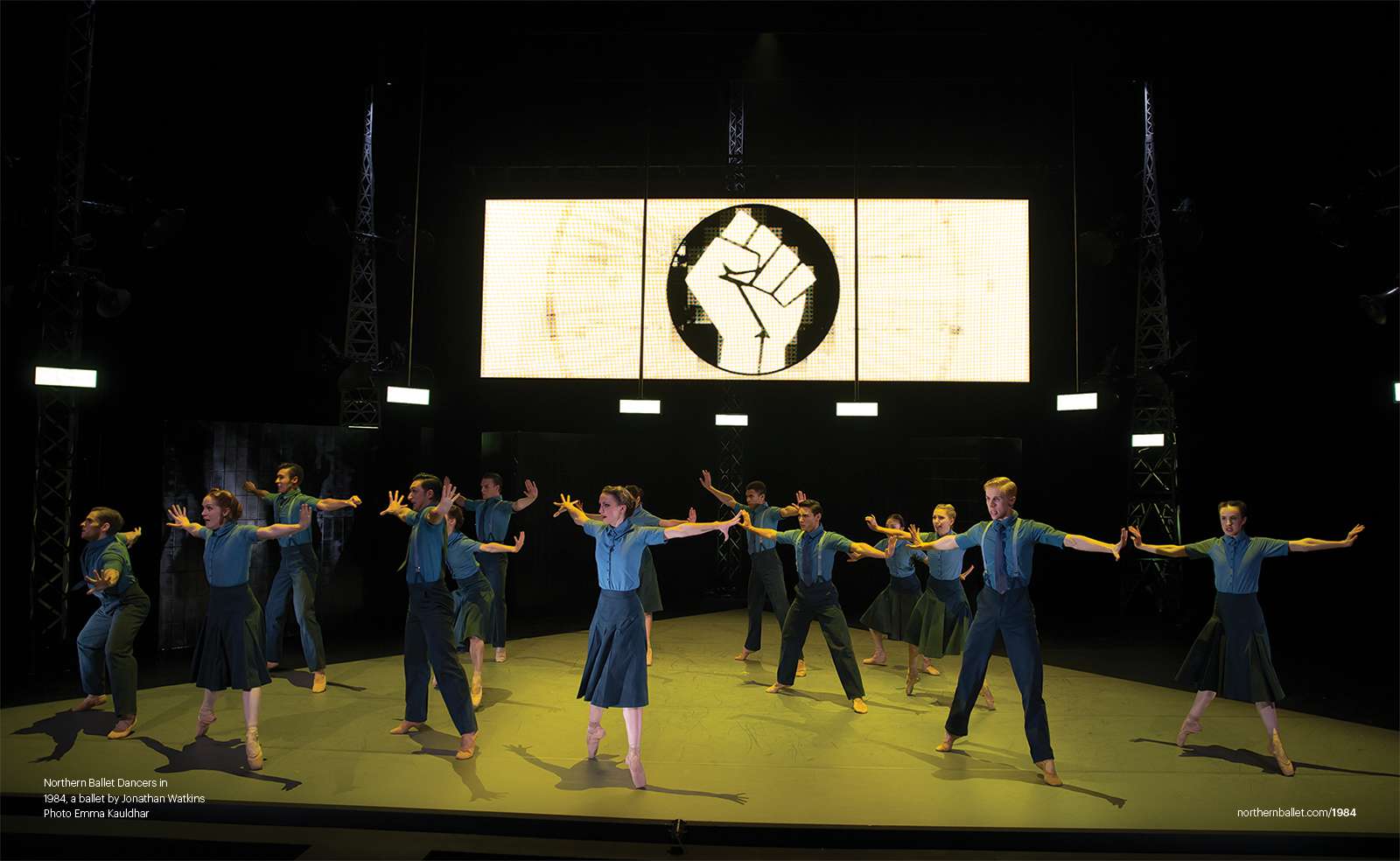
Jonathan Watkins’ choreography is created with all the intricacy and intelligence necessary to portray the complex ideas and changing moods within Orwell’s book. The workers’ unison sections are very crisp and powerful, with many recurring motifs of straight lines and triangles, both in individual movements and formation, which cleverly reflect the “all seeing eye”. Canon variations are used throughout for interest, which work very well to create production line style sequences, again very relevant to the era. In contrast, the Proles’ movements are easily identified through curves, contact improvisation and individuality of style. The lovers’ duet captures all the breath-taking beauty one might expect from a traditional ballet, while the fight scene towards the end is both graceful and gutting, as we see Winston fall and give in to the higher power.

Alex Baronowski’s score is full of accented beats and staccato rhythms which perfectly translate to the repeated motifs of the workers under the control of Big Brother, while the more romantic elements are brought out with strings and flowing, rousing melodies. Much like experimental music of the time, the orchestra uses an assortment of non-traditional instruments to create clashing tinny sounds and altogether this results in an authentic, haunting and sympathetic accompaniment to the action on stage.

Northern Ballet dancers in 1984. Photo Emma Kauldhar.

Northern Ballet dancers in 1984. Photo Emma Kauldhar.

While the relationship between music and movement are clearly intertwined, the design of this production seems equally balanced with the other elements. Chris Davey’s lighting is stark and structural, creating yet more triangles and straight lines for the dancers to follow and stay within, and Simon Daw’s set of moving walls and simple blank spaces adds to the feeling of isolation and hopelessness. Use of colour is also very powerful, from the traditional blue of the workers uniforms, to the bright yellow of hate to the oranges and browns of the Proles, this is clearly a production that pays high regard to many details, making it a joy to watch.

As can be expected in such an interpretation, not every nuance of the book is covered on stage, and sacrifices have to be made to adapt the work for this new form. It’s a shame that some sections aren’t made more of – the final quarter in particular seems a little rushed – but overall the piece strikes a fine balance between narrative progression and beauty of form. For those unfamiliar with the story this production may be somewhat difficult to follow, but even then, the artistry on display is of such high quality that it almost doesn’t matter.

outstanding

StarStarStarStarStar

Reviewer: Steve Griffin (Seen 1 April)

Go to Northern Ballet’s  1984

Visit the Festival Theatre archive.

International Waters (Traverse: 30 March – 3 April ’16)

International Waters 1

Photos: Tommy Ga-Ken Wan

“Almost edifying”

Editorial Rating:3 Stars Outstanding

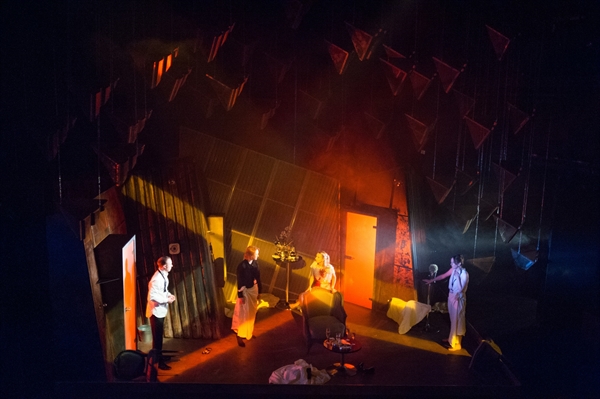
You have to wonder. Fifty minutes into the heaving swell of International Waters when we’re all dramatically well and truly cast off, the fire alarm lights flash red and the theatre is evacuated. It has to be a Fire Exit production. And the prime minister announces that there will be no fire sale of the UK’s steel industry but it could still all go down the pan; which is pretty much where David Leddy’s new play takes us. It’s gut-churning with intent, from programme-as-origami downwards. This is theatre in the raw; its passage probably indigestible without great work by Becky Minto (Design), Nich Smith (Lighting) and Danny Krass (Sound).

For the U-bend see a cabin suite for the super-rich in the bowels of a super-tanker, complete with champagne buffet and karaoke machine. Cheaper accommodation is in assorted containers where you might be stacked next to a tiger or two. It is all rather make-do, rather urgent, for this is the last ship out of London where the banks have really, really, done their mucky worst. It’s safe to assume that the ATMs are empty and that the poor are on the streets and burning porsches. Still, if you have shedloads of ready money you can look good in white linen, enjoy the Moët, do a line of coke, and singalong to doomsday. Unfortunately it turns out that Sarah, Ben, Sophia, and Arian are in the Caliban suite for a less than delightful reason and that their ‘escape’ will end wretchedly. There’s no mage on the bridge to save them or to get them away from each other’s throats … or crotches.

International Waters 2

Down below, gripped by burning cabin fever and flushing itself out, is the fabled 1%: powerful and greedy, vulnerable and unhappy. Sarah (Claire Dargo), Ben (Robin Laing), Sophia (Selina Boyack), and Arian (Lesley Hart) go at it with astonishing abandon, pulling each other’s chains – just to stay with the scatological – and soiling themselves and their values in the process. It’s abject, messy, and ridiculous and yet the acutely angled and allusive content is almost edifying.

Leddy unships a bulk load of issues: rogue algorithms, flagrant wealth, economic migrants, drowned refugees; the paranoid survivalist versus the self-obsessed, #Blessed; Twitter storms, Old Testament retribution and the gospel strains of New Testament promise. This is one crowded ark of a stage, freighted with ideas, that spills more than it holds, deliberately upset by intemperate behaviour, bad language, and scary discordant sound. If the play is dead in the water at its conclusion, it’s not rudderless or overblown, but simply exhausted.

FYI. The show continued after the fire alarm, which says a lot about the quality of the performance and the unlikely integrity of the piece. It is preposterous and explicitly farcical, yet Leddy goes in behind the theatrical facade. He says (see programme note) that he’s also after the romantic sublime. Well, here’s Adele on a comparable course from Rolling in the Deep: “Go ‘head and sell me out and I’ll lay your shit bare.” Nice!


outstanding

StarStarStar

Reviewer: Alan Brown (Seen 30 March)

Go to International Waters at the Traverse and at Fire Exit .

Visit Edinburgh49‘s  Traverse archive.

Endgame (Bedlam: 22-26 March ’16)

Thomas Noble as Hamm

Thomas Noble as Hamm

“The best student production I’ve seen in quite some time”

Editorial Rating: 4 Stars: Outstanding

One certainly cannot fault the courage of the students at Edinburgh University this year for taking on so many challenging productions, and to even attempt Beckett – whose works so often have age and world-weariness as themes – is admirable. I was lucky enough to spend an entire term studying Beckett at university, under the tutorship of a renowned expert on his works, but even then I worried that my final performance would be a tragic, naïve offering compared to what had gone before.

Beckett certainly isn’t for everyone, and Endgame is a one-act play with a running time of close to 90 minutes that has very little narrative development or real “action”. What is most satisfying about this production is the group’s sensitivity to Beckett’s text. The great man is notoriously particular about how his work should be performed, and Edinburgh University Theatre Company don’t try any tricks or fancy interpretations to make it new or innovative, but instead use subtlety to let the text speak for itself. Finlay McAfee’s masterful direction teases out various interesting repetitions in the dialogue and hints at some of the political undertones, but never makes bold statements or suggestions.

In saying that, this production also doesn’t take itself too seriously – it’s littered with comedic moments, just as Beckett intended, and is a very well-rounded and watchable show. Sarah Brown’s set is simple yet effective, using black and white as a nod to the “game” element, while all other creative elements are in sync to present a cohesive and professional mise-en-scene.

Thomas Noble as Hamm is the centrepiece of the actors – always on stage, centre stage, he commands attention with charisma and gusto. His moments of anger when flinging props aside are powerful, while he shows great contrast in more intimate conversations with Clov. In turn Clov (Michael Hajiantonis) is excellent as the down-trodden servant, whose development in confidence towards the end, extreme physicality and impressive Irish accent all contribute to a commendable performance.

Jennifer Jones is compelling to watch as Nag, with fantastic control over the small movements and expressions she makes inside the bin. Her physicality is exquisite, and her delivery of the tailor story is achingly on point. Antonia Weir is equally captivating and convincing as long-suffering wife Nell.

To me the only thing lacking from this production is a deeper sense of age and timelessness. The action all seemed a little too fresh and perhaps a touch too “performed” for it to be believable as a snapshot of continual drudgery. In saying that, I’d much rather a slight tip in this direction to keep it energetic and engaging rather than veering down the road of self-indulgent dawdling. In all other respects this show is hard to fault, it’s certainly the best student production I’ve seen in quite some time.

outstanding

StarStarStarStar

Reviewer: Steve Griffin (Seen 23 March)

Go to Endgame at Bedlam Theatre

Visit Edinburgh49‘s Bedlam archive.

RSNO: BENEDETTI & OUNDJIAN (Usher Hall: 18 March ’16

“Full on enthusiasm, lightness of touch and an abundance of joy”

Editorial Rating:  5 Stars Outstanding.

It was a bit like getting ready to hear Mahler’s Eighth Symphony, The Symphony of a Thousand. For there were musicians, and musical instruments, seemingly everywhere. Six timpani, two bass drums, two harps, five French horns, a bass tuba, and I reckoned a hundred young choristers, all dressed in black, sitting neatly at the back. Clearly we were in for quite a show.

And it was a show full of contrasts, spaced over almost 200 years of composition, yet all compellingly complementary. The beautiful austerity of James MacMillan; the lush, joyful optimism of Hector Berlioz; and the intense twentieth century romanticism of Karyl Szymanowski.

Sir Kenneth MacMillan’s Little Mass for children’s chorus was “little” only in the sense of limiting itself to the Kyrie, Sanctus and Agnus Dei and scoring it for young voices. It is a work of substance, first performed in Liverpool almost a year ago and premiered in Scotland with us. A piece of some drama: ghoulish, austere, dissonant and utterly beautiful. Undoubtedly a difficult work to perform, the RSNO Junior Chorus gave an excellent account of themselves in a composition many senior choirs would struggle with. Difficult intonations, tricky entries and fiercely challenging harmonies were sung with confidence and precision, with the cherry on top of the composer coming on to the platform to receive the applause and rightly point to the choir’s laudable achievement. Promising start.

A few minutes later on came Scotland’s musical sweetheart, Nicola Benedetti, resplendent in what looked like a Dolce and Gabbana figure-hugging long black dress with signature cascading curls hairstyle. It is a credit to her playing that one soon forgot such superficial accoutrements. Szymanowski and Benedetti have history, of the good kind. His first violin concerto was the piece that won her Young Musician of the Year in 2004 and her recording premiere for Deutsche Grammophon a year later. Tonight we heard her play the second concerto, a more complex work with a lot of writing in the higher register. Benedetti gave it everything and we got it all back. The young woman combines a phenomenal technique with extraordinary feeling; her 1717 ‘Gariel’ Stradivari more than responding to what she asked of it as it approaches its 300th birthday. Szymanowski’s intelligent and well-rounded orchestration gave the band ample opportunity to support and interplay with the solo part in this break-less twenty-five minute piece in the twentieth century romantic genre. Fine playing throughout. Kindly, this young woman who has absolutely no side, treated us to a Bach sarabande for an encore, considerately thanking us for our applause and announcing what she was going to play.

There is often a slight feeling of flatness as one dutifully returns to the auditorium for the second, usually symphonic part of the programme after the glamour and fireworks of the soloist and concerto have gone. Peter Oundjian and the RSNO were having none of this and brought Berlioz’s Symphonie Fantastique to light in a way that I have rarely heard it played, with full on enthusiasm, lightness of touch and an abundance of joy. More a symphonic poem than a symphony, there is a danger of the brass dominating, but Oudjian let everybody have their say: a beautiful intertwining of a very exposed but very well played cor anglais and timpani in the third movement; glorious, roaring brass in the fourth, and almost a fairground cacophony in the final fifth movement, the strings being given their head and the conductor, who one felt was liberating rather than directing the orchestra, ensuring balance, never vulgarity, and not once committing the cardinal sin of “looking encouragingly at the brass”. We left the auditorium chuckling.

StarStarStarStarStar

Reviewer: Charles Stokes (Seen 18 March)

Go to RSNO & Season 2016- 17

Visit Edinburgh49‘s Usher Hall archive.

Angels in America (Bedlam: 8 – 12 March ’16)

Brooks Hudgins as Prior and Emily Deans as Harper Photos: EUTC

Brooks Hudgins as Prior and Emily Deans as Harper
Photos: EUTC

‘A Gay Fantasia on National Themes’

Editorial Rating: 4 Stars: Outstanding

If you think a log cabin Republican is the kind of guy who would fire off a Patriot missile at a low flying angel, that would be way, way off target. And what would be his (her?) Democrat equivalent? I dunno but it might involve tepees and he / she might major in lines like ‘Respect the delicate ecology of your emotions’. You get both sorts on the Bedlam stage this week. Yay!

This is Tony Kushner’s cultural blockbuster of a play from the early 90s: that’s actually two plays, Millenium Approaches and Perestroika, with a runtime – then – of around seven hours. See this EUTC production, ably directed by Liam Rees, and you’re done in just over three hours but you will probably want to know what has had to be cut. (There is the made-for-cable HBO miniseries that might help and you won’t have to suffer the Baltic temperatures of Bedlam, although the scenes in Antarctica might feel familiar.) In the original script there are 67 scenes for two characters and that’s more or less how it all proceeds, two-handers with stand-out monologues for the principals. It’s sharp, witty, political, and yet manages to shade from the domestic to the mythic. Its subtitle, ‘A Gay Fantasia on National Themes’ sets the scene.

To begin with it is 1985, Cats is going strong on Broadway and Ronald Reagan is President. In New York City Prior Walter – latest of the Walters who got off the Mayflower – is getting sick from AIDS and his partner of four years, Louis Ironson, is not coping. Lou works in the same building as Joe Pitt, a legal clerk, who is offered a big move to Washington DC by his powerful associate and friend, Roy Cohn. Joe does not know if he can take the job because his wife, Harper, is popping Valium like there’s no tomorrow. You are never entirely sure how many tomorrows Prior has left, not least when he’s visited by two ancestors in black capes who regard his pestilential condition as entirely befitting a sodomite.  Angel wings hang above the stage and at the close a tremendous thrumming heralds the arrival of the ‘Messenger’. In all likelihood the bearer of glad tidings has arrived but there have been angelic voices before and Prior, bless him, has no idea what they’re talking about.

The excellent cast does not leave the stage which works well to impress a sense of full-on, marginally dislocated action. Prior’s sick bed stays up centre throughout. Brooks Hudgins plays the stricken WASP with timing that stings and with biting bittersweet delivery. Abandoned by Louis, he muses on his desperate isolation: it’s a sad joke that his dermatologist is on a [long] vacation in Hawaii and his mother … well, his mother just stays away. Rob Younger as Louis has all the lines and tousled angst of a Woody Allen character. It’s a kind, thoughtful part, full of faltering starts, punctuated by ‘Okay ..’ and ‘Right ..’ as he tries to explain himself. At home, stranded in her Brooklyn apartment, Emily Deans is outstanding as Harper Pitt, managing her depressive state with what amounts to mischievous glee in pyjamas and spotted dressing gown. Andrew Hally as husband Joe has to behave decently against demanding odds and more insuperable than even his Mormon upbringing or his sexuality is the foul mouthed, monster ego of Roy Cohn. The fact that Al Pacino took this part gives you a measure of what Peter Morrison has to do and he does well, lurching from one ghastly judgement to the next upon what’s rotten in the land of the free. It is not at all difficult to realise that Cohn (1927-1986) was a real-life horror show.

Peter Morrison as Roy Cohn

Peter Morrison as Roy Cohn

Supporting roles by Meera Munoz Pandya (notably as Belize, onetime drag queen, Prior’s ex-boyfriend and best friend) and by Erica Belton are clearly defined and remarkably effective within the significantly reduced script. The inevitable problem in this half and half version of Angels in America is that the impact of the ‘blockbuster’ cannot be the same as it was when young Americans were all ‘Reagan’s children’. It even predates Friends for heaven’s sake! The angelic chorus gets muffled, as it certainly did up in the rafters of Bedlam. Exhortations to ‘Look up, look up’ did not just baffle Prior Walter. Nevertheless, when ‘Modern Studies’ in many a Scottish high school can still stop at JFK’s assassination and when HIV infection and AIDS simply register as component parts of the Health and Well Being curriculum, this EUTC production is important work.


outstanding

StarStarStarStar

Reviewer: Alan Brown (Seen 8 March)

Go to Angels in America at Bedlam Theatre

Visit Edinburgh49’s Bedlam archive.

The Pillowman (Bedlam Theatre 2 – 6 Feb. ’16)

Scott Meenan as Katurian. Photo: Mollie Hodkinson

 “This show  will wring the life out of you, in the best way possible.”

Editorial Rating: 4 Stars Outstanding

Pillowman is to dark comedy what heroin is to vapor rub. Martin McDonagh’s tale of bloody flesh and fairytales is dark, dirty and sometimes barefacedly brutal – and in the hands of director Emily Aboud, often stingingly clever as well.

Set in a faceless concrete prison, ‘Pillowman’ tells the story of writer Katurian questioned about gory child murders strongly resembling the short stories he writes. Throw in a heaping helping of torture, a pinch of weirdly psychotic police banter and as much moral relativism as you can stomach, and you’ve got a play which (despite quite a few good laughs) stays tensely uncomfortable the entire way through. Make no mistakes: this show  will wring the life out of you, in the best way possible.

But a script without a director doesn’t get too far, and with Emily Aboud returning to the stage after her barnstorming production of Equus, there’s never any doubt it’s in safe hands. Apart from some strangely static blocking at the beginning, her overall vision for the production strikes gold: McDonagh’s work feels just as grittily surreal as it should.

And on the note of surreality, the set for this production is a gem- it’s not often I’ve seen twists dependent entirely on clever set design, let alone done so with such skill. There were some design choices, though, which seemed less prudent than others: a series of videos projected onto the stage wall would have had twice the impact if performed live. Whilst the presentation detracted nothing, it was slightly disappointing to think of its potential. And to sound designer Alex Greenwald, I’ll say only this: The low ambient drone? Fantastically slithery.

Luckily, the propitious problem of wasted potential is brilliantly absent from the cast. Theatre veteran Scott Meenan captures the quiet intensity of Katurian excellently. Subtle yet passionate is a hard duality to pull off, so it was a joy to see it done so well. And even more so when combined with Douglas Clark as Michal: the burden of the fool in black comedy is a heavy one, but Clark makes the part feel as natural as breathing.

Hot off the heels of EUSOG’s Addams Family, Esmee Cook expertly runs the emotional gamut as wonderfully sadistic second-in-command Ariel – but the indisputable star of the police parade is Paddy Echlin as Detective Tupolski. Sardonic and hilariously removed from normal logic, Echlin dominated the stage whenever his annoyingly wrong tie came flapping through the set doors.

The supporting cast were noticeably solid, especially in terms of physical theatre – Sian Davies in particular has a peculiar knack for playing tragically adorable kids.

With such energy and dynamism throughout, however, it was a disappointment to see the production fall into the trap of lengthy and jarring set changes. For a piece which, in every other aspect, set up a wonderfully naturalistic and believable surreality of tone, these seemed like a strange choice. They were luckily few and far between, but are still a bit like stopping a delicious meal to eat a couple of handfuls of packing peanuts.

Overall, I was impressed by Pillowman. It has creative and well-crafted direction and maintains the kind of thick atmosphere most other shows could only dream of (although, making the Bedlam Theatre feel like a freezing cell requires little help). Combine with stellar acting and a well-chosen crew, and you’ve got a production that’ll knock your socks off  –  and then probably strangle you with them, but still.


outstanding

StarStarStarStar

Reviewer: Jacob Close (Seen 3 February)

Go to Pillowman at Bedlam here.

Visit Edinburgh49’s Bedlam archive.

The Table (Traverse, 3rd Feb ’16) part of the Manipulate visual theatre festival

Edinburgh, UK. 17/08/2011. Fringe First winners, Blind Summit, present "The Table", starring Moses, the Bunraku table puppet, who is ably assisted into being by Mark Down, Nick Barnes and Sean Garratt. Photo credit: Jane Hobson

“One of the most wonderful performances I have ever witnessed”

Editorial Rating: 5 Stars: Outstanding

One table, one puppet, three men, no strings. And one of the most wonderful performances I have ever witnessed.

While it might seem quite basic, this spectacular puppet show (which could also be classified as stand-up comedy – more on that later) is a tour-de-force in keeping theatre simple yet incredibly effective. Within seconds, the carefully constructed cardboard face and cloth body became an intriguing old man whose every word and movement held me completely captive. And for a show an hour long, that’s no mean feat for something with no pulse.

The puppet began by introducing us to his table – his home – pointing out the garden, his vegetable patch, and where it might be extended to grow more carrots. All the while, he kept us entertained with witticisms most comedians would be proud of, and a dash of audience interaction to keep us all on our toes. And it’s all delivered so naturally, I was completely transported into the world of the table.

Yet while the slow and sometimes inappropriate ponderings of a confused old man were a delight in themselves, the crux of the performance lay in its original purpose – to retell the story of Moses’ saving of the Israelites and his eventual death on the mountainside. In this guise we see him humble, we see him angry and we see him defeated. We see him battle against the elements and lie down to sleep (which is far more difficult for a puppet than it may be assumed). And when he finally leaves the table, I genuinely felt lost and upset to say goodbye. Perhaps this says something about my childish tendencies, but the sell-out crowd of all ages seemed just as moved as I was.

The hands and voice behind this masterpiece – Nick Barnes, Mark Down and Sean Garratt – lovingly move every centimetre of the puppet with precision in care, and always in sync, down to their own breathing. What was particularly enjoyable about their roles were the playful and apparently improvised moments of the show, where the performers joked with and challenged each other to keep up with the pace. At one stage the poor puppet’s hand fell off, probably by accident, but this was covered and managed very well, even if the performers found themselves creasing up with infectious laughter.

About two minutes in I was hooked and thought this show has the potential to launch itself into my top ten favourite things I’ve ever seen on stage, and by the end it had firmly secured its place. Simply masterful.

outstanding

StarStarStarStarStar

Reviewer: Steve Griffin (Seen 3 February)

Go to The Table at Manipulate and Blind Summit

VisitVisit Edinburgh49’s  Traverse archive.

Macbeth: Without Words (Traverse, 2nd Feb ’16) – part of the Manipulate visual theatre festival

Sandra Franco photo. Ludens Ensemble

Sandra Franco photo.
Ludens Ensemble

“A compelling, highly intelligent and creative retelling of the famous story”

Editorial Rating: 4 Stars: Outstanding

Macbeth: Without Words is one of those shows you see from time to time where you can’t quite decide if you love or hate it. It’s gutsy, original, and a full-on hour long assault of the senses that I couldn’t take my eyes off.

The piece starts with one actor, in a corset and clown make-up, leaping around the stage acrobatically before picking up a microphone and making a range of strange noises. Those with a more traditional perspective on Shakespearian theatre might baulk at the very interpretative style, which I’ll admit took some getting used to, but what unfolded was a compelling, highly intelligent and creative retelling of the famous story.

It is a very physical performance, as it needs to be to convey the monstrous action. There is no spoken dialogue. The dexterity of performers was sensational, as the cast of three managed to create almost every character from the play – all identifiable through their physicality and token elements of props and costume. Stand out moments included the initial stabbing of the king silhouetted through a plastic sheet, and Lady Macbeth appearing through that same plastic sheet towards the end, in all her ghostly presence.

Although without speech, it was not without noise; and many of the sounds were created by the performers live – either vocalised into microphones or using various banging, rubbing and scraping of props and instruments. The layering and looping of these created fantastic tension and atmosphere, with a real sense of baleful magic and connection between the performers and the action. Given how powerful this technique was, especially at the beginning where a complex soundscape was created very simply, it was a shame that for some scenes the company relied on pre-recorded sound, leaving me feeling a little bit cheated. At one point a recording of bagpipes was played, and I felt the company – in Edinburgh of all places – missed a trick.

It was also disappointing that for a show pertaining to be “without words”, that short excerpts from the script were occasionally projected onto a screen to clarify the action on stage. I admit that the task to portray every nuance of Shakepeare’s work without any words at all is nigh-on impossible, but in some scenes it was done so well – the incantations of the witches, the murders, the washing of the hands, the breaking of the news – all performed using physicality, silhouette and props,  that it was such a shame that the company “copped out” in those rare moments. It seemed that with a little bit more work or development the company will have created a piece truly “without words” and fit for any European Capital of Culture.

This could have been one of those mind-blowing, life-changing performances that I’ll never forget, but unfortunately, those few flaws held it back somewhat. Still, ‘tis far from a sorry sight and overall the battle was far more won than lost.

outstanding

StarStarStarStar

Reviewer: Steve Griffin (Seen 2 February)

Go to Macbeth: Without Words at Manipulate

Visit Edinburgh49’s Traverse archive