EIFF: “Ideal Home” (Odeon 2: 21 June ’18)

“Fresh and clever”

Editorial Rating: 4 Stars

Andrew Fleming (Hamlet 2) delivers a through-and-through feel-good movie, with the crucial help of a particularly bombastic Steve Coogan and chameleonic talent Paul Rudd. Though some of the dialogue could use some editing, the film nevertheless achieves that rare balance between genuinely delightful comedy and grounded social relevance.

The action begins as it means to go on. A scrappy man and his elementary-age son scramble to escape a motel room as the cops wait outside. With them is a woman complaining that the scumbag inside stole her Chanel purse, her Chanel purse. The burly officer, between bangs on the door, turns to comfort her, saying “Hey, hey, I get it, I have some Chanel loafers that I love, so I understand.” Ideal Home continues in this vein of fabulously sardonic charm, as the story pivots to flamboyant couple Erasmus Brumble (Coogan) and Paul (Paul Rudd), who are suddenly saddled with the son from the opening. His father, now in custody, is Erasmus’ son, meaning Erasmus and Paul are all of a sudden in charge of a grandson they didn’t know existed. While this setup — the sudden introduction of a child that must be raised — has been done before, Fleming, Coogan, Rudd, and Jack Gore, as the kid himself, manage to make Ideal Home feel fresh and clever, and a welcome new chapter in the “family comes in all shapes and sizes” genre.

The film is fairly straightforward in its approach; in fact its main downside is the formulaic feeling of some of the dialogue and supporting characters. There is a conspicuous debt owed to The Birdcage for its presentation of bombastic men in love who offer quotable quips back and forth and prove over and over that the line between love and hate can at times seem very, very thin. But unlike previous iterations of these types of stories, Fleming’s film seems purposefully dotted with genuinely dark interactions here and there, from sudden fights to tragic revelations to near breakdowns; serious implications between the ditzy laughs. This changeable emotional landscape not only keeps the audience on their toes, but successfully recalls the knife edge on which many a family interactions walks, when an argument is only a few careless words away from exploding.

In moments like those, especially, but truly in the entire film, Mr. Rudd must be given credit for his all-in performance as put-upon partner Paul. While Coogan performs with candour aplenty, he nevertheless puts forward yet another version of his ubiquitous narcissistic jerk character, with some added heart, but not much. Rudd, on the other hand, explores entirely riveting sides of his extensively likeable persona, and it is nice to see such a versatile actor given a chance to go beyond his normal smiley self and try lashing out and being scornful for a change. Ideal Home is not all scorn and argument, of course, and thankfully Fleming and his cast have found room for loads of side-splitting lines and situations that I highly recommend you see for yourself.


StarStarStarStar


Reviewer: Nathaniel Brimmer-Beller (Seen 21 June)

Go to Edinburgh International Film Festival here

(Ideal Home is showing today Saturday 23 June & Monday 25th. See EIFF programme for details)


EIFF: “Calibre” (Cineworld, 22 June ’18)

Image: British Council.

“Notable style.”

Editorial Rating: 2 Stars

Writer-director Matt Palmer’s depiction of a rural Highland town and its inhabitants is not doing the Scottish tourism board any favours. His new film, Calibre, out on Netflix in a week, walks the line between outright horror and pulse-pounding masculine drama with notable style, and gives rising star Jack Lowden some seriously grisly meat to chew on. Overall, however, this tidy, affecting morality play with an impressive cast and excellent sound work cannot escape some garishly ill-devised plotting, a tiresome amount of doom and gloom, and a seriously terrible haircut. 

The fun begins in Edinburgh, as Vaughn (Lowden), kisses his pregnant wife goodbye for a weekend hunting in the Highlands with his lifelong friend Marcus (Martin McCann). Upon their arrival in the rural town, they cross paths with aggressive locals, dangerous women, and some surprisingly friendly contacts. Palmer builds a commendably unnerving sense of dread as every craggy corner in this middle-of-nowhere locale seems to possess some unseen malice, and the director’s horror influences are well-established early on. At times one expects some glowing eyes or demonic cackle to make an appearance but Palmer’s film avoids the supernatural in favor of the more horrifying type of evil: the one within man himself.

If that last line struck you as a bit much, take it as a test. If that sort of melodramatic meditation on evil! and honor! and truth! and shame! strikes you as a fun time, maybe you’d love Calibre. If the line “This can only be paid for in blood” doesn’t strike you as laughable, by all means get on Netflix on June 29th and stream this thing. 

Otherwise, take my word for it, this film is poorly measured. Lowden turns in another commendable performance as Vaughn, who commits a horrendous act completely by accident, which is so genuinely shocking that I won’t dare ruin the surprise when it comes. McCann is impressive as the cunning and duplicitous Marcus, who is unnervingly good at covering their tracks after the act, which implicates both of them in heinous wrongdoing and will completely destroy both their lives if discovered. Also delivering the goods is Tony Curran, a reliable presence on screen, who gives great depth to local leader Logan, who keeps the most brick-headed townsfolk from tearing the city boys to shreds just for being outsiders. 

Indeed, though most of the narrative follows the young men as they try to evade discovery, Calibre also has a lot to say about the relationship between rural and urban, rich and poor, privileged and underprivileged, strong and weak. Yet as the tension rises and the plot twists and yanks itself around, most of these ‘insights’ are either screamed at a frenzy worthy of Nicolas Cage’s choicest meltdowns, or growled with such Straw Dogs-esque menace, turned up to 11, that it comes off as silly rather than terrifying. This all culminates in a climactic setup so dour, so tastelessly brutal, that one cannot help but feel like they are watching Saw: Highlands Edition rather than the Hitchcockian crime thriller it packages itself as. Calibre does not ultimately earn its dourness, but rather just piles it on, in the hopes that grisliness will make up for lack of direction. (Not to mention, it is hard to have much sympathy for Vaughn when all his weeping and moaning is done while sporting such a revolting hairdo. But that might just be me.)

Palmer clearly has a nice grasp on how to build tension, and he is particularly impressive in his use of sound to set a scene. But Calibre would be vastly better if it knew how to release that tension in its final act without lazing into tasteless impulses. Skip it, I reckon.

Star (blue)Star (blue)

Reviewer: Nathaniel Brimmer-Beller (Seen 21 June)

Go to Edinburgh International Film Festival here

(Calibre is showing today, Saturday 23 June & on Saturday 30 June. See EIFF programme for venues.)


EIFF: “Puzzle” (Festival Theatre: 20 June’18)

“Genuinely affecting moments of liberation and subtle defiance.”

Editorial Rating: 3 Stars

Our first coverage of the film festival. Nathaniel Brimmer-Beller will keep them rolling.

As she addressed the gathered public at the opening screening of the 72nd Edinburgh International Film Festival on Wednesday, Kelly Macdonald expressed both gratitude — that her new film, Puzzle, directed by former producer Marc Turtletaub, was opening Scotland’s foremost film festival — and amusement that in it the Glasgow-born actress was playing an American. “I’m in nearly every frame of the film,” Macdonald continued, “so I’m sorry! But you’re in your seats and the doors are locked so you can’t leave now!”

From that introduction, one might expect Puzzle to be a point of embarrassment for the experienced actress. Macdonald has worked with talent as renowned as the Coen brothers (No Country for Old Men), Martin Scorsese (Boardwalk Empire), and Danny Boyle (Trainspotting, T2), yet Puzzle marks her first prominent, meaty leading role. Macdonald oughtn’t be embarrassed by her work in Turtletaub’s film, however, quite the opposite; yet by the time the credits roll, one is left wishing she was given more to do within all those frames. 

This, Turtletaub’s directorial debut, is a remake of Argentinian film Rompecabezas, directed by Natalia Smirnoff in 2009, and follows shrinking violet suburban housewife Agnes (Macdonald) as she gradually sheds the suffocating monotony of her daily life caring for her boorish husband (David Denman) and two insufferable teenage sons. In the film’s opening sequence, a stylistic high point in an otherwise unremarkable storytelling strategy, Agnes diligently weaves through a house party, existing in the background as her guests make a mess and ignore her. After a few minutes of watching her scrub and kowtow, Agnes reveals an impressive birthday cake, and the guests sing Happy Birthday to … her. Her servile existence at her own birthday celebration presents a perfect introduction to the character as a product of circumstance. As Agnes unwraps her presents, she finds a 1,000-piece puzzle, which, although average citizens remark it will take days to complete, she finishes within half an afternoon. Soon, she seeks out more puzzles, and through them, more control, more exploration, and more freedom, assisted along the way by her serendipitously-met “puzzle partner” Robert (Irrfan Khan). To its credit, though the initial setup of a film based entirely on one person’s self-discovery through 1,000-piece puzzles seems like an aggressively dull use of 103 minutes, the film manages to achieve some genuinely affecting moments of liberation and subtle defiance that avoid total insignificance. 

Unfortunately, I would not blame viewers for tuning out before these moments are reached, for despite that beginning, Puzzle begins to lose its grasp over its plot’s moving pieces quite quickly. Turtletaub, though partially responsible in his role as a producer on films such as Little Miss Sunshine and Loving for some of the more compelling family-based stories of the 21st century, can’t quite master the art of keeping the story fresh and maintaining depth. Too often, the dialogue between Agnes and her family lists into high-school-play levels of one-dimensionality, with displeasing references to veganism, Buddhism, and masculinity in “today’s youth” that come off as tone-deaf. Nearly every stereotypical “overdramatic indie film” line you can imagine is somewhere to be found in here, which becomes frustrating — not to mention its lamentably obvious central metaphor. In case you hadn’t guessed, the eponymous activity comes to represent the unsolvable puzzles in Agnes’s own life, and yes, there is a dramatic monologue about the cosmic connection between solving a particularly hard 1,000-piecer and solving yourself. (Though, to be fair, it is delivered by Mr. Khan, who continues to elevate uninteresting Hollywood ideas with his undeniable charm and masterful delivery — though the words he recites are unoriginal and formulaic, his performance of them is everything but.)

Overall, Puzzle does a lot more telling than it does showing. It is less a film than an overlong Hallmark ad, with a semi-profound lesson in there somewhere that is often overlooked in favor of ‘family drama’ beats that we have all seen before, repeatedly. If you are looking for bombast, style, or cutting-edge storytelling, all of which this year’s EIFF promises to offer by measure over the next two weeks, Turtletaub’s film is not for you. Yet, though such a clichéd film is a puzzling choice to open such a dynamic festival, as a calm, pensive look at a chronically overlooked type of person, this film fits well. 


Star (blue)Star (blue)Star (blue)

Reviewer: Nathaniel Brimmer-Beller (Seen 20 June)

Go to Edinburgh International Film Festival here


The Hour We Knew Nothing Of Each Other (Lyceum: 31 May-2 June ’18)

“A joy to watch”

Editorial Rating: 4 Stars: Outstanding

Peter Brook famously said he could take an empty space and call it a bare stage, continuing: “A man walks across this empty space, whilst someone else is watching him, and this is all that is needed for an act of theatre to be engaged.” In a masterclass of simplicity that Brook would be delighted with, The Hour We Knew Nothing Of Each Other is arguably very little more than several people walking across an empty space for the best part of 90 minutes, and the end result is nothing if not engaging throughout.

Inspired by an afternoon spent watching people come and go in a town square, playwright Peter Handke’s script transforms the actions of these normal people into a theatrical event, which is given new life here by directors Wils Wilson and Janice Parker, along with their community cast of over 90 (ninety!) Edinburgh residents.

The decision to use a large community cast works really well in bringing a sense of honesty and integrity to the action. These are people of all ages, backgrounds, shapes and sizes, with individual quirks that are celebrated on stage, but never embellished to make them ridiculous. Sure, there are some larger than life characters and a sprinkle of pizzazz to create some special moments, but the overall sense of realness conveyed by this piece makes it a joy to watch. Perhaps what’s most impressive though is how slick and deft everything is – one can only marvel at the intricacy that must go in to stage managing this huge cast and all their precise entrances and pathways on stage – it’s hard to spot a misstep anywhere.

Performed completely without words, this is a show that does ask quite a lot of an audience to keep with it, and Michael John McCarthy’s sound design and compositions are (excuse the pun) instrumental in creating a sense of wonderment throughout. His whimsical score facilitates a pleasing ebb and flow to the performance, as if you’re never sure if the music is leading the action or merely complementing it. There’s plenty of variety in the soundscape to punctuate different moods, yet enough consistency to keep it connected and grounded in some magical faraway place. Indeed, this is a production where all creative elements – from costume, design, sound, and direction (even the curtain!) – pull together towards a common goal, which manifests in a very high quality output.

In saying that, at almost an hour and a half in duration, this performance does verge on being too long and self-indulgent. In particular, the section where all performers cluster on stage feels like it should be the climax, but ends up being a surprisingly sloppy (in comparison to the rest of the show) and inconsequential few minutes, which peters out rather unceremoniously into more walking.

As a production that could easily be a rather bizarre lovechild of Samuel Becket and DV8, The Hour We Knew Nothing Of Each Other won’t appeal to everyone. But for me, there’s just such a vibrancy to this piece that leaves you 100% rooting for everyone involved. I’d happily go again.

outstanding

StarStarStarStar

Reviewer: Steve Griffin (Seen 1 June)

Visit the The Lyceum archive.

THIS REVIEW HAS NOT BEEN SUBEDITED

Forbidden Stories (Traverse: 17/18 May ’18)

“You can almost smell the emotion”

Editorial Rating: 4 Stars

Cyprus. A country torn apart by colonisation, occupation and civil war throughout the 20th Century – the repercussions of which are still deeply felt by its people today. The aptly titled Forbidden Stories is part documentary, part theatre piece bringing new life into the previously untold stories of many of those affected by the political situation on the island over the last 50 or so years.

The stories presented are an equally heart-wrenching and heart-warming collection, with comical, childish moments positioned alongside angry, confused and overjoyed perspectives from all sides of the conflict, dating from the 1960s until the early 2000s. And as a collection it feels like a fair representation of the truth, without ever swaying towards bias for any group or individual.

Much of the staging is basic, reflecting the sense of people at a loss with minimal possessions, and while the presentation in this performance sometimes verges on feeling a bit too low-budget and ill-conceived, the power from this piece comes from the delivery of the stories by the ensemble. Given the strength of the multi-talented and multinational cast, the sense of individual voices comes powering through – you can almost smell the emotion of families being forced to leave their homes or being reunited with their communities, thanks to the subtlety of the acting and deep personal connection with the text. At times it’s almost impossible to consider that they are indeed actors sharing someone else’s words rather than their own experiences.

Yet what a strictly Verbatim-style piece brings an emotional honesty, it can lack in cohesion and narrative, so while there is much insight to be gained from each story, the piece as a whole feels very fragmented, and some of the stories a little hard to follow. What’s disappointing from a theatrical angle is not being able to see individual stories and characters evolve over the duration of the piece to create more narrative drive – I really wanted several of the characters presented to come back and share more of their journey to bring a greater sense of resolution – though the chronological structure of the piece does go some way to completing this loop.

As an educational documentary production, Forbidden Stories is a unique and personal way to learn about the history of Cyprus from the people who lived through it, and it really hits the mark in that respect. As a theatrical performance in its own right, it feels somewhat unfinished and rough around the edges, but still very much worth watching.

Star (blue)Star (blue)Star (blue)Star (blue)

Reviewer: Steve Griffin (Seen 17 May)

Visit the Traverse archive.

THIS REVIEW HAS NOT BEEN SUBEDITED

Gut (Traverse: 20 April – 12 May ’18)

Kirsty Stuart and Peter Collins.
Photos. Mihaela Bodlovic.

‘Feel it!’

Editorial Rating: 4 Stars


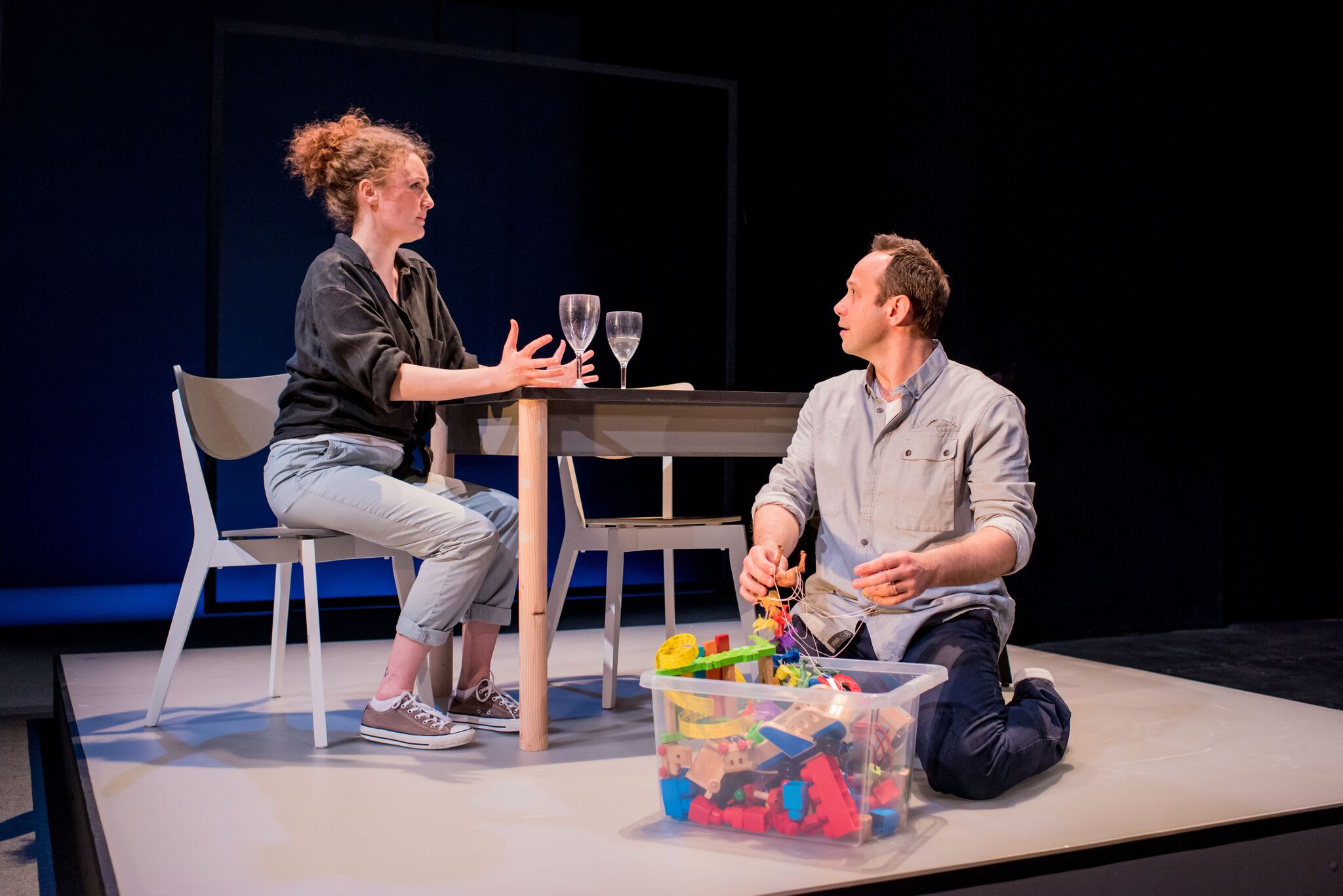
Turning over a toy box can be messy but upending the presumption of innocence is in an altogether different ballpark. What happens when a nice kind man in the queue at a place to eat helps grandma out and takes your three old to the toilet? You’re allowed a gut feeling about this one and it’s probably the right one? But are you sure, really, really sure?

OK, it’s not The Place to Eat up in John Lewis’ – writer Frances Poet can only go so far – but it might just as well be. As it is, Fisher-Price’s Laugh and Learn puppy takes the biscuit for product placement. Dad, Rory, another nice bloke, hasn’t found puppy’s On-Off switch and its happy-happy tune is doing his head in. It is not so funny for Mum, Maddy; not funny at all, for where there’s an edge in this ninety minute drama she is well and truly over it. And there’s no soft play area on the other side. Is it The Stranger who pushed her or did she do it all by herself?

It could not happen to a more ordinary, youngish, couple, which is precisely the point. We even have a Glasgow address: 65 Kelvindale Road – and Joshua (3) goes to Nursery and Granny Morven (Rory’s mother) helps out a lot, to begin with. First it’s the baby monitor and then it all goes wrong, which is where is the creative team get it just right. There’s a broad set, minimally dressed: a table and three chairs stage left, and a garden swing stage right; large rectangular panels, one of gauze, at the back. Colours are muted, contemporary greys and creams. The exceptional lighting design by Kai Fischer marks off areas that quickly isolate and focus attention. Various Strangers cast shadows, open to frightening doubt, that contrast with the chilling white of Maddy’s psychiatric stay. Michael John McCarthy’s music is spare and quietly ominous while Zinnie Harris’ direction is one keen judgement call after another. The overall effect is a silent ‘House’ in the grip of a familiar, media churned nightmare that cannot be shaken off.

George Anton and Kirsty Stuart.

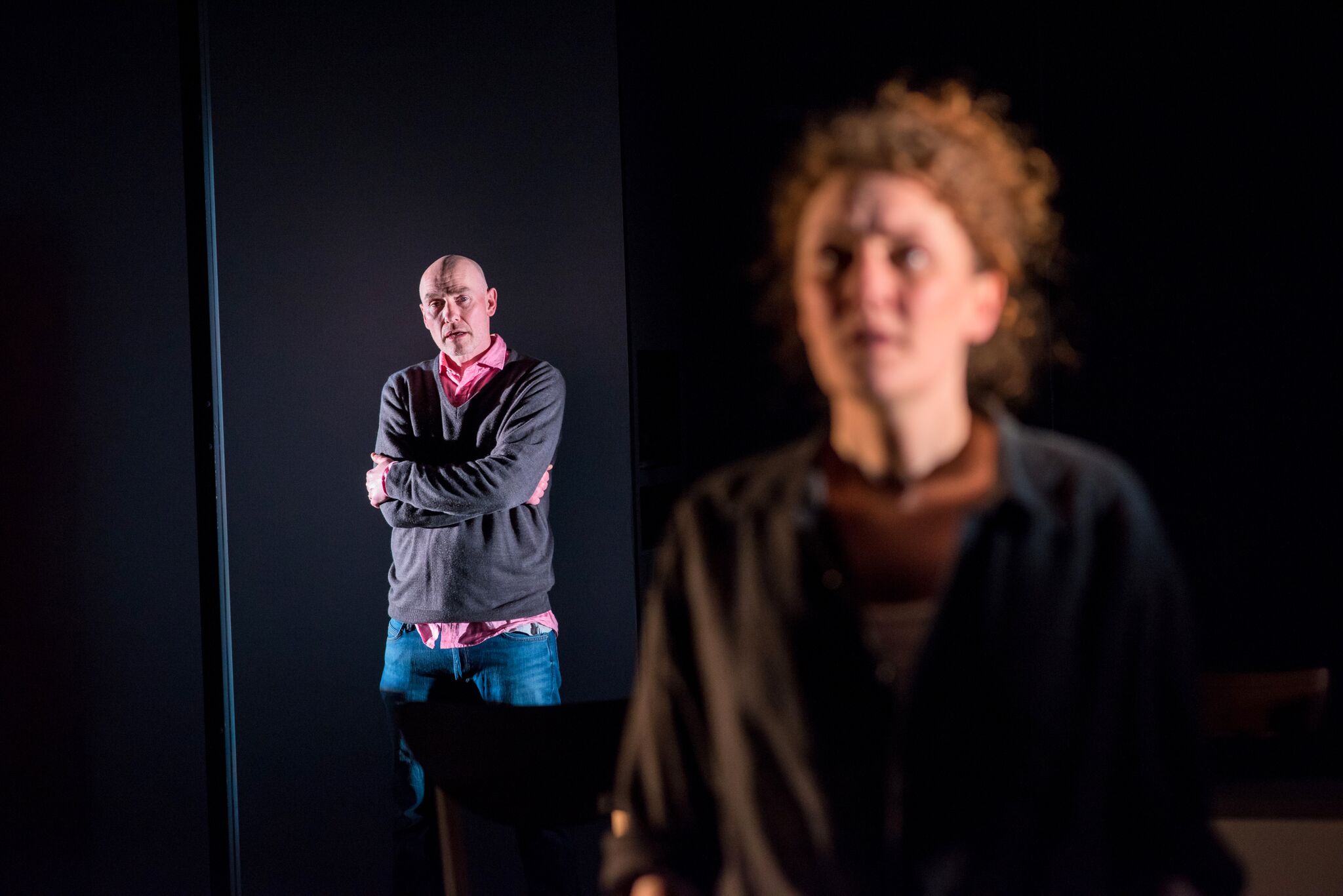
The script is conversational, inviting immediate and natural responses that seem at odds with the enveloping paranoia. Kirsty Stuart as Maddy is never more convincing as a loving mother than when she details her appalling behaviour. Rory (Peter Collins), who loves her to bits, can sort out toy trucks forever and still not get close to her. His mother, Morven (so believable by Lorraine McIntosh) can only be bewildered and hurt. George Anton is seven different Strangers, sympathetic in one light, scary in another. Presence is all and Anton delivers each time. The impassive concern of his police officer is especially alarming.

The initial setup is a little shaky, rather plastic. Can Maddy be that brittle? But if that’s a weakness the stage work carries it all the way. Gut succeeds in demonstrating that once parenting turns into child protection then it is a nervy, mind shredding issue. Feel it! Stand behind a swing and you risk getting your teeth knocked out but you can get thrown off a see-saw and bang your head just as easily. That, for me, is the audience’s experience. Up and down, up and down, see the Stranger, and then it’s touch-and-go (so to speak) whether it’s playtime or, ‘Wallop!’ “Mum’s out of it”.


Star (blue)Star (blue)Star (blue)Star (blue)

Reviewer: Alan Brown (Seen 24 April)

Go to Gut at the Traverse

Visit Edinburgh49 at the Traverse archive.

Rhinoceros (Lyceum Theatre: 23 March-7 April ’18)

Cast of Rhinoceros. Photography by Mihaela Bodlovic.

“A phenomenal combination of cast, crew, sound, visuals, and timeliness.”

Editorial Rating: 5 Stars: Outstanding

There often comes a point in allegorical pieces of theatre where an audience may understandably begin to tune out – the moment where they ‘get it’. Perhaps the thinly veiled stand-ins for real-world issues and figures wears tiresome, or the existential point of the play itself has simply been repeated ad nauseam. To the immense credit of director Murat Daltaban, adaptor Zinnie Harris, sound designer Oğuz Kaplangi, and the entire cast of The Lyceum’s staging of Eugene Ionesco’s absurd masterpiece Rhinoceros, during this production, that moment never comes.

Instead, this 96-minute masterpiece enraptures the audience at breakneck pace from start to finish, as it follows a quiet provincial town through a terribly sudden series of disastrous encounters with immense rhinoceroses who seem to come out of nowhere. As the townspeople begin to realise that their own citizens are transforming into the rhinoceroses around them, the remaining human beings react with a mixture of confusion, anguish, and disbelief, which all-too-quickly melts into skepticism, complacency, and inaction. Just motley, disheveled protagonist Berenger (an electric Robert Jack) seems to react with sheer panic and disgust for the beasts, and angles to figure out what to do, only to be talked over and ignored by everyone else.

On the subject matter, one can understand why Zinnie Harris’ adaptation of Ionesco’s hot-blooded anti-fascist play won over audiences at the Edinburgh International Festival this past year with its infuriating banality. The choice to follow Orson Welles’ example (when he directed the first English production of Rhinoceros at the Royal Court in 1960) and relocate the action from France, the original setting, to pseudo-modern Britain — possibly even Scotland…possibly even Edinburgh — is a commendable one, as the calamitous loss of reason and morality among society feels all too believable when delivered with accents as local as these. Even since its 2017 festival debut, the play has gained even more harrowing relevance, considering the looming deadline for Britain’s inflammatory exit from the European Union and the unimaginable complacency on display inside the Republican-led US government to its own all-American brand of authoritarianism. Harry Ward’s pitch-perfect and side-splitting rendition of The Logician’s “re-contextualizing” of the most pedantic and existential elements of the rhinoceros question, (instead of just focusing on what to do about it), is all too familiar, and a clever jab that lands brilliantly.

The play is full of commendably measured performances, including standout bone-headedness from Sally Reid as Botard and Myra McFadyen as a suspiciously familiar-looking Monsieur Papillon. Esin Harvey, John Cobb, and Natalie Arle-Toyne also turn in hilarious and eye-catching portrayals of variously deluded and theatrical supporting characters. But the real scene-stealer is Steven McNicoll as Jean, the rotund and incorrigible gentleman who bats Berenger around verbally and physically as he opines on the world, almost always in a completely unproductive direction. McNicoll plays Jean with such revolting yet somehow delightful arrogance and verbosity that in the genuinely terrifying sequence where Jean falls victim to the mysterious affliction, it is sad to see him go.

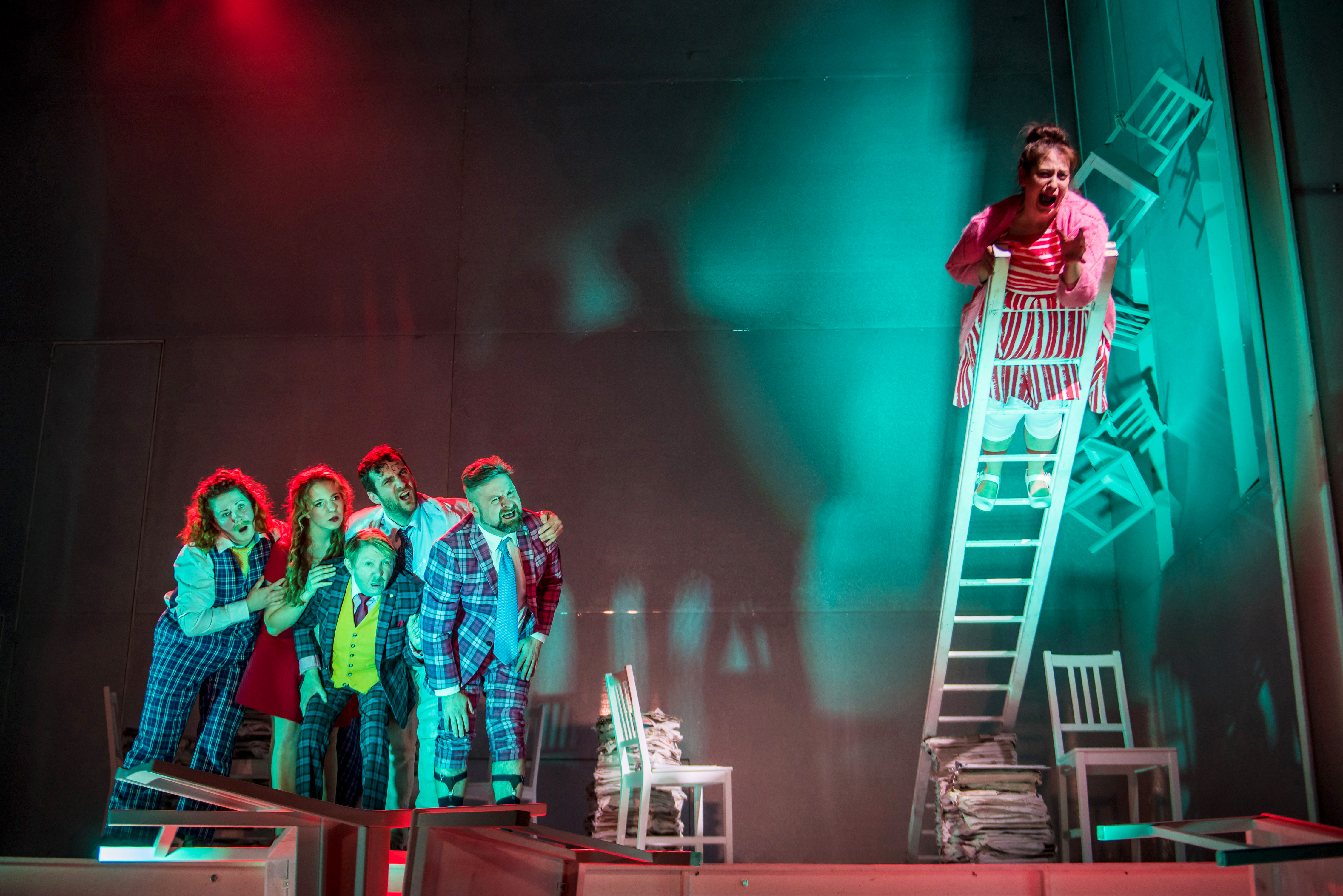
Complete loss of humanity, and the structures and pillars upon which ‘decent society’ are meant to rest, are ingeniously realised onstage. The set itself develops alongside the narrative by steadily adding platforms to raise the action higher and higher above the open settings the first scene. With truly nightmarish effect, the playing area for the performers becomes smaller and smaller, and physically farther away from where they began: a ‘rising tide’ of fascism. In addition to the set, the impressive stagecraft features delightfully insane costume design by Tom Piper, effective and visually arresting lighting design by Chris Davey (particularly memorable when Jean’s silhouette is portrayed in full during his horrifying transformation into the eponymous beast), and a pitch-perfect soundscape, composed and mostly performed onstage by Oğuz Kaplangi.

The ingenuity of Kaplangi’s sonic contribution is first introduced as the first rhinoceros stomps by, signified by a cacophonous racket that echoes behind and around the audience, leaving the viewer to fill in the visuals with their mind’s eye to match the might and ferocity that the onstage townspeople are witnessing. The fabulous use of sound and music only improves throughout the play, and it is striking how often the unsettling and masterfully composed soundtrack re-enters so subtly that the viewer might not notice its recurrence until it reaches an intense crescendo. Kaplangi also turns in perhaps the most unexpectedly memorable performance as a local cat, who saunters across the stage at the very opening and introduces the tone of the production perfectly.
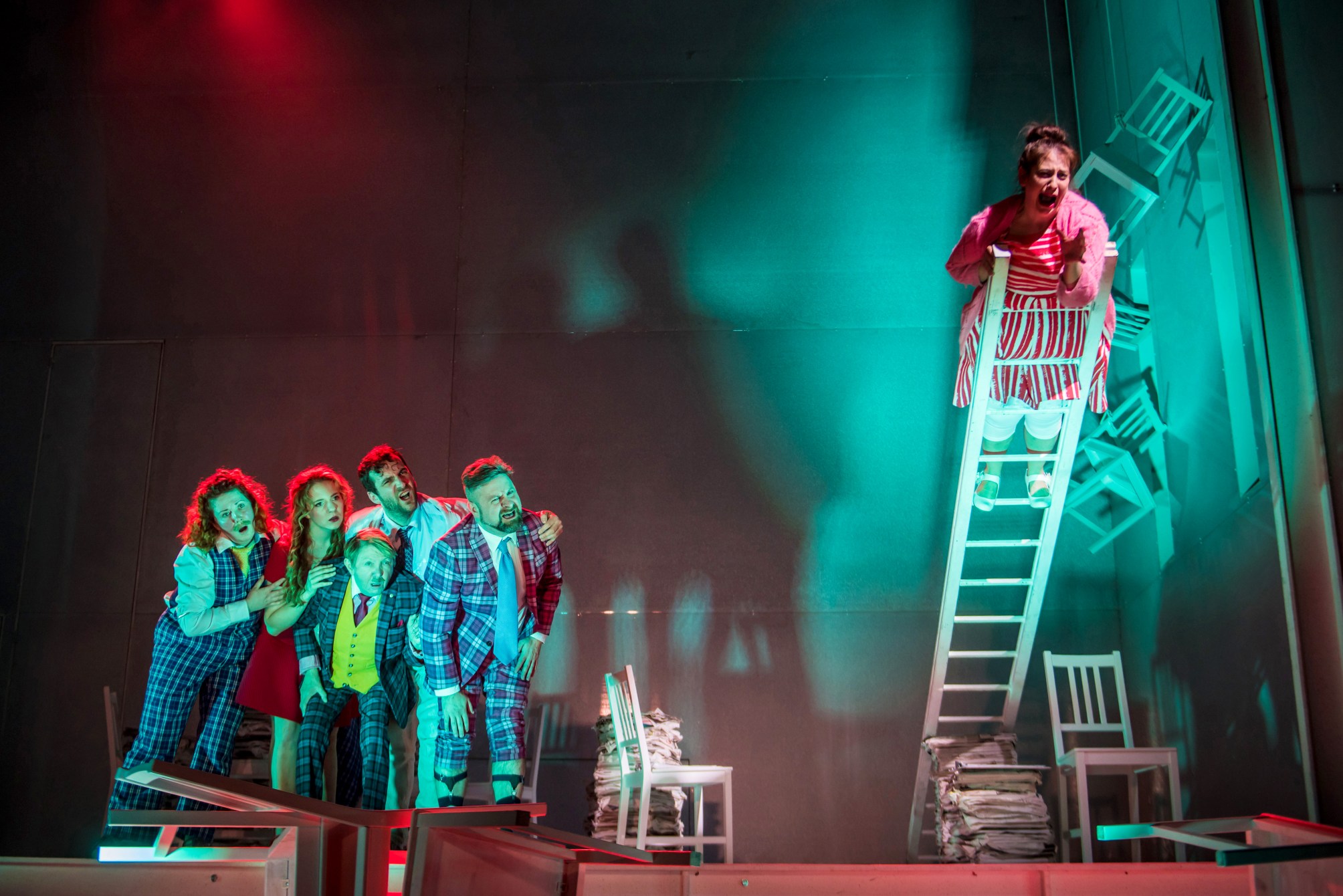
This production deserves to be seen by a wide and receptive audience, even though it falls victim to some less inspired elements. Harris, has for some reason, inserts repeated opportunities for the onstage performers to interact with the audience and generally poke and prod at the fourth wall. There are references to how hard it is to memorise some of the long words in the script, a direct description of how great the Royal Lyceum Theatre is, and quite a few winks to the audience about how insane the play has gotten. The production is so well-executed in nearly every other regard that the self-deprecation comes off as cheap and unnecessary. There is also a particularly aggravating sequence where Berenger and Dudard, at the peak of the storyline’s mayhem, conduct an entire conversation without looking each other in the eyes; and though this is quickly reframed as a deliberately surreal choice, it is perhaps too distanced from the narrative urgency of the scene.

One last note: perhaps this production’s most intriguing effect is the startling realisation that Ionesco’s cautionary tale of a society allowing itself to be consumed by monstrous, unacceptable forces, fits well into rejections of widespread societal change as a whole, both left and right wing. To be clear, Ionesco’s Rhinoceros is unmistakably anti-fascism and anti-fanaticism, and Daltaban pulls no punches about who to reference and ridicule. Yet Berenger’s climactic monologue, alone atop a mountain of crumbled society, announcing that he is the “last white man left,” and remarking on the foreign skin colour of the ubiquitous animals, leaves an oddly white supremacist taste in the mouth. Perhaps Harris and Daltaban, and even Ionesco himself, are intentionally reframing the ‘lone hero’ of Berenger as unreasonably disdainful of the new form of his fellow citizens, or perhaps society today regards Berenger’s self-assumed superiority more skeptically than Ionesco’s 1960 production would have, making what was once a statement of European decency sound more like a nationalist wail. Whether or not you agree, this heavy question serves as yet another reason to head over to The Lyceum for a night of hilarious yet harrowing théâtre de l’absurde. 

With such a phenomenal combination of cast, crew, sound, visuals, and timeliness, Murat Daltaban’s production of Rhinoceros is not one to miss.
outstanding

StarStarStarStarStar

Reviewer: Nathaniel Brimmer-Beller (Seen 24 March)

Visit The Lyceum archive.


SCO: Ticciati, Martin (Usher Hall: 22 March ’18)

Image result

Robin Ticciati

“Edinburgh’s loss is Berlin’s gain”

Editorial Rating: 4 Stars Nae Bad

I started checking the website the previous evening. And every couple of hours on the day. Would the great man show up? He has been plagued by back problems, and has publicly announced he is “doing less, to give himself more space”. Tell that to Valery Gergiev. A number of recent concerts have been missed.


Well he did, and well he had to, didn’t he? For this was the official farewell concert of Robin Ticciati as Principal Conductor of the SCO having taken up the position of Music Director of the Deutches Symphionie-Orchester Berlin. Pleasing that as Rattle leaves the BPO another Brit takes over at the DSO. Lucky Berlin to have such talented Brits.


As expected, there was a full house. Everybody knew they were in for something special. Robin and the band did not disappoint. Whilst mainstream repertoire was chosen, it was played with insight, intuition and zest. This was not a case of bashing out a few lollipops to keep the punters happy.


That having been said, the choice of Bach’s Orchestral Suite No 4 in D did not in my opinion sit well with the post romantic nature of the rest of the programme. It was played enthusiastically and fluently, notwithstanding the somewhat stilted, staccato-esque scoring. The standing violins and violas reminded me of Christopher Warren-Green’s London Chamber Orchestra and like them played from memory. This gave an effective theatrical turn to the interplay between solo first violin and viola, creating an atmosphere of baroque’n’roll.


Unusually scored for strings, harp and piano the Copland Clarinet Concerto is a hybrid work in the classical/jazz idiom akin to some of the music of Leonard Bernstein.   In two movements and but 18 minutes long, it is a work of depth, intensity and contrasts. The first movement “Slowly and expressively” was exquisitely played by Maximiliano Martin and is a real tearjerker akin to Samuel Barber’s Adagio for Strings. Seldom has the harp and viola introduction been played so sensitively intoned, followed by the lyricism and restraint of the soloist. Following a demanding and striking cadenza the second movement, “Rather fast – trifle faster” was virtually jazz (it was written for Benny Goodman) and was delivered with aplomb by Martin, light on his feet as if he were the Pied Piper. With much applause Martin stood next to the game pianist and granted us an encore.


Following the interval it was time for the party piece, Dvorak’s Symphony No 9 ‘From the New World’. These accursed titles do one no good in trying to get in touch with the music. Like the Moonlight Sonata they are publishers’ whims to help with their marketing. The work is a wonderful example of post-romantic symphonic form (1893), well constructed in four movements, tuneful and melodic throughout. And while there may be influences of Native American music and American Folk Song, it is on record that Dvorak thought that there was nothing much to distinguish between Native American, African –American or even Scottish music. We take the music on its merits, which are considerable.


The piece is so well known it is difficult to avoid cliché, but the orchestra played with such convincing phrasing and freshness that there was nothing hammy or schmaltzy at all, it was almost as if listening with fresh ears, albeit to a superbly classic interpretation. A wonderful note for Robin Ticciati to go out on, save for the lyrical “Song without Words” encore.


Robin Ticciati will be back conducting the SCO in the Brahms symphonic cycle for the Edinburgh Festival. In the meantime, Edinburgh’s loss is Berlin’s gain.


nae bad_blue

Star (blue)Star (blue)Star (blue)Star (blue)

Reviewer: Charles Stokes (Seen 22 March)

Go to the Scottish Chamber Orchestra here

Visit the Usher Hall archive.

SCO: Emelyanychev, Spacek (Usher Hall: 15 March ’18)

Image result

Josef Spacek

“If it were a blind tasting you would be definitely getting a taste of premier cru”

Editorial Rating: 4 Stars: Nae Bad


The winter season has been cruel to the fans of the more well known soloists booked by the Scottish Chamber Orchestra. Thursday’s concert, the latest of three I had planned to attend, was, for the third time in a row for me, blighted by the non-appearance of not only the soloist but also the conductor. The SCO points out in its no-show apology that there are no refunds because they have the right to substitute artists. Other Scottish orchestras take a less severe line. I had wanted to see Schiff a few weeks ago, I had wanted to see Tetzlaff on Thursday. I wanted to see Ticciati. That’s why I put the concert in the diary. All pulled. Ticciati’s on-going back problems deserve sympathy and should be recorded here. One hopes he can make it for his farewell concert next week. For the others, one wonders.


I decided to stay, not least because I feared that opportunities to review the SCO were proving elusive. I am glad I did, because that fickle spirit, Live Music, triumphed, and I learnt a lesson.


The B Team were young, but what they lacked in experience they made up for in enthusiasm, technical competence, and considerable depth of interpretation beyond their years. The concert was a joy from start to finish, melodic, engaging, very well played, relaxed and entertaining. Maxim Emelyanychev stood in for Robin Ticciati. A student of Rozhdesvensky and the Moscow Conservatory he has, at the tender age of 29, yet to conduct a first rank orchestra, but is booked next season for the Royal Philharmonic, the St Petersburg Philharmonic and at Glyndebourne with the Orchestra of the Age of Enlightenment. So tonight we were shown a window into a promising future.


Perhaps Josef Spacek, standing in for Christian Tetzlaff, has a few more pips on his shoulder. He has appeared not only with his native Czech Philharmonic, but also, among others, the Philadelphia Orchestra, Bamberger Symphoniker, Rotterdam Philharmonic and Netherlands Philharmonic. This was his first gig with a British orchestra. The 32 year old did well.


And so to the music. Of the three concertos written by Dvorak, I would put the piano concerto in the second division, the violin concerto at the bottom end of the first, and the cello concerto as a masterpiece. I personally prefer the Romance for Violin and Orchestra to the concerto, but of course the latter is a more substantial work. Spacek took immediate control with confidence, smooth phrasing, great tone and sufficient volume even way up high on the E string, standing out from the orchestra notwithstanding the limitations of his instrument.   Emelyanychev kept the orchestra in balance but brought everything out of the piece in a conducting style that was confident and far from laid back. The orchestra was competent and supportive after just the slightest waver on the fiendishly difficult and exposed horn opening, and one was in no doubt as to the natural synergy between the triad of orchestra, soloist and conductor, completely forgetting that two of them were stand-ins.


I cannot write about Schubert’s 9th Symphony without a reference to my then eight year old daughter chatting to a violinist from the London Philharmonic Orchestra during the interval at a concert at the Royal Festival Hall, just before playing the work. He said that he and his colleagues called it “The Great Sea Monster” and that is what the Great C Major has been in our household ever since.


The symphony is not without its challenges to the listener. The key of C has its limitations, and for Schubert it is relatively long. There is plenty of melody, but also quite a bit of ‘fill’. The solution, as rightly executed by Emelyanychev, is to take it at a cracking pace.  The SCO was melodic, cohesive, disciplined and played it better than many. I should give a special mention to the timpanist who unusually was given an opportunity to demonstrate his considerable expertise. Overall it was a very accomplished performance by both orchestra and conductor.


The lesson for this writer is, once again, with live music you never know what you are gong to get. Stars can disappoint, relatively unknowns can surprise and impress. To mix my metaphors, while the names tonight were perhaps more Naxos than DG, if it were a blind tasting you would be definitely getting a taste of premier cru.


nae bad_blue

Star (blue)Star (blue)Star (blue)Star (blue)

Reviewer: Charles Stokes (Seen 15 March)

Go to  the SCO, Scotland’s national chamber orchestra

Visit Edinburgh49 at the the Usher Hall archive.

Footloose (King’s Theatre: 14-17 March ’18)

“Genuine wow-factor”

Editorial Rating: 4 Stars: Outstanding

When the stage musical of Footloose (based on the 1984 film) hit Broadway in 1998 its critical reception was mixed. But this week in Edinburgh the Bohemian’s Lyric Opera Company are cutting it loose with a near-perfect interpretation, with plenty of positives to shout about.

Following the story of a young man who moves to a new town that’s banned dancing for being a bad influence on children, it’s a fairly mediocre plot, but it’s a show packed with punch, heart and fun to get anyone’s weekend off to a good start.

What makes or breaks a show like Footloose – where dance is what the whole show is about – is being able to sell the choreography, and boy, do the Bohemians do just that: it’s hard to spot a foot or fingernail out of place in this full-on production. And what’s most impressive is that whether there are five or fifty dancers on stage, everything is slick, polished and performed with smiles. Dominic Lewis’s excellent choreography not only captures the overriding sense of freedom vs. containment throughout the show, but it really works to the strengths of this amateur company, creating complex patterns with simple moves that result in a genuine wow-factor.

Leading man Ren McCormack (Ross Davidson) brings all the charisma and light-footedness required for the out-of-towner who dares to be different, while Felicity Thomas as Ren’s love interest Ariel More is honest, likeable and very impressive vocally throughout the show. The main comedic moments are delivered by Willard Hewitt (Thomas MacFarlane), whose gawky brashness brings a lightness and joy to proceedings whenever he is on stage, while Christopher Cameron shows great authority and control as anti-hero Rev. Shaw More.

Musically, this show won’t be to everyone’s taste: there’s a real 80s vibe to the score, which to me makes the standout upbeat songs quite poppy and obvious, leaving the others feeling a little bland in comparison. In saying that, on the whole, everything is very capably sung with some stunning vocals on display – especially from the female leads. Cathy Geddie in particular brings tear-jerking emotion to Can You Find it in Your Heart, and Charlotte Jones pumps up the party diva-style with Let’s Hear it for the Boy. But it’s when Felicity Thomas, Cathy Geddie and Ciara McBrien combine in the spine-tingling Learning to be Silent that you know you’re watching something very special.

The only downfalls in this show are a few pitching and power issues with some of the male soloists, and a tendency for some of the duologue scenes to dip in energy following big production numbers, creating a sense of imbalance from scene to scene. On the whole though, this is a very polished production, so lose your blues and go and see Footloose!


outstanding

StarStarStarStar

Reviewer: Steve Griffin (Seen 15 March)

Visit the King’s Theatre archive.

THIS REVIEW HAS NOT BEEN SUBEDITED