A Girl and a Gun (Summerhall: 2-27 Aug: 18.00: 60mins)

“A greatly rewarding hour of insight and grace for cinephiles, feminists, and iconoclasts everywhere.”

Editorial Rating: 5 Stars: Outstanding

Louise Orwin is one savvy film buff and her one-woman show, A Girl and a Gun (the title of which is derived from Jean-Luc Godard’s notorious quote “All you need to make a film is a girl and a gun”) is sixty minutes of finely crafted satire/tribute/criticism/fun on that very notion. For cinephiles and non-cinephiles alike, A Girl and a Gun offers laughs, thrills, and intimate insights into some of popular culture’s most beloved genres and setups within film, while asserting a masterfully subversive message.

Orwin is an electric performer, constantly keeping the audience guessing and engaged as she flits from scenario to scenario as “Her,” representing the interchangeable, lazily written female in so many Hollywood films. She is accompanied onstage by an unspecific male counterpart, as “Him,” a random actor who had responded to the show’s online call for male performers, and who is a different person every night. “Him” reads his lines from a teleprompter, and is, charmingly, just as surprised, shocked, amused, and impressed at the show’s content as the audience is at every turn. For Orwin has created an amalgam of sorts, of every misogynistic and abusive male-female dynamic presented in male-ego-centered films, to prove how toxic and destructive masculinity in popular culture can be.

“Him” is scripted to seduce, kiss, betray, bully, abuse, physically hit, and generally mistreat “Her” in carefully structured ways, so that sometimes he has free reign to strut around and take advantage of the audience and damsel in front of him, and other times he has no real choice but to act like a heel. Her commentary is strikingly simple, as she uncovers the terrible unfairness and cruelties beneath many a male/female action hero/damsel dynamics.

What is most impressive and reassuring about the show’s approach is the level of research evident behind the faithful recreations of the films it satirises. It is presented in a format all Tarantino fans will recognise; divided into chapters with pseudo-poetic titles like “Cherry Picker” or “Why You Don’t Have to be American to have an American Dream,” which is a particularly impactful one. Taglines, catchphrases and devices from lots of Tarantino’s writing are featured, including dances reminiscent of Pulp Fiction and Death Proof, and the opening theme from Kill Bill – indeed the piece is chock-full of cinematic observations and criticisms that are spot-on if you are a fan of the retro-worshipping, Western-esque American odysseys Orwin comes after. There is a particularly impressive and hilarious sequence in which Orwin and the male actor recite all the typical names of “Him” and “Her” in these films, like Charlie, Bobby, Big Charlie, Big Bobby, Tommy, Tony, Big Tommy, Big Tony; Suzie, Jenny, Little Suzie, Little Jenny, et cetera.

Points like these are also, in a larger sense, what makes Orwin’s show so clever and incisive; there are no individual films or even individual scenes that are criticised on their own. Rather, A Girl and a Gun takes aim at the sheer repetitiveness and laziness of re-used, tired tropes, with great success. One of the most memorable sequences comes near the ‘end’ of the experience, when “Him” has forsaken “Her” and she must, as she does in so many films, die. Orwin’s “Her” dies at least ten times in a row, in various gruesome fashions, from being shot with numerous types of firearms to being tied to a train track and run over. Her point lands with a surprising amount of grace, as we recall so many female characters who have been extinguished simply to prove the male protagonist’s point, and it is the sheer quantity of such deaths that packs the greatest punch.

The attention to detail in this show is also commendable, from the use of projection and subtitling to recall a movie being written and filmed, and on-screen directions for “Him” to don various costumes, play with numerous prop firearms and “act like he is in an action movie”. This device in particular leaves a meaningful impression, presenting both “Him” and “Her” as pawns of the written scripts, and suggesting it is not necessarily inherent to a man’s composition that he acts so cruelly — he is written that way, much as many men may have learned their behaviour from movies where that very same behaviour got the girl and saved the day.

A Girl and a Gun presents an ingenious deconstruction of male ego, cinematic influence, and the truth beneath the beauty of so many of society’s favourite films. It is a greatly rewarding hour of insight and grace, plus a goldmine for cinephiles, feminists, and iconoclasts everywhere.

outstanding

StarStarStarStarStar


Reviewer: Nathaniel Brimmer-Beller

THIS REVIEW HAS NOT BEEN SUBEDITED

Stiff & Kitsch: By All Accounts Two Normal Girls (C Royale: 14-28th Aug: 16.40: 60mins)

“Two extremely talented comedians who deserve to be playing to full houses”

Editorial Rating: 5 Stars

There’s something to be said for taking a label someone gives you and owning it, turning it into a badge of honour. It takes guts and good humour. And that’s exactly what Rhiannon Neads and Sally O’Leary display by the bucketload in their latest outing as Stiff & Kitsch in By All Accounts Two Normal Girls – a show so named after a quote from my review of them last year.

The premise of the show is a discussion and self-help guide on how to achieve the level of “normality” the two girls have (according to, erm, me) by taking a comedic look at different aspects of their lives from jobs, to health, wealth and everything in between. Opening quip “things are about to get normal” sets the tone for a witty, honest and accessible hour of fun.

Each section is punctuated with a trademark musical number, which work really well to summarise and highlight their main comments, with choruses including repeated lines as blunt as “Keep your bullshit to yourself” (in reference to seemingly narcissistic social media use by their peers), and “I haven’t a fucking clue”, which we’ve all felt about one thing or another. What pleases most about this duo is their slick back and forth – in both the songs and general banter – the whole performance maintains a beautifully unrehearsed aura, like they’ve put it together especially for you in that moment.

The professionalism and confidence from Stiff and Kitsch have pleasingly stepped up a notch from last year – there is a bit more a swagger and presence within their performance, not un-aided by the life-size cardboard cut-outs of themselves that adorn the back of the stage. Yet with this growth as performers what they haven’t lost is their likeability: the sense that they are still one (or two) of us with the same flaws and insecurities as everyone else. What they do really well is to make each one into something to laugh about, and there are certainly plenty of laughs to be had in this show.

While my main criticism of their show last year is still largely accurate – the variety and creativity within the musical numbers is somewhat lacking – it is the only blemish on an otherwise polished and very funny show. I didn’t stop smiling once throughout the whole hour.

It’s not always easy to admit that you were wrong, but this time I’m glad to: Stiff & Kitsch aren’t two normal girls: they’re two extremely talented comedians who deserve to be playing to full houses. And if they call their next show that, I am retiring.

Star (blue)Star (blue)Star (blue)Star (blue)Star (blue)

Reviewer: Steve Griffin (Seen 19 August)

THIS REVIEW HAS NOT BEEN SUBEDITED

Louise Reay: Hard Mode (The Stand Four: 3-27 Aug: 17.55: 60mins)

“A unique and insightful project perfect for Fringe audiences”

Editorial Rating: 3 Stars: Nae Bad

This is a very clever show. Through a healthy mixture of character work, pre-recorded videos, impressive knowledge of modern Chinese society, and truly human moments, Louise Reay has crafted a unique and insightful project perfect for Fringe audiences. Some fine tuning of the details and the flow of the show would be useful to make its 60 minutes shine brighter, but overall Hard Mode is a worthy offering.

The show’s title derives from the idea that in modern China, life is lived as if in ‘hard mode.’ Reay takes care to share a genuine taste of what that kind of life means, from tampering intrusively with audience members to stationing masked cronies around the room to watch and possibly punish the viewers at all times. She uses clever techniques like distributing identical napkins for all audience members to wear (to recall authoritarian homogeneity), and leading the room in hive-mind chants in between musings on what having a free society means now and what losing it could mean later. The masked guards do stay unsettlingly in character the whole time, even banishing non-compliant individuals who dare to remove the napkin to the ‘jail,’ which is the corner of the room. Though some of the points on surveillance are presented somewhat simplistically, the dark sense of forced enjoyment is done well. This show, to its credit given its subject matter, is effectively unpleasant.

Reay bases this societal reenactment on her lived experiences in China, thankfully. A few lines and jokes would seem like sweeping (and potentially offensive) generalisations if she hadn’t proven her extensive knowledge of Chinese culture, from the language to the media to the in-jokes. On the comedy end, the highlights of the show are her stagings of a possible future where the Chinese government has bought and hawkishly runs the BBC. Her David Attenborough-centered skits are hilarious, and her all-Chinese rendition of ‘Far-EastEnders’ is impressive for her sheer capability with the language, as a native English speaker.

On the dramatic side, and yes, there is a somewhat unexpected dramatic side, Reay mixes in her own real life in ways that teeter on the edge of too much. Without giving anything away, the sense of ‘hard mode’ in a societal sense is re-purposed in a personal sense, which at times is truly affecting, and at others feels like retreading and backtracking on points that have already been made.

Reay’s use of an actor to portray Chinese artist and social activist Ai Weiwei in a pre-recorded video conversation Reay apparently had with him feels strikingly off-kilter with the rest of the piece, and not only because it is never truly verified that Weiwei actually said any of the statements in the video. The actor’s timing is jarring, the delivery is confusing and flat, and points are muddled and indistinguishable — under what is admittedly fabulously intricate facial hair. For me, these filmed asides are revisited too often, and though most of Reay’s recurring jokes are quite funny and/or poignant (special nod to the unforgettable Loneliest Newsreader in the World), the Weiwei scenes feel poorly executed.

Overall, if you are looking for a bizarre yet poignant hour at the Fringe, and happen to be in the relatively far away lands that house the Stand Four, Louise Reay’s Hard Mode might be for you. Just be sure to set your expectations to Weird Mode.

nae bad_blue

Star (blue)Star (blue)Star (blue)

Reviewer: Nathaniel Brimmer-Beller
THIS REVIEW HAS NOT BEEN SUBEDITED

Douze (C Royale (studio 4): 2-28 Aug (not 14): 20.30: 60mins)

“Douze delivers by the bucketload”

Editorial Rating: 4 Stars

The format of Douze is simple enough: a musical group showcasing nine songs for Ireland’s latest Eurovision entry, and the audience has to vote for their favourite at the end. Voting slips will be found on the seats as the audience come in.

To begin, the lights go down and, as they return, the tension builds as the star of the show, Xnthony (Anthony Keiger), with his back to the audience, stands in front of a gold-tinselled backdrop. Xnthony is then revealed from behind an EU-starred cape, sporting statement make-up and a bespangled, very low-cut wrester’s singlet. Supporting him are the Penny Slots (Hannah Fisher and Tiffany Murphy), dressed in royal blue cheerleaders’ outfits, already out of breath and with make-up ready-smeared (emphasising the depiction of their supporting role).  And it only gets more crazy and energetic from there.

Yes, there are nine songs (which do a good job on satirising the various musical styles of Eurovision). Yes, there is a vote. Yes there is the cattiness and viciously competing egos under the showbiz smiles. Yes, there is politics. (You will hear “Yes” quite a lot during the show). All this though are buried under the physical slapstick on stage and the none-too-subtle comedy outrage perpetrated both on-stage and off.  The team make excellent use of the entire theatre space throughout the performance, but beware: sitting at the back may not save you from audience participation, which can verge on the blush-inducing.

As the action becomes increasingly energetic, the lasciviousness of the looks and poses become more apparent. While both women dance vigorously throughout, some of the noises, especially coming from Tiffany, are quite remarkable. One is pretty sure the Penny Slots get their name from their costumes. For sure that would be pre-decimal coinage.

Production levels in this medium-sized (at least for the Fringe) venue is good. Audio quality is high throughout and there is a tremendous use of cheap and cheerful props to great comic effect.  A critic’s duty is to keep watching but honestly, do close your eyes if asked: it really enhances the stage-magic. Thank goodness the venue is well-ventilated, even if only for the sake of the performers.

All three performers should be given full credit for the physical energy they bring to the stage. While the choreography is slapstick and sometimes quite lewd, they are all extremely funny.  Perhaps more vocal lines could have been assigned to the Penny Slots, as both Hannah and Tiffany demonstrate that they really can sing, and though Xnthony’s voice is never totally convincing, it doesn’t matter at all in this context.

A show about a group of Eurovision wannabes is never going to be an erudite and highbrow evening.  It doesn’t even matter whether one likes Eurovision. It’s about fun, laughter and outrage and that is exactly what Douze delivers by the bucketload.

Just be sure to give the pens back. Really, give them back.

                                        Star (blue)Star (blue)Star (blue)Star (blue)

Reviewer: Martin Veart

C Royale (studio 4)

THIS REVIEW HAS NOT BEEN SUBEDITED

Penetrator (C Cubed: 3-12 Aug: 18.25: 75mins)

“Flickers of brilliant storytelling”

Editorial Rating: 2 Stars

Anthony Neilson’s Penetrator covers the topics of masculinity, friendship, and how far a man will go for his mate. Max and Alan are friends and flatmates (with differing viewpoints on tidiness and laziness), when old friend of Max, Tadge, arrives unexpectedly, having been discharged from the army. Bringing a vast set of issues none in the group can comprehend we find out how much each of them is able to put up with.

Bizarrely, for a play that’s been produced at the Traverse, the Finborough and Royal Court (upstairs), it’s Neilson’s script which is really the weak link in this production, giving away frustratingly little about the backgrounds and motivations of each character. Conversation between Max and Alan frequently just dies and restarts again on a different topic for no reason, while any sort of tension and narrative drive appear only quite late on. Perhaps it’s all one over-burdened point by Neilson about men’s ability to communicate about emotion or anything of any depth, but even that wears thin as the chatter ploughs on about girls, haircuts, cards and cups of tea without feeling genuine.

The final fifteen minutes of drama are certainly attention-grabbing and tense, even if the motivation behind it feels rather flimsy with very little to establish it. Tadge’s accounts of the penetrators and his father never quite ring true, as the non-plussed reactions of the others smack of disbelief without enough intelligent dissection of the issues to draw the audience in. I was left wondering what all the fuss was about.

In saying all that, the cast do a fairly good job with the material – Chris Duffy is very relaxed and natural as Max, Matt Roberts suitably frustrated as Alan, and Tom White is the most convincing and compelling of the group as the war-affected Tadge. While the tense moments towards the end the production do get a little bit too shouty, the more emotional and thoughtful interchanges – particularly when recalling teenage incidents – are very well-delivered and stand head and shoulders above the rest in terms of emotional honesty as flickers of brilliant storytelling.

Given the amount of talent on display at moments during this performance, it’s clear that Fear No Colours as a company have the potential to produce great theatre, but unfortunately this production falls short in too many areas to show them in their best light.

Star (blue)Star (blue)

Reviewer: Steve Griffin (Seen 6 August)

THIS REVIEW HAS NOT BEEN SUBEDITED

Gossip (Zoo Southside: 4-15 Aug: 20.30: 75 mins)

“A chocolate box of visual delights”

Editorial Rating: 4 Stars: Outstanding

Gossip is a subject we can all relate too, and in a world of hearsay and “fake news”, the theme of Lenka Vagnerova & Company’s latest production is achingly relevant. Yet for a topic so closely associated with words, how does a dance piece explore its intricacies? On the whole, with zeal.

The action begins at a party, as guests arrive and go through the rigmarole of introductions and drinking. The movement is jarring and robotic – a cutting reflection of the forced politeness many of us display in social circumstances – and the skill and dexterity of each dancer’s exaggerated stilted reactions is really wonderful to watch. Tensions soon arise as gossip spreads, and then the real fun begins.

The whole piece follows different characters’ reactions to being gossiped about, joked with (or worse), with creative interpretations of what that experience feels like. From dancers being puppets on an evening out and inadvertently ending up in bed together, to another being physically swamped in a cape made up of all the things she doesn’t say about her husband, the whole performance is energetic, stylish and performed with the swagger one might expect of one of Czech Republic’s most lauded companies.

Yet while gossip is the overall theme, the undertones of the piece are much darker than you might expect – the taunts and fights are at times frightening, and the dramatic ending may be a lesson to us all in keeping our mouths shut and thinking about others before we act. It’s scintillating and dramatic, yet at times very funny, as facial expressions and stylised reactions add a slapstick feel at choice moments, giving the overall performance depth and balance.

The artistry, choreography and control are all stunning, with solos, duos, and ensemble moments, blurring the lines between dance and theatre. Daring lifts, throws and balancing acts will keep you on the edge of your seat and the clever use of changes in dynamic and music keep the performance moving and engaging throughout. This is a company that feels very natural on-stage, with all the creative elements and personalities working together to present of chocolate-box of visual delights.

For me the only disappointing aspect is the lack of clarity of through-line (dare I use the word “narrative”?) throughout the piece. At times it feels like a stream of ideas and explorations following no particular order or structure, and while some loose ends are tied up at the climax where the opening party scene is revisited, I would have liked for the piece to feel like it had more cohesion and completeness.

Overall, Gossip is a very high-quality performance with something for everyone. It certainly deserves to be talked about.

outstanding

StarStarStarStar

Reviewer: Steve Griffin (Seen 5 August)

THIS REVIEW HAS NOT BEEN SUBEDITED

EQ: Dance! (Various, until 14 June ’17)

“A real treat”

Editorial Rating: 4 Stars: Outstanding

The Edinburgh Quartet are one of our favourite live music acts here at Edinburgh49, and while normally it’s my colleague Charles we defer to for his superior knowledge of classical music, I was interested to see how a collaboration with Youth Dance Scotland would work, and what unexpected gems might be uncovered when combining classical music with contemporary dance.

The evening commences with a traditional musical performance by the quartet, followed by three dance/music collaborations: all original compositions for the quartet, and with original choreography from Marc Brew.

The first of these, For Sonny captures a very childlike and playful feel, with the dancers darting in and around the musicians (who are positioned centre-stage), seeming to make the rules up as the go along. There’s an element of give and take to the piece as the dancers respond directly to strokes from the quartet in the quieter elements, and to movements from each other – as if playing a rather bizarre version of “follow the leader” throughout. It’s fascinating to see such a close relationship between the dancers and the musicians, even though the danger of collisions sometimes causes the heart-rate to rise somewhat!

The quartet move to the side of the stage for the final two pieces, yet still feel integrated within the performance as the dancers watch and respond to them throughout. The second piece feels just slightly more grown up as the dancers adopt a more uniform and unison approach to their movement, though they become more animalistic – like a set of production line workers in rebellion against the formality of the everyday. Different dancers take turns to break out from the group, using more and more of the space, until they surround the quartet at the end, as if waiting for their next direction or inspiration.

Silent Shores has a significantly more ensemble feel, and combines the best of both of the previous two pieces, with some daring lifts and tableaux in direct response to the music, following its stops and starts with playfulness and control. Reflecting the nature of the isle of Arran, it’s a complex interrelationship as the different aspects of the piece – contrasting stillness and frantic movement – bring about a sense of ongoing time and flow, like the changing of the seasons.

Overall what’s most pleasing about the whole setup is the relationship between the dance and live music, which is cleverly structured and choreographed to integrate the two. At times the movements did lack a little polish and finesse – but perhaps given that the piece is touring across different venues in Scotland for just one night at a time, it can be expected that the dancers will have to adapt to the size and shape of their performance spaces each time, not allowing them to fully relax into each performance.

Something for both dance and classical music aficionados, a real treat. It’s a shame that, at just shy of an hour, the performance is so short.

outstanding

StarStarStarStar

Reviewer: Steve Griffin (Seen 10 June)

Visit the Summerhall archive.

Lyceum Variety Nights (Lyceum: 4th June ’17)

“Resident host Sian Bevan never fails to amuse”

Editorial Rating: 4 Stars

Ding ding, it’s round three of the Lyceum Variety Nights, and the last in the current season.

This latest outing had a very contemporary and slightly alternative feel, and it’s good to see curator Jenny Lindsay flexing her little-black-book muscles to bring a more diverse line-up of music, theatre, poetry and dance to proceedings.

Overall the night was a pleasing mix of more established artists sharing some of their fondest work from yesteryear, performing alongside some red hot and right now acts, sharing pieces from their latest collections. Among the red hot and right now were dancer Jack Webb, whose inclusion as the first dance act of the programme I was really excited about. He performed an emotive and powerful contemporary-style piece to a discordant soundscape, which, while not the most accessible of pieces, certainly brought some zing to proceedings. Musical acts The Miss’s and Maud the Moth were also bang up to date and on the pulse, sharing genre bending tunes and stunning vocals that just left me breathless.

It was nice too, to have the quieter moments, perhaps most finely shared by Caroline Bird, whose rather more introverted stage presence created a lovely balance between a lot of the madness and noise of some of the other acts. Her poetry was awash with splendid imagery and moments to cherish, that really left me longing for more. Mairi Campbell, accompanied by viola, brought a touch of the traditional to the night, and even had us all singing along with her folk-style music at the end of her set – delightful.

Yet while the variety of the performers was wider than in previous instalments, thus making it feel a little more niche, for me it’s the quality of all the acts which is key to the night’s success. Each night’s line-up never fails to include award winners, experienced practitioners and well-regarded artists from across the spectrum, and though they may not all appeal to individual tastes, those with a wider appreciation for the arts should be able to at least enjoy the overall skill on display. A special shout-out too to resident host Sian Bevan who never fails to amuse with her witty and sometimes humorously irreverent compering!

I have to say that this was not my personal favourite evening of the programme, but that’s variety for you – you can’t win ‘em all! I very much hope another season of these nights is programmed for next year, and I look forward to attending them all.

Star (blue)Star (blue)Star (blue)Star (blue)

Reviewer: Steve Griffin (Seen 4 June)

Visit the The Lyceum archive.

THIS REVIEW HAS NOT BEEN SUBEDITED

War in America (Former Royal High School/King’s Theatre: 24-27 May ’17)

Connor McLeod as Mr Slype. Photo by Greg Macvean

“Some fine performances from the young cast”

Editorial Rating: 3 Stars

War in America’s revival in the build-up to the current UK General Election is very apt – and almost feels as if it is written especially for this moment, though it is now over 20 years old. The narrative sees the rise of a female political leader (known only as “She”), who hides behind a variety of lies, disguises and games in order to get to the top. Meanwhile, in a pleasingly Orwellian set-up, our little man Mr Slype (a rather spineless MP) is bullied by rival parties to vote for a law he neither wants nor doesn’t want, and some rather underhand tactics see him inadvertently give his vote to She, handing her the reins of the country. What happens after gets a little confusing.

Given the setup and opening few scenes where the main characters and topics are introduced, the first fifteen minutes of this production really makes it feel like a cutting-edge, gripping political drama – not too dissimilar from Mike Bartlett’s King Charles III, which I reviewed last year. Jo Clifford’s dialogue is cutting, intelligent and witty, Susan Worsfold’s direction is slick, and there’s palpable tension between rival factions to keep us on our toes. The production loses its way somewhat in the second half, however, and tries to cram in too much with too many characters and melodramatic revelations, that it becomes more of a slog to sit through.

That being said, there are some fine performances from the young cast, most notably Andrew Cameron as the cunningly-named and deftly acted Mr Fox, who is very charismatic and convincing and throughout. Scenes with him and his assistant Alfred (Mark O’Neill) were among the most compelling of the performance, and I could easily picture them on a bigger stage receiving great acclaim. Connor McLeod is also strong as Mr Slype, with great variation in swagger and guilt from scene to scene.

It is, however in the more dramatic scenes where the tension and integrity of the piece slips. She’s relationship with her estranged daughter fails to ring true throughout the piece – distinctly missing the deep emotional connection needed to be convincing, and its climactic resolution is very sloppy compared to the polish evident in other areas. Indeed, many aspects of the show like this come across as rather rushed, when a more considered approach would be more powerful. While in general it’s a gutsy effort from the young cast (and great for them to be getting involved with works on important subjects like this), I think in some cases it would have been beneficial to have some more experienced actors to give the brutal narrative the necessary punch it needs.

And the “too controversial” content, which led the show’s initial production being cancelled 20 years ago? For me that must have been a lot of fuss over very little, as the more overt elements were perfectly pitched within the overall mood of the piece, never seeming gratuitous or unnecessary. Indeed, the scenes with sexual content were handled and incorporated very well, and while spawning a few titters, were powerful insights and metaphors into the darker side of politics. If anything, I think these elements could be pushed further.

Overall this is a show with fantastic potential, and with some more development could be very special indeed.

Star (blue)Star (blue)Star (blue)

Reviewer: Steve Griffin (Seen 26 May)

Visit the King’s Theatre archive.

Glory on Earth (Lyceum: 20 May – 10 June ’17)

(L-R) Christina Gordon, Rona Morison, Kirsty Eila McIntyre
Photos: Drew Farrell

“Evocative, imaginative drama”

Editorial Rating: 3 Stars: Outstanding

You’re 18 and you don’t know the 2nd Psalm. Well, that’s you written off. You do know a good few dance moves but that doesn’t cut it. Your stock is worthless, you’re ignorant; best go home little girl.

Ah, but where’s home? And who are you calling cheap?

Ans: Mary Stuart, born Linlithgow, brought up in France from the age of 5; Queen of Scots and actually in Scotland from 1561 to 1568, forced to abdicate, kept ‘safe’ under house arrest in England for 19 years and then beheaded, aged 44, in February 1587. Mother, via the union of the crowns, of James VI and I.

So much for dates and titles – but that’s not to dismiss their grip, far from it – it’s just that Linda McLean’s new play creates evocative, imaginative drama from the baleful encounters of the young, attractive queen with the almighty John Knox. He’s there from the off, in front of the curtain, in clerical black and giving new definition to the reproving stare. God’s word, you understand very, very quickly, is “non-negotiable”.

At least Mary has the support of her ‘Marys’, six of them in this telling, who attend her, dance freakpop with her (… really liked that!), and review her suitors in a modern, OMG/ “Awkward”, kind of way. There’s a disciplined choric role in there too, in whispers, gesture, and half lines, as well as the harmonious choral interludes, mostly in French. In other, opposed, parts the Marys are privy councillors and reformers. Queen Mary’s life is here, opened and closed by the executioner’s block, but the tawdry and the sensational (& the melodramatic) are absent: no Darnley, no Rizzio, no Bothwell – just her searching and bold question to Knox, “Do you see a bad person, Sir?”

(L-R) Jamie Sives, Shannon Swan, Christie Gowans, Hannah Jarrett-Scott, Christina Gordon, Fiona Wood, Kirsty McIntyre, & Rona Morison

James Sives, as Knox, is too cool to rise to the question. And he’s damnably clever, in or out of his pulpit in St Giles. Hear Sives and hear the preacher’s ‘History of the Reformation’, righteous and utterly fearless. He walks on stage and kills the dancing stone dead. An unexpected and rather wishful soundtrack of France’s finest minstrels: Piaf, Francoise Hardy, Christine and the Queens (sic), cannot stand. However, Brel’s ‘La chanson des vieux amants’ probably does touch him, as he grieves for the loss of his first wife, but then Brel was Belgian.

Rona Morison, as Mary, has the sympathetic part, the level gaze (female) and the appealing voice. More principled and upright than pliant or weak, and so much younger, this Mary is an important addition to the historical strumpet/martyr and – should you browse Netflix – an invaluable corrective to the endless episodes of CBS’s  ‘Reign’.

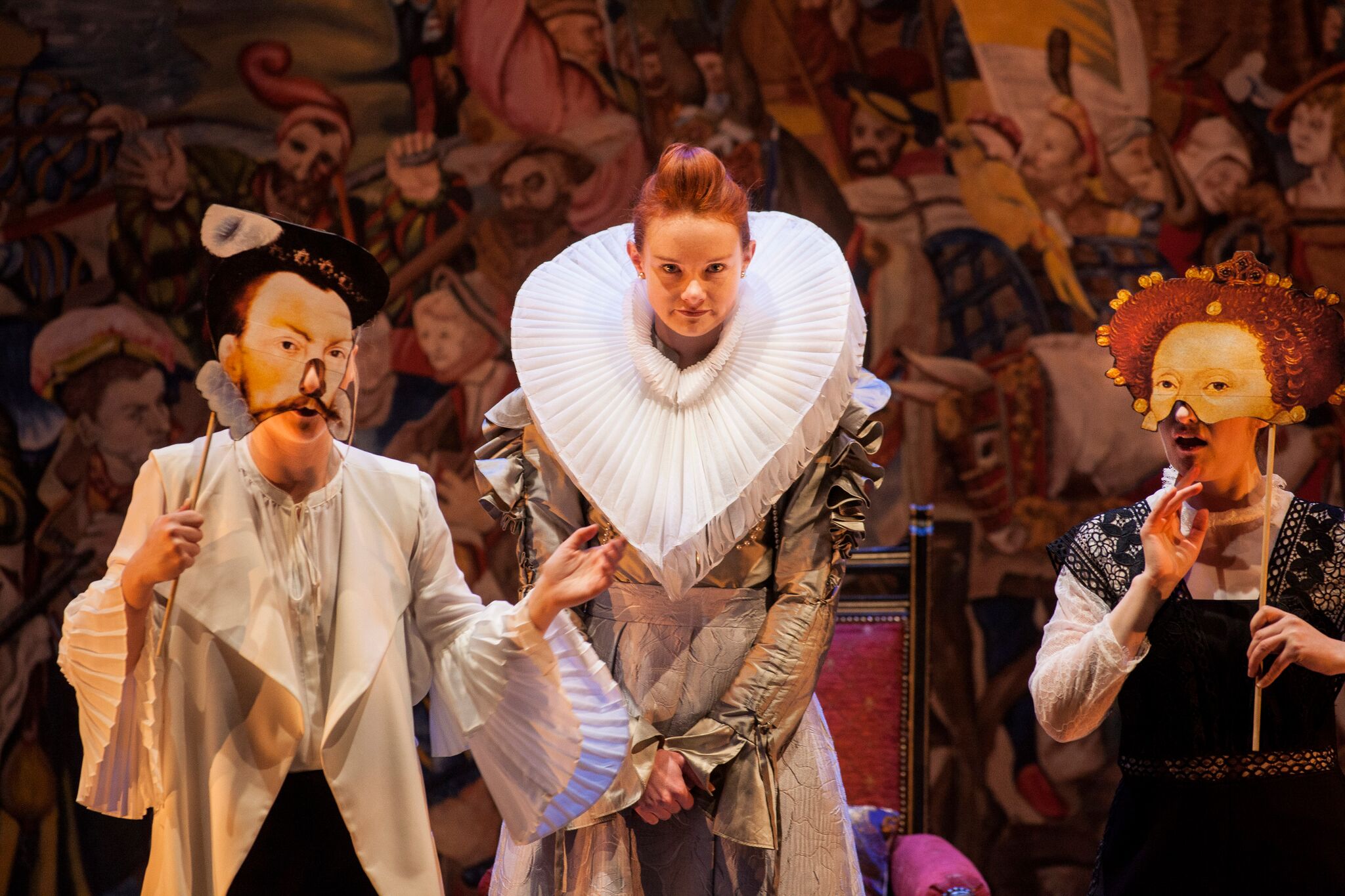
David Greig directs with a clear eye on what mattered then and should still matter now. Knox won and Mary failed. The austere and the severe are there in the steel blue lighting and the greys of an uncluttered set and in Knox’s strict delivery. Where there’s a wide and colourful tapestry, there’s dancing and short-lived levity. Elizabeth I, speaking through a mask, is both laughable and ominous and maybe the scheming Scottish nobility could have used the same distancing device. The disrobing of the queen at the end has its own proper and tragic significance.

‘Be wise now therefore, O ye kings: be instructed, ye judges of the earth.
Serve the LORD with fear, and rejoice with trembling.’    From Psalm 2.

You won’t fall to your knees but Glory on Earth will make you give thanks for new writing and live theatre.
.

outstanding

StarStarStar

Reviewer: Alan Brown  (Seen 23 May)

Glory on Earth is at the Lyceum

Visit Edinburgh49 at The Lyceum